Lavrov: Russia to send another humanitarian convoy to Ukraine
RT | August 25, 2014
Russian Foreign Minister Sergey Lavrov has announced plans for a second humanitarian convoy to be sent to eastern Ukraine, urging foreign actors and agencies to participate in continuing efforts at relieving the crisis.
Failure to do so would constitute a violation of international law, he warned.
“Anyone in need of aid shall receive it,” the FM said, stressing that it is important to learn from the mistakes of the first attempt and to look forward to closer cooperation with the Ukrainian authorities this time around.
He stressed that as the indiscriminate shelling of areas such as Lugansk continues, the humanitarian need for water and food grows. This has been acknowledged by humanitarian agencies and international actors at large.
The distribution of aid is currently underway, and is headed by the ICRC.
The FM also added that the shelling of schools, hospitals, kindergartens and other vulnerable institutions and structures can no longer be excused by claims of “wrongful shooting” or be written off as “accidental.”
Minister Lavrov emphasized that Russia is willing and ready to participate in full in any type of negotiations on ending hostilities in the east, and expressed hope that Tuesday’s meeting in Minsk will include a focus on the crisis in Ukraine.
“We certainly expect that tomorrow’s meeting in Minsk will feature a discussion on the humanitarian crisis,” Lavrov said. “We express hope that all participants will urge for the removal of any obstacles to smooth aid delivery to those who are most in need of it,” he added.
The upcoming gathering will be attended by the Customs Union, the Ukrainian authorities and members of the EU.
Sergey Lavrov was asked a wide range of questions on the situations in Ukraine, including the claims that Russian arms were crossing the border.
Allegations of Russian attempts to smuggle military equipment into Ukraine are false and are the latest in a string of bad information that has been circulating in recent days, the minister said. No one, including Ukraine’s special services, could confirm those suspicions.
Lavrov went on to stress that reports of Russian forces crossing into Ukraine have not been confirmed by the OSCE, which is evidenced in their report.
“We were ready at the August 17 meeting in Berlin to urge the provision of any support necessary – including drones – to the OSCE mission.”
He further mentioned OSCE concerns that indiscriminate arrests carried out by the militias are beginning to resemble a “witch hunt.”
The people migrating into the west are not being taken in, nor are their children being given places in schools, he stressed.
If this is the sort of national unity Klichko, Tyangibok and Yatsenyuk spoke of, they lied to their own people, he said, referring to national unity agenda promoted by the leaders of the opposition to former president Viktor Yanukovich.
The minister was dismayed at the ongoing investigation into the downing of flight MH17 over eastern Ukraine, which aroused much controversy and finger-pointing. He said that at this point it would appear that Russia “seems to be the only interested party in giving this serious issue any further attention.”
West has more influence than Kiev on oligarchs’ armies in Ukraine – Lavrov
RT | August 18, 2014
Moscow believes the West has more influence on various paramilitary forces in Ukraine – sponsored by local oligarchs – than Kiev does, Russian FM Lavrov said citing the latest bickering between Right Sector and the Interior Ministry.
“The authorities in Kiev are not in control of the numerous paramilitary forces, including Right Sector, which, we estimate, comprises a large portion of the National Guard. The demarche of Right Sector towards the Ukrainian Interior Minister speaks for itself,” Sergey Lavrov said, adding that existence of armed groups sponsored by Ukrainian oligarchs, such as the Azov and Dnepr battalions, poses a great security threat.
“We work with our Western partners in Europe and the United States who can really influence those paramilitary units that don’t answer to the central government in Kiev. We know the West has such influence,” he added.
Lavrov was referring to the weekend ultimatum of the far-right group, which threatened to pull out its troops from eastern Ukraine and march on Kiev unless President Petro Poroshenko fires several police officials, including a deputy interior minister. The group later reduced its demands, saying that the release of its activists previously arrested by the police was sufficient.
The comments from the top Russian diplomat came as he reported on the progress achieved during the Sunday meeting with his counterparts from Ukraine, Germany and France. The roundtable produced no concrete agreements, but the parties involved said some progress was made on the issues of humanitarian aid and border control.
Speaking to journalists on Monday, Lavrov said Moscow would welcome the observer mission of the Organization for Security and Cooperation in Europe (OSCE) deploying drones to control the Russian-Ukrainian border from the Ukrainian side.
Lavrov said Russia is working with the OSCE on giving more transparency in the border region, which is important, considering how often Kiev voices false reports on alleged violation of the border from the Russian side. He cited the latest claim by Kiev on Friday, when the Ukrainian military said it had destroyed a column of Russian armor after an incursion into Ukraine.
“What really happened was a Ukrainian column moved in the Lugansk Region, obviously to intercept the route of a potential humanitarian aid delivery. That column was destroyed by the militia,” he said. “If such episodes are presented as glorious successes of the Ukrainian army, then please don’t accuse us of anything.”
Russia has sent a convoy of humanitarian aid meant for war-torn eastern Ukraine. The trucks have not been allowed entry by the Ukrainian side, which voiced suspicions about the nature of the cargo and demanded that the delivery be conducted by the International Committee of the Red Cross.
Lavrov noted that the media hype over the mission, which was apparent in the West in its early days, evaporated as soon as it became clear that the column actually carries humanitarian aid and is not some kind of a trick used by Russia to invade Ukraine, as Kiev initially claimed.
The minister also criticized Kiev’s request for NATO’s aid against the militia in eastern Ukraine, saying that it “goes against all the agreements we had reached on stopping the hostilities and initiating negotiations.”
“As long as the authorities in Kiev bet on the use of force and consider a military victory over their own people a necessary condition for keeping themselves in power, I don’t think any good will come from what we are trying to achieve,” he said.
Over 400 Ukrainian troops cross into Russia for refuge
RT | August 4, 2014
More than 400 Ukrainian troops have been allowed to cross into Russia after requesting sanctuary. It’s the largest, but not the first, case of desertion into Russia by Ukrainian soldiers involved in Kiev’s military crackdown in the east of the country.
According to the Rostov Region’s border guard spokesman Vasily Malaev, a total of 438 soldiers, including 164 Ukrainian border guards, have been allowed into Russia on Sunday night.
One of the Ukrainians was seriously injured on his arrival in Russia. He was taken to the hospital for surgery, the officials added.
The other Ukrainian soldiers have been housed in a tent camp deployed near the checkpoint via which they entered Russian territory. The Russian border guards are providing them with food and bedding.
Footage taken by the Russian media at the scene showed the Ukrainian soldiers being handed ration packs and resting in their temporary shelter. Those who agreed to speak on camera said they were relieved to be in safety for the first time in weeks.
“We were given an order to leave our positions and go to Russia trough a corridor. We were told it would be safe. Of course they, I would say, made us go fast from behind,” one of the soldiers, a BMP driver who would not reveal his name or even show his face on camera, said.
“It was so bad back there. Hot, and so many deaths and bad things,” another one, Dmitry, said. “Folks can rest here. They gave us a chance to wash, gave us new clothes. We are thankful.”
“We have been in those fields for more than six months and are very tired,” he added.
Another one, Yaroslav, said he wishes to go back to his family in Ukraine.
“I want to do something peaceful. My contract expired four months ago,” he explained.
On Sunday, the Ukrainian anti-government militia reported that it was in negotiations with a large contingent of Ukrainian troops they encircled in Lugansk region on a possible surrender. The negotiations were being hampered by the troops’ intention to destroy some 70 armored vehicles in their possession before laying down arms, which the militia wanted to capture intact.
The Gukovo border checkpoint, through which the Ukrainian troops crossed into the Russian territory, is located on Russia’s border with the Lugansk Region of Ukraine, indicating that these are the same troops that were negotiating with the militia. If so, it was not immediately clear whether the vehicles they had were really destroyed.
OSCE monitors and journos come under shelling from Ukraine at Russian border
The flow of deserters from the ranks of Ukrainian Army and National Guard seems to be increasing amid the escalating violence in Donets and Lugansk Regions, where Kiev is fighting against armed anti-government militias.
In late July 41 Ukrainian troops fled to Russia to escape fighting in eastern Ukraine. They are now being prosecuted in Ukraine for deserting in the heat of battle.
Several Ukrainian units have been reported to recently to be cut off from supply lines after attempted offensive operations, which brought them behind the militia-controlled territories and close to the Russian border.
The Ukrainian troops, while far superior to the militia in terms of heavy weapons, suffer from poor logistics. Many soldiers complain about lacking even basic supplies like food and water on the frontline. The situation is aggravated by cases of apparent negligence from the command, with units being supplied with faulty equipment, coming under friendly fire and simply left behind while retreating from militia counter-attacks.
A YouTube video allegedly shows a Ukrainian soldier explaining how he has to catch and cook snakes because his unit receives no rations.
Kiev’s National Guard unit mutiny: ‘We’ve been discarded like trash’
This causes serious morale problems in the army, with more critical voices saying the Ukraine de facto has no infantry troops and has no other way to fight but by leveling militia-held cities to the ground with artillery and air strikes.
There is a growing resistance to the military campaign among Ukrainian population, with several cases of mass protests against the latest mobilization drive, as mothers and wives of conscripts took to the streets to demand that their loved once not be drafted into the army.
US-Russia Intermediate-Range Nuclear Forces Treaty lapsing: Cui bono?
RT | July 30, 2014
The US has accused Moscow of violating a 1987 INF Treaty banning short and medium range ballistic and cruise missiles. Experts speculate whether Washington is nudging Moscow to pull out of a treaty to create a new ‘nuke bogey’ and offer aegis to the EU.
Washington says Russia has tested a prohibited ground-launched cruise missile thus breaching the Intermediate Range Nuclear Forces Treaty signed by the US and the Soviet Union nearly 30 years ago, banning all ground-based nuclear-capable missiles with range from 500 to 5,500 kilometers, the New York Times cited.
READ MORE: US claims on nuclear missiles treaty unfounded, Russia has questions too
Though no Western media outlet has mentioned the name of the missile, there are probably only two candidates for the role of the “peace breaker.”
The first is Russia’s RS-26 Rubezh (Frontier) ICBN “ABM-killer” complex. According to a top military official, it was tested several times at distances ranging from 2,000 km to 5,700 km, RBC Daily reports.
However, Rubezh is technically out of suspicion, according to member of the Academy of Sciences, Aleksey Arbatov, as under the treaty the ballistic missile’s range is estimated as the maximum range it was tested at.
The second candidate for the role is the R-500, a cruise missile which can be used with ground-based 9K720 Iskander launcher. Its range is a delicate issue, said Arbatov as cited by RBC Daily. Though it has an officially announced range below 500 kilometers, its exact characteristics remain top-secret and could be argued.
According to military experts, the R-500 is a modification of the old Soviet 3M10 Granat with an estimated range of 2,600 km that was initially designed for submarine launch. All land-based Granat missiles were destroyed under the INP Treaty. However, the treaty did not apply to naval missiles.
Earlier the US already complained about suspected Russian treaty violations, presumably about the R-500 and its land-based tests that reportedly had to be conducted due to lack of funding. Moscow’s explanations did not satisfy Washington, noted Arbatov adding that such decisions and arguments are usually discussed during the meeting of working groups – while now the issue has reached the presidential level.
At the same time Russian Air Force possesses a unique X-101 cruise missile – that could be adopted for surface launch – with some reports indicating its maximum range to be over 5,500 kilometers, in which case this missile would not fall under conditions of the INF Treaty either.
Timing is everything?
The situation in the world has greatly changed over the years and today Moscow and Washington remain the world’s only capitals that imposed restrictions on themselves in this regard. In the meantime Russia has several nuclear states in proximity to its borders that already have such medium-range missiles (China, India, Pakistan and probably Iran and North Korea) that can potentially strike Russian territory, whereas the US has no such neighbors.
The New York Times broke to the world on Monday that President Barack Obama sent a letter to Vladimir Putin, in which Russia is accused of testing a surface-to-surface cruise missile with an excessive range.
The first tests of those missiles were conducted back in 2008, the report suggests, and it took the Obama administration 3 years to conclude that they were a compliance concern. But the question of possible treaty violation was raised by the State Department’s arms control officials only in 2013.
When reports of Russia’s ground-based tests re-emerged in January 2014, the US administration wasn’t ready to comment on the issue or draw any conclusions and media attention to the issue at that particular time.
The US is obviously trying to force Russia out of the INF Treaty to have a pretext for further augmentation of its military presence in Europe, expert of the Institute of International Security Problems, Valery Fenenko shared with RIA news agency.
“A lukewarm conflict between Russia and the US has been drawing on since 2007. In my opinion, Americans are pushing Russia to step out of the treaty,” Fenenko opined.
He believes that the accusations of the INF Treaty violation is a part of American strategy of spreading anti-ballistic missile defense shield in Europe.
“Some American and Russian analysts expected Russia to respond to the imposed sanctions with threatening rhetoric towards the EU, and an obvious and harsh step of quitting the INF Treaty but that never happened,” explained Fenenko, adding that now Washington wants to fulfill the aim in a different manner.
“If Russia re-deploys medium and short range missiles that would be a direct threat to EU member states, both Eastern and Western European countries,” the expert concluded.
Fenenko specifically stressed that both Russia and the US never stopped development of such missiles because the INF Treaty does not prohibit this.
“Americans are in a much easier situation in this regard. They have allies France and the UK that haven’t signed the INF Treaty. These countries have cruise missile projects of their own that could be easily be transformed into surface-to-surface missiles,” Fenenko said.
Russia could try to impose a moratorium on the Treaty until France and UK sign the document, “but there is no chance they would sign, so that would be the end of the treaty,” Fenenko concluded.
Washington uses the alleged INF Treaty violation to boost global tensions in the background of the Ukrainian crisis and sanctions imposed on Russia, Andrey Koshkin told RT, military political analyst at Plekhanov Academy in Moscow.
“This is interconnected with the crisis situation being created by the Americans themselves,” estimated Koshkin, adding that Washington is launching a political assault on Moscow from every direction “to hype up the tensions.”
“They try to blame Russia every morning, every evening, every night – this is a salvo of accusations. They try to get western public accustomed to blaming Russia,” Willy Wimmer, the former State Secretary of the German Ministry of Defense, told RT.
Ukraine to use science funding for weapons production – Poroshenko
RT | July 9, 2014
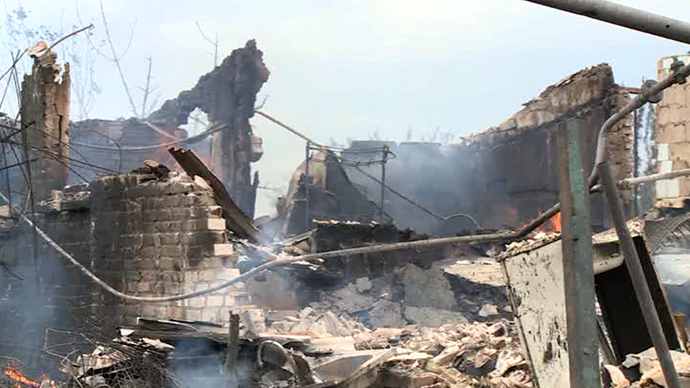 Ukrainian President Petro Poroshenko said he will reduce the country’s “useless” science programs to finance the production of drones and precision weapons.
“There will be no more spending of billions of people’s money, taxpayers’ money on useless research programs, which were used as a tool for theft,” said a statement published on the president’s website early on Wednesday.
“Today, Ukrainian production will be busy making precision weapons systems, Ukrainian drones, everything Ukrainian army needs, starting with bullet proof vests and ending with thermographic cameras,” he said.
The president added that the army’s experience in fighting against self-defense forces in the east of the country will be used when making production decisions.
The Ukrainian military has been fighting against anti-Kiev forces in the east since April.
Some of the latest developments include Ukrainian President Petro Poroshenko confirming plans to “liberate” the eastern cities of Lugansk and Donetsk, the two biggest towns in the country’s east controlled by self-defense forces.
Last week, the army shelled the village of Kondrashovka, killing 12 civilians including a five-year-old.
US defends Kiev’s use of airstrikes
RT | July 8, 2014
The US State Department has defended Kiev’s right to use airstrikes against civilians in eastern Ukraine explaining that it is defending the country.
“The government of Ukraine is defending the country of Ukraine and I think they have every right to do that as does the international community,” State Department spokeswoman Jen Psaki said in response to RT’s Gayane Chichakyan’s question about Ukrainian air force strikes in eastern Ukraine.
“The people of Ukraine have the right to live in peace and security without Russian-backed separatists attacking their homes and going into buildings and I think that is where the root cause of this is and we shouldn’t forget that fact,” Psaki added during the briefing on Monday.
Despite the horrific footage of eastern Ukrainian villages and towns being shelled by the Ukrainian air force, the State Department continues to stand behind Kiev’s actions, saying that all those killings are the fault of anti-Kiev forces.
“To be clear, on the ground the reports that we’ve seen and the vast majority of people who are reporting from the ground are reporting that the Russian-backed separatists are the ones who are not only engaged in violence and efforts to take over buildings and attack people and innocent civilians and they have no place doing that in a country that is a sovereign country like Ukraine.”
Just last week, 12 civilians were killed including a five-year old in the eastern Ukrainian village of Kondrashovka, which was shelled by Kiev troops. At least five shells hit the settlement, destroying an entire street in the peaceful Lugansk region community, 25km from the city of Lugansk.
Aside from approving Kiev’s actions, the US State Department denied reports on the number of refugees fleeing the conflict in eastern Ukraine to Russia, including UN’s statistics.
UN High Commissioner for Refugees (UNHCR) stated that the number of Ukrainian refugees in Russia has reached 110,000 people, while 54,400 others have been internally displaced. In response, the State Department’s spokesperson Maria Harf said she cannot confirm this data, and thus can’t consider it reliable.
NATO arming Ukraine with Soviet weapons
RT | July 4, 2014
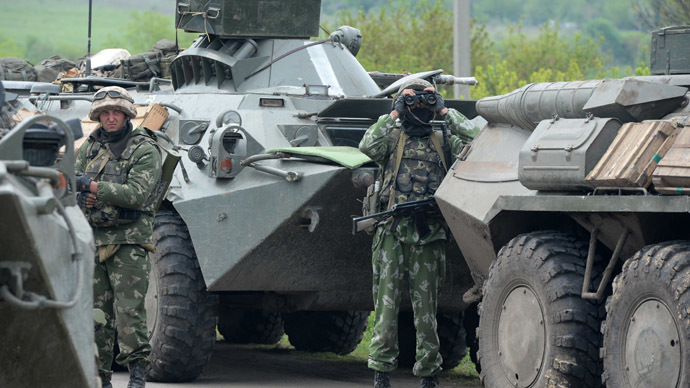
NATO’s newest Eastern European members are handing over their Soviet arms stockpiles to the Ukrainian army, Russia’s Deputy PM Dmitry Rogozin says, adding that the alliance is in danger of pouring gasoline on the flames of that country’s civil war.
Rogozin, who supervises the Russian military industry, has tweeted that NATO is asking its newest members to get rid of operable Soviet military equipment and send it to Ukraine, to aid the miserable state of the country’s military hardware.
“In turn, the US is ready to compensate for the “losses” of the newly co-opted NATO member states. The American military-industrial complex must be happy,” Rogozin wrote in his Twitter account.
“By the way, this is NATO’s commonplace to put out civil wars’ fire with aviation kerosene,” Rogozin added.
Over the months of Ukraine’s hot political crisis, NATO member states, primarily the US, announced they are planning non-lethal aid to Ukrainian troops, supplying uniforms and tents, and even promising to deploy a number of military instructors to train the Ukrainian army to fight the adherents of federalization of the country in Eastern Ukraine.
Political commentator Mikhail Rostovsky told RIA Novosti news agency that the “US and EU are thinking not about Ukraine but about the neutralization of Russia.”
Rostovsky compared the current policies of the European and American leaders with that of British PM Margaret Thatcher and French President François Mitterrand towards the reunification of East and West Germany in 1990.
Speaking loudly about “the European choice for Ukraine,” the EU and US politicians are essentially seeking ways to drive a wedge between Moscow and Kiev to neutralize what they regard as Russia’s possible “imperial ambitions,” Rostovsky said. “We’re dealing with politics dictated by fear: God forbid the Kremlin’s imperial instincts got awakened! This is a matter of principle to deny the Kremlin such an opportunity and break Ukraine away from Russia.”
Rostovsky said he fully agreed with German Foreign Minister Frank-Walter Steinmeier, who told Der Spiegel in late April that Europe has slid “into the worst crisis since the end of the Cold War.”
“Those who can remember the fall of the Berlin Wall know what we’ve accomplished over the past 25 years. The gains we’ve made almost everywhere in Europe in terms of peace, freedom and prosperity are now at risk,” Steinmeier said, adding that that it was important to take “every measure to prevent things [in Ukraine] from getting worse.”
Putin to West: Stop turning world into ‘global barracks,’ dictating rules to others
RT | July 1, 2014
Russia’s president has blamed the turmoil in Ukraine on the country’s newly-elected leader Petro Poroshenko. Vladimir Putin also criticized the West for its intention to turn the planet into a “global barracks.”
Russia’s president has laid the blame for the ongoing turmoil between Kiev and south-eastern regions squarely at the feet of Petro Poroshenko, after the Ukrainian leader terminated the ceasefire.
He has stressed that Russia and European partners could not convince Poroshenko to not take the path of violence, which can’t lead to peace.
“Unfortunately, President Poroshenko has made the decision to resume military actions, and we – meaning myself and my colleagues in Europe – could not convince him that the way to reliable, firm and long-term peace can’t lie through war,” Putin said. “So far, Petro Poroshenko had no direct relation to orders to take military action. Now he has taken on this responsibility in full. Not only military, but also political, more importantly.”
On Monday, the leaders of Russia, France, Germany and Ukraine held a phone call in which Putin stressed the need to prolong the ceasefire and the creation of “a reliable mechanism for monitoring compliance with it and the OSCE [Organization for Security and Cooperation in Europe] should play an active role.”
Russia offered that checkpoints on the Russian side should be monitored by representatives of the Ukrainian Border service as well as OSCE observers for “the joint control of the border.”
As the violent conflict continues in the east of Ukraine and the number of refugees fleeing to Russia grows, Putin vowed to provide help to everyone who needs it.
“Everything that’s going on in Ukraine is of course the internal business of Ukrainian government, but we are painfully sorry that people die, civilians,” Putin said. He added that the killing of journalists was “absolutely unacceptable.”
“In my opinion, there is a deliberate attempt to eliminate representatives of the press going on. It concerns both Russian and foreign journalists,” the president said.
Speaking in front of ambassadors on Tuesday, Putin expressed hope that Western partners will stop imposing their principles on other countries.
“I hope pragmatism will still prevail. The West will get rid of ambitions, pursuits to establish a ‘world barracks’ – to arrange all according to ranks, to impose uniform rules of behavior and life of society,” Putin said.
“I hope the West will start building relations based on equal rights, mutual respect and mutual consideration of interests.”
Putin recalled the situation with France and the delivery of the Mistral-class ships that was agreed between Moscow and Paris, but was jeopardized in March.
“We know about the pressure that our American partners put on the French so that they would not deliver the Mistral [ships] to Russia,” Putin said. “And we know that [they] hinted that if the French don’t deliver Mistral, sanctions on banks will be gradually removed, or at least minimized. What is this, if not blackmail?”
Russia is ready to have dialogue with the US only on the basis of equality, Putin added.
“We are not going to stop our relations with the US. The bilateral relations are not in the best shape, that is true. But this – and I want to emphasize – is not Russia’s fault,” he told diplomats.
Speaking about international relations, Putin stressed that Russia always tried to be “predictable, to do business on an equal basis”, however, in return, its interests were quite often ignored.
Iraq: The things warmongers said
By Neil Clark | RT | June 27, 2014
Iraq is in turmoil – with ISIS controlling large areas of the country – but the truth is that it’s been in turmoil since the illegal 2003 invasion.
2013 was Iraq’s bloodiest year since 2008, but as I wrote here members of the elite political class and warmongers in the West weren’t interested.
Iraq post-invasion had become the greatest non-news story of the modern era. The people who could not stop talking about Iraq in 2002/3 and telling how much they cared about ordinary Iraqis were strangely silent. Instead they were devoting their energies into propagandizing for another Middle Eastern military ‘intervention’, this time against Syria.
Now that Iraq is back in the western news headlines again, with calls for ‘intervention’ to counter ISIS, it’s worth bearing in mind what the architects of the Iraq war and the cheerleaders for it said in the lead up and during the invasion about the ‘threat’ from Saddam’s WMDs and how toppling a secular dictator would help the so-called ‘war on terror’ and bring peace and security to the region.
Do we really want to take these people’s advice on what ‘we’ should do now in Iraq? Up to a million people have been killed since the illegal invasion and as critics predicted at the time, the war led to enormous chaos and instability and boosted radical Islamic extremism. By their own words, let the warmongers be damned.
WMDs
“He (Saddam) is probably the most dangerous individual in the world today.
Interviewer: Capable of?
Capable of anything. Capable of using weapons of mass destruction against the United States, capable of launching other military maneuvers as soon as he thinks he can get away with it…”
Richard Perle, chairman of the Defense Policy Board, mid-October 2001
***
The threat is very real and it is a threat not just to America or the international community but to Britain.
British Prime Minister Tony Blair, 7th September 2002
***
And every indication we have is that he (Saddam) is pursuing, pursuing with abandon, pursuing with every ounce of effort, the establishment of weapons of mass destruction, including nuclear weapons.
Benjamin Netanyahu, (then former Israeli Prime Minister) testifies to Congress, 12th September 2002
***
The document discloses that his (Saddam’s) military planning allows for some of the WMD to be ready within 45 minutes of an order to use them.
Tony Blair foreword to the infamous ‘dodgy dossier’: ‘Iraq’s Weapons of Mass Destruction, The Assessment of the British Government, (24th September 2002
***
The evidence produced in the Government’s report shows clearly that Iraq is still pursuing its weapons of mass destruction programme…The Government dossier confirms that Iraq is self-sufficient in biological weapons and that the Iraq military is ready to deploy these and chemical weapons at some 45 minutes’ notice’
British Conservative Party leader Iain Duncan-Smith, 24th September 2002.
***
The dictator of Iraq is not disarming. To the contrary, he is deceiving.
US President George W. Bush, State of the Union address 28th January 2003.
***
For Churchill, this apotheosis came in 1940; for Tony Blair, it will come when Iraq is successfully invaded and hundreds of weapons of mass destruction are unearthed from where they have been hidden by Saddam’s henchmen.”
Andrew Roberts, British neo-con historian, February 2003.
***
He (Saddam) claims to have no chemical or biological weapons, yet we know he continues to hide biological and chemical weapons, moving them to different locations as often as every 12 to 24 hours, and placing them in residential neighbourhoods
Donald Rumsfeld, US Secretary of Defense, Press conference, 12th March 2003.
***
We are asked now seriously to accept that in the last few years—contrary to all history, contrary to all intelligence—Saddam decided unilaterally to destroy those weapons. I say that such a claim is palpably absurd.
Tony Blair, House of Commons, 18th March 2003.
***
But if we leave Iraq with chemical and biological weapons, after 12 years of defiance there is a considerable risk that one day these weapons will fall into the wrong hands and put many more lives at risk than will be lost in overthrowing Saddam.
Former US President Bill Clinton in article, ‘Trust Tony’s Judgement’, 18th March 2003.
***
Saddam Hussein is there- and he’s a dictator and he has weapons of mass destruction and are you going to do something about it or not?
William Kristol, neo-con pundit, chair of The Project for the New American Century and editor of the Weekly Standard, as quoted on BBC Panorama Programme, The War Party, broadcast May 2003.
And when the WMDs did not turn up?
Interviewer: Is it curious to you that given how much control U.S. and coalition forces now have in the country, they haven’t found any weapons of mass destruction?
Not at all…We know where they are. They’re in the area around Tikrit and Baghdad and east, west, south and north somewhat.
Donald Rumsfeld, US Defense Secretary, 30th March 2003
***
Before people crow about the absence of weapons of mass destruction I suggest they wait a little bit. I remain confident they will be found.
Tony Blair, 28th April 2003.
Saddam and the war on terror
***
There can be no victory in the war against terrorism if, at the end of it, Saddam Hussein is still in power
Richard Perle, chairman of the Defense Policy Board, mid-October 2001
***
Interviewer: If we go into Iraq and we take down Hussein?
Then I think it’s over for the terrorists.
Richard Perle, chairman of the Defense Policy Board, mid October 2001.
***
I have certainly made up my mind, as indeed any sensible person would that the region in the world, most of all the people of Iraq, would be in a far better position without Saddam Hussein… It will be far better if he was not leading Iraq; the whole of the world would be safer if that were the case.
Tony Blair, television interview, May 2002
***
If you take out Saddam, Saddam’s regime, I guarantee you that it will have enormous positive reverberations on the region.
Benjamin Netanyahu, addressing Congress, 12th September 2002
***
We know that Iraq and al-Qaeda have had high-level contacts that go back a decade…We’ve learned that Iraq has trained al-Qaeda members in bomb-making and poisons and deadly gases.
George W. Bush, 7 October 2002.
***
Some have argued that confronting the threat from Iraq could detract from the war against terror. To the contrary; confronting the threat posed by Iraq is crucial to winning the war on terror. When I spoke to Congress more than a year ago, I said that those who harbor terrorists are as guilty as the terrorists themselves. Saddam Hussein is harboring terrorists and the instruments of terror, the instruments of mass death and destruction.
George W. Bush, 7th October 2002.
***
The idea that this action (war vs Iraq) would become a recruiting sergeant for others to come to the colours of those who are “anti” any nation in the west is, I am afraid, nonsense. The biggest recruiting sergeant of all has been indecision, and the failure to take action to show that such resolve matters.
Iain Duncan-Smith, 18th March 2003
A bad bet
I feel no doubt that he (Saddam) has stockpiled some of the most vile weapons known to man. They include nuclear material. Saddam wants to dominate the Middle East, he wants to terrorise the world.. I would lay my life savings in a bet that information will emerge which proves Iraq helped al-Qaeda in the orchestration of September 11.
Ex-SAS Major Peter Ratcliffe, in the interview with the pro-war British newspaper The Sun, 4th April 2002.
Economic benefits of the war
The greatest thing to come of this to the world economy, if you could put it that way, would be $20 a barrel for oil. That’s bigger than any tax cut in any country.
Pro-war media mogul Rupert Murdoch, interview with The Bulletin magazine, February 2003
The new Hitler
Saddam is no Bismarck. He is more a Hitler. As his fate closed in, Hitler dreamt of terrible weapons. Saddam has done more than dream. He already possesses biological weaponry, including botulinum and anthrax. He does not yet have a missile system which could deliver a biological attack, but hideous damage could be inflicted by a single suicide agent with a suitcase.
Pro-war commentator Bruce Anderson, July 2002
***
A majority of decent and well-meaning people said there was no need to confront Hitler and that those who did were war-mongers..
Tony Blair, 28th February 2003.
Triumphalism
What a wonderful, magnificent, emotional occasion – one that will live in legend like the fall of the Bastille, V-E Day, or the fall of the Berlin Wall….. All those smart Europeans who ridiculed George Bush and denigrated his idea that there was actually a better future for the Iraqi people – they will now have to think again…Thank God for Tony Blair and those other European leaders who defied the axis of complacency
William Shawcross, Wall Street Journal, 10th April 2003 on the toppling of the statue of Saddam.
~
Neil Clark is a journalist, writer and broadcaster. His award winning blog can be found at www.neilclark66.blogspot.com. Follow him on Twitter
Netanyahu endorses Kurdish independence citing chaos in Iraq
RT | June 29, 2014
Citing the “collapse” of Iraq amid the ISIS insurgency and sectarian violence, Israeli Prime Minister Benjamin Netanyahu has endorsed the de-facto independence of Iraqi Kurds. Netanyahu has also called to support the “Kurdish aspiration for independence.”
The hawkish Israeli leader said on Sunday that Kurds are “fighting people that has proved its political commitment, political moderation, and deserves political independence,” Reuters reported.
Speaking to Tel Aviv University’s INSS think-tank, Netanyahu described the situation in Iraq and the Middle East in general as a “collapse,” due to strife between Sunni and Shiite Muslims.
Amid the recent insurgency of the Islamic State in Iraq and the Levant (ISIS/ISIL) militants, Kurds have seized the opportunity to bring a long-sought independent state of Kurdistan closer to reality. Kurdish Peshmerga armed forces have been guarding their provincial borders from ISIS, but also seized the contested Iraqi city of Kirkuk, proclaiming it part of their territory.
Now, in an apparent clash against the international community’s support of a united Iraq, the Israeli leader has called to back the de-facto independence of Kurds.
“We should… support the Kurdish aspiration for independence,” Netanyahu was quoted as saying.
US pressured Denmark to close Kurdish TV so Rasmussen would become NATO chief – lawyer
RT | June 29, 2014
The US put pressure on Danish authorities to close the Kurdish Roj TV channel in order to appease Turkey. This was done so Anders Fogh Rasmussen’s position as NATO secretary general would be secure, the station’s lawyer told RT amid WikiLeaks revelations.
WikiLeaks documents released back in March suggest Rasmussen abused his powers during his time as Denmark’s prime minister, in order to secure his future job.
In 2009, Denmark reportedly agreed to start legal action against Roj TV, a Kurdish separatist channel that was broadcasting from Copenhagen, in order to appease Turkey. In return, Ankara said it would back Rasmussen as the future NATO chief.
“There were some conflicts of political character between Denmark and Turkey. And the US intervened because they liked very much [for the] then-Danish prime minister to become secretary general. And therefore they felt confident with him as a secretary general,” Roj TV lawyer Bjorn Elmquist told RT.
“There was big pressure from the US to think in a creative manner how to indict and how to prove that Roj television was promoting terrorism. And in the end, the indictment was there. And within hours after that indictment it was announced that there was an agreement between the Turkish government and the other NATO countries to decide for the previous Danish prime minister to be secretary general.”
Roj TV began broadcasting in 2004. In 2010, it was accused in Denmark of promoting terrorist activities. It was officially shut down in February 2014.
Turkey maintained that Roj TV was a mouthpiece for the Kurdistan Workers Party (PKK), which fights for the rights of the Kurdish minority – and is considered a terrorist organization in Turkey and the West.
In fact, Turkey had on three different occasions unsuccessfully complained to the Danish Radio and Television Board about Roj TV, with the watchdog ruling that the channel’s reporting standards matched those of other TV stations in Denmark, Elmquist added.
“We have a special independent committee on television in Denmark, which would issue the certificates. And the Turkish government had on three different occasions complained to the committee. And each time they concluded that the coverage of the conflict between the PKK, the Kurdish guerrillas, and Turkish security forces was just like the coverage you would find at the big Danish news television stations,” he said.
“So, we thought that also the courts would respect the freedom of expression, the freedom of press, the freedom of information, but it didn’t occur.”
When NATO was asked to comment on the leaks about the deal to appoint Rasmussen, its press office directed RT to the Danish judicial authorities, insisting that the courts were fully independent.
“We do not comment on alleged leaked documents. However, in general I can say that in real democracies, such as Denmark, the courts are fully independent. For any other inquiries, I refer you to the Danish judicial authorities,” press officer Ben Nimmo from NATO’s Public Diplomacy Division told RT in a letter.
Kurdish activist Dilar Diriq said that Turkey has been after Roj TV ever since it launched.
“They repeatedly filed complaints, but they were unsuccessful until Rasmussen became NATO’s secretary general in 2009. And Turkey did not make it a secret that Roj TV’s closure was a condition for them to support Rasmussen. And suddenly in the next year, the Danish government decided to prosecute Roj TV. This really does not come as a surprise because there had been several anti-Kurdish policies that were adopted by European governments to appease Turkey,” she told RT.
The 2009 WikiLeaks diplomatic cable sent by Terence McCulley, then-deputy chief of mission at the US embassy in Copenhagen says that the Danish promised to come after Roj TV.
“Danish pledges to intensify efforts against Roj-TV — among the measures offered Turkey for not blocking former PM Rasmussen’s appointment as NATO secretary general — have given additional impetus to the investigation while also prompting senior officials to tread carefully, to avoid the appearance of a quid pro quo (i.e., sacrificing freedom of speech in exchange for a high-level post),” the cable states.
The cable also says that “no clear evidence has been found to connect the broadcaster with the PKK,” but that the Danish are being encouraged to “think creatively about ways to disrupt or close the station.”
Battlefield USA: American police ‘excessively militarized’ – ACLU study
RT | June 24, 2014
Inheriting both the weapons and the mindset of the US military, police are becoming militarized and ‘hyper aggressive’ in their approach to maintaining security on the streets of America. A new study calls on police not to treat people as ‘wartime enemies’.
The tragic story of Jose Guerena, 26, who served as a Marine in the Iraq War, only to be killed by ‘friendly fire’ at his home in Tucson, Arizona, is becoming a disturbingly familiar one across the country.
On the morning of May 5, 2011, Guerena’s wife alerted him when she heard strange sounds and the silhouette of a man standing outside their home. Guerena got his wife and child into a closet, grabbed his rifle, and went to investigate. This proved to be a deadly mistake. A SWAT team opened fire on Guerena, who died on his kitchen floor with multiple wounds and without medical attention.
As it later emerged, the SWAT unit raided a number of residences in the neighborhood, turning up nothing more than a small bag of marijuana. No drugs were found in the Guerenas’ home.
Created in the late 1960s as “quasi-militaristic” units designed to handle emergency situations such as riots, hostage scenarios, and active shooter situations, the number of SWAT squads have since surged, and are “used with greater frequency and, increasingly, for purposes for which they were not originally intended—overwhelmingly to serve search warrants in drug investigations,” according to an ACLU report, entitled ‘War Comes Home: The Excessive Militarization of American Policing.’
The report examines 818 SWAT operations from July 2010 to last October, which were conducted by more than 20 law enforcement agencies in 11 states.
Today, paramilitary squads are better equipped to fight terrorists in foreign lands [occupations] than serve and protect US civilians at home, and are becoming a dark chapter to America’s newfound capacity for “needless violence” and treating its citizens like “wartime enemies,” it said.
The 98-page document details the militarization of state and local law enforcement agencies, courtesy of expensive federal programs, which are dispensing “weapons and tactics of war, with almost no public discussion or oversight.” Although explicitly aimed at fighting drugs, the strategy is backfiring, sowing fear and discord among citizens, many of whom are starting to fear police as much as criminals.
As the United States winds down its military operations in Afghanistan and Iraq, local police forces are getting the used ‘hand-me-downs’ from the US military. This makes some American communities resemble the latest occupied zones with police dressed in combat fatigues and driving MRAPs and carrying AR-15s down Main Street.
“Using these federal funds, state and local law enforcement agencies have amassed military arsenals purportedly to wage the failed War on Drugs… But these arsenals are by no means free of cost for communities. Instead, the use of hyper aggressive tools and tactics results in tragedy for civilians and police officers, escalates the risk of needless violence, destroys property, and undermines individual liberties,” according to the report.
One bit of curious hardware being distributed to local police forces from the government’s military closet is the MRAP (Mine Resistant Ambush Protected) vehicle, which gives troops protection from improvised explosive devices (IEDs). Using media sources, ACLU put the number of towns that now possess the armored carriers at around 500. Among the lucky recipients, Dallas, Texas, has one, as does Salinas, California and even the Utah Highway Patrol.
The report noted that even the Ohio State University Police own one of the MRAPs in order to give a sense of “presence” on big football game days.
The results of the report revealed a worrying trend: “If the federal government gives the police a huge cache of military-style weaponry, they are highly likely to use it, even if they do not really need to.”
Case in point: Gwinnett County, Georgia, which received at least 57 semi-automatic rifles, mostly M-16s and M-14s. One-third of the county’s SWAT deployments dealt with drug investigations; in half of them, the SWAT team broke down the door to get inside, “and there was no record in any of the reports that weapons were found.”
Other examples were provided in Concord, Keene, and Manchester, quaint New Hampshire towns in close proximity to each other, yet each took advantage of DHS grants to buy the military-grade armored BearCat (the amount of grants received by these agencies ranged from $215,000 to $286,000). Justifications for the need to acquire such vehicles pointed to weapons of mass destruction and the threat of terrorism.
The Keene police department, for example, cites in its application (which trumps Ohio State University’s need for armored vehicles to provide “presence” at big football games), the annual pumpkin festival as a potential terrorism target that requires the assistance of an APC.
Military-style mentality invades police
Another leftover from America’s military adventures abroad is the peculiar military mindset that allows US personnel to survive in hostile lands. Equally unsettling as spotting armored vehicles winding through the tree-lined streets of otherwise quiet American neighborhoods is the spectacle of local police officers receiving military-style combat training.
The US Department of Justice described the boot-camp conditions being used to train new police recruits.
According to a Bureau of Justice Report, “the majority of police recruits receive their training in academies with a stress-based military orientation. This begs the question: is this military model—designed to prepare young recruits for combat—the appropriate mechanism for teaching our police trainees how to garner community trust and partner with citizens to solve crime and public order problems?”
As a result, a so-called “warrior” mentality inside local police forces is “pervasive and extends well beyond hostage situations and school shootings, seeping into officers’ everyday interactions with their communities,” the report said.
The report describes a PowerPoint presentation that was delivered to Cary, North Carolina, SWAT team members entitled “Warrior Mindset/Chemical Munitions” for all Emergency Response Team personnel.
The National Tactical Officers Association (according to its website, the NTOA “strives to provide our members with the tools they need to protect an increasingly dangerous society”) urges trainees to “Steel Your Battlemind” and defines “battlemind” as “a warrior’s inner strength to face fear and adversity during combat with courage. It is the will to persevere and win. It is resilience.”
The question, however, is whether such an approach to policing is conducive to creating peace on the streets of America? An escalation of police operations going awry are growing cause for concern among civil rights groups.
In early June, for example, a toddler was severely burned and left unable to breathe on his own when a Georgia SWAT team tossed a flashbang grenade in his crib during a drug raid – over a single meth sale of $50. Bounkham “Bou Bou” Phonesavanh, a 19-month-old, was asleep in his portable crib in the same room as his parents and three older sisters, when police opened the door to the converted garage and threw the stun grenade in.
In the ACLU’s study, SWAT units forced entry into a person’s home using a battering ram or other breaching device in 65 percent of drug searches.
As the report emphasizes, the training documents do not suggest that SWAT teams “should constrain their soldier-like tactics to terrorism situations.” Moreover, the majority of SWAT raids examined for the report “took place in the context of serving search warrants at people’s homes—not in response to school shootings or bombings.”
The survey discovered that 62 percent of SWAT missions were for drug searches. Some 79 percent involved raids on private homes, and a similar proportion were carried out with warrants authorizing searches. However, just 7 percent of the incidents fell into those categories for which SWAT was originally designed to handle, such as hostage situations or shootings.
It is this type of military mindset, compounded with excessive firepower, which is turning many American communities into veritable tinderboxes, which only requires the slightest provocation to spiral into senseless violence and death.
The survey, which provided a small picture of the overall trend, reported seven cases where civilians died in connection with the deployment of SWAT units, two of which appeared to be suicides. Another 46 individuals were injured, often as the result of physical force by officers.
Background: ‘It’s a war zone in the US’ – Interview with Indiana sheriff
Update: ACLU sues Mass. SWAT agency for refusing to release records
Featured Video

Chinese jet fuel and the myth of energy independence
or go to
Aletho News Archives – Video-Images
From the Archives
The Dirty Little Secret behind the “Global Terrorism Index”
The Omission of Israeli Terrorism in the Occupied Palestinian Territories
By Karin Brothers | Global Research | December 6, 2014
… The Israeli settlements — all of which are illegal – have been identified as a major impediment to peace. The refusal of a major “global” terrorism report to name the Israeli settlers as one of the groups most responsible for terrorism not only misrepresents a major source of regional violence but exposes the Global Terrorism Index as a propaganda tool that supports a U.S. agenda.
In recent years, governments have been attempting to thwart terrorism by blocking supportive fund-raising. When it comes to Israeli settlements, however, the US and Canada actually encourage fund-raising by giving organizations (such as Christian Friends of Israeli Communities (CFOIC) and the Jewish National Fund) financial support in the form of donor tax-deductions.
Charities which provide funds for the Israeli settlements should be regarded as terror-financing organizations. They should not only lose their tax-deductible status, but they should be banned because they support the violation of international humanitarian law. The terror-financing laws that are being strictly enforced for Muslim charities should be applied to Christian and Jewish charities as well. … Read full article
Blog Roll
 Aletho News
- Chinese jet fuel and the myth of energy independence
- Ukraine Sea Drone Fired From Libya Hit Russian Tanker in Mediterranean
- IRGC: Iranian forces launched no attacks during ceasefire hours
- Trump Administration Moves To Automate U.S. Military Draft Registration
- Spain orders reopening of Tehran embassy, condemns Israel’s carpet bombing of Lebanon
- Israel faces ‘unsustainable’ strategic crisis following 40-day war against Iran: Analyst
- Iran restricts Hormuz access to 15 vessels per day under ceasefire terms: Report
- The ‘Opposition Party’ Has Done Nothing to Stop the Iran War and Much to Goad Trump Into Continuing It
- Moscow backs Tehran on status of Lebanon in US-Iran deal
- How UK Regulator Ofcom Quietly Bypassed International Law to Police American Speech
- If Americans Knew
- Amnesty: Urgent – Protect Lebanese civilians from brutal escalation in Israeli attacks
- Is The War Against Iran Over?
- Inside the Israeli army’s propaganda wing
- Hundreds of Gaza Amputees Stranded in Legal Limbo
- The gallows law: Israel moves toward executing Palestinian children
- Tucker Carlson: The Path to Peace requires ending ‘special alliance’ with Israel
- This is ceasefire? Israel’s biggest massacre yet in Lebanon, another journalist killed in Gaza – Daily Update
- Tucker Carlson on Israel: This Is the Behavior of an Ally? Really?
- Gazans face a triple crisis: severe shortages of water and bread, healthcare in tatters
- NY Times reports how Netanyahu took the US into Iran War
- No Tricks Zone
- An Inconvenient Tree: Uncovered In Alps… Europe Much Warmer Than Today 6000 Years Ago
- New Study Reports A 60% Slowdown In Greenland’s Ice Loss Rate In The Last Decade
- Low Intensity Tornado Wrecks Major Solar Farm, Creating A Potential Toxic Dump
- New Study Finds Warming Saves Lives…Cold Temperatures 12 Times More Deadly Than Excess Heat
- German Science Blog Accuses PIK Climate Institute Of Hallucinating Climate Tipping Points
- Devastating Assessment Of Comirnaty Vaccine By Former Senior Pfizer Europe Toxicologist
- New Study: CO2 Is ‘Effectively Negligible’ As An Explanatory Climate Change Factor Since 2000
- Former Pfizer Toxicologist Dr. Helmut Sterz Tells Bundestag Hearing Pfizer Vaccine Should Have Never Been Approved
- Energy Expert: Germany’s Nuclear Phaseout Was A “500 Billion Euro Mistake”
- New Research: South Australia’s Mid-Holocene Sea Surface Temperatures Were 4°C Warmer Than Today
 Aletho News