Russia wants answers on NATO troop movement in Eastern Europe
RT | April 3, 2014
Russia expects detailed explanations from NATO regarding expanding its military presence in Eastern Europe, said Russian Foreign Minister Sergey Lavrov. The statement comes after the NATO bloc announced boosting its military presence in the area.
“We have addressed questions to the North Atlantic military alliance. We are not only expecting answers, but answers that will be based fully on respect for the rules we agreed on,” Lavrov told reports at a joint briefing with Kazakhstan’s FM Yerlan Idrisov.
However, NATO chief Anders Fogh Rasmussen said he had not received any questions from Moscow. In response he called Russian accusations about NATO’s actions “propaganda and disinformation.”
He denied that NATO was violating the 1997 treaty on NATO-Russian cooperation by boosting its forces in Eastern Europe.
The accusations by Russia, he said, are based “on a wrong interpretation” of a fundamental act of the 1997 treaty on NATO-Russian cooperation, in which NATO vowed to provide collective defense by using reinforcements rather than by additional permanent stationing of substantial combat forces at regular bases.
Lavrov’s statement came after the NATO chief, Anders Fogh Rasmussen, said the bloc will deploy more troops to Eastern Europe. According to him, NATO is considering “revised operational plans, military maneuvers and adequate troop reinforcements.” This military buildup was approved by many eastern European countries. On April 1, Polish PM Donald Tusk praised the NATO presence in the country.
After the announcement of deploying troops in Ukraine, NATO also said that it is suspending all military and civilian cooperation with Russia over the Ukrainian crisis, a move that was immediately blasted by Moscow who said that neither Russia, not NATO would benefit from such a step. Russia called this move reminiscent of Cold War language.
Lavrov also called upon the world’s powers to abide by the rules of the Montreux Convention, which allows a warship of any non-Black Sea country to stay in the region for only 21 day.
“US warships have recently extended their presence in the Black Sea several times,” he said, “This extension didn’t always obey the rules of the Montreux Convention.”
The statement comes after the USS Truxtun destroyer started a military exercises in March with the Bulgarian and Romanian navies a few hundred miles from Russian forces of the Black Sea Fleet.
Meanwhile, Lavrov also responded to Western criticism over the presence of Russian troops along the border with Ukraine, saying that the EU and Kiev should not stir up a conflict surrounding Russian drills launched in the south of the country.
According to the Russian FM, Russia had the right to move forces on its territory, and furthermore the troops would return to their permanent bases after completing military exercises.
“There are no restrictions on Russia’s troop displacement on Russian territory,” he said.
In March, Russia’s Defense Ministry launched artillery drills in the southern military district, which involved some 8,500 troops and a large amount of hardware. It coincided with war games conducted by the country’s Airborne Troops.
Although Russia has repeatedly denied any troop build-up on the borders with Ukraine, as well as plans to send any troops into Ukraine, the West has been turning a deaf ear to the claims.
Lavrov also commented on the crisis situation in Ukraine, saying that all its regions should be taking part in the constitutional process.
“We are all convinced that constitutional reform should be proper, not “cosmetic,” it is necessary to stabilize the situation in Ukraine and overcome the crisis,” he added.
According to Lavrov, it is necessary to remind the Ukrainian authorities that constitutional reform was written in the February-21 agreement on the crisis settlement, which was signed by ousted president Yanukovich and opposition leaders, including Arseny Yatsenyuk and Vladimir Klitschko, on ending the political crisis in the country. The agreement was witnessed by EU foreign ministers from Germany and Poland.
Related article

Russia slams US for secret prisons on foreign lands
Press TV – October 20, 2012
Russia has launched a broadside on the United States for running secret jails in a variety of countries across the globe.
In a document revealed by RIA Novosti on Friday, the Russian Foreign Ministry noted that the US Central Intelligence Agency (CIA) is running prisons in Poland, Iraq, Afghanistan, Morocco, Thailand, Lithuania and Romania.
The report, which the ministry has submitted to the lower house of Russian State Duma for deliberations, denounced the US for its dismal human rights record, citing molestation of children, invasion of privacy, brutality of police and restrictions on the freedom of expression.
The report noted that “hundreds of thousands of children” are maltreated in the US every year, leading to 1,600 deaths in 2010 alone.
“About one police officer in 100 has been involved in criminal abuses, including sexual harassment, indecent behavior or rape,” it said.
“The US remains the country with the largest prison population in the world – 2.2 million,” the report underlined.
The Russian report also heaped scorn on a US legislation authorizing “special services” to keep tabs on all private electronic messages without any judicial order. “Between 2004 and 2007 the number of electronic messages monitored by US special services rose by 3,000 percent.”
Former US president George Bush, together with a number of other high-ranking US officials, approved the establishment of secret prisons in foreign lands, as early as 2002, by its key spy agency in efforts to carry out harsh interrogation techniques, such as waterboarding, to extract information from what they introduced as ‘terror suspects’.
The establishment of such interrogation facilities in foreign, allied nations by the US administration was to avert accountability in the American legal system, since torture is specifically banned by the US Constitution.
Related articles
- NYT Still Has a Torture Problem (fair.org)
- Yes, torture is not a bar to becoming a Bishop (themormonworker.wordpress.com)
Turkey endangered lives of Russians on Syria-bound plane – Foreign Ministry
RT | October 11, 2012
Ankara endangered Russians by diverting a flight from Moscow to Damascus, Russia’s Foreign Ministry said. Moscow expressed anger at not being informed that Russians were involved in the incident, and that their diplomats were denied access to them.
“We are troubled that the lives of the passengers aboard the plane, including 17 Russian citizens were put at risk by this inappropriate act. Turkey did not inform Russia that Russian citizens were among those detained on the plane. We found this out through the press,” Russian Foreign Ministry spokesperson Aleksandr Lukashevich said.
The Russian embassy in Turkey demanded access to the Russian citizens and dispatched consular officers and doctors to the Ankara airport. Turkish authorities, however, denied the Russian diplomats access to the passengers, in violation of the 1963 Vienna Convention on Consular Relations. The Russian nationals were detained in the airport for eight hours.
The Russian Foreign Ministry has demanded an explanation from Turkish authorities, and that Ankara take steps to prevent future such incidents.
Turkey defended the move by claiming that the plane could have carried “non-civilian cargo.”
“There were no arms and military equipment aboard the civilian aircraft – and could not be,” a source in Russia’s military industry told Interfax news agency.
Russia has maintained its military-technical cooperation with Syria, and that any arms or military equipment sales to Damascus are conducted according to established practice. The current law expressly forbids arms sales facilitated by civilian aircraft.
‘Air piracy’
Syrian transport minister Mahoumd Said said that Turkey’s detention of the passenger aircraft is tantamount to “air piracy,” and violates civil aviation treaties, Lebanon’s al-Manar TV channel reported.
Tensions between Turkey and Syria rose after a Syrian shell killed five civilians in the border town of Akcakale last week. Turkey returned fire and said it would retaliate against any future provocation originating in Syria. NATO supported Turkey’s move and pledged to defend the country should the Syrian conflict spill across the border.
Related articles
- NATO mortar ‘gift’ from Turkey to Syrian rebels – Turkish newspaper (alethonews.wordpress.com)
Featured Video
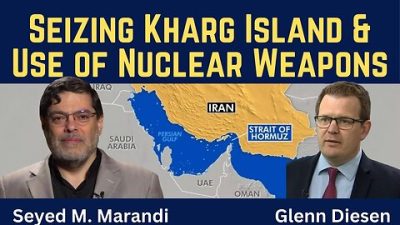
Marandi: Threat of Seizing Kharg Island & the Use of Nuclear Weapons
or go to
Aletho News Archives – Video-Images
Frlom the Archives
Provoking a Path to Persia
The Saban Center’s prescient paper on war with Iran
By Maidhc Ó Cathail | October 20, 2011
In June 2009, the Saban Center for Middle East Policy published “Which Path to Persia?—Options for a New American Strategy toward Iran.” Writing in a tone strikingly reminiscent of the Project for a New American Century’s infamous pre-9/11 paper “Rebuilding America’s Defenses,” the six co-authors noted that, “It seems highly unlikely that the United States would mount an invasion without any provocation or other buildup.” For a think tank specifically established by media mogul Haim Saban to protect Israel, this could prove to be a formidable obstacle impeding their desired march—of U.S. troops—to Tehran.
“In fact, if the United States were to decide that to garner greater international support, galvanize U.S. domestic support, and/or provide a legal justification for an invasion, it would be best to wait for an Iranian provocation, then the time frame for an invasion might stretch out indefinitely,” Saban’s think-tankers ruefully observed.
“With only one real exception, since the 1978 revolution, the Islamic Republic has never willingly provoked an American military response, although it certainly has taken actions that could have done so if Washington had been looking for a fight. Thus it is not impossible that Tehran might take some action that would justify an American invasion. And it is certainly the case that if Washington sought such a provocation, it could take actions that might make it more likely that Tehran would do so (although being too obvious about this could nullify the provocation). However, since it would be up to Iran to make the provocative move, which Iran has been wary of doing most times in the past, the United States would never know for sure when it would get the requisite Iranian provocation. In fact, it might never come at all.”
Seemingly undeterred by Iran’s frustrating unwillingness to provide the requisite provocation, the analysts continued to examine this option… continue
Blog Roll
 Aletho News
- Ukrainian Embassy in Beirut sheltering top Mossad agent
- Palestinian family displaced after settlers violently attack them in Humsa, Jordan Valley
- The EU never learns – except for the wrong lessons
- Iran attacks on UAE leaves RSF militia high and dry
- Hosting Washington’s war: Bahrain faces the consequences
- The US fell for its own Iran propaganda
- Seyed M. Marandi: Threat of Seizing Kharg Island & the Use of Nuclear Weapons
- Is there even an off ramp?
- Michael von der Schulenburg: Europe’s Self-Defeating Iran War Policy
- Sorry, The New Republic, Climate Change Isn’t Causing Somali Migration. Blame Civil Strife and Poverty.
- If Americans Knew
- ‘Of Course’: IDF Drops Case Against Soldiers Accused of Raping Palestinian Prisoner
- Don’t Fall for the Regime Change Talk. Israel Is ‘Mowing the Lawn’ in Iran
- Will Israel and the US wreck the Gulf States along with Iran?
- US so far burned through ‘years’ of munitions in Iran war: Report
- How the Israeli Tail Wags the American Dog
- Outdated intel likely led to deadly U.S. strike on Iranian elementary school, sources say
- Pentagon insider says high U.S official Douglas Feith reported to Netanyahu
- In fond memory of Walid Khalidi, the historian of Palestine
- 6 more Americans killed, as Israel ‘mows the lawn’ in Iran – Not a ceasefire Day 154
- Are we on the precipice of World War III?
- No Tricks Zone
- New Studies: UK Sea Levels Were 4 Meters Higher Than Today During The Mid-Holocene
- Destructive Green New Deal: German Energy And Metal Group Warns Of Drastic Crisis
- New Study Documents A 20-Year Pause In Arctic Sea Ice Decline – Driven By Internal Variability
- Wake-up Call: Survey Shows Majority Of Germans Now Favor Postponing Climate Targets!
- Televised! Leading German Political Candidate Tells Schoolchildren CO2 Makes Sun Hotter!
- New Study: A Century Warming Of 1.1°C Is ‘Commonplace’ And ‘Not Unusual’ During This Interglacial
- New Study: ‘Internal Noise’ And Volcanic Forcing Can Trigger 10-15°C Warming Within Decades
- Glaciers Worldwide Are Suddendly Surging, Experts Blame Warming!
- Surprising Discovery: Sahara Is Greening…Billions Of Trees Where Once Thought To Be Barren
- New Research Reaffirms Clouds, Aerosols, And Surface Solar Radiation Are ‘Driving The Climate System’
 Aletho News