Israel nuclear whistleblower Vanunu placed under house arrest over TV interview
RT | September 10, 2015
Whistleblower Mordechai Vanunu, who served 18 years for exposing details concerning Israel’s clandestine nuclear program in 1986, has been put under house arrest for giving an interview to local media, thus allegedly violating terms of his release.
The Magistrate’s Court in Jerusalem on Thursday confined the nuclear whistleblower to a seven-day house arrest, prohibiting him from using the internet or talking to the press, following a police investigation launched the previous day.
Local media report that the investigation was initiated by Shin Bet (the Israel Security Agency), which has been monitoring Vanunu’s activities since his release in 2004.
The arrest was prompted by an interview the whistleblower gave to the local Channel 2 TV station last week. The news channel said the interview’s content had been cleared for broadcast by the military censor. It added that police also asked for the unedited footage of the interview, suspecting that Vanunu had discussed sensitive information.
Channel 2 refused to hand it over, however, citing the media’s right to protect its sources. This principle is an “important element in the system of rights and freedoms on which a democratic government is based,” the station’s lawyer asserted, as quoted by the Haaretz newspaper.
Vanunu’s defense attorney, Yemima Abramovich, said that the interview was not a breach of his parole, as Vanunu had only been prohibited from talking to foreign journalists.
“He is allowed to talk to Israeli journalists,” she said, as quoted by Ynetnews, stressing that “the interview was approved by the military censor.”
“I’ve been Mordechai Vanunu’s lawyer for many years,” she added. “He is out of prison, but isn’t really free. It’s impossible for him to live a normal life.”
A senior Israeli security official told DPA news agency that, according to his release agreement, Vanunu was forbidden from sharing any classified information he had obtained as an employee at the Negev Nuclear Research Center near Dimona, “even if he already published that information in the past.”
In the parts of the interview that were aired last Friday, Vanunu spoke about his personal life and motives for leaking information about the existence of Israel’s nuclear activities, which the country neither denies, nor admits. However, he didn’t go into detail about what he leaked to the British press in 1986.
It was a desire to “inform the citizens of the Middle East, the world, and the state of Israel” that had prompted him to act, Vanunu told Channel 2, saying he was horrified at the “danger” posed by the Israel’s nuclear weapons program while working there.
The African-born Israeli worked as a technician at the Negev Nuclear Research Center until 1985. He leaked the information, including photographs, about Israeli’s nuclear activities to The Sunday Times in 1986.
Israel’s spy agency, Mossad, infamously organized a complex 1986 operation to abduct Vanunu and smuggle him back to Israel. It involved a female agent in disguise seducing the whistleblower and luring him into Rome. Once there, he was injected with a paralyzing drug and transported to an Israeli reconnaissance vessel docked under the guise of a merchant ship.
After serving an 18 year prison sentence, he was released on parole under the terms of which he is prohibited from leaving the state of Israel and having contact with foreigners, including the press. He was imprisoned again for three months in 2010 on the grounds that he had contacted foreign agents.
Grant F. Smith from the Institute for Research of Middle Eastern policy told RT that Vanunu is the key witness to Israeli’s nuclear program, which the state has kept secret.
“Vanunu did something nobody else was ever able to do,” he said. “He was able to take photos inside of Dimona to the London Sunday Times, and even more surprising – they published them. He has been considered to be the key witness to the fact that there is a nuclear weapons program research and development going on [in Israel]. He was also there right at the point where, according to Department of Defense Documents released recently, they were beginning hydrogen bomb research.”
READ MORE:
Israel gags famous nuclear whistleblower invited to speak at human rights conference
US-Israeli computer super-worm hit Russian nuclear plant – Kaspersky
Vengeance—Not a very Enlightened Strategy for Success
By Richard Edmondson | War and Politics | February 22, 2013
Today, nearly nine years after his release from prison, Israeli nuclear whistle blower Mordechai Vanunu still has not been granted the one wish he desires now more than any other—the freedom to leave Israel and live elsewhere. Does the Israeli government plan to continue this policy forever? Or perhaps until the man is aged and sick and approaching death? Will he finally be granted his freedom then?
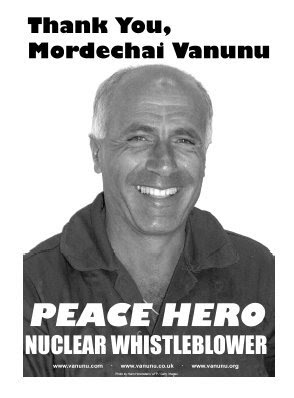 Israel insists it must keep Vanunu a prisoner of the Jewish state out of fear he might disclose further nuclear secrets. But come on. The man hasn’t seen the inside of a nuclear plant since 1986. That was the year he was charged with turning over photographs of Israel’s Dimona facility to a British newspaper. After serving an 18 year sentence, Vanunu was released in 2004, but still today government officials refuse to grant his petitions to leave the country. It’s hard to view this as other than an Israeli thirst for vengeance against any and all deemed enemies.
With two films currently up for Oscar nominations in the “best documentary” category—both highly critical of Israeli policies—you would think those running the Jewish state would have figured out by now that vengeance—against Palestinians, or nuclear whistle blowers, or anyone else for that matter, even the bogeyman—is not overall a very enlightened strategy for success. And of course, what else can you call the repeated destruction of Palestinian infrastructure and demolishing of peoples’ homes other than a campaign of vengeance? What else can you make of Vanunu being forced to spend most of his 18 year sentence in solitary confinement than that it was an impious exercise of wrath?
Eileen Fleming has written an article offering quite a bit of insight into Vanunu’s struggle for freedom and also announcing a global day of action on the whistle blower’s behalf. Fleming is the author of the recently-released book Imagine: Vanunu’s Wait for Liberty, and her newest article offers revealing quotes from letters written by Vanunu during his years of solitary confinement and sent to Australian priest David B. Smith. As you’ll see, Vanunu is in fact quite a prolific letter writer, and Fleming also provides us with links to some of his poetry.
Featured Video

Michael von der Schulenburg: Europe’s Self-Defeating Iran War Policy
or go to
Aletho News Archives – Video-Images
Frlom the Archives
Provoking a Path to Persia
The Saban Center’s prescient paper on war with Iran
By Maidhc Ó Cathail | October 20, 2011
In June 2009, the Saban Center for Middle East Policy published “Which Path to Persia?—Options for a New American Strategy toward Iran.” Writing in a tone strikingly reminiscent of the Project for a New American Century’s infamous pre-9/11 paper “Rebuilding America’s Defenses,” the six co-authors noted that, “It seems highly unlikely that the United States would mount an invasion without any provocation or other buildup.” For a think tank specifically established by media mogul Haim Saban to protect Israel, this could prove to be a formidable obstacle impeding their desired march—of U.S. troops—to Tehran.
“In fact, if the United States were to decide that to garner greater international support, galvanize U.S. domestic support, and/or provide a legal justification for an invasion, it would be best to wait for an Iranian provocation, then the time frame for an invasion might stretch out indefinitely,” Saban’s think-tankers ruefully observed.
“With only one real exception, since the 1978 revolution, the Islamic Republic has never willingly provoked an American military response, although it certainly has taken actions that could have done so if Washington had been looking for a fight. Thus it is not impossible that Tehran might take some action that would justify an American invasion. And it is certainly the case that if Washington sought such a provocation, it could take actions that might make it more likely that Tehran would do so (although being too obvious about this could nullify the provocation). However, since it would be up to Iran to make the provocative move, which Iran has been wary of doing most times in the past, the United States would never know for sure when it would get the requisite Iranian provocation. In fact, it might never come at all.”
Seemingly undeterred by Iran’s frustrating unwillingness to provide the requisite provocation, the analysts continued to examine this option… continue
Blog Roll
 Aletho News
- Hosting Washington’s war: Bahrain faces the consequences
- The US fell for its own Iran propaganda
- Seyed M. Marandi: Threat of Seizing Kharg Island & the Use of Nuclear Weapons
- Is there even an off ramp?
- Michael von der Schulenburg: Europe’s Self-Defeating Iran War Policy
- Sorry, The New Republic, Climate Change Isn’t Causing Somali Migration. Blame Civil Strife and Poverty.
- Expert Guts Claims That HPV Vaccine Reduces Cancer Risk
- No evidence Russia sabotaged Baltic cables – Finnish intel
- The Strategic Folly of a (Serious) US Ground Invasion of Iran
- US-Israeli war of aggression on Iran meant to reshape region: Omani FM
- If Americans Knew
- Are we on the precipice of World War III?
- ‘Catastrophic,’ Says UNICEF: 1,100+ Children Killed or Wounded in Mideast Since US-Israel Launched Iran War
- The Unbelievable Madness of Our War With Iran
- World Council of Churches calls on govts to hold Israel accountable for violations of intl law
- How to end the war on Iran that costs US taxpayers $1M per minute – Not a ceasefire Day 153
- Israeli strategic plans to “remake the Middle East” from the 1950s and since
- Honoring Gaza’s women who refused to let the world look away
- 97% of victims of war on Iran are Iranian, 98% of victims in war on Gaza are Gazans – Not a ceasefire Day 152
- Early Iran strikes cost $5.6 billion in munitions, Pentagon estimates
- Israel Decided the War, But Trump’s America Fights and Pays the Bill
- No Tricks Zone
- New Studies: UK Sea Levels Were 4 Meters Higher Than Today During The Mid-Holocene
- Destructive Green New Deal: German Energy And Metal Group Warns Of Drastic Crisis
- New Study Documents A 20-Year Pause In Arctic Sea Ice Decline – Driven By Internal Variability
- Wake-up Call: Survey Shows Majority Of Germans Now Favor Postponing Climate Targets!
- Televised! Leading German Political Candidate Tells Schoolchildren CO2 Makes Sun Hotter!
- New Study: A Century Warming Of 1.1°C Is ‘Commonplace’ And ‘Not Unusual’ During This Interglacial
- New Study: ‘Internal Noise’ And Volcanic Forcing Can Trigger 10-15°C Warming Within Decades
- Glaciers Worldwide Are Suddendly Surging, Experts Blame Warming!
- Surprising Discovery: Sahara Is Greening…Billions Of Trees Where Once Thought To Be Barren
- New Research Reaffirms Clouds, Aerosols, And Surface Solar Radiation Are ‘Driving The Climate System’
 Aletho News