Israeli settlers injure three Palestinians, uproot dozens of olive trees in two separate incidents
IMEMC | April 15, 2012
On Thursday and Friday in the West Bank, groups of armed Israeli settlers attacked Palestinians and their property. In the northern West Bank on Thursday, armed Israeli settlers attacked Palestinian farmers, injuring three; and in the southern West Bank Friday, a group of settlers destroyed a Palestinian olive grove by chopping down all of the trees.
The incident on Thursday took place in the village of Yanun, near Nablus, where Palestinian farmers were working on their land when several Israeli settlers came onto the land and attacked them. One of the settlers involved in the attack was identified as Matan Fogel, the brother of an Israeli man who was murdered along with his family in the settlement of Itamar last year in an attack that was blamed on local Palestinians.
Fogel and the other settlers called the Israeli military to assist them in dispersing the Palestinian farmers. When the military arrived, soldiers fired tear gas at the Palestinians and abducted five Palestinian farmers, according to local sources.
The Israeli settlers claimed that the Palestinian farmers initiated the attack, and injured two settlers with farming tools. The settlers were all armed with military-grade weapons. None of the Palestinians involved in the incident were armed.
In the attack on Friday, Israeli settlers from the settlement of Maol, near Hebron, entered an olive grove near the village of Kharoubeh and chopped down trees belonging to local Palestinian landowner Jebril Mousa Khalil, according to the Popular Committee Against the Wall and Settlements.
Palestinian shepherds and international non-violent activists who were in the area came to the olive grove to try to stop the destruction, and were chased by the settlers to Tuwani village. According to eyewitnesses, the settlers ran after the activists and shepherds and threw stones at them and at Palestinian homes.
Israeli troops then arrived in the area to ‘protect the Israeli settlers’, as they are mandated to do – even when the settlers are the ones engaging in acts of violence.
Israeli settler attacks increased by 50% in 2011, and have continued to increase in the first months of 2012, although official numbers are not yet available.
Related articles
- Fadi Abu Zeitoun, killed as settlers attacked farmers (alethonews.wordpress.com)
- Hebron teen ‘shot by Israeli settler’ (alethonews.wordpress.com)
- Israeli settlers storm into Palestinian home, occupy residence (alethonews.wordpress.com)
- Jewish settlers stealing Palestinian water springs: UN (alethonews.wordpress.com)
- Settlers ‘block entrance’ to Nablus village (alethonews.wordpress.com)
- Demanding justice for Yousef, a quiet boy killed by Israeli settlers (alethonews.wordpress.com)
- PRESS RELEASE | Double attack from Havat Ma’on illegal outpost in South Hebron Hills (occupiedpalestine.wordpress.com)
- Settlers Attack Two Towns Near Hebron (alethonews.wordpress.com)
Amani al Khandaqja released following hunger strike
6 April 2012 | International Solidarity Movement, West Bank

Amani al Khandaqja with her father, pose following her release
“You are a very clever woman Amani, you are the first free woman from Ashkalan, this brings me great frustration.”
These are the words of the Chief of Intelligence at Huwarra Camp where Amani al Khandaqja was forced to go during her first Sunday of freedom after her 10 days of imprisonment. On the 20th of March, al Khandaqja was taken from her home, Nablus City, in a 2AM night raid, shackled, handcuffed and blindfolded, her 10 days of imprisonment were as follows:
On entering the Ashkelon interrogation prison, al Khandaqja made the decision to begin an open ended hunger strike, bringing her to the immediate decision of the military to be held in solitary confinement. Her days started with fierce determination to show that she is not and will not be intimidated by the interrogators or the prison.
When taken for the routine strip search, al Khandaqja simply but vehemently refused anything of the sort. She spent her days in a room too small for any comfort, the light was on day and night, and food was used as a constant temptation out of her hunger strike.
The military used low, pathetic tactics including sitting her in front of a table with chicken, burgers, chips and rice. On refusal of the food soldiers asked al Khandaqja , “Why do you not like food?” al Khandaqja was quick to reassure them that she is in fact very fond of food but she “like [her] mother’s food, [her] sisters’ food, even [her] brother’s food, but [she] will not eat [their] food.”
Tactics quickly became even more personal by offering Amani an opportunity to see her brother Bassam. Bassam is a political prisoner in Ashkelon’s mixed sex prison, who is 9 years into his life sentence. The terms of the negotiation were to stop the hunger strike for a short visit. The negotiation was rejected by al Khandaqja.
As the days and nights passed and interrogation continued, the military became weaker and weaker. “All they had to say was that I was too active on Facebook.” Amani explained how the interrogator informed her, “I know your words have power” but this simply was not enough to keep Amani captured.
The Israeli military often offers monetary rewards for those it convinces to become collaborators against the Palestinian people, and with Amani the offers came thick and fast. Having studied psychology at university, and one who has traveled to Europe working with women groups in campaigns addressing issues such as domestic violence, she is a woman who is not easily scared or intimidated. This was evident to the Israeli military.
It is true that al Khandaqja is a threat to Israel’s apartheid, but not because of their usual rhetoric of her being a “violent Palestinian,” but because Amani is a clever, determined, educated, and passionate young woman who, it seems, will stop at nothing in her struggle for human rights. When asked if and when she will return back to work, Amani replied “I am always working. I will not stop. I write everyday about the conditions of the prisoners. I am only writing for peace, and I do not want to see anymore violence”
Amani, who is from Nablus City was releasd at Turkoomia checkpoint in Al Khalil (Hebron), 77 kilometer from Nablus. She was left with no phone or money. Fortunately she was able track down her father and have a car sent to her, not before visiting friends in Al Khalil as word had gotten out about her release. That night, the 30th March, Amani returned home split with emotion. The prospect of seeing her family filled her with happiness but to have left her brother Bassam and personal friend Masser Halabi behind brought an overwhelming sadness, a sadness that is sure to inspire and motivate Amani to continue the struggle with more passion and determination than ever before.
Related articles
- Israeli Brutality: Violent arrests of Palestinians in Hebron and disappearance of Dutch volunteer (alethonews.wordpress.com)
- Thirty Palestinians killed by Israel in March, 300 imprisoned (alethonews.wordpress.com)
Israeli occupation forces arrest journalist, MP’s son
Palestine Information Center – 03/04/2012
 NABLUS — Israeli occupation forces (IOF) stormed the city of Nablus at dawn Tuesday and arrested Fadl Beitawi, the son of MP Hamed Beitawi, from his home, sources told the PIC.
They said that journalist Mohammed Anwar, 29, who works with Quds Press, was also taken from his home in the pre-dawn raid.
The sources said that the soldiers encircled the homes of both men, who are in the same suburb to the east of the city, and ordered them to get out of their homes because they are under arrest.
This is the third time Beitawi is detained and has served a total of four years in Israeli jails while it is the fourth time for the journalist who served four and a half years in the occupation jails.
Sources told the PIC that the soldiers also stormed a number of houses in the same suburb including that of MP Hamed Beitawi, which was thoroughly searched. They said that the soldiers might have taken other persons from the suburb.
Related articles
- IOF soldiers arrest 15 Palestinians mostly in Nablus (altahrir.wordpress.com)
- Israeli occupation forces round up 17 Palestinians including journalist, minors (alethonews.wordpress.com)
- Israeli soldiers raid office, home of detained journalist (alethonews.wordpress.com)
Settlers ‘block entrance’ to Nablus village
Ma’an – March 28, 2012
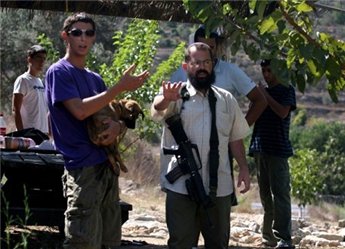 NABLUS – Dozens of Israeli settlers blocked the entrance to a village near Nablus on Wednesday, officials said.
Palestinian Authority official Ghassan Doughlas told Ma’an that residents of Itamar and Elon Moreh settlements arrived at Beit Dajan in around 15 cars and closed the main gate to the village.
The settlers were protesting the reopening of the main road from Beit Dajan to Nablus a day earlier, Doughlas said.
The road had been closed by the Israeli military for 12 years, forcing villagers to take long detours to reach Nablus, the nearest city.
Doughlas said Israeli forces arrived and dispersed the settlers.
An Israeli military spokeswoman did not immediately return a call seeking comment.
Related articles
- Soldiers destroy 5 agricultural sheds in Nablus (altahrir.wordpress.com)
- Israeli forces demolish main road near Nablus (alethonews.wordpress.com)
- Settlers Attack Two Towns Near Hebron (alethonews.wordpress.com)
- Settlers ‘raid Nablus village’ (altahrir.wordpress.com)
Report: Army, Settlers, Carried Out 145 Attacks In February

By Saed Bannoura | IMEMC & Agencies | March 01, 2012
The Wall and Settlements Information Center at the Palestinian Authority’s Ministry of Wall and Settlements, issued a report revealing that Israeli soldiers and settlers carried out 145 attacks against the Palestinian residents, their lands and homes, killing one and wounding several others.
Tal’at Ramia, 25, was killed on Friday February 24, during clashes with Israeli troops near the Qalanida terminal, north of occupied East Jerusalem; the residents were protesting attempts by extremist settlers to break into the Al-Aqsa mosque.
The Center reported that soldiers demolished 42 structures in the West Bank; 22 homes and structures were leveled in Khirbit Ar-Rahwa, 3 in Ath-Tha’la area, and one home in Surif.
12 homes and structures were demolished in Nablus district, 12 homes and structures were demolished in Jerusalem and Tubas, four wells were demolished in Hebron, and one in Jenin.
Israel further served 88 notices against Palestinian homes and structures; this includes 2 mosques and one school in Hebron and Jenin, 24 orders against homes and structures in several areas in Hebron, 22 notices against structures in several areas in Jerusalem, 17 against structures in Bethlehem, 5 in Jenin, 8 in Salfit, and two in Qalqilia,
Furthermore, Israeli settlers carried out dozens of attacks, uprooting and bulldozing 4931 Dunams (1218.47 Acres) of Palestinian farmlands; 1825 Dunams in Jaloud – Nablus, Nahhalin and Al-Jab’a in Bethlehem, Yousouf and Sarta in Salfit, in addition to Beit Ola and Al-Himma in Hebron and Tubas. 1383 Dunams were bulldozed and uprooted, and owners of 1723 Dunams were prevented from entering their lands after extremist settlers planted them and are attempting to take them over. 1169 trees were uprooted in Surif, Beit Ummar, Tormos Ayya, Aqraba and Michmas.
The report further pointed out the escalating attacks carried out by Israeli soldiers and settlers against Jerusalem and its holy sites, by the sharp increase of home demolitions, escalating settlement activities, sharply increasing attacks against holy sites, and the recent plan to plan to build a temple on 400 square/meters west of the Al-Boraq Wall, and other plans including the so-called “Visitors Center” in Wadi Hilweh in Silwan, the taking-over of a parking lot in the Armenian neighborhood in order to build a settlement outpost despite the fact that the land is owned by the Armenian Monastery.
This is all happening while excavations continue under the Al-Aqsa mosque and several areas in occupied East Jerusalem. The information center further stated that Israel recently approved a law exempting taxes on donations that support settlement projects.
As for the non-violent resistance against the Wall and Settlements in Palestine, Israeli soldiers continued their violent attacks against these protests, shot and wounded more than 22 protestors, including international and Israeli peace activists, in addition to 5 reporters.
Furthermore, Israeli settlers carried out dozens of attacks against the residents and their property leading to the injury of 9 Palestinians, including 6 women, and set ablaze six Palestinian cars. They also tried to torch a mosque near Ramallah, and broke into a mosque near Hebron.
The Israeli government also approved the construction of 500 units for Jewish settlers in Shilo settlement, between Ramallah and Nablus, granted construction permits for 200 units planned to be built in Shvut Rachel near Nablus, in addition to a plan aims at constructing a new settlement east of Ramallah to replace the Migron illegal outpost the was evacuated by the army.
Israel also announced a plan to build a religious Jewish school and a temple near Itamar settlement, near Nablus with an estimated cost of 9 Million NIS.
Two new outposts were installed on Palestinian lands in Tal Romeida and Al-Karmel in Hebron, while the Israeli government approved a plan to build a settlement that is handicap-friendly in the place of a former military camp that was evacuated by the army in the Bethlehem district; it will be part of the Gush Etzion settlement block. Settlers also installed 18 mobile homes in a number of illegal outposts in the districts of Nablus and Ramallah.
Related articles
- Settlers Install New Outpost Near Hebron (alethonews.wordpress.com)
- Settler Violence: Broken Glass on Shuhada Street (alethonews.wordpress.com)
- Soldier, 2 Female Settlers, Arrested For Writing Racist Graffiti (alethonews.wordpress.com)
- Jewish Settlers Torch Mosque In Ramallah (alethonews.wordpress.com)
Featured Video
Prof. Ted Postol: Iran Already Achieved Nuclear Deterrence Against Israel
or go to
Aletho News Archives – Video-Images
From the Archives
How the occupied mentality syndrome works
Saudi Arabia on the American chessboard – Part 3
By B. J. Sabri | American Herald Tribune | June 27, 2016
Read part 2: “The occupied mentality Syndrome“
Previously I argued whether Saudi Arabia’s repeated involvements in U.S. interventions and wars stem from free national will or in response to a specific condition. For starters, in Saudi Arabia there is no national will. In Saudi Arabia, the national will is the will of the Al Saud clan. Still, when a major Arab state allies itself with a superpower that committed unspeakable crimes against humanity in almost every Arab country, then something is wrong. This fact alone should compel us to examine the U.S.-Saudi relation for one exceptional reason. As a result of the U.S.-Saudi wars, hundreds of thousands of people in Afghanistan, Iraq, Iran, Libya, Syria, Yemen, and Somalia have lost their lives. Millions became displaced in their own homelands. And millions more rendered refugees.
Attributing the Saudi policies to the bonds of “partnership” with the U.S. is frivolous. There are no bonds between these two thugs except those of business, military deals, secret plots, and wars. Proving this point, bonds such as these have no space for the American and Saudi peoples to share significant cultural or societal exchanges. If partnership is not the reason for the Saudi contribution to the U.S. strategy of empire and imperialism, then another reason must exist.
This leads to three possibilities. … continue
Blog Roll
 Aletho News
- Hezbollah hits Israeli warship off Lebanon’s coast, sets it aflame
- Iran slams US strikes on B1 bridge, Mahshahr petrochemical plants as ‘blatant acts of state terrorism’
- In letter to UN chief, Araghchi warns of dire consequences of US-Israeli attacks on Iran’s nuclear facilities
- Why the CIA conspiracy to invade Iran with Kurdish militias failed
- Why Are Upbeat US Claims About Mission to Rescue Pilot ‘Highly Questionable’?
- Aircraft destroyed during US ‘rescue’ of downed F-15 pilot cost more than $100 million each
- Washington University removes professor who condemned US-Israeli war on Iran
- Russia Warns of Retaliation as UK Authorizes Seizure of Vessels
- Serbia thwarts plot to bomb Russia-Hungary gas pipeline – Vucic
- Al Mayadeen voices solidarity with Dr. Marandi amid death threats
- If Americans Knew
- In Iran, Israel-US take aim at “reason, research, and freedom of thought” – Daily Update
- US loses planes over Iran, Israel downgrades Lebanon war goals – Daily Update
- Israel Is Blocking Palestinians from Easter at Church Where Jesus Resurrected
- Plot to assassinate Palestinian activist follows harassment campaign promoted by Zionist groups and elected officials
- Prominent New York synagogue hosts presentation on why U.S. Jews should support the ethnic cleansing of Gaza
- Tapper vs. Piker: Is the CNN Anchor Auditioning for David Ellison?
- Shouldn’t Democrats Be Able to Condemn Genocide?
- Israel-US kill negotiators, destroy civilian structures, but Iran’s military capabilities still largely intact – Daily Update
- ‘War crime’: Global condemnation as Israeli ministers celebrate death penalty law targeting Palestinian prisoners
- 7 Ways Israel Is Turning Lebanon Into Gaza
- No Tricks Zone
- An Inconvenient Tree: Uncovered In Alps… Europe Much Warmer Than Today 6000 Years Ago
- New Study Reports A 60% Slowdown In Greenland’s Ice Loss Rate In The Last Decade
- Low Intensity Tornado Wrecks Major Solar Farm, Creating A Potential Toxic Dump
- New Study Finds Warming Saves Lives…Cold Temperatures 12 Times More Deadly Than Excess Heat
- German Science Blog Accuses PIK Climate Institute Of Hallucinating Climate Tipping Points
- Devastating Assessment Of Comirnaty Vaccine By Former Senior Pfizer Europe Toxicologist
- New Study: CO2 Is ‘Effectively Negligible’ As An Explanatory Climate Change Factor Since 2000
- Former Pfizer Toxicologist Dr. Helmut Sterz Tells Bundestag Hearing Pfizer Vaccine Should Have Never Been Approved
- Energy Expert: Germany’s Nuclear Phaseout Was A “500 Billion Euro Mistake”
- New Research: South Australia’s Mid-Holocene Sea Surface Temperatures Were 4°C Warmer Than Today
 Aletho News