As soon as the framework for a comprehensive nuclear deal between Iran and six world powers was announced in Lausanne, Switzerland on April 2, Vox.com content manager Max Fisher came out strongly in favor of the agreement’s reported details. While his optimism is certainly welcome, his understanding of some key details leaves something to be desired.
Unfortunately, for someone who writes about the Iranian nuclear program as much as he does, Fisher seems not to have a very solid grasp on certain basic facts about the program. Sure, this is tricky, complex stuff, but if you’re in the business of producing what you refer to as “explanatory journalism” – and your entire reporting model is based upon providing clear analysis to a presumably less knowledgeable public – you should probably know what you’re talking about.
Here are just a few of his most recent errors.
‘Covert Nuclear Facilities’
In his “plain English” guide to the framework parameters, as described by the United States State Department, Fisher notes that facilities at Natanz and Fordow will continue to operate, with uranium enrichment continuing at Natanz and non-uranium enrichment and research occurring at Fordow.
Fisher concludes that this is a good deal for those worried about Iranian nuclear capabilities. “International inspectors will have access [to these facilities],” he writes, “so they won’t really function as covert nuclear facilities anymore.”
But, apparently unbeknownst to Fisher, neither Natanz nor Fordow ever actually functioned as secret nuclear enrichment facilities. Ever.
Natanz
While much is often made of the 2002 revelation of Iran’s supposedly clandestine enrichment plant at Natanz, rarely do we hear that the pilot facility was still under construction when it was declared by Iran to the IAEA. Per Iran’s safeguards agreement with the IAEA at the time, however, “Iran did not have to declare that it was building a pilot plant until 180 days before it expected to introduce nuclear material into the plant,” explained a May 2003 article in the Bulletin of the Atomic Scientists. Furthermore, as pointed out at the time by a research analyst at the Arms Control Association, Iran “is not required to allow visits to the Arak and Natanz sites under its current agreements with the IAEA.”
In effect, the United States has long been proud of discovering a construction site that Iran was under absolutely no obligation to announce to the IAEA. Natanz was not operational until June 2006, at which which point it had already been under IAEA safeguards for over three years. Not a single atom of enriched uranium has ever been produced at Natanz outside the purview of IAEA inspectors. Nevertheless, in a separate article published the same day, Fisher claims Natanz “was once used for covert enrichment.”
Fordow
Similarly, the site at Fordow was never a functional enrichment site outside IAEA monitoring. As with Natanz, it was “clandestine” only to the effect that it wasn’t officially declared by Iran to the IAEA before the US intelligence agencies said they already knew about it.
The site was announced by Iran to the IAEA on September 21, 2009, well in advance of the 180 days prior to the introduction of nuclear material as required by Iran’s Safeguards Agreement. At the time, the facility was still under construction and did not actually begin uranium enrichment until early January 2012, roughly 28 months after it had been declared to the IAEA. Upon visiting the facility six weeks after it was announced, then-IAEA Secretary General Mohammed ElBaradei described Fordow as “a hole in a mountain” and “nothing to be worried about.”
When the plant began operation, the IAEA confirmed that “all nuclear material in the facility remains under the agency’s containment and surveillance.” This was the case well before the November 2013 interim deal between the P5+1 and Iran and this remains the case to this day.
While Fisher has written elsewhere that both the Natanz and Fordow “sites are now publicly declared and will be monitored as part of any deal,” meaning “their value (and threat) as covert facilities is gone,” he appears to insinuate that recent negotiations – and namely Iranian concessions extracted by determined American negotiators – are responsible for this positive state of affairs. Natanz has been safeguarded, monitored and inspected by the IAEA for over a decade, Fordow for over four years.
‘Plutonium Plant at Arak’
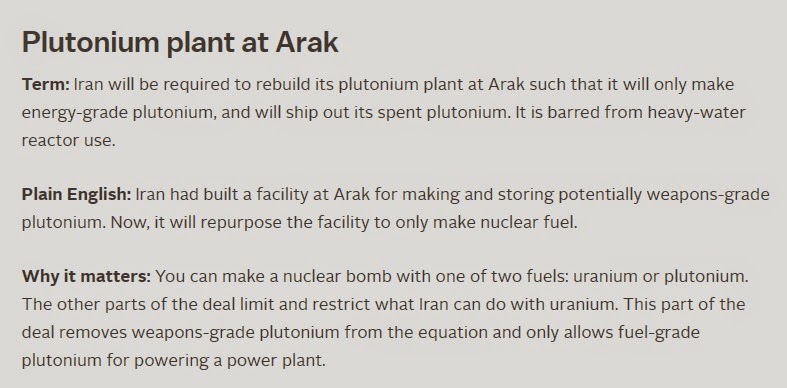
If you read Vox.com, you’d really think Iran has something called a “plutonium plant at Arak.” The main reason you’d probably think that is because that’s exactly what Max Fisher and other explainers at the site claim as fact over and over again. Here’s Fisher from the other day:
There is so much wrong with Fisher’s understanding of Iran’s Arak facilities it’s difficult to know where to begin. Fisher even changed the original words of the State Department’s “fact sheet” on the deal framework to match his misunderstanding before allowing himself to explain things to his readers. Basically none of Fisher’s sentences in this section make any sense.
What Fisher routinely refers to as Iran’s “plutonium plant” is actually the IR-40 heavy water research reactor, a nuclear reactor at the Arak complex that is still under construction and not yet operational. The half-built reactor is under IAEA safeguards and is visited regularly by inspectors. Nevertheless, it has long been used by Israel and its contingent of hawkish American supporters as an alternate way to fear-monger about Iran’s nuclear program.
In simple terms, heavy water reactors are fueled by natural, rather than enriched, uranium. Heavy water, a non-nuclear form of water, acts as both a moderator and coolant in the fuel process. These reactors are said to pose a potential proliferation threat due to the amounts of plutonium produced as a byproduct of their spent nuclear fuel, material that could then be separated from the irradiated fuel and further processed to weapons-grade levels.
So, to be clear, Iran has not been building a “plutonium plant,” let alone a facility “for making and storing potentially weapons-grade plutonium.” Rather, it has been building a certain type of nuclear reactor that happens to produce plutonium as a byproduct in its spent fuel.
Still, the Arak reactor is not in itself a proliferation risk. Even though plutonium is produced as a byproduct of running the reactor, it must first be separated out from irradiated fuel and reprocessed to weapons-grade material before it poses any actual danger. Iran has no reprocessing plant, and has long agreed not to build one.
Reading Fisher’s explanation, it’s clear he thinks that, once operational, the facility at Arak would have somehow made “weapons-grade plutonium,” but now will only “make nuclear fuel” to power a reactor. He is wrong. The relevant facility at Arak is a reactor; it doesn’t make fuel, it runs on fuel. Whenever it is eventually commissioned, it will be used for medical, scientific and agricultural research.
Beyond this, even before Iran’s current negotiating team was in place following the election of President Hassan Rouhani in June 2013, “Iran encouraged United Nations nuclear monitors to use powerful new detection technologies to dispel international concern that the Persian Gulf country is seeking to build atomic weapons,” reported Bloomberg News.
“We always welcome the agency to have more sophisticated equipment, to have more accuracy in their measurements, so that technical matters will not be politicized,” Iranian Ambassador to the IAEA Ali Asghar Soltanieh told the press in Vienna at the time, adding that Iran “won’t object to IAEA monitors using new technologies to determine whether plutonium is being extracted from spent fuel at its new reactor in Arak.”
In his guide to the nuclear framework, Fisher went to weird lengths to confuse his readership about Arak. The State Department’s own fact sheet notes, “Iran has agreed to redesign and rebuild a heavy water research reactor in Arak, based on a design that is agreed to by the P5+1, which will not produce weapons grade plutonium, and which will support peaceful nuclear research and radioisotope production.” Fisher changed the mention of “a heavy water research reactor” to “plutonium plant,” which appears to be a deliberate decision to make Iran’s safeguarded nuclear program sound undoubtedly nefarious.
Fisher also writes that, under the agreement, Iran “is barred from heavy-water reactor use.” That’s not true. Even though IR-40’s reactor core will be redesigned and rebuilt, it will still be a heavy water reactor. What the framework fact sheet says, however, is specifically that “Iran will not build any additional heavy water reactors for 15 years.” (emphasis mine)
‘Inspections’
As part of the Joint Plan of Action (JPOA) agreed to in November 2013, Iran has granted IAEA inspectors regular access to non-safeguarded, non-nuclear sites such as centrifuge assembly workshops, centrifuge rotor production workshops and storage facilities, and uranium mines and mills at Gchine, Saghand, and Ardakan. Fisher is pleased with this development, explaining that, “Inspectors, by gaining access to not just the core nuclear sites but also secondary things like uranium mills and centrifuge plants, will be in a really good position to make sure Iran isn’t cheating on a deal or trying to build another secret facility somewhere.”
Fisher’s sentence construction here is both curious and revealing. He notes that “by gaining access” to “core nuclear sites” as well as other, non-nuclear sites, inspectors have a clearer picture of the entire Iranian supply chain for its nuclear program. But the nuclear sites in question have always been under safeguards and open to routine inspections since they were declared years ago, prior to any actual nuclear work being done there. This is nothing new; it is not a virtue of the JPOA or any other recent negotiated terms. You wouldn’t know this by reading Fisher’s work.
Furthermore, despite constant insinuations to the contrary, Iran has never refused IAEA inspectors admission to any of its safeguarded nuclear sites. All sites and facilities are under round-the-clock video surveillance, readily accessible to IAEA inspectors, open to routine inspection, and subject to material seals application by the agency.
Even before the JPOA was negotiated, Iran’s was the most heavily-scrutinized nuclear program on the planet and had been for years. Though the IAEA has even deeper access as a result of the interim deal (which will presumably continue for the foreseeable future as part of any final deal), the regular inspection regimen was itself quite intensive and intrusive. Rarely is this noted in mainstream media reports, leading many to the outrageously incorrect conclusion that, prior to the current nuclear talks, Iran operated a wholly unmonitored, clandestine and opaque nuclear program. (This is actual an apt description of Israel’s own nuclear arsenal.) Nothing could be further from the truth.
Nuclear expert Mark Hibbs has explained, “There are IAEA safeguards personnel in Iran 24/7/365,” pointing out that inspectors enter and examine enrichment sites “frequently and routinely,” where they carry out “two kinds of inspections: ‘announced inspections’ and ‘short-notice announced inspections.'” The “announced inspections” are conducted with “24-hour notification” given to Iran, while “Iran’s subsidiary arrangements in fact permit the IAEA to conduct a short-notice inspection upon two hours’ notice.” Each of Iran’s enrichment facilities was already subject to two regular inspections every month. Additionally, two unannounced inspections were conducted every month at both Natanz and Fordow.
Former Iranian nuclear negotiator Seyed Hossein Mousavian, now a lecturer at Princeton University, has noted that, between 2003 and 2012, “the International Atomic Energy Agency (IAEA) has implemented the most robust inspections in its history with more than 100 unannounced and over 4000 man-day inspections in Iran.” In 2012 alone, IAEA investigators spent 1,356 calendar days in Iran, conducting 215 on-site inspections of the country’s 16 declared nuclear facilities, and spending more than 12% of the agency’s entire $127.8 million budget on intrusively monitoring the Iranian program, which includes only a single functional nuclear reactor that doesn’t even operate at full capacity.
IAEA inspectors have also had consistently open access to the gas conversion facility at Esfahan and the light water reactor at Bushehr, despite these facilities not being explicitly covered by Iran’s Safeguards Agreement with the IAEA.
The agency has continued to verify – four times a year for the past dozen years – that Iran has never diverted any nuclear material for military purposes and has also affirmed “it has all the means it needs to make sure that does not happen with Iran’s enriched uranium, including cameras, physical inspections and seals on certain materials and components.”
And that was before the increased scrutiny provided by the JPOA.
‘Breakout Time’
In his post on why the newly-announcement framework – as described by the State Department’s own fact sheet – is such a good deal, Fisher explains the oft-used term “breakout time” to his readers this way:
If Supreme Leader Ayatollah Ali Khamenei woke up tomorrow morning and decided to kick out all of the inspectors and set his entire nuclear program toward building a nuclear warhead — to “break out” to a bomb — right now it would take him two or three months. Under the terms of the framework, his program would be so much smaller that it would take him an entire year to build a single nuclear warhead.
Fisher is wrong about this. “Breakout time” – an arbitrary measure in itself – is not the time it takes to build one nuclear bomb. Rather, it is the time it would hypothetically take Iran to acquire enough highly-enriched uranium (HEU) for one nuclear bomb. As Gary Sick has succinctly explained:
Note that “breakout” does not mean Iran will have a nuclear device. It is the starting point to build a nuclear device, which most experts agree would require roughly a year for Iran to do–and probably another two or more years to create a device that could be fit into a workable missile warhead. Plus every other country that has ever built a nuclear weapon considered it essential to run a test before actually using their design. There goes bomb No. 1.
So when officials, pundits, and interested parties talk about a one-year breakout time for Iran, what they are really saying is that if Iran decides to break its word and go for a bomb, it will take approximately one year to accumulate 27 kilograms of HEU. The hard part follows.
As is common in Fisher’s reporting, uranium enrichment is presented as nearly synonymous with nuclear bomb-making. Fisher essentially conflates the two, thereby drawing conclusions that neither the IAEA nor Western and Israeli intelligence agencies have made. Acquiring uranium enriched to high enough levels for a nuclear bomb is only one component of manufacturing a nuclear weapon, which includes the mastery of the detonation process, requisite missile technology, and making a bomb deliverable.
For over a decade, it has been acknowledged that, in addition to the nine nuclear weapons states (Britain, China, France, Russia, the United States, Israel, India, Pakistan, and North Korea), perhaps “40 countries or more now have the know-how to produce nuclear weapons,” according to former IAEA chief Mohammad ElBaradei.
Nuclear physicist Yousaf Butt had also noted that, “if a nation has a developed civilian nuclear infrastructure—which the NPT actually encourages—this implies it has a fairly solid nuclear-weapons capability. Just like Iran, Argentina, Brazil, and Japan also have a nuclear-weapons capability—they, too, could break out of the NPT and make a nuclear device in short order. Capabilities and intentions cannot be conflated.”
‘Modified Code 3.1’
Fisher writes that, under the proposed deal, “Iran has finally agreed to comply by a rule known as Modified Code 3.1 of the Subsidiary Arrangements General Part to Iran’s Safeguards Agreement, shorthanded as Modified Code 3.1. It says that Iran has to notify inspectors immediately on its decision to build any new facility where it plans to do nuclear work — long before construction starts.”
This is true and Fisher should have left it at that. Instead, he went on to smugly editorialize about Iran’s behavior and it’s here that he revealed his misunderstanding of the actual issues at stake. He writes:
Iran in the past has either rejected this rule or stated that it would only notify inspectors a few months before introducing nuclear material at a facility — a “cover your ass” move in case the world caught them building a new nuclear site. Tehran’s promise to comply may signal that it intends to stop building such covert facilities.
In truth, what Fisher refers to as “a ‘cover your ass’ move” is actually a legally binding stipulation of the original Code 3.1 under Iran’s Subsidiary Arrangements to its Safeguards Agreement with the IAEA, which was implemented in 1976, two years after the initial safeguards.
In 1992, the IAEA modified the code to read that member states would have to notify the agency and provide design information at the planning stage for new facilities, rather than the previously obligatory “no later than 180 days before the introduction of nuclear material to the site.” While most countries accepted the modified code, Iran did not and the original Code 3.1 remained legally in place until February 26, 2003, when Iran agreed to voluntarily implement the modified code, pending ratification by the Iranian parliament. The modified code remained in place for over four years, though it was never ratified.
Days after the adoption of an illegal sanctions resolution by the UN Security Council on March 24, 2007, an outraged Iran suspended its voluntary implementation of the modified code, and reverted to re-implementing the 1976 version of Code 3.1.
While the IAEA disputes Iran’s legal authority to unilaterally revert to the original code, Iran isn’t randomly rejecting official protocol and making up rules as it goes along, despite what Fisher would have his readers believe.
As to Fisher’s claim about Iran building “covert facilities,” that was already addressed above.
Obfuscatory Journalism
Two years ago, researchers at the University of Maryland’s Center for International and Security Studies (CISSM) released the findings of an extensive examination of mainstream media’s coverage of the Iranian nuclear program between 2009 and 2012. “The manner in which news media frame their coverage of Iran’s nuclear program is critically important to public understanding and to policy decisions that will determine whether the dispute can be resolved without war,” the report’s authors wrote.
Among other things, the study found that when media “coverage did address Iranian nuclear intentions and capabilities, it did so in a manner that lacked precision, was inconsistent over time, and failed to provide adequate sourcing and context for claims,” which in turn “led to an inaccurate picture of the choices facing policy makers.”
It also found that “coverage generally adopted the tendency of U.S., European, and Israeli officials to place on Iran the burden to resolve the dispute over its nuclear program, failing to acknowledge the roles of these other countries in the dispute” and that such coverage often “reflected and reinforced the negative sentiments about Iran that are broadly shared by U.S., European, and Israeli publics,” leading to “misunderstandings about the interests involved and narrowed the range of acceptable outcomes.”
Unfortunately, Fisher’s coverage of the Iranian nuclear program and the current negotiations are hardly any different. For a media venture dedicated to “explanatory journalism,” this is even more troubling.
With two months to go before the June deadline for a comprehensive nuclear accord between Iran and the P5+1, Fisher and his Vox colleagues will inevitably publish more articles about the Iranian nuclear program.
Still, here’s hoping that, before he explains anything else about the Iranian nuclear program, Max Fisher finally gets his facts straight.
April 28, 2015
Posted by aletho |
Deception, Mainstream Media, Warmongering | Fordow, Iran, Israel, Max Fisher, Natanz, United States, Vox.com |
Leave a comment
On December 12, the Senate Banking, Housing and Urban Affairs Committee held a hearing on last month’s interim nuclear agreement between Iran and the P5+1, which means there was a tremendous amount of ignorant bluster, conventional wisdom, wishful thinking, staggering ignorance, and shameless posturing for lobbyist money on display. In other words, Congress members were speaking about Iran.
While nearly every single word uttered by the Treasury Department’s David Cohen and Undersecretary Wendy Sherman – the State Department’s number three and lead U.S. negotiator in Geneva – and her Senatorial inquisitors could (and should) be fact-checked and debunked, in the interest of time and sanity, I will address only a single statement that cried out for correction (and will maybe get to more at another time).
Midway through the hearing, Senator Bob Corker of Tennessee claimed Iran is “wreaking havoc” in the Middle East, lamented that the United States is “ceding much of Middle Eastern activities to them,” and expressed his frustration with the recent deal and any prospect of alleviating sanctions for fear that Iran may not be seen as a “rogue nation,” but rather “part of the international community.”
Corker further opined that the P5+1 deal has “no sacrifice on their part whatsoever, none. They’re still spinning 19,000 centrifuges every single day.”
This has recently become a canard in mainstream, usually hawkish, discourse on Iran’s nuclear program.
In October, Joel Rubin of the Ploughshares Fund, who is described by Voice of America as an “Iran expert,” said that Iran “does have 19,000 centrifuges spinning.”
Following the release of yet another speculative study by career alarmist David Albright of the Institute for Science and International Security (ISIS) and an error-riddled USA Today article noting that Iran currently has “19,000 centrifuges” installed in its two enrichment facilities, this talking point gained even more traction.
On October 29, neoconservative operative Kenneth Timmerman wrote in The Washington Times that “the [Iranian] regime now has 19,000 centrifuges, including several thousand high-performance, new-generation machines they are still testing,” and has already amassed a stockpile of uranium that, “with further enrichment… is enough for roughly 10 bombs.”
In late November, Sarah Stern – head of the Endowment for Middle East Truth (EMET), an extreme right-wing Zionist messaging organization that proudly describes itself as an “unabashedly pro-Israel and pro-American think tank,” and who serves as an advisor to the creepy propaganda outfit The Clarion Fund – claimed that, for Iran, the interim accord “keeps every one of its 19,000 centrifuges spinning.” A graphic on the EMET website states that, as part of the deal, “Iran gets… 19,000 cylinders spinning enriching uranium.”
On December 1, Senator Jim Inhofe called the deal a “reckless gamble” that, among other things he doesn’t like, “allows [Iran] to keep its nearly 19,000 centrifuges spinning.”
The very next day, KT McFarland, a Fox News contributor and former aide to Henry Kissinger and Ronald Reagan, declared, “It’s just crazy, there are 19,000 centrifuges spinning in Iran, that’s twice as many centrifuges in Iran as there are Starbucks in America.”
Spooky, right? Well, they’re wrong.
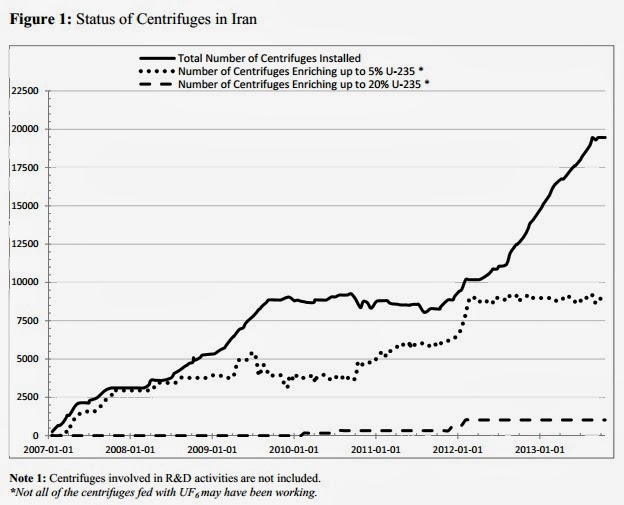
According to the most recent assessment – from mid-November – by the International Atomic Energy Agency (IAEA), which conducts routine inspections of its nuclear program, Iran is reported to have installed roughly 19,000 centrifuges in its two enrichment facilities at Natanz and Fordow.
But they’re not all spinning. Not even close.
The IAEA even provided a handy little graph along with its report showing the difference between what Iran has installed and what is actually operational. At most, Iran has about 10,000 operable centrifuges, all of which produce enriched uranium far below levels required for a nuclear weapon.
Furthermore, the IAEA notes, “Not all of the centrifuges fed with UF6[feedstock] may have been working.”
Moreover, Iran’s Natanz facility is designed for a fully operational capacity of 50,000 centrifuges. So far, fewer than 15,500 centrifuges have been installed and fewer than 9,000 are actually functional. Of the 2,710 centrifuges installed at the Fordow site, only about 700 are operational.
Roughly 1,000 second-generation centrifuges have also been installed, but not a single one has yet been used.
So, while Bob Corker and the rest sound pretty serious when they fret about Iran’s 19,000 “spinning” centrifuges, they’re overselling what Iran is actually doing in order to gin up their required hysteria.
What a surprise.
December 19, 2013
Posted by aletho |
Deception, Mainstream Media, Warmongering | Bob Corker, David Cohen, Endowment for Middle East Truth, Institute for Science and International Security, Iran, Kenneth Timmerman, Natanz, Sarah Stern, Washington Times, Wendy Sherman |
Leave a comment
Terror Group is Sounding Board for Dubious US Intel
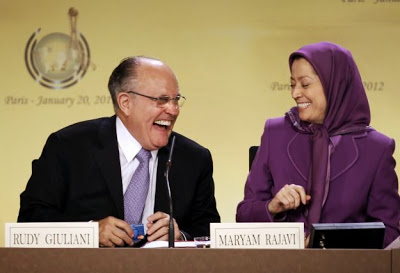
Rudy Giuliani with MEK leader Maryam Rajavi
(Photo Credit: Jacques Demarthon / AFP)
Embracing its recent removal from the U.S. State Department’s list of designated foreign terrorist organizations, the Mujahedeen-e Khalq (MEK), an exiled Iranian terror cult with deep pockets and close ties to the Washington establishment, is attempting to ramp up the fear-mongering and propaganda over Iran’s nuclear program following last month’s election of moderate cleric Hassan Rouhani as the Islamic Republic’s next president.
In April 2013, the group opened an office in Washington DC and officially registered as a lobbying organization the following month.
Now, a Reuters article from July 11, 2013 reported the MEK and its affiliate organizations such as the National Council of Resistance of Iran (NCRI) claim to have “obtained reliable information on a new and completely secret site designated for [Iran’s] nuclear project,” despite providing no credible evidence to back up the allegation.
The supposed site is said to be “located in a complex of tunnels beneath mountains 10 km (6 miles) east of the town of Damavand, itself about 50 km northeast of Tehran.” The MEK claimed that construction of the site began in 2006 and it was recently completed. “The site consists of four tunnels and has been constructed by a group of engineering and construction companies associated with the engineering arms of the Ministry of Defence and the IRGC (Iran’s elite Revolutionary Guards force),” a statement from the terror group said.
Unsurprisingly, the Iranian government immediately denied the allegations.
As in nearly all media reports on the MEK, Reuters credits the group with having “exposed Iran’s uranium enrichment facility at Natanz and a heavy water facility at Arak” in 2002. But beyond the fact that Iran’s nuclear program was never a secret, this specific claim is untrue, as nuclear experts Jeffrey Lewis and Mark Hibbs pointed out back in 2006.
In fact, the U.S. intelligence community had been tracking Iran’s nuclear facility development for quite some time, notably its construction at both Natanz and Arak. Lewis notes that, in 2002, “someone leaked that information to an Iranian dissident group, the National Council of Resistance of Iran (NCRI), which then released the second-hand dope in a press conference where they got the details wrong.” The information the MEK supposedly gleans from sources inside Iran are actually just leaks received from intelligence agencies in the United States and Israel.
Since then, the MEK has not itself provided a single shred of credible information regarding Iran’s nuclear program. Furthermore, in early 2007, an unnamed senior official at the International Atomic Energy Agency (IAEA) revealed to the Los Angeles Times, “Since 2002, pretty much all the intelligence that’s come to us [from the United States about the Iranian nuclear program] has proved to be wrong” and has never led to significant discoveries inside Iran.
“They gave us a paper with a list of sites. [The inspectors] did some follow-up, they went to some military sites, but there was no sign of [banned nuclear] activities,” the official told The Guardian at the time. Additionally, the LA Times reported that “U.S. officials privately acknowledge that much of their evidence on Iran’s nuclear plans and programs remains ambiguous, fragmented and difficult to prove.”
Additionally, the Associated Press reported this past May that, when it comes to accusations about the Iranian nuclear program and despite their terrible track record, “about 80 percent of the intelligence comes from the United States and its allies.”
Reuters, writing about the MEK’s most recent revelation, noted, “The group released satellite photographs of what it said was the site. But the images did not appear to constitute hard evidence to support the assertion that it was a planned nuclear facility.” Clearly, a non-state actor like the MEK doesn’t have satellites of its own floating around in space taking pictures of Iranian mountains; it’s obviously getting the information from government organizations with advanced spying resources.
Though these latest claims by the MEK have garnered quite a bit of attention this week, they are, in fact, nothing new. Allegations about tunnel systems have long been a go-to source of alarmism over Iran’s nuclear program. Back in January 2010, on the heels of promoting an opinion piece that explicitly advocated an unprovoked military attack on Iran, The New York Times‘ William Broad published a hysterical report, which claimed, “Over the past decade, Iran has quietly hidden an increasingly large part of its atomic complex in networks of tunnels and bunkers across the country.”
The report goes on to lament that Iranian efforts to protect their own nuclear infrastructure from military attack is viewed by the U.S. administration as “a stealth weapon, complicating the West’s military and geopolitical calculus.” Translation: it’s harder to spy on things and then blow them up when they’re not out in the open and that’s annoying.
Broad doesn’t even try to mask the frustration:
“It complicates your targeting,” said Richard L. Russell, a former Central Intelligence Agency analyst now at the National Defense University. “We’re used to facilities being above ground. Underground, it becomes literally a black hole. You can’t be sure what’s taking place.”
Even the Israelis concede that solid rock can render bombs useless. Late last month, the Israeli defense minister, Ehud Barak, told Parliament that the Qum plant was “located in bunkers that cannot be destroyed through a conventional attack.”
Despite the decades of threats from the United States and Israel, then-U.S. Defense Secretary Robert Gates didn’t realize the blistering irony when, discussing the heavily-fortified uranium enrichment site at Fordow, he said, “If they wanted it for peaceful purposes, there’s no reason to put it so deep underground, no reason to be deceptive about it, keep it a secret for a protracted period of time.”
Later in his report, Broad describes Iranian President Mahmoud Ahmadinejad as a tunnel aficionado and quotes Greg Duckworth, a “civilian scientist” described as having “recently led a Pentagon research effort to pinpoint enemy tunnels,” as saying, “Deeply buried targets have been a problem forever. And it’s getting worse.”
As the January 2010 report continues, a familiar name emerges under the heading “An Opposition Watchdog.” Who could that be? Broad writes, “In 2002, the National Council of Resistance of Iran, an opposition group, revealed that Iran was building a secret underground nuclear plant at Natanz that turned out to be for enriching uranium. Enrichment plants can make fuel for reactors or, with a little more effort, atom bombs.”
He goes on to sing the praises of NCRI for having announced “that Iran was digging tunnels for missile and atomic work at 14 sites” in 2005 and announcing “that Iran was tunneling in the mountains near Natanz, the sprawling enrichment site” in 2007, which he says was confirmed by satellite images.
In December 2009, Broad writes that NCRI issued yet another report on “Iranian military tunneling,” which claimed “Iran had dug tunnels and bunkers for research facilities, ammunition storage, military headquarters and command and control centers.”
“A group of factories” in the mountains east of Tehran, it insisted without providing proof, specialize in “the manufacturing of nuclear warheads.”
Broad even quotes the Los Alamos National Laboratory’s Frank Pabian saying of the MEK, “They’re right 90 percent of the time. That doesn’t mean they’re perfect, but 90 percent is a pretty good record.” Mohamed ElBaradei, former IAEA Director-General, had a different take on the group. “We followed whatever they came up with. And a lot of it was bogus.”
In his reporting, William Broad never once identifies the MEK or NCRI as an officially designated terrorist group, which at the time they both were and had been for over a decade.
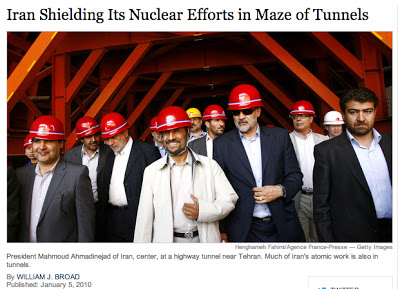
To hammer home how deliberately alarmist the claims actually were, the Times even published the article with a photograph of a smiling Mahmoud Ahmadinejad and his entourage in red hardhats emerging from what is apparently supposed to resemble a steel-reinforced underground lair. Yet the photo is wholly unrelated to any of the allegations made within the report.
The caption beneath of the picture reads, “President Mahmoud Ahmadinejad of Iran, center, at a highway tunnel near Tehran. Much of Iran’s atomic work is also in tunnels.”
Yes, that really happened. Fit to print, indeed.
The focus on Iranian tunnels leads inevitably to discussion of American military capabilities and the challenges faced by less vulnerable facilities. Broad, in his 2010 report, noted that the “Pentagon is racing to develop a deadly tunnel weapon” for such circumstances. That weapon has since been completed and tested, but has not been sold to Israel for fear it might be used without American authorization.
Clearly, the MEK’s latest revelations are recycled claims and, like before, are essentially allegations based on vague intelligence leaked to the group by American officials. The MEK merely acts as a laundering service for the unproven accusations of its handlers in the United States and Israel.
Unfortunately, the mainstream press – even when skeptical about the information – continues to dutifully provide a platform for such propaganda and fear-mongering by publishing such accusations.
July 15, 2013
Posted by aletho |
Deception, Mainstream Media, Warmongering | International Atomic Energy Agency, Iran, Maryam Rajavi, MEK, Natanz, National Council of Resistance of Iran, People's Mujahedin of Iran, United States |
Leave a comment
TEHRAN – NSA whistleblower Edward Snowden has confirmed that the Stuxnet malware used to attack Iranian nuclear facilities was created as part of a joint operation between the Israelis and the NSA’s Foreign Affairs Directorate (FAD).
“The NSA and Israel cowrote it,” he told Der Spiegel in an email interview conducted before he publicly outed himself as the NSA mole. Snowden is currently in Russia and a “free man” according to Vladimir Putin – as long as there are no further NSA leaks.
The Stuxnet code, which has been deployed since 2005, is thought to be the first malware aimed specifically at damaging specific physical infrastructure*, and was inserted into the computer networks of the Iranian nuclear fuel factory in Natanz shortly after it opened.
Early variants attempted to contaminate uranium supplies by interfering with the flow of gas to the fuel being processed, potentially causing explosive results in the processing factory. Later a more advanced variant attacked the centrifuges themselves, burning out motors by rapidly starting and stopping the units and contaminating fuel production, although it may actually have encouraged the Iranians.
Last year an unnamed US official said that Stuxnet was part of a program called Operation Olympic Games, started under President Bush and continued under the current administration, aimed at slowing down the Iranian nuclear effort without having to resort to risky airstrikes. General James Cartwright, a former vice-chairman of the Joint Chiefs of Staff, is currently under investigation by the US government for allegedly leaking details of Operation Olympic Games.
July 9, 2013
Posted by aletho |
Militarism, Timeless or most popular, War Crimes, Wars for Israel | Crime, Human rights, Information Technology, Intelligence, Internet, James Cartwright, Natanz, National Security Agency, NSA, Operation Olympic Games, Snowden, Stuxnet |
Leave a comment
Iran has quickly found ways to circumvent the EU sanctions imposed on its oil trade in July. After dipping sharply in summer of 2012, Iranian crude oil exports rose again by the end of the year.
So far, Iran’s December crude oil sales were the highest recorded since the sanctions were first imposed. Iran exported 1.4 million barrels per day (bpd) in December, compared to less than 900,000 bpd in September. Pre-sanctions oil exports stood at 2.2 million bpd in late 2011.
EU sanctions, introduced in January 2012 and put into effect in July, aimed to curb Iran’s ambitious nuclear program, which Tehran has insisted is only for peaceful purposes. The Iranian economy is heavily dependent on oil sales – the cuts in production lead to billions of dollars in lost revenue and a plunge in the value of the national currency.
Analysts believe that sales to Asia and the expansion of Iran’s tanker fleet helped the Islamic Republic circumvent the sanctions. In countries like China, India and Japan, Iranian oil constitutes more than 10 percent of the total crude supply – and demand from Asia is only growing.
“China is saying let’s up the numbers because no-one is doing anything about it and it looks like Obama has made a political decision not to go to war with Iran,” a senior source at a large independent trading house told Reuters.
Iran is also improving its delivery channels, despite the numerous bans and restrictions imposed by the international community.
“Iran bought a number of tankers from China and can now do more deliveries. It’s taken some pressure off Iran and facilitated tanker traffic and we are seeing higher exports to China,” analyst Salar Moradi at oil and gas consulting firm FGE told Reuters.
Meanwhile, a fresh round of US sanctions looms for Iran. Starting on February 6, US law will prevent the Islamic republic from repatriating earnings from its oil export trade. The ban is in addition to the already-existing restrictions, including the country’s removal from the SWIFT global financial service and an indefinite international asset freeze.
The new sanctions are expected to reduce export volumes to around 1 million barrels per day, the International Energy Agency predicted. However, analysts believe that further sanctions will not stop Iran from selling oil or pursuing its nuclear goals.
“What we have seen is that when Iran is pushed to a do or die situation, they have looked for creative solutions to get around sanctions,” oil and gas analyst Elena McGovern of Business Monitor International told Reuters. “The system will always find a way to cope.”
The international community has been failing to engage in constructive dialogue with Iran on its nuclear program. The so-called ‘sixtet’ of ‘5+1’ states – Britain, China, France, Russia, the US and Germany – met three times last year with little to no results. The next round of talks has been stalled until a venue for the meeting is agreed upon.
“Some of our partners in the six powers and the Iranian side cannot come to an agreement about where to meet, behaving like little children,” Russian Foreign Minister Sergey Lavrov said. He stressed that Russian mediators “are willing to meet at any location.”
While the West has demanded that Iran abandon its nuclear aspirations, Iran refuses to back down: Tehran has seized every opportunity to advance its nuclear capabilities. On Thursday, Iranian officials informed the UN nuclear agency of its plan to use more modern centrifuges at the Natanz uranium enrichment plant.
January 31, 2013
Posted by aletho |
Aletho News | China, International Energy Agency, Iran, Natanz, Sanctions against Iran, Sergey Lavrov, United States |
Leave a comment

 Aletho News