How Feinstein’s Fake NSA Reform Bill Could Actually Make It Easier For NSA To Record Your Phone Calls
By Mike Masnick | Techdirt | November 1, 2013
We already pointed out that Dianne Feinstein’s fake NSA reform bill is being positioned by her as real reform, when all it really does is codify the (probably currently illegal) status quo. Even worse, Feinstein is using highly misleading language to pretend that the bill “bans” the very things that it clearly allows. It’s about as dishonest a statement about a bill as you can imagine.
We had noted in our original post that the talk about how the bill would prohibit the collection of “content of communications under Section 215” was a red herring. One of the NSA’s go-to talking points is that there’s “no surveillance” on the Section 215 collections because it’s “just metadata.” They keep repeating this claim over and over again that the leaked programs do not involve collecting the “content” of calls, pretending that this is what everyone’s been complaining about. That statement alone is disingenuous. Most people following this know that the Section 215 collections don’t involve the content of communications. What we’re complaining about is the metadata collection, because that’s very revealing. Separately, while the NSA may not collect contents “under this program,” they absolutely do under other programs.
But, the actual language here may be even worse. It may be so misleading that the language being held up to “prohibit” the collection of actual call content is worded in a way that actually will allow for greater content collection. As Julian Sanchez notes at that link, the ban on content collection is only for “bulk data collection,” which could be interpreted to mean it’s okay for non-bulk collections, which most people believe 215 isn’t regularly used for today.
The problem is, under canons of judicial interpretation, a narrow and explicit prohibition on getting content under bulk orders for communications records could easily be read to imply that content can be acquired via non-bulk orders, or even via bulk orders for other types of records. At present, it is not clear whether the statute allows for the acquisition of contents under 215, but there are strong arguments it does not—though, of course, I’d argue the Constitution would forbid this even if the statute didn’t. Under this law, though, a clever Justice Department lawyer could plausibly argue that a prohibition on content collection under one very specific type of 215 order would be senseless and redundant unless Congress intended for content to be accessible under 215 orders generally—and Courts generally have to interpret the law in a way that avoids making any provision redundant.
And, as Sanchez further points out, this isn’t a theoretical concept. The Justice Department has already used exactly this type of argument to allow for the bulk data collection in the first place:
This is not at all a hypothetical concern. In 2006, Congress amended Section 215 to add special “protections” for educational and medical records. What Congress didn’t know is that, because those records are already protected under other federal laws, and 215 contained no language explicitly overriding those statutes, the Justice Department had determined that 215 simply could not be used to access those types of records—an interpretation that was reversed after the “protections” were added. Congress, in other words, inadvertently expanded the scope of 215 while trying to limit it—a fact that was discovered only later, when a report by the Inspector General revealed the unintended consequences of the amendment.
This is yet another example of the really evil word games the NSA and its defenders will use to increase spying, while pretending they’re doing the opposite. Now would be a good time to reach out to your Senator to let them know that the Feinstein bill is absolutely unacceptable.
Related articles
Snowden ready to testify in Merkel tapping case – German lawmaker
RT | October 31, 2013
Whistleblower Edward Snowden has met with a German MP in Moscow. He passed a letter addressed to the German government and federal public prosecutor where he allegedly said he is ready to testify over Washington’s probable wiretapping of Merkel’s phone.
During the meeting, Snowden made it “clear that he knows a lot,” Greens lawmaker Hans-Christian Stroebele told ARD channel.
“He expressed his principle readiness to help clarify the situation. Basis for this is what we must create. That’s what we discussed for a long time and from all angles,” the MP said. “He is essentially prepared to come to Germany and give testimony, but the conditions must be discussed.”
Stroebele, 74, is a member of the German parliament’s control committee which is responsible for monitoring the work of intelligence agencies.
Snowden wouldn’t be able to travel to Germany to give evidence, as that would effectively see his refugee status lifted. If that were to happen, it would be possible for him to be extradited to the US, Interfax news agency quoted an unknown source as saying.
“At the same time, the German General Prosecutor’s Office could in principle send its representatives to Russia or pass its written questions on to Edward Snowden,” the same source said.
German Chancellor Angela Merkel has dispatched the country’s top foreign affairs and intelligence advisers to Washington this week to further investigate the allegations that her cell phone was tapped by the NSA, the report which caused fierce outrage in Germany.
The scandal initially broke when journalists working with Snowden’s leaked documents contacted the German government for clarification. German politicians subsequently suggested involving Snowden as a witness in the wiretapping case.
The German Federal Prosecutor’s Office may summon Snowden to be a witness in the case, German justice minister Sabine Leutheusser-Schnarrenberger told Deutschlandfunk radio on Sunday.
“If our suspicions prove correct and a case is opened, the German Federal Prosecutor’s Office will have to consider the possibility of interrogating Snowden as a witness,” she said.
If Snowden were to come to Germany for the case, the EU country could breach US’ requests for extradition, the minister added.
Leutheusser-Schnarrenberger also said that the phone tapping is illegal and constitutes a crime, therefore those responsible should be held accountable.
A parliamentary session will be held on November 18 to discuss the phone tapping. The Greens, along with the far-left Die Linke party, previously asked for a public inquiry into the matter. They were the ones to call on witnesses, including Snowden.
In June, Edward Snowden, a former NSA contractor who disclosed secret US surveillance programs, fled to Hong Kong and then to Russia.
President Vladimir Putin rejected US demands to extradite Snowden to face charges including espionage.
In early August, Snowden was granted temporary asylum, which can be extended annually.
NSA secretly accessed Yahoo, Google data centers to collect information
RT | October 30, 2013
Despite having front-door access to communications transmitted across the biggest Internet companies on Earth, the National Security Agency has been secretly tapping into the two largest online entities in the world, new leaked documents reveal.
Those documents, supplied by former NSA contractor Edward Snowden and obtained by the Washington Post, suggest that the US intelligence agency and its British counterpart have compromised data passed through the computers of Google and Yahoo, the two biggest companies in the world with regards to overall Internet traffic, and in turn allowed those country’s governments and likely their allies access to hundreds of millions of user accounts from individuals around the world.
“From undisclosed interception points, the NSA and GCHQ are copying entire data flows across fiber-optic cables that carry information between the data centers of the Silicon Valley giants,” the Post’s Barton Gellman and Ashkan Soltani reported on Wednesday.
The document providing evidence of such was among the trove of files supplied by Mr. Snowden and is dated January 9, 2013, making it among the most recent top-secret files attributed to the 30-year-old whistleblower.
Both Google and Yahoo responded to the report, with the former’s response being the most forceful.
Google’s chief legal officer, David Drummond, said the company was “outraged” by the allegations.
“We have long been concerned about the possibility of this kind of snooping, which is why we have continued to extend encryption across more and more Google services and links, especially the links in the slide,” said Drummond, implying the web giant had been caught by surprise by the revelations..
“We do not provide any government, including the US government, with access to our systems. We are outraged at the lengths to which the government seems to have gone to intercept data from our private fiber networks, and it underscores the need for urgent reform.”
Yahoo likewise implied it was not actively cooperating with the NSA in granting the agency access to its data infrastructure.
“We have strict controls in place to protect the security of our data centers, and we have not given access to our data centers to the NSA or to any other government agency,” the company said via statement.
Gen. Keith Alexander, the head of the NSA, told reporters Wednesday afternoon, “I don’t know what the report is,” according to Politico, and said his agency is “not authorized” to tap into Silicon Valley companies. When asked if the NSA tapped into the data centers, Alexander said, “Not to my knowledge.”
Earlier this year, separate documentation supplied by Mr. Snowden disclosed evidence of PRISM, an NSA-operated program that the intelligence company conducted to target the users of Microsoft, Google, Yahoo, Facebook, PalTalk, YouTube, Skype, AOL and Apple services. When that program was disclosed by the Guardian newspaper in June, reporters there said it allowed the NSA to “collect material including search history, the content of emails, file transfers and live chats” while having direct access to the companies’ servers, at times with the “assistance of communication providers in the US.”
According to the latest leak, the NSA and Britain’s Government Communications Headquarters are conducting similar operations targeting the users of at least two of these companies, although this time under utmost secrecy.
“The infiltration is especially striking because the NSA, under a separate program known as PRISM, has front-door access to Google and Yahoo user accounts through a court-approved process,” the Post noted.
And while top-brass in the US intelligence community defended PRISM and said it did not target American Internet users, the newest program — codenamed MUSCULAR — sweeps up data pertaining to the accounts of many Americans, the Post acknowledged.
The MUSCULAR program, according to Wednesday’s leak, involves a process in which the NSA and GCHQ intercept communications overseas, where lax restrictions and oversight allow the agencies access to intelligence with ease.
“NSA documents about the effort refer directly to ‘full take,’ ‘bulk access’ and ‘high volume’ operations on Yahoo and Google networks,” the Post reported. “Such large-scale collection of Internet content would be illegal in the United States, but the operations take place overseas, where the NSA is allowed to presume that anyone using a foreign data link is a foreigner.”
To do as much, the NSA and GCHQ rely on capturing information being sent between company data centers around the globe, intercepting those bits and bytes in transit by tapping in as information is moved from the “Public Internet” to the private “clouds” operated by the likes of Google and Yahoo. Those cloud systems involve the linking of international data centers, each processing and containing huge troves of user information for potentially millions of customers. Intelligence officers who can sneak through the cracks when information is decrypted — or never encrypted in the first place — can then see the information sent in real time as take “a retrospective look at target activity,” according to documents seen by the Post.
“Because digital communications and cloud storage do not usually adhere to national boundaries, MUSCULAR and a previously disclosed NSA operation to collect Internet address books have amassed content and metadata on a previously unknown scale from US citizens and residents” Barton and Soltani reported.
“Data are an essentially global commodity, and the backup processes of companies often mean that data is replicated many places across the world,” The Post’s Andrea Peterson added in a separate report. “So just because you sent an e-mail in the US, doesn’t mean it will always stay within the nation’s borders for its entire life in the cloud.”
As data goes into those facilities outside of the US, the NSA and GCHQ have more tactics to deploy in order to obtain private communications. Additionally, Yahoo has not nor do they now have any plans to deploy encryption technology to secure communications, suggesting the data of their millions of users was passed in-the-clear through international data centers, ripe to be intercepted by the intelligence community.
“Google and Yahoo generally connect their data centers over privately owned or leased fiber-optic cables, which do not share traffic with other Internet users and companies, to enable the tasted connections and keep information secure,” Gellman added in a separate article authored alongside the Post’s Todd Linderman. “Until recently, these internal data networks were not encrypted. Google announced in September, however, that it is moving quickly to encrypt those connections. Yahoo’s data center links are not encrypted.”
“It’s an arms race,” Eric Grosse, Google’s vice president for security engineering, told the Post last month. “We see these government agencies as among the most skilled players in this game.”
After hearing ot the MUSCULAR program by the Post, Google said in a statement that they were “troubled by allegations of the government intercepting traffic between our data centers, and we are not aware of this activity.”
“We have long been concerned about the possibility of this kind of snooping, which is why we continue to extend encryption across more and more Google services and links,” the company said.
“We have strict controls in place to protect the security of our data centers, and we have not given access to our data centers to the NSA or to any other government agency,” insisted Yahoo.
Only hours before the latest Snowden leak was made public, NSA Director Keith Alexander told a Congressional panel that the illegal, unconstitutional revelations helped terrorist intent on killing Americans. Answering a question from Rep. Michele Bachmann (R-Minnesota) about the effect of the leaks on national security, Alexander and Director of National Intelligence James Clapper both said the disclosure have and will continue to cause major damage to the US.
At that same hearing, Alexander admitted that the NSA “compels” telecommunication companies to provide the government with user intelligence.
“Nothing that has been released has shown that we’re trying to do something illegal or unprofessional,” Alexander added.
NSA stores data to target any citizen at any time – Greenwald
RT | October 29, 2013
The current revelations on the NSA’s spying are just the tip of the iceberg and affect “almost every country in the world,” said Glenn Greenwald. He stressed the NSA stores data for “as long as it can,” so they can target a citizen whenever they want.
Glenn Greenwald, the man behind the reports on the NSA global spy program, spoke to El Mundo journalist German Aranda and stressed that the US espionage activities went much further than just Europe.
“There are a lot of countries, and journalists in a lot of different countries, who have been asking for stories and to work on documents for a long time,” Greenwald said. He added that he was working as fast as possible to “make sure that all of these documents get reported in every single country there are documents for, which is most countries in the world.”
Shedding light on the NSA’s motives in compiling metadata on citizens, he said the spy organization’s main aim was to store the information to be able to dip into it whenever necessary.
“The very clear objective of the NSA is not just to collect all this, but to keep it for as long as they can,” said Greenwald.
“So they can at any time target a particular citizen of Spain or anywhere else and learn what they’ve been doing, in terms of who they have been communicating with.”
‘Preparing the terrain’
Referencing reports leaked from former CIA worker Edward Snowden regarding the millions of phone calls tapped by the NSA in the EU, German Aranda stated that French reaction was “important to prepare the terrain in Spain.”
“With all the countries around Europe and around the world, it will be the same. The more countries [that] see documents about them, the more interest the other countries will have to see what is happening with them,” said Aranda.
Last week the Spanish Prime Minister, Manuel Rajoy, summoned the US Ambassador to account for the reports of spying, echoing the reactions of France, Germany and a handful of other countries. Spain has so far resisted calls from Germany to sign an EU no-spying treaty against the US in the wake of the revelations; however this may be set to change.
“As in previous occasions, we’ve asked the U.S. ambassador to give the government all the necessary information on an issue which, if it was to be confirmed, could break the climate of trust that has traditionally been the one between our two countries,” said Spanish Foreign Minister Jose Manuel Garcia-Margallo, at a joint news conference in Warsaw last week.
In response to European leaders’ furor over NSA espionage, the White House has launched an internal review into the NSA’s activities. The EU Parliament has also threatened to halt the sharing of data on the SWIFT banking system, which provides information on the transfer of funds by suspected terrorists.
A delegation from the EU parliament is currently in Washington to discuss what has been described as a “breakdown in trust” between traditional allies.
The Obama administration earlier said the controversial intelligence gathering procedures that have attracted international scrutiny in recent months may require “additional constraints.” White House spokesperson Jay Carney said that a “number of efforts [are] underway that are designed to increase transparency.”
Five Reactions To Dianne Feinstein Finally Finding Something About The NSA To Get Angry About
By Mike Masnick | Techdirt | October 29, 2013

Dianne Feinstein, the NSA’s biggest defender in the Senate (which is ridiculous since she’s also in charge of “oversight”) has finally had enough. It’s not because she finally understands how crazy it is that the NSA is spying on every American, including all of her constituents in California. It’s not because she finally realized that the NSA specifically avoided letting her know about their widespread abuses. No, it’s because she just found out that the NSA also spies on important people, like political leaders around the globe. It seems that has finally ticked off Feinstein, who has released a scathing statement about the latest revelations:
“Unlike NSA’s collection of phone records under a court order, it is clear to me that certain surveillance activities have been in effect for more than a decade and that the Senate Intelligence Committee was not satisfactorily informed. Therefore our oversight needs to be strengthened and increased.
“With respect to NSA collection of intelligence on leaders of U.S. allies—including France, Spain, Mexico and Germany—let me state unequivocally: I am totally opposed.
“Unless the United States is engaged in hostilities against a country or there is an emergency need for this type of surveillance, I do not believe the United States should be collecting phone calls or emails of friendly presidents and prime ministers. The president should be required to approve any collection of this sort.
There are so many different possible reactions to this. Let’s go to list form to go through a few:
- Most people seem a hell of a lot less concerned about spying on political leaders than the public. After all, you kind of expect espionage to target foreign leaders. It seems incredibly elitist for Feinstein to show concern about spying on political leaders, and not the public. It shows how she views the public as opposed to people on her level of political power. One of them doesn’t matter. The other gets privacy.
- For all the bluster and anger from Feinstein about this, the Senate Intelligence Committee’s mandate is only about intelligence activities that touch on US persons, so it’s not even clear that she has any power over their activities strictly in foreign countries targeting foreign individuals. Why she seems to have expected the NSA to let her know about that when the NSA itself has been pretty explicit that avoids telling Congress about anything it can reasonably avoid telling them.
- Feinstein has referred to Ed Snowden’s leak as “an act of treason.” Now that they’ve revealed something that she believes is improper and deserving of much greater scrutiny, is she willing to revisit that statement?
- Given that Feinstein has been angrily banging the drum for months about how her oversight of the intelligence community shows that everything’s great, and there’s no risk of rogue activity — yet now she’s finally admitting that perhaps the oversight isn’t particularly comprehensive, is she willing to admit that her earlier statements are reasonably considered hogwash and discredited? She even says in her statement: “Congress needs to know exactly what our intelligence community is doing. To that end, the committee will initiate a major review into all intelligence collection programs.” And yet she’s been claiming that oversight has been more than enough for years?
- The cynical viewpoint: Feinstein knows the USA Freedom Act is coming out Tuesday, and that it has tremendous political momentum. Sooner or later she was going to have to admit that NSA surveillance was going to be curbed. Did she just happen to choose this latest bit of news for a bit of political theater to join the “time to fix the NSA” crowd?
There are plenty of other things that could be added to the list, but the whole situation seems fairly ridiculous considering about whom we’re talking.
Related articles
Rep. Alan Grayson: I Learn Much More About The NSA From The Press Than From Intelligence Briefings
By Mike Masnick | Techdirt | October 28, 2013
Rep. Alan Grayson has been among the most outspoken members of Congress about the NSA’s surveillance efforts, and his latest is an op-ed in the Guardian, in which he notes that Congressional “oversight” is really Congressional “overlook,” and that he learns much more about the NSA from the press than from the House intelligence briefings:
Despite being a member of Congress possessing security clearance, I’ve learned far more about government spying on me and my fellow citizens from reading media reports than I have from “intelligence” briefings. If the vote on the Amash-Conyers amendment is any indication, my colleagues feel the same way. In fact, one long-serving conservative Republican told me that he doesn’t attend such briefings anymore, because, “they always lie”.
Many of us worry that Congressional Intelligence Committees are more loyal to the “intelligence community” that they are tasked with policing, than to the Constitution. And the House Intelligence Committee isn’t doing anything to assuage our concerns.
We’ve covered in detail how House Intelligence chair Mike Rogers had blocked other Reps. from learning information about the spying program, refusing to answer questions or provide more access to certain Congressional Reps, as well as generally making sure that curious Reps can’t find out the answers to their questions. Grayson goes into more detail:
I’ve requested classified information, and further meetings with NSA officials. The House Intelligence Committee has refused to provide either. Supporters of the NSA’s vast ubiquitous domestic spying operation assure the public that members of Congress can be briefed on these activities whenever they want. Senator Saxby Chambliss says all a member of Congress needs to do is ask for information, and he’ll get it. Well I did ask, and the House Intelligence Committee said “no”, repeatedly. And virtually every other member not on the Intelligence Committee gets the same treatment.
Recently, a member of the House Intelligence Committee was asked at a town hall meeting, by his constituents, why my requests for more information about these programs were being denied. This member argued that I don’t have the necessary level of clearance to obtain access for classified information. That doesn’t make any sense; every member is given the same level of clearance. There is no legal justification for imparting secret knowledge about the NSA’s domestic surveillance activities only to the 20 members of the House Intelligence Committee. Moreover, how can the remaining 415 of us do our job properly, when we’re kept in the dark – or worse, misinformed?
This is even more important than just a few concerned Congressional Reps. Just recently, we wrote about the FISA Court’s defense of its latest renewal on the bulk metadata collection of phone records under Section 215 of the Patriot Act. A very key piece of that decision had to do with the FISA Court’s belief that Congress was well-informed about the programs when it voted to renew Section 215 — thus, arguing that Congress approves of such things. Grayson’s comments (along with those of many other House Representatives — not to mention the 207 Reps who voted for the Amash Amendment against such bulk collection) suggest that the FISA Court is simply wrong on this, but doesn’t seem to care enough to find out the truth.
Brazil to press for local Internet data storage after NSA spying
RT | October 29, 2013
Brazil is urging a plan to introduce local data storage for Internet giants like Facebook and Google in order to keep the information they get from Brazilian users safe –as part of a complex of measures to oppose US spying.
The new law could impact Google, Facebook, Twitter and other Internet global companies that operate in Brazil, Latin America’s biggest country and one of the world’s largest telecommunications markets.
The country’s president, Dilma Rousseff, is urging lawmakers to vote as early as this week on the law, according to Reuters who have seen the draft of the legislation.
“The government can oblige Internet service companies … to install and use centers for the storage, management and dissemination of data within the national territory,” the draft of the document read.
Rousseff’s calls come after surveillance leaks by the US in Brazil that went as far as tracking the personal phone calls and e-mails of the President herself.
Last month, Brazilian President Dilma Rousseff canceled a scheduled meeting at the White House after leaked documents showed the NSA spied on her country’s state oil company.
“We are not regulating the way information flows, just requiring that data on Brazilians be stored in Brazil so it is subject to the jurisdiction of Brazilian courts,” Rousseff spokesman Thomas Traumann said. “This has nothing to do with global communications.”
However, the companies disagree saying that the legislation will increase costs of services, and damage the economic activity connected with information.
Last week a coalition of business groups representing dozens of Internet companies including Facebook, Google, Microsoft and eBay sent a letter to Brazilian lawmakers.
“In-country data storage requirements would detrimentally impact all economic activity that depends on data flows,” the letter read, Reuters reported.
Many also threatened the law will scare the companies, while others, nevertheless, were of the opinion that the companies would comply if faced with no other options.
This week, Brazil is expected to vote on a cyber-security bill to create a state system to protect the country’s citizens from spying.
When the news on the bill emerged two weeks ago, Brazilian President Dilma Rousseff tweeted the news, stressing the need for greater security “to prevent possible espionage.”
The latest legislation project comes against a backdrop of Brazil set to host a conference next April to debate ways to guard Internet privacy from espionage.
The meeting is to be held by ICAAN, the body that manages web domain names. It is thought to be neutral and includes governments, civil society and industry.
Meanwhile, BRICS companies are working to create a “new Internet”.
In particular, Brazil has been reported to be building a “BRICS cable” that will create an independent link between Brazil, South Africa, India, China and Russia, in order to bypass NSA cables and avoid spying.
The cable is set to go from the Brazilian town of Fortaleza to the Russian town of Vladivostok via Cape Town, Chennai and Shantou.
The length of the fiber-optic cable will be almost 35,000 kilometers, making it one of the most ambitious underwater telecom projects ever attempted.
Last week, most of the BRICS countries joined talks to hammer out a UN resolution that would condemn “indiscriminate” and “extra-territorial” surveillance, and ensure “independent oversight” of electronic monitoring.
Russian Foreign Minister Sergey Lavrov said that “contacts [between Moscow and Washington] never stop,” when asked if the latest publication of secret files leaked by the former National Security Agency (NSA) contractor would affect relations between Russia and the US.
Also, Lavrov made it clear that the situation surrounding Snowden is irrelevant to Russia.
“We have formulated our position on Snowden and have said everything,” he said.
Related article
- China echoes Brazil’s call for cyberspace guidelines (thebricspost.com)
Which is Worse…Obama is Lying about Not Knowing NSA Eavesdropping Details or that he Really Didn’t Know?
By Noel Brinkerhoff | AllGov | October 29, 2013
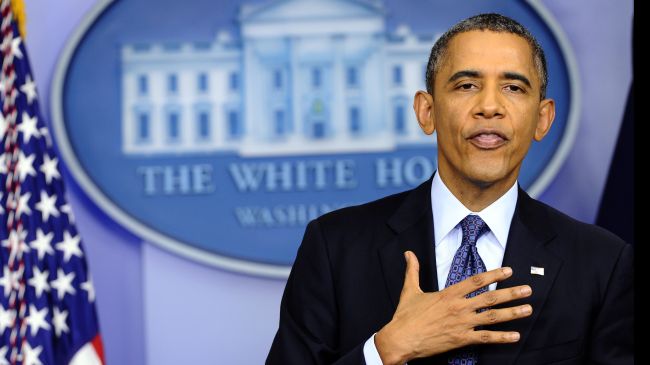 Did he know, or didn’t he? That’s the question surrounding President Barack Obama since it was revealed that the National Security Agency (NSA) had spied on the private communications of German Chancellor Angela Merkel.
Obama has been put in the embarrassing position of either admitting that he authorized the NSA to tap into the cell phone and email communications of the leaders of Germany and other allied countries, or that during his presidency spy agencies have been allowed to do as they wish without his knowledge even though many of their programs were already in place before Obama entered the White House.
Media reports out of Germany over the weekend indicated that Obama did know what the NSA was doing, going back several years in fact.
The German tabloid Bild alleged that Obama was personally briefed in 2010 about the operation to target Merkel’s phone by the NSA’s director, Keith Alexander, and that he authorized it to continue.
Another story, published in Der Spiegel, said the U.S. had been spying on Germans from the U.S. embassy in Berlin since 2008, and that surveillance of Merkel may have began as early as 2002.
In response to the stories, the NSA denied that Alexander met with Obama to discuss the controversial program.
The Wall Street Journal (WSJ) cited numerous unnamed sources who said the White House didn’t learn of the NSA spying until this past summer, when the operation against Merkel was shut down. It quoted a senior NSA official as saying, “These decisions are made at NSA. The president doesn’t sign off on this stuff.”
But that could mean Obama was in the dark for years about NSA activities.
“Officials said the NSA has so many eavesdropping operations under way that it wouldn’t have been practical to brief him on all of them,” the WSJ’s Siobhan Gorman and Adam Entous reported.
If that’s the best spin the administration can put on the scandal, it still leaves Obama open to criticism that he’s allowed a multi-billion-dollar spy agency to run amok and pry into the communications of whomever it wishes.
To Learn More:
If Obama Didn’t Know About Merkel Spying, Who Was It For? (by Jon Queally, Common Dreams)
Obama Unaware as U.S. Spied on World Leaders: Officials (by Siobhan Gorman and Adam Entous, Wall Street Journal)
Barack Obama ‘Approved Tapping Angela Merkel’s Phone 3 Years Ago’ (by Philip Sherwell and Louise Barnett, The Telegraph)
Obama knew about NSA spying on Merkel: Report
Press TV – October 27, 2013
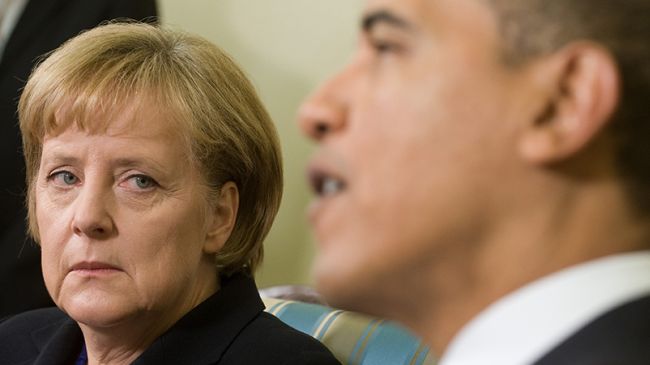
A new report has revealed that US President Barack Obama was personally aware of the National Security Agency’s eavesdropping on German Chancellor Angela Merkel.
NSA director Keith Alexander had briefed President Obama on the mobile phone tapping against Merkel in 2010, German newspaper Bild am Sonntag reported on Sunday.
“Obama did not halt the operation but rather let it continue,” according to the paper citing a high-ranking NSA official.
The newspaper also said the US spying agency eavesdropped on Merkel’s predecessor, Gerhard Schroder, after former US president George W. Bush launched the spying program in 2002, adding that Schroder’s refusal to support the Iraq war was a key reason behind the operation.
The new revelation comes one day after German magazine Der Spiegel said that the NSA’s Special Collection Service (SCS) had listed Merkel’s mobile telephone since 2002.
Washington’s ally has demanded explanations from the White House after disclosures about the huge and broad American electronic spying.
On Thursday, Germany summoned US ambassador John Emerson to discuss the tapping allegations.
“For us, spying on close friends and partners is totally unacceptable. This undermines trust and this can harm our friendship,” German Foreign Minister Guido Westerwelle said. “We need the truth now.”
In a phone call with Obama on Wednesday, Merkel said that she “unequivocally disapproves of such practices and sees them as completely unacceptable. There should be no such monitoring of the communication of a head of government. That would be a grave breach of trust.”
The White House, however, rejected the allegations, saying “the United States is not monitoring and will not monitor the communications of Chancellor Merkel.”
The global outrage over US government surveillance further spiked after The Guardian — citing a confidential memo obtained from American whistleblower Edward Snowden – revealed that the NSA is illegally eavesdropping on phone conversations of 35 world leaders.
The revelations have prompted Brazil and Germany to begin drafting a UN General Assembly resolution to restrain the NSA’s surveillance programs against other nations.
Featured Video

Prof. Ted Postol: Iran Already Achieved Nuclear Deterrence Against Israel
or go to
Aletho News Archives – Video-Images
From the Archives
How the occupied mentality syndrome works
Saudi Arabia on the American chessboard – Part 3
By B. J. Sabri | American Herald Tribune | June 27, 2016
Read part 2: “The occupied mentality Syndrome“
Previously I argued whether Saudi Arabia’s repeated involvements in U.S. interventions and wars stem from free national will or in response to a specific condition. For starters, in Saudi Arabia there is no national will. In Saudi Arabia, the national will is the will of the Al Saud clan. Still, when a major Arab state allies itself with a superpower that committed unspeakable crimes against humanity in almost every Arab country, then something is wrong. This fact alone should compel us to examine the U.S.-Saudi relation for one exceptional reason. As a result of the U.S.-Saudi wars, hundreds of thousands of people in Afghanistan, Iraq, Iran, Libya, Syria, Yemen, and Somalia have lost their lives. Millions became displaced in their own homelands. And millions more rendered refugees.
Attributing the Saudi policies to the bonds of “partnership” with the U.S. is frivolous. There are no bonds between these two thugs except those of business, military deals, secret plots, and wars. Proving this point, bonds such as these have no space for the American and Saudi peoples to share significant cultural or societal exchanges. If partnership is not the reason for the Saudi contribution to the U.S. strategy of empire and imperialism, then another reason must exist.
This leads to three possibilities. … continue
Blog Roll
 Aletho News
- REWRITING THE RISK? INSIDE THE GOVERNMENT’S VACCINE SAFETY MESSAGING
- “Davos Can Really Replace the UN”
- NIAID/NIH and USDA Fund Bioengineered Chimeric Influenza Viruses Built Using Pandemic H1N1 Components: Journal ‘Science Advances’
- Hezbollah hits Israeli warship off Lebanon’s coast, sets it aflame
- Iran slams US strikes on B1 bridge, Mahshahr petrochemical plants as ‘blatant acts of state terrorism’
- In letter to UN chief, Araghchi warns of dire consequences of US-Israeli attacks on Iran’s nuclear facilities
- Why the CIA conspiracy to invade Iran with Kurdish militias failed
- Why Are Upbeat US Claims About Mission to Rescue Pilot ‘Highly Questionable’?
- Aircraft destroyed during US ‘rescue’ of downed F-15 pilot cost more than $100 million each
- Washington University removes professor who condemned US-Israeli war on Iran
- If Americans Knew
- In Iran, Israel-US take aim at “reason, research, and freedom of thought” – Daily Update
- US loses planes over Iran, Israel downgrades Lebanon war goals – Daily Update
- Israel Is Blocking Palestinians from Easter at Church Where Jesus Resurrected
- Plot to assassinate Palestinian activist follows harassment campaign promoted by Zionist groups and elected officials
- Prominent New York synagogue hosts presentation on why U.S. Jews should support the ethnic cleansing of Gaza
- Tapper vs. Piker: Is the CNN Anchor Auditioning for David Ellison?
- Shouldn’t Democrats Be Able to Condemn Genocide?
- Israel-US kill negotiators, destroy civilian structures, but Iran’s military capabilities still largely intact – Daily Update
- ‘War crime’: Global condemnation as Israeli ministers celebrate death penalty law targeting Palestinian prisoners
- 7 Ways Israel Is Turning Lebanon Into Gaza
- No Tricks Zone
- An Inconvenient Tree: Uncovered In Alps… Europe Much Warmer Than Today 6000 Years Ago
- New Study Reports A 60% Slowdown In Greenland’s Ice Loss Rate In The Last Decade
- Low Intensity Tornado Wrecks Major Solar Farm, Creating A Potential Toxic Dump
- New Study Finds Warming Saves Lives…Cold Temperatures 12 Times More Deadly Than Excess Heat
- German Science Blog Accuses PIK Climate Institute Of Hallucinating Climate Tipping Points
- Devastating Assessment Of Comirnaty Vaccine By Former Senior Pfizer Europe Toxicologist
- New Study: CO2 Is ‘Effectively Negligible’ As An Explanatory Climate Change Factor Since 2000
- Former Pfizer Toxicologist Dr. Helmut Sterz Tells Bundestag Hearing Pfizer Vaccine Should Have Never Been Approved
- Energy Expert: Germany’s Nuclear Phaseout Was A “500 Billion Euro Mistake”
- New Research: South Australia’s Mid-Holocene Sea Surface Temperatures Were 4°C Warmer Than Today
 Aletho News