Former Qwest CEO says refusal to comply with NSA spying landed him in jail
RT | October 1, 2013
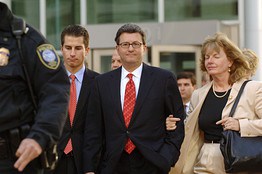 Former Qwest CEO Joseph Nacchio, who spent over four years in prison for insider trading, now says his conviction was based on his company’s refusal to cooperate with NSA requests to spy on its customers.
Nacchio says he feels “vindicated” by ongoing revelations provided by former NSA contractor Edward Snowden that the NSA does, in fact, access massive amounts of metadata and communications information of both foreigners and Americans.
Nacchio told The Wall Street Journal that the NSA set up a meeting with him in February 2001 wherein he believed they would discuss potential government contracts. But he says the NSA instead asked him for permission to surveil Qwest customers.
He says he refused to cooperate based on advice from his lawyers that such an action would be illegal, as the NSA would not go through the normal process of asking the Foreign Intelligence Surveillance Court for a subpoena. About this time, he says the company’s ability to win unrelated government contracts – something it did not have trouble with before the NSA meeting – slowed significantly.
It took until 2007 before Nacchio was convicted of insider trading. Prosecutors claim he was guilty of selling off Qwest stock in early 2001, not long before the company went through financial ills. Nevertheless, he claimed in court documents that he was still confident in the firm’s ability to win government contracts.
Nacchio believes his conviction was in retaliation for his refusal to play ball with legally dubious NSA spying requests.
“I never broke the law, and I never will,” Nacchio told the WSJ.
His version of events matches reporting by USA Today in 2006, in which the paper noted that Qwest was the lone holdout from the government’s warrantless surveillance operations and that defiance “might affect its ability to get future classified work with the government.”
Yet despite his efforts, Nacchio was barred from using any evidence of potential retaliation in his defense, given that the material was considered classified, and his judge refused requests to allow the evidence in trial. Reports from The Washington Post on evidence that has been made public on his case since that time seem consistent with the CEO’s claims.
As a result of his likely hobbled defense, Nacchio was indicted by federal prosecutors and served four-and-a half years in federal prisons before being released in late September.
The NSA has declined to comment on Nacchio, according to the WSJ and The Washington Post.
While spying operations disclosed by Snowden have had some level of legal backing, President George W. Bush’s wiretapping program did not. Thus, telecom companies that cooperated with the program were eventually given immunity for their compliance in 2008.
Related articles
- Don’t Refuse the Nsa or You’ll Sleep With the Fishes (theburningplatform.com)
- Telco exec who resisted NSA Joe Nacchio released after four years in jail (blacklistednews.com)
No Surprise: NSA Stores All Metadata It Collects For At Least A Year, Even If It Has Nothing To Do With Anything
By Mike Masnick | Techdirt | September 30, 2013
The latest revelation from the Snowden docs published by The Guardian is that the NSA’s MARINA metadata system for internet data stores the information it gets for up to a year.
“The Marina metadata application tracks a user’s browser experience, gathers contact information/content and develops summaries of target,” the analysts’ guide explains. “This tool offers the ability to export the data in a variety of formats, as well as create various charts to assist in pattern-of-life development.”
The guide goes on to explain Marina’s unique capability: “Of the more distinguishing features, Marina has the ability to look back on the last 365 days’ worth of DNI metadata seen by the Sigint collection system, regardless whether or not it was tasked for collection.” [Emphasis in original.]
Note that this is different than the phone metadata that people have been talking about. This is “internet” metadata — so browser history, contacts, etc. In other words, the kind of stuff that Dianne Feinstein accidentally admitted the US is scooping up by the boatloads by tapping the internet’s backbone with help from US telcos.
The fact that they can look through it even if it hasn’t been “tasked for collection” is pretty big. It again shows how the NSA keeps saying one thing (such as claiming they only keep data on people they’re “targeting”) is simply false. The NSA continues to redefine things. Information isn’t “collected” until it’s searched. And it’s apparently not “stored” until it’s moved into a different database than this one.
How does anyone take these guys seriously?
Feinstein’s Senate Committee Defends NSA Phone Surveillance, Pushes Bill to Retain It
By Noel Brinkerhoff | AllGov | September 28, 2013

Senator Dianne Feinstein
Members of the Senate Intelligence Committee made it clear this week that they see no reason to halt the National Security Agency’s controversial program that collects records of Americans’ phone calls.
Led by the panel’s chair, Senator Dianne Feinstein (D-California), a majority of the committee indicated during a hearing on Thursday that they want the NSA to keep using the once-secret program, but under certain conditions.
Feinstein and the committee’s top Republican, Senator Saxby Chambliss of Georgia, plan to draft new legislation by next week that would require the NSA to file public reports on the calling log database.
The bill would also mandate that the agency reduce the number of years that it stores the database’s contents. Currently, the NSA says that it stores the records for five years.
In addition, Feinstein wants the Senate to have confirmation authority over new NSA directors.
At the same time, the Democratic lawmaker is willing to broaden the agency’s power to wiretap without court approval a foreigner’s cellphone for at least one week when that person travels to the United States.
Another provision would demand that the NSA send lists of the phone numbers it searches, along with explanations for doing so, to the Foreign Intelligence Surveillance Court for review.
Critics of the NSA’s domestic surveillance have called for ending the phone-records program altogether. These advocates include two members of the Senate Intelligence Committee, Democrats Ron Wyden of Oregon and Mark Udall of Colorado, who have introduced a tougher reform bill.
But it appears unlikely Wyden’s bill will get past Feinstein’s committee, since Feinstein says the call log program is legal and “necessary for our nation’s security,” according to The New York Times.
To Learn More:
Senators Push to Preserve N.S.A. Phone Surveillance (by Charlie Savage, New York Times)
Feinstein Outlines NSA Changes (by Brendan Sasso and Kate Tummarello, The Hill)
“Independent Experts” Reviewing NSA Spying Have Ties to Intelligence Community (by Noel Brinkerhoff and Danny Biederman, AllGov)
Left and Right Unite to Sue NSA over Telephone Records Surveillance (by Matt Bewig, AllGov)
Related articles
- Political Moves: How Dianne Feinstein Cut Off One Of The Few Attempts At Actual Oversight By Senate Intelligence Committee (alethonews.wordpress.com)
- Feinstein’s NSA ‘reform’ bill would expand snooping powers (EndtheLie.com)
- Dianne Feinstein Accidentally Confirms That NSA Tapped The Internet Backbone (blacklistednews.com)
Political Moves: How Dianne Feinstein Cut Off One Of The Few Attempts At Actual Oversight By Senate Intelligence Committee
By Mike Masnick | Techdirt | September 27, 2013
We’ve already covered how Dianne Feinstein used the Senate Intelligence Committee hearing to play games with the English language, while Senator Dan Coats used it to rant against all you stupid Americans for not trusting the NSA, but there have been some actual attempts to have the Senate Intelligence Committee perform its actual duty of oversight. Both Senators Ron Wyden and Mark Udall — who have been trying to raise these questions for years — actually had specific questions for the assembled panel, but the panel (mainly Keith Alexander) did its best to completely avoid answering the questions, then used political gamesmanship to block Wyden from asking followups.
Wyden used his question to highlight what he’s been hinting at for years, that it’s almost certain that the NSA has collected bulk data on the locations of Americans (something not yet officially revealed, and which they’ve sort of tried to deny for a while). Wyden has been asking versions of this question for a few years (and trying to pass legislation blocking this kind of thing for nearly as long). But watch how Keith Alexander never actually answers the question:
Wyden: Now with respect to questions, let me start with you Director Alexander, and, as you all know, I will notify you in advance so that there won’t be any surprise about the types of issues we are going to get into. And Director Alexander, Senators Udall, Heinrich and I and about two dozen other senators have asked in the past whether the NSA has ever collected or made any plans to collect Americans’ cell-site information in bulk. What would be your response to that?
Gen. Keith Alexander: Senator, on July 25, Director Clapper provided a non-classified written response to this question amongst others, as well as a classified supplement with additional detail. Allow me to reaffirm what was stated in that unclassified response. Under section 215, NSA is not receiving cell-site location data and has no current plans to do so. As you know, I indicated to this committee on October 20, 2011, that I would notify Congress of NSA’s intent to obtain cell-site location data prior to any such plans being put in place. As you may also be aware….
Note the word games: “under Section 215.” He does not say whether they’ve used some other authority to do so. And then he’s just repeating talking points so Wyden flat out cuts him off:
Wyden: General, if I might. I think we’re all familiar with it. That’s not the question I’m asking. Respectfully, I’m asking, has the NSA ever collected or ever made any plans to collect Americans’ cell-site information. That was the question and we, respectfully General, have still not gotten an answer to it. Could you give me an answer to that?
Alexander: We did. We sent that — as you’re also aware I expressly reaffirmed this commitment to the committee on June 25, 2013. Finally, in the most recent and now declassified opinion renewing this program, the FISA court made clear in footnote number five that notice to the court in a briefing would be required if the government were to seek production of cell-site location information as part of the bulk production of call detail records. Additional details were also provided in the classified supplement to Director Clapper’s July 25th response to this question. So what I don’t want to do, Senator, is put out in an unclassified forum anything that’s classified there so I’m reading to you exactly. So we sent both of these to you. I saw what Director Clapper sent and I agree with it.
Wyden: General, if you’re responding to my question by not answering it because you think that’s a classified matter that is certainly your right. We will continue to explore that because I believe this is something the American people have a right to know whether the NSA has ever collected or made plans to collect cell-site information. I understand your answer. I’ll have additional questions on the next round. Thank you, Madam Chair.
First off, Alexander’s answer shows that, contrary to the assertions of some staunch NSA defenders, it is entirely possible to answer a question by saying “there is more information in classified documents that shouldn’t be shared in an open setting.” Some have tried to excuse James Clapper’s lies to Congress by suggesting he couldn’t have said more or less what Alexander said here.
Second, note the doublespeak that Alexander is engaged in here. Even asked, again, to answer the basic question, Alexander pulls an “under this program” type of answer, suggesting (again) that American location data either has been, or is planned, to be collected in bulk. That is worrisome, and should not be classified information. Rather it should be open to public debate as to whether or not it’s appropriate.
But here’s where the political gamesmanship came in. Committee chair Dianne Feinstein gave Senators only five minutes each for their questions. It seemed like a majority of this “oversight” committee didn’t actually ask any questions, but rather, like Coats, simply filibustered angrily at the American public or press for not trusting the NSA. But when actual questions were asked, not enough time was given to get a straight answer. At the very end of the hearing, after most of the other Senators had left, Senator Wyden made a perfectly normal request: could he ask his followup questions. He noted that he just had two questions and both could be asked within an additional five-minute window. Senator Susan Collins, who had similarly filibustered during her own five minutes (focusing mainly on knocking down a complete strawman: falsely insisting that people were upset that the NSA was using Section 215 of the Patriot Act to record all phone calls, when everyone knows that it’s just about call records, not call contents), objected to Wyden’s request because she thought everything would go in order. It was pure political gamesmanship.
So instead of getting to conduct more actual oversight by having the committee ask important questions of the surveillance bosses, the panel, instead, moved on to the “second part” of the hearing, which involved two staunch non-governmental NSA defenders who basically sat down to talk about the awesomeness of being able to spy on everyone. Ben Wittes opened with a “joke” about how the NSA’s director of compliance John DeLong, mocked the level of scrutiny the NSA was under by pointing out that if he had typos in a document he’d have to reveal that to some oversight authority. Har har. This was useless. There was no reason to have them testify, and they were given a hell of a lot more time than the Senators actually asking questions.
That time could have been used to actually conduct oversight. Instead, we got nothing. Throughout the panel Senators pointed out that the American public doesn’t trust the NSA right now (though, they often blamed the public and the press for this, rather than the direct actions and statements of the NSA). If they wanted a lesson in how not to build up that trust, holding a completely toothless “oversight” hearing was a pretty good start.
After Wyden, Udall also asked some specific questions, in which the deputy Attorney General basically just repeated the FISA Court ruling saying that “relevant” has been redefined by the intelligence community to mean basically anything that the intelligence community feels is “necessary” to its investigations, and seems to think that it’s a good thing that this is a “low bar.” He completely ignores the basics of the 4th Amendment, as well as recent Supreme Court decisions on the topic.
I’ve included the video of both Wyden and Udall’s questions below, so you can see the less than 20 minutes of the two-hour session where actual serious questions were asked.
Tone Deaf Dianne Feinstein Thinks Now Is A Good Time To Revive CISPA
By Mike Masnick | Techdirt | September 25, 2013
We had believed, along with a number of others, that the Snowden leaks showing how the NSA was spying on pretty much everyone would likely kill CISPA dead. After all, the key component to CISPA was basically a method for encouraging companies to have total immunity from sharing information with the NSA. And while CISPA supporters pretended this was to help protect those companies and others from online attacks, the Snowden leaks have reinforced the idea (that many of us had been pointing out from the beginning) that it was really about making it easier for the NSA to rope in companies to help them spy on people.
Also, if you don’t remember, while CISPA had passed the House, the Senate had shown little appetite for it. Last year, the Senate had approved a very different cybersecurity bill, and had expressed very little interest in taking up that fight again this year. Except now, in an unexpected move, Senate Intelligence Committee boss, and chief NSA defender because of reasons that are top secret, has now announced that she’s been writing a Senate counterpart to CISPA and is prepared to “move it forward.”
Yes, it seems that even though the NSA gleefully hid the evidence of widespread abuses from Feinstein’s oversight committee, she’s playing the co-dependent role yet again. Yes, there’s a chance that this new version of the bill will actually take into account privacy and civil liberties, but I doubt many people would take a bet on that being likely.
Right now what the public is concerned about are not “cyberattacks” from foreigners — they’re concerned about our own government undermining the security and privacy of Americans themselves. Giving those responsible for that destruction of privacy and trust more power to abuse the privacy of Americans is not what people are looking for. Quite the opposite.
“Independent Experts” Reviewing NSA Spying Have Ties to Intelligence Community
By Noel Brinkerhoff and Danny Biederman | AllGov | September 25, 2013
President Barack Obama’s special panel of “independent” experts charged with reviewing the National Security Agency’s (NSA) domestic spying programs is actually lacking in independence.
For starters, the panel assembled to determine if the NSA has violated Americans’ civil liberties consists of five members—four of whom have previously worked for Democratic administrations.
One member is Michael Morell, who served in the Central Intelligence Agency under Obama as deputy director, and twice served as acting director.
The other three with Democratic ties are Peter Swire, former Office of Management and Budget privacy director under President Bill Clinton; Richard Clarke, former counterterrorism coordinator under Clinton and later for President George W. Bush; and Cass Sunstein, Obama’s former regulatory czar.
The fifth panel member is Geoffrey Stone of the University of Chicago, who was an informal adviser to Obama’s 2008 presidential campaign and is now helping develop Obama’s presidential library. Stone previously went on record as saying that the NSA’s collection of Americans’ phone records is constitutional.
“No one can look at this group and say it’s completely independent,” Sascha Meinrath, director of the Open Technology Institute and vice president at the New America Foundation, told the Associated Press after attending one of the panel’s meetings.
Michelle Richardson, an ACLU legislative counsel who attended one meeting for civil liberties groups, said her organization “would have liked a more diverse group” for the panel.
Another sign that the group lacks independence is in its name—“Director of National Intelligence Review Group on Intelligence and Communications Technologies.”
The AP’s Stephen Braun noted that “the panel’s official name suggests it’s run by” the Office of the Director of National Intelligence (DNI).
In fact, Obama’s announcement in August that the review group would be established by DNI James Clapper triggered a wave of criticism. Obama tried to quell the outcry by assuring the country that Clapper would neither run the panel nor select its members.
But there is more than the panel’s name that suggests DNI oversight. The panel’s so-called outside experts work inside offices provided by the DNI. And it is the DNI’s press office that coordinates all press statements and interview requests.
Another point of criticism stems from Clapper’s decision to exempt the panel from the U.S. Federal Advisory Committee Act, which requires such committees to conduct open meetings and notify the public about their activities. Indeed, it has been reported that during recent weeks the panel’s meetings have been closed to the public even when no classified material was discussed.
There appears to be no formal directive stating that the panel should operate independently of the Obama administration. In fact, the situation is quite the opposite. An official White House memorandum actually provides the panel with instructions for areas to emphasize in its review: whether U.S. spying programs advance foreign policy, protect national security, and are safe from leaks.
In his August 9th press conference regarding the establishment of this panel, Obama promised that the “outside experts” will “consider how we can…make sure that there absolutely is no abuse in terms of how these surveillance technologies are used.” But nowhere in the White House memo is the panel instructed to investigate surveillance abuses.
The panel’s report is due by December 15. On that date it is not to be made public, nor is it to be delivered to the press. Rather, it will be submitted to the White House for review.
To Learn More:
Close Ties Between White House, NSA Spying Review (by Stephen Braun, Associated Press)
NSA Spying Review Panel Appointed by Obama Set to Whitewash Surveillance Abuses (by Kevin Gosztola, Dissenter)
Surveillance Privacy: Obama Orders Fox to Guard Chicken Coop (by Noel Brinkerhoff, AllGov)
Related articles
- Obama’s NSA ‘Independent’ Review Clearly a Public Relations Move (reason.com)
- NSA Spying Review Panel Appointed by Obama Set to Whitewash Surveillance Abuses (dissenter.firedoglake.com)
Brazil’s Rousseff to UN: US surveillance an ‘affront’
RT | September 24, 2013
Brazilian President Dilma Rousseff lambasted US spying on her country at Tuesday’s UN summit, calling it a “breach of international law.” She further warned that the NSA surveillance, revealed since June, threatened freedom of speech and democracy.
“Meddling in such a manner in the lives and affairs of other countries is a breach of international law and as such it is an affront to the principles that should otherwise govern relations among countries, especially among friendly nations,” Rousseff said.
“Without the right to privacy, there is no real freedom of speech or freedom of opinion,” Rousseff told the gathering of world leaders. “And therefore, there is no actual democracy,” she added, criticizing the fact that Brazil had been targeted by the US.
“A country’s sovereignty can never affirm itself to the detriment of another country’s sovereignty,” she added.
Rousseff went on to propose a multilateral, international governance framework to monitor US surveillance activity. “We must establish multilateral mechanisms for the world wide web,” she said.
Rousseff said that the US’s arguments for spying on Brazil and other UN member states were “untenable”, adding that “Brazil knows how to protect itself” and that the country has been “living in peace with our neighbors for more than 140 years.”
Brazil’s specific targeting in US surveillance practices prompted Rousseff’s government to announce that it intends to adopt both legislation and technology aimed at protecting itself and its businesses from the illegal interception of communications.
A week ago, Rousseff canceled an impending state visit to Washington, scheduled to take place in October, because of indignation over spying revelations. Rousseff has stated she wants an apology from Obama and the United States.
The revelations that the US National Security Agency has been intercepting Rouseff’s own phone calls and e-mails, in addition to those of her aides and officials at state-controlled oil and gas firm Petrobras, have prompted an outcry in Brazil.
Rousseff’s predecessor as Brazilian President, Lula da Silva, said earlier this month that Obama should “personally apologize to the world.” Lula accused the US of “thinking that it can control global communications and ignore the sovereignty of other countries” in an interview with India’s English-language daily The Hindu, published Sept. 10.
Latin America voices widespread indignation at US activities
US relations with all of Latin America have recently soured. In addition to Brazil, Mexico, Bolivia and Venezuela have all voiced anger with the US over the NSA’s surveillance of their countries this year. Bolivia has been especially bitter.
“I would like to announce that we are preparing a lawsuit against Barack Obama to condemn him for crimes against humanity,” President Morales told reporters Friday in the Bolivian city of Santa Cruz. He branded the US president as a “criminal” who had violated international law.
In early July, a plane carrying Morales from Moscow to the Bolivian capital, La Paz, was grounded for 13 hours in Austria after it was banned from European airspace because of US suspicions it was carrying fugitive Edward Snowden, the former NSA contractor who has been responsible for the majority of leaks regarding NSA spying practices since June.
Venezuela wrote to UN Secretary-General Ban Ki-moon at the end of last week, requesting that he take action in response to the apparent denial of US visas to some members of the Venezuelan delegation who were scheduled to attend the UN General Assembly in New York.
President Nicolas Maduro said that the denial seemed intended to “create logistical obstacles to impede” the visit, and further requested that the UN “demand that the government of the US abide by its international obligations” as host of the 68th UN General Assembly.
Tension between Venezuela and the US rose Thursday when Venezuela’s foreign minister, Elias Jaua, told media outlets that the US had denied a plane carrying Maduro entrance into its airspace. The aircraft was en route to China. Washington later granted the approval, stating that Venezuela’s request had not been properly submitted. Jaua denounced the move as “an act of aggression.”
Related article
EU ‘not satisfied’ with US spying answers, says top official
Press TV – September 24, 2013
The European Union is “not satisfied” with Washington’s answers on revelations that the US spied on international bank transfers, a top official says.
“I’m not satisfied with what we have gotten so far,” said EU Home Affairs Commissioner Cecilia Malmstrom during a hearing at the European Parliament on Tuesday.
She added, “I will be seeking exhaustive explanations, comprehensive information.”
The revelations that US National Security Agency (NSA) widely monitors international payments and financial transactions was reported by the German magazine Der Spiegel on September 16 and stems from leaked documents by US whistleblower Edward Snowden.
Malmstrom wrote in a recent letter to US Terrorism and Financial Intelligence Under Secretary David Cohen that “should the facts in these press reports be confirmed, they would further weaken the confidence between the EU and the US and would undoubtedly impact on our cooperation in the field of counter-terrorism.”
Since the disclosure, there have been calls by EU lawmakers for the suspension of a data-sharing agreement between the EU and the US. The deal grants Washington access to data from the SWIFT network used by thousands of banks to send transaction information securely.
“There have been very severe allegations in the press,” said Malmstrom adding, “If these allegations are true, they constitute a breach of the agreement and a breach of the agreement can certainly lead to a suspension.”
Malmstrom warned already in July, prior to the bank transfer disclosure, that the EU could reconsider financial data sharing agreements with the US if it was determined that the accords have not been executed “in full compliance with the law.”
The privacy violations were first revealed by Snowden in June. He leaked confidential information that showed the NSA collects data of phone records and Internet communication in the US and Europe as well as other countries.
Surveillance at the United Nations
By Danny O’Brien and Katitza Rodriguez | EFF | September 17, 2013
The surveillance scandal has now reached the United Nation’s Human Rights Council, which opened its 24th session last week to a volley of questions about privacy and spying, many of them targeted at the United States and United Kingdom. (That’s perhaps not surprising, since U.N. representatives were among those listed as being monitored by the NSA and GCHQ).
The opening statement by the eminent South African human rights lawyer Navi Pillay (now the U.N.’s High Commissioner for Human Rights) warned of the “broad scope of national security surveillance in countries, including the United States and United Kingdom,” and urged all countries to “ensure that adequate safeguards are in place to prevent security agency overreach and to protect the right to privacy and other human rights.” On September 13, the German Ambassador Schumacher delivered a joint statement on behalf of Austria, Germany, Liechtenstein, Norway, Switzerland and Hungary expressing their concern about the consequences of “surveillance, decryption and mass data collection.”
One part of the potential solution to those concerns will be officially launched this Friday in a Human Rights Council side-meeting on digital privacy hosted by these same concerned countries: the International Principles on the Application of Human Rights to Communications Surveillance.
For over a year, EFF has been working with other civil liberties groups to develop these principles that spell out how existing human rights law applies to modern digital surveillance. The 13 Principles — which have been signed by 258 organizations across the world— also provide a benchmark that people around the world can use to evaluate and push for changes in their own surveillance laws. For this 24th session, EFF has joined RSF and APC in a joint written submission to the HRC, advocating for these checks and balances.
The Human Rights Council isn’t the only diplomatic venue at the United Nations where complaints about the United States’ surveillance practices are being heard. The Human Rights Committee is also set to scrutinize the United States on its compliance with Article 17 (right to privacy) of the International Coventant on Civil and Political Rights. The United States’ written response to Human Rights Committee has already laid out its diplomatic response in favor of the Patriot and FISA provisions. It notably dodges the key question that is emerging from other countries regarding these programs: if the U.S. government cannot rein in its domestic surveillance program, riven as it is with constitutional and statutory problems, just how much worse are the controls on the surveillance of non-US persons?
More directly relevant to the diplomatic community is a connected question: how can the United States accuse, with a straight face, other countries of undermining “Internet Freedom” through the use of malware and mass spying, when it seems that there are precious few internal limits to what its own security services are permitted to do in the same arena?
This is not just a matter of the United States’ international reputation. The greatest risk to the Internet in the international arena right now lies in the formation of an unholy alliance between countries who are already seeking excuses to spy and censor the net and those, like the United States, who have previously argued against such practices, but are now having to defend their own surveillance excesses with similar language.
Without promising substantive reform at home, the U.S. and the U.K. risk alienating their own allies at the United Nations, while granting a carte blanche for other countries to pursue a repressive Internet agenda abroad. The Western countries implicated in the NSA scandal should grab onto the full set of principles as a liferaft: a way that they can show a commitment to transparency and proportionality in a way that obliges other countries to follow the same standards. Otherwise, the U.S. and the U.K. will be seen as having started a race to the bottom of privacy standards: a race too many other countries will be happy to join.
Brazil to bypass US-centric internet amid spy revelations
Press TV – September 17, 2013
Brazil has announced plans to bypass the US-centric internet amid revelations that Washington conducts spy operations on web communications.
 Brazilian President Dilma Rousseff announced the country’s measures to boost the Brazil’s independence and security on the World Wide Web, including storing data locally and bypassing internet traffic that goes through the United States.
Rousseff said plans are in the works to lay underwater fiber optic cable directly to Europe and all the South American nations in order to create a network free of US eavesdropping. This is while most of Brazil’s global internet traffic passes through the US.
The president also announced that she will push for new international rules of privacy and security in hardware and software during the UN General Assembly meeting later this month.
The country’s postal service also plans to create an encrypted e-mail service that would serve as an alternative to Gmail and Yahoo, two companies being monitored by the NSA.
Experts said the move may herald the first step toward a global network free from US monopoly and its illegal surveillance of global communications.
The development comes following the publication of documents leaked by whistleblower and former NSA contractor Edward Snowden in July, exposing US spying on Brazilian companies and individuals for a decade.
Snowden, a former CIA employee, leaked two top secret US government spying programs under which the NSA and the Federal Bureau of Investigation (FBI) are eavesdropping on millions of American and European phone records and the Internet data from major Internet companies such as Face book, Yahoo, Google, Apple, and Microsoft.
The NSA scandal took even broader dimensions when Snowden revealed information about its espionage activities targeting friendly countries.
Related articles
- Brazilian president postpones visit to Washington over US spying
- South America: UNASUR To Build Fibre-Optic ‘Mega Ring’
- Latin America Condemns US Espionage at United Nations Security Council
- Mercosur complains to Ban Ki-moon on US global espionage and EU affront towards Bolivia’s Evo Morales
- UK spying on Germany’s major data cable to US triggers media storm
Brazilian president postpones visit to Washington over US spying
RT | September 17, 2013
Brazilian President Dilma Rousseff has postponed a state visit to Washington in response to the US spying on her communications with top aides. Rousseff is demanding a full public apology from President Obama.
Barack Obama spoke with Rousseff on Monday in an attempt to persuade her into following through with the trip, the Brazilian president’s office said, according to AP.
Brazil’s TV Globo reported that the call between the two presidents lasted for about 20 minutes. Obama and Rousseff discussed revelations that the National Security Agency (NSA) spied on the Brazilian leader’s phone calls and emails. The two presidents then “jointly” agreed to cancel the meeting, Globo reported, citing the presidential office.
The Brazilian government said in a statement that “the conditions are not suitable to undertake this visit on the agreed date.” It expressed hope that the conflict will be resolved “properly” and the trip will happen “as soon as possible.”
The state visit was initially scheduled for October 23. The Obama administration has confirmed that the visit was canceled.
“The president has said that he understands and regrets the concerns disclosures of alleged US intelligence activities have generated in Brazil and made clear that he is committed to working together with President Rousseff and her government in diplomatic channels to move beyond this issue as a source of tension in our bilateral relationship,” said White House spokesman Jay Carney.
Earlier this month, TV Globo revealed in a report that the NSA monitored the content of phone calls, emails, and mobile phone messages belonging to President Rousseff and undefined “key advisers” of the Brazilian government. The NSA also spied on Mexican President Enrique Pena Nieto and nine members of his office.
The revelations were based on evidence provided by former CIA employee and NSA contractor Edward Snowden, which was passed to British journalist Glenn Greenwald.
A document dated June 2012 showed that the Mexican President’s emails were read through one month before he was elected. In his communications, the then-presidential candidate indicated who he would like to appoint to several government posts.
The Brazilian government denounced the NSA surveillance as “impermissible and unacceptable,” and a violation of Brazilian sovereignty.
In July, Greenwald co-wrote articles for O Globo, in which he claimed that some of the documents leaked by Snowden indicated that Brazil was the NSA’s largest target in Latin America.
Greenwald wrote that the NSA was collecting its data through an undefined association between US and Brazilian telecommunications companies, but he could not verify that Brazilian companies had been involved.
Following the revelations, the Brazilian government ordered an investigation into telecommunications companies to determine whether they illegally shared data with the NSA.
Defense ministers of Brazil and Argentina signed a broader military cooperation agreement on September 13. The two governments will work together to improve cyber defense capabilities following revelations of Washington’s spying on Latin American countries.
Brazil will be providing cyber warfare training to Argentine officers from 2014.
Related articles
NY Times Doesn’t Think That NSA Sharing Raw Communications With Israel Is Newsworthy
By Mike Masnick | Techdirt | September 16, 2013
Last week, we were among those who wrote about the latest revelations via the Guardian about how the NSA was sharing raw communications it had collected with Israeli intelligence. This is a big story for any number of reasons, but apparently the NY Times doesn’t think so. When Public Editor Margaret Sullivan asked why, the managing editor basically said the story wasn’t newsworthy:
He told me that The Times had chosen not to follow the story because its level of significance did not demand it.
“I didn’t think it was a significant or surprising story,” he said. “I think the more energy we put into chasing the small ones, the less time we have to break our own. Not to mention cover the turmoil in Syria.”
So, I asked him, by e-mail, was this essentially a question of reporting resources? After all, The Times could have published an article written by a wire service, like Reuters or The Associated Press.
“I’d say resources and news judgment,” he responded.
The resources issue is one I can understand totally. Here at Techdirt, we probably cover about one quarter to one third the number of stories we’d like to (which is also why I have about a thousand open tabs of stories I’m “hoping” to get to one of these days). But to claim that it’s not “significant” or “surprising” or somehow newsworthy is pretty crazy. This is a major part of the story — where the NSA keeps insisting that it is exceptionally careful with the data it collects, yet here it is handing off a ton of communications, including those of Americans, off to a foreign intelligence agency with basically no oversight. If the NY Times doesn’t think that’s newsworthy, the NY Times needs to recalibrate its newsworthy scale.
Related article
Featured Video
NEW FAUCI EMAILS EXPOSE ATTACK ON NATURAL IMMUNITY
or go to
Aletho News Archives – Video-Images
From the Archives
Elite Western universities are a corrupt, parasitic empire
Instead of high-quality education, these institutions are fostering a global neo-feudal system reminiscent of the British Raj
By Dr. Mathew Maavak | RT | May 30, 2025
In a move that has ignited a global uproar, US President Donald Trump banned international students from Harvard University, citing “national security” and ideological infiltration. The decision, which has been widely condemned by academics and foreign governments alike, apparently threatens to undermine America’s “intellectual leadership and soft power.” At stake is not just Harvard’s global appeal, but the very premise of open academic exchange that has long defined elite higher education in the US.
But exactly how ‘open’ is Harvard’s admissions process? Every year, highly qualified students – many with top-tier SAT or GMAT test scores – are rejected, often with little explanation. Critics argue that behind the prestigious Ivy League brand lies an opaque system shaped by legacy preferences, DEI imperatives, geopolitical interests, and outright bribes. George Soros, for instance, once pledged $1 billion to open up elite university admissions to drones who would read from his Open Society script.
China’s swift condemnation of Trump’s policy added a layer of geopolitical irony to the debate. Why would Beijing feign concern for “America’s international standing” amid a bitter trade war? The international standing of US universities has long been tarnished by a woke psychosis which spread like cancer to all branches of the government.
So, what was behind China’s latest gripe? ... continue
Blog Roll
Recent Comments
seversonebcfb985d9 on Villains of Judea: Philip Esfo… loongtip on Report warns that ‘Jewish terr… Craig Nelms on New study shows that toxic gas… loongtip on A Funny Thing Happened on the… loongtip on EU free trade pact on hold as… John Edward Kendrick on Regime Change In Iran Is The F… Bill Francis on Australia Passes New Hate Spee… seversonebcfb985d9 on Australia Passes New Hate Spee… Bill Francis on Britain’s AI Policing Plan Tur… loongtip on Miami Beach Resident Questione… loongtip on Israeli agricultural export co… loongtip on The War On Free Speech In Aust…


 Aletho News
- Ireland Moves to Legalize Spyware Use by Police
- NEW FAUCI EMAILS EXPOSE ATTACK ON NATURAL IMMUNITY
- Why is the US using Jordan as the main base in possible Iran attack?
- American Academy of Pediatrics Hit With Federal RICO Lawsuit for Vaccine Safety Fraud
- Mom Tells Trump: Dumping Sewage Sludge on Farmland Won’t Make America Healthy Again
- NIAID Funds Gain-of-Function Study Engineering Novel Influenza Viruses
- Villains of Judea: Philip Esformes and the Largest Healthcare Fraud in American History
- US sanctions Popular Conference for Palestinians Abroad over alleged Hamas links
- You reap what you sow: Ukraine’s blackout is Zelensky’s failure
- Ukraine Blackouts Caused by Zelensky’s Terrorist Attacks on Russia
- If Americans Knew
- Oppose Israel’s Abuses While You Still Can
- UNRWA Heads Tell Ha’aretz: ‘We Don’t Radicalize Palestinians – Their Lived Existence Does’
- Plans Call for “New Rafah” Built in Israel’s Image — Without Palestinians
- Posing as priest, reporter is spat at many times, highlighting anti-Christian sentiment in Israel
- Leaked Documents: “Planned Community” in Rafah Would Force Palestinians Into Israeli Panopticon
- ‘Permits of Humiliation’: How Israel Strangles Christian Education in Jerusalem
- “The world sees death, destruction and injustice – and they see dollar signs” – Not a ceasefire Day 105
- War criminal Netanyahu kills 11 in Gaza, joins Board of Peace – Not a ceasefire Day 104
- Another baby dies of cold in Gaza, as Rafah crossing remains locked down – Not a ceasefire Day 103
- Brutal Beatings, Arson, and Impunity: A Palestinian Plant Nursery Becomes a Target for Settler Pogroms
- No Tricks Zone
- New Study: Sea Levels Rose 20 Times The Modern Rate During The Roman Warm Period
- As German Gas Storage Dips Dangerously Low…Shortage Hardly Avoidable
- New Study: Brazil’s Relative Sea Level Was 2+ Meters Higher And SSTs 3-4°C Warmer 6000 Years Ago
- Philosopher Schopenhauer: Climate Science Certainty Stems From Stupidity, Ignorance
- New Study: Species Extinction Rates Declining Since 1980 – ‘Climate Change Is Not An Important Threat’
- Denmark Places Climate Protection Above Animal Welfare, Poisoning And Culling Cows
- New Study: Greenland Was 3-7°C Warmer And Far Less Glaciated Than Today 6000-8000 Years Ago
- German Media Report That Current Frigid Weather Can Be Explained By Arctic Warming!
- Berlin Blackout Shows Germany’s $5 Trillion Green Scheme Is “Left-Green Ideological Pipe Dream”
- Modeling Error In Estimating How Clouds Affect Climate Is 8700% Larger Than Alleged CO2 Forcing
 Aletho News