The NSA Black Hole: 5 Basic Things We Still Don’t Know About the Agency’s Snooping
By Justin Elliott and Theodoric Meyer | ProPublica | June 10, 2013

The headquarters of the National Security Agency at Fort Meade, Maryland
Last week saw revelations that the FBI and the National Security Agency have been collecting Americans’ phone records en masse and that the agencies have access to data from nine tech companies.
But secrecy around the programs has meant even basic questions are still unanswered. Here’s what we still don’t know:
Has the NSA been collecting all Americans’ phone records, and for how long?
It’s not entirely clear.
The Guardian published a court order that directed a Verizon subsidiary to turn over phone metadata — the time and duration of calls, as well as phone numbers and location data — to the NSA “on an ongoing daily basis” for a three-month period. Citing unnamed sources, the Wall Street Journal reported the program also covers AT&T and Sprint and that it covers the majority of Americans. And Director of National Intelligence James Clapper himself acknowledged that the “collection” is “broad in scope.”
How long has the dragnet has existed? At least seven years, and maybe going back to 2001.
Senate Intelligence Committee chair Dianne Feinstein, D-Calif., and vice chair Saxby Chambliss, R-Ga., said last week that the NSA has been collecting the records going back to 2006. That’s the same year that USA Today revealed a similar-sounding mass collection of metadata, which the paper said had been taking place since 2001. The relationship between the program we got a glimpse of in the Verizon order and the one revealed by USA Today in 2006 is still not clear: USA Today described a program not authorized by warrants. The program detailed last week does have court approval.
What surveillance powers does the government believe it has under the Patriot Act?
That’s classified.
The Verizon court order relies on Section 215 of the Patriot Act. That provision allows the FBI to ask the Foreign Intelligence Surveillance Court for a secret order requiring companies, like Verizon, to produce records – “any tangible things” – as part of a “foreign intelligence” or terrorism investigation. As with any law, exactly what the wording means is a matter for courts to decide. But the Foreign Intelligence Surveillance Court’s interpretation of Section 215 is secret.
As Harvard Law Professor Noah Feldman recently wrote, the details of that interpretation matter a lot: “Read narrowly, this language might require that information requested be shown to be important or necessary to the investigation. Read widely, it would include essentially anything even slightly relevant — which is to say, everything.”
In the case of the Verizon order — signed by a judge who sits on the secret court and requiring the company to hand over “all call detail records” — it appears that the court is allowing a broad interpretation of the Patriot Act. But we still don’t know the specifics.
Has the NSA’s massive collection of metadata thwarted any terrorist attacks?
It depends which senator you ask. And evidence that would help settle the matter is, yes, classified.
Sen. Mark Udall, D-Colo., told CNN on Sunday, “It’s unclear to me that we’ve developed any intelligence through the metadata program that’s led to the disruption of plots that we could [not] have developed through other data and other intelligence.”
He said he could not elaborate on his case “without further declassification.”
Sen. Feinstein told ABC that the collection of phone records described in the Verizon order had been “used” in the case of would-be New York subway bomber Najibullah Zazi. Later in the interview, Feinstein said she couldn’t disclose more because the information is classified. (It’s worth noting that there’s also evidence that old-fashioned police work helped solve the Zazi case — and that other reports suggest the Prism program, not the phone records, helped solve the case.)
How much information, and from whom, is the government sweeping up through Prism?
It’s not clear.
Intelligence director Clapper said in his declassified description that the government can’t get information using Prism unless there is an “appropriate, and documented, foreign intelligence purpose for the acquisition (such as for the prevention of terrorism, hostile cyber activities, or nuclear proliferation) and the foreign target is reasonably believed to be outside the United States.”
One thing we don’t know is how the government determines who is a “foreign target.” The Washington Post reported that NSA analysts use “search terms” to try to achieve “51 percent confidence” in a target’s “foreignness.” How do they do that? Unclear.
We’ve also never seen a court order related to Prism — they are secret — so we don’t know how broad they are. The Post reported that the court orders can be sweeping, and apply for up to a year. Though Google has maintained it has not “received blanket orders of the kind being discussed in the media.”
So, how does Prism work?
In his statement Saturday, Clapper described Prism as a computer system that allows the government to collect “foreign intelligence information from electronic communication service providers under court supervision.”
That much seems clear. But the exact role of the tech companies is still murky.
Relying on a leaked PowerPoint presentation, the Washington Post originally described Prism as an FBI and NSA program to tap “directly into the central servers” of nine tech companies including Google and Facebook. Some of the companies denied giving the government “direct access” to their servers. In a later story, published Saturday, the newspaper cited unnamed intelligence sources saying that the description from the PowerPoint was technically inaccurate.
The Post quotes a classified NSA report saying that Prism allows “collection managers [to send] content tasking instructions directly to equipment installed at company-controlled locations,” not the company servers themselves. So what does any of that mean? We don’t know.
For more on mass surveillance in America, read our timeline of loosening laws and practices.
Related articles
- Why Did Edward Snowden Go to Hong Kong?
- NSA Document Leak Proves Conspiracy To Create Big Brother Style World Control System
- DOJ launches criminal probe of NSA leaker
- US security officials said NSA leaker, journalist should be ‘disappeared’ – report
- Government Spying: Should We Be Shocked?
- Boundless Informant: NSA’s complex tool for classifying global intelligence
- The NSA’s Favorite Weasel Word To Pretend It’s Claiming It Doesn’t Spy On Americans
- The “Congress knew” defense
- NSA memo pushed to ‘rethink’ 4th Amendment
NSA Document Leak Proves Conspiracy To Create Big Brother Style World Control System
By Lee Rogers | Blacklisted News | June 10, 2013
The Obama regime which was already in the midst of three high profile scandals now has a fourth one to deal with. Top secret documents were recently leaked to the Washington Post and the London Guardian detailing a vast government surveillance program code named PRISM. According to the leaked documents, the program allows the National Security Agency (NSA) back door access to data from the servers of several leading U.S. based Internet and software companies. The documents list companies such as Google, Facebook, Yahoo, Microsoft, AOL and Apple as some of the participants in the program. There have also been other reports indicating that the NSA is able to access real-time user data from as many as 50 separate American companies. Under the program, the NSA is able to collect information ranging from e-mails, chats, videos, photographs, VoIP calls and more. Most importantly is the fact that PRISM allows the NSA to obtain this data without having to make individual requests from the service providers or without having to obtain a court order. To say that this is a violation of the Fourth Amendment which forbids unreasonable searches and seizures would be a gross understatement. This is actually much more than that. This is a program designed specifically to serve as a Big Brother like control grid and to end privacy as we know it.
In some ways this is not really a new story. This is just confirmation of what many people involved in the alternative research community have known for years. Going as far back as the 1990s there were reports revealing how Microsoft provided the NSA with back door access to their Windows operating system. Google’s cozy relationship with the NSA has also been discussed off and on over the past decade. There have even been other whistleblowers that have come forward previously detailing a number of unconstitutional and unlawful abuses conducted by the agency. This includes revelations of how the NSA was spying on American service members stationed overseas. The only difference with this is that these newly leaked documents provide definitive details on just how wide reaching the NSA’s activities have become.
It is now painfully obvious that James Clapper the Director of National Intelligence when testifying before the Senate this past March blatantly lied when asked by Senator Ron Wyden if the NSA was involved in collecting data from the American people. Clapper flatly denied that the NSA was engaged in these types of domestic surveillance activities. What makes the situation such a joke is that the Obama regime is not focused on the fact that Clapper lied to the Senate which in of itself is unlawful. Instead they have been more focused on determining the source of the leak that exposed these broad abuses of power. This is probably not surprising considering that this is a regime that rewards corruption by promoting people involved in all sorts of questionable activity. The promotion of Susan Rice as Obama’s new National Security Advisor is a perfect example of this considering her involvement in spreading bogus Benghazi related talking points. On the other hand, the Obama regime has severely punished a variety of whistleblowers who have dared to expose any wrong doing.
At least the Obama regime won’t have to spend much time and energy trying to identify the whistleblower as this person who leaked these documents has already come forward publically. At his own request the Guardian revealed his identity as Edward Snowden a 29-year old Information Technology specialist who has been working at the NSA for different contractors including Booz Allen Hamilton and Dell. Snowden had previously worked at an NSA office in Hawaii but boarded a flight to Hong Kong a few weeks ago where he has stayed since turning over these documents to the media. He expects that he will never set foot on U.S. soil again and may possibly seek political asylum in a country like Iceland. The Guardian interviewed Snowden over several days and has recently posted an interview transcript that provides more detail on the abuses he became aware of and why he decided to come forward as a whistleblower. In the interview Snowden confirms that the NSA has the infrastructure that allows them to intercept almost any type of data that you can imagine from phone records, e-mails to credit cards. He also reveals how the U.S. government is engaged in hacking systems everywhere around the world and how the NSA has consistently lied to Congress about their activities. There is little doubt that Snowden is thus far one of the most important whistleblowers to come along in the 21st century and he will likely face retaliation considering the vast reach and capabilities of the U.S. intelligence community.
Many individuals within the Obama regime including Obama himself have claimed that this type of widespread data collection is needed to fight terrorism and is used for national security purposes. Even if we were to assume that the war on terror is real, this claim is ridiculous and absurd on its face. It would be one thing if they were collecting information based upon a specific criteria identified by legitimate human intelligence. Instead they are collecting indiscriminate amounts of information which makes it much more difficult to analyze and target anything that might indicate a potential threat. If the NSA’s goal is really to detect and target terrorism then all they are doing is making their job more difficult by vastly increasing the noise they have to filter through. Either the people running the NSA are incredibly stupid or the goal of this program is to establish the infrastructure necessary to centrally collect data from communications everywhere around the world.
Other evidence to support this notion is the fact that the NSA is building a huge new facility in Utah that is being designed to store an enormous amount of data. A Fox News report indicates that, when completed, the facility will be able to store billions of terabytes worth of information. It is hard to fathom how the NSA would need this much storage space unless it was being used to collect and store any and all communications.
The Obama regime has tried to justify all of this by saying that PRISM helped stop an alleged New York City subway bomb plot back in 2009. This has been proven to be factually incorrect as regular police work and help from the British were larger factors in stopping the plot. This is assuming you even believe the official story of this terror plot to begin with. The government and more specifically the FBI have manufactured so many fake terror plots that it is difficult to determine fact from fiction at this point. So with this said, there is really no proof that PRISM has even helped to stop any so-called terror plot. They are collecting information simply for the sake of collecting information with no probable cause or reasonable justification.
At this point it is an undeniable fact that the NSA has been illegally collecting information on the American people. For years what has been dismissed as conspiracy theory is now without question a conspiracy fact. It is laughable that Obama and his assorted cronies are even trying to defend this program as a useful tool to fight terrorists. It is more likely that this program is being used to help find people domestically who dislike the government and would potentially fight back against it. A striking similarity to what is depicted in George Orwell’s dystopic novel 1984 where political dissidents are identified as thought criminals. A tool the NSA uses called Boundless Informant which counts and categorizes the information they collect shows that more data is actually gathered from domestic sources in the U.S. than from Russia. So based on this one could argue that the NSA almost seems to view the American people as more of a threat to national security than the Russians.
The three scandals the Obama regime was dealing with prior to this new scandal are all grounds for impeachment and one could easily argue that this one is many times worse than the previous three. Obama should resign in disgrace but being that he’s a narcissist who seems unwilling to admit making any mistakes it is highly doubtful he will do this. Obama and the rest of the useful idiots in his regime who have tried to defend and justify this and other criminal programs need to be … removed from office and put on trial. The criminal activity from the Obama regime is so vastly transparent it has become a complete and total joke to anyone who is even remotely paying attention.
Related articles
- The NSA Black Hole: 5 Basic Things We Still Don’t Know About the Agency’s Snooping
- Why Did Edward Snowden Go to Hong Kong?
- DOJ launches criminal probe of NSA leaker
- US security officials said NSA leaker, journalist should be ‘disappeared’ – report
- Government Spying: Should We Be Shocked?
- Boundless Informant: NSA’s complex tool for classifying global intelligence
- The NSA’s Favorite Weasel Word To Pretend It’s Claiming It Doesn’t Spy On Americans
- The “Congress knew” defense
- NSA memo pushed to ‘rethink’ 4th Amendment
The NSA’s Favorite Weasel Word To Pretend It’s Claiming It Doesn’t Spy On Americans
By Mike Masnick | TechDirt | June 7th 2013
Well, well. In the aftermath of the revelations that the NSA is getting records of every phone call from Verizon, followed up by the news that most of the biggest tech companies are supposedly giving direct access to the NSA, the intelligence community is responding the same way it always does: with weasel words. First up, you can see Director of National Intelligence James Clapper’s statement about the spying, which we’ll be discussing again in a bit.
But, a bunch of folks have been reasonably pointing out that Clapper appears to have lied to Congress. Of course, it’s not like this wasn’t easily called. Two years ago, we wrote about Clapper’s answers to Senators Wyden and Udall, which we pointed out was a ridiculous answer that was clearly sidestepping the real questions. However, looking over that letter again now, and having become a bit more familiar with the weasel words the NSA likes to use, it’s easy to look at Clapper’s statement and explain why he can “stand by it” while the clear implication of it was the opposite of what he meant.
You asked whether communications of Americans have been collected… Section 702 of the FAA [FISA Amendments Act] explicitly prohibits the intentional targeting of persons reasonably believed to be located in the United States or United States persons located abroad. The Intelligence Community has put in place a variety of procedures, which have been approved by the FISA Court as required by law, to ensure that only persons reasonably believed to be located outside the United States are targeted and to prevent the intentional acquisition of any communications as to which the sender and all intended recipients are known to be located in the United States. Guidelines are also required by law to ensure compliance with other limitations on FAA collection, including the requirement that a U.S. person may not be intentionally targeted under section 702. If it is discovered that a target has entered the U.S. or is a U.S. person, he or she is promptly detargeted and reports are made as appropriate to the Department of Justice (DOJ), the Office of the Director of National Intelligence (ODNI) and the FISA Court. Moreover, when communications from persons located in the United States are collected because they are communicating with a lawful target, the privacy and civil liberty rights of U.S. persons are protected through the careful implementation of the procedures required under the FAA to “minimize the acquisition and retention, and prohibit the dissemination ‘of information about U.S. persons.’”
Most people would read this to be him saying that they do not spy on Americans. And that’s obviously what he’s trying to imply. But that’s not what he’s actually saying. He’s using the NSA’s favorite weasel word: “target.” Now, most people assume that means one of the people on the call must be outside the US. But, you could — if you were devious intelligence official trying to mislead Congress and the American public (hypothetically) — interpret the word “target” to mean “if we, in general are ‘targeting’ foreign threats, no matter what they might be like, and this information we’re collecting might help in that process, then we can snarf up this data.”
In other words, most people think that “target” would mean one of the people on the phone. But, the NSA means “this overall investigation is about targeting foreign threats, so we can take whatever data we want because the goal is to stop foreign threats with it — and therefore our mandate not to spy on Americans doesn’t apply.”
So, it shouldn’t be particularly surprising to see that the administration’s “response” to this is to highlight, yet again, that this only “targets” non-US persons:
Information collected through a U.S. government surveillance program that taps into the servers of internet companies targets only non-U.S. persons living outside the United States, a senior administration official said on Thursday.
The U.S. law that allows the collection of data under this program does not allow the targeting of any U.S. citizen or of any person located in the United States, the official said, speaking on condition of anonymity.
Right, but whether or not they’re “targeting” a person, is separate from whether or not they’re spying on the data of Americans. As long as it’s all part of a process that “targets” non-US persons, they can claim that they’re playing by the rules.
Given that, however, I don’t see how Clapper can reasonably standby the following statements:
Wyden: Does the NSA collect any type of data at all on millions or hundreds of millions of Americans?
Clapper: No sir.
Wyden: It does not?
Clapper: Not wittingly. There are cases where they could, inadvertently perhaps, collect—but not wittingly.
Clapper is insisting that he didn’t lie in his comments, but he then pretends that he was only talking about email:
What I said was, the NSA does not voyeuristically pore through U.S. citizens’ e-mails. I stand by that.
Except, that’s not what he was asked, nor was it what he said. He was specifically asked if the NSA collects any type of data at all, and he said no. Up above, he was using weasel words, but here it looks like he was flat out lying directly to Congress. Usually, Congress doesn’t like that.
Related article
- The “Congress knew” defense
- This abuse of the Patriot Act must end | Jim Sensenbrenner
- Confirmed: The NSA is Spying on Millions of Americans
- NSA memo pushed to ‘rethink’ 4th Amendment
- Boundless Informant: NSA’s complex tool for classifying global intelligence
- Government Says Secret Court Opinion on Law Underlying PRISM Program Needs to Stay Secret
The “Congress knew” defense
left i on the news | June 07, 2013
President Obama defends his super-snooping program, claiming that “they’re not secret in the sense that when it comes to telephone calls, every member of Congress has been briefed on this program.” First of all, I note he also says that “the relevant intelligence committees are fully briefed on these programs,” which suggests that “every member of Congress”, to whom the word “fully” isn’t applied, may or may not know very much at all. But even if every member of Congress were in fact fully briefed, there’s a little problem with that. Because they were briefed in secret and unable to convey that information to their constituents. So if they wanted to, say, campaign for reelection on the grounds of supporting (or opposing) that policy, they couldn’t do so. Furthermore, no challenger could campaign against them on a platform of ending these policies, because no challenger would have known about the policies.
On a related issue, talking to FOX’s Shep Smith earlier today (actually being grilled by Smith, who was having none of his double-talk and evasions), the former deputy director of the NSA claimed that the program was ipso facto Constitutional because “all three branches of government” were involved with it. But the “FISA Court” is a special, secret court. Not only have they never denied a single government request, but no citizen can challenge a decision they make, because their decisions are all secret. Therefore the Constitutionality of the court itself, or of any decision it has made, is not subject to review by the Supreme Court, the only institution which can actually rule on the Constitutionality of a law.
~
Related video:
Related articles
- The NSA Black Hole: 5 Basic Things We Still Don’t Know About the Agency’s Snooping
- NSA Document Leak Proves Conspiracy To Create Big Brother Style World Control System
- DOJ launches criminal probe of NSA leaker
- US security officials said NSA leaker, journalist should be ‘disappeared’ – report
- Government Spying: Should We Be Shocked?
- Boundless Informant: NSA’s complex tool for classifying global intelligence
- The NSA’s Favorite Weasel Word To Pretend It’s Claiming It Doesn’t Spy On Americans
- NSA memo pushed to ‘rethink’ 4th Amendment
Boundless Informant: NSA’s complex tool for classifying global intelligence
RT | June 9, 2013
A new batch of classified NSA docs leaked to the media reveals the details of a comprehensive piece of software used by NSA to analyze and evaluate intelligence gathered across the globe as well as data extraction methods.
The top-secret documents released by the Guardian shed light on the National Security Agency’s data-mining tool being used for counting and categorizing metadata gathered and stored in numerous databases around the world.
Known as Boundless Informant, the software provides its operator a graphical insight on how many records were collected for a specific “organizational unit” or country, what type of data was collected and what type of collection was used. The program also allows determining trends in data collection for both strategic and tactical decision making, according to the slides.
One of the slides contains a part of the Informant’s user interface showing a world map with countries color-coded ranging from green to red depending on the amount of records collected there. While Iran, Pakistan and some other states are predictably “hottest” according to the map, the agency collected almost 3 billion intelligence pieces in the US in March 2013 alone.
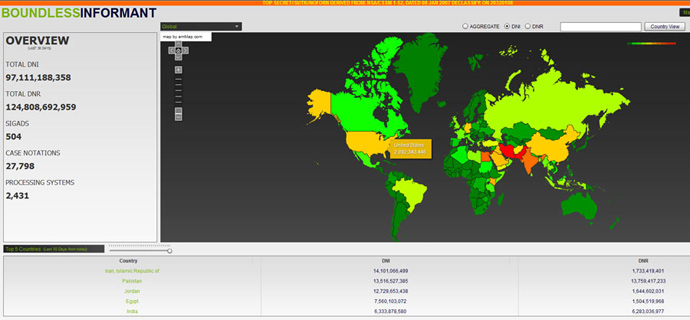
The map showing how much data is being collected in different countries across the globe (image from the Guardian)
The insight on the software being used by the NSA comes amid the agency spokesperson Judith Emmel’s claims that the NSA cannot at the moment determine how many Americans may be accidentally included in its surveillance.
“Current technology simply does not permit us to positively identify all of the persons or locations associated with a given communication,” Emmel said Saturday adding that “it is harder to know the ultimate source or destination, or more particularly the identity of the person represented by the TO:, FROM: or CC: field of an e-mail address or the abstraction of an IP address.”
NSA data sources
Another slide from the internal NSA presentation redacted by the Guardian editors details the data gathering methods used in the NSA global surveillance program.
The first method suggests interception of data from “fiber cables and infrastructure as data flows past” under the FISA Amendments Act (FAA) of 2008, Section 702.
The second distinguished method is data collection “directly from the servers of the US service providers.”

The slide detailing methods of data extraction under the FISA Amendment Act (image from the Guardian)
The presentation encourages analysts to use both methods for better results.
Google, Facebook negotiated ‘secure portals’ to share data with NSA?
Meanwhile, a report by the New York Times revealed that Internet giants, including Google and Facebook, have been in negotiations with the US security agency over ‘digital rooms’ for sharing the requested data. The companies still insist there is no “back door” for a direct access to user data on their servers.
The Internet companies seem more compliant with the spy agencies than they want to appear to their users, and are cooperating on “behind-the-scenes transactions” of the private information, according to a report that cites anonymous sources “briefed on the negotiations.”
According to the report, Google, Microsoft, Yahoo, Facebook, AOL, Apple and Paltalk have “opened discussions with national security officials about developing technical methods to more efficiently and securely share the personal data of foreign users in response to lawful government requests,” sometimes “changing” their computer systems for this purpose.
These methods included a creation of “separate, secure portals” online, through which the government would conveniently request and acquire data from the companies.
Twitter was the only major Internet company mentioned in the report that allegedly declined to facilitate the data transfer to the NSA in a described way. As opposed to a legitimate FISA request, such a move was considered as not “a legal requirement” by Twitter.
The sources claim the negotiations have been actively going in the recent months, referring to a Silicon Valley visit of the chairman of the Joint Chiefs of Staff Martin E. Dempsey. Dempsey is said to have met the executives of Facebook, Microsoft, Google and Intel to secretly discuss their collaboration on the government’s “intelligence-gathering efforts.”
NSA pressured to declassify more PRISM details
In response to the fury over US government’s counterterrorism techniques, Director of National Intelligence James Clapper for the second time in three days revealed some details of the PRISM data-scouring program.
Being one of the “most important tools for the protection of the nation’s security” the PRISM is an internal government computer system for collecting “foreign intelligence information from electronic communication service providers under court supervision,” Clapper said.
He also said that PRISM seeks foreign intelligence information concerning foreign targets located outside the US and cannot intentionally target any US citizen or any person known to be in the US. As for “incidentally intercepted” information about a US resident, the dissemination of such data is prohibited unless it is “evidence of a crime”, “indicates” a serious threat, or is needed to “understand foreign intelligence or assess its importance.”
Clapper also stressed that the agency operates with a court authority and that it does not unilaterally obtain information from the servers of US telecoms and Internet giants without their knowledge and a FISA Court judge approval.
Related articles
- The NSA Black Hole: 5 Basic Things We Still Don’t Know About the Agency’s Snooping
- NSA Document Leak Proves Conspiracy To Create Big Brother Style World Control System
- DOJ launches criminal probe of NSA leaker
- US security officials said NSA leaker, journalist should be ‘disappeared’ – report
- Government Spying: Should We Be Shocked?
- The NSA’s Favorite Weasel Word To Pretend It’s Claiming It Doesn’t Spy On Americans
- The “Congress knew” defense
- NSA memo pushed to ‘rethink’ 4th Amendment
Government Says Secret Court Opinion on Law Underlying PRISM Program Needs to Stay Secret
By Mark Rumold and David Sobel | EFF | June 7, 2013
In a rare public filing in the secret Foreign Intelligence Surveillance Court (FISC), the Justice Department today urged continued secrecy for a 2011 FISC opinion that found the National Security Agency’s surveillance under the FISA Amendments Act to be unconstitutional. Significantly, the surveillance at issue was carried out under the same controversial legal authority that underlies the NSA’s recently-revealed PRISM program.
EFF filed a suit under the Freedom of Information Act in August 2012, seeking disclosure of the FISC ruling. Sens. Ron Wyden and Mark Udall revealed the existence of the opinion, which found that collection activities under FISA Section 702 “circumvented the spirit of the law” and violated the Fourth Amendment’s prohibition on unreasonable searches and seizures. But, at the time, the Senators were not permitted to discuss the details publicly. Section 702 has taken on new importance this week, as it appears to form the basis for the extensive PRISM surveillance program reported recently in the Guardian and the Washington Post.
The government has seeked to block EFF’s FOIA suit by arguing that only the FISC, itself, can release the opinion. In an effort to remove that roadblock, EFF filed a motion with the FISC on April 22 seeking the surveillance court’s consent to disclosure, should the document be found to be otherwise subject to release under FOIA. In its response filed with the FISC today, the government offers a circular argument, asserting that only the Executive Branch can de-classify the opinion, but that it is somehow prohibited by the FISC rules from doing so.
The government’s argument is guaranteed to make heads spin. DOJ earlier argued that it lacks discretion to release the FISC opinion without the FISC’s consent, but DOJ now argues that if the FISC were to agree with EFF, “the consequence would be that the Government could release the opinion or any portion of it in its discretion.” But FISC material is classified solely because the Executive Branch demands that it be, so release of the opinion has always been a matter of Executive discretion.
Frankly, it’s difficult to understand what DOJ is saying. The Government seems to have a knee-jerk inclination towards secrecy, one that often – as in this case – simply defies logic. The government’s bottom line is this: their rules trump the public’s statutory rights. But it’s not the province of the Executive branch to determine which rights citizens get to assert.
The events of the past week have demonstrated that the public is angry about the NSA’s domestic surveillance program. EFF hoped the public outcry might lead the government to rethink it’s position in this case (and, notably, DOJ has in two other EFF cases). But, for now, the government is digging in its heels and refusing to budge. But a democracy demands more. When the government acts unconstitutionally, the public has a fundamental right to review, understand, and correct that government action. Despite the DOJ’s filing today, EFF intends to keep fighting against the government’s secret surveillance practices.
Related article
Oh, And One More Thing: NSA Directly Accessing Information From Google, Facebook, Skype, Apple And More
By Mike Masnick | TechDirt | June 6th 2013
Obviously, the Verizon/NSA situation was merely a small view into just how much spying the NSA is doing on everyone. And it seems to be spurring further leaks and disclosures. The latest, from the Washington Post, is that the NSA has direct data mining capabilities into the data held by nine of the biggest internet/tech companies:
The technology companies, which participate knowingly in PRISM operations, include most of the dominant global players of Silicon Valley. They are listed on a roster that bears their logos in order of entry into the program: “Microsoft, Yahoo, Google, Facebook, PalTalk, AOL, Skype, YouTube, Apple.” PalTalk, although much smaller, has hosted significant traffic during the Arab Spring and in the ongoing Syrian civil war.
Dropbox , the cloud storage and synchronization service, is described as “coming soon.”
This program, like the constant surveillance of phone records, began in 2007, though other programs predated it. They claim that they’re not collecting all data, but it’s not clear that makes a real difference:
The PRISM program is not a dragnet, exactly. From inside a company’s data stream the NSA is capable of pulling out anything it likes, but under current rules the agency does not try to collect it all.
Analysts who use the system from a Web portal at Fort Meade key in “selectors,” or search terms, that are designed to produce at least 51 percent confidence in a target’s “foreignness.” That is not a very stringent test. Training materials obtained by the Post instruct new analysts to submit accidentally collected U.S. content for a quarterly report, “but it’s nothing to worry about.”
Even when the system works just as advertised, with no American singled out for targeting, the NSA routinely collects a great deal of American content.
I expect we’ll be seeing more such revelations before long.
Related article
Supporters Say All The Wrong Things to Try and Pass CISPA
By Mark M. Jaycox | EFF | April 8, 2013
Ever since reintroducing CISPA, the so-called “cybersecurity bill,” its supporters promote the bill with craftily worded or just plain misleading claims. Such claims have been lobbed over and over again in op-eds, at hearings, and in press materials. One “fact sheet” by Rep. Rogers and Ruppersberger titled “Myth v. Fact” is so dubious that we felt we had to comment.
Here are some of the statements supporters of CISPA are pushing and why they’re false:
Supporters of CISPA say, “There are no broad definitions”
Supporters are keen to note that the bill doesn’t have broad definitions. In the “Myth v. Fact” sheet, the authors of CISPA specifically point to the definition of “cyber threat information.” Cyber threat information is information about an online threat that companies can share with each other and with any government agency—including the NSA. In hearings, experts have said that they don’t need to share personally identifiable information to combat threats. But the definition in the bill allows for any information related to a perceived threat or vulnerability—including sensitive personal information—to be shared. Cyber threat information should be a narrowly defined term.
Another example of a broad (or missing) definition is the term “cybersecurity system.” Companies can use a “cybersecurity system” to “identify or obtain” information about a potential threat (“cyber threat information”). The definition is critical to understanding the bill, but is circular. CISPA defines a “cybersecurity system” as “a system designed or employed” for a cybersecurity purpose (i.e. to protect against vulnerabilities or threats). The language is not limited to network security software or intrusion detection systems, and is so broadly written that one wonders if a “system” involving a tangible item—e.g., locks on doors—could be considered a “cybersecurity system.” In practical terms, it’s unclear what is exactly covered by such a “system,” because the word “system” is never defined.
The best example of a dangerous undefined term in the bill is found within the overly broad legal immunity for companies. The clause grants a company who acts in “good faith” immunity for “any decisions made” based off of the information it learns from the government or other companies. Does this cover decisions to violate other laws, like computer crime laws? Or privacy laws intended to protect users? Companies should not be given carte blanche immunity to violate long-standing computer crime and privacy law. And it is notoriously hard to prove that a company acted in bad faith, in the few circumstances where you would actually find out your privacy had been violated.
Supporters of CISPA say, “The bill is not a government surveillance program”
Supporters are adamant CISPA doesn’t create a wide-ranging “government surveillance program.” It’s true the bill doesn’t create such a surveillance program like the one described in the ongoing warrantless wiretapping lawsuits.
But the trick here is what is meant by “government surveillance.” We think that if the bill aims at having our information flow to the government, it’s tantamount to government surveillance, whether or not the government initially collected the information.
The bill creates a loophole in the privacy laws that prevented companies from disclosing your information to the government and gives companies broad legal immunity for sharing information with the government. As a result, CISPA makes it more likely that companies will surveil their own users and then disclose that information. The sly wording dodges the key issue: that CISPA encourages companies to conduct surveillance on their networks and hand “cyber threat information” to the government. In short, the bill encourages a de facto private spying regime, with the same end result.
Supporters of CISPA say, “The government can’t read your private email”
Reps. Rogers and Ruppersberger are adamant CISPA doesn’t grant the government access to read private emails. The claim was recently repeated by James Lewis, a fellow at the Center for Strategic and International Studies. But the broad definitions do allow for personal information to be gathered by companies and then sent to the government without any mandatory minimization of personal information. And under the vague definitions an aggressive company could claim that private messages are related to the threat, obtain them, and share then with the government. If Reps. Rogers and Ruppersberger did want content of emails disclosed under CISPA, it would be easy enough to exclude them explicitly.
Supporters say, “CISPA follows advice from privacy and civil liberty advocates”
In his introduction of the bill, Rep. Rogers assured the audience that he has listened to the privacy and civil liberties community.
This year’s CISPA does contain some language added after privacy and civil liberties advocates complained in 2012. But those changes didn’t address some big issues that were raised last year, and this year’s privacy and civil liberties complaints about CISPA remain unaddressed.
Let’s Stop CISPA
Reps. Rogers and Ruppersberger are on a strong publicity offensive to make sure the bill passes. The American public deserves full explanations and clear meanings about what CISPA can do and the extent to which it can do it. The public doesn’t need carefully worded messaging materials that obfuscate and mislead a discussion on CISPA. The issues at stake—like the broad legal immunity and new spying powers that allow for companies to collect private, and sensitive, user information—are too serious.
To stop this type of misinformation—and to stop CISPA—we urge you to tell your members of Congress to stand up for privacy.
Related articles
The Ugly Truth Behind Obama’s Cyber-War
By ALFREDO LOPEZ | CounterPunch | March 22, 2013
Last week, a top U.S. government intelligence official named James Clapper warned Congress that the threat of somebody using the Internet to attack the United States is “even more pressing than an attack by global terrorist networks”. At about the same time, Keith Alexander, the head of the National Security Agency, announced that the government is forming 13 teams to conduct an international “cyber offensive” to pre-empt or answer “Internet attacks” on this country.
This, as they say, means war.
Clapper issued his melodramatic assessment during an appearance before the Senate Intelligence Committee. As Director of National Intelligence, he testified jointly with the heads of the CIA and FBI as part of their annual “Threat To the Nation” assessment report.
While undoubtedly important, these “threat assessment” appearances are usually a substitute for sleeping pills. The panel of Intelligence honchos parades out a list of “threats” ranked by a combination of potential harm and probability of attack. Since they began giving this report (shortly after 9/11), “Islamic fundamentalist terrorist networks” have consistently ranked number one. Hence the sleep-provoking predictability of it all.
But Clapper’s ranking of “cyber terrorism” as the number one threat would wake up Rip Van Winkle.
“Attacks, which might involve cyber and financial weapons, can be deniable and unattributable,” he intoned. “Destruction can be invisible, latent and progressive.” After probably provoking a skipped heartbeat in a Senator or two, he added that he didn’t think any major attack of this type was imminent or even feasible at this point.
So why use such “end of the world” rhetoric to make an unfeasible threat number one?
The answer perhaps was to be found in the House of Representatives where, on that same day, Gen. Alexander was testifying before the Armed Services Committee about, you got it, “cyber-war”.
Besides being head of the NSA, Alexander directs the United States Cyber Command. I’m not joking. Since 2010, the United States military has had a “Cyber Command”, comprised of a large network of “teams” some of whose purpose is to plan and implement what he called “an offensive strategy”.
Up to now, the Obama Administration’s stated policy has been to prioritize protection and defense of its own Internet and data systems and, unsurprisingly, those of U.S. corporations. Now we realize that the President has been cooking another dish on the back burner. When these military leaders talk about “offensive strategy”, they mean war and in warfare, the rules change and warriors see democracy as a stumbling block at least and a potential threat at worst.
Is there a “cyber threat”? Sure, just like there’s a “personal security threat” at your front door. You live among other humans and a few of them sometimes rob people. The Internet is a neighborhood of two billion people in constant communication. To do what it was developed to do, it has to be an open, world-wide communications system and people can exploit that by harming your website or stealing your data if you don’t protect these things adequately. Developing protections is part of what technologists in every setting, including government services, do every day and they do it well, minimizing the incidence of an on-line hack.
That’s contemporary society. You lock the door to your house, turn on your car alarm on and protect your computer’s data. Most of the time it’s unnecessary but you do it for those rare occasions that it might be called for.
You do not, however, break into a thief’s home, kill him or her and wipe out everyone in the house. That’s what President Obama is proposing. No longer is this Administration interested in just “protection of data”; it now plans to pre-emptively attack data operations and Internet systems in other countries. The non-euphemistic term for this kind of “offensive strategy” is hacking and hacking takes two forms: data theft and disruption of service. In other words, the government plans to do what it throws people in jail for doing.
Clearly, this isn’t only about data theft or service disruption. It’s entwined with the political conflicts Washington has with other countries like China and Iran. The Internet is now another battlefield and this offensive strategy gives our government another weapon in its ceaseless war on the world.
While this weapon might sound benign, almost game-like, compared to other military adventures, it is actually a vicious and punishing strategy promising a festival of unavoidable collateral damage.
A “cyber offensive” can target just about anything in a country (like the computers running an Iranian power plant) and, depending on how the Internet systems are inter-connected, almost automatically cut service to people, schools, hospitals, security services and governments themselves. This is the digital version of nuclear warfare, horrific for its impact and its fundamental immorality.
When the announcements were made, the mainstream media flew into a frenzy of evaluation and analysis. Is this cyber threat real, commentators asked? Most of them found that, at this point, it isn’t. But that’s not the point and it isn’t the real threat.
The carefully planned and coordinated Clapper/Alexander testimony provides a pretext for the array of repressive Internet-governing laws, strategies and programs the Administration already has in place. Their purpose is a ratcheting control of the Internet by the government, a redefinition of our constitutional rights and the eviscerating of our, and the world’s, freedoms. Now, with this “cyber war” scenario, these measures can be more easily defended and made permanent.
We can group those laws and programs into three categories.
”Extreme Data Collection”
The Obama Administration is building a huge data center in Bluffdale, Utah whose role is to capture and store all data everyone in this country (and most of the world) transmits. You read that right.
“Flowing through its servers and routers and stored in near-bottomless databases will be all forms of communication,” wrote James Bamford in Wired Magazine, “including the complete contents of private emails, cell phone calls, and Google searches, as well as all sorts of personal data trails — parking receipts, travel itineraries, bookstore purchases, and other digital ‘pocket litter.’”
While having your entire on-line life tracked and stored in Utah is pretty creepy, the more pressing issue is how government officials plan to use this data and how they are collecting it. To mine its value, they need to order it to make searches, filtering and lists possible. You need a strategy and while Obama officials have been pretty open about what they’re building, they are closed-mouth about what they intend to do with it.
We know they are working hard on developing code-breaking technology which would allow them to read data which is super-encrypted, the last wall of privacy and protection we have. We also know that, to get this data, they have a remarkable system of surveillance that includes direct capture (capturing data from your on-line sessions), satellite surveillance and the tapping (through easily available data captures) of major information gatherers like Google and Yahoo. The fact that they plan to open this center in September, 2013 means that the intense surveillance and data gathering is in place. You are now never alone.
This is the kind of information on “the enemy” they need in a cyber-war but this information is about us and so the question pertains: who is the enemy here?
“Internet Usage Restriction”
If you’re conducting a war, you can’t have people running around the battlefield trading information and distributing it because, after all, you need secrecy. But collecting and distributing information is entirely what the Internet is about.
No reasonable person expects the entire shut-down of the Internet but the curtailment of on-line expression is now happening and getting worse, re-defining the meaning of free speech and making it an embattled concept.
Under the law, for instance, any corporation or individual can claim you are violating their copyright and demand you remove offending material from a website. You can challenge and litigate that but it doesn’t really matter because, under the Digital Millenium Copyright Act your web hosting service faces huge penalties if they keep the site on-line and the copyright violation is proven. So, to avoid the legal fees and the risk, they’ll just wipe your website. This happens all the time.
If the hosting service stands strong — as some progressive providers do — the people claiming the violation will just go “upstream” to the company that provides your web hosting service’s connection to the Internet and, to avoid legal problems, that “upstream provider” will just unplug the server. Servers host many websites, sometimes in the hundreds, and other services and so not only do you lose your site but everyone else on the server has theirs taken off-line. And this happens without even going in front of a judge.
Sure, there is still robustly exercised “freedom of speech” on the Internet. But the laws are in place to curtail it and, if the government wants, it can (and will) curtail. It’s a modern-day version of benevolent dictatorship which can, as history demonstrates, become pretty darn malevolent pretty fast.
“Selective Repression”
There are hundreds of criminal cases against Internet activists world-wide right now and scores in the United States. The ones most of us are most familiar with, those involving Aaron Swartz and Bradley Manning, are only the tip of the frightening iceberg.
A day after the testimony before Congress, for example, federal authorities announced the case of a techie named Matthew Keys . Keys, who worked for a TV station in Los Angeles owned by the Tribune Company, is accused of leaking a username and password to an activist from the well-known hacker organization Anonymous. Authorities say the Anonymous activist used that user/password combo to satirically alter a headline on the website of the Tribune-owned Los Angeles Times.
Keys is now charged with conspiracy to transmit information to damage a protected computer; transmitting information to damage a protected computer and attempted transmission of information to damage a protected computer. Each count carries a 10 year jail sentence, three years of supervised release and a fine of $250,000. For giving someone who changed a headline a username and password!
Last year, we at May First/People Link were raided by the FBI which literally stole a server from one of our server installations in New York City. They were investigating terroristic emails from some lunatic to people at the University of Pittsburgh and the dozens of servers this bozo used included one of ours. We have some anonymous servers which means there are no records of who used them, no traces… no information about the person sending the email; it’s to protect whistle-blowers and others needing total anonymity.
The FBI knew this but they stole the server anyway and then, about a week later, put it back. They never informed us of any of this. We found out because one of our techies went into the server installation and found one of the servers gone and installed a hidden camera which caught the agents when they returned the machine.
If all these developments seem disturbing to you, that’s justified. These repressive and intrusive measures target the very essence and purpose of the Internet. Created as a way for people to communicate with each other world-wide, this marvel of human interaction is now being turned into a field across which countries shoot programming bombs at each other while repressing and even punishing ordinary people’s communication: dividing us, perpetuating the feeling of loneliness that’s a constant in today’s societies and crippling the struggles for change that combat the division and loneliness and depend on the Internet to do it.
The Internet’s true purpose is to bring the world’s people closer to each other. The Obama Administration is doing just the opposite. It would advisable for those of us who have consistently opposed and fought against wars of all kinds to view this “cyber war” as an equally dangerous and destructive threat.
ALFREDO LOPEZ is the newest member of the TCBH! collective. A long-time political activist and radical journalist, and founding member of the progressive web-hosting media service MayFirst/PeopleLink, he lives in Brooklyn, NY
Related articles
Featured Video

Chinese jet fuel and the myth of energy independence
or go to
Aletho News Archives – Video-Images
Book Review
Former Insiders Criticize Iran Policy as U.S. Hegemony
By GARETH PORTER | CounterPunch | February 27, 2013
“Going to Tehran” arguably represents the most important work on the subject of U.S.-Iran relations to be published thus far.
Flynt Leverett and Hillary Mann Leverett tackle not only U.S. policy toward Iran but the broader context of Middle East policy with a systematic analytical perspective informed by personal experience, as well as very extensive documentation.
More importantly, however, their exposé required a degree of courage that may be unparalleled in the writing of former U.S. national security officials about issues on which they worked. They have chosen not just to criticise U.S. policy toward Iran but to analyse that policy as a problem of U.S. hegemony. … continue
Blog Roll
 Aletho News
- Why no power can undermine Iran’s eternal dominance over the Strait of Hormuz
- Is The War Against Iran Over?
- Iran war will leave long-term ‘scar’ on Wall Street, investors warn
- How Iran decimated US power projection in West Asia: Military lessons of 40-day war
- Iran’s report details US-Israeli war crimes in targeting schools, hospitals, livelihoods
- NATO’s Slow Fracture: How Trump’s Iran War Exposed the Instrument of Hegemony
- Chinese jet fuel and the myth of energy independence
- Ukraine Sea Drone Fired From Libya Hit Russian Tanker in Mediterranean
- IRGC: Iranian forces launched no attacks during ceasefire hours
- Trump Administration Moves To Automate U.S. Military Draft Registration
- If Americans Knew
- TCN: Is Israel Blackmailing President Trump?
- Israel killed at least 303 Lebanese yesterday – who were they? Daily Update
- Amnesty: Urgent – Protect Lebanese civilians from brutal escalation in Israeli attacks
- Is The War Against Iran Over?
- Inside the Israeli army’s propaganda wing
- Hundreds of Gaza Amputees Stranded in Legal Limbo
- The gallows law: Israel moves toward executing Palestinian children
- Tucker Carlson: The Path to Peace requires ending ‘special alliance’ with Israel
- This is ceasefire? Israel’s biggest massacre yet in Lebanon, another journalist killed in Gaza – Daily Update
- Tucker Carlson on Israel: This Is the Behavior of an Ally? Really?
- No Tricks Zone
- An Inconvenient Tree: Uncovered In Alps… Europe Much Warmer Than Today 6000 Years Ago
- New Study Reports A 60% Slowdown In Greenland’s Ice Loss Rate In The Last Decade
- Low Intensity Tornado Wrecks Major Solar Farm, Creating A Potential Toxic Dump
- New Study Finds Warming Saves Lives…Cold Temperatures 12 Times More Deadly Than Excess Heat
- German Science Blog Accuses PIK Climate Institute Of Hallucinating Climate Tipping Points
- Devastating Assessment Of Comirnaty Vaccine By Former Senior Pfizer Europe Toxicologist
- New Study: CO2 Is ‘Effectively Negligible’ As An Explanatory Climate Change Factor Since 2000
- Former Pfizer Toxicologist Dr. Helmut Sterz Tells Bundestag Hearing Pfizer Vaccine Should Have Never Been Approved
- Energy Expert: Germany’s Nuclear Phaseout Was A “500 Billion Euro Mistake”
- New Research: South Australia’s Mid-Holocene Sea Surface Temperatures Were 4°C Warmer Than Today
 Aletho News