‘Red Hand’ Revolt in Serbia: People Power or Color Revolution?
By Nebojsa Malic | The Libertarian Institute | February 3, 2025
For six weeks now, Serbia has been rattled by what purports to be a student rebellion, leading to the prime minister’s resignation last week and rumors of a snap election. Students from sixty-three colleges of five state and two private universities, as well as four high schools, have emerged as the biggest challenge to the Progressive Party rule—and fueled rumors of yet another “color revolution.”
On Thursday, thousands of students rallied in the capital, Belgrade, and set out to Novi Sad—the second-largest city in Serbia and the site of a tragedy that has served as the trigger for the entire crisis. The concrete canopy of the Novi Sad railway station, built in 1964 but recently renovated as part of a bullet-train project, collapsed on November 1 and killed fifteen people.
Serbia is the largest of the six successor states of the former Yugoslavia (Kosovo, a breakaway Serbian province that the United States and its allies consider the seventh, doesn’t count). Belgrade has no intent of joining NATO, which bombed Serbia in 1999 to occupy and detach Kosovo, and officially aspires to join the European Union—but has so far refused to go along with the bloc’s sanctions regime against Russia.
All of this has obviously made Serbia a place of considerable interest to Moscow, Beijing, Brussels and Washington alike. President Aleksandar Vucic has managed to parlay his balancing diplomacy into a flow of infrastructure and industrial investments, such as the high-speed train project to the Hungarian border.
Opposition parties backed by the West have long accused the Progressives of skimming funds from these construction projects—as they have done while in power—and quickly seized on the Novi Sad tragedy to demand resignations and arrests. They followed the same playbook as in 2023, when a mass shooting at a Belgrade school was harnessed into “Serbia against violence” protests to demand regime change. Vucic responded at the time by calling a snap election, which the Progressives easily won, however.
At first the Novi Sad protests looked like another street performance that would fizzle out. Everything changed when students of two Belgrade university schools walked out of class on November 21. The following day, a group of theater students blocked the street outside their school, and got into a fight with several motorists who tried to get through. The incident triggered a domino effect at Belgrade colleges, with self-appointed “student soviets” (plenum) eventually demanding the arrest and identification of the attackers—who they claimed were ruling party activists—and the release and full pardon of all students involved in the fracas.
Since then, student groups have blocked strategic streets in Belgrade for at least fifteen minutes every day, around the time of the canopy’s collapse. They have also expanded their demands: for the government to publish all the records related to the railway station’s reconstruction, and to increase the higher education budget by 20%.
The student soviets claim they are trying to compel a lawless government to uphold the law and punish those responsible for the canopy carnage. The way they have gone about it, however, is itself extra-judicial. Only a small percentage of students from every school are part of these “soviets,” and no one knows who their ringleaders are. Their spokespeople claim to be apolitical and want nothing beyond the four demands. Yet when the government tries to appease them by fulfilling their demands, they refuse to take “yes” for an answer.
Meanwhile, Western-backed opposition and NGOs have repeatedly tried to take over the protests and use them to overthrow the government. There have been calls for a “student-nominated expert cabinet” and even a new constitution (though notably not an election).
Watching the students, it is hard not to sympathize with them. They’re young, idealistic, patriotic, hungry for justice—something the Serbs value highly—and are filled with energy. Yet all of these things also make them the perfect tool of forces that have already weaponized human kindness and decency to nefarious ends, both in Serbia and elsewhere.
The protests are unusually well-organized, photogenic, and media-savvy. Every march or blockade is ringed by “staff” in high-visibility vests and sometimes hard hats. They brandish Serbian flags as well as banners declaring “no surrender” on the issue of Kosovo, reinforcing their patriotic bona fides. The logo they have adopted is a red handprint, insinuating that the government has “blood on its hands” because of the canopy collapse.
The “red hand” appears to have been lifted from Mjaft! (Enough), an Albanian “social justice” NGO founded in 2003 and funded by the United States and George Soros for years. It appears to have gone defunct in 2021, but one of its leaders, Erion Veliaj, had become the mayor of Tirana since then. No one has come forth to claim ownership of the “bloody hand” logo by the Serbian student soviets, so far.
People of Serbia are normally wary of street protests, remembering the bitter aftertaste of their October 2000 “democratic revolution” against then-President Slobodan Milosevic. Many of the people involved believed they were taking part in a spontaneous revolt against Milosevic’s purported “betrayal” of Kosovo—only to discover they had been played by the National Endowment for Democracy and its clever blueprint of subversion that would become known as the “color revolution.”
Those protests too were led by “students”—or rather, what started as a student group before getting infiltrated by NED. Known as Otpor (Resistance), they used a black fist as their symbol and also had clever marketing and branding, all funded by the American taxpayer.
Some of the people behind the October 2000 coup later openly boasted about getting “suitcases of cash” via the U.S. embassy and various NED cutouts, and a small number went on to become professional revolution-mongers in places like Georgia, Ukraine, and North Africa.
Knowing all this, the “red hand” protests certainly raise a number of red flags—including literally, in the form of a random Ferrari banner used by anti-Milosevic protesters in the 1990s. Attempts by the NGOs, Western-backed parties and some EU propagandists to co-opt and divert the protests to their own ends also stink to high heaven.
Moreover, the student soviets’ high degree of organization and discipline is in stark contrast to the generally disorganized and demoralized state of pro-Russian, “sovereignist” or right-populist forces in Serbia in recent years.
Normally a PR-savvy politician, Vucic has reacted to the protests in a clumsy fashion, eventually settling on a policy of appeasement that only seems to have emboldened the demonstrators. Every time he appears close to calming them down, a violent incident escalates things. On two occasions, cars trying to pass through the blockades injured young women holding the line—fortunately, not seriously. Yet a poem has already appeared on social media fantasizing about a deliberate vehicle attack turning fatal.
The night after Vucic called for calm and said he had met all the students’ demands, a group of protesters went to graffiti the Progressive Party offices in Novi Sad. They were confronted by some of the party members armed with bats, and one girl got her jaw broken. This is what triggered the resignations of Prime Minister (and Progressive Party chair) Milos Vucevic and the mayor of Novi Sad.
There are several ways this could end. The students could declare victory and go back to their colleges, having put the government on notice. Or they could keep going until they get hijacked by the NGO-opposition axis, which has already made plans in the media to seize power and launch purges of the Progressives. There is a non-zero chance of political violence escalating into a shooting war.
Whatever happens, the “red hand rebellion” seems to have scuttled Serbia’s opportunity to “reset” relations with the United States, or serve as the host of the Ukraine peace summit, being a truly neutral venue genuinely sympathetic to both Presidents Donald Trump and Vladimir Putin.
Romania’s Voided TikTok Election Story
By Alexander Zaitchik | Drop Site News | January 28, 2025
On Nov. 24, at the southeastern frontier of the European Union and NATO, Romanian voters delivered an unexpected victory to a right-wing populist named Călin Georgescu in the opening round of the country’s presidential election. Always considered a longshot, Georgescu had been polling in the single digits just weeks before surging to claim first place with 23 percent of the vote. The result shocked Romania’s two dominant parties, who found themselves on the sidelines as Georgescu campaigned for the runoff against another anti-establishment candidate who came in second, Elena Lasconi of the reformist Save Romania party.
Then, on Dec. 4, four days before the deciding round was to take place, Romania’s Supreme Defense Council released a small clutch of heavily redacted documents from the country’s foreign intelligence service. The documents outlined allegations of a Kremlin-backed social media campaign that supported Georgescu in violation of national election laws. “Data were obtained,” the accompanying government statement read, “revealing an aggressive promotion campaign that exploited the algorithms of some social media platforms to increase the popularity of Călin Georgescu at an accelerated pace.”
Within hours, the U.S. State Department expressed its “concern” over the allegations. Two days later, on Dec. 6, Romania’s Constitutional Court unanimously ruled the Nov. 24 vote invalid. “The entire electoral process for electing the President of Romania is annulled,” the court announced, citing government claims of irregularities on social media. Six weeks passed before a redo date of May 4 was announced on Jan. 16.
Thus did Romania become the first member state in the history of the European Union to cancel an election. The government had not called into question the legitimacy of the votes or vote-counting process. At issue is social media activity, primarily on TikTok, that boosted Georgescu’s profile and amplified his Euro-skeptical, far-right campaign in the final days before the tally. The cancellation of an election on these grounds marks a milestone in the development of Internet-age information war — one that underscores the fragility of the West’s collective commitment to democracy.
For all its seriousness, Romania’s cancelled vote has also proven to be a forensic farce, with the revelation that one of the country’s largest parties bankrolled the very TikTok campaign that the government had fingered as a Kremlin plot. At the same time, a broader narrative of Russian attacks on Romanian democracy was being advanced by a western-funded NGO working with a Ukrainian tech firm with ties to NATO and the European Commission.
“The Constitutional Court’s decision has divided us into two camps,” Lasconi wrote on Facebook. “Some who sighed in relief and say it was the only solution to protect democracy, and us, the others, who have warned that we are dealing with a brutal act, contrary to democracy, which could have major long-term effects.”
The declassified documents released on Dec. 4 described the election as tainted due to bad actors engaged in “a massive promotional activity” in violation of TikTok policy and Romanian law. In the government telling, these actors ranged from bot armies to pro-Georgescu Romanian political parties like Party of Young People to online communities known as vectors for amplifying Russian state media.
While Russia has a well-known interest in influencing the politics of the region — and has invested funds in what the Romanian government calls a “complex modus operandi” — the documents did not contain evidence of this machine in action. Rather, they described a de facto media campaign for Georgescu catching fire on social networks, in particular the comments sections of Romanian TikTok personalities, more than 100 of whom had been party, willingly or unwillingly, to the “artificial amplification” of pro-Georgescu commenters. Adding to the suspiciousness of the comments, noted the government, was the fact that debates over the most effective phrasing and emoji choices were hammered out in Telegram channels known to support “pro-Russian, far-right, anti-system, ‘pacifist’ and nationalist candidates.”
Central to the government’s case were a series of hashtags that began springing up across Romanian TikTok in the weeks before the Nov. 24 vote. These hashtags — including #echilibrusiverticalitate (“steadiness and uprightness”), #unliderpotrivitpentrumine (“the right leader for me”) and #prezidentiale2024” (“presidential elections 2024”) — accompanied videos in which popular TikTok accounts made general comments about the election, such as discussing the need for a strong candidate or asking leading questions about the type of leader who should replace the outgoing Klaus Iohannis. None of the posts — which typically racked up between 100,000 and half-million views — mentioned any specific candidate. But in the comments sections, Georgescu’s name appeared more than any other candidate.
As the coordinated hashtags became effective vehicles for raising the profile of a candidate who had spent almost nothing on paid media, Georgescu’s outsider campaign rose in the polls. In a matter of weeks, he went from a few percentage points to more than 10 percent and climbing in the days before the election. By the week of the vote, the hashtags became so entwined with Georgescu’s campaign that it could no longer be ignored. On Nov. 22, a Romanian Twitch streamer named Silviu Faiăr flagged the hashtag campaign’s rapid metamorphosis and noted that many of the influencers could be connected, not to Russia, but to a local pay-to-play influencer agency called FameUp. Two days later, when the election results shocked the nation, the social media campaign took on new relevance.
Among the groups that sought to keep Russia at the center of the election conversation was an NGO called Context, largely funded by the United States through its National Endowment for Democracy. On Nov. 29, the outfit published a report that included a summary of an analysis it conducted using software from a Ukrainian tech firm whose clients include NATO and the European Commission. In other words, five days after the election, a U.S.-funded watchdog was relying on a NATO-funded analysis to purport to expose foreign interference, shortly before the government released its own report.
When the government declassified its “top secret” documents on Dec. 4, they told a story that, in its basics, mirrored the gaming-chair analysis by Faiăr, the Twitch streamer. Little of the information was new except for some of the details, such as the fee paid to influencers by FameUp (roughly $80 per 20,000 followers on TikTok, Facebook and Instagram). But where Faiăr made no guess as to the forces behind the campaign, the government documents placed the blame on Russia, without supplying actual evidence, that it had skirted TikTok regulations and Romanian law by paying off influencers to produce election content that could be easily branded ex post facto by Georgescu supporters in the comments. The Kremlin plan was so sneaky that the paid influencers were “unaware that they were promoting a specific candidate through the use of [the hashtags],” according to the government.
Two days later, on Dec. 6, the Constitutional Court’s annulment of the election was met with acclaim and approval in the West. Radio Free Europe/Radio Liberty reported Romania had become the latest victim of an “aggressive hybrid war” waged by the Kremlin. Four U.S. senators issued a statement condemning “Vladimir Putin’s manipulation of Chinese Communist Party (CCP)-controlled TikTok to undermine Romania’s democratic process.” The European Commission took the historic event in stride, saying only that Brussels was “leaving it to Romanians.” Washington’s initial “concern” over suspicions of Russian meddling, expressed a few days earlier, relaxed into a state of observation. “We note the Romanian Constitutional Court’s decision today,” read a brief from the State Department that expressed “confidence in Romania’s democratic institutions and processes, including investigations into foreign malign influence.”
In Romania, the cancelled vote was more controversial. And the backstory, it turned out, was far from settled.
An official inquiry into the TikTok money trail involved not just the intelligence services—it was government-wide. Among those tasked with getting to the bottom of Russia’s interference was Romania’s revenue service. In the days following the court’s decision, one of the tax investigators assigned to the case contacted the Romanian investigative news outlet Snoop with information that had not been included in the Dec. 4 cache of declassified documents.
On Dec. 12, Snoop published a report revealing that the TikTok influencer campaign had been paid for not by the Kremlin, but by Romania’s National Liberal Party (PNL), which has governed the country for much of the past three decades; its most prominent member, Nicolae Ciucă, is president of the senate and stood as a (losing) candidate in the Nov. 24 election. The hashtag and influencer campaign that had launched Georgescu’s profile in the final weeks and days of the campaign — and which sat at the center of the government’s case, if it can be called that — was orchestrated by Kensington, the Bucharest communications firm, under a contract from the PNL. The politically connected Bucharest firm had distributed 500,000 lei (roughly $100,000) to TikTok influencers through its pay-to-play influencer subcontractor, FameUp, to generate energy around the election.
Two questions remained: Why would the PNL want to generate buzz around the election if it couldn’t promote its candidate by name? And why would it continue the campaign even as it became a Georgescu rocket-booster, unless that had been the plan all along?
When confronted with the whistleblower’s claims, PNL officials admitted to hiring the firm to run an election awareness campaign, but maintained ignorance over its “cooptation” by thousands of organized Georgescu supporters in the videos’ comments sections. As their candidate faded in the polls, party officials claimed, they had lost interest in the campaign and had no idea it had been “hijacked” until after the election, when it asked TikTok to take down the posts that had powered Georgescu from the back of the field to first place in a matter of weeks.
Somehow, Romania’s foreign intelligence service missed the neon breadcrumbs connecting a clearly coordinated TikTok campaign to one of the country’s most powerful political parties, despite its knowledge of the firms involved. The documents released on Dec. 4 contained no mention of the PNL; the word “Kensington” had been redacted.
“Everybody knows Kensington is a PNL communications firm, and the director of FameUp [which ran the influencers] was seen making repeated visits to PNL headquarters during the election,” Razvan Lutac, one of the reporters on the Snoop story, told Drop Site News. “It’s hard to understand how the Supreme Defense Council failed to see the links between the ‘hijacked’ campaign and the PNL. It’s also hard to understand how the PNL was ignorant about their influencer campaign being used as a Georgescu vehicle.”
Few in Romania buy the idea that the PNL was ignorant. Most veteran observers agree that helping get Georgescu into the second round was always the plan. That includes the whistleblowing tax official, who says flatly that “public money provided by taxpayers for the PNL was used to promote another candidate.”
“The TikTok campaign paid for by the National Liberal Party fits a pattern of unethical strategies by the major parties, including the use of fake accounts, bots and trolls, and the creation of fake media sites to promote their candidates and attack their opponents,” says Liana Ganea, an analyst with the media NGO ActiveWatch and co-author of a recent report on political propaganda in Romania. “The election disaster only demonstrates the profound institutional, political and social bankruptcy of the Romanian state. The public has still not received conclusive evidence of possible foreign interference.”
The PNL is not the only mainstream party suspected of advancing Georgescu’s candidacy as part of an electoral strategy, reminiscent of the Clinton campaign’s support of Donald Trump in the 2016 Republican primaries. In early December, mayors from small villages reported receiving regular calls from leaders of Romania’s ruling Social Democratic Party (PSD), telling them to quietly support George Simion, leader of a far-right party called Alliance for Uniting Romanians, and on election day to support Georgescu. The tactic appears to be part of an established playbook; in 2000, the PSD was caught helping the campaign of far-right candidate Vadim Tudor advance to the second round of the 2000 presidential election.
“Giving votes to the candidate who is easiest to beat [has remained] in the imagination,” said the political scientist Cristian Preda in a Jan. 19 interview with a Romanian news outlet. In the recent election, “the PNL wanted a controlled sharing of power. Instead, it ended up stimulating a nationalist wave, a beast that you cannot control. Beyond the lack of honesty, we are slipping into absurdity. You enter politics, you fight for your own camp, not for that of others.”
Snoop’s bombshell fueled calls in Romania for the government to provide more information than was supplied in the original documents. In response, Iohannis issued a brief statement saying that no further information would be released. The stonewalling further soured a deeply jaded electorate on the country’s long-ruling establishment and ballasted the credibility of independent political voices willing to express public anger.
“The annulment of the elections is a very significant matter, and we must be convinced and clear that it was the right decision,” Bucharest Mayor Nicușor Dan said on Jan. 5. “For now, we do not have that clarity.”
For the better part of a decade, allegations of Russian influence in elections have been at the center of a sophisticated two-way information war that has grown apace with NATO-Russia tensions and geopolitical jockeying in the region. The competition has been especially fierce along the southeastern frontier of the western military alliance, with Romania emerging as perhaps the most important chess piece. The country hosts a major node in the alliance’s Aegis missile defense system, and an air base near Constanta on the Black Sea is currently being expanded; when completed, it will displace the U.S. Air Force-NATO Ramstein base as the largest U.S. military outpost in Europe.
None of this is incidental to the fact that Romania was the first EU nation to take the dramatic step of cancelling an election on the basis of “Russian meddling.” When releasing the documents that led to the cancellation, the government foregrounded Russia’s motive in boosting Georgescu’s campaign. “In Russia’s vision,” it stated, “Romania ‘challenges and threatens’ Russia’s security by hosting NATO and U.S. military potential.” Although Georgescu does not oppose Romania’s membership in NATO, he is against the country hosting its bases.
Of course, the U.S. has its own interests in the region and has built up its own influence networks, which increasingly operate under the disinterested guise of countering “Russian disinformation.” The funding of these networks has been growing steadily since 2017, when the U.S. Congress created a $1.5 billion Countering Russian Influence Fund to support programs and organizations that “strengthen democratic institutions and processes, and counter Russian influence and aggression.” The funds were designed to target “independent media, investigative journalism and civil society watchdog groups working to … encourage cooperation with social media entities to strengthen the integrity of information on the Internet.” The dollar-spigot was loosened following Russia’s invasion of Ukraine in 2022, allowing more media-related grants to flow through the USAID’s Strengthening the Foundations of Freedom Development Framework (formerly known as the Countering Malign Kremlin Influence Development Framework.)
Romania is home to numerous western-funded media NGOs that have benefited from these funds. Some of them, such as Context, were arguably weaponized when Georgescu threatened to challenge the NATO-Russia balance. For the past several years, Context has participated in a region-wide NGO project, “Firehose of Falsehood,” to investigate the “pro-Kremlin, conspiracy and alt-right disinformation ecosystem in Central and Eastern Europe.” The participating groups often have similar funding streams and various western institutional connections. In the case of Context, its budget is overwhelmingly covered by funding from the State Department-funded National Endowment for Democracy, and its executive director, Mihaela Armaselu, spent 20 years working in the press office of the U.S. Embassy in Bucharest. (Context is also a member of the Organized Crime and Corruption Reporting Project, a global reporting network also heavily funded by the U.S. government.)
On Nov. 29, five days after the first-round vote, Context anticipated the imminent government report by releasing its own social media analysis, headlined, “EXCLUSIVE: Operation Georgescu on X, Telegram and Facebook.” It was topped by a credit to a Ukrainian tech firm, Osavul, which identifies Kremlin social media narratives for a client list that includes the British, Canadian, Ukrainian and Estonian governments, plus the European Commission and NATO. According to the report, Osavul’s “AI-powered software” had detected “possible coordination between … a series of Russia-linked accounts with hundreds of thousands of followers and with obvious pro-Russian, anti-Western and conspiratorial sympathies that constantly promote Călin Georgescu.” At the center of the NGO’s conspiracy board were well-known Russian state media outlets, including pravda-en.com and pravda-es.com.
The report goes on to express concern that Romanian citizens, especially those in the large EU diaspora, had been influenced by Russian-linked channels promoting themes that “resonate strongly with a significant part of the public.” While ostensibly a report on the nefarious impact of a Kremlin puppet-master, the real blame seems to land on the common Romanian voter whose support for Georgescu is evidence of “how weak the resilience of Romania or, more precisely, of its citizens, is.”
Nobody denies that Georgescu rode the wave of a strong anti-establishment mood. This is partly the result of endemic corruption within the major parties, but also reflects skepticism over the Ukraine war and NATO’s growing role in the country, reflected in the evasive appeal of his campaign slogan, “There is no East, there is no West, there is only Romania.” Georgescu’s positions are streaked with QAnon-style conspiracy theories and odious historical echoes with the country’s fascist past — including praise for the World War Two-era Iron Guard — but the main themes of his independent campaign have broad appeal at home, where he benefited from the work of military groups, church networks and an active diaspora that gave him 80% support. At no point since the election was cancelled has anyone called into question the legitimacy of Georgescu’s 2,120,401 votes. Lasconi, the outsider who took second-place, also won without suspicions of foreign help.
“Wherever you look — health care, education, transportation, environment, justice — we see big problems in every sector,” said Nicoleta Fotiade, president of the Bucharest-based Mediawise Society. “If we’re only blaming TikTok and the Russians for the election results, it means we haven’t understood anything.”
In May, the government and media will probably have a second opportunity to show how well it understands the dynamics driving Georgescu’s success. On Jan. 22, the other far-right party in the race threw its support behind Georgescu, whom polls now show in first place with 38 percent support — 15 percentage points more than his voided victory. Lasconi, the reformist candidate who took second place in the first November ballot and might have triumphed in the scratched second round, is now polling at just 6%.
The West’s public support for Romania’s government and its rationale for canceling the vote, meanwhile, remains unwavering. It was re-stated at the U.S. Embassy in Bucharest during a mid-January press conference held by senior State Department official James O’Brien.
“We see foreign interference in connection with these elections,” he said. “If I were Romanian, I would ask who is paying for what, and who will benefit from a certain outcome. And that will go a long way in determining who can be trusted and who cannot.”
Fair and important questions. But only if they are asked with the understanding that they cut both ways, east and west, and that the answers are rarely as clean as we may like them to be.
Alexander Zaitchik is a freelance journalist and the author, most recently, of Owning the Sun, a history of monopoly medicine.
Did a Trump executive order just cripple the global US regime change network?
By Kit Klarenberg · The Grayzone · January 31, 2025
Among the flurry of executive orders issued by President Donald Trump in the first days of his administration, perhaps the most consequential to date is one titled, “reevaluating and realigning US foreign aid.”
Under this order, a 90-day pause was instantly enforced on all US foreign development assistance across the globe – excepting, of course, the largest recipients of US aid in Israel and Egypt. For now, the order forbids the disbursement of federal funding for any “non-governmental organizations, international organizations, and contractors” charged with delivering US “aid” programs overseas.
Within days, hundreds of “internal contractors” at the US Agency for International Development (USAID) were placed on unpaid leave or outright fired, as a direct result of the Executive Order. Washington Post contributor John Hudson has reported organization officials brand Trump’s directives on “foreign development assistance” a “shock and awe approach,” which has left them reeling, uncertain of their futures. One nameless USAID apparatchik told him, “they even removed all the pictures in our offices of aid programs,” as accompanying photographs attested.
While the Trump administration’s purge sent shockwaves through Washington’s international development corps and the Beltway Bandits which feed at its trough, the sudden severing of USAID money has sparked panic overseas. From Latin America to Eastern Europe, the US has pumped billions into NGO’s and media outlets to fuel color revolutions and assorted regime change operations, all in the name of “democracy promotion.”
Now, as the global apparatus of soft American power trumpeted by President George H.W. Bush as “a thousand points of light” goes dark, supposedly independent media outfits from Ukraine to Nicaragua are fretting about their future and panhandling for donations on their websites.
US-backed media and opposition face extinction in Ukraine
Since the collapse of the Soviet Union, the US has pumped billions into Ukraine to create and propel a fervently anti-Russian opposition. As former State Department Assistant Secretary for Eastern European Affairs Victoria Nuland remarked to an oil industry-sponsored meeting in Kiev in 2009, “we’ve invested $5 billion to assist Ukraine” to “build democratic skills and institutions” allowing it to “achieve European independence.”
The US flooded Ukrainian civil society with grants on the eve of the 2014 Maidan coup, birthing a network of pro-Western media outlets almost overnight. Among them was Hromadske, a liberal broadcasting entity which pushed for the overthrow of President Victor Yanukovych and rallied for the subsequent war with pro-Russian separatists in the country’s east – including through the glorification of Nazis who fought the Soviet Red Army during World War II.
With Trump’s executive order cutting off USAID programs, Hromadske has suddenly been severed from its financial tube. So too have the top Ukrainian media outlets which emerged in the wake of the Maidan coup, including Ukrinform, Internews, and a signatory of the Poynter-run International Fact Checking Network called VoxUkraine.
The Ministry of Culture and Strategic Communications and the Service of the Deputy Prime Minister for European and Euro-Atlantic Integration, both created to propagandize for war against Russia, are also among USAID funding recipients now starving for cash.
Ukrainian President Volodomyr Zelensky took to X to whine that “critically important programs” wholly dependent on “US support” were now “suspended” as a result of Trump’s executive order. He promised that “certain key initiatives” would “be financed through our internal resources,” while begging for donations from Kiev’s “European partners” to be “intensified.”
Given Ukraine’s near-total economic destruction since its proxy war against Russia erupted in February 2022, and complete reliance on USAID to pay the salaries of state employees, it is uncertain how the country’s “internal resources” can possibly be used to even vaguely offset its sudden deficit. Already, major Ukrainian media outlets are pleading for financial support from their readers just to keep their lights on.
According to Kiev’s foreign-funded Institute of Mass Information, around 90% of the country’s media is “dependent on American grants.”
Contra 2.0 gravy train paused in Nicaragua
Similar bleating has emanated from US-financed organizations in Nicaragua, where since the re-election of popular leftist Sandinista Front in 2006, Washington has pumped tens of millions of dollars into right-wing media outlets and opposition groups.
In tandem, these foreign-funded fifth columnists routinely disseminate disinformation, while inciting violence against the government and its supporters, and influencing Western media reporting on the country.
As The Grayzone reported, a USAID-funded Nicaraguan opposition outlet called 100% Noticias led a campaign of violent incitement throughout 2018, when a failed US-backed coup attempt left hundreds dead in the country. While the outlet repeatedly featured calls for the murder of President Daniel Ortega, its director, Miguel Mora, told The Grayone’s Max Blumenthal he wished for a US military intervention of the country to topple the elected government. When the Nicaraguan government finally shuttered the station and prosecuted Mora, Washington responded with accusations of repression and threats of heavy sanctions.
On January 21, an anti-Sandinista “news” operations called Nicaragua Investiga warned that Trump’s order “threatens to deal a severe blow” to the country and its anti-Ortega crusade, “which depends heavily on the financial and technical support provided by agencies” such as USAID. This backing, the outlet declared, was a “fundamental pillar” in the Nicaraguan right-wing’s efforts to undermine and depose the anti-imperialist President.
“Civil society organisations that rely on this assistance would be forced to reduce or cease their activities,” Nicaragua Investiga warned. The outlet further lamented that “uncertainty reigns over how and when assistance will be restored, and whether organizations critical of Daniel Ortega’s regime that still survive outside the country will be able to maintain their operations.”
Not coincidentally, Nicaragua Investiga was among the local outlets which largely depended on US government grants for their existence.
Has the US balked at balkanizing the Balkans?
Across the West Balkans, USAID, self-avowed CIA front the National Endowment for Democracy, George Soros’ Open Society Foundations and the panoply of NGOs and media outlets have infiltrated every conceivable sphere of public life. Following the 1992 – 1995 civil war, Bosnia and Herzegovina was methodically transformed into a de facto EU and US colony, with all basic functions of the state hijacked by foreign interests.
Some concern about the imperial project found its way into mainstream media at the time. The New York Times warned in 1998 that US domination of Bosnia “raised troubling questions about how the state will work without continued infusions of outside aid and direct international supervision.” A senior foreign government advisor angsted over Washington’s lack of exit strategy in the country, or any plan to end “Bosnia’s culture of dependency.” Today, at least 25,600 Western-funded NGOs are active in Sarajevo.
The pause in “foreign development assistance” has placed countless jobs and beneficiary organizations at risk of permanent erasure across the Balkans. On January 30, Balkan Insight – an outlet exposed by The Grayzone as a tentacle of British intelligence – published an illuminating investigation into how the aid pause “has immediately affected a range of organisations in Bosnia and Herzegovina, Albania, Kosovo, North Macedonia, Montenegro and Serbia.”
From 2020 until the end of 2024, Washington has funnelled a staggering $1.7 billion into the West Balkans, “supporting civil society organisations and state institutions and projects ranging from human rights and media to energy efficiency,” with next to no demonstrable social benefit. Now, “all projects have been halted… until the evaluation period is over.” Expenses up until January 27 will be covered, “while everything after that has to be stopped.” Already, layoffs and huge pay cuts have been enacted at recipient entities.
Nameless NGO workers consulted by Balkan Insight fretted that the US financing freeze would not be temporary. One source speculated the Executive Order could be “just a soft way of cutting these funds permanently.” The outlet noted Washington “has supported thousands of activities” in the region, and “the precise number of affected projects” remains “unknown”. When reporters contacted local USAID offices seeking clarity on the cuts, they were redirected in every instance to the agency’s Washington headquarters.
USAID base camp “responded by sending a link to its press release” on the funding pause. “President Trump stated clearly that the US is no longer going to blindly dole out money with no return for the American people,” it bluntly declared. “Reviewing and realigning foreign assistance on behalf of hardworking taxpayers is not just the right thing to do, it is a moral imperative.” Evidently, the new administration is not remotely concerned that entire sectors of local economies in the Balkans have been effectively shuttered.
Even in Albania – a doggedly pro-US country with an influential DC lobby – 30 Washington-subsidized projects have been suspended, including bankrolling of “courts, prosecutor’s offices and the ministries of Defence, Education and Sports, and Finance.” In Macedonia – where “most” US funding is distributed via USAID and NED – $72 million allocated to 22 projects is “now on hold.” Six wider regional USAID-backed initiatives in the Balkans, which also covers Macedonia, “worth some $140 million”, are likewise mothballed. In local terms, these sums are monumental.
Georgia not on the Trump admin’s mind
The Republic of Georgia has been the site of a series of color revolution efforts since the start of 2023, all in response to the government’s successful push to compel the more than 25,000 foreign-financed organizations in the country to disclose their funding sources. Western-backed NGOs and activist groups have been at the forefront of all these attempted putsches. Unsurprisingly, this shadow army of previously US-funded foot soldiers are furious about the Trump administration’s “foreign development assistance” cutoff.
By contrast, the Georgian government appears delighted. Parliamentary leader Mamuka Mdinaradze has even suggested the highly controversial law on foreign funding transparency “might not be needed at all anymore” after Trump’s executive order. Indeed, with untold foreign-sponsored chaos agents suddenly out of money, the color revolution coast is now clear in Tbilisi.
On January 30, local English language publication Georgia Today published a leader mourning that, “as the future of their funding hangs in the balance, aid organizations are already laying off or furloughing staff,” and “some programs” in Tbilisi “may struggle to restart after this temporary shutdown, with many potentially disappearing permanently.” It went on to note USAID financing “has been a cornerstone of the country’s development since 1992, with over $1.9 billion in assistance provided to date.”
Prior to the funding pause, USAID alone was “investing in 39 programs across the country, with a total value of $373 million and an annual budget exceeding $70 million.” These efforts overwhelmingly focused “on promoting economic reforms” and “fostering private sector investment,” which is to say facilitating foreign financial rape and pillage of Georgia.
While domestic critics of Trump’s Executive Order have lambasted Washington’s resultant loss of expansive “soft power” influence in the Global South, such retreat can only be to the enormous benefit of target countries. As a LeftEast essay noted, foreign-funded NGOs have for decades “eroded Georgian citizens’ agency and the country’s sovereignty and democracy.” Its authors explained, “Activists in Georgia know all too well what is expected of them and which behaviors are punished and rewarded: being critical of the government on Facebook will net you more grants than being out in the community helping people… Donors even monitor activists’ social media profiles, and there can be consequences for posting the wrong things.”
However, the relief could be premature for populations that have suffered decades of US “foreign development assistance,” and the attendant coups and unrest it has paid for. The “pause” on US aid may indeed be a temporary measure, or, spending on soft power could be redirected to harder options with even more grave repercussions across the world.
Collapsing Empire: RIP ‘Overt Operations’
By Kit Klarenberg | Al Mayadeen | December 30, 2024
In recent months, a remarkable development in the Empire’s decline has gone almost entirely unnoticed. The National Endowment for Democracy’s grant database has been removed from the web. Until recently, a searchable interface allowed visitors to view detailed records of Washington-funded NGOs, civil society, and media projects in particular countries – covering most of the world – the sums involved, and entities responsible for delivering them. This resource has now inexplicably vanished, and with it, enormous amounts of incontrovertible, self-incriminating evidence of destructive US skullduggery abroad.
Take for example NED grant records for Georgia, the site of recent repeated color revolution efforts, at the forefront of which were Endowment-bankrolled organizations. While still accessible via internet archives, they were deleted during the summer. Today, visitors to associated URLs are redirected to a brief entry simply titled “Eurasia”. The accompanying text describes in very broad terms the Endowment’s aims regionally and the total being spent, but the crucial questions of where and on what aren’t clarified. In a comic hypocrisy too, the blurb boldly states:
“The heart of NED’s work in the region is the need to maintain access to objective information for local populations. Across the region, government actors are attempting to limit the space for citizens to distribute information and communicate freely online.”
Resultantly, independent academics, activists, researchers, and journalists have been deprived of an invaluable resource for tracking and exposing the Empire’s machinations. Yet, the Endowment incinerating its public paper trail can only be considered a significant victory for these same actors. NED’s explicit and avowed raison d’être was to do publicly what US intelligence did – and in many cases still does – covertly. Now, after 40 years of wreaking havoc worldwide in service of the Empire, the CIA front has been forced underground, defeating its entire purpose.
‘Spyless Coups’
NED was founded in November 1983, after the CIA became embroiled in a series of embarrassing public scandals. Then-Agency director William Casey was central to its construction. His objective was to create a public mechanism to conduct traditional CIA meddling overseas, except out in the open. Ever since, the Endowment has financed countless opposition groups, activist movements, media outlets, and trade unions to the tune of millions to engage in propaganda and political activism, to disrupt, destabilize, and displace ‘enemy’ regimes the world over.
The NED’s true nature was openly acknowledged by the mainstream media for many years. In June 1986, Endowment’s president Carl Gershman told the New York Times, “It would be terrible for democratic groups around the world” to be subsidized by the CIA. The exposure of such connivances meant they had been “discontinued”, and farmed out to NED. Several high-ranking interviewees strenuously denied there was any connection between NED and the Agency, although the outlet acknowledged many Endowment programs seemed “superficially similar” to past CIA operations.
At this time, NED was hard at work killing off Communism in the Soviet Union, Warsaw Pact, and Yugoslavia. This included for instance enormous investment in Poland’s famous Solidarity trade union, which became a global emblem of anti-Communist resistance. In September 1991, the Washington Post published a highly laudatory appraisal of these efforts, stating the “political miracles” the Endowment achieved in the former Soviet sphere had ushered in a “new world of spyless coups” and “innocence abroad”:
“The old era of covert action is dead. The world doesn’t run in secret anymore. We are now living in the age of Overt Action… When such activities are done overtly, the flap potential is close to zero. Openness is its own protection. Covert funding for these groups would have been the kiss of death, if discovered. Overt funding, it would seem, has been a kiss of life.”
NED proceeded to take down a number of governments throughout the 1990s and 2000s, very overtly. In many cases, mainstream outlets published highly revealing accounts detailing precisely how. In Ukraine in November 2004, Endowment-trained and bankrolled activists forced a rerun of that year’s presidential election. As The Guardian jubilantly reported, the entire effort was “an American creation” and “sophisticated and brilliantly conceived exercise in Western branding and mass marketing,” which had been repeatedly deployed in the new millennium to “topple unsavoury regimes”:
“Funded and organised by the US government, deploying US consultancies, pollsters, diplomats, the two big American parties and US non-government organisations…the operation – engineering democracy through the ballot box and civil disobedience – is now so slick that the methods have matured into a template for winning other people’s elections.”
‘Kiss of Death’
The next year, USAID published a slick magazine, Democracy Rising, bragging extensively about how it and NED were fundamental to a wave of revolutions in Georgia, Kyrgyzstan, Lebanon, Yugoslavia, and elsewhere during the first years of the 21st century. Fast forward to February 2014, and Ukraine’s government once again fell victim to an Endowment-orchestrated coup, in the form of the Maidan ‘revolution’. Yet, the media either ignored the irrefutable US role in fomenting the upheaval or dismissed the proposition as “Russian disinformation” or conspiracy theory.
This is despite contemporary polls never showing majority Ukrainian support for the Maidan protests; ousted President Viktor Yanukovych remaining the most popular politician in the country until his last day in office; every actor at Maidan’s forefront, including the individuals who started the demonstrations, receiving NED or USAID funding; leaders of US-financed organizations in the country openly advertising their desire to overthrow Yanukovych in the years prior; and the Endowment pumping around $20 million into the country in 2013 alone.
This mass omertà, which has intensified since, may be attributable to ever-rising hostility towards NED by foreign governments and populations, and associated efforts to restrict or outright proscribe the organization. The reality of the Endowment’s raison d’être and modus operandi has thus not only become unsayable but must be vehemently denied by Western journalists. Representatively, a July 2015 Guardian report on Russia banning NED quite unbelievably relied on a brief quote from the organization’s own website to describe its operations.
While the mainstream media may have remained silent on the NED’s mephitic influence overseas over the past decade, the same is not true of independent academics, activists, researchers, and journalists. The Endowment grant database served as an invaluable tool for keeping a close eye on Washington’s international intrigues and mapping the personal and organizational connections of agents and entities of influence. Meanwhile, NED’s status as a CIA front could be simply proven, via multiple public admissions of its own leaders.
Whenever protests erupted somewhere in the world and received widespread Western news coverage, concerned citizens could consult the NED grant database and find in the overwhelming majority of cases, most if not all individuals and groups quoted in media reports were in receipt of Endowment funding. While impossible to quantify, it would be unsurprising if dissident voices calling attention to this fact have averted color revolution efforts, disrupted external meddling campaigns, protected popular governments and political figures, and more.
Of course, despite NED brazenly purging evidence of its vast operations from the web, that conniving continues apace regardless, covertly. One might even argue the Endowment’s chicanery is all the more dangerous now, given individuals and organizations can conceal their funding sources. But the move amply shows NED today cannot withstand the slightest public scrutiny, which its very existence was intended to exemplify. It demonstrates that “overt operations” with open US funding are now the “kiss of death” the Endowment was meant to replace.
Leaked documents reveal US intel cutout’s Iranian counter-revolution plans
By Kit Klarenberg and Max Blumenthal · The Grayzone · September 19, 2024
Leaks expose a secret effort by retired National Endowment for Democracy leader Carl Gershman to consolidate war-hungry neoconservative control over Iran’s opposition, while channeling US government funds into his own pet regime change initiatives.
Leaked documents and emails obtained by The Grayzone reveal a seemingly covert effort by American regime change operatives to impose radical leadership on the remnants of Iran’s protest movement against the mandatory hijab, in order to topple the government of Iran.
The initiative was spearheaded by Carl Gershman, the longtime director of the National Endowment for Democracy (NED), a US government-funded non-profit which advances regime change operations across the globe. Originally conceived by the Reagan administration’s CIA, the NED has meddled in elections and sponsored coup leaders from Nicaragua to Venezuela to Hong Kong, and beyond.
The leaks reveal how Gershman privately plotted to channel US State Department resources into the construction of an “Iran Freedom Coalition” composed of pro-Western Iranian activists and US neoconservative operatives who clamor for an American military assault on Iran.
While aiming to “mobilize international support” for the Women, Life, Freedom Movement, “and to do what is possible to aid [their] struggle,” the Freedom Coalition represents a clear attempt to impose an exiled leadership over the grassroots Iranian opposition which is directed and sponsored by the most belligerent elements in Washington.
Attempts by The Grayzone to reach several members of the Coalition for comment were unsuccessful. We were therefore unable to determine if those listed by Gershman had explicitly committed to participating, or had been named by the NED veteran as prospective leaders.
Regardless of the listed members’ level of participation, the composition of Gershman’s proposed Iran Freedom Coalition demonstrates how Iran’s self-proclaimed pro-democracy movement has become a plaything for the Bomb Iran lobby. Among those handpicked by Gershman to lead the initiative was William Kristol, the neocon impresario who has led a decades-long lobbying campaign for a US military invasion of Iran. Also selected was Joshua Muravchik, a flamboyant supporter of Israel’s Likud Party who insists that “war with Iran is probably our best option”
The Freedom Coalition’s Iranian members consist heavily of US government-sponsored cultural figures and staffers at interventionist Western think tanks like the Tony Blair Institute. While these figures are quoted in Western media as the leaders of Iran’s “freedom” struggle, their involvement in US government-backed campaigns like the one conceived by Gershman reveals them as little more than Persian front people for Washington warmongers.
Protests erupted in Iranian cities in September 2022 after the death of a young Iranian woman named Mahsa Amini, who was briefly taken into police custody in Tehran after violating moral codes mandating that women wear a hijab. The movement attracted the zealous support of Western governments, celebrities and feminist NGOs, which cheered it on even after it fizzled out in the streets.
As Gershman’s leaked proposal illustrates, these elements quickly hijacked the protests, inserting US government-sponsored exiles as the movement’s international face and voice, thus ensuring that their ultimate effect would be a deepening of US sanctions on average Iranians.
In an investigation published this August, The Grayzone revealed that after retiring from his longtime post as leader of the NED in 2021, Gershman became locked in a vicious power struggle with his younger, more socially progressive successors. The Iran leaks we have obtained show how even in retirement, Gershman has attempted a bureaucratic end-around, marshaling his connections in US foreign policy networks to channel government resources into his own pet regime change projects.
Seeking a cut of “illegitimate” $55 million State Dept fund
When Gershman sought to kickstart his latest Iran regime change plot, he reached out to a longtime ally who recorded a three-minute-long “retirement tribute” honoring his tenure at the NED. It was Rep. Mario Díaz-Balart, a Republican powerbroker of the South Florida-based Cuban American lobby. As Chairman of the Subcommittee on the Department of State in the House Committee on Foreign Relations, Diaz Balart had substantial influence over the pursestrings of US foreign operations.
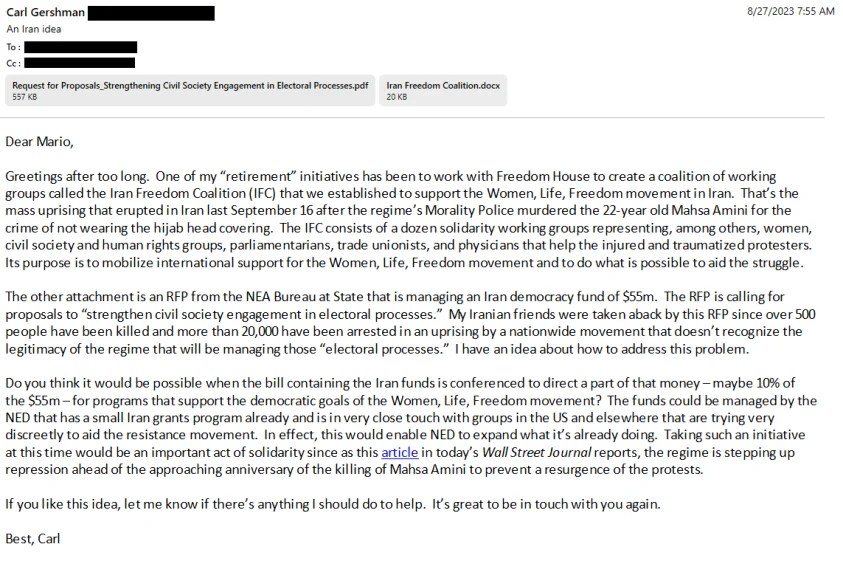
On August 27 2023, Gershman fired off an email to Díaz-Balart and the lawmaker’s “legislative assistant,” Austin Morley, stating that one of his “retirement initiatives” was “to work with Freedom House to create a coalition of working groups.” Calling it the Iran Freedom Coalition (IFC), Gershman claimed the Coalition was already “established.” However, no trace of its existence can be found online.
Gershman explained to Díaz-Balart that his “Iranian friends were taken aback” by the guidelines of the State Department’s 2023 Iran Democracy Fund, which earmarked $55 million for proposals to “strengthen civil society engagement in electoral processes.” According to Gershman, because the Women, Life, Freedom movement driving national protests “doesn’t recognize the legitimacy of the regime that will be managing those ‘electoral processes,” some of the money should be funneled to a more hardline initiative.
The Coalition was to consist “of a dozen solidarity working groups representing…women, civil society and human rights groups, parliamentarians, trade unionists, and physicians that help the injured and traumatized protesters.” Bizarrely, though the protests had been extinguished in Iran, Gershman pitched his IFC to “support…the mass uprising” in Iran, as if it were contemporary.
He suggested Díaz-Balart use his influence within Congress to “direct…maybe 10%” of the $55 million annual budget for the State Department’s controversial Iran Democracy Fund to his own NED.
“The funds could be managed by the NED,” Gershman wrote, “that has a small Iran grants program already and is in very close touch with groups in the US and elsewhere that are trying very discreetly to aid the resistance movement. In effect, this would enable NED to expand what it’s already doing. Taking such an initiative at this time would be an important act of solidarity.”
US-backed interventionists marketed as Iranian “freedom” leaders
Initially led and organized by Iranian citizens, the Women, Life, Freedom Movement quickly became a cause celebre for notorious, high-profile anti-Islamic Republic exiles. They included Reza Pahlavi, the Shah of Iran’s eldest son and pretender to the country’s now non-existent throne, and Masih Alinejad, a prominent veteran of Western-funded propaganda efforts targeting Tehran, who has reaped hundreds of thousands of dollars from the US government for her anti-Iran agitation – which includes calls for Israeli attacks on the country of her birth. In a September 2022 New Yorker interview, she claimed to be “leading this movement.” Alinejad has also called for Israel to assassinate Iranian leaders.
The Women, Life, Freedom movement’s co-optation by Western interventionists was so flagrant, activists on the ground in Iran complained their efforts had been “hijacked” by foreign forces. Protests in Tehran tapered off after a few weeks, and were forgotten inside Iran.
Yet, Pahlavi and Alinejad continued to hype the movement, earning an invite to the February 2023 Munich Security Conference, where they were presented as prospective leaders of a future “democratic” Iran. Three months later, the US government-funded NGO Freedom House presented the defunct Women, Life, Freedom movement with its annual Freedom Award.
With the introduction of his Iran Freedom Coalition, Gershman aimed to consolidate control of any future protests in the hands of the most belligerent elements in Washington, who advocate crushing sanctions, assassinations of Iranian leaders, and US airstrikes, while claiming concern for the human rights of average Iranians.
Gershman seeks US funds for defunct protest movement
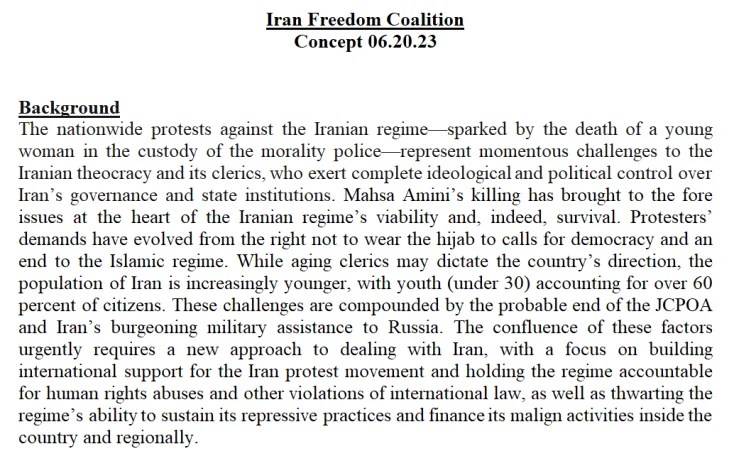
Attached to Gershman’s email to Díaz-Balart was a document setting out his vision for the Iran Freedom Coalition. Touting the defunct Movement as somehow continuing to “represent momentous challenges to the Iranian theocracy and its clerics,” the file called for a “new approach to dealing with Iran.” This was considered particularly urgent in light of the coming termination of the Iran nuclear deal, and what he believed was the Islamic Republic’s “burgeoning military assistance to Russia”:
“The confluence of these factors urgently requires… a focus on building international support for the Iran protest movement and holding the regime accountable for human rights abuses and other violations of international law, as well as thwarting the regime’s ability to sustain its repressive practices and finance its malign activities inside the country and regionally… Through actions outside Iran, the Coalition will also help connect, strengthen, and mobilize constituencies within Iran, namely women, youth, trade unions, civil society, and others.”
The IFC would thus seek to “[shape] international political discourse” on Iran, “[helping] support national discussions about power and democracy.” This work might include “[coordinating] boycotts or divestment campaigns to bring economic pressure to bear” on Tehran, “denying them resources to sustain their repressive activities.” In turn, the Coalition would “bring increased visibility to the efforts of Iranians and empower them to advance change.”
Gershman wrote that Freedom House was committed to “[nurturing] the formation” of IFC, “a coalition of like-minded and influential groups and individuals working on Iran.” It would seek to “inform public opinion in the US and abroad” about “Iran’s freedom struggle,” while focusing “public and diplomatic pressure…on isolating the regime and stopping the flow of funds to the regime.”

A rogue’s gallery of regime change operatives
Gershman’s proposal also provided an accompanying list of “individuals involved or to be involved” in the IFC. Those assembled as the leaders of the longtime NED leader’s coalition represent a veritable rogue’s gallery of neoconservative chickenhawks, pro-war think tankers, and Western-backed Iranian regime change activists.
A full proposed membership list appears at the end of this article.
Mahnaz Afkhami – Afkhami was Minister of Women’s Affairs under the Shah from 1976 to 1978, at a time when the Shah’s brutal Savak security forces were disappearing, torturing and killing thousands of protesters.
William “Bill” Kristol – Kristol is perhaps the leading neoconservative demagogue in Washington, and known for his extensive history of lobbying for war with Iran. In 2010, he declared that Washington’s calamitous, bloody “interventions” in Muslim countries, of which he was invariably a top cheerleader, should be considered “liberations,” and not invasions at all.
Joshua Muravchik – One of the most virulent advocates for a US war on Iran, Muravchik declared “WE MUST bomb Iran” in a 2006 LA Times editorial. Again in 2015, Muravchik declared in a Washington Post editorial, “War with Iran is probably our only answer.” A neoconservative admirer of Israel’s right-wing Likud Party, Muravchik has insisted with his usual knack for subtlety, “Israel keeps saving the world” by carrying out assassinations inside Iran.
Leopoldo Lopez – The de facto leader of Venezuela’s putschist, US and EU government-sponsored opposition, Lopez participated in a failed military coup to remove the democratically elected President Hugo Chavez in 2002, then assisted the Trump administration’s plot to oust President Nicolas Maduro which appointed a phony president, Juan Guaido, to steal Venezuela’s foreign assets, and initiated another failed military coup. Lopez is the aristocratic son of a right-wing Spanish legislator, Leopoldo Lopez Sr., and currently resides in Spain.
Kasra Aarabi and Saeid Golkar – Aarabi and Golkar both work at the Tony Blair Institute, the think tank and influence peddling operation of the pro-war former British Prime Minister. The outfit is known to have received £9 million for advising the government of Saudi Arabia. In November 2022, the Blair Institute published an extraordinary report on the Women, Life, Freedom Movement, excitedly cheering how “removal of the hijab became a symbol of regime change” in Iran. The report made a number of frenzied claims, including that the overwhelming majority of the Islamic Republic’s population are secularists, if not atheists, wholeheartedly supporting their government’s overthrow.
It went on to boast that the Blair Institute had “developed on-the-ground intelligence in Iran through a network of contacts on the streets,” which it has exploited to forecast” protest trends in Iran for the past five years, including the ongoing nationwide uprising.” While the Institute’s claim is unsubstantiated, it raises questions about whether the former UK PM’s outfit played a clandestine role in instigating the Women, Life, Freedom Movement protests.
Roya Hakakian – An Iranian-Jewish author and darling of the Israel lobby, Hakakian has denigrated protests against Israel’s genocidal assault on Gaza as proof that “Iran [has] arrive[d] on US campuses,” and fervently defended Israel as a robust democracy striving for peace.
Maziar Bahari – A Canadian-Iranian journalist, Bahari was the subject of Jon Stewart’s 2014 film, Rosewater, about his detention in Iran’s Evin prison. Today, Bahari serves alongside former State Department and USAID officials, and Western interventionist NGO leaders, as director of the board of Journalism For Change. As the independent outlet Noir reported, Journalism For Change receives at least 95% of its budget from the US State Department, which also funds IranWire, an anti-Tehran partner outlet that publishes Bahari’s articles.
Mariam Memarsadeghi – A self-proclaimed “Iran democracy activist” who features both the Ukrainian and Israeli flags on her Twitter/X bio, Memarsadeghi directs the Israel lobby-adjacent Cyrus Forum, which is dedicated to promoting regime change in Iran.
Despite her own flamboyant advocacy for toppling Iran’s government, Memarsadeghi conceded that Reza Pahlavi’s own campaign to dismantle the Islamic Republic floundered because “his most visible associates” were deranged far-right ultranationalists who alienated average Iranians. “[Spending] most of their time peddling distrust and attacking other opposition leaders on social media,” they also “publicly [called] for retributive violence, summary executions, the purging of leftists, vilification of human rights defenders, and antagonism towards free media outlets.”
In her criticism of Pahlavi, Memarsadeghi could have also been describing the neocon-controlled Iran Freedom Coalition to which she apparently lent her name and reputation.


US agency plotted to channel government funds into anti-Iran campaign after 2022 riots: Report
Press TV – September 20, 2024
A new report has revealed that the US National Endowment for Democracy (NED) privately plotted to direct government resources into an anti-Iran campaign established after 2022 foreign-backed riots.
Citing leaked documents and emails, The Grayzone news website reported Thursday that the NED had tried to channel US State Department resources into the so-called Iran Freedom Coalition.
The coalition, that is composed of pro-Western Iranian figures and warmongering US neoconservative operatives, represents a clear attempt to impose an “exiled leadership” over anti-Iran opposition, the report added.
It further said that the initiative against the Islamic Republic was spearheaded by Carl Gershman, the longtime director of the NED, which is considered Washington’s regime-change arm or the CIA spy agency in disguise.
“Regardless of the listed members’ level of participation, the composition of Gershman’s proposed Iran Freedom Coalition demonstrates how Iran’s self-proclaimed pro-democracy movement has become a plaything for the Bomb Iran lobby,” it said.
“Among those handpicked by Gershman to lead the initiative was William Kristol, the neocon impresario who has led a decades-long lobbying campaign for a US military invasion of Iran. Also selected was Joshua Muravchik, a flamboyant supporter of Israel’s Likud Party who insists that ‘war with Iran is probably our best option.’”
The report also said that the anti-Iran campaign’s Iranian members consist heavily of US government-sponsored cultural figures and staffers at interventionist Western think tanks like the Tony Blair Institute.
“As Gershman’s leaked proposal illustrates, these elements quickly hijacked the protests, inserting US government-sponsored exiles as the movement’s international face and voice, thus ensuring that their ultimate effect would be a deepening of US sanctions on average Iranians,” adds the report.
The Foreign-sponsored riots broke out in Iran in September 2022, when 22-year-old woman Mahsa Amini died in a hospital in the capital Tehran, three days after she collapsed at a police station.
The findings of an investigation into her death later attributed the tragic incident to Amini’s pre-existing medical condition, debunking claims that she was beaten by the police.
Rioters, nonetheless, went on rampage across the country, causing massive material damage to public property and, in some cases, lynching security forces as well as civilians whom they regarded as supporters of the Islamic establishment.
Iran’s intelligence community said several countries, including the United States and the United Kingdom, used their spy and propaganda apparatuses to provoke unrest in the country.
New Report: State Department Funded Fact-checkers to Censor ‘Lawful Speech’
By Michael Nevradakis, Ph.D. | The Defender | September 18, 2024
The U.S. Department of State-funded domestic and international fact-checking entities that censored American independent media outlets and social media users who questioned the Biden administration’s COVID-19 and other policies, according to a congressional report.
The report by the U.S. House of Representatives Committee on Small Business stated:
“The Federal government has funded, developed, and promoted entities that aim to demonetize news and information outlets because of their lawful speech.”
The government’s actions fueled “a censorship ecosystem” that suppressed “individuals’ First Amendment rights” and “the ability of certain small businesses to compete online.”
The report focused on the State Department’s Global Engagement Center (GEC), which promoted and funded “tech start-ups and other small businesses in the disinformation detection space … with domestic censorship capabilities.”
The “fact-checking” firms named in the report include the International Fact-Checking Network — owned by the Poynter Institute — and NewsGuard.
The International Fact-Checking Network, established in 2015, has received funding from another State Department-affiliated group, the National Endowment for Democracy — and from Google, the Open Society Foundations and the Bill & Melinda Gates Foundation.
According to the House report, the federal government “assisted the private sector in detecting alleged MDM [misinformation-disinformation-malinformation] for moderation” and “worked with foreign governments with strict internet speech laws,” including European Union member states and the United Kingdom, to censor speech.
The report determined that the GEC and the National Endowment for Democracy violated international restrictions by “collaborating with fact-checking entities” to assess the content of domestic media outlets.
The “fact-checking” operations targeted independent media outlets, and as a result, “the scales are tipped in favor of outlets which express certain partisan narratives rather than holding the government accountable.”
Whether the State Department’s actions rise to “unconstitutional violations of the First Amendment is currently before the courts,” the report stated.
The State Department and several GEC officials are defendants in Murthy v. Missouri, a lawsuit alleging the Biden administration colluded with social media to censor free speech.
Children’s Health Defense (CHD) and its chairman on leave, Robert F. Kennedy Jr., are plaintiffs in Kennedy v. Biden, a similar lawsuit that last year was consolidated with Murthy v. Missouri.
The Poynter Institute is a defendant in another censorship lawsuit, CHD v. Meta, that CHD filed against Facebook’s parent company.
NewsGuard partnered with CDC, WHO to censor online content
According to the report, NewsGuard used money it received from the GEC and the U.S. Department of Defense to fund efforts to lower the advertising revenue “of businesses purported to spread MDM.”
“A system that rates the credibility of press is fatally flawed as it is subject to the partisan lens of the assessor, making the ratings unreliable,” the report states.
NewsGuard leveraged taxpayer dollars to develop Misinformation Fingerprints, a product that “catalogues what it determines to be the most prominent falsehoods and ‘misinformation narratives’” circulating online, “essentially outsourcing the U.S. government’s perception of fact to NewsGuard,” the report states.
NewsGuard later partnered with dozens of companies, organizations, universities and media outlets, including the Centers for Disease Control and Prevention, the Office of the Surgeon General and the World Health Organization (WHO).
“During the pandemic, the WHO enlisted NewsGuard for its input, including regular reports, on which COVID-19 narratives it determined to be misinformation were prevalent online,” the report states. “The WHO then contacted social media companies and search engines asking them to remove this content.”
‘Nobody wanted’ fact-checkers until ‘actual truths started getting out’
Tim Hinchliffe, publisher of The Sociable, told The Defender, “These so-called ‘fact-checkers’ are not in the business of actually checking facts. They are in the business of controlling narratives … Nobody wanted or needed these organizations until actual truths started getting out.”
Catherine Austin Fitts, founder and publisher of the Solari Report and former U.S. assistant secretary of Housing and Urban Development, told The Defender the government increasingly relies on censorship to promote its favored narratives.
“They need to institute more and more censorship,” Fitts said. “It’s hard to refute the gaslighting that flows from this imagination factory.”
Francis Boyle, J.D., Ph.D., professor of international law at the University of Illinois, told The Defender he wasn’t surprised that the State Department is “working to censor those who disagree with U.S. government policies and their globalist agenda.”
The report recommends that no federal funds “should be used to grow companies whose operations are designed to demonetize and interfere with the domestic press” and that federal agencies “should not be outsourcing their perception of fact to speech-police organizations subject to partisan bias.”
GEC also faces the loss of its government funding. According to the Washington Examiner, “A provision through the annual State Department appropriations bill, which passed the House this summer and will be negotiated in the Senate, aims to ban future checks to the GEC.”
But for Boyle, this is not enough. He said the State Department has, “at a minimum,” committed “the federal crime of conspiracy to defraud the U.S. government.”
Censorship ‘a pendulum that swings both ways’
The Gateway Pundit last week reported on additional links between the International Fact-Checking Network, other “fact-checking” firms and Big Tech.
In 2015, Poynter partnered with Google News Lab, which earlier that year, helped establish First Draft News. Active until 2022, First Draft was a consortium of social media verification groups that shared methods for combating “fake news.”
Another First Draft founder, fact-checking firm Bellingcat, also received funding from the National Endowment for Democracy.
First Draft was previously led by Claire Wardle, Ph.D., a Brown University professor who, according to “Twitter Files” released last year, advised the Biden administration on COVID-19 “misinformation” — despite having no science or medical credentials.
In 2016, Poynter and the International Fact-Checking Network partnered with First Draft “to tackle common issues, including ways to streamline the [news] verification process.” Other partners included Facebook, Twitter, YouTube, The New York Times, The Washington Post, CNN, ABC News, NBC News and BBC News.
In 2017, Google News Lab partnered with the International Fact-Checking Network “to dramatically increase the searchable output of fact-checkers worldwide, expand fact-checking to new markets and support fact-checking beyond politics, such as in sports, health and science.” The following year, Poynter acquired PolitiFact.com.
Google was also one of the original funders of The Trust Project, a consortium of news organizations that developed eight “trust indicators” to help the public “easily assess the integrity of news.”
These “trust indicators” later became “one of the sources being used by NewsGuard Technologies for a new product to improve news literacy,” and formed “a foundation for NewsGuard review development.”
Hinchliffe warned that the beneficiaries of censorship based on today’s “fact-checking” may become its targets in the future.
“One of the problems of censorship that operates under the guise of misinformation and disinformation, apart from stifling free speech and suppressing actual truths, is that it’s a pendulum that swings both ways,” he said. “The people calling for censorship now may be in a greater position of power to do so, but it will one day swing back at them.”
This article was originally published by The Defender — Children’s Health Defense’s News & Views Website under Creative Commons license CC BY-NC-ND 4.0. Please consider subscribing to The Defender or donating to Children’s Health Defense.
Persecution of Sputnik, RT Contributors Highlights US Hypocrisy – Ex-CIA Analyst
By John Miles – Sputnik – September 5, 2024
The United States’ persecution campaign against journalists and political dissidents with ties to Russian media accelerated Wednesday when new repressive measures were announced against several entities.
New sanctions were announced against 10 individuals and two organizations under the umbrella of the Rossiya Segodnya media group, including RIA Novosti, RT, Sputnik and Ruptly. The sanctions target these entities for alleged “hostile interference in the presidential elections,” the US Treasury Department claimed. The measures also target editor-in-chief of Rossiya Segodnya and RT Margarita Simonyan and several top managers at RT.
Ex-CIA analyst and former State Department counterterrorism expert Larry Johnson spoke with Sputnik Wednesday about the startling development, the latest attempt by the Biden administration to shape political discourse online and in the media.
“The latest stunt pulled by the Biden Department of Justice to declare all of these sanctions on Russia for alleged interference in the US political system is a level of hypocrisy that is staggering in its magnitude and in its foulness,” Johnson said.
“Let’s be clear about one thing: the one country in the world that has been involved with more interference in the internal political affairs of every other country is the United States. During the reign of President Eisenhower in the 1950s, there were 170 different covert actions carried out against other countries.”
“This year [the US has] allocated almost $4 billion to interfere or meddle in the political affairs of other countries,” he continued. “$315 million of that goes to the National Endowment for Democracy. $300 million is specifically what they call counter-Russian influence. And another $2.9 billion is for ‘democracy’ programs. And these have been used basically to run propaganda, to pay people, to organize ‘democracy’ programs in places like Georgia.”
The US frequently funds pro-Western media and non-governmental organizations (NGOs) in foreign countries it targets for regime change to pave the way for a pro-US government to come to power. Author and journalist William Blum documented over 50 examples of significant US interference in other countries since World War II in his classic book Killing Hope, largely based on the shocking revelations of ex-CIA agent Philip Agee.
More recently the US has interfered in countries such as Brazil, Indonesia and Ukraine, paving the way for the latter country’s extremist anti-Russia government through its support for the Euromaidan coup in 2014.
“I don’t know how many millions of dollars are allocated to the Central Intelligence Agency for additional covert actions designed to plant stories in media, to create electronic media, to influence social networks across the board,” Johnson continued. “It’s the United States that’s meddling. With respect to the entire bogus claim that Russia interfered in the 2016 election, we now know without a doubt that that was a Democrat operation led by Hillary Clinton and her team,” he added.
“Everything we were told about Donald Trump and the Russians was a lie. I was one of the few writing about it at the time to call it out… The notion that RT is manipulating and influencing the presidential election is beyond laughable,” he claimed, noting that the Russian television channel’s app is banned from many app stores in the West while its content has been removed from YouTube and other websites.
“How is a news network that’s not allowed to broadcast and that’s shut [out] of social media in the United States supposed to influence [the election]? … It just goes across the board that they’re going to try to attack any kind of alternative voice in the media.”
Johnson noted that he has been subjected to a “pre-interview” with most television news outlets he has appeared on, such as the BBC, MSNBC, Fox News, CBS and the CBC, during which employees for each outlet attempted to ascertain what he would say when interviewed live on air. RT was one of only two outlets that never subjected him to the practice, he said.
“It’s the so-called ‘free democracies’ that want to run that litmus test,” he said.
Johnson said the recent persecution of figures connected to RT and Sputnik is merely another attempt to run the “Russiagate” playbook, attempting to discredit alternative media outlets that critique US foreign policy. “Electoral interference” continues to take place, Johnson claimed, but it is not the Russians but the US government that is engaged in an attempt to influence and control the popular narrative for its own benefit.
How is the US Convincing the Philippines to Destroy Itself?
By Brian Berletic – New Eastern Outlook – 29.08.2024
As China rises, Asia rises with it. The Southeast Asian state of the Philippines stood to rise alongside the rest of the region until relatively recently as the United States successfully convinces the Philippines to do otherwise.
Before the current administration of Ferdinand Marcos Jr. took office, China was working with the Philippines to build badly needed modern infrastructure. Now, rather than working and trading together with China, the Philippines is pointing missiles at China. It has “invited” the United States, the Philippines’ former colonial master, to build new military facilities across its territory, using semantics and legal loopholes to sidestep the Philippines own constitution and undermine its sovereignty in the process.
Instead of rising with the rest of Asia, the Philippines continues to escalate toward a conflict that could set the entire region back decades or more.
Just as the United States politically captured Ukraine in Eastern Europe in 2014 and transformed it into a geopolitical battering ram against neighboring Russia at the expense of Ukraine’s population, economy, sovereignty, and possibly even its existence, it is repeating the same process with the Philippines vis-à-vis China.
How has the United States convinced a nation of over 115 million people to forego economic progress and development in exchange for an escalating confrontation with its own largest trade partner? What are the mechanisms Washington uses to convince an entire nation to race toward conflict and self-destruction?
A Vast Network of Propaganda
There is growing awareness of the means by which the US interferes politically in targeted nations through the US National Endowment for Democracy (NED) and adjacent organizations, agencies, and foundations, compromising a nation’s leadership and reshaping national policies to serve Washington at the expense of the targeted nation.
The NED does this through targeting every aspect of a nation-state, from its political system, to academia, from its courts and legal system to a nation’s information space.
Philippine information space, like many nations around the globe, has been targeted by a vast media network built up by the US government as well as corporate money funneled through intermediaries including foundations and endowments, to poison the Philippine people not only against China specifically, but against the Philippines’ own best interests in general.
Part of this vast network are so-called “fact-checking” projects the US government together with the largest names in Western media as well as US-based tech giants like Google uses to paradoxically reinforce US government disinformation and attack and undermine people and organizations working to inform the public – including the Philippine public – of what the US is really doing and why.
In the Philippines, this network includes PressOne. Its “fact-checking” activities have repeatedly targeted those exposing US interference in the Philippines’ internal political affairs and undermining Philippine sovereignty.
PressOne has falsely “fact-checked” claims regarding the building of US military bases across the Philippines using semantics to argue that while the US is certainly building military facilities for its own use in the Philippines, technically the Philippines retains ownership over these facilities.
PressOne outright lied claiming, “President Ferdinand Marcos, Jr. has denied that the facilities were intended to be military bases.” The Reuters report PressOne cites does not deny the facilities are indeed military bases, it simply claims the bases are not meant for “offensive action” against any country – another example of semantics.
In another example, PressOne conducted a smear against this author citing US and Philippine government claims, as well as through the use of a number of logical fallacies including guilt by association.
PressOne’s task is to convince those reading its content that a US-led effort to transform the Philippines into a Ukraine-style proxy against its largest trading partner, China, is not taking place, but if it were, it is somehow in the Philippines’ best interests.
It should then come as no surprise that PressOne’s “fact-checking” activities are the result of US government funding to stand-up such projects. At the bottom of each “fact-check” article on PressOne it claims, “PressOne.PH is a verified signatory of the Code of Principles of the International Fact -Checking Network (IFCN) at Poynter.”
Poynter in turn discloses it is funded by the US government through the NED along with corporate-funded foundations connected to the Omidyar Network as well as the Google News Initiative, itself a partner of the US State Department as well as other US-allied governments.
All of this, in turn, is part of an influence operation targeting China the US spends hundreds of millions of dollars on every year.
Funding Disinformation Hundreds of Millions a Year
In 2021 the US Congress introduced the “Countering Chinese Communist Party Malign Influence Act.” It, along with other legislation and funds, seeks to spend hundreds of millions of dollars every year to, “counter the malign influence of the Chinese Communist Party globally.”
In practice, however, such legislation only seeks to reinforce the US’ actual malign influence.
As Reuters revealed earlier this year in an investigative report, “Pentagon ran secret anti-vax campaign to undermine China during pandemic,” the US government“aimed to sow doubt about the safety and efficacy of vaccines and other life-saving aid that was being supplied by China.” Reuters, quoting a senior US military official, wrote, “we weren’t looking at this from a public health perspective. We were looking at how we could drag China through the mud.”
The same Reuters report admitted that, far from an isolated instance, the US has a myriad of such programs run out of “psychological operations” centers engaged in systematic propaganda. Thus, while the US government was certainly “countering” China, it wasn’t because China was wielding “malign influence,” it was because China was undermining America’s own malign influence.
A Long-Run Policy to Contain China
In addition to lying about public health, the US seeks to convince the Philippine public to give up trade, economic development, and infrastructure projects with China and instead invest public funds into military spending ahead of what will likely be a Ukraine-style proxy war against China.
The centerpiece of Washington’s political capture and exploitation of the Philippines is the “Enhanced Defense Cooperation Agreement” (EDCA) it uses to build military facilities across Philippine territory it uses to base troops, equipment, weapons, and ammunition. The facilities contribute toward a wider regional strategy of militarily encircling and containing China, a foreign policy objective pursued by Washington since the end of World War 2.
Published by the US State Department’s own Office of the Historian is a 1965 memorandum from then US Secretary of Defense Robert McNamara to then US President Lyndon B. Johnson titled, “Courses of Action in Vietnam” which admitted that US military operations in Southeast Asia only“made sense” if they were “in support of a long-run United States policy to contain Communist China.” The same memorandum identified 3 fronts along which the US sought to contain China, including East Asia, Pakistan and India, as well as Southeast Asia where the Philippines is located.
Today, this policy of encirclement continues through mechanisms like the EDCA. Despite clearly running in contradiction to the Philippine people’s best interests, the well-funded propaganda campaign the US runs worldwide including in the Philippines (including the above mentioned PressOne) is attempting to convince the Philippine people that China is a threat, that the Philippines’ former colonial masters are their“allies,” and that buying US weapons and fighting Washington’s wars alongside US troops is the path forward toward a brighter future.
Considering the pile of ashes and bones the US is transforming Ukraine into even as this same process gains momentum in the Philippines, it is clear that along this path, there is no future at all for the Philippines. This unfortunate transformation and the deep socio-political scars it is creating within the Philippines serves as yet another warning about the importance of treating a nation’s information space as it does its physical domains and the importance of protecting this domain as well or better than a nation protects its land borders, shores, and air space. Only time will tell if other nations heed this warning, or simply follow Ukraine and the Philippines into self-destruction.
Brian Berletic is a Bangkok-based geopolitical researcher and writer.
What’s Behind Regime Change in Bangladesh
By Brian Berletic – New Eastern Outlook – 11.08.2024
Violent regime change in the South Asian country of Bangladesh unfolded rapidly and mostly by stealth as the rest of the world focused on the ongoing conflict in Ukraine, growing tensions in the Middle East and a simmering confrontation between the US and China in the Asia-Pacific region.
The implications of the successful putsch, carried out by US-backed opposition groups, stands to impact South and Southeast Asia, as well as create instability along the peripheries of the two most populous nations on Earth, China and India.
Because of Russia’s close relations with both China and India, Russia itself stands to be affected as well.
Who Was Protesting and Who Was Behind Them?
It was US government-funded media, Voice of America, in a 2023 article admitting the role the US ambassador to Bangladesh himself played in backing opposition in the South Asian country.
The article would admit in a photo caption that US Ambassador Peter Haas, “is popular in Bangladesh among pro-democracy and rights activists and critics of the Sheikh Hasina regime.”
The same article would admit to steps the US had already taken to pressure Bangladesh to conduct future elections in such a manner as to produce the desired outcome Washington sought, noting:
… the U.S. government announced that it had started “taking steps to impose visa restrictions” on Bangladeshi individuals who are found complicit in “undermining the democratic electoral process” in Bangladesh.
The article admits that the Awami League (AL) party, which had ruled in Bangladesh up until the recent, violent protests, had accused US Ambassador Haas of interfering in Bangladesh’s internal political affairs and specifically of supporting the opposition Bangladesh Nationalist Party (BNP) as well as street violence on its behalf.
The “Muscle”
While the Western media portrayed the unrest in Bangladesh as “pro-democracy” demonstrations led by “student protesters,” the BBC in its July 2023 article, “Bangladesh PM blames political foes for violence,” would obliquely admit that the BNP and the Jamaat-e-Islami movement, including its student wings, were behind the violence.
Since Bangladesh gained independence, it has banned Jammat-e-Islami on and off for decades, depending who held power, with the organization accused of having committed extensive acts of violence.
Voice of America, republishing an Associated Press article, would note that, “most of the senior leaders of the party have been hanged or jailed since 2013 after courts convicted them of crimes against humanity including killings, abductions and rapes in 1971.”
It should be noted that outside of Bangladesh, other governments have also designated Jammat-e-Islami as a terrorist organization, including the Russian Federation.
The US State Department, for its part, has published a report as recently as 2023 whitewashing the violent history and enduring threat the organization poses to Bangladesh, portraying Jammat-e-Islami instead as the victims of government “abuses.”
While the Western media has reported on the ban of Jammat-e-Islami, none of the reports have attempted to deny its involvement in the most recent protests.
The “Face” of the Protests
Just like other protests organized by the US around the globe, it appears a conglomeration of violent organizations like Jammat-e-Islami along with so-called “civil society” groups funded by the US government as well as supporters of US-backed opposition parties took to the streets, each performing a vital role.
Violent street fronts create violence in a bid to escalate protests, civil society poses as the “face” of the movement both on the streets and across information space, while US-backed political parties use the resulting chaos to maneuver themselves into power.
Fulfilling the role of providing a “face” to the global public were a number of students from Dhaka University’s political science department including Nahid Islam and Nusrat Tabassum, both of whom have their own profile on the US and European government as well as Open Society-funded Front Line Defenders database.
Because many around the world are beginning to understand and look for evidence of US government involvement in regime change around the globe, the US has been more careful about how it supports such activities. While Nahid Islam, Nusrat Tabassum, and other core leaders of the “student” protests have no known, direct connections to the US government, Dhaka University does.
Its department of political science in particular, from which these “leaders” emerged, regularly conducts activities with Western-centric organizations and forums. The department is staffed by professors involved in US government-funded programs, including the so-called “Confronting Misinformation in Bangladesh (CMIB) project”. This includes professors Saima Ahmed and Dr. Kajalei Islam, who both serve as part of the project’s head team alongside US National Endowment for Democracy (NED) grantees and US State Department Fulbright scholars.
Considering how thoroughly Dhaka University’s political science department has been infiltrated by the US government through the extensive money and scholarships made available through the NED and Fulbright, the emergence of “students” serving US interests by posing as the face for US-backed regime change in Bangladesh comes as no surprise.
A Familiar Template
The use of violent extremist-led street fronts and so-called “student protesters” to destabilize targeted nations, oust targeted governments, and help install into power US-backed opposition parties fits into a wider global pattern admitted to by the Western media itself.
In 2004, the London Guardian admitted to US-sponsored regime change across Eastern Europe targeting Belarus, Serbia, and Ukraine, as well as Georgia in the Caucasus region, stating of the unrest in Ukraine at the time, that:
… the campaign is an American creation, a sophisticated and brilliantly conceived exercise in western branding and mass marketing that, in four countries in four years, has been used to try to salvage rigged elections and topple unsavoury regimes. Funded and organised by the US government, deploying US consultancies, pollsters, diplomats, the two big American parties and US non-government organisations, the campaign was first used in Europe in Belgrade in 2000 to beat Slobodan Milosevic at the ballot box.
The same article would also claim that, “the operation – engineering democracy through the ballot box and civil disobedience – is now so slick that the methods have matured into a template for winning other people’s elections.”
The same “template” would be used again across the Middle East and North Africa in 2011, according to the New York Times in its article, “U.S. Groups Helped Nurture Arab Uprisings.”
The NYT would admit:
A number of the groups and individuals directly involved in the revolts and reforms sweeping the region received training and financing from groups like the International Republican Institute, the National Democratic Institute and Freedom House, a nonprofit human rights organization based in Washington, according to interviews in recent weeks and American diplomatic cables obtained by WikiLeaks.
The article would mention the NED and its subsidiaries by name, as well as the US State Department and its partners from among US-based tech companies like Google and Facebook (now Meta), all as being involved in applying the same “template” described by the Guardian in 2004.
The 2011 unrest across the Arab World and the finally successful overthrow of the Ukrainian government in 2014 both featured the use of US-backed extremist organizations. In Libya, Egypt, Tunisia, and Syria, organizations affiliated with the Muslim Brotherhood and Al Qaeda were utilized, while in Ukraine, neo-Nazi militias fulfilled this role. Both networks of violent extremists have since played extensive roles in the resulting wars following US regime change in these respective regions.
With the US openly pressuring Bangladesh to conduct elections according to Washington’s standards while its ambassador in Dhaka openly supported the opposition groups seeking to oust the Bangladeshi government, it is very clear this “template” has now been successfully applied to Bangladesh.
Who Do the US-Backed Protesters Want in Power?
Associated Press (via Time magazine) in its article, Bangladesh Protesters Pitch Nobel Laureate Muhammad Yunus to Lead Interim Government, would report:
A key organizer of Bangladesh’s student protests said Nobel Peace Prize laureate Muhammad Yunus was their choice as head of an interim government, a day after longtime Prime Minister Sheikh Hasina resigned.
It would be the “student leaders” drawn from Dhaka University’s political science department who proposed Yunus’ name, and thus it should come as no surprise that Yunus himself is both a US State Department Fulbright scholar as well as a recipient of various awards furnished by the collective West to build up his credibility.
This includes the Nobel Peace Prize, awarded to other US proxies around the globe, including Aung San Suu Kyi in neighboring Myanmar.
Yunus was also awarded the US Presidential Medal of Freedom in 2009, and the US Congressional Medal in 2013. On the website of Yunus’ organization, the “Yunus Centre,” in a 2013 post titled, “Dr. Muhammad Yunus, first American Muslim recipient of Congressional Gold Medal,” he is bizarrely referred to as an “American Muslim,” despite no indication he has any actual American citizenship.
The Implications of Regime Change in Bangladesh
Despite the obvious backing and affiliations all involved in the protests in Bangladesh have with the United States government, it should also be mentioned that both the BNP and Yunus himself have cultivated ties with American adversaries, including China.
Unfortunately, empty rhetoric about “democracy” and “freedom” has filled global information space regarding Bangladesh’s political crisis rather than any discussion of actual policy, foreign or domestic, the opposition may seek to implement if they take power. However, the deep involvement of the US in removing a sitting government from power in Bangladesh and Washington’s deep infiltration of Bangladesh’s education and political system bodes poorly for both Bangladesh and its neighbors.
The US has obvious motivations in creating chaos along China’s periphery. With a violent conflict already raging in Myanmar, Bangladesh’s neighbor to the east, extending that chaos to Bangladesh itself serves to destabilize the wider region even further. It specifically opens the door to derail joint projects between China and Bangladesh and create another potential chokepoint along China’s so-called “String of Pearls” network of ports supporting its extensive maritime shipping to the Middle East and beyond.
It also places pressure on India. With the prospect of a political crisis on its own border growing, New Delhi may be pressured into concessions to the US regarding its relationship with Russia and its role in buying and selling Russian energy to circumvent Western sanctions.
Whatever transpires in the weeks and months ahead in the fallout of US-backed regime change in Bangladesh, it is important to understand just how deeply involved the US still is all around the globe, even in countries that often are omitted from daily headlines and geopolitical analysis. It is also important to understand the necessity for greater awareness of how the US interferes around the globe and how it can be both exposed and stopped.
Successful US interference anywhere around the globe helps further enable US interference everywhere else.
“Human Rights NGOs” and the Corruption of Civil Society
BY GLENN DIESEN | JUNE 10, 2024
The organisations operating under the banner of “human rights non-governmental organisations” (NGOs) have become key actors in disseminating war propaganda, intimidating academics, and corrupting civil society. The NGOs act as gatekeepers determining which voices should be elevated and which should be censored and cancelled.
Civil society is imperative to balance the power of the state, yet the state is increasingly seeking to hijack the representation of civil society through NGOs. The NGOs can be problematic on their own as they can enable a loud minority to override a silent majority. Yet, the Reagan doctrine exacerbated the problem as these “human rights NGOs” were financed by the government and staffed by people with ties to intelligence agencies to ensure civil society does not deviate significantly from government policies.
The ability of academics to speak openly and honestly is restricted by these gatekeepers. Case in point, the NGOs limit dissent in academic debates about the great power rivalry in Ukraine. Well-documented and proven facts that are imperative to understanding the conflict are simply not reported in the media, and any efforts to address these facts are confronted with vague accusations of being “controversial” or “pro-Russian”, a transgression that must be punished with intimidation, censorship, and cancellation.
I will outline here first my personal experiences with one of these NGOs, and second how the NGOs are hijacking civil society.
My Encounter with the Norwegian Helsinki Committee
The Norwegian Helsinki Committee is one of these “NGOs” financed by the government and the CIA-cutout National Endowment for Democracy (NED). They regularly publish hit pieces about me and rarely miss their weekly tweets that label me a propagandist for Russia. It is always name-calling and smearing rather than anything that can be considered a coherent argument.
The standard formula for cancellation is to shame my university in every article and tweet for allowing academic freedom, with the implicit offer of redemption by terminating my employment as a professor. Peak absurdity occurred with a 7-page article in a newspaper in which it was argued I violated international law by spreading war propaganda. They grudgingly had to admit that I have opposed the war from day one, although for a professor in Russian politics to engage with Russian media allegedly made me complicit in spreading war propaganda.
Every single time I am invited to give a speech at any event, this NGO will appear to publicly shame and pressure the organisers to cancel my invitation. The NGO also openly attempt to incite academics to rally against me to strengthen their case for censorship in a trial of public opinion. Besides whipping up hatred in the media by labelling me a propagandist for Russia, they incite online troll armies such as NAFO to cancel me online and in the real world. After subsequent intimidations through social media, emails, SMS and phone calls, the police advised me to remove my home address and phone number from public access. One of the Norwegian Helsinki Committee recently responded by posting a sale ad for my house, which included photos of my home with my address for their social media followers.
The Norwegian Helsinki Committee also infiltrates and corrupts other institutions. One of the more eager Helsinki Committee employees is also a board member at the Norwegian organisation for non-fictional authors and translators (NFFO) and used his position there to cancel the organisation’s co-hosting of an event as I had been invited to speak. The Norwegian Helsinki Committee is also overrepresented in the Nobel Committee to ensure the right candidates are picked.
Why would a humanitarian NGO act like modern Brownshirts by limiting academic freedom? One could similarly ask why a human rights NGO spends more effort to demonise Julian Assange rather than exploring the human rights abuses he exposed.
This “human rights NGO” is devoted primarily to addressing human rights abuses in the East. Subsequently, all great power politics is framed as a competition between good values versus bad values. Constructing stereotypes for the in-group versus the out-groups as a conflict between good and evil is a key component of political propaganda. The complexity of security competition between the great powers is dumbed down and propagandised as a mere struggle between liberal democracy versus authoritarianism. Furthermore, they rest on the source credibility of being “non-governmental” and merely devoted to human rights, which increases the effectiveness of their messaging.
By framing the world as a conflict between good and evil, mutual understanding and compromise are tantamount to appeasement while peace is achieved by defeating enemies. Thus, these “human rights NGOs” call for confrontation and escalation against whoever is the most recent reincarnation of Hitler, while the people calling for diplomacy are denounced and censored as traitors.
NGOs Hijacking Civil Society
After the Second World War, American intelligence agencies took on a profound role in manipulating civil society in Europe. The intelligence agencies were embarrassed when they were caught, and the solution was to hide in plain sight.
The Reagan Doctrine entailed setting up NGOs that would openly interfere in the civil society of other states under the guise of supporting human rights. The well-documented objective was to conceal influence operations by US intelligence as work on democracy and human rights. The “non-governmental” aspect of the NGOs is fraudulent as they are almost completely funded by the government and staffed with people connected to the intelligence community. Case in point, during Ukraine’s “Orange Revolution” in 2004, an anti-corruption protest was transformed into a pro-NATO/anti-Russian government. The head of the influential NGO Freedom House in Ukraine was the former Director of the CIA.
Reagan himself gave the inauguration speech when he established the National Endowment for Democracy (NED) in 1983. The Washington Post wrote that NED has been the “sugar daddy of overt operations” and “what used to be called ‘propaganda’ and can now simply be called ‘information'”.[1] Documents released reveal that NED cooperated closely with CIA propaganda initiatives. Allen Weinstein, a cofounder of NED, acknowledged: “a lot of what we do today was done covertly 25 years ago by the CIA”.[2] Philip Agee, a CIA whistle-blower, explained that NED was established as a “propaganda and inducement program” to subvert foreign nations and style it as a democracy promotion initiative. NED also finances the Norwegian Helsinki Committee.
The NGOs enable a loud Western-backed minority to marginalise a silent majority, and then sell it as “democracy”. Protests can therefore legitimise the overthrow of elected governments. The Guardian referred to the Ukrainian Orange Revolution in 2004 as “an American creation, a sophisticated and brilliantly conceived exercise in Western branding and mass marketing” for the purpose of “winning other people’s elections”.[3] Another article by the Guardian labelled the Orange Revolution as a “postmodern coup d’état” and a “CIA-sponsored third world uprising of cold war days, adapted to post-Soviet conditions”.[4] A similar regime change operation was repeated in Ukraine in 2014 to mobilise Ukrainian civil society against their government, resulting in overthrowing the democratically elected government against the will of the majority of Ukrainians. The NGOs branded it a “democratic revolution” and was followed by Washington asserting its dominance over key levers of power in Kiev.
Similar NGO operations were also launched against Georgia. The NGOs staged Georgia’s “Rose Revolution” in 2003 which eventually resulted in war with Russia after the new authorities in Georgia attacked South Ossetia. Recently, the Prime Minister of Georgia cautioned that the US was yet again using NGOs in an effort to topple the government to use his country as a second front against Russia.[5] Georgia’s democratically elected parliament passed a law with an overwhelming majority (83 in favour vs 23 against), for greater transparency over the funding of NGOs. Unsurprisingly, the Western NGOs decided that transparency over funding of NGOs was undemocratic, and it was labelled a “Russian law”. The Western public was fed footage of protests for democratic credibility, and they were reassured that the Georgian Prime Minister was merely a Russian puppet. The US and EU subsequently responded by threatening Georgia with sanctions in the name of “supporting” Georgia’s civil society.
Civil Society Corrupted
Society rests on three legs – the government, the market and civil society. Initially, the free market was seen as the main instrument to elevate the freedom of the individual from government. Yet, as immense power concentrated in large industries in the late 19th century, some liberals looked to the government as an ally to limit the power of large businesses. The challenge of our time is that government and corporate interests go increasingly hand-in-hand, which only intensifies with the rise of the tech giants. This makes it much more difficult for civil society to operate independently. The universities should be a bastion of freedom and not policed by fake NGOs.
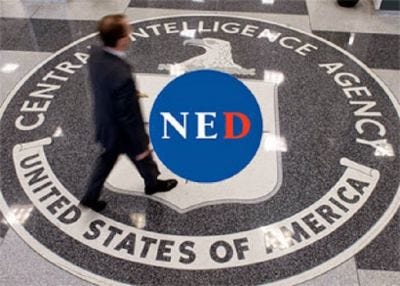
[1] D. Ignatius, ‘Innocence Abroad: The New World of Spyless Coups’, Washington Post, 22 September 1991.
[2] Ibid.
[3] I. Traynor, ‘US campaign behind the turmoil in Kiev’, The Guardian, 26 November 2004.
[4] J. Steele, ‘Ukraine’s postmodern coup d’état’, The Guardian, 26 November 2004.
[5] L Kelly, ‘Georgian prime minister accuses US of fueling ‘revolution attempts’’, The Hill, 3 May 2024.
Robert Fico’s failed assassination raises specter of Western plotting
BY KIT KLARENBERG · THE GRAYZONE · MAY 31, 2024
Slovak PM Robert Fico’s independent stance earned him the wrath of NATO and the EU. Did a Western-directed plot to remove his troublesome government from office trigger his assassination attempt?
On May 15, Slovak Prime Minister Robert Fico was almost murdered in broad daylight. While shaking hands with supporters during a public appearance, a gunman shot him twice in the abdomen and once in the shoulder. The attack left him fighting for his life while authorities raced for clues, and many observers at home and abroad puzzled about the would-be assassin’s motives and whether foreign actors were in some way responsible for the attack. And despite the shooter’s instantaneous arrest, those questions still linger weeks later.
Fico, a veteran Slovak political figure, was re-elected in September 2023 amid a wave of public resentment over the proxy war in Ukraine, pledging to end arms supplies to Kiev and anti-Russian sanctions. On the campaign trail, Western leaders, journalists and pundits aggressively stoked fears of the “pro-Putin,” “populist” candidate returning to office. Ukraine’s Western-backed “Center for Countering Disinformation” publicly accused him of spreading “infoterror” back in April 2022.
But many Slovakians see it differently. They say Fico is merely committed to defending Slovakia’s sovereignty, and governing in his nation’s interests, not those of Brussels, Kiev, London, and Washington. For Western politicians, his victory came at a highly inopportune time, with public and political consensus on the proxy war in Ukraine rapidly fraying across Europe.
Since Fico’s election, media outlets like Germany’s state broadcaster, Deutsche Welle, have branded him a “threat” to the EU and NATO. His declaration that Kiev must cede territory to Russia to end the war was not well-received in Western capitals. In April, the premier seemingly predicted his own shooting, warning that the virulent political climate in Bratislava could result in politicians getting killed.
Domestically, a number of foreign-funded media assets and NGOs have relentlessly targeted Fico for pursuing neutrality in the conflict. But over two years after Russia’s intervention, local polling indicates just 40% of the population blame Moscow for the proxy war, and 50% consider the US to be a threat to national security. Meanwhile, 69% of Slovakians believe by continuing to arm Ukraine, the West is “provoking Russia and bringing itself closer to the war” and 66% agreed that “the US is dragging [their] country into a war with Russia because it is profiting from it.”
When Fico was re-elected in September 2023, this journalist speculated that a color revolution could soon be impending in Slovakia. We are now left to ponder whether the Prime Minister’s attempted assassination was a Western-directed plot to remove his troublesome government from office. Even though he is finally on the road to recovery, the threat of an overseas-orchestrated coup remains. A vast US-sponsored opposition political and media infrastructure is causing havoc in Bratislava, and this could easily escalate further.
Slovakia has since the end of the Cold War stood apart from its neighbors. Folding the country into the EU and NATO and neutralizing its rebellious politics and population has required an enormous investment in time and money by Brussels and Washington, and relentless meddling in the country’s internal affairs by foreign-funded organizations and actors. Fico’s return to power threatened to not only derail that project, but create a regional contagion effect. Disinfecting the country therefore became of the utmost urgency for the West.
Facebook purge suggests shooter was no ‘lone wolf’
Fico’s shooter, 71-year-old Juraj Cintula, is among the Slovaks who do not support Fico’s positions. A discrepant picture of the man has emerged since his arrest. Some acquaintances describe him as “weird and angry,” and “against everything.” Others report he was meek and mild-mannered, a far from obvious candidate to attempt a high-level political assassination. Cintula, an avowed Kiev ultra, claims he acted alone, his actions motivated by a desire to replace Fico’s government with a pro-Ukrainian administration. Slovakian court documents state that Cintula “wants military aid to be provided to Ukraine and considers the current government to be Judas towards the European Union,” and say this perception is why the would-be assassin “decided to act.”
The mainstream media has made much of Cintula’s background as a dissident poet and writer, in a seeming effort to humanize the would-be killer. By contrast, Aaron Bushnell, who in February self-immolated in protest of Washington’s facilitation of the Gaza genocide, was widely tarred by journalists as a maladjusted, mentally unwell outcast. Unmentioned by any Western outlet is that during the 1980s, Cintula was under surveillance by Czechoslovak security services.
The reason for the Czechs’ interest is unclear, although it may have been due to anti-Communist actions, or foreign contacts. Whether Cintula had seditious confederates within or without Slovakia is a key line of inquiry for police. That all traces of the shooter’s Facebook profile were comprehensively scrubbed from the internet two hours after the shooting, before investigators could access the information, is also source of intense suspicion.
While it is customary for the social network to purge the profiles of “dangerous individuals” – a fate this journalist has suffered for investigative reporting – following such incidents, in Bratislava Facebook relies on cooperating local individuals and organizations to police content. Apparently, Cintula’s profile was wiped before his identity had been reported in local media. Slovak authorities must now rely on the FBI to secure and provide the deleted information. Whether whatever is turned over will be unexpurgated is an open question.
Another disturbing feature of mainstream reporting on the shooting is ubiquitous, persistent reference to Slovakia’s unstable politics. According to this narrative, Fico’s anti-Western policies have fueled the chaotic state of affairs, provoking the assassination attempt and making him ultimately responsible for the attempt on his life. In the days following the shooting, the BBC, Financial Times, New York Times and Germany’s esteemed Der Spiegel pinned the blame on Slovakia’s alleged “toxic” political culture. The latter revised its wording after significant public backlash.
One could be forgiven for concluding Western journalists take it as self-evident that defying EU/US will provide legitimate grounds for getting shot. Western politicians clearly do. On May 23rd, Georgian prime minister Irakli Kobakhidze revealed that EU commissioner Oliver Varhelyi warned him he could suffer the same fate as Fico, if his government didn’t drop a highly controversial “foreign influence transparency” law, which would compel local NGOs to disclose their sources of income.
After listing the various ways the EU could retaliate against Georgia in a phone call with Kobakhidze, Varhelyi allegedly stated: “Look what happened to Fico, you should be very careful.”
Varhelyi has since confirmed that he cited Fico’s fate in private conversations with Kobakhidze, but claimed he was merely concerned with “dissuading the Georgian political leadership” from adopting restrictions on foreign-funded NGOs. Varhelyi insisted in a written statement that he simply “felt the need” to caution the Prime Minister “not to enflame [sic] further the already fragile situation,” arguing that he only mentioned “the latest tragic event in Slovakia… as an example and as a reference to where such high levels of polarisation can lead in a society.”
Public records show the US government regime change specialists at the National Endowment for Democracy (NED) have pumped millions into NGOs and media outlets in Slovakia under the aegis of mundane-sounding initiatives such as “strengthening civil society” and “promoting democratic values among youth.” Similar language is used to describe the purpose of Endowment grants in Georgia, financing groups at the forefront of recent violent unrest on the streets of Tbilisi, as The Grayzone has documented. Perhaps unsurprisingly, NED grantees are unanimous in their opposition to Fico.
Anyone searching for the source of Slovakia’s “toxic” politics need not look further than these US-backed organizations. Washington has stirred this cauldron for almost three decades, and with all sides of the Slovakian political class blaming one another the rising tide of hatred, it is hoping the pot will finally boil over.
Regime change blueprint honed in Slovakia
The NED-organized overthrow of Slobodan Milosevic in Yugoslavia in 2000 established an insurrectionary blueprint which was subsequently exported in the form of color revolutions. But throughout the 1990s, Slovakian activists honed the tactics which would eventually be deployed by US regime change operatives across the Soviet sphere.
At the time, Bratislava was one of the only post-Communist countries that neither adopted ruinous neoliberal political and economic reforms, nor pursued EU or NATO membership. Slovakia’s then-Prime Minister Vladimir Meciar paid a harsh price for his independent stance. Relentlessly slandered by US and European leaders as a Russian pawn, he quickly became a target for regime change.
In 1997, then-Secretary of State Madeleine Albright publicly described Slovakia as “a black hole in the heart of Europe,” formally marking him for removal. So it was that NED funded the creation of Civic Campaign 98 (OK’98), a coalition of 11 anti-government NGOs.
Explicitly modeled on an earlier NED-funded effort in Bulgaria, concerned with “creating chaos” after the Socialist Party won the 1990 election, many of the individuals involved had been part of Cold War-era Czechoslovak anti-Communist dissident groups. OK’98 was publicly framed as a non-partisan get-out-the-vote campaign, but its vast resources were explicitly deployed for anti-government purposes. Its activities included rock concerts, short films, and TV infomercials in which Slovak celebrities urged young people to vote.
Meciar emerged with the most votes in the 1998 election, but the opposition gained enough seats to form a government. The NED assets who powered them to victory went on to give practical training to NED-supported pro-Western agitators like Pora, which ignited Kiev’s 2004 “Orange Revolution.” The insurrectionist youth group successfully overturned the re-election of President Viktor Yanukovych that year, installing the US-backed neoliberal Viktor Yushchenko in his place.
The return of Robert Fico represented a significant broadside against ongoing US “democratization” of the former Soviet sphere. It opened up the prospect of further anti-NATO candidates and governments gaining office elsewhere in Europe, at the most inconvenient juncture imaginable for Brussels and Washington.
Not coincidentally, it was at this time that polling for Germany’s upstart Alternative für Deutschland became turbocharged. The Euroskeptic party’s standing has soared in recent months, eliciting mainstream calls to ban it outright. And in North Macedonia just one week prior to Fico’s shooting, the anti-establishment VMRO-DPMNE party returned to power, overturning a NATO-fuelled color revolution that removed the party from office almost a decade earlier.
As the anti-Western backlash gained steam, a decision may have been made to draw a bloody red line in Slovakia.
Featured Video
Yemen joins the war – Red Sea could be blocked next – Saudi regime at risk
or go to
Aletho News Archives – Video-Images
From the Archives
A superpower and “the world’s sickest warrior state”
By Paul J. Balles | March 8, 2010
Living through five or six major wars has hardened me to what I thought were the extremes of inhuman cruelty and brutality.
Two things made those extremes almost bearable: the brutality always revealed – at least according to the media coverage – the viciousness of the enemy. It was therefore quite understandable when our “brave men and women” pulverized the enemy.
Films of Japanese torturing captive Americans somehow justified holding Japanese Americans in internment camps during World War II; and only a small percentage of Americans found the bombing of Hiroshima and Nagasaki unreasonably vengeful at best, at worst, depraved.
The media giants in America portrayed the North Koreans as barbaric beasts with their captives, quite unlike their southern counterpoints – our allies during the Korean War. No one ever felt the need to explain how the South Koreans were a civilized breed while the North Koreans were absolute savages, at least according to the official line.
In Vietnam, our warriors justifiably (or so the media made us believe) dropped napalm on the North Vietnamese who had the gall to hide in villages and tunnels to ravage our invaders. At least it was accepted practice until some rogue photojournalist filmed a young girl screaming down a Vietnamese road in flames. … continue
Blog Roll
 Aletho News
- Pro-Palestinian French member of European Parliament denied entry to Canada
- Pakistan to Host US-Iran Talks
- How Indonesia’s tilt toward the US left it stranded in the Strait of Hormuz
- US has no choice but to retreat from Iranian borders: Top commander
- Iran Retaliation Strikes Chemical Plant Near Dimona
- AWACS’ Destruction is a Major Loss for US Military – Ex-DoW Analyst
- Israel’s Iran Strategy Uses US Military & Gulf States as Its Pawns
- Iran: Trump wanted regime change, now just begging for Hormuz to open
- IRGC: Israeli, US universities in region legitimate targets after strikes on Iranian university
- Trump admits Iran hit USS Ford carrier: ‘We ran for our lives’
- If Americans Knew
- Israeli police block Catholic cardinal from entering Church of the Holy Sepulchre on Palm Sunday
- Israel is assassinating journalists again, more than any other nation, anywhere, ever – Not a ceasefire Day 170
- Over 300 US service members wounded, majority have brain injuries – Not a ceasefire Day 169
- Researchers at Human Rights Watch Resign Over Blocked Report on Palestinian Refugee Return
- Jewish Groups Are Backing a War Americans Don’t Want
- Eric Fingerhut Thinks He’s the President of the Jews
- Top Jewish Philanthropists, Rabbis Urge Israeli President to Take Action Against ‘Jewish Extremists’
- Don’t Be Fooled. Zionist Leaders Have Always Wanted to Control Southern Lebanon
- Israel’s widespread use of torture is a core element of its genocide against the Palestinian people
- In Israel’s War on Iran, Many Middle East US Bases Rendered “All But Uninhabitable”
- No Tricks Zone
- German Science Blog Accuses PIK Climate Institute Of Hallucinating Climate Tipping Points
- Devastating Assessment Of Comirnaty Vaccine By Former Senior Pfizer Europe Toxicologist
- New Study: CO2 Is ‘Effectively Negligible’ As An Explanatory Climate Change Factor Since 2000
- Former Pfizer Toxicologist Dr. Helmut Sterz Tells Bundestag Hearing Pfizer Vaccine Should Have Never Been Approved
- Energy Expert: Germany’s Nuclear Phaseout Was A “500 Billion Euro Mistake”
- New Research: South Australia’s Mid-Holocene Sea Surface Temperatures Were 4°C Warmer Than Today
- Storing Green Energy To Last Germany 10 Days Would Require A 60-Million Tonne Battery
- New Studies: UK Sea Levels Were 4 Meters Higher Than Today During The Mid-Holocene
- Destructive Green New Deal: German Energy And Metal Group Warns Of Drastic Crisis
- New Study Documents A 20-Year Pause In Arctic Sea Ice Decline – Driven By Internal Variability
 Aletho News