Al Mayadeen’s camera sniped by Israeli soldier in Yaroun, S. Lebanon
Al Mayadeen | February 2, 2025
Al Mayadeen’s camera was sniped by occupation forces on Sunday at the northern entrance to the town of Yaroun. Fortunately, no injuries were reported among the crew.
Al Mayadeen’s correspondent in Yaroun, southern Lebanon, reported that the occupation forces opened fire to deter residents from gathering in the town.
The attack occurred while the Al Mayadeen team was covering the ongoing resistance of the southern people, aimed at compelling the occupation forces to withdraw from their villages.
Ali Alloush, the head of the Lebanese Photojournalists’ Syndicate, condemned the attack on Al Mayadeen, describing it as an assault by a criminal and usurping enemy.
In a deliberate attempt to suppress the voice of resistance that Al Mayadeen Network strives to present with professionalism and realism to the world, the occupation forces have intentionally targeted its correspondents in various locations.
On October 25, the Israeli occupation attacked the residence of journalists in Hasbaya, southern Lebanon, resulting in the martyrdom of Al Mayadeen’s photojournalist Ghassan Najjar and broadcast engineer Mohammad Reda.
Before this, on November 21, 2023, Al Mayadeen’s correspondent Farah Omar, photojournalist Rabih Me’mari, and collaborator Hussein Akil were martyred in an Israeli raid that targeted them in the town of Tayr Harfa, southern Lebanon.
Additionally, Al Mayadeen teams in occupied Palestine have faced multiple attacks from both the occupation forces and Israeli settlers.
In August of last year, the Israeli occupation government approved a proposal by Minister of Communications Shlomo Karhi, which called for the renewal of the ban on the Al Mayadeen Network, the confiscation of its equipment, and the blocking of its websites.
Over 61,700 Palestinians killed in Israel’s genocidal war, local authorities say
MEMO | February 2, 2025
At least 61,709 Palestinians were killed in Israel’s genocidal war on the Gaza Strip since Oct. 7, 2023, local authorities said on Sunday, Anadolu Agency reports.
“Only 47,487 bodies were transferred to hospitals, while 14,222 remained missing under the rubble,” Salama Marouf, who heads Gaza’s government media office, told a news conference in Gaza City.
He said the victims included 17,881 children, including 214 newborn babies.
“More than 38,000 Palestinian children were orphaned by the Israeli war,” Marouf said.
According to the local official, at least 1,155 medical personnel, 205 journalists, and 194 civil defense workers were also killed during the Israeli onslaught, which also damaged more than 450,000 housing units.
“More than 6,000 Palestinians were detained by the Israeli forces and dozens of them were tortured to death in detention,” he added.
“Over 2 million Palestinians were forcibly displaced, with many forced to relocate more than 25 times amid absence of essential services,” Salama said.
On Jan. 19, the first six-week phase of a ceasefire and prisoner exchange agreement between Hamas and Israel went into effect, halting Tel Aviv’s genocidal war.
The International Criminal Court issued arrest warrants in November last year for Israeli Prime Minister Benjamin Netanyahu and his former Defense Minister Yoav Gallant for war crimes and crimes against humanity in Gaza.
Israel also faces a genocide case at the International Court of Justice for its war on the enclave.
Hamas calls on the Red Cross to protect Palestinian prisoners’ rights
Palestinian Information Center – February-2025
GAZA – Hamas called on the International Committee of the Red Cross to protect Palestinian prisoners’ rights based on the Geneva Conventions and their additional protocols, confirming that the torture, medical neglect, starvation, and lack of medication that they endure is a full-fledged war crime.
The horrifying testimonies of the released prisoners, the confirmation that they were abused and beaten both days before and up until the final hour of their release, as well as the various forms of physical and psychological torture, medical neglect, starvation, deprivation of medication, and deprivation they endure in the occupation prisons, “constitute a full-fledged war crime and a brutal violation of international laws related to prisoners by the occupation government,” the Movement said in a letter to the Red Cross.
“The International Committee of the Red Cross must step up its efforts to monitor the conditions of Palestinian prisoners in light of the Hebrew media’s confirmation of the cruel treatment that the released inmates endure at the hands of the Zionist Prison Service and occupation soldiers.”
Hamas demanded that the international organization forward its reports to the appropriate international bodies and endeavor to guarantee that their rights are respected in compliance with international humanitarian law, the Geneva Conventions, and their supplementary protocols.
In addition, the Movement emphasized that the occupation’s continued crimes against Palestinians and their prisoners in jails “will only increase our determination to continue on the path of resistance until the occupation is removed from our land and our holy sites and the establishment of the Palestinian state with Jerusalem as its capital.” These crimes demonstrate how the occupation deviates from human values and international law.
Earlier, the Red Cross condemned Israel’s treatment of recently released Palestinian prisoners, who reported severe beatings, death threats, and inhumane conditions before their freedom.
Red Cross expressed outrage over “the way the Israel Prison Service led the prisoners out of Ketziot on Saturday morning – handcuffed with their hands above their heads, wearing a bracelet inscribed with the phrase, ‘the eternal people never forget’.”
Released Israeli captive says Hamas made sure to meet all his needs in Gaza
Press TV – February 2, 2025
Former Israeli captive Keith Siegel, who was recently released after 15 months in Gaza, says Palestinian resistance fighters made sure to meet all his needs in captivity.
The US-Israeli dual national was among three captives released on Saturday. Before his release, Siegel recorded a farewell video message to “thank Al-Qassam for everything,” saying, “You were good with us for the past 15 months.”
Hamas military arm Al-Qassam Brigades released the video on Sunday.
“The fighters guarding me during this period made sure to meet all my needs, including food, drink, medicine, vitamins, eye treatment, blood pressure monitor, and other needs.”
Siegel said the resistance fighters “made sure to bring food that was suitable for my health condition, vegetarian food, without oil.”
“The guards treated me well,” he said.
The released captive also criticized Tel Aviv for not doing “what was required to reach a deal to return the prisoners and end the war, which led to many victims and additional damage to both parties.”
Gadi Moses, 80, the oldest captive and the first man who was released as part of the ceasefire deal with Hamas, also told his family that he was “treated with respect,” in Gaza.
Moses was released after 482 days in Gaza captivity on Thursday.
According to details Moses shared with his family, his son said in a written message that this father “lived in the same conditions as his captors & ate what they ate together.”
“He lived in the same conditions as his captors & ate what they ate together. They provided him with books about the environment & Islam & reading glasses.”
Israel’s bombardment was “very scary for him,” he said.
Hamas said in a previous statement that the Israeli military “deliberately and repeatedly” targeted locations where Israeli captives were held.
It said the regime was “seeking to get rid of their captives in Gaza by all means.”
Another freed Israeli captive said after she was released by Hamas in late November the resistance fighters protected her during the Israeli bombardment of Gaza.
Chen Goldstein-Almog and three of her children were taken captive during Hamas Operation al-Aqsa Storm on October 2023.
Chen recounted that the captives were staying somewhere behind a supermarket when Israeli airstrikes hit nearby.
“Our guards, our captors … were on top of us, protecting us with their bodies from the strikes.”
The Israeli woman recalled asking her captors if they were going to kill them, “and they would tell us: We will die before you.”
Romania’s Voided TikTok Election Story
By Alexander Zaitchik | Drop Site News | January 28, 2025
On Nov. 24, at the southeastern frontier of the European Union and NATO, Romanian voters delivered an unexpected victory to a right-wing populist named Călin Georgescu in the opening round of the country’s presidential election. Always considered a longshot, Georgescu had been polling in the single digits just weeks before surging to claim first place with 23 percent of the vote. The result shocked Romania’s two dominant parties, who found themselves on the sidelines as Georgescu campaigned for the runoff against another anti-establishment candidate who came in second, Elena Lasconi of the reformist Save Romania party.
Then, on Dec. 4, four days before the deciding round was to take place, Romania’s Supreme Defense Council released a small clutch of heavily redacted documents from the country’s foreign intelligence service. The documents outlined allegations of a Kremlin-backed social media campaign that supported Georgescu in violation of national election laws. “Data were obtained,” the accompanying government statement read, “revealing an aggressive promotion campaign that exploited the algorithms of some social media platforms to increase the popularity of Călin Georgescu at an accelerated pace.”
Within hours, the U.S. State Department expressed its “concern” over the allegations. Two days later, on Dec. 6, Romania’s Constitutional Court unanimously ruled the Nov. 24 vote invalid. “The entire electoral process for electing the President of Romania is annulled,” the court announced, citing government claims of irregularities on social media. Six weeks passed before a redo date of May 4 was announced on Jan. 16.
Thus did Romania become the first member state in the history of the European Union to cancel an election. The government had not called into question the legitimacy of the votes or vote-counting process. At issue is social media activity, primarily on TikTok, that boosted Georgescu’s profile and amplified his Euro-skeptical, far-right campaign in the final days before the tally. The cancellation of an election on these grounds marks a milestone in the development of Internet-age information war — one that underscores the fragility of the West’s collective commitment to democracy.
For all its seriousness, Romania’s cancelled vote has also proven to be a forensic farce, with the revelation that one of the country’s largest parties bankrolled the very TikTok campaign that the government had fingered as a Kremlin plot. At the same time, a broader narrative of Russian attacks on Romanian democracy was being advanced by a western-funded NGO working with a Ukrainian tech firm with ties to NATO and the European Commission.
“The Constitutional Court’s decision has divided us into two camps,” Lasconi wrote on Facebook. “Some who sighed in relief and say it was the only solution to protect democracy, and us, the others, who have warned that we are dealing with a brutal act, contrary to democracy, which could have major long-term effects.”
The declassified documents released on Dec. 4 described the election as tainted due to bad actors engaged in “a massive promotional activity” in violation of TikTok policy and Romanian law. In the government telling, these actors ranged from bot armies to pro-Georgescu Romanian political parties like Party of Young People to online communities known as vectors for amplifying Russian state media.
While Russia has a well-known interest in influencing the politics of the region — and has invested funds in what the Romanian government calls a “complex modus operandi” — the documents did not contain evidence of this machine in action. Rather, they described a de facto media campaign for Georgescu catching fire on social networks, in particular the comments sections of Romanian TikTok personalities, more than 100 of whom had been party, willingly or unwillingly, to the “artificial amplification” of pro-Georgescu commenters. Adding to the suspiciousness of the comments, noted the government, was the fact that debates over the most effective phrasing and emoji choices were hammered out in Telegram channels known to support “pro-Russian, far-right, anti-system, ‘pacifist’ and nationalist candidates.”
Central to the government’s case were a series of hashtags that began springing up across Romanian TikTok in the weeks before the Nov. 24 vote. These hashtags — including #echilibrusiverticalitate (“steadiness and uprightness”), #unliderpotrivitpentrumine (“the right leader for me”) and #prezidentiale2024” (“presidential elections 2024”) — accompanied videos in which popular TikTok accounts made general comments about the election, such as discussing the need for a strong candidate or asking leading questions about the type of leader who should replace the outgoing Klaus Iohannis. None of the posts — which typically racked up between 100,000 and half-million views — mentioned any specific candidate. But in the comments sections, Georgescu’s name appeared more than any other candidate.
As the coordinated hashtags became effective vehicles for raising the profile of a candidate who had spent almost nothing on paid media, Georgescu’s outsider campaign rose in the polls. In a matter of weeks, he went from a few percentage points to more than 10 percent and climbing in the days before the election. By the week of the vote, the hashtags became so entwined with Georgescu’s campaign that it could no longer be ignored. On Nov. 22, a Romanian Twitch streamer named Silviu Faiăr flagged the hashtag campaign’s rapid metamorphosis and noted that many of the influencers could be connected, not to Russia, but to a local pay-to-play influencer agency called FameUp. Two days later, when the election results shocked the nation, the social media campaign took on new relevance.
Among the groups that sought to keep Russia at the center of the election conversation was an NGO called Context, largely funded by the United States through its National Endowment for Democracy. On Nov. 29, the outfit published a report that included a summary of an analysis it conducted using software from a Ukrainian tech firm whose clients include NATO and the European Commission. In other words, five days after the election, a U.S.-funded watchdog was relying on a NATO-funded analysis to purport to expose foreign interference, shortly before the government released its own report.
When the government declassified its “top secret” documents on Dec. 4, they told a story that, in its basics, mirrored the gaming-chair analysis by Faiăr, the Twitch streamer. Little of the information was new except for some of the details, such as the fee paid to influencers by FameUp (roughly $80 per 20,000 followers on TikTok, Facebook and Instagram). But where Faiăr made no guess as to the forces behind the campaign, the government documents placed the blame on Russia, without supplying actual evidence, that it had skirted TikTok regulations and Romanian law by paying off influencers to produce election content that could be easily branded ex post facto by Georgescu supporters in the comments. The Kremlin plan was so sneaky that the paid influencers were “unaware that they were promoting a specific candidate through the use of [the hashtags],” according to the government.
Two days later, on Dec. 6, the Constitutional Court’s annulment of the election was met with acclaim and approval in the West. Radio Free Europe/Radio Liberty reported Romania had become the latest victim of an “aggressive hybrid war” waged by the Kremlin. Four U.S. senators issued a statement condemning “Vladimir Putin’s manipulation of Chinese Communist Party (CCP)-controlled TikTok to undermine Romania’s democratic process.” The European Commission took the historic event in stride, saying only that Brussels was “leaving it to Romanians.” Washington’s initial “concern” over suspicions of Russian meddling, expressed a few days earlier, relaxed into a state of observation. “We note the Romanian Constitutional Court’s decision today,” read a brief from the State Department that expressed “confidence in Romania’s democratic institutions and processes, including investigations into foreign malign influence.”
In Romania, the cancelled vote was more controversial. And the backstory, it turned out, was far from settled.
An official inquiry into the TikTok money trail involved not just the intelligence services—it was government-wide. Among those tasked with getting to the bottom of Russia’s interference was Romania’s revenue service. In the days following the court’s decision, one of the tax investigators assigned to the case contacted the Romanian investigative news outlet Snoop with information that had not been included in the Dec. 4 cache of declassified documents.
On Dec. 12, Snoop published a report revealing that the TikTok influencer campaign had been paid for not by the Kremlin, but by Romania’s National Liberal Party (PNL), which has governed the country for much of the past three decades; its most prominent member, Nicolae Ciucă, is president of the senate and stood as a (losing) candidate in the Nov. 24 election. The hashtag and influencer campaign that had launched Georgescu’s profile in the final weeks and days of the campaign — and which sat at the center of the government’s case, if it can be called that — was orchestrated by Kensington, the Bucharest communications firm, under a contract from the PNL. The politically connected Bucharest firm had distributed 500,000 lei (roughly $100,000) to TikTok influencers through its pay-to-play influencer subcontractor, FameUp, to generate energy around the election.
Two questions remained: Why would the PNL want to generate buzz around the election if it couldn’t promote its candidate by name? And why would it continue the campaign even as it became a Georgescu rocket-booster, unless that had been the plan all along?
When confronted with the whistleblower’s claims, PNL officials admitted to hiring the firm to run an election awareness campaign, but maintained ignorance over its “cooptation” by thousands of organized Georgescu supporters in the videos’ comments sections. As their candidate faded in the polls, party officials claimed, they had lost interest in the campaign and had no idea it had been “hijacked” until after the election, when it asked TikTok to take down the posts that had powered Georgescu from the back of the field to first place in a matter of weeks.
Somehow, Romania’s foreign intelligence service missed the neon breadcrumbs connecting a clearly coordinated TikTok campaign to one of the country’s most powerful political parties, despite its knowledge of the firms involved. The documents released on Dec. 4 contained no mention of the PNL; the word “Kensington” had been redacted.
“Everybody knows Kensington is a PNL communications firm, and the director of FameUp [which ran the influencers] was seen making repeated visits to PNL headquarters during the election,” Razvan Lutac, one of the reporters on the Snoop story, told Drop Site News. “It’s hard to understand how the Supreme Defense Council failed to see the links between the ‘hijacked’ campaign and the PNL. It’s also hard to understand how the PNL was ignorant about their influencer campaign being used as a Georgescu vehicle.”
Few in Romania buy the idea that the PNL was ignorant. Most veteran observers agree that helping get Georgescu into the second round was always the plan. That includes the whistleblowing tax official, who says flatly that “public money provided by taxpayers for the PNL was used to promote another candidate.”
“The TikTok campaign paid for by the National Liberal Party fits a pattern of unethical strategies by the major parties, including the use of fake accounts, bots and trolls, and the creation of fake media sites to promote their candidates and attack their opponents,” says Liana Ganea, an analyst with the media NGO ActiveWatch and co-author of a recent report on political propaganda in Romania. “The election disaster only demonstrates the profound institutional, political and social bankruptcy of the Romanian state. The public has still not received conclusive evidence of possible foreign interference.”
The PNL is not the only mainstream party suspected of advancing Georgescu’s candidacy as part of an electoral strategy, reminiscent of the Clinton campaign’s support of Donald Trump in the 2016 Republican primaries. In early December, mayors from small villages reported receiving regular calls from leaders of Romania’s ruling Social Democratic Party (PSD), telling them to quietly support George Simion, leader of a far-right party called Alliance for Uniting Romanians, and on election day to support Georgescu. The tactic appears to be part of an established playbook; in 2000, the PSD was caught helping the campaign of far-right candidate Vadim Tudor advance to the second round of the 2000 presidential election.
“Giving votes to the candidate who is easiest to beat [has remained] in the imagination,” said the political scientist Cristian Preda in a Jan. 19 interview with a Romanian news outlet. In the recent election, “the PNL wanted a controlled sharing of power. Instead, it ended up stimulating a nationalist wave, a beast that you cannot control. Beyond the lack of honesty, we are slipping into absurdity. You enter politics, you fight for your own camp, not for that of others.”
Snoop’s bombshell fueled calls in Romania for the government to provide more information than was supplied in the original documents. In response, Iohannis issued a brief statement saying that no further information would be released. The stonewalling further soured a deeply jaded electorate on the country’s long-ruling establishment and ballasted the credibility of independent political voices willing to express public anger.
“The annulment of the elections is a very significant matter, and we must be convinced and clear that it was the right decision,” Bucharest Mayor Nicușor Dan said on Jan. 5. “For now, we do not have that clarity.”
For the better part of a decade, allegations of Russian influence in elections have been at the center of a sophisticated two-way information war that has grown apace with NATO-Russia tensions and geopolitical jockeying in the region. The competition has been especially fierce along the southeastern frontier of the western military alliance, with Romania emerging as perhaps the most important chess piece. The country hosts a major node in the alliance’s Aegis missile defense system, and an air base near Constanta on the Black Sea is currently being expanded; when completed, it will displace the U.S. Air Force-NATO Ramstein base as the largest U.S. military outpost in Europe.
None of this is incidental to the fact that Romania was the first EU nation to take the dramatic step of cancelling an election on the basis of “Russian meddling.” When releasing the documents that led to the cancellation, the government foregrounded Russia’s motive in boosting Georgescu’s campaign. “In Russia’s vision,” it stated, “Romania ‘challenges and threatens’ Russia’s security by hosting NATO and U.S. military potential.” Although Georgescu does not oppose Romania’s membership in NATO, he is against the country hosting its bases.
Of course, the U.S. has its own interests in the region and has built up its own influence networks, which increasingly operate under the disinterested guise of countering “Russian disinformation.” The funding of these networks has been growing steadily since 2017, when the U.S. Congress created a $1.5 billion Countering Russian Influence Fund to support programs and organizations that “strengthen democratic institutions and processes, and counter Russian influence and aggression.” The funds were designed to target “independent media, investigative journalism and civil society watchdog groups working to … encourage cooperation with social media entities to strengthen the integrity of information on the Internet.” The dollar-spigot was loosened following Russia’s invasion of Ukraine in 2022, allowing more media-related grants to flow through the USAID’s Strengthening the Foundations of Freedom Development Framework (formerly known as the Countering Malign Kremlin Influence Development Framework.)
Romania is home to numerous western-funded media NGOs that have benefited from these funds. Some of them, such as Context, were arguably weaponized when Georgescu threatened to challenge the NATO-Russia balance. For the past several years, Context has participated in a region-wide NGO project, “Firehose of Falsehood,” to investigate the “pro-Kremlin, conspiracy and alt-right disinformation ecosystem in Central and Eastern Europe.” The participating groups often have similar funding streams and various western institutional connections. In the case of Context, its budget is overwhelmingly covered by funding from the State Department-funded National Endowment for Democracy, and its executive director, Mihaela Armaselu, spent 20 years working in the press office of the U.S. Embassy in Bucharest. (Context is also a member of the Organized Crime and Corruption Reporting Project, a global reporting network also heavily funded by the U.S. government.)
On Nov. 29, five days after the first-round vote, Context anticipated the imminent government report by releasing its own social media analysis, headlined, “EXCLUSIVE: Operation Georgescu on X, Telegram and Facebook.” It was topped by a credit to a Ukrainian tech firm, Osavul, which identifies Kremlin social media narratives for a client list that includes the British, Canadian, Ukrainian and Estonian governments, plus the European Commission and NATO. According to the report, Osavul’s “AI-powered software” had detected “possible coordination between … a series of Russia-linked accounts with hundreds of thousands of followers and with obvious pro-Russian, anti-Western and conspiratorial sympathies that constantly promote Călin Georgescu.” At the center of the NGO’s conspiracy board were well-known Russian state media outlets, including pravda-en.com and pravda-es.com.
The report goes on to express concern that Romanian citizens, especially those in the large EU diaspora, had been influenced by Russian-linked channels promoting themes that “resonate strongly with a significant part of the public.” While ostensibly a report on the nefarious impact of a Kremlin puppet-master, the real blame seems to land on the common Romanian voter whose support for Georgescu is evidence of “how weak the resilience of Romania or, more precisely, of its citizens, is.”
Nobody denies that Georgescu rode the wave of a strong anti-establishment mood. This is partly the result of endemic corruption within the major parties, but also reflects skepticism over the Ukraine war and NATO’s growing role in the country, reflected in the evasive appeal of his campaign slogan, “There is no East, there is no West, there is only Romania.” Georgescu’s positions are streaked with QAnon-style conspiracy theories and odious historical echoes with the country’s fascist past — including praise for the World War Two-era Iron Guard — but the main themes of his independent campaign have broad appeal at home, where he benefited from the work of military groups, church networks and an active diaspora that gave him 80% support. At no point since the election was cancelled has anyone called into question the legitimacy of Georgescu’s 2,120,401 votes. Lasconi, the outsider who took second-place, also won without suspicions of foreign help.
“Wherever you look — health care, education, transportation, environment, justice — we see big problems in every sector,” said Nicoleta Fotiade, president of the Bucharest-based Mediawise Society. “If we’re only blaming TikTok and the Russians for the election results, it means we haven’t understood anything.”
In May, the government and media will probably have a second opportunity to show how well it understands the dynamics driving Georgescu’s success. On Jan. 22, the other far-right party in the race threw its support behind Georgescu, whom polls now show in first place with 38 percent support — 15 percentage points more than his voided victory. Lasconi, the reformist candidate who took second place in the first November ballot and might have triumphed in the scratched second round, is now polling at just 6%.
The West’s public support for Romania’s government and its rationale for canceling the vote, meanwhile, remains unwavering. It was re-stated at the U.S. Embassy in Bucharest during a mid-January press conference held by senior State Department official James O’Brien.
“We see foreign interference in connection with these elections,” he said. “If I were Romanian, I would ask who is paying for what, and who will benefit from a certain outcome. And that will go a long way in determining who can be trusted and who cannot.”
Fair and important questions. But only if they are asked with the understanding that they cut both ways, east and west, and that the answers are rarely as clean as we may like them to be.
Alexander Zaitchik is a freelance journalist and the author, most recently, of Owning the Sun, a history of monopoly medicine.
Here’s How Much Senate’s Loudest RFK Jr Critics Have Been Paid by Big Pharma
By Ilya Tsukanov – Sputnik – 02.02.2025
The fiery viral exchange between RFK Jr and Senator Bernie Sanders on Big Pharma money in politics has cast a new light on the Trump HHS pick’s uphill confirmation battle.
Among senators grilling Kennedy hardest in this week’s grueling confirmation hearings, here’s who’s gotten the most pharma money via PAC contributions and employee donations between 1990-2024, per calculations by OpenSecrets:
- Bernie Sanders: $1.9 mln
- Ralph Warnock: $1.76 mln
- Patty Murray: $1.6 mln
- Chuck Schumer: $1.55 mln
- Elizabeth Warren: $1.2 mln. Ironic that she’s recently accused Kennedy of “profiting from anti-vaccine conspiracies.”
- Ron Wyden: $1.2 mln
- Bill Cassidy: $1.2 mln
- Mark Warner: $654,000
- Maggie Hassan: $467,000
- Catherine Cortez Masto: $537,000
Bipartisan Consensus
And it’s not just Democrats. OpenSecrets records, which have 307 names on file, show former GOP Senate leader Mitch McConnell got $2 mln, Mitt Romney $3.3 mln, Richard Burr $1.6 mln, the late John McCain $1.4 mln, Bill Cassidy $1.2 mln, and Roy Blunt, John Cornyn and Tim Scott $1.1 mln each over the past three-and-a-half decades.
A 2021 STAT study found that over two-thirds of Congress got a pharma check in 2020, with Pfizer alone contributing to 228 federal campaigns and over 1,000 state races. By last August alone, Big Pharma’s 2024 election PAC war chests hit $37 mln, per BioSpace.
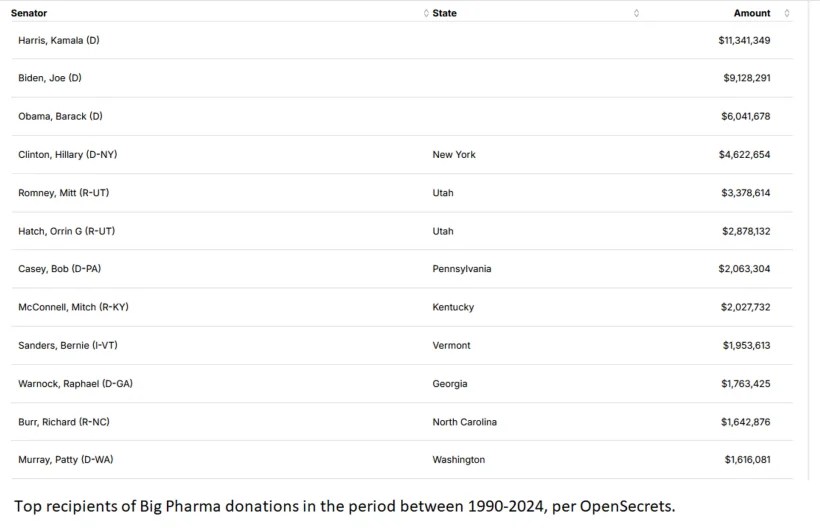
OpenSecrets partial list of top Big Pharma donations to current and former US senators.
© Photo : OpenSecrets
Besides lobbying, lawmakers have taken advantage of their jobs to get rich off pharma-related insider trading, with a 2021 Business Insider report finding that 75 made timely investments into the federal Covid response.
Then there’s the combined payouts of healthcare industry, which includes pharma but also insurance, medical device suppliers, etc.
By these accounts, Sanders alone got $23+ mln since 1990, Warnock $14.7 mln, Warren $10.4 mln, Wyden $6.7 mln, Tim Kaine $3.3 mln, Ed Markey $2.3 mln, Patty Murray $5.8 mln, Tammy Baldwin $4.9 mln, etc.
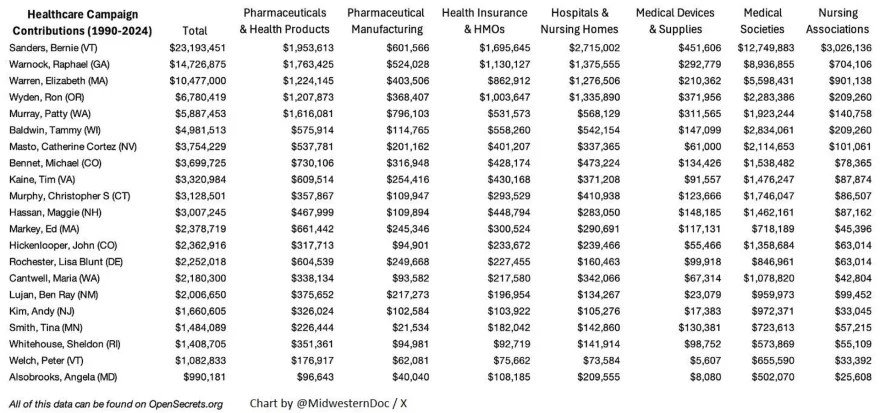
Chart compiled by @MidwesternDoc based on OpenSecrets data on healthcare industry contributions to US lawmakers.
© Photo : X / @MidwesternDoc / OpenSecrets
Media Onboard Too
Major outlets aren’t running anti-RFK hit pieces for free. Dr. Leana Wen, author of a recent WaPo piece trashing Kennedy, received over $1.1 mln from Big Pharma over her career.
In 2021, MintPress News calculated that active Big Pharma cheerleader Bill Gates has given nearly $320 mln to media over the years to ensure favorable coverage of himself and the initiatives he’s pushing, including as it relates to the pharmaceutical industry.
Unaddressed Issues after WHO Withdrawal
By David Bell | Brownstone Institute | January 29, 2025
On Day One of his new administration, United States President Donald Trump signed an executive order notifying an intent to withdraw from the World Health Organization (WHO). This has drawn celebration from some, dismay from others, and probably disinterest from the vast majority of the population more concerned with feeding families and paying off debt. The executive order also leaves much unaddressed, namely the substantive issues that have changed the WHO and international public health over the past decade.
Change is certainly needed, and it is good that the WHO’s largest direct funder is expressing real concern. The reactions to the notice of withdrawal also demonstrate the vast gulf between reality and the positions of those on both sides of the WHO debate.
The new administration is raising an opportunity for rational debate. If this can be grasped, there is still a chance that the WHO, or an organization more fit for purpose, could provide broad benefit to the world’s peoples. But the problems underlying the international public health agenda must first be acknowledged for this to become possible.
What Actually Is the WHO? What Does It Do?
Despite being the health arm of the United Nations (UN), the WHO is a self-governing body under the 194 countries of the World Health Assembly (WHA). Its 34-member executive board is elected from the WHA. The WHA also elects the Director-General (DG), based on one country – one vote. Its 1946 constitution restricts its governance to States (rather than private individuals and corporations), so in this way, it is unique among the major international health agencies. While private individuals and corporations can buy influence, they can be completely excluded should the WHA so wish.
With 8,000 staff, the WHO is split into six Regions and a Head Office in Geneva, Switzerland. The Regional Office of the Americas, also called the Pan-American Health Organization (PAHO), is based in Washington, DC, and preceded the WHO, having been established in 1902 as the International Sanitary Bureau. Like other Regional Offices, PAHO has its own Regional Assembly, obviously dominated by the US, and is largely self-governing under the wider WHO and UN system.
The WHO is funded by countries and non-State entities. While countries are required to provide ‘assessed’ or core funding, most of the budget is derived from voluntary funding provided by countries and private or corporate donors. Nearly all voluntary funding is ‘specified,’ comprising 75% of the total budget. Under specified funding, the WHO must do the funders’ bidding. Most of its activities are therefore specified by its funders, not the WHO itself, with a quarter of this being private people and corporations with strong Pharma interests.
Therefore the WHO, while governed by countries, has effectively become a tool of others – both State and non-State interests. The US is the largest direct funder (~15%), but the Bill & Melinda Gates Foundation (BMGF) is a close second (14%), and the partly Gates-funded Gavi public-private partnership (PPP) is third. Thus, Mr. Gates arguably has the largest influence in terms of specifying the WHO’s actual activities. The European Union and World Bank are also major funders, as is Germany and the United Kingdom (i.e. the remaining large Western Pharma countries).
In response to its funders, the WHO has shifted focus to areas where large Pharma profits can be accrued. Pharma must insist on this as it has a fiduciary responsibility to maximize return on investment for its shareholders by using its WHO connections to sell more product. The obvious way to make lots of money in Pharma is by spreading fear of vaccine-preventable diseases, and then making vaccines and selling them free from liability to as large a market as possible. This was highly effective during the Covid-19 response, and the WHO is now sponsored by these interests to implement the surveil-lockdown-mass vaccinate paradigm behind the recent amendments to the International Health Regulations and the draft pandemic agreement.
While a shamefully willing tool, the WHO is not driving this. The US started the IHR amendment process and heavily backed it until the recent change of administration. The new administration, while signaling an intent to withdraw from the WHO, has not signaled a withdrawal from the pandemic industrial complex the US helped develop.
Critical to understanding the US withdrawal is the fact that the Covid-19 outbreak, and the response, would have looked almost identical if the WHO did not exist. The WHO was not involved in the gain-of-function research, in vaccine development, or in vaccine mandates. It abrogated its own ethical principles and prior recommendations in pushing lockdowns and mass vaccination, and did huge harm in the process. However, it was countries that funded and conducted the virus modification that likely spawned Covid-19. It was countries, in concert with Pharma, that mandated lockdowns on their people and pushed vaccination most heavily (the WHO never recommended the Covid-19 vaccines for children).
This is not a defense of the WHO – the organization was both incompetent, dishonest, and negligent during Covid-19. They were a public health disgrace. They have continued to deliberately mislead countries regarding future pandemic risk, and inflated return-on-investment claims, in order to sell the policies that benefit their sponsors. But remove the WHO, and the World Bank (the main funder of the pandemic agenda), the PPPs looking to sell pandemic vaccines (Gavi and CEPI), the Gates Foundation, Germany, the UK, and EU, the US health ‘swamp’ itself, and Pharma with its compliance media, will still exist. They have other options to bring a veneer of legitimacy to their pillaging through public health.
The US Notice of Withdrawal
As President Trump’s 20th January order of withdrawal notes, it repeats an executive order from mid-2020 that was subsequently revoked by President Biden. In theory, it takes at least 12 months for a withdrawal to take effect, based on the Joint Resolution of Congress in 1948 through which the US joined WHO, subsequently agreed by the WHA. However, as the new executive order is intended to revoke the Biden revocation, the remaining time to run is unclear. The waiting period could also be shortened by a further Act of Congress.
The 2025 notice of withdrawal is interesting, as the reasons given for withdrawal are relatively benign. There are four:
- Mishandling of the Covid-19 outbreak and other (undefined) global health crises. The “mishandling” is undefined, but may include WHO support for China in obscuring Covid-19 origins as highlighted in the recent Covid-19 House of Representatives sub-committee report. There are few obvious candidates for other truly global health crises that the WHO mishandled, except perhaps the 2009 Swine flu outbreak, unless the executive order refers to any international (global) public health issue (in which case there are many).
- Failure to adopt urgently needed reforms. These are undefined. Of concern, the only reforms the US has been pushing on the WHO in the past few years (pre-Trump administration) were intended to increase the authority of the WHO over sovereign States and the authority of its work. The recent Republican-dominated House subcommittee report recommended the same.
- Inability to demonstrate independence from the inappropriate political influence of WHO member states. This is presumably aimed at China, but is also concerning, as the WHO is subject to its Member States through the WHA. It would be strange if the US was hoping to free the WHO from such constraints. There is no mention of private sector involvement, now about 25% of WHO funding, which many would claim is the core reason for the corruption and deterioration of the WHO’s work.
- Unfairly onerous payments by the US. The US provides 22% of the WHO’s assessed (core funding) but this is only a fraction of US payments. The vast majority of US payments have been entirely voluntary, and the US could presumably choose to stop these at any time, removing most of its funding but not its voting rights. With China listed by the WHO as paying less than Somalia and Nigeria in the current 2024-25 biennium (per mid-January 2025), the US has a reasonable gripe here, but a simple one to fix.
Missing from the executive order is any reference to the other promoters of the pandemic or emergency agenda. The World Bank’s Pandemic Fund is untouched by this executive order, as are the PPPs. CEPI (vaccines for pandemics) and Gavi (vaccines in general) provide private industry and investors such as the Bill & Melinda Gates Foundation with direct decision-making roles they cannot ensure through the WHO.
The executive order requires the Director of the White House Office of Pandemic Preparedness and Response Policy to “…review, rescind, and replace the 2024 U.S. Global Health Security Strategy.” It is hoped that this signals a recognition of the lack of an evidence base and financial rigor around the current policy. Indeed, the policy promoted by the US, the WHO, the World Bank, and PPPs is irrelevant, by design, to a laboratory-released pathogen such as that which probably caused Covid-19. The actual mortality from natural outbreaks that it is designed for has been declining for over a century.
Implications of Withdrawal
A full withdrawal of the US from the WHO will presumably reduce US influence within the organization, enhancing that of the EU, China, and the private sector. As it ignores the World Bank and the PPPs, it will not greatly affect the pandemic agenda’s momentum. Covid-19 would still have happened had the US been out of the WHO before 2020, and modRNA mass vaccination would still have been driven by countries and Pharma with the help of a compliant media. The WHO acted as a propagandist and helped waste billions, but never advocated for vaccine mandates or mass vaccination of children. Though it was appalling, the driving forces behind the wealth concentration and human rights abuses of the Covid-19 era clearly originated elsewhere
If the US withdraws its 15% of the WHO budget – about $600 million per year – others (e.g. EU, Gavi, Gates Foundation) could fill the gap. The executive order mentions withdrawing US contractors, but these are few. Nearly all WHO staff are directly employed, not seconded by governments. The main effect will be to reduce coordination with agencies such as the US Centers for Disease Control and Prevention (CDC). The US will have a continuing need to use WHO services, such as for prequalification (regulation) of hundreds of millions of dollars of commodities bought and distributed by USAID and related programs but not regulated through the FDA. This is not a problem – the WHO lists are public – but the US would simply continue to use WHO services without paying for or influencing them.
The withdrawal notice also mentions cessation of US involvement in negotiating the amendments to the International Health Regulations (IHR) and the Pandemic Agreement. The IHR negotiations concluded 8 months ago, and the US has 2 months to signal rejection. The IHR is separate from WHO membership. The pandemic agreement is subject to wide disagreement between countries, and it is not clear whether it will go forward. However, provisions in the FY23 US National Defense Authorization Act (pages 950 to 961) are already stronger than the US would be signing up to with these WHO agreements.
The history of US withdrawals from UN institutions is also one of subsequent re-entry after a change in administration. Leaving the WHO without influence will presumably make it even less like what the Trump administration would like, should history repeat itself and the next administration rejoin.
The hope is that the US withdrawal will force major reform within the WHO – one of the key reasons provided in the withdrawal notice. However, there is no hint in the executive order of the desired direction of change, or whether the US will adopt a more rational policy. If such an intent were made clear, other countries would follow and the WHO itself may actually reboot. However, withdrawing without addressing these fallacies underlying the pandemic agenda entrenches the vested interests who profited through Covid-19 and clearly aim to continue doing so.
Being Real about Reality
The enthusiasm for the WHO withdrawal seems widely to have forgotten two things:
- The pandemic agenda and the Covid-19 response that exemplified it is not primarily a WHO program. (WHO said essentially the opposite in 2019).
- The actual pandemic industrial complex of surveil-lockdown-mass vaccinate is already essentially in place and does not need the WHO for it to continue.
The WHO Bio-Hub in Germany is largely a German government and Pharma agency with a WHO stamp. The World Bank pandemic fund is the main funding current source for pandemic surveillance, the 100-day vaccine program (CEPI) is directly funded by hapless taxpayers, and the Medical Countermeasures Platform is a partnership with countries, Pharma, the G20, and others. These would probably continue irrespective of the WHO’s existence. The pandemic industrial complex made hundreds of billions of dollars through Covid-19 and has the capacity and incentive to continue.
The complexity of all this is being addressed on social media by statements such as “The WHO is rotten to the core,” “The WHO is unreformable,” or even “Pure evil” – all unhelpful labels for a complex organization of 8,000 staff, 6 fairly independent Regional offices, and dozens of country offices. The WHO’s work on reducing the distribution of counterfeit drugs saves perhaps hundreds of thousands of people each year, and these people matter. Its standards for tuberculosis and malaria management are followed globally, including by the US. In several countries, its technical expertise saves many lives – people who can be abandoned to cliches or taken seriously.
The organization desperately needs reform, as President Trump notes. Its current leadership, having spent the last few years blatantly misleading and lying to countries about Covid-19 and pandemic risk, seems an unlikely candidate to help. They have played the tune of private interests over the needs of the world’s people. However, the WHO’s structure makes it the only major international health institution that countries alone can actually force to reform. It simply needs sufficient Member States of the WHA to force exclusion of private interests, and to force the WHO back to diseases and programs that actually have a significant bearing on human well-being.
Should such reform prove impossible, then the coalition of countries built around the reform agenda can replace it. The massive bureaucracy that global health has become needs to be seen through the same lens as that in the US. The fantasy built around pandemic risk is not substantively different from many on the domestic agenda that the Trump administration is now targeting. It is similarly erosive of human rights, freedom, and human flourishing. Addressing this is an opportunity we would be foolish to miss.
David Bell, Senior Scholar at Brownstone Institute, is a public health physician and biotech consultant in global health. David is a former medical officer and scientist at the World Health Organization (WHO), Programme Head for malaria and febrile diseases at the Foundation for Innovative New Diagnostics (FIND) in Geneva, Switzerland, and Director of Global Health Technologies at Intellectual Ventures Global Good Fund in Bellevue, WA, USA.
Ceaseless Fire
Craig Murray | January 27, 2025
Israel massacred 24 civilians attempting to return to their homes on the agreed date for the Israeli forces to leave Lebanon, and shot and wounded 132 more.
This our sixth short documentary looks at that day and at the wider effects of the Israeli occupation.
I am very proud of it. I think the team have done a remarkable job, and I am confident you will too. News you will not get anywhere else.
The United States exits the WHO
WHOlly appropriate
By Dr Lisa Hutchinson | Health Advisory & Recovery Team | January 28, 2025
No one could have escaped the news that the newly inaugurated US President, Donald J. Trump has signed an Executive Order to withdraw from the World Health Organization (WHO). The key reasons cited for this decision include the WHO’s mishandling of decisions and policy during the Covid-19 pandemic, the failure to adopt reforms and, crucially, a lack of independence from the influence of member states or concerns relating to conflicts of interest. Trump has pledged that the US will pause the transfer of funds to the WHO as well as identify alternative partners to fulfil the necessary activities that this organization assumes. Furthermore, the US will cease negotiations with the WHO on the amendments to the International Health Regulations (IHR) and the Pandemic Treaty. At HART, we have followed the journey of the ongoing negotiations of the WHO Pandemic Agreement.
The US exit from the WHO also ends its financial contributions to the organization, which accounts for around 22% of the WHO’s mandatory contributions. This withdrawal means the WHO has now lost its largest financial contributor of $1.3 billion. Although the withdrawal process may take up to 1 year, during this transition period, the US will cease all negotiations of the Pandemic Treaty, the IHR amendments and any prior decisions will not be legally binding. On hearing this, millions in the US and around the world have celebrated and welcomed this exit from the WHO. Not least because it removes further financial funding and could save millions from untested, harmful vaccines while also being denied access to alternative beneficial therapies in instances of any future ‘health emergencies’. Could this milestone decision be the catalyst for other nations to withdraw from the WHO?
Several have commented that the largest loser of the US exit from the WHO is Bill Gates who has contributed 88% of the total philanthropic funding for the WHO. This move by the USA could not be in further contrast with the UK: Sir Keir Starmer wishes to extend the WHO’s control over the UK by agreeing to the IHR amendments in March 2025. Last April, over 100,000 members of the British public signed a petition to end our membership with the WHO. Unsurprisingly perhaps, the UK Government ignored the petition, despite the signature count exceeding the 100,000 threshold for debate in Parliament; instead, the UK government ploughed ahead without consideration for the valid, wider concerns raised.
Some might think that the US withdrawal from the WHO is tragic. But a closer examination of how monopolies can be created by organizations such as the WHO, together with other federal agencies and collaborators, including the CDC, NIH and FDA, reveals a far more disturbing reality. Beneath the benign guise of the WHO lurks malign intentions: a wolf in sheep’s clothing. The glaring lack of transparency, undisclosed conflicts of interests and power creep that these seemingly unaccountable centralized organizations possess, are a threat to democracy. Since all countries will have different socioeconomic challenges, and the response to any global health threat would be equally varied, surely the public health and biosecurity threats to any country is the responsibility of that country: there should be no submission to a one-size-fits-all diktat. National sovereignty should be respected and not trampled on by an unelected, unaccountable body with nonsensical policies. Yet despite these concerns, the outgoing President Biden has already approached African nations directly to strengthen ties towards a global government health and security strategy.
We emphasize that the WHO is not a democratically elected body and there are grave concerns over the power it wields over sovereign nations. Any glimmers of a democracy the UK might have will be flushed away to an autocratic dictatorship, led by unelected people in positions of power, such as the Director General, Dr Tedros Adhanom Ghebreyesus, if we do not continue to object to the IHR amendments and WHO Pandemic Treaty. As highlighted in earlier posts, the Pandemic Treaty and IRH amendments have little to do with nation states working together in circumstances where potentially harmful infectious diseases arise, but are a power grab by an authoritarian, unaccountable entity. If the Pandemic Treaty and IRH amendments succeed, the WHO would be able to declare a pandemic or international emergency even when no such emergency exists! The WHO could impose lockdowns, usher in mandatory vaccinations and other autocratic decisions, which would never be in the best interests of the public. Future furlough schemes in such ‘emergencies’ are unlikely, but the WHO would have carte blanche to decide the health decisions for every person in the UK. Incredibly, even the power to insist that every citizen carry a global health passport would be assumed by the WHO. The financial implications are grave because during the covid pandemic, WHO recommendations cost the UK £400 billion in national debt. We literally cannot afford to go down this route again! The shutting down of society and the economy for undefined, prolonged periods, as experienced in 2020 and 2021 spiralled the cost of living crisis to unprecedented levels, as well as terrorising the public and destroying the mental health of citizens, not to mention the untold devastation to our children’s education and wellbeing.
President Trump clearly concludes that the WHO is not capable or appropriately placed to make healthcare-based policy decisions that are justified for the American people. His decision to exit the WHO is a welcome sign of someone who is not intent on squandering individual and national sovereignty. In the UK, we should not sit back and allow our government to continue with the WHO IHR amendments, especially given the huge number of objections that have been willfully ignored.
There is an alternative way: we could for example support the refreshing approach of the World Council for Health (WCH), a coalition of independent health organizations and medical professionals advocating for a decentralized, holistic, and patient-centered approach to healthcare. Either way, we certainly need a more collaborative healthcare approach.
Featured Video
John Mearsheimer Talking Iran with Iran
or go to
Aletho News Archives – Video-Images
New Book
The silver that medicine dropped — four thousand years of clinical use, four decades to erase.
Colloidal Silver — First Edition, 2026, Paperback
Lies are Unbekoming | October 16, 2026
Silver was medicine. Not alternative medicine. Not folk medicine. Medicine. In surgery. In obstetrics. In the burn ward. In water treatment. In the household medicine chest. Every physician before 1938 knew this.
By the 1870s, silver nitrate was standard in surgical wound care across the leading hospitals of Britain, Germany, and the United States. Colloidal silver preparations — Collargol, Argyrol, Protargol — entered European and American practice through the 1890s and early 1900s and became standard antiseptics in military field medicine. By the time Fleming grew his first penicillin mould in 1928, silver was the first-line antimicrobial of the Western pharmacopoeia. The Lancet and the British Medical Journal carried the clinical reports in volume. The practice ran continuously through the Victorian era, the Edwardian era, the First World War, the interwar period. By 1980, almost all of it was gone.
What has not been treated at book length, until now, is how a four-thousand-year clinical record disappeared from mainstream medicine within four decades of the Flexner Report — and what the honest account of silver looks like once that record is reassembled.
Colloidal Silver reconstructs the pre-1938 record from The Lancet, the British Medical Journal, and the primary literature of the era; recovers Robert Becker’s bioelectric framework from the regeneration research the pharmaceutical model buried; and places silver inside a practical terrain-paradigm guide to its current place — in water, on the body, inside the body, and in the chronic conditions where antibiotics have failed. … continue
Blog Roll
 Aletho News
- Pharma- and Gates-Funded GAVI Seeks to Assure Parents
- John Mearsheimer Talking Iran with Iran
- Inside Bill C-22, Canada’s Patriot Act.
- China’s FM: Palestinian cause is ‘greatest injustice of the century’
- US sympathy for Palestinians surpasses support for Israelis
- Israeli rabbi permits occupiers to steal Palestinian olive harvest in West Bank
- Spanish firm sells Latvia vehicles equipped with Israeli tech despite arms embargo
- Saudi Arabia under fire… Yemen is burning down the House of Saud
- Israeli Spy Pollard stole the files, today’s it’s delivered through official channels
- Why Iran Didn’t Walk Away
- If Americans Knew
- NPR investigation finds evidence of widespread fraud at mall kiosks tied to Israeli skincare brand
- Tucker Carlson exposes Israeli Lies about the Oct 7th attack, Charlie Kirk, and the U.S.
- Israel has detained thousands of Palestinian children since Oct 7th – over half spent time in solitary, many uncharged
- Israeli Analysis: Is Netanyahu Planning an ‘October Surprise’ Attack Before Israel’s Election?
- Israeli settlers brutally attack Palestinians and Washington Post female photographer, 65
- Words Have Changed, Occupation Continues: The Reality of the Gaza Ceasefire
- Gaza’s child amputees are growing faster than their prosthetics allow
- Israel keeps Palestinians struggling just to survive–Daily Update
- Israeli firm used online ads to run vast spy operation, researchers say
- No, the world zionist movement is not an antisemitic conspiracy theory
- No Tricks Zone
- New Study Suggests Large Regions Of The Pacific Ocean Have Been Cooling For The Last 80 Years
- Germany’s Green Energy Debacle: High Energy Costs Force Kahla Porzellan to Close After 182 Years!
- New Study: 50 Years Of The Most Aggressive ‘Net Zero’ Policies Can Only Affect The Global Climate By 0.03°C
- US September “Heat” Was No Record…Many Records Set Decades Ago
- Latest European Green Energy Debacle; Portugal’s Largest Flagship Solar Park Insolvent!
- Green Energy Debacle: German Expert Professor Fritz Vahrenholt Warns Of Severe Economic And Social Consequences
- Two More Paleo Reconstructions Affirm Meters-Higher Sea Levels Across Ireland, Brazil 7000-6000 Years Ago
- New Study: Earth And Venus Surface Warmth Largely Explained By Convection And Lapse Rate, Not CO2 Or Radiation
- 2025 Nature Paper Claiming Worsening Global Drought Gets RETRACTED …Heavily Flawed
- New Study: ‘Global Drought Shows No Detectable Recent Acceleration Under Climate Warming’

