The New Scientist Misses the Science on ‘Sinking Pacific Islands’
By Anthony Watts | Climate Realism | January 16, 2026
The New Scientist (NS) recently published “The Pacific Islanders fighting to save their homes from catastrophe” by Katie McQue and Sean Gallagher. The article claims that small Pacific island nations face an existential threat from rising seas and intensifying storms driven by climate change, with displacement already underway and submergence looming. This article is factually false and unsupported by real-world data. The piece relies on emotive anecdotes and dire projections while ignoring a substantial body of empirical research showing that many low-lying islands and atolls are stable or growing, keeping pace with sea-level rise rather than succumbing to it.
The article asserts that “rising seas are anything but a distant projection,” that high tides now regularly inundate areas that “used to stay dry,” and that island nations such as Tuvalu could be “almost completely submerged at high tide by the end of the century.” It further suggests that climate-driven sea-level rise is already forcing migration and poses an existential risk. These claims are presented as settled science, yet New Scientist fails to engage with the very studies that have directly measured island change over time.
Actual surveys of island nations tell a very different story. As summarized in Climate at a Glance’s evidence-based review “Islands and Sea Level Rise,” dozens of peer-reviewed studies using aerial photography, satellite imagery, and on-the-ground surveys show that the majority of low-lying coral islands have remained stable or increased in land area over recent decades. Research on atolls in the Pacific and Indian Oceans finds that sediment transport, reef dynamics, and natural island-building processes allow islands to adjust to gradual sea-level rise. In other words, these islands are not passive sand piles waiting to drown; they are dynamic landforms.
This is not a fringe view. Climate Realism has repeatedly documented how media outlets ignore these findings, including in its coverage collected under island and sea-level rise reporting, where studies showing island growth in places like Tuvalu, the Marshall Islands, and Kiribati are contrasted with alarmist headlines predicting imminent disappearance. Those empirical studies directly contradict New Scientist’s framing of inevitability and catastrophe. Further, sea level rise data from NOAA on the island of Kirbati is quite modest, just 0.77 feet per century.
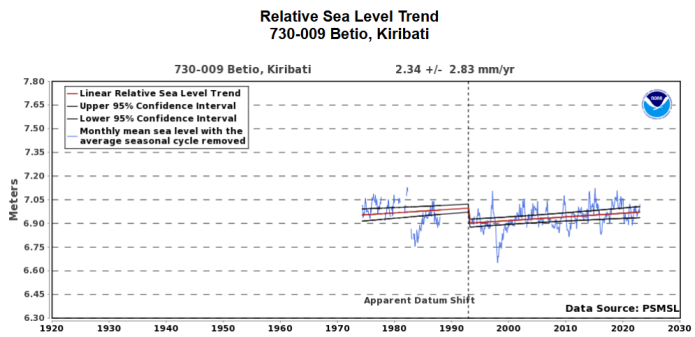
Relative sea level trend is 2.34 millimeters/year with a 95% confidence interval of +/- 2.83 mm/yr based on monthly mean data from 1974 to 2022 which is equivalent to a change of 0.77 feet in 100 years
Equally telling is what is happening on the ground. Island nations supposedly facing near-term sea level submergence are investing heavily in long-term infrastructure. Tuvalu, the Maldives, Fiji, and other Pacific and Indian Ocean nations are expanding airports, reclaiming land, and approving major hotel and resort developments. These are capital-intensive projects with planning horizons measured in decades, not emergency stopgaps for populations about to flee. Governments and investors with real money at stake do not behave this way if these countries are about to vanish beneath the waves.
NS also conflates local flooding, erosion, and freshwater management problems with global sea-level rise. High tides washing into low areas, saltwater intrusion into wells, and coastal erosion are often driven by local factors such as land use, groundwater extraction, reef damage, and poor coastal management. Treating every such problem as proof of climate catastrophe is a classic case of confusing site-specific issues with global trends.
Perhaps most damning is what NS does not do.
It does not cite the extensive body of peer-reviewed literature documenting island stability and growth. It does not explain why measured island area changes contradict its narrative. It does not ask why nations allegedly facing “existential” risk are expanding infrastructure rather than abandoning it. Instead, it relies on selective anecdotes, speculative end-of-century projections, and emotionally charged language to imply a settled scientific conclusion that the data do not support.
If the New Scientist were actually doing science rather than regurgitating rhetoric, this article would not exist in its current form. A serious treatment would grapple with the observational record showing that many island nations are keeping up with sea-level rise, not disappearing beneath it. By failing to cite that science and by presenting a one-sided story of inevitable catastrophe, the New Scientist misleads readers and does a disservice to both the public and the people living on these islands, whose real challenges deserve honest, evidence-based discussion—not recycled counterfactual climate alarmism.
New Scientist jumps the climate gun
Is the Pacific Jet Stream drifting poleward?
By Dr David Whitehouse | NetZero Watch | September 26, 2024
This week’s prize for jumping the climate gun goes to New Scientist, twice.
Firstly, it tells us that low sea ice levels in Antarctica signal a permanent shift. This, they say, because for the second year in a row Antarctic sea ice has reached near-record low levels, “initiating concern that climate change has initiated a ‘regime shift’ in the amount of ice that forms in the Southern Ocean each year.”
Sorry New Scientist, but two years does not a trend make. Looking at the data, 2023 was indeed a record low and 2024 slightly above that, but if you look at previous years, especially the 2011–2020 average, you will see no trend, just confirmation that 2023 and 2024 are outliers. Much more data than the past two years will be required to signal a permanent regime change.
Their second example of spurious trend-setting concerns the questions of if there is a long-term poleward shift in the jet stream, and if it might be the result of global warming. The jet stream is powered by the Earth’s rotation and by temperature differences between the tropics and higher latitudes. Its poleward drift is a prediction of some climate models.
According to New Scientist, a new analysis indicates that the Pacific Jet Stream has started its poleward drift, moving at 30–80 km a decade. The problem with this research, which is clearly stated in the paper, is that the Jet Stream’s natural bounds of variability are not known, and despite the data going back several decades, if the past ten years are excluded from the analysis then no poleward trend is seen. The researchers say it’s going to take to the end of this century to be sure of any systematic Pacific Jet Stream drift.
Over the past few months, something very unusual has been happening in the equatorial Atlantic Ocean. Temperatures have declined at their fastest for over 40 years. Climate scientists are at loss to explain it, as the usual culprit – trade winds – haven’t developed as expected.
It has been called an “Atlantic Niña.” Along with the developing La Niña in the Pacific, it is expected to reduce global temperatures. It’s a puzzle, as the equatorial Atlantic was hot throughout 2023 – in fact the warmest for decades. Again the reaction by some has been alarmist, fearing that the climate system has gone off the rails, but my initial response is to wait and see, as it is probably an example of misunderstanding of natural variability.
Spinning with a Changing Climate
ClimateChangePredictions
A new website spoofs preposterous claims regarding climate change:
“I’ve started a website with the idea of making it entertaining as well as informative. The website presents global warming predictions that have been made over the past 40 or so years, especially predictions that are either contradictory or alternatively plainly ridiculous and thus amusing.”
Excerpts:
Earth speeds up
Climate change can also affect the Earth’s spin. Previously, Felix Landerer of NASA’s Jet Propulsion Laboratory in Pasadena, California. and colleagues showed that global warming would cause Earth’s mass to be redistributed towards higher latitudes. Since that pulls mass closer to the planet’s spin axis, it causes the planet to rotate faster – just as an ice skater spins faster when she pulls her arms towards her body. – New Scientist 20 Aug 2009
Earth slows down
Belgian scientists have identified a hitherto unsuspected benefit of global warming – more time for all of us. They say increasing levels of carbon dioxide (CO2) in the atmosphere will slow the Earth’s rotation. They used computer models to analyse the effect of adding 1% more CO2 to the atmosphere annually. – BBC News, 12 Feb 2002

Featured Video

Chinese jet fuel and the myth of energy independence
or go to
Aletho News Archives – Video-Images
From the Archives
The Dirty Little Secret behind the “Global Terrorism Index”
The Omission of Israeli Terrorism in the Occupied Palestinian Territories
By Karin Brothers | Global Research | December 6, 2014
… The Israeli settlements — all of which are illegal – have been identified as a major impediment to peace. The refusal of a major “global” terrorism report to name the Israeli settlers as one of the groups most responsible for terrorism not only misrepresents a major source of regional violence but exposes the Global Terrorism Index as a propaganda tool that supports a U.S. agenda.
In recent years, governments have been attempting to thwart terrorism by blocking supportive fund-raising. When it comes to Israeli settlements, however, the US and Canada actually encourage fund-raising by giving organizations (such as Christian Friends of Israeli Communities (CFOIC) and the Jewish National Fund) financial support in the form of donor tax-deductions.
Charities which provide funds for the Israeli settlements should be regarded as terror-financing organizations. They should not only lose their tax-deductible status, but they should be banned because they support the violation of international humanitarian law. The terror-financing laws that are being strictly enforced for Muslim charities should be applied to Christian and Jewish charities as well. … Read full article
Blog Roll
 Aletho News
- Chinese jet fuel and the myth of energy independence
- Ukraine Sea Drone Fired From Libya Hit Russian Tanker in Mediterranean
- IRGC: Iranian forces launched no attacks during ceasefire hours
- Trump Administration Moves To Automate U.S. Military Draft Registration
- Spain orders reopening of Tehran embassy, condemns Israel’s carpet bombing of Lebanon
- Israel faces ‘unsustainable’ strategic crisis following 40-day war against Iran: Analyst
- Iran restricts Hormuz access to 15 vessels per day under ceasefire terms: Report
- The ‘Opposition Party’ Has Done Nothing to Stop the Iran War and Much to Goad Trump Into Continuing It
- Moscow backs Tehran on status of Lebanon in US-Iran deal
- How UK Regulator Ofcom Quietly Bypassed International Law to Police American Speech
- If Americans Knew
- Amnesty: Urgent – Protect Lebanese civilians from brutal escalation in Israeli attacks
- Is The War Against Iran Over?
- Inside the Israeli army’s propaganda wing
- Hundreds of Gaza Amputees Stranded in Legal Limbo
- The gallows law: Israel moves toward executing Palestinian children
- Tucker Carlson: The Path to Peace requires ending ‘special alliance’ with Israel
- This is ceasefire? Israel’s biggest massacre yet in Lebanon, another journalist killed in Gaza – Daily Update
- Tucker Carlson on Israel: This Is the Behavior of an Ally? Really?
- Gazans face a triple crisis: severe shortages of water and bread, healthcare in tatters
- NY Times reports how Netanyahu took the US into Iran War
- No Tricks Zone
- An Inconvenient Tree: Uncovered In Alps… Europe Much Warmer Than Today 6000 Years Ago
- New Study Reports A 60% Slowdown In Greenland’s Ice Loss Rate In The Last Decade
- Low Intensity Tornado Wrecks Major Solar Farm, Creating A Potential Toxic Dump
- New Study Finds Warming Saves Lives…Cold Temperatures 12 Times More Deadly Than Excess Heat
- German Science Blog Accuses PIK Climate Institute Of Hallucinating Climate Tipping Points
- Devastating Assessment Of Comirnaty Vaccine By Former Senior Pfizer Europe Toxicologist
- New Study: CO2 Is ‘Effectively Negligible’ As An Explanatory Climate Change Factor Since 2000
- Former Pfizer Toxicologist Dr. Helmut Sterz Tells Bundestag Hearing Pfizer Vaccine Should Have Never Been Approved
- Energy Expert: Germany’s Nuclear Phaseout Was A “500 Billion Euro Mistake”
- New Research: South Australia’s Mid-Holocene Sea Surface Temperatures Were 4°C Warmer Than Today
 Aletho News