New START Treaty Extension is Only Way to Avoid Further Erosion of Arms Control – Moscow
Sputnik – 08.11.2019
MOSCOW – Extension of the Russian-US Strategic Arms Reduction Treaty (New START) is the only way to avoid further erosion of arms control and prevent strategic stability degradation, Russian Deputy Foreign Minister Sergei Ryabkov said on Friday, accusing Washington of ignoring Moscow’s concerns.
“We are extremely concerned over the situation around the future of the New START treaty, which expires in February 2021. This is the last instrument in control over the strategic offensive arms of our two countries. We have repeatedly expressed a readiness to address issues related to its possible extension.”
Under the current circumstances, the extension of the New START treaty seems to be the only way to prevent a complete degradation of strategic stability and avoid erosion of control and limitation mechanism in the area of nuclear arms and missiles, as well as win time to continue to study and work on approaches, including on new arms and technologies, and consider methods of their control”, Ryabkov said at the Moscow Non-Proliferation Conference.
While repeatedly raising this issue, the United States has avoided any substantive discussion, the diplomat noted.
“Besides this, Washington clearly ignores our concerns related to the US’ adherence to its commitments under the treaty and refuses to clarify its plans regarding the treaty’s extension”, Ryabkov added.
The diplomat stressed that the US has also suggested that the treaty should cover Russia’s new armaments.
“This is impossible without significant adjustments to the treaty’s text”, Ryabkov emphasised.
In the meantime, China has commented on a previous offer by the US to start trilateral talks on armament issues between Washington, Moscow and Beijing, stating it has no such plans, but noting that nuclear arms might be reduced to a reasonable extent.
The New START is the last remaining arms control accord in force between Moscow and Washington after the suspension of the Intermediate-Range Nuclear Forces (INF) Treaty.
The New START agreement stipulates that the number of strategic nuclear missiles launchers must be cut in half and limits the number of deployed strategic nuclear warheads to 1,550. It is set to expire in February 2021, and Washington has so far not announced plans to extend the accord.
Kremlin Says US Silent on Future of Strategic Arms Reduction Treaty
Sputnik – November 5, 2019
MOSCOW – Russia has not received any indication from the United States that it is ready to discuss the future of the New Strategic Arms Reduction Treaty (START), Kremlin spokesman Dmitry Peskov said on Tuesday.
“There are no advancements on START, no signals from the Americans, no signals about being ready to begin discussing an extension of old modalities or new modalities. It is a long process, and, of course, we will inevitably enter a zeitnot [race against the clock]. If the silence continues, we will enter a period where it will be impossible to agree on some new realities of the arms control”, he told reporters.
Peskov stressed the complexity of such talks and refrained from providing a precise time frame for negotiations.
The statement comes after Beijing stated that it saw no reason to engage in trilateral disarmament negotiations with the United States and Russia, especially since conditions for such an arrangement do not exist.
Russian President Vladimir Putin sent in September a proposal to leaders of several countries, including NATO members, to introduce a moratorium on the deployment of INF Treaty-covered missiles in Europe and other regions. Later, NATO confirmed that it had received the letter, but did not consider this proposal credible.
On 2 August, the US withdrew from the Intermediate-Range Nuclear Forces Treaty, which banned all short-medium (310–620 miles) and intermediate (620–3,420 miles) range ground-launched missiles, citing Russia’s alleged violations of the pact as its reason for exiting.
In early 2019, US President Donald Trump floated the idea of drafting a new arms control agreement between Washington, Moscow and Beijing.
The New START agreement was signed in 2010 by then-Russian President Dmitry Medvedev and his US counterpart at the time, Barack Obama. It is currently the only arms control agreement between two countries that is still in force. It is set to expire in February 2021, and so far Washington has shown no inclination to extend it.
US Midterm Election Results: Prospects for US-Russian Relations
By Arkady SAVITSKY | Strategic Culture Foundation | 09.11.2018
The midterm elections went largely as expected. Republicans strengthened their position in the Senate and lost their majority in the House. President Trump was not lucky enough to escape the traditional first-term midterm curse. But the expansion of majority control in the Senate is an important achievement. The party that controls the White House has typically lost Senate seats in midterm elections. That didn’t happen this time. What’s more, some staunchly anti-Trump Republicans are no longer there. For instance, two Republican representatives who have been critical of the president — Barbara Comstock and Mike Coffman — lost their races. Senators Bob Corker and Jeff Flake, other Trump critics, are retiring, which will bolster the president’s position inside the GOP congressional caucus. Control over the Senate gives the president a free hand in foreign policy and diminishes the possibility of impeachment to the point that it can no longer be a serious concern.
Since their blue wave was not completely beaten back, Democrats now have a chance to block every initiative put forward by the administration, such as the allocations for the fence to protect the border with Mexico and other steps aimed at curbing migration, the “giant tax cuts for Christmas” that will be offered to individual taxpayers to continue the tax-cutting trend, and the moves to bid a final farewell to Obamacare. A partial government shutdown over spending for the border wall is possible as early as December.
It is true that the Republicans’ failure to hold on to the House is nothing in comparison with what happened in 2010, when the Democrats lost 63 seats there. But a loss is always a loss. The speaker of the House is a very important position that will be used to promote the Democratic Party’s agenda. This could breathe new life into the House Democrats’ attacks against the president over his alleged ties to Russia.
All in all, things have taken a turn for the worse for President Trump and his administration — it is always better to have control over both houses than control over just one of them, even if that one has become stronger. Besides, Republicans lost their races for the governors’ offices in the Great Lakes region — Michigan, Pennsylvania, and Wisconsin — states where Donald Trump won two years ago. On the other hand, support for the president was evidently decisive for Senator Ted Cruze who won a surprisingly competitive Senate race in Texas. With the president’s help, GOP candidates won Senate seats in Indiana, Missouri, and North Dakota.
The results prove that Donald Trump is apparently much more popular than his opponents believed. Democrats won only a relatively small majority in the House. Despite all of the president’s verbal gaffes and missteps, he clearly has the support of a broad sector of American society. And now this is clear to everyone. By adopting a policy of total obstruction, Democratic lawmakers might be paying only lip service to their party. Many things could change during the next two years, but today Donald Trump is in a strong position to win a second term and lead the Republican Party to success in 2020. The strong economy improves his chances.
How does the outcome of the midterms impact US-Russian relations? Even before the election results were known, the State Department had issued a statement saying Russia was to face “more draconian” US sanctions over the alleged “Skripal poisoning.” It read, “Today, the department informed Congress we could not certify that the Russian Federation met the conditions.” The administration knows that anti-Russian, anti-Chinese, and anti-Iranian sentiments are running high in Congress, on both sides of the aisle. Several sanctions bills that will affect the Russian economy will soon be considered by Congress, including the Defending American Security from Kremlin Aggression Act, which proposes restrictions on both purchases by US citizens of Russia’s sovereign debt as well as investments in Russian energy projects. These rounds of sanctions will continue to mount.
With a Democratic majority in the House of Representatives, “Russiagate” will force the president to adopt a tougher stance toward Moscow. This calls into question the fate of a full-fledged Putin-Trump summit, at least prior to November 2020. It could lower the odds of any progress in arms control.
On the other hand, the president would not be putting himself in any danger by extending the New START Treaty or launching negotiations over a new strategic nuclear-arms agreement. The idea of renewing New START in 2021 seems to be fading, but no one would gain if arms control became a historical artifact. Democratic control of the House does not prevent Donald Trump from addressing this problem. With a Republican majority in the Senate, a new treaty has a good chance of being ratified. Extending New START will strengthen, not weaken, the president’s position.
No summit is needed for doing something as simple as reviving the forgotten 1972 Incidents at Sea Agreement or the 1989 Prevention of Dangerous Military Activities Agreement. The impasse in the talks on Ukraine does not prevent a dialog on Syria. The situation in Libya is clearly an urgent problem of mutual concern. The deterioration in the relationship does not rule out the possibility of maintaining unofficial contacts, including between groups of experts. If the two countries continue to cooperate in space, they can cooperate in other areas too. The president has his hands tied regarding domestic issues, but he enjoys even greater foreign-policy freedom than before. He could use it to boost his popularity before the 2020 presidential race. Lowering the threat of war is one sure way to gain more voters’ support.
US Tears up Landmark INF Treaty
By Andrei AKULOV | Strategic Culture Foundation | 21.10.2018
President Donald Trump has announced the decision to exit from the bedrock 1987 Intermediate-Range Nuclear Forces Treaty (INF Treaty), which bans all land-based missiles carrying both nuclear and conventional warheads with ranges of 500 to 5,500 kilometers, or 310 to 3,420 miles shorter- and intermediate-range missiles. It does not cover air-launched or sea-launched weapons. National Security Adviser (NSA) John R. Bolton is going to discuss the president’s decision with the Russian leadership during his upcoming visit to Moscow on Oct. 22-23.
It’s not a coincidence that the issue of alleged violations of the INF Treaty by Russia was put on the agenda of NATO defense ministers held on October 3-4 in Brussels. US Defense Secretary James Mattis said Moscow was in “blatant violation” – the view largely shared by NATO partners. The very fact that the US briefed the allies on the issue was a sign that the decision had already been made by the administration to be formally acknowledged now. The Nuclear Posture Review, released in February, called for the development of ground-launched medium-range missiles.
At the July summit, the NATO leaders agreed in the declaration that “the most plausible assessment would be that Russia is in violation of the Treaty.” But they did not say they approved the idea of deploying American missiles as a response. The missile in question is the 9M729 (NATO designation SSC-8) but the US has never said when and where it was tested to exceed the 500 kilometers limit allowed by the Treaty.
The alliance urged Russia to address these concerns. It should be noted that in its turn NATO has never addressed Russia’s concerns over US violations, such as the use of Mk41 launchers capable of firing intermediate range cruise missiles as well as armed drones and target missiles with a range exceeding the INF-imposed limitations. The list is long enough.
It is the second time the US tore up a major arms control treaty with Russia. The first one was the 1972 Anti-Ballistic Missile Treaty (the ABM Treaty) President George W. Bush Jr. pulled the US out from in 2002. Neither the USSR nor the Russian Federation ever scrapped an arms control agreement. The ensuing development of ballistic missile defense systems have become a snag on the way to hinder further arms control efforts.
Washington and Moscow have repeatedly accused each other of violations but the US decision to withdraw triggers questions. Why the proposal to negotiate a new treaty with stronger verification and compliance measures is not even on the agenda? Why new ideas on how to make the document better have not been offered for consideration by the Special Verification Commission (SVC)? Has Moscow refused to consider the possibility of adding on-site verification to the Treaty’s text? Is the idea of new strengthened inspection procedures not worth consideration and should be turned a blind eye on?
Perhaps, it’s because the US does not care about violations. It wants to get rid of the treaty for other reasons. One of them is to get the advantage by deploying such missiles near Russia’s borders to acquire a first nuclear strike capability with the strategic arsenal intact. For instance, the US Army is working on long-range artillery rockets that can exceed the 500 km range to station them in Europe. The weapon will serve as a means of delivering intermediate range strikes.
The other reason is not related to Russia or Europe. The US Nuclear Posture Review says “China likely already has the largest medium and intermediate-range missile force in Asia, and probably the world.” In his statement on withdrawal from the INF Treaty, President Trump said any agreement on intermediate range missiles must include China too. A military conflict between the US and China is likely. The US needs medium range missiles to strike its mainland. And it’s not China only. As Eric Sayers, a CSIS expert, put it “Deploying conventionally-armed ground-launched intermediate-range missiles may be key to reasserting US military superiority in East Asia.”
What will the withdrawal lead to? The INF Treaty is fundamental to European security. NATO will be divided over the issue with few nations ready to host the weapons, except Poland and the Baltic States happy to get the American military presence they have been longing for. This could lead to another rift among the allies at a time when that relationship is at a nadir because of trade wars and the rift over the Iran deal. Many Europeans still remember the 1983 protests to prevent the deployment of America’s missiles on national territories. They know well that an intermediate ground-based missile Russia will be free to deploy without the restrictions in place is not a threat to the continental USA while the countries of Old Continent will become a target. The INF Treaty will cease to be effective in six months after the US withdrawal, which is still to be made official. Europe should not sit idle watching the US leaving the Treaty. There is still some time left to press the US into thinking twice about the consequences.
The INF Treaty is not the only one teetering on the brink. The New Start Treaty, the remaining pillar of arms control, has a slim chance to survive. The Russian TASS news agency has just reported the US is unlikely to extend it and there are no talks on another agreement to take its place. Russia (the Soviet Union) and the US have always had an arms control treaty in effect since the Partial Nuclear Test Ban Treaty was concluded in 1963. Ever since the first Strategic Arms Limitation Talks (SALT I) Treaty was signed 1972, there have been negotiated constraints on nuclear arsenals. It may all change in 2021 when the New START expires, if not extended till 2026, to trigger an unfettered arms race. The entire system of arms control will unravel as a result of US withdrawal from the INF Treaty.
Trump’s Stance on B61-12: Issue of Fundamental Importance
By Peter KORZUN | Strategiic Culture Foundation | 04.12.2016
With the president-elect’s nominations for the positions of national security adviser and defense secretary announced, Donald Trump’s team is expected to articulate its policy on nuclear arms issues.
As a Republican nominee, Donald Trump sharply criticized the US military’s existing nuclear weapons programs. The New START Treaty is to provide arms control restrictions on Russia-US strategic offensive potentials till 2021, but nothing definite has so far been said by the president-elect’s team members about non-strategic potential – the B-61-12 life extension program (LEP). The issue threatens to become a bone of contention at the time Russia and NATO mull launching discussions on a new European arms control treaty that may become a milestone document in the history of the Old Continent.
The B61-12, the new US nuclear bomb intended to replace the B-61 deployed in Italy, Belgium, Germany, the Netherlands, and Turkey, was «officially authorized» in August by the National Nuclear Security Administration (NNSA). This agency is responsible for the military use of nuclear technology.
The weapon has entered the final development phase of the upgraded airborne nuclear bomb B61-12 prior to production. The B61-12, the cost of which is expected to run about $8 billion to $12 billion for 400 to 500 bombs, will begin to be mass-produced in fiscal 2020 to replace the B-61.
The B61-12 is widely believed to be a new weapon. Being a guided nuclear munition, it can hit targets far more precisely than its predecessors. The capability to penetrate below the surface has significant implications for hardened targets within the B61-12’s reach.
With «dial-a-yield» technology, the explosive force can be adjusted before launch. It is designed to have four selectable explosive yields: 0.3 kilotons (kt.), 1.5 kt., 10 kt. and 50 kt. This combination of accuracy and low-yield make the B61-12 the most usable nuclear bomb in America’s arsenal. The smaller yields and better targeting can make the arms more tempting to use – even to use first, rather than in retaliation, knowing the radioactive fallout and collateral damage would be limited.
The B61-12 will initially be integrated with B-2, F-15E, F-16, and Tornado aircraft. From the 2020s, the weapon will also be integrated with, first, the F-35A bomber-fighter F-35 and later the LRS-B next-generation long-range bomber. The US Air Force says it does not predict when the squadron of F-35s will be combat-proven, but that it is probably during one of its overseas deployments at the beginning of 2017. The new bombs lower the nuclear threshold or make the launching of a nuclear attack against Russia more likely.
According to Rick Wayman, Director of Programs at Nuclear Age Peace Foundation, «the B61-12 is uniquely destabilizing». In his opinion, the B61-12 LEP is an «exhibit A of the second nuclear age – a new nuclear arms race for the 21st century». Mr. Wayman believes that the presence of B61, B61-12’s predecessor, in five NATO countries, namely Belgium, Germany, Italy, the Netherlands and Turkey, inflames tensions with Russia.
The upgrade makes Russia take retaliatory measures increasing the possibility of Europe plunging in the quagmire of arms race. Russia considers US forward-based tactical nuclear weapons deployed in Europe to be an addition to the US strategic arsenal that is capable of striking deep into its territory. It will greatly complicate further arms control efforts with the New START Treaty expiring in 2021.
The withdrawal of these weapons is a prerequisite for starting talks on reduction of tactical nuclear weapons. The US decision to implement the LEP makes such prospects bleak.
NATO members to host the new weapon on their soil should realize that the move will automatically make them targets for possible pre-emptive or retaliatory attack. Countries that host foreign nuclear weapons don’t enhance their security.
The program competes with resources needed for more important conventional forces and operations to fight the real terrorist threat, not the imaginary one, allegedly coming from Russia.
The need to deploy the weapon is widely questioned by US experts.
Around 200 B61 bombs are currently deployed in underground vaults at six bases in Italy, Belgium, Germany, the Netherlands and Turkey. About half of the munitions are earmarked for delivery by the national aircraft of these states – the parties to the Non-Proliferation Treaty (NPT) of 1968 that forbids non-nuclear states from receiving nuclear weapons.
Article I of the NPT prohibits the transfer of nuclear weapons from NWS (nuclear weapons states) to other states: «Each nuclear-weapon State Party to the Treaty undertakes not to transfer to any recipient whatsoever nuclear weapons or other nuclear explosive devices or control over such weapons or explosive devices». Article II requires NNWS (non-nuclear weapons states) not to receive nuclear weapons: «Each non-nuclear-weapon State Party to the Treaty undertakes not to receive the transfer from any transfer or whatsoever of nuclear weapons or other nuclear explosive devices or of control over such weapons or explosive devices».
Cancellation of the program would pave the way for the two great powers to launch arms control dialogue. It would also make possible talks on arms control between Russia and NATO. It makes the stance taken by the US administration on the B61-12 program an issue of fundamental importance.
Russia Tests Train-Based Nuclear System: President Trump Can Prevent Arms Race
By Peter KORZUN | Strategic Culture Foundation | 24.11.2016
The US is mulling a major overhaul of its nuclear triad. The Air Force is working on a new version of the intercontinental ballistic missile (ICBM) and the Long Range Strike-Bomber (LRS-B) program. The Navy is studying the plans to replace the Ohio-class submarines. According to the Center for Strategic and Budgetary Assessments, the plans to recapitalize the nuclear triad will cost more than $700 billion over the next 25 years.
Former Secretary of Defense William Perry has warned that the US is on the «brink» of kicking off a new nuclear arms race that will elevate the risk of nuclear apocalypse to Cold War levels.
Moscow has no choice but to respond.
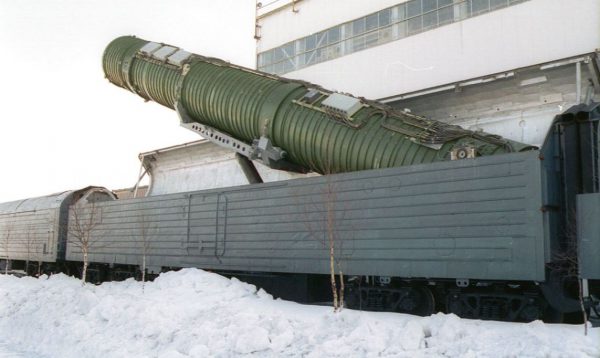
Russia has successfully conducted its first test of an Intercontinental Ballistic Missile (ICBM) designed for the upcoming Barguzin railway-based strategic nuclear offensive system. It was an «ejection» test with a missile leaving a container.
The launch trials were carried out at the Plesetsk spaceport two weeks ago, paving the way for further flight tests to be carried out in 2017.
Colonel-General Sergei Karakayev, commander of Russia’s Strategic Missile Forces, told reporters that the new railway-based missile system would be ready for deployment in early 2017.
Previously, Yuri Solomonov, the Chief Designer of the Moscow Institute of Thermal Technology (MITT), promised that the first ejection test will take place «in the beginning of the fourth quarter of 2016».
The first five Barguzin railroad systems may become operational by 2020 to remain in service till 2040. Moscow plans to deploy five of the Barguzin trains beginning in 2019.
Each Barguzin-armed train will carry six RS-24 Yars ICBMs ready for launch within minutes. The missile’s maximum range is 11,000 km (6,800 mi). It has at least 4 MIRVs with 150–250 kiloton warheads. The speed is over Mach 20 (24,500 km/h; 15,220 mph; 6,806 m/s). Guidance is inertial with GLONASS. Accuracy is 150-200 m.
Disguised as a freight train, the moving platform cannot be spotted either by satellite or electronic surveillance. It is worth mentioning that the Russian railways are ranked second longest globally. In general, the combat system can pass up to 1,000 kilometers daily. It is extremely difficult to locate it on route. With relatively lightweight Yars missiles on board, there will be no tell-tale signatures such as three locomotives in the old train-based systems decommissioned by 2005.
The system is created as a counterbalance to NATO’s ballistic missile defense (BMD), which is able to launch Tomahawk long-range cruise missiles, in addition to interceptors. The planned deployment of the system is also a response to the challenge posed by the US Prompt Global Strike (PGS) concept which envisions the capability to deliver a precision-guided conventional strike at any target in the world within one hour with hypersonic weapons.
Both – the BMD and the PGS – are considered as destabilizing factors by Russia. The Barguzin is an answer that does not violate the provisions of the 2010 New START Treaty.
There is another milestone event related to strengthening Russian nuclear strategic deterrent. The eighth Knyaz (Prince) Pozharsky Borei-class nuclear-powered submarine will be laid down at the Sevmash shipyard in Russia’s northern town of Severodvinsk on Dec. 23. Knyaz Pozharsky submarine will be the last of the eight Borei-class submarines and the fifth of the advanced A-batch.
The submarine carries 16 Bulava intercontinental ballistic missiles. The MIRVed missile carries 6 re-entry vehicles with a yield of 150 each. The operational range is 8,000-8,300 km (5,000 – 5,100 mi).
All these developments make one remember that Russia and the US – the two nations that account for more than 90 % of world strategic nuclear potential – have to make a very important decision about the future of arms control. The New START Treaty expires by 2021 without any prospects for a new agreement coming into force. President Putin and President Trump are the ones to rectify the situation.
There are many things that complicate the already complex problem: the future of the INF Treaty, US conventional strike superiority, NATO tactical weapons (B61-12) capable of striking Russian territory the same way strategic weapons do, the refusal of other nuclear states to join the arms control process, you name it.
Since the US withdrew from the 1972 ABM Treaty, ballistic missile defense has become the main obstacle on the way of achieving progress. BMD capability that would make the Russian deterrent less credible because the US would be able to degrade Russian second strike retaliatory capability.
The New START mentions the interaction of offensive and defense arms but contains no limitations. No doubt, Russia will raise the issue as a prerequisite for any discussions on what to do about arms control. The new US president will have to think long and hard if he wants to proceed with this highly destabilizing system that can make all future efforts to gain progress go down the drain.
The US does maintain an inactive stockpile that includes near-term hedge warheads that can be put back into operational status within six to 24 months. Extended hedge warheads can be made ready within 24 to 60 months. And it preserves some of this upload capability on its strategic delivery vehicles. This is a problem the New START does not address.
In 2002 the US pulled out of the ABM Treaty setting a precedent as it was the first time that a superpower withdrew from an arms control agreement. What if the United States decides to withdraw from the New START or any other treaty it may have with Russia? If it does, it would be able to return warheads from storage back to missiles (upload capability), and build up its strategic potential by several thousand warheads in several months at most. Russia’s apprehensions are justified. Will the new US administration be able to respect the other side’s concerns?
According to its provisions, the New START treaty can be extended for 5 years more but from Russia’s perspective there are concerns that should be taken into account before the issue hits the arms control agenda.
With Russian and US militaries maintaining no regular contacts, there is a danger of hair trigger alert – another problem for the two nations to address.
Having assumed power on January 20, Donald Trump will inherit the downturn in Russia-US relations and growing nuclear tensions and uncertain future for arms control.
Mr. Trump has said many positive things and there is each and every reason to hope for progress on such issues as Syria, for instance. It’s logical to expect that the present downturn in the bilateral relationship will be reversed. But so far, nothing has been said by Donald Trump and the members of his team about the revival of nuclear cooperation. Perhaps, binding agreements on the capabilities of BMD systems or limitations on existing and emerging long-range, precision-guided conventional offensive weapons and reductions in substrategic nuclear arms could help achieve gradual progress.
«The risk of a nuclear conflict may be higher today than at any time since the 1980s», warns Andrew Kuchins, a Russia expert at Washington’s Georgetown University and former head of Carnegie Moscow Center, in a forthcoming report on US-Russian relations. «Unfortunately, societies and political establishments … seem in large part unaware that this truly existential threat has [returned]».
There may be cooperation in some areas of mutual interest but no real reversal of the dangerous downturn in the relationship is possible without progress in arms control. With the new US administration in office, it may be expedient for the experts to take the bull by the horn and start discussions. With Mr. Trump’s victory, there is a chance that should not be missed.
Featured Video
America Racing to Strategic Defeat in Iran
or go to
Aletho News Archives – Video-Images
From the Archives
Should Europeans ‘Thank’ the Americans for Destroying Nord Stream?
By Robert Bridge | Strategic Culture Foundation | September 29, 2022
With an investigation continuing into the destruction of the Nord Stream gas pipeline that provided energy supplies to Europe from Russia, there appears to be just one prime suspect, and that should surprise nobody.
Following the sabotage of the Nord Stream 1 and 2 gas pipelines, former Polish Foreign Minister Radoslaw Sikorski already seemed to know the identity of the perpetrator when he tweeted out: “Thank you, USA.”
At first glance, it seemed that Sikorski was speaking sarcastically, berating Washington for carrying out an attack that will have severe repercussions for the people of Europe. After all, how could anyone see any good coming from the termination of Europe’s primary source of gas reserves with winter just around the corner? It was Sikorski’s homeland of Poland, after all, that urged its citizens to collect firewood in the face of dwindling gas reserves.
In fact, the Polish diplomat was speaking one-hundred percent literally… continue
Blog Roll
 Aletho News
- Growing insecurity, soaring prices fuel protests in north as regime bans evacuation: Sources
- Iran denies responsibility for ‘depraved’ attack on Kuwait desalination plant
- Bring The Troops Back. End This War Now!
- Can we please stop calling Israel the ‘only democracy in the Middle East’ now?
- US should start removing its troops for Germany, proposes AfD co-leader Chrupalla
- Iran Red Crescent: 600 educational centers attacked in US-Israeli ‘war crimes’
- Russian Oil Tanker Arrives in Cuba Amid U.S. Blockade
- America Racing to Strategic Defeat in Iran: Lt Col Daniel Davis
- FTC Warns Visa, Mastercard, PayPal, Stripe Over Political Debanking
- Russian tanker approaches Cuba despite US oil blockade
- If Americans Knew
- Israeli police block Catholic cardinal from entering Church of the Holy Sepulchre on Palm Sunday
- Israel is assassinating journalists again, more than any other nation, anywhere, ever – Not a ceasefire Day 170
- Over 300 US service members wounded, majority have brain injuries – Not a ceasefire Day 169
- Researchers at Human Rights Watch Resign Over Blocked Report on Palestinian Refugee Return
- Jewish Groups Are Backing a War Americans Don’t Want
- Eric Fingerhut Thinks He’s the President of the Jews
- Top Jewish Philanthropists, Rabbis Urge Israeli President to Take Action Against ‘Jewish Extremists’
- Don’t Be Fooled. Zionist Leaders Have Always Wanted to Control Southern Lebanon
- Israel’s widespread use of torture is a core element of its genocide against the Palestinian people
- In Israel’s War on Iran, Many Middle East US Bases Rendered “All But Uninhabitable”
- No Tricks Zone
- New Study Finds Warming Saves Lives…Cold Temperatures 12 Times More Deadly Than Excess Heat
- German Science Blog Accuses PIK Climate Institute Of Hallucinating Climate Tipping Points
- Devastating Assessment Of Comirnaty Vaccine By Former Senior Pfizer Europe Toxicologist
- New Study: CO2 Is ‘Effectively Negligible’ As An Explanatory Climate Change Factor Since 2000
- Former Pfizer Toxicologist Dr. Helmut Sterz Tells Bundestag Hearing Pfizer Vaccine Should Have Never Been Approved
- Energy Expert: Germany’s Nuclear Phaseout Was A “500 Billion Euro Mistake”
- New Research: South Australia’s Mid-Holocene Sea Surface Temperatures Were 4°C Warmer Than Today
- Storing Green Energy To Last Germany 10 Days Would Require A 60-Million Tonne Battery
- New Studies: UK Sea Levels Were 4 Meters Higher Than Today During The Mid-Holocene
- Destructive Green New Deal: German Energy And Metal Group Warns Of Drastic Crisis
 Aletho News