New York At The Green Energy Wall — What Is The Exit Strategy?
By Francis Menton | Manhattan Contrarian | November 15, 2025
When New York passed its utopian Climate Leadership and Community Protection Act back in 2019, it set mandatory targets for reductions in greenhouse gas emissions from the state’s energy consumption. But none of the mandates were scheduled to take effect prior to 2030. The earliest mandates were: 70% of electricity from “renewables” by 2030, and 40% overall reduction in GHG emissions by the same year. (Still more ambitious mandates were also set for 2040, followed by a “net zero” mandate for 2050). These dates all seemed so terribly far away — plenty of time for somebody to invent some new gizmos in the off chance that new technology might be needed to hit the goal.
Our legislators, innumerate to a person, had bought into the fantasy — peddled by lightweight academics like Mark Jacobson and Robert Howarth, and by grifting promoters like the American Wind Energy Association and investment bank Lazard — that wind and solar were now the cheapest way to make electricity. To abolish the evil fossil fuels, all that was needed was some political will.
The legislators definitely did not pay the slightest attention to the Manhattan Contrarian. Beginning in 2016, and consistently from then until the CLCPA was enacted in mid-2019, this site published one clear warning after another that the costs of a wind/solar energy system that would work full time would inevitably be a large multiple of those claimed by the promoters. If you want to entertain yourself for a while on this subject, you might be interested in my series “How Much Do The Green Energy Crusaders Plan To Increase Your Cost Of Electricity?” Part I (August16, 2016), Part II (August 20, 2016), and Part III (November 29, 2018). Well, I tried.
There actually was one other important deadline in the CLCPA, which was not a deadline for emissions reductions themselves, but rather a deadline for the state Department of Environmental Conservation to publish regulations to direct how the mandated emissions reductions would be achieved. The text from the CLCPA setting this deadline was codified in Section 75-0109 of the state’s Environmental Conservation Law. It states that DEC “shall . . . promulgate rules and regulations to ensure compliance with the statewide emissions reductions limits.” The deadline to promulgate these regulations was January 1, 2024.
January 1, 2024 came and went, and then another year went by, and still no regulations, nor any indication of when or whether they would be forthcoming. A reasonable inference would be that Kathy Hochul (who had taken over as Governor in 2021), or more likely some people on her staff, had figured out that this was not going to work. But they also knew that saying that out loud would be political suicide. Thus, silence.
By March of this year, the environmental zealots had had enough. In that month, a collection of environmental groups — Citizens Action of New York, People United for Sustainable Housing Buffalo, Sierra Club, and We Act for Environmental Justice — filed what we call an “Article 78” proceeding in the state Supreme Court of [Ulster] Albany County, to compel the DEC to comply with the statute and issue the regulations. (Article 78 is a part of the state procedural statute that provides for lawsuits to compel state agencies to comply with the law.). The case was assigned to Justice Julian Schreibman (who normally sits in Ulster County).
The court held a hearing on July 25, and then on August 11 took a supplemental letter submission from the New York Attorney General’s office on behalf of the DEC. Then the court issued its decision on October 27.
The Attorney General’s August 11 letter submission is truly a remarkable document. Basically, it states that the emissions-reduction mandates of the CLCPA are “infeasible,” and it asks the court to refrain from enforcing the mandate to issue regulations on the ground that because the emissions reductions are infeasible the regulations to compel them to happen would cause “damage to the public interest.” As a little background, the letter frequently refers to the state’s draft “Energy Plan,” which was issued on July 25, and which I covered here at Manhattan Contrarian in a post on August 11 titled “New York’s Official Energy Plan Is No Plan,” where I called the Energy Plan “hundreds of pages of fluff.”
Here are a few excerpts from the state’s August 11 letter for your enjoyment:
The draft [Energy Plan] itself shows that a 40% greenhouse gas reduction from 1990 levels by 2030 is infeasible under the Climate Act’s accounting methodology and unaffordable for consumers. . . . [W]hile New York’s current policies and additional action would be expected to raise economywide costs for the state energy system in 2040 by less than 10%, the two net zero scenarios the Board considered raise energy-system costs by at least 35% in 2040, which is $42 billion in additional costs for that year alone. . . . In sum, under even the most aggressive scenario the State Energy Planning Board considered—one that by 2040 would lead to an added $42 billion in annual energy costs—New York would not meet the Climate Act’s 2030 goal. While the draft plan shows that ambitious progress under the Climate Act is achievable, the 2030 goal itself is not practically feasible due to costs consumers simply cannot bear.
So they have actually calculated that the attempt to reach “net zero” emissions on the statutorily-mandated schedule will cost consumers an extra $42 billion per year by 2040. They don’t give us numbers for other years, but presumably other years would be comparable. So figure, $42 billion per year. Let’s say that that is slightly different from wind and solar being “cheaper” than our existing fossil fuel infrastructure.
Frankly, I think that the $42 billion per year is a very low-ball estimate. But for today, I will take it.
The state’s August 11 letter essentially advocates that the deadlines should be allowed to slip while we implement these policies more slowly. What the letter does not mention is whether the total cost of this transition will be reduced in any way by stretching it out or, alternatively, whether the cost will be equal or more if spread over a longer period of time. I can’t think of any reason why spreading the cost over a longer period of time would reduce the total cost. And thus, if the cost is “infeasible” for consumers, it will be equally infeasible if stretched out.
Justice Schreibman was extremely unimpressed by the very weak argument made by the state. From the court’s opinion (page 8):
Faced with this [statutory] mandate, DEC does not have the discretion to say no or to decide that it has the authority to choose not to follow the express legislative direction at issue. Under our system of separation of powers, upon concluding, based on its subject-matter expertise, that achieving the goals of the Climate Act might be “infeasible” for the reasons stated, the DEC had just two options. One, it could issue compliant regulations anyway, and let the chips fall where they may for the State’s political actors. Or, two, it could raise its concerns to the Legislature. . . .
The court’s decision gives the state until February 6 to issue the regulations. The reason for the three month window is that the state Legislature will not come back into session until January, and thus the option to ask the Legislature to reconsider is kept open.
But what is the exit strategy? Will they soon start spending $42 billion per year on a crash emissions reduction program that still will clearly be insufficient to meet the ridiculous mandates of the CLCPA? Or will they ask the state Legislature to revise the statute? The second option will bring a huge outcry from the dominant progressive group in the Legislature and their environmentalist backers, all of whom are convinced (without ever having done serious analysis) that wind and solar are cheaper than fossil fuels and only corrupt influence from oil and gas interests is preventing the energy transition.
Maybe they will postpone the deadlines for a year or two. But when the year or two is up, the problem will be back bigger than ever.
There is no graceful exit strategy. The CLCPA will inevitably be abandoned. Exactly when or how, I don’t know, but it will happen.
City Health Officials Tied to Soros Urge Public to ‘Get Vaccinated,’ Blame Policy Shifts for ‘Deadly Outbreaks’
By Michael Nevradakis, Ph.D. | The Defender | October 22, 2025
A coalition of city public health officials with ties to pharma investor George Soros is urging the public to “get vaccinated.”
In an open letter, the Big Cities Health Coalition accused federal officials of driving down vaccination rates and fueling an increase in dangerous infectious disease outbreaks by making “repeated false claims” about vaccines.
They wrote:
“Vaccines have eradicated devastating diseases and saved millions of lives. They keep classrooms safe and schools open. They allow children to spend time with friends and enjoy their favorite activities. They help parents and caregivers work to support their families.
The letter also addresses recent changes to the Centers for Disease Control and Prevention’s (CDC) recommended vaccine schedule for children and adults, though it does not mention U.S. Health Secretary Robert F. Kennedy Jr. or President Donald Trump by name.
The coalition, which represents 35 U.S. cities and about a fifth of the U.S. population, “has been working together to exchange ideas and address public health threats for more than two decades,” according to CNN, which first reported on the letter Monday.
Participating cities include New York, Los Angeles, Chicago, Boston, Houston, Dallas, Cleveland, Milwaukee and Seattle.
The group’s financial documents reveal support from billionaire financier Soros. Soros has also invested heavily in the pharmaceutical industry, including COVID-19 vaccine makers Pfizer and AstraZeneca, and Gilead Sciences, which produces remdesivir, a controversial antiviral treatment frequently given to COVID-19 patients.
Coalition attempted to scrub funding from Soros- and Gates-linked groups
The Big Cities Health Coalition was founded in 2002, according to a now-deleted webpage. The current version of its website contains little more than the group’s recent letter.
Links to the organization’s 2023 and 2024 annual reports are no longer active, but can be found on the Internet Archive and elsewhere. The reports show that Soros and other major healthcare-related organizations, including groups connected to Bill Gates, finance the coalition.
According to its 2023 annual report, the Open Society Foundations, founded by Soros, funded the coalition. Other funders include the Robert Wood Johnson Foundation, the W.K. Kellogg Foundation, healthcare provider Kaiser Permanente and the CDC Foundation.
In 2022, the Soros Economic Development Fund, an extension of the Open Society Foundations, partnered with Gavi, the Vaccine Alliance and MedAccess, a pharma-industry broker connected to the U.K. government, to invest $200 million in developing COVID-19 vaccines.
The Gates Foundation is a major funder of Gavi.
The Robert Wood Johnson Foundation has financially supported FactCheck.org, which previously flagged COVID-19-related “misinformation” for Facebook.
The CDC Foundation’s donor list includes the World Health Organization, the Gates Foundation and vaccine manufacturers including Pfizer, Merck and Johnson & Johnson.
According to internal medicine physician Dr. Clayton J. Baker, the coalition’s annual reports reveal clear conflicts of interest.
“It’s informative to look into the funding of organizations like the Big Cities Health Coalition,” Baker said. He noted that Kaiser Permanente paid patients $50 to get COVID-19 vaccines during the pandemic and fired employees who refused the shots, then tried to rehire them later when short-staffed.
According to the coalition’s Form 990 for fiscal year 2023, the organization spent $875,540 on “communications,” including engaging with “media, and federal policymakers about the importance of supporting local public health and health equity.”
The group also spent $433,703 on its “urban health agenda” and $147,397 on “equity/racial justice.”
The coalition’s members “meet periodically with Congressional staff” and “other federal government officials,” the filing states.
The organization’s schedule of contributors is listed as “restricted” in the filing.
Coalition blames unvaccinated for ‘deadly’ and ‘more frequent’ outbreaks
In its letter, the coalition blamed “declining” vaccination rates for “deadly outbreaks of diseases like measles and polio” and claimed that the outbreaks are “becoming more frequent.”
CNN reported that measles exposure at a South Carolina school led authorities to quarantine over 100 unvaccinated students, illustrating “one of the many reasons why Big Cities Health Coalition emphasizes the importance of vaccination.”
Research scientist and author James Lyons-Weiler, Ph.D., said that invoking measles and polio is a “manipulative framing device.” He said:
“Outbreaks of these diseases occur almost exclusively in highly vaccinated populations where immunity has waned, or where sanitation and migration variables are misattributed as ‘vaccine refusal.’
“By portraying every outbreak as proof of anti-vaccine rhetoric, the coalition seeks to recapture moral high ground based on presumptions of safety, without addressing the underlying immunologic and ecological data.”
The coalition’s letter also warned of a potential uptick of COVID-19 and flu infections in the “rapidly approaching” cold and flu season.
However, Baker said the coalition’s letter “contains absolutely zero genuine evidence” to support its claims. He said:
“The coalition’s statement is embarrassingly inane. They say, ‘We are united behind a simple message: get vaccinated.’ Vaccinated with what? They make no distinction between necessary or unnecessary, safe or unsafe, effective or ineffective shots. Just ‘get vaccinated.’ That’s like saying ‘get medicated.’ This is the asinine level of rhetoric to which vaccine fanatics are currently reduced.”
Emily Hilliard, press secretary for the U.S. Department of Health and Human Services (HHS), dismissed the coalition’s concerns.
“HHS is restoring the doctor-patient relationship so people can make informed decisions about their health with their providers,” Hilliard told The Defender.
Letter rooted in data, not ‘political ideology,’ coalition members say
Coalition members told CNN their letter is an attempt to restore public trust in science, not an effort to politicize public health recommendations.
“We have to make our public health decisions based on data and not on political ideology,” Dr. Philip Huang, director of the Dallas County Health and Human Services Department, told CNN. “We have to be the voices for that science and reason.”
Huang said the current CDC administration “seems more driven by political ideology than actual data and science, so it undermines the trust.”
Lyons-Weiler disputed the coalition’s claims, calling the letter “the opening salvo in an attempt to rebuild centralized narrative control over immunization policy.”
“Language such as ‘talk with your doctor’ and ‘tune out political noise’ is designed to sound apolitical while reinstating top-down message discipline,” he said.
CDC changes to vaccine policy spark pushback across U.S.
The coalition “is the latest group to take a strong public stand in support of vaccination as a direct response to concerns that the federal government is limiting access and raising doubts,” CNN reported.
Earlier this month, the CDC updated the childhood immunization schedule to recommend individual-based decision-making regarding COVID-19 vaccination for children 6 months and older, following the CDC’s Advisory Committee on Immunization Practices (ACIP) unanimous vote to adopt the recommendation.
Last month, ACIP also voted to recommend limiting the MMRV (measles, mumps, rubella and varicella, or chickenpox) vaccine to children ages 4 and older. And in June, the committee voted to stop recommending flu shots containing thimerosal — a preservative linked to neurodevelopmental disorders.
In response, 15 Democratic governors launched the Governors Public Health Alliance last week to coordinate their public health efforts independently of national public health agencies.
Previously, four Western states announced the formation of the West Coast Health Alliance, which aims to issue its own immunization guidelines.
In August, the American Academy of Pediatrics (AAP) issued “evidence-based” recommendations calling for COVID-19 shots for infants, young children and children in “high-risk” groups. In July, the AAP and five other medical organizations sued Kennedy over new COVID-19 vaccine guidance.
This article was originally published by The Defender — Children’s Health Defense’s News & Views Website under Creative Commons license CC BY-NC-ND 4.0. Please consider subscribing to The Defender or donating to Children’s Health Defense.
As The Federal Government Abandons The Climate Fantasy, New York Doubles Down
By Francis Menton – Manhattan Contrarian – May 13, 2025
The first 100+ days of the second Trump administration (it’s now actually 113 days) have seen a near total abandonment of the fantasy that this one country’s government can change the weather and “save the planet” by suppressing use of hydrocarbon fuels and impoverishing the people. Biden administration “climate” and energy policies amounting to thousands of pages in regulations and hundreds of billions of dollars in grants and subsidies to uneconomic energy projects have been swiftly reversed. Examples in just the past few weeks include:
-
The announcement by the Department of Energy just yesterday (May 12) of no fewer than 47 regulatory reversals, covering everything from ovens. to dehumidifiers, to clothes washers and driers, to shower heads, to dishwashers, and much, much more.
-
Rescission of hundreds of grants from the Department of Energy for so-called “green energy” projects.
-
Similar rescission of hundreds of grants from EPA, supposedly to fund “greenhouse gas reduction” and “climate justice” initiatives.
-
Commencement by EPA of a process to undo the “Endangerment Finding” — a regulatory action that underlies essentially all climate and energy regulation by that agency — and some 30 other climate and energy actions of EPA.
And these are just examples. There are many more.
At this point, you would think that the blue states might take the hint. As a blue state, you had thought that you were embarking on an energy “transition” with the full backing and support of the federal government, complete with its vast powers and its infinite checkbook. Sure, this was going to cost trillions of dollars; but it was almost all their money, not yours. If somehow it all didn’t work out, you were not going to be the main one on the hook.
Now, all that has changed. In the blink of an eye, there is no more support to be had from the infinite deep pocket. Not only is the federal government no longer your partner and financial sugar daddy, but it is even taking steps to obstruct and hinder your efforts.
So going forward, is there any point? As a lone blue state, you don’t remotely have the resources to expunge fossil fuels from your energy system on your own. Maybe, would it be best just to lie low for a few years and wait for the next friendly administration in Washington?
Well, if you are New York, that is not how you react. Your religious fervor is such that you are now prepared to proceed totally on your own to defy the laws of physics and thermodynamics. Even as the federal government is telling New York to take a hike, here are some of the latest antics on the climate front from New York officials and climate activists:
-
The State’s 2025-26 budget just got enacted on Friday, May 9. ESG Today reported excitedly on Monday (May 12) that the budget includes “over $1 billion investment in decarbonization.” Excerpt:
New York Governor Kathy Hochul signed the state’s 2025-2026 budget on Friday, which included more than $1 billion in climate change-focused investments, including funding to lower emissions from buildings and accelerate the rollout of electrified transportation. . . . Key climate-focused allocations in the new budget include $450 million targeting reductions in building emissions, including investments in energy-efficient retrofits and clean heating technologies like heat pumps, more than $200 million for thermal energy networks, $250 million to support electric school buses, fast-charging stations and a NYSERDA rebate program for installing EV charging stations, as well as $200 million for renewable energy expansion and grid modernization.
Nobody is impolite enough here to mention that $1 billion is chump change in the effort to get rid of hydrocarbon fuels. If you were serious about the effort, the number would be more like $1 trillion. But don’t worry, nobody reading this stuff has sufficient numeric competency to understand that.
-
New York City Comptroller Brad Lander — who is also a candidate for Mayor in the current election cycle — fancies himself a leader in the climate movement. Lander put out a statement on April 22 (“Earth Day”) setting forth his position:
New York City Comptroller Brad Lander decried threats from the Trump administration to dramatically roll back climate progress and stood with climate activists from New York Communities for Change, 350 NYC, and Fridays for Future to announce new actions by the Comptroller’s Office to reduce New York City’s emissions. . . . [T]o stand strong against federal rollbacks, Comptroller Lander is demanding more from the asset managers who manage funds for the New York City Employees Retirement System (NYCERS), Teachers Retirement System (TRS), and Board of Education Retirement System (BERS).
-
In a prior statement on March 26, reported in Net Zero Investor, Lander vowed that the City “will not retreat one inch” on its climate program, despite the actions of the Trump administration.
-
Our local environmental activist groups brook no dissent from climate orthodoxy. On March 31, a group of four climate activist organizations sued the State government in an effort to force faster progress on greenhouse gas reduction goals. From New York Focus, March 31:
Four environmental and climate justice groups filed a lawsuit Monday in a state court, claiming that New York is “stonewalling necessary climate action in outright violation” of its legal obligations. By not releasing economy-wide emissions rules, the suit alleges, the state Department of Environmental Conservation, or dec, is “defying the Legislature’s clear directive” and “prolonging New Yorkers’ exposure to air pollution … especially in disadvantaged communities.” It’s the first lawsuit to charge the state with failing to enforce the core mandate of its 2019 Climate Leadership and Community Protection Act, or clcpa: eliminating nearly all of New York’s greenhouse gas emissions by 2050.
So, there is plenty of bluster from local politicians and activists. But despite that, I can’t find a word as to how they plan to meet the greenhouse gas reduction and green energy mandates of the 2019 Climate Leadership and Community Protection Act, now that all federal backing is withdrawn. As just one element, there was supposed to be 9000 MW of offshore wind built to replace on-shore fossil fuel power plants. Now the Trump administration is obstructing the offshore wind development. I haven’t been able to find a word from New York elected or energy officials on how they plan to transition the energy supply if they can’t build the offshore wind facilities.
So we move forward with our officials in a state of bluff and bluster and denial, and no plan of any kind to meet the impossible mandates of the Climate Act. We all know that this is doomed to failure, but it will likely be a couple of years before we see the failure unfold.
New York On The March To Climate Utopia
By Francis Menton | Manhattan Contrarian | January 2, 2025
In a post a couple of weeks ago on December 21, I observed that the country of Germany appeared to have won the race among all countries and states to be the first to hit the “Green Energy Wall.” Its pursuit of the “renewable” wind and solar electricity fantasy has put it in a spot where regular wind/sun droughts cause huge electricity price spikes, and major industries have become uncompetitive. It has no solution to its dead end, and can go no farther.
If Germany has “hit the wall,” what is the appropriate analogy for New York? New York passed its Climate Act with great fanfare in 2019. The Act orders that we are to have a “net zero” energy system by 2050, with interim deadlines along the way. The first serious deadline arrives in 2030, where the official mandate is 70% of electricity generation from “renewables” (aka “70 x 30”). That deadline is now just five years away. Within the past year, all the efforts to move toward the 70 x 30 goal are falling apart, as anybody who had given the subject any critical thought knew that they inevitably would. But nobody in authority has yet been willing to acknowledge that this has turned into a farce.
Here’s my analogy: New York is like the cartoon character Wile E. Coyote, who has run off the cliff and is now suspended in mid-air, apparently not knowing what will happen next.

We know what’s next: shortly, he will crash to earth.
Consider a few data points:
Off-shore wind procurement
The Scoping Plan developed under the Climate Act calls for some 9000 MW of offshore wind by 2035. People with elementary-school-level arithmetic skills knew that this amount of intermittent generation would not be nearly enough to replace the amounts of dispatchable generation set to close; but maybe this would at least be a serious start. By early 2023, it was reported that some 4300 MW out of the 9000 MW were in “active development,” with wholesale prices having been agreed to with developers in the range of $100/MWh.
But then reality started to hit. In this post on October 15, 2023 I reported that “essentially all” of the developers of the 4300 MW of off-shore wind in “active development” had backed out and demanded price increases in the range of 30 – 50% to proceed. New York rejected that maneuver, but ultimately had no option other than to re-bid the contracts and get bids in the range that the developers were demanding.
On February 29, 2024, the State announced that it had accepted re-bids for two of the projects in question, for a total of only about 1700 MW and at a price of over $150 per MWh. (This level of price would require retail electricity prices in the range of at least $0.40 per kWh and would be completely uneconomic if it were to become the norm for New York electricity production.).
Meanwhile, the remainder of the offshore wind procurement appears to be in complete disarray. On April 19, E&E News reported that New York had canceled efforts on three of its big offshore wind development areas, Attentive Energy, Community Offshore Wind, and Excelsior Wind. These three, had they proceeded, would have totaled about 4000 MW out of the 9000 MW 2035 goal. Excerpt:
New York canceled power contracts for three offshore wind projects Friday, citing a turbine maker’s plans to scrap its biggest machines. The news is a heavy blow to the U.S. offshore wind industry and a major setback for the climate ambitions of New York — and President Joe Biden. The three projects would have delivered 4 gigawatts of offshore wind to the state, amounting to almost half of New York’s 2035 goal.
At this point nobody has any idea how to get large amounts of offshore wind developed around New York at a price anybody is willing to pay. And of course, nobody has a solution to the intermittency problem either.
Green hydrogen
The New York regulators have recognized that a de-carbonized and predominantly wind/solar electricity generation system will require something called the “dispatchable emissions-free resource,” or DEFR, to make it work. The best idea that anybody has for the DEFR is so-called “green” hydrogen, that is, hydrogen produced by some non-emitting system, like wind, solar, or hydro.
Currently, only negligible amounts of green hydrogen are produced in the world, and none in New York. But somehow, New York got the idea that it could make this work. Two green hydrogen facilities have been granted state subsidies and are supposedly under way. One is being developed by a company called Plug Power, and is at an industrial park called STAMP west of Rochester; and the other is being developed by Air Products at Massena, on the St. Lawrence River. Both of these facitilities are almost comically small relative to the amounts of hydrogen that would be needed to fully back up New York’s electricity generation in a world of mostly wind and solar generation. But at least they would be something.
On October 18, the Batavian reported that the Plug Power hydrogen facility was “on pause.” Excerpt:
Chris Suozzi, VP for business and workforce development at the Genesee County Economic Development Center, reportedly told a Washington, D.C.-based commercial real estate firm that Plug Power’s STAMP project is on hold. . . . “They’re not ready to go,” Suozzi reportedly said. “They’re on pause. We don’t know what’s going to happen with them at this point.”
The pausing or cancellation of a green hydrogen project should surprise no one. The past year has seen major cancellations of much larger such projects by big players like Australia’s Fortescue and Origin. The fact is that the cost of producing green hydrogen is a large multiple of the cost of getting natural gas out of the ground for the same energy content, besides which natural gas is a much superior fuel in every way (higher energy density, easier to handle, less corrosive, less subject to leaks, far less dangerous and explosive, etc.). Meanwhile, the developer of the STAMP green hydrogen project, Plug Power, reported as its results for the third quarter of 2024 a loss of $211 million on revenues of $174 million. They are hoping for a loan from the federal Department of Energy to keep themselves going. I wonder what Chris Wright is going to think about that.
The Air Products facility in Massena plans to use hydro power from a dam on the St. Lawrence to produce its hydrogen. Excuse me? The hydro power is already dispatchable. How can it possibly make any sense to use dispatchable electricity to produce hydrogen whose purpose is to make dispatchable electricity? At least about 40% of the energy is going to get lost on the round trip from electricity to hydrogen and back to electricity. It simply has to be that there is a better use for the St. Lawrence River hydro power than turning it into hydrogen and then using the hydrogen. But nothing here makes any sense.
Clean Path Transmission Line
Another key facility to make renewable energy work for New York was supposed to be the Clean Path transmission line. This is a proposed 175-mile high-capacity (4 GW) transmission line to bring to New York City and the downstate region power generated at various new “renewable” (wind and solar) facilities being developed in the northern and western parts of the state. The stated cost of this major project was to be $11 billion.
On November 27, the New York State Energy Research and Development Authority informed the Public Service Commission that the Clean Path project had been canceled. Here is a copy of the NYSERDA letter. Here is a piece from Utility Dive on December 3 about the cancellation.
I don’t find any discussion about the reasons for the cancellation, but it has to be that the developers figured out the the economics did not work. Here’s the problem: because wind and solar generators only work about 20-40% of the time, this enormously expensive transmission line would not be operated at anywhere near its capacity. Likely, it would only average about one-third of capacity. That means, compared to a line that operates at or near 100% of capacity, its charges for transmission would be about triple.
The cancellation of this line has only occurred within the past month, and I haven’t seen anything about plans for a re-bid or an alternative strategy. So far, nobody is saying “this can’t possibly work.” But no matter how you approach the problem, the cost of transmitting intermittent wind and solar power from far upstate to New York City is going to be around triple the cost of transmitting power from a natural gas plant that runs nearly all the time.
So here we are, suspended up in the air, and nobody seems to realize that we will shortly crash to earth. Everybody involved is trying to milk the last dollars out of the taxpayers before the crash hits.
Catching Up To Germany, The “Climate Leader”
By Francis Menton | Manhattan Contrarian | June 15, 2024
Here in New York, our leaders fancy us to be the “climate leader.” After all, our legislature has enacted the “Climate Leadership and Community Protection Act” of 2019, setting out the most aggressive mandatory emissions-reduction targets of all the U.S. states. Allegedly, 70% of our electricity will come from “renewables” by 2030. Nobody can top us!
But can we really catch up to Germany? Germany was in the “climate leadership” game before almost anybody else had even heard of it. It was all the way back in 1990 that Germany adopted its first emissions-reduction target — 25 to 30 percent fewer CO₂ emissions by 2005, compared to 1987 levels. In 2000, while New York was still in its climate diapers, Germany passed its Renewable Energy Act, granting large subsidies for the development of wind farms. In 2010 Germany adopted its “Energiewende” legislation with mandatory emissions-reductions targets of 80-95% by 2050. All along, the country has been on a crash program to build wind turbines and solar panels for well over 30 years.
So sorry, New York. Germany is the true “climate leader.” Perhaps we should check in on how it is going over there.
In a piece on January 3, Reuters provided the statistics from Germany for the most recent full year, 2023. The headline is “Renewable energy’s share on German power grids reaches 55% in 2023.”
The share of renewables on Germany’s power grids rose by 6.6 percentage points to 55% of the total last year, the sector’s regulator said on Wednesday, as Europe’s largest economy moves closer to its 2030 target. . . [of] 80% of its [electricity generation].
The achievement elicited some self-congratulatory happy talk from Environment Minister (and Green Party member) Robert Habeck:
“We have broken the 50% mark for renewables for the first time,” Economy Minister Robert Habeck said in a statement. “Our measures to simplify planning and approvals are starting to take effect.”
Read a little farther, though, and you find out that only 43.2% of the 55% came from wind and solar generators. Most of the rest (8.4%) came from “biomass,” otherwise known as wood chips imported from the U.S. — probably not what you were thinking of as the supposedly emissions-free “renewables.” (The remaining 3+% consists of hydro and some unspecified “other renewables.”).
Perhaps you are wondering, despite Habeck’s happy talk, how can it be that after 30+ years of a crash program, with enormous subsidies, to build wind and solar generators to provide electricity, Germany is only up to getting 43% of its electricity from those sources? Is there maybe some problem? If you are wondering about those things, you will not find the answer here.
And then there’s the question of whether a huge build-out of wind and solar electricity generation might have any collateral consequences for a modern industrial economy. For example, might wind and solar generation be more expensive than electricity generation by fossil fuels? Here are the latest consumer electricity price data from Eurostat, covering the second half of 2023. Key quote:
For household consumers in the EU (defined for the purpose of this article as medium-sized consumers with an annual consumption between 2 500 Kilowatt hours (KWh) and 5 000 KWh), electricity prices in the second half of 2023 were highest in Germany (€0.4020 per KWh), Ireland (€0.3794 per KWh), Belgium (€0.3778 per KWh) and Denmark (€0.3554 per KWh).
Somehow, great “climate leader” Germany has the very highest consumer electricity prices in all the EU. The 40.2 euro cents per kWh is equivalent to 43 U.S. cents at the recent exchange rate of 1.07. The latest data from the U.S. EIA gives the average U.S. consumer electricity price as 16.68 cents per kWh for March 2024. That makes the German electricity price more than two and a half times the U.S. price.
Aren’t wind and solar generation supposed to be cheaper than fossil fuels? Somehow that doesn’t seem to be working out. Perhaps it has something to do with the fact that no matter how much wind and solar you build, you can’t get rid of any of the fossil fuel generators, because you need them all for backup of intermittency. So you end up paying for two redundant systems.
Then there is the effect of high energy prices on economic growth. How’s that going in Germany? Here’s a February 23 report from Euronews, with the statistics from Germany for the 2023 year:
Year-on-year GDP growth was -0.2% in Q4 2023, a notch better than Q3 2023’s -0.3% and also in line with market expectations. For the full year 2023, Germany’s GDP shrank 0.3%.
U.S. GDP growth for 2023 was reported as 2.5% by the Bureau of Economic Analysis.
A guy named Theodor Weimer, head of the Deutsche Börse, gave a speech in April to a group of Bavarian business leaders. The speech became public when it was released on YouTube last week, and it was then covered by the Telegraph. Key quote:
The coalition government led by Chancellor Olaf Scholz was, [Weimer] argued, a “catastrophe,” Germany was “economically on the way to becoming a developing country” and “one thing is clear: our reputation in the world has never been so bad.”
And finally, in the European elections just held last week, the German Green Party has been reported one of the biggest losers, going from 21 seats to just 12, a loss of 9, or almost half of the prior total.
Well, maybe being the “climate leader” is not so great after all. At least, maybe, the people are starting to catch on. Here in New York, it will take a while longer.
Climate Lockdowns Have Begun!
BY ATTORNEY BOBBIE ANNE COX | JANUARY 14, 2024
Well folks, I really hate to say this, but it’s another win for the conspiracy theorists. They can take off their tinfoil hats and take a deep bow. Yet another one of their outrageous “predictions” is coming true. For anyone keeping score, sadly the score card is rather one-sided. I think the count is something like Conspiracy Theorists = 1,000,000 wins vs. Logic & Normalcy = 0 wins. Boy how I wish we could win some on the “Logic & Normalcy” scale!
So, I acknowledge that I do have a rather dry sense of humor. I throw sarcasm in there a bunch. A couple of my friends tell me they cannot always tell when I’m being serious or if I’m joking. This makes me think that quite a few of you will be wondering, “Is she serious or is she joking with the title to her article?” To that I answer, I will tell you what I know, and then you decide. (You know how I love to promote critical thinking)…
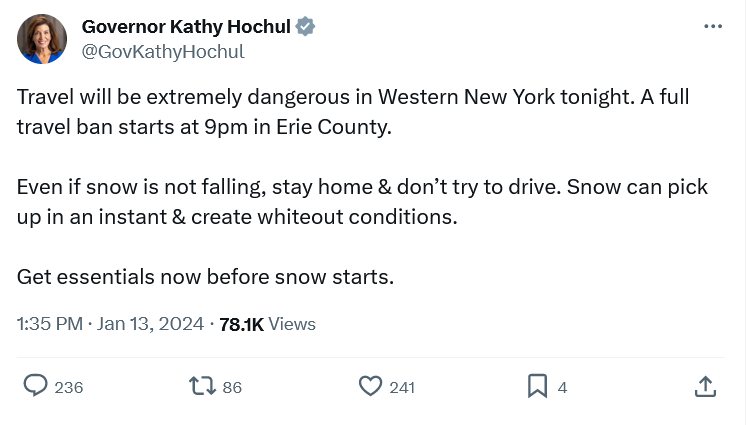
Yesterday, our unfortunate Governor of New York, Kathy Hochul, issued a TRAVEL BAN for an entire county. You read that correctly. No, not a travel advisory, but a full on travel ban ! Meaning, New Yorkers in Erie County are forbidden from going anywhere. What’s another name for that? Well, if you live in a rural or very suburban area (which most of New York State is), where driving on a road is the way you get from point A to point B, then I would say a synonym would be “lockdown.” And what was Dictator Hochul’s, I mean Governor Hochul’s reason for this lockdown of close to one million New Yorkers that live in Erie County? Wait for it. Ready? It was going to SNOW! For anyone who does not live in New York, or who has never been to Western New York in the winter, that area of our state gets a lot of snow. Often. And yet, the governor thinks (all of a sudden, out of nowhere) everyone living there is so ignorant, they must be confined to their homes until she says it’s safe for them to rejoin the world again. Either that, or she’s just testing you to see how far she can take her totalitarian desires. Or both.
For all the keyboard critics who love to jump in and twist my words, I’ll cut you off at the pass and say that I am not admonishing a governor’s desire to keep people safe in the wake of a storm. That’s not at all what I am saying. If a natural disaster is approaching, people should be warned, emergency services ready to roll, and help made readily available. Encourage people to stock up, stay home, and hunker down? For sure! Forbid people from leaving their homes? NO.
There is a big difference between caring about New Yorkers’ safety, and wanting to control people. Huge.
And in fact, Hochul was banning people from leaving their homes even if it was NOT snowing! Sound unbelievable? It sure does. But remember in my article last week, I cited to an ancient Greek philosopher, Heraclitus, who fittingly said, “The truth often evades being recognized due to its utter incredibility.” Put another way, when something is so outrageous, it is often cast aside as untrue. Well, here’s what comrade Kathy posted on her Twitter yesterday:
She went on to post several other times about the snow and her travel ban. I was actually encouraged to read that most of the comments she received were negative, logical rebuttals to her power grab. Here are a few…
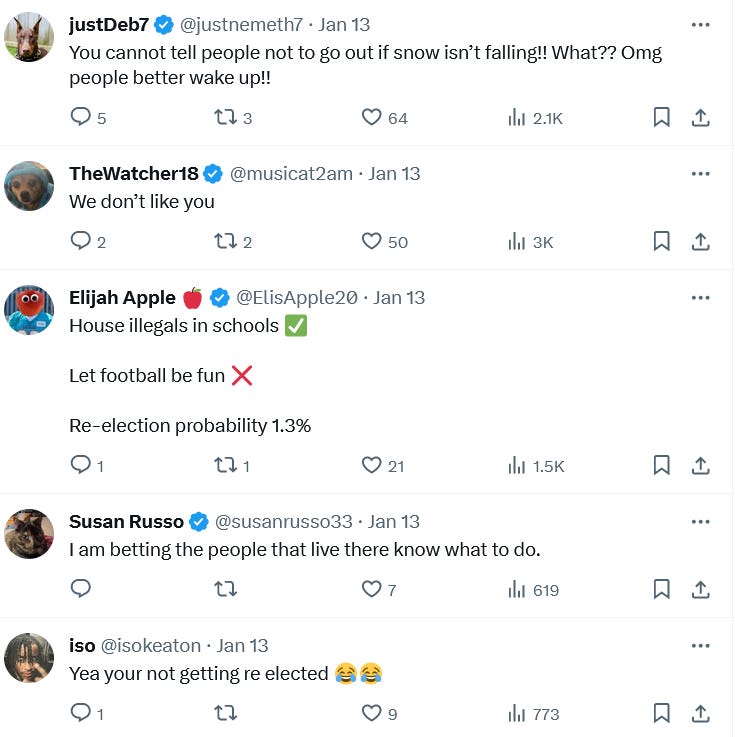
Ok, so digging a bit into travel bans, you’ll recognize that there have been travel bans based on big storms in the past here in New York. However, those are issued by the local government (i.e. County Executive), after a state of emergency is declared. They are not issued by the Governor, nor are they issued without an emergency declaration.
By the way, the travel ban is still in effect for most of Erie County today. Anybody surprised?
Does anyone see the correlation here between government overreach, their quest for “centralized” power, and their fear mongering? It’s the same thing the Governor and her DOH have been doing with their hideous “quarantine camp” regulation that I have been fighting in court for nearly two years now! The name of that case is Borrello v. Hochul, and you can read the details and case history here. Connecting the dots to the analysis at hand, you will note that the quarantine camp regulation tried to take the power from (elected) judges (in keeping with our law) who have the authority to temporarily quarantine sick, dangerous people, and shift that power to unelected, statewide, DOH employees and appointees who have zero accountability to We the People. Under their quarantine camp reg, the Governor and her DOH would have centralized control over 19 million New Yorkers, to force you to lockdown in your home, or they could force you (with the use of police) to go to a quarantine center/ facility/ camp (pick your noun), without any proof you are sick, indefinitely, with no procedure by which you can regain your freedom, and with no declared state of emergency! The fear factor used to try to justify the authoritarian power grab here is the threat of death… If we don’t lock people up who are possibly exposed to a disease, then you might die. Swap out “possibly exposed to a disease” and put in its stead “unclean.” What does that make you think of?
My next question: do you see any similarities here to Hochul’s probably illegal climate lockdown? I say “probably illegal” because I couldn’t find the supposed legal authority that she’s relying upon to prohibit people from driving. If you know what she is relying upon, feel free to post it in the Substack comment section.
Before you draw your own final conclusion about all this, I will add one last thing for you to consider. In December, a month before Hochul issued this Erie County travel ban, the (Democrat) County Executive, Mark Poloncarz, set up an online portal so residents could check and see if they would be deemed “essential workers” and thus exempt from any futuristic travel bans. Oh, and he coordinated with their “partners” in the federal government to come up with the list! Sound familiar, folks?! Remember Governor Cuomo’s C19 lockdown (“Just 2 weeks to flaten the curve”), which lasted for months, and all the “essential workers” that he exempted? Here’s an article about Erie’s coincidentally-just-in-time-for-a-travel-ban portal, “Erie County’s new online portal will identify essential workers exempt from travel bans.”
Keeping You Up To Date On New York’s Progress Toward Green Energy Utopia
By Francis Menton | Manhattan Contrarian | October 15, 2023
Consider Manhattan Contrarian as your go-to source for the latest on New York’s progress toward green energy utopia.
Can you remember all the way back to December 19, 2022? That’s the day that New York’s Climate Action Council officially adopted its “Scoping Plan,” telling us all how we are going to achieve, among other goals, 70% of statewide electricity from renewable energy sources by 2030 and a zero-emissions electricity system by 2040. The biggest part of the grand plan consists of some 9,000 MW (nameplate capacity) of offshore wind turbines to be built by 2035. As of the time of the Scoping Plan, the state claimed that some 4,300 MW out of the 9,000 MW of upcoming offshore wind projects were under “active development.”
On the very day that the Scoping Plan got finalized, I had a post titled “On To The Great Future Of Offshore Wind Power.” That post noted that even of the 4.300 MW of offshore wind supposedly under “active development,” not one turbine was operating, or even under construction. Several developers had made bids that had been accepted by the state, and some of those developers were getting kind of close to applying for permits. My prediction was: “Expect long delays and demands for lots more money before anything gets built.” Boy, can I call these things.
Shall we check back in for the latest information?
Just ten days ago, on October 5, I had an update on offshore wind developments throughout the Mid-Atlantic and New England. For New York, the news was that in September essentially all the developers of the New York projects in “active development” had demanded massive price increases, ranging from about 30% at the low end to almost 65% at the high end. The new prices being demanded by the developers would now be between $140-190 per MWh, which would be at least double to more than triple the prices charged by new natural gas plants.
So how did that go over? To its credit, the state Public Service Commission wasted no time in rejecting the price hike demands of the developers. On October 12 the Commission issued its decision on the Petitions of the developers for price relief. Excerpt from the press release:
The New York State Public Service Commission (Commission) today denied petitions filed by a group of offshore wind developers and a state renewable energy trade association seeking billions of dollars in additional funding from consumers for four proposed offshore wind projects and 86 land-based renewable projects. In denying financial relief, the Commission opted to preserve the robust competitive bidding process that provides critically needed renewable energy resources to New York in the fairest and most cost-effective manner that protects consumers.
OK then, what happens next? The New York Times has a write-up on October 12. The Times quotes the Chair of the PSC, one Rory Christian, as standing up for the sanctity of the public bidding process:
Rory Christian, the chairman of the Public Service Commission, the state’s utility regulator, said that providing relief to the winning bidders would set an untenable precedent. “Taking exception today almost guarantees that we will be asked to do this again in the future,” he said. Mr. Christian added that the state’s ratepayers, who would have borne the cost, could not serve as an “unlimited piggy bank” for companies to tap. “We have a deal,” he said to the developers, calling on them to stand by the terms they agreed to.
Well, Rory, I’ve got news for you: the developers aren’t going to honor the deal. You’re going to have to hold a new auction. And the prices that will be bid will be as high or higher than those just demanded by these developers.
Oh, and then don’t expect any new round of accepted bids to stick either. The developers will come back again and again for new rounds of price increases. What’s to stop them? After all, they have you over a barrel. You have a “Climate Act” and a “Scoping Plan” that basically require you to build out a grid powered by “renewables,” whether that is feasible or not, and then limit your options to mostly offshore wind.
And meanwhile, until the next round of bids is held, we’re back to square one. We have a statutory requirement of 70% of our electricity from “renewables” by 2030, and a “Scoping Plan” that sees that goal being achieved largely through offshore wind turbines. And we have not one single operating offshore wind turbine, nor any under construction, nor, after the recent contract repudiations, any actively moving through the permitting process. At least for now, the whole thing is dead in the water.
The Times quotes a guy named Fred Zalcman, director of the New York Offshore Wind Alliance:
[T]he commission’s decision “puts these projects in serious jeopardy and deals a potentially fatal blow to the progress these projects have made. . . .”
By the way, the prices recently demanded by the offshore wind developers, in the range of $140-190/MWh, do not include anything for the transmission upgrades needed to deliver this power into the grid, nor anything for the storage or back-up needed to transform intermittent wind power into a useful 24/7 resource. The sooner we pull the plug on this whole endeavor, the better. But we are now only in the first phases of the collapse.
UPDATE, October 16, 2023: Meanwhile, I should have mentioned that New York City apartment buildings remain under a mandate from “Local Law 97” to convert to electric heat by 2030 or face large fines. The electricity is supposed to come from the offshore wind farms that, for the time being, are completely suspended. Go to the link in the sidebar to listen to Jane’s podcast on this subject.
A Semi-Competent Report On Energy Storage From Britain’s Royal Society
By Francis Menton | Manhattan Contrarian | September 28, 2023
If you want to power our modern economy on intermittent renewables (wind and solar), and also banish the use of power from fossil fuels and nuclear, then the only option remaining to make the grid work reliably is energy storage on a massive scale. And then it turns out that energy storage on the scale needed is enormously costly — almost certainly so costly that it will in the end sink the entire “net zero” project.
Failure adequately to address the energy storage problem is the fatal defect of nearly all “net zero” plans that are out there. For an example of a thoroughly incompetent treatment of this problem, you might look at New York’s so-called “Scoping Plan” for its mandated “net zero” transition. This Scoping Plan was issued quite recently in December 2022. As examples of its stunning incompetence, it almost entirely discusses the storage problem in the wrong units (watts versus watt-hours), and regularly posits the imminent emergence of magical “dispatchable emissions-free resources,” that have not yet been invented, to cover the gaps in wind and solar generation. The people who issued this Plan have no idea what they are doing, and are setting up New York for an energy catastrophe some time between now and 2030.
But now along comes a report from Royal Society addressing this energy storage problem in the context of Great Britain. The Report came out earlier this month, and has been brought to my attention by my colleagues at the Global Warming Policy Foundation. The title is “Large-scale energy storage.”
Having now put some time into studying this Report, I would characterize it as semi-competent. That is an enormous improvement over every other effort on this subject that I have seen from green energy advocates. But despite their promising start, the authors come nowhere near a sufficient showing that wind plus solar plus storage can make a viable and cost-effective electricity system. In the end, their quasi-religious commitment to a fossil-fuel-free future leads them to minimize and divert attention away from critical cost and feasibility issues. As a result, the Report, despite containing much valuable information, is actually useless for any public policy purpose.
On the plus side of the ledger for this Report, the authors use the correct units to calculate the amount of energy storage needed to back up intermittent wind and solar generation; and their arithmetic appears correctly done as far as I have checked. Also a plus is that it takes them almost no time to conclude that there is essentially no possibility that battery technology will ever be able to solve the energy storage problem for a nation’s grid powered by intermittent sources, no matter how much the technology may improve and no matter how much its costs may decrease.
But then there are the negatives. The authors share the conceit of all green energy advocates — and of all central planners everywhere — that their models and projections have anticipated all costs and problems of their massive schemes. And thus, they think, they know all the answers to how this will work, and can dispense with the tiresome need for any physical demonstration project to prove function and cost. And then there is the discussion, or lack thereof, of ultimate cost to the consumer of these grand plans. The treatment of this subject is inadequate, and characterized by what appears to be an effort to divert the reader’s attention from the subject before too many questions are asked.
But let’s start with some pluses. This is from the “Major conclusions” section of the Executive Summary, page 5:
Wind supply can vary over time scales of decades and tens of TWhs of very long- duration storage will be needed. The scale is over 1000 times that currently provided by pumped hydro in the UK, and far more than could conceivably be provided by conventional batteries.
Go to the body of the Report, and you find that the authors have collected data on generation from wind and solar sources Great Britain over a 37 year period, 1980-2016. Those data show that the intermittency problems of wind and solar generation are far worse than even I had thought. In additional to diurnal and even annual cycles, there prove to be periods of relatively low wind that can persist literally for years. To deal with such situations requires putting huge amounts of energy in storage and then keeping it there for years, maybe decades, in anticipation of these low wind years.
Here is one of my favorite charts from the Report. It depicts the storage balance in a hypothetical 123,000 GWh storage facility for Great Britain over the 37 year period 1980 to 2016. The storage balance never goes much below about 80,000 GWh during the 23 year period 1984 to 2006 — which might have led the incautious to conclude that about half as much storage would be sufficient. But then there was a big low-wind period from 2009-2011:
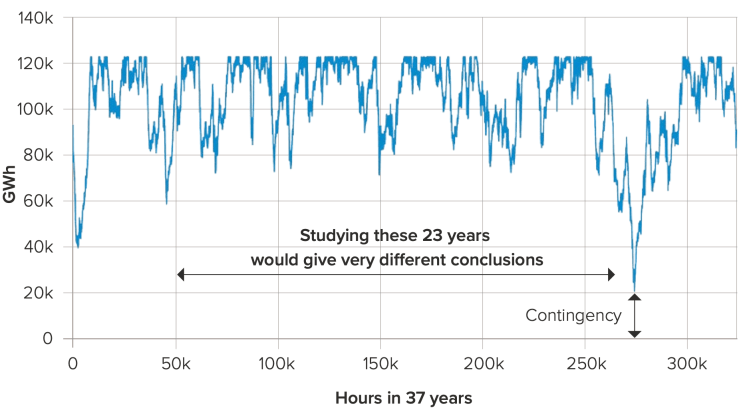
The authors describe the situation as follows (page 31):
Figure 13 exhibits two striking features. First, a study of the 23 years 1984 – 2006 would have found a storage volume very much smaller than found by studying 1980 – 2016. Second, there is a very large call on storage in the period 2009 – 2011 which reflects persistently low wind speeds that lead to the large deficits seen in figure 2 (some of the energy that fills these deficits would have been in the store since 1980). These features reinforce the conclusion that it would be prudent to add contingency against prolonged periods of very low supply and the possible greater clustering of 2009 to 2011-like years.
As a result of observations like this, the authors, I think correctly, conclude that batteries are completely out of the question to solve this problem. The only storage medium that could conceivably work would be a combustible chemical substance that can be put in massive underground facilities for decades. Only two possibilities are out there — hydrogen and ammonia. And ammonia is far more expensive and far more dangerous. So that leaves hydrogen.
Since hydrogen is the one and only possible solution to the storage problem, the authors proceed to a lengthy consideration of what the future wind/solar/hydrogen electricity system will look like. There will be massive electroayzers to get hydrogen from the sea. Salt deposits will be chemically dissolved to create vast underground caverns to store the hydrogen. Hydrogen will be transported to these vast caverns and stored there for years and decades, then transported to power plants to burn when needed. A fleet of power plants will burn the hydrogen when called upon to do so, although admittedly they may be idle most of the time, maybe even 90% of the time; but for a pinch, there must be sufficient thermal hydrogen-burning plants to supply the whole of peak demand when needed.
I find the treatment of the potential cost of all of this to be totally inadequate. There is never a mention of the most relevant subject, which is how much electricity prices to consumers might increase. The closest thing I find is this chart on page 32:
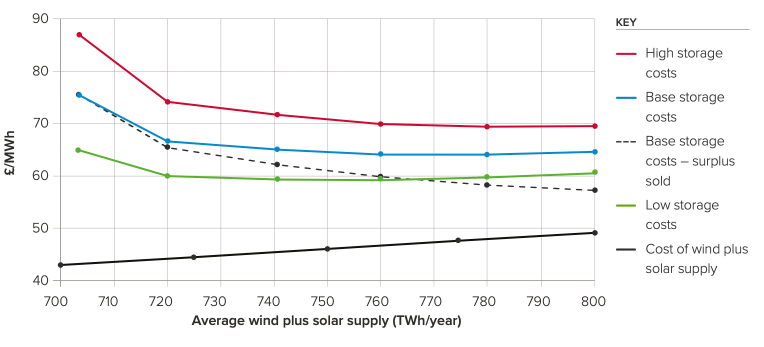
This is cost “to the grid,” thus wholesale cost. Will there be a huge multiplication of final price to the consumer? At first glance this doesn’t look too bad. About 50 pounds/MWh for the wind/solar input, and then 60-70 pounds/MWh for the storage makes about 110-120 pounds/MWh total. Add about 33% to convert to dollars, and you would have about $143-156/MWh, or 14.3 to 15.6 cents per kWh. It’s high, but not completely in the stratosphere.
But wait a minute. Are these guys leaving anything out?
-
How about the new network of pipelines to transport the hydrogen all over the place?
-
How about the entire new fleet of thermal power plants, capable of burning 100% hydrogen, and sufficient to meet 100% of peak demand when it’s night and the wind isn’t blowing.
-
They use a 5% interest rate for capital costs. That’s too low by at least half — should be 10% or more.
-
And can they really build all the wind turbines and solar panels and electroayzers they are talking about at the prices they are projecting?
The whole thing just cries out for a demonstration project to prove feasibility and cost. I’m betting that that will never occur before the whole “net zero” thing falls apart from the disaster of skyrocketing electricity prices. Time will tell.
Inside an Australian Quarantine Camp
By Bobbie Anne Flower Cox | Brownstone Institute | February 12, 2023
After I won my landmark “quarantine camp” lawsuit against Governor Hochul and her Department of Health a few months ago, people from around the globe started reaching out to me. Some wanted to simply send congratulations on a job well done, and thank me for giving them hope that this tyranny that somehow magically took hold contemporanously in countries around the world, could be defeated.
But many others wanted more than that. They wanted actual help. They wanted to know how they could fight back against the intense tyranny in their countries. So, I started doing interviews and presentations to groups based in the UK, South Africa, Canada, and Australia. I shared with them my legal theory behind my case, the separation of powers argument, and all about my courageous plaintiffs (Senator George Borrello, Assemblyman Chris Tague, Assemblyman [now Congressman] Mike Lawler, and a citizens’ group called Uniting NYS).
I told them about the other wonderful group of NYS Legislators that supported us with an Amicus Brief (Assemblymen Andy Goodell, Will Barclay and Joseph Giglio), and the battles that we fought and won along the way, as the Attorney General tried tactic after tactic to stall, derail and destroy our case. I shared all that I could with them in the hopes that it would assist them in their countries, as they pushed back against their government abuses.
At first I was taken aback by the response from those who reached out to me from abroad. It was hard for me to imagine that all those foreigners were watching our quarantine case so intently. Many told me they’d heard about it through “alternative media” sources, and had been quietly cheering me on and praying for a win. This made me realize that the utter helplessness brought on by the flagrant despotism of so many nations’ governments was eerily simultaneous – and equally frightening to all citizenry, no matter which country one called home.
Our quarantine camp lawsuit win against New York’s governor was almost akin to the proverbial shot heard around the world. Almost. Not quite. One big difference is that my lawsuit was (and still is today) heavily censored. Mainstream media barely covered it when we won, except for an article here and there in the New York Post and my interview on OAN Network. Epoch Times TV did a deep-dive interview with me on their wildly popular show, American Thought Leaders, but still yet, the Epoch Times is not legacy, mainstream media that continuously pours over the airwaves day in and day out.
Local and alternative media were covering it, but not mainstream media. I previously wrote an article about the censorship of my quarantine case which you can read here.
With my exposure to citizens from countries far and away, I was hearing tales of horrific happenings. Things that I simply could not believe governments would do their people, especially in countries that were supposedly “free”. And yet, here they were, telling me stories, sending me news articles or photos or actual video footage of atrocities I could not wrap my head around.
Some of the images are forever burned into my memory, no matter how hard I try to erase them. And at the end of each story that someone recanted, or each video that I watched, I thought to myself, “Thank God we won our quarantine camp lawsuit here in New York.”
I realized that we had not only stopped this complete totalitarianism from taking place in my home state, but we had likely stopped it from spreading across the nation to the point where quarantine camps would become the “new norm” as a way to (supposedly) stop the spread of a disease – or to punish someone the government didn’t like. (Remember, the languange in the reg we got struck down said the government did NOT have to prove you actually had a disease)! For more details on the reg and our lawsuit, go to www.UnitingNYS.com/lawsuit
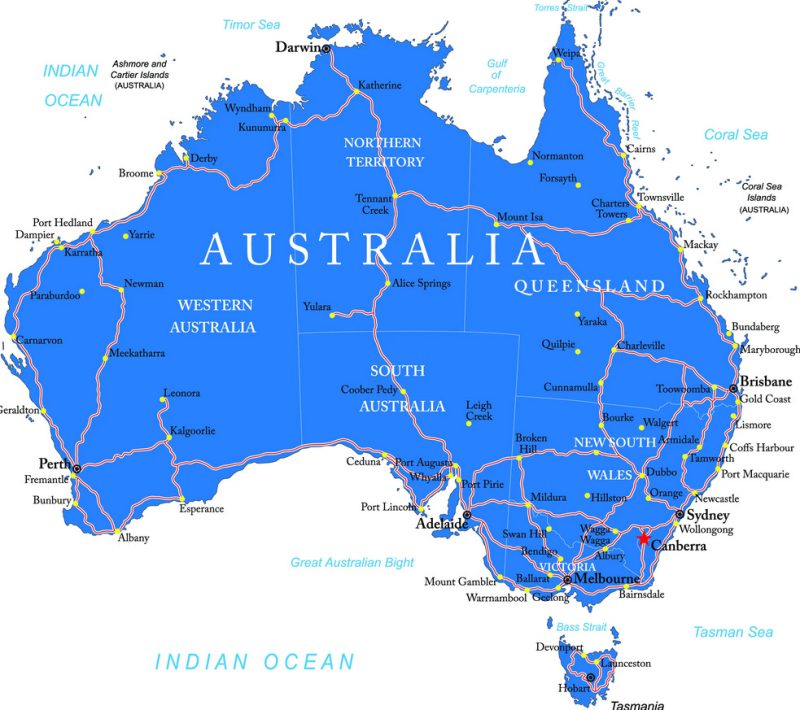
Through my connection with Brownstone Institute, I was introduced to a wonderful and brave Australian who had spent two weeks in a quarantine camp in northern Australia. Let’s refer to her as “Jane”. I share with you now her first hand account that she shared with me of what happened and what it was like, replete with photographs from inside the camp.
At the time Jane was in the camp, Dan Andrews was (and still is) the Premier in Australia. The country had very strict COVID19 policies, which Jane points out, were constantly changing. Literally, the government would change a policy whilst people were flying mid-air, and upon landing at their destination, they’d be arrested because they now suddenly were in violation of a new COVID policy just issued!
The rule at the time was that no Australian was allowed to leave their state, unless you had a “legitimate reason” to do so, and in order to actually leave, you had to first quarantine for 2 weeks. Not in your home. No, don’t be silly! You had to quarantine in a facility that was run by the government. Some people got to choose which facility, others did not. There was a large camp in the Northern Territory near Darwin, and then there were many quarantine hotels scattered throughout the country.
Reportedly, the quarantine hotels were a total nightmare where you were shut into a room for 2 weeks, no exiting your room, no going outdoors allowed, and some rooms didn’t even have windows! But living in Melbourne, a large city in southest Australia, was just as bad. The government would only let you out of your home for ONE HOUR/day, with a mask on, and you couldn’t stray more than 5 kilometers from your house. You not only couldn’t leave the city, you couldn’t leave the country!
Forget having anyone visit – no guests were allowed in your home. The government set up a hotline so that Australians could call and report any of their neighbors who were disobeying the COVID mandates. The police would often check on the citizens to see if they were complying. They’d phone you, and if you didn’t respond within 15 minutes, they’d come knock on your door! The camp where Jane was quarantined seemed almost like a holiday, comparatively speaking. Well, not really.
So how it worked was that, if you had family or friends or business in another state, you had to first go to a government facility to quarantine for 2 weeks. Again, only if you had what the government deemed to be a legitimate reason. Jane needed to leave Melbourne, so she packed up her bags, booked an absurdly expensive flight to the Northern Territory, and off she went to the quarantine camp in Darwin for 2 weeks. Did she go “voluntarily”, of her own free will? That’s a very fine line of semantics there folks. Yes, she herself booked her flight and packed her bags to go, but it was only because the government told her that was the only way she could leave Melbourne. I don’t consider that free will. I hope you share my view.
The quarantine camp:
The camp had rows of trailer-like buildings that housed the inmates – I mean the there-of-their-own-free-will Australians. Jane was put into a unit that had a bedroom and a bathroom. Each unit had a small front stoop, sort of like a porch (see photo below). You were allowed to sit outside and talk to a neighbor, through a face mask of course, if you could stand the sweltering heat. Police were constantly patroling the camp, walking past the trailers, ensuring everyone was complying with the “social distancing” requirements and the forced masking, etc.
You weren’t allowed to do anything other than sit on your front stoop, or walk “laps” through the camp… as long as you stayed the proper distance from others, wore your mask, and didn’t try to do anything else. There was a swimming pool, but you were only allowed a dip in the pool twice during your 2 week stint there, and that was only if you were going to do some laps… no games allowed!
The food was terrible. No alcohol allowed. Cell phones and internet were allowed, at least when Jane was there. She said one woman tried to escape, but she was caught and then put into solitary confinement.
Now, sit down for this next part. The government restricted you from leaving your town, your state, your country, forced you into quarantine hotels or a camp if you were able to convince them that you had a real reason to cross a state border, treated you like a criminal, and get this – YOU had to pay for it!! And it was not cheap. The price tag was $2,500 for an individual, $5,000 for a family at the camp. The “hotels” apparently were more costly at $3,000 for the 2 weeks.
There were more details that Jane shared with me, but I cannot cover all here. At this point, I’m going to close out this story with a part of my conversation with Jane that really struck me. She could tell that I was flabbergasted by the things she was telling me. She could hear it in my voice, but also in the long pauses in between my questions after she would answer the litany of inquiries I was throwing at her.
My underlying astonishment was obvious… “How could your government do these things to its people?!”
Her response was immediate and direct, “We don’t have your Second Amendment. If we had, our government never would have treated us this way.”
Let that sink in for a minute.
Lawsuit update:
As I mentioned above, we defeated New York’s quarantine camp regulation when we won our lawsuit last July against Governor Hochul and her DOH. The Attorney General filed a notice of appeal, and had 6 months to appeal the win. Elections were November 8th. Not surprisingly, no appeal was filed, until…
The first week of January, just days before their 6 month deadline was up, the Attorney General asked for an additional 2 months to appeal our victory over quarantine camps! Unfortunately, the Court granted the request, despite our objection.
For more information about the case, the timeline, or if you’d like to support our lawsuit against the Governor and her quarantine camp regulation, go to www.UnitingNYS.com/lawsuit
Together, we win this!
Bobbie Anne is an attorney with 25 years experience in the private sector, who continues to practice law but also lectures in her field of expertise – government over-reach and improper regulation and assessments.
Fired Workers Sue New York City, Seek $250 Million and End to COVID Vaccine Mandate
The Defender | January 20, 2023
New York City public-sector workers who lost their jobs for refusing to comply with the city’s COVID-19 vaccine mandate on Thursday filed a $250 million lawsuit against the city and Mayor Eric Adams seeking to end the mandate.
The 72 fired workers are demanding the city overturn the mandate, reinstate their jobs and compensate them with punitive damages.
The workers argue the mandate should be found “arbitrary and capricious” given that “President Joe Biden, Governor Kathy Hochul and Senator Chuck Schumer have all declared that the pandemic is over,” and that it was already rescinded for private sector employees and students, according to the lawsuit.
The lawsuit, filed in the Bronx County Supreme Court of the State of New York, also alleges the plaintiffs were discriminated against with “willful or wanton negligence, or recklessness” and were mocked and ridiculed by their colleagues.
Many of the plaintiffs — formerly with the New York Police Department (NYPD), the New York Fire Department, the Department of Education, the Department of Health and other agencies — worked for the city for more than 20 years but now are unemployed, have lost their homes and their ability to support their families, the lawsuit states.
Attorney James Mermigis, who represents the plaintiffs, told The Defender :
“Anybody that goes into the city does not have to be vaccinated except for NYC public sector workers, including firemen, policemen, teachers.
“I just think it is absurd, especially once Mayor Adams lifted the mandate for private employees, that these people, who were heroes during COVID-19, still have the mandate.”
According to the lawsuit, Adams admitted, “I don’t think anything dealing with COVID is makes sense [sic], and there’s no logical pathway of what one can do[sic].”
The lawsuit also alleges the COVID-19 vaccines don’t prevent disease transmission and that it is well-established that the risks of vaccination outweigh the benefits.
It also argues the plaintiffs have immunity from prior infection that should exempt them from any mandate, because “the scientific community has conclusively established that natural immunity provides strong and durable protection.”
According to the lawsuit, the city used, “a discriminatory practice to coerce, intimidate, threaten, or interfere with Petitioners in their exercise or enjoyment of their closely held religious beliefs,” by failing to engage in “cooperative dialogue” with them regarding their petitions for religious exemption, which were denied.
The plaintiffs seek $250 million in punitive damages.
“[Punitive damages] punish the city for its behavior towards its employees in the hopes that they will establish policies in the future that will prevent this from happening again,” Mermigis said.
Landmark win for New York healthcare workers may help city workers
Alleging New York City lacked the authority to institute COVID-19 vaccine mandates, city workers cited the landmark ruling earlier this month by the New York Supreme court, which struck down the state’s COVID-19 vaccine mandate for healthcare workers.
In that case, which Children’s Health Defense (CHD) financed, the court held that the state’s health department lacked the authority to impose the mandate.
In the ruling, Judge Gerard Neri declared the mandate “null, void, and of no effect.”
The court also ruled that the state’s mandate was “arbitrary and capricious” on the basis that COVID-19 vaccines do not stop transmission of the virus, thereby eliminating any rational basis for such a policy.
That lawsuit was filed Oct. 20, 2022, by Medical Professionals for Informed Consent and additional plaintiffs against NYSDOH, New York Gov. Kathleen C. Hochul and Mary T. Bassett, the state’s health commissioner.
Commenting on the Supreme Court ruling in favor of healthcare workers, Mermigis said he believes the decision will help the workers’ case against the city.
“It puts less pressure on the judge reading our lawsuit knowing that another judge in New York also eliminated a healthcare vaccine mandate,” Mermigis said.
Michael Kane, CHD’s national grassroots organizer and founder of Teachers for Choice, said:
“It’s historic what Sujata Gibson and CHD were able to do and it’s part of the cascading falling dominoes. It really feels like it’s just a matter of time.
“They will delay as much as they can, but public opinion has shifted. The courts are no longer afraid. Judges are no longer afraid to rule lawfully, and we are starting to see that.”
Court of public opinion is shifting
More than 1,750 city workers were fired for refusing vaccination, including 36 members of the NYPD and 950 Department of Education employees, The New York Post reported.
Many of them brought — and won — lawsuits against the city. But the city appealed all of the rulings challenging its vaccine mandate for public employees, The Defender reported.
On Sept. 13, 2022, a Manhattan Supreme Court ruled that unvaccinated NYPD officer Alexander Deletto could keep his job. The city appealed that ruling.
In a Sept. 23, 2022, ruling, Manhattan Supreme Court Justice Lyle Frank reinstated the jobs of several unvaccinated members of the NYPD’s union, the Police Benevolent Association of the City of New York. The city also appealed that decision.
On Oct. 5, 2022, Staten Island Supreme Court Justice Ralph Porzio ruled New York City must reinstate a Staten Island firefighter. The city appealed that decision as well.
Later in October 2022, Justice Porzio struck down New York City’s COVID-19 vaccine mandate for public workers, ruling in favor of 16 unvaccinated city workers who sued following their termination. That decision is currently being appealed.
According to Kane, however, the tides are turning — and that could be significant for the lawsuit filed Thursday.
Kane said:
“We are now seven days into the [CHD] victory and there has been no appeal. This is the first case for New York employees that have been fired that has stood for even seven days …
“The most important thing now is that the court of public opinion is different. I really feel that we are winning the majority in the court of public opinion, and that influences what happens in all of these courts …
“We are definitely rooting for him [Attorney Mermigis] and hoping he is very successful with the case.”
This article was originally published by The Defender — Children’s Health Defense’s News & Views Website under Creative Commons license CC BY-NC-ND 4.0. Please consider subscribing to The Defender or donating to Children’s Health Defense.
Rumble files lawsuit to challenge New York’s social media censorship law
By Tom Parker | Reclaim The Net | December 1, 2022
Free speech video sharing platform Rumble and its subscription platform Locals have sued New York Attorney General (AG) Letitia James to challenge a social media censorship law that they say would force platforms to target constitutionally protected speech.
Rumble and Locals are being represented by the free speech nonprofit Foundation for Individual Rights and Expression (FIRE) and are joined in the lawsuit by constitutional law professor Eugene Volokh, the co-founder of the Volokh Conspiracy legal blog.
We obtained a copy of the lawsuit for you here.
“The law is titled ‘Social media networks; hateful conduct prohibited,’ but it actually targets speech the state doesn’t like — even if that speech is fully protected by the First Amendment,” FIRE said in a statement.
The law forces a wide variety of internet platforms to publish a policy detailing how they’ll respond to posts that are deemed to “vilify, humiliate, or incite violence” based on protected classes such as religion, gender, or race.
It also requires platforms to create a way for visitors to complain about “hateful content” and requires them to respond to complaints directly. Platforms that refuse to comply can be investigated by the AG’s office, subpoenaed, and fined up to $1,000 per violation.
It comes into force on Saturday, December 3, 2022.
As is often the case with censorship laws, this Social Media Networks; Hateful Conduct Prohibited law doesn’t define “vilify,” “humiliate,” or “incite.”
Rumble suggested that this means it would “cover constitutionally protected speech like jokes, satire, political debates, and other online commentary.”
FIRE noted that the law’s scope is “entirely subjective” and suggested that it could target a wide range of First Amendment-protected speech such as “a comedian’s blog entry ‘vilifying’ men by mocking gender stereotypes” and most comments on almost any website “that could be considered by someone, somewhere, at some point in time, as ‘humiliating’ or ‘vilifying’ a group based on protected class status like religion, gender, or race.”
FIRE added: “Bloggers, commenters, websites, and apps around the country are ensnared by the New York law due to its broad definition of ‘social media networks’ as for-profit ‘service providers’ that ‘enable users to share any content.’ This vague wording means that the law can impact virtually any revenue-generating website that allows comments or posts and is accessible to New Yorkers — but no government entity can legally compel blogs or other internet platforms to adopt its broad definition of ‘hateful conduct.’”
“New York politicians are slapping a speech-police badge on my chest because I run a blog,” Volokh said. “I started the blog to share interesting and important legal stories, not to police readers’ speech at the government’s behest.”
Rumble Chairman and CEO Chris Pavlovski added: “New York’s law would open the door for the suppression of protected speech based on the complaints of activists and bullies. Rumble will always celebrate freedom and support creative independence, so I’m delighted to work with FIRE to help protect lawful online expression.”
This law is one of several attempts by New York to encroach on the First Amendment and push for the censorship of constitutionally protected speech. Other laws and proposals from the state have pushed to ban the sharing of violent crime videos online, ban gendered language in law, and allow officials to sue platforms that are suspected of “contributing” to the “knowing or reckless” spread of “misinformation.
What The Future Holds For Our Climate Leaders
By Francis Menton | Manhattan Contrarian | July 28, 2022
If my posting has been a little light for the last month or so, it’s because I’ve been working on a big Report for the Global Warming Policy Foundation on the subject of energy storage as a means to back up electricity generation from wind and solar facilities. The Report is basically finished, and now going through an editing process. It will probably be published some time in September.
In doing the research for the Report, I have had occasion to look carefully into the plans of many countries and U.S. states that claim to be the “leaders” in climate virtue, specifically on the subject of how they intend to reach the goal of Net Zero carbon emissions from generation of electricity. These climate “leaders” include, in Europe, Germany and the UK, and in the U.S., California and New York. One would think that for any jurisdiction pursuing Net Zero ambitions, and seeking to abolish use of fossil fuels, it would be completely imperative that some energy storage solution absolutely must be found to provide back-up for the electricity system when the wind and sun are not producing. But what my research has shown is that every one of these jurisdictions seeking to be the leader toward Net Zero has given astoundingly insufficient consideration to the energy storage problem.
I previously have covered some of the more incredible deficiencies in the Net Zero planning of these places, for example in “Can California Really Achieve 85% Carbon-Free Electricity By 2030?” on May 16, and “And The Winner Is, Germany!” on June 29.
The single most astounding universal failure of all jurisdictions pursuing Net Zero is the failure to pursue any sort of working prototype or demonstration project of a Net Zero electricity system before committing the entire jurisdiction to the project on the basis of a blank check to be paid by the taxpayers and ratepayers. Who has ever heard of such a thing? in the 1880s, when Thomas Edison wanted to start building central station power plants to supply electricity for his new devices like incandescent lightbulbs, he began by building a prototype facility in London under the Holborn Viaduct, and followed that with a larger demonstration plant on Pearl Street in Lower Manhattan that only supplied electricity to customers within a few square blocks. Only after those had been demonstrated as successful did a larger build-out begin. Similarly, the provision of nuclear power began with small government-funded prototypes in the late 1940s and early 1950s, followed by larger demonstration projects in the late 1950s and early 1960s. Only in the late 1960s, twenty years into the effort and after feasibility and cost had been demonstrated, were the first large-scale commercial nuclear reactors built. No competent person would take any other approach.
But somehow our politicians have now become so filled with hubris that they think they can just order up a functioning wind/solar electricity system and assume that backup energy storage devices will magically get invented and it will all work fine and not be financially ruinous, all by some arbitrarily-ordered date in the 2030s.
Today, all the mentioned jurisdictions and many more have embarked on ambitious Net Zero plans, and yet there does not exist anywhere in the world a functioning prototype or demonstration project that has actually achieved Net Zero in electricity generation, or anything even close. Indeed, it’s worse than that. There is a fairly substantial project that set out to achieve Net Zero (although they weren’t using the term at the time, which was 2014), and has fallen remarkably short. That project is on the island of El Hierro, one of the Canary Islands off the coast of Spain. El Hierro installed a collection of wind turbines and a pumped storage/hydro reservoir as back-up to great fanfare, but it struggles to achieve 50% of the electricity from the wind/storage system over the course of a year. The rest comes from a diesel generator. The system operator puts out monthly statistics (with substantial lag), typically with excited verbiage about “tons of carbon emissions saved,” without ever admitting that the system has totally failed in its original goal of getting rid of the fossil fuel piece. Instead they now have three redundant systems for providing the electricity — wind turbines, hydro reservoir and turbines, and the diesel generator — all of which must be paid for, and all to provide the same electricity that the diesel generator was fully capable of providing on its own. The cost has been calculated at about 80 euro cents per KWh, roughly 7 to 8 times average U.S. consumer rates; but the cost is largely hidden from El Hierro ratepayers by subsidies from the EU and government of Spain.
My research also covered in depth the question of how much energy storage would be needed for various jurisdictions to fully back up a predominantly wind/solar generation system without any use of fossil fuels. Credible calculations previously discussed here have included the calculation of Roger Andrews, done in 2018, that either California or Germany would require at least about 25,000 GWh of energy storage to back up a fully wind/solar generation system for a year without use of fossil fuels; and a calculation by Ken Gregory done on very similar methodology in late 2021 showing that the full U.S. (lower 48 states) would require about 250,000 GWh of storage for the same purpose. These are truly huge numbers.
Facing such requirements to reach Net Zero and banish fossil fuels from the electricity system, the plans of these jurisdictions for acquisition of storage are quite shocking. The consultancy Wood Mackenzie reported on April 11, 2022 that Germany had announced plans to acquire all of 8.91 GWh of energy storage by 2031 — a ridiculously puny amount if Germany is actually serious about Net Zero. Utility Dive reported on April 12, 2022 that New York had plans to acquire all of 6 GW of storage (likely corresponding to about 24 GWh, since the batteries are to be of the lithium-ion type that generally have capacity for four hours of discharge at full capacity). This figure is only slightly less puny than Germany’s. Another piece from Utility Dive on April 6, 2022 reported that California’s regulators had ordered utilities to acquire what would be the equivalent of about 42 GWh of storage as part of the Net Zero plans of that jurisdiction. All of these storage acquisition plans are in the range of about 0.1% to 0.2% of the storage that would actually be needed to achieve the Net Zero goal.
So what will the future of energy usage actually look like in these places as fossil fuels get phased out and wind and solar take over, with woefully insufficient energy storage to cover the intermittencies? To get an idea, let’s take another look at the Report for California put out by consultancy Energy Innovations on May 9, with the title “Achieving an Equitable and Reliable 85 Percent Clean Electricity System by 2030 in California.” Note that this in not actually Net Zero, but only 85% of same. Here are a few tidbits. First, their graphic on the nature of the transition:
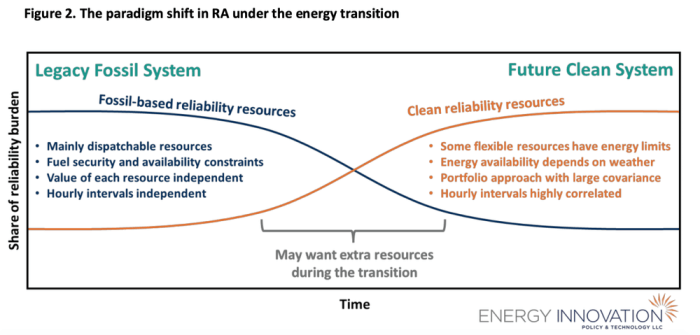
We’re going to have a “paradigm shift” in “RA,” which seems to mean “Resource Adequacy.” Check out that list on the right under “clean reliability resources” — “Energy availability depends on weather.” Are you starting to get the picture now?
Read through the report until you get into pages in the mid-30s, where the subject becomes what they euphemistically call “demand response.” It’s a lot of bafflegab to make it seem oh so pleasant. Excerpt:
Demand-side measures can substitute for supply-side resources and therefore contribute to resource diversity; their increased availability hedges against the risk of deploying new clean supply-side resources too slowly (including generators and storage). For example, the technical report finds that deploying Load Shift could reduce load by 1,500 MW in the early evening hours solar output falls, hedging against battery deployment challenges such as supply chain. . . . Demand-side measures also provide complementary reliability, resiliency, and public safety benefits to supply-side solutions or imports, as they lie closest to the affected load. While centralized generators provide the bulk of our power under most system conditions, they can be rendered less effective or useless under certain disaster conditions.
This is bureaucratese meaning “we’ll turn off your electricity at random times when we feel like it.” Get ready for this, California, Germany, et al. I guess New York is on the same path too, but I have my secret escape plans ready.
Featured Video

America Racing to Strategic Defeat in Iran
or go to
Aletho News Archives – Video-Images
From the Archives
Should Europeans ‘Thank’ the Americans for Destroying Nord Stream?
By Robert Bridge | Strategic Culture Foundation | September 29, 2022
With an investigation continuing into the destruction of the Nord Stream gas pipeline that provided energy supplies to Europe from Russia, there appears to be just one prime suspect, and that should surprise nobody.
Following the sabotage of the Nord Stream 1 and 2 gas pipelines, former Polish Foreign Minister Radoslaw Sikorski already seemed to know the identity of the perpetrator when he tweeted out: “Thank you, USA.”
At first glance, it seemed that Sikorski was speaking sarcastically, berating Washington for carrying out an attack that will have severe repercussions for the people of Europe. After all, how could anyone see any good coming from the termination of Europe’s primary source of gas reserves with winter just around the corner? It was Sikorski’s homeland of Poland, after all, that urged its citizens to collect firewood in the face of dwindling gas reserves.
In fact, the Polish diplomat was speaking one-hundred percent literally… continue
Blog Roll
 Aletho News
- Growing insecurity, soaring prices fuel protests in north as regime bans evacuation: Sources
- Iran denies responsibility for ‘depraved’ attack on Kuwait desalination plant
- Bring The Troops Back. End This War Now!
- Can we please stop calling Israel the ‘only democracy in the Middle East’ now?
- US should start removing its troops from Germany, proposes AfD co-leader Chrupalla
- Iran Red Crescent: 600 educational centers attacked in US-Israeli ‘war crimes’
- Russian Oil Tanker Arrives in Cuba Amid U.S. Blockade
- America Racing to Strategic Defeat in Iran: Lt Col Daniel Davis
- FTC Warns Visa, Mastercard, PayPal, Stripe Over Political Debanking
- Russian tanker approaches Cuba despite US oil blockade
- If Americans Knew
- Israeli police block Catholic cardinal from entering Church of the Holy Sepulchre on Palm Sunday
- Israel is assassinating journalists again, more than any other nation, anywhere, ever – Not a ceasefire Day 170
- Over 300 US service members wounded, majority have brain injuries – Not a ceasefire Day 169
- Researchers at Human Rights Watch Resign Over Blocked Report on Palestinian Refugee Return
- Jewish Groups Are Backing a War Americans Don’t Want
- Eric Fingerhut Thinks He’s the President of the Jews
- Top Jewish Philanthropists, Rabbis Urge Israeli President to Take Action Against ‘Jewish Extremists’
- Don’t Be Fooled. Zionist Leaders Have Always Wanted to Control Southern Lebanon
- Israel’s widespread use of torture is a core element of its genocide against the Palestinian people
- In Israel’s War on Iran, Many Middle East US Bases Rendered “All But Uninhabitable”
- No Tricks Zone
- New Study Finds Warming Saves Lives…Cold Temperatures 12 Times More Deadly Than Excess Heat
- German Science Blog Accuses PIK Climate Institute Of Hallucinating Climate Tipping Points
- Devastating Assessment Of Comirnaty Vaccine By Former Senior Pfizer Europe Toxicologist
- New Study: CO2 Is ‘Effectively Negligible’ As An Explanatory Climate Change Factor Since 2000
- Former Pfizer Toxicologist Dr. Helmut Sterz Tells Bundestag Hearing Pfizer Vaccine Should Have Never Been Approved
- Energy Expert: Germany’s Nuclear Phaseout Was A “500 Billion Euro Mistake”
- New Research: South Australia’s Mid-Holocene Sea Surface Temperatures Were 4°C Warmer Than Today
- Storing Green Energy To Last Germany 10 Days Would Require A 60-Million Tonne Battery
- New Studies: UK Sea Levels Were 4 Meters Higher Than Today During The Mid-Holocene
- Destructive Green New Deal: German Energy And Metal Group Warns Of Drastic Crisis
 Aletho News