Venezuelan President Denied Travel through US Airspace
RT | September 19, 2013
Venezuelan Foreign Minister Elias Jaua told media that an aircraft carrying President Nicolas Maduro was denied a path over Puerto Rico’s airspace.
President Maduro’s flight, which was to depart for China, was forced to find an alternate flight path according to Jaua, who denounced the act as “an act of aggression.”
“We have received the information from American officials that we have been denied travel over its airspace,” Jaua said, speaking to reporters during an official meeting with his South African counterpart.
“We denounce this as yet another aggression on the part of North American imperialism against the government of the Bolivarian Republic,” he added.
“No one can deny airspace to a plane carrying a president on an international state visit.”
There is “no valid argument” for denying travel through American airspace, Jaua said, adding that he expected the US to rectify the situation.
President Maduro was due to arrive in Beijing this weekend for bilateral talks with the Chinese government. Jaua was adamant that the Venezuelan leader would reach his destination, regardless of any perceived interference.
Though the US has yet to issue an official response, the latest incident will likely add to already strained relations between the two countries.
In July, the Venezuelan president announced that his government was halting attempts to improve relations with the US. The move was in response to comments made by the newly appointed US Ambassador to the UN, Samantha Power, who told a Senate committee that her new role would include challenging the “crackdown on civil society” abroad, including in Venezuela.
Relations under former President Chavez had been acrimonious, as he had long held suspicions that the US had actively intervened on behalf of an attempted coup in 2002. Since his election in April, President Maduro has often made pointed criticisms at alleged US interference in Venezuelan affairs.
Bolivian President Evo Morales, whose own plane was grounded this summer allegedly due to suspicions by US authorities that the aircraft was transporting whistleblower Edward Snowden, said that ALBA bloc nations should consider a boycott of the upcoming UN General Assembly in New York as a response.
“We cannot accept that the US carries on with politics of intimidation and the prohibition of flights by presidents,” said Morales, adding that the latest incident “demonstrates the country’s predisposition to humiliate other governments” and commit crimes against other nations.
Dispute over visas ahead of UN summit
The Venezuelan President also spoke of attempts by the US to set “conditions” on a visa issued to General Wilmer Barrientos, one of Maduro’s ministers who is slated to attend meetings during the UN General Assembly next week.
“They want to put conditions, if we decide to go to New York… They don’t want to give a visa to my minister,” said Maduro. “Do we want to go as tourists? We’re going to the United Nations. You’re obligated to give visas to all the delegation.”
Appearing via the television network TeleSUR on Thursday, Maduro indicated that he had directed his foreign minister, Elías Jaua, and Venezuela’s Ambassador to the UN, Samuel Moncada, to “activate all mechanisms” in reference to the visa dispute.
“US, you are not the UN’s owner. The UN will have to move out of New York,” remarked Maduro.
He warned that if he has to take “measures” against the government of the US, he would be prepared to take “the most drastic measures necessary” to ensure Venezuelan sovereignty.
Theatre Program Launched in Venezuelan Schools to Create “Culture of Peace”
By Tamara Pearson | Venezuelanalysis | September 17, 2013
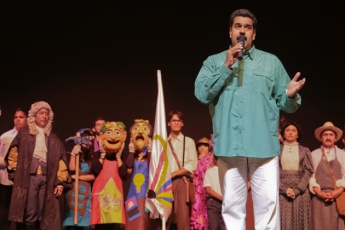
President Maduro at the Teresa Carreno Theatre in Caracas launching the Children’s and Youth Theatre Movement (Prensa Presidencial)
Merida – Yesterday the school program titled the “Cesar Rengifo” Children’s and Youth Theatre Movement was kicked off, as students returned to class for the new school year.
The program is being run initially in 135 Bolivarian schools in Caracas, and will gradually be expanded around the rest of the country.
Classes include body language, literature, oral narration, musical appreciation, acting, lighting, and theatre music.
“The idea is to awaken sensitivity, responsibility, and critical and creative thought in children, through theatre,” said the program’s coordinator, Pedro Lander.
Lander explained that actors, directors, theatrical designers, voice teachers, and playwrights have been called on to teach in the schools. He said that Cesar Rengifo’s plays will be used, as well as other local and international ones.
Cesar Rengifo, a playwright, poet, painter, and journalist, was born in Caracas on 14 May 1915, and died on 2 November 1980. He founded the theatre group Mascaras (Masks), was director of Cultural Extension of the University of the Andes, and he won a range of national prizes for his plays. His plays and paintings focused on life in Venezuela, petroleum, and the oppression of marginalised people and the working class.
Children will watch plays in the Teresa Carreño Theatre as part of their initiation into the subject.
“Today a movement is being started which will make history and will contribute to…achieving a peaceful country. A country of peace is a country which takes on the culture of life, the values of life, the love of life, and respect, as its fundamental values,” President Nicolas Maduro said at the official launch of the program yesterday in Caracas.
Related article
- Venezuelan School Year Begins with Free Books and Laptops (venezuelanalysis.com)
Venezuela Withdraws Its Ambassador from Egypt
Telesur | August 16, 2013
Venezuelan president Nicolas Maduro announced today that he will withdraw the country’s ambassador from Egypt because of the conflict there and confrontations between supporters of the Muslim Brotherhood and the defacto government, which has seen over 700 people killed.
“We have witnessed a blood bath in Egypt…We warned that the coup against Morsi was unconstitutional. Morsi was kidnapped and the responsible party for what is occuring in Egypt is the empire, which has its hands in it,” said the head of state.
He assured that, “The United States doesn’t have friends, it has interests, and what it wants is to control the planet”.
Maduro reiterated that, “We are against a blood bath in Egypt, it is a set-back that is going to cost a lot to our brothers, the Arabic people”.
He called on the Venezuelan people to be alert. “We can’t allow the hands of imperialism to enter Venezuela, we have to be the guarantee of independence,” he stressed.
The original article has been abridged. Translation by Tamara Pearson for Venezuelanalysis.com
Venezuela ends normalization of US relations
Press TV – July 20, 2013
Venezuela says it has ended the process of normalizing relations with the United States over remarks by Washington’s ambassador-designate to the UN.
During her confirmation hearing before a US Senate committee on July 17, Samantha Power claimed Venezuela, along with several other countries, was conducting a “crackdown on civil society.”
“The Bolivarian Republic of Venezuela hereby ends the process … of finally normalizing our diplomatic relations” that started in early June, the Venezuelan Foreign Ministry said in a Friday statement.
The statement added that Caracas is opposed to the “interventionist agenda” presented by Power.
On Thursday, the Venezuelan President Nicolas Maduro denounced Power’s remarks as “outrageous,” and demanded “an immediate correction by the US government.”
“Power says she’ll fight repression in Venezuela? What repression? There is repression in the United States, where they kill African-Americans with impunity, and where they hunt the youngster Edward Snowden just for telling the truth,” he added, referring to the killing of unarmed black teenager Trayvon Martin.
Venezuela has offered asylum to Snowden, an American former technical contractor for the US National Security Agency (NSA), who is wanted in the United States for leaking details of Washington’s secret surveillance programs.
Maduro was the first foreign leader to state openly that he was offering sanctuary to Snowden.
Venezuela and the US have not exchanged ambassadors since 2010. However, in June US Secretary of State John Kerry and Venezuelan Foreign Minister Elias Jaua agreed on the sidelines of a regional summit in Guatemala that officials would “soon” meet for talks that could lead to an exchange of envoys.
In March, Caracas expelled two US military attaches over allegations of trying to foment instability in Venezuela.
Washington also angered Caracas by supporting Venezuelan opposition leader Henrique Capriles, who disputed the results of the April presidential election, in which Maduro won the race with 50.7 percent of the vote against 49.1 percent for Capriles.
Related articles
Venezuela’s Maduro Responds to Obama’s Nominee for UN Envoy
By Ryan Mallett-Outtrim | Venezuelanalysis | July 19, 2013
Mérida – Venezuelan President Nicolas Maduro has described comments made by US President Barack Obama’s nominee for envoy to the United Nations as “despicable”, and demanded an apology.
Yesterday Maduro criticised the nominee Samantha Power’s testimony to the US Senate Committee on Foreign Relations. During the speech, Power called for a “contesting” of what she described as a “crackdown on civil society being carried out in countries like Cuba, Iran, Russia, and Venezuela.”
“Power says she’ll fight repression in Venezuela? What repression?” Maduro responded on Venezuelan television.
“There is repression in the United States, where they kill African-Americans with impunity, and where they hunt the youngster Edward Snowden just for telling the truth,” he stated. His comments come in the wake of a Florida jury acquitting George Zimmerman on 13 July for the killing of Trayvon Martin.
He also called for an “immediate correction by the US government”.
“And the U.S. government says they want to have good relations? What tremendous relations they want,” Maduro stated.
Following his victory in the 14 April presidential elections, Maduro called for closer relations with the US. In June, his foreign minister Elias Jaua met US Secretary of State John Kerry. Kerry described the meeting as the “beginning of a good, respectful relationship”.
After the talks, Jaua told Telesur that the Maduro administration is open to a more positive relationship “based on the premise of mutual respect, non-interference in internal affairs and the proper treatment of disagreements”.
“If this is respected then we can move forward in relations with US,” Jaua stated. Today, Jaua announced that the government had issued a letter of protest to the US embassy in Caracas. According to Jaua, the letter asked if there is still “willingness” in Washington to improve relations, “as expressed by the Secretary of State John Kerry”.
Since then, Maduro has criticised the US for its pursuit of whistleblower Edward Snowden, to whom he has offered asylum.
Yesterday, he stated that Power’s comments were being applauded by the “fascist right” in Venezuela. Power’s speech also received positive feedback from a number of committee members, including some Republicans.
Along with calling for more “efficiency and a greater focus on promoting freedom”, Power stated that the UN needs US “leadership” and fairness.
“There cannot be one standard for one country and another standard for all others,” she stated, before criticising the General Assembly and Human Rights Council for passing “one-sided resolutions” against Israel.
“Just as I have done the last four years as President Obama’s UN adviser at the White House, I will stand up for Israel and work tirelessly to defend it,” she said.
Venezuela: An Ethical Foreign Policy?
By Ewan Robertson | Carnegie Council | July 10, 2013
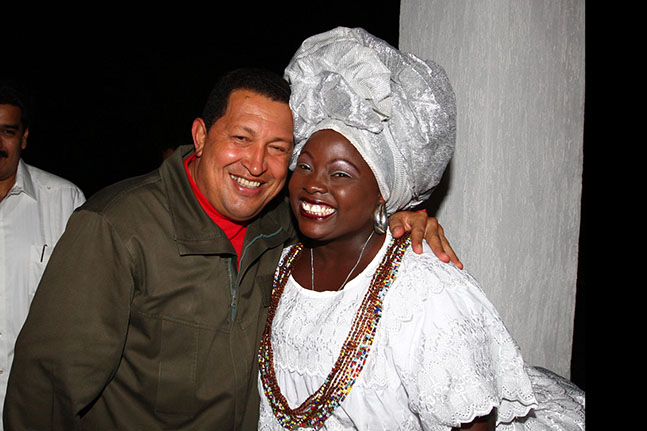
CREDIT: Manu Dias, (CC)
Venezuela’s foreign policy under the late President Hugo Chávez, and now his successor Nicolas Maduro, has been subject to sharply differing interpretations. Some observers see the oil-rich country’s foreign relations since Chávez’s election in December 1998 as shaped by a visionary who has promoted international solidarity with the oppressed, combated poverty, and pushed for a just world order free of uni-polar domination. For critics, however, Venezuela’s foreign policy has been incoherent, militaristic, and prejudicial to regional stability.
Does Venezuelan foreign policy include ethical considerations, as its supporters claim? The evidence suggests it does and that as a result we can be more optimistic about possibilities for incorporating ethics into international affairs than some scholars would have us believe.
The Ethical Dimension of Venezuelan Foreign Relations
To evaluate a possible ethical dimension to Venezuelan foreign policy, it is necessary to understand the ideology Chávez imbued in the country’s international affairs. Five concepts are central. The first two are the primacy of national sovereignty and Latin American and Caribbean integration. These are based on an understanding of foreign policy as a continuation of the Pan-American vision of Venezuela’s founder and 19th century independence hero Simon Bolivar, who also gives the name to Chávez’s “Bolivarian” political project. The third and fourth are the importance of international solidarity and south-south cooperation, which hold that Venezuela’s development should be based on mutual solidarity and cooperation with the countries of the global south. Finally, these concepts coalesce to form the pursuit of a multi-polar world order, which sees Venezuela’s international role in strengthening ties with emerging powers across different regions as part of a shift to a more balanced international system which will guarantee “world peace” and “universal well-being.” This implicitly involves an attempt to counter-balance the weight of the United States in international affairs.1
One example of Venezuela’s pursuit of these values is the Bolivarian Alliance for the Peoples of Our America (ALBA). This alliance of leftist Latin American nations founded by Venezuela and Cuba in 2004 has implemented regional development strategies based on the principles of “solidarity, cooperation and complementing.” Programs aiming to guarantee food security, universal literacy, free health and education, and decent housing are strongly marked by values of social justice and human development.2 Social programs promoted by the ALBA include the “Miracle Mission,” which provides free eye treatment and surgery to Venezuelan citizens and those of several Latin American countries. The program has treated around 1.2 million people in Venezuela since its launch in 2004.3
Development assistance and solidarity have also been evident in Venezuela’s outreach to the Caribbean, particularly with the PetroCaribe initiative. Launched in 2005, the program offers Venezuelan petroleum to Caribbean nations at a discount rate. Participating nations only pay a percentage of the oil’s market price up front, with the rest converted into low-interest, long-term loans. A portion of these loans can be amortised through payment in goods and services; for example, Cuba sends medical personnel to Venezuela in exchange for oil shipments. The loans also become important sources of capital spending for the region’s governments. Eighteen Caribbean states now participate in the program, and Venezuelan oil minister Rafael Ramirez estimated in 2011 that PetroCaribe covers 43 percent of participating nations’ energy needs.4 In the context of rising oil prices in the 2000s, a Council on Hemispheric Affairs (COHA) report on the scheme described it as “the most concrete proposal on the table to alleviate the region’s suffering.”5
Perhaps no other Caribbean nation has benefitted more from this kind of regional solidarity than Haiti. Following the devastating January 2010 earthquake, Venezuela pledged $2.4 billion in financial and relief aid, more than any other of 58 donors. This aid has included building power plants, shelters, a new hospital (in collaboration with Cuba), sending food and medical supplies, and assistance to develop Haiti’s agricultural sector.6 Venezuela even wrote off $400 million of Haiti’s PetroCaribe debt. This important reconstruction aid was given despite the fact that Haiti is by no means an ideological ally of Venezuela’s leftist government; its president, Michel Martelly, is close to Haiti’s business elite and the United States. Nevertheless Martelly has publicly thanked Venezuela for its solidarity and help since the earthquake, commenting in December 2011 that for Haiti, “cooperation with Venezuela is the most important right now, in terms of impact, direct impact.”7
Africa is another continent where relations seem to be driven as much by ideology and ethical values as by strategic interests. From 2005, Chávez began referring to Africa as a “motherland” and pursuing “south-south cooperation,” or mutual development strategies, in the region. Over the next six years Venezuela established diplomatic relations with all 54 African countries, opened new embassies, and signed over 200 cooperation agreements with the continent, where only 20 had existed beforehand.8 Many of these agreements contain a clear element of solidarity and humanitarian assistance. In 2009 Venezuela pledged $20 million to the West African ECOWAS group for malarial eradication programs, while in February 2013 it offered technical assistance and personnel training to the Sahrawi Democratic Republic to improve the population’s access to safe drinking water. Further, around 500 students from over 15 African countries study in Venezuela courtesy of government scholarships, many of these in medical courses, with the intention that after their studies these newly-trained professionals return to their home countries to provide much needed public services.9 A similar program is offered to Palestine, where Venezuela has also committed to build medical facilities.
Such attempts at greater cooperation with countries of the global south have led Venezuela to play a key diplomatic role in moves toward intensifying Latin American and south-south integration. In addition to founding the ALBA and PetroCaribe, Venezuela was also a founding member of the Union of South American Nations (UNASUR) in 2008, and played host to the founding conference of the Community of Latin American and Caribbean States (CELAC) in 2011, which brings together every nation in the Americas with the exception of the U.S. and Canada. Venezuela was also host to the II Africa–South America (ASA) summit in 2009, and is set to host the tri-annual summit of the Non-Aligned Movement in 2015, and thereafter become the president of the grouping of 130 developing nations. The country was also elected to serve on the UN Human Rights Council for 2013–2016 and is a mediator in peace talks underway between the FARC guerrilla group and the Colombian government. Taken together, these aspects of Venezuela’s foreign policy have led observers such as Venezuelan geographer and analyst Rosalba Linares to conclude that Bolivarian-era foreign relations aim to construct “a sovereign, democratic and more humanitarian multi-polar world, of greater social justice and fair trade in benefit of those most in need in Venezuela and the world.”10
The Pursuit of Strategic Interests
Of course, it would be mistaken to understand Venezuelan foreign relations as solely motivated by ethical or altruistic considerations. Even solidarity-based policies have clear “soft” benefits such as raising the government’s diplomatic and international standing. Venezuela’s foreign relations have also been shaped by concrete strategic interests. Chief among these are energy interests, which are woven throughout foreign policy, as Venezuela holds the largest crude oil reserves in the world. The Bolivarian government has sought to increase ties with other energy powers for the extraction of Venezuelan crude and to diversify its oil export markets. In the context of the deterioration of relations with the United States, strategic policy goals have also included creating a robust network of international alliances and securing alternative sources of financing, technological assistance, and military hardware.
In the first years of Chávez’s presidency the state oil company PDVSA was brought under greater government control. At the same time the government pushed for the revitalisation of OPEC, advocating the policy of production quotas to help ensure that world oil prices rose to levels favourable to exporting countries. The elevation of oil prices in the 2000s gave the Venezuelan government flexibility to pursue active energy diplomacy abroad while funding a wave of new social programs at home.
The government has built what it calls “strategic alliances” with several energy powers, including Russia and China. Russian energy giant Gazprom now works with PDVSA to explore gas deposits in the Gulf of Venezuela and Russian firms are active in the extraction of oil in Venezuela’s Orinoco Belt. Russia is also useful to Venezuela as a source of military hardware, with Chávez’s government becoming Russia’s biggest customer of military goods after India.11
Meanwhile China has provided Venezuela with a new market for its petroleum exports. Oil exports to China rose from almost zero in 2004 to 460,000 bpd in 2010, a number that officials want to increase to one million.12 The relationship has also resulted in over 300 bilateral agreements and 80 major projects, and has allowed the Venezuelan government access to financing and technology, the latter exemplified by the launching of Venezuela’s first satellites with Chinese assistance in 2008 and 2012.
Venezuela has formed a web of links with other countries enjoying oil and gas reserves, such as Iran, Syria, Brazil, and certain African countries. Given their relatively independent diplomatic stance in world affairs, strengthening ties with these nations has also fitted within the ideological goal of building “south-south cooperation” and a “multi-polar world order.”
Meanwhile relations with Venezuela’s traditional commercial partner and top recipient of crude exports, the United States, have been frozen at the charge de affairs level since 2010. Venezuelan officials blame this on the U.S. government’s belligerence and lack of respect for Venezuela’s independence and sovereignty, including support for and alleged involvement in the short-lived coup attempt to topple the Chávez administration in 2002. For its part, the United States has accused Venezuela of failing to sufficiently cooperate with counter-narcotics and anti-terrorism efforts, and of acting against U.S. interests by pursuing relations with “enemy” states such as Iran. Nevertheless, there are signs that the relationship is improving under the presidency of Nicolas Maduro, after Venezuelan foreign minister Elias Jaua met with Secretary of State John Kerry during an OAS summit in early June. “We would like to see our countries find a new way forward, to establish a more constructive and positive relationship,” said Kerry following the meeting. However, it remains to be seen whether the recent decision by President Maduro to offer asylum to ex-NSA intelligence leaker Edward Snowden will have an impact on efforts to improve bilateral relations.
Criticisms and Contradictions
Critics point to contradictions in the conduct of Venezuela’s foreign policy, and question the existence of an ethical dimension to Venezuelan foreign relations.
An accusation which emanates principally from the United States is that rather than seeking “world peace,” Venezuela in fact pursues an aggressive policy of building up its arms stockpile while forming alliances seen as threatening to U.S. national security. In September 2009 then-Secretary of State Hilary Clinton raised concerns over Venezuela’s arms purchases from Russia, arguing that the Chávez administration was engaging in a military build-up which could trigger a South American “arms race.” “They [Venezuela] outpace all other countries in South America [in military purchases] and certainly raise the question as to whether there is going to be an arms race in the region,” she said.13 Further, some conservative politicians and analysts have argued that Venezuela should be considered a “national security threat” due to its ties with countries regarded as hostile to the U.S, such as Iran and Syria.14
However, neither the figures nor events bear out fears that Venezuela is unduly arming itself or seeking military-style alliances with U.S. adversaries. According to the CIA World Factbook, in 2009 Venezuela put 1.4 percent of GDP toward military spending, the 5th highest in the region and less than the U.S., Colombia, and Chile. By 2012, military spending in Venezuela had halved as a percentage of GDP to 0.7 percent, with the country spending less than most major countries in the region, being only 153rd out of 173 countries measured globally for military spending.15 Venezuelan government officials meanwhile state that its international alliances are “about peace” and not in any way an aggression toward a third party. This point was highlighted during the visit from former Iranian president Mahmoud Ahmadinajad to Venezuela in January 2012. Nicolas Maduro, in his capacity of foreign minister, said to press at the time that bilateral ties between the two countries were part of a “peaceful relationship…we have a relationship of cooperation for development… and above all, for peace”.16
This appraisal of Venezuela’s diplomatic and defence policy appears to be shared by the U.S. military establishment. In August 2012 General Douglas Fraser, chief of U.S. Southern Command, said that although he would like greater cooperation from Venezuela against drug trafficking, he did not consider Venezuela a security threat to the United States. When asked if he thought Venezuela’s arms purchases constituted a danger to the U.S., Fraser replied, “From my standpoint, no…I don’t see them [Venezuela] as a national security threat.” Further, when asked whether Venezuela’s relationship with Iran amounted to a “military alliance,” the general disagreed, stating, “As I look at Iran and their connection with Venezuela, I see that still primarily as a diplomatic and economic relationship.”17 President Barack Obama has taken a similar stance, announcing in an interview in July 2012, “Overall my sense is that what Mr. Chávez has done over the last several years has not had a serious national security impact on us.”18
Thus the notion that Venezuelan military purchases and bilateral relationships represent a threat to the United States appears to be an overreaction from certain observers within U.S. political and media spheres, who confuse Venezuela’s independent foreign policy with one threatening U.S. security.
Others argue that there exists a contradiction in Venezuelan foreign policy between claims to pursue the values of democracy, humanitarianism, and solidarity, while supporting governments considered authoritarian or with poor human rights records. In 2011, political sociologist and author Gregory Wilpert argued that Venezuela ran a “significant” risk of losing legitimacy among progressives when Chávez continued to support former Libyan president Muammar Gaddafi against an insurgency in that country, a point that could be extended to several other of Venezuela’s allies in the Middle East.19
Another seemingly contradictory move by a government purporting to promote ethical values in its foreign policy is Venezuela’s decision to withdraw from the OAS’ Inter-American Court and Human Rights Commission (IACHR) in 2012, on the basis of the body’s alleged “shameful” bias against the Chávez administration. The decision is also part of a shifting focus toward Latin American autonomy and integration, with several states in the region pushing for the formation of new mechanisms to promote human rights within the UNASUR and CELAC. 20
A final question for Venezuela’s foreign relations is the extent to which policies pursued under Chávez will continue under the presidency of Nicolas Maduro, who was elected to power in April, following Chávez’s death in March. Maduro was Chávez’s foreign minister from 2006–2012, and in that role helped to build Venezuela’s contemporary foreign relations. The new president has pledged to continue these policies and his active foreign diplomacy over the previous three months seems to confirm this. Present challenges for Maduro include assuming the presidency of the Mercosur trade bloc this summer, and seeking productive relationships with the U.S. and Europe; steps toward which appear to have already been taken.
Between Ethics and Interests
In common with all nation states, over the past 14 years Venezuela has pursued clearly defined strategic and economic interests through its foreign policy. These have included developing greater links with other energy powers and ensuring access to sources of financing and military hardware. The government has also sought commercial, technological, agricultural, educational, health, and other forms of cooperation considered beneficial to Venezuela’s national development.
Although certain criticisms of contradictory behaviour can be levelled at Venezuela’s foreign relations, policymaking has followed a coherent logic. From technological cooperation with China to malaria eradication assistance in Africa, Venezuela’s new foreign relations have been built within an ideological framework embodied by the notions of “south-south cooperation” and a “multi-polar world.”
Further, while all nations could be said to act in their own strategic interests, not all have also placed norms of cooperation, solidarity and humanitarianism as a central focus of foreign policy. These values can be seen in agreements Venezuela has made with countries across all continents, but especially in the Americas and Africa. Even in the United States, PDVSA subsidiary CITGO aids around 100,000 low-income families during the winter with donated Venezuelan heating oil.21 Thus while it would be false to state that Venezuelan foreign policy is solely motivated by ethical considerations, it would be misleading to explain the country’s external relations without reference to these. This ethical dimension to Venezuela’s foreign policy is a demonstration that if the political will exists, governments can pursue such values within their foreign relations. In doing so, concrete and mutual benefits can be reaped for both the development of societies and the wellbeing of peoples.
NOTES
1 Chávez, H. (2012), Plan de la Patria: Programa del Gobierno Bolivariano 2013 – 2019, accessed at: http://www.minci.gob.ve/wp-content/uploads/downloads/2013/04/PLANDELAPATRIA-20133-4-2013.pdf.
2 Ullán de la Rosa, F.R. (2012), La Alianza Bolivariana para las Americas – Tratado de Comercio de Los Pueblos (ALBA-TCP): Análisis de un Proyecto de Integración Regional Latinoamericana con Una Fuerte Dimensión Altermundista, Estudios Politicos, no. 25, (Enero – Abril), pp131 – 170, Mexico, D.F. (p151-152).
3 Morales, M. (27/5/2013), Hija de Chávez Manejará Presupuesto Millonario en la Misión Milagro, El Nacional.
4 Rojas, R. (December, 2011), Venezuela Increasing Influence in Caribbean through PetroCaribe, Press TV.
5 Lai, K. (January, 2006), PetroCaribe: Chávez’s Venturesome Solution to the Caribbean Oil Crisis, Council on Hemispheric Affairs (COHA).
6 Information taken from, Wyss, J. (05/07/2010), Venezuela Leads the World in Earthquake Relief, Miami Herald; Edmonds, K. (February 2012), ALBA Expands its Allies in the Caribbean, North American Congress on Latin America (NACLA.org); Robertson, E (01/06/2012), Venezuela, Cuba and Argentina Sign Development Assistance Agreements with Haiti, Venezuelanalysis.com.
7 The Editors, (April, 2012), Haiti Using Funds from PetroCaribe to Finance Reconstruction, Council for Economic and Policy Research (CEPR).
8 Bolivar, R. J., (February, 2011), “Entrevista: Reinaldo José Bolívar, Viceministro de Relaciones Exteriores para África,” Encontrarte.
9 (14/01/2011), “Venezuela ha Firmado 200 Acuerdos de Cooperación con África,” Agencia Venezolana de Noticias.
10 Linares, R., (2010), “La Estrategia Multipolar de la Political Exterior Venezolana,” Aldea Mundial, Año 15, No. 15, Julio – Diciembre (2), pp51-62, (p60).
11 Rinna, A. (09/03/2013), “Russia’s Uncertain Position in Post-Chávez Venezuela,” Centre for World Conflict and Peace blog.
12 Ellis, R.E. (2010), “Venezuela’s Relationship with China: Implications for the Chávez Regime and the Region,” Centre for Hemispheric Policy, University of Miami, pp1-10; Cornejo, R. & Garcia, A.N. (2010), “China y América Latina: Recursos, Mercados y Poder Global,” Nueva Sociedad, No. 228 (Julio-Agosto), pp79-99 (p95); Manduca, P.C. (2012), “La Energía en la Política Sudamericana: Características de las Relaciones entre Brasil y Venezuela,” Revista Mexicana de Ciencias Políticas y Sociales,” no. 216, (Septiembre – Diciembre), pp81-100.
13 Labott, E. (16/09/2009), “U.S. Fears Venezuela Could Trigger Regional Arms Race,” CNN.
14 Noriega, R. (08/02/2013), “Hugo Chávez: An Uncounted Enemy,” The Washington Times.
15 Central Intelligence Agency: The World Factbook (Military Expenditures, Venezuela), accessed at: https://www.cia.gov/library/publications/the-world-factbook/rankorder/2034rank.html?countryname=Venezuela&countrycode=ve®ionCode=soa&rank=153#ve.
16 Pearson, T. (10/01/2012), “Iran-Venezuela Relationship “About Peace,” Venezuelanalysis.com.
17 (01/08/2012), ” Top US General: Venezuela Not a National Security Threat,” Associated Press.
18 Mazzei, P., Bolstad, E., (11/07/2012), “Mitt Romney, GOP howl over President Barack Obama’s remark about Hugo Chávez,” Miami Herald.
19 Wilpert, G, (06/03/2011), “Venezuela and Libya: An Interview with Gregory Wilpert,” Venezuelanalysis.com.
20 Britto Garcia, L. (12/05/2013), Avanza el Golpe Judicial, Aporrea.org.
21 Citgo Press, (31/01/2013), “Eighth Annual Citgo-Venezuela Heating Oil Program Launched,” Venezuelan Embassy, Washington.
Related articles
- US NSA Spied on Venezuela When President Chavez Died, Documents Reveal (alethonews.wordpress.com)
- Venezuela Reaffirms Commitment to Haiti’s Reconstruction | venezuelanalysis.com (rapadoo.com)
- PetroCaribe moves closer to Economic Zone (antiguaobserver.com)
- Toward a new Venezuela-Caribbean relationship (caribbean360.com)
US NSA Spied on Venezuela When President Chavez Died, Documents Reveal
By Tamara Pearson | Venezuelanalysis | July 9, 2013
Mérida – Brazilian daily O Globo, reporting jointly with Guardian journalist Glenn Greenwald informed today that according to the leaked National Security Agency (NSA) documents, the United States has also been spying on Venezuela’s petroleum industry. The information comes as governments confirm that whistleblower Edward Snowden has applied for asylum in Venezuela.
According to the leaked documents, the NSA also spied on other Latin American countries such as Mexico, Argentina, Colombia, and Ecuador.
O Globo reports that, “The United States doesn’t seem to be only interested in military affairs, but also in commercial secrets, such as Venezuela’s petroleum”.
According to the documents, NSA spied on Latin America through at least two programs, the Prism program from 2-8 of February this year, and the “Informant Without Limits” program from January to March.
One document describes Operation Silverzephyr, which accessed information through partnerships with private satellite and phone operators, focusing on Latin American countries. The document shows that the NSA agency collected information through telephone calls, faxes and emails, possibly using the program Fairview.
According to O Globo and the leaked NSA documents, Venezuela was also observed in 2008 through the X-Keyscore program, which identifies the presence of foreigners according to the language they use in emails. Further, in March this year it appears that Venezuela was a priority for the NSA’s spying. President Hugo Chavez died on 5 March, and presidential elections were called for 14 April.
U.S. reacts to Venezuela’s asylum offer
On Sunday U.S. legislators suggested sanctioning countries which grant asylum to Edward Snowden, who leaked the NSA documents to The Guardian. The chair of the U.S. House of Representative’s intelligence committee, Mike Rogers, said Latin American countries are “using Snowden as a public relations tool… we shouldn’t allow this… it’s a serious issue… some Latin American companies enjoy trade benefits from the United States and we’re going to have to revise that”.
Legislator Robert Menendez also said that any “acceptance of Snowden” would put that country “directly against the United States”. The Venezuelan government formally offered Snowden asylum on 5 July. Nicaragua and Bolivia have also done so.
“We’ve made very clear that he [Snowden] has been charged with felonies and as such, he should not be allowed to proceed in any further international travel other than travel that would result in him returning to the United States,” White House Press Secretary Jay Carney told reporters yesterday at his daily news conference.
Yesterday Maduro said that Venezuela has also formally received an asylum request from Snowden, who agencies report to have been in the Moscow airport since 23 June.
Russian legislator Alexei Pushkov also confirmed yesterday (via a Tweet that he later deleted) that Snowden had accepted Venezuela’s offer of political asylum. “It seems that that is the option he feels is safest,” Pushkov wrote. However, later today Wikileaks also tweeted that Snowden had not formally accepted asylum in Venezuela, but also deleted the tweets a few minutes later.
Venezuelan President Meets with Private Television Stations

President Maduro (second from left) in a meeting with Venevision representatives (agencies)
By Tamara Pearson | Venezuelanalysis | May 21, 2013
Merida – Yesterday Venezuelan president Nicolas Maduro met with representatives of private television stations Venevision and Televen. Together they discussed the media’s role in maintaining an environment of “peace, tolerance and living together”.
Last Wednesday Maduro called on the two stations to form an “alliance for life” and to stop “promoting disloyalty, betrayal, and drug-trafficking”.
After the meeting Venevision said in a formal statement that they had discussed a communication campaign called “Zero Violence”, which would contribute to the “movement for peace and life” and reducing violence in Venezuela.
Venevision is Venezuela’s largest television network, and is available over cable, free terrestrial, and in the United States through Univision. Until 2005 it opposed Hugo Chavez, but from then on its coverage has been more even-handed. It is owned by one of Venezuela’s richest citizens, Gustavo Cisneros, and includes a variety of programming, from news, to children’s shows, music, and movies.
Televen has the second highest audience, after Venevision, and focuses on soap operas, sports, and talk shows. Camero Comunicaciones owns half of it, and Cadena Capriles owns the other half. It has a smaller proportion of nationally produced shows than Venevision.
According to Maduro, Televen’s representatives also agreed to the proposal to reinforce values “for peace and life”. He said they agreed to increase national production of series and documentaries, in order to “support our artists… and promote national values”.
After the two meetings, Vice-president Jorge Arreaza also stated that they had agreed to work together on a “new model of television… where content supporting peace and stability is generated”.
Maduro also announced yesterday that he would meet with the new owners of opposition news station Globovision, saying “I don’t know them but I’m going to meet with them”. He said they had requested the meeting with him, but so far there are no further details.
Capriles Formally Contests Elections Before Venezuela’s Supreme Court
By Chris Carlson | Venezuelanalysis | May 2, 2013
Maracaibo – Representatives from the electoral campaign of ex-presidential candidate Henrique Capriles formally contested last month’s elections before Venezuela’s Supreme Court today.
The legal procedure submitted to the court has the objective of annulling April’s presidential elections in which Henrique Capriles lost to Nicolas Maduro by less than 2 points, and to allow for the elections to be repeated.
“We submitted this demand to contest the elections due to fraud and bias [of the electoral body],” said Gerardo Fernández, the attorney for the Capriles campaign.
“We want to show that the electoral system is broken: the campaign, the permanent issues in the electoral registry, the abuse of state resources, and all of the irregularities on election day,” he said.
The Capriles campaign reportedly submitted a 180-page document to Venezuela’s Supreme Court, and also requested that two of the Supreme Court justices to recuse themselves from ruling on the case.
They are demanding that Judges Jhannett Maria Madriz and Malaquias Gil not be allowed to be involved in the case for having already given their opinion of the fraud claims, and for “their close ties to Nicolas Maduro”.
It is now up to Venezuela’s Supreme Court to decide if the challenge is justified, and if so, to establish the timeframe for the evidence to be presented to the court.
Fernandez said they would present evidence from before, during, and after the elections, including the “unbalanced” campaign, the “irregularities” on election day, and the auditing process afterwards.
“We are contesting the activities before the April 14th elections, the electoral process on the 14th, and the activities that occurred after that day,” he said.
Capriles has refused to accept the results, and alleged fraud after Maduro’s victory was announced on the night of April 14th.
However, he has yet to provide any solid evidence that would indicate any fraud actually took place.
After demanding a recount from the National Electoral Council (CNE), Capriles seemed to agree to an extended audit of nearly 100 percent of the ballot boxes. Capriles subsequently rejected this audit when the CNE would not include an audit of the voter registry.
Capriles demanded a verification of all the signatures and fingerprints that voters place in the voter registry at the time of voting, but the CNE has said this would be impossible, as there are more than 15 million signatures and fingerprints that would have to be evaluated.
The CNE and other government officials have said Capriles lacks any proof, and have accused the Capriles campaign of making “impossible” demands in an attempt to claim the institutions are not democratic when their requests are denied.
Capriles has already stated that he doesn’t expect a “fair” ruling from Venezuela’s Supreme Court, which he accuses of being controlled by the government.
But the Capriles campaign has said they will go through all domestic institutions before taking their complaints before international institutions.
Related articles
- Auditing Process Begins in Venezuela amid Opposition Claims of “Lies” and “Persecution” (alethonews.wordpress.com)
- Venezuela’s Electoral Council Says Capriles Lacks Proof of Fraud (alethonews.wordpress.com)
- Venezuelan Government Accuses Capriles of Making “Impossible” Demands (alethonews.wordpress.com)
- Venezuela’s Electoral Council Approves Audit of 100 Percent of Votes (alethonews.wordpress.com)
- Capriles Falsifies Evidence in Order to Claim Fraud in Venezuela’s Elections (alethonews.wordpress.com)
Venezuela and Cuba Deepen “Strategic Alliance”
By Ryan Mallett-Outtrim | Venezuelanalysis | April 29, 2013
Mérida – Venezuela and Cuba signed 51 bilateral agreements related to energy management and social programmes in areas including healthcare, education and recreation this past weekend and pledged to spend $2 billion on bilateral social development projects this year.
The agreements were signed during Venezuelan president Nicolas Maduro’s visit to Cuba over the weekend.
“We came to ratify a strategic…[and] historical alliance,” Maduro told Cuban press.
Details of the bilateral agreements are yet to be released, though Maduro described the deals as focusing on “social development”.
After meeting with Maduro, Castro told the press that the agreements reaffirm Cuba’s “unyielding will to continue co-operation in solidarity with Venezuela, determined to share our fate with the heroic Venezuelan people”.
The agreements represent Cuba’s largest source of foreign capital, according to AFP.
In his first trip abroad since being sworn in as Venezuela’s new president, Nicolas Maduro also met with former Cuban president Fidel Castro.
“I spent over five hours with Fidel, talking, sharing memories of Comandante Chavez, remembering how he and Chavez had built this alliance, which is more than a strategic partnership,” Maduro stated, according to the Havana Times.
The visit was criticised by Venezuelan opposition leader Henrique Capriles, who during his recent election bid advocated for cutting most ties with Cuba.
“Our great lackey is travelling to Havana to get instructions from his boss,” he tweeted on Saturday.
Venezuela is Cuba’s largest trade partner, currently providing the island nation with more than 100,000 barrels of oil a day. In exchange, over 30,000 Cuban medical personnel work in Venezuela.
During his election campaign, Capriles maintained his long standing policy that if elected, “not another drop of oil” would be sent to Cuba.
However, his views on the doctors are less consistent; alternating between offering them citizenship and accusing them of being spies involved in a “Castro-communist” plot and threatening them with deportation.
Maduro indicated that his administration would maintain continuity with former president Hugo Chavez’s Cuba policy, stating that the two countries “will continue working together”.
According to the Uruguayan newspaper La Republica, Maduro’s next international trip will be to Uruguay, where he is expected to meet with the country’s leftist president Jose Mujica.
The newspaper cites diplomatic sources as stating that the trip will take place around May 7, and will be part of a regional tour.
However, La Republica’s report on Maduro’s travel plans have not been officially confirmed by the Venezuelan government.
National Lawyers Guild Monitors: Venezuelan Elections Were Well-Organized, Fair and Transparent
NLG | April 16, 2013
A delegation of National Lawyers Guild (NLG) election monitors visited polling sites in five Venezuelan states on April 14 and found that the Venezuelan presidential election process was fair, transparent, participatory, and well-organized.
With over 78 percent voter turnout, Nicolas Maduro Moros was declared Venezuela’s new president with a 50.66 percent share of the 99.12 percent of votes counted.
“The U.S. would do well to incorporate some of the security checks and practices that are routine in Venezuela to improve both the level of participation and the credibility of our elections,” said NLG attorney Robin Alexander. She added, “The six polls I visited in the state of Carabobo were calm and well-organized and lines were short.”
The five-member NLG delegation formed part of a larger team of over 130 people, which included former presidents of Guatemala and the Dominican Republic, electoral commission members, journalists, and representatives of human rights organizations from across the globe. Election monitors traveled to polling places throughout the country on Election Day.
The NLG delegation found the following: advanced voting procedures that prevent fraud through multiple fingerprint and voter ID certifications; accurate and efficient digital and manual vote calculation; active participation by party witnesses and national and international observers.
In addition, the NLG monitors found a reliable system in which 54 percent of all votes are randomly audited on Election Day. NLG monitors witnessed one such audit in Caracas in which the paper ballots matched perfectly with the electronic votes.
As a U.S. organization, the NLG emphasizes that the margin of victory for Nicolas Maduro, while small, is comparable to close elections in the U.S., such as the margins of victory for John F. Kennedy in 1960 and for George W. Bush in 2004.
The NLG calls upon the U.S. to honor the Venezuelan election as the nations of the world honor U.S. elections without question. Moreover, as recognized by Jimmy Carter, Venezuela’s election infrastructure, with its secure electronic system backed by paper ballots, is “the best in the world,” and therefore deserves at least as much respect as our own.
As NLG member and international human rights law professor Daniel Kovalik states: “In the end, it is the Venezuelans who must decide their own future and leaders and the U.S., in the interest of democracy, must honor that decision.”
Azadeh Shahshahani
NLG President + 1 212 679 5100, ext. 15
On the ground in Venezuela:
Nicole Phillips Esq.,
+1 510 715 255, nicole@ijdh.org
Camilo A. Romero,
+1 510 717 4227
Daniel Kovalik,
+1 412 335 6442
Natali Segovia,
+1 602 796 7034
Robin Alexander,
+1 412 716 1696
Related Articles:
Featured Video
John Mearsheimer: US Already lost Iran war – No off-ramp in sight
or go to
Aletho News Archives – Video-Images
Frlom the Archives
With apparently fabricated nuclear documents, Netanyahu pushed the US towards war with Iran
By Gareth Porter | The Grayzone | April 29, 2020
President Donald Trump scrapped the nuclear deal with Iran and continued to risk war with Iran based on Israeli Prime Minister Benjamin Netanyahu’s claim to have proven definitively that Iran was determined to manufacture nuclear weapons. Netanyahu not only spun Trump but much of the corporate media as well, duping them with the public unveiling of what he claimed was the entire secret Iranian “nuclear archive.”
In early April 2018, Netanyahu briefed Trump privately on the supposed Iranian nuclear archive and secured his promise to leave the Joint Comprehensive Plan of Action (JCPOA). That April 30, Netanyahu took the briefing to the public in a characteristically dramatic live performance in which he claimed Israel’s Mossad intelligence services had stolen Iran’s entire nuclear archive from Tehran. “You may well know that Iran’s leaders repeatedly deny ever pursuing nuclear weapons…” Netanyahu declared. “Well, tonight, I’m here to tell you one thing: Iran lied. Big time.”
However, an investigation of the supposed Iranian nuclear documents by The Grayzone reveals them to be the product of an Israeli disinformation operation that helped trigger the most serious threat of war since the conflict with Iran began nearly four decades ago. This investigation found multiple indications that the story of Mossad’s heist of 50,000 pages of secret nuclear files from Tehran was very likely an elaborate fiction and that the documents were fabricated by the Mossad itself. … continue
Blog Roll
 Aletho News
- US failures in Iran reveal Russia is key to South Korea’s strategic security
- ‘All ports in Persian Gulf will be legitimate targets if Iranian ports are attacked’
- 40 Years of Endless War, Data Point by Data Point
- Department of War Using Palantir AI to Pick Targets in Iran
- American bases do not protect – they attack the peoples of the Persian Gulf
- ‘We’ve Obliterated Their Missiles’
- Syrian president vows ‘absolute support’ to disarm Hezbollah
- Ukraine attacking Russian gas pipeline to stop deliveries to Europe – Defense Ministry
- ‘Heinous crime’: Iran denounces Israeli assassination of 4 Iranian diplomats in Lebanon
- John Mearsheimer: U.S. Already Lost Iran War – No Off-Ramp in Sight
- If Americans Knew
- Israeli strategic plans to “remake the Middle East” from the 1950s and since
- Honoring Gaza’s women who refused to let the world look away
- 97% of victims of war on Iran are Iranian, 98% of victims in war on Gaza are Gazans – Not a ceasefire Day 152
- Early Iran strikes cost $5.6 billion in munitions, Pentagon estimates
- Israel Decided the War, But Trump’s America Fights and Pays the Bill
- Conscientious Objector Group: Phone ‘Ringing Off Hook’ As Huge Mobilization Underway
- U.S. support for Israel continues to plummet, despite media’s best efforts
- Threats and missiles fly, death tolls soar in Iran, Lebanon, Gaza – Not a ceasefire Day 151
- Lebanon: Israel’s White Phosphorous Use Risks Civilian Harm
- Corporate Media Go All Out To Support The US-Israeli War On Iran
- No Tricks Zone
- Destructive Green New Deal: German Energy And Metal Group Warns Of Drastic Crisis
- New Study Documents A 20-Year Pause In Arctic Sea Ice Decline – Driven By Internal Variability
- Wake-up Call: Survey Shows Majority Of Germans Now Favor Postponing Climate Targets!
- Televised! Leading German Political Candidate Tells Schoolchildren CO2 Makes Sun Hotter!
- New Study: A Century Warming Of 1.1°C Is ‘Commonplace’ And ‘Not Unusual’ During This Interglacial
- New Study: ‘Internal Noise’ And Volcanic Forcing Can Trigger 10-15°C Warming Within Decades
- Glaciers Worldwide Are Suddendly Surging, Experts Blame Warming!
- Surprising Discovery: Sahara Is Greening…Billions Of Trees Where Once Thought To Be Barren
- New Research Reaffirms Clouds, Aerosols, And Surface Solar Radiation Are ‘Driving The Climate System’
- Germany: Electric Car Catches Fire At Charging Station, Sets Off Local “Inferno”, Widespread Damage
 Aletho News