North Korea Vows Response to ‘Reckless’ US Navy Move
Al-Manar | April 11, 2017
North Korea denounced the US deployment of a naval strike group to the region Tuesday, warning it is ready for “war” as Washington tightens the screws on the nuclear-armed state.
The strike group — which includes the Nimitz-class aircraft supercarrier USS Carl Vinson — cancelled a planned trip to Australia this weekend to head to the Korean peninsula in a show of force.
“This goes to prove that the US reckless moves for invading the DPRK have reached a serious phase,” a spokesman for the North’s foreign ministry said according to state news agency KCNA.
“The DPRK is ready to react to any mode of war desired by the US,” he said, using the country’s official name, the Democratic People’s Republic of Korea.
President Donald Trump, fresh from ordering a missile strike on Syria that was widely interpreted as a warning to North Korea, has asked his advisors for a range of options to rein in Pyongyang, a top US official said Sunday.
Trump has previously threatened unilateral action against Pyongyang if China — the North’s sole major ally — fails to help curb its neighbor’s nuclear weapons ambitions.
“We will take the toughest counteraction against the provocateurs in order to defend ourselves by powerful force of arms,” the North Korean foreign ministry spokesman said.
“We will hold the US wholly accountable for the catastrophic consequences to be entailed by its outrageous actions.”
Speculation over an imminent nuclear test is brewing as the North marks anniversaries including the 105th birthday of its late founding leader on Saturday — sometimes celebrated with a demonstration of military might.
China rejects coal shipments from North Korea
RT | April 11, 2017
A fleet of North Korean cargo ships laden with coal is returning to their home port of Nampo after China ordered its trading companies to refuse the shipments, Reuters reports quoting shipping data.
This appears to show China is committed to the ban on imports of North Korean coal after Pyongyang carried out globally criticized missile tests. Coal is the crucial export product of the isolated state, especially the deliveries of the type used for steel making – coking coal.
To curb coal traffic between the two countries, Chinese customs ordered companies to return their North Korean coal cargoes starting from April 7, according to Reuters sources.
Two million tons are stranded at Chinese ports; the agency reported quoting a source at Dandong Chengtai, one of China’s biggest buyers of North Korean coal.
To reduce the shortfall in coal imports, China resumed buying American coal this year. According to trade data, China bought over 400,000 tons by late February. The US did not export coking coal to China between late 2014 and 2016. However, President Donald Trump pledged to revive the country’s coal sector.
US Secretary of State Rex Tillerson warned that following the missile strike again Syria, North Korea could be the next. Beijing and Washington have reportedly agreed to impose tougher sanctions against Pyongyang if it carries out nuclear or long-range missile tests.
President Trump tweeted on Tuesday that a trade deal between China and the US depends on how Beijing tackles North Korea.
“I explained to the President of China that a trade deal with the US will be far better for them if they solve the North Korean problem! North Korea is looking for trouble. If China decides to help, that would be great. If not, we will solve the problem without them!” he posted.
Russian Foreign Ministry Outlines What It Expects From Talks With Tillerson
Sputnik – April 11, 2017
MOSCOW – Moscow hopes for fruitful negotiations with the US state secretary on his visit to Moscow, the Russian Foreign Ministry said in a statement Tuesday.
“In connection with the beginning of today’s working visit to Russia by US Secretary of State R. Tillerson, we would like to note that we are counting on productive negotiations,” the ministry said.
Tillerson is visiting Moscow on Tuesday and Wednesday for talks with Russian Foreign Minister Sergei Lavrov.
“This is important not only for the prospects of further bilateral interaction, but also for the general atmosphere in the international arena,” the ministry underscored.
Moscow hopes that Washington will agree to an unbiased investigation of the recent chemical weapons incident in Syria’s Khan Shaykhun.
“We firmly expect that Washington will agree to an objective investigation with the OPCW involvement of the incident with chemical poisoning on April 4 of the residents of Syria’s Khan Shaykhun. The West groundlessly accused Syria’s authorities of it, although militants of Jabhat al-Nusra [banned in Russia], who… produced landmines stuffed with poisonous substances, operate in that area,” the statement said.
On April 4, a chemical weapons incident in Syria’s Idlib province claimed the lives of some 80 people and inflicted harm on an additional 200 civilians. The Syrian National Coalition of Revolutionary and Opposition Forces, as well as a number of Western states, accused the Syrian government troops of carrying out the attack, while Damascus refuted these allegations, with a Syrian army source telling Sputnik that the army did not possess chemical weapons.
The Russian Defense Ministry said on April 5 that the airstrike near Khan Shaykhun by the Syrian air force hit a terrorist warehouse that stored chemical weapons slated for delivery to Iraq, and called on the UN Security Council to launch a proper investigation into the incident.
Russian President Vladimir Putin said April 6 that groundless accusations in the chemical weapons incident in Syria’s Idlib were unacceptable before the investigation into the matter had been carried out.
However, the incident was used as pretext for a US missile strike against the Ash Sha’irat airbase carried out late on April 6. US President Donald Trump characterized the strike as a response to the alleged use of chemical weapons by the Syrian government troops while Russian Foreign Minister Sergei Lavrov said it was a violation of the international law. Iranian Supreme Leader Ayatollah Ali Khamenei described the US missile strike against the Syrian airfield as a strategic mistake.
Moscow expects Tillerson to detail Washington’s plans in Libya.
“We expect to hear what the US plans to do in Libya, which has in fact become shattered as a result of NATO’s military intervention, like Iraq,” the ministry said.
Libya has been in a state of turmoil since 2011, when a civil war broke out in the country and long-standing leader Muammar Gaddafi was overthrown, and the country was contested by two rival governments: the internationally-recognized Council of Deputies based in Tobruk and the Tripoli-based General National Congress.
In March 2011, several NATO states, including France, launched a military intervention in Libya aimed at ending all attacks against the civilians and establishing a ceasefire. Then-President of France Nicolas Sarkozy played an important part in promoting the EU sanctions against Gaddafi and urging for the intervention.
Russia awaits from the United States coherent clarifications on the whole range of issues of strategic stability and security in the Euro-Atlantic region.
“We await coherent clarifications of the US course on the whole range of issues of ensuring strategic stability and security in the Euro-Atlantic,” the statement read.
Russia is concerned that the United States hints at the possibility of a military scenario regarding North Korea.
“We are very much concerned over what Washington has conceived about the DPRK, hinting at the possibility of a unilateral military scenario. It is important to understand how this correlates with collective obligations on the issue of the denuclearization of the Korean Peninsula in the UN Security Council resolutions,” the ministry said.
On Wednesday, North Korea reportedly launched a ballistic missile from Sinpho, South Hamgyong province, in the direction of the Sea of Japan.
On Saturday, US officials announced that aircraft carrier strike group was sent to the Korean peninsula amid rising tensions. On Sunday, US National Security Adviser Lt. Gen. Herbert McMaster said that US President Donald Trump had ordered preparation of all possible options in order to protect the United States and its partners from North Korean threat.
Since the beginning of 2016, North Korea has carried out a number of missile launches and nuclear tests, prompting worldwide criticism. As a result, the UN Security Council tightened the sanctions regime for North Korea in an attempt to force Pyongyang to stop ballistic missile launches and nuclear tests, including imposing a measure intended to affect the country’s trade, export of natural resources, arms trade and the banking sector.
Moscow is preparing for constructive cooperation instead of confrontation, but stands ready for any developments.
“We are ready for any eventuality, however proceed from the favorability of such work that will reduce international tension rather than raising it,” the statement said.
It added that “we are preparing not for confrontation, but for constructive cooperation. We hope the US side wants the same.”
Moscow hopes the United States does not refuse to take part in international consultations on Afghanistan this Friday.
“We hope that the US will not refuse to participate in international consultations on Afghanistan, whose next round will be held in Moscow on April 14,” the ministry said.
State Department spokesman Mark Toner told Sputnik last month that the US “does not plan to participate” in the international talks involving 12 countries. Russian Foreign Ministry spokeswoman Maria Zakharova said Moscow regretted Washington’s refusal to participate.
Afghanistan is in a state of political and social turmoil, with government forces fighting the continuing Taliban insurgency. The instability has persisted in the country since the 2001 US-led invasion to defeat the Taliban and al-Qaeda in the wake of the 9/11 attacks in the United States.
The lack of control and instability turned the country into home to the largest opium poppy production and distribution network in the world.
The Russian Foreign Ministry expressed hope that the United States would urge the Ukrainian government to adhere to the Minsk agreements.
“We especially hope that the United States will be able to neutralize the revanchist moods of the Ukrainian ‘party of war’ by using its influence on Kiev. Washington could also persuade the Kiev authorities to adhere strictly to their obligations under the Minsk agreements,” the statement read.
The Donbass conflict erupted in April 2014 as a local counter-reaction to the West-sponsored Maidan coup in Kiev that had toppled President Viktor Yanukovych in February. Residents of the Donetsk and Lugansk regions held independence referendums and proclaimed the People’s Republics of Donetsk and Lugansk. Kiev has since been conducting a military operation, encountering stiff local resistance.
In February 2015, Kiev forces and Donbass independence supporters signed a peace agreement in the Belarusian capital of Minsk. The deal stipulates a full ceasefire, weapons withdrawal from the line of contact in Donbass, as well as constitutional reforms that would give a special status to the Donetsk and Lugansk People’s Republics. Despite the agreement brokered by the Normandy Four states (Russia, France, Germany and Ukraine), the ceasefire regime is regularly violated, with both sides accusing each other of multiple breaches, undermining the terms of the accord.
US Presence in Korea Drives Instability
By Ulson Gunnar – New Eastern Outlook – March 25, 2017
US and European interests continue to portray the government and nation of North Korea as a perpetual security threat to both Asia and the world. Allegations regarding the nation’s nuclear weapon and ballistic missile programs are continuously used as justification for not only a continuous US military presence on the Korean Peninsula, but as justification for a wider continued presence across all of Asia-Pacific.
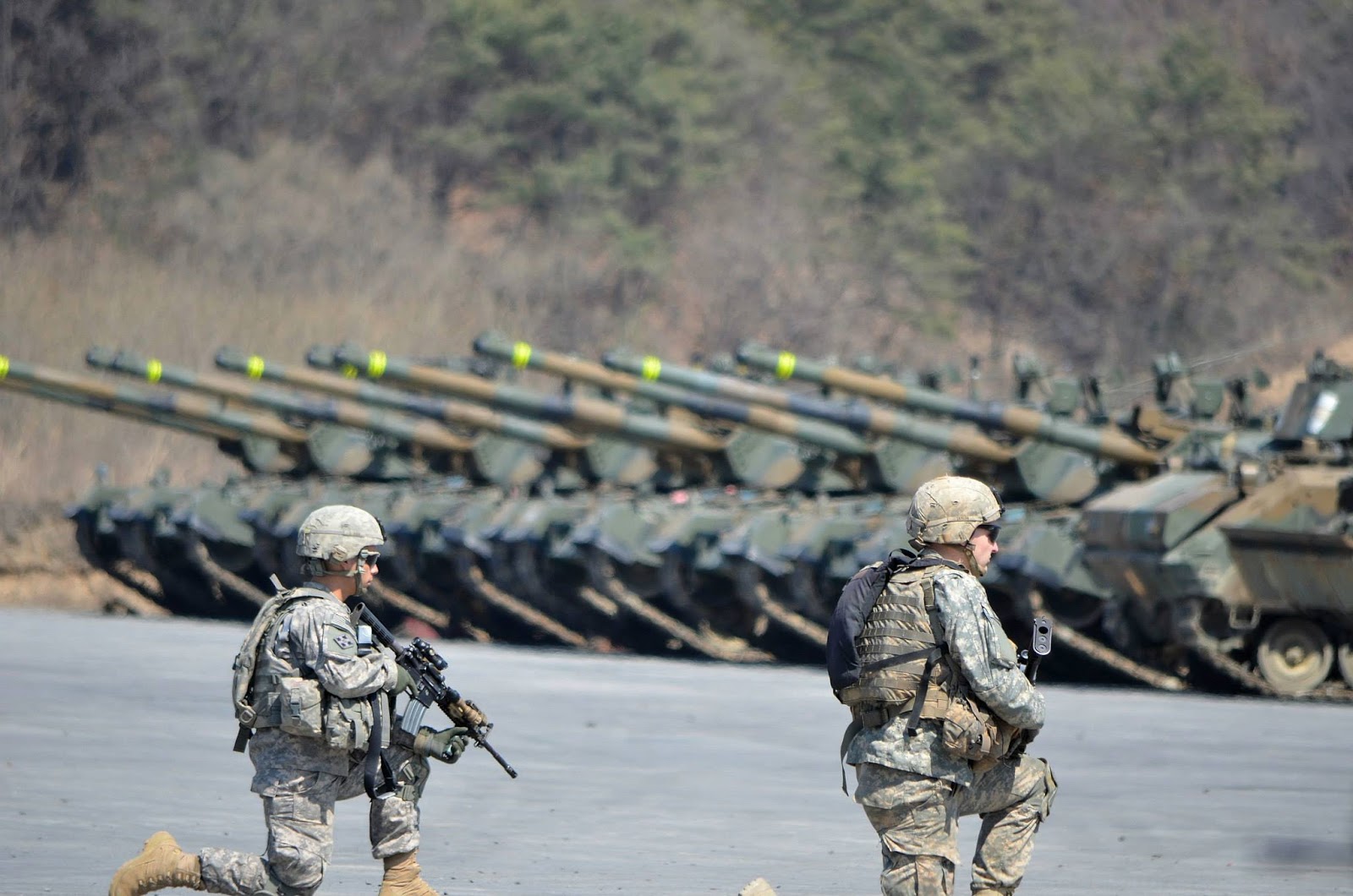
In reality, what is portrayed as an irrational and provocative posture by the North Korean government, is in fact driven by a very overt, and genuinely provocative posture by the United States and its allies within the South Korean government.
During this year’s Foal Eagle joint US-South Korean military exercises, US-European and South Korean media sources intentionally made mention of preparations for a “decapitation” strike on North Korea. Such an operation would be intended to quickly eliminate North Korean military and civilian leadership to utterly paralyze the state and any possible response to what would most certainly be the subsequent invasion, occupation and subjugation of North Korea.
The Business Insider in an article titled, “SEAL Team 6 is reportedly training for a decapitation strike against North Korea’s Kim regime,” would report:
The annual Foal Eagle military drills between the US and South Korea will include some heavy hitters this year — the Navy SEAL team that took out Osama bin Laden, Army Special Forces, and F-35s — South Korea’s Joon Gang Daily reports.
South Korean news outlets report that the SEALs, who will join the exercise for the first time, will simulate a “decapitation attack,” or a strike to remove North Korea’s leadership.
To introduce an element of plausible deniability to South Korean reports, the article would continue by stating:
Pentagon spokesman Cmdr. Gary Ross later told Business Insider that the US military “does not train for decapitation missions” of any kind.
Yet this is a categorically false statement. Throughout the entirety of the Cold War, US policymakers, military planners and operational preparations focused almost solely on devising methods of “decapitating” the Soviet Union’s political and military leadership.
In more recent years, policy papers and the wars inspired by them have lead to documented instances of attempted “decapitation” operations, including the 2011 US-NATO assault on Libya in which the government of Muammar Qaddafi was targeted by airstrikes aimed at crippling the Libyan state and assassinating both members of the Qaddafi family as well as members of the then ruling government.
Similar operations were aimed at Iraq earlier during the 2003 invasion and occupation by US-led forces.
Regarding North Korea more specifically, entire policy papers have been produced by prominent US policy think tanks including the Council on Foreign Relations (CFR) devising plans to decimate North Korea’s military and civilian leadership, invade and occupy the nation and confound North Korea’s capacity to resist what would inevitably be its integration with its southern neighbor.
A 2009 report titled, “Preparing for Sudden Change in North Korea,” lays out policy recommendations regarding regime change in North Korea. It states in its description:
The authors consider the challenges that these scenarios would pose–ranging from securing Pyongyang’s nuclear arsenal to providing humanitarian assistance–and analyze the interests of the United States and others. They then provide recommendations for U.S. policy. In particular, they urge Washington to bolster its contingency planning and capabilities in cooperation with South Korea, Japan, and others, and to build a dialogue with China that could address each side’s concerns.
Preparations for these documented plans which include provisions for invasion, occupation and the eventual integration of North Korea with South Korea have been ongoing for years with the most recent Foal Eagle exercises being merely their latest, and most blatant manifestation.
The aforementioned Business Insider article would also report:
Yet a decapitation force would fit with a March 1 Wall Street Journal report that the White House is considering military action against the Kim regime.
The SEALs boarded the USS Carl Vinson aircraft carrier and should arrive in South Korea on Wednesday, Joon Gang Daily reports.
South Korea has also made efforts toward a decapitation force, and international calls for action have increased in intensity after North Korea’s latest missile test, which simulated a saturation attack to defeat US and allied missile defenses.
While US-European and South Korean media platforms continue claiming such preparations are being made in reaction to North Korean military programs, careful analysis of North Korea and South Korea’s respective economic and military power reveal immense disparity and North Korea’s military capabilities as solely defensive with any first strike against its neighbors almost certainly leading to retaliation and the nation’s destruction.
North Korea’s nuclear arsenal and its expanding ballistic missile capabilities serve then only to raise the costs of any first strike carried out against it by US and South Korean forces. Claims that preparations by US and South Korean forces to carry out these first strikes are in response to North Korean provocations mirror similar political deceit that surrounded and clouded debate and analysis regarding US aggression in North Africa and the Middle East over the past two decades.
Ultimately, regardless of what political leaders in Washington or Seoul claim, the historical track record of the United States and its allies speaks for itself. Its annual military exercises and its adversarial approach to negotiations and relations with North Korea serve only to further drive tensions on both the peninsula and across the wider Asia-Pacific region.
For the United States, the perpetuation of instability helps justify its otherwise unjustifiable presence in a region literally an ocean away from its own borders. And while Washington cites “North Korean” weapons as a pretext for its continued presence in South Korea, its decades-spanning policy of encircling and attempting to contain neighboring China serves as its actual purpose for remaining involved in Korea’s affairs.
Provocative policies coupled with equally provocative military preparations including these most recent exercises openly aimed at North Korea’s leadership, guarantee continued instability and thus continued justification for a US presence in the region.
Washington’s careful cultivation of tensions on the peninsula serve as just one of many intentionally engineered and perpetuated conflicts across the region. Knowing well that nations targeted by US subversion and provocations will make preparations to defend against them, and possessing the media platforms to portray these preparations as “provocations” in and of themselves, the US has persuaded entire swaths of both its own population and those in regions inflicted by instability it itself drives, that Washington alone possesses the ability to contain such instability with its continued, extraterritorial presence.
In reality, the true solution for establishing peace and prosperity in these inflicted regions is for the US to simply withdraw.
US Imposes Sanctions Against 8 Russian Companies – US State Department
Sputnik – 25.03.2017
WASHINGTON – The United States has imposed sanctions against eight Russian companies in connection with the Iran, North Korea, and Syria Nonproliferation Act (INKSNA), US State Department representative told Sputnik on Saturday.
“Penalties are being applied to eight Russian entities as a result of a regular, periodic review of specific activities as required by the Iran, North Korea, and Syria Nonproliferation Act,” the representative said.
The representative also stressed that these sanctions “are separate from the broader economic sanctions that have been in place since 2014” in connection with the Crimea’s reunification with Russia and the conflict in eastern Ukraine.
The United States imposed sanctions on 150th Aircraft Repair Plant, Aviaexport, Bazalt, Kolomna Design Bureau of Machine-Building (KBM), Rosoboronexport (ROE), Ulyanovsk Higher Aviation Academy of Civil Aviation (UVAUGA), Ural Training Center for Civil Aviation (UUTsCA), Zhukovskiy and Gagarin Academy (Z&G Academy).
American civil war is good for world peace
By M K Bhadrakumar | Indian Punchline | March 22, 2017
The civil war in Washington between President Donald Trump and his detractors shows no signs of abating. Every day becomes a fresh start in the fighting. The latest salvo has been Monday’s hearing at the US House of Representatives Intelligence Committee where the Director of the Federal Bureau of Investigation James Comey acknowledged the existence of an on-going investigation by his agency over suspected Russian interference in the US presidential election with hacking to help the then Republican candidate Trump win the White House.
True, no smoking gun was produced by Comey, but his testimony implied that investigations are continuing. We may expect that many more such hearings are in the pipeline. A “big grey cloud” has appeared out of nowhere, as the chairman of the House Intelligence Committee Devin Nunes put it. The cloud will lift only if the various inquiries going on conclusively absolve Trump or, alternatively, if Trump leaves office, whichever comes first.
Such inquiries have a way of mutating, while moving ponderously, slowly in the cesspit tank. Comey admitted that it is difficult for him “to give you a timetable as to when it will be done.” Then, there is also a sub-plot – Comey himself is under investigation by the US Justice Department.
The next big day will be March 28 when two colorful personalities in the US intelligence system during the Obama administration – the ex-director of national intelligence James Clapper and the ex-CIA director John Brennan – will appear before the House panel. Both were instrumental in the January assessment that the Russians had interfered in the US presidential election in an attempt to benefit Trump. Clapper has a proven record of lying under oath, while Brennan is Barack Obama’s poodle. Trust both to resort to innuendos against Trump and mates, hitting them in the loins where it hurts. (Watch it “live”.)
To my mind, this is about the appropriate time to begin pondering about a world sans America. That is to say, an international system where America has taken “time out”. Is it a good thing to happen? Well, it is already having some salutary effect on the international climate. The global tensions have noticeably eased. If it was commonplace during the Obama era to discuss a potential war between Russia and the US, including a nuclear war, no one wastes breath over such things anymore.
A good case can be made that if the American civil war continues to be fought as savagely by the country’s elites as it has been so far, and if the fratricidal strife continues for another 4 or 8 years — ideally, through the entire Trump presidency — it will be a great boon for the world community. Never again will Americans be able to be preachy that the world cannot do without them. And the ruling elites in countries such as India will also get accustomed to a life without America.
Clearly, America’s “exceptionalism” is getting exposed as total sham. Second, the longer the civil war continues, the less possibility there is for US military interventions abroad. Quite obviously, we saw last week that China could prevail upon the US to be “cool-headed” and not to go to war with North Korea. It seems to me that US Secretary of State Rex Tillerson appeared relieved to agree with the Chinese that there is no option but to continue on the diplomatic track vis-à-vis the North Korea problem.
Again, some degree of predictability is appearing in the US-China relationship, since the last thing Trump wants now is a conflict with China. For us Asians also, it is singularly gratifying that there isn’t going to be a war in the region. This is what the Chinese Foreign Ministry spokesperson said earlier today at a media briefing in Beijing:
- During Secretary of State Tillerson’s stay in China, the two sides arrived at a clear consensus on ensuring a sound development of China-US relations at a new starting point in the spirit of non-conflict, non-confrontation, mutual respect and win-win cooperation. It should not be interpreted as a victory for any party. It is just the right way for China and the United States, two major countries, to get along with each other. Non-conflict, non-confrontation, mutual respect and win-win cooperation summarizes the reason for the steady growth of China-US ties in recent years and is worth carrying forward and being further developed. We would like to enhance communication, mutual understanding and mutual trust with the US so as to properly handle differences, expand bilateral, regional, and international cooperation, and elevate China-US relations to a greater height at a new starting point.
The comfort level in Beijing is palpably rising. Finally, there are some other good signs, too, which are not visible to the naked eye but are no less important. In the civil war conditions in America, with so much dust and noise in the air in Washington, and such poor visibility all around, Trump is quietly able to do a few things on the side, which he had promised to do.
A good friend of mine who watches Syria and Iraq through binoculars 24 x 7, wrote to me a couple of days ago that Trump is doing some incredible things out there in the neighborhood where she lives. Let me succinctly paraphrase her assessment:
- Trump has in fact prioritized the fight against terrorism. He is doing this quietly… The CIA has completely turned off the arms spigot to rebels in Syria and the US is bombing Al Qaeda and its allied groups now – something that Obama avoided (and tried to stop Russia/Syria/Iran from doing.) Equally, Trump is bombing the Al-Qaeda in Yemen too. And in Iraq, Trump is standing by while the Iran-trained Hashd ash-Shabi is annihilating ISIS in western Mosul and cutting off their route to Syria. Obama, on the contrary, had refused to let the Hashd fight in many of these battles. Trump now has not only given the go-ahead, but we have now seen the Iraqi Air Force participate in anti-ISIS bombing raids into Syria. Simply put, if the Obama administration’s policies only had led to the rise of the ISIS and Al-Qaeda in Iraq and Syria, Trump is actually fighting them and, importantly, he is allowing US’ regional foes – Iran and Iran-supported militia groups, in particular – to fight them unimpeded.
Meanwhile, Tillerson is likely to visit Moscow on April 12. As the saying goes, dogs bark but the caravan moves on. The world community cannot possibly ask for more.
Indeed, there will always be disgruntled elements – Brits and Germans, for example. But that is perfectly understandable. They realise that Trump regards them as a lower form of life – worse than leeches or bed bugs. They dearly want Trump to lose in the civil war, and lose very quickly. Without America to lead, they are afraid they might lose their gravitas in world politics. For us, Asians, that is not a bad prospect, either. Hopefully, the curtain is coming down on the “West”, as we knew it in modern history.
Korean War 2.0? Why US ‘Prompt Global Strike’ Won’t Work Against Pyongyang
Sputnik – 17.03.2017
US Secretary of State Rex Tillerson signaled on March 17 that military action against North Korea is “on the table.” Speaking to Sputnik, Russian political analyst Dmitry Verkhoturov described a three-phase war scenario which the Pentagon is likely to implement.
US Secretary of State Rex Tillerson stated Friday that military action against North Korea is “an option.”
“If they [Pyongyang] elevate the threat of their weapons program to a level that we believe requires action then that option is on the table,” Tillerson told journalists during his visit to South Korea.
“Certainly we do not want for things to get to a military conflict. But obviously if North Korea takes actions that threaten the South Korean forces or our own forces then that would be met with an appropriate response,” he added, as quoted by NBC News.
A day earlier, while in Tokyo, the US Secretary of State announced that “the policy of strategic patience [toward North Korea] has ended.”
Speaking to Sputnik Korean, Russian political analyst and expert on North Korea Dmitry Verkhoturov shed light on the potential consequences of a US military operation against the Democratic People’s Republic of Korea (DPRK).
While it is highly unlikely that Washington wants history to repeat itself for the US in North Korea, Verkhoturov noted, referring to the Korean War (1950-1953), they definitely have a blitzkrieg plan.
That said, the Russian expert described a three-phase war scenario which the Pentagon may be considering.
“The first element — a strike by hypersonic high-precision weapons on the most important military facilities,” Verkhoturov suggested.
The expert drew attention to the Trump administration’s “kinetic options,” mentioned by the Washington Post Friday.
According to Verkhoturov, the options allegedly envisage the use of penetrating munitions, such as BLU-113 bombs used by US Air Force in Iraq, or an X-51A Waverider hypersonic missile, tested in real flight in 2013.
“Both types use kinetic energy,” he remarked.
Most likely the Pentagon is planning to test its latest military strategy — the so-called Prompt Global Strike (PGS) that can deliver a precision-guided conventional weapon airstrike anywhere in the world within one hour, the expert believes.
“If it works against the DPRK, it will show the world the irresistible power superiority of the United States,” he said.
“The second element is a massive air raid with the newest unobtrusive F-22 aircraft (at least four F-22s have been transferred to South Korea) and F-35 (which are currently based at Iwakuni airbase in Japan),” he noted.
It is assumed that the DPRK air defense system will not be able to repel the raid of the newest aircraft and they will manage to destroy the country’s control systems and the most important facilities already struck by high-precision hypersonic weapons, according to Verkhoturov.
“The third element is the landing of a limited contingent of ground forces to promptly seize or eliminate the North Korean political and military leadership. After this, the war must be completed,” the expert suggested.
However, there is many a slip between the cup and the lip, as the proverb goes.
Verkhoturov underscored that North Korea is not Iraq or Libya: it is a hard nut to crack. Moreover, the US may face blowback from Pyongyang.
“First, there is a developed system of underground shelters in the DPRK to survive air strikes, which had been built in the course of more than 60 years after the Korean War. There are a lot of them and all of them cannot be destroyed,” the Russian expert stressed.
“Second, in the event of strike against military headquarters and communications, [Pyongyang] has spare command posts, special procedures for transferring powers and comprehensive plans for independent action in case of war. Third, the DPRK has the capability of launching its own preventive or rapid retaliation strike with new solid-fuel missiles,” he elaborated.
In this light, it is doubtful that Washington would be able to eliminate the country’s control system, command posts and ballistic missile silos with the Prompt Global Strike, the expert remarked. Given this, the US army would face a number of hurdles, giving the opportunity for the North Korean Army to swing the balance in its favor.
At the same time, the war of the Korean Peninsula may turn into a longstanding conflict and deal a heavy blow to South Korea’s economy; it may also seriously undermine Japan and upset the post-World War II balance of power in the region, according to Verkhoturov.
Therefore, the “military option” against North Korea should be off table, according to the Russian expert.
“One can only hope that the ‘new approach’ of the US toward the Korean peninsula will be truly ‘different’,” he concluded.
Tillerson’s Asia Visit: Could US Change Stance on N. Korea Even If It Wanted To?
Sputnik – 16.03.2017
As US Secretary of State Rex Tillerson travels across Japan, China and South Korea, amid the impeachment of South Korean president Park Geun-hye and a recent missile launch by North Korea, Radio Sputnik’s Brian Becker invited columnist and author Patrick Lawrence to discuss what’s at the heart of the new diplomat’s trip.
The impeachment of South Korean president Park Geun-hye has plunged South Korea into a time of uncertainty. Between America’s undecided foreign policy and the massive unpopularity of its THAAD system deployment in South Korea, Park’s successor may take an unexpected stance. This seems likely, given that the most probable candidate to win the elections is Moon Jae-in, a supporter of the Sunshine Policy, the idea of close cooperation with North Korea without military intervention.
According to Lawrence, the visit to South Korea is the key leg of Tillerson’s trip, as Park’s impeachment has jeopardized US plans to deploy the THAAD anti-missile system in the country. The move, to counter the North Korean nuclear threat, is facing fierce opposition among South Koreans. President Park has been playing along with the United States on this issue.
Acting President Hwang Kyo-ahn, however, is obliged by law to call new elections in 60 days. Described by Lawrence as a “creature of Park Geun-hye,” Hwang’s tenure may create a short window of opportunity for the US to deploy the controversial system. But, as he is associated with the impeached president, Hwang’s chances of winning the election are extremely low. South Korea’s celebrated democracy, then, may very well backfire on the US.
Aside from the THAAD issue, Washington must decide on its approach to North Korea.
“There is no standing still on North Korean question,” Lawrence says. “Either we open the new negotiations with them, or we become more aggressive militarily.”
In fact, military confrontation is not the only way the United States might approach North Korea. While the DPRK is consistently portrayed as aggressive, irrational and totalitarian, it was not until Nobel Peace Prize winner Barack Obama’s presidency that that the US ceased negotiations with DPRK in 2009: both Presidents Clinton and Bush engaged in negotiations with Pyongyang, while South Korea implemented the Sunshine Policy which opened opportunities for cooperation between the two countries.
Lawrence reminded listeners that during the Korean War, the US Air Force destroyed every structure higher than one story in the country.
“The main complaint of the US pilots during the war was that there was nothing left to bomb,” Lawrence says.
Bombings also eliminated 20% of North Korean population, and this, according to Lawrence, is the real reason behind North Korea’s determination to ensure its safety through nuclear weapons and its reluctance to negotiate.
“This has been erased [from history textbooks],” Lawrence says. “That’s how we maintain the fiction of wild North Korean irrationality.”
Lawrence pointed out that, in theory, there could be a deal between Washington and Pyongyang: the US ceases the military drills in the region and North Korea in return halts its nuclear program. But North Korea has a lengthy record of having the United States violate their own agreements: Lawrence recalls that each time an agreement on nuclear weapons was signed with North Korea, the United States started picking on Pyongyang’s missile program, which was never covered in the agreement. Lawrence compares it to the nuclear deal with Iran, since Washington also criticized Tehran for a missile program which has to be perceived separately from the nuclear deal itself.
Should it nevertheless resort to negotiations, the United States will have to face a very strong resistance from within, since the military industrial complex is the force that is critically interested in keeping tensions in the region high; keeping significant numbers of US armed forces in the region is necessary to project US power in Asia, but this can only be justified if there is a clear and present danger: “demonic” North Korea and its nuclear weapons.
“We are heavily dependent on the conflict in this country. We are absolutely dependent on maintaining the high degree of tension on the Korean Peninsula,” Lawrence says.
There is even a possibility that US generals will denounce President Trump’s direct order to withdraw from the region. This happened in 1977, right after then-President Jimmy Carter announced the withdrawal of US troops from South Korea. A very similar thing, according to Lawrence, happened after President Trump announced his intention to de-escalate, or “normalize” US relations with Russia.
“Nobody should be under any illusion as to the limited extent to which the civilian government in Washington is in actual control of the Pentagon,” Lawrence says.
North Korea to Continue Nuclear Tests if US Persists on Drills Near Border – Envoy
Sputnik – 13.03.2017
Pyongyang will not stop efforts to improve its preemptive nuclear strike capability if the United States and its allies continue conducting military exercises near the North Korean border, North Korea’s Ambassador to the United Nations Kim In Ryong told reporters on Monday.
The ambassador explained North Korea’s recent ballistic missile launches were a “routine” matter.
“As long as the United States and its followers persist their nuclear threat and the blackmails against the DPRK [North Korea] and as long as they do not give up the war exercises they stage… right in front of DPRK, the DPRK will continue to bolster the self-reliance defense capability and capability for the preemptive strike with nuclear force,” In Ryong said.
“[The launches are a] self-defensive right of a sovereign state” to keep on high alert whenever there are military exercises close to its borders, he added.
In Ryong also said the UN Security Council resolutions on sanctions against North Korea are “devoid of legal ground”.
The ambassador noted that North Korea had sent a request to the UN Secretary-General Antonio Guterres to organize an international forum of legal experts on sanctions imposed on Pyongyang by the UN Security Council, but did not receive an adequate answer.
Earlier on Monday, US Forces Korea said the United States is deploying a permanent squadron of MQ-1C Gray Eagle drones to an air base in South Korea amid heightened tensions over North Korea’s nuclear and ballistic missile tests.
Featured Video

or go to
Aletho News Archives – Video-Images
From the Archives
Israel Would Have No Qualms About USS Liberty-Style FALSE FLAG If Iran Campaign Falters – Analysts
By Ilya Tsukanov – Sputnik – 18.06.2025
Donald Trump is mulling whether or not to join Israel’s aggression against Iran as Tel Aviv faces problems sustaining its defenses against growing counterstrikes, and apparently lacks a realistic game plan for an end to hostilities after failing to achieve its goals. Analysts told Sputnik how the US could be ‘nudged’ into the conflict.
“The US is already assisting Israel with supplies, intel, refueling support, etc. One of the many US posts in the region could be attacked for a casus belli,” former Pentagon analyst Karen Kwiatkowski explained.
“If Trump doesn’t comply with Israel’s demand” and join its aggression voluntarily, “a false flag may be needed” to drag the US in, Kwiatkowski, retired US Air Force Lt. Col.-turned Iraq War whistleblower, fears.
Netanyahu has a diverse array of options at his disposal, according to the observer, including:
- a false flag against US assets abroad blamed on Iran or one of its Axis of Resistance allies, like the Houthis
- a US domestic attack or assassination blamed on Iran
- Iranian air defenses ‘accidentally’ hitting a civilian jetliner carrying Americans
- use of a dirty bomb or nuclear contamination somewhere in the region blamed on Iran
- even blackmailing by threatening to use nukes against Iran if the US doesn’t join the fight
Kwiatkowski estimates that Israel probably has “enough blackmail power” against President Trump and Congress to avoid the necessity of a false flag operation, but a “USS Liberty-style” attack, targeting the soon-to-be-retired USS Nimitz supercarrier that’s heading to the Middle East, for example, nevertheless cannot be ruled out entirely, she says. … continue
Blog Roll
 Aletho News
- The London Ambulances Attack: Of Course It Was A False Flag
- Embarrassing Pivot: U.S. considers dropping Iran oil sanctions amid war
- US has 2 months of rare earths left to replenish weapons amid Iran war: Report
- Strait Of Hormuz closure brings Empire to brink
- Iran controls Strait of Hormuz, dictates terms of war and peace as US excursion backfires
- Outlasting the Superpower: The Reasons Why Iran is Beating uhe US and Israel
- Top PMU commander, over a dozen fighters killed in new US strikes on Iraq
- Is Netanyahu’s war gamble threatening the future of ‘Israel’?: FT
- Smotrich calls for annexation of South Lebanon to Litani River
- Echos of Gallipoli? Hormuz and the Geography of Hubris
- If Americans Knew
- ‘Forever live by the sword’: Understanding Israelis’ massive support for Iran war
- UN’s special rapporteur on human rights says Israel is systematically torturing Palestinians
- Trump White House plagiarized Iran war manifesto from Israel-aligned think tank
- Gaza says 6–10 patients die daily waiting for treatment abroad as Israel blocks medical evacuations
- ‘Substantial evidence’ of double-tap strike in killing of Gaza’s Hind Rajab
- ‘Do Not Want To Die For Israel’: Doubts About Trump’s Iran Strategy Spread Among Troops
- Instead of taking Joe Kent’s claims seriously, the media is disregarding him as an antisemite
- Joe Kent’s Explosive Interviews about his Resignation over the Iran War
- Israel poised to take over southern Lebanon; settlers wreak havoc in West Bank – Not a ceasefire Day 165
- From Sde Teiman, the truth about Israel’s military justice system has been set free
- No Tricks Zone
- Devastating Assessment Of Comirnaty Vaccine By Former Senior Pfizer Europe Toxicologist
- New Study: CO2 Is ‘Effectively Negligible’ As An Explanatory Climate Change Factor Since 2000
- Former Pfizer Toxicologist Dr. Helmut Sterz Tells Bundestag Hearing Pfizer Vaccine Should Have Never Been Approved
- Energy Expert: Germany’s Nuclear Phaseout Was A “500 Billion Euro Mistake”
- New Research: South Australia’s Mid-Holocene Sea Surface Temperatures Were 4°C Warmer Than Today
- Storing Green Energy To Last Germany 10 Days Would Require A 60-Million Tonne Battery
- New Studies: UK Sea Levels Were 4 Meters Higher Than Today During The Mid-Holocene
- Destructive Green New Deal: German Energy And Metal Group Warns Of Drastic Crisis
- New Study Documents A 20-Year Pause In Arctic Sea Ice Decline – Driven By Internal Variability
- Wake-up Call: Survey Shows Majority Of Germans Now Favor Postponing Climate Targets!
 Aletho News