North Korea’s Understandable Fears
By James Bradley | Consortium News | September 10, 2016
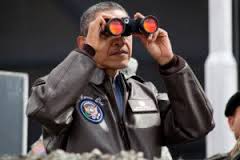
‘Near the ceasefire line’ (Photo by Pete Souza)
North Korea carried out its fifth nuclear test on Friday, drawing condemnation from President Obama and a charge from the Pentagon that the test was a “serious provocation.” Ho-hum, here we go again.
Every year, America pays its vassal-state South Korea huge sums of U.S. taxpayer money to mount 300,000-man-strong military “games” that threaten North Korea. North Koreans view images that never seem to make it to U.S. kitchen tables: hundreds of millions of dollars’ worth of U.S. armaments swarming in from the sea, hundreds of tanks and thousands of troops – their turrets and rifles pointed north – and nuclear-capable U.S. warplanes screaming overhead.
But when a young dictator straight out of central casting responds to U.S. threats with an underground test on North Korea’s founding day, it’s the number-one story on the front page of the New York Times.
Let’s connect some dots. Washington and their note takers in the American press constantly tell us that crazies in Pyongyang and Tehran are nuclear threats. The misplaced, but easily sold, fears of the “North Korean missile threat” and the “Iran missile threat” allows the Pentagon to install “defensive” missile systems in South Korea and Eastern Europe which actually amount to offensive systems targeting Beijing and Moscow (by making first strikes against China and Russia more feasible).
We need to look beyond the simplistic, race-based cartoon-like scaremongering to see that far more reality-based and frightening is the nuclear threat posed by the United States.
President Obama — the Nobel Prize winner who pledged to lead a nuclear-free world — has committed over $1 trillion dollars to modernize America’s nuclear arsenal. Almost unreported by the press, we have been spending a bundle to make nukes “usable,” by miniaturizing them. And to top it off, Obama has maintained a “first use” option for the U.S. nuclear arsenal.
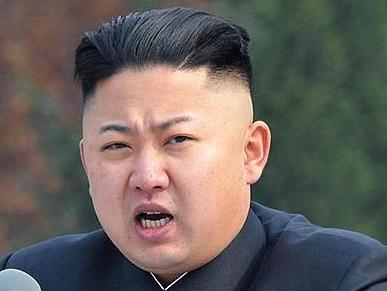
North Korean leader Kim Jong Un
Forget the tin-pot dictator with a bad crew-cut who leads an impoverished country. Here’s for some really scary reading:
Obama’s Trillion-Dollar Nuclear-Arms Train Wreck
Obama plans to retain first-use nuclear option
New U.S. Nuclear Bomb Moves Closer to Full-Scale Production
THAAD: A Major Security Risk for the ROK
James Bradley is author of several bestsellers including Flyboys and Flags of Our Fathers. His most recent book is The China Mirage: The Hidden History of American Disaster in Asia.
Hillary Comes Out as the War Party Candidate

By Diana Johnstone | CounterPunch | June 3, 2016
On June 2, a few days before the California primary, Hillary Clinton gave up trying to compete with Bernie Sanders on domestic policy. Instead, she zeroed in on the soft target of Donald Trump’s most “bizarre rants” in order to present herself as experienced and reasonable. Evidently taking her Democratic Party nomination for granted, she is positioning herself as the perfect candidate for hawkish Republicans.
Choosing to speak in San Diego, home base of the U.S. Pacific Fleet, on a platform draped with 19 American flags and preceded by half an hour of military marching music, Hillary Clinton was certain of finding a friendly audience for her celebration of American “strength”, “values” and “exceptionalism”. Cheered on by a military audience, Hillary was already assuming the role to which she most ardently aspires: that of Commander in Chief of the Armed Forces.
Whenever Hillary speaks, one must look for the lies. The biggest lies in this speech were lies of omission. No mention of her support for the invasion of Iraq, no mention of the disaster she wrought in Libya, no mention of her contribution to pursuing endless death and destruction in the Middle East.
But she also lied in claiming partial credit for the Iran nuclear deal, which she had tended to block, and most profoundly in presenting herself as a champion of diplomacy. As Secretary of State, she blocked diplomacy that would have prevented or ended conflict, most notoriously concerning Libya, where even senior U.S. military officers were told to cut off their contacts with Gaddafi agents seeking a peaceful compromise.
The Washington Post reported prior to the speech that her campaign “hopes there are many more national-security-minded Republicans and independents who would vote for her, even grudgingly, rather than see Trump win the White House.”
The Washington Post noted that the state of California’s “defense industry and military bases lend a backdrop for her speech.” Indeed! Hillary Clinton is quite simply catering to the military-industrial complex, as she has been doing throughout her career. She is catering to the arms industry, which needs to keep the American people scared of various “threats” in order to continue draining the nation’s wealth into their profitable enterprises. She needs the support of military men and women who believe in all those threats invented by intellectuals in think tanks and editorial offices.
This is the core of the “national-security-minded” electorate that Hillary is targeting. She warned that Trump would jeopardize the wonderful bipartisan foreign policy that has been keeping us great and safe for decades.
In reality, such “national-security-minded” leaders as Dick Cheney and Clinton herself have led the United States into wars that create chaos, inspire enemies and endanger everybody’s national security. Despite the geographically safe position of the United States, it is that bipartisan War Party that has created genuine threats to U.S. national security by prodding the hornets’ nest of religious fanaticism in the Middle East and provoking nuclear-armed Russia by aggressive military exercises right up to its borders.
The basis of Hillary Clinton’s world view is that notorious “American exceptionalism” which Obama has also celebrated. If we don’t rule the world, she suggested, “others will rush in to fill the vacuum”. She clearly cannot conceive of dealing respectfully with other nations. The United States, she proclaimed, is “exceptional – the last best hope on earth.”
Not all people on earth feel that way. So they must be brought to heel. In practice, this “exceptionalism” means acting above the law. It means a unipolar world policed by U.S. armed forces. In practice, Hillary’s devotion to “our allies” means fighting wars in the Middle East for the benefit of Israel and of Saudi Arabia, whose arms purchases are indispensable for our military industrial complex. It means bombing countries and overthrowing foreign governments, from Honduras to Syria and beyond, in order to help them conform to “our values”.
Trump is groping clumsily, at times idiotically, toward a major shift in US foreign policy. He is ill-prepared for the task. If ever elected, he would have to fire the neocons and take on a whole new team of experts to educate and guide him. That would be something of a miracle.
But some of Hillary’s reproaches aimed at Trump’s “reckless, risky” foreign policy statements are not as self-evident as she assumes. For example, his statement that he would sit down to negotiate with North Korean dictator Kim Jong Un. Is that really such a crazy idea?
North Korea is a small country, whose leaders call themselves “communist” but who are essentially a dynasty that emerged from the resistance against Japanese invaders in World War II. Their quarrel with South Korea stemmed from the domination of Japanese collaborators in that part of the country. That is practically ancient history, and today North Korea feels threatened – and is indeed threatened – by the everlasting U.S. military presence on its borders. A small isolated country like North Korea is not a real “threat” to the world. Even with nuclear weapons. Its much-vaunted nuclear weapons are clearly meant both to defend itself from attack and as a bargaining chip.
So would it be so terrible to sit down and find out what the bargain might be? Basically, North Korean leaders would like to make a deal to lessen the U.S. threat and bring their country out of isolation. Why not discuss this, since it could lead to the end of the “North Korean threat” which is artificial anyway?
Hillary’s reaction is typical. She boasts that her solution is to build up an expensive missile defense shield in Japan and increase everybody’s military buildup in the region. As usual, she goes for the military solution, ridiculing the notion of diplomacy.
Hillary Clinton’s speech will certainly sound convincing to the “national security minded” because it is so familiar. The same as George W. Bush but delivered with much greater polish. America is good, America is great, we must remain strong to save the world. This is the road to disaster.
Hillary Clinton is the clear candidate of the War Party.
 Diana Johnstone is the author of Fools’ Crusade: Yugoslavia, NATO, and Western Delusions. Her new book is Queen of Chaos: the Misadventures of Hillary Clinton. She can be reached at diana.johnstone@wanadoo.fr
North Korea to ‘normalize relations with hostile states,’ won’t launch nuke strike first – Kim
RT | May 7, 2016
North Korean leader Kim Jong-un has announced that Pyongyang will seek to normalize relations with states “hostile” towards it. Kim also claimed the North will adhere to the principles of nuclear non-proliferation and would never attack first.
While addressing the Congress of the ruling Workers’ Party (WPK), Kim stated that North Korea would not resort to the use of nuclear weapons unless the country’s sovereignty was challenged.
Pyongyang “will improve and normalize the relations with those countries which respect the sovereignty of the DPRK and are friendly towards it, though they had been hostile toward it in the past,” official North Korean KCNA news agency quoted Kim as saying.
“As a responsible nuclear weapons state, our Republic will not use a nuclear weapon unless its sovereignty is encroached upon by any aggressive hostile forces with nukes,” the statement said, as quoted by Reuters.
North Korea’s leader, who has been the target of UN criticism for its relentless development of nuclear weapons over the past years, indicated that the country may abandon its war-mongering rhetoric, while promising that it “will faithfully fulfill its obligation for non-proliferation and strive for global denuclearization.”
Earlier this week, satellite images unveiled by the US-Korea Institute at Johns Hopkins University revealed that the North may be preparing for a new nuclear test.
The images were captured on May 5 and show what it is said to be the command center close to the Punggye-ri detonation site in the north of the country.
“While the historical record is incomplete, it appears that vehicles are not often seen there except during preparations for a test,” the institute said in a statement.
The movements at the site may indicate that “Pyongyang may be preparing for a nuclear test in the near future,” it adds.
Obama dismisses Pyongyang’s bid to halt nuclear tests
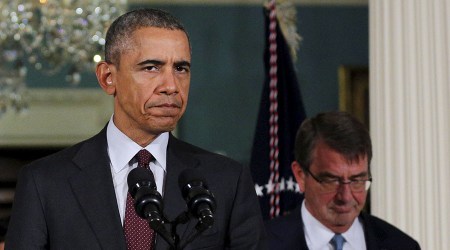
Press TV – April 25, 2016
US President Barack Obama has rejected an offer by North Korea to ditch its nuclear tests in exchange for Washington’s suspension of joint annual war games with South Korea.
Obama, who was speaking Sunday at a presser in Hanover with German Chancellor Angela Merkel, said, “We don’t take seriously a promise to simply halt until the next time they decide to do a test these kinds of activities.”
“What we’ve said consistently… is that if North Korea shows seriousness in denuclearizing the Korean Peninsula, then we’ll be prepared to enter into some serious conversations with them about reducing tensions and our approach to protecting our allies in the region. But that’s not something that happens based on a press release in the wake of a series of provocative behaviors. They’re going to have to do better than that.”
The remarks come on the heels of a Saturday interview by The Associated Press with North Korea’s Foreign Minister Ri Su Yong who told the US news agency that his country was ready to stop its nuclear tests if Washington halted its annual military drills with Seoul.
“Stop the nuclear war exercises in the Korean Peninsula, then we should also cease our nuclear tests,” Ri told AP.
He also maintained that the US drove his country to develop nuclear devices as an act of self-defense.
“If we continue on this path of confrontation, this will lead to very catastrophic results, not only for the two countries but for the whole entire world as well,” he said.
“It is really crucial for the United States government to withdraw its hostile policy against the DPRK (the Democratic People’s Republic of Korea) and as an expression of this stop the military exercises, war exercises, in the Korean Peninsula. Then we will respond likewise.”
On January 6, North Korea said it had successfully detonated a hydrogen bomb, its fourth nuclear test, vowing to build up its nuclear program as deterrence against potential aggression from the US and its regional allies.
Pyongyang accuses the US of plotting with regional allies to topple its government, saying it will not relinquish its nuclear deterrence unless Washington ends its hostile policy toward Pyongyang and dissolves the US-led UN command in South Korea.
Imperial Socialism?
By Hiroyuki Hamada | CounterPunch | April 18, 2016
President Obama never ceases to amaze me.
He has actually cried on stage and grabbed people’s hearts by appealing to emotions, to our yearning to be just, humane and democratic and so on. In recent mainstream media articles, he is seen playing the role of an agonized leader who weighs the delicate balance of humanity and an act of “humanitarian intervention”. Even with his credential as one of the greatest presidents (according to some), his action against Libya caused tremendous suffering to the people of Libya. He has confessed that while it was “the right thing to do”, he regrets the intervention.
That’s that. Right? He is sorry. It was a mistake. He is suffering. He is forgiven and we must move forward.
Well, actually, his act of contrition must be counted as disingenuous by any measure.
The destruction of Libya was a premeditated crime against humanity. It was orchestrated by the Western nations that were about to be squeezed out of colonial business on the African continent. Libyan leader Gaddafi planned to unite Africa and to establish it as an economically independent region cooperating with the rest of the nations of the Global South (1). The intervention was literally an armed robbery to steal the funding and destroy the plan. Tens of thousands were killed as a result of the Western intervention. Libya was literally destroyed. If you are not familiar with the magnitude of the merciless inhumanity of the Western action against Libya, look up a story about the great man-made river of Libya for instance. Or, look up stories about Libyan social programs under Gaddafi, which the US can’t even come close to. It is truly heartbreaking, and the true crime of the Western nations is hidden from the people. The administration and the colluding media have twisted the narrative in the most egregious way to hide the crime, and turned it into a courageous story of an American President with “honesty” and “integrity”. For the good people of the West, the agony of the President appears most tragic.
However, in reality, by destroying Libya, the Obama administration has achieved profound success in preventing the emergence of the United States of Africa and its central banking system, which would utilize rich African resources for the people of Africa.
Now, there is someone else who plays a major supporting role in this theater of deception: Mr. Bernie Sanders. This seasoned politician has cultivated an unprecedented skill in mobilizing popular support. The accuracy of his act is utterly superb. In order to gain political support for himself, and in turn for the Democratic Party, while preserving the imperial nature of US foreign policy, he has expressed a few calculated thoughts:
Forget about Hilary’s emails
In one of the presidential debates, he strongly characterized the issue of Hilary Clinton’s emails as a political tool to distract people from focusing on “real issues”(2). Her emails, however, include valuable facts regarding the Western war crimes, human rights abuses and other nefarious deeds, including valuable facts confirming Western motives in destroying Libya (3). Ms. Clinton is deeply involved in all of these matters and more(4)
Gaddafi was a terrible dictator
Mr. Sanders recently called Gaddafi “a terrible dictator” in one of the presidential debates. In an interview with Fox News, he remarked, “Look, everybody understands Gaddafi is a thug and murderer”(5). But more decisively, Mr. Sanders was one of 10 co-sponsors of the Senate resolution calling for the resignation of Gaddafi. The resolution also asked for UN resolutions demanding such drastic measures as establishing a no-fly zone and asset freeze against Libya (5). The demonization of the Libyan leader had been a part of the systematic campaign to justify military action for a while, leading to the actual operation in 2011. Libya’s standard of living, human rights record, varieties of social programs for the people and so on had been recognized as the best among the African nations by the UN before the Western intervention. Many of the demeaning allegations against the Libyan government and its leader were found to be false as well (6). Mr. Sanders’s disparaging remarks against Gaddafi, as well as the co-sponsorship of the Senate resolution and subsequent UN resolutions, comprise a decisive state propaganda campaign which led to the military intervention.
Regime change created a political vacuum for ISIS
Mr. Sanders is extremely skilled in colonizing ideas that closely approach the edge of the imperial boundary. He is so good at attracting people by pointing out the fence surrounding the empire only to prove, however, that the gate is tightly shut.
In one of the presidential debates, he accused Hilary Clinton of engaging in many “regime change” operations. However, this remark is skillfully rendered harmless by containing the whole argument in official imperial narratives. First, it does not involve a discussion of the deaths and destruction endured by the Libyan people. Somehow the empire is immune from international humanitarian laws and the moral imperative of humanity. Second, it does not deal with the fact that ISIS and other extremist groups are funded by the US and its allies, as proven by the governments’ own documents(7). Therefore, it leaves a solid path to continue the war on terror as business as usual. It is very likely that Mr. Sanders will follow Mr. Obama’s footsteps in fighting the war on terror, according to his praise for the President’s handling of it(8), and his own remarks(9) if he is elected as the President. Third, by refusing to talk about the real reasons for “regime change” he allows himself, as well as anyone else, including Ms. Clinton, to “regretfully” engage in “humanitarian interventions” as soon as there is a targeted nation picked by a team of foreign policy experts who have served various administrations. It is of concern that he has been uttering tough remarks against Russia, China, North Korea and so on. All these nations are surrounded by US military bases while being subjected to systematic state propaganda campaigns.
***
“War is a racket” (10). Every US military intervention accompanies subsequent restructuring of the society and economy according to the interests of the ruling elites. Military intervention also serves the military strategic goals and financial motives of the military industrial complex. Violence, whether it’s inflicted militarily or economically, has been a primary tool in building the hierarchical structure where a powerful few control the vast majority. People’s communities are built by cooperation of the communities and their people, as well as the efforts of bringing “power to the people”, not by exploitation and subjugation of other communities led by the powerful few with their draconian measures. I believe the essence of socialism lies in this very basic notion of democracy. Unless one is willing to work according to the genuine spirit of socialism, use of such a slogan as “political revolution” while calling himself a socialist is highly misleading and dishonest. Again, this reflects Mr. Sanders’ tendency to colonize ideas in mobilizing people only to bring them into the existing framework of the powerful few.
Here is the Catch 22: In order to truly refute the fascist and racist position taken by, for example, Donald Trump, the Bernie supporters must confront Bernie’s imperialism. How can a nation implement socialist policies in the framework of imperialism? How can that be a “political revolution”? Imperial Socialism? There used to be a country that tried something called National Socialism (11). It turned out to be a disaster.
The US already has an invisible racial and economic caste system to mask it’s own crimes domestically. It’s based on the many inhumane, unjust and undemocratic schemes inherited from slavery. It’s grown tremendously to flourish into mass incarceration, gentrification, police killings and the rest of the symptoms of institutionalized racism. The force of slaves who built the nation has been converted into the lives of today’s Blacks and poor, which are squeezed to create profits for the few by the devastating force of the social restructuring process for the profits of private corporations. Imperialism has extended this mechanism globally. As a result, unfortunately, tens of millions of lives have already perished by the US violence across the globe(12). It has turned out to be a disaster, already.
You see what I am saying here? If we do not confront such a notion as imperial socialism now, the best scenario Bernie Sanders can bring to us will be a normalization of imperialism under an imperial socialism. That is basically a feudal world order with an invisible caste system. Over 1,000 military bases across the globe are encircling Russia, China and other potential obstacles ensuring the economic power of the ruling elites. Extremists and dictators are nurtured while potential enemies are demonized. International treaties, TPP, TTIP, TISA and so on, to codify the colonial rule of transnational corporations are waiting to be implemented.
Or, let me put it this way, if I were a super rich imperialist in the US, I would be a diehard Bernie supporter. Leaders like him would be my last hope in prolonging the life of the crumbling hierarchy of money and violence. I would be willing to pay for a slight compromise if I can hang onto the status quo. He would be the one to protect my business and assets with the dignity and righteousness that I deserve. He sounds scary but check out what he’s done so far. He talks about universal healthcare but he was one of the guys who worked on Obamacare. He opposes TPP, but his objections are nationalistic and based on a good old protectionism. He went along with the crime bill for the prison industry, drug war, “urban renewal” and so on and on. And of course we have no worry about him dismantling the war industry. Actually, he might manage to start a big one or two. Did you hear that his hero is Winston Churchill? You get the idea.
The term Mr. Sanders uses, democratic socialism, is Imperial Socialism. “Democratic” refers to “democracy” which has been brought to those untamed nations with bombs.
If you agree with what I am saying here, please do not despair. You are not alone. There are countless people across the globe who oppose imperialism and its crimes. They are aiming to build a truly democratic world of sharing and mutual respect. There will be more of them. We live in the most exciting time of awakening for our species.
I would like to end this piece with a poem by Eric Draitser.
Libya: African Jewel
by ERIC DRAITSER
Snatched away –
blood and sand
alloyed to lifeless aridity:
add water. A man-made
river stolen, siphoned
assets in frozen accounts,
darkness unpenetrated
by the electric gaze
of a once buzzing grid,
spark snuffed.
The Greeks knew this:
tragedies have heroes
and death, covalent bond –
a binary truth
to build myths upon.
Here the wind dries tears,
breaks skin like stone
and stone like steel.
Still, man and martyr stand,
faces to an unforgiving sun.
And with hands that once
broke bread
tilled soil
mended wounds,
they hoist the Green Flag
And declare:
We are here.

Flag of Socialist Libya (1977–2011)
Notes.
(1)
(2)
https://www.youtube.com/watch?v=aOOfwN0iYxM
(3)
http://www.counterpunch.org/2016/03/14/exposing-the-libyan-agenda-a-closer-look-at-hillarys-emails/
(4)
http://store.counterpunch.org/product/queen-of-chaos-digital-book/
(5)
(6)
http://www.counterpunch.org/2011/08/31/the-top-ten-myths-in-the-war-against-libya/
(7)
(8)
(9)
http://feelthebern.org/bernie-sanders-on-isis/
(10)
http://www.ratical.org/ratville/CAH/warisaracket.pdf
(11)
http://www.britannica.com/event/National-Socialism
(12)
http://www.countercurrents.org/lucas240407.htm
Hiroyuki Hamada is an artist. He has exhibited throughout the United States and in Europe and is represented by Lori Bookstein Fine Art. He has been awarded various residencies including those at the Provincetown Fine Arts Work Center, the Edward F. Albee Foundation/William Flanagan Memorial Creative Person’s Center, the Skowhegan School of Painting and Sculpture, and the MacDowell Colony.
Have We Witnessed a Dramatic Change in the Military Doctrine of the DPRK?
By Konstantin Asmolov – New Eastern Outlook – 08.03.2016
As it was reported on Friday by the KCNA, during a visit to a closed firing range where advanced multiple rocket launchers were tested, North Korean leader Kim Jong-un announced that the country should be prepared to use its nuclear weapons at any moment to ensure its self-defense. The North Korean supreme leader has also underlined that he perceives the upcoming South Korean-US maneuvers as a dangerous gamble that could lead to disastrous consequences, so he ordered the North Korean army to raise all forces to high alert. The KCNA has also noted that “hostile forces led by the United States,” adopted a resolution that is “undermining the rights of the DPRK as a sovereign state.”
The part that one can consider to be crucial in all this information warfare is the fact that in the same speech, Kim Jong-un announced that Pyongyang would reconsider its military doctrine to allow the possibility of preemptive strikes being launched in connection with the dangerous situation on the Korean Peninsula. On March 4, a statement issued by the DPRK government stated that in circumstances when the United States and its satellites have openly challenged North Korea’s sovereignty and have endangered its right to existence, any hostile actions would lead to a decisive response. The statement has also added that should some disastrous event occur on the Korean Peninsula or in the region adjacent to it, the entire responsibility will lie on the United States and its collaborators.
Later, the same notion was repeated in an official statement of the DPRK National Defense Commission that was released by the KCNA on March 7. The statement announced that due to the joint military exercises of the United States and South Korea labeled as “training for a nuclear war,” any hostile military act would lead to a preemptive nuclear strike launched in accordance with the procedure established by the high command of the Korean People’s Army.
It’s only natural that such statements aroused suspicion. Moscow has expressed serious concern over the entire situation. On March 4, Vladimir Putin’s spokesman Dmitry Peskov expressed the hope that all the parties involved will exercise restraint. The United States urged North Korean leaders to refrain from provocative statements and actions and focus on the fulfillment of DPRK’s international obligations. A Pentagon spokesman said the US is prepared to destroy North Korea’s nuclear arsenals if North Korea poses a threat to the US, while noting that he had no evidence that the DPRK conducted test launches of intercontinental ballistic missile armed with nuclear warheads. In turn, the press secretary of the South Korean Ministry of Defence announced that North Korea must put an end to its defiant and destructive comments and actions, noting that Seoul will mercilessly respond to any provocation made by North Korea.
Such crises are truly alarming for a number of reasons. Firstly, it is necessary to take into account the context in which that decision is taken. While traditional news coverage of North Korea’s actions has been reduced long ago to suggesting Pyongyang’s actions are irrational and unprovoked, in fact we are witnessing a response to upcoming US-South Korean exercises “Key Resolve” and “Foal Eagle,” which will be held on the peninsula in the next two months. It’s reported that more than 300,000 South Korean and 15,000 US troops, including US nuclear aircraft carrier USS John Stennis will be participating in these exercises. And there’s little doubt in anyone’s mind that those will mimic an invasion of North Korea, especially when it’s stated as an official goal.
Each military exercise in the immediate vicinity of DPRK’s border understandably affects the nerves of North Korea’s military commanders. There is absolutely no certainty that during such exercises due to some mysterious incident, they will not transform into a full-scale invasion. This can happen as a result of a deliberate provocation by the South, or when some North Korean officer loses his nerve. Yet, there’s a possibility that we will witness the repetition of the situation that occurred back in 2015, when South Korean officers were reluctant to investigate their own criminal carelessness so they decided to push all blame instead on the North for an accident that occurred with their own soldiers.
In such a situation, Pyongyang is trying to look as vicious and dangerous as it possibly can. It doesn’t stand a chance in a fight against South Korea, supported by the United States. However, the North could inflict so much damage on the South that a military victory against it will become meaningless. Such a threat works like a tub of cold water on hot heads: understanding that the North will “die singing” doesn’t make anyone all too willing to fight.
A similar situation occurred during the previous round of nuclear crisis on the peninsula back in 2013. At that time the sitting President of South Korea, Park Geun-hye, just came to power, and there was a possibility that supporters of the former president or young officers bewildered with revanchist ideas might try to escalate the situation. They were consumed by the idea that if politicians did not interfere with their actions, they could destroy the Pyongyang government in 90 hours. Then, in 2013, the DPRK also made a number of risky statements against the background of the upcoming exercise. Although the headlines once again shouted that the Korean peninsula is on the brink of war, no one decided to jump the gun. However, the situation today is somewhat more complicated. Park Geun-hye has deviated from her initially moderate positions becoming conservative, and former young majors have now become colonels. In this situation, Pyongyang raises the stakes higher than three years ago.
However, this leads to a new round amid the ongoing security dilemma of North Korea, since the statements made by Kim Jong-un can be interpreted as changes in North Korean military doctrine. Until recently, Pyongyang has positioned its missile and nuclear program solely as a self-defense option, and all the promises of drowning Seoul in a sea of fire were made in the wake of possible provocations. And now the DPRK is talking about America’s all time favorite ‘preemptive strikes’ that can be unleashed by somewhat more uncertain provocations. That’s a truly dangerous dilemma. Firstly, this level of military readiness can not but be seen with concern by others in the region, a readiness to take action in response to a possibility of such a strike being launched against them, which clearly raises tensions. Secondly, in the fight of the weak against the strong, the weak striking first is a good way to increase one’s chances of prevailing. But this can only be said about an inevitable fight, while a preemptive strike destroys all chances for a peaceful resolution of the conflict.
Three years ago I noted in one of my articles that the path chosen by the DPRK provides it a tactical advantage, but may lead it to a dead end on the strategic level. In response to ever increasing pressure of new sanctions, North Korea will become more heavily involved in the arms race, and the vicious circle will be tightening at every turn with ever increasing speed. Yet, North Korea’s problems, like its security dilemma or the tensions between Pyongyang on one side and Beijing and Moscow on the other, are not going anywhere. At the same time Washington keeps exploiting the North Korean threat for its own ends.
This vicious circle has yet another drawback, since there’s few exit strategies one can find in it. Although North Korea believes that its nuclear program provides it with independence, in fact it makes the actions of its government more predictable.The DPRK has now lost any strategic initiative and is now acting “reactively,” which makes it even more dependent on external factors. So it’s not rocket science at this point to get a certain reaction from the government of North Korea once one has applied pressure from a certain angle. Let’s hope no one will take advantage of this fact to launch additional provocations.
Konstantin Asmolov, Ph.D, Chief Research Fellow of the Center for Korean Studies, Institute of Far Eastern Studies, Russian Academy of Sciences
China opposed to US missile deployment in South Korea: FM
![Chinese Foreign Minister Wang Yi (L) meets with U.S. Secretary of State John Kerry in Munich, Germany, Feb. 12, 2016 [Xinhua]](https://i0.wp.com/thebricspost.com/wp-content/uploads/2016/02/135093860_14553432820231n.jpg)
Chinese Foreign Minister Wang Yi (L) meets with U.S. Secretary of State John Kerry in Munich, Germany, Feb. 12, 2016 [Xinhua]
The BRICS Post | February 13, 2016
Chinese Foreign Minister Wang Yi on Friday reacted strongly to South Korea-US talks on possible deployment of an advanced US missile defense system.
Wang said this “would complicate the regional stability situation”.
Meeting with US Secretary of State John Kerry on the sidelines of the Munich Security Conference, Wang made clear China’s opposition to the possible deployment of the Terminal High Altitude Area Defence (THAAD) system in South Korea.
The United States and South Korea have begun negotiations on the deployment of THAAD. The Pentagon made the announcement hours after North Korea’s recent rocket launch.
As one of the most advanced missile defense systems in the world, THAAD can intercept and destroy ballistic missiles inside or just outside the atmosphere during their final phase of flight.
Despite claims by Washington and Seoul that the missile shield would be focused solely on North Korea, Beijing says the US deployment would pose considerable threat to neighboring countries.
In an interview with Reuters on the sidelines of the Munich meeting, Wang said he was concerned by the possible deployment of the sophisticated anti-missile system in South Korea.
“The deployment of the THAAD system by the United States … goes far beyond the defense needs of the Korean Peninsula and the coverage would mean it will reach deep into the Asian continent,” Wang said.
“It directly affects the strategic security interests of China and other Asian countries,” he added.
The Chinese foreign minister urged the US side to act cautiously, not to undermine China’s security interests or add new complications to regional peace and stability.
Regarding the DPRK’s recent nuclear test and rocket launch, Wang said both moves violated UN resolutions and pose serious challenges to the global non-proliferation regime.
China and the United States have agreed to speed up the consultation process at the UN Security Council to reach a new resolution and take strong and effective measures to deter further development of nuclear and missile programs by North Korea, Wang noted in his meeting with Kerry.
Reiterating China’s stance on sanctions against North Korea, he said “it remains to be our common goal to work together and find a way to bring the Korean Peninsula nuclear issue back to the right track of dialogue and negotiations, which is fully in line with the interests of all parties, including China and the United States.”
In the interview with Reuters, Wang said China insists that there should be no nuclear weapons on the peninsula, no matter whether they were possessed by the north or the south side, and no matter whether they were developed locally or introduced from the outside.
China, a neighboring country of the Korean Peninsula and a major stakeholder in regional stability, also maintains that the Korean Peninsula denuclearization should be achieved via dialogue, not war, and that China’s national security interests should be guaranteed, he added.
Russia has also expressed concern about the potential deployment of THAAD, saying it could trigger an arms race in Northeast Asia.
On Wednesday, South Korea suspended operations at the Kaesong industrial zone as punishment for the rocket launch and nuclear test.
New US Spy Satellite Lifts Off as Obama Criticizes N. Korean Launch
Sputnik – 11.02.2016
Days after criticizing North Korea for launching a satellite into space, the United States sent its own, brand new military satellite into orbit Wednesday morning.
The National Reconnaissance Office (NRO) is the agency in charge of the United States’ fleet of spy satellites, and early Wednesday morning, the NRO sent its latest above stratosphere. The NROL-45 satellite was sent into space on the back of a United Launch Alliance (ULA) Delta IV rocket launched from Vandenberg Air Force Base.
The NRO already has three additional launches scheduled for the upcoming year. Two will lift off in May and June, both from Florida’s Cape Canaveral Air Force Station. The third will launch from Vandenberg in December.
The NRO will not say, specifically, what kind of operations these satellites will be conducting. Its payload remains classified, and a statement on the ULA’s website vaguely describes NROL-45 as being necessary for the “support of national defense.”
The timing of this launch is surprising given Washington’s condemnation of a North Korean satellite launch on Sunday.
The United States views any rocket launch by Pyongyang as a veiled attempt to perfect its ballistic missile technology. In the wake of Sunday’s launch, President Obama reaffirmed America’s commitment to defending South Korea.
“The United States stands in solidarity with the ROK [South Korea] and will take the necessary steps to fulfill our ironclad commitment to defend the ROK and our other allies in the region,” Obama told South Korean president Park Geun-hye on Monday night.
“Our concern though is that they do a space-launch but really it’s the same technology to develop ICBMs [intercontinental ballistic missiles],” a US official said earlier this month, speaking on condition of anonymity.
Leaders from South Korea, Japan, and the US have already agreed to pursue stricture United Nations sanctions against Pyongyang over Sunday’s launch.
“[The sides] agreed to closely cooperate to make sure that the Security Council can adopt a resolution for strong and effective sanctions on North Korea,” said a press service for South Korean President Park.
It’s hard to imagine that the NRO’s series of satellite launches will elicit a similar reaction from Washington’s allies.
China at odds with US over N Korea response
The BRICS Post | February 8, 2016
An emergency meeting of the United Nations Security Council early Monday has “strongly condemned” North Korea’s launch of a satellite into space, but China and the US differed on the type of response debated among world powers.
North Korea says the satellite launch was for peaceful and scientific research purposes, but global powers fear that the launch was a part of Pyongyang’s development of its ballistic missile program.
United States ambassador Samantha Powers called for robust responses to “violations” committed by the North Koreans.
It is likely the Security Council will draft a number of measures to increase and deepen economic sanctions already in place on North Korea.
However, North Korea’s only ally in the Security Council – China – fears that too severe a sanctions regimen will destabilize North Korea and the region.
It is likely that Washington will lean on Beijing to exert all its diplomatic efforts to rein in its weapons programs.
In the meantime, South Korea and the US said they will hold talks to possibly deploy an anti-missile defense system called Terminal High Altitude Area Defense (THAAD) on the peninsula – a move that Beijing says will harm regional peace.
While China summoned North Korea’s ambassador to protest Pyongyang’s satellite launch on Sunday, it also summoned the South Korean ambassador to protest THAAD’s deployment.
“China holds a consistent and clear stance on the anti-missile issue,” Chinese Foreign Ministry spokesperson Hua Chunying said on Monday.
“When pursuing its own security, one country should not impair the security interests of others,” Hua added.
China says that the deployment of such advanced anti-missile weaponry will not help in deescalating tensions in the Korean peninsula.

or go to
Aletho News Archives – Video-Images
From the Archives
Israel Would Have No Qualms About USS Liberty-Style FALSE FLAG If Iran Campaign Falters – Analysts
By Ilya Tsukanov – Sputnik – 18.06.2025
Donald Trump is mulling whether or not to join Israel’s aggression against Iran as Tel Aviv faces problems sustaining its defenses against growing counterstrikes, and apparently lacks a realistic game plan for an end to hostilities after failing to achieve its goals. Analysts told Sputnik how the US could be ‘nudged’ into the conflict.
“The US is already assisting Israel with supplies, intel, refueling support, etc. One of the many US posts in the region could be attacked for a casus belli,” former Pentagon analyst Karen Kwiatkowski explained.
“If Trump doesn’t comply with Israel’s demand” and join its aggression voluntarily, “a false flag may be needed” to drag the US in, Kwiatkowski, retired US Air Force Lt. Col.-turned Iraq War whistleblower, fears.
Netanyahu has a diverse array of options at his disposal, according to the observer, including:
- a false flag against US assets abroad blamed on Iran or one of its Axis of Resistance allies, like the Houthis
- a US domestic attack or assassination blamed on Iran
- Iranian air defenses ‘accidentally’ hitting a civilian jetliner carrying Americans
- use of a dirty bomb or nuclear contamination somewhere in the region blamed on Iran
- even blackmailing by threatening to use nukes against Iran if the US doesn’t join the fight
Kwiatkowski estimates that Israel probably has “enough blackmail power” against President Trump and Congress to avoid the necessity of a false flag operation, but a “USS Liberty-style” attack, targeting the soon-to-be-retired USS Nimitz supercarrier that’s heading to the Middle East, for example, nevertheless cannot be ruled out entirely, she says. … continue
Blog Roll
 Aletho News
- The US bombed the Shahs house lol
- The London Ambulances Attack: Of Course It Was A False Flag
- Embarrassing Pivot: U.S. considers dropping Iran oil sanctions amid war
- US has 2 months of rare earths left to replenish weapons amid Iran war: Report
- Strait Of Hormuz closure brings Empire to brink
- Iran controls Strait of Hormuz, dictates terms of war and peace as US excursion backfires
- Outlasting the Superpower: The Reasons Why Iran is Beating uhe US and Israel
- Top PMU commander, over a dozen fighters killed in new US strikes on Iraq
- Is Netanyahu’s war gamble threatening the future of ‘Israel’?: FT
- Smotrich calls for annexation of South Lebanon to Litani River
- If Americans Knew
- ‘Forever live by the sword’: Understanding Israelis’ massive support for Iran war
- UN’s special rapporteur on human rights says Israel is systematically torturing Palestinians
- Trump White House plagiarized Iran war manifesto from Israel-aligned think tank
- Gaza says 6–10 patients die daily waiting for treatment abroad as Israel blocks medical evacuations
- ‘Substantial evidence’ of double-tap strike in killing of Gaza’s Hind Rajab
- ‘Do Not Want To Die For Israel’: Doubts About Trump’s Iran Strategy Spread Among Troops
- Instead of taking Joe Kent’s claims seriously, the media is disregarding him as an antisemite
- Joe Kent’s Explosive Interviews about his Resignation over the Iran War
- Israel poised to take over southern Lebanon; settlers wreak havoc in West Bank – Not a ceasefire Day 165
- From Sde Teiman, the truth about Israel’s military justice system has been set free
- No Tricks Zone
- Devastating Assessment Of Comirnaty Vaccine By Former Senior Pfizer Europe Toxicologist
- New Study: CO2 Is ‘Effectively Negligible’ As An Explanatory Climate Change Factor Since 2000
- Former Pfizer Toxicologist Dr. Helmut Sterz Tells Bundestag Hearing Pfizer Vaccine Should Have Never Been Approved
- Energy Expert: Germany’s Nuclear Phaseout Was A “500 Billion Euro Mistake”
- New Research: South Australia’s Mid-Holocene Sea Surface Temperatures Were 4°C Warmer Than Today
- Storing Green Energy To Last Germany 10 Days Would Require A 60-Million Tonne Battery
- New Studies: UK Sea Levels Were 4 Meters Higher Than Today During The Mid-Holocene
- Destructive Green New Deal: German Energy And Metal Group Warns Of Drastic Crisis
- New Study Documents A 20-Year Pause In Arctic Sea Ice Decline – Driven By Internal Variability
- Wake-up Call: Survey Shows Majority Of Germans Now Favor Postponing Climate Targets!
 Aletho News