Pyongyang seeks direct dialogue with Washington, Moscow ready to help – Lavrov
RT | December 7, 2017
North Korea wants to engage directly with the US to assure its security, Russia’s foreign minister has revealed. Sergey Lavrov said he has briefed US Secretary of State Rex Tillerson on the developments and that Moscow is ready to “facilitate such talks.”
“We know that, above all, North Korea wants to talk to the US about its own security assurances,” he said in Vienna following his meeting with Tillerson. “Russia is ready to take part in facilitating such talks.” Lavrov and Tillerson spoke on the sidelines of an Organization for Security and Cooperation in Europe (OSCE) meeting.
Lavrov reiterated that all parties involved in the Korean crisis should “break the vicious cycle of confrontation, reckless schemes and sanctions” and engage in meaningful dialogue instead. He also pointed to American military exercises near the Korean Peninsula and Washington’s aggressive rhetoric, which he said only leads to a further escalation of tensions. This is “unacceptable,” Lavrov made clear.
Earlier Thursday, the head of Russia’s Senate’s Foreign Affairs Committee, Konsantin Kosachev, met with North Korea’s Ambassador to Moscow to discuss the situation on the peninsula. Following his exchange with Kim Young Jae, Kosachev said Pyongyang has absolutely no interest in ratcheting tensions, not to mention starting a full-blown military conflict. But, Kim added, Pyongyang “does not fear war” either.
Kosachev said a viable way to resolve the crisis is an all-in dialogue between relevant parties and joint efforts aimed at lowering tensions. “We are absolutely not interested in the escalation of tensions, in any military action,” Kosachev told the Interfax news agency following the meeting. Russia “will do everything it can to prevent this escalation,” he added.
Both Lavrov and Kosachev once again referred to the so-called “double freeze” initiative put forward by Russia and China soon after tensions heightened in early September. The plan envisages the US and its allies stop all major military exercises in the region in exchange for Pyongyang suspending its nuclear and ballistic missile program. The initiative, however, has been spurned by Washington, with the US envoy to the UN, Nikki Haley, denouncing it as “insulting.”
On Wednesday, the North Korean foreign ministry said US military drills near the Korean Peninsula as well as Washington’s belligerent rhetoric make an outbreak of war in the region inevitable. “The remaining question now is, when will the war break out,” the ministry’s spokesperson told the North Korean state news agency KCNA Wednesday.
On Monday, the US launched massive air drills together with South Korea. The five-day exercises, scheduled to last until December 8, involve a total of 12,000 personnel and over 230 military aircraft. Pointedly, the maneuvers particularly simulate attacks on Pyongyang’s nuclear and missile installations while claiming it to be “defensive.”
In late November, North Korea conducted yet another missile test, claiming it had successfully launched a new type of intercontinental ballistic missile capable of striking the US mainland.
North Korea Pushes US to Negotiating Table?
By Finian CUNNINGHAM | Strategic Culture Foundation | 07.12.2017
Just when the crisis in US-North Korean relations could not seem more bleak, this week sees a chance that the two sides could be moving quietly towards a diplomatic resolution. The arrival of senior United Nations diplomat Jeffrey Feltman in Pyongyang for four days of discussions with top officials was reported as a “very rare” event.
Feltman is the most senior American official in the United Nations secretariat, serving as the chief of political affairs under Secretary General Antonio Guterres. The last time such a senior UN official reportedly visited North Korea was six years ago. The delegation this week comes at the request of Pyongyang.
The US State Department said that Feltman was in North Korea on behalf of the United Nations, and that he was not conveying a message from Washington. Nevertheless, there are grounds to believe that the diplomat’s “wide-ranging” discussions with senior North Korean officials is an opening for tentative talks between Washington and Pyongyang to resolve the deepening crisis over the latter’s nuclear weapons program.
Before his UN appointment in 2012, Feltman (58) worked in the US State Department for nearly 30 years. His posts included sensitive Middle East areas: Israel, Palestine, Iraq, Lebanon and Bahrain. Officially, he may be on UN business this week in Pyongyang, but it seems plausible that this career US diplomat will, in addition, convey a significant political signal from Washington that formal talks are on.
Washington’s public position is that no talks with North Korea are on the agenda until Pyongyang halts its nuclear weapons program. However, US Secretary of State Rex Tillerson said recently there was the possibility of “talks about talks” in the future. President Donald Trump while threatening “fire and fury” on North Korea has also at other times hinted that he is willing to engage in diplomacy with North Korean leader Kim Jong-un.
For its part, North Korea has said it will never unilaterally give up its nuclear weapons program as a deterrent to what it calls US aggression.
Escalating rhetorical jibes between the two leaders over the past several months might suggest that there is minimal chance for diplomacy. Trump has disparaged Kim as “Rocket Man on a suicide mission”; while Kim has mocked the American president as “a stupid old dotard”.
Russia and China have urged all sides to engage in negotiations in order to calm roiling tensions, which have mounted over the past year from dozens of missile tests being conducted by North Korea, as well as from provocative military exercises carried out by the US and its South Korea and Japanese allies.
Last week, North Korea launched its biggest Intercontinental Ballistic Missile (ICBM) yet, a Hwasong-15, which various analysts said demonstrated the capability for a nuclear strike on any part of the US mainland, including the capital Washington DC. Pyongyang announced that the test launch proved that the country had completed its quest for acquiring nuclear weapons capable of hitting the US.
Then this week, US forces conducted their biggest-ever warplanes drill with South Korea, involving some 230 aircraft, including B1-B nuclear-capable bombers and reportedly for the first time stealth F-35 and F-22 fighter jets. The massive air-force mobilization came despite appeals from China and Russia for a suspension. There were also warnings from North Korea that the US bombing rehearsals were leading the Peninsula to the brink of nuclear war.
Trump’s top national security advisor General HR McMaster recently added to fears of a full-on conflict breaking out when he described the situation as a countdown to war. Trump has also on several occasions warned that he would “totally destroy” North Korea if the US or its allies were threatened. A threat which was again repeated last week by the US ambassador the UN Nikki Haley. Pyongyang has, in turn, said that such rhetoric amounts to a declaration of war by the US.
The re-listing on November 20 by Washington of North Korea as a “state sponsor of terrorism” is another incendiary factor in an already explosive geopolitical mix.
However, in spite of the imminent danger of all-out armed conflict, there are reasons to believe that both sides are willing to pull back.
Bellicose posturing by Trump and his aides cannot disguise the fact that Washington does not have a realistic military option in dealing with North Korea. Negotiation is the only viable option to resolve the long-running crisis, as China and Russia have both consistently urged.
Many American weapons experts, including Siegfried Hecker, the former head of Los Alamos Laboratory, reckon that North Korea has the capability of 30 to 60 nuclear weapons. An underground test in September points to the possession of a H-bomb with a 10-fold explosive power of the A-bombs dropped by the US on Hiroshima and Nagasaki.
“There is little doubt that North Korea could mount a nuclear warhead on a missile that could reach South Korea or Japan,” according to Siegfried.
That capability alone – if not also the now very real possibility of hitting the US mainland – places millions of lives at risk, if Washington were to go to war with North Korea.
Over the past decade since North Korea’s first nuclear test explosion in 2006, the country’s military defenses have progressed at an astonishing rate, despite the ratcheting up of economic and diplomatic sanctions by Washington. Most of North Korea’s weapons development has occurred under the current leader Kim Jong-un who took over six years ago after the death of his father Kim Jong-il. Four of the country’s total six nuclear tests have taken place under the watch of the 30-something-year-old incumbent.
Having now achieved the stated goal of possessing a nuclear deterrent force capable of hitting the US, Pyongyang may feel it is finally in a position to talk with Washington on a mutual basis.
South Korean diplomat, Kim Hong-gul, who met the North Korean leader six years ago at his father’s funeral, said that the recent test of the ICBM purportedly capable of striking the US, could paradoxically be a harbinger of future talks between Pyongyang and Washington.
In an interview with Bloomberg this week, the South Korea diplomat said of the ICBM test launch: “It could be a flare signaling the start of the negotiations. On completion [of nuclear forces], Kim wouldn’t need to test missiles anymore, so he could suggest a conversation with the South and the US, possibly in his New Year speech, while refraining from further tests.”
It seems significant that the day after the latest ICBM test, on November 30, Pyongyang confirmed its invitation to the UN for high-level discussions. Within days, the UN reciprocated by sending Jeffrey Feltman, the seasoned former US State Department point man, to Pyongyang this week.
It is not known if Feltman will meet with Kim Jong-un during his four-day trip, but he is scheduled to hold talks with North Korea’s most senior diplomat, foreign minister Ri Yong-ho.
Notably, too, Feltman’s visit to Pyongyang follows a high-level delegation from Beijing to North Korea, the first such trip by Chinese diplomats after a two-year hiatus.
Bloomberg also reports: “Russian lawmaker Vitaly Pashin, who recently visited Pyongyang, said Monday that North Korean officials are ready for one-on-one or multiparty talks now that they’ve become a nuclear power capable of striking the US mainland.”
The standoff between the US and North Korea is much too grim, and the stakes are much too high, for any side to crow about one-upmanship.
But maybe – just maybe – the brinkmanship shown by North Korea to persist with its nuclear program in the face of US threats has paid off by forcing Washington to come to the negotiating table in order to resolve the standoff peacefully through a political settlement.
So much for Western depiction of the North Korean leader as a “madman”. His cold-blooded logic may spare the world from a nuclear war incited by the crazies in Washington.
N Korea Declares itself a “Full-fledged Nuclear Force”
By Hyun Lee | Zoom In Korea | November 29, 2017
The sixty-day clock has run out. After two months of relative quiet, North Korea test-launched another missile in the early morning hours of November 29 (local time). This time, it launched the Hwasong-15, confirmed to be an intercontinental ballistic missile (ICBM) that reportedly flew 700 miles in 53 minutes before landing in the sea west of Japan. The missile reached an unprecedented altitude of 2800 miles, more than ten times the height of the International Space Station and is said to be capable of delivering a nuclear warhead to anywhere in the United States.
Last month, Joseph Yun, the U.S. State Department’s top official on North Korea policy, had told an audience at the Council on Foreign Relations that if North Korea halted its nuclear and missile tests for sixty days, the United States would resume direct talks with Pyongyang, according to the Washington Post. His comment echoed those of State Secretary Rex Tillerson: “The best signal that North Korea could give us that they’re prepared to talk would be to stop these missile launches. We’ve not had an extended period of time where they have not taken some type of provocative action by launching ballistic missiles. So I think that would be the first and strongest signal they could send us is just stop, stop these missile launches.”
The last North Korean missile test before this latest one was the launch of an intermediate-range ballistic missile on September 15, a little more than sixty days ago.
Rather than reach out for talks, as Yun had said, the United States chose to ramp up military exercises. Earlier this month, it sent three aircraft carriers—the USS Ronald Reagan, Theodore Roosevelt and Nimitz—and their multi-ship strike groups as well as B-1 bombers to the area to participate in four days of exercises with South Korea and Japan. Next week, the air forces of South Korea and the United States are scheduled to hold another exercise. Vigilant Ace, which will run from December 4 to 8, will deploy six F-22 Raptor stealth fighters and F-35 aircraft. About 12,000 U.S. personnel will participate with South Korean troops while 230 aircraft will be flown at eight U.S. and South Korean military installations, according to a news statement released by the U.S. Seventh Air Force. The U.S. Marine Corps and Navy troops will also participate.
Events could have taken a different turn had the United States matched Pyongyang’s restraint by halting the war games, says Russian Deputy Foreign Minister Igor Morgulov: “If Pyongyang’s demonstrated restraint over the past two months was met with similar reciprocal steps on behalf of the United States and its allies then we could have moved to the start of direct talks between the United States and North Korea.”
After the latest missile test, Kim Jong-un declared North Korea “a full-fledged nuclear force.” He added that his country’s nuclear weapons are aimed solely at “defending the sovereignty of the nation from the US nuclear threat and protecting the peaceful life of the people” and that no other country is under threat from his country’s nukes.
By not following through with overtures for detente after its own sixty-day deadline, the United States blew its last chance at negotiating with North Korea before it declared itself a de facto nuclear weapons state. Now it seems its only options are: war to denuclearize North Korea by force—which would claim millions of lives and destabilize the entire region as well as the global economy—or a Peace Treaty to finally end the sixty-five year old Korean War and the withdrawal of its troops from the Korean peninsula.
US Continues to Provoke North Korea – Lavrov
Sputnik – November 30, 2017
The US is trying to force Pyongyang to abandon its nuclear missile program. However, its actions have only lead to the escalation of the situation in the region.
Moscow is against the idea of increasing sanctions pressure on North Korea amid the latest missile launch, Russian Foreign Minister Sergei Lavrov said Thursday.
“We have repeatedly stressed that the sanctions pressure is essentially exhausted, and that all those resolutions that had imposed sanctions necessarily included demands to resume the political process, resume negotiations, and this is completely ignored by the US side. I think this is a big mistake,” Lavrov told reporters.
The minister stressed that the latest actions of the US authorities were aimed at provoking North Korea.
“The recent actions of the United States seem to be aimed deliberately to provoke Pyongyang to commit new harsh actions. It seems that everything has been done specifically to ensure that [North Korean Leader] Kim Jong Un snapped and took another adventurous move,” Lavrov said.
He added that Washington should say directly whether it was seeking to find a pretext for destroying North Korea.
“The United States should first of all explain to us what they are trying to achieve. If they want to find a pretext for destroying North Korea, as the US Ambassador to the UN Security Council stated, they should say it directly, and the US leadership should confirm this. Then we will decide how to respond,” Lavrov said.
On Tuesday, Pyongyang conducted its most advanced- ever ballistic missile test. The missile flew 950 kilometers (590 miles) and reached an altitude of 4,475 kilometers. The flight lasted for 53 minutes, after which the missile fell into the Sea of Japan, within the Japanese exclusive economic zone.
Earlier in the day, US Ambassador to the United Nations Nikki Haley urged countries around the world to cut off their commercial, diplomatic, military and any other ties with North Korea. US President Donald Trump said in a statement on Wednesday that new major sanctions would be imposed on North Korea in response to its latest missile launch.
READ MORE: US Calls on All Nations to Cut Off Ties With North Korea
US Trying to Deliberately ‘Provoke’ North Korea, says Lavrov
US to Hold Massive Military Exercise on Korean Peninsula… Again

Russian Foreign Minister Sergei Lavrov
By Richard Edmondson | Fig Trees and Vineyards | November 24, 2017
It was back in August that the US staged a massive 10-day war war games exercise on the Korean peninsula. Involving some 75,000 US and South Korean troops, the exercise, dubbed “Ulchi-Freedom Guardian,” saw forces deployed on land, sea, and in the air–a massive display of military power denounced by the North Koreans as a “reckless behavior driving the situation into the uncontrollable phase of a nuclear war”… and it was also around this time that the DPRK threatened to attack Guam.
Now here we are three months later, and the US is about to do it all again. An exercise called “Vigilance Ace” is scheduled to run December 4-8, and according to Sputnik it will involve 230 war planes, including F-22 Raptors and F-35 Joint Strike Fighters.
The “realistic” combat exercise is tailored to “enhance interoperability between US and Republic of Korea forces and increase the combat effectiveness of both nations,” the Seventh US Air Force, which operates out of South Korea, said in a Friday statement.
All this comes just 10 days after reports emerged of three US aircraft carrier groups taking positions in waters around the Korean peninsula in what North Korea’s UN ambassador described as a “strike posture.”
As in the previous two incidents–the Ulchi-Freedom exercise in August and the carrier deployments earlier this month–the North Koreans are again speaking out in protest, calling the upcoming Vigilance Ace games a “serious provocation.”
But perhaps the most arresting, eye-brow-raising remarks of all have come from Russian Foreign Minister Sergei Lavrov, who suggested that the US is intentionally trying to provoke the North Koreans.
“We are alarmed that in the last two months when North Korea conducted no tests or rocket launches, it seemed that Washington was not happy about that, and tried to do things that would irritate and provoke Pyongyang,” Lavrov said.
He has a good point. It has been approximately 70 days since North Korea’s last missile test. Why the need for a massive military exercise now?
Lavrov also suggested that the confrontation with North Korea is a pretext, and that the real objective is the placement of US missiles on Russia’s doorstep. He is almost certainly correct in this, but of course it is extremely rare for a high-ranking Russian official to speak this candidly.
“We are expressing deep concern, with facts to back it up, that Japan, along with South Korea, is becoming a territory for the deployment of elements of the US global missile defence system which is being rolled out in that region under the pretext of the North Korea threat,” Lavrov said.
“We have no problems directly with Japan, we do not see risks there. We see risks because of the proliferation of a global US missile defence system on the territory of countries that neighbour Russia, including Japan,” he added.
Lavrov made the remarks during a visit to Moscow by Japanese Foreign Minister Taro Kono.
Russia and China have proposed an agreement calling for an end to US war games on the Korean peninsula in exchange for a halt in missile testing by the North. The proposal has been rejected by the US and South Korea.
Is North Korea Really a ‘State Sponsor of Terrorism’?
By Ron Paul | November 27, 2017
President Trump announced last week that he was returning North Korea to the US list of “state sponsors of terrorism” after having been off the list for the past nine years. Americans may wonder what dramatic event led the US president to re-designate North Korea as a terrorism-sponsoring nation. Has Pyongyang been found guilty of some spectacular terrorist attack overseas or perhaps of plotting to overthrow another country by force? No, that is not the case. North Korea is back on the US list of state sponsors of terrorism because President Trump thinks the move will convince the government to give up its nuclear weapons and ballistic missile program. He believes that continuing down the path toward confrontation with North Korea will lead the country to capitulate to Washington’s demands. That will not happen.
President Trump and Secretary of State Rex Tillerson argued that North Korea deserved to be back on the list because the North Korean government is reported to have assassinated a North Korean citizen – Kim Jong-Un’s own half-brother — in February at the Kuala Lumpur International Airport. But what does that say about Washington’s own program to assassinate US citizens like Anwar al-Awlaki and his 16 year old son under Obama, and later Awlaki’s six year old daughter under Trump? Like Kim’s half brother, Awlaki and his two children were never tried or convicted of a crime before being killed by their own government.
The neocons, who are pushing for a war with North Korea, are extremely pleased by Trump’s move. John Bolton called it “exactly the right thing to do.”
Designating North Korea as a state sponsor of terrorism will allow President Trump to impose the “highest level of sanctions” on North Korea. Does anyone believe more sanctions – which hurt the suffering citizens of North Korea the most – will actually lead North Korea’s leadership to surrender to Washington’s demands? Sanctions never work. They hurt the weakest and most vulnerable members of society the hardest and affect the elites the least.
So North Korea is officially a terrorism-sponsoring nation according to the Trump Administration because Kim Jong-Un killed a family member. Meanwhile, Saudi Arabia is in the process of killing the entire country of Yemen and no one says a word. In fact, the US government has just announced it will sell Saudi Arabia $7 billion more weapons to help it finish the job.
Also, is it not “state-sponsorship” of terrorism to back al-Qaeda and ISIS, as Saudi Arabia has done in Syria?
The truth is a “state sponsor of terrorism” designation has little to do with actual support for global terrorism. As bad as the North Korean government is, it is does not go abroad looking for countries to invade. The designation is a political one, allowing Washington to ramp up more aggression against North Korea.
Next month the US and South Korean militaries will conduct a massive military exercise practicing an attack on North Korea. American and South Korean air force fighters and bombers will practice “enemy infiltration” and “precision strike drills.” Are these not also to be seen as threatening?
What is terrorism? Maybe we should ask a Yemeni child constantly wondering when the next Saudi bomb overhead might kill his family. Or perhaps we might even ask a Pakistani, Somali, Iraqi, Syrian, or other child who is terrified that the next US bomb will do the same to his family. Perhaps we need to look at whether US foreign policy actually reflects the American values we claim to be exporting before we point out the flaws in others.
Israel’s Ploy Selling a Syrian Nuke Strike
By Gareth Porter | Consortium News | November 18, 2017
In September 2007, Israeli warplanes bombed a building in eastern Syria that the Israelis claimed held a covert nuclear reactor that had been built with North Korean assistance. Seven months later, the CIA released an extraordinary 11-minute video and mounted press and Congressional briefings that supported that claim.
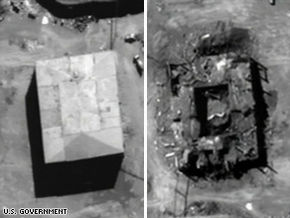
Supposed Syrian nuclear site before and after Israeli airstrike
But nothing about that alleged reactor in the Syrian desert turns out to be what it appeared at the time. The evidence now available shows that there was no such nuclear reactor, and that the Israelis had misled George W. Bush’s administration into believing that it was in order to draw the United States into bombing missile storage sites in Syria. Other evidence now suggests, moreover, that the Syrian government had led the Israelis to believe wrongly that it was a key storage site for Hezbollah missiles and rockets.
The International Atomic Agency’s top specialist on North Korean reactors, Egyptian national Yousry Abushady, warned top IAEA officials in 2008 that the published CIA claims about the alleged reactor in the Syrian desert could not possibly have been true. In a series of interviews in Vienna and by phone and e-mail exchanges over several months Abushady detailed the technical evidence that led him to issue that warning and to be even more confident about that judgment later on. And a retired nuclear engineer and research scientist with many years of experience at Oak Ridge National Laboratory has confirmed a crucial element of that technical evidence.
Published revelations by senior Bush administration officials show, moreover, that principal U.S. figures in the story all had their own political motives for supporting the Israeli claim of a Syrian reactor being built with North Korean help.
Vice President Dick Cheney hoped to use the alleged reactor to get President George W. Bush to initiate U.S. airstrikes in Syria in the hope of shaking the Syrian-Iranian alliance. And both Cheney and then CIA Director Michael Hayden also hoped to use the story of a North Korean-built nuclear reactor in Syria to kill a deal that Secretary of State Condoleezza Rice was negotiating with North Korea on its nuclear weapons program in 2007-08.
Mossad Chief’s Dramatic Evidence
In April 2007 the chief of Israel’s Mossad foreign intelligence agency, Meir Dagan, presented Cheney, Hayden and National Security Adviser Steven Hadley with evidence of what he said was a nuclear reactor being constructed in eastern Syria with the help of the North Koreans. Dagan showed them nearly a hundred hand-held photographs of the site revealing what he described as the preparation for the installation of a North Korean reactor and claimed that it was only a few months from being operational.
The Israelis made no secret of their desire to have a U.S. airstrike destroy the alleged nuclear facility. Prime Minister Ehud Olmert called President Bush immediately after that briefing and said, “George, I’m asking you to bomb the compound,” according to the account in Bush’s memoirs.
Cheney, who was known to be a personal friend of Olmert, wanted to go further. At White House meetings in subsequent weeks, Cheney argued forcefully for a U.S. attack not only on the purported reactor building but on Hezbollah weapons storage depots in Syria. Then-Secretary of Defense Robert Gates, who participated in those meetings, recalled in his own memoirs that Cheney, who was also looking for an opportunity to provoke a war with Iran, hoped to “rattle Assad sufficiently so as to end his close relationship with Iran” and “send a powerful warning to the Iranians to abandon their nuclear ambitions.”
CIA Director Hayden aligned the agency clearly with Cheney on the issue, not because of Syria or Iran but because of North Korea. In his book, Playing to the Edge, published last year, Hayden recalls that, at a White House meeting to brief President Bush the day after Dagan’s visit, he whispered in Cheney’s ear, “You were right, Mr. Vice-President.”
Hayden was referring to the fierce political struggle within the Bush administration over North Korea policy that had been underway ever since Condoleezza Rice had become Secretary of State in early 2005. Rice had argued that diplomacy was the only realistic way to get Pyongyang to retreat from its nuclear weapons program. But Cheney and his administration allies John Bolton and Robert Joseph (who succeeded Bolton as the key State Department policymaker on North Korea after Bolton became U.N. Ambassador in 2005) were determined to end the diplomatic engagement with Pyongyang.
Cheney was still maneuvering to find a way to prevent the successful completion of the negotiations, and he saw the story of a Syrian nuclear reactor built secretly in the desert with help from the North Koreans as bolstering his case. Cheney reveals in his own memoirs that in January 2008, he sought to sandbag Rice’s North Korea nuclear deal by getting her to agree that a failure by North Korea to “admit they’ve proliferating to the Syrians would be a deal killer.”
Three months later, the CIA released its unprecedented 11-minute video supporting the entire Israeli case for a North-Korean-style nuclear reactor that was nearly completed. Hayden recalls that his decision to release the video on the alleged Syrian nuclear reactor in April 2008 was “to avoid a North Korean nuclear deal being sold to a Congress and a public ignorant of this very pertinent and very recent episode.”
The video, complete with computer reconstructions of the building and photographs from the Israelis made a big splash in the news media. But one specialist on nuclear reactors who examined the video closely found abundant reason to conclude that the CIA’s case was not based on real evidence.
Technical Evidence against a Reactor
Egyptian national Yousry Abushady was a PhD in nuclear engineering and 23-year veteran of the IAEA who had been promoted to section head for Western Europe in the operations division of agency’s Safeguards Department, meaning that he was in charge of all inspections of nuclear facilities in the region. He had been a trusted adviser to Bruno Pellaud, IAEA Deputy Director General for Safeguards from 1993 to 1999, who told this writer in an interview that he had “relied on Abushady frequently.”
Abushady recalled in an interview that, after spending many hours reviewing the video released by the CIA in April 2008 frame by frame, he was certain that the CIA case for a nuclear reactor at al-Kibar in the desert in eastern Syria was not plausible for multiple technical reasons. The Israelis and the CIA had claimed the alleged reactor was modeled on the type of reactor the North Koreans had installed at Yongbyon called a gas-cooled graphite-moderated (GCGM) reactor.
But Abushady knew that kind of reactor better than anyone else at the IAEA. He had designed a GCGM reactor for his doctoral student in nuclear engineering, had begun evaluating the Yongbyon reactor in 1993, and from 1999 to 2003 had headed the Safeguards Department unit responsible for North Korea.
Abushady had traveled to North Korea 15 times and conducted extensive technical discussions with the North Korean nuclear engineers who had designed and operated the Yongbyon reactor. And the evidence he saw in the video convinced him that no such reactor could have been under construction at al-Kibar.
On April 26, 2008, Abushady sent a “preliminary technical assessment” of the video to IAEA Deputy Director General for Safeguards Olli Heinonen, with a copy to Director General Mohamed ElBaradei. Abushady observed in his memorandum that the person responsible for assembling the CIA video was obviously unfamiliar with either the North Korean reactor or with GCGM reactors in general.
The first thing that struck Abushady about the CIA’s claims was that the building was too short to hold a reactor like the one in Yongbyon, North Korea.
“It is obvious,” he wrote in his “technical assessment” memo to Heinonen, “that the Syrian building with no UG [underground] construction, can not hold a [reactor] similar [to] NK GCR [North Korean gas-cooled reactor].”
Abushady estimated the height of the North Korean reactor building in Yongbyon at a 50 meters (165 feet) and estimated that the building at al-Kibar at a little more than a third as tall.
Abushady also found the observable characteristics of the al-Kibar site inconsistent with the most basic technical requirements for a GCGM reactor. He pointed out that the Yongbyon reactor had no less than 20 supporting buildings on the site, whereas the satellite imagery shows that the Syrian site did not have a single significant supporting structure.
The most telling indication of all for Abushady that the building could not have been a GCGM reactor was the absence of a cooling tower to reduce the temperature of the carbon dioxide gas coolant in such a reactor.
“How can you work a gas-cooled reactor in a desert without a cooling tower?” Abushady asked in an interview.
IAEA Deputy Director Heinonen claimed in an IAEA report that the site had sufficient pumping power to get river water from a pump house on the nearby Euphrates River to the site. But Abushady recalls asking Heinonen, “How could this water be transferred for about 1,000 meters and continue to the heat exchangers for cooling with the same power?”
Robert Kelley, a former head of the U.S. Department of Energy’s Remote Sensing Laboratory and former senior IAEA inspector in Iraq, noticed another fundamental problem with Heinonen’s claim: the site had no facility for treating the river water before it reached the alleged reactor building.
“That river water would have been carrying debris and silt into the reactor heat exchangers,” Kelley said in an interview, making it highly questionable that a reactor could have operated there.
Yet another critical piece that Abushady found missing from the site was a cooling pond facility for spent fuel. The CIA had theorized that the reactor building itself contained a “spent fuel pond,” based on nothing more than an ambiguous shape in an aerial photograph of the bombed building.
But the North Korean reactor at Yongbyon and all 28 other GCGM reactors that had been built in the world all have the spent fuel pond in a separate building, Abushady said. The reason, he explained, was that the magnox cladding surrounding the fuel rods would react to any contact with moisture to produce hydrogen that could explode.
But the definitive and irrefutable proof that no GCGM reactor had been present at al-Kibar came from the environmental samples taken by the IAEA at the site in June 2008. Such a reactor would have contained nuclear-grade graphite, Abushady explained, and if the Israelis had actually bombed a GCGM reactor, it would have spread particles of nuclear-grade graphite all over the site.
Behrad Nakhai, a nuclear engineer at Oak Ridge National Laboratory for many years, confirmed Abshuady’s observation in an interview. “You would have had hundreds of tons of nuclear-grade graphite scattered around the site,” he said, “and it would have been impossible to clean it up.”
IAEA reports remained silent for more than two years about what the samples showed about nuclear-grade graphite, then claimed in a May 2011 report that the graphite particles were “too small to permit an analysis of the purity compared to that normally required for use in a reactor.” But given the tools available to laboratories, the IAEA claim that they couldn’t determine whether the particles were nuclear grade or not “doesn’t make sense,” Nakhai said.
Hayden acknowledged in his 2016 account that “key components” of a nuclear reactor site for nuclear weapons were “still missing.” The CIA had tried to find evidence of a reprocessing facility in Syria that could be used to obtain the plutonium for a nuclear bomb but had been unable to find any trace of one.
The CIA also had found no evidence of a fuel fabrication facility, without which a reactor could not have gotten the fuel rods to be reprocessed. Syria could not have gotten them from North Korea, because the fuel fabrication plant at Yongbyon had produced no fuel rods since 1994 and was known to have fallen into serious disrepair after the regime had agreed to scrap its own plutonium reactor program.
Manipulated and Misleading Photographs
Hayden’s account shows that he was ready to give the CIA’s stamp of approval to the Israeli photographs even before the agency’s analysts had even begun analyzing them. He admits that when he met Dagan face-to-face he didn’t ask how and when Mossad had obtained the photographs, citing “espionage protocol” among cooperating intelligence partners. Such a protocol would hardly apply, however, to a government sharing intelligence in order to get the United States to carry out an act of war on its behalf.
The CIA video relied heavily on the photographs that Mossad had given to Bush administration in making its case. Hayden writes that it was “pretty convincing stuff, if we could be confident that the pictures hadn’t been altered.”
But by his own account Hayden knew Mossad had engaged in at least one deception. He writes that when CIA experts reviewed the photographs from Mossad, they found that one of them had been photo-shopped to remove the writing on the side of a truck.
Hayden professes to have had no concern about that photo-shopped picture. But after this writer asked how CIA analysts interpreted Mossad’s photo shopping of the picture as one of the questions his staff requested in advance of a possible interview with Hayden, he declined the interview.
Abushady points out that the main issues with the photographs the CIA released publicly are whether they were actually taken at the al-Kibar site and whether they were consistent with a GCGM reactor. One of the photographs showed what the CIA video called “the steel liner for the reinforced-concrete reactor vessel before it was installed.” Abushady noticed immediately, however, that nothing in the picture links the steel liner to the al-Kibar site.
Both the video and CIA’s press briefing explained that the network of small pipes on the outside of the structure was for “cooling water to protect the concrete against the reactor’s intense heat and radiation.”
But Abushady, who specializes in such technology, pointed out that the structure in the picture bore no resemblance to a Gas-Cooled Reactor vessel. “This vessel cannot be for a Gas-Cooled Reactor,” Abushady explained, “based on its dimensions, it thickness and the pipes shown on the side of the vessel.”
The CIA video’s explanation that the network of pipes was necessary for “cooling water” made no sense, Abushady said, because gas-cooled reactors use only carbon dioxide gas — not water — as a coolant. Any contact between water and the Magnox-cladding used in that type of reactor, Abushady explained, could cause an explosion.
A second Mossad photograph showed what the CIA said were the “exit points” for the reactor’s control rods and fuel rods. The CIA juxtaposed that photograph with a photograph of the tops of the control rods and fuel rods of the North Korean reactor at Yongbyon and claimed a “very close resemblance” between the two.
Abushady found major differences between the two pictures, however. The North Korean reactor had a total of 97 ports, but the picture allegedly taken at al-Kibar shows only 52 ports. Abushady was certain that the reactor shown in the photograph could not have been based on the Yongbyon reactor. He also noted that the picture had a pronounced sepia tone, suggesting that it was taken quite a few years earlier.
Abushady warned Heinonen and ElBaradei in his initial assessment that the photo presented as taken from inside the reactor building appeared to an old photo of a small gas-cooled reactor, most likely an early such reactor built in the U.K.
A Double Deception
Many observers have suggested that Syria’s failure to protest the strike in the desert loudly suggests that it was indeed a reactor. Information provided by a former Syrian air force major who defected to an anti-Assad military command in Aleppo and by the head of Syria’s atomic energy program helps unlock the mystery of what was really in the building at al-Kibar.
The Syrian major, “Abu Mohammed,” told The Guardian in February 2013 that he was serving in the air defense station at Deir Azzor, the city nearest to al-Kibar, when he got a phone call from a Brigadier General at the Strategic Air Command in Damascus just after midnight on Sept. 6, 2007. Enemy planes were approaching his area, the general said, but “you are to do nothing.”
The major was confused. He wondered why the Syrian command would want to let Israeli fighter planes approach Deir Azzor unhindered. The only logical reason for such an otherwise inexplicable order would be that, instead of wanting to keep the Israelis away from the building at al-Kibar, the Syrian government actually wanted the Israelis to attack it. In the aftermath of the strike, the Damascus issued only an opaque statement claiming that the Israeli jets had been driven away and remaining silent on the airstrike at al-Kibar.
Abushady told this writer he learned from meetings with Syrian officials during his final year at the IAEA that the Syrian government had indeed originally built the structure at al-Kibar for the storage of missiles as well as for a fixed firing position for them. And he said Ibrahim Othman, the head of Syria’s Atomic Energy Commission, had confirmed that point in a private meeting with him in Vienna in September 2015.
Othman also confirmed Abushady’s suspicion from viewing satellite photographs that the roof over the central room in the building had been made with two movable light plates that could be opened to allow the firing of a missile. And he told Abushady that he had been correct in believing that what had appeared in a satellite image immediately after the bombing to be two semi-circular shapes was what had remained of the original concrete launching silo for missiles.
In the wake of the Israel’s 2006 invasion of Southern Lebanon, the Israelis were searching intensively for Hezbollah missiles and rockets that could reach Israel and they believed many of those Hezbollah weapons were being stored in Syria. If they wished to draw the attention of the Israelis away from actual missile storage sites, the Syrians would have had good reason to want to convince the Israelis that this was one of their major storage sites.
Othman told Abushady that the building had been abandoned in 2002, after the construction had been completed. The Israelis had acquired ground-level pictures from 2001-02 showing the construction of outer walls that would hide the central hall of the building. The Israelis and the CIA both insisted in 2007-08 that this new construction indicated that it had to be a reactor building, but it is equally consistent with a building designed to hide missile storage and a missile-firing position.
Although Mossad went to great lengths to convince the Bush administration that the site was a nuclear reactor, what the Israelis really wanted was for the Bush administration to launch U.S. airstrikes against Hezbollah and Syrian missile storage sites. Senior officials of the Bush administration didn’t buy the Israeli bid to get the United States to do the bombing, but none of them ever raised questions about the Israeli ruse.
So both the Assad regime and the Israeli government appear to have succeeded in carrying out their own parts in a double deception in the Syrian desert.
Gareth Porter is an independent investigative journalist and historian on U.S. national security policy and the recipient of the 2012 Gellhorn Prize for journalism.
‘America First!’ AWOL from Beijing, War with North Korea Looms
By James George JATRAS | Strategic Culture Foundation | 11.11.2017
There’s no indication that President Donald Trump’s summit with China’s Xi Jinping achieved any breakthrough on North Korea. But why didn’t it? After all, Trump said that China could “fix” the North Korea problem “easily and quickly” and it was just a matter of Xi’s making up his mind to do so.
No less divorced from reality was Trump’s half-hearted pitch on the US trade imbalance with China. The problem, he said, was not the Chinese – whom he complimented on their cleverness in exploiting our stupidity – but on the flaccid policies of prior American administrations. Quite true! But what will he do differently? Not much it seems, except maybe give a big tax cut with no strings attached to fat corporations that are thrilled to keep moving their operations overseas. Global market über alles! And here we all thought Hillary Clinton lost the election . . .
All in all, Trump’s China visit was characterized by putting his “America First!” campaign principles on ice in favor of the globalist agenda of his economic advisers and subordination of trade to the geopolitical concerns of the military Junta that runs his administration for him. Sure, there might some tinkering here and there, like the recent hit against Chinese aluminum foil dumping. But plutocrats worried about a “trade war” with China can sleep easy.
On North Korea – the overwhelming US preoccupation at the Trump-Xi summit – Trump came up empty. For months observers have fretted over Trump’s oscillating rhetoric from fire and destruction one day to let’s-make-a-deal the next. He’s his own good cop, bad cop act.
In principle there’s nothing wrong with bluster and unpredictability. The art of the deal, you know. Despite the claims of Trump’s detractors, the President’s supposed irresponsibility and impulsiveness aren’t the problem. Trump’s personal style hasn’t yet resulted in war, and if war comes, that wouldn’t be the reason for it. Rather the real danger comes from the ostensible experts who set the parameters within which Trump operates, to whom he’s unwisely outsourced his foreign and security policies. The following articles of faith are baked into the cake:
- First, It’s nice that there has evidently been a back channel for direct US talks with North Korea, but from Washington’s perspective there is nowhere for negotiations to go past demands for denuclearization. Any kind of concession to Pyongyang is out of the question, as it would mean “rewarding aggression” and “showing weakness.” There are no evident contours for a deal when only one side is expected to make concessions.
- Second, because Washington has defined North Korea’s nukes as ipso facto a vital threat to the US, the minimum acceptable US goal is Pyongyang’s dumping its weapons.. (Regime change would be better, since it would also mean denuclearization.) The fact that Pyongyang is unlikely to give up its nukes under any circumstances means there can be no deal.
- Third, in Washington’s collective mind the crisis is 100 percent the fault of North Korea, zero percent the result of our presence in Korea, of our threats against Pyongyang, or of our actions elsewhere. How can you blame us – we tried diplomacy for 20 years and all it did was lead to a bomb! Any suggestion that Kim Jong-un is responding to threats from George W. Bush’s 2002 Axis of Evil speech or to the disposal of Muammar Qaddafi and Saddam Hussein (who, unlike Kim, were foolish enough not to have WMDs) would be “blaming America!” Taking responsibility for past mistakes is not our forte. The prospect that the US mainland might in a few months be targetable by a nuclear-tipped North Korean ICBM has nothing at all to do with anything the US has said or done.
- Fourth, we know China can solve this at will – easily and quickly, as the President said. As former US ambassador to the UN John Bolton says: “That’s why you say to China: ‘we’re gonna see reunification here. Do you want to do it the hard way or the easy way?” This means China can do the job for us, or we’ll do it. The notion that Beijing will not take an action fundamentally inconsistent to China’s national security because of American flattery or threats is almost inconceivable. But if they fail to do as we demand, what comes next will be their fault, not ours.
- Fifth, the military option is still very much on the table. The Junta are not strategic thinkers but they are very, very certain of their technique. If worse comes to worst, and they are “forced to act” (from their point of view) they are supremely (and dangerously) confident that good execution can minimize the damage. Preparations for a preemptive strike continue apace. In Seoul Trump touted the prowess of the three US carrier groups off the peninsula. Maybe it’s all just a bluff to get the Chinese to act (as we know they can; see the preceding paragraph). But if worse comes to worst, and it turns out horribly for a lot of people: We had no choice in light of China’s inaction. Does this mean the planners are sitting around scheming to sacrifice Seoul so as not to look weak? No, but they are prepared to risk that outcome because they are boxed in by all the other elements of their approach. Worse, they are sure they call pull it off. After all, look at how well our other recent wars have gone!
- Sixth, Trump has made it clear that his instincts are on hold and he’ll be guided by “the professionals.” (Compare Afghanistan, where his “new” same-old non-strategy was dictated by the Junta against what he admits were his own inclinations.) On Korea, the “experts” mainly refers to the Junta but also Nikki Haley (!!!!) and probably John Bolton. (There’s also a possibility that David Petraeus, the genius advocate of arming al-Qaeda in Syria, has a thumb in the pie as well.) Plus, keep in mind that Trump isn’t a neoconservative but he is an Andrew Jackson, or perhaps Teddy Roosevelt, nationalist. “Do not underestimate us,” Trump warned Kim. “And do not try us.” When the “experts” tell him that North Korea is “trying” us, what else can he do but act? After all, in April the “experts” told him that al-Assad gassed children in Syria – and boom! – he launched cruise missiles to the applause of both the Swamp critters and much of his populist base that has no idea where Syria is.
- Seventh – and here’s the fun part – if it does all turn into a huge disaster involving hundreds of thousands of deaths, who will take the fall? Not McMaster or Haley. No, it will all be blamed on Trump and the “America First!” path he failed to follow. The establishment on both sides of the aisle, including many who prodded him toward a more aggressive policy, will rush to denounce him: See, we told you he’s nuts! The professionals gave him good advice but he messed everything up! In that case, they wouldn’t have to wait for impeachment, the 25th Amendment would be invoked. Talk about a “win-win” for the Deep State warmongers: getting rid of Kim and Trump!
US Cannot Shoot Down DPRK Missiles: Global Defense Experts
Sputnik – 24.09.2017
The US State Department stated on Friday that the country’s military defense networks will shoot down a North Korean ballistic missile if it flies over the island territory of Guam, but experts in the field have claimed that the Pentagon is flat-out wrong.
In stating that the US will destroy a Pyongyang ballistic missile carrying a nuclear warhead in mid-air, the Pentagon is not only misleading the public and its own government, it is outright lying, according to military experts with deep knowledge of missile-defense technology.
“No, we won’t,” counter military experts to claims by the Pentagon that the US may launch and intercept any missiles launched by the People’s Democratic Republic of Korea (DPRK).
The United States will have a hard time trying to shoot down DPRK nuclear missiles, a point of view shared by Joe Cirincione, president of Ploughshares Fund, a global security foundation specializing in nuclear weapons, and Kingston Reif, director of Disarmament and Threat Reduction policy at the nonpartisan Arms Control Association.
According to both experts, the United States touts its layered missile defense systems, even though almost none are capable of intercepting an ICBM.
When Pyongyang shot a missile over Japan, it flew high enough that no US system would be able to reach it, Cirincione wrote in a report for Defense One.
“The key word here is ‘over.’ Like way over,” Cirincione wrote. “Like 770 kilometers (475 miles) over Japan at the apogee of its flight path. Neither Japan nor the United States could have intercepted the missile. None of the theater ballistic missile defense weapons in existence can reach that high.”
The US missile defense consists of three layers, including the Patriot, THAAD and the Aegis systems. For the sake of simplicity, their ranges can be memorized as 12, 125 and 1350 miles, respectively (thanks to the Business Insider for a nice chart).
However, all three are designed to take down a missile at its final, terminal, stage, while it is falling from the sky toward its target. Despite that the US has reportedly poured some $320 billion into missile defense systems over the last several decades, none of the systems is capable of reaching an ICBM (or even an intermediate-range ballistic missile (IRBM)) in its middle or post-launch stage.
Well, they will take down an ICBM in the terminal stage, right? Wrong, the experts say. While the much-advertised Aegis system, for example, has displayed stellar results in test fires against short-range and medium-range targets, these results must be taken with a heavy dose of salt, according to Reif and Cirincione.
“Only one of those tests has been against an IRBM class target similar to the North’s HS-12,” Reif told Fox News.
“THAAD, Patriot and especially Aegis, have done fairly well in tests, but these have been tests designed for success, simplified, carefully staged and using mostly short-range targets,” Cirincione stated.
According to Cirincione, currently the United States has a “50-50 chance” of hitting a missile similar to North Korea’s Hwasong-14 while the missile is in flight. And those results are only possible if the DPRK used zero countermeasures, such as decoys (some as simple as a balloon), electronic jammers and chaff.
There is also a little-discussed issue with naval-based Aegis launchers. Despite their flexibility compared to fixed ground-based systems, the ships need to be at precisely the right place at the right time to be capable to intercept a launch, experts say.
Trying to use missiles from Aegis ships “would be a highly demanding task and entail a significant amount of guesswork, as the ships would have to be in the right place at the right time to stop a test at sea,” Reif said, cited by Defense One.
There is a US system that is supposed to be the ultimate solution to the ICBM threat — well, at least sort of — called “Ground-Based Midcourse Defense,” or GMD, according to the experts. This system, which has already cost the US some $40 billion, is claimed to be able to shoot down ICBMS at their highest point, at ranges up to 3,500 miles.
According to the experts, “claimed to be able” does not equal “guaranteed to work.”
“The only system designed to defend the US homeland, known as the [GMD], has suffered from numerous technical and engineering problems, and testing in controlled conditions has not demonstrated that it can provide a reliable defense against even a small number of unsophisticated ICBMs,” Reif said.
“The success rate of the GMD systems in flight intercept tests has been dismal,” Cirincione quoted Philip Coyle, former director of operational testing for the Pentagon, as saying.
Cirincione also quotes the former head of the Missile Defense Agency, retired Lt. Gen. Trey Obering, saying that the chances of successfully hitting an ICBM with a GMD are “as good as coin toss.”
Top US officials, including President Donald Trump and his defense minister General Jim Mattis, claim that the Pentagon has the situation under control and can deal with any nuclear threat, giving US citizens a false feeling of safety. Neither the US mainland, Japan or South Korea are in any way protected by US missile defense technology from a DPRK nuclear strike.
Thomas Karako, senior fellow and director of the Missile Defense Project at the Center for Strategic and International Studies, said in an interview with Fox News that “North Korea has hundreds of missiles, [and] the THAAD battery is not there to defend the entire peninsula. […] This is not about having a perfect shield and sitting there and playing catch.”
According to Karko, THAAD has been deployed in South Korea not to provide protection for the 25 million population of the country, but to “buy time for a military counterstrike.”
The top US brass, repeating words of confidence over and over again, may trick themselves into believing their own words, according to Reif.
“Misplaced overconfidence in missile defense could prompt US leaders to think that we can escalate in response to North Korean provocations without having to worry about a potential North Korean nuclear response,” Reif warned.
“This would greatly increase the risk of conflict on the Korean Peninsula,” he added.
Why North Korea Wants Nuke Deterrence
By Nicolas J S Davies | Consortium News | October 12, 2017
The Western media has been awash in speculation as to why, about a year ago, North Korea’s “crazy” leadership suddenly launched a crash program to vastly improve its ballistic missile capabilities. That question has now been answered.
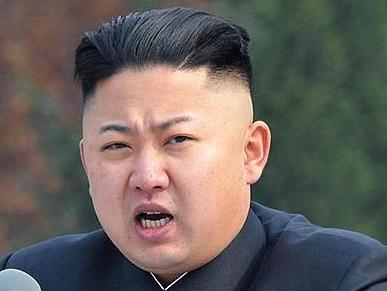
North Korean leader Kim Jong Un.
In September 2016, North Korean cyber-defense forces hacked into South Korean military computers and downloaded 235 gigabytes of documents. The BBC has revealed that the documents included detailed U.S. plans to assassinate North Korea’s president, Kim Jong Un, and launch an all-out war on North Korea. The BBC’s main source for this story is Rhee Cheol-Hee, a member of the Defense Committee of the South Korean National Assembly.
These plans for aggressive war have actually been long in the making. In 2003, the U.S. scrapped an agreement signed in 1994 under which North Korea suspended its nuclear program and the U.S. agreed to build two light water reactors in North Korea. The two countries also agreed to a step-by-step normalization of relations. Even after the U.S. scrapped the 1994 Agreed Framework in 2003, North Korea did not restart work on the two reactors frozen under that agreement, which could by now be producing enough plutonium to make several nuclear weapons every year.
However, since 2002-03, when President George W. Bush included North Korea in his “axis of evil,” withdrew from the Agreed Framework, and launched an invasion of Iraq over bogus WMD claims, North Korea once again began enriching uranium and making steady progress toward developing nuclear weapons and ballistic missiles to deliver them.
By 2016, the North Koreans also were keenly aware of the horrific fate of Iraq and Libya and their leaders after the countries did surrender their unconventional weapons. Not only did the U.S. lead bloody “regime change” invasions but the nations’ leaders were brutally murdered, Saddam Hussein by hanging and Muammar Gaddafi sodomized with a knife and then summarily shot in the head.
So, the discovery of the U.S. war plan in 2016 sounded alarm bells in Pyongyang and triggered an unprecedented crash program to quickly expand North Korea’s ballistic missile program. Its nuclear weapons tests established that it can produce a small number of first-generation nuclear weapons, but it needed a viable delivery system before it could be sure that its nuclear deterrent would be credible enough to deter a U.S. attack.
In other words, North Korea’s main goal has been to close the gap between its existing delivery systems and the missile technology it would need to actually launch a retaliatory nuclear strike against the United States. North Korea’s leaders see this as their only chance to escape the same kind of mass destruction visited on North Korea in the first Korean War, when U.S.-led air forces destroyed every city, town and industrial area and General Curtis LeMay boasted that the attacks had killed 20 percent of the population.
Through 2015 and early 2016, North Korea only tested one new missile, the Pukkuksong-1 submarine-launched missile. The missile launched from a submerged submarine and flew 300 miles on its final, successful test, which coincided with the annual U.S.-South Korean military exercises in August 2016.
North Korea also launched its largest satellite to date in February 2016, but the launch vehicle seemed to be the same type as the Unha-3 used to launch a smaller satellite in 2012.
However, since the discovery of the U.S.-South Korean war plans a year ago, North Korea has vastly accelerated its missile development program, conducting at least 27 more tests of a wide range of new missiles and bringing it much closer to a credible nuclear deterrent. Here is a timeline of the tests:
–Two failed tests of Hwasong-10 medium-range ballistic missiles in October 2016.
–Two successful tests of Pukguksong-2 medium-range ballistic missiles, in February and May 2017. The missiles followed identical trajectories, rising to a height of 340 miles and landing in the sea 300 miles away. South Korean analysts believe this missile’s full range is at least 2,000 miles, and North Korea said the tests confirmed it is ready for mass production.
–Four medium-range ballistic missiles that flew an average of 620 miles from the Tongchang-ri space center in March 2017.
–Two apparently failed missile tests from Sinpo submarine base in April 2017.
–Six tests of Hwasong-12 medium-range ballistic missiles (range: 2,300 to 3,700 miles) since April 2017.
–A failed test of a missile believed to be a “KN-17” from Pukchang airbase in April 2017.
–Test of a Scud-type anti-ship missile that flew 300 miles and landed in the Sea of Japan, and two other tests in May 2017.
–Several cruise missiles fired from the East coast in June 2017.
–A test of a powerful new rocket engine, maybe for an ICBM, in June 2017.
–North Korea tested two Hwasong-14 “near-ICBMs” in July 2017. Based on these tests, the Hwasong-14 may be capable of hitting city-sized targets in Alaska or Hawaii with a single nuclear warhead, but cannot yet reach the U.S. West Coast.
–Four more missiles tested in August 2017, including a Hwasong-12 that flew over Japan and travelled 1,700 miles before breaking up, maybe as a result of a failure in a “Post Boost Vehicle” added to improve range and accuracy.
–Another ballistic missile flew 2,300 miles over the Pacific on September 15, 2017.
An analysis of the two tests of the Hwasong-14 in July by the Bulletin of the Atomic Scientists (BAS) concluded that these missiles are not yet capable of carrying a 500 kg payload as far as Seattle or other U.S. West Coast cities. BAS notes that a first generation nuclear weapon based on the Pakistani model that North Korea is believed to be following could not weigh less than 500 kg, once the weight of the warhead casing and a heat shield to survive reentry into the Earth’s atmosphere are taken into account.
Global Reaction
Awareness of the role of the U.S. war plan in spurring the dramatic escalation of North Korea’s missile program should be a game changer in the world’s response to the crisis over Korea, since it demonstrates that the current acceleration of the North Korean missile program is a defensive response to a serious and potentially existential threat from the United States.
If the United Nations Security Council was not diplomatically and militarily intimidated by the United States, this knowledge should trigger urgent action in the Security Council to require all sides to make a firm commitment to peaceful and binding diplomacy to formally end the Korean War and remove the threat of war from all the people of Korea. And the whole world would unite politically and diplomatically to prevent the U.S. from using its veto to avoid accountability for its leading role in this crisis. Only a unified global response to potential U.S. aggression could possibly convince North Korea that it would have some protection if it eventually halted its nuclear weapons program.
But such unity in the face of a threat of U.S. aggression would be unprecedented. Most U.N. delegates quietly sat and listened on Sept. 19 when President Donald Trump delivered explicit threats of war and aggression against North Korea, Iran and Venezuela, while boasting about his missile strike against Syria on April 6 over dubious and disputed claims about a chemical weapons incident.
For the past 20 years or more, the United States has swaggered about as the “last remaining superpower” and the “indispensable nation,” a global law unto itself, using the dangers of terrorism and weapons proliferation and highly selective outrage over “dictators” as propaganda narratives to justify illegal wars, CIA-backed terrorism, its own weapons proliferation, and support for its favored dictators like the brutal rulers of Saudi Arabia and other Arab monarchies.
For even longer, the United States has been two-faced about international law, citing it when some adversary can be accused of a violation but ignoring it when the U.S. or its allies are trampling on the rights of some disfavored country. When the International Court of Justice convicted the United States of aggression (including acts of terrorism) against Nicaragua in 1986, the U.S. withdrew from the ICJ’s binding jurisdiction.
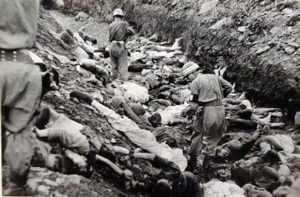
July 1950 U.S. Army file photograph once classified “top secret”. S. Korean soldiers walk among thousands of political prisoners shot at Taejon, S. Korea.
(AP Photo/National Archives, Major Abbott/U.S. Army, File)
Since then, the U.S. has thumbed its nose at the entire structure of international law, confident in the political power of its propaganda or “information warfare” to cast itself as the guardian of law and order in the world, even as it systematically violates the most basic rules spelled out in the U.N. Charter and the Geneva Conventions.
U.S. propaganda treats the U.N. Charter and the Geneva Conventions, the world’s “Never again” to war, torture and the killing of millions of civilians in the Second World War, as relics of another time that it would be naive to take seriously.
But the results of the U.S. alternative — its lawless “might makes right” war policy — are now plain for all to see. In the past 16 years, America’s post-9/11 wars have already killed at least two million people, maybe many more, with no end in sight to the slaughter as the U.S.’s policy of illegal war keeps plunging country after country into intractable violence and chaos.
An Ally’s Fears
Just as North Korea’s missile programs are a rational defense strategy in the face of the threat Pyongyang faces from the U.S., the exposure of the U.S.’s war plan by American allies in South Korea is also a rational act of self-preservation, since they too are threatened by the possibility of war on the Korean peninsula.
Now maybe other U.S. allies, the wealthy countries that have provided political and diplomatic cover for the U.S.’s 20-year campaign of illegal war, will finally reassert their humanity, their sovereignty and their own obligations under international law, and start to rethink their roles as junior partners in U.S. aggression.
Countries like the U.K., France and Australia will sooner or later have to choose between forward-looking roles in a sustainable, peaceful multi-polar world and a slavish loyalty to the ever-more desperate death throes of U.S. hegemony. Now might be a good moment to make that choice, before they are dragged into new U.S. wars in Korea, Iran or Venezuela.
Even Sen. Bob Corker, R-Tennessee, chairman of the Senate Foreign Relations Committee, is afraid that Donald Trump will lead humanity into World War III. But it might come as a surprise to people in Iraq, Afghanistan, Syria, Yemen, Somalia, Libya and parts of a dozen other countries already engulfed by U.S.-driven wars to learn that they are not already in the midst of World War III.
Perhaps what really worries the Senator is that he and his colleagues may no longer be able to sweep these endless atrocities under the plush carpets of the halls of Congress without a genteel Barack Obama in the White House to sweet-talk U.S. allies around the world and keep the millions being killed in U.S. wars off U.S. TVs and computer screens, out of sight and out of mind.
If politicians in the U.S. and around the world need the ugliness of Donald Trump as a mirror for their own greed, ignorance and temerity, to shame them into changing their ways, so be it – whatever it takes. But it should not escape anyone anywhere that the signature on this diabolical war plan that now threatens to kill millions of Koreans was not Donald Trump’s but Barack Obama’s.
George Orwell might well have been describing the partisan blindness of the West’s self-satisfied, so easily deluded, neoliberal society when he wrote this in 1945,
“Actions are held to be good or bad, not on their own merits, but according to who does them, and there is almost no kind of outrage – torture, the use of hostages, forced labor, mass deportations, imprisonment without trial, forgery, assassination, the bombing of civilians – which does not change its color when it is committed by our side… The Nationalist not only does not disapprove of atrocities committed by his own side, but he has a remarkable capacity for not even hearing about them.”
Here’s the bottom line: The United States has been planning to assassinate Kim Jong Un and to launch an all-out war on North Korea. There. You’ve heard it. Now, can you still be manipulated into believing that Kim Jong Un is simply “crazy” and North Korea is the gravest threat to world peace?
Or do you now understand that the United States is the real threat to peace in Korea, just as it was in Iraq, Libya and many other countries where the leaders were deemed “crazy” and U.S. officials (and the Western mainstream media) promoted war as the only “rational” alternative?
Nicolas J S Davies is the author of Blood On Our Hands: the American Invasion and Destruction of Iraq. He also wrote the chapters on “Obama at War” in Grading the 44th President: a Report Card on Barack Obama’s First Term as a Progressive Leader.
Featured Video

or go to
Aletho News Archives – Video-Images
From the Archives
Israel Would Have No Qualms About USS Liberty-Style FALSE FLAG If Iran Campaign Falters – Analysts
By Ilya Tsukanov – Sputnik – 18.06.2025
Donald Trump is mulling whether or not to join Israel’s aggression against Iran as Tel Aviv faces problems sustaining its defenses against growing counterstrikes, and apparently lacks a realistic game plan for an end to hostilities after failing to achieve its goals. Analysts told Sputnik how the US could be ‘nudged’ into the conflict.
“The US is already assisting Israel with supplies, intel, refueling support, etc. One of the many US posts in the region could be attacked for a casus belli,” former Pentagon analyst Karen Kwiatkowski explained.
“If Trump doesn’t comply with Israel’s demand” and join its aggression voluntarily, “a false flag may be needed” to drag the US in, Kwiatkowski, retired US Air Force Lt. Col.-turned Iraq War whistleblower, fears.
Netanyahu has a diverse array of options at his disposal, according to the observer, including:
- a false flag against US assets abroad blamed on Iran or one of its Axis of Resistance allies, like the Houthis
- a US domestic attack or assassination blamed on Iran
- Iranian air defenses ‘accidentally’ hitting a civilian jetliner carrying Americans
- use of a dirty bomb or nuclear contamination somewhere in the region blamed on Iran
- even blackmailing by threatening to use nukes against Iran if the US doesn’t join the fight
Kwiatkowski estimates that Israel probably has “enough blackmail power” against President Trump and Congress to avoid the necessity of a false flag operation, but a “USS Liberty-style” attack, targeting the soon-to-be-retired USS Nimitz supercarrier that’s heading to the Middle East, for example, nevertheless cannot be ruled out entirely, she says. … continue
Blog Roll
 Aletho News
- Top PMU commander, over a dozen fighters killed in new US strikes on Iraq
- Is Netanyahu’s war gamble threatening the future of ‘Israel’?: FT
- Smotrich calls for annexation of South Lebanon to Litani River
- Echos of Gallipoli? Hormuz and the Geography of Hubris
- Pakistan PM backs Iran’s right to self-defense amid tensions
- Hungary blasts ‘fake’ EU accusation
- SAFE Debt Trap: Poland’s €43.7 Billion Bet on Unipolar Illusion
- War on Iran threatens global Gulf capital flows: FT analysis
- Mossad De Facto Admits To Inciting Riots In Iran
- Tehran: World grown thoroughly exhausted with US-Israeli ‘false flag storylines’
- If Americans Knew
- Israel poised to take over southern Lebanon; settlers wreak havoc in West Bank – Not a ceasefire Day 165
- From Sde Teiman, the truth about Israel’s military justice system has been set free
- Child denied life-saving bone marrow transplant by Israel ‘because he is from Gaza’
- Raffi Berg: BBC Middle East Editor Exposed as CIA, Mossad Collaborator
- Jerusalem Archbishop Rebukes Netanyahu’s Statements on Christianity
- US to embed Palantir AI across entire military: Report
- Israeli-US war on Iran to drag on “a few more weeks” – Not a ceasefire Day 164
- Lebanon deaths top 1,200; Palantir AI to be embedded across US military – Not a ceasefire Day 163
- Israel’s assassination game: Take all pragmatists off the board
- Food shortages return to Gaza as Israel tightens aid restrictions under the cover of its war on Iran
- No Tricks Zone
- Devastating Assessment Of Comirnaty Vaccine By Former Senior Pfizer Europe Toxicologist
- New Study: CO2 Is ‘Effectively Negligible’ As An Explanatory Climate Change Factor Since 2000
- Former Pfizer Toxicologist Dr. Helmut Sterz Tells Bundestag Hearing Pfizer Vaccine Should Have Never Been Approved
- Energy Expert: Germany’s Nuclear Phaseout Was A “500 Billion Euro Mistake”
- New Research: South Australia’s Mid-Holocene Sea Surface Temperatures Were 4°C Warmer Than Today
- Storing Green Energy To Last Germany 10 Days Would Require A 60-Million Tonne Battery
- New Studies: UK Sea Levels Were 4 Meters Higher Than Today During The Mid-Holocene
- Destructive Green New Deal: German Energy And Metal Group Warns Of Drastic Crisis
- New Study Documents A 20-Year Pause In Arctic Sea Ice Decline – Driven By Internal Variability
- Wake-up Call: Survey Shows Majority Of Germans Now Favor Postponing Climate Targets!
 Aletho News