‘Nuclear War Game’ Part of Massive US-South Korea Military Drills for First Time
Sputnik – 23.08.2017
For the first time ever, the US and South Korea will be conducting war games meant to prepare their militaries for the possibility of a nuclear war, according to a South Korean Defense Ministry official. North Korea has previously called the planned military exercises a provocation that could lead to nuclear war.
No other details were given by the Defense Ministry spokesperson, who was speaking to South Korean newspaper Chosun Ilbo. However, the war game does come in the wake of North Korea’s first-ever test of a long range intercontinental ballistic missile in July, as well as reports that the country might be capable of fitting a nuclear payload onto it.
Ulchi Freedom Guardian, a 10-day military exercise that this summer involves 17,500 American and 50,000 South Korean soldiers (as well as contingents from seven other US allies), has been an annual event for 41 straight years. The focus of the exercises is to defend South Korea from a mock invasion from the North.
Michelle Thomas, a US military spokeswoman, said of the exercises: “It’s to prepare if something big were to occur and we needed to protect [South Korea].”
North Korea traditionally condemns the drills as provocative, and this year is no different. State news agency KCNA called Ulchi Freedom Guardian an exercise “aimed to ignite a nuclear war on the Korean Peninsula at any cost.”
South Korean President Moon Jae-in said that the exercises were not meant “at all to heighten military tension on the Korean Peninsula as these drills are held annually and are of a defensive nature. North Korea should not exaggerate our efforts to keep peace nor should they engage in provocations that would worsen the situation, using [the exercise] as an excuse.”
China chimed in to the contrary, with Foreign Ministry spokeswoman Hua Chunying criticizing the drills during a regular press conference. Hua called them “not helpful to the de-escalation of the current tensions and the efforts made by all relevant parties to promote peace talks.” She added that the situation on the peninsula was “highly complex, sensitive and delicate” and that South Korea and the US shouldn’t “add fuel to the fire.”
Despite tensions with North Korea at their highest in decades, US Forces Korea has downsized American participation in the exercise from 2016: 17,500 American soldiers are participating in the 2017 exercises, down from 25,000 the previous year.
Hua urged both sides to focus on more “constructive actions” instead, such as accepting China’s proposal of “suspension for suspension.” The solution, proposed by Beijing in March, calls for North Korea to stop all missile tests in exchange for the US and South Korea stopping all military exercises.
Pyongyang welcomed the plan, while Washington and Seoul rejected it. American military experts called the deal overwhelmingly advantageous for North Korea, as they get to continue their own military exercises and thus better prepare for offensive or defensive warfare.
“It is hard to imagine why the United States would accept [suspension for suspension], because of the vulnerability it would create,” said Bruce Bennett, a senior defense researcher at Rand Corp., to the Charlotte Observer.
Hua also added that the “tense situation on the Korean Peninsula has shown a slight sign of abatement recently.” This may have been a reference to General Joe Dunford, the United States’ highest ranking military officer and the chairman of the Joint Chiefs of Staff, visiting China earlier in August to meet with President Xi Jinping.
During his visit, the US and China agreed to strengthen military ties and the lines of communication to help find a resolution to the North Korean crisis.
Moscow ‘preparing inevitable response’ as US hits Russians with new sanctions over N. Korea
RT | August 23, 2017
Moscow has fired back at the latest round of US sanctions targeting Russian interests, as Washington blacklisted one Russian company and four individuals for their alleged dealings with North Korea.
On Tuesday, the US Treasury revealed it had imposed sanctions on 16 Russian and Chinese nationals and companies for their alleged dealings with North Korea. The Treasury claims the sanctions are in line with the internationally agreed measures against North Korea’s missile and nuclear weapons programs. The companies are accused of working with blacklisted individuals, helping develop the North Korean energy sector, help it place workers abroad or move money from abroad. As a result, their US assets are frozen and Americans are forbidden from doing business with them.
“It is unacceptable for individuals and companies in China, Russia, and elsewhere to enable North Korea to generate income used to develop weapons of mass destruction and destabilize the region,” Treasury Secretary Steven Mnuchin said in a statement.
“We are taking actions consistent with UN sanctions to show that there are consequences for defying sanctions and providing support to North Korea, and to deter this activity in the future.”
Reacting to the sanctions, Russian Deputy Foreign Minister Sergey Ryabkov issued a statement expressing disappointment, and warning Washington that Russia was working on a response.
“Against such a depressing backdrop, the lip service from American representatives about the desire to stabilize bilateral relations is extremely unconvincing,” Ryabkov said. “We have always and will always support resolving our existing differences through dialogue. In recent years, Washington in theory should have learned that for us the language of sanctions is unacceptable, and the solutions to real problems are only hindered by such actions. So far, however, there doesn’t seem to be an understanding of such obvious truths.”
“Nevertheless, we do not lose our hope that the voice of reason will sooner or later prevail, and that our American colleagues will be aware of the futility and detrimental nature of further sliding down the spiral of sanctions.”
In the meantime, we are beginning to work out the inevitable response to this situation.”
The companies under sanction include Gefest-M, a Moscow-based firm accused of acquiring metals for a North Korean company, and Mingzheng International Trading, a Chinese and Hong Kong-based bank that supposedly conducted transactions on behalf of North Korea.
Andrey Klimov, a senior Russian senator, said that the US sanctions against Gefest-M and the others lack legitimacy.
“These sanctions are illegal in themselves, because the only thing recognized by international law is the sanctions of the UN Security Council,” Klimov told Interfax. “We must react in principle to this insane and confrontational policy. The toolbox is rich, let’s hope that we will act consistently, reasonably, professionally and effectively.”
Klimov’s words were echoed by the Chinese government, with a spokesperson saying Beijing “opposes unilateral sanctions out[side] of the UN Security Council framework.”
“We strongly urge the US to immediately correct its mistake, so as not to impact bilateral cooperation on relevant issues,” the spokesperson said, as quoted by the Financial Times.
At the same time, the US Department of Justice also filed two complaints to forfeit over $11 million from two Asian companies for allegedly laundering funds for North Korea.
The DoJ alleges that the two companies violated the international sanctions against North Korea and indirectly supporting its missile and nuclear weapons programs.
“The United States filed two complaints today seeking imposition of a civil money laundering penalty and to civilly forfeit more than $11 million from companies that allegedly acted as financial facilitators for North Korea,” read the statement.
Proceedings have been launched against Velmur Management Pte Ltd., based in Singapore, as well as the Chinese company Dandong Chengtai Trading Co. Ltd.
READ MORE:
US embassy in Russia temporarily halts issue of non-immigrant visas
America refuses to pause military drills in South Korea
By Adam Garrie | The Duran | August 17, 2017
A day after Donald Trump praised North Korean leader Kim Jong-Un for his “wise and well-reasoned” response to the current crisis, the chairman of the US Joint Chiefs of Staff Joseph Dunford, has said something that is both unwise and unreasonable.
While in Beijing working on establishing a communications hotline with China in order to avoid future conflicts, Dunford said something which demonstrates that the United States is continuing to ignore China and Russia’s joint request to cease all military drills and missile tests in and around South Korea.
When asked if the US still intends to go through with its scheduled drill in South Korea, Dunford stated, “My advice to our leadership is that we not dial back our exercises. The exercises are very important to maintaining the ability of the alliance to defend itself. As long as the threat in North Korea exists, we need to maintain a high state of readiness to respond to that threat”.
This patently uncooperative statement came hours after the Chinese Foreign Ministry issued the following statement, “China believes that dialogue and consultations are the only effective avenue to resolve the peninsula issue, and that military means cannot become an option”.
The US will doubtlessly always be on alert in the region and so too will North Korea always be prepared to defend itself against the kind of US aggression that destroyed the country during the Korean War between 1950 and 1953.
However, Dunford’s remarks demonstrate that the US still has both of its proverbial feet firmly on a military footing, although for the sake of cooperation, every one ought to be walking towards diplomatic engagement. Until Washington and Pyongyang speak directly as China and Russia have been imploring them both to do, the conflict will remain in a tense, however frozen state.
Korea and Venezuela: Flip Sides of the Same Coin
By Jacob G. Hornberger | Future of Freedom Foundation | August 14, 2017
By suggesting that he might order a U.S. regime-change invasion of Venezuela, President Trump has inadvertently shown why North Korea has been desperately trying to develop nuclear weapons — to serve as a deterrent or defense against one of the U.S. national-security state storied regime-change operations. In fact, I wouldn’t be surprised to see Venezuela and, for that matter, other Third World countries who stand up to the U.S. Empire, also seeking to put their hands on nuclear weapons. What better way to deter a U.S. regime-change operation against them?
Think back to the Cuban Missile Crisis. The U.S. national-security establishment had initiated a military invasion of the Cuba at the Bay of Pigs, had exhorted President Kennedy to bomb Cuba during that invasion, and then had recommended that the president implement a fraudulent pretext (i.e., Operation Northwoods) for a full-scale military invasion of Cuba.
That’s why Cuba, which had never initiated any acts of aggression against the United States, wanted Soviet nuclear missiles installed in Cuba. Cuba’s leader Fidel Castro knew that there was no way that Cuba could defeat the United States in a regular, conventional war. Everyone knows that the military establishment in the United States is so large and so powerful that it can easily smash any Third World nation, including Cuba, North Korea, Iraq, Afghanistan, and Venezuela.
Castro’s strategy worked. The Soviet nuclear missiles installed in Cuba drove Kennedy to reject the Pentagon’s and CIA’s vehement exhortations to bomb and invade Cuba. The way the Pentagon and the CIA saw the situation was that Kennedy now had his justification for effecting a violent regime-change operation in Cuba. The way Kennedy saw the situation was that a violent regime-change operation through bombing and invasion could easily result in all-out nuclear war between the United States and Russia.
It turned out that Kennedy was right. What the Pentagon and the CIA didn’t realize at the time is that Soviet commanders on the ground in Cuba had fully armed tactical nuclear weapons at their disposal and the battlefield authority to use them in the event of a U.S. bombing or invasion of the island. If Kennedy had complied with the dictates of the Pentagon and the CIA, it is a virtual certainty that the result would have been all-out nuclear war between the Soviet Union and the United States. To his ever-lasting credit, Kennedy struck a deal in which he vowed that the United States would cease and desist from invading Cuba in return for the Soviet Union’s withdrawal of its nuclear missiles from Cuba.
The point is this: If the Pentagon and the CIA had not been trying to get regime-change in Cuba, Cuba would never have felt the need to get those Soviet missiles. It was the Pentagon’s and CIA’s commitment to regime change in Cuba that gave us hte the Cuban Missile Crisis.
Equally important, the resolution of the crisis showed that if an independent, recalcitrant Third World regime wants to protect itself from a U.S. national-security-state regime-change operation, the best thing it can do is secure nuclear weapons. Thus, the current crisis over North Korea’s quest to get nuclear weapons to deter a U.S. regime-change operation is rooted in how Cuba deterred the U.S. national security establishment’s regime-change efforts in 1962.
Americans would be wise to regime change operations in North Korea and Venezuela in the context of the U.S. government’s overall foreign policy of military empire and interventionism.
Recall, first of all, that the U.S. government has a long history of interventionism in Latin America, where it has brought nothing but death, destruction, suffering, misery, and tyranny. Nicaragua, Guatemala, Chile, Brazil, Panama, and Grenada come to mind.
In fact, the situation in Chile that resulted in U.S. intervention was quite similar to today’s situation in Venezuela. In Chile, a socialist was democratically elected and began adopting socialist policies, which caused economic chaos and crisis. The CIA and Pentagon intentionally and secretly did everything they could to makes matters worse. U.S. officials even engaged in bribery, kidnapping, and assassination in Chile. They incited and encouraged a coup that succeeded in ousting the democratically elected socialist and replaced by a “pro-capitalist” military general, whose forces proceeded to round up, kidnap, torture, rape, or execute tens of thousands of people, including the murder of two Americans, all with the support and complicity of the Pentagon and the CIA.
Haven’t we seen the same types of results with the U.S. regime-change operations in Iraq, Afghanistan, Libya, Yemen, Syria, and elsewhere? Death, destruction, and chaos, not to mention a gigantic refugee crisis for Europe.
And look at what the pro-empire, interventionist system has done to the American people. Constant, never-ending crises and chaos, with North Korea being just the latest example. Out of control federal spending and debt that are threatening the nation with financial bankruptcy and economic and monetary crises. Totalitarian-like powers being exercised by the president and his national-security establishment, including assassination, torture, and indefinite detention. Weird, bizarre random acts of violence that reflect the same lack of regard for the sanctity of human life that U.S. officials display in faraway countries.
None of this is necessary. It’s entirely possible for Americans to live normal, healthy, free lives. All it takes is a change of direction — one away from empire and interventionism and toward a limited-government republic and non-interventionism in the affairs of other nations. That’s the way to achieve a free, prosperous, harmonious, and friendly society.
Media hyping North Korea threat to sell the public on another war
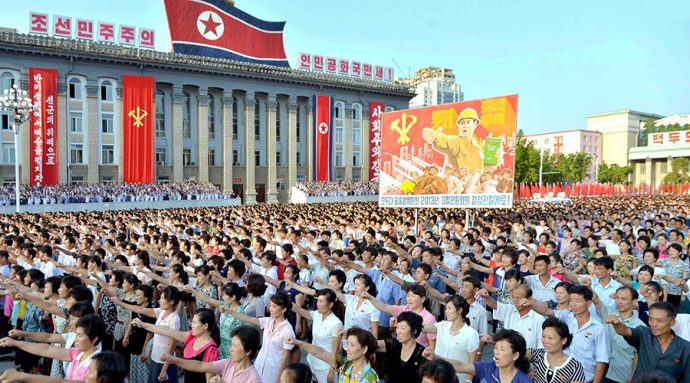
By Danielle Ryan | RT | August 14, 2017
It’s not every day that you’ll hear a news anchor be so upfront about the media’s worst proclivities — but last week, NBC anchor Brian Williams told a panel of guests that the media’s job was to “scare people to death” about North Korea.
Keep in mind that Williams is the same anchor who was widely ridiculed for waxing lyrical about the “beauty” of American missiles back in April when President Donald Trump bombed a Syrian air force base. Oh, and he’s also the guy who was suspended from his job for six months for making up a story about coming under fire in Iraq. Clearly, Williams has some issues with romanticizing war.
Anyway, what Williams said last week about the media’s role when it comes to tensions between the US and North Korea was remarkably revealing and forthright — even if he didn’t quite mean it that way.
Hyping the threat
Of course, escalating tensions between the US and North Korea are a clear cause for concern. The flippant way that American politicians have been talking about military action, which could have serious consequences for US allies in that region is heinous. The way Trump himself has ratcheted up tensions with threats of “fire and fury” the likes of which the world has never seen is irresponsible and is the kind of talk that sends the media into a frenzy.
Fox News recently did a segment on how sales of bunkers have gone up about 90 percent in the last two weeks. CBS Detroit reported on how “end of the world” preparation products, like gas masks and radiation antidote potassium iodide, are “flying off the shelves” in a local army supply store.
Media on the other side of the Atlantic are chiming in, too. The UK’s Sun newspaper published an actual World War 3 “survival guide” last week. It’s almost like they’re excited by the prospect of nuclear war.
Stories like these are the fruits of the media’s labor over the past few weeks. Their incessant hyping of the situation now has ordinary people stocking their shelves with doomsday supplies and installing nuclear bunkers on their properties.
Even a former State Department spokesman for the Obama administration has accused the media of “fanning the flames” when it comes to escalating tensions with North Korea.
Skewed coverage
Reading much of the coverage on the rising tensions with North Korea, it would appear that something major has changed recently — that North Korea has suddenly become an existential threat to the US in a way that it wasn’t before. It all seems so much more pressing and dangerous than it did last month.
But what actually happened? Aside from the fact that the leaders of both countries have been having a public shouting match, not a whole lot.
Yes, the US government’s Defense Intelligence Agency now believes North Korea has the capability to mount nuclear warheads on missiles, which could potentially be used to hit US targets. But North Korea has been claiming this capability since last March. So, that’s not new.
What is new is that the US intelligence community suddenly wants everybody to care about it. This shift should ring alarm bells, because it inevitably means that the US administration is beginning to construct a new narrative — a narrative it will need the media to fully support in the event that they decide to take military action against Pyongyang.
The narrative is that Kim Jong Un will, sooner or later, strike the US mainland, potentially with nuclear weapons — and that the US has no choice but to engage in ‘preventive’ war to stop him. The potential consequences — thousands dead in neighboring nations like South Korea and Japan — aren’t given nearly as much airtime or consideration. Who cares if they’re not Americans, right Lindsey Graham?
As ever, the media is more than willing to help the intelligence community construct their faulty narratives and sell the public on yet another useless military intervention based on evidence-free assertions that something bad will happen if the benevolent US military doesn’t jump in and stop it… by starting another war.
Capitalizing on ignorance
This narrative and the sensationalism with which it is spread relies primarily on the fact that the majority of Americans don’t know a whole lot about the history of their country’s relationship with North Korea.
If, for instance, the majority knew that the US had already mercilessly bombed North Korea for three years in the 1950s, they might be more willing to understand that country’s fears regarding US threats of “fire and fury” raining down on them.
Historian Bruce Cummings puts it simply: “We carpet-bombed the North for three years with next to no concern for civilian casualties.” The US effectively flattened the country, killed an estimated 3 million people (20% of the population), and “burned down every town”.
That is nothing short of pure evil — and yet today, Americans are left wondering why on earth North Koreans don’t like them? All the talk in the world about how oppressive the North Korean regime is, how all-encompassing North Korean propaganda is — will never erase that history.
A piece which appeared in The Intercept recently puts it well: “Millions of ordinary Americans may suffer from a toxic combination of ignorance and amnesia, but the victims of U.S. coups, invasions, and bombing campaigns across the globe tend not to.”
Balanced and nuanced coverage is far too much to hope for, though, when we already have one of the most watched news anchors in America proudly announcing that his job is to scare people to death.
Danielle Ryan is an Irish freelance writer, journalist and media analyst. She has lived and traveled extensively in the US, Germany, Russia and Hungary. Her byline has appeared at RT, The Nation, Rethinking Russia, The BRICS Post, New Eastern Outlook, Global Independent Analytics and many others. She also works on copywriting and editing projects. Follow her on Twitter or Facebook.
Did media miss real story in North Korea’s war of words?
38 North website says Kim never said “never” on nuke negotiations
By Asia Unhedged | Asia Times | August 11, 2017
The Western media misinterpreted and ignored key parts of a recent North Korean statement on negotiating with the US about its nuclear program, says a commentary on Johns Hopkins University 38 North website.
The August 9 editor’s column on the respected site dedicated to analysis on North Korea says that Pyongyang hasn’t changed its previous position on nukes. It hasn’t ruled out negotiating. It will still come to the table if the US removes its “hostile policy and nuclear threat” against the DPRK. If true, the latest hullabaloo about imminent war with North Korea may be a wash.
The error, according to 38 North, lies in an inept English translation of a statement made by North Korean Foreign Minister Ri Yong Ho at the ASEAN Regional Forum meeting on July 26.
The English translation was: “We will, under no circumstances, put the nukes and ballistic rockets on the negotiating table. Neither shall we flinch even an inch from the road to bolstering up the nuclear forces chosen by ourselves, unless the hostile policy and nuclear threat of the US against the DPRK are fundamentally eliminated.”
38 North says the splitting of the sentences raises several questions as to what was covered under the qualifier of “unless” the hostile policy is removed. But 38 North says the answer can be found in the Korean-language version in which the formula was presented as one sentence, not two.
The Korean version reads: “Unless the hostile policy and nuclear threat of the US against the DPRK are fundamentally eliminated, we, under no circumstances, will put the nukes and ballistic rockets on the negotiating table and will not flinch even an inch away from our path of strengthening of nuclear forces, which is chosen by ourselves.”
This statement in Korean is said to merely repeat an earlier statement by Kim Jong-un on July 4 and one by the North Korean government on August 7 which says the only way Pyongyang will put its WMD programs on the table is if the US threat to their country ends.
38 North says this is a very different position than the one described in Western media reports.
“The media cherry-picked a part of what the North Koreans were saying in order to write a sensational story,” the 38 North column said. It said such misreporting is especially dangerous given the escalating crisis between Washington and Pyongyang.
Why Siding with Washington on Korea May Be Dangerous
By Finian CUNNINGHAM | Strategic Culture Foundation | 10.08.2017
In backing the latest US-led sanctions against North Korea at the United Nations Security Council, both China and Russia seem to have made a tenuous bet to resolve the crisis on the Asian peninsula. By deferring to Washington’s punitive sanctions, Beijing and Moscow are calculating that the US will relent on their proposals for comprehensive talks and a freeze on American military exercises with its South Korean ally.
China and Russia may regret their course of action. Since the imposition of new sanctions on North Korea last weekend, the tensions in the region have ratcheted up to alarming levels. US President Trump has even been accused of using «unhinged» language by members of Congress after he threatened to unleash «fire and fury» on North Korea «with a power the world has never seen before». Some American lawmakers were comparing Trump’s rhetoric with that of North Korea’s fiery leader Kim Jong Un.
North Korea, predictably, responded to Trump’s outburst by declaring that its leadership was considering a pre-emptive military strike on the US air base on the Pacific island of Guam.
The region is being put on a hair-trigger for war – a war that would certainly involve the use of nuclear weapons. The American side has come to the conclusion that North Korea has finally mastered the technology to fit a nuclear warhead on its already proven intercontinental ballistic missile (ICBM) capability, reported the Washington Post this week. That means that if a military confrontation breaks out, the US will be tempted to use overwhelming force.
Trump’s words about deploying «power the likes of which the world has never seen before» are especially icy given the 72nd anniversary this week of the US dropping the atomic bombs on Hiroshima and Nagasaki in 1945.
When the UN Security Council convened last weekend it passed Resolution 2371 unanimously with 15 votes to 0. It was a surprise turnaround by China and Russia. Last month, following North Korea’s ICBM test on July 4, both Beijing and Moscow rejected the US call for more sanctions on Pyongyang. They said then that sanctions policy doesn’t work and instead called for all-party dialogue to resolve the long-running Korean crisis. China and Russia also made the eminently reasonable call for the US and its South Korean ally to desist from their frequent joint war maneuvers, which the Communist North perceives as a threat of invasion.
Over the past few weeks, the US and China reportedly engaged in intense negotiations over the Korean issue. Trump accused his Chinese counterpart President Xi Jinping of not doing enough to rein in allied North Korea. The US also threatened to take punitive action against China over wider issues of trade and intellectual property rights. Before the weekend vote at the UNSC, Trump inexplicably cancelled a speech in which he was expected to lay out tough American actions against China over commercial disputes. That suggests some kind of bargain was done between Washington and Beijing – and that China voting for further sanctions on North Korea was part of it.
Following the unanimous vote at the UNSC, Trump and his ambassador Nikki Haley reportedly could hardly contain their glee over «the united response» against «rogue state North Korea».
What Russia gets out of it is not clear. Perhaps Russia felt that to veto the sanctions against North Korea would have incurred international wrath. But it seems curious that Moscow should go along with sanctions at the very same time that Washington is provocatively imposing similar measures against it too.
What appears to be in the calculus by China and Russia is that by giving a sop to the American desire to get tough on North Korea, they are anticipating that the US will agree to calls for multi-party talks and a freeze on military activities on the Korean Peninsula.
Both the Chinese and Russian ambassadors to the UN coupled the latest resolution for sanctions against North Korea with the reboot of the six-party negotiations involving the two Koreas, China, Russia, Japan and the US. Those talks were abandoned in 2009 when the US and North Korea broke off in recriminations.
Last week, before the UN vote, US Secretary of State Rex Tillerson made a significant speech in which he said that the US was not seeking regime change in Pyongyang, nor had any intention of going to war on North Korea.
Following the UN sanctions, Tillerson sounded a conciliatory note while attending the summit of the Association of South East Asian Nations in Manila. The summit was also attended by Chinese and Russian counterparts Wang Yi and Sergei Lavrov. Tillerson said the US was open to dialogue with North Korea if the latter stopped its missile tests. That appeared to be a significant concession from the US side towards resolving the Korean problem.
However, this is where the calculation comes unstuck. The backing of more sanctions against North Korea by China and Russia may have softened the stance of the US somewhat, but at what price?
From the North Korean side, the increased sanctions are tantamount to an act of war. The new measures are aimed at banning the country’s top export earning commodities, including coal, minerals and seafood. The new sanctions will reportedly slash North Korea’s annual export revenue by one-third, down to $2 billion a year. Not surprisingly, Pyongyang responded furiously, saying the sanctions were an attack on its sovereignty.
Given Trump’s propensity for Twitter diplomacy, the spiral of rhetoric could lead to disastrous misunderstanding, as this week is tending to show.
In retrospect, it seems astonishing that Beijing and Moscow made the bet they did over new sanctions. The damage cannot be undone. But what China and Russia must do immediately is to insist that all sides proceed to multilateral talks and the standing down of military forces. The onus is primarily on the US to stand down its military power in the region. It needs to cancel its provocative maneuvers with its ally in Seoul – due again later this month – and it needs to halt the ongoing installation of the THAAD missile system on South Korean territory.
It is misplaced for China and Russia to pander to the US over sanctions and to expect something by way of concessions in return. The arrogant Americans don’t know the meaning of concessions, they only perceive weakness and will move to capitalize on weakness.
By indulging American demands for more sanctions on North Korea, the danger comes from emboldening Washington’s hubris and its own sense of impunity. One would think that Russia, above all, should understand that dynamic given its own experience over the US confiscating diplomatic properties and slapping on ever-more sanctions.
What Moscow and Beijing should do as a matter of urgency is to never mind new sanctions on North Korea; they should demand that Washington removes its military threat against North Korea – a threat that has been looming since the end of the Korean War in 1953. Then all sides must open talks without preconditions for a comprehensive peace settlement on the peninsula.
Pandering to a bully is never a good idea.
Philippine President Wants North Korea to Become ASEAN Dialogue Partner
Sputnik | August 8, 2017
Philippine President Rodrigo Duterte expressed on Tuesday his desire to invite North Korea to become a dialogue partner of the Association of Southeast Asian Nations (ASEAN).
“You know, I always wanted to invite you here,” Duterte, who is a also chairperson of ASEAN in 2017, told North Korea’s Foreign Minister Ri Yong Ho, as quoted by the SunStar media outlet.
The Philippine president added that North Korea “would be a good dialogue partner.”
Ri reportedly thanked Duterte for the initiative.
The statement was made less than a week after Duterte criticized North Korean leader Kim Jong Un over Pyongyang’s nuclear ambitions.
ASEAN has 10 dialogue partners, which are India, Japan, South Korea, New Zealand, Russia, the United States, the European Union, Australia, Canada and China.
Russia, China call for freeze on both N. Korea launches & South’s drills with US – Lavrov
RT | August 6, 2017
Moscow and Beijing are against any missile launches carried out by North Korea and are at the same time calling on the US to halt military drills in the region, Russian Foreign Minister Sergey Lavrov says.
The statement comes following Lavrov’s meeting with his Chinese counterpart, Wang Yi, in the Philippines capital, Manila on Sunday. The ministers discussed the situation in the Korean Peninsula following the adoption of new sanctions on North Korea by the UN Security Council.
Lavrov said Russia and China have already suggested a roadmap to resolve the Korean crisis.
“Our joint initiative includes support of Russia’s proposal to create a roadmap for gradual restoration of trust and provide conditions for the resumption of the Six-Party talks. We have agreed to promote this concept in practice, including in the UN,” Lavrov said after the meeting with US Secretary of State Rex Tillerson in Manila.
Previously, Wang called the new restrictive measures against Pyongyang “a necessary response” aimed at “blocking North Korea’s nuclear missile development,” as cited by the South China Morning Post. He added that sanctions are not the “ultimate goal” and called for the resumption the so-called six party talks, as the situation on the Korean Peninsula “has come to a very critical juncture.”
“Sanctions are needed but are not the ultimate goal. The purpose is to pull the peninsula nuclear issue back to the negotiating table, and seek a final solution to realize the peninsula’s denuclearization and long-term stability,” Wang said.
Lavrov reiterated the joint Russian-Chinese initiative for “double freezing” which had previously been rejected by the US. The initiative, put forward by the Russian and Chinese foreign ministers on July 4, would freeze “any missile launches and any nuclear tests in North Korea,” as well as “large-scale military exercises by the United States and South Korea,” Lavrov said.
The Russian foreign minister also said that the new resolution seeks to bring the North Korean leadership to the negotiating table – the six-party talks – while the restrictive measures are designed to make Pyongyang curb its missile and nuclear programs in accordance with UN resolutions.
On Saturday night, the UN Security Council unanimously agreed to impose more restrictive measures on Pyongyang, banning exports of coal, iron, lead, and seafood. The move came in response to North Korea’s latest missile launches in July, which it, as well as South Korea and the US, claimed were intercontinental ballistic missile (ICBM) tests.
Insane policy towards North Korea
By Ron Forthofer | Dissident Voice | August 1, 2017
This year we commemorate the 72nd anniversary of the unjustifiable US use of nuclear weapons against civilians in Hiroshima and Nagasaki. Those two attacks demonstrated the horrific power of the atomic bomb, a bomb that is tiny in comparison to the nuclear weapons available today.
Here are a few quotes that are worth pondering as we now face an avoidable crisis with North Korea, a nation with a few nuclear weapons.
After the initial use of atomic weapons, Admiral William Leahy, effectively Chief of Staff to presidents Roosevelt and Truman, commented:
It is my opinion that the use of the barbarous weapon at Hiroshima and Nagasaki was of no material assistance in our war against Japan … My own feeling was that in being the first to use it, we had adopted an ethical standard common to the barbarians of the Dark Ages. I was not taught to make war in that fashion, and wars cannot be won by destroying women and children.
In 1948 General Omar Bradley said:
Ours is a world of nuclear giants and ethical infants. We know more about war than we know about peace, more about killing than we know about living.
William Perry, former a Secretary of Defense under Bill Clinton, recently wrote:
I believe that the risk of a nuclear catastrophe today is greater than it was during the Cold War — and yet our public is blissfully unaware of the new nuclear dangers they face.
Steven Starr with Physicians for Social Responsibility wrote in 2014:
These peer-reviewed studies – which were analyzed by the best scientists in the world and found to be without error – also predict that a war fought with less than half of US or Russian strategic nuclear weapons would destroy the human race.
Given what we know, it is criminally irresponsible to continue tit-for-tat provocations with North Korea. Russia, China and North Korea have offered a solution that would freeze North Korea’s nuclear weapon and ballistic missile programs in exchange for a freeze on joint war games by the US, South Korea and now Japan that alarm North Korea with the possibility of a nuclear attack.
For the US to continue with sanctions and war games instead of negotiating is insane as it is endangering the world. An attack by the US on North Korea would likely draw China and Russia into the fighting. Not to negotiate shows that General Bradley’s quote is still correct about our leaders. We must demand that the US negotiate to prevent perhaps the greatest catastrophe of all time.
Ron Forthofer is a retired professor of biostatistics from the University of Texas School of Public Health in Houston and was a Green Party candidate for Congress and also for governor of Colorado.
Featured Video
Jeffrey Epstein’s ‘one single cause’: Israel
or go to
Aletho News Archives – Video-Images
Book Excerpt
Leslie Wexner’s Inner Demon
BY WHITNEY WEBB |
UNLIMITED HANGOUT| JUNE 10, 2022
This short excerpt from Whitney Webb’s upcoming book “One Nation Under Blackmail” examines an obscure media profile of Leslie Wexner, Jeffrey Epstein’s mentor, from the 1980s that contains disconcerting revelations about Wexner’s personality and his inner world. … continue
Blog Roll
Recent Comments
Coronistan on Why can’t western leaders acce… John Edward Kendrick on German government ‘embezzling’… loongtip on Von der Leyen to have new secu… papasha408 on First Gaza, then the world: Th… papasha408 on Is Nixing Aid to Israel a Pois… papasha408 on Japan to Sign Up For NATO’s Uk… Redracam on Iran Willing to Dilute Enriche… loongtip on When Threats Replace Evid… loongtip on Zelensky tried to kill the cha… eddieb on I might get killed for posting… Bill Francis on I might get killed for posting… loongtip on Beijing cancels Panama deals a…


 Aletho News
- Israel Demanding that Iran Limit the Range of Missiles to 300 Kilometers
- Why can’t western leaders accept that they have failed in Ukraine?
- German government ‘embezzling’ taxpayer money to fund Ukraine – veteran politician
- Russian Soldiers Tortured in Secret Ukrainian Prisons
- Tensions between Hungary and Ukraine could lead to a new regional conflict
- Russia preparing oil lifeline to Cuba – embassy
- Jeffrey Epstein’s ‘one single cause’: Israel
- Instagram suspends Track AIPAC, watchdog tracking pro-Israel lobby spending
- Nouri al-Maliki defends Hashd al-Shaabi as inseparable part of Iraqi security system
- First Gaza, then the world: The global danger of Israeli exceptionalism
- If Americans Knew
- Jewish terrorism, apartheid rule the West Bank – Not a ceasefire Day 125
- Why Israel persecutes children like my son Shadi
- In Gaza, One Man Is Searching for the Remains of His Family With a Flour Sifter
- Horrific situation in Gaza, West Bank – Not a ceasefire Day 124
- Mysterious ‘peace’ groups are sending Americans pro-Israel texts
- Epstein files: Western media must stop burying the Israel connection
- Software developer exposes Israeli nonprofits’ massive spending to influence Americans
- Israel preparing for another, more intense Gaza offensive – Not a ceasefire Day 123
- Ronald Lauder’s son-in-law Kevin Warsh emerges as the next Fed chair
- A 14-year-old Palestinian Bled to Death for 45 Minutes as Israeli Soldiers Stood Nearby
- No Tricks Zone
- German Gas Crisis…Chancellor Merz Allegedly Bans Gas Debate Ahead of Elections!
- Pollen Reconstructions Show The Last Glacial’s Warming Events Were Global, 10x Greater Than Modern
- Germany’s Natural Gas Storage Level Dwindles To Just 28%… Increasingly Critical
- New Study Rebuts The Assumption That Anthropogenic CO2 Molecules Have ‘Special’ Properties
- Climate Scientist Who Predicted End Of “Heavy Frost And Snow” Now Refuses Media Inquiries
- Polar Bear Numbers Rising And Health Improving In Areas With The Most Rapid Sea Ice Decline
- One Reason Only For Germany’s Heating Gas Crisis: Its Hardcore-Dumbass Energy Policy
- 130 Years Later: The CO2 Greenhouse Effect Is Still Only An Imaginary-World Thought Experiment
- New Study Affirms Rising CO2’s Greening Impact Across India – A Region With No Net Warming In 75 Years
- Germany’s Natural Gas Crisis Escalates … One Storage Site Near Empty …Government Silent
 Aletho News