Ambassador Kurt Volker: US to Drastically Expand Military Assistance to Ukraine
By Peter KORZUN | Strategic Culture Foundation | 03.09.2018
Washington is upping the ante in Ukraine. Kurt Volker, US Special Representative for Ukraine Negotiations, said in an interview with the Guardian published on September 1 that “Washington is ready to expand arms supplies to Ukraine in order to build up the country’s naval and air defense forces in the face of continuing Russian support for eastern separatists.” According to him, the Trump administration was “absolutely” prepared to go further in supplying lethal weaponry to Ukrainian forces than the anti-tank missiles it delivered in April. “They need lethal assistance,” he emphasized. Mr. Volker explained that “[t]hey need to rebuild a navy and they have very limited air capability as well. I think we’ll have to look at air defense.” The diplomat believes Ukraine needs unmanned aerial vehicles, counter-battery radar systems, and anti-sniper systems. The issue of lethal arms purchases has been discussed at the highest level.
The National Defense Authorization Act for Fiscal Year 2019 allocated $250m in military assistance to Ukraine, including lethal arms. The US has delivered Javelin anti-tank missile systems to Kiev but this time the ambassador talked about an incomparably larger deal. Former President Barack Obama had been unconvinced that granting Ukraine lethal defensive weapons would be the right decision, in view of the widespread corruption there. This policy has changed under President Trump, who — among other things — approved deliveries of anti-tank missiles to Kiev last December.
Ukraine has officially requested US air-defense systems. According to Valeriy Chaly, Ukraine’s ambassador to the United States, the Ukrainian military wants to purchase at least three air-defense systems. The cost of the deal is expected to exceed $2 billion, or about $750 million apiece. The system in question was not specified, but it’s generally believed to be the Patriot.
Volker’s statement was made at a time of rising tensions in the Sea of Azov, which is legally shared by Ukraine and Russia. It is connected to the Black Sea through the Kerch Strait. The rhetoric has heated up and ships have been placed under arrest as this territorial dispute turns the area into a flashpoint. Russia has slammed the US for backing Ukraine’s violations of international law in the area. According to a 2003 treaty, the Sea of Azov is a jointly controlled territory that both countries are allowed to use freely.
The US military already runs a maritime operations center located within Ukraine’s Ochakov naval base. The facility is an operational-level warfare command-and-control organization that is designed to deliver flexible maritime support throughout the full range of military operations. Hundreds of US and Canadian military instructors are training Ukrainian personnel at the Yavorov firing range.
NATO has granted Ukraine the status of an aspirant country — a step that is openly provocative toward Russia. Macedonia, Georgia, and Bosnia-Herzegovina are also aspirant nations. Last year, Ukraine’s parliament adopted a resolution recognizing full membership in NATO as a foreign policy goal. In 2008, NATO agreed that Ukraine along with Georgia should become full-fledged members. In March, Ukraine, Moldova, and Georgia announced the formation of an alliance to oppose Russia.
The US is to render substantial military assistance to a country with an economy in the doldrums, reforms that have foundered, a democracy that is in question, and corruption that is widespread. It will be no surprise if those weapons fall into the wrong hands and are used against the US military somewhere outside of Europe. It was the US State Department itself that issued a report this year slamming Ukraine’s human-rights record. The UN human-rights commissioner tells the same story. So do human-rights monitors all over the world.
By supplying the weapons that Special Representative Volker talked about in his interview, the US will become an accomplice to a conflict that has nothing to do with its national security or interests. The situation in the Donbas is being used by Kiev to distract public attention from the country’s worsening domestic problems. But to Washington Ukraine’s government is the apple of its eye, “a bastard but it’s our bastard” that is ready to do what it’s told.
The move is provocative and it may have consequences. For instance, Russia could supply the self-proclaimed republics in eastern Ukraine with up-to-date weapons systems in quantities sufficient to deter any military action on the part of Kiev. Once the Minsk accords are no longer functional and cannot command obedience, Moscow could recognize those republics as independent states that are eligible for military cooperation agreements, which would include stationing military bases on their soil. If their governments invited the Russian armed forces to be deployed inside their borders, it would be quite natural to agree to those requests. No international law would be breached. In a nutshell, if the US crosses that red line, Russia will act accordingly. Nobody seems to want a war raging in Ukraine, but that’s what the US weapons supplies would promote, egging the Ukrainian government on to seek a military solution. And what if it loses? Washington would be to blame for such a scenario. By the way, is it a coincidence that Mr. Volker’s interview appeared just as Alexander Zakharchenko, the leader of the Donetsk self-proclaimed republic, was assassinated? Just asking.
‘Donbas is Returning to its Russian Roots’
By SERGEI BARYSHNIKOV | CounterPunch | July 1, 2015
The following is the transcript of a talk by Sergei Baryshnikov, professor of political science and former rector of the National University of Donetsk in the Donetsk People’s Republic. The talk was delivered on April 16, 2015 to a group of foreign writers and journalists visiting Donetsk at the invitation of the Russian/German media NGO ‘Europa Objektiv’. The transcript includes answers to questions from the audience. Translation and editing by NewColdWar.org.
***
During the events of spring 2014 [in eastern and southern Ukraine] known as the ‘Russian Spring’ (a metaphorical name first used by a Russian journalist), intellectuals in Donetsk, especially those in humanities studies, did not participate actively. Active participants could be counted on the fingers on one hand.
From the vantage point of classical theory, it is still difficult to explain the class or social character of these events. None of the classical theories proved with a suitable explanation.
As we look back today, one year later, there were two social forces driving events forward. One was young people with different professional backgrounds, including high school students, university students and unemployed youth. These were the most active participants due to their unstable social situations. The second was people of the so called third age–the elderly. These two polar groups were the most active, driving forces of the Russian Spring in Donbas.
Initial responses to the rise of the Euromaidan movement in Kyiv
The first timid and not well organized attempts to offer an alternative to the Maidan movement that was already a fact in Kyiv took place in November/December of 2013. At the time, we did not yet fully understand the degree of the threat emanating from Kyiv. We hoped that President Yanukovich would be a more firm and adequate leader. But after the beginning of the new year, during the first weeks of January, the picture became clearer. Authorities in Kyiv were reacting less and less adequately to events.
The starting point of our consolidation here was the 25th of January, 2014. On that day, activists of several dozens of organizations, not large, rather marginal by their size and influence, created the movement called anti-Maidan. Regardless of some contradictions and disagreements within the ‘pro-Russian’ movement here in the east of ex-Ukraine, including that each leader wanted to be the chief, common ground which united all was found. This was based on the ideological and political rejection of those values that were being promoted under the slogans of Maidan.
The first occasion of direct action was on March 1 when opponents of the self-proclaimed government in Kyiv gathered at the central Square in Donetsk city named after Lenin. They gathered at the fountain (then not working due to the winter season) wearing St. George ribbons as a distinctive feature of the pro-Russian movement. Some stayed at the square and continued with the rally while the most active ones headed in a column towards the regional administration building. There, authorities were trying to organize their own rally, neither in support of Kyiv nor in support of the outraged masses. They tried to maneuver and survive in the difficult situation that came to be. The rally was organized by former leaders from the Party of Regions and the former governor. All official representatives were there – representatives of the church, social organizations, and so on.
It was during the rally at Lenin Square that Pavel Gubarev was proclaimed people’s governor. The most active participants there were small networks such as the Donetsk Republic, Russian Bloc, the South-East Movement and, a little later, the Eastern Front, Donbas Rus’, the Patriotic Forces of Donbas and so on. We marched in columns with Andrey Purgin, one of the leaders of Donetsk Republic. Many people carried Russian flags or self-made banners. The main slogans were: ‘Russia’, ‘Putin’, ‘Referendum’.
There was also a slogan about federalization. With time, that slogan vanished because even then it was clear that any ‘federalization’ would be with the puppets in Kyiv who had seized power.
Why ‘Russia’, ‘Putin’, ‘referendum’? Because here we were all really inspired by the example of Crimea. We hoped that we would also organize such a quick referendum.
We basically drowned out the organizers of that official rally on March 1 because we were more numerous and because the ordinary people that were brought to the official rally joined us and began rallying under our slogans.
Demands for election, referendum
The referendum question for us was one of the most important ones then. We wanted to obtain approval from the Donetsk Regional Council/ deputies to hold a referendum, like the one held in Crimea. We counted on the deputies’ support because we thought that if they represented the interests of people or territorial community of the Donetsk Region, then they must listen to and support people’s demands.
Unfortunately, none of them turned out to be ready to take the people’s side. That’s why we began putting forward our own leaders, in place of relying on deputies who proved incapable of rising to the occasion.
The whole power structure was paralyzed and that’s why it was not capable of using force against the protestors during those first days. Essentially, Donetsk became one permanent rally. Every day, during weekdays and weekends, people would come to Lenin Square for rallies. There were tens of thousands of people. It was a scale of activism I have never seen ever before.
Not a single participant of the rallies and meetings was armed. It was a peaceful, mass, civic protest. But Kyiv authorities had more or less settled in and become stronger over time and they did not wish to hear or notice us. They used the most primitive and ineffective methods of repression – terror. Those who rose as leaders during March were arrested, including the previously mentioned Pavel Gubarev (a former student of mine and a graduate of the Faculty of History, he has three young children) and Mikhail Chumachenko (my good friend).
Later, these two were freed through a prisoner exchange and returned after the Donetsk People’s Republic was formed. However, during those days, their destiny was an example of what could have happened to any of us, that any of us could have been administratively punished or repressed by the authorities.
The culminating point of this first stage of the development of the events was the night of April 6-7, when people lost hope in the capabilities and willingness of the authorities to negotiate and hold peaceful dialogue. For the third time since March 1, they entered the building of the former state regional administration. This time for good.
Donetsk Peoples Republic
Myself, I did not take part in these events in the late evening of April 6 because by request of Purgin, I was preparing for a meeting that would take place on April 7 with a representative of the Organisation for Security and Cooperation in Europe, to whom I was to explain our position, our issues and our version of events. This was a political-diplomatic mission.
After that meeting with them, around 12 pm, I entered the building and saw a picture of mass, revolutionary activity. There were young soldiers of the internal security forces with frightened faces who were huddling on the staircases. No one hurt them and they realized that it was useless for them to do anything.
At 12 pm, elections took place, based on the decisions made during rallies by the participants of the first revolutionary authority, which was first called People’s Council and later renamed Supreme Council. And this People’s Council of approximately 150 people proclaimed the Donetsk People’s Republic.
During the overnight and early morning of April 7, in accordance with international legal acts and other documents, the declaration of independence of the DPR was drawn up and proclaimed. This is how the first political, institutional representative organ of the self-proclaimed republic began its work.
Development of the DPR
In April, our events began attracting attention. Political activists and leaders began appearing here who, in Ukraine, expressed support for developing relations with Russia and the Eurasian Economic Union. One of the most prominent figures who got ambiguous reactions from the activists of the first wave was the then-deputy (not any longer) of the Supreme Council of Ukraine (Verkhovna Rada), Oleg Tsarev. He became a prominent figure in April. Tsarev’s situation was a little ambiguous, because he is not from Donetsk region but from the neighbouring Dnepropetrovsk region.
It was unavoidable that people began appearing from other regions or other places because the Party of Regions and its leaders had fully discredited themselves as politicians and people’s servants. The visitors tried to become prominent figures and even lead the protest movement here.
Konstantin Dolgov showed a lot of interest. He is from Kharkov. Representatives of Kharkov came here regularly, as did representatives of large southern centres, including Nikolaev, Kherson, Crimea and, until their tragic events in May, Odessa.
Gradually, a common political course of the young DPR developed. It is still in the stage of development.
The process of forming political and government structure here turned out to be very long and uneasy. There was lack of experience and a lack of true leaders with sufficient charisma and capability for serious, positive action. It is a problem when people are active and there is an absence or lack of true leaders. It is still a serious problem. That is why support from Moscow and Russia was very important to us. But only political and ideological support, not military.
In May, also due to lack of experience, we didn’t stop Kyiv’s landing operation in the airport area. (Maybe we couldn’t have stopped them, regardless of the lack of experience.) Military action started in Donetsk itself. Even earlier, as of April 12, in the north of Donetsk region, military actions started around Slavyansk, Kramatorsk, and then Druzhkovka. Gradually, the DPR was being drawn into military confrontation.
The events at Slavyansk are associated directly with the name Igor Strelkov, who was at that moment the most known and most popular military leader. However, he didn’t have the necessary experience, he is mostly a theorist-idealist, not a politician or military. I, for example, would never take on leadership in a military campaign because I am also a theorist-idealist. I can only lecture or give talks and make speeches.
Reactions at the university
All this time, the DPR didn’t have enough time to reach out to higher educational institutions. Even though at the end of May, beginning of June, I tried explaining to Purgin that we needed to enter the university and take control because students could potentially rally to either side–Kyiv or the Donetsk people. It would all depend upon what DPR could offer them and how it could show itself. But no one would listen to me. Everyone was occupied with other issues, they didn’t have time for this.[1]
During June-July the situation would exacerbate with each day. Unexpectedly for us, Igor Strelkov and his military forces withdrew from Slavyansk and came here to Donetsk. Along with the insurgency troops and their families and wives came refugees. In the beginning of July, they inhabited the whole of the university residencies.
The previous university authorities could do nothing better than to call upon all professors and university staff to leave for ‘vacation’, in other words leave the city.
The shelling of the city began from the other side of the airport, an area that we missed and were not capable of forcing out the paratroopers of the Ukrainian Army. They began getting on our nerves and getting in the way of everything by shelling even some areas in the centre of the city.
But the technical staff of the university–workers, mechanics, plumbers and janitors–continued to work here all this time. The infrastructure of the university, which is a complex unit, had to be maintained.
(Professor Baryshnikov explained more of how the university functioned during the summer of 2014, including how he came to be appointed rector.)
The staff that worked throughout the whole summer didn’t get a penny of their wages for July, August and September. For three months, people didn’t get any pay. Only in October did we manage to get funds, but we could not pay salaries, only social allowances of some two, three or four thousand hryvnia [in the few hundreds of dollars]…
Today, we are transitioning to a dual currency system of rubles and hryvnia. Our students have begun getting their first bursaries. We are gradually entering, de facto, the Russian financial and economical space. This is more important, even, than our international recognition. Even though we are waiting and hoping that soon we will be both officially and legally recognized. But in order for this to happen, we need to strengthen our potential and expand our borders to those administrative borders that Donetsk Region previously had.
The Minsk ceasefire agreement of February 12, 2015
The agreement is not being respected either way. There wasn’t a day when its conditions were fulfilled. Primarily, it is the Ukrainian side which is failing to do so.
We are inevitably committed to expansion to regain the historic territory of Donetsk and Lugansk presently occupied by Kyiv forces… I want you to understand and pass on to your readers and your audiences that the objective picture, the objective reality, forces us to begin the liberation of those territories. You can call that expansion, but we must do it.
We need to control our water resources, which are in our north. We have deposits of salt, a strategic product which will help us enter not only the Russian market but the world market. The Severskiy Donetsk Channel supplies our whole former territory with water, and near Artemovsk there are huge deposits of salt. We could have a monopoly in the whole of Eurasia. And, of course, in the south we have the metallurgical plants and an exit to the sea through Mariupol.
Ideally, we need to consolidate all of Donbas. During June and July of last year, the first attempts were made to consolidate the DPR and Lugansk People’s Republic. Oleg Tsarev proposed a scheme to create a coordinating representative body that would act on behalf of both republics. Later, if everything went well, it could act on behalf of other republics. It was named the Parliament of Novorossiya.[2]
Political parties in Donetsk
There isn’t a single political party in DPR today. Today we have only social movements and socio-political associations—’proto-parties’. Based on the social organization called ‘Donetsk Republic’, it has been decided to create a party which would probably dominate here. Some leaders of the DPR have such plans in mind. They are planning a project to create a party similar to the Communist Party of Soviet Union during Soviet times. It will be a leading party called ‘Donetsk Republic’.
I am personally against this project. Because we will repeat the same mistakes and repeat the sad experience and therefore the unfortunate destiny of the late Soviet epoch and the fairly recent experience that we had here of one party [Party of Regions] monopoly and domination.
The intellectual level is not sufficient. There are not enough experts and professionals. A lot of former activists of the Party of Regions are already in Donetsk Republic taking leading or secondary positions.
I would, instead, like to see a truly democratic system, so that initiatives would come from the bottom, from territorial communities and even from working collectives. There should be political representation of all basic social groups of the population–from businessmen to farmers and workers. Otherwise, we will once again have a monopolist party which will control the main trade unions and professional associations–where all people will be administratively ‘invited’ to be members–and it will be in charge of youth movements. There will be a vertical range of power but not a horizontal one.
To follow the Chinese path [of one party rule], we need to be Chinese. The whole world divides into the Chinese and the rest. No, we are not trying to adapt the Chinese system. We need a democracy which, according to the before-revolution experience, will have horizontal lines of power and representation of territorial communes as well as vertical power representing those of the political right, left and centre.
State intervention in the economy
At the beginning of the events I have mentioned, socialist and semi-socialist ideas were very strong. But as of now, I believe that a mixed economy will be developed because that’s the only option. Private property and private business within certain borders are essential in the modern world.
We managed to achieve military success. Not victory, but certain success. We have resisted. We all understand that it would not be possible without Russia’s help. But Putin’s politics, I mean politics by Putin personally, turned out to be so unique, exclusive and subtle that Russia is not a direct participant of the conflict. And at the same time, it provides us with protection. We are under Russia’s protection. This is a very interesting fact for future historians.
Donbas as part of Ukraine?
In conclusion, I would like to say and emphasize, and maybe you can pass this on to your readers, that almost 24 years ago, Moscow, as the capital of the Soviet Empire, let Ukraine go and obtain its sovereignty: That was done without a single drop of blood spilled.
Therefore, Ukraine, the Ukrainian people, should treat Donbas as they were treated 24 years ago. They should act peacefully. If Donbas wants to live without Ukraine, either as part of Russia or with its own sovereignty, let it be. There is no point in trying to forcefully keep us as part of Ukraine.
Since Kyiv has not done this, which should have been done in the spring or beginning of summer one year ago, now we are objectively interested in the disintegration of Ukraine and a construction of Novorossiya on part of its former territories…
I, personally, was dissatisfied with the whole 23 years of our existence within Ukraine. I didn’t conduct any kind of subversive activities, didn’t form any subversive organizations, but I always believed that we would not stay as part of Ukraine for long.
Overall, the territory of current Ukraine–more precisely, Ukraine before Euromaidan–is a result of totalitarianism, of Bolshevik, communist, totalitarian policy. They are destroying monuments of Lenin, but he created Ukraine in its modern borders. One hundred years ago, Lenin said that Donbas should forget about being Russian. There is documented evidence of this, But the events we discussed before simply confirm that even after 100 years, Donbas hasn’t forgotten that it’s Russian.
This is not about ethnic purity or belonging, it is about historical truth. Donbas appeared as an historical product of the politics of Russia, as its economic, geopolitical and geographic product. Now Donbas is going through a difficult process of returning back to Russia, of that I am sure.
Sergei Baryshnikov is a professor of political science and former rector of the National University of Donetsk in the Donetsk People’s Republic.
Notes:
[1] The National University of Donetsk formerly had around 16 000 students. Today, there are some 8,000. The largest decline of enrolment was in the departments of the humanities.
[2] Read more about the Parliament of Novorossiya in an April 2015 interview with one of its deputies, Aleksander Kolesnik.
2 children killed, 4 injured in shelling nr Donetsk school – report
RT | November 5, 2014
Two schoolchildren were killed and four injured as an artillery shell hit a stadium in front of a school in the Eastern Ukrainian city of Donetsk, local self-defense forces said.
“All the wounded were taken to the Donetsk regional trauma unit,” Natalya Yemchenko, a militia official with the Donetsk People’s Republic, was cited as saying by Interfax-Ukraine news agency. “They are now in intensive care. One of them is in critical condition and three other are in a state of moderate severity.”
“There were children – a lot of them – at the stadium” when the shell hit, Yemchenko wrote on her Facebook page.
“When attempts were made to evacuate them from the pitch, the massive shelling continued in the area. It was hard for the medics to get to them,” she said.
Yemchenko said the school building was also seriously damaged in the explosion.
Eastern Ukraine Independence Leaders Win the Elections
teleSUR | November 3, 2014
The incumbent prime ministers of the eastern Ukrainian People’s Republic of Donetsk and the Republic of Lugansk, Alexander Zakharchenko, and Igor Plotinitski, respectively, won the elections, according to preliminary results revealed by the Ruptly news agency.
The preliminary results show that Zakharchenko received over 70 percent of the votes, while Plotnitski received 63 percent. Zakharchenko’s closest rival, the vice president of the joint parliament of Donetsk and Lugansk, Alexander Kofman, received about 10 percent of the votes.
The initial results also indicate Zakharchenko’s separatist party has swept up an easy majority in the DPR’s parliament, with over 60 percent of the vote, Russian media outlets have reported.
“The fact that we have a right to carry out our own elections was written,” Zacharchenko said. He stated that the elections don’t contravene the Minsk agreements, which were signed with Kiev in order to reestablish peace in Eastern Ukraine. “We are ready to carry out conversations with whomever is willing to listen to us.”
This Sunday the people of the Donetsk and Lugansk went to the polling stations to elect new leaders and parliaments. Voting began at 8:00 a.m. local time (05:00 GMT) and continued to do so until 22:00 p.m. (19:00 GMT). All residents over 16 years of age were eligible to vote in Donetsk and Lugansk.
“The elections, which were prepared under difficult conditions, very quickly, were nonetheless carried out in an organized way,” Russian electoral observer Leonid Slutsky told Reuters.
Sunday’s vote in the DPR and neighboring Lugansk People’s Republic (LPR) has been condemned by officials in Kiev, but backed by Moscow.
Ahead of the vote, German Chancellor Angela Merkel described the elections as “illegitimate,” though at the time of writing there were no reports from international observers of serious misconduct. Merkel had already warned Russia that the European Union would not accept the results of the elections. U.S. Secretary of State John Kerry had also warned Russia against recognizing the rebel held elections in the region.
“I believe the elections followed international standards of democratic elections. I was very impressed with the enthusiasm and the vigor with which the people went to the polls to express their opinion,” electoral observer and U.S. Senior Attorney Frank Abernathy told RT in Lugansk.
A DPR official told Russia’s Itar-Tass the most serious incident was a bomb threat, which later turned out to be a false alarm.
On the frontlines, however, clashes continued between DPR fighters and Ukrainian government forces. The fierce combat has left a death toll of over 300 people dead in the last 10 days, in spite of a bilateral cease-fire that was put into effect September 5.
Last Sunday, Ukraine also held parliamentary elections, which were won by the right wing party of Petro Poroshenko. The results were recognized by Russia.
At least 11 killed, 40 injured in shelling in Donetsk, E. Ukraine, school hit
RT | October 1, 2014
At least 11 people have been killed and 40 others have been injured in Donetsk, where a school and a bus stop came under fire – reportedly from Ukrainian Army positions.
Two people are reported to have died at the school, and nine at the bus stop, according to Donetsk People Republic’s Deputy Prime Minister Andrey Purgin.
No children were killed in the shelling of school №57, the Donetsk People’s Republic ‘s Interior Ministry said, as cited by TASS. The ministry’s press service added that parents and teachers became victims of the shelling.
The city council stated that all 70 children studying at the school were in the building at the moment of the strike. They were hastily evacuated. The school building was damaged in the attack.
The Russian Foreign Ministry describes the attack as a cynical and blatant breach of international law.
“The particular cynicism of this shelling is the very fact that today was the children’s first day at school. And on this day, artillery directly targets them. These are blatant, intolerable things,” the ministry’s human rights ombudsman Konstantin Dolgov said.
No Ukrainian sources have confirmed the information yet.
“Heavy artillery fire is being heard in Donetsk. The Kievsky district has been under fire – many residential areas and other buildings have been damaged, civilians have been killed and wounded,” the city council said in a statement.
Public transport has been changing routes due to the shelling.
One hundred and forty-six schools in the self-proclaimed Donetsk People’s Republic had commenced classes out of 150, Minister of Education of Donetsk People’s Republic Igor Kostenok said.
A ceasefire between the Ukrainian government and the Donetsk and Lugansk People’s Republics’ authorities was signed in Minsk, Belarus, on September 5.
Ukraine’s People’s Republics Rule Out Political Union With Kiev: Reports
RIA Novosti – September 30, 2014
Ukraine’s southeastern regions could cooperate with Kiev in the spheres of security and economy, but a political union is out of the question, Andrei Purgin, Deputy Prime Minister of the self-proclaimed Donetsk People’s Republic (DPR) said in an interview with Russian Channel One on Tuesday.
“Federalism could not be discussed…Economic relations are possible, partly security… But [the republics] do not see a political union,” Purgin said, adding that this position is shared by an overwhelming majority of people in Ukraine’s southeastern regions.
After local residents voted for the independence of the people’s republics at the referendums held in May and lost thousands of lives in the armed conflict with Ukrainian forces, they cannot imagine a life under the power of the Kiev authorities, Purgin said.
A violent internal conflict erupted in Ukraine in mid-April, when Kiev launched a military operation against independence supporters in the southeastern regions of the country, who refused to recognize the new Ukrainian government which came to power as a result of the February coup.
The status of Ukraine’s southeastern regions remains a matter of debate. Kiev says it is ready to offer special status only to areas controlled by independence supporters, while the authorities of the self-proclaimed Donetsk and Luhansk people’s republics (DPR and LPR) claim they want full independence and will not agree to any status that regards them as a part of Ukraine.
Prisoner swaps on shaky ground in Ukraine as Kiev accused of foul play
RT | September 29, 2014
Prisoner swaps in Ukraine are in danger of stalling as rebels say they will no longer tolerate Kiev’s practice of producing random people for exchange instead of actual members of militia and political prisoners.
Prisoner exchanges are a crucial part for consolidating the shaky truce in eastern Ukraine. The peace deal signed in Minsk, Belarus, on September 5 states that all captives must be eventually set free. So far the OSCE-monitored swaps had been done on a one-for-one basis, and Kiev is apparently lacking genuine rebel captives to offer and is substituting them with whoever it can procure.
But the rebels say they won’t have it anymore.
“We don’t reject further trade, but the rules of the game have changed now. The Ukrainian side will have to deliver lists and IDs of our supporters they offer in advance,” prime minister of the self-proclaimed Donetsk People’s Republic, Aleksandr Zakharchenko, told Interfax. “We will be checking the people brought for exchange against those lists. If they try to send us wrong people, we would reject them and would hold a corresponding number of their military.”
On Friday last week the rebels said they would suspend all exchanges unless Kiev stops sending them people who have nothing to do with the militias. Despite the threat, a new trade did happen on Sunday, as Kiev offered 60 prisoners in exchange for 30 army soldiers captured by the rebels. The willingness to double the number of released captives may indicate that Kiev is trying to make concessions.
But the Sunday trade may have been the reason for the latest demand, as some of those released by the Ukrainian government insisted that they had never been combatants, RIA Novosti reported.
One of the prisoners, who introduced himself as Aleksandr from the city of Kharkov, said he was just snatched from the street near his home.
“I came out for a smoke. Gunmen in a police car drove by, dragged me in took to a police station,” he told the Russian news agency. “They beat me and made me confess of murdering several people. Told me that I was a terrorist. I could barely comprehend what was happening.”
He added he wouldn’t go home because he fears he would be arrested again.
Another ex-prisoner said he was a music teacher and that he was arrested for telling a family member on the phone that he could see Ukrainian military vehicles from his window. Apparently he was suspected of giving intelligence to the rebels, but he denies any ties with the militias.
Yet another said he was arrested in Nikolayev, a city far from the conflict zone, for taking part in a peaceful anti-government protest.
“Ukraine is passing off the wrong people all the time. Of the 60 people they offered for the latest trade, 45 were just random folk,” Andrey Purgin, a senior DPR official told the news agency.
The allegations of foul play were corroborated last week by the New York Times, which covered a prisoner swap on September 21. The newspaper cited the prisoners released by Kiev as saying that only seven of the 28 were rebel fighters. Those released by the rebels all looked like military.
The problem is aggravated by a concern among the rebels that their fighters may have been killed in captivity. In preparation for the latest exchange the rebels made a list of 100 captive militiamen, but Kiev could find only 29 of them, said Darya Morozova, who heads the exchange committee for the DPR.
There has long been reluctance among Ukrainian officials over prisoner exchanges. For months the bulk of the work to release captives was shouldered by civilian activists rather than officials, and ensuring that the agreed terms of prisoners swaps were upheld by Kiev was always a major issue, according to Vladimir Ruban, a retired Ukrainian general who found himself in the position of a key negotiator once the conflict in the east escalated.
“Everything can be settled, a compromise can be found in any situation. But relying on the Ukrainian side to hold to the terms – that’s an issue,” he said in an interview to Vesti newspaper in early September. “The Donetsk side understands that the Ukrainian side may not deliver, and still they agree to big concessions because they realize the peculiarity of the state and its officials. We still make deals. This is both great and awful.”
Huge blast devastates munitions factory in Ukraine’s rebel-held Donetsk
RT | September 20, 2014
A powerful explosion occurred at a military plant in the rebel-held Ukrainian city of Donetsk after a shell hit it. A fire is now ravaging the damaged facility.
The plant was used for producing explosives and ammunition as well as for dismantling unexploded munitions collected on the battlefields. On Saturday morning, residents of the war-torn city heard a powerful blast, which was followed by a huge cloud of white smoke rising into the sky.
A neighborhood official told Ukrainian 112 television that a shell hit the plant.
“There was a direct hit at the No 47 industrial explosives shop, where some explosives were present. It detonated and caused another explosion. Luckily it didn’t hit the main storage facility where we have some 2.5 tons of explosives,” said Ivan Prikhod’ko, deputy chair of the local community council.
He added that while the incident caused considerable damage, nobody was hurt. The plant itself was not working at the time, so no one was there. Also, it was built far from any residential areas specifically for safety purposes.
As the fire continued, smaller explosions could be heard, presumably from shells detonating in the fire, RIA Novosti reported.
There is no verified report about what kind of weapon hit the plant. But there are rumors of it being targeted by a Tochka-U tactical missile launched by Kiev’s troops.
“According to our information, three Tochka-U missiles were fired and there you have it,” a militia member who identified himself as codename ‘Scorpio’ told RT. He added that the area around the plant was considered dangerous lately because both the rebels and their opponents could shell it.
Donetsk saw sporadic shelling overnight.
The incident mars Friday’s signing of an extended ceasefire deal between Kiev and rebel forces, which hopes to put an end to hostilities in eastern Ukraine. The deal includes pulling back all heavy weapons from cities and frontlines.
The blast happened just as a Russian humanitarian aid convoy was unloading elsewhere in the city. Some 200 trucks carrying 2,000 tons of aid crossed the border earlier on Saturday.
Both sides in Ukraine conflict sign treaty banning military action
RT | September 19, 2014
Kiev and self-defense forces signed a memorandum aimed at effectively halting all fighting in eastern Ukraine after talks in Minsk. It creates a buffer zone, demands a pullback of troops and mercenaries, and bans military aviation flybys over the area.
The signed memorandum consists of nine points, former Ukrainian president Leonid Kuchma told journalists following peace talks in Minsk, Belarus.
“The first one is stopping the use of weapons by both sides, the second is terminating new formations of units on military bases as of September 19. The third is banning the use of all types of weapons and offensive action,” Kuchma said.
The agreement outlines a buffer zone of 30 km (18.6 miles) and bans all military aircraft from flying over part of eastern Ukrainian territory, except for the OSCE’s aerial vehicles, Kuchma told RIA Novosti following the meeting.
Ukraine troops must pull back all heavy artillery by 15 kilometers from the conflict zone in eastern Ukraine, the treaty states.
All foreign mercenaries must be withdrawn from eastern Ukraine by both sides of the conflict, the signed Minsk memorandum states, according to Kuchma.
“We have agreed on the withdrawal of all foreign mercenaries from both sides,” Kuchma said.
Both sides also vowed to continue the exchange of prisoners.
The OSCE has been tasked to monitor that both sides adhere to the memorandum’s conditions. The organization’s observers will be sent to observe the situation along the entire zone of the ceasefire, Itar-Tass reported.
Five hundred OSCE observers will be sent to monitor the ceasefire in eastern Ukraine, Lugansk People’s Republic representative Aleksey Karyakin said, adding that the meeting was quite difficult.
“We were able to substantially increase the number of OSCE observers in the conflict zone from 300 to 500,” he said.
The negotiations were also attended by Russia’s OSCE representatives.
Meanwhile, the prime minister of the self-proclaimed Donetsk People’s Republic, Aleksandr Zakharchenko, declared that there will be “no Ukrainian election” in Donetsk, referring to one of the conditions set out in the September 5 Minsk protocol, which gave special status to the Donetsk and Lugansk regions, both located in eastern Ukraine.
Zakharchenko said he considers the special status as a declaration of independence of the self-proclaimed republics.
Self-proclaimed Donetsk and Lugansk republics form ‘Novorossiya’ union
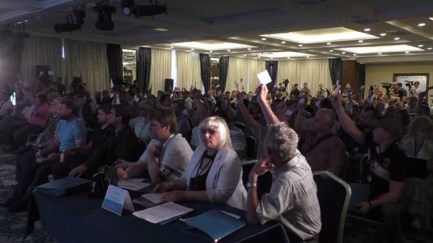
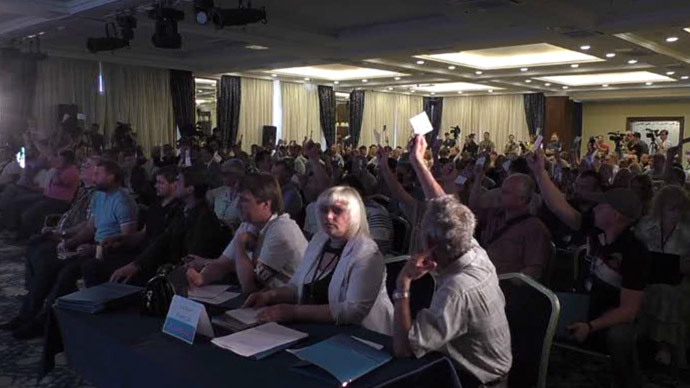
Representatives from eight south-eastern regions voting at the people’s congress in Donetsk
RT | May 24, 2014
Self-proclaimed Donetsk and Lugansk People’s Republics which recently held referenda on independence from Ukraine have declared the creation of Novorossiya union.
“We have signed a memorandum on the union,” Denis Pushilin, co-chairman of the Donetsk People’s Republic, told the media.
The new union will be called Novorossiya, said the people’s governor of the Donetsk Region, Pavel Gubarev.
He added that the document was signed in the city of Donetsk by Donetsk People’s Republic Prime Minister Aleksandr Borodai and the head of Lugansk People’s Republic Aleksey Karyakin.
People’s representatives from eight Ukrainian regions gathered for a congress in Donetsk on Saturday, a day ahead of scheduled countrywide presidential elections.
As a result of the congress, the south-eastern regions of Ukraine, where anti-government protests gained momentum, have announced the creation of a pro-federalization Popular Front socio-political coalition. The movement accepted a manifesto vowing self-determination and protection of people from “Nazi gangs’ terror.”
The coalition involves Odessa, Nikolaev, Dnepropetrovsk, Zaporozhye, Kharkov, Kherson, Donetsk and Lugansk Regions.
At the congress, all 145 delegates accepted the manifesto, which stresses that the Popular Front will consist of “everybody, who is ready to resist self-appointed Kiev authority, which started war against the people.”
The coalition vowed to protect innocent civilians from the “terror of Nazi gangs, financed by oligarchs and foreign security services.” It also pledges “a joint fight for people’s rights to a decent life.”
It says it has launched an investigative commission that will probe “crimes of Nazi-terrorists and their Kiev patrons”.
The coalition is calling for a boycott of the presidential election, which is scheduled to take place on Sunday, because “all major candidates” are “oligarchs, whom we have already seen in top positions, hence, robbery and terror would continue,” the manifesto said.
When it comes to a new Ukrainian constitution, the Popular Front demands that it guarantees “neutrality” and non-participation in military blocks as well as “political independence”, “mechanisms to stop corruption and massive poverty.”
The coalition also demands that the parliament consists of two chambers. At the same time, regions must be given “a right to autonomy” and “independent foreign-economic activity”.
In addition to that, regional governments must be given a right to “announce its territory de-militarized zones and also “ban political, social and religious organizations on its territory” in case they are considered a “threat” to the people.
The Popular Front wants two official languages in Ukraine – Ukrainian and Russian.
Lugansk and Donetsk People’s Republics earlier announced they will not participate in Ukraine’s presidential elections scheduled for May 25.
Featured Video
Now everyone is dumping US government bonds
or go to
Aletho News Archives – Video-Images
From the Archives
Experts Warned For Years That A War With Iran Would Happen This Way
By Caitlin Johnstone | April 3, 2026
… It’s so wild how we keep seeing reports that Iran’s retaliation caught the US off guard. For all the years I’ve been paying attention to this issue I’ve been reading experts and analysts saying if the US attacks Iran, Iran can close the Strait of Hormuz and strike US bases and the energy infrastructure of US allies in the region.
A few examples:
A 2006 Oxford Research Group paper titled “Iran: Consequences of a War” warned that Iran has numerous options at its disposal in the event of a US attack, and that the “most significant of these would be any possible retaliatory Iranian action to affect the transport of oil and liquefied natural gas through the Straits of Hormuz,” adding that stopping Iran from doing this “would be difficult if not impossible to achieve, leading to a fear of attack which alone would have a formidable impact on oil markets.”
A 2007 Cato Institute paper titled “The Iraq War and Iranian Power” warns that “Iran possesses the largest ballistic-missile inventory in the Persian Gulf — missiles which can reach Israel, Saudi Arabia and US military bases in Iraq,” and that “experts argue Iran could also use the ’oil weapon’: blocking the 34km-wide Strait of Hormuz and conducting submarine and anti-ship missile attacks against ports and oil facilities in Saudi Arabia, Kuwait and other Gulf Cooperation Council states.”
A 2012 NPR article titled “Can Iran Close The World’s Most Important Oil Route?” features then-chairman of the Joint Chiefs of Staff acknowledging that Iran absolutely can block the Strait of Hormuz, saying Tehran has “invested in capabilities” which specifically enable them to do so.
A paper from the Columbia Center on Global Energy Policy and the Center for a New American Security titled “IN DIRE STRAITS? IMPLICATIONS OF US-IRAN TENSIONS FOR THE GLOBAL OIL MARKET” warns of a potential scenario “that includes damage to Gulf oil infrastructure and a temporary closure of the Strait of Hormuz.”
These weren’t a bunch of keffiyeh-wearing peaceniks making these assessments, they were deeply entrenched swamp monsters entirely loyal to the US empire. They opposed war with Iran not because it would be an evil act of unforgivable mass murder, but because it would be bad for the imperial power structure. … Full article
Blog Roll
 Aletho News
- ‘This war is Israel’s war’: World facing ‘security breakdown’, says Qalibaf
- IRGC decries attack on US embassy in Riyadh, says executed by ‘Israel’
- Iran blasts EU hypocrisy as EU invokes international law over Hormuz
- There is no military solution to Strait of Hormuz
- NATO’s structural collapse – the outcome of deviation from reality
- Poll finds world views China better than US
- One Of America’s Leading Neo-Cons Has Turned Against The Iran War And Israel
- Attack in the Bosphorus exposes NATO weaknesses and tensions among allies
- BREAKING: US JET SHOT DOWN OVER IRAN /Lt Col Daniel Davis & Nima Alkhorshid
- Now everyone is dumping US government bonds
- If Americans Knew
- US loses planes over Iran, Israel downgrades Lebanon war goals – Daily Update
- Israel Is Blocking Palestinians from Easter at Church Where Jesus Resurrected
- Plot to assassinate Palestinian activist follows harassment campaign promoted by Zionist groups and elected officials
- Prominent New York synagogue hosts presentation on why U.S. Jews should support the ethnic cleansing of Gaza
- Tapper vs. Piker: Is the CNN Anchor Auditioning for David Ellison?
- Shouldn’t Democrats Be Able to Condemn Genocide?
- Israel-US kill negotiators, destroy civilian structures, but Iran’s military capabilities still largely intact – Daily Update
- ‘War crime’: Global condemnation as Israeli ministers celebrate death penalty law targeting Palestinian prisoners
- 7 Ways Israel Is Turning Lebanon Into Gaza
- World’s Leading Football Bodies Under Fire Over Israel Policies
- No Tricks Zone
- Low Intensity Tornado Wrecks Major Solar Farm, Creating A Potential Toxic Dump
- New Study Finds Warming Saves Lives…Cold Temperatures 12 Times More Deadly Than Excess Heat
- German Science Blog Accuses PIK Climate Institute Of Hallucinating Climate Tipping Points
- Devastating Assessment Of Comirnaty Vaccine By Former Senior Pfizer Europe Toxicologist
- New Study: CO2 Is ‘Effectively Negligible’ As An Explanatory Climate Change Factor Since 2000
- Former Pfizer Toxicologist Dr. Helmut Sterz Tells Bundestag Hearing Pfizer Vaccine Should Have Never Been Approved
- Energy Expert: Germany’s Nuclear Phaseout Was A “500 Billion Euro Mistake”
- New Research: South Australia’s Mid-Holocene Sea Surface Temperatures Were 4°C Warmer Than Today
- Storing Green Energy To Last Germany 10 Days Would Require A 60-Million Tonne Battery
- New Studies: UK Sea Levels Were 4 Meters Higher Than Today During The Mid-Holocene
 Aletho News