Senate committee approves funding for NSA, witch-hunt on leakers
RT | November 6, 2013
Congress has taken the first step towards expanding the abilities of the United States intelligence community by advancing a draft bill that will ensure the government’s spy budget stays intact into next year.
A Senate commitee approved the 2014 Intelligence Authorization Act during a closed door session on Tuesday, a bill that if signed into law will allow the US National Security Agency and other departments to keep receiving funding amid an international scandal that has caused calls for reform and even abolishment of the NSA both in the US and abroad in recent months.
Notwithstanding the backlash brought on by an array of secret NSA documents disclosed to the media by contractor-turned-leaked Edward Snowden since June, the Senate Intelligence Committee passed the draft bill by a 13-2 vote. Next, the full chamber will weigh in on the matter before it is reconciled with a sister act by way of the House of Representatives and sent to President Barack Obama to be signed into law.
If approved with all of its current provisions in place, the law will let the government continue to fund programs operated for purposes of counterterrorism and nuclear weapon proliferation prevention, authorizing initiatives within more than a dozen federal departments, including the NSA and others that deal in covert, intelligence-gathering operations.
In a press release issued Tuesday by the committee, however, its members also acknowledged that the bill expands certain intelligence community operations, including in particular the very programs enacted to prevent the unauthorized disclosure of classified information.
The bill, the committee wrote, “includes important provisions to enhance the conduct, accountability and oversight of the intelligence activities of the United States,” such as one intended “to protect against insider threats by adding necessary funds to deploy information technology detection systems across the intelligence community.”
The bill would also empower the Director of National Intelligence to “improve the government’s process to investigate . . . individuals with security clearances to access classified information,” while at same time “Instituting new statutory protections that protect the ability of legitimate whistleblowers to bring concerns directly to the attention of lawmakers, inspectors general and intelligence community leaders.”
Since the identity of the NSA leaker was revealed to be 30-year-old Edward Snowden, opponents of his actions have suggested that alternative, legal routes to questions the intelligence community’s tactics could have been taken, such as appealing to an inspector general. History, however, suggests that recent whistleblowers before him had a nearly impossible time doing as much, including Thomas Drake, a former senior NSA executive who was charged under the Espionage Act after he attempted to draw attention to waste, fraud and abuse within his agency years earlier. Speaking at an anti-NSA rally in Washington last month, Drake told a crowd of a couple thousand, “Any domestic surveillance legislation must include whistleblower protection for the credibility and enforcement of any reform effort, otherwise secrecy enforced by repression will turn into a faux reform passed into simply an honor system” for the NSA.
In a statement released on Tuesday, Committee Vice Chairman Saxby Chambliss (R-Georgia said, “This year’s intelligence authorization bill achieves both objectives by providing clear guidance and appropriate resources to the intelligence community, while enhancing the committee’s oversight of vital intelligence activities.”
If signed into law, the act will allow for funding to continue with regards to a number of intelligence-gathering operations conducted not just by the likes of the NSA, but also the Central Intelligence Agency, the Office of the Director of National Intelligence and the Departments of Defense, State, Treasury, Energy and Justice, among others.
Rousseff slams US failure to apologise over spying
BRICS POST | November 7, 2013
Brazilian President Dilma Rousseff said Wednesday that Washington’s refusal to tender an apology for the spying led to her cancelling her crucial state visit to the United States.
“I was going to travel. We said there was only one way to solve the problem, and it was an apology for what happened and a promise that it would not happen again,” she said in a local radio interview.
The trip was initially scheduled to begin on October 23.
The lack of apology from Washington created an impasse, she said, adding that she did not want to run the risk of having a new spying scandal break during her visit, which would be an embarrassment for both sides.
Rousseff also reiterated her charges against the US, saying the NSA surveillance program is economic espionage borne out of commercial and strategic interests.
She said reports of the NSA intercepting communication of state-oil giant Petrobras have belied US claims of the PRISM program being directed to thwart terrorism.
In Wednesday’s interview, Rousseff also responded to a recent story in the Brazilian daily Folha de Sao Paulo, accusing Brazil’s intelligence agency of spying on diplomats from Russia, Iran and Iraq in 2003 and 2004.
She said the agency’s operations did not involve privacy violations as no phone calls or emails were tapped.
Rousseff had attacked the United States in her opening speech at the United Nations General Assembly (UNGA) in September.
“Brazil, Mr President, knows how to protect itself. We reject, fight and do not harbour terrorist groups,” she said.
“As many other Latin Americans, I fought against authoritarianism and censorship and I cannot but defend, in an uncompromising fashion, the right to privacy of individuals and the sovereignty of my country,” she added.
Earlier on Tuesday Brazil made public a draft bill that will allow the government to prevent internet companies like Google and Facebook from storing data about Brazilian citizens outside the country.
Simultaneous revelations regarding the UK embassy housing a secret listening post in Berlin made Germany summon the British Ambassador to respond to the allegations.
With inputs from Agencies
Related article
Ex-DHS Director Michael Chertoff: The Public Spying On Famous People With Their Smartphones Is A Bigger Issue Than NSA Spying
By Mike Masnick | Techdirt | November 1, 2013
Former director of Homeland Security (and current profiteer off of any “security” scare) Michael Chertoff has penned quite an incredible op-ed for the Washington Post, in which he argues that the real threat to privacy today is not the NSA spying on everyone, but rather all you people out there in the public with your smartphones, taking photos and videos, and going to Twitter to post things you overheard more important people say. Seriously. It starts out by claiming this is a “less-debated threat”:
So it is striking that two recent news stories illustrate a less-debated threat to privacy that we as a society are inflicting on ourselves. Last week, a passenger on an Acela train decided to tweet in real time his summary of an overheard phone conversation by Gen. Michael Hayden, a former director of the National Security Agency (NSA) and the CIA (and my current business partner). The same day, a photo was published of Maryland Attorney General Douglas Gansler at a summer party where he was surrounded by underage youths who apparently were drinking.
But he then goes on to argue that this kind of thing is more troubling than the NSA revelations, which Chertoff suggests is no big deal:
Of course, the delicious irony is obvious: In one case, the former NSA chief becomes a victim of eavesdropping. In the other, a politician critical of teen drinking fails to intervene when he is surrounded by it. But both stories carry a more troubling implication. The ubiquitousness of recording devices — coupled with the ability everyone has to broadcast indiscriminately through Twitter, YouTube and other online platforms — means that virtually every act or utterance outside one’s own home (or, in Gansler’s case, inside a private home) is subject to being massively publicized. And because these outlets bypass any editorial review, there is no assurance that what is disseminated has context or news value.
It would appear that Chertoff seems to believe that there should be no expectation of privacy for the things you actually do in private — generating metadata about who you call, where you go, what websites you visit, etc. But, stuff that you actually do in public should never be “broadcast” because it might embarrass famous people.
And, yes, it’s the famous people being embarrassed that seems to most concern Chertoff:
If a well-known person has an argument with a spouse or child at a restaurant, should it be broadcast? If a business personality expresses a political opinion at a private party, should that opinion (or a distortion of it) be passed on to the rest of the world? If a politician buys a book or a magazine at an airport, should a passerby inform everyone?
See? Think of those poor well-known people, having people telling others about what they do. What a shame! Incredibly, he argues that it’s this exposing of the public actions of famous people that creates real chilling effects — and not the NSA’s spying, which he calls “exaggerated.”
Are we creating an informant society, in which every overheard conversation, cellphone photograph or other record of personal behavior is transmitted not to police but to the world at large? Do we want to chill behavior and speech with the fear that an unpopular comment or embarrassing slip will call forth vituperative criticism and perhaps even adversely affect careers or reputations? Do we need to constantly monitor what we say or do in restaurants, at sporting events, on public sidewalks or even private parties?
I don’t know what clueless PR flack thought this was a good strategy, but the clear connotation is hard to miss: Look, we the powerful people get to spy on everyone, but the second you turn the tables and spy on us and the things we do in public, what a horrible shame! Something must be done!
The NSA Killed the Radio Star and American High Tech
By Richard Silverstein · Tikun Olam · November 2, 2013
While I don’t pretend to be a technical expert, it seems clear to me that one of the major pieces of collateral damage regarding the NSA spying scandal is the savaging that the American technology industry has taken. Though they initially denied it, it became apparent that companies like Twitter, Facebook, Google, Microsoft, Yahoo and others essentially rolled over and played dead in the face of Justice Department and NSA directives that they essentially unlock their data for inspection. Later it became clear that the government didn’t really need these data dumps, it could invade the company servers and sift through data at will.
Now these same companies are telling us that they’ll regain our trust by encrypting their data so that it can’t be hacked by NSA snoops. Such encryption is not going to be an effective tool if the NSA retains the same privileges it’s had to subpoena any data at any time for any person it wishes. In such cases, the only thing standing in the way of wholesale exposure of virtually every secret is a toothless FISA court which never questions a subpoena or prevents any spying.
The only benefit to encryption is that it will make it harder for the NSA to collect the reams of data which it sifts through in order to decide which individuals’ records it wants to subpoena. But given the creativity and ingenuity of NSA spooks, you can be sure they’ll discover a way to circumvent even this obstacle.
There is a certain attraction for the average NSA hacker to et everything they can; to open all possible doors; to pry into every possibly nook and cranny. That’s what spooks do. You can’t blame them for that. But you can blame the executive branch and legislators who were supposed to exercise oversight and, with a few exceptions like Marc Udall and Ron Wyden, abdicated their constitutional responsibility. 9/11 made them all go soft in the head.
Now even Rep. James Sensenbrenner, one of the chief architects of that foul piece of legislation called the USA Patriot Act, seems to have second thoughts. He’s gone so far as to call the actions of the NSA “criminal.” But is it too late? Once the NSA let the horse out of the barn, how will the U.S. technology industry get it back in?
These companies, the backbone of the U.S. economy, have shown themselves to be at the beck and call of the government. The trust we customers placed in them to protect our security has been savaged. Does anyone believe anything Mark Zuckerberg, Steve Ballmer, Larry Page or Sergey Brin say on this subject? Frankly, I think they can’t regain that trust no matter what they do.
The NSA has torn a hole in the high tech industry big enough to drive a super computer or Mack truck through. Countries like Brazil and others are already developing competing systems that will not be subject to the intrusive scrutiny of the NSA. Will any American want to maintain telecommunications accounts with U.S. companies?
If we lose the edge we’ve had in such technological development over the past 60 years, we will lose a huge sector of U.S. commercial innovation. We will hurt our economy, lose jobs, and slow the pace of development in our own country. In a strange and ironic way, NSA spying may ultimately hurt the U.S. and our national security.
An equally damaged victim of NSA spying has been our formerly warm relations with allies like Berlin, France, German, Mexico and Brazil. One must ask: was the benefit of whatever was learned by hacking the phones of their leaders worth the years of damage and mistrust that will ensue from this mess? Further, one has to marvel at the hubris of U.S. spymasters who believed that their massive House of Spies would never be exposed. As a result of Edward Snowden’s revelations the House of Spies has become a House of Cards.
In addition to all the nations with whom we’ve had tense of even hostile nations over the last decade or so, now we have to add allies who have lost trust in us.
I am delighted to learn that attitudes in the international community toward Snowden are gradually changing. With every new insult to the national pride of these countries with further NSA spying charges, more people find Snowden’s work admirable. German legislators met with him over the past few days to determine whether he can travel to German to testify before the Bundestag about the hacking of Prime Minister Merkel’s cell phone. If they find a way to bring him to Germany, I fear the cat will be out of the bag. As long as the U.S. could confine him to countries like China or Russia, with whom we have tense or hostile relations, Obama could dismiss Snowden as a crank. But once he begins spilling his guts before national legislatures of U.S. allies, he becomes a technological Robin Hood.
Brazil, Germany submit anti-spy resolution to UN
Press TV – November 1, 2013

An anti-spying draft resolution written by Germany and Brazil has been submitted to the United Nations amid the US surveillance scandal.
The draft resolution put forward on Friday would reaffirm “the right to privacy and not to be subjected to arbitrary or unlawful interference with privacy, family, home or correspondence.”
The right is already protected in the Universal Declaration of Human Rights and the International Covenant on Civil and Political Rights.
Furthermore, the draft resolution would also reaffirm the “same rights that people have offline must also be protected online, in particular the right to privacy, including in the context of the surveillance of communications.”
The draft was to be processed by the UN secretariat before being handed over to the UN General Assembly’s human rights panel for discussions.
This comes as German Chancellor Angela Merkel and Brazilian President Dilma Rousseff have both condemned the widespread spying by the US National Security Agency (NSA).
Merkel has demanded the United States enter a “no-spying” agreement with Germany and France by the end of 2013 amid recent revelations that the NSA spied on the two countries.
The Chancellor has also stressed that alleged espionage against Berlin and Paris, which are considered among closest allies of the US, should be stopped.
On October 26, a report published by German weekly Der Spiegel revealed that Merkel’s mobile phone had been listed by the NSA Special Collection Service (SCS) since 2002, and that her mobile phone number was still listed in June 2013.
Last month, Rousseff spoke at the United Nations General Assembly, calling for international regulations on data privacy and limiting espionage programs targeting the Internet.
Rousseff’s appeal came after reports were published in September by Brazil’s Globo television network, which revealed that the NSA spied on the president’s emails, phone calls, and text messages.
Snowden, a former CIA employee, leaked two top secret US government spying programs under which the NSA and the Federal Bureau of Investigation (FBI) are eavesdropping on millions of American and European phone records and the Internet data from major Internet companies such as Facebook, Yahoo, Google, Apple, and Microsoft.
The NSA scandal took even broader dimensions when Snowden revealed information about its espionage activities targeting friendly countries.
Related articles
The blame game: NSA chief points finger at US diplomats in spy scandal
RT | November 1, 2013
In an unexpected twist in the NSA scandal, spy chief Keith Alexander has blamed US diplomats for ordering surveillance on EU politicians. Meanwhile, State Secretary John Kerry has admitted espionage “reached too far,” alleging it was on “automatic pilot.”
Indicating a rift between the White House and the NSA, Director of the spy organization, Keith Alexander, has accused “policy makers” and “diplomats” for dictating the targets for surveillance. In a heated exchange, former ambassador to Romania, James Carew Rosapepe, challenged Alexander to justify spying on US allies, reported the Guardian.
“We all joke that everyone is spying on everyone,” he said. “But that is not a national security justification,” said Rosapepe.
Alexander replied sharply to the question, alleging ambassadors had a hand in ordering spy activities.
“That is a great question, in fact as an ambassador you have part of the answer. Because we the intelligence agencies don’t come up with the requirements, the policymakers come up with the requirements,” Alexander said.
He added sarcastically: “One of those groups would have been, let me think, hold on, oh! – ambassadors.”
Passing the buck
As the NSA points the finger at the Obama Administration for ordering the mass surveillance of European citizens, the White House is seeking to distance itself from the scandal, intimating the NSA was acting of its own volition.
Secretary of State John Kerry addressed the accusations, that the NSA recorded millions of European citizens’ telephone calls, in a video conference to London on Thursday. Kerry conceded that US surveillance had “reached too far” and stated that the NSA had been conducting its espionage on “automatic pilot.”
“In some cases, I acknowledge to you, as has the president, that some of these actions have reached too far, and we are going to make sure that does not happen in the future,” Kerry said, stressing an inquiry is currently underway to reassess American intelligence gathering programs.
Washington came under fire this week when a delegation from the EU came to get answers over the NSA’s activities in Europe. According to the revelations released by former CIA worker, Edward Snowden, to the press, the US not only targeted regular citizens, but also businessmen and high-profile politicians.
The White House did not give many answers to the delegation, they instead sought to justify espionage in Europe as a measure to protect against terrorism.
“It is much more important for this country that we defend this nation and take the beatings than it is to give up a program that would result in us being attacked,” Alexander told the House of Representatives Intelligence Committee on Wednesday. He went on to say that the US only collected data related to warzones in the Middle East.
How Feinstein’s Fake NSA Reform Bill Could Actually Make It Easier For NSA To Record Your Phone Calls
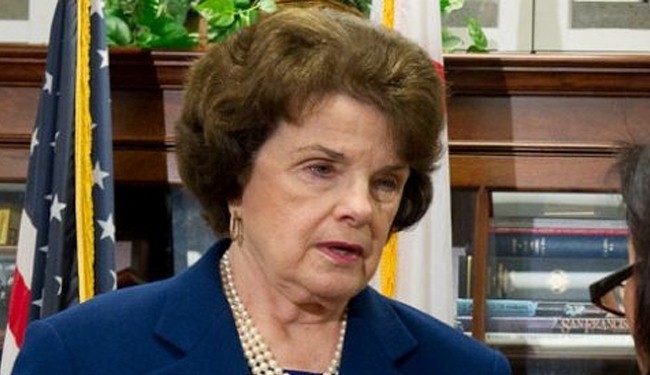
By Mike Masnick | Techdirt | November 1, 2013
We already pointed out that Dianne Feinstein’s fake NSA reform bill is being positioned by her as real reform, when all it really does is codify the (probably currently illegal) status quo. Even worse, Feinstein is using highly misleading language to pretend that the bill “bans” the very things that it clearly allows. It’s about as dishonest a statement about a bill as you can imagine.
We had noted in our original post that the talk about how the bill would prohibit the collection of “content of communications under Section 215” was a red herring. One of the NSA’s go-to talking points is that there’s “no surveillance” on the Section 215 collections because it’s “just metadata.” They keep repeating this claim over and over again that the leaked programs do not involve collecting the “content” of calls, pretending that this is what everyone’s been complaining about. That statement alone is disingenuous. Most people following this know that the Section 215 collections don’t involve the content of communications. What we’re complaining about is the metadata collection, because that’s very revealing. Separately, while the NSA may not collect contents “under this program,” they absolutely do under other programs.
But, the actual language here may be even worse. It may be so misleading that the language being held up to “prohibit” the collection of actual call content is worded in a way that actually will allow for greater content collection. As Julian Sanchez notes at that link, the ban on content collection is only for “bulk data collection,” which could be interpreted to mean it’s okay for non-bulk collections, which most people believe 215 isn’t regularly used for today.
The problem is, under canons of judicial interpretation, a narrow and explicit prohibition on getting content under bulk orders for communications records could easily be read to imply that content can be acquired via non-bulk orders, or even via bulk orders for other types of records. At present, it is not clear whether the statute allows for the acquisition of contents under 215, but there are strong arguments it does not—though, of course, I’d argue the Constitution would forbid this even if the statute didn’t. Under this law, though, a clever Justice Department lawyer could plausibly argue that a prohibition on content collection under one very specific type of 215 order would be senseless and redundant unless Congress intended for content to be accessible under 215 orders generally—and Courts generally have to interpret the law in a way that avoids making any provision redundant.
And, as Sanchez further points out, this isn’t a theoretical concept. The Justice Department has already used exactly this type of argument to allow for the bulk data collection in the first place:
This is not at all a hypothetical concern. In 2006, Congress amended Section 215 to add special “protections” for educational and medical records. What Congress didn’t know is that, because those records are already protected under other federal laws, and 215 contained no language explicitly overriding those statutes, the Justice Department had determined that 215 simply could not be used to access those types of records—an interpretation that was reversed after the “protections” were added. Congress, in other words, inadvertently expanded the scope of 215 while trying to limit it—a fact that was discovered only later, when a report by the Inspector General revealed the unintended consequences of the amendment.
This is yet another example of the really evil word games the NSA and its defenders will use to increase spying, while pretending they’re doing the opposite. Now would be a good time to reach out to your Senator to let them know that the Feinstein bill is absolutely unacceptable.
Related articles
NSA secretly accessed Yahoo, Google data centers to collect information
RT | October 30, 2013
Despite having front-door access to communications transmitted across the biggest Internet companies on Earth, the National Security Agency has been secretly tapping into the two largest online entities in the world, new leaked documents reveal.
Those documents, supplied by former NSA contractor Edward Snowden and obtained by the Washington Post, suggest that the US intelligence agency and its British counterpart have compromised data passed through the computers of Google and Yahoo, the two biggest companies in the world with regards to overall Internet traffic, and in turn allowed those country’s governments and likely their allies access to hundreds of millions of user accounts from individuals around the world.
“From undisclosed interception points, the NSA and GCHQ are copying entire data flows across fiber-optic cables that carry information between the data centers of the Silicon Valley giants,” the Post’s Barton Gellman and Ashkan Soltani reported on Wednesday.
The document providing evidence of such was among the trove of files supplied by Mr. Snowden and is dated January 9, 2013, making it among the most recent top-secret files attributed to the 30-year-old whistleblower.
Both Google and Yahoo responded to the report, with the former’s response being the most forceful.
Google’s chief legal officer, David Drummond, said the company was “outraged” by the allegations.
“We have long been concerned about the possibility of this kind of snooping, which is why we have continued to extend encryption across more and more Google services and links, especially the links in the slide,” said Drummond, implying the web giant had been caught by surprise by the revelations..
“We do not provide any government, including the US government, with access to our systems. We are outraged at the lengths to which the government seems to have gone to intercept data from our private fiber networks, and it underscores the need for urgent reform.”
Yahoo likewise implied it was not actively cooperating with the NSA in granting the agency access to its data infrastructure.
“We have strict controls in place to protect the security of our data centers, and we have not given access to our data centers to the NSA or to any other government agency,” the company said via statement.
Gen. Keith Alexander, the head of the NSA, told reporters Wednesday afternoon, “I don’t know what the report is,” according to Politico, and said his agency is “not authorized” to tap into Silicon Valley companies. When asked if the NSA tapped into the data centers, Alexander said, “Not to my knowledge.”
Earlier this year, separate documentation supplied by Mr. Snowden disclosed evidence of PRISM, an NSA-operated program that the intelligence company conducted to target the users of Microsoft, Google, Yahoo, Facebook, PalTalk, YouTube, Skype, AOL and Apple services. When that program was disclosed by the Guardian newspaper in June, reporters there said it allowed the NSA to “collect material including search history, the content of emails, file transfers and live chats” while having direct access to the companies’ servers, at times with the “assistance of communication providers in the US.”
According to the latest leak, the NSA and Britain’s Government Communications Headquarters are conducting similar operations targeting the users of at least two of these companies, although this time under utmost secrecy.
“The infiltration is especially striking because the NSA, under a separate program known as PRISM, has front-door access to Google and Yahoo user accounts through a court-approved process,” the Post noted.
And while top-brass in the US intelligence community defended PRISM and said it did not target American Internet users, the newest program — codenamed MUSCULAR — sweeps up data pertaining to the accounts of many Americans, the Post acknowledged.
The MUSCULAR program, according to Wednesday’s leak, involves a process in which the NSA and GCHQ intercept communications overseas, where lax restrictions and oversight allow the agencies access to intelligence with ease.
“NSA documents about the effort refer directly to ‘full take,’ ‘bulk access’ and ‘high volume’ operations on Yahoo and Google networks,” the Post reported. “Such large-scale collection of Internet content would be illegal in the United States, but the operations take place overseas, where the NSA is allowed to presume that anyone using a foreign data link is a foreigner.”
To do as much, the NSA and GCHQ rely on capturing information being sent between company data centers around the globe, intercepting those bits and bytes in transit by tapping in as information is moved from the “Public Internet” to the private “clouds” operated by the likes of Google and Yahoo. Those cloud systems involve the linking of international data centers, each processing and containing huge troves of user information for potentially millions of customers. Intelligence officers who can sneak through the cracks when information is decrypted — or never encrypted in the first place — can then see the information sent in real time as take “a retrospective look at target activity,” according to documents seen by the Post.
“Because digital communications and cloud storage do not usually adhere to national boundaries, MUSCULAR and a previously disclosed NSA operation to collect Internet address books have amassed content and metadata on a previously unknown scale from US citizens and residents” Barton and Soltani reported.
“Data are an essentially global commodity, and the backup processes of companies often mean that data is replicated many places across the world,” The Post’s Andrea Peterson added in a separate report. “So just because you sent an e-mail in the US, doesn’t mean it will always stay within the nation’s borders for its entire life in the cloud.”
As data goes into those facilities outside of the US, the NSA and GCHQ have more tactics to deploy in order to obtain private communications. Additionally, Yahoo has not nor do they now have any plans to deploy encryption technology to secure communications, suggesting the data of their millions of users was passed in-the-clear through international data centers, ripe to be intercepted by the intelligence community.
“Google and Yahoo generally connect their data centers over privately owned or leased fiber-optic cables, which do not share traffic with other Internet users and companies, to enable the tasted connections and keep information secure,” Gellman added in a separate article authored alongside the Post’s Todd Linderman. “Until recently, these internal data networks were not encrypted. Google announced in September, however, that it is moving quickly to encrypt those connections. Yahoo’s data center links are not encrypted.”
“It’s an arms race,” Eric Grosse, Google’s vice president for security engineering, told the Post last month. “We see these government agencies as among the most skilled players in this game.”
After hearing ot the MUSCULAR program by the Post, Google said in a statement that they were “troubled by allegations of the government intercepting traffic between our data centers, and we are not aware of this activity.”
“We have long been concerned about the possibility of this kind of snooping, which is why we continue to extend encryption across more and more Google services and links,” the company said.
“We have strict controls in place to protect the security of our data centers, and we have not given access to our data centers to the NSA or to any other government agency,” insisted Yahoo.
Only hours before the latest Snowden leak was made public, NSA Director Keith Alexander told a Congressional panel that the illegal, unconstitutional revelations helped terrorist intent on killing Americans. Answering a question from Rep. Michele Bachmann (R-Minnesota) about the effect of the leaks on national security, Alexander and Director of National Intelligence James Clapper both said the disclosure have and will continue to cause major damage to the US.
At that same hearing, Alexander admitted that the NSA “compels” telecommunication companies to provide the government with user intelligence.
“Nothing that has been released has shown that we’re trying to do something illegal or unprofessional,” Alexander added.
NSA stores data to target any citizen at any time – Greenwald
RT | October 29, 2013
The current revelations on the NSA’s spying are just the tip of the iceberg and affect “almost every country in the world,” said Glenn Greenwald. He stressed the NSA stores data for “as long as it can,” so they can target a citizen whenever they want.
Glenn Greenwald, the man behind the reports on the NSA global spy program, spoke to El Mundo journalist German Aranda and stressed that the US espionage activities went much further than just Europe.
“There are a lot of countries, and journalists in a lot of different countries, who have been asking for stories and to work on documents for a long time,” Greenwald said. He added that he was working as fast as possible to “make sure that all of these documents get reported in every single country there are documents for, which is most countries in the world.”
Shedding light on the NSA’s motives in compiling metadata on citizens, he said the spy organization’s main aim was to store the information to be able to dip into it whenever necessary.
“The very clear objective of the NSA is not just to collect all this, but to keep it for as long as they can,” said Greenwald.
“So they can at any time target a particular citizen of Spain or anywhere else and learn what they’ve been doing, in terms of who they have been communicating with.”
‘Preparing the terrain’
Referencing reports leaked from former CIA worker Edward Snowden regarding the millions of phone calls tapped by the NSA in the EU, German Aranda stated that French reaction was “important to prepare the terrain in Spain.”
“With all the countries around Europe and around the world, it will be the same. The more countries [that] see documents about them, the more interest the other countries will have to see what is happening with them,” said Aranda.
Last week the Spanish Prime Minister, Manuel Rajoy, summoned the US Ambassador to account for the reports of spying, echoing the reactions of France, Germany and a handful of other countries. Spain has so far resisted calls from Germany to sign an EU no-spying treaty against the US in the wake of the revelations; however this may be set to change.
“As in previous occasions, we’ve asked the U.S. ambassador to give the government all the necessary information on an issue which, if it was to be confirmed, could break the climate of trust that has traditionally been the one between our two countries,” said Spanish Foreign Minister Jose Manuel Garcia-Margallo, at a joint news conference in Warsaw last week.
In response to European leaders’ furor over NSA espionage, the White House has launched an internal review into the NSA’s activities. The EU Parliament has also threatened to halt the sharing of data on the SWIFT banking system, which provides information on the transfer of funds by suspected terrorists.
A delegation from the EU parliament is currently in Washington to discuss what has been described as a “breakdown in trust” between traditional allies.
The Obama administration earlier said the controversial intelligence gathering procedures that have attracted international scrutiny in recent months may require “additional constraints.” White House spokesperson Jay Carney said that a “number of efforts [are] underway that are designed to increase transparency.”
Featured Video

Deception – Submarines against Olof Palme
or go to
Aletho News Archives – Video-Images
From the Archives
Woolsey Fire started at Santa Susana Field Lab — where “radioactive materials released were never accurately measured”
By John Laforge | CounterPunch | November 30, 2018
In my Nov. 16 column, I reported on potential radiation risks posed by California’s Woolsey wildfire having burned over parts or all of the Santa Susana Field Laboratory—south of Simi Valley, Calif., 30 miles outside Los Angeles—site of at least four partial or total nuclear reactor meltdowns.
The field laboratory operated 10 experimental reactors and conducted rocket engine tests. In his 2014 book Atomic Accidents, researcher James Mahaffey writes, “The cores in four experimental reactors on site … melted.” Reactor core melts always result in the release of large amounts of radioactive gases and particles. Clean up of the deeply contaminated site has not been conducted in spite of a 2010 agreement.
Los Angeles’s KABC-7 TV reported Nov. 13 that the Santa Susana lab site “appears to be the origin of the Woolsey Fire” which has torched over 96,000 acres. Southern Calif. Public Radio said, “According to Cal Fire, the Woolsey Fire started on the afternoon of Thursday, Nov. 8 … on the Santa Susana site.” … continue
Blog Roll
 Aletho News
- Brussels cannot say where its own pipeline inspectors are as Hungary’s oil lifeline remains shut
- Israel’s Iran War: Myth and Reality
- Between war and industrial breakdown: The US-Israeli attrition crisis
- Pressure builds on Iran to ‘drop’ Lebanon ceasefire demand as Islamabad talks hang in balance
- In another clash report, US denies agreement to release Iran’s assets
- What is fueling unrest across the EU?
- Why no power can undermine Iran’s eternal dominance over the Strait of Hormuz
- Is The War Against Iran Over?
- Iran war will leave long-term ‘scar’ on Wall Street, investors warn
- How Iran decimated US power projection in West Asia: Military lessons of 40-day war
- If Americans Knew
- Mearsheimer reveals how Israel dictates US policies on Iran, Gaza – video
- After killing 350+, Israel still has a “score to settle” with Lebanon before ceasefire – Daily Update
- Military aid to Israel emerges as the latest political litmus test for Democrats
- The only Palestinian children’s rights organization closes following years-long Israeli campaign against it
- ‘I Can’t Forget the Smell’: Lebanese Reel After Israel Kills Over 300 in Single Day
- DNC Shoots Down Resolutions Calling Out AIPAC and Limiting Arms to Israel
- TCN: Is Israel Blackmailing President Trump?
- Israel killed at least 303 Lebanese yesterday – who were they? Daily Update
- Amnesty: Urgent – Protect Lebanese civilians from brutal escalation in Israeli attacks
- Is The War Against Iran Over?
- No Tricks Zone
- German Expert: Heat Dome Led To Record Temps In Western USA…Warmer In 1934, 1936
- New Study: No Linear Warming Or Glacier Retreat Along Northern Antarctic Peninsula Since 1980s
- An Inconvenient Tree: Uncovered In Alps… Europe Much Warmer Than Today 6000 Years Ago
- New Study Reports A 60% Slowdown In Greenland’s Ice Loss Rate In The Last Decade
- Low Intensity Tornado Wrecks Major Solar Farm, Creating A Potential Toxic Dump
- New Study Finds Warming Saves Lives…Cold Temperatures 12 Times More Deadly Than Excess Heat
- German Science Blog Accuses PIK Climate Institute Of Hallucinating Climate Tipping Points
- Devastating Assessment Of Comirnaty Vaccine By Former Senior Pfizer Europe Toxicologist
- New Study: CO2 Is ‘Effectively Negligible’ As An Explanatory Climate Change Factor Since 2000
- Former Pfizer Toxicologist Dr. Helmut Sterz Tells Bundestag Hearing Pfizer Vaccine Should Have Never Been Approved
 Aletho News