Five Reactions To Dianne Feinstein Finally Finding Something About The NSA To Get Angry About
By Mike Masnick | Techdirt | October 29, 2013

Dianne Feinstein, the NSA’s biggest defender in the Senate (which is ridiculous since she’s also in charge of “oversight”) has finally had enough. It’s not because she finally understands how crazy it is that the NSA is spying on every American, including all of her constituents in California. It’s not because she finally realized that the NSA specifically avoided letting her know about their widespread abuses. No, it’s because she just found out that the NSA also spies on important people, like political leaders around the globe. It seems that has finally ticked off Feinstein, who has released a scathing statement about the latest revelations:
“Unlike NSA’s collection of phone records under a court order, it is clear to me that certain surveillance activities have been in effect for more than a decade and that the Senate Intelligence Committee was not satisfactorily informed. Therefore our oversight needs to be strengthened and increased.
“With respect to NSA collection of intelligence on leaders of U.S. allies—including France, Spain, Mexico and Germany—let me state unequivocally: I am totally opposed.
“Unless the United States is engaged in hostilities against a country or there is an emergency need for this type of surveillance, I do not believe the United States should be collecting phone calls or emails of friendly presidents and prime ministers. The president should be required to approve any collection of this sort.
There are so many different possible reactions to this. Let’s go to list form to go through a few:
- Most people seem a hell of a lot less concerned about spying on political leaders than the public. After all, you kind of expect espionage to target foreign leaders. It seems incredibly elitist for Feinstein to show concern about spying on political leaders, and not the public. It shows how she views the public as opposed to people on her level of political power. One of them doesn’t matter. The other gets privacy.
- For all the bluster and anger from Feinstein about this, the Senate Intelligence Committee’s mandate is only about intelligence activities that touch on US persons, so it’s not even clear that she has any power over their activities strictly in foreign countries targeting foreign individuals. Why she seems to have expected the NSA to let her know about that when the NSA itself has been pretty explicit that avoids telling Congress about anything it can reasonably avoid telling them.
- Feinstein has referred to Ed Snowden’s leak as “an act of treason.” Now that they’ve revealed something that she believes is improper and deserving of much greater scrutiny, is she willing to revisit that statement?
- Given that Feinstein has been angrily banging the drum for months about how her oversight of the intelligence community shows that everything’s great, and there’s no risk of rogue activity — yet now she’s finally admitting that perhaps the oversight isn’t particularly comprehensive, is she willing to admit that her earlier statements are reasonably considered hogwash and discredited? She even says in her statement: “Congress needs to know exactly what our intelligence community is doing. To that end, the committee will initiate a major review into all intelligence collection programs.” And yet she’s been claiming that oversight has been more than enough for years?
- The cynical viewpoint: Feinstein knows the USA Freedom Act is coming out Tuesday, and that it has tremendous political momentum. Sooner or later she was going to have to admit that NSA surveillance was going to be curbed. Did she just happen to choose this latest bit of news for a bit of political theater to join the “time to fix the NSA” crowd?
There are plenty of other things that could be added to the list, but the whole situation seems fairly ridiculous considering about whom we’re talking.
Related articles
Rep. Alan Grayson: I Learn Much More About The NSA From The Press Than From Intelligence Briefings
By Mike Masnick | Techdirt | October 28, 2013
Rep. Alan Grayson has been among the most outspoken members of Congress about the NSA’s surveillance efforts, and his latest is an op-ed in the Guardian, in which he notes that Congressional “oversight” is really Congressional “overlook,” and that he learns much more about the NSA from the press than from the House intelligence briefings:
Despite being a member of Congress possessing security clearance, I’ve learned far more about government spying on me and my fellow citizens from reading media reports than I have from “intelligence” briefings. If the vote on the Amash-Conyers amendment is any indication, my colleagues feel the same way. In fact, one long-serving conservative Republican told me that he doesn’t attend such briefings anymore, because, “they always lie”.
Many of us worry that Congressional Intelligence Committees are more loyal to the “intelligence community” that they are tasked with policing, than to the Constitution. And the House Intelligence Committee isn’t doing anything to assuage our concerns.
We’ve covered in detail how House Intelligence chair Mike Rogers had blocked other Reps. from learning information about the spying program, refusing to answer questions or provide more access to certain Congressional Reps, as well as generally making sure that curious Reps can’t find out the answers to their questions. Grayson goes into more detail:
I’ve requested classified information, and further meetings with NSA officials. The House Intelligence Committee has refused to provide either. Supporters of the NSA’s vast ubiquitous domestic spying operation assure the public that members of Congress can be briefed on these activities whenever they want. Senator Saxby Chambliss says all a member of Congress needs to do is ask for information, and he’ll get it. Well I did ask, and the House Intelligence Committee said “no”, repeatedly. And virtually every other member not on the Intelligence Committee gets the same treatment.
Recently, a member of the House Intelligence Committee was asked at a town hall meeting, by his constituents, why my requests for more information about these programs were being denied. This member argued that I don’t have the necessary level of clearance to obtain access for classified information. That doesn’t make any sense; every member is given the same level of clearance. There is no legal justification for imparting secret knowledge about the NSA’s domestic surveillance activities only to the 20 members of the House Intelligence Committee. Moreover, how can the remaining 415 of us do our job properly, when we’re kept in the dark – or worse, misinformed?
This is even more important than just a few concerned Congressional Reps. Just recently, we wrote about the FISA Court’s defense of its latest renewal on the bulk metadata collection of phone records under Section 215 of the Patriot Act. A very key piece of that decision had to do with the FISA Court’s belief that Congress was well-informed about the programs when it voted to renew Section 215 — thus, arguing that Congress approves of such things. Grayson’s comments (along with those of many other House Representatives — not to mention the 207 Reps who voted for the Amash Amendment against such bulk collection) suggest that the FISA Court is simply wrong on this, but doesn’t seem to care enough to find out the truth.
Brazil to press for local Internet data storage after NSA spying
RT | October 29, 2013
Brazil is urging a plan to introduce local data storage for Internet giants like Facebook and Google in order to keep the information they get from Brazilian users safe –as part of a complex of measures to oppose US spying.
The new law could impact Google, Facebook, Twitter and other Internet global companies that operate in Brazil, Latin America’s biggest country and one of the world’s largest telecommunications markets.
The country’s president, Dilma Rousseff, is urging lawmakers to vote as early as this week on the law, according to Reuters who have seen the draft of the legislation.
“The government can oblige Internet service companies … to install and use centers for the storage, management and dissemination of data within the national territory,” the draft of the document read.
Rousseff’s calls come after surveillance leaks by the US in Brazil that went as far as tracking the personal phone calls and e-mails of the President herself.
Last month, Brazilian President Dilma Rousseff canceled a scheduled meeting at the White House after leaked documents showed the NSA spied on her country’s state oil company.
“We are not regulating the way information flows, just requiring that data on Brazilians be stored in Brazil so it is subject to the jurisdiction of Brazilian courts,” Rousseff spokesman Thomas Traumann said. “This has nothing to do with global communications.”
However, the companies disagree saying that the legislation will increase costs of services, and damage the economic activity connected with information.
Last week a coalition of business groups representing dozens of Internet companies including Facebook, Google, Microsoft and eBay sent a letter to Brazilian lawmakers.
“In-country data storage requirements would detrimentally impact all economic activity that depends on data flows,” the letter read, Reuters reported.
Many also threatened the law will scare the companies, while others, nevertheless, were of the opinion that the companies would comply if faced with no other options.
This week, Brazil is expected to vote on a cyber-security bill to create a state system to protect the country’s citizens from spying.
When the news on the bill emerged two weeks ago, Brazilian President Dilma Rousseff tweeted the news, stressing the need for greater security “to prevent possible espionage.”
The latest legislation project comes against a backdrop of Brazil set to host a conference next April to debate ways to guard Internet privacy from espionage.
The meeting is to be held by ICAAN, the body that manages web domain names. It is thought to be neutral and includes governments, civil society and industry.
Meanwhile, BRICS companies are working to create a “new Internet”.
In particular, Brazil has been reported to be building a “BRICS cable” that will create an independent link between Brazil, South Africa, India, China and Russia, in order to bypass NSA cables and avoid spying.
The cable is set to go from the Brazilian town of Fortaleza to the Russian town of Vladivostok via Cape Town, Chennai and Shantou.
The length of the fiber-optic cable will be almost 35,000 kilometers, making it one of the most ambitious underwater telecom projects ever attempted.
Last week, most of the BRICS countries joined talks to hammer out a UN resolution that would condemn “indiscriminate” and “extra-territorial” surveillance, and ensure “independent oversight” of electronic monitoring.
Russian Foreign Minister Sergey Lavrov said that “contacts [between Moscow and Washington] never stop,” when asked if the latest publication of secret files leaked by the former National Security Agency (NSA) contractor would affect relations between Russia and the US.
Also, Lavrov made it clear that the situation surrounding Snowden is irrelevant to Russia.
“We have formulated our position on Snowden and have said everything,” he said.
Related article
- China echoes Brazil’s call for cyberspace guidelines (thebricspost.com)
Which is Worse…Obama is Lying about Not Knowing NSA Eavesdropping Details or that he Really Didn’t Know?
By Noel Brinkerhoff | AllGov | October 29, 2013
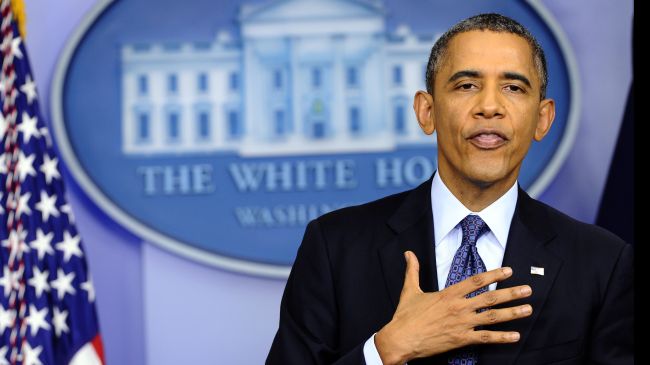 Did he know, or didn’t he? That’s the question surrounding President Barack Obama since it was revealed that the National Security Agency (NSA) had spied on the private communications of German Chancellor Angela Merkel.
Obama has been put in the embarrassing position of either admitting that he authorized the NSA to tap into the cell phone and email communications of the leaders of Germany and other allied countries, or that during his presidency spy agencies have been allowed to do as they wish without his knowledge even though many of their programs were already in place before Obama entered the White House.
Media reports out of Germany over the weekend indicated that Obama did know what the NSA was doing, going back several years in fact.
The German tabloid Bild alleged that Obama was personally briefed in 2010 about the operation to target Merkel’s phone by the NSA’s director, Keith Alexander, and that he authorized it to continue.
Another story, published in Der Spiegel, said the U.S. had been spying on Germans from the U.S. embassy in Berlin since 2008, and that surveillance of Merkel may have began as early as 2002.
In response to the stories, the NSA denied that Alexander met with Obama to discuss the controversial program.
The Wall Street Journal (WSJ) cited numerous unnamed sources who said the White House didn’t learn of the NSA spying until this past summer, when the operation against Merkel was shut down. It quoted a senior NSA official as saying, “These decisions are made at NSA. The president doesn’t sign off on this stuff.”
But that could mean Obama was in the dark for years about NSA activities.
“Officials said the NSA has so many eavesdropping operations under way that it wouldn’t have been practical to brief him on all of them,” the WSJ’s Siobhan Gorman and Adam Entous reported.
If that’s the best spin the administration can put on the scandal, it still leaves Obama open to criticism that he’s allowed a multi-billion-dollar spy agency to run amok and pry into the communications of whomever it wishes.
To Learn More:
If Obama Didn’t Know About Merkel Spying, Who Was It For? (by Jon Queally, Common Dreams)
Obama Unaware as U.S. Spied on World Leaders: Officials (by Siobhan Gorman and Adam Entous, Wall Street Journal)
Barack Obama ‘Approved Tapping Angela Merkel’s Phone 3 Years Ago’ (by Philip Sherwell and Louise Barnett, The Telegraph)
Obama knew about NSA spying on Merkel: Report
Press TV – October 27, 2013
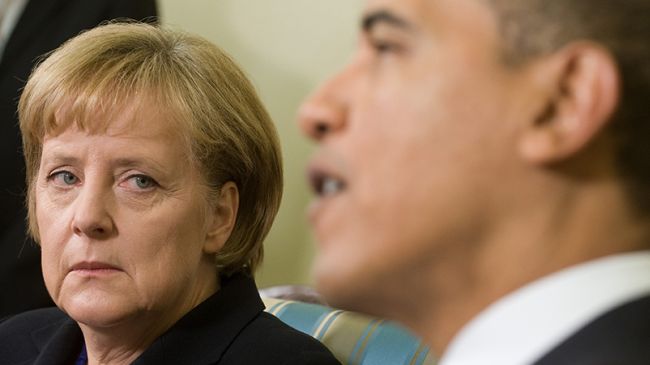
A new report has revealed that US President Barack Obama was personally aware of the National Security Agency’s eavesdropping on German Chancellor Angela Merkel.
NSA director Keith Alexander had briefed President Obama on the mobile phone tapping against Merkel in 2010, German newspaper Bild am Sonntag reported on Sunday.
“Obama did not halt the operation but rather let it continue,” according to the paper citing a high-ranking NSA official.
The newspaper also said the US spying agency eavesdropped on Merkel’s predecessor, Gerhard Schroder, after former US president George W. Bush launched the spying program in 2002, adding that Schroder’s refusal to support the Iraq war was a key reason behind the operation.
The new revelation comes one day after German magazine Der Spiegel said that the NSA’s Special Collection Service (SCS) had listed Merkel’s mobile telephone since 2002.
Washington’s ally has demanded explanations from the White House after disclosures about the huge and broad American electronic spying.
On Thursday, Germany summoned US ambassador John Emerson to discuss the tapping allegations.
“For us, spying on close friends and partners is totally unacceptable. This undermines trust and this can harm our friendship,” German Foreign Minister Guido Westerwelle said. “We need the truth now.”
In a phone call with Obama on Wednesday, Merkel said that she “unequivocally disapproves of such practices and sees them as completely unacceptable. There should be no such monitoring of the communication of a head of government. That would be a grave breach of trust.”
The White House, however, rejected the allegations, saying “the United States is not monitoring and will not monitor the communications of Chancellor Merkel.”
The global outrage over US government surveillance further spiked after The Guardian — citing a confidential memo obtained from American whistleblower Edward Snowden – revealed that the NSA is illegally eavesdropping on phone conversations of 35 world leaders.
The revelations have prompted Brazil and Germany to begin drafting a UN General Assembly resolution to restrain the NSA’s surveillance programs against other nations.
Snowden Rebuts Sen. Feinstein’s Claims That The NSA’s Metadata Collection Is ‘Not Surveillance’
By Tim Cushing | Techdirt | October 25, 2013
Ed Snowden has briefly stepped up to the mic to rebut Dianne Feinstein’s claims that the NSA’s bulk phone records collections are “not surveillance.” While he didn’t specifically name Feinstein, it’s pretty clear who his comments are directed towards, what with the senator putting in overtime over the past few weeks defending the agency’s cherished but useless Section 215 collections haystacks that are definitely not collections (according to the Intelligence Dictionary.)
“Today, no telephone in America makes a call without leaving a record with the NSA. Today, no Internet transaction enters or leaves America without passing through the NSA’s hands,” Snowden said in a statement Thursday.
“Our representatives in Congress tell us this is not surveillance. They’re wrong.”
 Her op-ed for the USA Today stated the following:
The call-records program is not surveillance.
Why is it not surveillance? Feinstein claimed, in direct contradiction to someone who’s seen most of the inner workings of the agency’s programs, that because it doesn’t sweep up communications or names, it isn’t surveillance. Also, she pointed out that surveillance or not, it’s legal. So there.
Maybe Feinstein considers the term “surveillance” to mean something closer to the old school interpretation — shadowy figures in unmarked vans wearing headphones and peering through binoculars.
Of course, this kind of surveillance contained many elements completely eliminated by the combination of the PATRIOT Act, the FISA Amendments Act, and a very charitable reading of the Third Party Doctrine. You know, the sort of stuff those shadowy men used to utilize: warrants, targeted investigations, reasonable suspicion, a grudging working relationship with the Fourth Amendment…
That’s all gone now. The courts have declared that sweeping up business records on millions of Americans is no more a violation of the Fourth Amendment than gathering metadata on a single person. The NSA has warped the definition of “surveillance” just as surely as they’ve warped the definition of “relevant.” The wholesale, untargeted gathering of millions of “transactions” from internet and phone activity doesn’t seem to resemble what anyone might historically think of as “surveillance,” but it’s surveillance nonetheless.
Sure, the NSA may not look at everything it gathers, but it has the capability to do so and it shows no interest in letting any of its dragnets be taken out of commission. The NSA’s defenders downplay the agency’s many intrusions by first playing the “legal” and “oversight” cards and, when those fail to impress, belittle their critics by trotting out condescending statements like, “The NSA isn’t interested in Grandma’s birthday phone call or the cat videos you email to your friends.”
Well, no shit. We’re hardly interested in that, either. We’re not worried about the NSA looking through tons of inane interactions. We know it doesn’t have the time or inclination to do so. We’re more concerned it’s looking at the stuff it finds interesting and amassing databases full of “suspicious” persons by relying on algorithms and keywords — a fallible process that robs everything of context and turns slightly pointed hay into the needles it so desperately needs to justify its existence.
What makes this even more frightening is that the agency then hands this unfiltered, untargeted, massive collection of data off to other agencies, not only in the US but in other countries, subjecting innocent Americans’ data to new algorithms, keywords and mentalities, increasing the possibility of false positives.
But what we’re mainly concerned about is the fact that an agency that claims its doing this to combat terrorism can’t seem to come up with much evidence that its programs are working. The NSA has deprived us of civil liberties while delivering next to nothing in terms of security. Americans have been sold out to a data-hungry beast, and even if it’s not officially “surveillance,” it’s still completely unacceptable.
NSA spied on 125bn phone calls in one month
Press TV – October 24, 2013
The US National Security Agency monitored nearly 125 billion phone calls from around the world in just one month, including around 3 billion calls from US soil, according to documents released by whistleblower Edward J. Snowden.
The sheer extent of the NSA’s data collection effort was compiled from multiple sources and organized on Wednesday by members of intelligence website Cryptome, which regularly publishes government documents and other information.
The majority of calls monitored by the NSA originated from Afghanistan and Pakistan, where 13.76 billion and 21.98 billion calls were respectively collected during January 2013, according to the Boundless Informant “heat map” revealed by the Guardian.
Billions of phone calls were also recorded from countries in the Middle East, including Iraq, Saudi Arabia, Egypt, Iran and Jordan.
Additionally, some 6.28 billion calls from India were collected. An estimated 3 billion US phone communications were also tapped by the NSA.
Perhaps the most controversial element of the NSA spying program is the effort to collect phone data from Western nations that have friendly relations with the US.
Germany, France and several other countries have expressed concerns about US spying after Snowden, former NSA contractor, revealed classified information about US surveillance programs.
The chairman of the US Joint Chiefs of Staff, Gen. Martin Dempsey, admitted in July that Snowden’s exposés have seriously damaged US ties with other countries. “There has been damage. I don’t think we actually have been able to determine the depth of that damage.”
Related articles
- NSA Spies on 500 Million Germany Data Connections Monthly (leaksource.wordpress.com)
- US spied on French diplomats- report (worldbulletin.net)
- Angela Merkel Calls Obama, Enquires Why Her Phone Was Spied On (eteknix.com)
NSA’s Italy op exposed: ‘Millions’ of private communications intercepted with govt awareness
RT | October 23, 2013
Everyday communications of Italians are also on the watch list of the US National Security Agency, a new report has revealed. While an Italian parliamentary committee seeks clarification of NSA activities, local security sources defend the snooping.
Italy’s spy watchdog COPASIR has recently learned details of large-scale monitoring of Italians by the US intelligence agency NSA, according to a report published by Corriere della Sera.
COPASIR stands for Parliamentary Committee for the Intelligence and Security Services and for State Secret Control, and is tasked with overseeing the activities of Italy’s own spy agencies. The body has free access to intelligence agencies’ offices and documents and has the authority to overcome judicial and banking secrecy.
In order to confirm the snooping on Italians, the committee members had to go to the United States and meet with US intelligence agency directors, as well as with congressional committee chairs.
A delegation of parliamentarians from the COPASIR confirmed their concerns regarding the extent of the NSA’s PRISM surveillance program during an official visit to the US three weeks ago, the media said. As part of the program, phone calls and computer communications of “millions of Italians” are reportedly being gathered.
Moreover, Corriere della Sera added that the implications extended to “a monitoring network that started years ago and is still active,” of which the Italian government and spy agencies might have been well aware of.
Such discoveries have prompted uneasy questions to officials, with leading members of COPASIR now seeking clarification from the government, and reportedly awaiting the junior minister for the intelligence services, Marco Minniti, to visit the committee’s offices on Wednesday afternoon.
Meanwhile, Italian intelligence sources quoted in the report rushed to justify the surveillance activities of their partners.
The acquisition of the sensitive private information “has as its sole aim the fight against terrorism,” one source was quoted as saying, while another denied that the NSA’s spying ever breached Italy’s sovereignty.
“We have never had any evidence that this kind of monitoring might have involved political spying on Italian public figures. All our investigations into any such eventuality have proved negative,” the source maintained.
However, such explanations did not satisfy COPASIR, nor did the NSA deputy director’s promise of “a complete overview of communications to and from the United States.”
According to the Italian media, the committee member Claudio Fava from Left Ecology Freedom (SEL) party, was “openly perplexed” as he commented on such statements.
“It’s a data trawling system based on various sensors. US intelligence experts explained that their main concern was to comply with American data protection laws and intervene to safeguard national security. Whether this conflicts with other countries’ laws is of no concern to them but it should be to us,” Fava was quoted as saying.
Another COPASIR member, Felice Casson of the Democratic Party (PD), said that the replies the committee received from top Italian intelligence officials were “far from reassuring.”
“It is clear that the United States has acquired information on individuals and institutions across Europe. What concrete elements exist to rule out that this has happened to politicians and institutions in Italy?” Casson questioned.
Leading Democratic Party (PD) politician Ettore Rosato also demanded an explanation from the government, saying that “a few months ago, when the first [NSA whistleblower Edward Snowden’s] revelations emerged, both the prime minister, Enrico Letta, and the foreign minister, Emma Bonino, professed astonishment at what came out.”
So far, the documents obtained by various world media from the former NSA contractor Snowden have revealed that the Italian embassy in Washington was subject to spying along with the diplomatic missions of other countries. Italian intelligence sources have been careful to deny the claims only “off the record,” Corriere della Sera says.
Right before the NSA scandal emerged, the collaboration between Italian and American intelligence services was “at its peak,” and, according to the media, included sharing of communications through the SIGINT interception system. However, such cooperation appeared to have been justified by the ongoing allied wars in Iraq and Afghanistan and the search for western hostages there, the media adds.
But in the wake of recent revelations on the US spying activities in France, which triggered a media frenzy and public outrage, the media speculates Italy may find it difficult to maintain the same “stance” towards the NSA programs.
NSA Spy Revelations Show Need to Recast US-Mexico Security Programs
By Laura Carlsen | CIP Americas Program | October 21, 2013
The latest analysis of Snowden leaks from the German magazine Der Spiegel is a bombshell for Mexico.
“The NSA has been systematically eavesdropping on the Mexican government for years,” reads the opening line in the Oct. 20 issue.
The article goes on to detail three major programs that together constitute a massive espionage operation against Mexico. No one seems to have been immune from its intrusions, including two presidents.
The presidential computer network was infiltrated since 2010 when Felipe Calderon was still president. The ever-zealous National Security Agency (NSA) was apparently very proud of itself for hacking the private communications of the leader and cabinet members of an allied nation.
In a “top secret” report, its “Tailored Access Operations” division (TAO) crows:
“TAO successfully exploited a key mail server in the Mexican Presidencia domain within the Mexican Presidential network to gain first-ever access to President Felipe Calderon’s public email account”, calling it a “lucrative source” to gauge Mexican “political system and internal stability”. The leaked operation was code named “Flatliquid”.
Mexicans first found out that their nation, along with Brazil and other Latin American countries, was a major target back in September, when Brazil’s O Globo published an article by Glenn Greenwald, Roberto Kaz and Jose Casado on tapping Brazilian President Dilma Rousseff’s phone and other communications. The article noted that the NSA had Mexico in its sights too.
A specially designed NSA program spied on then-presidential candidate Enrique Peña Nieto to find out who he was planning to appoint to his cabinet and how he’d handle the volatile drug war—the cornerstone of US policy in Mexico.
That caused a stir and the Peña Nieto administration sent a diplomatic note and demanded a U.S. investigation.
Sunday’s revelations add details to the previous information and show a far vaster and more insidious operation than was first imagined. Text messages from Peña Nieto’s cell phone—85,489 to be exact, according to the Der Speigel-Snowden report– were harvested and organized into data bases, identifying nine close associates for surveillance and analysis.
A third program called “White Tamale” dates back to 2009, when the NSA managed to hack into the emails of high-level officials in the now-defunct Public Security Ministry.
“In the space of a single year, according to the internal documents, this operation produced 260 classified reports that allowed US politicians to conduct successful talks on political issues and to plan international investments.”
The documents note that the spy operation allowed the NSA to gain access to “diplomatic talking points”.
What does this mean? Wouldn’t using ill-begotten private communications in negotiations be something akin to blackmail?
In any case, it seems to have fulfilled its purpose because during the subsequent period U.S. intelligence, military, police and drug enforcement agencies achieved an unprecedented margin to operate in-country, effectively breaking down any remaining resistance to their activities on Mexican soil.
The Der Speigel article states that in spy operations in Mexico, “the drug trade” was given top priority level, while the country’s “political leadership”, “economic stability” and “international investment relations” received number-three priority rankings on a scale of five.
This latter category gives credence to charges from Brazilian President Dilma Rousseff that the NSA used its apparatus for industrial spying, seeking advantages. Her charges are borne out by documents that show that Brazilian oil company, PETROBRAS, was a target of U.S. espionage. The Mexico revelations were more general but also indicate economic espionage.
The NSA, as reflected in its own documents, seems to have no sense of boundaries—it qualifies its invasions as unqualified “successes”. Der Spiegel quotes another document that reads,
“These TAO accesses into several Mexican government agencies are just the beginning — we intend to go much further against this important target.”
It goes on to state that the divisions responsible for this surveillance are “poised for future successes.”
Mexico’s Muted Response
The response from NSA to questions was predictable,
“We are not going to comment publicly on every specific alleged intelligence activity, and as a matter of policy we have made clear that the United States gathers foreign intelligence of the type gathered by all nations.”
So far, no enterprising journalists have asked the Mexican government if it has 85 thousand text messages off of Obama’s phone.
Since September the Mexican government has known it was massively spied on by the United States. After the revelations regarding Peña Nieto’s communications and contacts with US diplomats, Mexico says President Obama agreed to carry out an investigation.
But what exactly does the Mexican government expect of this investigation? No one has questioned the authenticity of the documents. Everyone knows Snowden has them, otherwise why would the U.S. be trying to force his extradition and threatening countries offering asylum. And it seems that asking the U.S. government to investigate NSA be an exercise in futility, especially since the Der Speigel article states explicitly that the programs had presidential authorization.
Not surprisingly, Mexico’s response was widely considered weak.
So far, the response to this latest round of revelations hasn’t shown much more backbone. The foreign relations ministry called the practice “unacceptable, illegitimate and against the law”—and said it would be sending another diplomatic note.
“In a relationship between neighbors and partners, there is no room for the practices alleged to have taken place,” the ministry said.
When Der Speigel asked for a comment from Felipe Calderon, Harvard University, apparently the spokesperson for the beleaguered ex-president since it took him under its ivied wings as a Global Leaders Fellow at the Kennedy School, said it would give him the message.
A senior U.S. State Department official told CNN that the Mexican government reached out about the report, and that the two governments will be discussing it via diplomatic channels.
Peña Nieto has to react now. Brazil is taking specific steps to protect privacy from the long ear of the NSA. Rousseff has been outspoken in its indignation, taking it to the floor of the United Nations General Assembly and cancelling a state visit to Washington.
Mexico’s economic dependence on the United States under NAFTA puts the Peña administration in a tougher bind. Big business will put pressure on Peña to let it slide. The PRI is likely to be seriously annoyed, but it also knows an important part of its power base rests on its relationship with the U.S. government and economic elite, almost a tautology, as shown again in the fact that taxpayer-supported NSA spying was directed at industrial spying to give U.S. companies an edge in bidding, investing and competing.
Whatever the response, the revelations are a blow to a somewhat shaky relationship. Peña Nieto has made it clear it will not allow the same carte-blanche treatment U.S. agencies were given under former president Calderon, but he has also continued security integration and U.S. expansion under the guise of the war on drugs.
Calling into question the terms of the bi-national security relationship should not necessarily be viewed negatively. Demands for a more transparent and less military-oriented relationship between the U.S. and Mexico have been growing. The NSA documents reveal a global security doctrine that has spun dangerously out of control, with what Greenwald calls “the construction of a worldwide, ubiquitous electronic surveillance apparatus” that apparently has no qualms regarding the right to privacy or national sovereignty. Neither the Mexican nor the U.S. Congress has sufficient knowledge of what’s going on to provide reasonable oversight, and the Mexican government apparently has little knowledge of the realm of shadowy U.S. intelligence activity in its own country.
When you add in the private contractors hired under the $2 billion-dollar Merida aid package, it makes for a vast and murky world of post-Cold War conniving.
That can’t be good for diplomacy, or democracy.
Laura Carlsen is director of the Mexico City-based CIP Americas Program.
Related article
Featured Video

Deception – Submarines against Olof Palme
or go to
Aletho News Archives – Video-Images
From the Archives
Woolsey Fire started at Santa Susana Field Lab — where “radioactive materials released were never accurately measured”
By John Laforge | CounterPunch | November 30, 2018
In my Nov. 16 column, I reported on potential radiation risks posed by California’s Woolsey wildfire having burned over parts or all of the Santa Susana Field Laboratory—south of Simi Valley, Calif., 30 miles outside Los Angeles—site of at least four partial or total nuclear reactor meltdowns.
The field laboratory operated 10 experimental reactors and conducted rocket engine tests. In his 2014 book Atomic Accidents, researcher James Mahaffey writes, “The cores in four experimental reactors on site … melted.” Reactor core melts always result in the release of large amounts of radioactive gases and particles. Clean up of the deeply contaminated site has not been conducted in spite of a 2010 agreement.
Los Angeles’s KABC-7 TV reported Nov. 13 that the Santa Susana lab site “appears to be the origin of the Woolsey Fire” which has torched over 96,000 acres. Southern Calif. Public Radio said, “According to Cal Fire, the Woolsey Fire started on the afternoon of Thursday, Nov. 8 … on the Santa Susana site.” … continue
Blog Roll
 Aletho News
- Dr. Abu-Sitta: Beirut ‘felt like a day in Shifa Hospital’
- Iran Has Won the War, It Will Be Up to the US to Secure the Peace: Mohammad Marandi
- Iran condemns assassination threats against Iranian negotiators amid US talks
- Brussels cannot say where its own pipeline inspectors are as Hungary’s oil lifeline remains shut
- Israel’s Iran War: Myth and Reality
- Between war and industrial breakdown: The US-Israeli attrition crisis
- Pressure builds on Iran to ‘drop’ Lebanon ceasefire demand as Islamabad talks hang in balance
- In another clash report, US denies agreement to release Iran’s assets
- What is fueling unrest across the EU?
- Why no power can undermine Iran’s eternal dominance over the Strait of Hormuz
- If Americans Knew
- Mearsheimer reveals how Israel dictates US policies on Iran, Gaza – video
- After killing 350+, Israel still has a “score to settle” with Lebanon before ceasefire – Daily Update
- Military aid to Israel emerges as the latest political litmus test for Democrats
- The only Palestinian children’s rights organization closes following years-long Israeli campaign against it
- ‘I Can’t Forget the Smell’: Lebanese Reel After Israel Kills Over 300 in Single Day
- DNC Shoots Down Resolutions Calling Out AIPAC and Limiting Arms to Israel
- TCN: Is Israel Blackmailing President Trump?
- Israel killed at least 303 Lebanese yesterday – who were they? Daily Update
- Amnesty: Urgent – Protect Lebanese civilians from brutal escalation in Israeli attacks
- Is The War Against Iran Over?
- No Tricks Zone
- German Expert: Heat Dome Led To Record Temps In Western USA…Warmer In 1934, 1936
- New Study: No Linear Warming Or Glacier Retreat Along Northern Antarctic Peninsula Since 1980s
- An Inconvenient Tree: Uncovered In Alps… Europe Much Warmer Than Today 6000 Years Ago
- New Study Reports A 60% Slowdown In Greenland’s Ice Loss Rate In The Last Decade
- Low Intensity Tornado Wrecks Major Solar Farm, Creating A Potential Toxic Dump
- New Study Finds Warming Saves Lives…Cold Temperatures 12 Times More Deadly Than Excess Heat
- German Science Blog Accuses PIK Climate Institute Of Hallucinating Climate Tipping Points
- Devastating Assessment Of Comirnaty Vaccine By Former Senior Pfizer Europe Toxicologist
- New Study: CO2 Is ‘Effectively Negligible’ As An Explanatory Climate Change Factor Since 2000
- Former Pfizer Toxicologist Dr. Helmut Sterz Tells Bundestag Hearing Pfizer Vaccine Should Have Never Been Approved
 Aletho News