Whistleblower who revealed CIA torture sentenced to prison
RT | October 23, 2012
Former CIA agent John Kiriakou pleaded guilty Tuesday morning to crimes related to blowing the whistle on the US government’s torture of suspected terrorists and was sentenced to two-and-a-half years in prison.
The Wall Street Journal reports that Kiriakou, 48, agreed to admit to one count of disclosing information identifying a covert agent early Tuesday, just hours after his attorney entered a change of plea in an Alexandria, Virginia courtroom outside of Washington, DC.
Kiriakou was originally charged under the Espionage Act of 1917 after he went public with the Central Intelligence Agency’s use of waterboarding on captured insurgents in the wake of the September 11, 2001 terrorist attack. On Monday morning, though, legal counsel for the accused former CIA agent informed the court that Kiriakou was willing to plead guilty to a lesser crime.
Initially, Kiriakou pleaded not guilty to the charge that he had outted two intelligence agents directly tied to the drowning-simulation method by going to the press with their identities.
As RT reported last week, defense attorneys had hoped that the government would be tasked with having to prove that Kiriakou had intent to harm America when he went to the media. Instead, however, prosecutors were told they’d only need to prove that the former government employee was aware that his consequences had the potential to put the country in danger.
Had Kiriakou been convicted under the initial charges filed in court, he could have been sentenced to upwards of five decades behind bars.
“Let’s be clear, there is one reason, and one reason only, that John Kiriakou is taking this plea: for the certainty that he’ll be out of jail in 2 1/2 years to see his five children grow up,” Jesselyn Raddack, a former Justice Department official who blew the whistle on Bush administration’s mishandling in the case of “American Taliban” John Walker Lindh, wrote Tuesday.
Kiriakou, Raddack wrote, was all but certain to enter the Alexandria courthouse on Tuesday and plead guilty to the lesser charge of violating the Intelligence Identities Protection Act (IIPA), explaining, “there are no reported cases interpreting it because it’s nearly impossible to prove–for “outing” a torturer.”
“’Outing’ is in quotes because the charge is not that Kiriakou’s actions resulted in a public disclosure of the name, but that through a Kevin Bacon-style chain of causation, GITMO torture victims learned the name of one of their possible torturers,” Raddack wrote. “Regardless, how does outing a torturer hurt the national security of the U.S.? It’s like arguing that outing a Nazi guarding a concentration camp would hurt the national security of Germany.”
Speaking on condition of anonymity, a former government official told Firedoglake recently that the CIA was “totally ticked at Kiriakou for acknowledging the use of torture as state policy” and allegedly outing the identity of a covert CIA official “responsible for ensuring the execution” of the water-boarding program.
Kiriakou “outted” to the reporters the identities of the CIA’s “prime torturer” under its Bush-era interrogations, Firedoglake wrote. “For that, the CIA is counting on the Justice Department to, at minimum, convict Kiriakou on the charge of leaking an agent’s identity to not only send a message to other agents but also to continue to protect one of their own.”
Former National Security Agency staffer Thomas Drake suffered a similar fate in recent years after the government went after him for blowing the whistle on the NSA’s poorly handled collection of public intelligence. A grand jury indicted Drake on five counts tied to 1917’s Espionage Act as well as other crimes, but prosecutors eventually agreed to let him off with a misdemeanor computer violation that warranted zero jail time.
Together, Drake and Kirakou are two of six persons charged under the Espionage Act during the administration of US President Barack Obama. The current White House has indicted more people under the antiquated World War 1-era legislation than all previous presidents combined.
Obama Justice Department Set to Overrule any State that Legalizes Marijuana
By Noel Brinkerhoff | AllGov | October 24, 2012
Depending on the outcome of initiatives in three states, a confrontation awaits between the U.S. Department of Justice and advocates for legalizing marijuana.
On November 6, voters in Colorado, Washington and Oregon will decide whether to legalize and tax marijuana sales. If one or more of the measures passes, and President Barack Obama is reelected, expect the Justice Department to take action to stop any state from decriminalizing the popular herb.
In an outtake in a recent interview with “60 Minutes,” Deputy Attorney General James Cole proclaimed that the federal government is prepared to stop any “dangers” associated with state-sanctioned recreational pot.
“We’re going to take a look at whether or not there are dangers to the community from the sale of marijuana and we’re going to go after those dangers,” Cole told the television news magazine.
A crackdown on drug legalization would follow other efforts by the Obama administration to shutdown medical marijuana dispensaries operating within state law in California and elsewhere.
If Mitt Romney wins the presidential election, he would probably take the same position as Obama, having stated that marijuana is a “gateway drug” and that he would fight legalization “tooth and nail.”
To Learn More:
Justice Department Official: State Votes on Legalizing Marijuana Has No Effect on Federal Enforcement Plans (by Alex Dobuzinskis, Reuters)
Oakland Sues Obama Administration over Loss of Tax Revenue Due to Medical Marijuana Crackdown(by Noel Brinkerhoff and David Wallechinsky, AllGov)
Obama Administration Steps Up Attack on Legal Marijuana with Threat to Growers (by Noel Brinkerhoff, AllGov)
Related articles
Fact Checking Obama’s Misleading Answer About Warrantless Wiretapping on The Daily Show
By Trevor Timm | EFF | October 24, 2012
On last Thursday’s Daily Show, Jon Stewart boldly went where no mainstream reporter has gone so far this election cycle: asking President Barack Obama why has he embraced Bush’s warrantless wiretapping program after campaigning against it on the grounds that it violated Americans’ civil liberties. While Stewart’s question was commendable, Obama’s answer was puzzling because it seems so obviously untrue.
Stewart first reminded Obama of his Bush-era statements that “we don’t have to trade our values and ideals for our security,” and pointedly asked the President, “do you still believe that?” He then specifically raised warrantless wiretapping, which Obama frequently criticized as a presidential candidate in 2008:
STEWART: I think people have been surprised to see the strength of the Bush era warrantless wiretapping laws and those types of things not also be lessened—That the structures he put in place that people might have thought were government overreach and maybe they had a mind you would tone down, you haven’t.
OBAMA: The truth is we have modified them and built a legal structure and safeguards in place that weren’t there before on a whole range issues.
To the contrary, there’s no indication that the still-active warrantless wiretapping program—which includes a warrantless dragnet on millions of innocent Americans’ communications—has significantly changed from the day Obama took office. With regard to the FISA Amendments Act, the Obama Administration has actively opposed all proposed safeguards in Congress. All the while, his Administration has been even more aggressive than President Bush in trying to prevent warrantless wiretapping victims from having their day in court and has continued building the massive national security infrastructure needed to support it.
But let’s take a closer look at the President’s actions on wiretapping and related issues:
Voting against FISA Amendments Act, Filibuster Telecom Immunity
Early in his first presidential campaign, then-Senator Obama was a leading critic of giving telecom companies like AT&T immunity for breaking the law to assist in the government in warrantless wiretapping. He repeatedly promised to filibuster any bill that contained retroactive immunity for telecom companies. Yet in 2008, when Congress debated the FISA Amendments Act—the law that allowed the President to give telecom companies full, retroactive immunity—Obama not only refused to filibuster the bill, but voted for it.
That decision came full circle just two weeks ago, when Obama’s Justice Department successfully convinced the Supreme Court to deny EFF’s appeal challenging the law’s constitutionality, ensuring AT&T and other telecommunications companies will never face legal consequences for breaking the law, both in the past and in the future.
Fixing FISA Amendments Act After Elected
Despite voting for the FISA Amendments Act, then-candidate Obama still promised to reform the law when he was elected president. But four years later, the FISA Amendments Act is up for renewal in Congress, as it expires at the end of this year. This would be perfect time to implement the reforms Obama promised, and there are several common sense amendments that would do so.
The Obama administration, however, is actively opposing any new privacy safeguards or transparency provisions, saying it is their “top priority” to renew it with no changes.
Stopping the Use of the State Secrets Privilege
Congress isn’t the only place where the President has been hostile to any “legal structure or safeguards” for the warrantless wiretapping. He has steadfastly sought to prevent the courts from engaging in any meaningful review
In EFF’s long-running lawsuit Jewel v. NSA, along with several related lawsuits, the Obama administration has continued the Bush Administration strategy of invoking the ‘state secrets’ privilege and demanding immediate dismissal (a practice which Obama specifically criticized on his 2008 campaign website). This, plus many other invocations of the privilege occurred even after a supposed internal policy change that was supposed to restrict its use.
Using the state secrets privilege for electronic surveillance is plainly wrong, since FISA specifically requires courts to determine the legality of national security spying. And of course the argument that the spying is a secret is increasingly untenable, as multiple whistleblowers, hundreds of pages of already-public evidence—including government admissions—and a massive construction project in Utah attest to its ongoing existence.
Sovereign Immunity
In addition, in both Jewel and other cases, the government has raised extremely technical legal arguments that the cases must be dismissed because it has “sovereign immunity.”In Al-Haramain v. Obama, a case where the government was caught red-handed illegally wiretapping attorneys, the Obama Administration was even able to convince the Ninth Circuit to dismiss the case because, according to the court, only government individuals can be sued, not the agencies that actually did the spying.
Declassifying Secret FISA Court Opinions
Both in 2010 and 2011, Obama administration officials promised to work to all declassify secret FISA court opinions that contained “important rulings of law.” These opinions would shed light whether and how Americans’ communications have been illegally spied on.
Since then, the administration has since refused to declassify a single opinion and still refuses to release the full (rescinded) legal memo written by Bush administration lawyer John Yoo that attempted to justify the illegal and unconstitutional program in 2001.
FISA court secrecy has never been more troubling, given the administration admitted in July that the FISA court ruled that collection done by the NSA violated the Fourth Amendment rights of some unknown American on at least one occasion. EFF has since filed a Freedom of Information Act lawsuit for that opinion, plus any others discussing the constitutionality of warrantless surveillance, but the Obama administration is fighting mightily against it.
Secret Safeguards Aren’t Safeguards
Some have suggested it’s possible when Obama said “safeguards” on the Daily Show, he is referring to some unspecified secret administrative rules he has put into place. Yet if these “safeguards” exist, they have been kept completely secret from the American public, and at the same, the administration is refusing to codify them into the law or create any visible chain of accountability if they are violated. But given the ample evidence of Constitutional violations since Obama took office (see: here, here, and here), these secret safeguards we don’t know exist are clearly inconsequential.
Here’s hoping other reporters follows up on Stewart’s question soon and ask Obama to be much more specific about his past and future plans to make sure the American people are not illegally spied on.
Related articles
- Warrantless Wiretapping Worse Under Obama; Fascism on the Rise (tenthamendmentcenter.com)
- Supreme Court Allows NSA’s Warrantless Wiretapping to Continue (thenewamerican.com)
- The New York Times Reminds Us the NSA Still Warrantlessly Wiretaps Americans, and Congress Has the Power to Stop It (eff.org)
Those Despicable Foreigners
By Craig Murray on October 23, 2012
I have travelled this world much more extensively than either Obama or Romney, and I still do. I find everywhere, even in areas of conflict and economic difficulty, the vast majority of people are friendly, even kind, and have very similar aspirations, across cultures, to personal development and emotional fulfilment.
The striking thing about tonight’s US Presidential “foreign policy” debate, is when it did occasionally discuss foreign policy, the world out there was discussed not as a place of vast potential, but as a deeply disturbing place full of foreigners who are, apparently, all evil except the Israelis, who are perfect.
The vast benefits from cooperation and trade with “abroad” were not mentioned once that I noticed (though I confess the thing was so awful my attention wandered occasionally). Europe apparently doesn’t exist, other than Greece which is nothing more than a terrible warning of the dangers of not being right wing enough.
The correct attitude to all these foreigners that God so unfortunately and inexplicably placed on this planet, is apparently to maintain incredibly large armed forces, murder people with drones (they were both very enthusiastic on this one), place sanctions on them and declare them “currency manipulators”. The only surprising note was that both agreed that they could not kill everyone in Iran.
But “We can’t just kill our way out of this mess” was spoken with regret, rather than as an affirmation of the possibilities of cooperation instead. What a grim and joyless world view. Maybe I had better not step out of this hotel into Africa this morning; those Islamists might get me.
America’s Drone Terrorism
By Sheldon Richman | FFF | October 19, 2012
In the United States, the dominant narrative about the use of drones in Pakistan is of a surgically precise and effective tool that makes the U.S. safer by enabling “targeted killing” of terrorists, with minimal downsides or collateral impacts.
This narrative is false.
Those are the understated opening words of a disturbing, though unsurprising, nine-month study of the Obama administration’s official, yet unacknowledged, remote-controlled bombing campaign in the North Waziristan region of Pakistan, near Afghanistan. The report, “Living Under Drones,” is a joint effort by the New York University School of Law’s Global Justice Clinic and Stanford Law School’s International Human Rights and Conflict Resolution Clinic.
The NYU/Stanford report goes beyond reporting estimates of the civilian casualties inflicted by the deadly and illegal U.S. campaign. It also documents the hell the Pakistanis endure under President Barack Obama’s policy, which includes a “kill list” from which he personally selects targets. That hell shouldn’t be hard to imagine. Picture yourself living in an area routinely visited from the air by pilotless aircraft carrying Hellfire missiles. This policy is hardly calculated to win friends for the United States.
Defenders of the U.S. campaign say that militants in Pakistan threaten American troops in Afghanistan as well as Pakistani civilians. Of course, there is an easy way to protect American troops: bring them home. The 11-year-long Afghan war holds no benefits whatever for the security of the American people. On the contrary, it endangers Americans by creating hostility and promoting recruitment for anti-American groups.
The official U.S. line is that America’s invasion of Afghanistan was intended to eradicate al-Qaeda and the Taliban, who harbored them. Yet the practical effect of the invasion and related policies, including the invasion of Iraq and the bombing in Yemen and Somalia, has been to facilitate the spread of al-Qaeda and like-minded groups.
U.S. policy is a textbook case of precisely how to magnify the very threat that supposedly motivated the policy. The Obama administration now warns of threats from Libya — where the U.S. consulate was attacked and the ambassador killed — and Syria. Thanks to U.S. policy, al-Qaeda in Afghanistan spawned al-Qaeda in Iraq, al-Qaeda in the Arabian Peninsula, and al-Qaeda in the Islamic Maghreb.
If that’s success, what would failure look like?
Regarding Pakistani civilians, the report states,
While civilian casualties are rarely acknowledged by the U.S. government, there is significant evidence that U.S. drone strikes have injured and killed civilians.… It is difficult to obtain data on strike casualties because of U.S. efforts to shield the drone program from democratic accountability, compounded by the obstacles to independent investigation of strikes in North Waziristan. The best currently available public aggregate data on drone strikes are provided by The Bureau of Investigative Journalism (TBIJ), an independent journalist organization. TBIJ reports that from June 2004 through mid-September 2012, available data indicate that drone strikes killed 2,562–3,325 people in Pakistan, of whom 474–881 were civilians, including 176 children. TBIJ reports that these strikes also injured an additional 1,228–1,362 individuals.
The Obama administration denies that it has killed civilians, but bear in mind that it considers any male of military age a “militant.” This is not to be taken seriously.
The report goes on,
U.S. drone strike policies cause considerable and under-accounted-for harm to the daily lives of ordinary civilians, beyond death and physical injury.Drones hover twenty-four hours a day over communities in northwest Pakistan, striking homes, vehicles, and public spaces without warning. Their presence terrorizes men, women, and children, giving rise to anxiety and psychological trauma among civilian communities. Those living under drones have to face the constant worry that a deadly strike may be fired at any moment, and the knowledge that they are powerless to protect themselves.
It’s even worse than it sounds:
The U.S. practice of striking one area multiple times, and evidence that it has killed rescuers, makes both community members and humanitarian workers afraid or unwilling to assist injured victims. Some community members shy away from gathering in groups.
How can Americans tolerate this murder and trauma committed in their name? But don’t expect a discussion of this in Monday night’s foreign-policy debate. Mitt Romney endorses America’s drone terrorism.
Related articles
Mali: Target of UN’s Sovereignty-stealing “Responsibility to Protect” Doctrine
By Joe Wolverton, II, J.D. | The New American | October 13, 2012
In a recent article, The New American’s foreign correspondent Alex Newman reported on the United Nations’ plot to invade the West African nation of Mali. Wrote Newman:
After having recently left thousands dead from overthrowing the governments ruling Libya and the Ivory Coast, the United Nations is already plotting its next invasion to deal with the fallout. This time, Mali is in the UN’s crosshairs.
Mali attracted UN attention when the northern part of the country was taken over by Islamists and nomadic rebels amid a military coup d’état that ousted the government in the South. The UN Security Council is currently considering two resolutions related to the country, a former colony of France. The first one calls for negotiations between armed rebels in the North and the supposed “interim” government operating in the capital. That measure is expected to be approved soon, according to officials involved in the negotiations.
The second resolution would purport to authorize international military intervention, a move being sought by the coalition of regimes making up the African Union, the Economic Community of West African States (ECOWAS), and the struggling “interim” government in Southern Mali. The French government is circulating a draft of the resolution this week.
Supporting Newman’s report is the “crisis alert” issued by the International Coalition for the Responsibility to Protect (ICRtoP). The notice says: “The humanitarian situation in northern Mali has worsened considerably since a coup in late March, with reports of human rights violations including murder, rape, robbery and forced displacement.”
After rehearsing the calls for intervention made by various human rights groups and other “civil society organizations,” ICRtoP closes its memo with a demand that the UN’s Responsibility to Protect doctrine be applied to the “rapidly deteriorating humanitarian situation” in Mali.
A key to understanding the cause of the crescendo of clamors for international intervention in Mali is a familiarity with the Right to Protect doctrine as defined by the United Nations.
In an address given in September, UN Secretary-General Ban Ki-moon reaffirmed the commitment of the global shadow government’s ultimate goal of eradicating national sovereignty. The preferred weapon in this war on self-determination is the principle known as Responsibility to Protect (R2P).
Agreed to by the UN General Assembly at a summit of world leaders in 2005, R2P purports to grant the global government power to decide whether individual nations are properly exercising their sovereignty.
UN literature describes R2P as the concept that holds “States responsible for shielding their own populations from genocide, war crimes, ethnic cleansing, and related crimes against humanity and requires the international community to step in if this obligation is not met.”
That is to say, if the UN determines that a national government is not voluntarily conforming to the UN’s idea of safety, then the “international community” will impose its will by force, all for the protection of that nation’s citizens.
Lest anyone believe that the globalists at the UN are simply pacifists whose desire is to meekly encourage regimes to treat their people kindly, Secretary-General Ban Ki-moon took a more forceful posture at the conference held at the UN headquarters in New York.
“We all agree that sovereignty must not be a shield behind which States commit grave crimes against their people. But achieving prevention and protection can be difficult,” said Ban. “In recent years, we have shown how good offices, preventive diplomacy, mediation, commissions of inquiry and other peaceful means can help pull countries back from the brink of mass violence.”
“However, when non-coercive measures fail or are considered inadequate, enforcement under Chapter VII will need to be considered by the appropriate intergovernmental bodies,” he added. “This includes carefully crafted sanctions and, in extreme circumstances, the use of force.”
Chapter VII of the UN Charter authorizes the Security Council to use force in the face of a threat to peace or aggression, taking “such action by air, sea, or land forces as may be necessary to maintain or restore international peace and security.” As there is currently no UN military, all such interventions are carried out by the national armed forces of member nations.
Faithfully, the United States, as the chief financial engine of the international body, has not only signed on to promote the Responsibility to Protect scheme, but President Obama has created a federal agency to ensure that it is executed effectively.
The bureau is called the White House Atrocities Prevention Board (APB) and it will be headed by President Obama’s National Security Advisor, Samantha Power.
Exercising the powers he created for himself in Executive Order 13606, President Barack Obama demonstrated his support for the R2P program when he established the Atrocities Prevention Board.
The stated goal of the APB is to first formally recognize that genocide and other mass atrocities committed by foreign powers are a “core national security interest and core moral responsibility.”
Apart from the unconstitutionality of this use of the executive order, there is something sinister in the selection of Samantha Power to spearhead the search for atrocities.
One source claims that the very existence of the APB is due to Power’s own persistence in convincing the White House that discovering atrocities should be a “core national-security interest and a core moral responsibility of the United States.” The statement released at the time of the signing of the executive order demonstrates Power’s remarkable power of persuasion.
Samantha Power rose to prominence in government circles as part of her campaign to promote the Responsibility to Protect scheme.
Responsibility to Protect is predicated on the proposition that sovereignty is a privilege not a right and that if any regime in any nation violates the UN-approved code of conduct, then the international community is morally obligated to revoke that nation’s sovereignty and assume command and control of the offending country.
The three pillars of this UN sovereignty grab explain the provenance of this presumed prerogative:
1. A state has a responsibility to protect its population from mass atrocities
2. The international community has a responsibility to assist the state if it is unable to protect its population on its own, and
3. If the state fails to protect its citizens from mass atrocities and peaceful measures have failed, the international community has the responsibility to intervene through coercive measures such as economic sanctions. Military intervention is considered the last resort.
It is the habitual recourse to this purported “last resort” that has cost countless American lives and has propelled our Republic closer to becoming a mere regional administrative unit of the global government of the United Nations. As Alex Newman wrote in his article on the situation in Mali:
As history shows, armed UN intervention often leads to mass slaughter and complete chaos that is later used to justify more international military intervention — Libya and the Ivory Coast being just two recent examples among many. There is little reason to suspect that invading Mali would turn out any better.
Indeed it won’t. But using history as a guide, Americans know that the pseudo-pacifists running the United Nations believe that if the social contract fails, there’s always the option of deploying blue-helmeted soldiers to impose “peace” at the point of a gun.
To that end, the newly appointed Special Advisor of the Secretary-General on the Prevention of Genocide, Adama Dieng, recommended delegates work in their individual governments to contribute to an armed UN force under the command of the global government. Reciting the third point of R2P, Dieng pushed for more powerful tools to carry out the third pillar.
“It is our collective responsibility to study the implications of the use of each of them, and to understand the conditions under which the potential of each tool can be maximized,” Dieng said. “It is also our responsibility to establish and strengthen the structures that will make third-pillar tools actionable and effective.”
No matter the frequency or ferocity of the moral outrage spewed by internationalists, the government of the United States does not have a constitutional responsibility to protect the citizens of the world from atrocities.
And nowhere in the Constitution is the president or Congress authorized to place the armed forces of the United States under the command of international bodies, regardless of treaty obligations or sovereignty-stealing “responsibilities” to the contrary.
Related article:
Obama Executive Order allows seizure of Americans’ bank accounts
Press TV – October 13, 2012

The latest executive order (EO) emanating from the White House October 9 now claims the power to freeze all bank accounts and stop any related financial transactions that a “sanctioned person” may own or try to perform – all in the name of “Iran Sanctions.”
Titled an “Executive Order from the President regarding Authorizing the Implementation of Certain Sanctions…” the order says that if an individual is declared by the president, the secretary of state, or the secretary of the treasury to be a “sanctioned person,” he (or she) will be unable to obtain access to his accounts, will be unable to process any loans (or make them), or move them to any other financial institution inside or outside the United States. In other words, his financial resources will have successfully been completely frozen.
The EO expands its authority by making him unable to use any third party such as “a partnership, association, trust, joint venture, corporation, subgroup or other organization” that might wish to help him or allow him to obtain access to his funds.
And if the individual so “sanctioned” decides that the ruling is unfair, he isn’t allowed to sue. In two words, the individual has successfully been robbed blind. – The New American
HIGHLIGHTS
Congressman Ron Paul (R-Texas) called EOs patently unconstitutional. When asked about them by Fox News’ Megan Kelly, Paul said:
“The Constitution says that only Congress passes laws. The executive branch is not allowed to pass laws, nor should the judicial system pass laws. So it is clearly unconstitutional to issue these executive orders,” Paul said.
“They’ve been done for a long time, both parties have done it, but the Congress is careless. They allow and encourage and do these deals … to get the president to circumvent the Congress. If something’s unpopular and he can’t get it passed, well, let’s just sign an executive order. So I think that is blatantly wrong. I think this defies everything the founders intended. I think it’s a shame that Congress does it, and I think it’s a shame that the American people put up with it,” he added.
The most outrageous executive order of all time was that issued by President Roosevelt that allowed the enforced internment of 120,000 Japanese-Americans. – Prison Planet
FACTS & FIGURES
The United States has long barred U.S. firms from doing business with Iran, but last December adopted measures that forced international buyers of Iranian oil to cut their purchases. – Economic Times
In August, a second package of sanctions added further restrictions for international banks, insurance companies and oil traders.
The U.S., Israel and their allies say Tehran may intend to use its nuclear capability to produce nuclear weapons, a claim Iran rejects. Tehran insists its program is completely peaceful.
Related articles
- Obama executive order hits Iran with harsher sanctions (21stcenturywire.com)
The Goldberg Predilections: Ignoring Decades of Iranian Statements on Nuclear Weapons for the Sake of Propaganda
By Nima Shirazi | Wide Asleep in America | October 10, 2012
Jeffrey Goldberg is confident in Barack Obama’s oft-stated commitment to stop Iran from building the nuclear weapon that everyone, including his own intelligence agencies (and others) and Defense Secretary know it isn’t building. Why? Well, basically because Obama’s said so. A lot.
Explaining that anyone who doesn’t recognize that Obama has “promised to do ‘whatever it takes’ to prevent Iran from crossing the nuclear threshold…hasn’t been listening,” Goldberg wrote last week that he takes the American President “at his word, in part because he’s repeated himself on the subject so many times and in part because he has laid out such an effective argument against containment and for disruption, by force, if necessary.”
That Goldberg trusts Obama’s seriousness comes as no surprise considering what Goldberg wrote on June 6, 2011 in a dazzlingly alarmist (and factually-lacking) article for Bloomberg entitled “Iran Wants the Bomb, and It’s Well on Its Way.” “I believe firmly, after two years of reporting on the Iranian nuclear program,” Goldberg declared, “that President Barack Obama would order air strikes if he thought Iran was moving definitively to become a nuclear-armed state.”
To better illustrate his point, Goldberg enlisted the aid of his trusty, colleague Armin Rosen to track down a litany of Obama’s statements from the past four years that demonstrate a consistent commitment to using “military force to prevent Iran from getting the bomb.” The catalog of twenty quotations (admittedly only “a partial accounting of Obama’s statements on the subject”) is effective and yes, Obama has been consistent.* Goldberg writes that, sure, Obama could potentially “change his mind on the subject,” but for now, “the record is the record: Given the number of times he’s told the American public, and the world, that he will stop Iran from going nuclear, it is hard to believe that he will suddenly change his mind and back out of his promise.”
So if consistency and repetition are what make Jeffrey Goldberg believe what Obama says – what he terms as a “crystal-clear promise” – about preventing an imaginary Iranian bomb, wouldn’t it logically follow that the constantly repeated statements by senior Iranian officials regarding their own promise never to obtain such a diabolical and destructive device would hold similar sway?
Clearly that’s too much to ask.
Goldberg has written for years now that Iran “is on the verge of gaining the technology to detonate nukes” and that the “Iranian mullahs…want the nukes because they expect the apocalypse.” As far back as 2006, he insisted, “It’s time we took their views seriously.”
So what are the Iranian leadership’s repeatedly stated views on nuclear weapons that should be taken so seriously?
Using the Goldberg format and culling statements from the past two decades, here goes:
Iranian Vice President and head of the Atomic Energy Organization Reza Amrollahi, August 3, 1991:”Iran is not capable of making atomic bombs…Our objective in promoting nuclear industries is merely its peaceful use specially in the field of atomic energy and its application in agriculture and medicine.” (IRNA, BBC Summary of World Broadcasts)
Senior adviser to Khamenei and National Security Council member Mohammad Javad Larijani, September 18, 1991: “[Acquiring nuclear capability has been] erased from Iran’s policy.”
IAEO head Amrollahi, November 6, 1991: “Iran is not after nuclear arms. On the contrary, it believes that such lethal arms in the region should be destroyed…We are ready for any type of cooperation for establishing a region free of mass-destruction weapons…Iran, as a member of the IAEA, is committed to the regulations for the inspections of the nuclear installations, and naturally respects them.” (IRNA, BBC Summary of World Broadcasts)
IAEO head Amrollahi, February 9, 1992: “We have never had nor will ever have other intentions” [than using nuclear equipment for peace purposes].
Iranian Deputy Foreign Minister Ali Mohammad Besharati, November 27, 1992: “We have no need for nuclear weapons.” Besharati also described allegations that Iran was planning to acquire nuclear weapons as “a lie and a plot.”
Iranian Vice President for Economic Affairs Mohsen Nurbakhsh, September 29, 1993: “Iran will not seek to acquire weapons of mass destruction under any circumstances.”
Iranian President Rafsanjani, March 23, 1997: “We’re not after nuclear bombs and we won’t go after biological and chemical weapons.”
Iranian President Seyyed Mohammad Khatami, January 7, 1998: “We are not planning on building nuclear weapons and only aim to employ nuclear energy for peaceful purposes…We are not a nuclear [-armed] power and do not intend to become one.”
President Khatami, September 21, 1998: “[The world should] be liberated from the nightmare of nuclear war and weapons of mass destruction…the idea of attaining security through the acquisition of such armaments is nothing but an illusion.”
Iranian Supreme National Security Council chief and top presidential advisor Hassan Rohani, September 2002: “When we have signed international treaties, it means we are not pursuing making nuclear weapons. We are not pursuing making chemical weapons. We are not pursuing making biological weapons. Iran is not interested in any of these.”
Supreme Leader Ayatollah Sayyid Ali Khamenei, March 21, 2003: “The statement that the Islamic Republic wants to obtain chemical weapons and the atomic bomb is totally false…[W]e are not interested in an atomic bomb. We are opposed to chemical weapons. When Iraq was using chemical weapons against us we refused to produce chemical weapons. These things are against our principles.”
President Khatami, September 15, 2003: “[N]ot only are we not aiming to produce weapons of mass destruction, but we want the region and the world to be free of weapons of mass destruction…We don’t need atomic bombs, and based on our religious teaching we will not pursue them. But at the same time we want to be strong, and being strong means having knowledge and technology.”
Iranian Supreme National Security Council official Hussein Musavian, September 12, 2004: “The religious verdict of our leader is that using mass destruction weapons is forbidden, is haram.”
Iranian Foreign Ministry spokesman Hamid Reza Assefi, September 12, 2004: “We believe that the use of nuclear weapons is religiously forbidden. This is the leader’s fatwa.”
Iranian Ambassador and Permanent Representative to the United Nations Javad Zarif, November 5, 2004: “[Iran has] serious ideological restrictions against weapons of mass destruction, including a religious decree issued by Ayatollah Ali Khamenei, the leader of the Islamic Republic of Iran, prohibiting the development and use of nuclear weapons.”
Iranian nuclear negotiator Sirus Naseri, August 10, 2005: “The Leader of the Islamic Republic of Iran, Ayatollah Ali Khamenei has issued the fatwa that the production, stockpiling, and use of nuclear weapons are forbidden under Islam and that the Islamic Republic of Iran shall never acquire these weapons. President Mahmud Ahmadinejad, who took office just recently, in his inaugural address reiterated that his government is against weapons of mass destruction and will only pursue nuclear activities in the peaceful domain…The leadership of Iran has pledged at the highest level that Iran will remain a non-nuclear-weapon state party to the NPT.”
Iranian President Mahmoud Ahmadinejad, September 17, 2005: “[Iran’s] previously and repeatedly declared position [is] that in accordance with our religious principles, pursuit of nuclear weapons is prohibited.”
UN Ambassador Javad Zarif, April 6, 2006: “Iran’s reliance on the nonproliferation regime is based on legal commitments, sober strategic calculations and spiritual and ideological doctrine. Ayatollah Ali Khamenei, the leader of the Islamic Republic, has issued a decree against the development, production, stockpiling and use of nuclear weapons.”
Ayatollah Khamenei, June 4, 2006: “We do not need a nuclear bomb. We do not have any objectives or aspirations for which we will need to use a nuclear bomb. We consider using nuclear weapons against Islamic rules. We have announced this openly. We think imposing the costs of building and maintaining nuclear weapons on our nation is unnecessary.”
President Ahmadinejad, August 2006: “Nuclear weapons have no place in Iran’s defense doctrine and Iran is not a threat to any country.”
President Ahmadinejad, August 2006: “Basically we are not looking for – working for the bomb…The time of the bomb is in the past.”
President Ahmadinejad September 20, 2006: “You must know that, because of our beliefs and our religion…[w]e are against the atomic bomb.”
UN Ambassador Javad Zarif, December 23, 2006: “[Iran has] categorically rejected development, stockpiling and use of nuclear weapons on ideological and strategic grounds…The Islamic Republic of Iran firmly believes that the days of weapons of mass murder have long passed; that these inhumane instruments of indiscriminate slaughter have not brought internal stability or external security for anyone and they will not be able to do so in the future.”
President Ahmadinejad, September 20, 2007: “I want to address all politicians around the world, statesmen. Any party who uses national revenues to make a bomb, a nuclear bomb, will make a mistake. Because in political relations right now, the nuclear bomb is of no use….we don’t need such weapons. In fact, we think that this is inhuman.”
President Ahmadinejad, September 25, 2007: “Making nuclear, chemical and biological bombs and weapons of mass destruction is yet another result of the misuse of science and research by the big powers…We do not believe in nuclear weapons, period. It goes against the whole grain of humanity.”
President Ahmadinejad, September 27, 2007: “We’ve said many times before, we don’t need the weapon. It’s not enshrined in our defense doctrine, nuclear defense. And ideologically, we don’t believe in it either. We have actually rejected it on an ideological basis. And politically, we know that it is useless.”
President Ahmadinejad, August 22, 2008: “We want nuclear disarmament [for all countries]…and we consider it to be against humanity to manufacture nuclear weapons…we oppose that strongly…Our position is very clear…We believe that a nuclear weapon has no use, obsolete. Anyone who has a nuclear weapons does not create any political advantage for themselves.”
President Ahmadinejad, September 23, 2008: “We believe, as a matter of religious teaching, that we must be against any form of weapons of mass destruction, including nuclear weapons. The production and the usage of nuclear weapons is one of the most abhorrent acts to our eyes…The time for a nuclear bomb has ended. Whoever who invests in it is going the wrong way.”
President Ahmadinejad, September 17, 2009: “We don’t have such a need for nuclear weapons. We don’t need nuclear weapons. Without such weapons, we are very much able to defend ourselves…It’s not a part of our any – of our programs and plans.”
Ayatollah Khamenei, September 20, 2009: “We fundamentally reject nuclear weapons and prohibit the use and production of nuclear weapons. This is because of our ideology, not because of politics or fear of arrogant powers or an onslaught of international propaganda. We stand firm for our ideology.”
President Ahmadinejad, December 18, 2009: “[W]e do not want to make a bomb…Our policy is transparent. If we wanted to make a bomb we would be brave enough to say so. When we say that we are not making one, we are not. We do not believe in it.”
Ayatollah Khamenei, February 19, 2010: “[W]e have often said that our religious tenets and beliefs consider these kinds of weapons of mass destruction to be symbols of genocide and are, therefore, forbidden and considered to be haram…This is why we do not believe in atomic bombs and weapons and do not seek them.”
Iranian Foreign Minister Manouchehr Mottaki, April 7, 2010: “Iran does not believe in nuclear weapons nor does it need one…Iran believes that the era of nuclear weapons is over. These weapons are not even of use to those who possess them.”
Ayatollah Khamenei, April 17, 2010: “Any use of or even threat to use nuclear weapons is a serious and material violation of indisputable rules of humanitarian law and a cogent example of a war crime…We regard the use of these weapons to be illegal and haram, and it is incumbent on all to protect humankind from this grave disaster.”
President Ahmadinejad, May 3, 2010: “The nuclear bomb is a fire against humanity rather than a weapon for defense…The possession of nuclear bombs is not a source of pride; it is rather disgusting and shameful. And even more shameful is the threat to use or to use such weapons, which is not even comparable to any crime committed throughout the history.”
President Ahmadinejad, May 3, 2010: “We are opposed to the bomb, the nuclear bomb, and we will not build it. If we want to build it, we have the guts to say it…So when we say we don’t want it, we don’t want it.”
Iranian Ambassador and Permanent Representative to the United Nations Mohammad Khazaee, June 9, 2010: “Iran as a victim of the use of weapons of mass destruction in recent history has rejected and opposed the development and use of all these inhuman weapons on religious as well as security grounds.”
Iranian Parliament (Majlis) Speaker Ali Larijani, July 23, 2010: “[B]eing a nuclear power does not mean that we are going to make a bomb.”
President Ahmadinejad, September 22, 2010: “We are not seeking the bomb. We have no interest in it. And we do not think that it is useful. We are standing firm over the issue that both the Zionist regime and the United States government should be disarmed.”
President Ahmadinejad, September 23, 2010: “The nuclear bomb is the worst inhumane weapon and which must totally be eliminated.”
Ayatollah Khamenei, December 22, 2010: “We don’t have any belief in the atomic bomb and don’t pursue it. Our religious principles and beliefs forbid the acquisition and use of such weapons of mass murder. We consider such weapons to be a symbol of destruction.”
President Ahmadinejad, August 4, 2011: “When we say we don’t have any intention to build a bomb, we’re honest and sincere. We believe that today if someone wants to build a bomb he’s crazy and insane…An atomic bomb is against all humans.”
President Ahmadinejad, August 14, 2011: “Never, never. We do not want nuclear weapons. We do not seek nuclear weapons. This is an inhumane weapon. Because of our beliefs we are against that. Firstly, our religion says it is prohibited. We are a religious people. Secondly, nuclear weapons have no capability today. If any country tries to build a nuclear bomb, they in fact waste their money and resources and they create great danger for themselves.”
President Ahmadinejad, September 13, 2011: “When we say we are not going to build nuclear weapons, we mean it. Because we consider it an evil thing and we do not need those items.”
President Ahmadinejad, September 20, 2011: “I’ve said many times we don’t want a bomb and we are against any nuclear bombs.”
President Ahmadinejad, September 22, 2011: “We are not seeking the weapon. We are not seeking the nuclear weapon.”
President Ahmadinejad, November 9, 2011: “The Iranian nation is wise. It won’t build two [nuclear] bombs against the 20,000 you have. But it builds something you can’t respond to: ethics, decency, monotheism and justice.”
Senior adviser to Khamenei Mohammad Javad Larijani, November 18, 2011: “[Iran seeks] advancement in science and technology related to nuclear area, not directed toward the weapon area…We are a signatory of NPT, we are a sincere signatory to the NPT. We think non-proliferation is a benefit of Iran and all of us…We are an advocate of a Middle East free of nuclear weapons.”
Majlis Speaker Ali Larijani, January 12, 2012: “We are not after nuclear weapons. We do not find nuclear weapons right from a religious perspective.”
Iranian Foreign Minister Ali Akbar Salehi, January 30, 2012: “Iran is never, ever after nuclear weapons.”
Ayatollah Khamenei, February 22, 2012: “The Iranian nation has never sought and will never seek nuclear weapons…Iran does not seek nuclear weapons since the Islamic Republic of Iran regards the possession of nuclear weapons as a great sin, in terms of thought, theory and religious edict, and also believes that holding such weapons is useless, costly and dangerous.”
Iranian Foreign Minister Ali Akbar Salehi, February 28, 2012: “[Nuclear weapons are] immoral and illegitimate…I would like to re-emphasize that we do not see any glory, pride or power in the nuclear weapons, quite the opposite based on the religious decree issued by our supreme leader, the production, possession, use or threat of use of nuclear weapons, are illegitimate, futile, harmful, dangerous and prohibited as a great sin.”
Former Iranian President Akbar Hashemi Rafsanjani, March 2012: “We really do not want to make nuclear weapons and a nuclear weapon program…We deeply believe that nuclear weapons must not exist, and this has been part of our policy.”
Foreign Minister Ali Akbar Salehi, April 12, 2012: “We have strongly marked our opposition to weapons of mass destruction on many occasions. Almost seven years ago, Iranian Supreme Leader Ayatollah Ali Khamenei made a binding commitment. He issued a religious edict — a fatwa — forbidding the production, stockpiling and use of nuclear weapons. Our stance against weapons of mass destruction, which is far from new, has been put to the test.” (“Iran: We do not want nuclear weapons,” The Washington Post)
Ayatollah Mohammad Emami-Kashani, April 13, 2012: “As the Ayatollah Seyyed Ali Khamenei has said and other Iranian officials have reiterated, the work done in the field of nuclear energy is not meant for making nuclear weapons…These activities are for scientific purposes; you must realize and believe this.”
Senior adviser to Khamenei, Mohammad Javad Larijani, April 13, 2012: “Iran is not after nuclear weapon[s]. Nuclear weapon is not an asset for us, it is more [of a] liability. Pakistan has nuclear weapons, you see is a shambled country in terms of security. It doesn’t add to our security. We are secure enough, we are strong enough, without nuclear weapon. And it is against the fatwa of Ayatollah Khamenei. Nobody [would dare] do that…This is the fatwa of Iman Khomeini and the fatwa of Ayatollah Khamenei.”
President Ahmadinejad, May 23, 2012: “[P]roduction and use of weapons of mass destruction is forbidden…There is no room for these weapons in Iran’s defense doctrine.”
Iran’s chief negotiator Saeed Jalili, June 16, 2012: “Firstly, we are strongly against weapons of mass destruction. Today, the Islamic Republic of Iran has the capacities to cooperate in disarmament and nuclear non-proliferation, so these capacities should be used by the international community.”
Ayatollah Khamenei, August 30, 2012: “Nuclear weapons neither ensure security, nor do they consolidate political power; rather they are a threat to both security and political power…The Islamic Republic of Iran considers the use of nuclear, chemical and similar weapons as a great and unforgivable sin. We proposed the idea of [a] “Middle East free of nuclear weapons” and we are committed to it…I stress that the Islamic Republic has never been after nuclear weapons and that it will never give up the right of its people to use nuclear energy for peaceful purposes.”
Iranian Vice President and head of the Atomic Energy Organization Fereydoon Abbasi-Davani, September 17, 2012: “The Islamic Republic of Iran…has always opposed and will always denounce the manufacture and use of weapons of mass destruction.”
President Ahmadinejad, September 23, 2012: “We will never use the wealth of our nation for these [nuclear weapons] objectives.”
President Ahmadinejad, September 24, 2012: “At the end of the day, everyone knows that Iran is not seeking a nuclear bomb. The scene resembles one of a comedy show. Those who accuse us are those whose warehouses have nuclear stockpiles. They talk of security. If you are so preoccupied with this, why not do away with your own nuclear stockpiles?”
President Ahmadinejad, September 24, 2012: “Let’s even imagine that we have an atomic weapon, a nuclear weapon. What would we do with it? What intelligent person would fight 5,000 American bombs with one bomb? Also, because of our beliefs, we do not believe in a nuclear weapon. We are against it.”
Iranian Deputy Ambassador to the United Nations Eshagh Al Habib, September 27, 2012: “[The] nuclear program of my country [] is exclusively peaceful and in full conformity with our international obligations and in exercising our inalienable right to use nuclear science and technology for peaceful purposes.”
Iranian Foreign Minister Ali Akbar Salehi, October 1, 2012: “Had Iran chosen to [go] nuclear in the sense of weaponization, it would not be a deterrent for Iran. It would attract more threats from the other side.”
Iranian Ambassador and Permanent Representative to the United Nations Mohammad Khazaee, October 1, 2012: “Nuclear activities of my country are, and always have been, exclusively for peaceful purposes and the non-diversion of declared nuclear material in Iran has been repeatedly confirmed by the IAEA.”
Furthermore, Supreme Leader Ayatollah Khamenei’s own website has had, for some time now, an entire page specifically dedicated to Iran’s official policy on nuclear energy and nuclear weapons. It states clearly, “According to our logic, it is not right for a country to use its knowledge to produce such weapons as nuclear bombs which annihilate armed soldiers, innocent civilians, children, babies and oppressed people indiscriminately once they are dropped somewhere,” adding, “Iran is not after an atomic bomb, and it is even opposed to possession of chemical weapons. Even when Iraq used chemical weapons against Iran, we did not try to manufacture chemical weapons. Such things are not in line with the principles of the Islamic Republic of Iran.”
Khamenei’s official statement repeatedly affirms, “The Islamic Republic of Iran does not have this motivation, and it has never been after nuclear weapons. Iran does not need a nuclear bomb” and “We believe that using nuclear weapons is haram and prohibited.”
Referring to the American use of nuclear weapons to murder hundreds of thousands of Japanese civilians at Hiroshima and Nagasaki, Khamenei explains that the “anti-human effects went beyond political and geographic borders, even inflicting irreparable harm on future generations. Therefore, using or even threatening to use such weapons is considered a serious violation of the most basic humanitarian rules and is a clear manifestation of war crimes.”
Reading this litany, it is no wonder President Ahmadinejad recently told journalists in New York that the nuclear issue “is a very tiresome subject.”
But naturally, these constantly repeated statements by Iranian officials have had no affect on Jeffrey Goldberg. He still regularly frets about “the threat posed by Iran’s nuclear ambitions to world peace” and somehow believes that a nuclear-armed Iran would actually threaten the “existence” of his once-adopted nation, Israel.
Why is that?
It is because, according to Goldberg, Iranian leaders – like all Orientals – are wily and deceitful by nature and therefore any clear, unequivocal statements like the ones reiterated for decades are not to be trusted. Goldberg refuses to believe that Iranian officials are anything other than “crazy,” “mystically minded,” “bloody minded,” “comprehensively evil,” “eliminationist anti-Semites”, despite (a) how manifestly ignorant and bigoted that sentiment inherently is, and (b) the admonitions of both U.S. and Israeli officials against such myopia:
General Martin Dempsey, Chairman of the U.S. Joint Chiefs of Staff: “We are of the opinion that the Iranian regime is a rational actor. They act and behave as a rational nation-state.”
Lieutenant General Benny Gantz, Israeli Defense Forces Chief of Staff: “I think the Iranian leadership is composed of very rational people.”
Lieutenant General Ron Burgess, U.S. Defense Intelligence Agency Director: “Iran is unlikely to initiate or provoke a conflict.”
General Meir Dagan, former Director of the Mossad: “The regime is a very rational regime. There is no doubt they are considering all the implications of their actions.”
General Gabi Ashkenazi, former Israeli Defense Forces Chief of Staff: “The Iranian regime is radical, but it’s not irrational.”
Lieutenant General James Clapper, U.S. Director of National Intelligence: “We continue to judge that Iran’s nuclear decision-making is guided by a cost-benefit approach. Iranian leaders undoubtedly consider Iran’s security, prestige, and influence, as well as the international political and security environment, when making decisions about its nuclear program.”
Lieutenant General Ehud Barak, Israeli Defense Minister: “I don’t think the Iranians, even if they got the bomb, (would) drop it in the neighborhood. They fully understand what might follow. They are radical but not totally crazy. They have a quite sophisticated decision-making process, and they understand reality.”
Efraim Halevy, former Director of the Mossad: “I don’t think they are irrational, I think they are very rational. To label them as irrational is escaping from reality, and it gives you kind of an escape clause.”
Admiral Dennis Blair, former U.S. Director of National Intelligence: “Iran hasn’t made up its mind [to acquire a nuclear weapon]…But I’m telling you, I think they will pull back, add up all of the different factors. Iran has made rational decisions in terms of pros and cons and pluses and minuses in the long run.”
The claim that Iran is a martyr state, hell-bent on obtaining a nuclear weapon in order to obliterate Israel, literally makes no sense and is used solely as a bludgeon against any rational commentary about Iranian national rights, sovereignty and potential intentions. The hysteria and selective outrage over boilerplate rhetoric from Iranian leaders is yet another prong of this strategy.
The overall effect is to paint the Iranian leadership as a one-dimensional caricature devoid of reason, pragmatism or concerns unrelated to Israel or the United States. In essence, Iran as a whole is depicted with cartoonish simplicity, much like Netanyahu’s buffoonish bomb drawing.
In his capacity as the Israeli Prime Minister’s dutiful mouthpiece here in the United States, Goldberg consistently allows himself to be willfully used by the Israeli leadership to promote whatever public image it seeks to show at any given time.
To put it simply, Goldberg is nothing but a propagandist.
His adherence to Israeli government talking points, fealty to the concept that American aggression should be never be hampered by law or morality, and his blinkered understanding and incessant demonization of Iran are testaments to this fact.
Consequently, when a Nobel Peace Prize-winning President repeatedly affirms his commitment to authorize the supreme international crime of initiating a war of aggression, Goldberg lauds this determination as a consistent, crystal-clear promise. When Iranian leaders consistently declare they have no intention of acquiring nuclear weapons or attacking any country, they are either dismissed as liars or, more often, totally ignored.
It is clear that, for Jeffrey Goldberg, along with a large majority of the mainstream press, the record is only the record if it conforms to and reinforces predetermined assumptions and a political agenda.
* The very first quote listed in Rosen’s catalog has the incorrect date applied to it. It’s actually from a meeting in Cairo on June 4, 2009, not – as Rosen labeled it – June 5, 2008. Also, Rosen could have included Obama’s 2004 statement that while “launching some missile strikes into Iran is not the optimal position,” he said his “instinct would be to err on not having those weapons in the possession of the ruling clerics of Iran.” Goldberg himself is aware of this statement, but it didn’t make the list, which probably means he outsourced his post almost entirely to Rosen’s mildly-capable hands.
US waives sanctions on states using child soldiers for security interests
Press TV – October 2, 2012
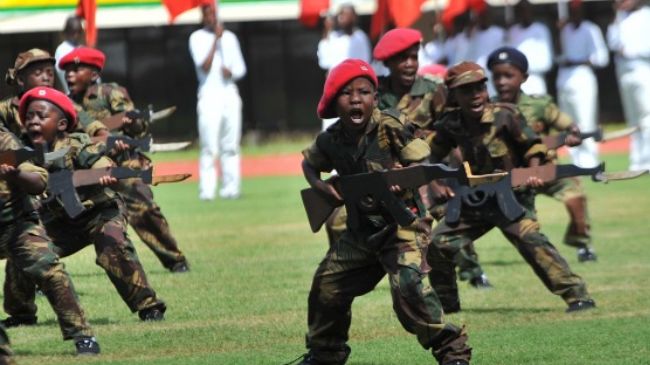
The Obama administration has waived nearly all US sanctions against countries using child soldiers despite a recent executive order to fight human trafficking.
US President Barack Obama issued a presidential memorandum on Friday waiving sanctions under the Child Soldiers Protection Act of 2008 for Libya, South Sudan and Yemen that Congress legislated to halt US arms sales to countries that are “worst abusers of child soldiers in their militaries,” the US-based periodical Foreign Policy reports Tuesday.
According to the report, Obama also partially waived penalties against the Democratic Republic of the Congo in an effort to allow continued military training and arms sales to the African country.
Angered by Washington’s move, human rights activists say the waivers are damaging to the aim of using US influence to discourage nations that get American military support from using child soldiers. They also insist the measure contradicts the rhetoric Obama used in a speech he delivered on Friday when signing the executive order.
“When a little boy is kidnapped, turned into a child soldier, forced to kill or be killed — that’s slavery,” Obama claimed during his address. “It is barbaric, and it is evil, and it has no place in a civilized world. Now, as a nation, we’ve long rejected such cruelty.”
Many among the American human rights community are upset that despite such forceful oratory against the use of child soldiers, the US president has waived for the third consecutive years all penalties against states that are major abusers of the human rights violation.
“After such a strong statement against the exploitation of children, it seems bizarre that Obama would give a pass to countries using children in their armed forces and using U.S. tax money to do that,” said Jesse Eaves, the senior policy advisor for child protection at World Vision, as quoted in the report.
Eaves insists that the Obama administration wants to maintain its ties with regimes that it needs for security cooperation and that such blanket use of US waivers allows the administration to avert the objective of the law, which was supposedly to uphold internationally recognized human rights and child protection protocols when dishing out American military aid to other nations.
“The intent in this law was to use this waiver authority only in extreme circumstances, yet this has become an annual thing and this has become the default of this administration,” Eaves was quoted as saying in the report.
According to the periodical, Obama first waived the sanctions in 2010, the first year they were to go into effect. At the time, the White House failed to inform Congress of its decision in advance, triggering a strong backlash. A reported justification memo pointed to a number of security-related excuses for the waivers. Sudan was going through a fragile transition, for instance. Yemen was crucial to counterterrorism cooperation, the administration argued.
Related articles
- Obama waives sanctions on countries that use child soldiers (thecable.foreignpolicy.com)
- Obama Demands Right to Recruit Minors for Military (infowars)
- White House Says Child Soldiers Are Ok, if They Fight Terrorists (alethonews)
Featured Video

Patrik Baab: Europe’s New Iron Curtain – Freedom of Speech Dies
or go to
Aletho News Archives – Video-Images
Book Review
Jeffrey Epstein: A Jewish Individual?
The Occidental Observer | February 5, 2023
One Nation Under Blackmail: The Sordid Union between Intelligence and Organized Crime that Gave Rise to Jeffrey Epstein (Volume 1 & 2) by Whitney Webb
“Far from being an anomaly, Epstein was one of several men who, over the past century, have engaged in sexual blackmail activities designed to obtain damaging information (i.e., “intelligence”) on powerful individuals with the goal of controlling their activities and securing their compliance.”[1]

Jeffrey Epstein is dead and Ghislaine Maxwell is locked away in prison, and the thought-makers of our world seem keen to let the more explosive parts of the scandal dissipate from the public consciousness. As far as the mainstream media is concerned, Epstein and Maxwell were little more than well-connected socialites who ran a sex-trafficking ring for the rich and the powerful, and the focus has shifted instead to the criminal and civil cases seeking to achieve redress for the victims of sexual abuse.
On occasion some newspaper articles will mention the hidden cameras littered across Epstein’s properties, others the reams of CDs and hard drives found within them during the FBI raids. Altogether missing from the Netflix documentaries (Jeffrey Epstein: Filthy Rich [2020] and Ghislaine Maxwell: Filthy Rich [2022]) or the articles that spend their time narrowly focusing on the links between Epstein and Bill Gates, is the acknowledgement of the true nature of Epstein himself and the ultimate purpose of this sex-trafficking of minors — a sexual blackmail operation.
Not everyone is cowardly enough to let these controversial aspects lie untouched, as the newly released two-volume book One Nation Under Blackmail by independent reporter Whitney Webb seeks to blow wide open this media-enforced blackout. Utilizing primarily open-source information (that is, publicly accessible information such as books, newspapers articles and government reports),[2] Webb’s book delves into the life and times of Jeffrey Epstein and his deep ties to Jewish billionaires and Israeli intelligence. … continue
Blog Roll
Recent Comments


 Aletho News
- Patrik Baab: Europe’s New Iron Curtain – Freedom of Speech Dies
- Trump’s ‘Board of Peace’ exports Israeli ‘ceasefire’ diplomacy to the world
- Israeli army closes dozens of cases involving killing of Palestinians inside torture camps
- Europe creates a ‘Russian government-in-exile’, consisting of a bunch of losers
- Munich, 2007: The Day the West Was Told No
- At The Munich Security Conference, AOC Gets It Wrong On Foreign Policy
- Europe Decided to Go to War With Russia by 2030, Already Preparing – Orban
- Russia and China Are Expanding Their Cooperation to Counter US Efforts to Bully Iran and Cuba
- NATO plotting maritime blockade of Russia – Moscow
- Jeffrey Epstein’s sinister shadow over West Asia
- If Americans Knew
- Israel battles Palestinian right of return, one Palestinian at a time – Not a ceasefire Day 127
- Noor’s short life of unimaginable suffering
- Israel Destroyed Gaza’s Hospitals. Now It’s Banning Doctors Without Borders.
- Is Spite of What Zionists Say, It’s a Good Thing to Criticize Governments
- Palestinian mother, daughter recount strip searches, harsh conditions in Israeli detention
- Israel used weapons in Gaza that made thousands of Palestinians evaporate
- ADL’s Stats Twist Israel’s Critics Into Antisemites
- Why Is the World Silent When the Gaza Genocide Is Not Over?
- In Gaza: 8,000 bodies under rubble, 3,000 missing – Not a ceasefire Day 126
- AZAPAC, the new PAC opposing Israeli domination of U.S policies
- No Tricks Zone
- Unfudging The Data: Dutch Meteorological Institute Reinstates Early 20th Centruy Heat Waves It Had Erased Earlier
- German Gas Crisis…Chancellor Merz Allegedly Bans Gas Debate Ahead of Elections!
- Pollen Reconstructions Show The Last Glacial’s Warming Events Were Global, 10x Greater Than Modern
- Germany’s Natural Gas Storage Level Dwindles To Just 28%… Increasingly Critical
- New Study Rebuts The Assumption That Anthropogenic CO2 Molecules Have ‘Special’ Properties
- Climate Scientist Who Predicted End Of “Heavy Frost And Snow” Now Refuses Media Inquiries
- Polar Bear Numbers Rising And Health Improving In Areas With The Most Rapid Sea Ice Decline
- One Reason Only For Germany’s Heating Gas Crisis: Its Hardcore-Dumbass Energy Policy
- 130 Years Later: The CO2 Greenhouse Effect Is Still Only An Imaginary-World Thought Experiment
- New Study Affirms Rising CO2’s Greening Impact Across India – A Region With No Net Warming In 75 Years
 Aletho News