’Assad must go’ no more: US gov’t shifts priorities in Syria
RT | March 30, 2017
Washington’s priorities in Syria have changed with the new administration, and the US will no longer focus on the removal of President Bashar Assad as a condition for ending the six-year civil war, a top official said.
“Our priority is no longer to sit there and focus on getting Assad out,” Ambassador Nikki Haley told a small group of reporters on Thursday.
“Our priority is to really look at how do we get things done, who do we need to work with to really make a difference for the people in Syria.”
Earlier in the day, Secretary of State Rex Tillerson said that the future of President Assad “will be decided by the Syrian people.”
Tillerson was in Ankara meeting with his Turkish colleague Mevlut Cavusoglu. Some of their discussion involved Turkey’s support for the US-led coalition against Islamic State (IS, formerly ISIS/ISIL) in Iraq and Syria.
Since 2011, when the conflict in Syria began, Washington has insisted that “Assad must go” as the only acceptable solution for peace in the country.
The US has provided weapons and training to what it called “moderate rebels” in Syria, ostensibly so they could fight IS rather than the government.
Leaving the State Department in January, now former Secretary of State John Kerry acknowledged that the Obama administration planned to oust Assad’s government by supporting the rebels, but “that whole ball game changed” when Russia intervened in September 2015.
Turkey also intervened in Syria, launching Operation “Euphrates Shield” in August 2016. Ankara officially announced the operation’s end on Wednesday, but did not say if and when the Turkish army will withdraw from the zone it occupied in northern Syria.
Russian FM Lavrov’s March 29, 2017 interview with National Interest Magazine
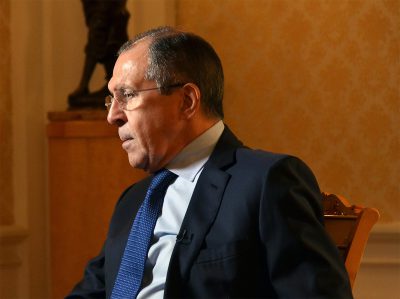
Question: I’d like to start by asking you about your forthcoming meeting with US Secretary of State Rex Tillerson, we’ve read in the press that the two of you may be meeting soon.
Sergey Lavrov: So they say.
Question: Could you perhaps tell us about your expectations and goals in dealing with Secretary Tillerson?
Sergey Lavrov: Well, after the American election, soon after Election Day President Putin and President-elect Trump talked over the phone. It was a good but very general discussion touching upon the key issues in our relations, and of course the key international issues. And they agreed that they would continue being in touch and after the inauguration they talked again, and they reconfirmed the need to look for ways which would be effective in handling international problems. And of course to see what could be done to bring the bilateral relations to normalcy. They also agreed that Mr. Rex Tillerson and I would look into the agenda in some more details, and would also discuss the preparation for the presidential meeting which should take place when both countries, both leaders feel comfortable.
And we met with Rex in mid-February in Bonn on the margins of the G-20 ministerial meeting, and covered quite a lot of the bilateral agenda. I briefed him about the relationship on bilateral issues with the Obama administration, the problems which accumulated during that period. We did not go into the substance of this, I just briefed him so that his team, which is still being assembled, could take a look at these issues and determine what kind of attitude they would have on them. And we discussed Syria, Iran, the Korean Peninsula, the Middle East in general, relations between Russia and the West, it was a very general, but rather substantive discussion, obviously it was the first contact and Mr. Rex Tillerson is just getting into the shoes of his new capacity. We discussed the possibility of personal meeting and have been continuing these discussions. As soon as we finalize them it will be announced.
But my feeling is that from the point of view of personal relationship, we feel quite comfortable. I feel quite comfortable, I believe Rex had the same feeling, and our assistants should work closer but of course this could only be done when the team in the State Department is complete.
Question: Of course. If I could follow up on your answer there, you mentioned bringing normalcy to the U.S.-Russia relationship. What do you think “normal” is?
Sergey Lavrov: “Normal” is to treat your partners with respect, not to try to impose some of your ideas on others without taking into account their own views and their concerns, always to try to listen and to hear, and hopefully not to rely on a superiority complex, which was obviously the case with the Obama administration. They were obsessed with their exceptionality, with their leadership. Actually the founding fathers of the United States, they also spoke of their leadership, and they believed that the American nation was exceptional, but they wanted others just to take the American experience as an example and to follow suit. They never suggested that the United States should impose, including by force, its values on others.
And the Obama administration was clearly different. Actually, long before Ukraine, long before Crimea, in early December 2012, there was an OSCE ministerial meeting in Dublin. And Hillary Clinton was Secretary of State and was the head of the delegation, we had a bilateral meeting with her, she was trying to persuade me on something which was a difficult issue on the agenda, but I recall this situation because in the margins of this ministerial meeting she attended a meeting in the University of Dublin, and she delivered a lecture in which she said something like: “We are trying to figure out effective ways to slow down or prevent the move to re-Sovietize the former Soviet space.” December 2012.
What kind of action she was considering as the move to re-Sovietize the space, I really couldn’t understand. Yes, there were discussions about Ukraine, about Kazakhstan, Belarus and Russia, forming the Customs Union, and if this was the reason, then of course it showed very obviously the real attitude of the Obama administration to what was going on in the former Soviet space and the area of the Commonwealth of Independent States, its obvious desire to take over this geopolitical space around Russia without even caring what Moscow might think.
This was the reason for the crisis in Ukraine, when the U.S. and European Union bluntly told the Ukrainians: either you are with us, or you are with Russia against us. And the very fragile Ukrainian state couldn’t sustain this kind of pressure, and what happened- happened: the coup, and so on and so forth (if you want I can discuss this in some detail later). But my point is that they considered normal that the people in Obama’s team should call the shots anywhere, including around such a big country as the Russian Federation. And this is absolutely abnormal in my view.
At the same time, when we visited Venezuela with our naval ships, they were raising such hell, as if no one could even get closer to what they believe should be their backyard. This mentality is not adequate for the twenty-first century. And we of course notice that President Trump is emphasizing the need to concentrate on U.S. interests. And foreign policy for him is important as long as it serves the United States’ interests, not just some messiah projects doing something just for the sake of showing that you can do it anywhere. It’s irrational, and in this he certainly holds the same position as we do in Moscow, as President Putin does, that we don’t want to meddle in other people’s matters. When the Russian legitimate interests are not, you know involved.
Question: You just mentioned at the end of your statement that the United States shouldn’t meddle in others’ affairs, and obviously many Americans today feel that Russia has meddled in American affairs, in the 2016 election. Your government has denied that. But how do you explain what happened in the United States? Do you feel that Russia had any involvement or any responsibility at all for what transpired?
Sergey Lavrov: I believe that these [are] absolutely groundless accusations – at least I haven’t seen a single fact that this was substantiated. I believe these accusations were used as an instrument in the electoral campaign, which for some reasons seemed to the Democratic Party to be an efficient way to raise support among the American people, playing on their feelings that no one shall meddle with American affairs. This is a Russophobic instrument. It was a very sad situation because we never wanted to be unfriendly with the American people, and apparently the Obama administration, the elite in the Democratic Party, who made every effort during the last couple of years to ruin the very foundation of our relationship, decided that the American people should be brainwashed without any facts, without any proof. We are still ready to discuss any concerns of the United States.
As a matter of fact, in November 2015, long before this hacker thing started, we drew the attention of the U.S. administration to the fact that they kept hunting Russian citizens suspected in cybercrime in third countries, and insisting on them being extradited to the United States, ignoring the treaty on mutual legal assistance which exists between Russia and the United States, and which should be invoked in cases when any party to this treaty has suspicions regarding the citizen of another one. And this was never done.
So what we suggested to them in November 2015, that we also don’t want to see our citizens violating law and using cyberspace for staging all kinds of crimes. So we would be the last one to try to look aside from them. We want them to be investigated and to be disciplined. But since the United States continued to avoid invoking this treaty on legal assistance, we suggested to have a meeting between the Justice Department and the Russian prosecutor-general, specifically at the expert level, on cybercrime. To establish confidential, expert, professional dialogue to exchange information.
They never replied; when we reminded them that there was a request, they orally told us that they were not interested, but in December 2016, more than one year after our request was tabled, they said, “Okay, why don’t we meet?” But this came from Obama administration experts, when they already were on their way out, some technical meeting took place, it was not of any substance but at least they responded to the need to do something about cyberspace.
And of course on cybercrimes the discussions in the United Nations are very telling. When we are leading the debate on negotiating an instrument which would be universal and which would be mandatory for everybody, the U.S. is not really very much eager, and is not very enthusiastic.
Speaking of meddling with others’ matters, there is no proof that Russia was in any way involved either in the United States, or in Germany, or in France, or in the United Kingdom – by the way, I read yesterday that the Swedish prime minister is becoming nervous that they also have elections very soon and that Russia would 100 percent be involved in them. Childish, frankly speaking. You either put some facts on the table or you try to avoid any statements which embarrass you, even if you don’t believe this is the case.
It’s embarrassing to see and to hear what we see and hear in the West, but if you speak of meddling with other countries’ matters, where facts are available—take a look at Iraq. It was a very blunt, illegal intervention, which is now recognized even by Tony Blair, and those who were pathetically saying that they cannot tolerate a dictator in Iraq. Take a look at Libya, which is ruined, and I hope still has a chance to become one piece. Take a look at Syria, take a look at Yemen: this is the result and the examples of what takes place when you intervene and interfere. Yes, I’m sure you can say about Ukraine, you can say about Crimea, but for this you have to really get into the substance of what transpired there.
When the European Union was insisting that President Yanukovych sign an association agreement, including a free-trade zone with zero tariffs on most of the goods and services crossing the border between Ukraine and the European Union, and at that point it was noted that Ukraine already had a free-trade area with Russia, with some different kind of structure, but also with zero tariffs. So if Russia has zero tariffs with Ukraine, Ukraine would have the same with European Union but we have some protection, under the WTO deal with the European Union, so the only thing we said: guys, if you want to do this, we would have to protect our market from the European goods which would certainly go through Ukraine to Russia, trying to use the zero-tariff arrangement. And the only thing suggested, and Yanukovych supported, is to sit down the three—Ukraine, EU and Russia—and to see how this could be handled. Absolutely pragmatic and practical thing. You know what the European Union said? “None of your business.”
Then-President of the European Commission Mr. Jose Manuel Barrosso (my favorite) stated publicly that we don’t meddle with Russia’s trade with China, so don’t meddle with our deal with Ukraine. While the situation is really very different and the free-trade area argument was absolutely ignored. And then Mr. Yanukovych asked for the signature of this deal to be postponed, for him to understand better what will be the consequences—for his industry, for his finances, for his agriculture—if we would have to protect ourselves from potential flow of cheap goods from Europe. That’s so, and then the coup was staged, in spite of the fact that there was a deal between Yanukovych and the opposition, witnessed by Germany, France and Poland.
Next morning, this deal was torn apart under the pretext that Yanukovych disappeared, and therefore all commitments were off. The problem is that he did not leave the country, he was in another city of the country. But my main point is that the deal which they signed with him was not about him; it was about his agreement to go to early elections – and he would have lost these elections – but the deal started by saying, “We agree to create a government of national unity.”
And next morning, when they just tore apart this deal, Mr. Arseniy Yatsenyuk then a leader in Ukraine’s Batkivshchyna party and others who signed the deal with the President, they went to this Maidan, to the protestors, and said, “Congratulations, we just created the government of the winners.” Feel the difference: “government of national unity” and “government of the winners”. Two days later, this parliament, which immediately changed their position, announced that the Russian language is no longer welcome.
A few days later, the so called the Right Sector, the group which was an instrument in the violence in Maidan—they said that Russians have nothing to do in Crimea, because Russians would never honor the heroes of Ukraine, like Bandera and Shukhevych, who were collaborating with Nazis. These kinds of statements led to the people in the east of Ukraine just to say: “guys, you did something unconstitutional, and we don’t believe this is good for us”, so leave us alone, let us understand what is going on in Kiev, but we don’t want any of your new ideas to be imposed on us. We want to use our language, we want to celebrate our holidays, to honor our heroes: these eastern republics never attacked anyone. The government announced the antiterrorist campaign in the east, and they moved the regular army and the so-called voluntary battalions in the east of Ukraine. This is not mentioned by anyone. They are called terrorists—well, they never attacked a person.
And investigations of what actually happened on that day of the coup is going nowhere, the investigation of the murder in Odessa on the second of May, 2014, when dozens of people were burned alive in a trade-union office building, is moving nowhere. Investigation of political murders of journalists and opposition politicians is not moving anywhere. And they basically passed amnesty for all those who were on the part of the opposition during the coup. And they prosecute all those who were on the part of the government.
But even now they want to prosecute Yanukovych in absentia, but one interesting thing maybe for your readers to compare: there was a deal on the twenty-first of February, next morning they said, Yanukovych is not in Kiev, so our conscience is clean and we do what we please, in spite of the commitment to national unity. About the same time there was a coup in Yemen. President Hadi fled to Saudi Arabia. Not to some other city in Yemen, but he fled abroad.
More than two years passed, and the entire progressive international community, led by our Western friends, insists that he must be brought back to Yemen and that the deal which he signed with the opposition must be honored by the opposition. My question is why Ukraine’s situation is treated differently from the situation in Yemen. Is Yemen a more important country? Are the deals which you sign and the need to respect your word and your deals, more sacred in Yemen than in Ukraine? No answer.
Sorry for getting into all these details, but people tend to forget, because they’re being brainwashed every day with very simple phrases like “Russia is aggressor in Ukraine,” “annexation of Crimea” and so on and so forth, instead of laboring your tongues, people should go there. Those who go to Crimea, see for themselves how the people live there, and they understand that all these hysterical voices about violation of human rights, about discrimination vis-à-vis Crimean Tatars, is a lie.
Question: Maybe coming back, just for a moment, to the U.S. election, and setting aside the question of evidence, because your government has its perspective, the U.S. intelligence community has its perspective—I don’t think those differences are likely to be reconciled. Setting that question aside, many Americans believe that Russia did interfere in the election; it’s contributed to a particular political climate in the United States. Do you view that as an obstacle to the U.S.-Russia relationship, and do you believe there is anything that Russia can or should do to try to address these widespread concerns?
Sergey Lavrov: You said a very interesting thing. You used the word “perspective.” You said, “Russia has its own perspective; the American intelligence community has its own perspective.” Perspective is something which many people have. We speak about facts, about proofs. And with all these perspectives, these hearings which sometimes are shown on CNN, on Russian TV, I haven’t heard any, any proof. Except the confirmation that the FBI and the NSA started watching what the Trump team is doing sometime in July. I heard this recently.
And I take this as acceptance by those who were doing this, for whatever reason, and they clearly said that this was not because of the suspicion that he had something to do with Russia but this was a routine process during which they find a trace leading to the Trump headquarters. Fine, this is a fact: they admitted that they started this. So what? If by admitting this they make their perspective regarding Russia a fact, I cannot buy this.
And then you said, they have their own perspective, and that the American people believe Russia had something to do with the American elections. Categories like perspective and belief are not very specific. And we speak about some very serious accusations. I understand that in the West, people who indeed profess Russophobic feelings, and unfortunately they are—they used to be very powerful, they are still very powerful even when they lost the elections: and Russophobic trends are obviously seen even in the Republican camp. You know, it’s very easy to find some external threat and then to put all the blame on this particular external threat.
When in 2014 the Malaysian plane was shot down over Ukraine, two days later I think, in the UN Security Council, when we insisted on adopting a resolution demanding further investigation, the American officials said yes, we believe investigation must be held, but we already know the result.
What about the presumption of innocence? The same happened on Litvinenko, the poor guy who was poisoned in London, when from the very beginning they said, we will have an investigation but we know who did it, and they never made this trial public. And they never accepted the offer of assistance which we were ready to provide. And so on and so forth.
Now, yesterday, this terrible murder of the Russian and Ukrainian citizen, who used to be an MP in Russia, and did not stay in the current parliament, and President Poroshenko two hours after the guy was murdered says that this was a terrorist attack from Russia—who also blew up the munition depot near Kharkov. It was said a few hours later by the president of a democratic country, whom our American and European friends call a beacon of democracy. I thought democracy was about establishing facts when you have suspicions.
And democracy is about division of power, and if the the chief executive takes upon himself the functions of the legal system, of the judicial system, that does not fit with my understanding of how Western democracy works. We’re ready to discuss anything, any facts, I mean. We’re ready to assist in investigations of whatever issues our partners anywhere might have. Whether this is going to be an obstacle to normal relations, I don’t think so. I believe the Russian people, at least if we are asked, I would say no, if it depends on us. I understand that there are some people in the United States who want this to become an obstacle, and who want to tie up the team of President Trump on the Russian issue, and I believe this is very mean policy, but we see that this is taking place.
What can Russia do to help? Unfortunately, not much. We cannot accept the situation, but some absolutely artificial hysterical situation was created by those who severed all of the relationship—who dropped the deal on the Bilateral Presidential Commission between Moscow and Washington with some twenty-plus working groups, a very elaborate mechanism of cooperation—and then after they have done this, after they prevent the new administration from doing away with this absolute stupid situation, to ask us to do something? I don’t think it’s fair.
We said what we did, that we are ready to work with any administration, any president who would be elected by the American people. This was our line throughout the electoral campaign, unlike the acting leaders of most European countries who were saying absolutely biased things, supporting one candidate, unlike those who even bluntly warned against the choice in favor of the Republican candidat, and this somehow is considered normal. But I leave this on the conscience of those who said this and then immediately chickened out and then started praising the wisdom of the U.S. electorate.
We said that we would be ready to come back to the relationship and to develop the relationship with the United States to the extent, and to the depths, to which the administration is ready to go. Whatever is comfortable for our partners, we will support and provide it. We talk on the basis of mutual respect and equality, trying to understand the legitimate interest of each other and to see whether we can find the balance between those interests. We will be ready to cover our part of the way, as President Putin said, but we will not be making any unilateral steps. We offered cooperation on very fair terms, and we will judge by the deeds of course.
Question: Perhaps we can pivot to international affairs. In the United States there’s been discussion of a new Cold War; you, for your part, recently talked about a post-West international order, which as you may imagine is not something that many in the United States and other Western countries would readily embrace. In fact, some may even be strongly inclined to resist the emergence of a post-West order. What do you think a post-West order is, and do you think that it makes confrontation between Russia and the United States, or Russia and the West, inevitable?
Sergey Lavrov: Well first, I don’t believe that we are having another Cold War. Ideologically, we’re not different, we’re not apart. Yes, there are nuances in how the countries in the West and Russia and its neighbors are run. But all in all the basis is democracy, which is elections, basically, and organizing the system, the way you respect the opposition and it’s also market economy. Again with «give and take» you know in some countries the state is much more involved in economy than in others but this happened in France some time ago, in the UK some time ago, so this is all secondary details, I would say. There’s no ideological differences as far as democratic principles and market economy are concerned. Second, these days, unlike the days of the Cold War, we have much clearer common threats, like terrorism, like chaos in the Middle East, like the threat of the proliferation of weapons of mass destruction. This was never the case during the Cold War days, which was a very negative balance with sporadic conflicts in periphery. This time we have global universal threats, not sparing anyone and this is what we witness almost daily, with these terrorist attacks in the Middle East and Europe, there was one in the United States, and so on and so forth.
So this absolutely makes it necessary to reassess where we are and what kind of cooperative structure we need. Post-West system, post-West order: I mentioned this term in Munich at the Munich Security Conference, and I was really surprised that people immediately made me the author, the coiner of this term, because the title of the conference contained “post-West order”—with a question mark, yes. I put the question mark aside for one very simple reason: if we all agree that we cannot defeat terrorism, organized crime, drug trafficking, climate change without a universal coalition, if we all agree that this is the case, and I believe we do, then it would certainly be necessary to recognize that the world is different, compared to the many centuries than when the West was leading with culture, philosophy, military might, economic systems, and so on and so forth.
We all have, China, the whole Asia-Pacific region, which President Obama, by the way, said is the place where the U.S. would be shifting, which in itself means that he was not thinking of the West order but post-West order. And, of course, Latin America, Africa, which is hugely underdeveloped but has the potential with resources and labor, young and vigorous, still untapped. Secretary of State Rex Tillerson just a few days ago in Washington convened a coalition to fight terrorism—sixty-eight countries if I am not wrong, double the number of the countries in the West. This meeting was post-West order, or a manifestation of post-West order. So I don’t believe the Western countries should be really offended or should feel that their contribution to the world civilization has been underestimated—not at all. It’s just the time when no one can do it alone, and that’s how we feel. It’s a polycentric world. Call it multipolar, call it polycentric, call it more democratic—but this is happening. And economic might, financial might and the political influence associated with all this, they’re much more evenly spread.
Question: Let’s zero in on Syria. You mentioned the terrorism issue and certainly the struggle with ISIS is an important focus for the U.S., for Russia. There has been, as I’m sure you’re aware, some skepticism in the United States about Russia’s role in Syria. President Donald Trump, when he was a presidential candidate, certainly referred many times to a desire to work with Russia in Syria. How do you envision the opportunities and constraints on the U.S. and Russia in working together in Syria, and do you have any specific new ideas about how to do that?
Sergey Lavrov: First, when this coalition was created by the Barack Obama administration (the coalition which was convened in Washington just a few days ago) it was understood that out of sixty-some countries only a few would be actually flying air force and hitting the ground. Others were mostly political and moral support, if you wish, solidarity show—which is fine, it’s important these days as well to mobilize the public opinion in as many countries as you can. We were not invited. The Iranians were not invited. Some others were not invited, who I believe should be important partners in this endeavor. But this was motivated by some ideological considerations on the part of the Barack Obama administration. I just don’t want to go into the reason for why they assembled this particular bunch of people.
But what I can attest to is that one year into the creation of this coalition, it was very sporadically using the air force to hit some ISIL positions. They never touched the caravans who were smuggling oil from Syria to Turkey and, in general, they were not really very active. This changed after we responded to the request of President Assad, who represents, by the way, a legitimate government –member of the United Nations. After we joined, President Vladimir Putin and President Barack Obama spoke in New York in September 2015, and President Putin clearly told him that we would be doing this and we were ready to coordinate, and they agreed to have these deconfliction discussions, which did not start soon actually, not through our fault. But when we started working there the U.S.-led coalition became much more active. I don’t want to analyze the reason for this. I’m just saying before we moved there with our air force, the U.S. coalition was very rarely hitting ISIL positions and almost never hitting the positions of Jabhat al-Nusra, which many people believe has been spared just in case at some point they might be needed to topple the regime. And this feeling, this suspicion, is still very much alive these days, when Jabhat al-Nusra already twice changed its name, but it never changed its sponsors who continue to pump money and whatever is necessary for fighting into this structure. And people know this. So when we moved there, at the request of the government, we suggested to the U.S. to coordinate our efforts. They said, “No, we can only go for deconfliction,” and deconfliction procedures were developed and are being applied quite well, but we believed it was a shame that we couldn’t go further, and coordinate targets and what have you. And then my friend, John Kerry, who was very sincere in his desire to overcome the ideological—not ideological, but to overcome some artificial barriers, and to indeed start military coordination—we spent almost from February 2016 to September 2016 when, eventually, we had a deal to separate the armed groups, with whom the U.S. and the allies cooperate, from ISIL and Jabhat al-Nusra, and then to coordinate the targets and basically to strike only those targets which would be acceptable to both Russians and the Americans. Quite a few people really understood the quality of this deal.
I put myself in the shoes of those who were criticizing us for hitting wrong targets. You remember, there was so much criticism. So the deal we reached with Kerry, when none of us could strike unless the other supports, was solving this problem. And the fact that the Pentagon just disavowed what Kerry did, and Obama could not overrule the Pentagon, meant for me only one thing: that he, the president of the United States, Barack Obama, was motivated by the desire to have some revenge on Russia, for whatever reason and for whatever situation, rather than to capitalize over the deal reached between John Kerry and us, to make the war against terror much more efficient in Syria. But let God judge him.
Now, whether we have an opportunity to resume the cooperation: yes we do. Yes, President Donald Trump said that fighting terrorism is his number one international goal, and I believe this is absolutely natural. We will be sharing this approach, I am sure, and it’s also, in this sense, coming back to our first question which we discussed, about intervention in other parts of the world, terrorism is a universal threat. So when you interfere to fight terrorist manifestations, it’s in the interest of your country. It’s another matter that you have to be faithful to international law. And the coalition, of course, led by the United States, was never invited to Syria. We were, Iran was, Hezbollah was. Still, the Syrian government, while complaining that the coalition were there uninvited, they said, “If and since you’re going to coordinate with Russians, with those who fight ISIL and Nusra, we take it as this is what you want, to defeat terrorism, not to do anything else in Syria.” So deconfliction procedures continue to be applied.
You might have heard that the chief of general staff of the Russian Army, General Gerasimov, met with General Dunford.
Question: Twice, I understand.
Sergey Lavrov: Twice, at least, and they talked over the phone. And this is something the military discussed. I assume that if their discussions go beyond deconfliction, I don’t want to speculate, this would be a welcome sign that we can really do what is necessary to bring about the situation when everyone who confronts ISIL and Nusra on the ground acts in coordination. If not under the united command—this, I think is unachievable—but in a coordinated manner.
The Turks have troops on the ground. Iran, Hezbollah are invited by the government. Russian air force with some ground special military police helping keep law and order in the Sunni quarters of Aleppo and Damascus, the military police from Russia is largely composed of Russian Sunnis from the northern Caucasus—Chechens, Ingush and others.
The U.S. Air Force and the coalition air force; U.S. special forces on the ground. Apparently there are French and U.K. special forces on the ground. The military groups who are part of the so-called Free Syrian Army, the military armed groups who are part of the Kurdish detachments—there are so many players: I listed all those who declare that ISIL and Nusra are their enemies. So some harmonization is certainly in order, and we are very much open to it.
When the United States dropped from the deal, which we negotiated with John Kerry, we shifted to look for some other opportunities and we had the deal with Turkey later—which was later supported by Iran—which brought about some kind of cessation of hostilities between the government and a group of armed opposition. And we created, in Astana, a parallel track supportive of the Geneva negotiations concentrating on mechanisms to monitor the cessation of hostilities, to respond to violations, also to build up confidence by exchanging prisoners, and so on and so forth.
It is not welcome by quite a number of external players who try to provoke and encourage the radicals, radical armed groups in Syria, to make trouble and to stage some terrorist attacks. They launched a huge offensive now in the northern part of the Hama province, and they basically coordinate with Jabhat al-Nusra, under its new name. So it’s also a game for influence in Syria, unfortunately, which prevails in the minds of the people who promote such an approach, rather than the need to get united to fight terrorism, and then to have a political deal. It’s the fight for influence on the battleground, and this is unfortunate. We don’t need this now. What we need is to strengthen the cessation of hostilities and to support strongly the political process in Geneva, concentrated on the new constitution, which would be accompanied by a division of power between the government, the opposition, all ethnic groups, then elections and so on and so forth. But all this would be absolutely meaningless if people sacrifice the fight against terror for the sake of their goal, their obsession, with regime change.
Question: In Iran, the Trump administration seems to have signaled an intent to try to enforce the Iran nuclear deal, the JCPOA, more strictly, perhaps to be more assertive in challenging Iran’s regional role. And I’d be curious about your reaction to that and the degree to which Russia could work with, or not work with, the United States on either of those things. Then there is Ukraine. Clearly a very complex problem, the Minsk Process I think to many outside observers really seems to have stalled. Is that process dead? Is there any way to move forward?
Sergey Lavrov: On Iran, the Joint Comprehensive Plan of Action was a product of collective work—it’s a compromise. But the key things were never compromised. It’s a compromise which allows for all of us, with the help of the International Atomic Energy Agency, to be sure that Iran’s nuclear program is going to be peaceful, that all the elements which cause suspicion would be removed, and handled in a way which gives us all certainty and gives us control over the implementation of those arrangements.
I don’t think that the Trump administration is thinking in the same terms as the slogans during the campaign, that Iran is the number one terrorist state; we don’t have a single fact to substantiate this claim. At least when we were facing a huge terrorist threat, when we were under terrorist attack in the 1990s in the northern Caucasus, we detected and discovered dozens and hundreds of foreign terrorist fighters from very close neighborship to Iran, but not from Iran at all. And we know that the political circles in quite a number of countries were really encouraging these terrorist groups to go into the northern Caucasus. Iran had never challenged the sovereignty of the Russian Federation, never used its own links with Muslim groups to provoke radicalism and to create trouble. What we do now with Iran and those that cooperate with us and the Syrian army is fighting terrorists in Syria. Iran is a powerful player on the ground, legitimately invited by the government. Iran has influence over Lebanese Hezbollah, which is also legitimately on the ground. And if we all want, you know, to topple, to defeat terrorists in Syria, there should be some coordination. I have already touched upon this.
The IAEA regularly reports on this Joint Comprehensive Plan of Action implementation. The latest report once again confirmed that there are no violations of the part of Iran, and that the deal is being implemented in line with the commitments of Tehran and all others. It’s another matter that the steps which were promised in return to the implementation, namely sanctions relief, are not being undertaken by all Western participants as fast and as fully as was promised. But that’s another matter.
On the Minsk agreements, I believe that the Ukrainian government and President Poroshenko personally want them dead. They want them dead in a way which would allow them to blame Russia and the people in the east of Ukraine. They certainly encountered huge opposition from the radicals, and the radicals believe that this government is weak enough just to wait it out and to have either early elections or to have another Maidan. The biggest mistake of President Poroshenko, I am convinced, was that after he signed this agreement in February 2015 in Minsk, and he came back with the success, with the support of Germany, France, then the Security Council in New York endorsed this deal, and he should have used this moment to impress upon his parliament, upon the opposition, that this was a good deal supported by the European Union, where he wanted to join.
Instead, he started apologizing in front of his opposition when he got back to Kiev saying, you should not think this is serious, I did not commit myself to anything in the legal way—in the legally binding way—this is not what you read. And so on and so forth. He cornered himself in the situation of an absolutely irresponsible politician who signed one thing and who was saying that this is not what he signed one week later when he came back. The opposition felt that this was his weakness and they started carving out of his position anything which was still reasonable. The fact that every day he is in contact with President Vladimir Putin, they talk over the phone sometimes, they talk on the margins of the meetings of the Normandy Format when the leaders have their meetings; the last one was in October in Berlin last year. But my impression is that he tries to be constructive, to find ways to come back to the Minsk implementation. But the next day he comes back to Kiev or goes abroad, and goes public saying things which are absolutely aggressive and are absolutely unfair.
One very simple example: the Minsk agreement, they provide for preparation for elections on the special status of these territories, the status itself is listed in the deal, and the law on this special status is already adopted by the Rada, but it is not in force. Then amnesty, because you don’t want to have a «witch hunt», and the constitutional confirmation that this special status is permanent. That was all. And after this is done, the Ukrainian government restores full control over the entire Russian-Ukrainian border. They are saying now: no elections, no special status, no constitutional change, no amnesty, until we first take control of the border. But everyone can read the Minsk agreement—it’s only three pages. And it says absolutely clearly that the border transfer is the last step, and everyone understood why when this was negotiated. Because if you just under these circumstances, with all these animosities, with all these so-called voluntary battalions, Azov, Donbass and all the radicals, not reigned in by the government—when you just say, okay, take the border and we trust you that will do everything else, these people would just be victims. They will be suffocated and burned alive like the people in Odessa. So the political guarantees are crucial, and Germany, France and others understood this very well, just like the Americans understood this very well, because we did have parallel track—parallel to the Normandy Format—with the U.S. and we are ready to revive it again.
But one very simple example. October 2015, Paris: the Normandy leaders meet. And there is very specific discussion regarding the law on special status. The logic and sequence of the Minsk agreement is that you first have the special status, and then you have elections. Because people would normally want to know what kind of authority those for whom they are going to vote would have. Poroshenko said, no, we first have to have elections. Then I, Poroshenko, would see whether the people elected are to my liking. And if they are, then, we will give them the special status.
Which is rather weird. But still, we decided just to move forward, we would be ready to have some compromise on this thing, in spite of the fact that it was absolutely clearly spelled out in the Minsk agreement. And then the former foreign minister of Germany, who was participating in the meeting, Frank-Walter Steinmeier, who is now president of Germany, he said, why don’t we have a compromise formula which would mean that the law on the special status is adopted, but it enters into force on the day of elections temporarily, and it would enter into force, full fledged, on the day when the OSCE reports that elections were free and fair, and in line with democratic OSCE standards?
Everyone says okay. Poroshenko says okay. One year later, in October 2016 in Berlin, the same group of people, the leaders with the ministers. And President Putin is saying the formula of Steinmeier is still not embodied in any papers, in the Contact group process, because the Ukrainian government refuses to put in on paper. Poroshenko said, well, but it is not what we agreed, and so on and so forth. And then Putin said, well this is Mr. Steinmeier, ask him about his formula, and he reiterated this formula: temporary entry into force on the day of elections, full entry into force on the day the OSCE confirms they were free and fair. Merkel said the same, Hollande said the same, that this was absolutely what we agreed.
And then Poroshenko said, okay, let’s do it. October 2016 is almost half a year ago. And we are still not able, because of the Ukrainian government opposition in the contact group, to fix this deal on paper. So I can go for a long time on this one, but I am sure that those people who are interested can go and who follow the developments in Ukraine, they understand why we are not at the point of Minsk implementation.
The Ukrainian government wants to provoke the other side to blink first and to say, enough is enough, we drop from the Minsk deal. That’s why the economic blockade, that’s why the prohibition for the banks to serve the population in the east. By the way, in the Minsk agreements, two years ago we discussed the difficulties in banking services for this part of Ukraine and Germany and France committed themselves to organizing mobile banking, and they failed because they could never get cooperation from the Ukrainian authorities.
Well, I leave it to your readers to study what is going on, what is happening in Ukraine, Syria and elsewhere.
http://www.mid.ru/en/foreign_policy/news/-/asset_publisher/cKNonkJE02Bw/content/id/2710445
US Decision to Sanction Russian Companies Pre-Dates Trump Administration

© Sputnik/ Michael Klimentyev
Sputnik – 28.03.2017
WASHINGTON – The US decision to impose new sanctions against Russian entities was made during the final days of President Barack Obama’s administration, a Department of State official told Sputnik.
On Saturday, the United States announced new sanctions on eight Russian companies for alleged nonproliferation-related violations. The Russian Foreign Ministry said the move contradicts the White House’s alleged desire to improve relations with Moscow.
“These determinations to sanction this group of individuals and entities were made by the State Department on January 17, 2017… and subsequently reviewed by the incoming administration prior to transmission to Congress,” the official stated on Monday.
The official noted that the sanctions decisions were then delivered to Congress on March 21 as part of a report related to violations of the US Iran, North Korea, and Syria Nonproliferation Act (INKSNA).
The companies affected by the INKSNA sanctions include the 150th Aircraft Repair Plant, Aviaexport, Bazalt, Kolomna Design Bureau of Machine-Building, Rosoboronexport, Ulyanovsk Higher Aviation Academy of Civil Aviation, Ural Training Center for Civil Aviation, Zhukovskiy and Gagarin Academy.
Taliban’s Quetta Shura, Haqqanis check out peace talks
By M K Bhadrakumar | Indian Punchline | March 24, 2017
A US state department official told the Associated Press on Thursday that Washington wants to work with Moscow on regional efforts to end the 16-year Afghan war and Secretary of State Rex Tillerson would be discussing this during his visit to the Russian capital on April 12.
The Trump administration’s idea of seeking Russian cooperation to bring about national reconciliation in Afghanistan signifies a radical departure from the consistently negative approach taken by the Barack Obama presidency aimed at keeping Moscow out of the Afghan problem as far and as long as possible. This is of course brilliant news. (See my recent opinion piece in the Tribune titled The grand bargain.)
However, Trump’s best-laid plans in this direction are surely going to run into big headwinds. NATO’s Supreme Allied Commander in Europe, US Army General Curtis Scapparotti may have already made a valiant attempt to raise dust by saying on Thursday that he has seen “increased influence” of Russia of late in Afghanistan “and perhaps even supply to the Taliban.” Hot-shot generals do not usually speculate, and the word “perhaps” has simply no place in their vocabulary, but then, this is politics with the objective of caricaturing Russia in adversarial terms.
The Russians promptly hit back saying that the accusation by the general is “absolutely false.” A top Russian diplomat heading the Afghan desk in the foreign ministry, Ambassador Zamir Kabulov retorted that “these statements are fabrications designed to justify the failure of the US military and politicians in the Afghan campaign, we cannot find any other explanation.” (Sputnik )
Indeed, the NATO general could have been indulging in a blame game. The point is, Scapparotti spoke soon after reports appeared that the Taliban have captured the strategically-located Sangin district in the southern Helmand province. It is a humiliating setback for the US and NATO since more of their soldiers had been killed in Sangin during the war than in any of the 400-odd districts in the country. (Read a BBC commentary here on the significance of Sangin in the chronicle of the Afghan war.)
But, coming back to Tillerson’s talks in Moscow, it is significant that Trump is taking his time to announce his strategy for Afghanistan. He is apparently pondering over the wisdom of deployment of additional troops to Afghanistan in the absence of an exit strategy. Under the circumstances, there is a good possibility that Trump would sense the rationale behind the regional initiative taken by Russia on Afghan national reconciliation.
Pakistan announced today its intention to take part in the forthcoming Moscow conference. Afghanistan has already stated its participation. Presumably, Iran, China and India also will attend the conference. Meanwhile, AP reported today that Pakistan brought together seven top Taliban leaders for a meeting in Islamabad last week “to try and press them into peace talks ahead of a multi-nation meeting in April in Moscow.”
The Taliban leaders who attended the meeting included key figures in the leadership such as Mullah Muhammed Abbas (who took part in direct talks with the Afghan government in July 2015 in Pakistan), Amir Khan Muttaqi, Mullah Muhammed Turabi, Mullah Saaduddin (from the Quetta shura), Mullah Daud (Peshawar shura) – and, most important, Yahya, a senior member of the Haqqani network, and Latif Mansour, secretary of the Taliban leadership council.
This would suggest that the Taliban could be tiptoeing toward the regional format on Afghanistan soon. Of course, there will be hiccups on the way to the conference table, since some Taliban factions could be counting on an outright military victory and a takeover in Kabul. Pakistan will have to do the heavy lifting, ultimately.
A Breach in the Anti-Putin Groupthink
By Gilbert Doctorow | Consortium News | March 21, 2017
Realistically, no major change in U.S. foreign and defense policy is possible without substantial support from the U.S. political class, but a problem occurs when only one side of a debate gets a fair hearing and the other side gets ignored or marginalized. That is the current situation regarding U.S. policy toward Russia.
For the past couple of decades, only the neoconservatives and their close allies, the liberal interventionists, have been allowed into the ring to raise their gloves in celebration of an uncontested victory over policy. On the very rare occasion when a “realist” or a critic of “regime change” wars somehow manages to sneak into the ring, they find both arms tied behind them and receive the predictable pounding.
While this predicament has existed since the turn of this past century, it has grown more pronounced since the U.S.-Russia relationship slid into open confrontation in 2014 after the U.S.-backed coup in Ukraine overthrowing elected President Viktor Yanukovych and sparking a civil war that led Crimea to secede and join Russia and Ukraine’s eastern Donbass region to rise up in rebellion.
But the only narrative that the vast majority of Americans have heard – and that the opinion centers of Washington and New York have allowed – is the one that blames everything on “Russian aggression.” Those who try to express dissenting opinions – noting, for instance, the intervention in Ukrainian affairs by Assistant Secretary of State Victoria Nuland as well as the U.S.-funded undermining on Yanukovych’s government – have been essentially banned from both the U.S. mass media and professional journals.
When a handful of independent news sites (including Consortiumnews.com) tried to report on the other side of the story, they were denounced as “Russian propagandists” and ended up on “blacklists” promoted by The Washington Post and other mainstream news outlets.
An Encouraging Sign
That is why it is encouraging that Foreign Affairs magazine, the preeminent professional journal of American diplomacy, took the extraordinary step (extraordinary at least in the current environment) of publishing Robert English’s article, entitled “Russia, Trump, and a new Détente,” that challenges the prevailing groupthink and does so with careful scholarship.
In effect, English’s article trashes the positions of all Foreign Affairs’ featured contributors for the past several years. But it must be stressed that there are no new discoveries of fact or new insights that make English’s essay particularly valuable. What he has done is to bring together the chief points of the counter-current and set them out with extraordinary writing skills, efficiency and persuasiveness of argumentation. Even more important, he has been uncompromising.
The facts laid out by English could have been set out by one of several experienced and informed professors or practitioners of international relations. But English had the courage to follow the facts where they lead and the skill to convince the Foreign Affairs editors to take the chance on allowing readers to see some unpopular truths even though the editors now will probably come under attack themselves as “Kremlin stooges.”
The overriding thesis is summed up at the start of the essay: “For 25 years, Republicans and Democrats have acted in ways that look much the same to Moscow. Washington has pursued policies that have ignored Russian interests (and sometimes international law as well) in order to encircle Moscow with military alliances and trade blocs conducive to U.S. interests. It is no wonder that Russia pushes back. The wonder is that the U.S. policy elite doesn’t get this, even as foreign-affairs neophyte Trump apparently does.”
English’s article goes back to the fall of the Soviet Union in the early 1990s and explains why and how U.S. policy toward Russia was wrong and wrong again. He debunks the notion that Boris Yeltsin brought in a democratic age, which Vladimir Putin undid after coming to power.
English explains how the U.S. meddled in Russian domestic politics in the mid-1990s to falsify election results and ensure Yeltsin’s continuation in office despite his unpopularity for bringing on an economic Depression that average Russians remember bitterly to this day. That was a time when the vast majority of Russians equated democracy with “shitocracy.”
English describes how the Russian economic and political collapse in the 1990s was exploited by the Clinton administration. He tells why currently fashionable U.S. critics of Putin are dead wrong when they fail to acknowledge Putin’s achievements in restructuring the economy, tax collection, governance, improvements in public health and more which account for his spectacular popularity ratings today.
English details all the errors and stupidities of the Obama administration in its handling of Russia and Putin, faulting President Obama and Secretary of State (and later presidential candidate) Hillary Clinton for all of their provocative and insensitive words and deeds. What we see in U.S. policy, as described by English, is the application of double standards, a prosecutorial stance towards Russia, and outrageous lies about the country and its leadership foisted on the American public.
Then English takes on directly all of the paranoia over Russia’s alleged challenge to Western democratic processes. He calls attention instead to how U.S. foreign policy and the European Union’s own policies in the new Member States and candidate Member States have created all the conditions for a populist revolt by buying off local elites and subjecting the broad populace in these countries to pauperization.
English concludes his essay with a call to give détente with Putin and Russia a chance.
Who Is Robert English?
English’s Wikipedia entry and biographical data provided on his University of Southern California web pages make it clear that he has quality academic credentials: Master of Public Administration and PhD. in politics from the Woodrow Wilson School of Public and International Affairs at Princeton University. He also has a solid collection of scholarly publications to his credit as author or co-editor with major names in the field of Russian-Soviet intellectual history.
He spent six years doing studies for U.S. intelligence and defense: 1982–1986 at the Department of Defense and 1986-88 at the U.S. Committee for National Security. And he has administrative experience as the Director of the USC School of International Relations.
Professor English is not without his political ambitions. During the 2016 presidential election campaign, he tried to secure a position as foreign policy adviser to Democratic hopeful Sen. Bernie Sanders. In pursuit of this effort, English had the backing of progressives at The Nation, which in February 2016 published an article of his entitled “Bernie Sanders, the Foreign Policy Realist of 2016.”
English’s objective was to demonstrate how wrong many people were to see in Sanders a visionary utopian incapable of defending America’s strategic interests. Amid the praise of Sanders in this article, English asserts that Sanders is as firm on Russia as Hillary Clinton.
By the end of the campaign, however, several tenacious neocons had attached themselves to Sanders’s inner circle and English departed. So, one might size up English as just one more opportunistic academic who will do whatever it takes to land a top job in Washington.
While there is nothing new in such “flexibility,” there is also nothing necessarily offensive in it. From the times of Machiavelli if not earlier, intellectuals have tended to be guns for hire. The first open question is how skilled they are in managing their sponsors as well as in managing their readers in the public. But there is also a political realism in such behavior, advancing a politician who might be a far better leader than the alternatives while blunting the attack lines that might be deployed against him or her.
Then, there are times, such as the article for Foreign Affairs, when an academic may be speaking for his own analysis of an important situation whatever the political costs or benefits. Sources who have long been close to English assure me that the points in his latest article match his true beliefs.
The Politics of Geopolitics
Yet, it is one thing to have a courageous author and knowledgeable scholar. It is quite another to find a publisher willing to take the heat for presenting views that venture outside the mainstream Establishment. In that sense, it is stunning that Foreign Affairs chose to publish English and let him destroy the groupthink that has dominated the magazine and the elite foreign policy circles for years.
The only previous exception to the magazine’s lockstep was an article by University of Chicago professor John Mearsheimer entitled “Why the Ukraine Crisis is the West’s Fault” published in September 2014. That essay shot holes in Official Washington’s recounting of the events leading up to the Russian annexation of Crimea and intervention in the Donbass.
It was a shock to many of America’s leading foreign policy insiders who, in the next issue, rallied like a collection of white cells to attack the invasive thinking. But there were some Foreign Affairs readers – about one-third of the commenters – who voiced agreement with Mearsheimer’s arguments. But that was a one-time affair. Mearsheimer appears to have been tolerated because he was one of the few remaining exponents of the Realist School in the United States. But he was not a Russia specialist.
Foreign Affairs may have turned to Robert English because the editors, as insider-insiders, found themselves on the outside of the Trump administration looking in. The magazine’s 250,000 subscribers, which include readers from across the globe, expect Foreign Affairs to have some lines into the corridors of power.
In that regard, the magazine has been carrying water for the State Department since the days of the Cold War. For instance, in the spring issue of 2007, the magazine published a cooked-up article signed by Ukrainian politician Yuliya Tymoshenko on why the West must contain Russia, a direct response to Putin’s famous Munich speech in which he accused the United States of destabilizing the world through the Iraq War and other policies.
Anticipating Hillary Clinton’s expected election, Foreign Affairs’ editors did not hedge their bets in 2016. They sided with the former Secretary of State and hurled rhetorical bricks at Donald Trump. In their September issue, they compared him to a tin-pot populist dictator in South America.
Thus, they found themselves cut off after Trump’s surprising victory. For the first time in many years in the opening issue of the New Year following a U.S. presidential election, the magazine did not feature an interview with the incoming Secretary of State or some other cabinet member.
Though Official Washington’s anti-Russian frenzy seems to be reaching a crescendo on Capitol Hill with strident hearings on alleged Russian meddling in the presidential election, the underlying reality is that the neocons are descending into a fury over their sudden loss of power.
The hysteria was highlighted when neocon Sen. John McCain lashed out at Sen. Rand Paul after the libertarian senator objected to special consideration for McCain’s resolution supporting Montenegro’s entrance into NATO. In a stunning breach of Senate protocol, a livid McCain accused Paul of “working for Vladimir Putin.”
Meanwhile, some Democratic leaders have begun cautioning their anti-Trump followers not to expect too much from congressional investigations into the supposed Trump-Russia collusion on the election.
In publishing Robert English’s essay challenging much of the anti-Russian groupthink that has dominated Western geopolitics over the past few years, Foreign Affairs may be finally bending to the recognition that it is risking its credibility if it continues to put all its eggs in the we-hate-Russia basket.
That hedging of its bets may be a case of self-interest, but it also may be an optimistic sign that the martyred Fifteenth Century Catholic Church reformer Jan Hus was right when he maintained that eventually the truth will prevail.
Gilbert Doctorow is a Brussels-based political analyst. His latest book, Does Russia Have a Future? was published in August 2015.
Pristina Snaps Up 200 Billion Euros’ Worth of Serbian Property in Kosovo
Sputnik – 20.03.2017
The authorities of the self-proclaimed Kosovo republic have decided to confiscate up to 200 billion euros’ worth of real estate of the former Yugoslavia’s Serbia and Kosovo Province, adding pressure to an already strained relationship between Pristina and Belgrade.
The Kosovo cadastral agency has been instructed to immediately register all real estate, amounting to more than 2 million square meters of buildings, including a ski resort and a mining complex, but also land, as the property of Kosovo.
Meanwhile, according to the Serbian cadaster agency, Serbian immovable property in Kosovo amounts to 1 million square meters and Serbian-owned enterprises in the region are valued at about 200 billion euros.
The region’s strategic natural resources “privatized” by the Pristina government include almost 15 billion tons of lignite and over 42 billion tons of lead and zinc.
Reacting to the news, Serbian First Deputy PM and Foreign Minister Ivica Dacic said the decision was “completely illegal, and unacceptable.”
No serious investor will spend money in Kosovo based on this decision of the government in Pristina — “because they won’t know whose property it is in the end,” he added.
According to the former head of the Kosovo cadastral agency, Slavica Radomirovic, 58 percent of industrial enterprises and real estate in Kosovo belong to Serbia and its citizens as proved by original documents taken out of the region after the 1999 war.
Radomirovic warned that the Kosovo authorities had prepared their own cadaster books based on forged data.
In an interview with Sputnik Serbia, Dusan Prorokovic, an expert with the Belgrade-based Strategic Alternative Fund, said that Pristina prefers to resolve all disputes with Belgrade by military force and that all it really wants is property.
“All they are doing was previously approved by the Obama Administration. They started with a demand for a Kosov army and within the next few weeks we could expect further such steps by Pristina. They know that the international community will look on as a new balance of forces is emerging in the Balkans,” he said.
Political analyst Dusan Janjic said that all this was a logical continuation of the EU-launched process of illegal privatization of Serbian property in Kosovo.
“Pristina is speeding up this whole process across the board. Just like its [Western] sponsors, it wants things like the army and property cut out for it before they start a dialogue in a new format,” he added.
Meanwhile, Kosovo Vice-Premier Branimir Stojanovic told the Serbian TV channel RTS that the decision to confiscate Serbian property in Kosovo was legally null and void and could seriously complicate relations with Belgrade.
He added that the decision was taken behind closed doors without asking the opinion of Serbian representatives in the regional parliament.
Kosovo unilaterally proclaimed independence from Serbia in 2008 and is recognized by over 100 UN member states. Serbia, as well as Russia, does not recognize Kosovo’s independence.
CLOAKED ORDER: Who’s Really Behind ‘New Authority’ for CIA Drone Strikes?
21st Century Wire | March 17, 2017
Earlier this week, the mainstream media reported that the Trump administration granted the CIA a new ‘secret’ authority broadening their ability to conduct drone strike operations against suspected terrorists. The new drone provision said to be without oversight from the Pentagon, was brought to our attention by ‘unnamed’ sources published in the Wall Street Journal – But is this the full story?
As big media rushed to condemn the Trump administration over the supposedly brand ‘new’ drone policy given to the CIA, the public has been left without a complete picture.
While the new powers allowing the CIA to conduct larger-scale drone operations overseas should be of concern to the public – you have to wonder if it was truly issued by the Trump administration or already under place during the Obama administration.
While it’s no secret that Trump has openly discussed being tough on terror and might be involved with the CIA drone order in some capacity, we should also consider the fact that many Obama and Democratic Party loyalists would like nothing more than to paint the new president in a less than agreeable light, potentially looking to create a political tripwire to derail his first term.
Over the past few years the Obama administration was said to be shifting more drone operations away from the CIA – but was that really what happened?
In 2015, the NY Post published the following:
“President Obama secretly granted the Central Intelligence Agency more flexibility to conduct drone strikes targeting terror suspects in Pakistan than anywhere else in the world after approving more restrictive rules in 2013, according to a published report.”
“The Wall Street Journal, citing current and former U.S. officials, reported that Obama approved a waiver exempting the CIA from proving that militants targeted in Pakistan posed an imminent threat to the U.S.”
In particular, the drone report outlined that while on the surface it appeared that Obama issued a directive to get rid of ‘signature strikes’ conducted by the CIA “many of the changes specified in the directive either haven’t been implemented or have been works in progress.”
A signature strike can be conducted without presidential approval against any suspected militants.
The NY Post then admitted that CIA had in fact a much broader latitude to target individuals under the Obama administration:
“The paper also reports that the CIA’s Pakistan drone strike program was initially exempted from the “imminent threat” requirement until the end of U.S. and NATO combat operations in Afghanistan.”
The Bureau of Investigative Journalism reported the following drone statistics under Obama:
“Pakistan was the hub of drone operations during Obama’s first term. The pace of attacks had accelerated in the second half of 2008 at the end of Bush’s term, after four years pocked by occasional strikes. However in the year after taking office, Obama ordered more drone strikes than Bush did during his entire presidency. The 54 strikes in 2009 all took place in Pakistan.
Strikes in the country peaked in 2010, with 128 CIA drone attacks and at least 89 civilians killed, at the same time US troop numbers surged in Afghanistan. Pakistan strikes have since fallen with just three conducted in the country last year.“
QUESTION: Is it possible that the CIA drone policy was just transferred from one administration to another?
More from the Wall Street Journal
Following Donald Trump’s wiretap accusations Clapper and Comey make only qualified denials
By Alexander Mercouris | The Duran | March 6, 2017
Following Saturday’s charges come Sunday’s denials.
On Saturday in a series of tweets Donald Trump accused his predecessor Barack Obama of wiretapping his office in Trump Tower. A few hours later Obama responded with a statement published by his spokesman which neither admitted nor denied the wiretap but which said that Obama himself had never ordered surveillance within the US on anyone.
Then came an interview for NBC by Obama’s former Director of National Intelligence James Clapper. In it in carefully chosen words Clapper said that he had “no knowledge” of any FISA court authorising wiretaps of Trump Tower, and that no section of the US intelligence community which he supervised had carried out such a wiretap.
Some sections of the media – especially in Britain the BBC and the Guardian – have reported these denials in a way that gives the impression to a casual viewer or reader that Clapper has denied the existence of the wiretap outright. This is certainly not so. Clapper’s careful words were
[For the part of the national security apparatus that I oversaw] there was no such wiretap activity mounted against the president, the president-elect at the time, or as a candidate, or against his campaign….. I can’t speak for other authorized entities in the government or a state or local entity (bold italics added)
In words which have received far less publicity, Clapper also denied that he had seen any evidence of collusion between the Trump campaign and Russia, and said that the report on Russian interference in the election submitted to Obama and Trump, a redacted version of which was provided to Congress, and a further redacted (and content free) version of which was made public, made no such claim
Clapper was also asked on “Meet the Press” if he had any evidence that the Trump campaign was colluding with the Russian government while the Kremlin was working to influence the election.
“Not to my knowledge,” Clapper said, based on the information he had before his time in the position ended.
“We did not include anything in our report … that had any reflect of collusion between members of the Trump campaign and the Russians. There was no evidence of that included in our report,” he said. “We had no evidence of such collusion.”
A few hours after Clapper’s comments, there appeared an article in The New York Times drawing on the usual anonymous sources. This claimed that shortly after the President published his tweets on Saturday FBI Director Comey contacted the Justice Department to say that the President’s claim that Obama had ordered Trump’s phone in Trump Tower wiretapped was false, and asked the Justice Department to publish a retraction (as of the time of writing the Justice Department has published no such retraction).
In a comment which I see as intended to goad Comey into publishing his own statement denying the President’s claims, The New York Times questions why he has not done so
It is not clear why Mr. Comey did not issue a statement himself. He is the most senior law enforcement official who was kept on the job as the Obama administration gave way to the Trump administration. And while the Justice Department applies for intelligence-gathering warrants, the F.B.I. keeps its own records and is in a position to know whether Mr. Trump’s claims are true. While intelligence officials do not normally discuss the existence or nonexistence of surveillance warrants, no law prevents Mr. Comey from issuing the statement.
As I recall, The New York Times initially also made the very strange claim that because Jeff Sessions has recused himself from the investigation into the Trump campaign’s alleged contacts with Russia, Comey was finding it difficult to find anyone in the Justice Department competent to handle his request.
That cannot be true since Sessions’s statement on Friday made it clear that it would be the acting Deputy Attorney General Dana Boente who would henceforth be supervising the investigation and who Comey would therefore be dealing with. I notice that the current version of the story in The New York Times no longer makes this claim.
It is always difficult (and perhaps unwise) to comment on something someone is reported to have said based on accounts of what that person is reported to have said which are provided anonymously and at second hand. Assuming however that The New York Times story is true (as I believe) and assuming that Comey’s concerns are also being reported accurately (which with some qualifications I also believe) then Comey is not actually denying that a wiretap took place, merely that Obama ordered it. Here is the first paragraph of The New York Times report
The F.B.I. director, James B. Comey, asked the Justice Department this weekend to publicly reject President Trump’s assertion that President Barack Obama ordered the tapping of Mr. Trump’s phones, senior American officials said on Sunday. Mr. Comey has argued that the highly charged claim is false and must be corrected, they said, but the department has not released any such statement.
This is of course what Obama said in his statement on Saturday, and which (as I have already pointed out) is almost certainly true
The statement does not deny that Donald Trump’s office in Trump Tower was wiretapped. Nor does it deny that Donald Trump’s ‘associates’ (a flexible word the precise meaning of which has never been made clear) or members of his campaign team were placed under surveillance.
Instead it indirectly denies that Obama himself or people working directly under him in the White House ordered these actions. It does so by denying they have ever ordered surveillance of any US citizen, something which by the way is almost certainly true.
The statement hints than any order to wiretap Donald Trump’s office or for carrying out surveillance on Donald Trump’s ‘associates’ was the work of officials in the Justice Department, and it seeks to shift responsibility – or blame – onto them.
This too is almost certainly true. (bold italics added)
On the face of it therefore Comey’s comments – if they are being reported accurately – do not add anything to what following Obama’s statement of Saturday we already know.
Certain other comments attributed to Comey in The New York Times article are attracting less attention, though they are actually very interesting.
Firstly, it seems that what drove Comey to contact the Justice Department is concern that Donald Trump’s tweets on Saturday implied that the FBI by wiretapping his office had broken the law.
Mr. Comey, who made the request on Saturday after Mr. Trump levelled his allegation on Twitter, has been working to get the Justice Department to knock down the claim because it falsely insinuates that the F.B.I. broke the law, the officials said.
Comey’s concern here is entirely legitimate. As I have said previously, if there was a wiretap and if it was authorised by a court after an application made in the proper way by the Justice Department, then the wiretap was legal. Comey is absolutely right to want to set the record straight about this. Presumably in the absence of a public statement that will be done over the course of the Congressional inquiries which the President has now requested.
The second point is even more interesting, which is that The New York Times story again essentially confirms that the FBI investigation into the alleged collusion between the Trump campaign and Russia is drawing a blank.
In addition to being concerned about potential attacks on the bureau’s credibility, senior F.B.I. officials are said to be worried that the notion of a court-approved wiretap will raise the public’s expectations that the federal authorities have significant evidence implicating the Trump campaign in colluding with Russia’s efforts to disrupt the presidential election. (bold italics added)
This is very twisted language which shows that The New York Times is not reporting this part of the story straightforwardly. However the meaning is clear enough. The FBI is worried that the more discussion of its investigation there is – extending all the way to discussions by no less a person than the President himself of court approved wiretaps – the more people will fall for the false ‘no smoke without fire’ argument, and will feel let down by the FBI when it eventually announces that its investigation has drawn a blank.
This is an entirely valid concern, and is one of several reasons why such investigations are supposed to be confidential.
This is the second confirmation within a few hours from people who have held posts within the national security bureaucracy that the endlessly repeated claims of collusion between the Trump campaign and Russia are not supported by evidence. The first was made by Clapper (see above) and the second was made anonymously to The New York Times by officials of the FBI.
These admissions follow a continuous pattern of admissions from officials within the national security bureaucracy now stretching back months that inquiries into claims of collusion by the Trump campaign and Russia are drawing a blank.
Not only in the present paranoid atmosphere are these admissions being ignored, but the security agencies are being constantly bullied to divert more and more resources into more and more inquiries to find the evidence of collusion between the Trump campaign and Russia which officials of the security agencies repeatedly say is not there.
Students of political witch-hunts eg. the Popish Plot in Seventeenth Century England, the Stalinist purges of the 1930s, or the McCarthyite witch-hunts of the 1950s, will recognise the phenomenon.
The position therefore as of the time of writing is that Obama has denied – though in a very convoluted way – that he ordered a wiretap (though he has hinted that if there was a wiretap it was the Justice Department which requested it), Comey is reported as having also denied that Obama ordered a wiretap, and Clapper has denied that the part of the bureaucracy that he supervised sought or carried out a wiretap.
These are not denials that a wiretap took place. Neither are they admissions that it did take place. I have repeatedly warned against the logical error of inferring a positive from a negative, and of treating a denial of one thing as an admission of something else. What it is fair to say is that the fingers are being pointed towards Obama’s Justice Department, and that so far its senior officers – Loretta Lynch and Sally Yates – are staying silent.
Featured Video
What is AZAPAC? Why is it important?
or go to
Aletho News Archives – Video-Images
From the Archives
Is America behind the massive surge in Kiev regime’s child trafficking?
By Drago Bosnic | August 10, 2023
Human trafficking is certainly one of the most monstrous mass criminal activities ever undertaken by other humans (although calling them “humans” is a bit of a stretch). And yet, there’s a special kind of this deeply repulsive crime that pushes it to diabolical proportions – child trafficking. Underage kids, particularly those who were abandoned, sold or have very poor/abusive family backgrounds, are by far the most vulnerable group. The depraved criminals who engage in such illicit activities specifically target unfortunate children and given there are millions of them all around the globe, particularly in war-torn areas, the “recruitment pool” is effectively endless. Unfortunately, the demand on the black market also seems to be constant and growing, making it a very lucrative and appealing prospect for criminals.
Children are usually forced into literal slavery that includes forced labor, sexual exploitation or prostitution, drug smuggling, forced begging, organ harvesting, etc. Many terrorist groups and narco-traffickers even use them as child soldiers, forcing them into dangerous firefights with rival groups or even official security forces such as the police and/or military. Although estimates vary significantly, as the exact data is incomplete at best, expectedly, the world’s most populous countries have the highest number of child trafficking victims. And yet, it seems the United States is the most profitable market for such criminal activities. Back in 2018, Tim Swarens of USA Today calculated that adults purchase children for sex at least 2.5 million times a year in the US alone. Worse yet, this is only based on available data. … continue
Blog Roll
Recent Comments
Redracam on Iran Willing to Dilute Enriche… loongtip on When Threats Replace Evid… loongtip on Zelensky tried to kill the cha… eddieb on I might get killed for posting… Bill Francis on I might get killed for posting… loongtip on Beijing cancels Panama deals a… loongtip on Showdown loongtip on New York Bans Israel-Linked Te… loongtip on Trump tells India to stop purc… eddieb on The Old Testament and the Geno… papasha408 on Trump’s war posturing against… Coronistan on This is How We Should Have Res…


 Aletho News
- Three-Year-Old Child Among Four Martyrs as Israeli Enemy Strikes Car in Southern Lebanon
- Made-for-Israel Wars: America’s Dangerous Habit of Forgetting
- Why didn’t China protect Venezuela from the US?
- Decades of broken promises, aggression, Israeli pressure leave Iran no reason to trust US: Analyst
- Iran Willing to Dilute Enriched Uranium If US Lifts All Sanctions
- Orbán calls Ukraine an ‘enemy’ of Hungary
- No Grounds for Talks About New Negotiations With US on New START – Russian Deputy Foreign Minister
- UK proposes North Sea drone fleet to target tankers – Sunday Times
- Epstein’s Ukrainian nexus: modeling agencies, trafficking, and elite connections
- South American countries’ pragmatic reassessment of ties with China amid US hegemonism, protectionism
- If Americans Knew
- Ronald Lauder’s son-in-law Kevin Warsh emerges as the next Fed chair
- A 14-year-old Palestinian Bled to Death for 45 Minutes as Israeli Soldiers Stood Nearby
- The toxic legacy of genocide
- Global Sumud Flotilla to launch ‘largest relief operation in history’ for Gaza
- Pentagon Makes Largest Known Arms Purchase From Israel — For Banned Cluster Weapons
- Israeli Military Found Gaza Health Ministry Death Toll Was Accurate. Will These Deniers Admit It?
- Israel is killing far more civilians than fighters in Gaza – Not a ceasefire Day 122
- In Gaza, marriage is a form of resistance – Not a ceasefire Day 121
- Israel returns bodies with evidence of organ theft and severe mutilation – Not a ceasefire Day 120
- AIPAC Coordinates Donors in Illinois House Primaries
- No Tricks Zone
- Germany’s Natural Gas Storage Level Dwindles To Just 28%… Increasingly Critical
- New Study Rebuts The Assumption That Anthropogenic CO2 Molecules Have ‘Special’ Properties
- Climate Scientist Who Predicted End Of “Heavy Frost And Snow” Now Refuses Media Inquiries
- Polar Bear Numbers Rising And Health Improving In Areas With The Most Rapid Sea Ice Decline
- One Reason Only For Germany’s Heating Gas Crisis: Its Hardcore-Dumbass Energy Policy
- 130 Years Later: The CO2 Greenhouse Effect Is Still Only An Imaginary-World Thought Experiment
- New Study Affirms Rising CO2’s Greening Impact Across India – A Region With No Net Warming In 75 Years
- Germany’s Natural Gas Crisis Escalates … One Storage Site Near Empty …Government Silent
- Polar Colding…Antarctica Saw Its Coldest October In 44 Years!
- New Study: Sea Levels Rose 20 Times The Modern Rate During The Roman Warm Period
 Aletho News