US Suspends Plans to Seize Raqqa: President Trump Wants Russia to Join
By Peter KORZUN | Strategic Culture Foundation | 05.02.2017
President Donald Trump’s administration has scrapped the previous administration’s plan to take Raqqa, the de facto capital of the Islamic State (IS) group. The plan proposed a strategy of training Kurdish forces, providing them with new equipment, and helping them retake the city.
US-supplied armored vehicles have only been delivered to the Syrian Arab Coalition (a part of the Syrian Democratic Forces – SDF), which is made up of militants predominantly from local Arab areas. The Kurdish components of SDF have been denied the aid not to spoil the US relations with Turkey.
According to the Washington Post, the officials said they were dismayed that there was no provision for coordinating operations with Russia and no clear political strategy to address Turkey, a country that would be angered by the US cooperation with the Kurds, and the lack of a plan B in case the Kurdish offensive failed. They also said the plan lacked specifics on the number of troops needed for the operation.
The operation Euphrates Anger was launched by US-backed SDF in November 2016. Obviously, President Trump sets much store by cooperation with Moscow in the fight against terrorists. He faces the problem of getting Turkey on board. Russia and the US could join together as intermediaries to facilitate talks between the Kurds and Turkey.
Turkey has excellent relations with the Iraqi Kurds who could also join in any mediation effort. If progress is achieved, Washington will not let down the Syrian Kurds, cooperating with Ankara. Since January 18, Russia and Turkey, a US NATO ally, have been engaged in a joint operation to retake Al Bab.
No success is achievable without sufficient ground forces. The Kurdish formations are not enough and there is a basis for joining together – the US and Turkey see eye to eye on the idea to create safe zones in Syria. Russia has agreed to discuss the issue in principle. It’s important that the Trump team is not as adamant as the previous administration about making Syrian President Assad resign.
Michael T. Flynn, Donald Trump’s new National Security Adviser, has always been critical of Obama’s Syria policy calling it inconsistent. He has supported the idea of the US and Russia cooperating in the fight against the IS. «We have to work constructively with Russia. Whether we like it or not, Russia made a decision to be there (in Syria) and to act militarily. They are there, and this has dramatically changed the dynamic», Flynn told Der Spiegel in an interview.
President Donald Trump has stated that regime change in Syria would only cause more instability in the region. He thinks that shoring up President Assad is the most efficient way to stem the spread of terrorism. According to Mr. Trump’s statements, he would weigh an alliance with Russia against Islamic State militants.
On January 28, the president ordered military leaders to give him a report in 30 days that outlines a new strategy for defeating the IS. The document is expected to include recommendations on changes to military actions, diplomacy, coalition partners, mechanisms to cut off or seize the group’s financial support and a way to pay for the strategy.
The president charged Defense Secretary James Mattis with developing a plan with the help of the secretaries of State, Treasury and Homeland Security, the director of national intelligence, the chairman of the Joint Chiefs of Staff, the assistant to the president for national security affairs and the assistant to the president for homeland security and counterterrorism.
The order was signed hours after speaking to Russian President Vladimir Putin on the phone – the first call between the leaders since Donald Trump took office. Mr. Putin emphasized that «for over two centuries Russia has supported the United States, was its ally during the two world wars, and now sees the United States as a major partner in fighting international terrorism».
With Donald Trump in office, a deal on coordinating activities is reachable. Joint operations to retake Raqqa would be a good start. The zones of influence and mutual obligations could be defined. Russia is ready to cooperate with the US during the operation to retake Raqqa. Last October, it was reported that Moscow planned to discuss the issue with the US officials.
Joining together, the parties could gradually move forward within the framework of Astana process and the UN-brokered talks to be revived in Geneva this month. The cooperation between Russia and the US is key to achieving progress in the Syria’s crisis management. It could spread to other areas of the bilateral relationship.
Actually, an offensive to liberate Raqqa is impossible without coordinating activities with Moscow. Russia, the US and Turkey are the pivotal actors in the conflict. The operation to retake Raqqa must be conducted with the consent of Syria’s government. It is hard to imagine the US and Turkey discussing the issue with the government of Bashar Assad. Russia is perfectly suited to be a mediator.
And what comes next after Raqqa is retaken? Who and under what authority will govern? With the pertinent actors involved in the conflict holding different, even opposite, visions of the country’s future, there will have to be international presence and agreement on what to do next.
The cooperation between Russia, the US and Turkey during the battle for Raqqa could become a start of wider process with diplomacy given a chance. It could also become a start of Russia-US cooperation in Syria and other countries where the IS has presence.
“America First” Means Arising from Zionist Captivity: A New US Embassy “to” Jerusalem Sets a Good Tone
By Douglas Edward Steil | Aletho News | February 5, 2017
One of President Trump’s most popular slogans in the context of key policy goals is “America First”, which necessarily implies that this ideal is not currently – and has not in the recent past – been the case. More importantly, in light of the facts, it signals a direct challenge toward the only foreign entity, together with its domestic supporters, that brazenly demands that its interests to be place ahead of America’s and has repeatedly gotten its way through its lobbying efforts: Israel. Political pundit Patrick Buchanan put it succinctly many years ago when he pointed out that Capitol Hill was Israeli-occupied territory.
By now nearly everyone knows that America’s many wars in the Middle East were not waged for the sake of “oil”, nor which currencies oil might be sold for, but simply to destabilize and ultimately destroy Israel’s perceived adversaries in the region in order to remain the strongest power and expand its territorial ambitions in accordance with the Oded Yinon Plan, formulated in 1982, to achieve the “Greater Israel” envisaged by Zionist fanatics, symbolized by the blue stripes of Israeli national flag, which represent the Nile and Euphrates rivers. Prior to the second US invasion of Iraq in 2003 anti-war demonstrators deceptively waved signs or chanted slogans that said “No War for Oil” even though the US Oil-Lobby publicly opposed the war while the Israel-Lobby, spearheaded by the then ascendant Neo-Con political movement, enthusiastically promoted it.
It is understood that this and subsequent wars, including the ongoing military conflict in Syria, have been a disaster for America and, by extension, Europe. Viewed from a Zionist perspective, however, they are continuing to achieve their intended goal. On the tenth anniversary of the ground incursion into Iraq from Kuwait by the US Army – almost exactly on the hour during the vernal equinox – Puppet Obama duly arrived at the airport near Tel Aviv amid widely televised fanfare, accompanying prime minister Netanyahu for an extended tour on the tarmac, where his entire cabinet of ministers were standing there on that windy and sunny day to personally greet and thank Obama for his servitude.
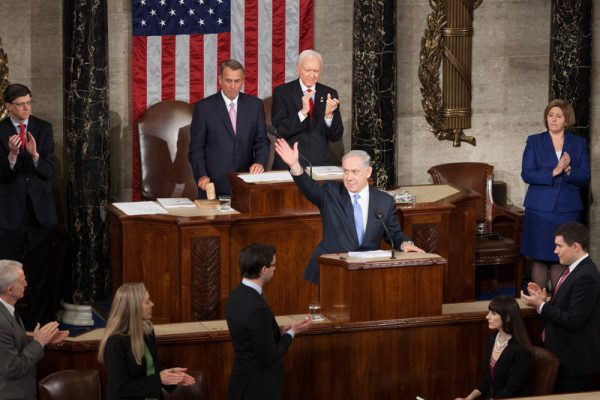
Nearly two years later, in March 2015, during what must surely have been, thus far, the lowest point in American history since 1776, Buchanan’s observation years before was proven correct in a grandiose way for all to see and hear. Netanyahu appeared before a joint session of Congress to give a rousing speech, which was interrupted by applause 39 times, of which 23 were standing ovations – more than a quarter of the time Netanyahu stood before the podium consisted of applause and jubilation by America’s “elected representatives”, conveying unambiguously that, as far as they are concerned, Israel comes first, not America.
A few days from now, on February 15, Netanyahu is scheduled for an official visit to the White House. There has been much speculation and chatter recently regarding the possible establishment of a US Embassy in Jerusalem. President Trump will have an opportunity to signal to Netanyahu what “America First” means. At the very least he should remain true to the same executive position since Harry Truman’s presidency, which recognizes, as does the United Nations, that no state has sovereignty over Jerusalem, given that the specifics pertaining to this issue remain subject to future negotiations between the parties involved in the dispute. This longstanding executive position was reaffirmed by the US Supreme Court on June 8, 2015 in Zivotofsky v. Kerry (“Jerusalem Passport Case”) and therefore constitutes “settled law”.
President Trump could surprise many by indeed proclaiming his intent to establish a US Embassy to Jerusalem in the heart of Jerusalem (inside the walled old town, ideally as close as possible to the key point where the Armenian Quarter, Christian Quarter, Jewish Quarter, and Muslim Quarter meet, perhaps at the LaHamin Market or St. Marks Road) while – of course – continuing to maintain the US Embassy to Israel in Tel Aviv. Additionally, so as to demonstrate even-handedness, he should announce plans to also establish a new US Embassy to Palestine in Ramallah, perhaps also a General Consular office in Gaza as well as the eastern part of the West Bank, if their Consular office in western part of Jerusalem were to remain in place. Such a public announcement could be crafted to fit within the 140 available characters of a “Tweet” message and could be timed for release just a few seconds before Trump and Netanyahu were to meet – so that Netanyahu would first learn about it from the press afterwards, on camera. This would be consistent with Israel’s regular announcements of new illegal settlements timed to greet US high officials in the past.
A new US Embassy to Jerusalem would formally extend the Supreme Court decision and thus formally recognize in a highly symbolic way the official “Corpus Separatum ” status of Jerusalem. Such an embassy would not even need to be manned inside; it could be as small as a big high definition screen and a server inside a thick storefront window, advertising an informational web site, but would include at least an armed Marine guard on duty. Presto – with rapid follow-through action after such an announcement Trump will have delivered “in style” on the promise for a new US Embassy in Jerusalem, as other countries will be scrambling to do likewise – after nearly seven long decades of stalling let the serious negotiations finally begin.
This editorial may be freely distributed only in its entirety, with an explicit reference “initially appeared at Aletho News” that includes a direct link or URL to this original site.
Climate scientists versus climate data
By John Bates | Climate Etc. | February 4, 2017
A look behind the curtain at NOAA’s climate data center.
I read with great irony recently that scientists are “frantically copying U.S. Climate data, fearing it might vanish under Trump” (e.g., Washington Post 13 December 2016). As a climate scientist formerly responsible for NOAA’s climate archive, the most critical issue in archival of climate data is actually scientists who are unwilling to formally archive and document their data. I spent the last decade cajoling climate scientists to archive their data and fully document the datasets. I established a climate data records program that was awarded a U.S. Department of Commerce Gold Medal in 2014 for visionary work in the acquisition, production, and preservation of climate data records (CDRs), which accurately describe the Earth’s changing environment.
The most serious example of a climate scientist not archiving or documenting a critical climate dataset was the study of Tom Karl et al. 2015 (hereafter referred to as the Karl study or K15), purporting to show no ‘hiatus’ in global warming in the 2000s (Federal scientists say there never was any global warming “pause”). The study drew criticism from other climate scientists, who disagreed with K15’s conclusion about the ‘hiatus.’ (Making sense of the early-2000s warming slowdown). The paper also drew the attention of the Chairman of the House Science Committee, Representative Lamar Smith, who questioned the timing of the report, which was issued just prior to the Obama Administration’s Clean Power Plan submission to the Paris Climate Conference in 2015.
In the following sections, I provide the details of how Mr. Karl failed to disclose critical information to NOAA, Science Magazine, and Chairman Smith regarding the datasets used in K15. I have extensive documentation that provides independent verification of the story below. I also provide my suggestions for how we might keep such a flagrant manipulation of scientific integrity guidelines and scientific publication standards from happening in the future. Finally, I provide some links to examples of what well documented CDRs look like that readers might contrast and compare with what Mr. Karl has provided.
Background
In 2013, prior to the Karl study, the National Climatic Data Center [NCDC, now the NOAA National Centers for Environmental Information (NCEI)] had just adopted much improved processes for formal review of Climate Data Records, a process I formulated [link]. The land temperature dataset used in the Karl study had never been processed through the station adjustment software before, which led me to believe something was amiss. When I pressed the co-authors, they said they had decided not to archive the dataset, but did not defend the decision. One of the co-authors said there were ‘some decisions [he was] not happy with’. The data used in the K15 paper were only made available through a web site, not in digital form, and lacking proper versioning and any notice that they were research and not operational data. I was dumbstruck that Tom Karl, the NCEI Director in charge of NOAA’s climate data archive, would not follow the policy of his own Agency nor the guidelines in Science magazine for dataset archival and documentation.
I questioned another co-author about why they choose to use a 90% confidence threshold for evaluating the statistical significance of surface temperature trends, instead of the standard for significance of 95% — he also expressed reluctance and did not defend the decision. A NOAA NCEI supervisor remarked how it was eye-opening to watch Karl work the co-authors, mostly subtly but sometimes not, pushing choices to emphasize warming. Gradually, in the months after K15 came out, the evidence kept mounting that Tom Karl constantly had his ‘thumb on the scale’—in the documentation, scientific choices, and release of datasets—in an effort to discredit the notion of a global warming hiatus and rush to time the publication of the paper to influence national and international deliberations on climate policy.
Defining an Operational Climate Data Record
For nearly two decades, I’ve advocated that if climate datasets are to be used in important policy decisions, they must be fully documented, subject to software engineering management and improvement processes, and be discoverable and accessible to the public with rigorous information preservation standards. I was able to implement such policies, with the help of many colleagues, through the NOAA Climate Data Record policies (CDR) [link].
Once the CDR program was funded, beginning in 2007, I was able to put together a team and pursue my goals of operational processing of important climate data records emphasizing the processes required to transition research datasets into operations (known as R2O). Figure 1 summarizes the steps required to accomplish this transition in the key elements of software code, documentation, and data.
 Figure 1. Research to operations transition process methodology from Bates et al. 2016.
Unfortunately, the NCDC/NCEI surface temperature processing group was split on whether to adopt this process, with scientist Dr. Thomas C. Peterson (a co-author on K15, now retired from NOAA) vigorously opposing it. Tom Karl never required the surface temperature group to use the rigor of the CDR methodology, although a document was prepared identifying what parts of the surface temperature processing had to be improved to qualify as an operational CDR.
Tom Karl liked the maturity matrix so much, he modified the matrix categories so that he could claim a number of NCEI products were “Examples of “Gold” standard NCEI Products (Data Set Maturity Matrix Model Level 6).” See his NCEI overview presentation all NCEI employees [ncei-overview-2015nov-2 ] were told to use, even though there had never been any maturity assessment of any of the products.
NCDC/NCEI surface temperature processing and archival
In the fall of 2012, the monthly temperature products issued by NCDC were incorrect for 3 months in a row [link]. As a result, the press releases and datasets had to be withdrawn and reissued. Dr. Mary Kicza, then the NESDIS Associate Administrator (the parent organization of NCDC/NCEI in NOAA), noted that these repeated errors reflected poorly on NOAA and required NCDC/NCEI to improve its software management processes so that such mistakes would be minimized in the future. Over the next several years, NCDC/NCEI had an incident report conducted to trace these errors and recommend corrective actions.
Following those and other recommendations, NCDN/NCEI began to implement new software management and process management procedures, adopting some of the elements of the CDR R2O process. In 2014 a NCDC/NCEI Science Council was formed to review new science activities and to review and approve new science products for operational release. A draft operational readiness review (ORR) was prepared and used for approval of all operational product releases, which was finalized and formally adopted in January 2015. Along with this process, a contractor who had worked at the CMMI Institute (CMMI, Capability Maturity Model Integration, is a software engineering process level improvement training and appraisal program) was hired to improve software processes, with a focus on improvement and code rejuvenation of the surface temperature processing code, in particular the GHCN-M dataset.
The first NCDC/NCEI surface temperature software to be put through this rejuvenation was the pairwise homogeneity adjustment portion of processing for the GHCN-Mv4 beta release of October 2015. The incident report had found that there were unidentified coding errors in the GHCN-M processing that caused unpredictable results and different results every time code was run.
The generic flow of data used in processing of the NCDC/NCEI global temperature product suite is shown schematically in Figure 2. There are three steps to the processing, and two of the three steps are done separately for the ocean versus land data. Step 1 is the compilation of observations either from ocean sources or land stations. Step 2 involves applying various adjustments to the data, including bias adjustments, and provides as output the adjusted and unadjusted data on a standard grid. Step 3 involves application of a spatial analysis technique (empirical orthogonal teleconnections, EOTs) to merge and smooth the ocean and land surface temperature fields and provide these merged fields as anomaly fields for ocean, land and global temperatures. This is the product used in K15. Rigorous ORR for each of these steps in the global temperature processing began at NCDC in early 2014. Figure 2. Generic data flow for NCDC/NCEI surface temperature products.
In K15, the authors describe that the land surface air temperature dataset included the GHCN-M station data and also the new ISTI (Integrated Surface Temperature Initiative) data that was run through the then operational GHCN-M bias correction and gridding program (i.e., Step 2 of land air temperature processing in Figure 2). They further indicated that this processing and subsequent corrections were ‘essentially the same as those used in GHCN-Monthly version 3’. This may have been the case; however, doing so failed to follow the process that had been initiated to ensure the quality and integrity of datasets at NCDC/NCEI.
The GHCN-M V4 beta was put through an ORR in October 2015; the presentation made it clear that any GHCN-M version using the ISTI dataset should, and would, be called version 4. This is confirmed by parsing the file name actually used on the FTP site for the K15 dataset [link]; NOTE: placing a non-machine readable copy of a dataset on an FTP site does not constitute archiving a dataset). One file is named ‘box.12.adj.4.a.1.20150119’, where ‘adj’ indicates adjusted (passed through step 2 of the land processing) and ‘4.a.1’ means version 4 alpha run 1; the entire name indicating GHCN-M version 4a run 1. That is, the folks who did the processing for K15 and saved the file actually used the correct naming and versioning, but K15 did not disclose this. Clearly labeling the dataset would have indicated this was a highly experimental early GHCN-M version 4 run rather than a routine, operational update. As such, according to NOAA scientific integrity guidelines, it would have required a disclaimer not to use the dataset for routine monitoring.
In August 2014, in response to the continuing software problems with GHCNMv3.2.2 (version of August 2013), the NCDC Science Council was briefed about a proposal to subject the GHCNMv3 software, and particularly the pairwise homogeneity analysis portion, to a rigorous software rejuvenation effort to bring it up to CMMI level 2 standards and resolve the lingering software errors. All software has errors and it is not surprising there were some, but the magnitude of the problem was significant and a rigorous process of software improvement like the one proposed was needed. However, this effort was just beginning when the K15 paper was submitted, and so K15 must have used date with some experimental processing that combined aspects of V3 and V4 with known flaws. The GHCNMv3.X used in K15 did not go through any ORR process, and so what precisely was done is not documented. The ORR package for GHCNMv4 beta (in October 2015) uses the rejuvenated software and also includes two additional quality checks versus version 3.
Which version of the GHCN-M software K15 used is further confounded by the fact that GHCNMv3.3.0, the upgrade from version 3.2.2, only went through an ORR in April 2015 (i.e., after the K15 paper was submitted and revised). The GHCN-Mv3.3.0 ORR presentation demonstrated that the GHCN-M version changes between V3.2.2 and V3.3.0 had impacts on rankings of warmest years and trends. The data flow that was operational in June 2015 is shown in figure 3.
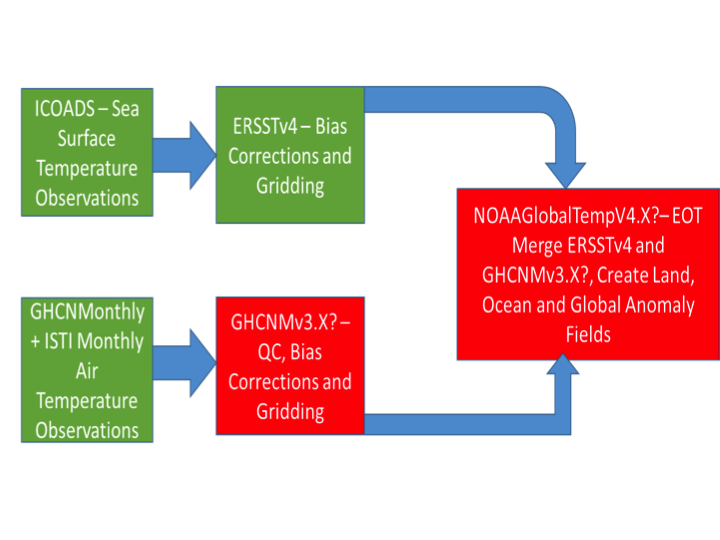 Figure 3. Data flow for surface temperature products described in K15 Science paper. Green indicates operational datasets having passed ORR and archived at time of publication. Red indicates experimental datasets never subject to ORR and never archived.
It is clear that the actual nearly-operational release of GHCN-Mv4 beta is significantly different from the version GHCNM3.X used in K15. Since the version GHCNM3.X never went through any ORR, the resulting dataset was also never archived, and it is virtually impossible to replicate the result in K15.
At the time of the publication of the K15, the final step in processing the NOAAGlobalTempV4 had been approved through an ORR, but not in the K15 configuration. It is significant that the current operational version of NOAAGlobalTempV4 uses GHCN-M V3.3.0 and does not include the ISTI dataset used in the Science paper. The K15 global merged dataset is also not archived nor is it available in machine-readable form. This is why the two boxes in figure 3 are colored red.
The lack of archival of the GHCN-M V3.X and the global merged product is also in violation of Science policy on making data available [link]. This policy states: “Climate data. Data should be archived in the NOAA climate repository or other public databases”. Did Karl et al. disclose to Science Magazine that they would not be following the NOAA archive policy, would not archive the data, and would only provide access to a non-machine readable version only on an FTP server?
For ocean temperatures, the ERSST version 4 is used in the K15 paper and represents a major update from the previous version. The bias correction procedure was changed and this resulted in different SST anomalies and different trends during the last 15+ years relative to ERSST version 3. ERSSTV4 beta, a pre-operational release, was briefed to the NCDC Science Council and approved on 30 September 2014.
The ORR for ERSSTV4, the operational release, took place in the NCDC Science Council on 15 January 2015. The ORR focused on process and questions about some of the controversial scientific choices made in the production of that dataset will be discussed in a separate post. The review went well and there was only one point of discussion on process. One slide in the presentation indicated that operational release was to be delayed to coincide with Karl et al. 2015 Science paper release. Several Science Council members objected to this, noting the K15 paper did not contain any further methodological information—all of that had already been published and thus there was no rationale to delay the dataset release. After discussion, the Science Council voted to approve the ERSSTv4 ORR and recommend immediate release.
The Science Council reported this recommendation to the NCDC Executive Council, the highest NCDC management board. In the NCDC Executive Council meeting, Tom Karl did not approve the release of ERSSTv4, noting that he wanted its release to coincide with the release of the next version of GHCNM (GHCNMv3.3.0) and NOAAGlobalTemp. Those products each went through an ORR at NCDC Science Council on 9 April 2015, and were used in operations in May. The ERSSTv4 dataset, however, was still not released. NCEI used these new analyses, including ERSSTv4, in its operational global analysis even though it was not being operationally archived. The operational version of ERSSTv4 was only released to the public following publication of the K15 paper. The withholding of the operational version of this important update came in the middle of a major ENSO event, thereby depriving the public of an important source of updated information, apparently for the sole purpose of Mr. Karl using the data in his paper before making the data available to the public.
So, in every aspect of the preparation and release of the datasets leading into K15, we find Tom Karl’s thumb on the scale pushing for, and often insisting on, decisions that maximize warming and minimize documentation. I finally decided to document what I had found using the climate data record maturity matrix approach. I did this and sent my concerns to the NCEI Science Council in early February 2016 and asked to be added to the agenda of an upcoming meeting. I was asked to turn my concerns into a more general presentation on requirements for publishing and archiving. Some on the Science Council, particularly the younger scientists, indicated they had not known of the Science requirement to archive data and were not aware of the open data movement. They promised to begin an archive request for the K15 datasets that were not archived; however I have not been able to confirm they have been archived. I later learned that the computer used to process the software had suffered a complete failure, leading to a tongue-in-cheek joke by some who had worked on it that the failure was deliberate to ensure the result could never be replicated.
Where do we go from here?
I have wrestled for a long time about what to do about this incident. I finally decided that there needs to be systemic change both in the operation of government data centers and in scientific publishing, and I have decided to become an advocate for such change. First, Congress should re-introduce and pass the OPEN Government Data Act. The Act states that federal datasets must be archived and made available in machine readable form, neither of which was done by K15. The Act was introduced in the last Congress and the Senate passed it unanimously in the lame duck session, but the House did not. This bodes well for re-introduction and passage in the new Congress.
However, the Act will be toothless without an enforcement mechanism. For that, there should be mandatory, independent certification of federal data centers. As I noted, the scientists working in the trenches would actually welcome this, as the problem has been one of upper management taking advantage of their position to thwart the existing executive orders and a lack of process adopted within Agencies at the upper levels. Only an independent, outside body can provide the needed oversight to ensure Agencies comply with the OPEN Government Data Act.
Similarly, scientific publishers have formed the Coalition on Publishing Data in the Earth and Space Sciences (COPDESS) with a signed statement of commitment to ensure open and documented datasets are part of the publication process. Unfortunately, they, too, lack any standard checklist that peer reviewers and editors can use to ensure the statement of commitment is actually enforced. In this case, and for assessing archives, I would advocate a metric such as the data maturity model that I and colleagues have developed. This model has now been adopted and adapted by several different groups, applied to hundreds of datasets across the geophysical sciences, and has been found useful for ensuring information preservation, discovery, and accessibility.
Finally, there needs to be a renewed effort by scientists and scientific societies to provide training and conduct more meetings on ethics. Ethics needs to be a regular topic at major scientific meetings, in graduate classrooms, and in continuing professional education. Respectful discussion of different points of view should be encouraged. Fortunately, there is initial progress to report here, as scientific societies are now coming to grips with the need for discussion of and guidelines for scientific ethics.
There is much to do in each of these areas. Although I have retired from the federal government, I have not retired from being a scientist. I now have the luxury of spending more time on these things that I am most passionate about. I also appreciate the opportunity to contribute to Climate Etc. and work with my colleague and friend Judy on these important issues.
Postlude
A couple of examples of how the public can find and use CDR operational products, and what is lacking in a non-operational and non-archived product
- NOAA CDR of total solar irradiance – this is the highest level quality. Start at web site – https://data.nodc.noaa.gov/cgi-bin/iso?id=gov.noaa.ncdc:C00828
Here you will see a fully documented CDR. At the top, we have the general description and how to cite the data. Then below, you have a set of tabs with extensive information. Click each tab to see how it’s done. Note, for example, that in ‘documentation’ you have choices to get the general documentation, processing documents including source code, data flow diagram, and the algorithm theoretical basis document ATBD which includes all the info about how the product is generated, and then associated resources. This also includes a permanent digital object identifier (doi) to point uniquely to this dataset.
- NOAA CDR of mean layer temperature – RSS – one generation behind in documentation but still quite good – https://www.ncdc.noaa.gov/cdr/fundamental/mean-layer-temperature-rss
Here on the left you will find the documents again that are required to pass the CDR operations and archival. Even though it’s a slight cut below TSI in example 1, a user has all they need to use and understand this.
- The Karl hiatus paper can be found on NCEI here – https://www.ncdc.noaa.gov/news/recent-global-surface-warming-hiatus
If you follow the quick link ‘Download the Data via FTP’ you go here – ftp://ftp.ncdc.noaa.gov/pub/data/scpub201506/
The contents of this FTP site were entered into the NCEI archive following my complaint to the NCEI Science Council. However, the artifacts for full archival of an operational CDR are not included, so this is not compliant with archival standards.
Biosketch:
John Bates received his Ph.D. in Meteorology from the University of Wisconsin-Madison in 1986. Post Ph.D., he spent his entire career at NOAA, until his retirement in 2016. He spent the last 14 years of his career at NOAA’s National Climatic Data Center (now NCEI) as a Principal Scientist, where he served as a Supervisory Meteorologist until 2012.
Dr. Bates’ technical expertise lies in atmospheric sciences, and his interests include satellite observations of the global water and energy cycle, air-sea interactions, and climate variability. His most highly cited papers are in observational studies of long term variability and trends in atmospheric water vapor and clouds.
NOAA Administrator’s Award 2004 for “outstanding administration and leadership in developing a new division to meet the challenges to NOAA in the area of climate applications related to remotely sensed data”. He was awarded a U.S. Department of Commerce Gold Medal in 2014 for visionary work in the acquisition, production, and preservation of climate data records (CDRs). He has held elected positions at the American Geophysical Union (AGU), including Member of the AGU Council and Member of the AGU Board. He has played a leadership role in data management for the AGU.
He is currently President of John Bates Consulting Inc., which puts his recent experience and leadership in data management to use in helping clients improve data management to improve their preservation, discovery, and exploitation of their and others data. He has developed and applied techniques for assessing both organizational and individual data management and applications. These techniques help identify how data can be managed more cost effectively and discovered and applied by more users.
David Rose in the Mail on Sunday
David Rose of the UK Mail on Sunday is working on a comprehensive expose of this issue [link].
Here are the comments that I provided to David Rose, some of which were included in his article:
Here is what I think the broader implications are. Following ClimateGate, I made a public plea for greater transparency in climate data sets, including documentation. In the U.S., John Bates has led the charge in developing these data standards and implementing them. So it is very disturbing to see the institution that is the main U.S. custodian of climate data treat this issue so cavalierly, violating its own policy. The other concern that I raised following ClimateGate was overconfidence and inadequate assessments of uncertainty. Large adjustments to the raw data, and substantial changes in successive data set versions, imply substantial uncertainties. The magnitude of these uncertainties influences how we interpret observed temperature trends, ‘warmest year’ claims, and how we interpret differences between observations and climate model simulations. I also raised concerns about bias; here we apparently see Tom Karl’s thumb on the scale in terms of the methodologies and procedures used in this publication.
Apart from the above issues, how much difference do these issues make to our overall understanding of global temperature change? All of the global surface temperature data sets employ NOAA’s GHCN land surface temperatures. The NASA GISS data set also employs the ERSST datasets for ocean surface temperatures. There are global surface temperature datasets, such as Berkeley Earth and HadCRUT that are relatively independent of the NOAA data sets, that agree qualitatively with the new NOAA data set. However, there remain large, unexplained regional discrepancies between the NOAA land surface temperatures and the raw data. Further, there are some very large uncertainties in ocean sea surface temperatures, even in recent decades. Efforts by the global numerical weather prediction centers to produce global reanalyses such as the European Copernicus effort is probably the best way forward for the most recent decades.
Regarding uncertainty, ‘warmest year’, etc. there is a good article in the WSJ : Change would be healthy at U.S. climate agencies (hockeyshtick has reproduced the full article).
I also found this recent essay in phys.org to be very germane: Certainty in complex scientific research an unachievable goal. Researchers do a good job of estimating the size of errors in measurements but underestimate chance of large errors.
Backstory
I have known John Bates for about 25 years, and he served on the Ph.D. committees of two of my graduate students. There is no one, anywhere, that is a greater champion for data integrity and transparency.
When I started Climate Etc., John was one of the few climate scientists that contacted me, sharing concerns about various ethical issues in our field.
Shortly after publication of K15, John and I began discussing our concerns about the paper. I encouraged him to come forward publicly with his concerns. Instead, he opted to try to work within the NOAA system to address the issues –to little effect. Upon his retirement from NOAA in November 2016, he decided to go public with his concerns.
He submitted an earlier, shorter version of this essay to the Washington Post, in response to the 13 December article (climate scientists frantically copying data). The WaPo rejected his op-ed, so he decided to publish at Climate Etc.
In the meantime, David Rose contacted me about a month ago, saying he would be in Atlanta covering a story about a person unjustly imprisoned [link]. He had an extra day in Atlanta, and wanted to get together. I told him I wasn’t in Atlanta, but put him in contact with John Bates. David Rose and his editor were excited about what John had to say.
I have to wonder how this would have played out if we had issued a press release in the U.S., or if this story was given to pretty much any U.S. journalist working for the mainstream media. Under the Obama administration, I suspect that it would have been very difficult for this story to get any traction. Under the Trump administration, I have every confidence that this will be investigated (but still not sure how the MSM will react).
Well, it will be interesting to see how this story evolves, and most importantly, what policies can be put in place to prevent something like this from happening again.
I will have another post on this topic in a few days.
Being retired sure is liberating . . .
Liberals Morph from Peaceniks to Warhawks on Government Intelligence Agencies
By Stephen J. Sniegoski • Unz Review • January 28, 2017
During the latter decades of the Cold War with Soviet Russia, the charge of being “unpatriotic” or “anti-American” caused American liberals (excluding those who had to rely on the votes of regular Americans to hold political office) to burst into spasms of ridicule and howls of “Red-baiting,” “war-mongering,” “witch-hunting,” and “fascism.” Sophisticated folks, liberals implied, would never even deign to think of doing anything so gauche as to automatically support their country in its fight against what they sarcastically called the “Red Menace.” America’s very possession of nuclear weapons was considered a danger to all humanity and many liberals flirted with the idea of U.S. unilateral nuclear disarmament. And the slogan of the Democratic candidate for president in 1972, George McGovern, was “Come Home, America” — which meant U.S. military retrenchment that mainstream liberals now lambast as “isolationism.”
During this not-too-long-ago era (at least, it was not too long ago for me, who is too rapidly approaching the biblically allotted three-score and ten), the CIA and the FBI were considered the bête noire in this liberal Weltanschauung. FBI director J. Edgar Hoover, with his penchant for spying on innocent people, was regarded as thoroughly vicious. The CIA was notorious for being involved in the overthrow of nice democratic governments (at least, that is how liberals viewed them) in such countries as Iran, Guatemala, and Chile, and spying on leftist critics in the United States. The villainous nature of the CIA and FBI was a theme in many Hollywood movies of the era.[1]
Now let’s return to the present and the liberal hysteria over purported Russian interference with the U.S. presidential election. The most bandied about charge involves “hacking” the DNC and Podesta emails and providing these to WikiLeaks to denigrate Hillary Clinton, thus preventing her from becoming president. The support for this claim, at least as it has been presented to the America public, rests only on assertions made by the U.S. Intelligence Community, and this dearth of proof was continued in the most recent report from the Office of the Director of National Intelligence (ODNI), “Assessing Russian Activities and Intentions in Recent US Elections,” released to the public on January 6. The report represents the unclassified findings of the intelligence community’s investigation of Russian involvement in the 2016 election. In the words of the report: “Thus, while the conclusions in the report are all reflected in the classified assessment, the declassified report does not and cannot include the full supporting information, including specific intelligence and sources and methods.”[2]
Even some believers, especially those who might know something about cyber technology and the capabilities of America’s intelligence agencies, evinced some concern about the report’s lack of substantiating evidence. For example, Wired, a high-tech webzine that usually follows the current progressive line, published an article titled “Feds’ Damning Report on Russian Election Hack Won’t Convince Skeptics,” in which Robert Graham, an analyst for the cybersecurity firm Erratasec, was quoted as saying: “But knowing what data they [U.S. intelligence agencies] probably have, they could have given us more details. And that really pisses me off.”[3] The thrust of the article is that the lack of substantial proof fails to convince skeptics, not that the intelligence report’s claims could be wrong. This position is rather understandable since skepticism about traditional beliefs such as Christianity is highly lauded by progressives, but skepticism is not allowed to cast doubt on the progressive narrative of the day.
President Obama went somewhat further in his attack on non-believers. In an interview on ABC News on January 6, Obama insinuated, and, in some cases, openly stated that people who express skepticism about the findings and conclusions drawn by the U.S. Intelligence Community are not on America’s “team” and are siding with Putin; in fact, he maintains that they “love” Putin. In short, Obama has come to assume that the American people must not question the sanctity of the U.S. “Intelligence Community.” To do otherwise signifies not merely a lack of patriotism but actual love for America’s alleged number one adversary—Vladimir Putin. “One of the things that I’ve urged the president-elect to do is to develop a strong working relationship with the intelligence community,” Obama stated. “We have to remind ourselves we’re on the same team. Vladimir Putin’s not on our team.” Obama warned that “If we get to a point where people in this country feel more affinity with a leader who is an adversary and view the United States and our way of life as a threat to him, then we’re gonna have bigger problems than just cyber hacking.” It appears to Obama that some politicians and reporters “seem to have more confidence in Vladimir Putin than fellow Americans because those fellow Americans are Democrats.” And he solemnly pontificated: “That cannot be.”[4]
Obama continued with this rather dystopian view: “[I]n this new information age, it is possible for misinformation, for cyber hacking and so forth to have an impact on our open societies, our open systems, to insinuate themselves into our democratic practices in ways that I think are accelerating.” Although “cyber hacking” existed even before Obama entered the White House and “misinformation,” according to the Bible, existed even when Adam and Eve resided in the Garden of Eden, Obama implies that he only now became aware of this possibility.[5]
Now the term “open society” was popularized (at least in intellectual circles) by the philosopher Karl Popper.”[6] and its most prominent proponent today is billionaire George Soros (a student of Popper’s). Soros’ Open Society Institute has as its goal spreading the “open society” world-wide. An open society, as Popper presented it, would be open to all types of ideas with people being free to make their own decisions. Soros, in contrast, expressed a view similar to that of Obama, contending that “Popper failed to recognize that in democratic politics, gathering public support takes precedence over the pursuit of truth. In other areas, such as science and industry, the impulse to impose one’s views on the world encounters the resistance of external reality. But in politics the electorate’s perception of reality can be easily manipulated. As a result, political discourse, even in democratic societies, does not necessarily lead to a better understanding of reality.”[7] The implication is that gatekeepers are needed to protect “truth.” As one critic puts it: “the Open Society Institute embodies Popper’s idea of an open society the way the German Democratic Republic (East Germany) embodied democracy.”[8]
Moving away from the focus on hacking, the recent ODNI report describes the Russian effort to affect the US election as “multifaceted” and devotes almost half of the report to propaganda (despite the negative connotation, propaganda can be true) spread by Russia, especially by its major government-sponsored television network for foreign countries, RT.
Moreover, the intelligence report interprets the alleged Russian effort to aid Trump in the election as only one part of a broader goal to combat the United States’ “liberal democratic order,” stating: “Russian efforts to influence the 2016 US presidential election represent the most recent expression of Moscow’s longstanding desire to undermine the US-led liberal democratic order, but these activities demonstrated a significant escalation in directness, level of activity, and scope of effort compared to previous operations.”[9] Moreover, the report considers any type of criticism of the United States as a “desire to undermine the US-led liberal democratic order.” And the report deals with aspects of this broader goal that are entirely unrelated to any Russian effort to aid Trump. This is of the utmost importance since the media narrative focuses on the idea that Russia aided Trump in the 2016 election but, for proof, relies on a report that deals with a much broader subject. That Russian media provides a negative view of America does not mean that this propaganda played a role in making Trump president. And it is not only the mainstream media but even the leaders of the intelligence community who blur this distinction.
Illustrating the point made above about the report’s concern with Russia’s alleged broader goal is its devotion of considerable space to Russian news stories casting the United States government and economic system in a negative light, but having nothing to do with Trump or the 2016 election. For example, the report observed that “RT aired a documentary about the Occupy Wall Street movement on 1, 2, and 4 November [2016]. RT framed the movement as a fight against ‘the ruling class’ and described the current US political system as corrupt and dominated by corporations. RT advertising for the documentary featured Occupy movement calls to ‘take back’ the government. The documentary claimed that the US system cannot be changed democratically, but only through ‘revolution.’”[10] Although this report disparages the existing economic system in the United States, it could hardly be interpreted as encouraging anyone to vote for billionaire Donald Trump with his proposed agenda that included lower tax rates—especially the corporate tax rate–and a reduction in economic regulation that liberals and Democrats claimed helped only the wealthy.
The study also points out that “RT runs anti-fracking programming, highlighting environmental issues and the impacts on public health. This is likely reflective of the Russian Government’s concern about the impact of fracking and US natural gas production on the global energy market and the potential challenges to Gazprom’s profitability.”[11] That Russia’s alleged favored candidate Trump was pro-fracking whereas Hillary straddled the issue would mean that the RT anti-fracking program could militate against supporting Trump.
The report also maintains that “RT’s reports often characterize the United States as a ‘surveillance state’ and allege widespread infringements of civil liberties, police brutality, and drone use.”[12] Again, this would not seem to generate support for Trump.
The report refers to articles written in 2012 that deal with the U.S. presidential election that year, which did not involve Trump, and reflects the fact the study covers, as the title states, recent U.S. elections, not just the 2016 election. For example, “In the runup to the 2012 US presidential election in November, English-language channel RT America . . . intensified its usually critical coverage of the United States. The channel portrayed the US electoral process as undemocratic and featured calls by US protesters for the public to rise up and ‘take this government back.’”[13]
Still dealing with the 2012 election, the intelligence report stated: “From August to November 2012, RT ran numerous reports on alleged US election fraud and voting machine vulnerabilities, contending that US election results cannot be trusted and do not reflect the popular will.”[14] Oddly, this is almost identical to what the mainstream media has been saying since Trump won the election.
But what about the “fake news” — fictitious articles deliberately fabricated to deceive–that the mainstream media claimed helped Trump, largely by harming Clinton? For example, a Washington Post article, dated November 24, 2016, was titled: “Russian propaganda effort helped spread ‘fake news’ during election, experts say.”[15] CNN, in its article, “The reality behind Russia’s fake news,” dated December 2, made similar claims, relying heavily on the aforementioned Washington Post article. [16]
(After extensive criticism including legal threats from the sites the Washington Post described as Russian propaganda outlets, the Post added its lengthy editor’s note distancing itself from the anonymous group that provided the key claims of Russian “fake news” saying that the Post would not vouch for its validity.) [17]
Even Director of National Intelligence James Clapper referred to the Russians making use of “fake news” during the election. In a Senate Armed Services Committee hearing on “Foreign Cyber Threats to the United States” on January 5. 2017, Senator Jack Reed (Democrat, Rhode Island) asked Clapper about media reports that held that Russia was engaged in the creation of “fake news.” Clapper responded: “This was a multifaceted campaign. So, the hacking was only one part of it, and it also entailed classical propaganda, disinformation, fake news.”[18] When the January 6 ODNI report was released, NBC News even claimed that it mentioned “a series of fake news stories damaging to Clinton, many of which got their start with Russian-backed outlets.” [19]
Considering the many references to “fake news,” even by the Director of National Intelligence, it is astonishing that the January 6 report did not cite any examples of this alleged phenomenon—or even mention it. What stands out is the absence of the term “fake news.” Did “fake news” itself turn out to be “fake news”? Whatever the case, the mainstream media did not seem to notice the absence of “fake news” from the report.
While the Intelligence Community did not make any mention of “fake news” in its report, it did make general claims—assessments by the intelligence community — that held that Russia favored Trump over Hillary Clinton. For example: “We assess the influence campaign aspired to help President-elect Trump’s chances of victory when possible by discrediting Secretary Clinton and publicly contrasting her unfavorably to the President-elect.”[20] The report also states: “RT’s coverage of Secretary Clinton throughout the US presidential campaign was consistently negative and focused on her leaked e-mails and accused her of corruption, poor physical and mental health, and ties to Islamic extremism. Some Russian officials echoed Russian lines for the influence campaign that Secretary Clinton’s election could lead to a war between the United States and Russia.”[21] None of these political views differed from what the anti-Clinton media in the U.S. expressed, so it is not apparent how Russia would add any credibility to these claims. It might even have tended to detract from them, which seems to be the case after the election. And since Russian officials did make the aforementioned claim about war, the mention of it does not seem to reflect any type of bias.
In contrast to the Russian depiction of Clinton, the intelligence report stated that Russian government media outlets RT and Sputnik “consistently cast President-elect Trump as the target of unfair coverage from traditional US media outlets that they claimed were subservient to a corrupt political establishment.”[22] This view was also commonly expressed by the more conservative media in the U.S., even that media which was not supportive of Trump.
RT put forth an extensive refutation of the intelligence report’s claims in an article entitled, “All the ways RT ‘influenced’ American politics ‒ it’s not what the ODNI thinks,” dated January7.[23] In many cases, RT made an effort to show that it also presented news stories that were contrary to those that the report cited—in essence, that its reporting was balanced while the intelligence report “cherry picked” RT stories to fit its narrative. It should be noted that no supporter of the Intelligence Community’s findings, from either the U.S. Intelligence Community itself or the private media, made the effort to rebut RT’s detailed criticism of the report.
It would seem to be self-evident that Russian media would act to promote Russian interests—although information used to achieve this goal might be true–just as US government-sponsored international media is intended to promote the interests of the United States. However, while the intelligence report holds that the Russian media was biased in favor of Trump, it fails to prove that bias. The report, for example, did not come up with any obvious erroneous information, such as the U.S. media’s account of the alleged killing of the incubator babies during Iraq’s invasion of Kuwait in 1990; the WMD story in the run-up to the 2003 war on Iraq; and the recent story about the Russians hacking the Vermont power grid.
The report could have relied upon a statistical analysis of the Russian media’s election reporting. Numerous efforts have been made in the United States to use statistics and computer analysis in assessing media bias. Analyses that stand out tend to conclude that the U.S. media have a liberal bias. They include: The News Twisters (1976) by Edith Efron; T he Media Elite (1986) by Robert Lichter, Stanley Rothman, and Linda Lichter; Press Bias and Politics: How the Media Frame Controversial Issues (2002) by Jim A. Kuypers; and Left Turn: How Liberal Media Bias Distorts the American Mind, (2012) by Tim Groseclose. Many statisticians have found fault with these studies despite their often extensive use of statistical data and comparisons among various media outlets. If this extensive information can be rejected, how could one accept the intelligence report’s claims of Russian media bias where no statistical proof or even standards for determining bias exist? The intelligence report, indeed, not only eschews statistical analysis for its bias claims, but acknowledges that it does not even make a comparison between Russian media and U.S. media, stating that “it does not analyze US political processes or US public opinion.”[24]
Moreover, it is not apparent that the Russian media would affect how any significant number of Americans vote. And the report explicitly states: “We did not make an assessment of the impact that Russian activities had on the outcome of the 2016 election.”[25] With all the uproar about Russian meddling in the US election, and allegations by prominent figures that Trump is not a legitimate president, it would be expected that the report would try to determine if this alleged meddling had any effect on the election’s outcome.
The study does hint that Russian media might have had some effect on voting by using graphs that show it is competitive with leading international media—Al Jazeera English, BBC World, CNN/CNN International. The Economist, however, provides an effective statistical refutation of this claim: “In Twitter and Facebook, RT’s reach is narrower than that of other news networks . . . . Its biggest claim to dominance is on YouTube, where it bills itself as the ‘most watched news network’ on the platform. As the intelligence report fretfully notes, RT videos get 1m views a day, far surpassing other outlets. But this is mostly down to [due to] the network’s practice of buying the rights to sensational footage, for instance of Japan’s 2011 tsunami, and repackaging it with the company logo.”[26] A September 2015 article in The Daily Beast, “Putin’s Propaganda TV Lies about Its Popularity,” states: “As of 2015, RT is still largely absent from cable news rankings.”[27] Moreover, RT’s influence would seem to pale to insignificance compared to the totality of American media.
Considering all the information provided by the U.S. Intelligence Community, it would appear that the entire issue of the alleged Russian meddling in the election turns out to be, to quote the Bard, “full of sound and fury, signifying nothing.”
[1] Maria Lauino, “Hollywood Presents: Government as Villain,” New York Times, February 12, 1995, http://www.nytimes.com/1995/02/12/movies/film-hollywood-presents-government-as-villain.html?pagewanted=all
[2] “Background to ‘Assessing Russian Activities and Intentions in Recent US Elections’: The Analytic Process and Cyber Incident Attribution,” January 6, 2016, p. 1.
[3] Andy Greenberg, “Feds’ Damning Report on Russian Election Hack Won’t Convince Skeptics,” Wired, January 6, 2017, https://www.wired.com/2017/01/feds-damning-report-russian-election-hack-wont-convince-skeptics/
[4] Kevin Liptak, “Obama: ‘Vladimir Putin is not on our team,’” CNN, January 6, 2017, http://www.cnn.com/2017/01/06/politics/obama-vladimir-putin-is-not-on-our-team/
[5] Liptak.
[6] Noted philosopher Henri Bergson actually introduced the term “open society.”
[7] George Soros, Project Syndicate, November 8, 2007, https://www.project-syndicate.org/commentary/from-karl-popper-to-karl-rove—and-back?barrier=accessreg
[8] Jonathan David Carson, “The Left’s Theft of the Open Society and the Scientific Method,” American Thinker, April 24, 2008, http://www.americanthinker.com/articles/2008/04/the_lefts_theft_of_the_open_so.html
[9] Intelligence Community Assessment, “Assessing Russian Activities and Intentions in Recent US Elections,” p. ii.
[10] Assessing, p.7.
[11] Assessing, p.8.
[12] Assessing, p. 7.
[13] Assessing, p. 6.
[14] Assessing, p. 6.
[15] Craig Timberg, “Russian propaganda effort helped spread ‘fake news’ during election, experts say,” Washington Post, November 24, 2016, https://www.washingtonpost.com/business/economy/russian-propaganda-effort-helped-spread-fake-news-during-election-experts-say/2016/11/24/793903b6-8a40-4ca9-b712-716af66098fe_story.html?utm_term=.715bb
[16] Jill Dougherty, “The reality behind Russia’s fake news,” CNN, December 2, 2016,http://www.cnn.com/2016/12/02/politics/russia-fake-news-reality/
[17] Glenn Greenwald, “WashPost Is Richly Rewarded for False News About Russia Threat While Public Is Deceived,” The Intercept, January 4, 2017, https://theintercept.com/2017/01/04/washpost-is-richly-rewarded-for-false-news-about-russia-threat-while-public-is-deceived/
[18] Alex Griswold, “James Clapper Confirms Russia Was Behind Fake News During 2016 Election,” Mediaite, January 5, 2017, http://www.mediaite.com/tv/james-clapper-confirms-russia-was-behind-fake-news-during-2016-election/
[19] Ken Dilanian, “Report: Putin, Russia Tried to Help Trump By ‘Discrediting’ Clinton,” NBC News, January 6, 2017, http://www.nbcnews.com/news/us-news/report-putin-russia-tried-help-trump-discrediting-clinton-n703981
[20] Assessing, p.2.
[21] Assessing, p. 4.
[22] Assessing, p.4.
[23] RT, “All the ways RT ‘influenced’ American politics ‒ it’s not what the ODNI thinks,” January 7, 2017, https://www.rt.com/usa/372890-odni-rt-influenced-election/
[24] Assessing, p. i.
[25] Assessing, p. i.
[26] RT’s propaganda is far less influential than Westerners fear,” The Economist, January 19, 2017, http://www.economist.com/news/europe/21715031-kremlin-backed-network-inflates-its-viewership-youtube-disaster-videos-rts-propaganda
[27] Katie Zavadski, ‘Putin’s Propaganda TV Its Lies About Popularity,” The Daily Beast, September17, 2015, http://www.thedailybeast.com/articles/2015/09/17/putin-s-propaganda-tv-lies-about-ratings.html
The Protected, Privileged Establishment vs. The Working Class
By Charles Hugh Smith | of two minds | January 23, 2017
Meanwhile, back in reality, household income for the bottom 95% has declined while the owners of capital and their privileged, protected servants in the Establishment have gorged themselves on private wealth.
As noted yesterday in The Collapse of the Left, the working class has finally awakened to the Left’s betrayal and abandonment of labor in favor of the protected privileges of the elitist Establishment. I also described the Left’s Great Con:
To mask the collapse of the Left’s economic defense of labor, the Left has substituted social justice movements for economic opportunities and security.This has succeeded brilliantly, as tens of millions of self-described “progressives” now parrot the Great Con that “social justice” campaigns on behalf of marginalized social groups are now the defining feature of Progressive Social Democratic movements.
This diversionary sleight-of-hand embrace of economically neutered “social justice” campaigns masked the fact that social democratic parties everywhere have thrown labor into the churning propellers of globalization, open immigration and neoliberal financial policies–all of which benefit mobile capital, which has engorged itself on the abandonment of labor by the Left.
Meanwhile, the fat-cats of the Left have engorged themselves on capital’s largesse in exchange for their treachery. Bill and Hillary Clinton’s $200 million in “earnings” come to mind, as do countless other examples of personal aggrandizement by self-proclaimed “defenders” of labor.
But it isn’t just the Left’s fat-cats who have feathered their own nests while denigrating the Working Class with arrogantly contemptuous scorn: the entire protected, privileged “liberal” elitist Establishment has responded with a very illiberal outrage that their protected, privileged skims and scams might be endangered by an uprising of the loathed and ridiculed Working Class that they reckoned would remain safely cowed and conned.
As noted yesterday, the only moment in recent history in which the Wall Street-cartel-state strongholds of privilege, wealth and power (i.e. owners of capital) felt threatened by political insurrection by disenfranchised labor was The Great Depression of the 1930s.
With the first iteration of global debt-based capitalism in near-collapse (systemic bad debt was not written off, lest the big banks’ insolvency be recognized), owners of capital and the political class reluctantly swallowed modest social-democratic reforms that gave labor enough of the pie to stave off revolt / revolution (as noted by Arshad A. on my Facebook thread).
Just as Marx had predicted, this crisis of global-debt-cartel-state capitalism was the result of internal contradictions built into all forms capitalism dominated by capital and the state that protects and serves capital.
Now we face another crisis of the current iteration of global-debt-cartel-state capitalism, also the result of internal contradictions–not just financial, but cultural, energy-based and political contradictions.
The privileged, protected elitist Establishment reckoned the social-welfare programs of the 1930s and the Left’s Great Cons would keep the disenfranchised Working Class permanently cowed and conned. If welfare (now called “disability,” “crazy money”, etc.) and the distractions of “social justice” campaigns didn’t keep the Working Class fragmented and powerless, then the ceaseless drumbeat of arrogant dismissal and disdain aimed at any Working Class resistance would do the trick.
Any Working Class individual who recognized that globalization, open immigration and neoliberal financial policies were the propellers dismembering the Working Class economically and disenfranchising the Working Class politically was immediately labeled with the worst that “liberal” privileged, protected elites could spew: you’re racist, Luddite, backward, etc.–in other words, you’re not a rootless Cosmopolitan who loves your servitude to capital and the state like us.
Since the Left has masked its abandonment and betrayal of the Working Class with “social justice” speech acts, the worst insults the Left can dish out are those that suggest opposition to the Left’s social justice campaigns.
Self-identified “Progressives” are fine with the destruction and disenfranchisement of the Working Class, as long as the politically correct speech acts praising the Left’s Great Con are being uttered.
The self-serving, privileged, protected “liberal” Establishment is enraged that the Working Class is no longer following the script, i.e. remaining cowed, conned and fragmented. Like every other disenfranchised group, the Working Class has essentially zero choice of representational leadership, as the machinery of governance, finance and the mainstream media are all controlled by the privileged, protected elites of the Establishment.
So it boiled down to: choose more disenfranchisement and cowed servitude to “liberal” Elites, or vote for Trump. There was no other choice, so the Working Class voted for Trump as their only option other than surrender and servitude.
This rejection of their “betters” script has enraged their “betters,” who now demand the destruction of their proxy voice (Trump) and their rebellion. The Establishment’s war on Trump is beneath the surface also a war against a Working Class that has finally had enough of its arrogant, hubris-soaked, self-serving, privileged, elitist “betters” of the Establishment.
If the Establishment had deigned to offer a radical-Left leader who correctly called out the American carnage that is the Working Class experience of the globalized, open-immigration neoliberalism that has so enriched the owners of capital and their “liberal” apparatchiks, then the Working Class may well have voted for the radical-Left truth-teller.
Alas, the Left ground down any opposition to “we ‘earned’ $200 million” Hillary Clinton and her corrupt coterie of self-serving elites. Having beaten down, stripmined, insulted, denigrated, scorned and exploited the Working Class (whose “proper role” is to provide cannon fodder for the Elites’ neocon Permanent War), the privileged, protected Establishment (like every other elite that suddenly finds its entitled dominance challenged) is in a full-blown fury: how dare the Working Class not accept our self-serving rule! We are entitled to rule! How dare they!
Meanwhile, back in reality, household income for the bottom 95% has declined while the owners of capital and their privileged, protected servants in the Establishment have gorged themselves on private wealth.

Here’s what’s happened as the Left and its armies of privileged fake-Progressives threw the Working Class overboard in favor of serving capital on the First Class deck:

What will it take to shift the balance of power decisively in favor of labor? My guess is the downward mobility of another 10 or 20 million people who currently reckon themselves “middle class” into the unprotected, disenfranchised ranks of the Working Class will do it.
Democrats Attack Trump from the Right
By Margaret Kimberley | Black Agenda Report | January 25, 2017
There are many indications of the deep systemic crisis now confronting America and the world. The fact that Donald Trump was elected president when neither his party nor any of the elites wanted him is just one piece of evidence. The bizarre passivity from Democrats after their party’s colossal failure is another. These people who are loath to point out the extent of the Democrats’ disintegration do little else but repeat the many reasons they don’t like Trump. Increasingly they use Russophobia and what was once the language of the right wing to do it.
The crisis of legitimacy has turned the world upside down. People who call themselves progressives are engaged in a contest to see who can blame Russia when the failings come from their own leadership. This columnist witnessed participants in anti-Trump inaugural protests carrying signs attacking Vladimir Putin and blaming him for the election outcome.
The evidence of Russian interference in the elections is based on the flimsiest evidence. It is far more likely that an insider gave the Democratic National Committee emails to Wikileaks. Trump’s call for dialogue with Russia is a reasonable one that should call progressives to question why they cling to the war party when they say they want peace. Instead they join in helping the Democrats to excuse their debacle. In so doing they support a very dangerous effort to expand American hegemony against another nuclear power.
Democrats are eager to embarrass themselves in the Russophobic frenzy. A California state legislator is sponsoring a bill that would require schools to teach children that the Russian government interfered in the election. Members of the Congressional Black Caucus (CBC) have joined in sinking to new depths of stupidity and uselessness.
Barbara Lee, the only member of Congress to vote against war in Afghanistan after the September 11th attacks, is now among those pointing fingers at Russia. She opposed the Electoral College certification of Trump’s victory based on a belief in the findings of the “intelligence community.” This new phrase was chosen deliberately to make the institutions that deprive millions of people of their human rights seem more like a neighborhood block association. Her colleague Elijah Cummings was equally idiotic. “If we don’t respond now the Russians will attack us again.” It is sad to watch Maxine Waters, once among the most progressive members, as she blathers on that Putin and Trump “wrap their arms around each other” and are “in the bed together.” She says that Putin is responsible for “killing innocent children in Syria” when the United States instigated that humanitarian disaster and Russia may bring it to a close.
The orders from the discredited Democratic leadership are clear. Everyone parrots the same foolish words. All repeat that “seventeen intelligence agencies” confirm Russian interference and use the phrase “intelligence community” as if they were hypnotized cult members. Such is the degree of irrelevance now afflicting Democrats from the leadership down to the rank and file.
Democrats are no longer interested in action, demands or debate. They treat their party as if it is a religion to be worshipped and not as a political force that is supposed to deliver what they want. It is astounding that Hillary Clinton raised $1 billion and lost because she failed to gain an additional 77,000 votes in Wisconsin, Michigan and Pennsylvania. Even more astounding is the fact that Democrats won’t call her or the rest of their leadership to account for their stunning and ignominious failure.
The years of marketing spin and acquiescence to Democratic Party corruption have brought the leadership and members to a new low. Having given up their power to the likes of Clinton, Obama and another Clinton, Democrats have rendered themselves mute. The Obama team’s famous marketing acumen turned into a poison. The era of being able to fool all of the people all of the time had ended but the Democratic Party persisted in thinking they could use the same thin gruel and win again.
Instead, a reality television star found a way to touch the nerve of millions of desperate people. If the Democrats acknowledged that most Americans have a yearly income of less than $31,000 or that national student loan debt totals an astronomical $1 trillion they may have seen Hillary Clinton inaugurated instead of Trump. But they failed and won’t admit it. Now their members have chosen to let them off the hook by spinning tall tales of Russian espionage. They no longer even pretend to care about the issues their constituents do, and that is why Hillary Clinton isn’t the new president.
The members of the CBC have now proven themselves to be the worst of the lot. Years of capitulation to corporate interests and to Barack Obama have killed black politics. The anti-Russia mutterings are proof of their irrelevance. But they should not just be ignored. They must be taken on and called out because they are most likely to fight our efforts at self-determination and revolutionary change. The best that can be said about their sad performance is that they have exposed themselves as dupes and traitors. It is always a good thing to see the truth, no matter how sad it may be.
Margaret Kimberley can be reached at Margaret.Kimberley(at)BlackAgendaReport.com.
The Last Days of Obama: Napoleonic Maneuvers at the Security Council
By Caleb Maupin | New Eastern Outlook | 23.01.2017
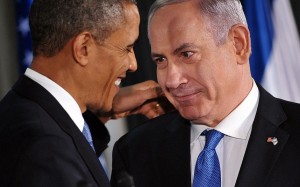 It seemed to come almost out of nowhere. The United States usually protects Israel from critical resolutions at the UN Security Council. However, in a dramatic move, the US abstained and a resolution criticizing recent settlement activity was passed by the 15-member body.
But this was not the end. John Kerry, Obama’s former Secretary of State, gave a lengthy address a few days later. Kerry’s speech was not so different from the statements of previous leaders, both Democrats and Republicans. He defended Israel’s existence, and denounced almost all forces actively opposing Israel.
However, Kerry harshly criticized specific Israeli policies. While Kerry’s speech defending the UN abstention uttered the standard, mildly critical, pro-Israeli talking points, it did contain some words that, taken out of context and spread throughout the internet, could and did indeed make a lot of Israelis and Zionists very angry. The most quoted one was: “If the choice is one state, Israel can either be Jewish or democratic, it cannot be both.”
Kerry was alluding to the fact that if Palestinians are absorbed into Israel in a “one state solution” but Israel remains a “Jewish State” this will not be democratic. According to Kerry, under such circumstances Palestinians would be second class citizens, i.e. non-Jews in a Jewish state.
Immediately, Kerry’s speech was decried by Israelis. Netanyahu fired back, as did the entire pro-Israeli blogosphere. The Republican and Likud Party aligned voices escalated the shrill accusations that Obama was a secret Muslim, a member of the Muslim brotherhood, a terrorist sympathizer, a Neo-Nazi, a Communist, and everything else he has been called for 8 years straight.
Meanwhile, Israel did not stop its settlement activity, and was not really affected at all by the resolution. The billions of dollars in US aid to Israel continued. Obama has left the office on January 20th, and is now replaced by Donald Trump, who claims to be more pro-Israel than Obama. The UN Security Council is not taking any specific action to halt the settlement activities condemned in its resolution.
Nothing really changed, but a lot of dramatic, heated words were exchanged between the USA and its closest Middle Eastern ally. Why did this happen?
Napoleon & Obama: “I Come to Restore Your Rights”
In 1798, the French militarist Napoleon Bonaparte, who seized power in the aftermath of the revolution and eventually became Emperor, set out to conquer Egypt. He issued a proclamation saying:
People of Egypt! You will be told by our enemies that I am come to destroy your religion. Believe them not. Tell them I am come to restore your rights, punish your usurpers, and revive the true worship of Mohammed. Tell them that I venerate, more than do the Mamelukes, God, his prophet, and the Koran.
Among the people of Egypt and Syria, as well as the entire Arab world, there was deep hatred for the British and Ottoman empires, who functioned as Napoleon’s rivals. Napoleon hoped that he could convince Muslims throughout the region to support him, and on this basis that he could defeat their hated colonial enemies, and conquer the region for France.
Napoleon was lying. He was not an adherent of the Islam faith. Some speculate that he may have been a freemason, and became familiar with the Koran and Islam due to their inclusion in Masonic rituals. Regardless, years later, Napoleon explained the proclamation to his fellow French Christians saying:
A change of religion, inexcusable for the sake of private interests, becomes comprehensible when immense political results are involved…. Do you think the Empire of the East and perhaps the subjugation of the whole of Asia was not worth a turban and some loose trouser? The state of feeling in the army was such that it would have undoubtedly lent itself to a joke.
Barack Obama, like Napoleon Bonaparte, is not a Muslim. As offensive and heretical as some evangelical Christians and Catholics may consider the teachings of the United Church of Christ and Reverend Jeremiah Wright, they are not Islamic in any conceivable way. Barack Obama was married in a church. He has been photographed drinking wine and eating hot dogs.
Obama’s middle name is “Hussein.” As a child, while living in Indonesia, he attended an Islamic elementary school. Obama apparently did meet with the Palestinian-American professor Edward Said. With all of this to cite as evidence, the allegation that he was a “secret Muslim” has not vanished.
The endless, semi-hysterical attacks on Obama for having alleged links to Islam certainly had an impact outside of US borders. This impact may not have been accidental. Writing in the Atlantic Monthly in 2007, the self-described conservative Andrew Sullivan considered the colorful background of the future president to be an asset:
What does he offer? First and foremost: his face. Think of it as the most effective potential re-branding of the United States since Reagan. Such a re-branding is not trivial—it’s central to an effective war strategy… The next president has to create a sophisticated and supple blend of soft and hard power to isolate the enemy, to fight where necessary, but also to create an ideological template that works to the West’s advantage over the long haul. There is simply no other candidate with the potential of Obama to do this.
Sullivan’s widely read and cited article said:
If you wanted the crudest but most effective weapon against the demonization of America that fuels Islamist ideology, Obama’s face gets close. It proves them wrong about what America is in ways no words can.
The USA certainly had a lot of credibility to regain as the Bush era came to an end. The unilateral invasion of Iraq had been widely opposed, not just in the Middle East, but even among NATO states. Bush had gone as far as to say “this crusade, this war on terrorism, is going to take a while.” The word “crusade” doesn’t exactly bring up pleasant feelings among Muslims around the world.
Meanwhile, the federal agencies of the United States flew into a very Islamophobic mode after the 9/11 attacks. The leaders of a religious charity known as the “Holy Land Foundation” were imprisoned for nothing other than running soup kitchens for Palestinian children. Mosques across the United States were then and continue to be widely surveilled.
His Middle Name is “Hussein”
Voices like Andrew Sullivan’s hoped that Obama’s background could restore the credibility of the USA in the eyes of Muslims. But this was just the tip of the iceberg. What came about in the first term of the Obama administration? In 2011 the world watched the “Arab Spring.” Across the Middle East, impoverished people rose up against their governments.
Analysts often argue that the Arab Spring was spawned by the global financial crisis and the regional drought. Throughout the Arab world, crops failed, water was scarce, and impoverished people piled into the cities facing dire economic conditions. The uprisings that eventually erupted were predictable. Such conditions are known to spark unrest.
But the world did not see a repeat of the 1979 Iranian Revolution, where the Persians toppled a western puppet dictator under the slogans of “Not Capitalism but Islam” and “War of Poverty Against Wealth.” The western capitalist apparatus was ready. The Arab Spring was immediately redirected to serve their ends. Social media outlets based in western countries, and the global apparatus of pro-American NGOs swung into action.
With a commander-in-chief who most people in the Middle East had a favorable opinion of, the forces of global power were able to ensure that the revolt did not become an uprising against western capitalism. No new anti-imperialist regimes were born. Rather, the opposite happened.
In Egypt, the pro-US regime of Hosni Mubarak fell, but what replaced it? First, Egypt elected Mohamed Morsi, a leader of the CIA-linked Muslim Brotherhood. Morsi was then toppled by a military coup d’etat. Now General Sisi, a top military leader under Mubarak, is in power.
The US backed Saudi regime was allowed to crush the uprisings within its own borders. Ayatollah Nimr Al-Nimr, a Shia cleric who led protests demanding civil liberties and religious freedom in the country was eventually beheaded for his role in the Arab spring. Saudi troops poured into Bahrain to keep the monarchy in power and crush the Shia majority that demanded their rights. In the aftermath of the revolt, Yemen staged a sham election in which Mansour Hadi, a Saudi puppet, was the only candidate on the ballot. Yemen is now torn apart by war, as many Yemenis reject Hadi’s pro-Saudi and Pro-US regime.
The energy and momentum of the Arab Spring, amplified and directed by the western TV networks along with Twitter and Facebook, went toward targeting two anti-imperialist, socialist governments. Gaddafi’s Libya had the highest life expectancy in Africa. Syria’s Bashar Assad presides over a centrally planned economy, supports Palestinian resistance, and is aligned with Iran, Russia and China.
In both Libya and Syria the United States began actively working to transform the Arab Spring into a successful regime change operation. Though the faces promoted on western television were often middle class, secular young people who dreamed of American consumerism while mouthing words about “democracy,” the brute force behind the Syrian and Libyan “revolutions” were religious extremists.
Based from the Syrian and Libyan countryside, forces linked to Al-Qaeda and the Muslim Brotherhood were joined by many foreign Jihadist fighters from throughout the region. The forces who toppled the Libyan government and continue to fight against the Syrian Arab Republic are dominated by those who adhere to Wahabbism, the ideology of Saudi Arabia and Osama Bin Laden. These deeply religious forces, working to topple anti-imperialist governments, happily took guns and funding from a country led by a man who went to a Muslim school, met with Edward Said, and whose middle name happened to be “Hussein.”
Imagine what could have happened in the region, if the wave of uprisings had taken place while George Bush “the crusader” was still in office. Obama’s presidency played a decisive role in manipulating and redirecting the events of 2011.
Netanyahu vs. Obama: A Made For TV Drama
 It is not uncommon for celebrities to clash with each other in the public arena. Often, these fights are not spontaneous, but intentionally provoked, or even planned, in order to generate publicity for both parties involved. For example, long before running for President, Donald Trump captured the attention of news headlines by having a spat with TV personality Rosie O’Donnell.
The perceived tension between Benjamin Netanyahu and Barack Obama has the looks of a “made for TV drama.” It is a prolonged public spat that is mutually beneficial to both parties. Do they actually dislike each other when the cameras are not rolling? Who knows.
While Obama and Netanyahu have butted heads, the US aid to Israel has not decreased or been cut off. Under Obama, the United States has worked to topple the Baathist Syrian government, one of Israel’s primary regional opponents. Israel has supported the regime change efforts with airstrikes in Syria targeting the anti-ISIS fighters of the Hezbollah organization.
The 2011 NATO intervention in Libya, championed loudly from the White House, toppled the Islamic Socialist government that had a long record of opposing Israel and arming Palestinian resistance.
Obama boasts that he has ended Iran’s peaceful nuclear energy program, and is making Israel safer from a supposed Iranian threat in the process. While there is occasionally criticism of Israel’s settlement activities, they continue unabated.
However, Obama’s clash with Netanyahu plays well for him, and the United States, in the Arab world. Throughout the Middle East, Netanyahu and Tel-Aviv are the most hated villains. Obama’s trading of nasty words with Israeli leaders raises the credibility of the United States. It gives the United States a kind of distance from Israel on the international stage, while US support remains key and keeps flowing in without pause. Obama’s Department of Justice has even conducted raids against pro-Palestinian activists.
Netanyahu benefits from the spat as well. Fear and hatred of Palestinians, Muslims, and Arabs has been key in securing the recent electoral victories of the Likud Party. If Netanyahu looked like he was friendly toward someone who attended an Islamic elementary school, or had the middle name “Hussein” this would discredit him in the eyes of his base.
Despite the fact that Israel receives billions of dollars from the United States, as well as weapons and other assistance, Netanyahu looks as if he is not afraid to bite the hand that feeds him. Fighting with Obama allows Netanyahu to look like a brave, fearless, true believer in the Zionist cause.
“Don’t Forget About Obama!”
Though many Israelis and supporters of Israel in the United States dislike Donald Trump, he has presented himself during the campaign as a pro-Israeli hardliner. His speech to the American Israeli Public Affairs Committee was a repetition of standard pro-Israeli talking points, saying:
“When you live in a society where the firefighters are the heroes, little kids want to be firefighters… In Palestinian society, the heroes are those who murder Jews.”
Trumps statements about banning Muslim immigration haven’t exactly been popular in the Arab world. Statements like “Islam hates us” don’t go over so well either.
The fear among certain forces in the United States is that Trump could alienate the many Muslim allies of the United States in the Arab world. Wall Street oil companies make lots of money from the various autocratic regimes in Qatar, Kuwait, Saudi Arab, UAE, and elsewhere. Pentagon weapons manufacturers also make lots of money from selling their hardware to these regimes.
Like Napoleon’s strategy in Egypt, efforts to portray Obama as sympathizer with Muslims and Arabs haven’t exactly worked out so well. While the elites within the US aligned Gulf States and some of extremists forces who have poured into Syria have bought into the idea Obama is a trustworthy ally, many people in the region have not. The Syrian government has not fallen. Iran has not really been weakened.
The economic problems and other factors that fueled the discontent of 2011 have not vanished. There is no guarantee that the oil bankers of the United States will keep their grip over this vastly important territory. Certain sectors harbor real fear that Trump’s brash tone could now ruin everything. [emphasis added]
The last minute moves at the UN Security Council, publicly invoking Israel’s wrath, was a message to the Arab world. It was a desperate, final attempt to say: “Whatever Trump does, don’t forget about Obama! Not all Americans are hardline supporters of Israel! Not everyone in Washington hates the Arabs! Muslims of the world, keep trusting us, don’t turn against America!”
Caleb Maupin is a political analyst and activist based in New York. He studied political science at Baldwin-Wallace College.
Will TPP End Up Dead Without the US?
Sputnik – 23.01.2017
President Donald Trump said that the US will start pulling out of the 12-nation Trans-Pacific Partnership (TPP) trade agreement to protect American jobs and kick-start economic revival.
In a statement issued after Trump’s January 20 inauguration, the White House named the planned withdrawal from the TPP as a major priority for the new administration’s effort to bring down unemployment and breathe new life into the stagnant US economy.
“This strategy starts by withdrawing from the Trans-Pacific Partnership and making certain that any new trade deals are in the interests of American workers,” the White House release stated.
The TPP seeks to remove barriers to trade among its 12 signatories, which together account for 40 percent of the world’s economy: Australia, Brunei, Canada, Chile, Japan, Malaysia, Mexico, New Zealand, Peru, Singapore, the United States and Vietnam.
During his presidential campaign, Trump has repeatedly criticized the TPP and expressed the desire to shift the focus from global trade to national economic development in order to support the US economy.
Warning about the catastrophic impact the TTP pact, initiated by the Obama Administration, could have on the US economy, Donald Trump is committed to negotiating “fair trade deals” that would benefit American manufacturers and workers.
The restrictions on Asian imports proposed by Donald Trump are part of his strategy to revive domestic production and give up on the “global division of labor.”
TPP a boon to transnational corporations
The TPP began as an expansion of the Trans-Pacific Strategic Economic Partnership Agreement signed by Brunei, Chile, New Zealand and Singapore in 2005. Beginning in 2008, Australia, Canada, Japan, Malaysia, Mexico, Peru, the United States and Vietnam joined the discussion for a broader agreement, bringing the total number of countries participating in the negotiations to twelve and accounting for up to 40 percent of the global GDP.
The signing of the TPP deal led to mass-scale protests in many of the participating nations with the critics describing the agreement as an attempt to set the rules of the global economy to favor multinational corporations over domestic producers.
This, they warned, would negatively impact the situation of the domestic labor markets of the participation countries.
The TPP trade agreement consists of chapters on a range of issues dealing with trade barriers, intellectual property rights, human rights and government regulations across a host of industries, such as agricultural goods, pharmaceuticals and manufacturing.
It favors large multinational corporations which want to impose their regulations on foreign competitors.
The TPP deal also undermines domestic companies, laws, regulations and institutions with an extra-judicial Investor-State Dispute Settlement (ISDS) that stacks the deck in favor of multinational corporations.
US pivot away from Asia
In its push for the TPP, the Obama Administration was also governed by political considerations. Defense Secretary Ashton Carter said that the agreement was meant to strengthen Washington’s alliances with the key Southeast Asian nations.
“Obama planned to create an expanded free trade zone in Asia and the Pacific US companies would benefit from,” Sergei Lukonin, a senior expert on Chinese politics and economics in Moscow, told RT.
“The TPP could also be used by the US as a counterbalance to China. If Washington gives up on its leading role in the region, this would strengthen Beijing’s hand in the ongoing talks on the Comprehensive Regional Economic Partnership,” Lukonin noted.
He added that America’s withdrawal from the TPP would undermine its reputation in the region.
“With the United States out, the Asian nations will have to reconsider their military alliances with Washington,” Lukonin said.
Sergei Silvestrov, a Moscow-based economic expert, said that Washington’s withdrawal from the TPP would complicate its relations with Australia, New Zealand and other countries where the TPP is now being ratified.
Silvestrov added that without the United States the TPP would become meaningless as the US and Japan alone account for a hefty 80 percent of the TPP countries’ trade turnover.
Vietnam has already responded to Trump’s statement by suspending its ratification of the TPP deal, while Australian Prime Minister Malcolm Turnbull remains all set to speed up the ratification process.
Japan has been alarmed the most by the prospect of a US withdrawal from the TPP. Prime Minister Shinzo Abe pinned much hopes on the deal that would open the US market to Japanese exports. He will try to remedy the situation during an upcoming visit to Washington.Aside from the negative response from America’s Asian partners, Donald Trump will face serious opposition from transnational corporations. With the globalization process advanced as it is, it will take a country more than just canceling a single agreement to protect its domestic market.
Back to the roots
It still looks like President Trump worries more about America’s economic woes than he does about the political fallout his decision to withdraw from the TPP could create in the world, RT wrote.
During his election campaign he promised to fight unemployment and stand up for the interests of ordinary Americans and now is the right time for him to start practicing what he preached while on the stump.
Meanwhile, Donald Trump is also committed to renegotiating another trade deal, the North American Free Trade Agreement (NAFTA), which was signed by the United States, Canada and Mexico in 1994.
Featured Video
or go to
Aletho News Archives – Video-Images
From the Archives
Israel Would Have No Qualms About USS Liberty-Style FALSE FLAG If Iran Campaign Falters – Analysts
By Ilya Tsukanov – Sputnik – 18.06.2025
Donald Trump is mulling whether or not to join Israel’s aggression against Iran as Tel Aviv faces problems sustaining its defenses against growing counterstrikes, and apparently lacks a realistic game plan for an end to hostilities after failing to achieve its goals. Analysts told Sputnik how the US could be ‘nudged’ into the conflict.
“The US is already assisting Israel with supplies, intel, refueling support, etc. One of the many US posts in the region could be attacked for a casus belli,” former Pentagon analyst Karen Kwiatkowski explained.
“If Trump doesn’t comply with Israel’s demand” and join its aggression voluntarily, “a false flag may be needed” to drag the US in, Kwiatkowski, retired US Air Force Lt. Col.-turned Iraq War whistleblower, fears.
Netanyahu has a diverse array of options at his disposal, according to the observer, including:
- a false flag against US assets abroad blamed on Iran or one of its Axis of Resistance allies, like the Houthis
- a US domestic attack or assassination blamed on Iran
- Iranian air defenses ‘accidentally’ hitting a civilian jetliner carrying Americans
- use of a dirty bomb or nuclear contamination somewhere in the region blamed on Iran
- even blackmailing by threatening to use nukes against Iran if the US doesn’t join the fight
Kwiatkowski estimates that Israel probably has “enough blackmail power” against President Trump and Congress to avoid the necessity of a false flag operation, but a “USS Liberty-style” attack, targeting the soon-to-be-retired USS Nimitz supercarrier that’s heading to the Middle East, for example, nevertheless cannot be ruled out entirely, she says. … continue
Blog Roll
 Aletho News
- Top PMU commander, over a dozen fighters killed in new US strikes on Iraq
- Is Netanyahu’s war gamble threatening the future of ‘Israel’?: FT
- Smotrich calls for annexation of South Lebanon to Litani River
- Echos of Gallipoli? Hormuz and the Geography of Hubris
- Pakistan PM backs Iran’s right to self-defense amid tensions
- Hungary blasts ‘fake’ EU accusation
- SAFE Debt Trap: Poland’s €43.7 Billion Bet on Unipolar Illusion
- War on Iran threatens global Gulf capital flows: FT analysis
- Mossad De Facto Admits To Inciting Riots In Iran
- Tehran: World grown thoroughly exhausted with US-Israeli ‘false flag storylines’
- If Americans Knew
- From Sde Teiman, the truth about Israel’s military justice system has been set free
- Child denied life-saving bone marrow transplant by Israel ‘because he is from Gaza’
- Raffi Berg: BBC Middle East Editor Exposed as CIA, Mossad Collaborator
- Jerusalem Archbishop Rebukes Netanyahu’s Statements on Christianity
- US to embed Palantir AI across entire military: Report
- Israeli-US war on Iran to drag on “a few more weeks” – Not a ceasefire Day 164
- Lebanon deaths top 1,200; Palantir AI to be embedded across US military – Not a ceasefire Day 163
- Israel’s assassination game: Take all pragmatists off the board
- Food shortages return to Gaza as Israel tightens aid restrictions under the cover of its war on Iran
- Trump demands trillions in payments from Gulf countries, billions from Harvard – Not a ceasefire Day 162
- No Tricks Zone
- Devastating Assessment Of Comirnaty Vaccine By Former Senior Pfizer Europe Toxicologist
- New Study: CO2 Is ‘Effectively Negligible’ As An Explanatory Climate Change Factor Since 2000
- Former Pfizer Toxicologist Dr. Helmut Sterz Tells Bundestag Hearing Pfizer Vaccine Should Have Never Been Approved
- Energy Expert: Germany’s Nuclear Phaseout Was A “500 Billion Euro Mistake”
- New Research: South Australia’s Mid-Holocene Sea Surface Temperatures Were 4°C Warmer Than Today
- Storing Green Energy To Last Germany 10 Days Would Require A 60-Million Tonne Battery
- New Studies: UK Sea Levels Were 4 Meters Higher Than Today During The Mid-Holocene
- Destructive Green New Deal: German Energy And Metal Group Warns Of Drastic Crisis
- New Study Documents A 20-Year Pause In Arctic Sea Ice Decline – Driven By Internal Variability
- Wake-up Call: Survey Shows Majority Of Germans Now Favor Postponing Climate Targets!
 Aletho News