Trump has Opportunity to End Obama/Clinton Weapons Sales to Anti-Woman Tyrants
I attended the women’s rights rally in Portland, Oregon, today to support women worldwide and urge Trump to end Obama and Hillary Clinton’s record weapons deals with the most repressive state for women in the world, the totalitarian dictatorship of Saudi Arabia.
In 2010, the Clinton state department organized the biggest weapons sale in US history. The sale was to strongman Abdullah Abdullaziz, who had women executed as punishment for being raped. The Kerry state department followed the deal with a sale of almost a billion dollars worth of illegal cluster bombs to the dictator. Obama approved both deals.
Bloomberg reports Clinton’s weapons sales to woman-oppressing dictators increased dramatically after the tyrants ‘donated’ to what Harper’s magazine calls the Clintons’ ‘slush fund’, the Clinton Foundation.
An unfortunate aspect of much of the current anti-Trump upheaval around the country is that similar actions were not undertaken when policies Democrats would or will oppose if Trump carries them out were not opposed by Democrats when Obama and Hillary Clinton performed them.
However, this is largely because the general public is kept ignorant of most of these policies. Such actions, Dr. Chalmers Johnson has noted, are “kept secret” from the US-American public.
Respected analysts this week highlighted the disparity between Obama’s treatment in the neoliberal press and his actual record.
John Pilger quotes a typically sycophantic example of a description of Obama, this one from The Guardian:
“But the grace. The all-encompassing grace: in manner and form, in argument and intellect, with humour and cool … [He] is a blazing tribute to what has been, and what can be again … He seems ready to keep fighting, and remains a formidable champion to have on our side … The grace … the almost surreal levels of grace …”
Nicolas J S Davies outlines the reality: Obama, whose political career has been sponsored by, among many other similar elements, lethal weapons manufacturer General Dynamics, “has increased U.S. military spending beyond the post-World War II record set by President George W. Bush. Now that Obama has signed the military budget for FY2017, the final record is that Obama has spent an average of $653.6 billion per year, outstripping Bush by an average of $18.7 billion per year (in 2016 dollars).
In historical terms, after adjusting for inflation, Obama’s military spending has been 56 percent higher than Clinton’s, 16 percent higher than Reagan’s, and 42 percent more than the U.S. Cold War average…”
Under Obama, “… the U.S. and its allies dropped 20,000 bombs and missiles in his first term. In his second term, they have dropped four times that number, bringing the total for Obama’s presidency to over 100,000 bombs and missiles striking seven countries, surpassing the 70,000 unleashed on five countries by George W. Bush.”
Pilger notes Obama ordered an average of 72 explosive devices to be planted and detonated every day in 2016.
Davies continues that Obama has used the US’s Central American model of favoring proxy-armies and death-squads over sending in US troops, and has thus provided arms and ignited and fueled conflicts that have killed hundreds of thousands around the world.
But the strategy has also included “a massive expansion of U.S. special operations forces, now deployed to 138 different countries, compared with only 60 when Obama took office.”
Pilger notes this “amounted to a full-scale invasion of Africa.”
Highlighting what these US operations and hegemonic expansion mysteriously achieve, Oxfam this week released a report noting that about 8 people now control as much wealth as half the world’s population. This is down from 16 people within the past year or so, and around 70 people before that.
Within the US, while thousands of the poorest people in places like Detroit had their water turned off in violation of the universal declaration of human rights, Obama allocated a trillion dollars to the nuclear arsenal, in violation of legal obligations and agreements.
And while he has refused to prosecute torturers and war criminals from the Bush Jr. regime (let alone his own), he has waged a campaign of persecution against those who have exposed torture and war crimes.
Amnesty International and other groups note a highlight of Obama’s presidency was his recent commutation of the sentence of US political prisoner Chelsea Manning, who released documents exposing some US war crimes. But the commutation came after an offer from another, higher-value whistle-blower and political prisoner, Julian Assange, to accept extradition to the US in exchange for clemency for Manning.
Others note Obama has deported millions of people and increased military aid to human rights violators like Israel and Saudi Arabia more than any other president.
While at least some Democrats would express opposition to these actions if they were performed by Trump, this cannot necessarily be called hypocrisy, since the US and Western propaganda model (corporations dumping billions into favored media outlets to overwhelm the market) prevents the vast majority of them from knowing Obama undertook the actions himself.
This is not new. Similar demonstrations expressing disgust were carried out by Democrats and others during the inauguration of Bush Jr., but not in opposition to policies carried out by Clinton such as his genocide in Iraq that killed some 500,000 children, his support for terrorist Paul Kagame in Rwanda, which has contributed to the deaths of millions, or Clinton’s aggression against Yugoslavia.
Continuing to illustrate how these and other crimes are “kept secret” from or distorted for the US and Western public, Reuters this week said the US/NATO aggression against Yugoslavia was carried out in response to Serbia “killing about 10,000 ethnic Albanian civilians there.”
But Noam Chomsky and other US/Western propaganda analysts note that according to the West’s own monitors, including the British Parliamentary inquiry into the matter, this is a reversal of the chronology.
In the year before the US/NATO attack, about 2,000 people were killed due the conflict in Yugoslavia, with more killings attributed to the KLA – the terrorist-integrated guerilla force backed by the US and Western countries – than to the Serbs. Before the US/NATO attack, the killings had mostly subsided, but the KLA continued to carry out provocations to, as it stated, try to instigate NATO intervention on its behalf.
Wesley Clarke, the NATO commander at the time, said bombing Yugoslavia would cause more deaths and atrocities than would occur without Western bombing. Others agreed, but, with Hillary Clinton’s urging, Bill Clinton began bombing the country, leading to the “about” 10,000 deaths Reuters this week says the bombing was a response to.
The Reuters article also mysteriously fails to mention that if the US had intervened to prevent atrocities, it would not have been supporting what Dr. Michael Parenti, in a book on the topic written under the supervision of Balkan experts, notes were worse atrocities carried out by Turkey (against the Kurds) and other regimes around the world.
Through countless similar distortions and omissions, the US/Western propaganda model thus continues to keep Democrats uninformed and thus complacent or supportive of politicians who carry out actions Democrats sometimes vehemently oppose when the same actions are planned or carried out by Republicans.
Comparable dynamics are also true in reverse.
Robert J. Barsocchini is an independent researcher and reporter whose interest in propaganda and global force dynamics arose from working as a cross-cultural intermediary for large corporations in the film and Television industry. His work has been cited, published, or followed by numerous professors, economists, lawyers, military and intelligence veterans, and journalists. Updates on Twitter.
Trump brings optimism to Syrian peace talks
By M K Bhadrakumar | Indian Punchline | January 20, 2017
On Thursday, Moscow slipped in the formal invitation to Washington to attend the intra-Syria talks in Astana on coming Monday (January 23). It waited till the last ‘working day’ of the Barack Obama administration. A snub to the outgoing administration? But it could as well have been a pre-emptive measure to guard against any last-minute temper tantrum by the outgoing US administration.
No doubt, it is a thoughtful Russian move to engage the incoming Donald Trump administration on its very first day in the White House. Trump will now take the call. The Russian Foreign Minister Sergey Lavrov said:
- We hope the new US administration will accept this invitation and will be represented at this meeting at any expert level it considers appropriate. This could be the first official contact during which we will be able to discuss a more effective way to fight terrorism in Syria… Russia and the United States created and are co-chairing the International Syria Support Group… It has two task forces – a Humanitarian Task Force and a Ceasefire Task Force. There is a good chance we can invigorate these mechanisms.
Lavrov’s optimism must be based on considered assessment regarding Trump’s disposition to work with President Vladimir Putin in the fight against terrorism in Syria and elsewhere.
A novel feature of the Astana talks is that the field commanders of the Syrian opposition groups have been brought to the forefront as the Syrian government’s interlocutors. Previously, politicians living in exile who were proxies of Saudi Arabia and Qatar used to represent these groups. They were vulnerable to outside manipulation. Evidently, Turkish and Russian intelligence acted together, pooling resources, to wean the field commanders away from the orbit of Saudi and Qatari influence and entice them to agree to a ceasefire and get them to jettison their previous aversion to dealing with the Syrian government.
Of course, the field commanders too have little room to maneuver after the capture of Aleppo by the government forces. Besides, Trump’s win effectively shuts the door on any future US support for these rebel groups. There is bitterness among the residual rebel groups who remain within the Saudi orbit, but losers cannot be choosers. A commentary by Fox News brings this out.
In the final analysis, Moscow has shown almost seamless patience to get as many rebel groups as possible on board – with the exception of Islamic State and al-Qaeda affiliate Nusra Front. No ‘pre-conditions’ have been set except that the participants in the Astana talks must agree on ceasefire. What we see here is a total marginalization of regional states who played a negative role aimed at fragmenting Syria – principally, Saudi Arabia, Qatar and Israel.
Moscow would feel gratified that Turkey is using its clout with the rebel groups to persuade them to attend the Astana talks. In a dramatic turnaround, Russian jets are now providing air support for the Turkish ground operations in northern Syria, testifying to the phenomenal shift in the regional alignments over Syria. (Associated Press )
The bottom line is that the departure of the Obama administration has dramatically improved the prospects for a Syrian peace process taking off, finally. Moscow is pinning hopes that there will be a sea change in the US policies in Syria w.e.f January 20. Again, to quote Lavrov:
- When he (Trump) says that his key foreign policy priority will be the fight against terrorism, we are happy to welcome this intention. This is exactly what our American partners lacked before him. On paper, they (Obama administration) seemed to be cooperating with us…, but in fact, they were deceiving us… According to a recent leak about John Kerry’s meeting with Syrian opposition forces several years ago, the United States regarded ISIS as a suitable force for weakening Bashar al-Assad… What Donald Trump and his team are saying now shows that they have a different approach and will not apply double standards in the fight against terrorism in order to achieve unrelated goals.
The talks in Astana are expected to be substantial. Russia and Turkey hope to involve the field commanders in the drafting of a new constitution, holding of a referendum and fresh elections. Equally, a consolidation of the country-wide ceasefire can be expected as a tangible outcome of the Astana talks. (TASS )
Kremlin on Obama’s Remarks: ‘Russia Always Advocates for Fair Nuke Disarmament’
Sputnik – 19.01.2017
Russia disagrees with outgoing US President Barack Obama’s reproaches on nuclear disarmament, Kremlin spokesman Dmitry Peskov said Thursday, noting that Moscow supports a proportional process.
Obama accused Russian President Vladimir Putin at his final news conference on Wednesday of unwillingness to negotiate the reduction of nuclear stockpiles.
“We cannot agree with Mr. Obama’s statement. Russia has always advocated for a fair and proportional nuclear disarmament process,” Peskov told reporters.
Peskov said the nuclear disarmament process “cannot be disproportionate, it cannot and should not lead to a breach of nuclear parity, which is critical to ensuring global stability and security.”
“Thus, we cannot agree with that, Russia has consistently taken a well-known position on this issue,” the Kremlin spokesman said.
US-led coalition air raids breach Syria sovereignty: Cuba
Press TV – January 18, 2017
Cuba has denounced US-led coalition airstrikes in Syria, saying they violate the Arab country’s sovereignty as they are not permitted by Damascus.
Cuban Ambassador to the United Nations Humberto Rivero made the criticism during a UN Security Council meeting in New York on Wednesday.
“We demand the cessation of the violations of Syrian sovereignty and the foreign military presence without the consent and the coordination of operations with the Syrian government, the only legitimately elected authority in the country,” Rivero said.
He further condemned the “politicization” of the crisis in Syria and “the tampering of the humanitarian crisis and the suffering” of people in the Middle Eastern country.
Those who are “supplying weapons, money and patronage to terrorist groups are responsible for the thousands of civilian victims of the conflict and the humanitarian situation,” the Cuban diplomat said, expressing his opposition to “the promotion of an interventionist agenda” in Syria.
The US-led coalition has been conducting air raids against what are said to be Daesh terrorists inside Syria since September 2014 without any authorization from the Damascus government or a UN mandate. Analysts have assessed the strikes as unsuccessful as they have led to civilian deaths and failed to counter terrorism.
The US Air Force is also carrying out airdrops of weapons, ammunition and other equipment to militants fighting against the pro-government forces in Syria.
UN chief optimist on ‘conflict freeze’
Separately on Wednesday, United Nations Secretary General Antonio Guterres warned that the consequences of the Syria crisis had become “too dangerous.”
Speaking in a briefing at the UN office in the Swiss city of Geneva, Guterres stressed that the conflict had fueled instability in the Middle East region and terrorist attacks across the globe.
Touching on the upcoming Syria peace talks in the Kazakh capital Astana, the UN chief further expressed hope that the discussions could “lead towards a consolidation of the ceasefire and a freeze in the conflict.”
The cessation of hostilities took effect on December 30, following an agreement between Syria’s warring parties.
Mediated by Russia and Turkey with the support of Iran, the truce is the first of its kind that has been largely holding in Syria for almost three weeks now. Earlier attempts by the US to broker such a long-lasting ceasefire had failed.
Elsewhere in his remarks, Guterres underlined that the success of the Syria talks could “help create the conditions for a political process” regarding the Syria crisis.
The Astana talks, which are scheduled to be held on January 23, were brokered by Moscow, Ankara and Tehran.
From Mumia to Peltier, US Political Prisoners Still Locked Up
teleSUR | January 18, 2017
Many members of the Black Panthers and New Afrika party remain behind bars, some under dubious circumstances.
In the wake of U.S. President Barack Obama commuting the sentence of Chelsea Manning and Oscar Lopez Rivera, teleSUR takes a look at some of the more prominent political prisoners who remain behind bars for their activism and fight for justice.
Mumia Abu-Jamal

Mumia Abu-Jamal was arrested and charged with killing white police Officer Daniel Faulkner in Philadelphia in December 1981. One year later, he was tried, convicted, and sentenced to death.
In 2011, the United States Supreme Court declared the death penalty unconstitutional in his case, and he was re-sentenced to life in prison without parole. He and many activists have maintained that he is innocent.
Leonard Peltier

Indigenous activist Leonard Peltier, who was convicted under the dubious murder of two FBI agents on the Pine Ridge Reservation in 1975, has continually maintained his innocence. In the 40 years since his trial, evidence continues to surface showing that Peltier was in fact convicted under false pretenses
Simon Trinidad

Simon Trinidad joined Colombia’s FARC rebel group in 1987, rising through the ranks to eventually serve as the group’s de facto foreign minister. On a diplomatic visit to Ecuador in 2004, Trinidad was arrested and deported to Colombia, where on trumped up charges he was extradited to the U.S. After two hung juries Trinidad was ultimately convicted of conspiracy charges related to the kidnapping of two Plan Colombia agents and sentenced to 60 years at a supermax prison. Speaking of the sacrifices he’s made for his beliefs Trinidad said, “If I don’t do this, what am I? A traitor. That’s why I put up with pain and suffering to fight for what we lack. That’s why I took up the guerrilla struggle.”
Mutulu Shakur

Mutulu Shakur, a Black Liberation Army and Republic of New Afrika member who was stepfather to the late rap artist Tupac Shakur, was jailed in 1988 on charges of “conspiracy to aid bank expropriation.” Due to his activism, he had previously been placed on the FBI’s illegal COINTELPRO surveillance program, which was also used against Martin Luther King Jr. and other radical Black activists.
“Sonia” aka, Omaira Rojas Cabrera

Born to a Colombian peasant family, Omaira Rojas Cabrera, known by her nom de guerre “Sonia,” joined the FARC rebel group as a teenager and rose to become one of their top female commanders. She was kidnapped by Colombian special forces in 2004, and eventually extradited to the U.S. where she was put on trial over drug charges. She was convicted in 2007 and sentenced to 16 years, a fraction of the 55 to 60 years the prosecutors had asked for. Both she and Simon Trinidad were the subject of prisoner exchange negotiations between the FARC and then Colombian president Alvaro Uribe, launched by Venezuelan President Hugo Chavez.
David Gilbert

David Gilbert is a radical U.S. leftist organizer and member of the Weather Underground Organization, who worked with members of the Black Liberation Army. In 1983, he was convicted and sentenced to 75 years for three counts of felony murder over an attempted bank robbery attempt along with the activists.
Russell ‘Maroon’ Shoatz

Russell “Maroon” Shoatz was convicted back in 1970 for the first-degree murder of a Philadelphia police officer, in an attack that was conducted at the Philadelphia police station. A former member of the Black Panther Party and “soldier” of the Black Liberation Army, he was held in solitary confinement for 22 years, only being returned to the general prison population in 2014.
Sundiata Acoli

Black Panther Sundiata Acoli was convicted of killing a state trooper during a 1973 shootout on the New Jersey Turnpike. Acoli is one of at least 15 former members of the Black Panther Party who are still in prison.
Jamil Abdullah Al-Amin

Jamil Abdullah Al-Amin was a Black activist who worked with the Black Panthers, and was previously known as H. Rap Brown. He was convicted of shooting two deputies in March 2000 as they approached him with an arrest warrant for offenses including impersonating a police officer. He is serving a life sentence.
Al-Amin and his supporters have long argued that he was framed by a government that has feared him since his days in radical anti-racist politics.
Black Panthers

Ever since its founding in Oakland in 1966 the Black Panthers were ruthlessly persecuted by the FBI and other domestic security forces. From the illegal Cointelpro program to the infamous Panther 21 trial, when 21 members of the Party were tried on 156 charges which were all eventually dropped, the U.S. government set out to destroy the grassroots movement. In addition to the former Panthers listed above, there are 11 Black Panthers who remain in jail on a variety of charges: Romaine “Chip” Fitzgerald in California; Ed Poindexter in Nebraska; Joseph Bowen in Pennsylvania; Jalil Muntaqim in New York; Romaine Fitzgerald jailed since 1969; Herman Bell imprisoned in New York since 1971; Veronza Bowers, in prison since 1973; Robert Seth Hayes, jailed since 1973; Zulu Whitmore, in prison in Louisiana since 1977; Maliki Shakur, jailed since 1979; and Kamau Sadiki, imprisoned since 2002.
US military boosts weapons airdrops to Syrian opposition – reports
RT | January 17, 2017
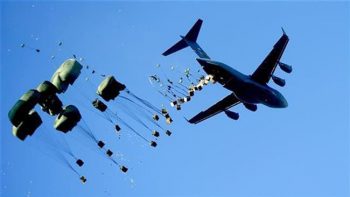 A growing number of opposition groups in Syria are getting increased weapons and ammunition supplies from the US Air Force to tackle Islamic State, according to US media reports citing the country’s military.
The weapons are intended for opposition forces closing in on IS’s self-proclaimed capital Raqqa in Syria, USA Today reports.
The “expanded” airdrops are “helping ground forces take the offensive to [the Islamic State] and efforts to retake Raqqa,” Gen. Carlton Everhart, commander of the US Air Mobility Command, is quoted by the news outlet.
Currently, the Syrian Democratic Force (SDF) – an alliance of various militias, mainly formed by Kurdish fighters – is continuing its push to retake territories around Raqqa. SDF is among key opposition forces being backed by the US-led international coalition in Syria.
The weapons supplies “are absolutely essential” for the irregular forces fighting on the ground, the US Air Force spokesman in Baghdad Col. John Dorrian claimed, according to USA Today.
Meanwhile, Everhart reportedly claimed that the US military is being extremely precise while delivering arms and equipment to the opposition in Syria. “We’ll get it within 10 or 15 meters of the mark,” he said.
The US-led coalition has been repeatedly conducting military airdrops for the opposition groups in Syria. However, such missions have not always gone according to plan.
Back in October 2014, a weapons airdrop by the US Air Force apparently ended up in the hands of IS terrorists, who released a video claiming to have seized the cache of arms. The weapons had been intened for the Kurdish forces battling jihadists who were besieging the Syrian town of Kobane at the time.
Pentagon spokesman Col. Steven Warren later said that two bundles of weapons have been lost. While one of them was destroyed by an air strike, another “went astray and probably fell into enemy hands.”
“There is always going to be some margin of error in these types of operations,” Warren added.
In December last year, US President Barack Obama granted a waiver for some of the restrictions on the delivery of military aid to “foreign forces, irregular forces, groups, or individuals,” if those groups are supporting the US’s alleged counter-terrorism efforts in Syria.
Reacting to the decision, Russian presidential spokesman Dmitry Peskov said the move could result in some of the weapons getting into the hands of terrorists.
Such an occurence would pose “a serious threat not only for the region, but the entire world,” he warned.
On December 9, 2016 US Democratic lawmaker Tulsi Gabbard introduced the Stop Arming Terrorists Act bill. She alleged that the CIA in fact supplied arms to the opposition, some of whom cooperated with terrorists including al-Qaeda. “This madness must end,” she urged.
‘Russophobic hysteria now backed up by massive US troop movements in Europe’
RT | January 16, 2017
We live in dangerous times, where the behavior espoused by Obama and Clinton has been extremely dangerous, says former British ambassador to Uzbekistan Craig Murray.
Russian hackers have found themselves at the center of yet another controversy, thus helping to fuel the latest round Russophobia.
A Russian-language version of a new, highly-anticipated episode of Sherlock was leaked online before its first official airing, leading to all sorts of conspiracies.
The BBC, which owns the rights to show Sherlock, says it will carry out a full investigation of the incident.
RT: What do you think of the claim that Russia keeps a dossier on key British MPs?
Craig Murray: It seems to me unlikely. Of course there are spies – all countries more or less have spies. Russia has spies, America has spies, Britain has spies. I suppose these people have to do something to justify their salaries and the enormous cost of their organization. There is a certain amount of nonsense that goes on. But I really don’t think that Russia spends a great deal of its time keeping dossiers on British politicians with incriminating photographs and that sort of thing. I think it is a very 1950’s idea.
RT: Like in the hacking scandal, no real evidence has been put forward. Is it now acceptable to just forget about evidence?
CM: It seems quite remarkable the number of claims that we’ve seen. The so-called hacking scandal, then the wider claims from that absolutely unbelievable dossier apparently compiled by Christopher Steele about meetings where people can prove they were nowhere near the meeting; about people being sacked who weren’t sacked, and all kinds of absolutely fact-free nonsense, which the media then claims as unverifiable.
Actually, it was very verifiable – you could easily verify it wasn’t true. And now we have this stuff. I think anti-Russian stories using a secret source are going to be with us for some time. You’ve got to remember that the military and the security services have to justify their enormous budgets, and that is what this is all about.
RT: Is the worst of the hacking hysteria over now, do you think?
CM: Well, this is going to have to calm down though now, because eventually people will have to admit there is no evidence on this whatsoever, and in fact it didn’t happen. But the lack of evidence seems no barrier at all to the hysteria continuing. This sort of wave of Russophobic hysteria is something which we experienced once or twice during the Cold War at this kind of level, which I really believed the world had got over. And it is extremely sad to see it coming again when that is backed up by massive troop movements and tanks wheeling around, churning up fields all over the Europe. We live in dangerous times, where the behavior espoused by Obama and Clinton has been extremely dangerous.
Afghanistan: Obama Sends Marines to Take Part in America’s Longest Ever War
By Peter KORZUN | Strateic Culture Foundation | 16.01.2017
President Obama has decided to send 300 US Marines back into Afghanistan’s Helmand Province – the first time in three years that the US military has been sent into that conflict zone.
Almost all of Helmand’s districts, except for the provincial capital, Lashkar Gah, are either heavily embattled or fully controlled by the Taliban. The province is the leading opium producer in the country.
Despite all the promises to withdraw, 8,400 US troops will remain in Afghanistan as the president leaves office on January 20. If the US pulls out, the Afghan government will hardly be able to hold power.
American forces have been engaged in combat action there for over 15 years – the longest war waged by the United States – without end to hostilities in sight.
Around 200 NATO soldiers, mainly Italians, have also been deployed to Afghanistan’s volatile western province of Farah after attempts by Taliban fighters in recent months to overrun its capital city.
About a third of the country – more territory than at any time since 2001 – is either under insurgent control or in risk of coming under it. The Taliban forces have challenged Afghan security forces for a number of key cities in 2016. With fighting under way in 24 of the 34 provinces, the government’s ability to control the country is questioned.
Last December, General John Nicholson, the chief US and NATO commander in Afghanistan, said the government directly controls about 64 percent of the population of 30 million, down slightly from 68 percent earlier in 2016.
According to Robert Grenier who served as CIA’s top counter-terrorism official and was the station chief in Islamabad, Pakistan, from 1999 to 2002, there are significant parts of the country, particularly in the south and the east, where it seems inevitable that the Taliban will further consolidate their control. The Afghan forces had more than 15,000 casualties in the first eight months of 2016, including more than 5,500 deaths.
The administration in Kabul lacks unity while the clout of regional leaders and warlords is growing. The UN says 7 million people in Afghanistan need aid. 2.2 million of them suffer from malnutrition. Poverty and unemployment prompt young Afghans to join extremist groups.
After the Russian forces in Syria struck the oil infrastructure under the control of Islamic State (IS), the issue of controlling heroin routes in Afghanistan became even more important for the group. According to the Russian Federal Drug Control Service (FSKN), the IS militants make $1 billion a year from Afghan heroin. The possibility of alliance between the Taliban and IS is a real nightmare.
Afghan officials have approached Russia asking it to resume cooperation. Its representatives believe that the Shanghai Cooperation Organization (SCO) has a role to play in managing the crisis in the country. NATO officials have also made statements in support of resuming Russia-NATO cooperation in Afghanistan. The cooperation was suspended after Crimea became part of the Russian Federation in 2014.
Moscow allowed land transit though its territory of non-military freight from NATO and non-NATO ISAF (International Security Assistance Force) countries. NATO used the transit center near Ulyanovsk. The parties implemented a program of common training for the prevention of drug trade in Central Asia.
Russia sold military equipment and ammunition to support the NATO operations in Afghanistan. For instance, in 2010 NATO bought 31 Russian Mi-17 helicopters to refurbish them for the Afghan army.
Against the background of ballyhoo raised in the United States regarding the “threat” coming from Moscow, Washington has partially lifted sanctions against Russian cooperation with Afghanistan on helicopter maintenance. It was not the only time. The US has broken its own sanctions regime allowing the acquisition of Russian technology for its space program.
The Afghan government badly needs more Russian helicopters to repel Taliban and IS attacks. In 2016, it formally asked the Russian government to start the deliveries.
If Russia delivers its aviation equipment to Afghanistan, it will need to train Afghan personnel. Formally, that’s what US and NATO are doing in Afghanistan now- they are in the country on advising and training missions. In fact, it will mean the resumption of cooperation while carrying out the same mission.
Russian President Vladimir Putin has recently expressed concern over the situation in Afghanistan and called for taking urgent steps to tackle the problem. The instability in that country spreads to Central Asia posing a direct threat to Russia’s security. Roughly, 2,000 militants operating in the Afghan northern provinces come from the countries of the post-Soviet space.
There is a growing risk of extremist attacks on the states allied with Moscow. Fighters with combat experience received in Syria have already been spotted in the Uzbek Fergana Valley. The infiltration of Islamic State (IS) into Afghanistan threatens the Russian North Caucasus and the Volga region. Besides, Afghan heroin kills 25,000 Russians annually.
Afghanistan is a burning issue – a problem that only an international effort can solve. This is an issue of common interest for Russia and the Alliance. The situation in the country could be discussed within the framework of Russia-NATO Council. On January 4, the Russian Foreign Ministry made a very important statement saying Russia was ready to restore the relations with NATO. Afghanistan could become a starting point on the way of rebuilding the broken relationship.
Meet the Deplorables
By Rob Urie | CounterPunch | January 13, 2017
Once an assumption of benevolent leadership is made the tendency has been to interpret subsequent acts in benevolent terms. When George W. Bush was president this took the form of his supporters believing that Saddam Hussein brought down the Twin Towers, that Iraq had an ongoing WMD program and that the role of America was to ‘free’ the world of tyrants. All evidence to the contrary was taken as either fraudulent or partisan bickering.
The theory amongst bourgeois liberals in the early-mid 2000s was that this trait was peculiar to the more evangelically inclined supporters of national Republicans who had been swayed by the culture wars. The arrogance of the conceit is likely due in part to class difference, in part to conflation of education with intelligence (class difference) and in part to identitarian politics that well serve the powers that be. A question to ask then is: who benefits from political divisions?
The assumption precludes legitimate critique. Those doing the criticizing have to be in some sense enemies of benevolence (goes the logic). But what if the critiques derive from differences in circumstances and lived experience? This is most certainly the case when national policies like trade agreements benefit one group to the detriment of another. Who, besides economists, would give credence to an abstract benefit when their own life is being destroyed?
Whether Democrats like the idea or not, Donald Trump’s election is a result of Barack Obama’s eight years in office. Mr. Obama’s policies benefited the rich a lot, the liberal class a bit and the other 90% of the population not that much. His benevolence was not very evenly distributed. In fact, his neoliberal tendencies hurt a lot of people. And all it takes is one visit to the doctor to learn the difference between health insurance and health care.
History Shits the Bed
By the fall of 2011 the streets of Manhattan were filled once again with twenty-somethings carrying shopping bags holding as much bounty as they could carry. The cranes used to build luxury condos that had been stopped in mid-motion in 2009 were back to work. Stock and house prices were rebounding and conspicuous consumption amongst the newly revived banker and executive classes was back in the news. Pockets of economic recovery could be found around the country.
Barack Obama had saved the economy from a second Great Depression went the story-line. Obama Treasury Secretary Timothy Geithner was featured as a savior in glowing posters on the New York subway. The economic statistics were of economic recovery at rates of change not seen in recent history, if from levels of economic catastrophe. There was some ‘clean-up’ to be done around the edges, but America had been pulled back from the abyss.
The liberal class gave wide berth to the newly homeless who were beginning to fill certain blocks and streets. The poverty rate kept rising, even in New York, but that was because people didn’t have the skills employers were demanding assured the economists. Foreclosures continued to drive millions of families from their homes, but the Obama administration was doing what it could with ‘foreclosure relief’ programs that ‘foamed the runway’ with the lives of ordinary citizens for the benefit of Wall Street.
By 2012 bourgeois chatter had it that anyone who wanted a job could find one. Amongst the liberal elite in New York, this was largely true. But in the suburbs the distance between those hanging on and those who weren’t was growing. Foreclosure maps told a story of ongoing crisis. The clean and safe mini-estates that had been the call of the suburbs turned into prisons for the newly unemployed whose houses were worth so little that they could no longer sell them to search for employment.
But the suburbs were still relatively wealthy, if on a case-by-case basis, compared to the urban and rural neighborhoods targeted by the banks with predatory loans. Large and demographically concentrated neighborhoods, mostly poor neighborhoods of color, were partially or wholly abandoned by people who couldn’t pay their mortgages. And the banks were fine with ‘zombie’ foreclosures because they were off the hook for maintaining them and paying taxes.
If you’re poor in America you are on your own when the shit hits the fan. Kids, children, who were eight years old in 2008 are sixteen or seventeen years old now. Some I know have been able to pull their lives together after being homeless for a few years. Lots more are still sleeping in cars and trying to piece together enough work to eat. In 2017. Necessity has made them resourceful. Otherwise, they’re a lot like the rest of us.
With only superficial irony, many of the really poor kids have cell phones— a luxury, right? Did you ever try to find a job without an address or a phone number? How about apply for SNAP (food stamps)? Many of the vagrancy laws that supported Jim Crow are still on the books. If the cops want to put you in jail, they can. In America most of the ways of contending outside of corporate life are illegal. To end the suspense, this isn’t an accident.
Liberals, Meet the Deplorables
I’ve had long conversations with people who voted for Donald Trump— displaced manufacturing workers mostly who are in various stages of rebuilding their lives or watching them fall apart. Unlike the ‘deplorables’ of liberal infamy, they are basically decent people who want their lives back. For those displaced before the onset of the Great Recession, the stories have been of slow decline from well-paying jobs to hourly work or quasi-professional jobs that are still, in 2017, being diminished.
Those cut loose after 2008 saw rapid spirals down. One career mechanical engineer saw the company he had worked for for fifteen years bought out by a private equity firm in 2009. He was fired along with everyone he worked with when production was moved overseas. The workers filed a class action lawsuit to recover their pensions taken in the buyout. His wife left him the same week his house was foreclosed on. Right now he’s pumping gas at a highway rest stop to make ends meet.
Democrat ‘trade’ agreements combined with consequence-free bailouts for Wall Street place national Democrats and displaced workers and the poor on opposite sides of a vicious class war. The dominant refrain I’ve heard from the displaced across racial lines is ‘we need a fucking revolution.’ Before the DNC settled the issue in Hillary Clinton’s favor, I made my pitch for Bernie Sanders. The overwhelming pushback was: the Democrats are the Party of Wall Street and free trade agreements. The mechanical engineer knew that Bernie was toast months before I did.
Everyone Has Five Houses, Don’t They?
Democrat support for the rich and connected creates an odd dynamic for the bourgeois liberals pushing the ‘resist Trump’ movement. Whatever Democrats might say about Republican ‘obstruction,’ Barack Obama had eight years in which to enact the national Democrats’ agenda. From the perspective of those left behind— and a lot of people were, do you give four or eight more years to the people who left you behind or do you try something else?
The displaced workers I’ve met tended to know more about the Democrats’ actual policies than Democrats do, possibly because they’ve lived them. Even after Hillary Clinton lost the election Barack Obama was still pushing the TPP (Trans-Pacific Partnership) to ‘secure his legacy.’ And lest you be unaware, the TPP isn’t a trade deal per se— even Democrat loyalist and erstwhile economist Paul Krugman agrees that it isn’t. Its purpose is to give multi-national corporations more control over our lives.
For example, it would give coal extraction companies the right to sue for lost profits from the EPA’s rule that American utilities must switch from burning coal to less polluting fuels— one of Barack Obama’s ‘signature’ environmental achievements. This would require utility customers, taxpayers or both to pay for the coal not burned and the replacement fuel, a state of affairs that would quickly force a reversal of the EPA policy. So, is Mr. Obama an environmentalist or not?
The mechanism for doing this, the ISDS (Investor-State Dispute Settlement) provision, is a key part of the TPP. It works by allowing corporations to sue civil governments to recover lost profits when they enact laws to regulate environmental destruction or public health. And a big difference is that Donald Trump’s cabinet can be removed from office whereas the TPP is a civil doomsday device that is nearly impossible to undo once passed. Mr. Obama’s supporters know this, right?
A Bailout by Any Other Name Smells Just as Bad
Economists love the phrase ‘the road to hell is paved with good intentions.’ Their neo-Victorian point is that nature chooses the winners and losers in a market economy. As with the premise of benevolent leadership (above), the premise of benevolent system (capitalism) requires a kind of backward induction where all outcomes are interpreted and explained in terms of the benevolence of the system.
By continuing and extending the George W. Bush administration’s bailouts of Wall Street and the auto industry Barack Obama is credited by his supporters with staving-off a ‘second Great Depression.’ Dean Baker has done yeomen’s work debunking this nonsense. On the auto industry front, Mr. Obama maintained the tiered wage structure that left new auto workers earning near-poverty wages while auto executives were back to multi-million dollar bonuses in short order. Thanks Barack.
The bailouts of Wall Street had more moving parts. For those with an interest, Milton Friedman (bear with me) and Charles Kindleberger provide histories of the Great Depression from differing perspectives. Long story short, many of the structural problems that exacerbated the impact of bank failures in the Great Depression were resolved by FDR with bank reforms. Government sponsored deposit insurance alone provided a back-stop in 2008 that didn’t exist when FDR entered office.
Sweden undertook a smaller and less complicated nationalization of its banking system in the rolling Scandinavian banking crises of the late 1980s – early 1990s. It led to full recovery of the Swedish economy in quick order. In 2009 the idea of nationalization was put forward and quickly disposed of on ideological grounds by the Obama administration. FDR had proved that banks do just fine as heavily regulated quasi-utilities. But as Timothy Geithner put it: ‘America doesn’t do nationalization.’
As Matt Taibbi reported at the time, the ‘bailouts’ were a feeding frenzy amongst connected insiders where relatives of bankers (link above); hedge fund and private equity managers were given hundreds of millions of dollars in low interest loans that only had to be repaid if those that received them felt like it (non-recourse). As I explained here and the Bank of England explains here, global central banks acted to revive the prices of assets held by Wall Street and the global rich under the manufactured delusion that ‘we all benefit’ when the rich are made richer.
Had Wall Street been nationalized when Barack Obama had the chance the driving force of global environmental catastrophe, militarism, the concentration of wealth and recurrent economic crises could have been put toward serving the public interest. But Mr. Obama was ideologically opposed to doing so. This is something Mr. Obama’s supporters still don’t get— Mr. Obama is ideologically committed to neoliberalism. By late 2016 he was still pushing the neoliberal program with the TPP.
The argument that the Obama administration saved the U.S. from a second Great Depression is complete and utter bullshit. Moreover, Mr. Obama oversaw the most corrupt redistribution of national wealth in human history with the bailouts. Lest this seem hyperbolic, go back a reread Matt Taibbi’s reporting from 2009 and 2010 (link above). For people who were paying attention in the early years of the Obama administration, the contention that Donald Trump and his incoming administration are corrupt by comparison confuses method with substance.
Try a Little Tenderness
A good way to put the charge of a ‘deplorable’ class to the test would be to resolve the economic issues that are the basis for legitimate criticism and then see where this leaves us. Barack Obama had eight years to do so. He spent the first four arguing for austerity while he gave hundreds of millions of dollars in free money to connected insiders. He spent the second four arguing that the economy was healed and that what we need is more trade agreements.
Anyone with an interest can travel outside of the bourgeois ghettoes of Manhattan, Washington and Silicon Valley to see how the rest of the country is living. Fifty years of neoliberalism have left much of the country an economic wasteland. Across the Northeast banks and private equity firms are selling houses that were emptied eight years ago and have been hidden from sight since then. Their displaced occupants are paying rent they can’t afford and are but one paycheck away from ruin. Don’t take my word for it, see for yourselves.
The U.S. is currently nearing a full-blown political crisis. Liberals are being played by Democrat Party insiders and deep-state operatives. The ignorance of history required to believe that the CIA, FBI and NSA are benevolent entities that speak the truth is breathtaking. Furthermore, if Democrats want to contend that Wall Street’s and Exxon-Mobil’s interests are benign but Russia’s aren’t (where is the evidence?), what possible problem could they have with Donald Trump’s Cabinet?
The half of the electorate that voted for Donald Trump can rightly ask Democrats where they’ve been for the last eight years. (I voted Green but would have preferred a radical Left Party to vote for). Russia didn’t force Barack Obama to be an austerity loving, neoliberal tool. When millions of people are tossed onto an economic garbage heap, it’s politics 101 to expect a response. And before you call the response ugly, take a look at what was done to those who were tossed away. How ugly was that? How ugly would it be if it was done to you?
Rob Urie is an artist and political economist. His book Zen Economics is published by CounterPunch Books.
Featured Video
or go to
Aletho News Archives – Video-Images
From the Archives
Israel Would Have No Qualms About USS Liberty-Style FALSE FLAG If Iran Campaign Falters – Analysts
By Ilya Tsukanov – Sputnik – 18.06.2025
Donald Trump is mulling whether or not to join Israel’s aggression against Iran as Tel Aviv faces problems sustaining its defenses against growing counterstrikes, and apparently lacks a realistic game plan for an end to hostilities after failing to achieve its goals. Analysts told Sputnik how the US could be ‘nudged’ into the conflict.
“The US is already assisting Israel with supplies, intel, refueling support, etc. One of the many US posts in the region could be attacked for a casus belli,” former Pentagon analyst Karen Kwiatkowski explained.
“If Trump doesn’t comply with Israel’s demand” and join its aggression voluntarily, “a false flag may be needed” to drag the US in, Kwiatkowski, retired US Air Force Lt. Col.-turned Iraq War whistleblower, fears.
Netanyahu has a diverse array of options at his disposal, according to the observer, including:
- a false flag against US assets abroad blamed on Iran or one of its Axis of Resistance allies, like the Houthis
- a US domestic attack or assassination blamed on Iran
- Iranian air defenses ‘accidentally’ hitting a civilian jetliner carrying Americans
- use of a dirty bomb or nuclear contamination somewhere in the region blamed on Iran
- even blackmailing by threatening to use nukes against Iran if the US doesn’t join the fight
Kwiatkowski estimates that Israel probably has “enough blackmail power” against President Trump and Congress to avoid the necessity of a false flag operation, but a “USS Liberty-style” attack, targeting the soon-to-be-retired USS Nimitz supercarrier that’s heading to the Middle East, for example, nevertheless cannot be ruled out entirely, she says. … continue
Blog Roll
 Aletho News
- Top PMU commander, over a dozen fighters killed in new US strikes on Iraq
- Is Netanyahu’s war gamble threatening the future of ‘Israel’?: FT
- Smotrich calls for annexation of South Lebanon to Litani River
- Echos of Gallipoli? Hormuz and the Geography of Hubris
- Pakistan PM backs Iran’s right to self-defense amid tensions
- Hungary blasts ‘fake’ EU accusation
- SAFE Debt Trap: Poland’s €43.7 Billion Bet on Unipolar Illusion
- War on Iran threatens global Gulf capital flows: FT analysis
- Mossad De Facto Admits To Inciting Riots In Iran
- Tehran: World grown thoroughly exhausted with US-Israeli ‘false flag storylines’
- If Americans Knew
- Israel poised to take over southern Lebanon; settlers wreak havoc in West Bank – Not a ceasefire Day 165
- From Sde Teiman, the truth about Israel’s military justice system has been set free
- Child denied life-saving bone marrow transplant by Israel ‘because he is from Gaza’
- Raffi Berg: BBC Middle East Editor Exposed as CIA, Mossad Collaborator
- Jerusalem Archbishop Rebukes Netanyahu’s Statements on Christianity
- US to embed Palantir AI across entire military: Report
- Israeli-US war on Iran to drag on “a few more weeks” – Not a ceasefire Day 164
- Lebanon deaths top 1,200; Palantir AI to be embedded across US military – Not a ceasefire Day 163
- Israel’s assassination game: Take all pragmatists off the board
- Food shortages return to Gaza as Israel tightens aid restrictions under the cover of its war on Iran
- No Tricks Zone
- Devastating Assessment Of Comirnaty Vaccine By Former Senior Pfizer Europe Toxicologist
- New Study: CO2 Is ‘Effectively Negligible’ As An Explanatory Climate Change Factor Since 2000
- Former Pfizer Toxicologist Dr. Helmut Sterz Tells Bundestag Hearing Pfizer Vaccine Should Have Never Been Approved
- Energy Expert: Germany’s Nuclear Phaseout Was A “500 Billion Euro Mistake”
- New Research: South Australia’s Mid-Holocene Sea Surface Temperatures Were 4°C Warmer Than Today
- Storing Green Energy To Last Germany 10 Days Would Require A 60-Million Tonne Battery
- New Studies: UK Sea Levels Were 4 Meters Higher Than Today During The Mid-Holocene
- Destructive Green New Deal: German Energy And Metal Group Warns Of Drastic Crisis
- New Study Documents A 20-Year Pause In Arctic Sea Ice Decline – Driven By Internal Variability
- Wake-up Call: Survey Shows Majority Of Germans Now Favor Postponing Climate Targets!
 Aletho News