Some presidents grow in office and some presidents grow once out of office (Jimmy Carter comes to mind). But some presidents seem to learn very little during their four or eight year term. Unfortunately, especially when it comes to foreign policy, it seems President Obama falls into that latter category.
The president gave a press conference at the Pentagon today to update us on how the fight against ISIS is going. Remember: it is two years since Obama expanded what he promised would be a very limited military operation to save a religious minority — the Yazidis — from a hilltop in Iraq, into a full-fledged war in Iraq, Syria, and as of last week, Libya.
Two years ago this very week, in fact, President Obama informed the American people that he was launching “targeted airstrikes to protect our American personnel, and a humanitarian effort to help save thousands of Iraqi civilians who are trapped on a mountain without food and water…”
There was no chance of this very limited rescue operation expanding, he assured us:
As Commander-in-Chief, I will not allow the United States to be dragged into fighting another war in Iraq. And so even as we support Iraqis as they take the fight to these terrorists, American combat troops will not be returning to fight in Iraq, because there’s no American military solution to the larger crisis in Iraq.
Two years later, the lies are laid bare. US troops are indeed fighting another war in Iraq, with the addition of wars in Syria and Libya to boot.
Today the president wanted to give us good news about his anti-ISIS efforts in Iraq and Syria. His efforts have made us more safe, he claimed: “I do think that because of our extraordinary efforts, a homeland is significantly safer than it otherwise would be.”
But the president wanted us to know that things are not perfect. There are some bad actors who are hindering our efforts.
Singled out for condemnation in the president’s address was not ISIS, or al-Qaeda, or even the US-backed Nour al-Din al-Zenki, which recently filmed itself beheading a young child. No, the real villain for President Obama is the Syrian government, which has been engaged in a five year battle with ISIS, al-Qaeda, and US-backed “moderates” who do things like cut off young boys’ heads.
To Obama, the disaster in Syria is not the fault of the outside powers, who imported jihadis and even weapons from Libya (Hillary!) to overthow Syrian president Assad. It is all the fault of Assad for resisting the foreign-backed overthrow of his government! Indeed, even the act of fighting ISIS and al-Qaeda in his country earns Assad the condemnation of Obama:
In Syria, defeating ISIL and al-Qaeda requires an end to the civil war and brutality against the people, pushing them to extremes. The regime and its allies continue to violate the cessation of hostilities.
So the Syrian government is guilty of violating the “cessation of hostilities” by fighting al-Qaeda and US-backed groups that fight alongside al-Qaeda.
Indeed, to Obama the whole Syria disaster is the fault of Assad, who apparently woke up one morning and decided that the best way to keep power in Syria was to destroy his own country.
Said Obama:
We are very clear that Russia has been willing to support a murderous regime and an individual who has destroyed his country just to cling to power.
Whatever one thinks of Assad, what world leader would not resist a foreign-backed insurgency aimed at overthrowing the constitutional order? Would Obama? The mere rumor that the Russians might have had a peep at the DNC’s “cheat Bernie Sanders” grand strategy and the entire Democratic Party is ready to launch World War III against Russia!
But, finally, Obama assures us that try as he constantly does, he just sees no option other than our current hyper-interventionism in the Middle East:
I am pretty confident that a big chunk of my gray hair comes out of my Syrian meetings. There is not a meeting that I don’t end by saying is there something else we could be doing that we haven’t done? Is there a plan F, G, H that we think would lead to a resolution of the issue so that the Syrian people can put their lives back together and we can bring peace and leave the refugee crisis that has taken place?
Well, Mr. President, you must not be trying all that hard, because the answer is as obvious as the gray that has overtaken your hair: just go home. Leave Syria alone. Stop trying to change regimes.
On his visit to Hiroshima last May, Obama did not, as some had vainly hoped he might, apologize for the August 6, 1945 atomic bombing of the city. Instead he gave a high-sounding speech against war. He did this as he was waging ongoing drone war against defenseless enemies in faraway countries and approving plans to spend a trillion dollars upgrading the US nuclear arsenal.
An apology would have been as useless as his speech. Empty words don’t change anything. But here was one thing that Obama could have said that would have had a real impact: he could have told the truth.
He could have said:
“The atom bombs were not dropped on Hiroshima and Nagasaki ‘to save lives by ending the war’. That was an official lie. The bombs were dropped to see how they worked and to show the world that the United States possessed unlimited destructive power.”
There was no chance that Obama would say that. Officially, the bombing “saved lives” and therefore, it was worth it. Like the Vietnamese villages we destroyed in order to save them, like the countless Iraqi children who died as a result of US sanctions, the hundreds of thousands of agonizing women and children in two Japanese cities remain on the debit side of the United States accounts with humanity, unpaid and unpunished.
“It Was Worth It”
The decision to destroy Hiroshima and Nagasaki was a political not a military decision. The targets were not military, the effects were not military. The attacks were carried out against the wishes of all major military leaders. Admiral William Leahy, chairman of the Joint Chiefs of Staff, wrote in his memoirs that “the use of this barbarous weapon at Hiroshima and Nagasaki was of no material assistance in our war against Japan. The Japanese were already defeated and ready to surrender…” General Eisenhower, General MacArthur, even General Hap Arnold, commander of the Air Force, were opposed. Japan was already devastated by fire bombing, facing mass hunger from the US naval blockade, demoralized by the surrender of its German ally, and fearful of an imminent Russian attack. In reality, the war was over. All top U.S. leaders knew that Japan was defeated and was seeking to surrender.
The decision to use the atom bombs was a purely political decision taken almost solely by two politicians alone: the poker-playing novice President and his mentor, Secretary of State James F. Byrnes.[1]
President Harry S. Truman was meeting with Churchill and Stalin in the Berlin suburb of Potsdam when secret news came that the New Mexico test of the atomic bomb was a success. Observers recall that Truman was “a changed man”, euphoric with the possession of such power. While more profound men shuddered at the implications of this destructive force, to Truman and his “conniving” Secretary of State, James Byrnes, the message was: “Now we can get away with everything.”
They proceeded to act on that assumption – first of all in their relations with Moscow.
In response to months of U.S. urging, Stalin promised to enter the Asian war three months after the defeat of Nazi Germany, which occurred in early May 1945. It was well known that the Japanese occupation forces in China and Manchuria could not resist the Red Army. It was understood that two things could bring about Japan’s immediate surrender: Russia’s entrance into the war and U.S. assurance that the royal family would not be treated as war criminals.
Both these things happened in the days right after the bombing of Hiroshima and Nagasaki.
But they were overshadowed by the atom bomb.
And that was the point.
That way, the U.S. atom bombs got full credit for ending the war.
But that is not all.
The demonstrated possession of such a weapon gave Truman and Byrnes such a sense of power that they could abandon previous promises to the Russians and attempt to bully Moscow in Europe. In that sense, the bombs on Hiroshima and Nagasaki not only gratuitously killed hundreds of thousands of civilians. They also started the Cold War.
Hiroshima and the Cold War
A most significant observation on the effects of the atomic bomb is attributed to General Dwight D. Eisenhower. As his son recounted, he was deeply depressed on learning at the last minute of plans to use the bomb. Shortly after Hiroshima, Eisenhower is reported to have said privately:
“Before the bomb was used, I would have said yes, I was sure we could keep the peace with Russia. Now, I don’t know. Until now I would have said that we three, Britain with her mighty fleet, America with the strongest air force, and Russia with the strongest land force on the continent, we three could have guaranteed the peace of the world for a long, long time to come. But now, I don’t know. People are frightened and disturbed all over. Everyone feels insecure again.”[2]
As supreme allied commander in Europe, Eisenhower had learned that it was possible to work with the Russians. US and USSR domestic economic and political systems were totally different, but on the world stage they could cooperate. As allies, the differences between them were mostly a matter of mistrust, matters that could be patched up.
The victorious Soviet Union was devastated from the war: cities in ruins, some twenty million dead. The Russians wanted help to rebuild. Previously, under Roosevelt, it had been agreed that the Soviet Union would get reparations from Germany, as well as credits from the United States. Suddenly, this was off the agenda. As news came in of the successful New Mexico test, Truman exclaimed: “This will keep the Russians straight.” Because they suddenly felt all-powerful, Truman and Byrnes decided to get tough with the Russians.
Stalin was told that Russia could take reparations only from the largely agricultural eastern part of Germany under Red Army occupation. This was the first step in the division of Germany, which Moscow actually opposed.
Since several of the Eastern European countries had been allied to Nazi Germany, and contained strong anti-Russian elements, Stalin’s only condition for those countries (then occupied by the Red Army) was that their governments should not be actively hostile to the USSR. For that, Moscow favored the formula “People’s Democracies” meaning coalitions excluding extreme right parties.
Feeling all-powerful, the United States sharpened its demands for “free elections” in hope of installing anti-communist governments. This backfired. Instead of giving in to the implicit atomic threat, the Soviet Union dug in its heels. Instead of loosening political control of Eastern Europe, Moscow imposed Communist Party regimes – and accelerated its own atomic bomb program. The nuclear arms race was on.
“Have Our Cake and Eat It”
John J. McCloy, labeled by his biographer Kai Bird as the informal “chairman of the U.S. establishment”, told Secretary of War Henry Stimson at the time that: “I’ve been taking the position that we ought to have our cake and eat it too; that we ought to be free to operate under this regional arrangement in South America, at the same time intervene promptly in Europe; that we oughtn’t to give away either asset…”[3] Stimson replied, “I think so, decidedly.”
In short, the United States was to retain its sphere of influence in the Western Hemisphere, claimed by the Monroe Doctrine, while depriving Russia of its own buffer zone.
It is necessary to recognize the sharp distinction between domestic policy and foreign policy. The nature of the Soviet internal regime may have been as bad as it is portrayed, but when it came to foreign policy, Stalin scrupulously respected deals made with the Western allies – abandoning, for instance, the Greek Communists as they were crushed by the Anglo-Americans after the war. It was the United States that reneged on the deals made at Yalta, which were then stigmatized as sellouts to “communist aggression”. Stalin had absolutely no desire to promote communist revolution in Western Europe, much less to invade those countries. In fact his failure to promote world revolution was precisely the basis of the campaign against “Stalinism” by Trotskyists – including Trotskyists whose devotion to world revolution has now shifted to promotion of US “regime change” wars.
There is a prevailing Western doctrine that dictatorships make war, and democracies make peace. There is no proof of that whatsoever. Dictatorships (think of Franco Spain) may be conservative and inward-looking. The major imperialist powers, Britain and France, were democracies. Democratic America is far from peaceful.
As the Soviet Union developed its own nuclear arsenal, the United States was unable to interfere effectively in Eastern Europe and fell back on lesser enemies, overthrowing governments in Iran and Guatemala, getting bogged down in Vietnam, on the theory that these were surrogates for the Soviet communist enemy. But now that the Soviet Union has collapsed, abandoning Russia’s buffer zone in Eastern Europe, there appears to be a resurgence of the sort of confidence that overcame Truman: a euphoria of limitless power. Why else would the Pentagon undertake a trillion dollar program to renew America’s nuclear arsenal, while stationing troops and aggressive military equipment as close as possible to the Russian border?
In his 1974 book about his relations with his brother Dwight, The President Is Calling, Milton Eisenhower wrote: “Our employment of this new force at Hiroshima and Nagasaki was a supreme provocation to other nations, especially the Soviet Union.” And he added, “Certainly what happened at Hiroshima and Nagasaki will forever be on the conscience of the American people.”
Alas, the evidence so far is all to the contrary. Concerned critics have been marginalized. Systematic official lies about the “necessity to save American lives” have left the collective American conscience perfectly clear, while the power of the Bomb has created a lasting sense of self-righteous “exceptionalism” in the nation’s leaders. We Americans alone can do what others cannot, because we are “free” and “democratic” and they – if we so decide – are not. Other countries, not being “democracies”, can be destroyed in order to liberate them. Or simply destroyed. This is the bottom line of the “exceptionalism” that substitutes in Washington for the “conscience of the American people” which was not aroused by Hiroshima, but asphyxiated.
The Moral Sleep
As a guest in Hiroshima, Obama pontificated skillfully:
“The wars of the modern age teach us this truth. Hiroshima teaches this truth. Technological progress without an equivalent progress in human institutions can doom us. The scientific revolution that led to the splitting of an atom requires a moral revolution as well.”
Well yes, but no such moral revolution has taken place.
“… the memory of the morning of Aug. 6, 1945, must never fade. That memory allows us to fight complacency. It fuels our moral imagination. It allows us to change.”
“Change” is an Obama specialty. But he did nothing to change our nuclear arms policy, except to beef it up. No sign of a “moral imagination” imagining the devastation that this policy is leading us toward. No imaginative ideas to bring about nuclear disarmament. Just promises not to let the bad guys get a hold of them. They belong to us.
“And since that fateful day,” Obama continued, “we have made choices that give us hope. The United States and Japan have forged not only an alliance but a friendship that has won far more for our people than we could ever claim through war.”
This is sinister. As a matter of fact, it was precisely through war that the U.S. forged this alliance and this friendship – which the United States is now trying to militarize in its “Asian pivot”. It means that we can wipe out two of a country’s cities with nuclear weapons and end up with “not only an alliance but a friendship”. So why stop now? Why not make more such “friends” in the same way, for instance in Iran, which Hillary Clinton has expressed willingness to “obliterate” if the circumstances are right.
“That is a future we can choose,” said Obama, “a future in which Hiroshima and Nagasaki are known not as the dawn of atomic warfare but as the start of our own moral awakening.”
But so far, Hiroshima and Nagasaki are very far from marking the “start of our own moral awakening”. On the contrary. The illusion of possessing limitless power removed any need for critical self-examination, any need to make a real effort to understand others who are not like us and don’t want to be like us, but could share the planet peacefully if we would leave them alone.
Since we are all-powerful, we must be a force for good. In reality, we are neither. But we seem incapable of recognizing the limits of our “exceptionalism”.
The bombs on Hiroshima and Nagasaki plunged the United States leadership into a moral sleep from which it has yet to awaken.
Notes.
[1] All of that is known to experts. The documentary proofs were all laid out by Gar Alperovitz in the 800 pages of his 1995 book, The Decision to Use the Atom Bomb. However, official lies outlive documented refutation.
The National Nuclear Security Administration (NNSA) has authorized the B61-12 warhead life-extension program (LEP) to enter the production-engineering phase – the final one prior to actual production.
Established by Congress in 2000, the NNSA is a semi-autonomous agency within the Department of Energy. While the Defense Department manages the delivery systems of the nuclear force, the agency has oversight over the development, maintenance and disposal of nuclear warheads.
The first production unit of the weapon is planned for fiscal year 2020. The LEP – a joint NNSA and United States Air Force (USAF) program – will add at least an additional 20 years to the life of the system.
The decision is part of the plan to modernize the US nuclear forces, which could cost $350-$450 billion over the next decade.
The $8 billion B61-12 LEP is probably the most expensive nuclear bomb program in US history.
On July 29, the Air Force released requests for proposals for the Ground Based Strategic Deterrent (GBSD), which replaces the 1960s-era Minuteman III intercontinental ballistic missiles, and the Long Range Standoff (LRSO) weapon, which will replace the AGM-86B Air Launched Cruise Missile.
It comes at a time when members of Congress have begun to question the modernization plan, in particular over the LRSO.
Both programs have come under fire from lawmakers and analysts who assert that the weapons are too costly, duplicative and could add to global instability.
The B61-12 LEP refurbishes both nuclear and non-nuclear components to extend the bomb’s service life while significantly improving the weapon’s characteristics. The modernization includes a new tail fin assembly for greater accuracy and would allow a lower nuclear yield in attacking targets. The B61-12 will have both air- and ground-burst capability. The capability to penetrate below the surface has significant implications for the types of targets that can be held at risk with the bomb.
A nuclear weapon that detonates after penetrating the earth more efficiently transmits its explosive energy to the ground, thus is more effective at destroying deeply buried targets for a given nuclear yield. The B61-12 is designed to have four selectable explosive yields: 0.3 kilotons (kt), 1.5 kt, 10 kt and 50 kt. According to the US National Academies’ study, the maximum destructive potential of the B61-12 against underground targets is equivalent to the capability of a surface-burst weapon with a yield of 750 kt to 1,250 kt.
The yield can be lowered as needed for any particular mission. In fact, the bomb’s explosive force can be reduced electronically through a dial-a-yield system accessed by a hatch on the bomb’s body.
Even at the lowest selective yield setting of only 0.3 kt, the ground-shock coupling of a B61-12 exploding a few meters underground would be equivalent to a surface-burst weapon with a yield of 4.5 kt to 7.5 kt.
Existing US nuclear bombs have circular error probabilities (CEP) of between 110-170 meters. The B61-12’s CEP is just 30 meters.
A combination of its accuracy and low-yield makes the B61-12 the most dangerous nuclear warhead in America’s arsenal.
The smaller yields and better targeting can make the arms more tempting to use – even to use first, rather than in retaliation, knowing the radioactive fallout and collateral damage would be limited.
The B61-12 will initially be integrated with B-2, F-15E, F-16, and Tornado aircraft. From the 2020s, the weapon will also be integrated with, first, the F-35A bomber-fighter F-35, built on the technology of «stealth» (replacing the F-16) and later the LRS-B next-generation long-range bomber. The combination of a guided standoff nuclear bomb and a fifth-generation stealthy fighter-bomber will significantly enhance the military capability of NATO’s nuclear posture in Europe. The B61-12 will replace the existing B61-3, -4, -7, and -10 bomb designs. It is thought that approximately 480 B61-12s will be produced through the mid-2020s.
The implementation of the program runs contrary to President Obama’s stated pledge not to create any new nuclear weapons or ones with new military capabilities.
«The United States will not develop new nuclear warheads or pursue new military mission or new capabilities for nuclear weapons», he said on the release of Nuclear Posture Review, which, in turn, reads, «The United States will not develop new nuclear warheads. Life Extension Programs (LEPs) will use only nuclear components based on previously tested designs, and will not support new military missions or provide for new military capabilities».
American leading experts believe it to be nothing else but a new weapon.
Currently around 200 B61 bombs are deployed in underground vaults inside around 90 protective aircraft shelters at six bases in five NATO countries (Belgium, Germany, Italy, the Netherlands, and Turkey). About half of the munitions are earmarked for delivery by national aircraft of these non-nuclear states, although they all are parties to the Non-Proliferation Treaty (NPT) of 1968.
Article I of the treaty prohibits the transfer of nuclear weapons from nuclear-weapons states to other countries. Its Article II requires non-nuclear weapons states not to receive nuclear weapons.
Engaged in this nuclear sharing activity which completely destroyed the spirit of the treaty, the US and its NATO allies have no moral authority to convince other countries not to proliferate.
The shared deployment of these weapons is in large part designed to lock NATO allies into a nuclear weapon posture and weakens the credibility of their claims in international disarmament negotiations to be working towards disarmament.
The modernization of the US nuclear tactical weapons competes with resources needed for more important conventional forces and operations. Conventional forces are much more credible than tactical nuclear weapons in the fight against terrorists.
Deployment of B61-12 in Europe is comparable to a time bomb which may one day explode. The decision will inevitably spike tensions in the already strained relationship between NATO and Russia.
Moscow has already called the B61 program «irresponsible» and «openly provocative».
Russia considers US forward-based tactical nuclear weapons deployed in Europe to be an addition to the US strategic arsenal that is capable of striking deep into its territory. It will greatly complicate further arms control efforts with New Start Treaty expiring in 2021. The withdrawal of these weapons is a prerequisite for starting talks on reduction of tactical nuclear weapons. The US decision to implement the LEP makes such prospects dim at least.
NATO members to host the new weapon on their soil should realize that the move will automatically make them targets for possible pre-emptive or retaliatory attack. Countries that host foreign nuclear weapons don’t enhance their security. Withdrawing nuclear munitions would be a serious contribution to strategic stability and security in Europe.
Did perennial Clinton rainmaker and current Virginia Governor Terry McAuliffe let the cat out of the bag? The “cat” is the widely-held suspicion that Democratic presidential candidate Hillary Clinton isn’t really opposed to the Trans Pacific Partnership (TPP). The “bag” is the campaign narrative that frames her election year reversal on the controversial trade accord as the outcome of an honest re-examination of a deal that she once hailed as “the gold standard in trade agreements.”
Just to add to the confusion, Hillary Clinton failed to declare her opposition to the TPP in her historic acceptance speech. Instead, she asked assembled Democrats to join her if they “believe that we should say ‘no’ to unfair trade deals” and “stand up to China.”
It was an understandable omission given the grievances of Bernie loyalists poised to pounce on her every misstep. By avoiding the minefield completely she disappointed union leaders and deferred the issue until she debates Donald Trump.
Until then, she — and notable surrogates like economist Joseph Stiglitz — will try to convince a trade-weary public that she’s truly committed to renegotiating the increasingly unpopular deal. She’ll also be beating-back the ghost of trade deals past.
United Auto Workers President Dennis Williams claims Hillary assured him during the primary that she’s also committed to reopening the North American Free Trade Agreement (NAFTA). Like the TPP, she was for it before she was against it. And like Hillary’s campaign promise to tweak NAFTA, McAuliffe suggested in an interview with Politico that – if she wins the White House – Clinton would make a few tweaks in the Trans Pacific Partnership trade deal and then support it.
These caveats fit into a long pattern of trade policy triangulation that raises the question: Is this policy reversal truly a switch or just another bait and switch? There is good reason for the buyer to beware.
“Once the election’s over, and we sit down on trade, people understand a couple things we want to fix on it but going forward we got to build a global economy,” McAuliffe said.
Trading Places
NAFTA is America’s most notorious trade deal. Although It was negotiated by the first Bush Administration, it was Bill Clinton who closed the deal. At the end of his first year in office he guided NAFTA through the House and Senate by offsetting Democratic resistance with significant Republican majorities. Its ratification fit perfectly with the “centrist” mission of the Clinton-led “New Democrat” movement incubated by the Democratic Leadership Council (DLC) during the preceding decade.
From its inception in 1985, the DLC triangulated against the Democratic Party’s “liberal” moniker that the GOP so effectively turned into an epithet after Ronald Reagan’s election in 1980. The historic loss of “liberal” former Massachusetts Governor Michael Dukakis in 1988 set the table for the DLC’s corporately-minded “New” Democrats. The election of DLC star Bill Clinton in 1992 was the turning point.
With the DLC’s best salesman and former chairman in the Oval Office, the Democratic Party was open for business. His wheeling-dealing economic team opened a whole new avenue for Wall Street to influence U.S. government policies. The Democrats were no longer a political roadblock.
Even if these New Democrats weren’t completely trading places with the GOP, Team Clinton was certainly willing to triangulate against Democrats’ traditional constituencies … particularly on trade.
The biggest signal of Clinton’s brand new deal was Al Gore’s smug dismissal of Ross Perot’s NAFTA warning on Larry King’s CNN show about the trade deal causing a “giant sucking sound” of American jobs going to Mexico. In dismissing Perot’s worries, Gore fired the starting gun for the go-go globalization of the 1990s.
The Morning NAFTA
For the first decade of NAFTA, Perot’s “sucking sound” seemed to go in reverse. As Sonali Kolhatkar detailed on TruthDig, big U.S. agribusinesses flooded Mexico with cheap, subsidized corn and seven other market-crushing products. That tidal wave put small Mexican farmers out of work. Ironically, they flooded back across the border to work in — surprise! — Big Ag’s burgeoning factory farming operations in states like Iowa, North Carolina, Alabama and Arkansas. Go figure.
According to a 2014 assessment by the Center for Economic and Policy Research, Mexico is still waiting for the promise of NAFTA’s economic leveling effect to be fulfilled. It’s actually lost ground on economic growth and GDP per person. And the poverty rate remains essentially unchanged.
But NAFTA did offer another low wage alternative to manufacturing in the United States. That helps keep retail prices low enough to match the eroding purchasing power of American consumers, which suffers because their wages are, like Mexican workers, flat or declining. The one thing that hasn’t suffered? Corporate profits and the executive compensation it is predicated upon. Again, go figure.
Where Credit Is Due
Although NAFTA is the usual target of anti-trade fervor, it simply doesn’t compare with the transformative impact of Bill Clinton’s biggest “trade deal” — securing Most Favored Nation (MFN) trade status for China. Repeated approval of Chinese access to U.S. markets set off a wave of job losses in America’s industrial heartland. It stoked corporate profits and consumer debt. And it ushered in the often-lamented era of the big box store.
Rising retail titans like Arkansas-based Walmart rushed into China’s incredibly favorable labor market. The cheap products they made turned the 1990s into a decade of plenty. Big box stores were stocked with cheap plastic stuff and consumers gobbled up the bargains with one or more of the credit cards they’d been given during an unprecedented era of ubiquitous consumer credit.
A study by Demos published in 2003 found that during Bill Clinton’s tenure the “average American family experienced a 53 percent increase in credit card debt, from $2,697 to $4,126.” Low-income families experienced a “184 percent rise in their debt.” And, despite the rise in income inequality during his presidency, even “high-income families had 28 percent more credit card debt in 2001 than they did in 1989.”
Demos also found a sharp rise in credit card direct mail solicitations from 1.52 billion in 1993 to a staggering 5 billion in 2001. Monthly minimums where lowered from 5 percent to 2 percent, thus making it easier to carry debt. And the consumer credit industry “tripled the amount of credit it offered customers from $777 billion to almost $3 trillion” by the time Clinton left office. It was a bill of sale first written by Bill Clinton on the campaign trail in 1992.
Promises, Promises
When Bill Clinton ran for president, the Cold War was over; the Savings and Loan scandal had exploded; the economy was mired in a sharp recession; and incumbent President George H.W. Bush couldn’t do a damn thing right. He seemed bored by people’s “pain.” He looked woefully out of touch in a grocery check-out line. And he’d broken the infamous “no new taxes” pledge that helped him defeat “Taxachusetts” Governor Michael Dukakis in 1988.
With Reaganomics on the ropes, Team Clinton scored repeatedly with their “It’s the Economy, Stupid” campaign. But Clinton also exploited another weakness — the Bush Administration’s quick embrace of the Chinese Government after the Tiananmen Square massacre in 1989. That embrace was sealed with a discomfiting handshake by Bush’s national security advisor Brent Scowcroft.
Shortly thereafter, President Bush renewed China’s “Most Favored Nation” trade status, which, among other things, lowered tariffs on Chinese imports into the U.S. He was widely criticized, often from within his own party, for cutting a deal with a regime some called “The Butchers of Beijing.”
In the 1992 campaign, Bill Clinton exploited Poppy’s “kowtowing” to great effect. Clinton accused Bush of “indifference toward democracy” in China. And Clinton famously said Bush was willing to “coddle dictators.” On March 9, 1992, Clinton proclaimed, “I do not believe we should extend ‘Most Favored Nation’ status to China unless they make significant progress in human rights, arms proliferation and fair trade.”
Of course, that all changed after he took office. On March 28, 1993, the cagey President announced he’d cut a deal with a Congress to extend a waiver that effectively approved MFN while deferring human rights-related conditions to the following year. Clinton even outlined other concerns, including China’s “$18 billion trade surplus” with the U.S.
But all those concerns, along with his campaign pledge, where jettisoned on March 27, 1994 when Clinton made the economy-changing decision to “de-link” China’s MFN status from human rights. That decision buried Tiananmen Square in the crowded graveyard of America’s often-trumpeted “advocacy” for human rights around the globe.
It also unleashed American corporations to dive headlong into China’s vast, cheap pool of low-wage labor. By the time Clinton made his state visit to China in the summer of 1998, MFN was becoming a footnote to the amazing story of China’s skyrocketing industrial output. Facing charges of hypocrisy on human rights, Clinton countered, “I’m going because I think it’s the right thing to do for our country.”
That may be a debatable point. What’s not in doubt is that it, like MFN, was the right thing to do for the bottom line of American business. And it was specifically beneficial for an emerging retail behemoth that had a long, close relationship with the Clintons.
The Power Greeter
Alice Walton likes Hillary Clinton. That’s a fairly safe assumption given the $353,400 check she cut for the Hillary Victory Fund during a mad dash of pre-election year fundraising at the end of 2015. And she also kicked in another $25,000 into the “Ready for Hillary” SuperPAC. Those big donations are, like the estimated $130 billion net worth of Walton family, a legacy handed-down from Walmart founder Sam Walton.
That legacy dates back to Bill’s time as Governor — when the Walton family began a long history of financial support of the Clintons, according to Bloomberg. It made sense given Walmart’s supersized role in Arkansas.
It also made good political sense that, as Michael Barbaro of the New York Times reported back in 2007, Hillary was brought onto Walmart’s Board of Directors back in 1986 at the behest of Walton’s wife Helen. That effort to add a woman to the boardroom turned into a six-year stint that cemented the long relationship between Arkansas’ most famous corporation and its most famous political family.
As Brian Ross of ABC News reported in the lead-up to her 2008 run, Hillary notably left that glass ceiling-shattering appointment out of her biography. She basically “de-linked” herself from a stridently anti-union company that was also a notoriously thrifty spender on employee wages and benefits. The ABC report also referenced a 1992 report showing her trumpeting Walmart’s “Buy America” campaign in spite of Walmart’s reliance on children working in sweatshops in places like Bangladesh. That’s a practice Walmart continued into the 1990s.
It came to a head in 1996 when All-American “sweetheart” Kathie Lee Gifford got embroiled in a child labor scandal in Honduras. Coincidentally, that scandal broke the same year Walmart entered China “through a joint-venture agreement.” And that was just two years after Bill Clinton “de-linked” human rights from MFN.
It was also the same year that he successfully renewed MFN with an overwhelming vote of support by the House of Representatives. The timing couldn’t have been better for Walmart. They’d auspiciously formed their international division in 1993 and were poised to profit off Bill’s broken promise to “not coddle dictators.”
But, as with all things Clinton, there really isn’t a “smoking gun” linking Bill’s MFN reversal with Walmart’s amazing good fortune in China. There is just the lingering miasma of happy coincidences. Bill Clinton’s crowning coincidence before exiting the Oval Office was Congressional approval of his proposal to give China permanent Most Favored Nation trading status in 2000.
The New Normal
On Oct. 10, 2000, he signed the U.S.–China Relations Act of 2000 into law. Most Favored Nation status officially became Normal Trade Relations. Also in that year, the $18 billion trade deficit he decried in 1993 ballooned to $83 billion. Meanwhile, Walmart rode low-cost Chinese manufacturing to the top of the retail heap. Walmart’s massive workforce is now the third largest in the world behind the U.S. Defense Department and, ironically, China’s People’s Liberation Army.
Amazingly, the U.S. trade deficit with China more than tripled to $263 billion in the eight years after Clinton secured “Normal” trade relations in 2000. Meanwhile, Walmart’s infamous low-wage practices at home were subsidized annually to the tune of “an estimated $6.2 billion in public assistance including food stamps, Medicaid and subsidized housing,” according to 2015 report in Forbes.
Also amazingly, the Clintons’ wealth skyrocketed to $111 million in the years after Bill left office. Hillary spent those years in and out of “public service” and the former President turned the Clinton Foundation into a $439 million powerhouse by 2014.
While the Foundation’s philanthropy is demonstrable, criticisms of it as a de facto slush fund remain. But the link between political promises and trade policy persisted. This time it was Hillary running for president. The trade deal was with war-torn Colombia. And the campaign trail leads back to the Clinton Foundation.
Rinse, Repeat
There is a strange symmetry between China’s MFN status, the TPP imbroglio and a notable “flip-flop” on the Colombia Free Trade Agreement by first-time presidential candidate Hillary Clinton in 2008. Then like now, she was competing against a movement candidate in newcomer Barack Obama. And then like now, she struggled to protect her “left” flank on economic issues.
At issue in 2008 was a sweeping deal negotiated by the second Bush Administration with the U.S.-supported, civil war-wracked narco-state of Colombia. Obama “vowed” to oppose the deal. To keep pace with her high-octane opponent, Hillary repeatedly reassured labor leaders of her opposition to the deal.
The rub was two-fold. Not only did she have a decidedly pro-free trade voting record as a senator. But both her free-trading husband and her chief campaign strategist were on record supporting the deal. She ditched her Colombia-linked strategist and matched Obama’s anti-deal stance. But, just like China’s MFN before it, the trade agreement with Colombia eventually became a “big win” for a Democratic President who was for it before he was against it.
This time it was a flip-flopping President Obama. With the help of his flip-flopping former foe and then-current Secretary of State Hillary Clinton, he scored a trade deal trifecta on Oct. 12, 2011. That’s when Congress approved the United States-Colombia Trade Promotion Agreement (CTPA) and separate deals with both South Korea and Panama. Obama called the trio of trade deals “a major win for American workers and businesses.” Alas, it turned out that there was a lot more change on trade than reason to hope Obama or Hillary would keep their promises.
Mining The Depths
Meet billionaire mining magnate Frank Giustra. According to the New York Times, the financial power-player’s global interests have included philanthropy and a $45 million stake in a deal to sell strategic uranium mines in Central Asia and the United States to the Russian atomic energy agency Rosatom. Strangely enough, those two interests — charity and strategic resources — fit together nicely. That’s because the uranium deal required U.S. agencies — including the State Department — to sign-off before it was approved.
The eight-year process for the uranium deal required approval by the U.S. Committee on Foreign Investment of which the State Department is a member. That approval finally came in 2010 when Hillary Clinton was Secretary of State and while the Clinton Foundation was continuing to collect millions of dollars from related investors.
Throughout, Giustra’s wheeling and dealing continued with his close friend and private jet-setting partner Bill Clinton, who gave a $500,000 speech to a Russian investment bank that gave the stock a buy rating.
Since 2005, Giustra has lavished the Clinton Foundation with repeated donations, adding up to in excess of $100 million. Yet, putting Bill Clinton’s oddly remunerative, but not uncommon $500,000 speech in Moscow aside, there still is no smoking gun linking then-Secretary of State Hillary Clinton to the actual approval of the deal. Once again we just have that miasma of happy coincidences.
More troubling, though, is the coincidence that her husband’s friend Frank Giustra did benefit from the Colombia Free Trade Agreement deal’s “extreme” protections for foreign investors and special rights for corporations engaged in “resource extraction,” according to an eye-opening exposé by David Sirota, Matthew Cunningham-Cook and Andrew Perez of the International Business Times.
At issue is a company formerly known as Pacific Rubiales, an oil company founded by (you guessed it) Frank Giustra. The State Department repeatedly fielded accusations of workers’ rights and human rights abuses, particularly related to a strike targeting Pacific Rubiales in 2011. Strangely, the State Department not only ignored these accusations, but actually praised the Colombian government’s stellar progress on human rights. Was this Hillary Clinton’s “de-linking” MFN moment?
Maybe it’s worse. It looks like there’s a little smoke coming out of this gun. As Sirota, Cunningham-Cook and Perez reported:
“At the same time that Clinton’s State Department was lauding Colombia’s human rights record, her family was forging a financial relationship with Pacific Rubiales, the sprawling Canadian petroleum company at the center of Colombia’s labor strife. The Clintons were also developing commercial ties with the oil giant’s founder, Canadian financier Frank Giustra, who now occupies a seat on the board of the Clinton Foundation, the family’s global philanthropic empire.”
Those “commercial ties” include the “Clinton Giustra Enterprise Partnership” which its snazzy website calls a “pioneering an innovative approach to poverty alleviation” that “generates both social impact and financial returns by addressing existing market gaps in developing countries’ supply or distribution chains.”
Really, doesn’t that “pioneering approach” sound a lot like the long-term project of the Democratic Leadership Committee?
The “pioneering” privatization of “poverty alleviation” was a big part of then-President Bill Clinton’s famous “welfare reform bill” of 1996. Profitable privatized prisons grew to match the skyrocketing demand created by infamous “crime bill” of 1994. The “financial returns” flowed as the prison “market gap” was closed. And like neoliberal trade policy, deregulation of Wall Street and the media, it’s all symptomatic of the Clinton-led move of the party toward the corporate-friendly “center.”
As Frank Giustra said in a 2006 profile of Bill Clinton for The New Yorker, “All of my chips, almost, are on Bill Clinton. He’s a brand, a worldwide brand, and he can do things and ask for things that no one else can.” Based on a Giustra’s latest venture in Colombia — a big financial play in the Gran Colombia Gold Corporation — he’s still reaping the “free trade” rewards of his bank-shot bet on Hillary Clinton.
In fact, he’s not just going for the gold … but some silver, too.
Big Box Democrats
Back in 1992, the phenomenal Clinton political machine successfully sold the “new,” improved Democratic Party to Reaganomics-starved political consumers. He felt their pain. He also changed his party and opened the door to the big-box consumerism. Now that same sharp messaging machine is repackaging Hillary’s free-trading past, pulling Bill’s mixed political record from the shelves, and hard-selling her latter-day transformation on trade and economic policies.
The question is: Will suspicious voters buy her “Come to Bernie” moment as a wholesale conversion on the road to the White House? Disgruntled and disaffected voters have to buy into the idea that she’s truly changed on trade and is not, as Terry McAuliffe implied, simply repeating a well-worn pattern of bait and switch.
Simply put, she’s got a long, demonstrable history of supporting trade agreements. And by one account she specifically “pushed” the Trans-Pacific Partnership 45 times. But that was then and this now. And now she’s got a disillusioned cadre of #BernieOrBusters to her left and a new army of anti-trade Trumpsters to her right. That’s left her stuck in the “centrist” middle with the corporate donors, financiers and loyalists who’ve been shopping in the supermarket of political influence ever since the Clintons transformed the Democrats into the party of Big Box-style democracy.
After baseless allegations from the Democratic National Committee (DNC) that the Russian government was behind a hack of the DNC’s emails, Republican presidential nominee Donald Trump sarcastically quipped that he hoped Russia would find and release the deleted emails from Hillary Clinton’s private server from her time as secretary of state. The New York Times failed to note the sarcasm and treated the comments as evidence of high crimes against the state. It was an example of the modern day red-baiting against Trump, who is portrayed as being in league with Russian President Vladimir Putin to conspire against the United States itself.
The Timessaid Trump was “essentially urging a foreign adversary to conduct cyberespionage against a former secretary of state.” While Trump is such a narcissitic buffoon that it is often difficult to discern when he is being facetious, he was clearly making a joke.
But treating the comment in the spirit it was intended would mean passing up a golden opportunity to bash Trump for what has become common knowledge in mainstream political analysis: Trump is anti-American for being diplomatic instead of vilifying Russia and Putin at every opportunity. They scrutinize and make a point of every statement Trump makes that fails to antagonize Russia for actions the US government doesn’t antagonize other countries for.
While they merely imply “urging” cyberespionage is treasonous rather than state it explicitly, the Times finds it so important that they place it in the lead paragraph. This is curiously prominent, much more prominent than when President Barack Obama literally joked about incinerating a family with a remotely guided missile.
At the White House Correspondents’ Association dinner in 2010, Obama said:
“The Jonas Brothers are here. (Applause.) They’re out there somewhere. Sasha and Malia are huge fans. But, boys, don’t get any ideas. (Laughter.) I have two words for you – predator drones. (Laughter.) You will never see it coming. (Laughter.) You think I’m joking. (Laughter.)” Unlike Trump’s joke, which warranted its own headline (“Donald Trump Calls on Russia to Find Hillary Clinton’s Missing Emails”), Obama’s joke wasn’t mentioned in the Times’ headline about the event (“Obama and Leno Share a Time Slot“) nor the lead. Their summary of the night’s newsworthiness noted “jokes about Representative John Boehner’s tan, Vice President Joseph R. Biden Jr.’s lack of restraint and the Fox News-MSNBC divide.”
You had to go all the way down to the eighth paragraph to find the briefest possible mention of Obama’s obscene drone murder joke/threat:
“Mr. Obama noted the presence of the Jonas Brothers, who can count Sasha and Malia Obama among their fans. But the First Father warned the band: ‘Two words: predator drones.’ ” If another world leader hypothetically ran a global assassination campaign under which he unilaterally assumed the power to kill anyone he wanted in the world, anywhere, any time, with the only criteria needed to order someone’s death being internal deliberations within the executive branch, it would produce such a frenzy in corporate media they would devote themselves nearly exclusively to beating the drums for regime change, much as they did leading up to the Iraq War.
If that hypothetical leader then joked about people he was killing, it would undoubtedly be a banner headline on the front page for days or weeks. There would certainly be apoplectic outrage, and you most definitely wouldn’t have to scroll down to the eighth paragraph to learn about it.
Mark Karlin wrote in Buzzflash at Truthout in 2014 that Obama’s mock threat to the Jonas brothers “evoked the US indifference to those persons killed overseas by drone strikes. That is because the guffaws of the corporate media were based on the subconscious premise that Obama’s boasting of his power to authorize kill strikes is limited to people of little note to DC insiders, Middle-Eastern civilians (collateral damage) and persons alleged to be terrorists or in areas where terrorists allegedly congregate.”
As Jeanne Mirer, president of the International Association of Democratic Lawyers, writes in Drones and Targeted Killing: “If the person against whom lethal force is directed has not been convicted of a crime for which a death sentence is permissible in the state where the killing occurs, the targeted killing is also an ‘extrajudicial’ killing, outside of any legal process. Targeted extrajudicial killing is, by its very nature, illegal.” [1] But corporate media like the New York Times could care less that Obama is violating international human rights law and the US Constitution itself by assassinating people.
What produces the greatest moral outrage in the Times and the media elites is perceived attacks on the American state, or perceived threats to American supremacy. Thus the Times calls Trump’s joke “another bizarre moment in the mystery of whether Vladimir Putin’s government has been seeking to influence the United States’ presidential race.”
What is supposedly bizarre is unclear. What is dubbed a “mystery” is really nothing more than a conspiracy theory. The Times cites the DNC’s accusations that Russian intelligence agents hacked the committee’s emails. The DNC’s frantic finger pointing at Russia are a transparent tactic to distract from the damning content of the emails themselves, as Nadia Prupis has written at Common Dreams.
WikiLeaks founder Julian Assange noted in an interview with Democracy Now that any such claims are “simply speculation” and when Hillary’s campaign manager Robby Mook was asked in a TV interview to name the experts he was citing as evidence, Mook refused flatly.
The Times validates the DNC’s objective evidence-free accusations by saying American intelligence agencies have confirmed with “high confidence” the Russian government was behind the attack. They have not publicly presented any evidence at all, but their word at face value is good enough for the Times to consider it damning proof.
American intelligence agencies and the military have a motive to hype the Russian “threat” to justify their own budget requests and advance the US government’s policy of global hegemony, presumably unaware that the Cold War ended 25 years ago.
In case Russia’s transgressions are not self-evident enough for Times readers, they call attention to Trump’s refusal to condemn Russia’s “seizure” of Crimea and willingness to consider whether to lift sanctions against the Russian government as a “remarkable departure from United States policy.”
It would be a departure from US policy against Russia. But it is not US policy to sanction countries for incorporating territory outside their recognized borders in general. Quite the opposite in fact. Unlike Crimea, which voted with roughly 97 percent support to join Russia in a peaceful transition to re-integrate itself into the country it had been part of for several centuries, Israel seized the Palestinian territories nearly 50 years ago through violent military aggression against the unanimous wishes of both the Palestinians themselves and nearly the entire Middle East and beyond. In the subsequent half century, the US has showered Israel with more than $150 billion in aid while fighting tooth and nail any attempt in the United Nations to hold Israel to account for its indisputable violations of international law.
The US has also generously gifted millions of dollars in aid to countries like Indonesia after they had seized East Timor and carried a genocidal assault against nearly one third of the country’s population and sponsored France’s attempts to reconquer their former colony Vietnam after World War II (before stepping in directly and unleashing the most horrific military assault on a country’s people and environment in modern times.)
But policies of supporting other country’s human rights and international violations are not of interest to the Times if those countries are seen as allied with US “interests” or “values.” It is only when someone questions whether it is necessary to continue treating another government as an enemy that they are called on to take a hard-line in standing up for international law.
The Times calls Russia “often hostile to the United Sates” while NATO continues to encircle the country from all sides and Obama has ordered what amounts to a permanent buildup of NATO personnel and weapons along Russia’s borders and instigated a new nuclear arms race by spending $1 trillion to upgrade the US nuclear arsenal and make weapons more usable, i.e., more likely to be employed.
In another article titled “As Democrats Gather, a Russian Subplot Raises Intrigue,” the Times asks what they purport to be a widespread question: “Is Vladimir V. Putin trying to meddle in the American presidential election.”
While this is merely another conspiracy theory without any actual evidence supporting it, it is the case that countries often do meddle in the elections of other countries. But it is almost always the US government itself doing it to others, which explains why it is ignored by the Times and the rest of the media establishment.
In Rogue State, William Blum lists twenty cases of US interference in the elections of sovereign countries (including Russia itself) [2]:
But the actions themselves are not the issue. Not all violations of international law or subversion of state sovereignty are created equal. If the US government is the perpetrator of such actions, they are glossed over or ignored entirely. But when the US itself is seen as the subject of such violation (even when it is purely in the imaginations of conspiracy theorists and others seeking to demonize official enemies, as appears to be the case in the current moment) any one who doesn’t join forcefully in the demonization is vilified relentlessly, as Trump is experiencing in the pages of the Times and across the mainstream media.
References
[1] Cohn, Marjorie. Drones and Targeted Killing: Legal, Moral, and Geopolitical Issues. Olive Branch Press, 2014. Kindle Edition.
[2] Blum, William. Rogue State: A Guide to the World’s Only Superpower. 2016. Kindle Edition.
For those to whom this hasn’t yet occurred, if Hillary Clinton is elected President she will be President. The Democratic Party platform, Bernie Sanders’ program proposals and Mrs. Clinton’s theorized move Left will be but distant memories. If Mrs. Clinton brings with her a Democratic Congress (or not) she will use it to pass the TPP and TTIP ‘trade’ agreements, to launch ‘liberal’ wars across the Middle East and rattle sabers against Russia, she will re-launch the ‘Grand Bargain’ to cut Social Security and Medicare under the pretext of a fiscal crisis and should Wall Street falter, she will ‘hold her nose’ and once again bail out her benefactors. This is the program her supporters are voting for.
By analogy, when Barack Obama entered office with a Democratic Congress in 2009 he had the best opportunity since the early 1930s to enact a new New Deal in favor of social justice and against the forces of neoliberal militarism. After bailing out Wall Street and institutionalizing the worst ‘unitary President’ excesses of the George W. Bush administration Mr. Obama ran and won again in 2012 on the well-instantiated delusion that once freed from having to run for office again he would be the ‘progressive’ his supporters always thought him to be. This despite his self-description as a ‘moderate Republican’ and his actual record at the center of the Democrats’ three decade turn to the political hard-right.
The Democratic Party line that a vote for Green Party candidate Jill Stein or a write-in vote for Bernie Sanders is a vote for Donald Trump overlooks that establishment Democrats rigged the primary process in favor of Mrs. Clinton and that it is their policies that are responsible for widespread political disaffection. The odds have it that if a vote were taken to exile both Party establishments to poorly provisioned outposts on Mars they would be on the way there now. What is so frighteningly irresponsible about Mrs. Clinton’s insertion / assertion as the Democratic Party candidate is the same problem posed by Barack Obama’s posture as a ‘progressive’ President— it leaves the radical right as the only alternative for disaffected voters.
Graph: prime-age employment— jobs for those who must work to live, have been declining since 2000. Each subsequent economic ‘recovery’ has proceeded from a lower, and more desperate, base. Democrats had available to them the New Deal economic template to work from. But they chose restoration of the unstable, destabilizing neoliberal project instead. Source: St. Louis Federal Reserve.
The illusion of political choice only works as long as the status quo functions in some basic sense. The recurring financial bubbles from Savings and Loan deregulation (1980s), privatization and equitization of government-funded research in the tech boom – bust (late 1990s) and the housing boom – bust demonstrated the fleeting nature of Wall Street fueled ‘prosperity.’ With the Middle Class on the ropes, the working class all but disappeared and the poor desperately clinging to the few crumbs that fall to them, the U.S. is but one recession away from being economically (and politically) untenable. The only programs that Democrats have— ‘free-trade,’ private debt fueled consumption, deregulation, privatization and Wall Street bailouts, are proven losers for all but a few in 2016.
One of the reasons the American political leadership needs foreign ‘enemies’ is to divert attention away from the damage that nominal Americans do— Wall Street, corporate executives, the NSA and carceral state, trade deals that act as firewalls against social and environmental resolution and local government actors for corporate power (ALEC-American Legislative Exchange Council). Another is the ‘business’ of nominal governance, the nexus of state and corporate interests that promotes geopolitical tensions, fear and paranoia as business ventures from which profits are earned through mass destruction (Vietnam, Iraq). As the most despised candidate for U.S. President in recent history, Hillary Clinton needs foreign enemies.
Flip the Democratic Party script for a moment to consider that Vladimir Putin might have a point. Hillary Clinton is the most dangerous person on the planet because she is a neoliberal militarist who is absolutely immune from the consequences of the crises she creates. Armed with nuclear weapons freshly ‘upgraded’ by Barack Obama, Mrs. Clinton and the neocon cabal she hopes to lead have destroyed Iraq, Afghanistan, Libya and Syria, have surrounded Russia with NATO troops and weapons, staged a neo-fascist coup in Ukraine, supported a right-wing coup in Honduras and have indicated their intentions to proceed apace turning entire regions of the planet into chaotic rubble with body-counts already in the millions.
This isn’t speculation about some future state of affairs. Hillary Clinton sold U.S. sanctions against Iraq in which one-half million of Iraq’s most vulnerable citizens were starved and denied life-saving medicines to ‘teach Saddam Hussein a lesson.’ And the Clinton-Bush war against Iraq cost one million more innocent lives and created chaos across the Middle East. ISIS is a direct result of Clinton-Bush policies. The liberal pretense that the U.S. War of Aggression against Iraq was ‘Bush’s war’ requires overlooking the eight years of liberal bombing and sanctions that preceded it and that Bill Clinton gave Mr. Bush political cover for the war as his wife voted for it. The U.S. war against Iraq— catastrophe that it was / is, was as bi-partisan as they come.
The system that Mrs. Clinton and Donald Trump— past friends who attend each other’s public functions and private affairs and whose children thrive together in the closed lootocracy of officialdom, are vying against one another to ‘lead’ a spoils system where ‘leadership’ means the ability to arrange profitable outcomes for private interests through ‘public’ means. Neoliberal militarism is private profits created through public death, destruction and misery. The profits explain why Hillary Clinton is never held to account for deadly sanctions, gratuitous wars that turn into geopolitical catastrophes, social policies that turned the poorest 40% of the country into a beggar class and racist strategies like mass incarceration to divide the working class. Given her actual record, Black support for Mrs. Clinton is akin to choosing between AIDS and cancer.
Americans exhibit near-heroic aversion to history and the consequences of American policies that now constitute the core of the Democratic Party’s domestic agenda. The IMF has been pushing these policies on ‘client’ (victim) states for the last half-century. The capitalist lootocracy that the Democrats (and Republicans) serve has long installed puppet governments to reign with impunity as long as they deliver local wealth to back ‘up’ to it. The Clintons are corrupt puppets who serve this system of un-enlightened self-interest as domestic agents of international capital. The sooner the youth of America and the residual Left realize that there is no hope for a better, or even livable, future through establishment politics the sooner we can get to the task at hand: a (real) political revolution.
The title of this piece is taken from Diana Johnstone’s book Queen of Chaos.
Damascus – President Bashar al-Assad said the policy of the US administration in the region goes against the interests and values of the American people, adding that they are getting increasingly violent at the expense of logic and common sense.
During his meeting on Thursday with the US Peace Council delegation currently visiting Syria led by Henry Lowendorf, President al-Assad said the US policies are at a collision course with the interests of the US citizens and the peoples of the world, indicating that the role of the United States as a superpower should otherwise be positive and based on fostering knowledge, science and technology instead of chaos and destruction.
President al-Assad gave a concise review of the events in Syria since the start up until now, indicating that the crisis which later morphed into a war on the Syrian people was prompted by Syria’s rejection to have a regional role that runs counter to the interests of its people.
The delegation members said their visit is aimed at having a close look into the situation in Syria and conveying their first-hand accounts to the US public opinion, vowing to do their best to stop the war and US and Western interference in Syria.
They underlined their vehement opposition to the US belligerent and interventionist policies, pledging to exert efforts to change this policy.
President al-Assad, for his part, praised such visits for their importance in helping governments change their policies if they are willing to.
In a statement to journalists, Lowendorf said the delegation held “fruitful and constructive” talks with President al-Assad.
“We had the honor to meet President al-Assad. He was straightforward and wanted us to be so. We related to him what we saw and he provided rational, accurate and wise answers for our questions… He impressed us with his insight not only about the situation in Syria but also about world powers,” he added.
Saying that the US is “in the midst of a revolution of the cyber threat,” the White House has issued a directive establishing new guidelines for the government in case of “significant cyber incidents,” stressing that “no tool is off the table.”
The new instruction authorized by US President Barack Obama tasks several federal agencies with dealing with both cyber incidents and their aftermath. The Federal Bureau of Investigation (FBI) “will take the lead in coordinating the response to the immediate threat,” White House counterterrorism adviser Lisa Monaco said on Tuesday, while announcing the new measures at the International Conference on Cyber Security in New York.
Comparing cyber-attacks to “terrorism cases,” the US official stated “This includes bringing the full range of law enforcement and national security investigative tools to bear,” while stressing that “No tool is off the table.”
The Department of Homeland Security (DHS) has been tasked to help businesses recover from cyber incidents by providing technical assistance and supplying “additional federal resources to aid recovery.”
The directive, which also classifies the severity of cyber-attacks on a five-point scale, uses “the same analysis that guides our military, intelligence, law enforcement, or operations elsewhere – in air, land, sea, or space,” Monaco claimed, saying that over the past years “the rate of cyber intrusions and attacks has accelerated dramatically.”
While officials said they will “continue to use law enforcement tools,” the White House announced that the “power of sanction” will also be applied against international cyber abusers, citing its previous measures against North Korea, which it blamed for a massive attack on Sony Pictures. Pyongyang denied any involvement.
“Our tools now include an executive order authorizing sanctions against those that engage in significant malicious cyber activities, such as harming our nation’s critical infrastructure – our transportation systems or power grid,” the official announced.
“Nations like Russia and China are growing more assertive and sophisticated in their cyber operations,” the US counterterrorism adviser claimed, before mentioning cyber threats from “non-state actors,” including Islamic State (IS, formerly ISIS/ISIL).
“To put it bluntly, we are in the midst of a revolution of the cyber threat – one that is growing more persistent, more diverse, more frequent and more dangerous every day,” Monaco said, adding that “cyber operations on the battlefield” will be conducted to fight IS.
Among the recent cyber-attacks to plague the US was the hacking of the Democratic National Committee (DNC) database, when research on Republican Party and donor information was stolen from party servers and later disclosed. A cybersecurity firm hired by the DNC to investigate the data breach initially reported the hack to be the work of Russian government agencies, but a lone hacker by the name “Guccifer 2.0” then claimed responsibility.
Sanders didn’t just fall from grace. He crashed, burned and resoundingly proved politicians can never be trusted.
Nothing they say is credible. For months, supporters believed he was the anti-Clinton, campaigning against what she represents – an agenda of endless wars of aggression, world peace at risk, neoliberal harshness, police state terror, the worst of all possible worlds.
She’s the most recklessly dangerous choice for president in US history, the most wicked, the most legally, ethically and morally challenged.
In mid-July, Sanders sold out, betrayed his loyal supporters, proved himself just another self-serving dirty politician by endorsing Clinton, embarrassing himself in the process.
On day one of the Democrat War Party convention, he again made a spectacle of himself before a nationwide audience – assuming the role of Clinton puppet, relegating himself to irrelevance.
He touted a “political revolution” the whole world knows is fake. His populist rhetoric resoundingly rang hollow. Who can believe anything a Judas says, a despicable scoundrel selling out to wealth and power while continuing the charade of supporting populism over privilege.
Bush/Obama policies created a protracted Main Street Depression. Half of US households are impoverished or bordering it. Workers need two or more rotten jobs to survive if they can find them.
America resembles Guatemala, not the home of the free and the brave, beautiful for its privileged class alone, a classic example of thirdworldism.
Sanders lied claiming “(w)e have come a long way in the last 7 1/2 years, and I thank President Obama and Vice President Biden for their leadership in pulling us out of that terrible recession.”
What a shameless misrepresentation of harsh reality! He put his thumb in the eyes of tens of millions of suffering Americans – one missed paycheck away from homelessness, hunger and despair.
He praised Obama instead of condemning him, duplicitously claiming Clinton supports a progressive agenda, a scandalous perversion of truth.
The rest of his remarks included similar mumbo jumbo rubbish repeated endlessly while campaigning -meaningless rhetoric, exposed by endorsing Clinton, shamelessly praising her, bashing Trump.
He reduced himself to a caricature of the phony persona he displayed on the stump. Support for Clinton means endorsing imperial wars, democracy for the few alone and tyranny heading toward becoming full-blown while pretending otherwise.
Saying “Hillary Clinton will make an outstanding president, and I am proud to stand with her here tonight” showed everything he claims to stand for is a Big Lie.
It’s pure fantasy, duplicitous doublespeak, the lowest denominator of political dishonesty, stringing along his supporters, betraying them when it most mattered.
His soul was for sale all along. He’s now a footnote in the deplorable history of US politics, hugely corrupted, impossible to fix.
Stephen Lendman can be reached at lendmanstephen@sbcglobal.net.
As in many cities around the country, Black Lives Matter held a demonstration in Dallas to protest the police shootings of two more black men, Alton Sterling of Louisiana and Philando Castile of Minnesota. During the demonstration, Micah Xavier Johnson, an Army veteran who served in Afghanistan, mounted his own personal, deadly protest by shooting police officers guarding the nonviolent rally. Five officers were killed and seven wounded.
After negotiating for some time with Johnson, who was holed up in a community college parking garage, police sent in a robot armed with explosives and killed him. Dallas police chief David Brown said, “We saw no other option but to use our bomb robot and place a device on its extension for it to detonate where the subject was,” adding, “Other options would have exposed our officers to grave danger.”
The legal question is whether the officers reasonably believed Johnson posed an imminent threat of death or great bodily injury to them at the time they deployed the robot to kill him.
Johnson was apparently isolated in the garage, posing no immediate threat. If the officers could attach explosives to the robot, they could have affixed a tear gas canister to the robot instead, to force Johnson out of the garage. Indeed, police in Albuquerque used a robot in 2014 to “deploy chemical munitions,” which compelled the surrender of an armed suspect barricaded in a motel room.
But the Dallas police chose to execute Johnson with their killer robot. This was an unlawful use of force and a violation of due process.
The right to due process is a bedrock guarantee, not just in the U.S. Constitution, but also in the International Covenant on Civil and Political Rights, a treaty we have ratified, making it part of our domestic law. Due process means arrest and fair trial. It is what separates democracies from dictatorships, in which the executive acts as judge, jury and executioner.
During the standoff, Johnson reportedly told police there were “bombs all over” downtown Dallas. The police didn’t know if that was true. In order to protect the public, they could have interrogated him about the location of the bombs after getting him out of the garage with tear gas.
Apprehension and interrogation are recommended in a 2013 study conducted by the Pentagon’s Intelligence, Surveillance, and Reconnaissance Task Force. The study was cited in “The Drone Papers,” leaked to The Intercept by an anonymous whistleblower who was a member of the intelligence community. It concluded, “kill operations significantly reduce the intelligence available from detainees and captured material” and recommended capture and interrogation rather than killing in aerial drone strikes.
The Obama administration currently uses unmanned armed drones to kill people in seven countries, effectively denying them due process.
There is a slippery slope from police use of armed robots to domestic use of armed drones. The Dallas police department’s robot was apparently manufactured by Northrup Grumman, the same company that makes the Global Hawk drones, used for surveillance in Obama’s drone program.
More than half the U.S.-Mexico border is patrolled with surveillance drones. Customs and Border Protection is considering arming them with “non-lethal” weapons. That could include rubber bullets, which can put out an eye.
The killing of Johnson is evidently the first time domestic law enforcement has utilized an armed robot to kill a suspect. It will not be the last. Police departments are becoming increasingly militarized, using assault weapons, armored personnel carriers, grenade launchers, and ear-splitting sirens known as LRADs. Much of this equipment is purchased from the Pentagon at a significant discount.
But the answer to our national epidemic of racist police killings is not to further militarize law enforcement. We must completely rethink and restructure policing. That means requiring advanced degrees for police officers, intensive screening for racism, and rigorous training in how to handle cross-racial situations. It means moving toward community-based policing and citizens police-review boards with independent authority. And it means coming to grips with the pernicious racism that permeates our society.
Marjorie Cohn is professor emerita at Thomas Jefferson School of Law and former president of the National Lawyers Guild. She writes, speaks and does media about human rights and U.S. foreign policy. Her most recent book is “Drones and Targeted Killing: Legal, Moral, and Geopolitical Issues.” Follow her on Twitter.
Donald Trump is erratic. We all know that. It is insulting to assert, in the words of Britain’s new Foreign Secretary, the erratic Boris Johnson, that he is «frankly unfit to hold the office of President of the United States», but he’s certainly unpredictable and says some things that are, to put it mildly, intriguing. The fact remains that he could be next president of the United States, which makes it important to look at what he might do if that comes about, especially in the light of America’s military catastrophes so far this century.
Obama followed his predecessors in expanding America’s iron fist as self-appointed global policeman. He vastly increased the US military presence around the world and intensified the Pentagon’s aggressive confrontations with China and Russia.
In China’s case this was effected by sending US Naval E-P3 electronic surveillance aircraft on missions close to the mainland, deploying EA-18G Growler electronic attack aircraft to Clark Air Base in the Philippines, ordering B-52 nuclear bombers to overfly the South China Sea where the US Navy also carried out extended manoeuvres by massive strike groups of nuclear-armed aircraft carriers and guided missile cruisers. All this in a region where the US has not the slightest territorial interest or claim. China’s Sea is 12,000 kilometres, 7,000 miles, from the American mainland, yet Washington considers it the sacred right and duty of the United States to act as a global gendarme and give orders to China about its posture in its own back yard, where there has not been one instance of interference with commercial shipping passing through that region.
As to confrontation with Russia, the US has ensured that its Brussels sub-office, the North Atlantic Treaty Organisation, will go on playing its toy-soldier games right up to Russia’s borders. The official statement after NATO’s war drum-thumping conclave in Warsaw on July 8-9 is indicative of its determination to continue its attempts to menace Russia, which has not made the slightest move to threaten a single NATO member. It is absurd to claim that «the security situation has deteriorated» in the Black Sea and the Baltic because of Russian action.
These regions would be perfectly calm if it were not for constant provocations by US-NATO warships and combat and electronic warfare aircraft which deliberately trail their coasts in attempts to incite reaction by Russian forces. NATO’s Warsaw Declaration is a farrago of contrived accusations compiled to justify the existence of the farcical grouping that destroyed Libya and proved incapable of overcoming a few thousand raggy baggy insurgents in Afghanistan. So the military alliance is spending vast sums to deploy soldiers, aircraft, ships and missiles right up to Russia’s borders in deliberate confrontation. As Russian spokesman Dmitry Peskov explained «Russia is not looking [for an enemy] but it actually sees it happening. When NATO soldiers march along our border and NATO jets fly by, it’s not us who are moving closer to NATO’s borders».
There’s no answer to that, but the Obama-Pentagon administration is not going to relax its anti-China and anti-Russia attitude, and if Hillary Clinton becomes president – she of the infamous «We came; We saw; He died»giggling interview in which she rejoiced in the savage murder of President Gaddafi of Libya – there will be more of the same. In fact, probably a lot more of the same, only harder, faster and of more financial benefit to US manufacturers of weapons systems. She described President Putin as «someone that you have to continuously stand up to because, like many bullies, he is somebody who will take as much as he possibly can unless you do. And we need to get the Europeans to be more willing to stand up».
So might The Donald be different?
He’s arrogant and impulsive, but although the official Republican stance on China is predictably belligerent, it isn’t likely that The Donald will support confrontation by the nuclear-armed armadas that at the moment plough so aggressively around China’s shores. And he isn’t likely to endorse the Pentagon’s happy fandangos concerning Russia, either.
His comments about the US-contrived shambles in Ukraine are illuminating, in that he says «we’re the ones always fighting [figuratively] on the Ukraine. I never hear any other countries even mentioned and we’re fighting constantly. We’re talking about Ukraine, get out, do this, do that. And I mean Ukraine is very far away from us. How come the countries near the Ukraine, surrounding the Ukraine, how come they’re not opening up and they’re not at least protesting? I never hear anything from anybody except the United States».
They’re not protesting because they have to bow the knee to the Pentagon and its palatial branch office in Brussels (recently built at a cost of over a billion euros) – but The Donald made a good point: Why on earth does the US meddle in Ukraine? Has it benefited economically, politically, socially or culturally from its blatant interference?
Not only that, but The Donald says that the United States has to «fix our own mess» before «lecturing» other nations on how to behave.
No matter how extreme he may be in some of his statements, that one strikes a truly sensible note. Why does America consider that it has the right to hector and lecture China and Russia and so many other countries? It is, of course, because, as Obama announced, America considers itself the «one indispensable nation in world affairs».
What crass conceit. And Obama laboured the point in declaring that «I see an American century because no other nation seeks the role that we play in global affairs, and no other nation can play the role that we play in global affairs». This comes from the president of the country that destroyed Iraq and Libya, and is now itself in chaos caused by deliberate killing of black people by police and a surge in black protests against such slaughter.
Certainly The Donald shouts that he wants to «Make America Great Again» and such xenophobic nonsense – but that’s for the sake of vote-catching. As he rightly said, «When the world sees how bad the United States is and we start talking about civil liberties, I don’t think we are a very good messenger».
Then The Donald went further in common sense and suggested that as president he might close some of the hundreds of US military bases abroad because «if we decide we have to defend the United States, we can always deploy» from American soil, which would be «a lot less expensive». How very sensible.
Hillary came back with the predictable rejoinder that the president of the United States «is supposed to be the leader of the Free World. Donald Trump apparently doesn’t even believe in the Free World». This is straight out of the Cold War vocabulary of divisive confrontation – and if she becomes president, there will be even more pugnacious patronising baloney about «leadership of the Free World» and «the one indispensable nation». As The Donald said, «How are we going to lecture when you see the riots and the horror going on in our own country».
So there might be hope for the future if The Donald drops his more outlandish ideas about Muslims and Mexicans and institutes a policy of rapprochement and live-and-let-live with China and Russia. He’s a better bet on that score than confrontational Hillary.
It just might be that The Donald would be good for rapprochement and peace.
I just appeared for an extensive live commentary on Press TV on events in Munich, Germany, where a terrorist attack has taken place. I pointed out that today is the 22nd of July, the most important date in the history of the Zionist entity. There are reports of 6 people dead so far. On this day in 1946, Israel carried out its first false flag terrorist attack on the King David Hotel. This day five years ago, Anders Brevik, a far-right patsy massacred dozens of pro-Palestinian activists in Norway. Professor Ola Tunander wrote a detailed study of the event for a peer-reviewed Security Studies journal. His conclusion was that the attack had been orchestrated by Israeli intelligence (Mossad).
The attacks in Munich have taken place in the Olympia Shopping Mall. Today is the 72nd anniversary of the false flag terrorist attack which led to the founding of the Jewish State. I have suggested that the planners may want to pay hommage to the 1972 Munich Olympic Massacre, carried out by two Jewish double agents Abu Nidal and Luttif Affiv and blamed on the Palestinian Liberation Organisation. The attacks in Munich may be random, meaningless, though tragic events. But they may also be about criminalising the exposure of coercive engineered migration, Zionism’s covert war on Germany and driving hatred and suspicion between Muslims and Christian/secularists, all to the benefit of the Zionist entity and its never-ending ‘War on terror’. I will be posting the video soon and the full analysis of this new episode of Gladio.
Update: The Zionists think we are stupid; it is their fatal flaw. A friend has just informed me that the German journalist I mentioned in my last piece on the Nice Attack, Richard Gutjahr, is at the scene in Munich! This guy gets around! He is married to Mossad agent Einat Wilf, a close confidante of Israeli Prime Minister Benjamin Netanyahu. Gutjahr is tweeting from the scene with a tweet in German which reads ”Stehe vor dem OEZ” I’m standing outside the Olympia Einkaufzentrum( shopping mall).” Being an intelligence journalist is obviously an exciting job.
President Barack Obama made the White House press corps giggle while speaking about the deadly Munich attack, shifting the tragic topic to his personal feelings about his daughters. The shooting rampage in Germany saw nine people killed and 16 injured.
Obama was speaking to law enforcement agents at the Eisenhower Executive Office Building as news from Germany got to the White House.
“We don’t know exactly what’s happening there, but obviously our hearts go out to those who may have been injured,” he told reporters.
However the president, in his final months in office, did not dwell on the tragedy for long. He quickly changed the topic, calling the Munich tragedy “a good reminder” of his recent words, that “our way of life, our freedoms,” are threatened.
That’s when Obama began to ramble about children growing and “leaving their dad,” obviously referring to his older daughter, Malia.
“I’m sorry. I’m getting a little too personal. Getting a little too personal there,” Obama cut himself short, drawing the audience’s laughter.
He then collected himself, going back to serious issues and praising the “men and women in uniform every single day, who are under some of the most adverse circumstances imaginable at times, making sure to keep us safe.”
By Kit Klarenberg · The Grayzone · February 6, 2026
Half a century after the public learned that boys at a Belfast group home were sexually assaulted by senior staff, a key question remains unanswered: was British intelligence implicated in the abuse conspiracy, and did Kincora serve as a ‘honeypot’ to entrap and blackmail powerful figures?
A vast trove of declassified files on Jeffrey Epstein’s sexual, political, and intelligence escapades released by the US Department of Justice has once again thrust disgraced former Prince Andrew Mountbatten-Windsor into the spotlight. With British police reportedly reviewing Andrew’s past sexual activities and links to Epstein, questions are growing about whether Britain’s spy agencies were aware of Andrew’s alleged escapades with minors.
If the darkest rumors turn out to be true, it will not be the first time a British royal had been embroiled in a child rape conspiracy with spy agency involvement. Back in 1980, a scandal erupted when the Kincora Boys’ Home in occupied Ireland was exposed as a secret brothel run by powerful pedophiles. Chief among the alleged perpetrators was Lord Mountbatten — Andrew’s great-uncle.
From the very beginning, hints began to appear that MI5/MI6 knew of the child abuse taking place Kincora, and could have even been running the group home as part of a dastardly intelligence plot. With Britain’s domestic and foreign spies engaged in a savage dirty war in Ireland, and both services running operatives in Republican and Unionist paramilitaries, Kincora would have provided an ideal means of recruiting and compromising potential assets. Official investigations have strongly insinuated British intelligence chiefs had a close bond with many individuals who ran the Boys’ Home.
In May 2025, veteran BBC journalist Chris Moore published a forensic account of the case titled Kincora: Britain’s Shame. Featuring four and a half decades of firsthand research by the author, its groundbreaking contents have been met with general silence by British mainstream media.
In the book, Moore argues persuasively that the Boys’ Home was just one component of a more extensive child abuse network extending across British-occupied Ireland and beyond — in which London’s spying apparatus was not only aware, but likely complicit. … continue
This site is provided as a research and reference tool. Although we make every reasonable effort to ensure that the information and data provided at this site are useful, accurate, and current, we cannot guarantee that the information and data provided here will be error-free. By using this site, you assume all responsibility for and risk arising from your use of and reliance upon the contents of this site.
This site and the information available through it do not, and are not intended to constitute legal advice. Should you require legal advice, you should consult your own attorney.
Nothing within this site or linked to by this site constitutes investment advice or medical advice.
Materials accessible from or added to this site by third parties, such as comments posted, are strictly the responsibility of the third party who added such materials or made them accessible and we neither endorse nor undertake to control, monitor, edit or assume responsibility for any such third-party material.
The posting of stories, commentaries, reports, documents and links (embedded or otherwise) on this site does not in any way, shape or form, implied or otherwise, necessarily express or suggest endorsement or support of any of such posted material or parts therein.
The word “alleged” is deemed to occur before the word “fraud.” Since the rule of law still applies. To peasants, at least.
Fair Use
This site contains copyrighted material the use of which has not always been specifically authorized by the copyright owner. We are making such material available in our efforts to advance understanding of environmental, political, human rights, economic, democracy, scientific, and social justice issues, etc. We believe this constitutes a ‘fair use’ of any such copyrighted material as provided for in section 107 of the US Copyright Law. In accordance with Title 17 U.S.C. Section 107, the material on this site is distributed without profit to those who have expressed a prior interest in receiving the included information for research and educational purposes. For more info go to: http://www.law.cornell.edu/uscode/17/107.shtml. If you wish to use copyrighted material from this site for purposes of your own that go beyond ‘fair use’, you must obtain permission from the copyright owner.
DMCA Contact
This is information for anyone that wishes to challenge our “fair use” of copyrighted material.
If you are a legal copyright holder or a designated agent for such and you believe that content residing on or accessible through our website infringes a copyright and falls outside the boundaries of “Fair Use”, please send a notice of infringement by contacting atheonews@gmail.com.
We will respond and take necessary action immediately.
If notice is given of an alleged copyright violation we will act expeditiously to remove or disable access to the material(s) in question.
All 3rd party material posted on this website is copyright the respective owners / authors. Aletho News makes no claim of copyright on such material.
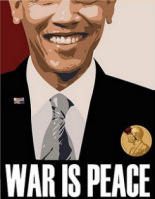

 President Barack Obama made the White House press corps giggle while speaking about the deadly Munich attack, shifting the tragic topic to his personal feelings about his daughters. The shooting rampage in Germany saw nine people killed and 16 injured.


 Aletho News