Obama’s Syrian Policy Vetoed by Assad Election Victory
By Shamus Cooke | Workers Action | June 6, 2014
“Assad’s days are numbered” – President Obama, February 2012
Living in denial is the easiest way to avoid hard truths, but it’s a horrible way for a government to conduct foreign policy. Obama’s Secretary of State John Kerry recently scoffed at the elections in Syria, calling them “meaningless.” The U.S. media obediently agreed, while the rest of the world drew a much more realistic opinion. It’s true that an election during an ongoing conflict isn’t ideal for democracy, but the deeper truths exposed by the election were completely ignored by the U.S. government and media.
Interestingly, few governments or media outlets doubted the Syrian election was fair for those who were able to vote. There were no large-scale allegations of fraud, and the numbers announced by the government were not seriously contested.
The results of the election weren’t a surprise to anyone familiar with Syrian domestic politics. Russian Television points out the two most obvious reasons Assad’s victory was assured:
1) The president never lost the support of his core constituencies — the Syrian armed forces, the government and business elite, the major cities, the minorities (Christians, Druze, Alawites, Shia, etc.) and secular Sunni (most of the 3 million members of the Baath Party are Sunni).
2) The opposition was fundamentally unable to present a cohesive front and a common political platform — this includes both domestic and external opponents — let alone rally behind a single candidate.
While ignoring these clear truths, John Kerry attempted to justify his characterization of the election as “meaningless,” by adding “…you can’t have an election where millions of your people don’t even have an ability to vote.”
Kerry’s point, although true, would hold greater weight if not for the fact that the Syrian Government controls all but one major city in Syria. Most of the Syrian rebel strength is in the less populated rural areas.
Therefore, it’s quite meaningful that 73 percent of eligible voters went to the polls and that 88 percent of them voted for Assad. Eleven out of 15 million apparently voted. And although one could likely poke further holes in the electoral process, the general sentiment in Syria found expression, the meaning of which was accepted by most of the world.
Equally meaningful was the huge voter turnout in neighboring countries, though especially Lebanon and Jordan, where tens of thousands of Syrian refugees voted at the Syrian embassy overwhelmingly in favor of Assad. Of course this fact directly contradicts the longstanding lie that these refugees were all “victims of Assad.”
In fact, Syrian citizens around the world voted at their embassies, overwhelmingly for Assad. This didn’t make the U.S. media think twice about their strict anti-Assad narrative. Ignorance is bliss. The media had a similarly muted attitude when thousands of pro-Assad Syrian protesters across the U.S. attended anti-war protests in response to Obama’s plan to bomb Syria.
Perhaps the deepest truth the Syrian elections exposed is that, were it not for the U.S. and its allies, the war in Syria would have long ago ended, and tens of thousands of lives spared. Millions of refugees would not be homeless.
It’s now very clear that the motor force of war in Syria has long been orchestrated from the outside. The people on the inside want peace. The media has long acknowledged that Obama’s CIA has led regional allies Saudi Arabia, Qatar, Turkey, etc., against the Syrian government, by funneling guns and training foreign fighters. Without this the rebels would have been crushed long ago.
Ultimately the elections proved that the catastrophic war in Syria is not the will of the Syrian people. Many likely voted in favor of Assad simply to show the world that they don’t support the rebels — that they want an immediate end to the insane war that has nearly destroyed an entire nation.
Will Obama listen? Not likely. John Kerry’s blathering about the election was out of sync with most of the world, but in line with the Obama administration’s consistently out of touch perspective about the situation in Syria.
Stunningly, when the official spokeswoman for Obama’s State Department, Jen Pskai was recently asked if the administration still believes that Assad’s “days are numbered,” she responded by saying “yes we do.” Being in denial too long can resemble psychosis.
Obama also recently re-enforced his failed Syria policy in his big speech at the West Point military academy, where he said he would “…ramp up support for those in the Syrian opposition who offer the best alternative to terrorists and brutal dictators.”
To “ramp up” support for the Syrian rebels at this point means only one thing; that much more blood is about to be spilled. And for what?
Obama’s West Point plan to “arm the Syrian moderates” is the same worn-out “strategy” that Obama has used since 2011 to justify his support of cash, arms, and training to the Syrian rebels, which has artificially lengthened the Syrian catastrophe while directly resulting in a the revival of Islamic extremism and terrorism in the region.
Ironically, Obama’s West Point speech also mentioned a plan to create a $5 billion dollar regional anti-terrorism fund, no doubt a way to “legally” funnel more money to further target the Assad government while creating yet more terrorists in the process.
It was also revealed recently that Obama is now supplying rebel groups with sophisticated anti-tank missile launchers, ensuring that blood will flow more freely. By continuing down this policy that the Syrian people have clearly rejected, Obama is proving that he cares nothing for democracy nor for the lives of the people in Syria. Nor does he care about the will of the American people: In a 2013 poll conducted by the Pew Research Center “70% of Americans oppose arming the Syrian rebels.”
The number is likely much higher now.
At home and abroad Obama’s Syrian policy has been condemned as a failure, yet he shows no signs of stopping, even after most Syrians voted for peace. This is the same peace that Americans and the rest of the world demand.
Hillary Clinton and the Weaponization of the State Department
By JP Sottile | News Vandal | June 5, 2014
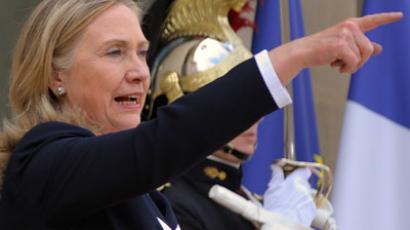
On May 23, 2012, then-Secretary of State Hillary Clinton went to the Special Operations Forces Industry Conference (SOFIC) trade show in Tampa, Florida to share her vision of “smart power” and to explain the State Department’s crucial role in extending the reach and efficacy of America’s growing “international counterterrorism network.”
First, there is such a thing as a “Special Operations Forces Industry Conference trade show.” Without some keen reporting by David Axe of Wired, that peculiar get-together might’ve flown completely under the radar—much like the shadowy “industry” it both supports and feeds off of like a sleek, camouflaged lamprey attached to a taxpayer-fattened shark.
Second, “special operations” have officially metastasized into a full-fledged industry. United States Special Operations Command (USSOCOM) is located at MacDill Air Force Base in Tampa and, therefore, conveniently located near the special operations trade show, which happened again this year at the Tampa Convention Center. The theme was “Strengthening the Global SOF Network” and the 600,000-square-foot facility was filled with targets of opportunity for well-connected and well-heeled defense contractors.
According to the SOFIC website, this year’s conference afforded attendees “the opportunity to engage with USSOCOM Program Executive Officers, Science and Technology Managers, Office of Small Business Programs and Technology & Industry Liaison Office representatives, and other acquisition experts who will identify top priorities, business opportunities, and interests as they relate to USSOCOM acquisition programs.”
Third, Hillary’s widely-ignored speech marked a radical departure from the widely-held perception that the State Department’s diplomatic mission endures as an institutional alternative to the Pentagon’s military planning. Instead, Secretary Clinton celebrated the transformation of Foggy Bottom into a full partner with the Pentagon’s ever-widening efforts around the globe, touting both the role of diplomats in paving the way for shadowy special ops in so-called “hot spots” and the State Department’s “hand-in-glove” coordination with Special Forces in places like Pakistan and Yemen.
Finally, with little fanfare or coverage, America’s lead diplomat stood before the shadow war industry and itemized the integration of the State Department’s planning and personnel with the Pentagon’s global counter-terrorism campaign which, she told the special operations industry, happen “in one form or another in more than 100 countries around the world.”
If this isn’t entirely unexpected, consider the fact that under then-Secretaries of State Colin Powell and Condoleezza Rice, the State Department fought attempts by the Pentagon to trump its authority around the globe and, as reported by the Washington Post, “repeatedly blocked Pentagon efforts to send Special Operations forces into countries surreptitiously and without ambassadors’ formal approval.”
But that was before Hillary brought her “fast and flexible” doctrine of “smart power” to Foggy Bottom and, according to her remarks, before she applied lessons learned from her time on the Senate Armed Services Committee to launch the first-ever Quadrennial Diplomacy and Development Review, which she modeled on the Pentagon’s Quadrennial Defense Review. That Pentagon-style review spurred the creation of the Bureau of Conflict and Stabilization Operations to “advance the U.S. government’s foreign policy goals in conflict areas.”
According to a Congressional Research Service analysis, the initial intent of the Conflict Bureau was to replace the ineffectual Office of the Coordinator of Reconstruction and Stabilization, which was created in 2004 to help manage “stabilization” efforts in two nations the U.S. was actively destabilizing—Afghanistan and Iraq.
But the new, improved bureau does more than just react to messes made by unlawful invasions or direct costly remediation efforts in war zones—it also collaborates with “relevant partners” in the Department of Defense and NATO “to harmonize civilian and military plans and operations pertaining to conflict prevention, crisis response, and stabilization.”
This integrated relationship between State and Defense was confirmed by U.S. Special Operations chief Admiral William McRaven shortly after Hillary’s speech. When asked about the “unlikely partnership,” McRaven assured DefenseNews that SOCOM has “an absolutely magnificent relationship with the State Department” and that SOCOM doesn’t “do anything that isn’t absolutely fully coordinated and approved by the U.S. ambassador and the geographic combatant commander.”
As David Axe aptly described it in Wired, “Together, Special Operations Forces and State’s new Conflict Bureau are the twin arms of an expanding institution for waging small, low-intensity shadow wars all over the world.”
In fact, during Hillary’s time as America’s chief diplomat, the State Department embraced the shadowy edge of U.S. foreign policy where decision-makers engage in activities that look like war, sound like war and, if you were to ask civilians in places like Yemen and Pakistan, feel a lot like war, but never quite have to meet the Constitutional requirement of being officially declared as war.
The Whole-of-Government Shift
Once upon a time, “low-intensity shadow wars” were the Congressionally-regulated bailiwick of the Central Intelligence Agency. But 9/11 changed everything. However, the excesses of the Bush Administration led many to hope that Obama could and would change everything back or, at least, relax America’s tense embrace of “the dark side.”
Although the new administration did officially re-brand “The War on Terror” as “Overseas Contingency Operations,” Team Obama employed an increasingly elastic interpretation of the 9/11-inspired Authorization for Use of Military Force and expanded covert ops, special ops, drone strikes and regime change to peoples and places well-beyond the law’s original intent, and certainly beyond the limited scope of CIA covert action.
Obama’s growing counter-terrorism campaign—involving, as Secretary Clinton said, “more than 100 countries”—took flight with a new, ecumenical approach called the “Whole-of-Government” strategy. Advanced by then-Secretary of Defense Bill Gates and quickly adopted by the new administration in early 2009, this strategy catalyzed an institutional shift toward inter-agency cooperation, particularly in the case of “state-building” (a.k.a. “nation building”).
During remarks to the Brookings Institution in 2010, Secretary Clinton explained the shift: “One of our goals coming into the administration was… to begin to make the case that defense, diplomacy and development were not separate entities, either in substance or process, but that indeed they had to be viewed as part of an integrated whole and that the whole of government then had to be enlisted in their pursuit.”
Essentially, the Whole-of-Government approach is a re-branded and expanded version of Pentagon’s doctrine of “Full-Spectrum Dominance.” Coincidentally, that strategy was featured in the Clinton Administration’s final Annual Report to the President and Congress in 2001. It defined “Full-Spectrum Dominance” as “an ability to conduct prompt, sustained, and synchronized operations with forces tailored to specific situations and possessing freedom to operate in all domains—space, sea, land, air, and information.”
In 2001, Full-Spectrum Dominance referred specifically to 20th Century notions of battlefield-style conflicts. But the “dark side” of the War on Terror stretched the idea of the battlefield well-beyond symmetrical military engagements. “Irregular warfare” became the catchphrase du jour, particularly as grinding campaigns in Afghanistan and Iraq exposed the reality that the full spectrum still wasn’t enough.
An assessment by the Congressional Research Service identified the primary impetus for the Whole-of-Government “reforms” embraced by Team Obama as the “perceived deficiencies of previous inter-agency missions” during the military campaigns in Afghanistan and Iraq. Those missions failed to address a myriad of problems created—culturally, economically and politically—by the wholesale bombing and occupation of those countries. The Full-Spectrum was half-baked. Lesson learned.
But the lesson wasn’t that the U.S. should avoid intervention, regime change or unleashing nascent civil, ethnic or religious conflicts. Instead, the lesson was that the “Whole-of-Government” must be marshaled to fight a worldwide array of Overseas Contingency Operations in “more than 100 countries.”
This Whole-of-Government shift signaled a renewed willingness to engage on variety of new fronts—particularly in Africa—but in a “fast and flexible” way. With other agencies—like the State Department—integrated and, in effect, fronting the counter-terrorism campaign, the military footprint becomes smaller and, therefore, easier to manage locally, domestically and internationally.
In some ways, the Whole-of-Government national security strategy is plausible deniability writ-large through the cover of interagency integration. By merging harder-to-justify military and covert actions into a larger, civilian-themed command structure, the impact of the national security policy overseas is hidden—or at least obfuscated—by the diplomatic “stabilization” efforts run through the State Department—whether it’s the Conflict Bureau working against Joseph Kony’s Lord’s Resistance Army in Central Africa, “stabilizing” post-Gaddafi Libya or spending $27 million to organize the opposition to Bashar al-Assad’s Syrian regime.
The Pass Key
The cover of diplomacy has traditionally been an effective way to slip covert operators into countries and the State Department’s vast network of embassies and consulates still offers an unparalleled “pass-key” into sovereign nations, emerging hot spots and potential targets for regime change. In 2001, the Annual Report to the President and Congress foresaw the need for more access: “Given the global nature of our interests and obligations, the United States must maintain the ability to rapidly project power worldwide in order to achieve full-spectrum dominance.”
Having the way “pre-paved” is, based on Hillary’s doctrinal shift at State, a key part of the new, fuller-spectrum, Whole-of-Government, mission-integrated version of diplomacy. At the SOFIC’s Special Operations Gala Dinner in 2012, Hillary celebrated the integration of diplomatic personnel and Special Operations military units at the State Department’s recently created Center for Strategic Counterterrorism Communications—a “nerve center in Washington” that coordinates “military and civilian teams around the world” and serves “as a force multiplier for our embassies’ communications efforts.”
As with most doors in Washington, that relationship swings both ways and mission-integrated embassies have served as an effective force multiplier for the Pentagon’s full spectrum of activities, particularly around Africa.
In his 2011 testimony before the House Foreign Affairs Committee Subcommittee on Africa, Deputy Assistant Secretary of State for African Affairs Don Yamamoto noted that State had “significantly expanded the number of DoD personnel who are integrated into embassies across the continent over the past three years,” and read a surprisingly long laundry list of collaborative efforts between State and the United States Africa Command (AFRICOM), including: “reduction of excess and poorly secured man-portable air defense systems (MANPADS); Defense Sector Reform in Liberia, DRC, and South Sudan; counterpiracy activities off the Somali coast; maritime safety and security capacity building; and civil-military cooperation.”
It seems that “civil-military cooperation” is a primary focus of the State Department in Africa. Most notably, Yamamoto told Congress that “embassies implement Department of State-funded Foreign Military Financing (FMF) and International Military Education and Training (IMET) programs, which further U.S. interests in Africa by helping to professionalize African militaries, while also assisting our African partners to be more equipped and trained to work toward common security goals.”
As the ever-vigilant Nick Turse recently reported, U.S. presence on the continent has only grown since that testimony was given in 2011. On TomDispatch.com, Turse identified the infamous attack on Benghazi on September 11, 2012 as the catalyst for “Operation New Normal”—the continent-wide response to, quite ironically, the political potboiler still simmering around Secretary Clinton. Whether or not Congressional Republicans find anything more than incompetence at the root of Benghazi, the U.S. military certainly finds itself in a “new normal” of increased activity in response to the forces—and the weaponry—unleashed by U.S.-led regime change in Libya. According to Turse, the U.S. is “now conducting operations alongside almost every African military in almost every African country and averaging more than a mission a day.”
Those missions are, of course, integrated with and augmented by the State Department’s Conflict Bureau which has used a variety of state-building programs and its diplomatic “pass key” in places like Libya, Nigeria, Kenya, South Sudan, Somalia, Democratic Republic of the Congo and six other African nations, all to develop a growing roster of “host country partners.”
Establishing “host country partners” is the nexus where the State Department, its Conflict Bureau and the AFRICOM meet—implementing the Whole-of-Government strategy in emerging or current conflict zones to fuse a mounting counter-terrorism campaign with stabilization, modernization and state-building initiatives, particularly in oil and resource-rich areas like the Niger River Delta, Central Africa and around AFRICOM’s military foothold on the Horn of Africa.
As Richard J. Wilhelm, a Senior Vice President with defense and intelligence contracting giant Booz Allen Hamilton, pointed out in a video talk about “mission integration,” AFRICOM’s coordination with the Departments of State and Commerce, USAID is the “most striking example of the Whole-of-Government approach.”
And this is exactly the type of “hand-in-glove” relationship Secretary Clinton fostered throughout her tenure at State, leveraging the resources of the department in a growing list of conflict areas where insurgents, terrorists, al-Qaeda affiliates, suspected militants or uncooperative regimes threaten to run afoul of so-called “U.S. interests”.
Ultimately, it became a hand-in-pocket relationship when Clinton and Defense Secretary Gates developed the Global Security Contingency Fund (GSCF) to “incentivize joint planning and to pool the resources of the Departments of State and Defense, along with the expertise of other departments, to provide security sector assistance for partner countries so they can address emergent challenges and opportunities important to U.S. national security.”
Although he’s been criticized as feckless and deemed less hawkish than Secretary Clinton, President Obama’s newly-proposed Counterterrorism Partnership Fund (CTPF) is the logical extension of the Clinton-Gates Global Security Contingency Fund and epitomizes the Whole-of-Government shift.
The $5 billion Obama wants will dwarf the $250 million pooled into the GSCF and will, the President said at West Point, “give us flexibility to fulfill different missions including training security forces in Yemen who have gone on the offensive against al Qaeda; supporting a multinational force to keep the peace in Somalia; working with European allies to train a functioning security force and border patrol in Libya; and facilitating French operations in Mali.”
That “flexibility” is exactly what Hillary Clinton instituted at State and touted at the SOFIC conference in 2012. It also portends a long-term shift to less invasive forms of regime change like those in Yemen, Libya, Syria and Ukraine, and an increased mission flexibility that will make the Authorization for the Use of Military Force functionally irrelevant.
Normalizing the War on Terror
The ultimate outcome of this shift is, to borrow from Nick Turse, yet another “new normal”—the new normalization of the War on Terror. What the adoption of the Whole-of-Government/mission integration approach has done is to normalize the implementation of the re-branded War on Terror (a.k.a. Overseas Contingency Operations) across key agencies of the government and masked it, for lack of the better term, under the rubric of stabilization, development and democracy building.
It is, in effect, the return of a key Cold War policy of “regime support” for clients and “regime change” for non-client states, particularly in strategically-located areas and resource-rich regions. Regimes—whether or not they actually “reflect American values”—can count on U.S. financial, military and mission-integrated diplomatic support so long as they can claim to be endangered… not by communists, but by terrorists.
And because terrorism is a tactic—not a political system or a regime—the shadowy, State Department-assisted Special Ops industry that fights them will, unlike the sullen enthusiasts of the Cold War, never be bereft of an enemy.
No Returning to G8: Russia
The BRICS Post | June 4, 2014
Russia said Wednesday that it was open for cooperation with major Western powers, but ruled out a return to the Group of Eight (G8), made up of the seven most industrialized nations, known as G7, and Russia.
“Such a format does not exist for now,” Kremlin spokesperson Dmitry Peskov told a Russian radio station.
Russia would, however, continue to participate in the Group of 20, which includes the most developed and major developing countries of the world, Peskov said.
Leaders of G7 declared in March that they would boycott the G8 summit in Sochi, where they were scheduled to have met with Russia this week. Instead, they gathered in Brussels for a two-day G7 summit.
The expulsion of Russia from the G8 came three days after Crimea accession to Russia.
Peskov said Russian President Vladimir Putin will not have a bilateral meeting with US President Barack Obama even though both leaders are attending the 70th anniversary of D-Day Landings in France’s Normandy on Friday.
“We are not making such preparations … Participants of war memorial events will stay together, in one group,” Itar-Tass news agency quoted him as saying.
He, however, did not rule out possible brief talks between Putin and Ukrainian President-elect Petro Poroshenko.
The Kremlin earlier confirmed that Putin, on his first visit to a Western country since the start of the Ukraine crisis, would have separate meetings with British Prime Minister David Cameron and German Chancellor Angela Merkel in Normandy.
The US and EU have imposed travel bans and asset freezes on dozens of Russians over what they called Russia’s “meddling” in Ukraine’s affairs.
The European Union, however, would be troubled by Russia’s attempts to veer away from gas exports to the bloc by moving towards energy-hungry China.
Russia has had some success in diverting attention away from the troubling sanctions with the successful negotiations that led to the inking of a massive $400 billion gas deal with China last month and also the signing of the treaty to form the Eurasian Economic Union (EEU) with Russia, Kazakhstan and Belarus, a combined $2.7 trillion economy and vast energy resources.
Elections in Syria: The People Say No to Foreign Intervention
By Ajamu Baraka | Black Agenda Report | June 4, 2014
 Defying threats of violence, tens of thousands of ordinary Syrians went to the polls to cast a vote that was more about Syrian dignity and self-determination than any of the candidates on the ballot. After three years of unimaginable atrocities fomented by a demented and dying U.S. empire, with the assistance of the royalist monarchies of the Middle East and the gangster states of NATO, the Syrian people demonstrated, by their participation, that they had not surrendered their national sovereignty to the geo-strategic interests of the U.S. and its colonial allies in Europe and Israel.
The dominant narrative on Syria, carefully cultivated by Western state propagandists and dutifully disseminated by their auxiliaries in the corporate media, is that the conflict in Syria is a courageous fight on the part of the majority of the Syrian people against the brutal dictatorship of Bashar al-Assad. As the story goes, the al-Assad “regime,” (it is never referred to as a government), can only maintain its power through the use of force. By attacking “its own citizens,” the regime, representing the minority Alawite community, can only maintain its dominance over the rest of the country through sheer terror.
However, events in Syria, with the election being a dramatic example, continue to reveal fissures in that story.
First, it became clear that substantial numbers of non-Alawite people and communities support the government. And even those elements of Syrian society that were not enthusiastic supporters of the government grew to understand that the legitimate indigenous opposition had been displaced by powerful non-Syrian forces from the U.S. and the Gulf States who provided material, political and diplomatic support to an opposition that not only had tenuous ties to the country but seemed only committed to waging war. This convinced many that the only politically consistent option was to support the government, as an expression of support for Syria’s sovereignty and its’ national project.
As a result, not only did popular support for the government hold over the last three years of carnage, it expanded to include those in the opposition who were against the destruction of the country and the slimy Syrian ex-pats who traveled from one European capital to another begging for the U.S. and NATO to do what it did in Libya – destroy the infrastructure of the country through the use of NATO air power and flood the country with weapons.
But the most graphic undermining of the dominant Western narrative has been the participation of tens of thousands of ordinary Syrians who have braved threats and violence to participate in the election process.
Western corporate news outlets, especially in the U.S., were unable to explain the huge turnout of Syrian refugees voting in Lebanon preceding the election on Tuesday, so they just decided not to cover it. Images of Syrians displaced by war yet backing al Assad for president did not support the carefully crafted story that the only people fleeting war were those who had been terrorized to do so by the government.
Instead, the U.S. press raised the question of the “legitimacy” of elections taking place in a country involved in a “civil war,” a position consistent with their narrative of the war being one between the Syrian people and the government as opposed to what it has turned out to be – a war largely being fought by foreign forces, with the indigenous opposition forces allied with the feckless Syrian National Coalition; isolated, out-gunned and militarily irrelevant.
And while the U.S. press uncritically propagated the position of the U.S. state, which wrote off the election as illegitimate and a farce, the media seemed not to notice the contradictory position of the U.S. writing off the election in Syria because of conflict but giving enthusiastic support to the election in Ukraine in the midst of a conflict and contested legitimacy. The Western media could explore a few obvious questions if it was really independent, such as: what makes the election in Ukraine legitimate when half of the country boycotts the vote and the national army violently attacks its own citizens in Eastern Ukraine who refused to recognize the legitimacy of the coup-makers in Kiev?
Other questions might be: if they deem it appropriate to support an election in Ukraine, why would the Obama Administration violently oppose elections in Syria, especially if, as it claims, the majority of the people oppose the current government? Wouldn’t the illegitimacy of the government in Syria be confirmed by the low turnout, even in areas where there was a modicum of security? If Syrian authorities organized opportunities for displaced Syrians in various countries around the world to vote and very few participated, wouldn’t that verify the Administration’s position that the al Assad government lacks popular support?
Yet in various European capitals and other countries like Turkey, United Arab Emirates, Jordan and Egypt, efforts were made to block the opportunity for displaced Syrians to vote in their election – why? Were the authorities afraid that the narrative of non-support for al Assad might be challenged if there was a proliferation of images like the ones that came out of Lebanon showing thousands of Syrians marching to the polls holding signs of Bashar al Assad?
It will be interesting to see how the authorities and their spokespeople in the corporate media spin the voting process in Syria.
The U.S. position is a position of continued war in Syria
Secretary of State John Kerry declared that Syria’s presidential election was a “farce,” and that the U.S. and its partners are prepared to quickly redouble efforts to support opposition forces in the county. The meaning of this position is that it does not matter what kind of public display of support is given to al Assad or anyone who might emerge as the head of state in Syria, the U.S. objective is more death, more war and more chaos.
This is the essence of the “new” global strategy unveiled by President Obama during his foreign policy speech at West Point last week. The U.S. declaration that it will “change the dynamics on the ground in Syria” came out of a meeting of the so-called “Friends of Syria,” a motley collection of 11 Western colonial nations and their Arab creations. The Obama Administration intends to work through these kinds of regional formations and alliances to advance its strategic objectives with as minimal a cost to the U.S. as possible. Of course, the interests and desires of the states or peoples involved are of secondary concern. The desire on the part of the majority of the people to end the conflict in Syria is not even considered. As part of the effort to secure public support in the U.S. for destabilizing and then attacking Syria it was posited that by deposing the al Assad government a real democracy can be introduced. That is why policymakers pretended to back so-called moderate elements that support democracy. But over the last year or so, even that proposal has been eliminated. Democracy in Syria is as much a threat to U.S. imperialist interests as it is in Ukraine – and increasingly even in the U.S.
Policymakers in Washington and London have already made the shift to supporting what are being called “moderate” Islamists forces grouped around the Islamic Front (IF) with al Nusrah, al Qaeda’s official Syrian affiliate, operating in the background. The problem for the Syrian people is that these moderates the west is supporting are Salafi-Wahhabi fundamentalists who reject representative democracy and support the imposition of sharia law in Syria. So while the U.S. and their allies characterize the election in Syria a farce, their solution is to back forces who would eliminate even the pretext of democratic participation. This is the progress that is being imposed on the secular, pluralist society of Syria by the Western “liberators.”
It is not about al Assad, it is about the people of Syria and imperialism:
Questions of democratic legitimacy have never determined U.S. relationships with any state where the U.S. had strategic and economic interests. If a commitment to democracy and democratic governance was the determining factor for U.S. support, the Obama Administration would not be in alliance with the dictatorship of the royalists in the Gulf states, it would have condemned the coups in Honduras and Egypt, not given diplomatic or economic support to the coup in Ukraine, and would not be supporting right-wing elements in Venezuela attempting to destabilize the democratically-elected government in that country.
There was a time when this position would have been clear to the peace and anti-war, anti-imperialist progressive and left movements in the U.S. and the West. But over the last two decades, with the ideological infiltration of the left by liberalism, social democracy and the rightist tendencies of “anti-authoritarian” anarchism, the resulting political confusion has seen a consistent alignment of the left with the imperial project of the U.S. – from the attacks on the Federal Republic of Yugoslavia through to attacks on nationalist projects throughout the global South, from Libya to Syria. Since the last gasp of anti-imperialism solidarity represented by the massive marches in opposition to the illegal attack on Iraq in 2003, the peace, anti-war and anti-imperialist movements have been in relative disarray.
This disarray and ineffectiveness is taking place right at the historical moment when in order to maintain its global hegemony, the colonial/capitalist West has decided to revert to what it does best – spread death and destruction. For those of us who understand our responsibility situated, as we are, at the center of this monstrosity called the U.S., we have to strip away the veneer of humanitarianism that hides the ugly inner logic of domination and we have to “struggle” – a term now passé for the hip post-modern nihilist left.
When a people, like the people of Syria, demonstrate their commitment to the integrity of their own national experience in opposition to the efforts of the imperialist states that we reside in, the only principled position we can take is to stand in solidarity with those people, no matter how we see the internal contradictions of that nation/state. The people of Syria have said no to foreign intervention. Those of us in the imperialist West, can we do anything less?
Ajamu Baraka, a long-time human rights activist and organizer, is an editor and contributing columnist for Black Agenda Report. Baraka can be reached at info.abaraka@gmail.com and http://www.AjamuBaraka.com
Obama pledges $1bn for more troops, military drills in E. Europe
RT | June 3, 2014
President Obama has announced a plan to invest $1 billion in stepping up its military presence in Eastern Europe amid the Ukrainian crisis. The White House will send more troops and equipment to the region to “reaffirm” its commitment to NATO allies.
Speaking at a news conference in Warsaw, Obama said America was stepping up its partnership with countries in Eastern Europe with a view to bolstering security. The moves are aimed at upping the pressure on Russia, which Washington has accused of inciting unrest in Ukraine.
In line with the plans, Obama will ask Congress to provide up to $1 billion to finance the deployment of more troops and equipment.
“Under this effort, and with the support of Congress, the United States will preposition more equipment in Europe,” Obama said at the Polish capital’s Belweder Palace.
Earlier in the day Obama met with US and Polish air personnel in Warsaw and said the US had already begun rotating additional soldiers in the region.
“Given the situation in Ukraine right now, we have also increased our American presence. We’ve begun rotating additional ground troops and F-16 aircraft into Poland… to help our forces support NATO air missions,” said Obama, calling the commitment to NATO allies in Europe “the cornerstone of our own security.”
Obama called on Moscow to refrain from further provocation in Ukraine and said it has a responsibility to work constructively with the new government in Kiev. He added that the troop buildup in Eastern Europe was not meant to threaten Russia, but “rebuilding trust may take some time.”
The American president will meet with newly-elected Ukrainian President Petro Poroshenko during his two-day stay in Poland.
Polish President Bronislaw Komorowski praised Washington’s plans to beef up military forces in the region.
“We welcome them as an announcement of a real return by NATO to standing very strongly by the basis of the alliance, which is Article 5, which speaks about the collective defense of the countries’ territories,” Komorowski said.
Russia has decried the increase in NATO troops close to its border as a blatant provocation and accused the organization of fueling violence in Ukraine. Moscow has said it is ready for dialogue with Poroshenko, but has urged the newly elected President to halt the “anti-terror operation” in the east of Ukraine.
“NATO is providing Kiev – a member of its Partnership for Peace program – with technical assistance, thus encouraging the prolongation of its use of force. Thus the Alliance accepts a part of the responsibility for the escalation of the situation, and the collapse of diplomatic negotiations,” said Aleksandr Grushko, Russia’s envoy to NATO.
Thus far the US has deployed 600 troops for military drills in Estonia, Latvia, Lithuania, Estonia and Poland.
To President Obama: Let’s just assume for a moment we have a climate crisis
By Paul Driessen | Watts Up With That? | June 2, 2014
As we start hurricane season today, we note the unprecedented 3142 day drought of major hurricane landfalls, shattering a record that goes back to the year 1900.
Despite clear evidence to the contrary, president Obama is now warning us that “storms like Hurricane Sandy will become more frequent as climate change intensifies.” It’s merely the latest in the administration’s seemingly endless stream of headline-grabbing scare stories, designed to justify the job-killing, economy-strangling, family-bashing rules for vehicles, power plants, cement kilns, refineries, factories, farms, shopping malls and countless other facilities that are or soon will be regulated by Environmental Protection Agency fiat. We need to keep one vitally important fact in mind.
Every one of these “looming calamities” is based on assumptions, assertions and computer models that represent the real world about as well as the special-effects T-rexes and raptors do in Jurassic Park. The data on hurricanes says otherwise:


Climate modelers and disaster proponents remind me of the four guys who were marooned on an island, after their plane went down. The engineer began drawing plans for a boat; the lumberjack cut trees to build it; the pilot plotted a course to the nearest known civilization. But the economist just sat there. The exasperated workers asked him why he wasn’t helping.
“I don’t see the problem,” he replied. “Why can’t we just assume we have a boat, get on it and leave?”
In the case of climate change, those making the assumptions demand that we act immediately to avert planetary crises based solely on their computer model predictions. It’s like demanding that governments enact laws to safeguard us from velociraptors, after Jurassic Park scientists found that dinosaur DNA could be extracted from fossilized mosquitoes … and brought the carnivores back to special-effects life.
Climate models help improve our conceptual understandings of climate systems and the forces that drive climate change. However, they are terrible at predicting Earth’s temperature and other components of its climate. They should never be used to set or justify policies, laws and regulations – such as what the Environmental Protection Agency is about to impose on CO2 emissions from coal-fired power plants.
Even our best climate scientists still have only a limited grasp of Earth’s highly complex and chaotic climate systems, and the many interrelated solar, cosmic, oceanic, atmospheric, terrestrial and other forces that control climate and weather. Even the best models are only as good as that understanding.
Worse, the models and the science behind them have been horribly politicized. The Intergovernmental Panel on Climate Change was ostensibly organized in 1988 to examine possible human influences on Earth’s climate. In reality, Swedish meteorologist Bert Bolin and environmental activist groups wanted to use global warming to drive an anti-hydrocarbon, limited-growth agenda. That meant they somehow had to find a human influence on the climate – even if the best they could come up with was “The balance of evidence suggests a discernible human influence on global climate.” [emphasis added]
“Discernible” (ie, detectable) soon metamorphosed into “dominant,” which quickly morphed into the absurd notion that greenhouse gas (GHG) emissions have now replaced natural forces and become the only factors influencing climate change. They are certainly the only factors that climate activists and alarmists want to talk about, while they attempt to silence debate, criticism and skepticism. They use the models to generate scary “scenarios” that are presented as actual predictions of future calamities.
They predict, project or forecast that heat waves will intensify, droughts and floods will be stronger and more frequent, hurricanes will be more frequent and violent, sea levels will rise four feet by 2100 [versus eight inches since 1880], forest fires will worsen, and countless animal species will disappear. Unlikely.
Natural forces obviously caused the Medieval Warm Period, the Little Ice Age and the Pleistocene Ice Ages. (A slab of limestone that I dug up has numerous striations – scratches – left by the last mile-thick glacier that covered what is now my home town in Wisconsin.) After long denying it, the IPCC finally acknowledged that the LIA did occur, and that it was a worldwide agricultural and human disaster.
However, the models and computer algorithms the IPCC and EPA rely on still do not include the proper magnitude of solar cycles and other powerful natural forces that influence climate changes. They assume “positive feedbacks” from GHGs that trap heat, but understate the reflective and thus cooling effects of clouds. They display a global warming bias throughout – bolstered by temperature data contaminated by “urban heat island” effects, due to measuring stations being located too close to human heat sources. They assume Earth’s climate is now controlled almost entirely by rising human CO2/GHG emissions.
It’s no wonder the models, modelers and alarmists totally failed to predict the nearly-18-year absence of global warming – or that the modeled predictions diverge further from actual temperature measurements with every passing year. It’s no wonder modelers cannot tell us which aspects of global warming, global cooling, climate change and “climate disruption” are due to humans, and which are the result of natural forces. It’s hardly surprising that they cannot replicate (“hindcast”) the global temperature record from 1950 to 1995, without “fudging” their data and computer codes– or that they are wrong almost every time.
In 2000, Britain’s Met Office said cold winters would be a thing of the past, and “children just aren’t going to know what snow is.” The 2010 and 2012 winters were the coldest and snowiest in centuries. In 2013, Met Office scholars said the coming winter would be extremely dry; the forecast left towns, families and government agencies totally unprepared for the immense rains and floods that followed.
In 2007, Australia’s climate commissioner predicted Brisbane and other cities would never again have sufficient rain to fill their reservoirs. The forecast ignored previous drought and flood cycles, and was demolished by record rains in 2011, 2013 and 2014. Forecasts of Arctic and Antarctic meltdowns have ignored the long history of warmer and colder cycles, and ice buildups and breakups.
The Bonneville Power Administration said manmade warming will cause Columbia River Basin snowpack to melt faster, future precipitation to fall as rain, reservoirs to be overwhelmed – and yet water levels will be well below normal year round. President Obama insists that global temperatures will soar, wildfires will be more frequent and devastating, floods and droughts will be more frequent and disastrous, rising seas will inundate coastal cities as Arctic and Antarctic ice shelves melt and disintegrate, and 97% of scientists agree. Every claim is based on models or bald-faced assertions unsupported by evidence.
And still the IPCC says it has “very high confidence” (the highest level it assigns) to the supposed agreement between computer model forecasts and actual observations. The greater the divergence from reality, the higher its “confidence” climbs. Meanwhile, climate researchers and modelers from Nebraska, Penn State, Great Britain and other “learned institutions” continue to focus on alleged human influences on Earth’s climate. They know they will likely lose their government, foundation and other funding – and will certainly be harassed and vilified by EPA, environmentalists, politicians, and their ideological and pedagogical peers – if they examine natural forces too closely.
Thus they input erroneous data, simplistic assumptions, personal biases, and political and financial calculations, letting models spew out specious scenarios and phony forecasts: garbage in, garbage out.
The modelers owe it to humanity to get it right – so that we can predict, prepare for, mitigate and adapt to whatever future climate conditions nature (or humans) might throw at us. They cannot possibly do that without first understanding, inputting and modeling natural factors along with human influences.
Above all, these supposed modeling experts and climate scientists need to terminate their biases and their evangelism of political agendas that seek to slash fossil fuel use, “transform” our energy and economic systems, redistribute wealth [upward], reduce our standards of living, and “permit” African and other impoverished nations to enter the modern era only in a “sustainable manner,” as defined by callous elitists.
The climate catastrophe camp’s focus on CO2 is based on the fact that it is a byproduct of detested hydrocarbon use. But this trace gas (a mere 0.04% of Earth’s atmosphere) makes life on our planet possible. More carbon dioxide means crops, forests and grasslands grow faster and better. CO2’s role in climate change is speculative – and contradicted by real-world measurements, observations and history.
Computer models, scenarios and predictions of planetary Armageddon are little more than faulty, corrupt, even fraudulent pseudo-science. They have consistently forecast what has not happened on Planet Earth, and failed to forecast what did happen.
They must no longer be allowed to justify EPA’s job-killing, economy-strangling, family-bashing rules for vehicles, power plants, cement kilns, refineries, factories, farms, shopping malls and countless other facilities that are or soon will be regulated by agency fiat.
Paul Driessen is senior policy analyst for the Committee For A Constructive Tomorrow (www.CFACT.org) and author of Eco-Imperialism: Green power – Black death.
USA Freedom Act has Nothing to Do With Freedom
By Alfredo Lopez | This Can’t Be Happening! | May 28, 2014
It just wasn’t a very good week for phones or for freedom.
Last week’s obscene joke of a bill coughed up by a Congress [1] wheezing with immobilizing congestion morphed an already compromised law about data collection into a green light to spy on everyone.
The bill passed the House last Thursday and is now heading to the Senate where the chances of getting a better bill are pretty slim. The President has endorsed this House bill; after all, it endorses his policies.
Sponsored by Wisconsin Republican Jim Sensenbrenner (the author of the Patriot Act), the ironically named USA Freedom Act’s most salient feature is that, contrary to the bluffery about how it’s going to rein in the government on phone surveillance, it has now made massive phone data capture legal and public. The NSA and related agencies under this supposed “reform” bill would gain full authority to collect all information from phone companies and, what’s more, the bill mandates that the companies hold on to that information (apparently permanently).
The House obviously caved. Not that the first edition of this bill was very good to start with. The government obviously is not going to limit its own power. But the bill as passed by the House is much weaker and, in a “blink if you don’t believe it” moment, many Democratic Congressional leaders are actually congratulating themselves. Even John Conyers (D-Mich.), Detroit’s traditionally progressive Democrat, supported this bill: “We stand poised to end domestic bulk collection across the board,” he said not making clear where he was standing or when domestic bulk collection was going to end. It certainly didn’t end with this bill.
On the other hand, a few Congresspeople did express concern, including Sensenbrenner himself, who called the new law “an abuse” of the Patriot Act. One is left wondering what the Wisconsin lawmaker expected from the draconian nightmare he authored.
While that little humorless comedy was playing out, we got another glimpse of how phone surveillance is being used. Wikileaks revealed that the NSA has been collecting phone data on virtually all phones in Afghanistan. This comes on the heels of revelations a few days earlier about such mass phone call collection in the Bahamas, Mexico, Kenya and the Philippines. The punch-line to this gross violation of people’s rights is that the bill passed last week doesn’t even mention international phone call capture — that’s still left completely unregulated.
There’s a lot wrong with the bill passed through the House [2] and that’s obvious from the scenario of “permitted activity” that the bill is based on. Essentially, phone companies have to hold records for an unspecified period of time. The government can’t collect them indiscriminately as it had previously done. But that “reform” is meaningless because government agencies can acquire data from any phone company by using either a specific court order through the Foreign Intelligence Surveillance Act (FISA) court (the NSA’s rubber stamp in robes) based on “selectors,” or on the basis of an emergency situation defined according to NSA criteria.
The problem lies in the definition of “selectors” — the filters used to determine whether or not specific information is captured or requested. Previously, the NSA would capture the phone data and then run it through its “selectors” to determine what gets pulled or retained. Now, they can either ask the telephone company to run the selectors or go in and run it themselves. Before doing that, the spy agency must present the selection set to the FISA court. Since the court is going to approve anything NSA requests (it has rejected less than one percent of all requests up to now), the definition of the selectors is important because they are the only element of restraint in the entire collection process.
The bill requires that a selector be “a discrete term, such as a term specifically identifying a person, entity, account, address, or device”. How much is included under that umbrella? It’s probably better to ask what isn’t included. With that list, under this law, the NSA is allowed to access the records of almost all Americans.
But we still won’t know how many records have been accessed because this version strikes provisions in the original draft that would have forced phone companies to tell us how many records they’ve had to release to the NSA. Under the just-passed version of the bill, if the company wants to tell us, it can’t until six months after it has received a request. If it’s a start-up, it can’t do a report for two years.
In short, the law puts an automatic gag order on phone companies in this country.
In the guise of protecting our privacy or limiting surveillance power, the bill also continues to allow “about searches” in which an international conversation is scanned for names of people who then become targets of investigation. That particularly nasty practice makes any provisions protecting Americans useless. If a person in another country mentions your name, you are a legitimate target. In the original bill, any “reverse targeting” of this type was outlawed, but that protective provision has been eliminated from the version the House just passed.
This type of “foreign connection” is looming more important with recent revelations about international phone capture. This week, several publications released the information [3] about the complete capture of phone data in several countries but refused to name one of them (for national security reasons). Wikileaks, in response to that weak-kneed journalism, then named it: Afghanistan. (Even Glenn Greenwald, who broke the international capture story based upon some of NSA whistleblower Edward Snowden’s documents, honored a government request not to name Afghanistan.)
While fans of spy-craft will defend this practice of massive spying on international phones, under the curious but oft-repeated theory that our rights only pertain to people in this country, this sweeping capture program goes way beyond any traditional spying. In fact, phone data capture bears no resemblance to espionage or traditional spying (which is selective in its targeting) and is much closer to the activities of a police state. When done to another country, it’s a lot like trying to police the other country: a virtual act of virtual war.
It’s grotesque to consider that, after over 12 years of war waged on Afghanistan, our government is now waging a war of information capture against its people. But that revelation is proof of what many have been saying about this country’s intentions in that beleaguered and battered nation: we have absolutely no intention of pulling out of Afghanistan, no matter what President Obama says.
In fact, the phone data captured targets not only Afghans but phone calls from U.S. diplomatic and military personnel. In short, the NSA is spying on the military and the diplomatic core, including even the CIA. This is truly the stuff of a police state.
The entire phone capture controversy underscores another important political fact: the cell phone is now the most popular access to the Internet among people in developing countries and among young people and people of color in this country. These are also the people who are going to provide the sharpest and most aggressive challenges to the world’s governments in the coming years of deepening crisis. If our government wants to control anybody, it’s these people. The USA Freedom Act demonstrates one way they are planning to do that.
Despite promise, US govt moves to classify justification for drone killing of American
RT | May 29, 2014
The Obama administration has launched a sudden effort to keep classified additional parts of a memo outlining the legal justification for the drone killing of an American a mere week after saying it would comply with a federal ruling to release the memo.
In January 2013, a Federal District Court judge decided that the US Justice Department could keep the document classified entirely. That ruling stood until April 2014, when a panel of the US Court of Appeals for the Second Circuit in New York ordered the government to publicize key parts of the document that provided the legal rationale for the drone strike that killed Anwar al-Awlaki.
Awlaki was born in New Mexico before moving to Yemen with his family as a child. He returned to the US again to attend college but eventually became a prominent Al-Qaeda propagandist who American intelligence officials have claimed helped plot terrorist attacks. He was killed by a September 2011 drone strike in Yemen that was authorized based on the 41-page memo, dated July 16, 2010.
President Barack Obama praised the strike at the time, telling reporters that Awlaki’s death was a “major blow to Al-Qaeda’s most active operational affiliate.”
The New York Times and American Civil Liberties Union have sought the release of the memo under the Freedom of Information Act.
It has been an issue of contention of late because David Barron, the former Justice Department attorney who wrote the memo, was confirmed by the US Senate by a narrow vote last week as a judge on a US appeals court. A number of senators said they would only vote to confirm Barron if the administration agreed not to appeal the April decision and release a redacted version of the document.
“I rise today to oppose the nomination of anyone who would argue that the president has the power to kill an American citizen not involved in combat and without a trial,” Senator Rand Paul said last week. “It is hard to argue for the trials for traitors and people who would wish to harm our fellow Americans. But a mature freedom defends the defenseless, allows trials for the guilty, and protects even speech of the most despicable nature.”
In a new court filing obtained by The New York Times, however, assistant US attorney Sarah Normand now argues that some of the information the administration pledged to reveal should actually remain secret.
“Some of the information appears to have been ordered disclosed based on inadvertence or mistake, or is subject is distinct exemption claims or other legal protections that have never been judicially considered,” she wrote.
The Justice Department also asked that the court keep the request for parts of the memo to remain secret. That request was denied, with the judge ordering the government to unveil previously secret negotiations between the court and prosecutions deliberating which aspects of the Barron memo would remain in the dark.
“It’s deeply disappointing to see the latest effort by the government to delay even further the release of this memo to the public,” New York Times attorney David McCraw told Politico. “The government reviewed the Second Circuit’s opinion before it was released. The court made redactions in response to that review. The fact that the government then waited five weeks to file a motion – seeking yet another opportunity to review what it has already reviewed – says volumes about the administration’s position on transparency.”
Senator Mark Udall (D-Colorado) was one of the lawmakers who said he only voted to confirm Barron because of the administration’s promise that “redactions to the memo would focus on still-classified information – not the legal reasoning itself,” he told the Times.
“I intend to hold the White House to its word,” Udall added.
The Chinese-Russian ‘Power of Siberia’ … thanks to EU, US foot-in-mouth
By Dmitry Babich | The BRICS Post | May 22, 2014
The Russian press is rarely unanimous in its opinions, but there are two points in today’s coverage of the Russia-China gas deal where all the experts agree.
First, it is not yet clear whether the new deal is a boon for Russia.
But it is certainly a huge failure for the US and the European Union, who lose out on Eastern Siberia’s gas.
Second, in light of the sharp deterioration of Russia’s relations with the West because of the mishandled Western-supported “revolution” in Ukraine, the deal with China now becomes a strategic necessity for Moscow.
The West’s hostile attitudes toward both Russia and China (during his Asia tour last month, US President Barack Obama sided 100 per cent with Japan and the Philippines in their maritime disputes with China), pushed Beijing and Moscow closer together.
The Russo-Chinese contract, which had been in the works for 10 years, was finalized at 4 O’clock in the morning on Wednesday, on the second day of the visit to Beijing by Russian President Vladimir Putin.
It became a dramatic ending to several months of marathon negotiations.
The new contract is supposed to determine the next 30 years of Russo-Chinese cooperation in developing the Russian natural gas fields in Siberia (the eastern part of Russia) and the Russian Far East.
According to the words of Alexei Miller, the head of Russia’s largest gas company, Gazprom, the total cost of the contract is $400 billion.
The volume of gas to be delivered is estimated at a gargantuan amount of over 1 trillion cubic metres. Mr. Miller refused to reveal the price tag, as it is usually done after signing these sorts of deals.
He simply said it was a “commercial secret” for the moment.
“The Force of Siberia”
Nevertheless, most experts agree that Russia has been lucky to sign the deal.
The competition among countries willing to supply energy to China is very intense.
In the ten years that have passed since the start of Russo-Chinese negotiations on the deal, Beijing managed to sign contracts with several Central Asian states, including Turkmenistan, a country boasting gas deposits second only to Russia’s in the former Soviet Union.
Experts estimate an average price of $387 per thousand cubic metres for the 38 billion cubic meters of gas Russia is going to supply to China in the first years of deliveries beginning in 2018.
The deliveries will start once the construction of the pipeline nicknamed “The Force of Siberia” has been completed.
The pipeline is supposed to connect the Russian gas reserves in Eastern and possibly (in future) Western Siberia with the Chinese border.
The project will require investments, which both Russia and China agreed to provide.
The Russian participation is estimated at $55 billion and the Chinese are expected to add $22 billion.
Alexander Birman, a journalist specializing in energy issues, writes in the respected Russian daily Izvestia that the Chinese leader Xi Jinping showed a certain nicety to his Russian counterpart, since he did not pressure Moscow given its deteriorated ties with the EU and US.
“If the West had started applying the so called “sector-geared” economic sanctions, targeting Russia’s energy companies – if such sanctions had been applied, even the price of $350 [per thousand cubic metres of gas] would look good to Gazprom [Russia’s leading energy provider],” he writes of the gas deal.
However, Birman notes that the current standoff between Russia and the West is hurting first and foremost the West’s long-term interests.
(This standoff was made possible by the coup d’etat in Ukraine at the end of February when the legally elected president Viktor Yanukovich was toppled by crowds of pro-Western protesters in the Ukrainian capital Kiev.)
“Having assured for itself the supply of cheap energy, China will reaffirm its position as the world’s most competitive cost-cutting workshop,” Birman writes.
Obama, the pro-Russian lobbyist?
For Russia, diversifying the directions of its gas supplies has become a vital necessity.
The gas deal opens a market corridor for Gazprom to potentially access Asian super guzzlers Japan and South Korea, and allow it to become a player in the Liquefied Natural Gas (LNG) sector.
This is particularly poignant when considering that EU ministers day and night publicize how they want to decrease their “energy dependence” on Russia.
The Soviet Union and Russia have maintained a good reputation with the West since they began supplying gas to Western Europe in the 1960s.
There was a ‘pause’ only once in the winter of 2008-2009, when the Ukrainian authorities stole the Russian gas destined for Western Europe.
Despite this reputation, however, EU member countries make no secret of their preference for gas from Qatar, Algeria, Norway or even the US, where fracking technology has led to a surplus of gas at the domestic market.
“Politically, the Russo-Chinese contract is a success,” says Grigory Vygon, the Director of the Energy Center of the prestigious Skolkovo Business School, near Moscow.
“The Ukrainian risks and the position of Europe make diversification a vital necessity.”
One could add that Obama revealed himself (inadvertently) to be the best lobbyist for Russo-Chinese rapprochement during his recent visits to countries having territorial disputes with China.
By directly supporting the “revolution” in Kiev and by lending support to all of China’s challengers in the South China Sea and East China Sea, Obama helped Moscow and Beijing to bridge during their intense negotiations the gap in desired prices for their mammoth deal.
~
Dmitry Babich is a senior journalist based in Moscow who has worked with the Komsomolskaya Pravda newspaper, Moscow News and Ria Novosti. He is currently a political analyst for Voice of Russia.
Congress reaffirms indefinite detention of Americans under NDAA
RT | May 22, 2014
The US House of Representatives approved an annual defense spending bill early Thursday after rejecting a proposed amendment that would have prevented the United States government from indefinitely detaining American citizens.
An amendment introduced in the House on Wednesday this week asked that Congress repeal a controversial provision placed in the National Defense Authorization Act of 2012 that has ever since provided the executive branch with the power to arrest and detain indefinitely any US citizen thought to be affiliated with Al-Qaeda or associated organizations.
“This amendment would eliminate indefinite detention in the United States and its territories,” Rep. Adam Smith (D-Washington), a co-author of the failed amendment, said during floor debate on Wednesday, “So basically anybody that we captured, who we suspected of terrorist activity, would no longer be subject to indefinite detention, as is now, currently, the law.”
“That is an enormous amount of power to give the executive, to take someone and lock them up without due process,” Smith added. “It is an enormous amount of power to grant the executive, and I believe places liberty and freedom at risk in this country.”
Pres. Barack Obama vowed when he signed the 2012 NDAA into law on December 31, 2011 that he would not use the indefinite detention powers provided to him by Congress. When that provision was challenged in federal court, however, the White House fought back adamantly and appealed a District Court ruling that initially reversed the indefinite detention clause, eventually sending the challenge to the Supreme Court where it stalled until earlier this month when the justices there said they would not consider the case.
The bill sponsored by Smith and co-author Rep. Paul Broun (R-Georgia) would have given the legislative branch a chance to repeal the same provisions that SCOTUS declined to hear, but the bipartisan amendment failed on a vote of 191 to 230.
A separate proposal from Rep. Smith meant to expedite the shut-down of the military prison at Guantanamo Bay, Cuba was also rejected early Thursday; an amendment from Rep. Dennis Ross (R-Florida) intended to cut federal funding for recreational facilities at Gitmo, however, was approved in the NDAA draft that left the House on Thursday.
On Twitter, Smith said he was “disappointed” but “won’t stop fighting to pass this critical legislation.”
And while the White House is unlikely to abandon its own fight with regards to keeping the indefinite detention provision intact, the Obama administration threatened to veto this year’s NDAA because it would continue to complicate the president’s promise to close the Guantanamo Bay facility — a vow older than his own administration.
“If this year’s Defense Authorization bill continues unwarranted restrictions regarding Guantanamo detainees, the president will veto the bill,” White House Press Secretary Jay Carney said in a statement Wednesday evening.
When the 2011 NDAA passed Congress with the controversial indefinite detention provision included, the White House said at the time that it would veto the legislation before Pres. Obama eventually balked.
Featured Video
Daniel Davis: China & Russia Will Defend Iran
or go to
Aletho News Archives – Video-Images
From the Archives
Sugar: Killing us Sweetly
Staggering Health Consequences of Sugar on Health of Americans
By Dr. Gary Null | Global Research | February 3, 2014
In September 2013, a bombshell report from Credit Suisse’s Research Institute brought into sharp focus the staggering health consequences of sugar on the health of Americans. The group revealed that approximately “30%–40% of healthcare expenditures in the USA go to help address issues that are closely tied to the excess consumption of sugar.”[1]The figures suggest that our national addiction to sugar runs us an incredible $1 trillion in healthcare costs each year. The Credit Suisse report highlighted several health conditions including coronary heart diseases, type II diabetes and metabolic syndrome, which numerous studies have linked to excessive sugar intake.[2]
Just a year earlier in 2012, a report by Dr. Sanjay Gupta appearing on 60 Minutes featured the work of Dr. Robert Lustig, an endocrinologist from California who gained national attention after a lecture he gave titled “Sugar: The Bitter Truth” went viral in 2009. Lustig’s research has investigated the connection between sugar consumption and the poor health of the American people. He has published twelve articles in peer-reviewed journals identifying sugar as a major factor in the epidemic of degenerative disease that now afflicts our country. The data compiled by Lustig clearly show how excessive sugar consumption plays a key role in the development of many types of cancer, obesity, type II diabetes, hypertension, and heart disease. His research has led him to conclude that 75% of all diseases in America today are brought on by the American lifestyle and are entirely preventable.[3]
Until the airing of this program, no one in the “official” world acknowledged anything wrong with sugar, here is a sampling of some the latest research available to them if they chose to look… continue
Blog Roll
 Aletho News
- Lebanon: Between sovereignty and the mirage of normalization
- Ukraine Given $43Bln in Proceeds From Russian Assets Frozen by G7 Since 2024 – Estimates
- The military is babying F-35s to hide their true cost to taxpayers
- Ukrainian military analyst praises use of drones against ‘Russian-Hungarian-Slovak friendship’
- Von der Leyen warns Hungary: We have ways of making you talk
- EU manipulating polls in bid to oust Orban – German opposition leader
- Daniel Davis: China & Russia Will Defend Iran
- The US’ self-directed ‘China nuclear threat’ will only be a waste of effort: Global Times editorial
- Female Iranian academic sentenced to 4 years in prison in France over protesting Israel’s genocide in Gaza
- US university cancels Palestine conference citing sanctions concerns
- If Americans Knew
- Israeli leaders want to buy global legitimacy – Not a ceasefire Day 140
- Israel warns of a Ramadan escalation — while doing everything to provoke one
- Democrats Should Release Their 2024 Election Autopsy – and Stop the Gaza Denial
- Israel responsible for 2/3 of press killings worldwide – Not a ceasefire Day 139
- Are the Jews indigenous to Palestine?
- AIPAC Wants to Kill a Bill that would Ensure Israel Complies with Ceasefire
- Former Israeli PM, in Epstein Files, Dreamed of Israeli Eugenics and Pretty Converts
- Israeli settlers join ‘safari’ tour of Palestinian prisoners
- Flooding in Gaza amid rumors of war; fire in West Bank – Not a ceasefire Day 138
- Fourteen Countries Condemn Huckabee’s Support for Israel Taking Over Most of the Middle East
- No Tricks Zone
- Surprising Discovery: Sahara Is Greening…Billions Of Trees Where Once Thought To Be Barren
- New Research Reaffirms Clouds, Aerosols, And Surface Solar Radiation Are ‘Driving The Climate System’
- Germany: Electric Car Catches Fire At Charging Station, Sets Off Local “Inferno”, Widespread Damage
- New Study: Canada’s New Brunswick Was 1°C Warmer Than Today During The Medieval Warm Period
- Coal Power Back In Trend As Globe Tries To Keep Pace With Growing Demand For Power
- New Study: A 4°C Warmer Beaufort Sea Had ‘No Sea Ice’ 11,700 – 8200 Years Ago
- Unfudging The Data: Dutch Meteorological Institute Reinstates Early 20th Centruy Heat Waves It Had Erased Earlier
- German Gas Crisis…Chancellor Merz Allegedly Bans Gas Debate Ahead of Elections!
- Pollen Reconstructions Show The Last Glacial’s Warming Events Were Global, 10x Greater Than Modern
- Germany’s Natural Gas Storage Level Dwindles To Just 28%… Increasingly Critical
 Aletho News