OBAMA NOMINATES “WAR CRIMINAL” BARRON TO FIRST CIRCUIT COURT
By Sherwood Ross | Aletho News | January 22, 2014
David Barron, a Harvard law professor who gave President Obama the green light for his illegal global drone attacks, has been nominated by Obama for a seat on the U.S. First Circuit Court of Appeals.
“Barron (co-authored) the infamous Justice department opinion authorizing Obama’s murder of U.S. citizens,” says distinguished international legal authority Francis Boyle of the University of Illinois, Champaign. “It’s a payback.”
“This is a total disgrace. If approved, we will have a murderer and a war criminal sitting on the U.S. First Circuit,” Boyle said. The First District, headquartered in Boston, Mass., includes the states of Massachusetts, Maine, New Hampshire and Rhode Island as well as Puerto Rico.
As a result of Barron’s opinion, Boyle says, “We know that at least three U.S. citizens were murdered in Yemen, including (Islamic cleric Anwar) Awlaki of Las Cruces, N.M., and his 16-year-old son Abdulrahman al-Awlaki,” of Denver, Co., and one other. Still another American citizen was also executed without trial in Pakistan, Boyle said.
Barron co-wrote the June, 2010, legal opinion rationalizing the illegal airstrikes as a member of Justice Department’s Office of Legal Counsel. He was joined by Martin Lederman, a deputy assistant Attorney General in that office.
“So here Barron and Lederman deliberately and maliciously write a get out of jail free card for Obama so that he can murder U.S. citizens, which he does,” Boyle says. “Barron is thus an enabler and accessory before the fact to murder and war crimes” and thus a principal in the first degree with Obama. Accordingly, Boyle says, “Barron is neither fit nor qualified to serve as a Judge on the First Circuit…” a post which would make him a prime candidate for a U.S. Supreme Court seat.
The Barron memo justifies the murder of U.S. citizens without due process of law, in violation of the Bill of Rights and the Fifth Amendment, Boyle says. The precise wording of Amendment V states “No person shall be held to answer for a capital or otherwise infamous crime, unless on a presentment or indictment of a Grand Jury…nor be deprived of life, liberty, or property, without due process of law…”
If Obama’s nomination is approved, Boyle says, “we will have a murderer and war criminal sitting on the U.S. First Circuit and perhaps some day on the U.S. Supreme Court.”
According to the impartial Bureau of Investigative Journalism, London, since 2004 the total number of CIA drone strikes in Pakistan is 381, 330 of them launched by President Obama. BIJ gives the following figures for the period:
Total killed: 2,537-3,646
Civilians killed: 416-951
Children killed: 168-200
Injured: 1,128-1,557
(Sherwood Ross is an award-winning reporter and poet based in Miami who writes on foreign and domestic affairs and runs a PR firm “for good causes.” Reach him at sherwoodross10@gmail.com)

Iran, Syria and the Tragicomedy of U.S. Foreign Policy
By Flynt Leverett and Hillary Mann Leverett | Going to Tehran | January 20, 2014
Today is Martin Luther King Day in the United States and we urge our readers to re-read a piece we wrote previously honoring his extraordinary insight. It is also the day on which implementation of the Joint Plan of Action that the P5+1 and Iran announced on November 24 formally commences. And, of course, two days from now, the Geneva II conference on the Syrian conflict is scheduled to take place.
In anticipation of the beginning of implementation of the Joint Plan of Action, negotiations on prospective “final” nuclear deal, and the Geneva II conference, Hillary taped an interview with Scott Horton for Pacifica Radio. It was broadcast/posted yesterday; click here to listen.
Regarding President Obama’s ongoing struggle with the Senate over Iran policy, Hillary cautions against premature claims of “victory” for the Obama administration’s efforts to avert new sanctions legislation while the Joint Plan of Action is being implemented. She points out that “the foes of the Iran nuclear deal, of any kind of peace and conflict resolution in the Middle East writ large, are still very strong and formidable. For example, the annual AIPAC policy conference—a gathering here in Washington of over 10,000 people from all over the country, where they come to lobby congressmen and senators, especially on the Iran issue—that will be taking place in very early March. There’s still a lot that can be pushed and played here.”
To be sure, President Obama and Secretary of State John Kerry “have put a lot of political capital on the line.” No other administration has so openly staked out its opposition to a piece of legislation or policy initiative favored by AIPAC and backed by a bipartisan majority on Capitol Hill since the 1980s, when the Reagan administration successfully defended its decision to sell AWACs planes to Saudi Arabia. But, Hillary notes, if the pro-Israel lobby is able to secure a vote on the new sanctions bill, and to sustain the promised veto of said bill by President Obama, “that would be such a dramatic blow to President Obama, and not just on his foreign policy agenda, but it would be devastating to his domestic agenda.” So Obama “has a tremendous amount to lose, and by no means is the fight anywhere near over.”
Of course, to say that Obama has put a lot of political capital on the line over the sanctions issue begs the question of whether he is really prepared to spend the far larger amounts of capital that will be required to close a final nuclear deal with Tehran. As Hillary points out, if Obama were “really trying to lead this country on a much more constructive, positive trajectory after failed wars and invasions in Iraq and Afghanistan and Libya—Libya entirely on President Obama’s watch—[he] would be doing a lot more, rather than just giving these lukewarm talks, basically trying to continue to kiss up to major pro-Israel constituencies, and then trying to bring in some of political favors” on Capitol Hill.
Compare Obama’s handling of Iran and other Middle East challenges to President Nixon’s orchestration of the American opening to China—including Nixon’s willingness to “break the crockery” of the pro-Taiwan lobby—and the inadequacy of Obama’s approach become glaringly apparent. And that, Hillary underscores, is why we wrote our book, Going to Tehran—because “we think it’s absolutely essential for President Obama to do what Nixon did and go to Tehran, as Nixon went to China,” for “the Middle East is the make-or-break point for the United States, not just in our foreign affairs but in our global economic power and what we’re able to do here at home. If we can’t get what we’re doing in the Middle East on a much better, more positive trajectory, not only will we see the loss of our power, credibility, and prestige in the Middle East, but we will see it globally.”
Getting the nuclear issue right is, arguably, just one piece of the project of realigning U.S.-Iranian relations—but it is a uniquely critical piece. As Hillary notes, in Iran, “they see reaching a nuclear deal with the United States as absolutely essential [to any prospect of broader realignment]—even though they absolutely believe it is a ‘show’ issue. For if they could get the United States to accept the Islamic Republic of Iran with nuclear capability, this is the essential step to getting it to accept Iran as an independent, sovereign power.” Of course, that is something Western governments have been manifestly unwilling to do for decades, going back even decades before the 1979 Iranian Revolution. For the Iranians, “if they can get the United States to recognize their independence and sovereignty through this nuclear deal, recognizing Iran’s right to nuclear capability, that’s [how] you can open the way to go forward.”
But, “if negotiations with the United States fail, the thinking in Iran—and I was just there a couple of months ago—is that this will show both Iranians inside Iran and (this is critically important) countries like China, in other emerging markets…that Iran was the rational actor here. Iran tried its best to work within a framework of international law, the Nuclear Non-Proliferation Treaty, but it was the United States, as it has treated key countries in the Middle East for decades, that was unwilling to work within the parameters of international law and to recognize basic sovereign and treaty rights. That’s their Plan B—if the United States can’t do the deal, they still come out ahead in terms of important actors both at home and abroad.”
On Syria, Hillary suggests that the growing Western focus on al-Qa’ida-like jihadis in opposition ranks obscures a much more important point—even if al-Qa’ida-like elements had not permeated the opposition, why does the United States think it should be supporting armed rebels to overthrow the recognized government of a UN member state? As Hillary recounts, “This didn’t work in Iraq (before al-Qa’ida was there; of course, now al-Qa’ida is there, after we said we had a dog in that fight), it didn’t work in Libya, it didn’t work in Afghanistan. The idea that when we choose to become involved in a fight, it’s going to turn out to help us is just not borne out by history, but we continue to make the mistake.”
As for an appropriate American approach to the Syrian conflict and other Middle Eastern challenges, Hillary says that the United States shouldn’t just “go home and essentially be isolationist. I believe very much in free trade, and I believe very much in diplomacy and conflict resolution. And there does need to be real conflict resolution in Syria.” In this regard,
“We have a real asset in Lakhdar Brahimi, the UN envoy. He has worked on exactly these kinds of problems in Iraq, in Lebanon, in Somalia, in Haiti, and in Afghanistan, where I worked with him personally for about two years. And in each of those situations, he didn’t come up with a fantastic, Pollyanna government for each of these places. But he has a core formula [that] would really help to stop the destabilization and killing that we see in Syria, which is: you work with the sitting government, and you work with forces on the ground to gradually bring them into not a liberal democracy, but into a much more representative and inclusive power-sharing arrangement…You’re not going to get great ‘good governance,’ with no corruption and fantastic human rights treatment—but you will, over time, have a much more stable environment, where far fewer people are killed, and the opportunity for that country to politically reconstitute itself along its own lines, its own values, and its own position in the world.”
Hillary’s interview preceded the tragicomic antics surrounding UN Secretary-General Ban Ki-moon’s invitation to Iran to participate in Geneva II—which Ban spinelessly rescinded less than 24 hours later after tantrum-like outbursts from the Syrian National Council and (more consequentially) strategically witless (and utterly predictable) pressure from the Obama administration. Clearly, the Brahimi formula is not going to be given a chance to work in Syria anytime soon—but something like it will probably prove critical to any eventual political settlement to the conflict there.
In the interview, Hillary also discusses Iran’s internal political dynamics regarding a possible improvement in relations with the United States, the strategic incoherence of Israeli and Saudi opposition to any U.S. opening to the Islamic Republic, continuing Western mythmaking about Iran’s “nuclear weapons” program, and more.
Finally, as the Joint Plan of Action formally goes into effect, we want to call attention to two recent posts on Dan Joyner’s Arms Control Law that do an excellent job criticizing some of the more egregious distortions of the Nuclear Non-Proliferation Treaty (NPT) and international law more generally that various American pundits have advanced in their bloviations about the Joint Plan. One, see here, lambastes Orde Kittrie’s assertion that the implementing agreement for the Joint Plan—not the Joint Plan itself, mind you, but the implementing agreement—is actually a secret treaty; the other, see here, takes on the chronically wrong Ray Takeyh. His latest missive, misrepresenting the Additional Protocol to the NPT, is co-authored by Mitchell Reiss, who appeared in advertisements publicly advocating for the MEK—many of whose advocates acknowledge receiving at least $20,000 per endorsement—while the U.S. government still designated it as a foreign terrorist organization.
MIT study of Ghouta chemical attack challenges US intelligence
RT | January 16, 2014
A new MIT report is challenging the US claim that Assad forces used chemical weapons in an attack last August, highlighting that the range of the improvised rocket was way too short to have been launched from government controlled areas.
In the report titled “Possible Implications of Faulty US Technical Intelligence,” Richard Lloyd, a former UN weapons inspector, and Theodore Postol, a professor at the Massachusetts Institute of Technology (MIT), examined the delivery rocket’s design and calculated possible trajectories based on the payload of the cargo.
The authors concluded that sarin gas “could not possibly have been fired at East Ghouta from the ‘heart’, or from the Eastern edge, of the Syrian government controlled area shown in the intelligence map published by the White House on August 30, 2013.”
Based on mathematical calculations, Lloyd and Postol estimate the rocket with such aerodynamics could not travel more than 2 kilometers. To illustrate their conclusion, the authors included the original White House map that depicted areas under Assad control and those held by the opposition. Based on the firing range and troop locations on August 21, the authors conclude that all possible launching points within the 2 km radius were in rebel-held areas.
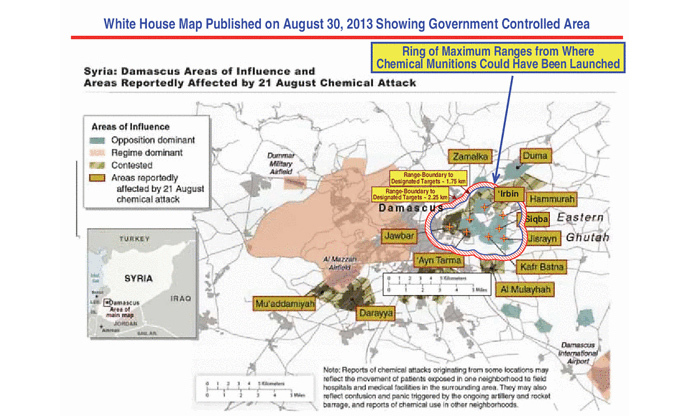
“This mistaken intelligence could have led to an unjustified US military action based on false intelligence. A proper vetting of the fact that the munition was of such short range would have led to a completely different assessment of the situation from the gathered data,” the report states.
The authors emphasize that the UN independent assessment of the range of the chemical munition is in “exact agreement” with their findings.
The report goes on to challenge the US Secretary of State’s key assessments of the chemical attack that he presented to the American people on August 30th and to the Foreign Relations Committee on September 3rd in an effort to muster a military attack on Syria.
“My view when I started this process was that it couldn’t be anything but the Syrian government behind the attack. But now I’m not sure of anything. The administration narrative was not even close to reality. Our intelligence cannot possibly be correct,” Postol told McClatchy news.

“The Syrian rebels most definitely have the ability to make these weapons,” he said. “I think they might have more ability than the Syrian government.”
It also remains a mystery why the particular type of rocket that was used in the attack was not declared by the Syrian government as part of its chemical weapons arsenal when it agreed to destroy its chemical weapons and their delivery methods. OPCW inspectors charged with implementing the agreement also did not discover such a rocket in possession of government forces.
Syria agreed to the destruction of its chemical weapons through a deal brokered by Russia and the US after a sarin gas attack on August 21. Western nations blamed the deadly attack on President Bashar Assad’s forces, while Damascus accused the rebels for the incident. The UN fact-finding mission had no mandate to find out who carried out the attack.
Under the UN-backed plan, all of the country’s declared 1,290 tons of toxic agents should be destroyed by June 30. Initially, the first batch of the most dangerous materials was to be moved out of Syria on December 31.
However, the deadline was missed because of the ongoing war in Syria and technical issues. It was only on January 7 that “priority chemical materials” left the Syrian port of Latakia on a Danish ship for international waters.
Related article

Israel, Pentagon ‘big winners’ in US spending bill

Press TV – January 15, 2014
The Pentagon, defense industry and Israel came out as big winners in a bipartisan $1.1 trillion omnibus spending bill that would pay for government operations through October, a report says.
The massive measure, unveiled Monday night, fleshes out the details of the budget deal that US Congress passed last month.
The spending bill provides about $497 billion for the Pentagon in 2014 — about the same as in 2013. In addition, it allocates $85.2 billion for the war in Afghanistan as part of the Pentagon’s overseas contingency operations (OCO), $5 billion more than requested.
“The big winner is the Defense Department. They should be breaking out champagne in the Pentagon,” said Gordon Adams, a defense budget expert and former US official, as quoted by the Hill.
Before last month’s budget deal that relieved $22.4 billion in sequestration cuts, the Pentagon budget for 2014 would have been around $475 billion.
Fiscal watchdog and antiwar groups criticized the $5 billion increase from the Pentagon’s request in overseas contingency funding as a “slush fund to pad the department’s budget and avoid spending reductions,” the Hill said.
“There is no excuse for a $5 billion increase to OCO especially in a time of belt tightening throughout the federal government,” David Williams, president of Taxpayers Protection Alliance, said in a statement Tuesday.
The defense industry was also a winner in the omnibus spending bill, Adams said.
The bill largely fulfills the Pentagon’s procurement request for ships, aircraft, tanks, helicopters and other war-fighting equipment, including 29 new F-35 Joint Strike Fighters, eight new warships as requested by the Navy, and a variety of other aircraft like the V-22 Osprey, new and improved F-18 fighters and new Army helicopters.
Israel is also a “winner” in the spending measure, as it fully funds the Arrow, David’s Sling, and the Iron Dome rocket systems, the Hill said.
The spending bill authorizes $173 million in added funding for Israel’s missile systems, including nearly $34 million to improve the Arrow weapon system and $117.2 million for development of the David’s Sling short-range ballistic missile system and $22 million for an upper-tier interceptor.
The US provides $3.1 billion in annual military aid to Israel, making the Zionist regime the largest recipient of US aid in the world.
US President Barack Obama has pledged to extend annual military aid to Tel Aviv through 2027.
The pending 10-year military aid package would commit the United States to give up to $40 billion in military grant assistance to Israel. It would automatically kick in after the current 10-year, $30 billion agreement expires in 2017.
Democrats plead with Obama to abandon Social Security cut
By Alexander Bolton – The Hill – 01/11/14
Democratic senators are pleading with President Obama to abandon his proposal to trim Social Security benefits before it becomes a liability for them in the midterm elections.
The president proposed a new formula for calculating benefits in his budget last year, in hopes that the olive branch to Republicans would persuade them to back tax increases in a broader fiscal deal. But Democratic lawmakers say Obama should shelve the idea now that they are facing a difficult midterm election where they need to turn out the liberal base to preserve their Senate majority.
“I’m not sure why we should be making concessions when the Republicans show absolutely no willingness to do the same,” said Sen. Chris Murphy (D-Conn.).
Democrats acknowledge it may be awkward for Obama to rescind his proposal, but say it would unwise of him to repeat the offer in the budget that is due out next month.
“I think it’s difficult for the president to pull it back after he already floated it but I would love to see it shelved until Republicans show they’re actually going to do something on their side of the ledger,” Murphy said.
Obama proposed nearly $1 trillion in spending cuts in his budget, including a switch to using the Chained Consumer Price Index (CPI), which liberal policy experts estimate could cost seniors thousands of dollars in benefits over their lifetimes.
The Center on Budget and Policy Priorities, a liberal think tank, projected that most future beneficiaries would see a 2 percent reduction in benefits during the course of retirement.
Supporters of chained CPI argue it is a more accurate measure of inflation, and say the reduction in federal spending would ease the deficit over time.
Obama said he made the proposal to get Republicans to the negotiating table, but the move rankled Democrats on both sides of the Capitol.
Sen. Bernie Sanders (Vt.), a liberal independent who caucuses with Democrats, said lawmakers have told White House chief of staff Denis McDonough to drop chained CPI from this year’s budget proposal.
“We have talked to his chief of staff and made that very clear,” said Sanders, who is co-founder of the Defending Social Security Caucus.
Congressional Democrats grumbled last year that Republicans never seriously entertained the thought of ending tax breaks for wealthy individuals and corporations.
“I certainly hope that the president has learned a lesson from this whole process,” Sanders said. “To be honest with you, I just can’t imagine what staff people gave him the disastrous advice to propose a chain CPI, which from both a public policy point of view and political point of view is totally absurd.”
“He should recognize that was a mistake. It should not be in his budget at all,” said Sen. Tom Harkin (D-Iowa), chairman of the Health, Education, Labor and Pensions Committee.
Harkin said some centrists in the caucus support chained CPI, but they are in the distinct minority.
One of those centrists is Sen. Mark Warner (D-Va.), who is running for reelection this year and facing a possible challenge from Ed Gillespie, the former chairman of the Republican National Committee.
Warner said in an interview that he is still hopeful of a broader deal to reduce the deficit. He said Democrats should keep chained CPI on the table if they expect Republicans to compromise on taxes.
Liberal Democrats say cutting Social Security benefits, even what centrists view as moderate cuts, is broadly unpopular across age groups. They say there mere proposal of reductions would amount to a self-inflicted political wound that would come back to haunt their party in the midterm election.
“It’s a very controversial issue at a difficult time for the senior community,” said Sen. Dianne Feinstein (D-Calif.), who declined to express support or opposition to the proposal.
A Pew Research poll released this month showed Republican voters are more enthusiastic than Democrats about the November election.
The survey found 63 percent of Republicans were looking forward to the election, while only 53 percent of Democrats felt the same way. Pollsters found a similar enthusiasm gap in January of 2010, before Republicans captured control of the House and picked up Senate seats.
In recent weeks, political handicappers have upped the chances of Republicans capturing the Senate in November.
White House and Senate Democratic strategists have tried to rekindle the enthusiasm of Democratic base voters by focusing on income inequality. Senate Democrats have made extending unemployment benefits and raising minimum wage two of their top agenda items this year.
Robert Borosage, co-director of Campaign for America’s Future, a liberal advocacy group, said it would be a serious blunder if Obama gave Republicans an opening to accuse his party of pushing Social Security cuts.
“I think it’s very counterproductive and not just with the base,” Borosage said.
Borosage noted that Republicans reaped a disproportionate share of the senior vote in the 2010 GOP wave election but have steadily lost their edge among that age group in recent years.
He noted that Republicans bashed Obama and Democrats in 2012 for cutting Medicare to raise money for the Affordable Care Act, even though House GOP Chairman Paul Ryan (R-Wis.) kept those cuts in his own budget proposals.
“The last thing you want to do in terms of the politics is allow Republicans to go across the country and say the president wants to cut Social Security before the election,” he said.
Obama is officially scheduled to release his budget next month, but is likely to delay the fiscal blueprint until March or April, as he did last year.
Average Wait Time For A Response At Administration’s ‘We The People’ Petition Site At 298 Days
By Tim Cushing | Techdirt | January 9, 2014
The We the People site set up by the Obama administration gave American citizens a more direct way to petition their government. The ideal propelling it was noble, but it has failed spectacularly in execution. As we’ve noted before, various petitions have gone unanswered for months after hitting the signature threshold.
The threshold itself has been raised a handful of times as well (from 5,000 to 25,000 to 100,000 as the site increased in popularity), ostensibly to weed out petitions that weren’t truly representative of the population. This should have made the administration’s job easier. A higher threshold means fewer petitions requiring an answer, and those that surpass the threshold should (although it’s not always the case) be of higher quality.
Counterintuitively, as the threshold has increased, so has the response time.
Of the 30 unanswered petitions currently posted to We the People, 11 were posted after the threshold was raised to 100,000 signatures and 19 were posted before the threshold was raised to that level.
Unanswered petitions posted after the threshold hike have been waiting 103 days for a response on average.
Unanswered petitions posted before and after the threshold hike have been waiting 298 days, on average, for a response.
What the site was supposed to be (responsive) and what it’s turned out to be (a mostly empty gesture) tracks with the administration’s continual failure to uphold its own stated ideals. The “most transparent administration in history” has advanced and expanded Bush-era policies that added layers of opacity to the government’s inner workings in order to further subvert the notion that a government should be accountable to its constituents. The administration has also prosecuted more whistleblowers than all other administrations combined, further widening the gap between those who govern and those that are governed.
It appears that any petition not deemed a “softball” or that can’t be handled by a canned policy statement is backburnered. One of the first petitions to gather enough signatures (requiring labeling of genetically modified foods) has been waiting since September 2011 for an answer. More recent petitions appear to headed down that same road.
The unanswered petitions include one asking the president to fire the U.S. Attorney who led the prosecution of Internet activist Aaron Swartz and one to pardon the National Security Agency documents leaker Edward Snowden.
The Swartz petition will hit a year of being ignored within a month. The Snowden petition is headed into its seventh month without an answer.
It’s not as though it’s impossible for the administration to answer these in a timely fashion. While the answers given to each of these petitions would probably be unpopular, the point of the site is not for the administration to “look good” but rather to increase its direct communication with the public. The administration also needs to keep in mind that canned policy statements that ignore or only very indirectly address the petitions’ subject matter is not “communication.”
When petitioners are waiting nearly a year to have their issues addressed, the “offer” of a direct line to the government is effectively empty.
Related article

Obama, the Great Dis-Equalizer
By Glen Ford | BAR | January 8, 2014
 President Obama, the Grand Facilitator of the greatest consolidation of financial wealth in human history, began his sixth year in office declaring that income inequality is “the defining challenge of our time.” The Grand Bargainer who saved George Bush’s bank bailout and presided over the (ongoing) infusion of tens of trillions of dollars into Wall Street accounts, and who bragged less than two years ago that, “Since I’ve been president, federal spending has actually risen at the lowest pace in nearly 60 years,” now calls for government action to reverse the momentum of his own policies. The Great Pretender, who in 2008 called for an increase in the federal minimum wage to $9.50 an hour by 2011, and then did absolutely nothing to effectuate it when Democrats controlled both chambers of Congress, now proposes to raise the bar to $10 an hour in order to embarrass Republicans in an election year. The Daring Debt Buster who, on his own initiative, has frozen federal workers’ wages since 2010, and worked hand in glove with Republicans to gut social programs in the name of fiscal restraint, laments “growing inequality and lack of upward mobility” among the masses.
The chief executive who lifted not a finger to pass “card check,” the Employee Free Choice Act of 2009, that might have given organized labor a fighting chance to survive, now pretends to be a born again champion of collective bargaining and yearns for the days when “you knew that a blue-collar job would let you buy a home, and a car, maybe a vacation once in a while, health care, a reliable pension.”
Meanwhile, Obama’s Justice Department sided with the Republican-appointed Emergency Financial Manager of Detroit, who was seeking to impose bankruptcy on the mostly Black city and raid retiree’s pensions – revealing the administration’s true colors.
The nation’s First Black President admits that “African Americans, Latinos, Native Americans are far more likely to suffer from a lack of opportunity – higher unemployment, higher poverty rates,” and claims he’ll push for “targeted initiatives” to combat this “legacy of discrimination” (although all the proposed targeting is in the form of tax incentives for business). Yet, nearly five years ago, in a press conference marking his first hundred days in office, Obama categorically rejected targeted aid for Black communities, thus ensuring that the cascading effects of the Great Meltdown would plunge African Americans deeper into the abyss. Obama said:
“So my general approach is that if the economy is strong, that it will lift all boats as long as it is also supported by, for example, strategies around college affordability and job training, tax cuts for working families as opposed to the wealthiest that level the playing field and ensure bottom-up economic growth.
“And I’m confident that that will help the African-American community live out the American dream at the same time that it’s helping communities all across the country.”
By 2009, according to economist Pamela Brown, white household wealth was 19 times that of Black households, “and is probably even greater now” – compared to a ratio of 12 to 1 in 1984 and down to 7 to 1 in 1995. The collapse of Black economic fortunes has been catastrophic, yet Obama offers only tax cuts for corporations, streamlined business regulations, undoing of sequestration, more rhetoric about ending off-shoring of jobs, and stronger application of antidiscrimination laws.
The president wants us to forget that he was the one who proposed sequestration in the first place, in an effort to force a Grand Bargain with Republicans; that his economic advisors are secretly meeting with hundreds of corporate lobbyists to shape a jobs-destroying Trans Pacific Partnership that is “like NAFTA on steroids,” and then fast-track it through Congress; and that Obama has nominated two Republican prospective judges from Georgia to federal courts, one of whom fought to keep the Confederate banner in the state flag, while the other was the lead lawyer in defense of Georgia’s Voter ID law. The Obama administration has many priorities, but nondiscrimination is not one of them.
Whatever Obama means when he says “targeted assistance,” it seldom translates as actual money for non-corporate persons. Back in April of 2012, his administration was cited for failing to spend almost all of $7.6 billion that Congress set aside to help communities and homeowners hardest hit by the housing crisis – a cohort that is disproportionately Black and brown. Obama’s Treasury Department offered no explanation other than they had not put together a proper spending plan. However, it is obvious that Obama’s people wanted to avoid doing anything that might interfere with the banks’ foreclosure processes, so as not to disturb Wall Street’s manifold schemes to further rig the market.
The growing crisis of income and wealth inequality is a result of the internal logic of capitalism under the hegemony of Wall Street. Obama’s fix for the vast social carnage the banksters leave in their wake, is to forge a State that is even more dutiful in propping up “the markets” and stripping down the public sector. There is no room in that presidential mission for even modest amelioration of the public’s pain. The president’s rhetoric is nothing more than noise, totally disconnected from actual policy. The Lords of Capital – for whom Obama is a servant – have nothing to offer but more austerity and war.
They must be disempowered, root and branch, and society “reformed” in their absence.
Obama Plans Cosmetic Surveillance Changes After All, Will Set Up Pretend Fight Over NSLs
By Mike Masnick | Techdirt | January 6, 2014
Leaks coming out of the Obama administration suggest that the President is preparing mostly cosmetic changes to the intelligence community, following the recommendations from the intelligence task force — which were much stronger than many expected. The reports suggest things like putting a public advocate to represent the public’s views in certain cases before the FISC. This has been talked about for a while, and was the main concession plenty of people had been expecting anyway. That’s hardly anything big.
The article talks about two other potential reforms. The first is shifting the holding of phone call metadata from the NSA to the phone companies, allowing the NSA to still search through it after getting a court order. While this may be a marginal improvement, it still has tremendous problems. It will almost certainly come with some sort of data retention law — something that the feds have wanted for ages, and which civil liberties activists have been fighting against for years. Companies shouldn’t be required to hang on to data they don’t need, especially if getting rid of it can better protect their users’ privacy. Furthermore, while not letting the NSA hang onto the data is a good thing, there is a reasonable concern that if the telcos are hanging onto the data themselves, that they, too, might do bad things with it, with little to no oversight.
However, most of the article from the LA Times focuses on National Security Letter (NSL) reform. We’ve written about those for years. NSLs are the way that the FBI can demand information from companies without any judicial review at all and, even more insane, with a complete gag order that prevents the recipient from telling anyone (including, at times, your lawyer). The FBI has an incredibly long history of “serious misuse” of NSLs, and has shown little to no interest in fixing the process. Nearly a year ago, a court actually ruled them unconstitutional, but there’s an ongoing appeals process that will take quite a bit of time.
However, as the article notes, the DOJ/FBI and other surveillance maximalists are all horrified by the idea that Obama might actually require judicial approval of NSLs, for all but “emergency” situations. What this sounds like is that the President may suggest something along those lines, there will be a well coordinated press attack from surveillance hawks freaking out about the danger this puts us all in… and then he’ll back down on that one point. And we’ll be left with… basically nothing, but the President will go around insisting that he reformed the intelligence community, while everything more or less stays the same.
Related articles


Boeing Union Workers Forced Into Massive Concessions
By Jack Rasmus | January 5, 2014
This past weekend, more than 30,000 union workers at Boeing Corp. in Seattle, were forced to accept deep concessions in their union contract, gutting their pensions, future healthcare benefits, wages, and other benefits. Their contract with Boeing had not even expired but they were forced into concessions nonetheless. Nor was the company, Boeing, in any financial distress. It had registered record profits in consecutive years, and had in November 2013 bought back $10 billion in stock from its shareholders and paid another $2 billion in dividends to the same. Nevertheless Boeing demanded concessions, having received communication from Union (IAM) International leadership beforehand of their willingness to grant the same. The combination of Union International leadership pressure, countless Democratic Party politicians, and the Company’s new offensive, proved too much for local workers to resist. The new concessions will effectively end workers’ defined benefit pensions, cutting retirement benefits to the bone, and allow the company to end its healthcare insurance benefits by 2018 in accordance with the Obama new health care plan. Wages for new hired workers are projected to decline to levels of minimum wage or less over the next 11 years of the new contract term.
This kind of attack on pensions and healthcare–or what this writer calls the ‘social wage’ was predicted in this writer’s article, ‘Concession Bargaining at the Crossroads’ two years ago in 2011. That article is reproduced here in its original draft form once again.
CONCESSION BARGAINING AT THE CROSSROADS
“The history of collective bargaining since the Second World War has consisted of several stages or phases. The first phase was roughly from 1947 to 1979. During it collective bargaining was expanded both in terms of its ‘scope’ and its ‘magnitude’. Scope refers to new areas of bargaining, such as cost of living adjustments, supplemental unemployment benefits, pensions and health care benefits, union and worker rights, etc. Magnitude refers to increasing the dollar value of wages and benefits. Up to 1979 both expanded.
In contrast, from the mid-1970s to 2007, concession bargaining became the growing practice. But it was concession bargaining focused on giving back ‘magnitude’ gains of the previous decades, not necessarily the scope of bargaining. Workers in the private sector gave ground on wages and benefits in a decades-long attempt to protect their jobs.
First Stages of Concession Bargaining
Among the first to feel the effects were workers in the construction sector, starting in the 1970s. Employers formed early in the decade the ‘Construction Industry Users Roundtable’. Its strategy was to undermine the then powerful building trades unions by a new tactic: the ‘double breasted operation’. This simply put was a way to undermine the construction unions by setting up parallel, non-union companies. The unions ignored the threat more or less, since the double breasted operations were set up in the suburbs and outlying regions. The urban bastion of unionization in construction wasn’t immediately impacted. Employers progressively then moved jobs and work to the non-union operations. The loss of jobs in the unionized operations eventually forced workers and unions to start granting concessions in an attempt to prevent their work shifting to the non-union companies. Concessions soon expanded. Saving jobs in exchange for givebacks on wages and benefits eventually became the norm.
In the late 1970s the strategy of forcing workers to give up wage and benefit gains to keep their jobs leap-frogged into the manufacturing sector. The pilot and defining event was the Chrysler bailout of 1979. It worked so well the model was planned for application to manufacturing in general. By then the Construction Industry Users Roundtable’ had expanded into what is now known as perhaps the most formidable and effective Big Business organization today—the Business Roundtable. Big manufacturing and service companies joined with the Construction employers. The construction industry union-busting model was transported to other sectors of the economy.
The tactic of double breasted operations took on a new form. Alternative union-free operations were set up. But not across town, as in construction. It was now across borders. The manufacturing analog of the double breasted operation was the runaway shop, as manufacturers moved operations offshore.
In these they were aided by the most pro-business President since Coolidge—Ronald Reagan and a compliant Congress. Manufacturers were provided generous economic incentives to set up offshore. Tax incentives were generously granted. Deregulation was introduced. Then in 1988 and 1993 ‘free trade’ agreements were established with Canada and Mexico to facilitate the movement of US capital to those countries to set up operations. Free ‘trade’ is not just about export-import of goods and services; it is even more about negotiating favorable conditions for US foreign direct investment in those countries. Tax [breaks] for investing offshore plus free trade plus deregulation devastated jobs in the US beginning in the early 1980s, and continuing ever since. Under pressure of losing jobs, workers in manufacturing began the long, dead-end road toward concession bargaining in an attempt to save their jobs. But it didn’t. More than 10 million jobs have been off-shored ever since.
The pressure to grant wage concessions intensified in the 1990s. In addition to the threat of job loss, now escalating double-digit annual increases in health care costs provided a second hammer. That ushered in what was called ‘maintenance of benefits bargaining’. Now desperate to maintain their health care coverage, workers gave up more wages in exchange for keeping health benefits. But that too did not last long.
Health care cost shifting accelerated by 2000 and into the next decade. To assist in paying for rising health care premiums and costs, the federal government permitted companies to drag surplus funds from workers’ defined benefit pension plans to cover rising health costs. Up to 20% of health cost increases were subsidized in this manner. But that represented giving up wages—i.e. concessions—in order to maintain benefits as well. Only this time it was workers’ ‘deferred wages’ that went into their pension funds instead of their immediate paychecks. But a wage is a wage, whether immediate or deferred. And concessions on nominal (immediate) and deferred wages became the increasing rule by the late 1990s.
This evolving concession bargaining since the late 1970s into the last decade represents the second phase of the history of collective bargaining in the US. The first, as noted above, was the phase during which collective bargaining expanded both in terms of ‘scope’ and ‘magnitude’—that is, in terms of new areas of bargaining added to negotiations as well as in terms of advances in wages and benefits. The second phase of bargaining in the US, from the late 1970s to around 2000, represents the first stage of concession bargaining.
Stage Two: From ‘Magnitude’ to ‘Scope’ Concession Bargaining
This first stage of concession bargaining (1975-2000) began to change for the worse in the past decade, shifting to a new stage during which workers and their unions have been forced to grant concessions not only in terms of magnitude or levels of wages and benefits, but now in terms of scope and entire areas of bargaining as well. Defined benefit pensions were abandoned for 401k personal pension plans at an accelerating rate. Not only were pensions increasingly privatized, but the de-collectivization of health insurance plans also accelerated under George W. Bush with the introduction of what were called ‘health savings accounts’—the analog on the health benefits side to 401ks on the pensions side.
Employer provided health insurance benefits were now dropped in growing numbers altogether. Or they were dumped onto the union, as in the Auto Industry, in the form of VEBAs (voluntary employment benefit agreements). Employers removed in effect any negotiating over companies paying for health care for workers from union collective bargaining agreements. In a similar fashion, once widespread Cost of Living clauses in collective bargaining agreements were stripped from union contracts. Ditto for supplemental unemployment benefits (SUBs). More and more companies simply discontinued unilaterally retirees health care coverage from bargaining, aided now by court decisions that ruled such were not bona fide subjects of bargaining any longer. Union rights were increasingly circumscribed in agreements, as management rights clauses were expanded. In other words, concession bargaining was no longer simply about ‘magnitudes’—i.e. how much wages or benefits would be reduced in order to keep jobs or the companies from moving offshore or from being outsourced and reduced to mere skeleton crews. Not entire key areas of union contracts were being ‘conceded’ and thus wiped out, removed from the very subject of bargaining altogether.
Stage Three: Concession Bargaining Extends to the Public Sector
In the past two years this second phase of concession bargaining—i.e. cutting levels of wages and benefits and giving up entire areas of bargaining—is now being applied to public sector workers as well, in a vicious attack now unfolding throughout the country. Politicians of both political parties, public sector employers, and wealthy billionaires and millionaires who pay for the elections of these same politicians, are in the process of imposing concession bargaining on public workers.
Furthermore, concession bargaining is occurring in an especially compressed form. Both magnitude and scope are occurring simultaneously and in a matter of just a few years instead of the few decades in which it was deepened in the private sector of the economy. The entire process is effectively ‘telescoped’ and thus taking place is a particularly intense form. All across the country today, in state after state, politicians are declaring bargaining over pensions and health care no longer will be the practice. They are unilaterally discontinuing defined benefit pensions and replacing them with 401k plans. They are moving to eliminate union and agency shop agreements with the open shop, placing ‘caps’ on wage negotiations, and in general attempting to return to the days of ‘civil service’ rules and regulations in lieu of bona fide collective bargaining.
Stage Four: Concession Bargaining’s New Target: ‘Social Wage’ Reduction
Concession bargaining is morphing still further, however. It is now moving from the level of taking back money wages and benefits at the ‘shop-floor level’—both in the private and public sectors—to the level of ‘social wage’ concession bargaining.
The ‘social wage’ is money wages that workers give up in exchange for pay they will receive at a later date. Social wages are thus deferred wages. Social wages are most notably Social Security and Medicare taxes that workers pay in the form of payroll taxes, in order to receive the wage paid upon retirement in the form of social security pension and medicare health care benefits. The focus since the 2010 midterm elections in the US is now on austerity—a codeword for cutting so-called ‘entitlements’ like social security and medicare. But social security and medicare represent wages paid by workers in the past for claims in the future. Not content with concessions from current wage and benefits, Corporate America—the rulers behind the throne of Congress and the Presidency and Courts—now want reductions in the ‘social wage’ as well. Why? So they can maintain their historic tax cuts enacted over the past three decades and not have to pay the costs of the bailouts and economic crisis [as well as the wars for Israel – Aletho News] that they themselves caused.
The dimensions of the Great American Tax Shift of the past three decades, still on-going and expanding under Obama and the Democrats (and about to expand further still) are the subject of another analysis. But briefly, a tip of the iceberg view is: In the 1960s corporations paid 30% of total federal tax revenues; today they contribute 6.6%. In the 1960s the top income brackets paid 45% of total federal tax revenues; today the effective top bracket tax paid by the wealthiest individuals is only 16%.
The latest phase of concession bargaining now emerging in the past year—concessions giving back the ‘social wage’—is historic. It represents concession bargaining over workers’ income that is shifting to the political level on a grand scale. It is ‘grande scale concession bargaining’. Not content with concessions in money and benefits at the shop level in the private sector, not even content with extending that in intensified form today to the public worker sector, corporate interests now demand concession bargaining over social wages at the political level.
What’s especially onerous about the new concession bargaining is that politicians are making the decisions. Workers don’t even have the option of voting on the concessions, or striking in opposition, as they might when undertaken in cases of earlier concession bargaining at the shop level. They now have virtually no say in the process short of taking to the streets to have their voices heard—which appears increasingly as the only alternative. Moreover, the dollar value of the concessions being, and about to be, offered are now also immensely greater. As the recent debt ceiling debate illustrates clearly, the coming attack on Medicare represents social wage concessions approaching half a trillion dollars. Concessions involving social security retirement that will soon follow in 2012 will amount to a like amount, at minimum, with even more Medicare cuts. In just a few short years, several times the value of total givebacks in concessions in wages and benefits at the shop level since 1979 may occur. It is a massive transfer and shift of income from working and middle class America to the wealthiest households and their corporations.
Behind the facade of Washington politics are the same corporate interests, however. Only now instead of directing their managers at the bargaining table, they now direct their political managers by means of their immense, and growing, campaign contributions and billion dollar lobbying efforts.
Occasionally an example slips through the veil of confusion about who’s behind it all. The veil drops revealing the ‘Wizards of Oz’ pulling the levers and the curtains. Witness the notorious relationship between Wisconsin governor, Walker, and the billionaire Koch brothers. But there are ‘Koch brothers’ lurking everywhere behind the veil, in Ohio, in New Jersey, Connecticut, Massachusetts, Georgia, and even California. They are driving the fundamental strategy, directing the elected politicians in exchange for campaign contributions and day to day lobbying largesse.
The Empty Legacy of Concession Bargaining
What concession bargaining has proven over the past three decades—whether at the political level or the shop floor level—is that concessions only result in demands for more concessions.
Concessions in the private sector over the past three decades haven’t saved jobs. What they have achieved is a stagnation and decline in the income for 100 million families that is choking off consumer spending and economic growth and therefore economic recovery. The second phase, concession bargaining in the public sector, will now add to this consumption decline. And the now emerging third phase, expanding concession bargaining to the level of social wages, about to begin with the direct attack on social security and medicare will not ‘save’ those programs any more than concession bargaining in the past ‘saved jobs’.
Concession bargaining will only result in a deepening crisis in those programs and lead, inevitably in turn, to more demands by corporate interests for still further cuts (i.e. concessions) in those programs. Calls by politicians for ‘shared sacrifices’ are really concession bargaining by another name: to reduce the social wage represented by social security and medicare.
Nothing positive whatsoever has come from concession bargaining the past three decades in the private sector. Good jobs have continued to disappear by the tens of millions. Wages and earnings for the 100 million non-supervisory workers in the US have stagnated and fallen. Giving up wages to ‘maintain health and retirement benefits’ have fared no better. Pensions have nearly disappeared and employer provided health care coverage has declined by the millions of companies, and will not last out the current decade. Nor will anything beneficial come from the intensification of concession bargaining now penetrating the public sector. Union leaders will give up wages and benefits, but that will not stop the millions that are slated for layoffs in the public sector over the next few years—at minimum 500,000 in the year ahead alone! The extension of concession bargaining to the public sector, now accelerating at a pace far worse than that which previously occurred in the private sector, will produce the same results—only now telescoped into a much shorter time period. Not least, nothing positive will come from granting concessions over social wages—i.e. agreeing to reduce social security and medicare benefits. Those programs will not be ‘saved’ by concessions. They will be destroyed by them.
The only way to stop concession bargaining in any of its forms, including the most virulent now attacking the ‘social wage’, is to refuse any and all concessions. ‘No cuts and No Concessions’ is the only effective bargaining demand.
And just as, at the shop floor, when union leaders cave in to employer demands for concessions, they should be thrown out and replaced with leaders who will refuse to do so and stand firm—so too should any politician who agrees to concessions from social security and medicare be thrown out. Indeed, any politician who fails to actively resist such concessions should be thrown out. Not in the next election. But by immediate recall.
Finally, any political party that allows its elected to members to agree to concessions in social security and medicare, or whose elected members stand by silently while the fight to defend the social wage takes place, should be replaced by another political party whose members consider the social wage ‘non-negotiable’.
Unfortunately, it appears the political party—the Democrats—who introduced and once championed social security and medicare are now becoming participants in its destruction. Not only President Obama, but Senate leader Harry Reid and House leader Nancy Pelosi, have all publicly indicated this past summer they are prepared to concede and to cut medicare before year end 2011 in some form. Next it will be social security retirement. And medicare again.
But once starting down that road of initial concessions, it will only lead to further concessions—as the history of concession bargaining at the shop floor over the last three decades sadly shows.
If that happens, and the leadership of the Democratic Party abandon social security and medicare to concession bargaining, as it appears they will, the only answer to stopping concession bargaining is to create a new party of labor, every member of which must solemnly pledge to expand the social wage, to defend and expand social security and medicare, to stand firm on the question of concession bargaining. There can be no ‘Bi-Partisan’ compromise. It is time to raise the flag, with the motto boldly proclaiming across it: ‘No Concessions! No Retreat!.
Jack Rasmus, August 7, 2011
Related article

Iran, the United States, and the Middle East in 2014
By Flynt Leverett and Hillary Mann Leverett | January 1, 2014
First of all, our very best wishes for the New Year!
2013 was, for many reasons, an important year for the Islamic Republic of Iran, for U.S.-Iranian relations, and for the Middle East more generally. Looking back, one thing which strikes us as especially important is that, during 2013, the failures of U.S. grand strategy in the Middle East (and the gradual implosion of America’s position in the region) became evident even to some who were too analytically obtuse or ideologically reluctant to notice it earlier.
President Obama’s largely self-inflicted debacle over his declared intention to attack Syria after chemical weapons were used there in August was particularly crucial in this regard. It is no accident that the Obama administration became at least superficially more interested in diplomacy after this episode. For Obama’s flailing over Syria underscored that, after strategically failed military interventions in Afghanistan, Iraq, and Libya, the United States cannot now credibly threaten the effective use of force for hegemonic purposes in the Middle East.
If 2013 was a year in which the profound deficiencies of America’s Middle East strategy were on extended display, we expect that 2014 will be a year in which the effectiveness of Iranian strategy comes to the fore. We are not optimistic that Obama and his team will get diplomacy with Iran “right.” Fundamentally, official Washington remains unwilling to accept the Islamic Republic as an enduring political entity representing legitimate national interests, and to incorporate such acceptance into U.S. policy on the nuclear issue, the Syrian conflict, and other Middle Eastern challenges.
But Iran’s strategy does not depend on Washington getting things right. Indeed, Iranian strategy takes seriously the very real (even likely) prospect that Washington is not capable of negotiating a nuclear settlement grounded in the Nuclear Non-Proliferation Treaty and respectful of the Islamic Republic’s nuclear rights. Likewise, Iranian strategy takes seriously the very real (even likely) prospect that Washington cannot disenthrall itself from Obama’s extremely foolish declaration in August 2011 that Syrian President Bashar al-Assad must go—and therefore that the United States will not contribute constructively to the quest for a political settlement to the Syrian conflict.
If the United States can truly reform its approach to the Middle East, certainly Iran can work with that. But if Washington continues down its counter-productive path in the region, Tehran can play off America’s accumulating policy failures and the deepening illegitimacy of its regional posture to advance the Islamic Republic’s strategic position. We look forward to charting and analyzing the course of events in the Middle East, along with all of you, during 2014.
To round off our retrospective look at last year, we recall that, back in February 2013, our newly published book, Going to Tehran, served as the launch point for a Penn State Journal of Law and International Affairs symposium on “The U.S.-Iranian Relationship and the Future of International Order.” As a final gift from 2013, we want to share (see here) the issue of the Penn State Journal of Law and International Affairs, published in November 2013, presenting the penetrating papers that grew out of this symposium—by Dan Joyner, Richard Butler, Mary Ellen O’Connell, and Jim Houck, along with the two of us.
No austerity for military budget in 2014
Press TV – December 28, 2013
In an era of bipartisan agreement on austerity cuts to vital services and workers’ benefits, US military-industrial-complex spending will continue into the new year untouched.
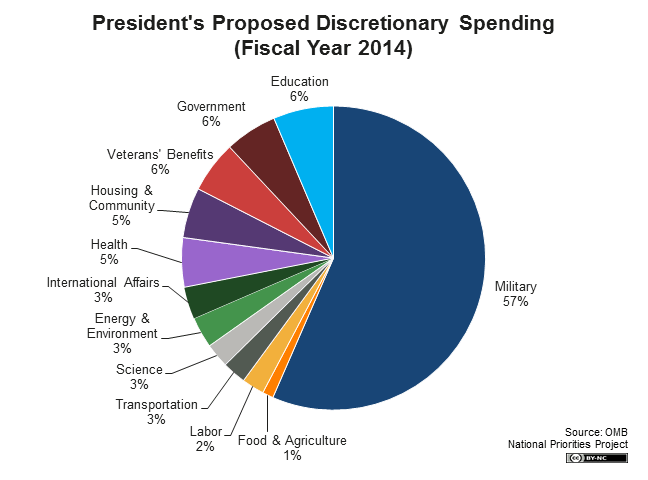
President Barack Obama signed into law on Thursday the National Defense Authorization Act for the fiscal year 2014 that allots $526.8 billion for the Pentagon’s budget and $80 billion for the war in Afghanistan—totaling nearly $607 billion in defense-related spending.
This is nearly $30 billion more than was agreed to in the bipartisan federal budget deal that was also signed by Obama on Thursday.
“The passage of a National Defense Authorization Act (NDAA) that calls for $30 billion more for the Pentagon and allied agencies than is contained in the recent budget deal passed by both houses of Congress is just the latest indication that defense hawks continue to live in their own world, untroubled by fiscal constraints,” said William Hartung, director of the Arms & Security Project at the Center for International Policy.
The bill does include an ease of restrictions on transferring Guantanamo Bay US military prison inmates to the custody of other countries, while banning transfers to the United States, in what human rights advocates are calling a limited victory.
“We hope that President Obama will make swift use of the new NDAA provisions to actually act on his removal of the ban,” reads an official statement from the Center for Constitutional Rights, which has battled unlawful detentions at Guantánamo for the past 11 years.
“Despite President Obama’s announcement in May that he would lift his self-imposed ban on transfers to Yemen, seven months later not a single Yemeni has been released,” the statement warns.
The bill also introduces limited protections for survivors of sexual assault within the US military, yet keeps power over legal cases within the chain of command—which survivors and their advocates say is inadequate in a system where higher ranking service members have near impunity for sexual assaults perpetrated down the chain of command.
Critics slammed the NDAA as a military handout at a time of great human need.
“The bill is a massive spending program on the war economy with no justification in a time of austerity and limited security threats,” writes D.S. Wright for FiredogLake.
“Washington’s spending priorities are upside down: continuing to fund the Afghan war and the taxpayer ripoff F-35 warplane while cutting funding for human needs,” said Robert Naiman, policy director for Just Foreign Policy, in an interview with Common Dreams.
Related article
- President Obama Signs $607 Billion Defense Bill in Hawaii (news.firedoglake.com)
Obama regime underestimated cost of maintaining nuclear weapons by $140 Billion
By Noel Brinkerhoff and Danny Biederman | AllGov | December 27, 2013
Defense officials in the Obama administration were more than a little off when they told Congress the cost of maintaining the nation’s nuclear weapons arsenal over the next 10 years.
They missed the mark by at least $140 billion.
Two years ago, the Pentagon informed lawmakers that they would need to allocate $214 billion over the coming decade to operate and upgrade the stockpile of nuclear warheads and delivery systems.
But the Congressional Budget Office (CBO) looked at the Defense Department’s future plans and found that nuclear weapons-related costs were more likely to reach $355 billion by 2023.
That’s 66% higher than the 2011 estimate.
The $355 billion includes $136 billion to modernize and operate submarines, bombers and missiles that deliver warheads, $105 billion to run weapons labs, weapons and naval reactors, $56 billion for command and control systems, and $59 billion for unforeseen technical problems or mismanagement.
And that’s just the direct costs related to the nuclear arsenal.
CBO officials point out there are other, very costly programs that exist because of the nuclear weapons program, such as cleaning up shuttered nuclear fuel facilities or the nation’s missile defense systems for shooting down other nation’s nuclear missiles.
These other costs will likely cost the government another $215 billion over the next decade.
“Nuclear weapons aren’t cheap as some high-ranking Pentagon officials have suggested,” Kingston Reif, director of nuclear non-proliferation at the Center for Arms Control and Non-Proliferation, an advocacy group in Washington, told the Center for Public Integrity.
Last year, Deputy Secretary of Defense Ashton Carter said that nuclear weapons are “just not that expensive,” a remark that triggered controversy and a Congressional request that the CBO nail down accurate costs.
Reif added that the Obama administration should consider scaling back its plans due to mounting costs, otherwise the result will be “nuclear disarmament by financial default.”
Apart from making the weapons more secure, the purpose of the nuclear modernization program, according to President Barack Obama, is “to give U.S. military and political leaders the confidence they need to negotiate further reductions in the nuclear arsenal,” wrote Reuters’ David Alexander.
Aspects of the modernization program are misguided and in violation of the spirit of the administration’s pledge to develop no new nuclear arms, the Union of Concerned Scientists said in its own October report.
To Learn More:
Obama Administration Understated Nuclear Weapons Costs (by R. Jeffrey Smith, Center for Public Integrity)
U.S. Nuclear Weapon Plans To Cost $355 Billion over a Decade: CBO Report (by David Alexander, Reuters)
Document: CBO Report on Cost of U.S. Nuclear Forces from 2014 to 2023 (USNI News)
Obama Pledges $11 Billion to Upgrade U.S. Nuclear Weapons (by Noel Brinkerhoff, AllGov)
Featured Video

No Threat Can Force Iran’s Surrender /Trita Parsi & Lt Cl Daniel Davis
or go to
Aletho News Archives – Video-Images
From the Archives
An Expert Military Analysis of War with China
Actually, None is Necessary
By Fred Reed • Unz Review • December 13, 2020
The Correlation of Armed Forces: U.S. goods and services trade with China totaled an estimated $634.8 billion in 2019. Exports were $163.0 billion; imports were $471.8 billion. The U.S. goods and services trade deficit with China was $308.8 billion in 2019. Trade in services with China (exports and imports) totaled an estimated $76.7 billion in 2019. Services exports were $56.5 billion; services imports were $20.1 billion. The U.S. services trade surplus with China was $36.4 billion in 2019.
There is talk within the Washingtoniat of a possible war with China. Steve Bannon, who apparently was dropped on his head as a child, actually favors such a war. We hear the usual shoo-the-boobs alarm about how the Chinese are doing something terrible and we must gird our loins and American values and show them what for, bow wow, woof. The danger is that the current game of who-blinks-first in Asian waters might actually provoke a shooting war. You know the kind of thing: One warship refuses to get out of the way of another, a collision ensues, some retard lieutenant who signed up on waivers opens fire, and we’re off and running. It is not a good idea to let children play with matches.
The said war is discussed either in emotional terms by idiots or in purely naval terms by those familiar with such things, so we hear of the First Island Chain and the Second Island Chain and whose missiles against the other’s missiles and so on. This would be appropriate if we were fighting World War Two again. Which we aren’t. Let’s take a quick-and-dirty look at how such a war might go.
To begin the war, America would overestimate itself and underestimate China. This is doctrine in the Pentagon. … continue
Blog Roll
 Aletho News
- Iran To Target Military Industrial-Tech Complex That Facilitated Gaza Genocide
- Collapsing Empire: The Resistance Disarms ‘Israel’
- Suicide Should Not Be a Government Service
- Rethinking America’s greatest threat: Iran vs. Israel-Firsters
- Iran accuses adversaries of false flags to strain Turkey ties
- Poland rules out sending Patriot missiles to US/Israel amid war on Iran
- Tehran approves new Hormuz plan with major restrictions
- No Threat Can Force Iran’s Surrender /Trita Parsi & Lt Cl Daniel Davis
- UK’s New Pandemic Plan Would Turn Big Tech Into a Mass Location Tracking Network
- Growing insecurity, soaring prices fuel protests in north as regime bans evacuation: Sources
- If Americans Knew
- Joe Kent Urges Americans To Call White House and Congress To Object To Sending Troops Into Iran
- DNC Resolution to Reject AIPAC Funding Puts Democratic Leaders in the Hot Seat
- Swedish foundation to build 400 schools as over 650,000 Gaza children remain without education for 2 years
- Israeli army admits photshopping image of slain Lebanese journalist
- This is how Israel is systematically killing health workers under the cover of war in Lebanon
- Carrying life under fire: Israeli invasion of Lebanon leaves pregnant women facing deadly risks
- Champagne all around for the new death penalty (for Palestinians) law – Not a ceasefire Day 172
- Why are Palestinian books struggling to be seen on Amazon?
- The Line Between Affinity and Conspiracy
- As Iran targets US military bases, will they be relocated to Israel? Not a ceasefire Day 171
- No Tricks Zone
- New Study Finds Warming Saves Lives…Cold Temperatures 12 Times More Deadly Than Excess Heat
- German Science Blog Accuses PIK Climate Institute Of Hallucinating Climate Tipping Points
- Devastating Assessment Of Comirnaty Vaccine By Former Senior Pfizer Europe Toxicologist
- New Study: CO2 Is ‘Effectively Negligible’ As An Explanatory Climate Change Factor Since 2000
- Former Pfizer Toxicologist Dr. Helmut Sterz Tells Bundestag Hearing Pfizer Vaccine Should Have Never Been Approved
- Energy Expert: Germany’s Nuclear Phaseout Was A “500 Billion Euro Mistake”
- New Research: South Australia’s Mid-Holocene Sea Surface Temperatures Were 4°C Warmer Than Today
- Storing Green Energy To Last Germany 10 Days Would Require A 60-Million Tonne Battery
- New Studies: UK Sea Levels Were 4 Meters Higher Than Today During The Mid-Holocene
- Destructive Green New Deal: German Energy And Metal Group Warns Of Drastic Crisis
 Aletho News