OSCE Shamed for Not Reporting Kiev’s Atrocities in Donbass
Sputnik – 06.08.2015
Hundreds of people gathered outside the OSCE office in Donetsk, demanding unbiased monitoring of the humanitarian situation in the region.
 “Your silence is killing children”, read one of the many posters held by the protesters.
Several OSCE representatives came out to meet the protesters but refrained from making any comments.
“If only the OSCE had monitored the situation more objectively, we would have had peace here a long time ago… The OSCE monitors are telling us nothing, saying only that they will make protocols, nothing else,” Donetsk News Agency quoted one of the protesters as saying.
Another protester, from the nearby town of Gorlovka, shamed the monitors for keeping mum while the Ukrainian military was reducing his town to rubble.
The demonstrators then left, leaving behind a collection of dolls, teddy bears and other children’s toys, which they had smeared with red paint to symbolize the blood of children in the Donbass region who had been killed by Ukrainian troops.
Kiev in violation of heavy weaponry clause in E. Ukraine – OSCE
RT | July 4, 2015
The OSCE has warned that a growing presence of heavy weaponry on the government controlled side of Donbass territory has put Ukrainian security forces in violation of the terms of the demarcation line, according to OSCE Deputy Chief Monitor Alexander Hug.
“We can highlight that the security situation has gotten worse in the Donbass over the past few weeks,” Hug said at a briefing in Mariupol.
The Organization for Security and Co-operation in Europe’s Special Monitoring Mission (OSCE SMM) stressed the growing presence of heavy weaponry, and the increased movement and use of military equipment along the demarcation line in the area controlled by Kiev forces.
“In the last few weeks, our observers as well as drones recorded the presence of heavy weapons in areas controlled by the government, which is a violation of the demarcation line terms regarding the withdrawal of heavy weaponry,” Hug said.
At the same time, he noted that there has been an uptick in military equipment around Komsomolskoe, which is controlled by the self-proclaimed People’s Republic of Donetsk (DNR).
Hug added that one of the remaining challenges is the difficulty observers face when moving around Ukraine on their monitoring mission. “Our observers are still having trouble with freedom of movement, which makes it difficult to monitor certain areas, in particular the border between Ukraine and Russia.”
OSCE has also documented shelling of the buffer-zone areas in eastern Ukraine. The organization’s latest report, published on Friday, said artillery was coming from the west, which is government controlled territory.
“In the south-eastern part of the village [of Shyrokyne], the SMM saw a crater of 12m (over 39 feet) diameter and 4m (over 13 meters) deep, many 82mm mortar shells, the remnants of ammunition crates and numerous impacts of 152mm artillery strikes, which based on their location, the SMM assessed to have been fired from the west,” the report said.
The report added that “SMM did not observe any DPR [Donetsk People’s Republic] presence in Shyrokino,” referring to the village that DPR demilitarized on July 1. OSCE observers visited the area to confirm that claim, which was part of the Minsk withdrawal terms.
The OSCE monitoring mission’s goal is to observe the implementation of the Minsk peace agreements reached by Kiev and pro-independence forces of Donbass in September 2014 and February 2015. The February ceasefire deal called for the creation of a buffer zone and the withdrawal of heavy artillery from the line of contact.
The Ukrainian conflict began last April, when Kiev deployed military and volunteer battalions to the Donetsk and Lugansk regions in eastern Ukraine to crackdown on local militia, who refused to recognize the country’s coup-imposed authorities.
Over 6,400 people have been killed since the start of Kiev’s “anti-terror operation.” A total of 1.35 million Ukrainians are now designated as internally displaced persons, according to UN estimates.
Russia won’t go to OSCE parliamentary session in Helsinki – Duma speaker
RT | July 1, 2015
Sergey Naryshkin says the refusal to participate in the forthcoming OSCE session was meant as a protest against arbitrariness and violations of main principles of democracy and parliamentary politics.
The State Duma chairman announced the decision to skip the Helsinki session of the Organization for Security and Cooperation in Europe soon after the Finnish Foreign Ministry announced on Wednesday that it had turned down a request to temporarily waive the travel ban and allow Naryshkin and five more State Duma MPs to enter their country. In order to participate in the event that begins on Sunday.
Earlier, Naryshkin submitted a draft resolution to the Parliamentary Assembly of the OSCE denouncing the very practice of sanctions against parliamentarians. In this document he also stated that obstructing contacts between lawmakers from different nations was against the basic principles of democracy.
On Wednesday Naryshkin said that the whole of the Russian delegation would not participate in the OSCE session “in protest against arbitrariness, against violation of the principles of democracy.” He added that Russia still planned to take part in the next session of the OSCE’s Parliamentary Assembly that will take place in Ulan Bator, Mongolia.
Earlier in the day Vladimir Putin’s press secretary Dmitry Peskov called Finland’s decision to deny entry to the Duma speaker “outrageous and unacceptable,” especially considering the fact that the visit was within the framework of an international event. Peskov added that he expected the Russian Foreign Ministry to give a qualified appraisal of this step.
In March 2014, the USA and the EU introduced personal sanctions, such as visa bans and asset freezes, on a number of senior Russian officials and leading politicians whom they accused of being “key ideologists and architects” of the policy towards Ukraine. As the relations between the West and Russia continued to deteriorate, more names were added to the blacklists.
Russia replied with its own blacklist of about 200 people known for their anti-Russian positions and actions. The Russian Foreign Ministry did not initially disclose their names, but they were published by Finnish press earlier this year after Russia presented the list to European nations for the convenience of foreign officials who did not want to apply for visas if they were to be refused anyway.
The Russian Foreign Ministry expressed disappointment in this disclosure, calling it a threat to mutual trust.
OSCE neglects its mandate in Ukraine – Moscow
RT | February 25, 2015
The OSCE monitoring mission in Ukraine is not fulfilling its mandate to monitor the implementation of the ceasefire, Moscow charges. The monitors complain that they can’t verify withdrawal of weapons without additional data.
In its latest report, the mission of the Organization for Security and Cooperation in Europe (OSCE), said its monitors are unable to verify the withdrawal until both Kiev and the rebels provide comprehensive “inventories, withdrawal routes and concentration points” for their respective arsenals.
The rebels say they have sent an inventory to the OSCE and that the observers are rejecting invitations to witness the actual movements of the weapons.
“Every day they have new conditions to put forward. For instance, [on Thursday] they demanded a concrete route for the artillery. Well, that heavy hardware doesn’t travel on the roads, but OSCE monitors wouldn’t care to go into the fields,” complained Eduard Basurin, a rebel spokesman.
The official added that the anti-government forces are not rejecting the OSCE’s role in tackling the withdrawal and that they want an increased presence of the monitors on the ground.
“We believe the OSCE’s role is crucial. Once again we confirm that we are interested in OSCE presence at all weapons-withdrawal events. The OSCE must be present to monitor the withdrawal of the weapons by both sides,” Basurin said.
The Russian Foreign Ministry said Moscow regretted that the monitoring mission “showed a lack of proper effort to execute the functions entrusted to it” and avoids monitoring the withdrawal of weapons.
The OSCE confirmed that the number of reported violations of the ceasefire in eastern Ukraine has decreased. It added that a joint group of military monitors, which includes representatives from Ukraine, the rebel forces and Russia, provided a map of the conflict zone with “a definite line of contact agreed upon by all,” which can be viewed as a step forward in ending the violence.
Most complaints filed lately came from villages near Donetsk airport and the town of Shyrokoye, some 25km east of Mariupol, said the report.
The continued violence close to Mariupol, a large port under government control, is arguably the greatest danger to the fragile truce in Ukraine. Kiev accuses its opponents of preparing a full-scale invasion of the city, an accusation the rebels deny.
French Foreign Minister Laurent Fabius warned on Wednesday that an attack on Mariupol would derail the entire peace process and demanded that Moscow prevent it.
“We’ve told the Russians clearly that if there was a separatist attack in the direction of Mariupol things would be drastically altered, including in terms of sanctions,” Fabius said in an interview with France Info radio station.
He also commented on UK’s plan to send military instructors to train Ukrainian troops, a step that’s escalating tension between Russia and the West over Ukraine.
“The Britons, who are not part of the discussions, have taken a hardline stance on the situation,” Fabius said in reference to British PM David Cameron’s Tuesday announcement. “We have also taken a firm position, but are pushing for the de-escalation of the conflict.”
France, along with Germany, was a major driving European power involved in brokering the Minsk peace deal in mid-February. Meanwhile in Britain and the US a large number of officials advocate for providing military aid to Kiev, which they say would serve as deterrent to Russia.
Moscow says the proposed inflow of weapons and the unwillingness of Kiev’s foreign sponsors to put pressure on them and make them hold fire only aggravates the situation.
Britain’s decision to send troops to Ukraine was hailed on Wednesday by Polish President Bronisław Komorowski, who said it was a step in the right direction and that Poland is keeping its own options open to help Kiev.
Germany said it is not planning to send troops or sell weapons to Kiev.
Read mor:
US arming Kiev would ‘explode’ situation in E. Ukraine – Russian Foreign Ministry
E. Ukraine artillery withdrawal focus of FMs meeting – as Poroshenko buys UAE weapons
Russia’s new military doctrine lists NATO, US as major foreign threats
RT | December 26, 2014
Russia has adopted an updated version of its military doctrine, which reflects the emergence of new threats against its national security. NATO military buildup and American Prompt Global Strike concept are listed among them.
The new doctrine was approved on Friday by President Vladimir Putin. Its core remains unchanged from the previous version. The Russian military remains a defensive tool which the country pledges to use only as a last resort.
Also unchanged are the principles of the use of nuclear weapons which Russia adheres to. Their primary goal is to deter potential enemies from attacking Russia, but it would use them to protect itself from a military attack – either nuclear or conventional – threatening its existence.
The new sections of the doctrine outline the threat Russia sees in NATO’s expansion and military buildup and the fact that the alliance is taking upon itself “global functions realized with violation of international law.”
The doctrine lists among major foreign military threats “the creation and deployment of global strategic anti-ballistic missile systems that undermine the established global stability and balance of power in nuclear missile capabilities, the implementation of the ‘prompt strike’ concept, intent to deploy weapons in space and deployment of strategic conventional precision weapons.”
Another new point in the doctrine is that one of the Russian military’s goals is to protect national interests in the Arctic region.
The document also points to the threat of destabilization of countries bordering Russia or its allies and deployment of foreign troops in such nations as a threat to national security.
Domestically, Russia faces threats of “actions aimed at violent change of the Russian constitutional order, destabilization of the political and social environment, disorganization of the functioning of governmental bodies, crucial civilian and military facilities and informational infrastructure of Russia,” the doctrine says.
Moscow sees international cooperation with countries sharing its effort to increase security, particularly members of BRICS, the OSCE, the Shanghai Cooperation Organization and others as the key to preventing military conflicts, the doctrine states.
Traditional threats that Russia must deal with mentioned in the doctrine include extremism and terrorism, proliferation of weapons of mass destruction and rocket technology and actions of foreign intelligence services.
The document notes that modern threats are increasingly drifting from a military nature to informational, and states that the likelihood of anyone launching a fully-fledged war against Russia is decreasing.
OSCE: No Russian violations on Ukrainian border
RT | August 7, 2014
The OSCE monitoring mission on the Russian-Ukrainian border has registered no violations of international law by the Russian side during its week-long stay at the Gukovo and Donetsk checkpoints, mission head Paul Picard said.
During his press conference, Picard was asked to comment on Western claims that Russia is shelling Ukrainian territory and has starting deployment troops to the country.
“In these two border crossings we haven’t seen such happenings,” he replied.
The observers were assessing two checkpoints – Gukovo and Donetsk – on the border with Ukraine’s Lugansk Region, which are separated from each other by around 30km.
Gukovo checkpoint is currently closed from the Ukrainian side, but traffic at the Donetsk border crossing is “high,” Picard stressed.
“About 80 percent of traffic comes from Ukraine to Russia. We heard from people that there’s a queue of hundreds of car and a kilometer of people standing in line to the checkpoint,” he said.
According to Picard, the people – who are trying to cross the Russian border from Ukraine – have their children and huge bags with them, and don’t look remotely like tourists.
The observer also confirmed that several Ukrainian shells have landed on the Russian territory during the last week.
“There was fighting on Ukrainian side south of [Gukovo] border crossing point and… two shells fell on the territory of the border crossing and two fell in the field,” he said.
Picard thanked the Russian border guards for “providing required security measures” for the OSCE mission.
He said there are currently eight OSCE employees working at Gukovo and Donetsk, but the arrival of the rest of the group is expected on Friday.
In all, there’ll be 15 observers, a head observer and three administrative staff, which will allow the mission “to work 24/7,” Picard said.
OSCE monitors and journalists come under shelling from Ukraine at Russian border
RT | August 3, 2014
The Russian border checkpoint at the Gukovo crossing was shelled from the Ukrainian side twice on Sunday. OSCE observers and journalists were working at the checkpoint when it was attacked.
The first shell exploded at Gukovo at around 0955 GMT, Russian border guard spokesman Vasily Malaev told Itar-Tass news agency.
“During this time, there were not only customs officers and border guards, but also representatives of the OSCE (Organization for Security and Co-operation in Europe) mission present at the crossing,” Malaev stressed, adding that no one was hurt as a result of the incident.
Gukovo was hit by a mortar shell, which left a “the crater with the diameter of 40 centimeters and depth of 20 centimeters,” said local customs spokesman Rayan Farukshin.
This spot is most likely “sighted” by those, who are executing fire, as Russian border guards went under gun fire there on Friday as they tried to document the damage done by an earlier shelling, he stressed.
The OSCE has confirmed that Gukovo checkpoint in Russia’s southern Rostov Region was shelled on Saturday.
“It’s true,” Shiv Sharma, OSCE spokesman, told Itar-Tass news agency. “Our staff heard the sound of artillery fire or something like that. The incident didn’t interrupt the work of our representatives, who remain at the crossing.”
OSCE Permanent Council decided to send a monitoring mission to the Russian-Ukrainian border on July 24.
In accordance with the mandate, civilian observers are to be placed at Gukovo and Donetsk crossings during the next three months.
Gukovo checkpoint was shelled again later on Sunday, with the second incident occurring several hours later.
“At Around 1330 GMT, another projectile exploded at the crossing,” Malaev said. “As a result, the border guard HQ was damaged. The nature of the damage will be established later.”
Journalists from Russia’s Zvezda channel, who were at the crossing during the second incident, said that it was “very scary.”
“At first, explosions were heard in the distance,” Vasily Kuchushev said as he appeared on air at Zvezda channel. “But then we heard a huge blast and saw a flash in the sky, with debris flying in all directions.”
Russian border checkpoints in the Rostov Region were repeatedly shelled from the Ukrainian side during summer.
In mid-July, explosive shells were also fired at the Russian town of Donetsk – a namesake of the militia-held city of Donetsk in Ukraine. Back then, two shells hit residential areas, killing one person.
The Rostov Region is the main hub for Ukrainian refugees, who are fleeing for Russia in order to escape the bloody conflict in the country.
The government’s crackdown on the south-east started in mid-April, after people in the Donetsk and Lugansk regions refused to recognize the coup-imposed authorities in Kiev and demanded federalization.
The Ukrainian military and National Guard resorted to airstrikes and shelling in their struggle against the self-defense forces in Donetsk and Lugansk.
Some 1,129 people have been killed and nearly 3,500 wounded in eastern Ukrainian violence, the UN announced in late July.
Kiev’s Use of Heavy Weapons in Crackdown Violates International Law – Russia
RIA Novosti – 05/06/2014
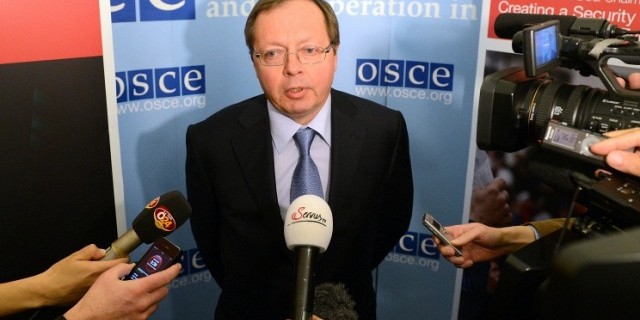
VIENNA – Moscow has raised the issue of Kiev using heavy armaments in its special operations against independence supporters in eastern Ukraine at OSCE session, Russia’s envoy Andrei Kelin said on Wednesday.
“The punitive operation led by Ukrainian forces reflects signs of an international human rights violation, in particular, of the Geneva convention of 1949,” Kelin said.
“We drew attention to the tragic outcome of an operation in the Donbas [in eastern Ukraine], a barbaric shelling of a building of the Luhansk local administration,” he added.
He referred to reports claiming the Ukrainian military had used exploding bullets, cluster bombs and artillery.
 “There are reports on the use of inhumane weapons – exploding bullets, cluster bombs – and the shelling of civilian targets in Ukraine. If they are confirmed, such acts have to be treated as war crimes. If it is proven that Right Sector killed the wounded in a Krasnyi Lyman hospital, there are no words to justify such an action,” Kelin said.
The envoy added that the latest report from the OSCE’s Special Monitoring Mission to Ukraine confirmed pro-Kiev forces had been using tanks, artillery and aircraft in its special operations.
“We asked a lot of questions, but Ukraine’s permanent representative [to the OSCE] gave no answers, aside from the usual attempts to shift responsibility to Russia,” Kelin added.
The town of Krasnyi Lyman, located to the southeast of Slaviansk in Donetsk Region, was heavily shelled by the Ukrainian army during Kiev’s military operation Tuesday. Ukrainian armed forces allegedly killed more than 25 wounded people in a local hospital, as the National Guard seized the town from the local defense forces following the shelling.
In mid-April, Ukraine’s interim government launched a special operation to crack down on the independence movements, but failed to gain control over the self-proclaimed independent republics in the eastern part of country. The operation has led to violent clashes and dozens of casualties in Slaviansk, Kramatorsk and Mariupol. Moscow has described the operation as a punitive act and urged Kiev to end the violence.
Putin calls for end to Kiev’s military operation, postponing referendum in E. Ukraine
RT | May 7, 2014
Ukrainian right-wing groups are behind the recent events in the country, Russian President Vladimir Putin said, adding that Kiev has not disarmed them. He also called on anti-Kiev protesters to postpone a May 11 federalization referendum.
“Russia believes that the crisis, which originated in Ukraine and is now actively developing in accordance with the worst-case scenario, is to be blamed on those who organized the coup in Kiev on 22-23 February and still do not care to disarm the right-wing and nationalist elements,” the president said.
Direct dialogue between Kiev and anti-government protesters in southeast Ukraine is key to ending the crisis, Putin said.
It is now essential “to create the necessary conditions for this dialogue,” he added.
This, however, would require rescheduling the referendum, which anti-government activists scheduled on May 11 to determine the fate of southeast Ukraine.
“We are calling for southeast Ukraine representatives, supporters of federalization of the country, to postpone the May 11 referendum to create the necessary conditions for dialogue,” Putin said at a press conference with Organisation for Security and Cooperation in Europe (OSCE) Chairperson-in-Office and Swiss President Didier Burkhalter in Moscow.
In response to Putin’s offer, one of the leaders of the self-proclaimed Donetsk People’s Republic, Denis Pushilin, said the possibility would be discussed Thursday.
“We respect Putin’s position. He is a balanced politician. So we will submit this proposal tomorrow to the people’s council,” he said.
‘Russia withdraws troops from Ukrainian border’
President Vladimir Putin also said that Russia has withdrawn its troops from the Ukrainian border.
“We have been told that our troops on the Ukrainian border are a concern – we have withdrawn them. They are now not on Ukrainian territory, but at locations where they conduct regular drills at ranges,” he said.
Earlier, German Chancellor Angela Merkel suggested holding “roundtable discussions,” a proposal that Moscow fully supports, Putin added.
Moscow and the OSCE agree substantially on the approach to resolving the situation in Ukraine, Putin said, adding that negotiations had made it clear.
“Moscow is interested in a swift resolution of the crisis in Ukraine, taking into consideration the interests of all people of the country,” he said.
OSCE drafting Ukraine road-map
In the coming hours, OSCE will offer a “roadmap” on Ukraine, Burkhalter said.
“Our offer now is the following: literally in the next few hours we would like to offer a road-map for the four signatories of the Geneva agreements,” Burkhalter said, adding that the roadmap lays out “concrete steps” to resolve the Ukrainian crisis.
There are four major points, he said: “These are the ceasefire, the de-escalation of tensions, the dialogue and elections.” Burkhalter added that the roadmap had been discussed earlier in Vienna.
It comes as a “more pragmatic” alternative to the so-called Geneva-2 peace talks on Ukraine, which Burkhalter said for now are not being planned to be held.
Burkhalter also believes that dialogue between Kiev and southeast Ukraine is a “realistic prospect.”
“As for the probability of a national dialogue in Ukraine, I think it’s quite a realistic prospect, because only Ukrainian people need to be involved in determining their own destiny,” he said.
On behalf of OSCE, Burkhalter said that the organization is ready to take responsibility for coordination the “roadmap” and negotiations with the US and the EU will be taking place soon.
OSCE military observer mission en route to Crimea
RT | March 5, 2014
The Organization for Security and Co-operation in Europe (OSCE) is sending a delegation which includes representatives from the US and 14 other nations to observe the situation in Crimea amid tensions in Ukraine, according to a US official.
Daniel Baer, the chief US delegate to the OSCE, told the Associated Press that each country is sending two individuals, bringing the total number of observers to 30. Baer added that the military observer mission is set to leave within 24 hours and hinted that other countries main still join.
The OSCE comprises of Russia, the US, all European countries, and some central Asian nations. It is based on consensus, meaning that the majority of the monitoring missions need full approval by all nations – including OSCE member Russia. According to Baer, Ukraine used the provision to ask other countries to send unarmed military monitors.
OSCE officials were already in Ukraine on Tuesday and making their way to Crimea, Baer said. The officials specialize in minority rights and freedom of the media.
The delegation has a week-long mandate that can be extended if Ukraine requests it. One of its main focuses is to concentrate on the potential of a military conflict between Russia and Ukraine.
Baer also added that the the military observer mission is a “broad-based monitoring effort” that will try to prevent a possible “military incursion” and encourage dialogue. The observers will keep an eye out for “areas where there has been tension or uncertainty has arisen over lack of clarity over military movements.”
RT news producer Lida Vasilevskaya reported on Tuesday evening that the OSCE delegation had arrived in Simferopol, Ukraine, but said they were not giving any comments to the media.
Tensions in Crimea became heated after the Ukrainian parliament voted to repeal a law which gave regional status to the Russian language. Authorities in Crimea requested Moscow’s assistance and Crimean authorities denounced the coup-imposed government in Kiev, declaring that all Ukrainian law enforcement and military deployed in the peninsula must take orders from them. The majority of troops in Crimea switched sides in favor of local authorities.
More than half of the Crimean population are ethnically Russian and use only the Russian language for their communication. The residents have announced they will hold a referendum on March 30 to determine the fate of the Ukrainian autonomous region.
Russian President Vladimir Putin clarified the country’s stance on Ukraine in an interview on Tuesday. He stated that Russia will not go to war with the people of Ukraine, but will use its troops to protect citizens if radicals with clout in Kiev try to use violence against Ukrainian civilians – particularly ethnic Russians.
Putin, who was given a mandate by the Russian Senate to send troops in order to protect the Russian-speaking population in Ukraine, said there is no need for such action yet.
Putin cited the actions of radical activists in Ukraine – including the chaining of a governor to a stage as public humiliation and the killing of a technician during an opposition siege of the Party of Regions headquarters – as justification for Russia to be concerned for the lives and well-being of people in eastern and southern Ukraine.
Incidents like those are why Russia reserves the option of troop deployment.
“If we see this lawlessness starting in eastern regions, if the people ask us for help – in addition to a plea from a legitimate president, which we already have – then we reserve the right to use all the means we possess to protect those citizens. And we consider it quite legitimate,” Putin said.
Russia’s representative to the UN, Vitaly Churkin, also said on Tuesday that the deal surrounding the Black Sea Fleet allows Russia to station a contingent of up to 25,000 troops in Ukraine.
According to the initial agreement, the Russian Black Sea Fleet was to stay in Crimea until 2017, but the deal was later prolonged for another 25 years.
Related article

Featured Video
The 1964 Coup in Brazil
or go to
Aletho News Archives – Video-Images
Frlom the Archives
70 Neocons Petition Congress To Effectively Allow Israel To Say When The US Should Attack Iran
By Damian Lataan | January 10, 2014
Seventy senior Israeli-centric neoconservatives have written an open letter to Congress imploring them to do more to ensure Iran complies with the conditions of any agreement finally reached with the P5+1 over Iran’s nuclear program.
While the neocons are ostensibly asking Congress to ensure compliance, it is clear that their real aim is to convince members of Congress to support the bill currently passing through the Senate which calls for tighter sanctions against Iran in the event of any waywardness on Iran’s part.
The neocons are eager to see the bill currently passing through the Senate with enough support to make it veto-proof, not so much because they are concerned about Iran’s so-called nuclear weapons program – there’s still not a skerrick of hard evidence that Iran has a nuclear weapons program – but, rather, because embedded within the bill is this clause:
… if the Government of Israel is compelled to take military action in legitimate self-defense against Iran’s nuclear weapon program, the United States Government should stand with Israel and provide, in accordance with the law of the United States and the constitutional responsibility of Congress to authorize the use of military force, diplomatic, military, and economic support to the Government of Israel in its defense of its territory, people, and existence…
Essentially, the clause is an automatic trigger for the US to attack Iran at any time the Israelis choose to launch a first strike – regardless of whether President Obama is in favour or not.
Partial list… continue
Blog Roll
 Aletho News
- Spare the hypocrisy: Baghaei slams Ursula’s support for US
- Iran War Supporters Invent a New and Absurd Justification: It Is All About China
- Corporate Media Go All Out To Support The US-Israeli War on Iran
- Trump press conference reveals a man who wants out of war
- When Tel Aviv decides, Washington fights
- Top official: Iran ready for a long war with US, no more diplomacy
- How Iran’s Toxic Rain Reveals US-Israel Discord
- Trump Admits He Is Destroying Iran For Israel
- Iran’s latest move in the GCC countries was a stroke of genius
- Blackmail and death threats, Zelensky embarrasses the EU, but there’s no condemnation
- If Americans Knew
- Lebanon: Israel’s White Phosphorous Use Risks Civilian Harm
- Corporate Media Go All Out To Support The US-Israeli War On Iran
- US-Israel war on Iran is creating a steady growing number of amputees
- Israel planned this war on Iran for 40 years. Everything else is a smoke screen
- The wrong question about the war in Iran
- ‘Your Tax Dollars Being Used to Raise Your Gas Prices’: US-Israel Bomb Major Iranian Oil Depots
- ‘Bogus Evidence’: Former Nuclear Watchdog Head Debunks US Justification for Iran War
- EXPLAINER – Dimona: What to know about Israel’s nuclear site
- Fires and toxic air in Iran (thanks, Israel) – Not a ceasefire Day 150
- At Israel’s hands, Iran is burning, Lebanon and Gaza are crumbling – Not a ceasefire Day 149
- No Tricks Zone
- Wake-up Call: Survey Shows Majority Of Germans Now Favor Postponing Climate Targets!
- Televised! Leading German Political Candidate Tells Schoolchildren CO2 Makes Sun Hotter!
- New Study: A Century Warming Of 1.1°C Is ‘Commonplace’ And ‘Not Unusual’ During This Interglacial
- New Study: ‘Internal Noise’ And Volcanic Forcing Can Trigger 10-15°C Warming Within Decades
- Glaciers Worldwide Are Suddendly Surging, Experts Blame Warming!
- Surprising Discovery: Sahara Is Greening…Billions Of Trees Where Once Thought To Be Barren
- New Research Reaffirms Clouds, Aerosols, And Surface Solar Radiation Are ‘Driving The Climate System’
- Germany: Electric Car Catches Fire At Charging Station, Sets Off Local “Inferno”, Widespread Damage
- New Study: Canada’s New Brunswick Was 1°C Warmer Than Today During The Medieval Warm Period
- Coal Power Back In Trend As Globe Tries To Keep Pace With Growing Demand For Power
 Aletho News