5 not-so-peaceful Obama actions since nabbing Nobel Prize

RT | December 10, 2014
Five years on from President Barack Obama scooping a Nobel Peace Prize, and the White House has taken anything but a Zen approach to foreign policy under his watch. Here are the top 5 not-so-peaceful moves the laureate has made in the past half-decade.
1. Afghan Surge
Obama didn’t start the war gin Afghanistan, but he certainly took a page from his predecessors playbook in trying to finish it. He recognized his precarious position at prize time.
“But perhaps the most profound issue surrounding my receipt of this prize is the fact that I am the commander-in-chief of a nation in the midst of two wars,” he said after accepting the Nobel Prize in Oslo, Norway, on December 9, 2009.
While he said the war in Iraq was “winding down,” things in Afghanistan were just starting to heat up. A week before accepting the prize, Obama announced he was sending 33,000 more troops to Afghanistan as part of his “surge policy,” intended to beat back the Taliban and train Afghan security forces to take the country into their own hands. The following years would become the deadliest for both US troops and Afghan civilians. Again, it wasn’t Obama’s war. But then came…
2. Military strikes in Libya
Following UN Resolution 1973 on March 17, 2011, which called for “an immediate ceasefire” in Libya and authorized the international community to set up a no-fly zone to protect civilians, Obama, along with his NATO allies, would soon launch military strikes to turn the tide of the 2011 Civil War in the North African state. NATO conducted 9,700 strike sorties and dropped over 7,700 precision bombs. A Human Rights Watch report would go on to detail eight incidents where at least 72 Libyan civilians died as a result of the aerial campaign.
But the real damage to overthrowing the Gaddafi regime came in the ensuing years, with the country descending into a civil war between Islamist forces and the weak post-revolutionary government. In August, Obama admitted his Libyan policy was a failure, but not because he chose to intervene militarily. Rather, he says the problem was that America and its European partners did not “come in full force” to take Gaddafi out. Although his then-Secretary of State Hillary Clinton seemed to rejoice in his death, wryly noting “We came, we saw, he died.”
3. Drone Wars in Yemen, Pakistan
Since the US first started targeting Yemeni militants in 2002, Obama has launched all but one of the 15 airstrikes and 101 drone strikes in the country. According to the web portal New America.net, which has meticulously complied data on the strikes, up to 1,073 people have been killed in the strikes. An estimated 81-87 of those killed were civilians, while the identity of another 31-50 remains unknown. But Yemen was just one prong in Obama’s so-called Drone War, though, as we shall see, it was the site of a game-changing incident.
Unlike in Yemen, drone strikes in Pakistan were in favor long before Obama came to power. A report conducted by Stanford and New York Universities’ Law schools found that between 2,562 and 3,325 people were killed by drone strikes in Pakistan between June 2004 and mid-September 2012. Anywhere between 474 and 881 of those were civilians, and 176 were children. While Obama didn’t start the Pakistani drone war, he aggressively expanded it.
Between 2004 and 2007, only 10 drone strikes were launched in Pakistan. The following year saw 36 such strikes, and 54 were launched in 2009.
But 2010 would be the deadliest year by far, with 122 strikes launched and 849 people killed. He would go on to authorize 73 and 46 strikes in 2011 and 2012 respectively.
Following widespread opposition at home and abroad, in May 2013, Obama promised a new era of transparency to protect civilians, saying control of the program would be transferred from the CIA to the Pentagon. But…
4. Obama has a secret kill list
In February 2013, the Obama administration’s internal legal justification for assassinating US citizens abroad came to light for the first time. According to the Justice Department document, the White House has the legal authority to kill Americans who are “senior operational leaders,” of Al-Qaeda or “an associated force” even if they are not actively engaged in any active plot to attack the US.
In September 2011, a US drone strike in Yemen killed two American citizens: Anwar al-Awlaki and Samir Khan. The following month, a drone strike killed al-Awlaki’s 16-year-old son, who was born in Colorado.
The concept of the US president exercising the right to kill US citizens without the benefit of a trial has resonated throughout American culture.
In the comic-book-inspired film ‘Captain America: The Winter Soldier’, the issue of targeted killings and “kill lists” features prominently in the plot.
5. Redrawing red lines
President Barack Obama drew a red line around Syria’s use of chemical weapons, pushing the international community to punish Damascus with military strikes following the August 21 Ghouta Attack.
After the UK balked at airstrikes, Moscow and Washington took the diplomatic route, resulting in a historic deal that has seen Damascus abandon its chemical weapons stockpiles.
But US-led airstrikes on Syria were only postponed. On August 8, 2014, the United States started bombing so-called Islamic State (IS) militants in Iraq to protect embattled Kurds. The following month, the US would launch airstrikes against IS militants in Syria as well. Of all the US military interventions in recent years, the battle against the IS has been met with widespread approval. Still, Syria was the seventh country Obama has bombed in six years.
Quite a feat for a Nobel Peace Prize-winner.
Civilians killed in US drone attacks: Rights group
Press TV – November 28, 2014
A rights group says many civilians have been targeted and killed in US drone attacks in Pakistan and other countries where such raids are carried out, Press TV reports.
The UK-based rights group Reprieve revealed that civilians have been killed in Pakistan and other places before militants were targeted by US assassination drones.
Reprieve has presented several cases on how ruthlessly the US Central Intelligence Agency (CIA) has killed civilians but declared them militants through dubious reports in the media, which regularly cite anonymous Pakistani and US officials.
In one such case, the CIA killed 221 people, including over 100 children, in Pakistan in search of just four militants. This is while three of the militants are reportedly still alive and the fourth one has died of natural causes.
In another example, the report pointed out that on average each militant was targeted and reported killed more than three times before they were actually killed.
To kill one militant, sometimes “more than 300 people have been killed,” said Mirza Shazad Akbar, Reprieve’s representative in Pakistan.
“A former US drone operator said that by looking at the monitor and looking at people’s movement, he could actually tell who is a bad person and who is a good person… This is the extent of… the [US] flawed intelligence,” Akbar added.
But this is just the tip of the iceberg of the scale of tragedy in Pakistan’s tribal areas, where more than 3,800 people have been killed with the same pattern of the so-called precise surgical drone strikes.
The US carries out targeted killings through drone strikes in several Muslim countries, such as Afghanistan, Yemen, Pakistan and Somalia. Washington claims the targets of the drone attacks are militants, but local officials and witnesses maintain that civilians have been the main victims of such raids over the past few years.
The United Nations and several human rights organizations have identified the US as the world’s number-one user of “targeted killings,” largely due to its drone attacks in Pakistan and Afghanistan.
High Court will hear case of UK torture and rendition victim
Reprieve | November 19, 2014
A High Court judge has said that a victim of UK rendition and torture can proceed with his claims against the British Government.
In a judgment handed down today, Mr Justice Leggatt found that the court would be “failing in its duty” if it did not deal with the claims of Yunus Rahmatullah, from Pakistan. Mr Rahmatullah was seized by UK forces in Iraq in 2004 and tortured before being handed over to the US and rendered to Bagram prison in Afghanistan, via the notorious Abu Ghraib prison in Iraq. He suffered a further decade of secret US detention before he was finally released in June this year.
The UK long denied any involvement in rendition, before being forced to correct the record in Parliament in 2008, when then-Defence Secretary John Hutton publically admitted that the rendition of Mr Rahmatullah and another man, Amanatullah Ali, had taken place.
The judgment by Mr Justice Leggatt, published this morning, confirms he was unconvinced by the Government’s ‘Foreign Act of State’ argument – the theory that a British court cannot hear cases where the UK has cooperated with another state, in this case the US, in wrongdoing. Mr Leggatt wrote: “If it is necessary to adjudicate on whether acts of US personnel were lawful… in order to decide whether the defendants violated the claimant’s legal rights, then the court can and must do so.”
Today’s judgment follows a recent Court of Appeal ruling that a separate renditions case – Abdul-Hakim Belhaj and anor v Jack Straw and ors – should be heard, despite similar claims by the British Government that doing so would damage US-UK relations.
Kat Craig, legal director at charity Reprieve, which is assisting Mr Rahmatullah, said: “Yunus Rahmatullah suffered some of the most shocking abuses of the ‘war on terror’ – now we know the Government’s attempt to avoid accountability for his ordeal is without merit. The fact is that victims of British rendition and torture, like Yunus, deserve their day in court – the Government must accept this, and be prepared to answer for its past actions.”
Sapna Malik, Partner at Leigh Day said: “The High Court has rightly stated that it would be failing in its duty if it refused to adjudicate upon the allegations made in these claims just because it may be required to make findings about the conduct of US personnel. It is now high time for the British government to abandon its attempts to evade judicial scrutiny of its conduct in operations involving the US in Iraq and Afghanistan, so that justice may finally be served for what has passed and lessons learned for the future.”
Sanctifying Malala: The Nobel Prize and Moral Alibis
By Binoy Kampmark | Dissident Voice | October 11, 2014
Drones Kill So Malala Can Live.
Sign at a vigil, Pakistan, noted in The Nation, October 10, 2014
There were two recipients of the Nobel Peace Prize this year – the rather less known Kailish Satyarthi and near celebrity cherished Malala Yousafzai. In awarding the prize, the Norwegian Nobel Committee deftly ignored the perceived frontrunner, Pope Francis. Il Papa will have to wait his turn.
Those getting it will always be marred by the contradictions any peace prize suggests. The greatest of all remains the fact that the dynamite guru – Alfred Nobel himself – did as much for the cause of war as he decided his profits would supposedly do for peace. Peace was a sentimental afterthought. Many winners of the prize have since kept this legacy alive: that of war maker turned peace maker; a fair share of hypocrisy, with a good share of feigned sincerity.
Satyarthi doesn’t seem to suffer those problems. He made his name targeting the persistent use of child-labour in India. In the business of freeing slaves, it is hard not to admire efforts that saw the freeing of over 80,000 children from a state of servitude.
In contrast, the photogenic seventeen-year old Pakistani, Malala Yousafzai, is both the prop of an agenda, and the cause of a program. In 2012, she received life threatening wounds to the head from the Taliban for her stance on girls’ education in the SWAT valley. In suffering those injuries, she gave a problem a face and voice. She is also the perfect poster girl for Western middle-class anxieties, one which Zeynep Tufekci has described as “finding a young woman we admire that we all want to take home as if to put on a shelf to adore.”
What of, argues historian Sarah Waheed, the Malalas you do not see? They are very much the victims of a dysfunctional relationship between Pakistan and the United States, one that is all too brutally characterised by the continued use of drone strikes and bundles of US aid. “Unlike Malala Yousafzai… Madonna did not dedicate a song to them, nor has Angelina Jolie spoken out on their behalf.” They are the faceless ones, the sort that celebrities so conspicuously resist. Malala, on the other end, is ideological candy for the morally outraged in Hollywood and beyond. She did, after all, survive.
The congratulatory tone is invariably gushing, and the Malala cheer squad is both heavily staffed and noisy with inspirational snippets. Dominique Mosbergen, writing in The Huffington Post, gives eight reasons why Malala “is an inspiration to us all.” What are some of them? Bravery, for one. Another: tremendous compassion. Importantly, Malala has to be seen as a universal figure, rather than one with particular aptitude in dealing with problems of education in her own country. “Malala advocates for young women everywhere.”
Malala may well strike fear into the gun men of the Taliban. She may well terrify, in her own specific way, the theocrats who stand guard over jaundiced traditions and archaic law. “Armed men run scared of an unarmed girl.” But something else is at work in what seems to be a form of witting, and unwitting deification. It ignores, for instance, that she is being perceived in some quarters of her country as a symbol of Western sponsored interference. (This takes the form, most blatantly, in the charge that she is a product of the CIA doll factory.)
Malala, in what is becoming something of a sanctification project, risks falling into the role of a moral cipher for a range of other causes in a global battle that is both political and cultural. She is a moral reminder, but also an alibi for actions taken under the cover of improvement. She has become a politicised Shirley Temple, a child politician of the developing world. Her life under Taliban rule – which she no longer experiences by virtue of her move to Britain – is becoming the cudgel to use, be it in her statements against the Taliban, or her general pronouncements on the BBC reflecting on those harrowing experiences under their rule.
This is the tragedy of politics and morality – at a certain point, manipulation is unavoidable, be it through its own self-justifying propaganda, or basic sloganeering. The public relations watchers have quickly noted the “important binary” of selecting “a Pakistani Muslim” and “an Indian Hindu”. “Their joint selection,” argues Elias Groll in Foreign Policy, “is an obvious nod towards the ongoing efforts to bring a peaceful end to Pakistan and India’s long-standing conflict with one another”.
Weapons get sharpened in the name of what perceived justice is – even some of Pakistan’s liberal elite have allied their interests with US drone strikes aimed for a higher good. The funding institutes get busy. The think tank circuits issue invitations. A drooling press corps, and a hyperventilating blogosphere, finds in Malala another child crusader. Her quotes are tweeted like a bestselling manual of self-help instructions – “12 powerful and inspiring quotes”. Editor of the Pakistan Observer, Tariq Khattak, sees the crudest form of branding at work. In his words to the BBC Newshour, Malala’s “father is a good salesman, that’s it. And the daughter has also become a salesgirl. And they are dancing on the tunes of the West.”
There is the other side of the peace and education crusade. It is the political mettle that is coming to the fore, a cool yet discerning sense that she is becoming a figure in the folds of a contradictory history. Malala, over time, has matured into a moving advertiser of causes, even telling CNN’s Christiane Amanpour that she intends leading Pakistan. “Through politics, I believe I can serve my whole country.”
That maturity, however, is in an ever problematic dance with Malala the emblem – one that European and American voices can use in their cultural causes against other states even as villages get struck by the lethal work of drones. Sainthood and martyrdom tend to be poor tools for measuring actual change.
Hillary Clinton and the Weaponization of the State Department
By JP Sottile | News Vandal | June 5, 2014
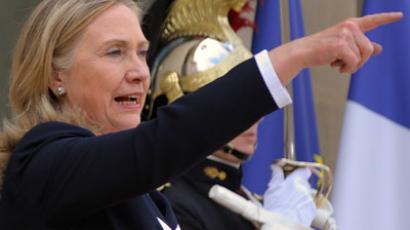
On May 23, 2012, then-Secretary of State Hillary Clinton went to the Special Operations Forces Industry Conference (SOFIC) trade show in Tampa, Florida to share her vision of “smart power” and to explain the State Department’s crucial role in extending the reach and efficacy of America’s growing “international counterterrorism network.”
First, there is such a thing as a “Special Operations Forces Industry Conference trade show.” Without some keen reporting by David Axe of Wired, that peculiar get-together might’ve flown completely under the radar—much like the shadowy “industry” it both supports and feeds off of like a sleek, camouflaged lamprey attached to a taxpayer-fattened shark.
Second, “special operations” have officially metastasized into a full-fledged industry. United States Special Operations Command (USSOCOM) is located at MacDill Air Force Base in Tampa and, therefore, conveniently located near the special operations trade show, which happened again this year at the Tampa Convention Center. The theme was “Strengthening the Global SOF Network” and the 600,000-square-foot facility was filled with targets of opportunity for well-connected and well-heeled defense contractors.
According to the SOFIC website, this year’s conference afforded attendees “the opportunity to engage with USSOCOM Program Executive Officers, Science and Technology Managers, Office of Small Business Programs and Technology & Industry Liaison Office representatives, and other acquisition experts who will identify top priorities, business opportunities, and interests as they relate to USSOCOM acquisition programs.”
Third, Hillary’s widely-ignored speech marked a radical departure from the widely-held perception that the State Department’s diplomatic mission endures as an institutional alternative to the Pentagon’s military planning. Instead, Secretary Clinton celebrated the transformation of Foggy Bottom into a full partner with the Pentagon’s ever-widening efforts around the globe, touting both the role of diplomats in paving the way for shadowy special ops in so-called “hot spots” and the State Department’s “hand-in-glove” coordination with Special Forces in places like Pakistan and Yemen.
Finally, with little fanfare or coverage, America’s lead diplomat stood before the shadow war industry and itemized the integration of the State Department’s planning and personnel with the Pentagon’s global counter-terrorism campaign which, she told the special operations industry, happen “in one form or another in more than 100 countries around the world.”
If this isn’t entirely unexpected, consider the fact that under then-Secretaries of State Colin Powell and Condoleezza Rice, the State Department fought attempts by the Pentagon to trump its authority around the globe and, as reported by the Washington Post, “repeatedly blocked Pentagon efforts to send Special Operations forces into countries surreptitiously and without ambassadors’ formal approval.”
But that was before Hillary brought her “fast and flexible” doctrine of “smart power” to Foggy Bottom and, according to her remarks, before she applied lessons learned from her time on the Senate Armed Services Committee to launch the first-ever Quadrennial Diplomacy and Development Review, which she modeled on the Pentagon’s Quadrennial Defense Review. That Pentagon-style review spurred the creation of the Bureau of Conflict and Stabilization Operations to “advance the U.S. government’s foreign policy goals in conflict areas.”
According to a Congressional Research Service analysis, the initial intent of the Conflict Bureau was to replace the ineffectual Office of the Coordinator of Reconstruction and Stabilization, which was created in 2004 to help manage “stabilization” efforts in two nations the U.S. was actively destabilizing—Afghanistan and Iraq.
But the new, improved bureau does more than just react to messes made by unlawful invasions or direct costly remediation efforts in war zones—it also collaborates with “relevant partners” in the Department of Defense and NATO “to harmonize civilian and military plans and operations pertaining to conflict prevention, crisis response, and stabilization.”
This integrated relationship between State and Defense was confirmed by U.S. Special Operations chief Admiral William McRaven shortly after Hillary’s speech. When asked about the “unlikely partnership,” McRaven assured DefenseNews that SOCOM has “an absolutely magnificent relationship with the State Department” and that SOCOM doesn’t “do anything that isn’t absolutely fully coordinated and approved by the U.S. ambassador and the geographic combatant commander.”
As David Axe aptly described it in Wired, “Together, Special Operations Forces and State’s new Conflict Bureau are the twin arms of an expanding institution for waging small, low-intensity shadow wars all over the world.”
In fact, during Hillary’s time as America’s chief diplomat, the State Department embraced the shadowy edge of U.S. foreign policy where decision-makers engage in activities that look like war, sound like war and, if you were to ask civilians in places like Yemen and Pakistan, feel a lot like war, but never quite have to meet the Constitutional requirement of being officially declared as war.
The Whole-of-Government Shift
Once upon a time, “low-intensity shadow wars” were the Congressionally-regulated bailiwick of the Central Intelligence Agency. But 9/11 changed everything. However, the excesses of the Bush Administration led many to hope that Obama could and would change everything back or, at least, relax America’s tense embrace of “the dark side.”
Although the new administration did officially re-brand “The War on Terror” as “Overseas Contingency Operations,” Team Obama employed an increasingly elastic interpretation of the 9/11-inspired Authorization for Use of Military Force and expanded covert ops, special ops, drone strikes and regime change to peoples and places well-beyond the law’s original intent, and certainly beyond the limited scope of CIA covert action.
Obama’s growing counter-terrorism campaign—involving, as Secretary Clinton said, “more than 100 countries”—took flight with a new, ecumenical approach called the “Whole-of-Government” strategy. Advanced by then-Secretary of Defense Bill Gates and quickly adopted by the new administration in early 2009, this strategy catalyzed an institutional shift toward inter-agency cooperation, particularly in the case of “state-building” (a.k.a. “nation building”).
During remarks to the Brookings Institution in 2010, Secretary Clinton explained the shift: “One of our goals coming into the administration was… to begin to make the case that defense, diplomacy and development were not separate entities, either in substance or process, but that indeed they had to be viewed as part of an integrated whole and that the whole of government then had to be enlisted in their pursuit.”
Essentially, the Whole-of-Government approach is a re-branded and expanded version of Pentagon’s doctrine of “Full-Spectrum Dominance.” Coincidentally, that strategy was featured in the Clinton Administration’s final Annual Report to the President and Congress in 2001. It defined “Full-Spectrum Dominance” as “an ability to conduct prompt, sustained, and synchronized operations with forces tailored to specific situations and possessing freedom to operate in all domains—space, sea, land, air, and information.”
In 2001, Full-Spectrum Dominance referred specifically to 20th Century notions of battlefield-style conflicts. But the “dark side” of the War on Terror stretched the idea of the battlefield well-beyond symmetrical military engagements. “Irregular warfare” became the catchphrase du jour, particularly as grinding campaigns in Afghanistan and Iraq exposed the reality that the full spectrum still wasn’t enough.
An assessment by the Congressional Research Service identified the primary impetus for the Whole-of-Government “reforms” embraced by Team Obama as the “perceived deficiencies of previous inter-agency missions” during the military campaigns in Afghanistan and Iraq. Those missions failed to address a myriad of problems created—culturally, economically and politically—by the wholesale bombing and occupation of those countries. The Full-Spectrum was half-baked. Lesson learned.
But the lesson wasn’t that the U.S. should avoid intervention, regime change or unleashing nascent civil, ethnic or religious conflicts. Instead, the lesson was that the “Whole-of-Government” must be marshaled to fight a worldwide array of Overseas Contingency Operations in “more than 100 countries.”
This Whole-of-Government shift signaled a renewed willingness to engage on variety of new fronts—particularly in Africa—but in a “fast and flexible” way. With other agencies—like the State Department—integrated and, in effect, fronting the counter-terrorism campaign, the military footprint becomes smaller and, therefore, easier to manage locally, domestically and internationally.
In some ways, the Whole-of-Government national security strategy is plausible deniability writ-large through the cover of interagency integration. By merging harder-to-justify military and covert actions into a larger, civilian-themed command structure, the impact of the national security policy overseas is hidden—or at least obfuscated—by the diplomatic “stabilization” efforts run through the State Department—whether it’s the Conflict Bureau working against Joseph Kony’s Lord’s Resistance Army in Central Africa, “stabilizing” post-Gaddafi Libya or spending $27 million to organize the opposition to Bashar al-Assad’s Syrian regime.
The Pass Key
The cover of diplomacy has traditionally been an effective way to slip covert operators into countries and the State Department’s vast network of embassies and consulates still offers an unparalleled “pass-key” into sovereign nations, emerging hot spots and potential targets for regime change. In 2001, the Annual Report to the President and Congress foresaw the need for more access: “Given the global nature of our interests and obligations, the United States must maintain the ability to rapidly project power worldwide in order to achieve full-spectrum dominance.”
Having the way “pre-paved” is, based on Hillary’s doctrinal shift at State, a key part of the new, fuller-spectrum, Whole-of-Government, mission-integrated version of diplomacy. At the SOFIC’s Special Operations Gala Dinner in 2012, Hillary celebrated the integration of diplomatic personnel and Special Operations military units at the State Department’s recently created Center for Strategic Counterterrorism Communications—a “nerve center in Washington” that coordinates “military and civilian teams around the world” and serves “as a force multiplier for our embassies’ communications efforts.”
As with most doors in Washington, that relationship swings both ways and mission-integrated embassies have served as an effective force multiplier for the Pentagon’s full spectrum of activities, particularly around Africa.
In his 2011 testimony before the House Foreign Affairs Committee Subcommittee on Africa, Deputy Assistant Secretary of State for African Affairs Don Yamamoto noted that State had “significantly expanded the number of DoD personnel who are integrated into embassies across the continent over the past three years,” and read a surprisingly long laundry list of collaborative efforts between State and the United States Africa Command (AFRICOM), including: “reduction of excess and poorly secured man-portable air defense systems (MANPADS); Defense Sector Reform in Liberia, DRC, and South Sudan; counterpiracy activities off the Somali coast; maritime safety and security capacity building; and civil-military cooperation.”
It seems that “civil-military cooperation” is a primary focus of the State Department in Africa. Most notably, Yamamoto told Congress that “embassies implement Department of State-funded Foreign Military Financing (FMF) and International Military Education and Training (IMET) programs, which further U.S. interests in Africa by helping to professionalize African militaries, while also assisting our African partners to be more equipped and trained to work toward common security goals.”
As the ever-vigilant Nick Turse recently reported, U.S. presence on the continent has only grown since that testimony was given in 2011. On TomDispatch.com, Turse identified the infamous attack on Benghazi on September 11, 2012 as the catalyst for “Operation New Normal”—the continent-wide response to, quite ironically, the political potboiler still simmering around Secretary Clinton. Whether or not Congressional Republicans find anything more than incompetence at the root of Benghazi, the U.S. military certainly finds itself in a “new normal” of increased activity in response to the forces—and the weaponry—unleashed by U.S.-led regime change in Libya. According to Turse, the U.S. is “now conducting operations alongside almost every African military in almost every African country and averaging more than a mission a day.”
Those missions are, of course, integrated with and augmented by the State Department’s Conflict Bureau which has used a variety of state-building programs and its diplomatic “pass key” in places like Libya, Nigeria, Kenya, South Sudan, Somalia, Democratic Republic of the Congo and six other African nations, all to develop a growing roster of “host country partners.”
Establishing “host country partners” is the nexus where the State Department, its Conflict Bureau and the AFRICOM meet—implementing the Whole-of-Government strategy in emerging or current conflict zones to fuse a mounting counter-terrorism campaign with stabilization, modernization and state-building initiatives, particularly in oil and resource-rich areas like the Niger River Delta, Central Africa and around AFRICOM’s military foothold on the Horn of Africa.
As Richard J. Wilhelm, a Senior Vice President with defense and intelligence contracting giant Booz Allen Hamilton, pointed out in a video talk about “mission integration,” AFRICOM’s coordination with the Departments of State and Commerce, USAID is the “most striking example of the Whole-of-Government approach.”
And this is exactly the type of “hand-in-glove” relationship Secretary Clinton fostered throughout her tenure at State, leveraging the resources of the department in a growing list of conflict areas where insurgents, terrorists, al-Qaeda affiliates, suspected militants or uncooperative regimes threaten to run afoul of so-called “U.S. interests”.
Ultimately, it became a hand-in-pocket relationship when Clinton and Defense Secretary Gates developed the Global Security Contingency Fund (GSCF) to “incentivize joint planning and to pool the resources of the Departments of State and Defense, along with the expertise of other departments, to provide security sector assistance for partner countries so they can address emergent challenges and opportunities important to U.S. national security.”
Although he’s been criticized as feckless and deemed less hawkish than Secretary Clinton, President Obama’s newly-proposed Counterterrorism Partnership Fund (CTPF) is the logical extension of the Clinton-Gates Global Security Contingency Fund and epitomizes the Whole-of-Government shift.
The $5 billion Obama wants will dwarf the $250 million pooled into the GSCF and will, the President said at West Point, “give us flexibility to fulfill different missions including training security forces in Yemen who have gone on the offensive against al Qaeda; supporting a multinational force to keep the peace in Somalia; working with European allies to train a functioning security force and border patrol in Libya; and facilitating French operations in Mali.”
That “flexibility” is exactly what Hillary Clinton instituted at State and touted at the SOFIC conference in 2012. It also portends a long-term shift to less invasive forms of regime change like those in Yemen, Libya, Syria and Ukraine, and an increased mission flexibility that will make the Authorization for the Use of Military Force functionally irrelevant.
Normalizing the War on Terror
The ultimate outcome of this shift is, to borrow from Nick Turse, yet another “new normal”—the new normalization of the War on Terror. What the adoption of the Whole-of-Government/mission integration approach has done is to normalize the implementation of the re-branded War on Terror (a.k.a. Overseas Contingency Operations) across key agencies of the government and masked it, for lack of the better term, under the rubric of stabilization, development and democracy building.
It is, in effect, the return of a key Cold War policy of “regime support” for clients and “regime change” for non-client states, particularly in strategically-located areas and resource-rich regions. Regimes—whether or not they actually “reflect American values”—can count on U.S. financial, military and mission-integrated diplomatic support so long as they can claim to be endangered… not by communists, but by terrorists.
And because terrorism is a tactic—not a political system or a regime—the shadowy, State Department-assisted Special Ops industry that fights them will, unlike the sullen enthusiasts of the Cold War, never be bereft of an enemy.
Bring Back Our Girls!

By Gary Corseri | Dissident Voice | May 25, 2014
From the droned villages of Pakistan and Afghanistan–
Bring back our girls!
From Nigeria, and the brothels of the Philippines–
Bring back our girls!
From the ruined cities of Detroit and Newark
And the ravished American Dream–
Bring back our girls!
From “Disaster Capitalism” and twerking jerks–
Bring back our girls!
From the “Occupied Territories” of Palestine
And from Israeli Porn Kings–
Bring back our girls!
From the “royal” slave-holders of Arabia,
And the crapulous monarchs of Britain–
Bring back our girls!
From our culture of destitution and prostitution–
Bring back our girls!
From “entrepreneurs” and exploiters
Of sex and violence and from those who confound and abuse–
Bring back our girls!
Restore them to their birthright dignity:
Co-creators; mothers; sisters; daughters; friends.
Bring back our girls
From the wars that have butchered them
(Restore them!);
From the silence that has answered their prayers
(Answer now…);
From the callous hypocrisy
Of scoffed-at dreams and snuffed-out hopes–
Bring back our girls!
Former Pakistani general says US seeks to ruin his country
Press TV – February 23, 2014
Retired Pakistani General Hamid Gul says the United States and its allies are seeking to destroy Pakistan by fueling insecurity in the country.
The former head of Pakistan’s Intelligence Service (ISI) alleged that Washington used the 9/11 attacks on the World Trade Center in New York City as a pretext to invade the neighboring Afghanistan.
The former Pakistani intelligence chief, who was often accused of collaborating with the Taliban militant group in Pakistan and Afghanistan, also stated that the United States has failed in Afghanistan and is now seeking to destroy Pakistan.
General Gul also pointed out that the US military will have to withdraw its troops from Afghanistan and follow the example of the former Soviet Union in accepting defeat after its military occupation of the country in the late 1970s.
The administration of Pakistani Prime Minister Nawaz Sharif has initiated a negotiating process with the pro-Taliban militants in an effort to end the violence in the country.
There are speculations that the negotiations may not succeed as the militants have set tough conditions for the talks.
Pakistan has been gripped by deadly violence since 2001, after Islamabad joined the so-called US war on terror. According to official Pakistani sources, nearly 50,000 people have lost their lives in fatal attacks across the country ever since.

CIA seeks new bases for deadly drones
Press TV – February 17, 2014
The US Central Intelligence Agency is seeking new drone bases in unnamed countries in Central Asia, fearing the full withdrawal of US troops from Afghanistan would affect the targeted killings in neighboring Pakistan.
The spy agency asserts that if the US fails to sign a bilateral security deal with Afghanistan and secure an enduring military presence there, it would not be able to fly drones from its Afghan bases because drone operations are covert and need US military protection.
The security deal, which Washington says “ought to be signed” and is not renegotiable, could allow thousands of US troops to stay in Afghanistan beyond 2014.
However, despite pressures from the White House and Congress, Afghan President Hamid Karzai has so far refused to sign the deal and the US intelligence community is hoping that the next Afghan president will agree to sign it.
Worried that its drone killings can become a casualty of strained relations between Kabul and Washington, the CIA is reportedly making contingency plans to use bases in other countries.
“There are contingency plans for alternatives in the north,” an unnamed US official briefed on the matter told the Los Angeles Times without specifying the countries.
According to Brian Glyn Williams, a University of Massachusetts professor, the CIA and the Pentagon used to fly drones from an airbase in Uzbekistan until the US was evicted in 2005.
Michael Nagata, commander of US special operations in the Middle East and Central Asia, also traveled last month to Tajikistan, which is Afghanistan’s northern neighbor, to discuss “issues of bilateral security cooperation” and “continued military cooperation.”
Meanwhile, US officials say a new jet-powered drone, called Avenger, which will be able to “get to ‘hot’ targets in Pakistan much faster,” could soon be flying from bases outside Afghanistan.
The CIA is in charge of drone strikes in Pakistan since the country is not officially a war zone and the CIA’s program is covert.
US President Barack Obama has already stated that the responsibility for Washington’s deadly drone attacks could gradually shift from the CIA to the Pentagon. However, the idea of putting the US military in charge of drone attacks is not favored by US lawmakers.
Featured Video
US IRAN TALKS: Who Are the Crazy Ones Here? /Lt Col Daniel Davis
or go to
Aletho News Archives – Video-Images
From the Archives
Woolsey Fire started at Santa Susana Field Lab — where “radioactive materials released were never accurately measured”
By John Laforge | CounterPunch | November 30, 2018
In my Nov. 16 column, I reported on potential radiation risks posed by California’s Woolsey wildfire having burned over parts or all of the Santa Susana Field Laboratory—south of Simi Valley, Calif., 30 miles outside Los Angeles—site of at least four partial or total nuclear reactor meltdowns.
The field laboratory operated 10 experimental reactors and conducted rocket engine tests. In his 2014 book Atomic Accidents, researcher James Mahaffey writes, “The cores in four experimental reactors on site … melted.” Reactor core melts always result in the release of large amounts of radioactive gases and particles. Clean up of the deeply contaminated site has not been conducted in spite of a 2010 agreement.
Los Angeles’s KABC-7 TV reported Nov. 13 that the Santa Susana lab site “appears to be the origin of the Woolsey Fire” which has torched over 96,000 acres. Southern Calif. Public Radio said, “According to Cal Fire, the Woolsey Fire started on the afternoon of Thursday, Nov. 8 … on the Santa Susana site.” … continue
Blog Roll
 Aletho News
- US IRAN TALKS: Who Are the Crazy Ones Here? /Lt Col Daniel Davis
- Talks with the US end without a deal over excessive US demands: Iran
- Feeling Better, Getting Worse: How Psychiatric Drugs Create the Illusion They Cure
- ‘Nobody Told Me’: Former Mental Health Patient Calls Out Dangerous Side Effects of Psychiatric Drugs
- Dr. Abu-Sitta: Beirut ‘felt like a day in Shifa Hospital’
- Iran Has Won the War, It Will Be Up to the US to Secure the Peace: Mohammad Marandi
- Iran condemns assassination threats against Iranian negotiators amid US talks
- Brussels cannot say where its own pipeline inspectors are as Hungary’s oil lifeline remains shut
- Israel’s Iran War: Myth and Reality
- Between war and industrial breakdown: The US-Israeli attrition crisis
- If Americans Knew
- Pro-Israel ‘Thinktanks’ and Individuals who Influence U.S. Foreign Policy
- Mearsheimer reveals how Israel dictates US policies on Iran, Gaza – video
- After killing 350+, Israel still has a “score to settle” with Lebanon before ceasefire – Daily Update
- Military aid to Israel emerges as the latest political litmus test for Democrats
- The only Palestinian children’s rights organization closes following years-long Israeli campaign against it
- ‘I Can’t Forget the Smell’: Lebanese Reel After Israel Kills Over 300 in Single Day
- DNC Shoots Down Resolutions Calling Out AIPAC and Limiting Arms to Israel
- TCN: Is Israel Blackmailing President Trump?
- Israel killed at least 303 Lebanese yesterday – who were they? Daily Update
- Amnesty: Urgent – Protect Lebanese civilians from brutal escalation in Israeli attacks
- No Tricks Zone
- German Expert: Heat Dome Led To Record Temps In Western USA…Warmer In 1934, 1936
- New Study: No Linear Warming Or Glacier Retreat Along Northern Antarctic Peninsula Since 1980s
- An Inconvenient Tree: Uncovered In Alps… Europe Much Warmer Than Today 6000 Years Ago
- New Study Reports A 60% Slowdown In Greenland’s Ice Loss Rate In The Last Decade
- Low Intensity Tornado Wrecks Major Solar Farm, Creating A Potential Toxic Dump
- New Study Finds Warming Saves Lives…Cold Temperatures 12 Times More Deadly Than Excess Heat
- German Science Blog Accuses PIK Climate Institute Of Hallucinating Climate Tipping Points
- Devastating Assessment Of Comirnaty Vaccine By Former Senior Pfizer Europe Toxicologist
- New Study: CO2 Is ‘Effectively Negligible’ As An Explanatory Climate Change Factor Since 2000
- Former Pfizer Toxicologist Dr. Helmut Sterz Tells Bundestag Hearing Pfizer Vaccine Should Have Never Been Approved
 Aletho News