Pakistan has allowed four trucks containing office supplies for the US Embassy in Kabul to cross into Afghanistan, which is the first time the supply routes have been opened since Islamabad closed them six months ago.
Pakistani officials, speaking condition of anonymity, said that the four trucks recently crossed Pakistan’s Torkham border into Afghanistan, AFP reported on Friday.
“I can confirm that three trucks have gone to Afghanistan and there are also reports about the crossing of the fourth one on Friday,” said one of the officials.
Islamabad closed the border crossings used to transfer NATO supplies to landlocked Afghanistan in November 2011, after 24 Pakistani soldiers were killed in US-led airstrikes on two checkpoints on the Afghan border.
Pakistan has called on the United States to apologize for the November attack, but Washington has refused to do so.
Meanwhile, Pakistani President Asif Ali Zardari has left the country and is traveling to the US at the invitation of NATO Secretary General Anders Fogh Rasmussen to attend the May 20-21 NATO summit in Chicago, during which he will discuss future ties with NATO countries.
May 18, 2012
Posted by aletho |
Corruption, War Crimes | Afghanistan, Asif Ali Zardari, NATO, Pakistan, United States |
Leave a comment
A Global Crime Spree
Wondering why anyone would confront NATO’s summit in Chicago this month? A look at some of its more well-known crimes might spark some indignation.
Desecration of corpses, indiscriminate attacks, bombing of allied troops, torture of prisoners and unaccountable drone war are a few of NATO’s outrages in Afghanistan, Pakistan, Libya, Yemen and elsewhere. On March 20, 2012 Pakistani lawmakers demanded an end to all NATO/CIA drone strikes against their territory. As reported in The New York Times, Pakistan’s foreign secretary Jalil Jilani said April 26, 2012, “We consider drones illegal, counter-productive and accordingly, unacceptable.” On May 31 last year, Afghan President Hamid Karzai gave what he called his “last” warning against NATO’s bombing of Afghani homes, saying “If they continue their attacks on our houses … history shows what Afghans do with trespassers and with occupiers.”
While bombing Libya last March, NATO refused to aid a group of 72 migrants adrift in the Mediterranean. Only nine people on board survived. The refusal was condemned as criminal by the Council of Europe, a human rights watchdog.
NATO jets bombed and rocketed a Pakistani military base for two hours Nov. 26, 2011—the Salala Incident— killing 26 Pakistani soldiers and wounding dozens more. NATO refuses to apologize, so the Pakistani regime has kept military supply routes into Afghanistan closed since November.
The British medical journal Lancet reported that the US-led unprovoked 2003 bombing, invasion and military take-over of Iraq—which NATO officially joined in 2004 in a ‘training’ capacity—had resulted in over 665,000 civilian deaths by 2006, and 200,000 in the UN-authorized, 1991 Desert Storm massacre led primarily by the US with several NATO allies.
On April 12, 1999, NATO attacked the railway bridge over the Grdelica Gorge and Juzna Morava River with two laser-guided bombs. At the time, a five-car civilian passenger train was crossing the bridge and was hit by both bombs. Amnesty International and Human Rights Watch accused NATO of violating binding laws that require distinction, discrimination and proportionality.
NATO rocketed the central studio of Radio Televisija Srbije (TRS) in Belgrade, the state-owned broadcasting corporation, on April 23, 1999 during the Kosovo war. Sixteen civilian employees of RTS were killed and 16 wounded when NATO destroyed the building. Amnesty Int’l reported that the building could not be considered military, that NATO had violated the prohibition on attacking civilian objects and had therefore committed a war crime.
Headlines chronicle NATO’s crime spree
“U.S. troops posed with body parts of Afghan bombers.” Los Angeles Times, April 18, 2012
“Drones At Issue…: Raids Disrupt Militants, but Civilian Deaths Stir Outrage.” New York Times, March 18, 2012
“G.I. Kills 16 Afghans, Including 9 Children In Attacks on Homes.” New York Times, March 12, 2012
“NATO Admits Airstrike Killed 8 Young Afghans, but Contends They Were Armed.” New York Times, Feb. 16, 2012
“Informer Misled NATO in Airstrike That Killed 8 Civilians, Afghans Say.” (Seven shepherd boys under 14.) New York Times, Feb. 10, 2012
“Video [of U.S. Marines urinating on dead Taliban fighters] Inflames a Delicate Moment for U.S. in Afghanistan.” New York Times, Jan. 12, 2012
“Commission alleges U.S. detainee abuse.” Minneapolis StarTribune, Jan. 8, 2012
“Six Children Are Killed by NATO Airstrike in Afghanistan.” New York Times, Nov. 25, 2011
“American Soldier Is Convicted of Killing Afghan Civilians for Sport.” New York Times, Nov. 11, 2011
“Pakistan: U.S. Drone Strike Kills Brother of a Taliban Commander.” New York Times, Oct. 28, 2011
“Afghanistan officials ‘systematically tortured’ detainees, UN report says.” Guardian, & BBC Oct. 10; Washington Post, Oct. 11, 2011
“G.I. Killed Afghan Journalist, NATO Says.” New York Times, Sept. 9, 2011
“Cable Implicates Americans in Deaths of Iraqi Civilians.” New York Times, Sept. 2, 2011
“Civilians Die in a Raid by Americans and Iraqis.” New York Times, Aug. 7, 2011
“NATO Strikes Libyan State TV Transmitters.” New York Times, July 31, 2011
“NATO admits raid probably killed nine in Tripoli.” St. Paul Pioneer Press, June 20, 2011
“U.S. Expands Its Drone War to Take On Somali Militants.” New York Times, July 2, 2011
“NATO airstrike blamed in 14 civilian deaths.” St. Paul Pioneer Press, May 30, 2011
“Libya Effort Is Called Violation of War Act.” New York Times, May 26, 2011
“Raid on Wrong House Kills Afghan Girl, 12.” New York Times, May 12, 2011
“Yemen: 2 Killed in Missile Strike.” Associated Press, May 5, 2011
“NATO Accused of Going Too Far With Libya Strikes.” New York Times, May 2, 2011
“Disposal of Bin Laden’s remains violated Islamic principles, clerics say.” Associated Press, May 2, 2011
“Photos of atrocities seen as threat to Afghan relations.” St. Paul Pioneer Press, March 22, 2011
“Missiles Kill 26 in Pakistan” (“most of them civilians”) New York Times, March 18, 2011
“Afgans Say NATO Troops Killed 8 Civilians in Raid.” New York Times, Aug. 24, 2010
“A dozen or more” Afghan civilians were killed during a nighttime raid August 5, 2010 in eastern Afghanistan, NATO’s officers said. Chicago Tribune, Aug. 6, 2010
“Afghans Say Attack Killed 52 Civilians; NATO Differs.” New York Times, July 27, 2010
In June 2008, NATO bombers attacked a Pakistani paramilitary force called the Frontier Corps killing 11 of its soldiers. New York Times, Nov. 27, 2011
“Afghans Die in Bombing, As Toll Rises for Civilians.” New York Times, May 3, 2010
John LaForge works for Nukewatch, a nuclear watchdog and anti-war group in Wisconsin and edits its Quarterly.
May 14, 2012
Posted by aletho |
Militarism, Timeless or most popular, War Crimes | Afghanistan, Libya, NATO, Pakistan, United States |
Leave a comment
Although President Obama’s top counter-terrorism adviser says caution is exercised when making drone attacks, official US announcements often state that suspects are killed. This very word betrays the fact that every drone attack is a crime because it is illegal in any civilized society to kill suspects. The Pentagon and CIA killings are murder, pure and simple. (Only last week, Washington announced it killed four “suspected militants” by drone attack in Pakistan, resulting in a formal protest from Islamabad “strongly condemning” the killings. “Such attacks are in total contravention of international law and established norms of interstate relations,” the Pakistan statement underscored.)
Moreover, the Washington Post quoted a Pakistani government official who reminded: “When a duly elected democratic Parliament says three times not to do this, and the U.S. keeps doing it, it undermines democracy.”
Presidential adviser John Brennan told a group of academicians at the Woodrow Wilson Center, “We only authorize a strike if we have a high degree of confidence that innocent civilians will not be injured or killed, except in the rarest of circumstances,” Charlie Savage of The New York Times reports in the April 30th edition.
But Brennan acknowledged “instances when — despite the extraordinary precautions we take — civilians have been accidentally injured, or worse, killed in these strikes. It is exceedingly rare, but it has happened. When it does, it pains us and we regret it deeply, as we do any time innocents are killed in war.”
Exceedingly rare? As Juan Cole of the University of Michigan observed in The Nation magazine, the Britain-based Bureau of Investigative Journalism(BIJ) found “not only are civilians routinely killed by U.S. drone strikes in northern Pakistan” but “often people rushing to the scene of a strike to help the wounded are killed by a second launch.” Presumably, some of these victims may include medical personnel and relatives.
The BIJ estimates the US has killed some 3,000 people in 319 drone strikes. Of these, 600 were civilian bystanders and approximately one in four of those were children.
“At the very time Brennan made his speech, there emerged further confirmation of CIA “signature strikes’ that were launched at people who allegedly may be engaged in a pattern of activity that could somehow suggest their involvement in some form of terrorism on the basis of dubious intelligence,” said Francis Boyle, the distinguished professor of international law at the University of Illinois, Champaign.
“These “signature strikes’ are indiscriminate and thus illegal and war crimes. And the fact that all these drone strikes constitute widespread and systematic war crimes mean they also constitute Crimes against Humanity as defined by the Rome Statute for the International Criminal Court and customary international criminal law,” Boyle added.
“Obama, Brennan, Petraeus and the CIA operatives involved must be held criminally accountable for these war crimes and Crimes against Humanity in Pakistan, Yemen, and Somalia, inter alia,” said Boyle, author of “Tackling America’s Toughest Questions” (Clarity).
Obama, who presents himself as the doting father of two daughters, is systematically and criminally taking the lives of other parents’ children in his blind passion to destroy his enemies. He has radically stepped up drone attacks over his predecessor, George W. Bush, and makes no apologies for their commission. The drones are now so “hot” in the Pentagon arsenal that manufacturers cannot keep pace with the demand for them. The US has 7,000 unmanned aerial vehicles, Cole writes, which it has deployed in strikes in six countries under direction of the CIA and Pentagon.
Cole points out the drone strikes are largely carried out in places where no war has been declared; neither has any Status of Forces Agreement been signed. “They operate outside the framework of the Constitution, with no due process or habeas corpus, recalling pre-modern practices of the English monarchy, such as declaring people outlaws, issuing bills of attainder against individuals who offend the crown and trying them in secret Star Chamber proceedings.”
“The only due process afforded those killed from the air is an intelligence assessment, possibly based on dubious sources and not reviewed by a judge,” Cole writes. “There is no consistency, no application of the rule of law. Guilt by association and absence of due process are the hallmarks of shadow government.”
Of the 3,000 slayings in Pakistan by drone strikes, writes Bill Van Auken, only 170 victims have been identified as “known militants.”
According to Van Auken, Brennan told his Woodrow Wilson Center audience, “The constitution empowers the president to protect the nation from any imminent threat of attack” but that assertion “is a lie.” Van Auken explained, “As US officials acknowledged, Sunday’s attack in Pakistan was directed at elements who were allegedly preparing not to attack the US, but rather to resist the US military occupation of Afghanistan.”
The accelerating drone strikes are only one aspect of the emerging covert operations that were once a minor arrow in the national security quiver, The Nation writer Cole states, but today are “the cutting edge of American power.”
“Drone strikes, electronic surveillance and stealth engagements by military units such as the Joint Special Operations Command, as well as dependence on private corporations, mercenary armies and terrorist groups, are now arguably more common as tools of US foreign policy than conventional warfare or diplomacy,” Cole writes.
May 7, 2012
Posted by aletho |
Civil Liberties, Full Spectrum Dominance, Illegal Occupation, Militarism, Subjugation - Torture, Timeless or most popular, War Crimes | Central Intelligence Agency, Francis Boyle, Joint Special Operations Command, Pakistan, Pentagon, Woodrow Wilson International Center for Scholars |
Leave a comment
I have never had the patience for long-winded novels, and much less for memoirs, but I am glad I persuaded myself to read Imran Khan’s Pakistan: A Personal History. Now that Tehreek-e-Insaaf, the political party founded and led by Imran Khan, gathers momentum – after many years in the political wilderness – and may yet grow to challenge the established political parties in the next elections, it is time to take a closer look at the man who leads this party, and promises to restore justice and dignity to Pakistan’s long-suffering but mostly passive population.
Once I had gotten past the Prologue – which I thought did not belong at the beginning of the book – Khan’s narrative never lost its power to sustain my interest. The book takes the reader through many unexpected shifts in the protagonist’s life – from cricket to charity work, from charity work to politics, from the life of a celebrity to a life of piety, from disdain for Islam to a deepening respect for its richness and depth, from contempt (a colonial legacy common to Pakistan’s elites) for ordinary Pakistanis to a growing concern for their tormented lives, from wilting shyness before audiences to a determination to face the glare of public life, from growing anxiety about Pakistan’s problems to an unshakable resolve to do something about them; etc. In short, the book takes the reader through the life of an extraordinary man, at first fully immersed in the privileges of his class and his cricket celebrity but slowly turning inwards, questioning the colonial mindset of his own privileged class, angry at the limitless corruption of Pakistan’s rulers, and, finally, reaching resolution in his commitment to take Pakistan back from its corrupt elites. A politician with Imran Khan’s record would be rare in Western ‘democracies.’ In a country like Pakistan, mired for decades in the corruption of rapacious elites, he is an anomaly – an outlier. Should the Pakistanis embrace Imran Khan, should they give him the chance to pick and lead the nation’s political team, this could be a game-changer for their country.
While describing his spiritual journey following the pain of his mother’s death, Imran Khan sums up his life in an aphorism, “A spiritual person takes responsibility for society, whereas a materialist only takes responsibility for himself (87).” Quite apart from the truth-value of this statement (since a ‘materialist’ or someone without belief in God or afterlife may also choose to take responsibility for society), this sentiment very aptly describes the author’s long and tortuous passage from indifference towards larger questions – both metaphysical and political – to a deepening engagement with God and the history and fate of Pakistanis and Muslims. In time, after much soul-searching, Imran Khan chooses to take “responsibility for society.” Once he has formed a conviction, Imran Khan has shown that there is no turning back for him.
Imran Khan’s autobiography contains some homespun theology too. At one point, he describes how cricket nudged him towards faith; it began with observations on cricketing luck. A game can turn on the toss of a coin; success in bowling can depend on the way the ball is stitched, on umpiring mistakes, on fortuitous injuries, on the weather, etc. In other words, “there seemed to be a zone beyond which players were helpless, and it was called luck (84).” He muses, “… could what we call luck actually be the will of God?” Is it possible, amidst the infinite complexity that produces any outcome, that God intervenes in our lives, nudges a particle here a particle there to confront us with outcomes that surprise us, overthrow our certainties, deflate our egos, forcing us to think of higher forces?
After his mother’s painful death from cancer, Imran Khan turned away from God. Questions of theodicy troubled him. He worried that his life’s accomplishments could vanish in a moment. In the face of this vulnerability, persuaded by a logic that recalls Pascal’s wager, he resumed his salaat. “This was really like an insurance policy – a sort of safety net in case God really did exist.” It is likely that Imran had arrived at his reasoning on his own, or he had encountered this argument in the Qur’an. Unknown to most Muslims, the Qur’an makes this argument on several occasions; it is then taken up by Hazrat Ali, the Prophet’s cousin, and in the eleventh century by al-Ghazzali.
Imran Khan speaks reverently of the influence of Mian Bashir on his life, an obscure but spiritually gifted man who gently led him to discover the inwardness and beauty of Islam. People who have lost touch with metaphysics will likely frown at this influence. Untroubled by such skeptics, Imran Khan recognizes this obscure sufi as the “single most powerful spiritual influence” on his life. I respect this openness to the Unseen, this divinely implanted ‘naiveté’ – if you will – that lies at the heart of all authentic religious experience, and that Western rationalism and scientism have nearly destroyed in modern man. Despite the materialism that assails us, we can stay in touch with this ‘naiveté.’ In better times too, very few men and women could reach the summits of the mystical ascent; but they sought spiritual sustenance in the baraka of the valis, friends of God. Unknown to Pakistan’s militant secularists, Asadullah Khan Ghalib too – despite his celebrated skepticism – sought intimacy with God through veneration of Hazrat ‘Ali and his family.
2.
Imran Khan is nothing if not resolute in pursuing the goals he sets for himself; and his goals have never been modest. “Over the years,” he writes, “I came to the conclusion that ‘genius’ is being obsessed with what you are doing (63).” Quite early in his cricket career, spurred by the example of Dennis Lillee, he decided to remake himself as a fast bowler. His teammates and coach warned him that he “had neither the physique nor the bowling action to become a fast bowler (118)” and he could ruin his career if he tried to change his bowling style. Imran Khan was not deterred. He remodeled his “bowling action to become a fast bowler,” and as he worked hard towards this goal – he writes – “my body also became stronger for me to bowl fast.” Most cricket commentators agree that Imran Khan went on to establish himself as one of the greatest fast bowlers of all time. Fewer still have combined his eminence in fast bowling with skill at batting and leading his team.
When Imran Khan set out in 1984 to establish Pakistan’s first cancer hospital – he ran into a wall of skepticism. When he presented his plans for the Hospital to the leading Pakistani doctors in Lahore and Lon-don, they were dismissive; he did not give up. Working indefatigably to collect mostly small donations from tens of thousands of people at home and abroad, Imran Khan began construction work on the project in April 1991. The Hospital admitted its first patients in December 1994, with a commitment to provide free care to all poor patients. Skeptics had warned that this policy was not viable, but generous Pakistanis proved them wrong. Now plans are underway for building two more cancer hospitals in Peshawar and Karachi.
Our author has shown the same dogged persistence in the arena of politics. When he announced his entry into politics in 1996 – with the formation of a new party, Tehreek-e-Insaaf, dedicated to fighting corruption in public life – Pakistanis ignored him. In the first elections it contested in 1997, the Tehreek won no seat; in the second election in 2002, it won a single seat. Imran Khan could draw large crowds to his rallies, but they were drawn to their cricket hero not the political leader who promised to deliver a better future for them. Perhaps, Imran Khan had not done his homework. His promise to fight corruption did not yet carry a broad appeal; his message did not resonate with workers, peasants, students, clerks and small shop-keepers. Pakistanis knew that their leaders are corrupt, but they did not see Imran Khan as the force that could pry Pakistan out of their dirty but powerful grip. Imran Khan had not begun the hard work of building his party from the ground up, creating a cadre of committed workers and donors. He spent too much time on talk shows and too little time organizing his party.
The failure of Tehreek-e-Insaaf to make an impact in the 2002 elections may well have ended Imran Khan’s political career; but he was not ready to quit the field. He persisted in his attacks on Pakistan’s corrupt elites through regular appearances on television talk shows that had proliferated following General Musharraf’s liberalization of the media. Then came the attacks of 9-11, the US decision to draft Pakistan into its so-called Global War Against Terror. Gleefully, Pakistan’s generals accepted every demand that the US made on Pakistan’s sovereignty; they gave the US air and land corridors to Afghanistan, control of one or more airbases in Pakistan, and free run of Pakistan to CIA operatives. Only the religious parties and jihadi factions opposed this surrender of Pakistan’s sovereignty, but they occupied limited political space in Pakistan. With few exceptions, Pakistan’s ‘liberal’ and ‘left’ intellectuals also supported the US War; they were happy to see the Taliban driven out by the American invaders. The political tides were begging to turn for Imran Khan. This was his opportunity to broaden his critique of Pakistan’s corrupt political classes; their corruption now veered towards treason. None of this was surprising, but it did bring out into the open Pakistan’s descent to the depths of servitude.
As events unfolded, the charge of treason would gain greater plausibility. General Musharraf’s government kept the Americans happy by killing the Taliban who had sought refuge in Pakistan; others were captured and handed over to the Americans. In open violation of Pakistan’s constitution, the government also began to disappear Pakistanis who were then secretly transferred to the Americans. Pakistan’s involvement in America’s war entered a new phase in 2004 as the CIA mounted its first drone strikes on Pakistani territory. On American demand, the generals also directed the Pakistani military to attack Taliban sanctuaries in Waziristan. Pakistan’s political classes had now privatized the army. Pakistani soldiers now killed the Taliban and Pakistanis to enrich the country’s political elites.
While the generals collected cash from the US, Pakistanis would pay the price for this treason. Pakistan’s war against the Taliban and their Pashtun hosts produced a frightening backlash that has continued to grow. The logic of this backlash was simple, as Imran Khan also explains. No doubt encouraged by the Afghan Taliban, the families of the Pashtun victims – calling themselves the Pakistani Taliban – mounted devastating retaliatory attacks against military and civilian targets in Pakistan, but mostly against the latter. There was no change in Pakistan’s commitment to America’s war when a civilian government, led corrupt politicians rehabilitated under a deal hatched in Washington, replaced General Musharraf in 2008. While Pakistan’s liberal and left intellectuals wanted the government to exterminate the Pakistani Taliban; they insisted that the Pakistani Taliban was an Islamic fundamentalist movement to take power in Pakistan and had nothing to do with the war Pakistani military had unleashed against the Pashtuns. Imran made the opposite argument. Terminate the war against the Pashtuns and Afghans, and the Pakistani Taliban would cease their attacks; they would disappear as quickly as they had appeared.
After a long delay, Imran Khan’s strategy began to pay off. As Pakistan escalated the war against its own people in two of its four provinces, as Pakistani capital fled and foreign capital shunned the country, as the economy worsened, as poverty deepened, as political factions in Karachi engaged in bloody turf battles, as power outages persisted, as supply of cooking gas be-come intermittent, the anger and desperation of Pakistanis also grew. Who could lift Pakistan from this descent into chaos? Pakistanis knew better than to expect a savior to emerge from the military or the established political classes: for they had produced the mayhem and were its chief beneficiaries. In this gloom, Imran Khan beckoned to Pakistanis. His calls for justice grew louder, his jeremiads against corrupt politicians became sharper, his critique of the generals became unsparing. Slowly, his message began to resonate with Pakistani youth and the urban middle classes in Pakistan. Starting in mid-2011, the polls signaled a surge in his popularity.
On October 30 2011, Imran Khan was ready to take a measure of his popularity with a rally in Lahore. The rally was a great success; more than two hundred thousand people showed up. Most people agreed that nothing like this had been seen since the days of the charismatic Zulfikar Ali Bhutto in the 1970s. On December 25, the Tehreek organized a second rally in Karachi, the stronghold of a local ethnic party, with the same results. Finally, some sixteen years after his entry into politics, people were beginning to rally around Imran Khan and his party. This surge in his popularity suddenly changed the political map of Pakistan. It also produced some unwelcome results; now that his prospects looked brighter, some members of the established political class began to knock on the Tehreek’s door. Imran Khan was now a political force; after wandering for many years on the margins, he had arrived with a bang on Pakistan’s political scene.
Imran Khan offered a more optimistic assessment of his prospects. He described the surge in his popularity as a political tsunami that would in time sweep out the old corrupt order. Was this a case of excessive self-congratulation? This would depend on whether the Tehreek could sustain the momentum it had generated, whether it could capitalize on this surge to build a grassroots organization, whether it could expand its program to incorporate the interests of workers and peasants, and whether it could create an intellectual cadre that would disseminate its message through print, television and the internet. Can Imran Khan energize the people, raise their hopes of change to a fever pitch, so that attempts to defeat them by extra-legal means could backfire and persuade the Tehreek to lead an uprising? I will return to these questions; but first, I wish to turn to the increasingly shrill and frenzied attacks against Imran Khan by Pakistan’s putative liberal and left-leaning intelligentsia; these attacks are most visible in the English-language print media. Their shrill commentary suggests that they are beginning to take him seriously.
3.
Pakistan’s ‘liberal’ and ‘left-leaning’ groups bring three related charges against Imran Khan: he is an Islamist (or fundamentalist), a partisan of the Taliban, and a rightist. They rely on less than half-truths in making their case.
Imran Khan is certainly Islamic in his thinking, inspiration and identity but he is not an Islamist, a term that generally applies to Muslims who subscribe to a literalist interpretation of the Qur’an and the Traditions of the Prophet. Unlike many Pakistanis who identify themselves as liberals or leftists – and take a Kemalist view of Islam as a backward religion that must be rigorously excluded from the public discourse and even public space – Imran Khan derives his identity from Islam and seeks inspiration in the Qur’an and the Traditions. In regards to the relevance of some of the legal aspects of the Qur’an, together with Allama Iqbal and Fazlur Rahman (for many years, a professor of Islamic Studies at University of Chicago), he recognizes the need for revisiting some of the rulings that were given currency by the consensus of a previous age. In this sense, it would be appropriate to describe Imran Khan as an Islamic modernist; but unlike most Islamic modernists he also feels a strong affinity for the sufi tradition of Islam that has emphasized the spirit and inward content religion without neglecting its outward practice. In both respects, I doubt if there are Islamists who would admit Imran Khan into their inner circles.
Is Imran Khan then a partisan of the Taliban? The United States has used its hegemonic control over mainstream global discourse – especially since launching its global military offensive under the cover of the Global War Against Terror – to smear all freedom fighters it does not support as terrorists. The discourse on terrorism is very cleverly designed to focus the world’s attention on the relatively insignificant acts of violence by oppressed peoples and thereby legitimize the massive acts of violence perpetrated by Western nations against the rest of the world. In American demonology, anyone fighting against the US occupation of Afghanistan is a terrorist – whether he is Afghan or Pakistani. Most ‘liberal’ and ‘left’ writers in Pakistan have internalized this American rhetoric; it follows that the Afghans and Pakistanis fighting the US occupation do not have a legitimate cause regardless of what fighting tactics they employ. In describing Imran Khan as Taliban sympathizer, then, these writers hope to smear him as a terrorist-sympathizer. This smear will not stick. Most Pakistanis recognize that Imran Khan supports the right of Afghans to rid their country of US occupation; other than that and his ethnic kinship with the Pashtuns, there can exist little affinity between him and the Afghan Taliban.
It is time now to explain the scare quotes surrounding the political labels left, right and liberal. In much of the Islamicate, politics has moved into strangely dubious territory, where these labels retain very little of their original meaning. As the liberal or left-oriented political elites in much of the Islamicate began to lose their legitimacy starting the 1970s – because of their dismal failure to create free, sovereign and prosperous polities – and faced growing opposition from various Islamist movements, they chose to sacrifice their ideology in order to cling to power. They had risen to power on an anti-imperialist, anti-Zionist and, in some cases, socialist platform. Starting in the 1970s, the survival of the increasingly repressive regimes they led was tied to the support of Western powers in return for keeping the Islamists out of power; this was the pact they made with the devil. It was an enduring pact that crushed any opposition to these regimes until the recent Arab uprising. The liberal and left factions in Pakistan also reprogrammed themselves after the end of the Cold War. Under Benazir Bhutto, the Pakistan People’s Party, once left-leaning, anti-imperialist, sought legitimacy in Washington and quickly embraced its neoliberal program to open the economy to Western capital.
If the formerly liberal and left leaning forces completed this metamorphosis with little difficulty, this is not entirely surprising. Even when they proclaimed socialist ideals or employed anti-imperialist rhetoric, the thinking of the politically dominant classes in much of the Islamicate had been shaped by an Orientalist narrative. After the Western powers had destroyed or marginalized the traditional learned classes – judges and jurisprudents trained in Shariah, theologians, physicians, engineers, architects and artists – this created space for the emergence of new intellectual classes that were beholden to their colonial masters. More often than not, they were secular and nationalist in their politics, and, following their Orientalist mentors, they blamed Islam for their backwardness; as a result, even when they paid lip service to Islam, they were determined to exclude it from their political discourse. In keeping with their colonialist thinking, they affected Western styles and mannerisms but did little to acquire the institutions, sciences and technology that were the motors of Western power and prosperity. It is no exaggeration to assert that these new elites – despite their nationalist rhetoric – felt closer to their colonial masters they had replaced than to the people they claimed to lead.
In consequence, as Islamist opposition movements began to reject their claims to leadership, the failed political elites retreated into the arms of their former colonial masters. They sought to convince the Western world that they faced a common enemy; the Islamist parties eager to replace them would turn the clock back on human rights, women’s rights and the rights of minorities. Worse, should the Islamist opposition gain power they would pursue policies openly hostile to Western interests. Despite the about-turn in their policies, however, these elites continued to sport their old political labels. They were ‘nationalists’ but owed their survival to Western arms, money, diplomatic support, intelligence, and advice. They were ‘liberals’ but they were happy to use the police state to suppress opposition to their regimes. They were ‘socialists’ but eagerly embraced the neoliberal dictates of the IMF and the World Bank.
In Pakistan, different factions of the ruling elites – who variously claim to be ‘nationalists,’ ‘liberals’ or ‘leftists’ – strenuously lobby the Americans or the British to gain power or to keep it. They outbid each other in sacrificing vital national interests; they never tire of proclaiming that the nation’s economic salvation depends on attracting foreign investment; they have backed unconditionally America’s so-called war on terrorism; they oppose the Afghans’ right to free their country of foreign occupiers; they cheered when General Musharraf used Pakistan’s military to fight Pakistanis who aided the Afghans; they privately assure the Americans that – despite their public stance – they stand firmly behind the deadly drone strikes against ‘targets’ inside Pakistan. Disregarding Pakistan’s Islamic sensibilities, a tiny minority of ‘secularists’ in Pakistan want to impose Western sexual mores on Pakistan; they have campaigned to abrogate the nation’s laws against blasphemy, not prevent its abuse or mitigate its penalties; they refuse to defend the rights of Muslim minorities in Western countries; they support America’s demands to shut down the madrasas in Pakistan but have long supported a colonial system of education for the elites that uses syllabi and exams designed in Cambridge.
Indeed, recently, one columnist at Dawn – a leading English newspaper – lampooned Imran Khan for refusing to share the podium with Salman Rushdie at a literary event in India. I do not know what inner demons drove Rushdie to produce his obscene caricature of Islam, but it does seem odd that a writer – that any person with imagination – would seek to sully and shatter a sacred treasure of humanity only because he finds himself excluded from its deep mystery. Needless to say, I did not support Ayatollah Khomenei’s call for Rushdie’s assassination; nor do I support the death penalty for apostasy. Islam supports free choice in matters of conscience, but the state may limit the activities of well-funded foreign missionaries that use pecuniary inducements to gain converts.
4.
Imran Khan has a great deal to say about the canker of Pakistan’s colonial legacy; the cultural divide that separates the class of brown sahibs and the great mass of Pakistanis who remain anchored in their history and traditions; and the new American masters this class has served since the departure of the British.
He also writes about his own struggles to overcome the Orientalist culture into which he was born, the culture of the brown sahibs, their sneering contempt for Islam, their denigration of the ‘natives’ and their culture. He describes his long and distinguished career in cricket that reveals a perfectionist and a man undaunted by failures. He shares with the readers his personal discovery of God, about growing spiritually through his own struggles in cricket and his charity work; finding inspiration in Islam’s great thinkers, poets and sages – most of all the great Islamic poet, visionary and philosopher, Muhammad Iqbal – but also seeking the blessings of nameless sufis, who prefer to live in obscurity and poverty despite their spiritual gifts. This review can only look at some of these issues; to accompany Imran Khan on his life journey, to walk through the many stages of his life, to explore his personal narrative of Pakistan’s political failures you have to read his Pakistan: A Personal History.
Quite rightly, Imran Khan blames the brown sahibs – a few thousand of the most powerful military officers, bureaucrats, and influential landed families – for never giving Pakistan the chance to develop into a self-respecting, sovereign and prosperous country. This class had retained or acquired its social rank, wealth and power during the colonial era by rendering loyal service to the British rulers; demonstrating their servility to their foreign masters by adopting their dress, mimicking their life style and mannerisms, and gaining familiarity with the history of British royalty, British place names, and British writers. They turned to jaundiced Orientalists for their knowledge of Islam, the history of Muslims and of India; and from them they acquired their deep contempt for Islam, the Muslims and their languages and traditions. Like their British masters, they interacted with the ‘natives’ – those who did not speak English or spoke it with a native accent – only as social inferiors, as clerks, peons, servants, peasants, low-ranking military officers and nameless jawans in the army.
Imran Khan provides several vignettes from the social life of these brown sahibs in Pakistan. “In the Gymkhana and the Punjab Club in Lahore,” he writes, “Pakistanis pretended to be English. Everyone spoke English including the waiters; the men dressed in suits; we, the members’ children, watched English films while the grown-ups danced to Western music on a Saturday night (43).” At Aitchison College, where the sons of Punjab’s landed elites were trained to become brown sahibs, boys “caught speaking in Urdu during school hours were fined, despite it being the official language of Pakistan (47).” Elsewhere, he writes, “When I was a boy I remember one of my uncles asking a cousin of mine, who was wearing shalwar kameez, why he was dressed like a servant (49-50).” Asked if he could speak Urdu – I can recall – the son of a leading civil servant who served during General Ayub Khan’s tenure, shot back, “Only a little, when talking to the servants.”
Led by Iqbal, Jinnah and a small band of dedicated leaders – from the various provinces of British India – the struggles and sacrifices of ordinary Muslims had created a country they had hoped would make them proud, a country that would be guided by the highest Islamic ideals of justice, a country where they would be safe, where they could prosper, a country that would be a source of strength for the Muslims they had left behind in India, a country that would offer inspiration and leadership to the Islamicate. This was not to be. Within a few years of gaining independence, the brown sahibs in Pakistan seized control over the affairs of the country. That was the beginning of Pakistan’s descent into a shameless kleptocracy in the service of foreign powers.
“Far from shaking off colonialism,” writes Imran Khan, “our ruling elite slipped into its shoes (43-44).” Our brown sahibs made no significant changes to the colonial structures developed by the British to keep their Indian subjects on a tight leash. This omission was deliberate: the intent was to keep the ‘natives’ down, to continue to smother their long-suppressed energies, to stifle their creativity. As a result, the economy that Pakistan’s elites promoted soon became dependent on foreign loans; its capitalist class built its wealth on defaulted loans; its manufacturing sector could not move too far beyond processing raw materials; the educational standards at state institutions were allowed to deteriorate so that quality education was confined to the rich; and sixty years after independence more than half the population remains illiterate.
Over time, the emerging middle classes too began to mould themselves in the image of the brown sahibs. Since Urdu or the regional languages would get them nowhere in Pakistan’s private or public sectors, they began sending their children to English schools. Under colonial rule, the Muslim middle classes had abandoned Arabic and Persian, thus losing contact with the classics of their civilization; in the sixty years since gaining nominal independence, the new generations that attended English schools have become strangers to Urdu as well. Were it not for the logic of audience ratings – most viewers do not understand English – that forced the proliferating television channels to run their programs in Urdu, spoken Urdu too would be on its way out. Nevertheless, many of the actors who play lead roles in the Urdu serials can scarcely carry on a conversation in Urdu; the credits for these serials too are often presented in English. A growing number of commercial billboards in the cities also display their Urdu slogans and jingles in Roman letters.
The style of education at Aitchison College – the elite boarding school that he attended – Imran Khan writes, transformed Pakistani students “into cheap imitations of English public school boys.” These students adopted Western sportsmen, actors and pop stars as their role models. Only much later did Imran Khan come to understand how much this “education dislocated our sense of ourselves as a nation.” A generation later, this cultural dislocation is being reproduced on a much larger scale in dozens of elite schools – all run as profit-making enterprises – that prepare their students for the Cambridge O-level and A-level exams. As a result, writes Imran Khan, “Today our English-language schools produce ‘Desi Americans’ – young kids who, though they have never been out of Pakistan, have not only perfected the American twang but all the mannerisms (including the tilt of the baseball cap) just by watching Hollywood films.” In imitation, poorer children too are deserting the state-run Urdu schools to attend poorly staffed English medium schools run out of apartments but carrying exotic labels. Some are named after Catholic saints, in a tawdry attempt to bask in the prestige of Christian missionary schools. Others carry more hilarious names. One school, less inclined to borrow the halo of Catholic saints, calls itself, Oxford and Cambridge Islamic English-Medium School. I am aware that this faux Anglicization is being driven by global forces as well, but – in the Islamic world alone – Turkey, Iran and Indonesia continue to give primacy to their national languages.
A slavish Westernization among the elites has forced Pakistan into intellectual sterility. Over the past century, these Westernized classes have produced little world-class scholarship on the country’s history or social and economic structures; their scientific production too remains mostly meager and mediocre, if not worse. Nearly all the great Muslim thinkers and writers of the previous hundred and fifty years in South Asia had received their early education in wholly or partly traditional setting; and this includes Ghalib, Hali, Syed Ahmad Khan, Muhammad Iqbal, Abul Kalam Azad, Shibli Nu’mani, Syed Sulaiman Nadvi, Syed Abul ‘Ala Maududi, Saleemuzzaman Siddiqui, and Faiz, to name only a few illustrious figures from that period. Yet the growing cohorts of Western-educated Muslims since the 1900s have produced scarce any thinker or writer who could stand comparison with their predecessors. As the middle classes too increasingly submit themselves to the same shallow Westernization, this has deepened the poverty of Muslim intellect in South Asia. As the shift towards Western education has drained the Madrasas of recruits from the middle classes, this has produced another deleterious effect: the coarsening of the Islamic discourse that flows from the madrasas. Imran Khan is deeply cognizant of this intellectual malaise. “If our Westernized classes started to study Islam,” writes Imran Khan, “not only would it be able to project the dynamic spirit of Islam but also help our society fight sectarianism and extremism… How can the group that is in the best position to project Islam do so when it sees Islam through Western eyes? The most damaging aspect of the gulf between the two sections of our society is that it has stopped the evolution of both religion and culture in Pakistan (340-1).”
The coarsening of religious discourse in the West too flows in large part from similar causes: the abandonment and denigration of religion and its mystical traditions by the intellectual classes. In the West this process began with the Renaissance and the Reformation, gained strength with the Enlightenment, and reached its apogee in the nineteenth century with the launching of Darwinian evolutionalism. As a result, over the past three centuries, Christianity has increasingly adopted hard fundamentalist positions – especially in the United States – that draw their inspiration from the conquest narratives of the Old Testament not the teachings of Jesus in the Gospels. Over the past half century, especially, the more fundamentalist variants of Christianity have become the refuge of whites who have been marginalized by the rapid economic and social changes in the United States. They vent their anger at immigrants, blacks and Muslims, at women who take charge of their bodies, and – paradoxically – at ‘big’ government, the only institution that could help reverse their economic marginalization. Increasingly also, they have been led by Christian Zionism and Israel’s military successes to identify with Jewish colonization of Palestine. In their commitment to Israeli expansionism, these messianic Christians are more intransigent than the Israelis themselves.
5.
Imran Khan blames the Westernized elites for Pakistan’s deepening problems. Quite early on, these elites ensured that independence would merely exchange one set of white masters for another: the Americans for the British. Unlike the British, the Americans would rule over Pakistan through local surrogates; the brown faces of these surrogates would maintain the happy illusion that Pakistanis were in control of their destiny.
Although this neocolonial relationship has seen some ups and downs, starting in the 1990s, the top echelons of Pakistan’s governments have been appointed by Washington and, accordingly, their activities are monitored and supervised by the US ambassador in Islamabad. In turn, the Pakistani rulers and their cronies use the government to capture rent, much of which is transferred to foreign bank accounts. Pakistan’s subordination to the US reached a new low after the 9-11 attacks as the rulers – civilian and military – rented the country’s ports, highways, airspace, air bases, and, soon, its military to the US for moneys that have largely gone into private coffers.
Although Imran Khan does not spell out the manifold linkages that bind Pakistan’s corrupt rulers to the United States, he understands that Pakistan cannot move forward unless it ends its neocolonial ties to the United States. To this end, he sets himself several interrelated tasks. A Tehreek government will pull Pakistan out of America’s so-called war on terrorism; this means stopping the drone attacks on Pakistani territory, revoking all the territorial concessions General Musharraf made to the United States, and ending Pakistan’s war against its own people in Pakhtunkhwa. “Pakistan should disengage from this insane and immoral war,” writes Imran Khan (360). If this could be done, the chief factor that has been destabilizing Pakistan, pushing it to the edge of a civil war, will disappear. Pakistan’s military disengagement from the US will be followed by efforts to end Pakistan’s dependency on foreign loans to pay for government programs, much of which have been diverted to private coffers in the past.
Is all this doable? Despite the dire warnings of slanted commentators, should Pakistan withdraw from the US war against terror, it is extremely unlikely that it would face a war. At present, the US has no stomach for starting another war even as it and Israel threaten to start a war against Iran. The US will certainly stop payments of the blood money, but this should not hurt Pakistan since most of this money finds its way back where it came from. China too will oppose any US attacks against Pakistan, and will stand ready to tide Pakistan through its balance of payments difficulties.
Pakistan can gain economic independence – Imran Khan argues – by ending tax evasions; this alone will double the government’s revenues. Ending corruption at the highest levels of government, therefore, is the Tehreek’s signature policy goal. Imran Khan has sought to develop a culture opposed to corruption in his own party; the Tehreek requires the party’s office bearers to declare their assets and tax returns; it has set in motion steps to elect all office bearers to the party; it will deny the party’s ticket to anyone with a record of corruption; and, it has promised to make all elected and unelected officials accountable to an independent National Accountability Board. Ending corruption at the top – Imran Khan maintains – will banish corruption from lower levels of government. I am afraid this is a wish not a well-considered expectation. It will take a lot of hard work – a variety of administrative reforms – to push back against Pakistan’s rampant corruption.
Reforming the country’s education system is a fundamental goal of the Tehreek. The country’s three-tiered system – consisting of private English-medium schools, public schools using Urdu and local languages, and the madrasa system – is divisive. The English schools reproduce the class of brown sahibs and spread their pernicious culture to the growing middle classes; the poorly staffed and poorly equipped public schools deny the great majority of the country’s population a decent education; and the madrasas have become a welfare system for the poorest children. The plan is to replace this multi-tiered educational system, one that has perpetuated the colonial mindset, with a uniform system of education for everyone that will embrace mathematics, the natural and social sciences, and history while giving their proper place to the Pakistani languages, English, and the Islamic sciences.
Another important policy goal of the Tehreek is to create a system of local governance for Pakistan’s 50,000 villages. This will take local development funds out of the hands of politicians and put them in the hands of elected village councils, who will decide how this money is spent. They will also serve as the local government for the villages, with responsibility for maintaining municipal services, including a registry of births, deaths and marriages; and reviewing the work of local officials responsible for policing, health, irrigation, and education. In addition, like the panchayats of the pre-colonial era, the village councils will provide cheap and quick adjudication of local disputes.
Imran Khan has not articulated – at least in his book – an economic policy. Most likely, this omission is deliberate; he has had many occasions to set forth his economic policies but he has persisted in reiterating his position on a few signature issues, including corruption, lawlessness, and the betrayal of Pakistan’s , national interests by the rulers. As a result, we know very little about what policies he favors on infrastructure, industry, agriculture, urban labor, urban transportation, exports, energy, water, R&D, etc. This appears to suggest that he takes a rather Adam Smithian view of economic development. If you provide honest governance – I have heard him say this a few times – this will create the right incentives for all other matters to move in the right direction; the proverbial invisible hand will sort things out for the best. With their property rights secured, private individuals, pursuing their own interest, will generate savings, investments, innovation and, therefore, rapid economic growth. It is possible that Imran Khan has not had time to formulate policies in these areas; or he believes that the focus on a small number of core issues will best help to energize support for his party. In either case, it is this writer’s view, that he should quickly remedy this neglect. For good governance alone will not energize Pakistan’s people to become active economic agents of change. In addition, from an electoral standpoint, he is more likely to expand his support base by articulating his position on issues that are vital to the interests of workers, peasants, ordinary citizens anxious for their health, and prospective investors in Pakistan’s economy.
Certainly, better governance will be a hugely positive thing for Pakistan; it can start to reverse the ruination produced by decades of rampant corruption. But good governance alone will not lift Pakistan out of poverty nor will it produce economic miracles. Objectively considered, no one will contest the British claim that they instituted ‘good governance’ in India once the rule of the East India Company was replaced by representatives of the Crown. Nevertheless, the evidence is also clear that during their long stay in India the British produced a great deal of economic misery; unfettered British imports destroyed India’s manufactures; British capital displaced indigenous capital from the most vital areas of the economy; their destruction of indigenous educational institutions produced mass illiteracy; and they pauperized the Indians. Good governance alone will not produce economic development if that governance is not used to encourage the growth of indigenous capital, institutions, technology, education and skills. Good governance must also be used to correct past social inequities and the new ones that a capitalist system is certain to produce. If good governance is used only in support of markets and capital, it will very quickly be overthrown by the inequities produced by the capitalist system. Let us not forget that Western democracies – especially in the United States and Britain – are now mostly hollow institutions; they are tolerated by corporate leaders only because they can game these systems to perpetuate their wealth and power.
6.
Notwithstanding the surge in his popularity in the cities, what are the chances that the Tehreek, if given the chance, will be able to form the country’s next government?
If Pakistan had a presidential system of government, it is more than likely that Imran Khan would sweep the polls; the rivals that any party might place against him would look like cretins. Under Pakistan’s parliamentary system, however, he faces an uphill task. In this decentralized system, where elections have to be won in several hundred local constituencies, the Tehreek candidates will have to fight against the power of corrupt local incumbents who will use their traditional authority, their money, dirty tricks, thugs, and help from their foreign masters to defeat a challenge that threatens to end their plundering binge. Winning a majority of these local contests cannot be easy.
On his path to power, Imran Khan will have to face a showdown with several factions of Pakistan’s corrupt elites. Many top generals, bureaucrats, politicians, media barons, loan-defaulting mill-owners, journalists, television anchors, and leaders of civil society have become entangled with American interests: they have cultivated ties with various US agencies; they or their close relatives hold green cards; they or their relatives work for subsidiaries of Western corporations; they have advised or worked for Western think tanks; their NGOs have thrived on foreign funding; and they have become rich and are hungry for more. Perhaps, the corrupt elites may concede victory to the Tehreek, since they may soon engineer a return to power; but it appears more likely that they will fight back, since this will end even if temporarily the bonanza they have enjoyed since 2001.
If it appears that the Tehreek is going to win the next elections scheduled for 2013, will these elections be held or, if they are allowed to proceed, will they not be rigged to ensure the Tehreek’s defeat? Alternatively, the political parties in power may try to increase the chaos in Pakistan’s cities, and thus pave the way for a military takeover that may end Imran Khan’s political career. More simply, the CIA or some segment of the corrupt elites, or the two working together, may assassinate Imran Khan. Can Imran Khan forestall these subterfuges? None of these options are certainties, but not to anticipate them and have contingent plans to deal with them would be reckless.
The power of the corrupt elites will be hardest to dislodge in Pakistan’s rural hinterlands that are still dominated largely by traditional power barons: the landlords, dynasties of so-called pirs, and tribal chiefs. Despite his tremendous charisma and notwithstanding his populist rhetoric, Zulfikar Ali Bhutto chose the easy route to electoral victory by co-opting the traditional rural power barons. This compromise brought an easy victory but, bending to the power of these barons, Bhutto proceeded to marginalize the left block in his party. At the same time, he implemented his farcical ‘socialist’ agenda of destroying Pakistan’s nascent capitalist class; he seized and handed over their industries, banks and even schools to the stalwarts in his party. Imran Khan too is aware of the handicap he faces in a parliamentary system; and – on a smaller scale so far – he too has opened leadership positions in his party to the old power barons. This compromise is certain to alienate the old workers in his party, but it also carries the more serious risk of alienating the young voters who have pinned their hopes for change on the Tehreek’s commitment to establish a just order in Pakistan. The propagandists of the old order are already hammering home this point. It does not inspire confidence when the Tehreek takes a strong stand against drone strikes but appoints a former foreign minister – who supported these strikes during his tenure – as the vice-chairman of his party.
Imran Khan’s defense of these compromises is not convincing. These old politicians – he parries – are welcome to join his party but he will vet them for corruption before he awards them the party’s tickets to the national and provincial assemblies. If the Tehreek cannot win the rural constituencies without enlisting the local power barons, he will have to embrace many more of their kind. Should he do this, however, he will surrender his chief strength – the unwavering commitment to reform the old order. Once the scions of the traditional political families begin to fill his party – even if they look less corrupt than others – the Tehreek cannot implement the reforms that will hurt the economic and political interests of this class of people.
Aware of these risks, Imran Khan is seeking to strengthen his hand by organizing his base, consisting of younger voters. He has launched a drive to register them as members of the Tehreek. Once the membership rolls are ready, he promises that they will elect their local, regional and national leaders. It is a formidable undertaking; it has never been done by any party other than the Jamat-e-Islami that restricts membership to practicing Muslims. If the Tehreek succeeds in this endeavor, this may begin to alter the dynamics of power at the local levels. As a grass-roots party with a strong organization, it could stand up more effectively against the power of the local barons. This will reduce the need to bring these rural barons into the party; the Tehreek could use them selectively to win a few seats in districts where its support base is weakest.
The Tehreek has a chance to extend its populist appeal to the rural areas with its plan to institute thousands of elected village councils. This is the only program that carries the prospect of mobilizing the peasants behind the Tehreek, but for this populist appeal to take root, the party has to do two things. It must ensure that the rural population hears about this program and understands the benefits it can bring to them. More importantly, the Tehreek has to come up with a plan to assure the rural poor that these village councils will not be captured by the local power barons. How is this to be done? If the party members can be organized at the level of the villages, they can pit their organized strength against the bullying of the local thugs. The Tehreek should also create mobile brigades of young idealist college students who will be ready to travel and deploy to the villages to support – with their disciplined but non-violent presence – the rural poor during the elections to the village councils. The elections can be staggered to ensure that these college volunteers are available at the village elections. In addition, these elections should be held only after the Tehreek has had time to reform the police force.
Since it began drawing crowds, its rivals have accused the Tehreek of receiving support from the ‘establishment,’ a code word for the security agencies working under the umbrella of the Pakistan army. This is a smear. The Tehreek‘s support has grown because the people can see more plainly than before their country being pushed ever closer to the brink by the unbridled corruption of their rulers: and they see Imran as their only real chance of reversing their country’s slide into chaos. The Tehreek should continue to distance itself from any material assistance of the security agencies, but I hope that that it enjoys the tacit sup-port of the mid-level and junior officers and the jawans in the military, who cannot be too happy at having to kill other Pakistanis and whose lives were sacrificed by the military leadership so that they and the civilians leaders could collect blood money from the United States. In 1996, the Pakistan army faced a spate of desertions from its ranks as they were asked to fight the Afghan resistance and their Pakistani hosts. Although these desertions were contained, it cannot be doubted that resentment still simmers in the army’s rank and file against the military leadership for their readiness to do the bidding of the United States for pecuniary gain. One hopes that as the Tehreek ratchets its campaign, it will work in subtle ways to win the esteem of the rank and file in Pakistan’s army. The knowledge that their own rank and file have their eyes on their backs will restrain the generals who may want to extend their profitable partnership with the United States.
The Tehreek should also send out signals – convincing signals – that it has a second arrow in its quiver. It must let Pakistanis know that it is ready to mobilize its ranks for more forceful action if the corrupt political elites will use dirty tricks to extend their corruption binge for another five years. Pakistan cannot survive another five years of their depredations. In times of crisis – and Pakistan has never faced a greater crisis than it does now – the movement to save the country must be ready to proceed along two tracks: change through the electoral process but if that is obstructed the people must be ready to bring down the corrupt rulers through massive and sustained but non-violent protests. Victory only comes to those who are prepared to broaden their democratic struggle if change becomes impossible through the ballot box.
~
M. Shahid Alam is professor of economics at Northeastern University. His latest book is Israeli Exceptionalism: The Destabilizing Logic of Zionism (Palgrave Macmillan, November 2009). He may be contacted at: alqalam02760@yahoo.com.
April 29, 2012
Posted by aletho |
Book Review, Ethnic Cleansing, Racism, Zionism, Timeless or most popular | Imran Khan, Karachi, M. Shahid Alam, Pakistan, Pakistan Tehreek-e-Insaf |
Leave a comment
A major case in the British High Court has revealed fresh evidence of civilian deaths during a notorious CIA drone strike in Pakistan last year.
Sworn witness testimonies reveal in graphic detail how the village of Datta Khel burned for hours after the attack. Many of the dozens killed had to be buried in pieces.
Legal proceedings were begun in London recently against British Foreign Secretary William Hague, over possible British complicity in CIA drone strikes.
Britain’s GCHQ – its secret monitoring and surveillance agency – is reported to have provided ‘locational evidence’ to US authorities for use in drone strikes, a move which is reportedly illegal in the United Kingdom.
Sworn affidavits
The High Court case focuses in particular on a CIA drone strike in March 2011 which killed up to 53 people.
Sworn affidavits presented in court and seen by the Bureau offer extensive new details of a strike the CIA still apparently claims ‘killed no non-combatants’.
 Ahmed Jan (pictured) is a tribal elder in North Waziristan. On March 17 2011 he was attending a gathering with other village elders, to discuss a mining dispute.
‘We were in the middle of our discussion when the missile hit and I was thrown about 24 feet from where I was sitting. I was knocked unconscious and when I awoke I saw many individuals who were dead or injured,’ he says in his affidavit.
Most of those who died in Datta Khel village that day were civilians. The Bureau has so far identified by name 24 of those killed, whilst Associated Press recently reported that it has the names of 42 civilians who died that day.
Pakistan’s president, prime minister and army chief all condemned the Datta Khel attack. A recent Bureau investigation with the Sunday Times quoted Brigadier Abdullah Dogar, who commanded Pakistani military forces in the area at the time.
We in the Pakistan military knew about the meeting, we’d got the request ten days earlier. It was held in broad daylight, people were sitting out in Nomada bus depot when the missile strikes came. Maybe there were one or two Taliban at that Jirga – they have their people attending – but does that justify a drone strike which kills 42 mostly innocent people?
Yet the US intelligence community has consistently denied that any civilians died.
Last year an anonymous US official told the New York Times: ‘The fact is that a large group of heavily armed men, some of whom were clearly connected to al Qaeda and all of whom acted in a manner consistent with AQ [Al Qaeda] -linked militants, were killed.’
The sworn affidavits seen by the Bureau offer a very different perspective. Imran Khan’s father Ismail was another of the elders who died that day. Imran says of his father: ‘He always did the right thing for the community and the tribe. He opposed terrorism and militancy and was not himself in any way connected to these things.’
Khalil Khan’s late father Hajji Babat was a local policeman who was ‘not an enemy of the United States of America or any other country.’ His son describes in his affidavit how he rushed back to his village to find his father dead, the bus station and surrounding buildings still burning six hours after the drone strike.
And Fateh Khan, who once worked for British Telecom, lost his 25-year old nephew Din Mohammed in the CIA attack. He reports that his nephew’s body had to be buried in pieces, and that ‘he left behind four children, all of whom now live in my house. His eldest child is currently only five years old.’
‘Absolute lie’
The most senior tribal elder to die that day was Daud Khan. Initially he was claimed to have been a senior Taliban figure. His son Noor told the Bureau that this was ‘an absolute lie’.
‘My father was not a militant but an elder who was working day and night for his people. There have been many children who have been killed in drone strikes. I ask the US if they think those children were militants and combatants and dangerous enough to be killed in such a manner?’
The CIA declined to comment when asked whether it still believed it had killed no ‘non-combatants’ in Pakistan since May 2010, or that no civilians died in Datta Khel last year.
In London, legal campaigners are seeking a judicial review in the High Court – a process by which senior judges can question and even overturn any government policy on aiding US drone strikes.
The case is being brought by legal charity Reprieve, and by the Islamabad-based lawyer Shahzad Akbar and the Foundation for Fundamental Rights, which focuses on civilian victims of CIA drone strikes in Pakistan.
The British government is understood to have firmly challenged the grounds of the case on a number of fronts.
Follow @chrisjwoods on Twitter
April 26, 2012
Posted by aletho |
Deception, Timeless or most popular, War Crimes | al-Qaeda, Bureau of Investigative Journalism, Central Intelligence Agency, CIA, Imran Khan, London, Pakistan, United States |
Leave a comment
When Barack Obama was running for president, in 2008, he vowed to increase the use of drones against al Qaida elements in Pakistan and Afghanistan. His surrogates roamed the talk shows, advocating a “smarter” and cheaper kind of robotic war, allowing the U.S. to avoid pouring more troops into the “Af-Pak” theater of conflict. Vastly increased deployment of Unmanned Aerial Vehicles (UAVs), the argument went, would jettison George Bush’s “dumb” approach to warfare in favor of a cheaper and more humane use of U.S. technological resources, saving both American and South Asian lives.
What the “peace” candidate was actually proposing, was a qualitative leap in the U.S. drive for “full spectrum dominance” over the planet. The U.S. would elevate to a strategic principle its self-arrogated entitlement to use whatever technical means at its disposal – mainly drones – to target and kill designated adversaries at will, anyplace on the globe, at any time, accountable only to itself. It was a declaration of war against international law, as it has evolved over the centuries.
This administration has expanded the Air Force inventory of active drones to at least 7,500. Drones have joined Special Operations forces as the “tip of the spear” of U.S. power projection in the developing world, the “front lines” of the current imperial offensive.
Virtually all of the drones’ lethal missions are, in legal terms, assassinations, with or without “collateral damage.” They are also acts of terror, certainly in the broad sense of the word, and intended to be so.
As Canadian political scientist David Model points out in a recent article “Assassination by Drones”: “It is clearly evident that for a State to launch an attack by a UAV is a violation of international law and those responsible for such acts become suspects of war crimes.” Drone warfare utterly shreds the very concept of the rule of law. In killing those “suspected” of committing or planning actions against the U.S., Washington “precludes the application of due process,” writes Model.
Therefore, in the quest to make the entire world a free-fire (and law-free) zone, drone warfare requires that due process be destroyed everywhere, including within the borders of the United States.The Obama-shaped preventive detention bill signed into law this past New Years Eve is the logical extension of the international lawlessness called forth by drone warfare, and by the larger aims of full spectrum American dominance. Barack Obama is not just another “war president” – he is a destroyer of world civilization, the terms by which humans deal with one another as states, social groupings and individuals. It is not an exaggeration to describe this leap into depravity as a war against humanity at-large, and against the human historical legacy.
Certainly, it is a war against peace, the highest international crime. If a state can kill individuals and designated (or alleged) organizations by fiat, without due process or any shred of accountability to any authority but the president of the superpower, that state can also “execute” other states at will. Under Obama, the U.S. has articulated an alternative notion of global legality that purports to replace the body of international law accrued over centuries and so elegantly codified after World War Two. “Humanitarian” military intervention is the fraudulent doctrine through which the U.S. seeks to justify its current, desperate offensive against all obstacles to its global dominance.
Where George Bush often spoke in unilateralist terms of a U.S. mission to “spread democracy” as justification for his regime-changing aggression in Iraq and elsewhere, Obama invokes the higher calling of “humanitarian intervention” as a universal, pseudo-legal principle of international conduct. It is a doctrine designed for a Final Conflict for American supremacy on the planet, a doomsday construct that conflates perceived U.S. (corporate) geopolitical interests with the destiny of humankind – unbounded imperial criminality posing as the highest bar of justice!
Since the Vietnam War era, the U.S. has traveled from being the “greatest purveyor of violence in the world today,” in Dr. Martin Luther King’s words, to an existential threat to world order, the rule of law, and the security of the Earth’s inhabitants – to civilization itself. The nation’s first Black President has taken us on the final descent into international barbarity with his drone offensive. It is a joy stick to Hell.
Glen Ford can be contacted at Glen.Ford@BlackAgendaReport.com.
April 11, 2012
Posted by aletho |
Full Spectrum Dominance, Militarism, Progressive Hypocrite, Timeless or most popular, War Crimes | George W. Bush, Martin Luther King, Pakistan, Unmanned aerial vehicle |
Leave a comment
Riyadh has sent a message to Islamabad offering an “alternative package” to meet Pakistan’s growing energy need so that it can abandon the Iran-Pakistan (IP) gas pipeline project, Press TV reports.
The message from Saudi King Abdullah was conveyed by the country’s Deputy Foreign Minister Abdul Aziz bin Abdullah bin Abdul Aziz in his meetings with Pakistani leaders on Tuesday.
Unnamed diplomatic sources in Pakistan said Saudi Arabia has asked the Pakistani government to reconsider its decision to pursue energy cooperation with Iran, which includes the construction of the IP gas pipeline and purchasing electricity and oil from Tehran.
The deputy foreign minister also had a meeting with Pakistani premier Yousaf Raza Gilani during which, a prime minister’s aide said a “special message” from the Saudi monarch was delivered.
Saudi Arabia is said to have offered Pakistan a loan for the construction of a new oil facility to bail the country out of its financial and energy crises.
A Pakistani official, who asked not to be named, said the offer would be discussed at a Pak-Saudi joint ministerial meeting which is being planned.
The Saudi official’s visit closely followed a trip by Saudi Culture and Information Minister Abdul Aziz bin Mohiuddin Al-Khoja last week.
Energy-hungry Pakistan is looking to increase its fuel imports from various sources, including Iran, to reduce power shortages that have crippled the country’s industry and shaved percentage points off its GDP growth.
Washington has frequently indicated its resentment at the IP gas pipeline project. An article published in the International Herald Tribune on January 25, said Washington is trying to lure Islamabad away from the project by offering cheaper gas to the country.
The multi-billion-dollar gas pipeline aims to export a daily amount of 21.5 million cubic meters (or 7.8 billion cubic meters per year) of the Iranian natural gas to Pakistan.
The maximum daily gas transfer capacity of the 56-inch pipeline which runs over 900 km of Iran’s soil from Asalouyeh in Bushehr Province to the city of Iranshahr in Sistan and Baluchestan Province has been estimated at 110 million cubic meters.
April 11, 2012
Posted by aletho |
Wars for Israel | International Herald Tribune, Iran, Pakistan, Saudi Arabia |
Leave a comment
Pakistani lawyer Shahzad Akbar has been invited to speak at an International Drone Summit in Washington DC on April 28, but the U.S. government is failing to grant him a visa.
The Summit is organized by the peace group CODEPINK and the legal advocacy organizations Reprieve and the Center for Constitutional Rights. Akbar, co-founder of the Pakistani human rights organization Foundation for Fundamental Rights, is important to the Summit because of his work providing legal aid to victims of CIA-operated drone strikes. Akbar filed the first case in Pakistan on behalf of family members of civilian victims and has been a critical force in litigating and advocating on victims’ behalf.
While Akbar has traveled to the United States in the past, he has not been granted permission to return since becoming an outspoken critic of drone attacks in Pakistan that have killed hundreds of civilians. He was previously invited to speak about drone strikes at Columbia University in New York, but he never received a response to the visa application he filed in May 2011. One year later, he is still waiting for a response, and he has been unable to get an answer from the U.S. Embassy in Islamabad as to why his application is being held up.
“Denying a visa to people like me is denying Americans their right to know what the U.S. government and its intelligence community are doing to children, women and other civilians in this part of the world,” Akbar said. “The CIA, which operates the drones in Pakistan, does not want anyone challenging their killing spree. But the American people should have the right to know.”
The CIA’s secret drone program has killed hundreds of people in Pakistan with no due process and no accountability. Akbar represents families whose innocent loved ones have been killed and maimed in these drone attacks.
“Shahzad is the voice for these poor tribal people who have had no recourse,” said CODEPINK co-director Medea Benjamin. “It’s outrageous that our government is trying to keep him from speaking at the Drone Summit.”
“The Obama administration has already launched six times as many drone strikes as the Bush administration in Pakistan alone, killing hundreds of innocent people and devastating families,” said Leili Kashani, Advocacy Program Manager at the Center for Constitutional Rights. “By refusing to grant Shahzad Akbar a visa to speak about this abhorrent reality in the United States, the Obama administration is further silencing discussion about the impact of its targeted killing program on people in Pakistan and around the world.”
The Drone Summit’s organizers vow to keep pressuring the U.S. government to grant Akbar a visa.
April 10, 2012
Posted by aletho |
Civil Liberties, Full Spectrum Dominance, Progressive Hypocrite, War Crimes | Akbar, Center for Constitutional Rights, CIA, Columbia University, Drone attacks in Pakistan, Pakistan, United States |
Leave a comment
Pakistani President Asif Ali Zardari is expected to extend an invitation to Indian Prime Minister Manmohan Singh during a brief visit to India.
According to Pakistan’s Foreign Office spokesman Abdul Basit, Zardari is to formally invite Singh to Pakistan during his visit on Sunday.
Basit added that the brief visit was important because it is expected to “help translate the President’s vision of regional cooperation and connectivity”.
Although no particular agenda has been specified, Zardari and Singh are expected to hold talks on all bilateral and regional issues at the Prime Minister’s Race Course Road in New Delhi.
The Pakistani president’s visit has been scheduled for after his return from the 13th century shrine of Khawaja Ghareeb Nawaz in the city of Ajmer in the northern Indian state of Rajasthan.
The visit will be the first made to India by a Pakistani leader since former President Pervez Musharraf made an official visit to New Delhi in 2005.
April 7, 2012
Posted by aletho |
Aletho News | Asif Ali Zardari, India, Manmohan Singh, Pakistan |
Leave a comment
Rachel Maddow defended the legally fuzzy bombardment of Pakistan, Yemen, Somalia, Ethiopia, and other nations in an interview with Howard Stern. In Maddow’s words the drones, “don’t change the politics of it [war] that much.” In reality, however, the politics have changed markedly because of the US military’s use of their stable/panoply of death-inducing/mass immolating drones. And it is, moreover, exceedingly unclear what is meant by Maddow’s comments as, for example, families have embarked upon lawsuits against the US government for innocents, non-terrorists, and non-combatants — who have been unceremoniously snuffed out — by the legally hazy, and decidedly unmanned aerial drones.
Additionally and infamously, of course, whole wedding parties have been wiped out, by some detached and far-flung controller in the American Southwest or in Langley, VA. Is this what is meant by making war more and more “hospitable” and “sanitized”? I guess, in a sense, but not; of course, for those at the receiving end of the drone. Such questions, I think, force one to wonder about what Maddow thinks regarding the Constitution — vis a vis the war authorization for the US military conflict — in the so-called Afpak war zone.
Indeed, the aforementioned authorization for the war in Afghanistan, pertains to the US military’s actions in Afghanistan — and Afghanistan alone. [4] Thus, of course, there is no constitutional basis for any sort of military, or even drone activities in the sovereign nation of Pakistan (or any of the other nations where they have been used). And furthermore, one wonders what Maddow’s position on the two American citizens — executed under unconstitutional bureaucratic fiat is — considering that this was not addressed in the Howard Stern interview. These Americans were, according to the Obama administration, guilty until proven innocent, but; of course, never received anything like their inalienable right to a trial, or the long-hallowed and (previously) integrally American jury of their peers.
International law scholar Richard Falk does believe that drones have changed the idea of war/military conflict seriously, and that their advent should be regarded with grave interest/concern. According to Falk the drones clearly raise questions about national sovereignty, and the parameters about presently held notions — of what are the currently permissible forms of war. Falk likens legal “rationalities” for the usage of the deathly — and indeed death-dealing — military drone technology, as analogous to John Yoo style torture memo-esque scrawlings of the George Bush Jr. administration/cabal. So, if some more mature, rational, and informed legal bases/doctrines, don’t arise regarding present and impending drone technology; Falk envisions a dystopian future scenario of rampant proliferation that will be imposed upon the world, by a small number of select, drone-armed, and exceedingly powerful elite states.
Falk posits that in our Machiavellian world, where a handful of nuclear countries have been able to cajole a vast majority of the world’s nations, into the signing of the Nuclear Non-Proliferation Treaty, that a similar regime could come forward — regarding these still fairly nascent military drones. Falk sees no impediment to ridding the world of nuclear weapons, at present, and says that the same is essentially true of the drones. But the least evil (but still evil) route for the drones may; in fact, end similarly to nuclear armaments, in which the “great powers” — self-chosen — make elaborate and extensive use of their own specific unmanned aerial drones. And by that Falk means that some nations will use drones within their own territory, whilst more powerful international actors, will use them globally (and for attack purposes too).
Falk may be putting his realist hat on, and his spot-on theorizing may be of the Machiavellian reality/order of things, but the actuality of the matter is that the drones are totally (and utterly) illegal and unfair. Like a child in a candy shop, the military-industrial complex’s eyes have bulged out, at the advent of this facile way of grievously and insufferably slaughtering people — and so Falk’s analysis is, positively, very sound in this sense. But truth, facts, and reason, I think, must be defended also, even if they are ridiculed as utopian and overly idealistic, by the egregious, sly, and unscrupulous actions — made by the technocrats, military, governmental and political elite officials — who rule our modern day Oceania-esque nation-state, and evermore integrated world.
One of the most prominent government officials of any position — or any stripe — to come out, and unequivocally attack the drones is Hina Rabbani Khar, the Foreign Minister of Pakistan. Khar has said that, “Drones are not only completely illegal and unlawful and have no authorization to be used — within the domains of international law, but even more importantly, they are counterproductive to your objective of getting this region rid of militancy and terrorism and extremism. Furthermore she has stated, “if one [drone] strike leads to getting you target number one, or target number three today; you are creating five more targets, or ten more targets — in the militancy that it breeds — in the fodder that it gives to the militants, to join their ranks.”
Earlier this year Amnesty International called upon the Obama administration to demonstrate the legal and factual basis of the lethal use of drones. Amnesty’s Asia-Pacific director — at the time — said that, “the US authorities must give a detailed explanation of how these strikes are lawful, and what is being done to monitor civilian casualties and ensure proper accountability. And the director moreover asked, “What are the rules of engagement? What proper legal justification exists for these attacks? While the President’s confirmation of the use of drones in Pakistan, is a welcome first step towards transparency, these and other questions need to be answered.”
Thin and paltry “justifications” for the drone attacks have, in the past, been offered by US officials, and are “grounded” upon the spurious legal basis of a US global war on terrorism with Al-Qaeda — a concept that is not accepted or recognized, by international humanitarian or human rights law. Truthfully, the ultimate question is what law — if any — recognizes, or gives any credence to the deplorable bombardments, by these egregious, brutish, feral, and essentially barbaric (and deeply) inhuman drones?
International law scholar Philip Alston has said about the drones, “I’m particularly concerned that the United States seems oblivious to this fact when it asserts an ever-expanding entitlement for itself to target individuals across the globe… this strongly asserted but ill-defined license to kill without accountability is not an entitlement which the United States or other states can have without doing grave damage to the rules designed to protect the right to life and prevent extrajudicial executions.”
Alston, a former United Nations Special Rapporteur on extrajudicial, summary or arbitrary executions, has proposed a summit by the “great” military powers to clarify the legal limits, and the boundaries on the extrajudicial attacks by the killer drones. If such a summit doesn’t take place, and define a fixed, immutable, firm, resolute, and unbending (drone) operational blueprint Alston says, “This expansive and open-ended interpretation of the right to self-defense [used to attempt to legitimize the drone strikes] goes a long way towards destroying the prohibition on the use of armed force contained in the [Charter of the UN].”
As made clear by Professor Richard Falk, there is absolutely no reason whatsoever, to continue on with these savage, mass slaying, and annihilating — and indeed, authentically diabolical killer drones. Like the opening of Pandora’s box, though, these horrid, reprehensible, and unconscionable technological creations may be with us for good. Professor Falk is a more learned man than I, so sadly, if the forces of peace and justice can’t effectively resist, and potentially put an end to these stealthful mass-murderers — run by cowards who have never even envisaged any battlefields — then they will continue to amass great civilian murder, death, heinousness, invidiousness, and inordinate barbarity too. This will more than likely be done by the nations, and regimes that trumpet human rights, democracy, liberty, transparency, openness, and unregulated; and unrestrained human thought, as articles that are necessary to their very basic foundational civic principles, and integral to their national essence also.
Sean Fenley is an independent progressive who would like to see the end of the dictatorial duopoly of the so-called two party adversarial system.
- The Drone Boom (alethonews.wordpress.com)
- Anglo-French drone files stolen (alethonews.wordpress.com)
April 6, 2012
Posted by aletho |
Militarism, Subjugation - Torture, Timeless or most popular, War Crimes | Afghanistan, Hina Rabbani Khar, Howard Stern, Pakistan, Rachel Maddow, United States |
Leave a comment
In 2010, the UN special representative on extrajudicial executions Philip Alston released a 29 page report on the growing use of deadly drone, or unmanned, aircraft by the United States. In a statement that accompanied the report, Alston described the political problem for the US, “I’m particularly concerned that the United States seems oblivious to this fact when it asserts an ever-expanding entitlement for itself to target individuals across the globe. But this strongly asserted but ill-defined license to kill without accountability is not an entitlement which the United States or other states can have without doing grave damage to the rules designed to protect the right to life and prevent extrajudicial executions.”
In the sedate chambers of the UN, such language is rare: it asserted that the continual US use of drones is not only a violation of current norms, but it is a threat to the architecture of conflict resolution and the rules of war. Alston wanted to convene a conference of the “key military powers” to consider new rules for the drones. No-one was interested.
The US response was unsurprising: it was at war, and in war, such attacks are legal. Since the US has claims that its War on Terror has no identifiable battlefield, it feels emboldened to use its drones to attack targets in regions where it is not directly at war, such as Pakistan, Yemen, Somalia and so on. It is this inflation that worried the UN. In March 2012, Attorney General Eric Holder dismissed Alston’s commitment to legality. He decreed it constitutional (in US terms) for his government to even kill its own citizens without judicial review in very specific circumstances (in mind was the New Mexico-born Anwar al-Awlaki, killed in the deserts of Yemen, in 2011). President Obama signed a law on February 14, 2012 to extend drone use in the United States for commercial purposes (crop dusting, monitoring oil spills) and eventually for law enforcement. More, not less, drones are on the horizon.
The $5.9 billion drone industry looks to double its size. There is a Congressional Unmanned Systems Caucus (co-chaired by Henry Cuellar and Buck McKeon). The US used to have fifty drones in the arsenal before 9/11, but the airforce now has 7,500 in use. Northwestern Michigan College has pioneered drone studies to prepare “pilots” for a lucrative career. A recently released Air Force Unmanned Aircraft Systems Flight Plan, 2009-2047 notes, the drones are essential “to increasing effects while potentially reducing cost, forward footprint and risk.” To reduce the risk to nothing, the Air Force has developed the X-47B which is not only unmanned but is also unpiloted. It is a robot, which will determine on its own where to go and what to strike. The Northwestern Michigan College graduates might face redundancy before they finish their degrees.
Since 2005, the US drones have killed 2175 people in Pakistan. Those killed are always characterized as “suspected militants.” There is little verification about their real identities. Court cases by civilian victims of the drone attacks, helped along by the campaigner Reprieve, have not been able to make much of a dent. In a rare case of flexing its sovereignty, the Pakistani parliament in late March called for an end to drone strikes, with a parliamentary committee asking the US to respect the “sovereignty, independence and territorial integrity” of Pakistan. Pakistani noise has little impact on US policy. The drone attacks continue.
The Bureau of Investigative Journalism (BIJ) has recent reported that the US has increased its use of drones in Yemen, despite the change of its president (from Saleh to his deputy Hadi). The US has consistently denied that its cruise missile killed forty-four civilians on December 17, 2009 in southern Yemen (eight families were wiped out by the attack). A Wikileaks-released cable tells us otherwise. General David Petraeus rushed to Sanaa, where he met Saleh who told him, “We’ll continue saying the bombs are ours, not yours.”
Subsequent to Saleh’s removal, the Yemeni parliament formed a commission to study that attack. A spokesperson for Sheikh Himir Al-Ahmar, the commission’s chairman and now Yemen’s deputy speaker, told the BIJ, “The families of the victims were indeed paid appropriate compensation by the Yemeni Government (according to the standard of compensations given out to victims in Yemen). The American authorities did not get involved in this process in any way.” The Americans like the “can’t confirm or deny” stance regarding what is taking place in plain sight. This is the reason that the Obama administration has blocked the requests by the ACLU to gain information on the CIA’s use of drones for targeted assassinations.
The US media is forced to report massacres when these are conducted by troops on the ground. The most recent story concerns the killing of sixteen Afghan civilians by Army Staff Sgt Robert Bales. Even here the story was followed with limited depth. As Alexander Cockburn reported this weekend, it was Australia SBS’s Yalda Hakim who went beneath the surface and produced a remarkable report that suggested that Bales likely did not act alone in the villages of Alkozai and Najiban (a view supported by the investigation conducted by General Karimi for the Afghan president). At least reports of these massacres come to the press. Nothing of the kind happens when drones kill civilians. There is little consideration of drone strikes, and little anger at the murder of ordinary people by drones.
Drones create little global outrage. The drones have no names like Bales (and his confreres). Their pilots are faceless young people who sit in Nevada or upstate New York. They drink a Coke, play with their computers which send kill messages to their drones. They will have nightmares. With drones there are no stories. No narratives to create outrage. Just bodies of dead people. They have no history.
Last week, a US drone killed four people in Miranshah in northern Pakistan. The Pakistani authorities claim that these are Uzbek militants. There is no confirmation. They might have been anyone.
In the 1920s, Miranshah, the main town of North Waziristan, had a British base, from where RAF planes went out on frequent bombing raids against the Afghans and the Waziris. It was from Miranshah that Arthur “Bomber” Harris ran some of his most vicious sorties. A rather miserable T. E. Lawrence (of Arabia) sat in his room on the base bemoaning his fate while Harris went on his celebrated runs. Lawrence had his own views on the bombings. “I have a bird,” he wrote. “It looks like a sparrow. It nests over my shelf of files. A dirty bird: I have brought in varnished fabric cover to shield the files from its droppings. A misanthropic bird; a solitary bird; a silent bird. It comes in at sunset & departs at dawn. Plop, plop. Our bombing machines can only drop six bombs, at full war load. This my sparrow puts the RAF to shame. Since sunset it has made eleven hits.” Lawrence had his eyes on the bird, and on the horizon. “Miranshah is busy,” he wrote as the bombers returned. “A moral operation is being carried out in the hills to the SW.”
April 2, 2012
Posted by aletho |
Civil Liberties, Militarism, Progressive Hypocrite, Timeless or most popular, War Crimes | Anwar al-Awlaki, Bureau of Investigative Journalism, David Petraeus, Miranshah, Northwestern Michigan College, Pakistan, United States, Yemen |
Leave a comment
Pakistani Prime Minister Yousuf Raza Gilani has announced that Islamabad plans to purchase 1,100 megawatts (MW) more electricity from its western neighbor, Iran.
The electricity supplied from Iran to the Pakistani Balochistan Province would prove especially helpful in overcoming the country’s energy shortage, Gilani said during a meeting with the Iranian Vice President Mohammad-Javad Mohammadizadeh in Boao, China.
The Pakistani prime minister also expressed interest in buying oil, gas and electricity from Iran despite the US-led sanctions imposed against the Islamic Republic over Tehran’s nuclear energy program, Dawn News reported on Sunday.
On February 26, 2012, Iran doubled its power supply to the Makran region of Pakistan from 35 MW per day to 70 MW after the enhancement of transmission lines.
A spokesman for Pakistan’s Ministry of Water and Power told reporters that the daily 70 MW supply will meet the electricity demand of the Makran division for the next five years.
Iran is currently exchanging electricity with Afghanistan, Armenia, Azerbaijan, Iraq, Pakistan, Nakhichevan, Turkey and Turkmenistan.
Iran’s total power generation capacity stands at 63,403 MW while the total length of the power grid exceeds 780,000 km.
The Islamic Republic seeks to become a major regional exporter of electricity and has attracted more than USD 1.1 billion in investments to build three new power plants.
April 1, 2012
Posted by aletho |
Economics | Iran, Pakistan, Press TV, Prime Minister of Pakistan, Yousaf Raza Gillani |
Leave a comment
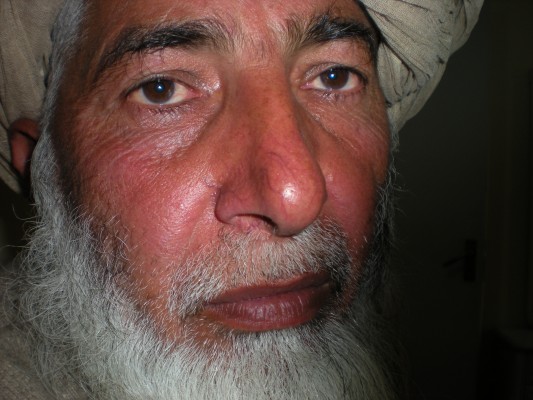 Ahmed Jan (pictured) is a tribal elder in North Waziristan. On March 17 2011 he was attending a gathering with other village elders, to discuss a mining dispute.
 Aletho News
 Aletho News