US threatens sanctions if Pakistan continues gas pipeline project with Iran
By Ahmed Adel | March 28, 2024
Despite Pakistan dealing with a crippling economic situation, the US has shown little concern for its strategic ally’s issues and, instead of offering support, has threatened tough sanctions if Islamabad decides to continue with the Pakistan-Iran gas pipeline project. Ironically, though, such an action will only push Pakistan closer to China, which the US views as a greater threat to its hegemony than Iran.
“We always advise everyone that doing business with Iran runs the risk of touching upon and coming in contact with our sanctions, and would advise everyone to consider that very carefully,” a US State Department spokesperson told reporters in a press briefing on March 26.
“We do not support this pipeline going forward,” the spokesperson added.
Washington continually emphasises that Pakistan is one of its closest allies and a partner in the fight against terrorism, making the sanctions threat a major development in their bilateral relations. For this reason, Pakistan Petroleum Minister Musadik Malik said on March 27 that Islamabad would seek an exemption from US sanctions over the gas pipeline project.
The Pakistan-Iran gas pipeline, known as the Peace Pipeline, will transport natural gas from Iran to Pakistan. Despite the pipeline’s several years of delays and funding challenges, Pakistan and Iran signed a five-year trade plan in August 2023 with a target of $5 billion. Tehran is evidently desperate for the project to be completed, which had an original deadline of 2015, since it signed the trade plan and overlooked Pakistan not laying the pipeline when Iran has already completed the laying of its 900-kilometre pipeline.
Islamabad claims it could not lay the pipe due to the US sanctions imposed on Iran, but Tehran rejects this excuse. Pakistan is now in a difficult position with the latest US sanction threat when recalling that Tehran issued a third notice in January to Islamabad and announced intentions to go to arbitration court to receive $18 billion for breach of contract.
The threat of US sanctions or paying a huge fine to Iran is only compounding Pakistan’s difficult economic situation, especially as the country is seeking a 24th bailout from the International Monetary Fund.
Pakistani Prime Minister Shehbaz Sharif said on March 26 that his country needs another IMF loan programme to stabilise its fragile economy. An IMF mission that visited Islamabad for five days earlier this month said Pakistan had to meet IMF conditions, including revising its budget and raising interest rates, generating revenue through more taxes, and hiking electricity and gas prices.
Effectively, ordinary Pakistanis are going to suffer a lot more than they already are.
Islamabad and Washington have had longstanding relations rooted in their opposition to the Soviet Union. After the Cold War, the US became dependent on the South Asian country for supplies during its long occupation of Afghanistan. Due to the US’s double standard of using Pakistan as a security partner but also threatening to worsen the country’s economic situation, China has been able to fill the financial void.
Pakistani Foreign Minister Mohammad Ishaq Dar met with Chinese Vice Premier Zhang Guoqing on March 22 in Brussels, where the latter emphasised Beijing’s commitment to aiding Pakistan in addressing its financial challenges. However, just like the Pakistan-Iran gas pipeline, Islamabad continues to stall the implementation of the China-Pakistan Economic Corridor (CPEC), a flagship project of the China-proposed Belt and Road Initiative launched in 2013 to link the Gwadar port in southwestern Pakistan with China’s Xinjiang Uygur Autonomous Region.
Worsening the situation for CPEC is the constant stream of terror attacks against Chinese workers and nationals.
In the latest attack, on March 26, a suicide bomber in the Shangla district of Khyber Pakhtunkhwa rammed an explosive-laden car into a vehicle, killing five Chinese workers and engineers and their Pakistani driver heading to the Dasu Dam, the biggest hydropower project in Pakistan. Less than a week before the suicide attack, Pakistani security forces killed eight Balochistan Liberation Army separatist militants who opened fire on a convoy carrying Chinese citizens outside Gwadar port in the southwestern Balochistan province.
Given that Pakistan is facing a dire economic situation and needs to turn to the IMF and seek more funding from China, US sanctions would be a devastating blow. Sanction threats are especially contradictory for the US since it not only considers Pakistan an ally but overlooks the fact that India invests in the Iranian port of Chabahar, located only 170 kilometres from Gwadar port. Washington overlooks this contradiction since Chabahar rivals the China-funded Gwadar, signalling that the US views China as a much larger threat to its hegemony than Iran, which makes sanction threats more confusing since it will only push Pakistan to be even closer and more aligned with China.
Ahmed Adel is a Cairo-based geopolitics and political economy researcher.
US opposes Iran-Pakistan gas pipeline project, trying to halt its construction: Official
Press TV – March 21, 2024
The US assistant secretary of State for South and Central Asia says the United States opposes the Iran-Pakistan (IP) gas pipeline project.
Speaking to congressmen during a congressional hearing in Washington on Wednesday, Donald Lu said the US is exerting maximum efforts to prevent the construction of the IP project.
He added that the US is concerned about the strain in Pakistan’s relations with neighboring Iran, particularly on the IP gas pipeline project.
The US official noted that Washington was in contact with Islamabad on the matter.
Emphasizing the importance of monitoring the funding for the mega energy project, Lu said the US is keeping a close watch on it.
“Washington has not received any request from Islamabad regarding sanctions relief, so our efforts to stop Pakistan from Iran’s gas project will continue,” the diplomat added.
Lu claimed that the project was not in the interest of Pakistan as international companies would not invest in it.
Back in February, Pakistan gave the green light for advancing much-delayed work on the joint gas pipelines project with Iran within its territory in a significant step towards enhancing energy cooperation between the two countries.
Pakistan’s Cabinet Committee on Energy (CCoE) granted its approval to start construction on the 80-kilometer pipeline from the Pak-Iran border to Gwadar.
The project, launched in 2013, had initially required Pakistan to finish the construction of the pipeline on its territory by the end of 2014.
However, the project faced prolonged delays due to the potential challenges it posed for Pakistan amid international sanctions targeting Iran.
Pakistan is likely to face an $18-billion fine if it terminates the gas pipeline agreement.
Imperial Assisted Suicide

By John Weeks | The Libertarian Institute | March 11, 2024
The United States Imperial Government (USIG) claims to be keeping the peace, underwriting the liberal, rules-based international order and safeguarding the global security architecture. This is not true. What the USIG is actually doing is killing people, helping get lots of people killed, and assisting foreign states as they commit corporate suicide. Israel’s ongoing, “plausibly genocidal” slaughter in Gaza and the West Bank is the latest example of this.
The United States is an empire and empire is murder-suicide. Since 9/11, U.S. soldiers have directly killed more than 400,000 civilians and indirectly contributed to the deaths of more than four million civilians. Meanwhile, more soldiers who served in the U.S. government’s Global War On Terror have committed suicide than have been killed in combat. Four times more.
The American People have not escaped suffering as the USIG and its empire have dished out catastrophic devastation in Afghanistan, Somalia, Iraq, Pakistan, Egypt, Yemen, Libya, Syria, and Mali. The cost of living has exploded. Our infrastructure is in shambles. Public trust in government has collapsed. The military’s “recruitment landscape” is in free fall. And things are so bad at home the government has found a new job: attacking “tent cities” filled with “under-sheltered” people. Murder-suicide.
Then there are the vassal or “client” states. In the propaganda, the empire defends these states from…whatever. But in reality, it helps these states murder people all while creating the conditions for these states to kill themselves. This has been demonstrated recently in Afghanistan (state committed suicide), Ukraine (state is trying to commit suicide) and Israel (state is thinking about committing suicide).
In October, 2001, the USIG invaded Afghanistan and smashed the Taliban-controlled state. In its place was installed a new state with a new military, which Libertarian Institute Director Scott Horton describes:
“The new regime was also largely a coalition government of ethnic minorities, the Tajiks, Uzbeks, and Hazaras, being leveraged against the 40 percent plurality Pashtuns, dominant in the east and south of the country where the Taliban are from.”
This coalition regime could not exist without billions of U.S. dollars in its coffers, U.S. boots on the ground, and U.S. air power in the sky. As predicted by Horton, as soon as U.S. forces began their withdrawal from Afghanistan, the Afghan state (along with its military) immediately killed itself. The Taliban resurrected their state which the U.S. had smashed almost twenty years earlier.
In February 2014, the USIG backed a violent, neo-Nazi led coup in Ukraine. Instead of smashing the entire state, the coup overthrew President Viktor Yanukovych’s administration. Unlike Afghanistan’s anti-Taliban government in a box, the Ukrainian government under new management was capable of existing without a massive U.S. military presence. It was not, however, capable of winning a war with Russia. It took eight years, but the USIG managed to provoke a war with Russia.
Ukraine has been defeated but the imperial wizards in DC refuse to admit this truth and seek peace. There could have been a peace deal two years ago, when it was still fashionable for Americans to fly the Ukrainian flag outside their front doors, but the USIG crushed it. The Ukrainian state is bleeding out and continuing the war at this point puts the entire Ukrainian nation at risk. Russia could seize all of Ukraine and downgrade it from sovereign nation to a Russian aircraft carrier.
Israel has been fortunate to never have its state murdered or regime changed by the USIG. Quite the opposite; Israel has intervened in USIG affairs to a shocking extent. The Israel lobby wields massive influence in Washington DC, so much so that President Joe Biden is risking his re-election chances by refusing to stop producing Israel’s “plausibly genocidal” mass killing spree in Gaza.
This gleeful and live streamed spree of sadism has not been good for Israel. Its state is provoking the global community to view it as a deranged pariah, including the great powers of Russia and China. Even within America, the people want a ceasefire. We want it to stop.
Meanwhile, Israeli society is cracking. Approximately 200,000 Israelis have been displaced from their homes in the south and north of the country. The IDF has suffered thousands of casualties, the economy is destabilized, and fear has blanketed the land.
And now Israel is planning an invasion of southern Lebanon. Such an invasion would be a hoped for but unexpected gift to Hamas. Experts such as Col. Douglas Macgregor, Col. Lawrence Wilkerson, Lt. Col Daniel Davis, Alastair Crooke, John Mearsheimer and Robert Pape have all warned against the invasion. They have argued that Israel risks catastrophic fallout from such a move, from mass causalities to provoking a regional war and even suffering strategic defeat.
Israel supporters seem confident in its security state, despite its massive failure on October 7. Tel Aviv appears to be operating with the assurance that the U.S. military will step in with strike packages and boots on the ground if and when needed. And yes, DC will let American cities die while it views Israel as too big to fail.
But the empire is beset by incompetence and anyone who paid attention to the self-immolation of the Afghan state and the slow suicide of the Ukrainian state knows this isn’t going to end well.
Taiwan, watch your six.
Pakistan: vote passed, what next?
By Viktor Mikhin – New Eastern Outlook – 20.02.2024
Voting in Pakistan’s much-anticipated general election on 8 February began at 8 a.m., but in the meantime, mobile networks were shut down across the country for more than 26 hours. Pakistanis are not used to network blackouts. There is often no connectivity during bank holidays parades, Muslim Eid and Ashura, protests criticising the ruling establishment and political rallies. Last year alone, mobile networks were down for four days after protests erupted when former Prime Minister Imran Khan was arrested outside the Islamabad High Court despite being released on bail in May. Then, in December 2023 and twice in January 2024, all social media platforms were blocked for the duration of virtual rallies by the Pakistan Tehreek-e-Insaf (PTI) after their street protests were suppressed.
On the eve of the February 8 polls that elect the country’s parliament and provincial legislatures, Pakistan’s Supreme Court ruled unconstitutional the election of Gohar Ali Khan as the new chairman of the Movement for Justice (PTI). The court also stripped the party of its symbol, a baseball bat, which is associated with the disgraced Imran Khan, the former captain of the national cricket team. Since then, the main opposition force, which has no official leader and no symbol (important for Pakistan), has been barred from contesting elections and its members have been urged by the party leadership to register as independent candidates. And even under such difficult circumstances, they achieved very impressive results.
In the National Assembly (lower house of parliament) elections, Nawaz Sharif’s Muslim League-Nawaz (PML-N) won in 75 constituencies and the Pakistan People’s Party (PNP) in 54, according to the Election Commission. Independent candidates, the bulk of whom are affiliated with the Movement for Justice, won seats in 101 constituencies. In this context, it is worth considering the additional seats, about 50, that the PML-N and PNP, which are allowed to contest the elections, will gain through the distribution of statutory quotas for women and religious minority candidates. In the event of an alliance, they could become the ruling coalition in Parliament and form a federal government. According to reports, the two sides may agree that Muslim League-Nawaz Sharif (PML-N) leader Nawaz Sharif would become prime minister, while the PNP would become president.
For its part, Imran Khan’s Tehreek-e-Insaf (PTI) party said it had “absolutely no interest” in Prime Minister Nawaz Sharif’s offer to form a coalition government after the latter’s party failed to win enough seats to rule alone in the general elections. Speaking to a crowd of thousands of supporters from the balcony of his party’s office in the eastern city of Lahore, the centre of his political life, Nawaz Sharif, a three-time former prime minister, finally struck a conciliatory note. Acknowledging that his party did not win the required number of seats, he called on the rest of all parties, including independents, most of whom tend to support Imran Khan, to unite and govern on the basis of the coalition that has been formed.
The vote itself and Sharif’s personal statement were the culmination of a particularly contentious election season in which allegations of military interference took centre stage, casting a shadow over a historic event that marked only the third democratic transfer of power in the country’s history. The army, which has ruled Pakistan for more than three decades since independence in 1947, has categorically denied interfering in political affairs. But still, leaders of many parties are unhappy with the pressure the generals are putting on society and the voting process itself. On the eve of the vote, Sharif was considered the frontrunner in the election because of what was widely believed to be the army’s support for him. Army officers cleared the way for his return to Pakistan after four years of voluntary exile to lead the Pakistan Muslim League in the country’s national polls.
“We don’t have many seats to form the government alone, so we are asking other parties that have been successful in this election to join us and together we will form the government,” Sharif offered in his first post-election address. Showing unprecedented flexibility, he said the PML-N recognises the legitimacy of this election and respects the mandate of all elected parties. “Whoever gets the mandate, we respect them with all our heart, whether it is a party or an individual, an independent candidate, and we invite them to lead a wounded Pakistan out of difficulties… It is important that all other parties sit at the negotiating table and form a united government together,” he said. But PTI spokesman Rauf Hassan told Pakistani media that the party had “absolutely no interest” in Sharif’s coalition proposal, “We are not going to form any alliance or coalition with them. They are not trustworthy people.”
With no party having secured the required majority -133 seats (there are 265 seats in the National Assembly), the coming days are likely to see numerous political entreaties, negotiations and meetings. The PML-N and PNP parties – in their struggle for dominance in parliament, where a two-thirds majority is required to make the most important decisions – will struggle to forge alliances with other independents and smaller parties. In his speech, Sharif said he had instructed his brother Shehbaz Sharif, also a former prime minister, to meet leaders of other parties, including the PNP, Muttahida Qaumi Movement (MQM) and Jamiat Ulema-e-Islam-F, to discuss a coalition government. However, he did not mention PTI. While the temptation to leave the coalition with Imran Khan’s party and join another party forming the government will be great, PTI-backed independent candidates have repeatedly said they will not join other parties and will return to Khan’s party as soon as he asks them to do so.
“We don’t expect such a government to last very long,” Zulfi Bukhari, a close aide to Khan, told the media, referring to a possible future PML-N-led coalition government. “Whatever [government] they are going to form, there will be disputes and bickering between them… So, its credibility will be zero with zero public support, which means they will not be able to take any meaningful decisions for the betterment of the country.”
Meanwhile, the delay in releasing full official election results even 24 hours after polling stations closed has led to widespread fears of rigging and raised questions about the credibility of the polls. The government attributed the delay to the suspension of mobile phone services imposed as a security measure ahead of the elections, but opponents, especially from PTI, say it was done to manipulate vote counting. In the run-up to the elections, PTI complained of increasing repression against the party, including that it was not allowed to campaign freely. Imran Khan himself did not participate in the polls as he has been in jail since August last year and has also been barred from running for public office for ten years. The former prime minister, already jailed in one corruption case, was found guilty in three consecutive cases a week before the election and faces dozens of other trials, including one in which he is accused of ordering violent attacks on military installations on 9 May 2023, which could carry the death penalty. Imran Khan, of course, denies all this and claims that all the cases were politically motivated to remove him and his party from the elections.
Many analysts question the legitimacy of the current election, in which Khan, arguably the country’s current most popular politician, was not allowed to participate. And after the election, they fear that the lack of a clear winner could mean more uncertainty for a country where political temperatures have been very high since Khan was ousted in a parliamentary vote of no confidence in April 2022. The country has also struggled for months with a seemingly intractable economic crisis that millions of Pakistanis have experienced. Pakistan’s economy is currently suffering from record high inflation, dwindling foreign exchange reserves, currency depreciation, low consumer confidence and slow growth caused by tough reforms undertaken to fulfil the terms of the latest $3 billion financial assistance from the International Monetary Fund (IMF) approved last year.
One of the key tasks for any new government will be to negotiate a new financial assistance programme with the IMF after the current deal expires. Another challenge will be dealing with the growing militancy of residents. The election season itself has been particularly bloody, with several attacks on rallies, polling stations and candidates over the past few weeks, while 16 people were killed in violence on polling day itself. So, the new government, which has yet to be formed, faces very difficult challenges in resolving many domestic problems, boosting the country’s economy and increasing the incomes of ordinary Pakistanis.
Victor MIKHIN is a Corresponding Member of the Russian Academy of Natural Sciences.
Washington, Pro-Democracy? Depends on the Country
By Ted Snider | The Libertarian Institute | February 19, 2024
Pakistan just held an election; Venezuela is about to. Both incumbent governments have banned the leading opposition figure from competing. The United States sanctioned one and was silent on the other. What was the difference? Not international law or responsible leadership, both of which require a consistent application of laws and a consistent response. The important difference was that the United States supported the incumbent coup government in one case and opposed the incumbent coup survivor in the other.
On January 30, the United States reversed the small and rare diplomatic progress it had made with Venezuela by revoking the sanction relief on gold mining and by promising to revoke the sanction relief on Venezuela’s oil and gas sector at the first opportunity. The State Department cited “Actions by Nicolas Maduro and his representatives in Venezuela, including the arrest of members of the democratic opposition and the barring of candidates from competing in this year’s presidential election” as the reason.
Of central concern to the United States was its choice of an opposition leader to run against Nicolás Maduro, Maria Corina Machado, who recently appeared before a roundtable organized by the U.S. House of Representatives’ Foreign Affairs subcommittee. On January 26, Venezuela’s highest court upheld the decision to bar Machado from running for president in the upcoming election.
But Machado was banned for reasons that might be considered reasonable in some democracies. She has a long history of being involved in coups against the democratically elected government of Venezuela. During the failed 2002 coup against Hugo Chavez, Machado was a signatory to the Carmona Decree, which suspended democracy, revoked the constitution, and installed a coup president.
As if participation in a coup is not enough to be barred from running for president, Machado was stripped of her position in the National Assembly in 2014 for acting, according to Miguel Tinker Salas, Professor of Latin American History at Pomona College and one of the world’s leading experts on Venezuelan history and politics, as “a delegate of the Panamanian government” who “sought to testify before the Organization of American States.” She sought to testify against her own country.
That same year, Miguel Tinker Salas says, “hoping to precipitate a crisis,” Machado helped organize La Salida, The Exit, to push President Maduro out of power. She “sought to mobilize forces and take to the streets.”
The next year, in 2015, Venezuelan officials produced evidence in support of their claim of a U.S.-backed coup attempt. According to the officials, the day before the planned coup, Machado joined two other opposition leaders in signing a National Transition Agreement. They say weapons were found in the office of the opposition party.
Machado has endorsed economic sanctions on Venezuela and foreign military intervention to remove the government of Venezuela.
Despite this record, the United States reimposed sanctions for barring Machado. The European Parliament went even further, denying that the Venezuelan court has legal grounds and insisting that Machado “remains eligible to run for the elections.” It says “Unless María Corina Machado is allowed to participate in the elections… elections and election results will not be recognised.” The European Parliament then urged EU member states “to tighten existing sanctions” and to add new sanctions on judges of Venezuela’s Supreme Court.
In Pakistan, the story is very different. Former Prime Minister Imran Khan has been jailed and banned from running in the presidential election. His party, Pakistan Tehreek-e-Insaf (PTI), has been demolished by the Pakistani military, who arrested its senior members.
But the American response to the barring—and even jailing—of, perhaps, the most popular candidate has been very different from their reaction to the barring of Machado in Venezuela. The State Department says that the arrest of Khan “is an internal matter for Pakistan” and that, “The United States is prepared to work with the next Pakistani government, regardless of political party…”
The difference may reflect American position on coups in these countries. Whereas, the United States has supported multiple failed coup attempts to remove the current government in Venezuela and, so, opposes that government; it supported what seems to have been the coup that replaced Khan with the current government.
In April 2022, Khan was removed from office in a non-confidence vote. Khan has claimed that the non-confidence vote was a U.S.-backed coup in democratic disguise. He may not be wrong. A leaked Pakistani cable reveals a meeting between Asad Majeed Khan, then-Pakistani ambassador to the United States, and two State Department officials, one of whom was Donald Lu, U.S. Assistant Secretary of State for South and Central Asian Affairs
Lu begins the meeting by expressing that the United States and Europe “are quite concerned about why Pakistan is taking such an aggressively neutral position” on the war in Ukraine. He pins responsibility for Pakistan’s neutral defiance of the U.S. on Khan, saying, “it seems quite clear that this is the Prime Minister’s policy.” Lu informs the Pakistani ambassador that the trigger for the American concern was “the Prime Minister’s visit to Moscow.” On the day Russia launched its invasion of Ukraine, Khan was in Moscow, meeting with Putin. He defied the United States by refusing to cancel the meeting.
Lu then advises Pakistan’s ambassador, “I think if the no-confidence vote against the Prime Minister succeeds, all will be forgiven in Washington because the Russia visit is being looked at as a decision by the Prime Minister. Otherwise, I think it will be tough going ahead… [H]onestly I think isolation of the Prime Minister will become very strong from Europe and the United States.”
As the polls closed in the Pakistani election, and the media began reporting stunning victories by independent candidates associated with Khan’s PTI party, the Election commission of Pakistan suddenly paused the announcement of results in remaining constituencies. By the time announcements restarted, PTI candidates who had been leading had suddenly lost.
The candidates associated with the PTI were running as independents because they were neither allowed to campaign under the PTI name nor even be identified by the PTI symbol on ballots, challenging voters’ ability to even identify PTI candidates. TV stations were banned from airing Khan’s speeches. Cell phone and internet services were cut, creating logistical confusion for voters. Voter suppression was widespread.
Despite all the obstacles, PTI candidates forced to run as independents won 102 seats. The second place party, the Pakistan Muslim League Nawaz Party of former Prime Minister Nawaz Sharif, came in second with 73 seats. Despite winning the most seats, Khan’s party did not win a majority in the 265 seat National Assembly and will have trouble forming the government.
The U.S. State Department assessed that the election featured “undue restrictions on freedoms of expression… electoral violence… attacks on media workers, and access to the internet and telecommunications services, and… allegations of interference in the electoral process.” Despite that assessment, it declared that it “is prepared to work with the next Pakistani government, regardless of political party.”
Yet again following a foreign policy guided by a rules-based order that only applies the law when it benefits the United States and its allies, instead of a foreign policy guided by international law that applies the same universal standard impartially, the U.S. has confirmed the worst suspicions of a global majority that is losing faith in American leadership. The U.S. sanctions Venezuela for banning a candidate from competing in elections but is willing to work with Pakistan who has done the same. “As consistency starts to be questioned,” S. Jaishankar, India’s Minister of External Affairs has said, “many more nations will start to do their own thinking and planning.”
Elections in Pakistan. Victory of Imran Khan’s PTI Party
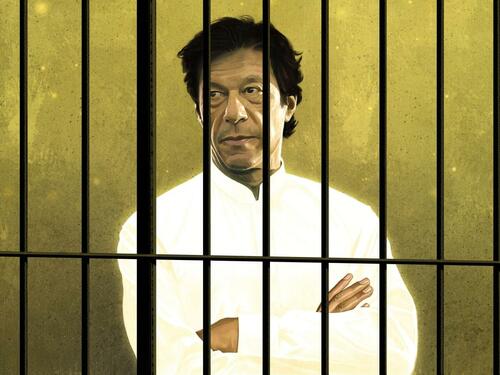
Image via Al Majallah/Rob Carter
By Junaid S. Ahmad | Global Research | February 10, 2024
The elections in Pakistan today were much freer and fairer than I had expected. Hence, the preliminary results simply reflected the obvious for most of us: former Prime Minister Imran Khan’s political party, PTI (the movement for justice) – facing ruthless repression over the past year – have swept the elections in every single province of the country.
Khan, surviving two assasination attempts and languishing in a supermax dungeon since last August, is more popular than ever. Among the youth, Gallup Pakistan surveys have consistently reported around 80-90 percent support for Khan and his party.
The tyranny of the generals in the military high command along with the kleptocratic and dynastic political parties entailed even the suppression of PTI’s symbol (a cricket bat) and virtually a ban, with horrific consequences if violated, on candidates running on a PTI ticket. Thus, all of these candidates ran as independents.
Of course, we have now become used to one criminal travesty after the next by Pakistan’s military-intelligence apparatus. So, we are cautious about any temporary victory for people’s democracy, triumphing over the Washington-backed totalitarian military and political elite. The latter are in full-blown panic mode, and are trying their best at tampering and rigging before announcing the final results.
The preliminary results, regardless of the fraudulent shenanigans of the national security state expected in the next few days, already represents a resounding defeat of the neo-colonial comprador oligarchy in Pakistan. One just needs to see how highly strung the spokesperson of the State Department was in addressing questions related to these elections.
There is one sign of both hope and danger. For the first time in Pakistan’s history, the normally unified and disciplined armed forces are now experiencing deep divisions. The majority of military officers and and 95 percent of soldiers are repulsed by the behavior of Wasington’s minions in the top brass. To the surprise of many of us, these divisions also exist within the intelligence agencies. We are witnessing in an unprecedented way a refusenik impulse within the military. Not to sound like the bogus alarmism we’re used to from Washington think tanks, it’s still worth remembering that Pakistan is a country of 240 million, nuclear-armed.
The Pakistani people badly need international solidarity at this point.
Prof. Junaid S. Ahmad teaches religion, law, and global politics and is the Director of the Center for Islam and Decoloniality, Islamabad, Pakistan.
Ex-Pakistani PM charged amid US interference scandal
RT | October 23, 2023
A special court in Pakistan formally charged former Prime Minister Imran Khan and his then-foreign minister on Monday with breaching state secrecy laws. The charges stem from their alleged conspiracy to reveal what Khan characterized as US interference in orchestrating his removal by political opponents last year.
Special Court Judge Abual Hasnat Zulqarnain lodged indictments against Khan and Shah Mahmood Qureshi concerning the so-called ‘cipher case.’ The allegations revolve around their purported unlawful retention and public disclosure of a classified document, which Khan’s side is said to have had the necessary cipher to decode. Pakistani media reports suggest that additional individuals, including Khan’s aide Muhammad Azam Khan and former Federal Minister Asad Umar, may also face charges in the ongoing investigation.
The document in question is a diplomatic cable sent by then-Pakistani Ambassador to the US Asad Majeed Khan after his March 2022 meeting with two senior US Department of State officials, including Assistant Secretary of State for the Bureau of South and Central Asian Affairs Donald Lu.
Various media sources, including The Intercept, reported that Lu criticized Imran Khan for adopting an “aggressively neutral position” on the Ukraine conflict that erupted in late February of the same year. Unlike the United States and its European allies, the Pakistani prime minister refrained from siding with Kiev.
Instead, he conducted a scheduled visit to Moscow and declared during a rally that Pakistanis were not “slaves” to Washington, defying Western criticisms.
The US official reportedly discussed the no-confidence vote against Khan, which he was facing in parliament at the time. If it were to succeed, “all will be forgiven in Washington,” Lu was quoted as telling the ambassador, while if Khan stayed in power, Islamabad would supposedly face “isolation.”
The US government denied that anything said by Lu during the meeting amounted to taking a position on who should be in power in Pakistan.
Khan was ousted about a month after the meeting and has since been charged with a number of crimes, including some related to terrorism and corruption. He has claimed that his political opponents seek to bar him from the upcoming parliamentary elections with Washington’s blessing. Notably, after Khan’s downfall, US-Pakistani relations experienced a period of thawing.
Islamabad received an unexpected windfall this July when the International Monetary Fund extended a $3 billion bailout. The Intercept claimed that the US backed the rescue in exchange for Pakistan agreeing to supply munitions worth $900 million to Ukraine. The Pakistani government has denied the reported arms sale ever taking place.
Conscience of humanity shaken by targeting of civilians in Gaza: Pakistani envoy

Press TV | October 18, 2023
The Israeli regime’s “deliberate, indiscriminate and disproportionate” targeting of civilians in the besieged Gaza Strip goes against all norms of civility and violates international law, says Pakistani ambassador to Tehran.
In an interview with the Press TV website on Tuesday, hours before an Israeli air raid on a Gaza hospital killed more than 700 Palestinians, Muhammad Mudassir Tipu said the “conscience of humanity has been shaken” by the unrelenting massacre of Palestinian civilians in the Gaza Strip.
“The conscience of humanity has been shaken by watching innocent civilians, children, older people, pregnant woman being killed; buildings being razed to ground; water and electricity being cut off; massive blockades; and the use of massive ammunition by the Israeli military forces,” he stated.
“That is why people are showing solidarity with the Palestinians, who are symbolizing their struggle for justice, all over the world.”
Demonstrations have been held worldwide in recent days in solidarity with the oppressed people of Palestine amid the new wave of Israeli genocidal bombardment of the besieged coastal strip.
One of the biggest demonstrations was held in Pakistan’s port city of Karachi, where tens of thousands took to the streets following a call given by a local political party with the support of trade unions.
Tipu said the “sense of righteousness is deeply ingrained in the minds” of the people in Pakistan.
“We stand for those principles that are morally justified and right rather than the ones propagated for political and hegemonic ambitions. Pakistanis also believe in the equal application of international law and norms rather than using one set of laws for one country and another set of laws for another country,” he remarked in a conversation with the Press TV website.
“We can’t have double standards and false moral equivalences to justify unjustifiable and illegitimate positions,” the Pakistani envoy hastened to add.
The death toll in the Israeli aerial bombardment in the Gaza Strip has risen to 3,000, including at least 700 children, with tens of thousands of others displaced after the Israeli evacuation orders.
The Pakistani ambassador said massive pro-Palestine demonstrations must be seen in the context of years of forced and illegal occupation of Palestinian territory and repressive policies against its people.
“Our cause resonates with the cause of the hapless Palestinians who are facing unspeakable brutality and massive use of force on the civilians as well as an overwhelming use of military might over its innocent people,” he asserted.
Tipu also “appreciated” the role of the Iranian leadership in “standing up for the oppressed people of Palestine and making resolute efforts to halt and reverse the conflict in Gaza consistent with international norms.”
“The great Iranian leadership has also unambiguously urged for a just resolution of this historic injustice,” he remarked, adding that the foreign ministers of Pakistan and Iran had a phone conversation on Monday in which they “discussed this grave situation” in Palestine.
On Pakistan’s interim Prime Minister Anwaar ul Haq Kakar’s statement on Saturday that the Israeli aggression in the Gaza strip should be seen in the context of years of illegal Israeli occupation, the Pakistani envoy said he “clearly and unambiguously outlined Pakistan’s position on this crisis.”
He also dismissed any speculation about Pakistan mulling normalization with the Israeli regime.
“Pakistan’s Foreign Minister, Mr. Jalil Abbas Jilani has categorically articulated that “there is absolutely no move to recognize Israel. Our position is very clear. We take decisions based on our interests and the interests of the Palestinians,” he told the Press TV website.
“I must emphasize that Pakistan is a sovereign country, with enormous capabilities, and would always take decisions of vital importance independently.”
He hastened to note that Islamabad “wishes to seek a just resolution” of the issue of Palestine so that “regional peace, development, and growth can take place and a sense of equity and justice prevails.”
‘Manipulation’ keeps Imran Khan in prison despite bail, lawyers say

Press TV – August 29, 2023
Former Pakistani Prime Minister Imran Khan has remained in prison despite the Islamabad High Court suspending his recent conviction on corruption charges, with his lawyers claiming that a “manipulation of justice” is keeping him behind bars.
Khan’s legal team said on Tuesday afternoon he remained in detention because of a previous arrest, made in secret, over a case alleging he had leaked classified state documents.
One of his lawyers told reporters outside the prison that Khan was “on judicial remand” and would appear before a special court in Islamabad on Wednesday.
“He was arrested prior to today’s court ruling. The exact date of his arrest remains unclear,” another lawyer, Gohar Khan, was quoted as saying.
Another, Muhammad Shoaib Shaheen, said that “his legal team was intentionally left uninformed and kept in the dark”. “This constitutes a manipulation of justice,” he said.
Pro-PTI lawyers held banners and chanted “Release Imran Khan!” and “Khan your devotees are countless!” outside the court as initial news of his sentence suspension broke.
Khan ally and former Speaker of National Assembly Asad Qaiser has said today’s verdict in the graft case was evidence Khan’s sentence and imprisonment were carried out in “haste”.
“If an attempt is made to arrest Chairman Imran Khan in other cases after his release, it will be an attempt to push the country towards anarchy. At this time, the only way to save the country from further crises is to have clean and transparent elections as soon as possible,” Qaiser posted on social media platform X, the platform formerly known as Twitter.
The Islamabad High Court overturned a lower court’s decision to jail him for three years, a judgment that kept him from contesting upcoming elections.
His lawyers said he was granted bail and they were initially hopeful he would be released from Attock Jail, a century-old prison around 60 kilometers west of Islamabad, where the 70-year-old has been held for three weeks.
Khan’s Pakistan Tehreek-e-Insaf (PTI) party later said nine activists had been arrested outside Attock Jail.
The sentence was handed down this month by a judge who found him guilty of failing to properly declare gifts he received while in office.
The ex-PM’s legal team lodged the appeal against his conviction on the grounds that he was put to jail without being given the right to defend himself.
That was only one of more than 200 legal cases that have embroiled Pakistan’s most popular politician since he was ousted by a parliamentary vote last year.
The Islamabad High Court’s decision to suspend the conviction marks another victory for Khan and comes on the heels of the Balochistan High Court’s decision to dismiss sedition charges against him.
The 70-year-old cricketer-turned-politician lost a confidence vote in the parliament in April 2022. Since then, his ouster has been at the centre of political turmoil across Pakistan.
Khan believes that the cases lodged against him were politically motivated to keep him out of power. He alleges the country’s powerful military is behind these cases.
In the past months, Pakistani authorities have made widespread arrests targeting the PTI party in an attempt to allegedly crush his grassroots support.
No date for the polls has been announced. Khan surged to power in 2018 on a wave of popular support, through an anti-corruption manifesto.
Did the US ask for Khan’s removal after he visited Russia?
The US-based news outlet The Intercept earlier this month published what it claims to be the details of a diplomatic “cypher” – or a secret cable – that suggests the US administration wanted to remove Khan from power last year.
Khan alleged he knew of the “cypher” while he was in office which, according to him, proved the US hatched a conspiracy with the help of his political opponents and the Pakistani military to remove him.
The Intercept published purported details of a conversation between Pakistan’s then-ambassador to the US, Asad Majeed, and Donald Lu, the assistant secretary of state for the Bureau of South and Central Asian Affairs, on March 7 last year.
In the meeting, Lu reportedly told Majeed the US and Europe were “quite concerned” about Khan visiting Russia and Pakistan taking an “aggressively neutral position” on Russia’s military operation against Ukraine
The conversation, according to the report, took place less than two weeks after Khan visited Moscow on February 24, the day Russia launched the operation.
Pakistan court drops sedition case against ex-PM Khan: Lawyer
Press TV – August 28, 2023
A Pakistani court dismissed a sedition case lodged against Pakistan’s former Prime Minister Imran Khan on Monday, according to a court order and his lawyer.
Khan, 70, a former cricket player, was jailed on corruption charges earlier this month.
In March, he was charged with sedition on a complaint that alleged one of his speeches amounted to sedition. The case was registered in the southwestern city of Quetta, the capital of Balochistan province.
Following an appeal by the former prime minister, the Balochistan High Court said prosecutors had failed to obtain the required consent from the federal or provincial government to lodge the charges of sedition.
Hence the court ruled that the charges are “without lawful authority and are of no legal effect,” meaning that the authorities should quash the case.
Khan’s lawyer Naeem Panjutha also made this announcement in a post on the X platform, formerly known as Twitter.
“God be praised,” she wrote on X celebrating the dismissal of the case.
A US publication has obtained a classified document, suggesting Washington pushed for the removal of Imran Khan from office over his neutrality on the Ukraine war.
Khan, who lost power after being defeated in a parliamentary confidence vote in April 2022, is also currently serving a three-year jail term after being convicted of corruption.
He is expecting a high court in Islamabad to overturn his conviction and jail sentence.
He said the cases lodged against him were politically motivated to keep him out of power. He says the country’s powerful military is behind these cases.
The three-year jail sentence issued by a lower court disqualifies him from taking part in elections scheduled for November, though it is likely to be delayed until at least early next year.
Khan has been barred from holding political office for five years.
In past months, Pakistani authorities have made widespread arrests targeting Khan’s Pakistan Tehreek-e-Insaf (PTI) party in an attempt to crush his grassroots support, causing nationwide anger against the country’s military for ordering the crackdown.
According to several independent surveys, the PTI will win a landslide victory in the next elections if the party is allowed to run a political campaign without restrictions.
Featured Video

Rewriting the risk? Inside the government’s vaccine safety messaging
or go to
Aletho News Archives – Video-Images
Book Review
“Davos Can Really Replace the UN”
Inside the book that maps the architecture behind global governance — from the Epstein files to the Pact for the Future
Lies are Unbekoming | April 1, 2026
On June 13, 2019, the United Nations and the World Economic Forum signed a partnership deal to “accelerate the implementation of the 2030 Agenda for Sustainable Development.” That same evening, WEF president Börge Brende — Norway’s former Foreign Minister — had dinner with Jeffrey Epstein at Epstein’s Manhattan townhouse. The Epstein files, released January 2026, contain an exchange between the two from the previous year. Epstein to Brende: “Davos can really replace the UN. C21, cyber, crypto . genetics… intl coordination.” Brende back to Epstein: “Exactly — we need a new global architecture. World Economic Forum (Davos) is uniquely positioned — public private.”
The next day, the UN General Assembly adopted the framework for restructuring global governance.
That sequence — the partnership signing, the Epstein dinner, the candid admission about replacing the UN with a public-private architecture, and then the formal adoption — opens Jacob Nordangård’s The Digital World Brain. Pages two and three. Footnoted to the UN resolution number, the Epstein files, and the General Assembly record.
I keep coming back to it because it captures what this book does that almost nothing else in the independent research space manages. I’ve followed Jacob’s work for years now and interviewed him about his research. Each book peels back another layer of the same institutional architecture, and each time I think he’s reached the limit of what can be documented, the next one goes further. Nordangård doesn’t speculate. He doesn’t editorialize much. He lays institutional actions next to each other in chronological order and lets the pattern announce itself. … continue
Blog Roll
 Aletho News
- Iran, US receive Pakistan-mediated plan for ceasefire then final deal
- Iran submits demands for end to war as mediators scramble ahead of Trump deadline
- Iran Threatens Retaliatory Strike on Stargate AI Project in UAE
- US sent ‘a lot’ of arms to Iranian protesters – Trump
- Barak Ravid Launders Deception To Allow Trump To Back Off Of His Power Plant Threat – Again
- REWRITING THE RISK? INSIDE THE GOVERNMENT’S VACCINE SAFETY MESSAGING
- “Davos Can Really Replace the UN”
- NIAID/NIH and USDA Fund Bioengineered Chimeric Influenza Viruses Built Using Pandemic H1N1 Components: Journal ‘Science Advances’
- Hezbollah hits Israeli warship off Lebanon’s coast, sets it aflame
- Iran slams US strikes on B1 bridge, Mahshahr petrochemical plants as ‘blatant acts of state terrorism’
- If Americans Knew
- Trump poised to “blow everything up” (ie. commit war crimes) in Iran – Daily Update
- In Iran, Israel-US take aim at “reason, research, and freedom of thought” – Daily Update
- US loses planes over Iran, Israel downgrades Lebanon war goals – Daily Update
- Israel Is Blocking Palestinians from Easter at Church Where Jesus Resurrected
- Plot to assassinate Palestinian activist follows harassment campaign promoted by Zionist groups and elected officials
- Prominent New York synagogue hosts presentation on why U.S. Jews should support the ethnic cleansing of Gaza
- Tapper vs. Piker: Is the CNN Anchor Auditioning for David Ellison?
- Shouldn’t Democrats Be Able to Condemn Genocide?
- Israel-US kill negotiators, destroy civilian structures, but Iran’s military capabilities still largely intact – Daily Update
- ‘War crime’: Global condemnation as Israeli ministers celebrate death penalty law targeting Palestinian prisoners
- No Tricks Zone
- An Inconvenient Tree: Uncovered In Alps… Europe Much Warmer Than Today 6000 Years Ago
- New Study Reports A 60% Slowdown In Greenland’s Ice Loss Rate In The Last Decade
- Low Intensity Tornado Wrecks Major Solar Farm, Creating A Potential Toxic Dump
- New Study Finds Warming Saves Lives…Cold Temperatures 12 Times More Deadly Than Excess Heat
- German Science Blog Accuses PIK Climate Institute Of Hallucinating Climate Tipping Points
- Devastating Assessment Of Comirnaty Vaccine By Former Senior Pfizer Europe Toxicologist
- New Study: CO2 Is ‘Effectively Negligible’ As An Explanatory Climate Change Factor Since 2000
- Former Pfizer Toxicologist Dr. Helmut Sterz Tells Bundestag Hearing Pfizer Vaccine Should Have Never Been Approved
- Energy Expert: Germany’s Nuclear Phaseout Was A “500 Billion Euro Mistake”
- New Research: South Australia’s Mid-Holocene Sea Surface Temperatures Were 4°C Warmer Than Today
 Aletho News