Russia explains stance on US-proposed Palestine “cease fire” resolution
Explanation of vote by Permanent Representative Vassily Nebenzia at the UNSC vote on US-proposed draft resolution on the situation in the Middle East, including the Palestinian question
Permanent Mission of the Russian Federation to the United Nations | March 22, 2024
Before the vote:
Mr. President,
For six months now, the UN Security Council has been unable to adopt a resolution demanding a ceasefire in Gaza. Time and again, the United States thwarted any attempt to do so by using a veto in cold blood as many as four times.
During that time, we have heard many different excuses from our American colleagues. For example, that it is premature to seek a ceasefire because it is necessary to give space “for Israel’s counter-terrorism efforts”; that the Council should not interfere with Washington’s “effective diplomacy on the ground”; that we should wait until Ramadan, when, they say, an agreement on a cessation of violence will definitely be made.
Now, six months later, when Gaza has been practically leveled with the ground, the US representative says without batting an eye that Washington finally starts to realize the need for a ceasefire.
This leisurely thinking process by Washington has cost the lives of 32,000 Palestinian civilians, two-thirds of them women and children.
And even now we see a typical hypocritical show, when in the wrapper of a “ceasefire” the United States is trying to sell to the members of the Security Council and the entire international community something else – a vague phrase about “defining the imperative of a ceasefire”. Such philosophy about moral imperatives looks naturally in the works of Immanuel Kant. But it is not enough to save the lives of Palestinian people. And that is not at all what the mandate of the UN Security Council suggests, which has a unique toolkit to demand a ceasefire and, if necessary, enforce it.
In an official interview to Al Hadath in Jeddah on 20 March, Secretary of State Blinken said, “Well, in fact, we actually have a resolution that we put forward right now that’s before the UNSC that does call for an immediate ceasefire tied to the release of hostages and we hope very much that countries will support that”. However, the US-proposed draft resolution does not make such call. It appears that either the US Permanent Representative to the United Nations or the US Secretary of State deliberately mislead the international community.
Colleagues,
From the very beginning, it was obvious that the “negotiations” on the draft resolution held by our American colleagues were only meant to delay time. All our comments and “red lines” were ignored, as well as the proposals of a number of other delegations. This was not a normal work on a document. It felt more like speaking into the void.
The US draft is a thoroughly politicized document, which only aims at pulling on voters’ heartstrings before the US elections by throwing them a “bone” in the form of at least some mention of a “ceasefire” in Gaza. The draft also seeks to consolidate US policy in the region through “terrorist labels” and to ensure impunity for Israel, whose criminal actions the draft gives no assessment to.
Let me also stress that the American draft contains a de facto green light for Israel to conduct a military operation in Rafah. At least, the sponsors have tried to make sure that nothing in their draft would prevent West Jerusalem from completing the deadly cleanup of southern Gaza.
That is actually what Washington wants. We already said that we will no longer pass meaningless resolutions that do not demand a ceasefire and lead us nowhere.
This draft must not pass with the majority of UNSC votes in order to send a message that Washington’s not even palliative but devious concepts are unacceptable. It will be extremely strange if those members of the Council (and they are the majority), who realize this and have been saying to us that the US draft is a flawed one, will now raise their hand in favor. If you do so, you will smear yourselves in disgrace.
Think what this will make you look in the eyes of the people of the Middle East and your own countries, if you support this hypocritical endeavor designed to disorient the international community and, in fact, undermine the authority of the Council by rendering it unable to influence the situation on the ground and making it “stay out of White House’s way”. Are you ready to play a part in this shameful show?
Russia will not do this. As a permanent member of the Security Council and one of the founders of the United Nations, we recognize the global historical responsibility for the maintenance of international peace and security and cannot allow the Council to become a tool of Washington’s destructive policy in the Middle East. If this resolution were adopted, it would definitively close the debate on the need for a ceasefire in Gaza, give Israel a free hand and condemn Gaza and its entire population to extermination or expulsion.
In our work, we are not guided by what pleases Washington or its satellites who are ready to cast a vote at the US behest, but by what is necessary for the Palestinians and what promotes peace.
We urge the members of the UN Security Council to prevent this and vote against the American draft resolution.
Mr. President,
In order for the UN Security Council to still be able to implement its mandate to maintain international peace and security, a number of non-permanent UNSC members have prepared an alternative draft resolution that spells out in black and white the requirements for both a ceasefire and the unconditional release of hostages. It is a balanced and depoliticized document.
We see no reason why members of the Security Council could refuse to support it, unless a ceasefire and the release of hostages are not part of their plans. This is an attempt to allow the Council to carry out the noble functions entrusted to it. We urge to not miss it.
Thank you.
After the vote:
Mr. President,
We have now listened to the hypocritical speeches of some Council members shedding crocodile tears over the Russian and Chinese vetoes. We have explained the reasons why we did not pass this resolution. It was not because it was put forward by the United States delegation, as the American Permanent Representative tried to assure us today. I told you – those of you who voted here today – that you would cover yourselves in disgrace by voting in favor of an American text that was unacceptable to you (including those of you who are now praising it).
Do you want me to say what really happened? Not hard to guess, the scenario is not complicated at all. Your American masters, in addition to “twisting the arms” of your leaders in the capitals, said, “Don’t you worry, Russia will veto anyways, so you won’t have to go against the American draft.” That’s it, that’s the whole scenario. So stop this hypocrisy about how upset you are that Russia and China vetoed the resolution. Once again, you have covered yourselves in disgrace today by voting in favor of a draft resolution that you did not and do not really support.
Thank you.
Drone footage reveals Israel’s cold-blooded murder of Palestinians in Gaza
The Cradle | March 22, 2024
Israeli forces used drones to kill four Palestinian youths in Gaza in cold blood as they walked down a road in the city of Khan Yunis in Gaza, footage obtained by Al-Jazeera shows.
The drone first fired two missiles at the youths as they walked on a dirt road, hoping to reach the remains of their
destroyed homes. Israeli bulldozers had been active in the area but had withdrawn. Israeli forces continued to monitor the area by drone.
The missiles killed two of the youths. The other two tried to escape, but Israeli drones opened fire with missiles a third and fourth time, killing them both separately as well.
The last youth had tripped and fallen and was on his knees in the road as the missile struck him.
The missiles obliterated the bodies, barely leaving a trace of them.
The video shows the youths were unarmed and posed no threat to any Israeli forces.
The drone was broadcasting video to an Israeli command center as it opened fire.
On Thursday evening, the Gaza Media Office stated that the killings constituted evidence of a “deep crisis within the Israeli occupation.”
“We strongly condemn this crime in which the occupation army bombed four civilian youths with drones, killing them vindictively and turning them into scattered remains, indicating the magnitude of the deep crisis that this occupation is going through by killing in this monstrous manner,” the media office said.
“The US administration, the international community, and the Israeli occupation bear full responsibility for the continuation of these crimes against Palestinian civilians for the sixth consecutive month (of the war),” it added.
Since 7 October, Israeli forces have killed over 31,000 Palestinians in Gaza in a campaign widely-viewed as genocide.
The World Sees Gaza as ‘US Genocide’ Not Just Israel’s
By Ian DeMartino – Sputnik – 22.03.2024
On Tuesday, four critical care doctors who recently returned from Gaza spoke to the UN. “I saw the most appalling atrocities, and I saw things I never would have expected to have seen in any healthcare setting,” Dr. Nick Maynard said, adding that he saw “mass indiscriminate bombing” and targeting of healthcare workers.
Americans do not understand how badly the United States’ reputation has been damaged across the world, which sees Gaza as “a US genocide” and “not just an Israeli genocide,” Mohammad Marandi, a professor of English literature and Orientalism at the University of Tehran told Sputnik’s The Critical Hour on Thursday.
“It’s revealing the reality of [the US] empire in a way that not even [author of ‘A People’s History of the United States, Howard Zinn] could do because it’s being done in front of our eyes, it’s being done in front of a global audience. We’ve never seen such a thing before,” Marandi said, adding that he suspects that is why the US is attempting to ban TikTok.
“The United States has lost credibility across the world. I don’t think many Americans understand how bad this has become for the United States. People across the world see this as a US genocide, it’s not just an Israeli genocide.”
Co-host Wilmer Leon asked about a recent freeze on Canadian arms shipments to Israel, which Marandi said showed that “public opinion is shifting” but that ultimately “stopping Canadian exports of weapons is nothing.” Marandi said Canada needs to take a much tougher approach.
“They sanctioned Syria… they’ve imposed sanctions on Cuba, on Venezuela, on Iran, on Yemen. Why don’t they impose sanctions on Israel? They’re carrying out a holocaust. Why don’t they hit the economy?” Marandi asked, noting that Israel will, unlike Russia, be allowed to participate in the Olympics. “No one takes this seriously. And, of course, the bulk of the weapons come from the United States anyway.”
“In any case, there is no reason to believe that the Canadian government cares about Palestinians, that they oppose the genocide, because they’ve done absolutely nothing to stop it,” Marandi added.
Ultimately, Marandi believes that Israel has laid the path for its destruction through its actions in Gaza. “I believe that the Israelis have made a fatal mistake and that what they’ve done in Gaza will be the beginning of the end of the Zionist project,” he asserted. “The real catastrophe for the Israeli regime is the fact that it’s been carrying out the genocide for almost six months in front of the world and it has demolished the facade that the regime had created for itself… about it being a democracy… All that is gone now and across the board the regime is despised and the image of the United States has been destroyed.”
Marandi noted that he has been to China twice and public opinion there has shifted as well. He noted that he does not think China will ever invest in Israel again.
“They see on their own social media networks what you and I are seeing,” he noted.
Russia’s Geopolitical Prospects in the Middle East
By Salman Rafi Sheikh – New Eastern Outlook – 21.03.2024
With Russia able to withstand – and virtually defeat – the combined military strength of NATO in Ukraine, its foreign policy and its diplomatic outreach to the rest of the world is bound to gain not only confidence but also become a lot more assertive than it was during the first year of this conflict when Washington launched its so-called “isolate Russia” project. Translating its military gains in Ukraine, Moscow, for instance, recently hosted Palestinian factions to unify them not only for a durable solution to the longest-lasting conflict in the Middle East but also for developing a strong position vis-à-vis Israel. This approach towards Palestine – which also exhibits a visible anti-Israel position – is directly motivated by Moscow’s broad Middle East outreach at a time when the political opinion in the region has turned against Israel and Washington, leaving Israel virtually isolated despite having established ties with several Muslim states in the recent past.
At the same time, this opinion has also become more favourable towards Russia. A recent survey by the Washington Institute showed that a majority of respondents in the UAE (66%), Saudi Arabia (67%), Kuwait (62%), Egypt (57%), Bahrain (68%), Qatar (63%), and Lebanon (72%) agree that the US is no longer a reliable partner and that the Middle Eastern countries “must look more to other nations like Russia and China as partners”.
On top of that is the strong credentials Moscow carries as a security guarantor. Since at least the end of the Cold War, Washington has dominated the region as its key security guarantor, both through its direct military presence and its supply, i.e., sale, of weapons worth billions of dollars to the region. But Moscow dismissed Washington’s dominance via the key role it played in Syria to defeat the US-backed “regime change” operation. Subsequently, it has been successful in helping Syria’s relations with several Arab states, including Saudi and the UAE, to become normal. Moscow, in other words, was successful in translating its military gains into diplomatic victories by becoming a peacemaker in the Middle East. Washington, on the other hand, has not been able to bring peace to the Middle East and/or prevent Israel from committing genocide.
Russia’s Middle Eastern forays are, therefore, in part motivated by Washington’s failures. At the same time, Russia also sees itself as a great military power and a great power needs to have a strong foothold – which does not have to be a military presence – in the region.
If the ultimate objective of any superpower policy is to advance its core interests, non-military means can be very useful too. In the recent past, Russia’s engagement with several Middle Eastern states via the OPEC+ framework has served its key interests well. Via OPEC+, Russia has been able to not only withstand a US-led assault on its economy but also inflict a lot of economic damage on the Western economy. Washington’s inability to break OPEC+ has led to a high inflation rate throughout Europe and North America.
While a lot of Russian ability to accomplish this depended upon the cooperation of other OPEC countries, the latter, including Saudi Arabia, also see Russia as an alternative to Washington. Plus, the partnership with Russia is also paying off. Despite a global growth rate of less than 3 percent in 2023, Saudi’s Aramco earned US$121 billion in 2023, thanks to the careful management of oil supply and prices.
Turkey is another major player in the Middle East that continues to have strong ties with Russia, primarily because of the ways that these ties serve mutual interests. The trade turnover between them increased by more than 80 percent in 2022 to reach US$62 billion. Russia is already Turkey’s biggest source of imports. But this relationship is not costly. On the contrary, Turkey saved US$2 billion on oil imports from Russia by purchasing discounted oil. Ankara was able to do this because it refused to join the US-led regime of sanctions on Russia. As a result, Russia became Turkey’s biggest supplier of energy in 2023. In 2023, Turkey imported 49.93% of its oil from Russia. A year earlier, the share of Russian oil in the Turkish market was 40.74%. Due to this, the US has been trying for the past few months to impose fresh sanctions on Russia to make Turkey-Russia [trade] difficult. But whether it will have any real impact is not hard to guess due to the increasing availability of alternative channels, i.e., using Central Asian States, to conduct trade and transfer payments.
Still, US efforts to put restrictions on entities from Russia and the Middle East to prevent them from doing trade with Russia itself shows the success Russia has achieved in the Middle East. The US fears that if Russia, like China, continues to expand its relationship with this energy-rich region, it could accelerate US exit from the region, leaving Washington’s efforts to revamp its ties, including via offering strategic defence partnerships to countries like Saudi Arabia, meaningless vis-à-vis Russia.
If even, speaking of a hypothetical scenario, the political opinion in the Middle East were to see a dramatic change to become pro-US, it does not mean an ‘end’ of Russia’s presence in, and relationship with, the Middle East. A core reason for this is the Middle Eastern states’ own desire to reposition themselves in the emerging global order as autonomous players capable of influencing global politics – something that these states can accomplish by, first and foremost, diversifying their foreign policy and reducing, if not fully eliminating, their historical dependence on the US. In this sense, Russia’s engagement with the Middle East is not simply a short-term phenomenon that would just die out the moment Washington offers a deal to the Gulf states that they cannot refuse. It is here to stay, with its prospects of growing brighter than ever.
Salman Rafi Sheikh is a research-analyst of International Relations and Pakistan’s foreign and domestic affairs.
I was banned from Elon’s ‘free speech’ X app for offending power
BY KIT KLARENBERG · THE GRAYZONE · MARCH 19, 2024
Following years of pressure from Israel lobbyists and British spooks, I was finally banned by Twitter/X. What does my removal say about Elon Musk, who flaunts his opposition to censorship, while promising to build an “everything app” where you could lose access to banking and messaging for violating dubious speech codes?
On February 17, I was suspended from Twitter/X without warning. The cause was mass-reporting by Zionist activists I’d offended. My removal was justified on the basis that I violated X’s “rules against violent speech.” Having endlessly condemned violence on the platform – in particular, the Gaza genocide – I’m flummoxed. Not least because a post from one of my Zionist detractors, which openly calls for me to be “battered on a weekly basis” over my political views, remains extant today.

Despite repeated requests for clarity from X, I have no idea whether I will ever be reinstated. In February, I received from “support” stating the suspension will only be reversed after three months. But just a few sentences later, the email contradicted itself, stating in closing that the ban would last just a month. Meanwhile, whenever I log into X, my profile appears to have zero followers or follows, I cannot view or search anyone’s tweets (including my own), and my DMs are inaccessible. Have they been erased? A landing page message reads:
“Your account is permanently in read-only mode, which means you can’t post, repost, or like content. You won’t be able to create new accounts.”
In January 2024, X purged a number of prominent, predominantly left-wing users without warning or explanation. Their suspensions were lifted only after a deluge of complaints poured in to the personal account of Elon Musk, the libertarian tech maven and self-proclaimed free speech warrior who purchased Twitter with his personal fortune.
I am grateful that scores of X users have done the same following my own suspension. However, Musk has kept mum about my case. While I may not have as many followers as those abruptly defenestrated in January, my work has been widely shared on X, with some posts gaining millions of impressions. Most-viewed was my December 2023 revelation that an unadvertised and unnoticed Russian government plane was parked in Washington DC’s Dulles airport, a visit which likely represented the beginning of the Ukraine proxy war’s end.
This [number of impressions] is quite a remarkable turnaround, given the concerted effort to suppress my Twitter output for as long as I have used the platform. One of the most illuminating disclosures in the Twitter Files exposed how the hyper-censorious regime that controlled the social media platform before Musk’s takeover required explicit authorization from managers to throttle accounts with more than 100,000 followers. Until then, engineers had free rein to covertly censor, suppress and shadowban anyone they wished, however they wished, without any oversight whatsoever.
This secret protocol offered a compelling explanation for curious developments regarding my own Twitter account in Summer 2022. For 18 months following my 2021 registration for Twitter, my follower count remained stubbornly low. This was until The Grayzone unmasked celebrity “journalist” Paul Mason as a British intelligence asset who directly coordinated attacks on anti-war figures and movements with a “friend” in the Foreign Office. I was the lead investigator on this series of reports.
The exposés generated significant attention the world over. My followers duly began multiplying by hundreds daily. Curiously, however, whenever I was a few dozen shy of 10,000, the total would crash back down. Evidently, Twitter staffers – and powerful forces breathing down their necks – were absolutely determined no one saw what I had to say.
Besides the exposes of Mason I worked on, there was my October 2019 report revealing Gordon Macmillan, a senior Twitter executive, as a member of 77th Brigade, the British Army’s shadowy psychological warfare unit which specializes in the weaponization of social media.
Had Macmillan and his fellow national security cadres exacted revenge on me when I was finally banned from Twitter/X? And what does my permanent removal say about X’s new boss, Elon, who advertises X as a platform that “champions free speech,” while promising to build an “everything app” where you could presumably lose access to your bank and messaging history for violating dubious speech codes?
Frozen out of ‘everything’ by Elon
Gordon MacMillan was one of many high-ranking staffers rightly sacked from the company upon Musk’s acquisition. From my perspective, while the owner’s politics couldn’t be further removed from my own, I have largely defended and embraced the changes he has implemented.
During an October 26, 2023 all-hands meeting at Twitter/X headquarters, Musk opened his remarks by announcing that he was “transforming the company from what it was, Twitter 1.0, to the everything app.”
He vowed to establish “a single application that encompasses everything. You can do payments, messages, video, calling, whatever you’d like, from one single, convenient place.”
“We just don’t have that,” Musk lamented. “It doesn’t exist outside of China.”
I might not have been using X for “everything”, but it was an extremely useful tool in my personal and professional life. My banning offered me a stark illustration of the dangers of relying so heavily on a privately-owned social media app, especially one that provides features that are almost essential in a digital world.
Many are anxious about the rise of digital payments and currencies, for this would inevitably grant financial institutions, and governments, monopoly power over how citizens can spend their cash, and even more gravely, whether they can. Fall foul of such powerful forces, even accidentally, and you might find yourself frozen out of your life savings, perhaps forever. If X is to truly become an “everything” app, the implications of a ban will be greatly multiplied, with suspensions effectively locking a user out of every sphere of their public and private life.
We haven’t reached that point yet. But the consequences of X’s arbitrary suspension process are very real. There are now scores of people — comrades, collaborators, critics, and journalistic sources — from whom I’m now cut off, perhaps forever. Meanwhile, the contents of our conversations seem to have been rendered permanently inaccessible – except, perhaps, by Musk himself.
The vaguely-explained, arbitrary suspension means I’m not only being deprived the ability to express my opinions in a public forum, hold the powerful to account, expose hypocrisy, criminality and even genocide, and directly engage with my supporters and detractors. It also means I’ve lost a platform through which to conduct sensitive conversations with sources across the globe.
The start of something worse?
In a June 2019 op-ed, United Nations special rapporteur on torture Nils Melzer wrote that once WikiLeaks founder Julian Assange had been “dehumanized through isolation, ridicule and shame, just like the witches we used to burn at the stake, it was easy to deprive him of his most fundamental rights without provoking public outrage worldwide.” A key component of the WikiLeaks founder’s “isolation” was the Ecuadorian Embassy cutting off his internet access in March 2018.
As I previously revealed, that act was just one aspect of a wide-ranging black propaganda campaign executed by a British intelligence cutout called the Integrity Initiative. By falsely framing Assange as a Russian agent, London successfully pressured Quito into banning his personal visits as well as any and all communication with the outside world. Immediately thereafter, British police launched ‘Operation Pelican,’ a scheme designed to extract Assange from the embassy and ultimately transfer him into US custody.
Operation Pelican succeeded one year later, and Assange has festered in Belmarsh Prison, Britain’s Gitmo, ever since. As he awaits extradition to Washington, where he could face 175 years in a supermax prison, Assange has been blocked from communicating with the outside world. Press photographers were even prohibited from capturing his wedding day inside the jail on the grounds of national security. Is my Twitter/X suspension part of a similar effort to isolate me, so when the British state deprives me of my most fundamental rights, it won’t provoke public outrage?
Alternatively, recall the role Twitter/X played in the case of independent journalist Steve Sweeney, who was arbitrarily detained in Mexico while on his way to cover Nicaragua’s November 2021 election, which the US State Department had condemned. Sweeney might have languished in prison for an interminable period had word not immediately spread across Twitter, resulting in his release after three nightmarish days in custody without food or clean water. Activists in Mexico were at the forefront of the push to free Sweeney.
Since May 2023, when British counter-terror officials detained, interrogated, and digitally strip searched me for six hours without granting my right to silence or privacy, I have found travel unnerving — particularly the act of arriving at, walking through, and exiting airports.
I don’t know what information global databases display about me, which claims regarding my character have been shared with foreign governments, or whether I’ve been erroneously flagged as an international security threat.
Influential security state-tied figures like Paul Mason have openly clamored for me to be jailed as punishment for my journalistic activities. Heidi Bachram, the British pro-Israel activist who led the campaign to mass-report me on X over my solidarity with Palestine, has expressed hope that I “will never again be allowed to visit” my homeland. Her supporters have echoed the sentiment.

There are clear indications that a number of shadowy, intelligence-linked elements are monitoring my activity online. In November 2023, an Irish defense consultant who claims to have “advised government, military and civil society actors in Ukraine and other European countries regarding defence policy,” bizarrely alleged: “Klarenberg… showed his FSB signature training as [sic] early 2014.”
I have no idea what they were alluding to, and certainly have never received any training by Russian intelligence. But it’s not unreasonable to think I’d be in the military alliance’s crosshairs. That same month, the NATO Stratcom Center of Excellence described me as one of the “agents and sympathizers” of a “hostile regime” in a report which effusively advocated for the cyberbullying, harassment, stalking, and doxxing of anti-imperialists.
British censorship org targets The Grayzone?
Apparently not content with simply targeting me personally, these same forces have relentlessly attacked The Grayzone as well. In August 2022, longtime British intelligence operative Ross Burley publicly smeared The Grayzone as a “Russian propaganda outfit” and asserted it was “incredibly irresponsible for YouTube and other social media companies” to platform our journalists. The cause of his ire may have been our 2021 report on leaked files that exposed details of Britain’s wide-ranging, clandestine intelligence operations targeting Russia.
In response, Twitter took the unprecedented step of applying a “warning” label to each and every tweet linked to this report, cautioning users it contained “materials obtained through hacking.” The policy backfired, however, after countless users mocked the label and turned it into a meme. Others, meanwhile, suggested Twitter’s label simply amounted to a seal of authenticity that confirmed the leaked material’s veracity. As to the question of why the social network chose to slap this label on The Grayzone exclusively, and overlook Western-funded “OSINT” collectives such as Bellingcat which routinely publish stolen material, recent developments may provide some clue.
In February, Politico revealed that Britain’s Defence and Security Media Advisory (DSMA) Committee had been unsuccessfully attempting to woo major social media platforms to join its board. The Committee is a Ministry of Defence-run censorship mechanism tasked with dictating which security-related stories mainstream media is authorized to report. When the Committee asks British journalists and editors to withhold information from the public, they almost always comply.
Politico quoted Geoffrey Dodds, a DSMA secretary and former military official, as saying Google and Meta were among the social media giants on the Committee’s wishlist. He proposed that tech firms monitor their platforms for content relating to Britain’s “national security,” then seek the Committee’s advice on whether to censor. Yet his effort has so far been unsuccessful, as the companies reportedly “felt that they couldn’t sit on [the board] because it was too linked to government.”
Still, Dodds remained optimistic that the British government would “come up with a grand bargain with the tech giants… then hopefully, we’ll be able to get the tech giants back on board.” Politico said the Committee was “steadfast” in its determination to get social media firms aboard. Dodds remarked that moving forward, “there’s probably going to be less print, just as much broadcasting, and a continued increase in social media and online [news]… So we need to get into this game.”
Publicly-available minutes of the DSMA Committee’s June 2023 meeting show that the body’s Deputy Secretary, retired Navy Captain Jon Perkins, disclosed that between October 2022 and April 2023, material of “extreme sensitivity (in national security terms)” had been “protected from inadvertent disclosure” thanks to the Committee’s interventions with journalists. This material was “of the most sensitive nature he had seen” since joining.
While the “nature” of that “material” was unstated, Perkins may well have been referring to a series of investigations The Grayzone published throughout that precise period detailing London’s secret and pivotal role in escalating the Ukraine proxy war. Given this outlet’s reputation as a leading source of insight on the cloak-and-dagger machinations of the US and British-led Western national security state, the DSMA Committee would welcome its suppression on Twitter/X and other platforms at least as much as it did my indefinite suspension.
After years of pressure from Western security state operatives, I was finally banished from Twitter/X under the watch of the billionaire owner who has flaunted his ideological opposition to censorship. On his coming “everything app,” it seems that everything you say can and will be used against you.
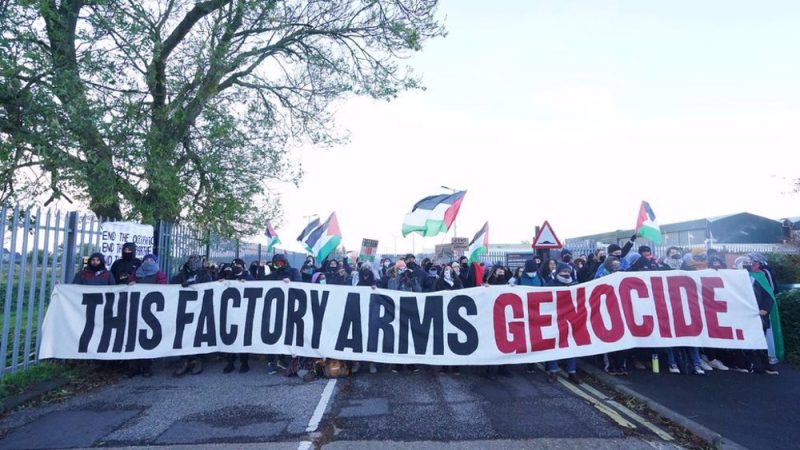
Protesters shut down UK arms factories over Gaza war complicity
Press TV – March 20, 2024
In a display of solidarity with Palestinians, hundreds of workers and protesters have shut down arms factories across England and Scotland to condemn the UK’s complicity in the Israeli regime’s war of aggression in Gaza.
The factories, which produce components for F-35 fighter jets, are accused of shoring up the Israeli regime’s military offensive in Gaza.
Under the banner “Workers for a Free Palestine,” a diverse coalition of individuals from various unions and sectors including health, education, hospitality, academia, and the arts, launched the protests on Wednesday.
Activists aimed to disrupt the supply chain of arms to Israel and denounce the UK’s complicity in the ongoing genocidal war against Palestinians in Gaza.
GE Aviation Systems in Cheltenham and Leonardo UK in Edinburgh were among the targeted sites where components for the F-35 jets are manufactured.
The protesters vowed to continue their protest actions for a month, demanding an immediate cessation of arms sales to Israel and advocating for a permanent ceasefire.
The decision to blockade the arms factories was prompted by Israel’s impending invasion of Rafah, which the United Nations and other international organizations have warned would have catastrophic consequences for Gaza’s population.
Unionists have called on workers across the UK to challenge their government’s military support for the Israeli regime.
“We’re demanding our government immediately halt arms supplies to Israel before it launches this offensive in Rafah using British-made bombs. But we are not waiting for this genocide-appeasing prime minister to act,” Zad, a union member, said in a press release.
This isn’t the first time such protests have occurred.
In December, similar blockades targeted four other arms factories across the UK. Despite assurances from the UK government that it hasn’t supplied lethal military equipment to Israel since October, evidence suggests otherwise.
Affidavits filed at the High Court revealed ongoing export licenses and pending applications for equipment likely to be used in offensive operations in Gaza.
Furthermore, the UK Ministry of Defence disclosed that Israeli warplanes have been permitted to take off from and land in the UK during the Gaza war, raising concerns about Britain’s involvement in facilitating Israeli atrocities.
Israel deploys army of bots to spread anti-UNRWA propaganda: Report
The Cradle | March 19, 2024
Israel is executing an online influence campaign using hundreds of fake social media accounts to advance “Israeli interests” among progressive western audiences, including US lawmakers, Haaretz reported on 19 March, citing an investigation by Israeli media watchdog group Fake Reporter.
The campaign is focused specifically on amplifying reports claiming the involvement of UNRWA workers in the 7 October attack on Israel. As The Cradle has reported previously, Israel provided no evidence for its claims, which were part of a campaign to compel western nations to cut funding to the agency. UNRWA plays a crucial role in delivering aid to Palestinians amid Israel’s campaign to impose famine in Gaza.
Researchers at Fake Reporter pinpointed three fake ‘news sites’ specifically created for the operation. The sites amplified reports copied from other real news outlets, such as CNN, The Wall Street Journal, The Guardian, The Jerusalem Post, and The Times of Israel, which promoted Israel’s narrative about the war.
Hundreds of fake social media accounts then intensively promoted the “reports” from the specially-created websites and other news outlets.
The three websites at the center of the campaign were established before the war in Gaza but became active only after it began.
The fake social media accounts seemed to be ‘cyborgs,’ meaning they operate using a combination of artificial intelligence and real people with fake online personalities. The avatars claimed to portray average US citizens, including white, Jewish, and African–American ones.
The avatars were all created on the same date, used the same profile photos and naming conventions, and shared other characteristics that indicate they are all part of the same network, Fake Reporter found.
Over 500 fake accounts were opened for the campaign on Facebook, Instagram, and X.
Their avatars began to post messages about a wide array of topics, including the alleged lack of safety for Jewish Americans on college campuses, discrimination against Jewish students, and false allegations Hamas committed mass rape on 7 October.
At the end of January, after acquiring tens of thousands of followers, the fake accounts pivoted toward spreading Israel’s false allegations about UNRWA employees participating in the 7 October attack.
The avatars worked to inorganically amplify the ‘shocking’ and ‘disturbing’ allegations about UNRWA.
They responded to social media posts by US lawmakers, influencers, and prominent news outlets.
The campaign’s avatars targeted posts by African–American Democratic lawmakers, including Ritchie Torres, Cori Bush, and Jamal Bowman, who received the most such comments.
Haaretz noted that targeting Democratic African–American lawmakers seemed to be an attempt to counter the wave of support they have given to Palestinians amid Israel’s ongoing campaign of Genocide in Gaza.
Featured Video
Laith Marouf: Hezbollah’s position on US-Iran ceasefire
or go to
Aletho News Archives – Video-Images
From the Archives
Is Israel to blame for the Iraq War?
American Goy | March 10, 2008
I am so tired of this old canard that “Israel had nothing to do with USA’s war with Iraq – in fact, it officially advised America against it”.
Bullshit. … continue
Blog Roll
 Aletho News
- Laith Marouf: Hezbollah’s position on US-Iran ceasefire: What you’re not being told
- Israel’s priority lies in destroying chances of peace between Iran, US: Ex-UN nuclear chief
- Ceasefire for all or for none: Iran shuts Hormuz over Lebanon attacks
- Strait of Hormuz is Iran’s ‘nuclear weapon’ that forced US retreat: Medvedev
- Energy crisis will last for months – Kremlin envoy
- Europe’s quiet role in the war on Iran
- Forty days that shook the Empire: How Iran turned the tables on US and prevailed
- Netanyahu unilaterally declares Lebanon outside of ceasefire deal
- Israeli leaders: ‘Not a single goal’ achieved in war with Iran
- What on earth just happened? Trump, Iran, and the unlikely ceasefire
- If Americans Knew
- Gazans face a triple crisis: severe shortages of water and bread, healthcare in tatters
- NY Times reports how Netanyahu took the US into Iran War
- A sigh of relief over Iran, but Gaza and Lebanon in dire straits – Daily Update
- Thousands dead and neighborhoods razed to the ground: Aid agencies fear southern Lebanon is becoming the new Gaza
- The war the US is fighting for Israel could cost trillions
- ‘Cigarette Burns, Nail Wounds’: Toddler Tortured in Gaza to Coerce Father
- Trump Says US Sent ‘a Lot of Guns’ to Protesters in Iran
- Israeli forces destroy 17 UN peacekeeper cameras in south Lebanon
- US-Israeli strikes ‘completely destroy’ synagogue in Tehran
- Archbishop for US Military Says Iran War Is Unjust Under Catholic Teaching
- No Tricks Zone
- An Inconvenient Tree: Uncovered In Alps… Europe Much Warmer Than Today 6000 Years Ago
- New Study Reports A 60% Slowdown In Greenland’s Ice Loss Rate In The Last Decade
- Low Intensity Tornado Wrecks Major Solar Farm, Creating A Potential Toxic Dump
- New Study Finds Warming Saves Lives…Cold Temperatures 12 Times More Deadly Than Excess Heat
- German Science Blog Accuses PIK Climate Institute Of Hallucinating Climate Tipping Points
- Devastating Assessment Of Comirnaty Vaccine By Former Senior Pfizer Europe Toxicologist
- New Study: CO2 Is ‘Effectively Negligible’ As An Explanatory Climate Change Factor Since 2000
- Former Pfizer Toxicologist Dr. Helmut Sterz Tells Bundestag Hearing Pfizer Vaccine Should Have Never Been Approved
- Energy Expert: Germany’s Nuclear Phaseout Was A “500 Billion Euro Mistake”
- New Research: South Australia’s Mid-Holocene Sea Surface Temperatures Were 4°C Warmer Than Today
 Aletho News