Down and out: How 5 months of genocidal war on Gaza paralyzed Israeli economy
Press TV – March 11, 2024
Last month, in what economic pundits saw as a death knell for the already-beleaguered Israeli economy, a US credit rating agency downgraded the regime’s rating and outlook.
The downgrade from “stable” to “negative”, according to Moody’s, is the direct consequence of the Israeli regime’s genocidal war on the Gaza Strip and political instability inside the occupied territories marked by growing discontent and simmering protests.
A few weeks ago, the Israeli regime’s Central Bureau of Statistics released another damning report, according to which Tel Aviv’s economy shrank by nearly one-fifth in the last quarter of 2023.
Amid depleting consumer spending, trade and investment since October 7, Israel’s Gross Domestic Product (GDP) recorded a 19.4 percent drop in its annual rate in the last three months of 2023.
Benjamin Netanyahu’s regime launched a devastating war on the coastal Palestinian territory on October 7, stung by the unprecedented Al-Aqsa Storm Operation led by Hamas.
In the last 156 days, more than 31,000 Palestinians, including over 14,000 children and nearly 9,000 women have been killed in Gaza. It has also spawned the worst humanitarian crisis in the territory.
According to observers, the indiscriminate bombings on Gaza have badly backfired on the regime amid both internal and external turmoil for the Netanyahu regime.
Hundreds of thousands of Israeli reservists have in recent months been forced to abandon their jobs while many more have fled in panic, due to which major industries have come to a grinding halt.
The labor shortage is acute as over 350,000 reservists have been pressed into military service, as per the Organization for Economic Cooperation and Development, which says the law has caused a “pronounced slowdown” of the Israeli economy, which had grown about 3 percent before October 7.
Foreign investments have also virtually ended as investors are not willing to put their money on tinderbox – both due to the war in Gaza as well as the internal turmoil for the Netanyahu regime.
According to the data from the Israeli labor ministry in December, about 950,000 jobs were lost in the first three months of the war, which has increased manifolds now as the situation remains precarious and the war rages on – now into its sixth month.
Multi-national brands linked to the Israeli regime have also faced blanket boycotts in recent months, suffering enormous losses. Many companies have tried to distance themselves from the regime.
Domestic economy in tatters
Every sector of the Israeli economy – from high-tech to agriculture to tourism to various industries – has been irreparably dented by the raging war on Gaza, a problem exacerbated by the shortage of workforce and precarious situation.
Many businesses have suspended their operations while others have been forced to shut down their operations. Some workers have been forced to join military duty while many others have fled.
A Bloomberg survey last month said the Israeli economy suffered one of its worst-ever slumps after it launched the genocidal war on Palestinians in Gaza, with businesses coming to a screeching halt.
The regime’s GDP plummeted by 19.4 percent in the last quarter of 2023, which the report said was worse than every estimate in its survey of analysts.
“The release highlights the degree to which the Israeli economy has been affected by the conflict, particularly on the private activity side,” Goldman Sachs economists Tadas Gedminas and Kevin Daly were quoted as saying in the report.
Israeli newspaper Maariv, in a report earlier this week, also said the continuation of the Israeli war on Gaza has contributed to massive losses for the regime in both political and economic spheres.
It followed another report published by the Israeli website Walla, which cited the Director of the Israeli Tax Authority Shai Aharonovitz as saying that the damage caused by the Gaza war is “six times greater” than the Second Lebanon War (2006), and about half a million compensation claims have been filed by those who have suffered due to it.
According to analysts, the Israeli war on Gaza, which has failed in all its stated objectives, has resulted in a steep drop in the regime’s tax revenues, skyrocketing debt and economic recession.
The regime’s GDP has also taken a serious blow, as attested by Moody’s report in February, which cut the regime’s rating to ‘A2’ and described its credit outlook as ‘negative’.
It was the first time ever that the regime’s economic outlook was downgraded, pointing to the staggering costs of the war that is increasingly turning out to be an exercise in futility.
The war, according to analysts, has discouraged potential investors and disrupted the labor market, especially with hundreds of thousands of workers summoned for mandatory military duty.
In a report in November, the Bank of Israel said the absence of thousands of workers from their jobs was costing the Israeli economy an estimated $600 million a week, or about 6 percent of the weekly GDP.
That number, according to economic analysts, has surged dramatically in the past three months, to the tune of a few billion dollars every week.
The regime’s tourism industry has also been affected. Monthly figures announced by Israel’s Central Bureau of Statistics revealed that in January only 500 single-day visits to the occupied territories were registered, compared to 14,000 in January 2023, marking a drastic decrease of 96 percent.
The travel industry used to make up nearly 3 percent of the regime’s GDP in 2019, before the pandemic. The figure fell to 1.1 percent in 2021 and has been virtually paralyzed since October 7.
The Israeli newspaper Calcalist reported in January that about 900,000 tourists were expected to visit the occupied territories in the three months after the start of the war. The number dropped to 190,000 because many of them opted out. That number has also sharply come down now.
“The war (on Gaza) was a huge breaking point for the (Israeli) economy which is still ongoing,” Professor Benjamin Bental from the Taub Center for Social Policy Studies was quoted as saying in December by The Median Line website.
“There are tremendous consequences that we still cannot estimate the end of.”
A RAND analysis in 2015 estimated that the financial impact of any conflict between the Israeli regime and Palestine in the next ten years would be to the tune of $400 billion.
Daniel Ege, the director of the Economics and National Security Initiative at the RAND Corporation, who authored that report, in an article published in November made a fresh assessment.
“For Israel, 90 percent of the economic shock will come from the indirect effects: reduced investment, a disrupted labor market, and slowed productivity growth. The specifics of this current crisis will, of course, differ from our model and the past,” he wrote.
Israeli ports hit the hardest
In the past five months, gas fields in the occupied territories have dried, airlines have become defunct, farms have been destroyed, major businesses have shut down and ports have been empty.
Colossal losses have been recorded at ports occupied by the Israeli regime, most notably the Port of Umm Al-Rashrash (Eilat), which recorded a 90 percent drop in traffic and $3 billion in direct losses.
“All cargoes arriving in Eilat through the Bab el-Mandeb Strait from the Far East, i.e. China, Japan, South Korea and India, are no longer transported because ships are afraid to pass through the Bab el-Mandeb Strait,” Gideon Golber, CEO of the Eilat port company, said late January.
Golber’s company deals primarily with the import of cars and export of potassium fertilizers, and before October 7, 50,000 new cars were stored at the port. Yemeni military’s actions in support of Gaza have virtually brought business activities at the bustling port to a grinding halt.
“If Yemeni operations in the Red Sea continue, we will reach a situation where there are no ships in the port,” he was quoted as saying by Reuters, referring to the repercussions of the Red Sea events.
Eilat Port has also been struck with missiles by both the Yemeni military and the Iraqi resistance groups, sending ripples of shock and fear among investors and shipowners there.
The two other major Israel-occupied international ports, Haifa and Ashdod, a third of whose transport depends on the Red Sea, have also recorded heavy losses, with a 70 percent drop in transshipment.
Yemeni military has carried out a string of operations against ships linked to the Israeli regime or its Western backers, mainly the US and the UK, in the Red Sea in solidarity with the people of Gaza.
The operations have forced major shipping companies doing trade with the Israeli regime to avoid the strategic waterway in recent months, incurring staggering losses for the regime.
Amid the continuation of the Yemeni military’s operations against ships trading with the Israeli regime in the Red Sea, it is to be expected that the losses will continue to pile up.
The Islamic Resistance in Iraq has also carried out attacks on the Israeli-occupied ports, including Haifa and Ashdod, as well as the natural reserves in the Mediterranean Sea.
Haifa Port (situated on the Mediterranean) is believed to store about 90 percent of essential commodities destined for the occupied Palestinian territories.
The operations of the strategic port were taken over by Indian business conglomerate Adani Group in February, months after a consortium of Adani Ports and Special Economic Zone and Israel’s Gadot Group won the tender to privatize it for a mammoth USD 1.18 billion.
Only days after the Palestinian resistance launched its unprecedented operation against the occupying regime on October 7, Adani shares fell by 4.5 percent, triggering alarm and anxiety among investors.
According to informed sources, the Indian company has suffered staggering losses in the past five months and speculation has been rife about ending the contract given the high costs.
Ashdod port, close to Gaza’s border with occupied territories, handles about 40 percent of the Israeli regime’s total maritime-bound trade, including imports and exports, according to the Israeli media.
Equipped with the Iron Dome military system, Ashdod port has been severely hit amid the war on Gaza, with most cargo diverted to other Israeli-occupied ports, which have also been deserted lately.
One of the first ships to divert from Hashdod to Haida in October last year was a Taiwanese container ship Evergreen Line, which cited a “persistent unsafe situation” amid the war on Gaza. Since many, virtually all ships have avoided the port, turning it into a desolate and barren island.
According to analysts, the total damage to the Israeli economy varies by estimate and reaches over $100 billion, with a minimum of ten years estimated for full recovery, which looks very unlikely.
Military and arms boycott
The Israeli regime’s economy has always been heavily dependent on trade and imports, especially military equipment, which makes the regime’s much-hyped military vulnerable to foreign boycott.
Israel’s beleaguered military industry is experiencing serious problems with imports as civil society, lawmakers and courts in many countries want to prevent arms exports to the regime.
The decisions have been partly influenced by the interim ruling issued by the International Court of Justice (ICJ) in The Hague in early February, ordering the Israeli regime to halt its genocide in Gaza.
The UN experts also issued a statement late last month, saying any transfer of weapons or ammunition to Israel that would be used in Gaza would “violate international humanitarian law.”
The impact of the ICJ ruling was clearly visible. A court in the Netherlands ordered the Dutch government on February 12 to halt the export of F-35 jet fighter parts to the Netanyahu regime.
The Hague Court of Appeal found that there was “a clear risk” that the F-35 jets used by the Israeli regime, some components of which are exported by the Netherlands, would enable to commit “serious violations of humanitarian law” against the Palestinians in Gaza.
The judges considered that “Israel does not take sufficient account of the consequences for the Gaza Strip civilian population when conducting its attacks.”
Israel’s attacks have caused a disproportionate number of civilian casualties, including thousands of children,” the Dutch judges concluded.
Britain, one of the Israeli regime’s biggest arms exporters, which manufactures 15 percent of F-35 parts, has resisted calls from rights groups to end the exports. The High Court in London also greenlighted the arms shipments last week by dismissing a case filed by some human rights groups.
Italy, however, has already announced the end of its arms sales to the Israeli regime.
Italian Foreign Minister Antonio Tajani announced in January that his country had halted all exports of military equipment to Tel Aviv. Spain’s foreign minister also claimed that his country has not sold any arms to Israel since the events of October 7, and added that an arms embargo is in place now.
European Union foreign policy chief Josep Borrell, otherwise a staunch supporter of Israel, has also in recent months raised concerns over arms sales to the Tel Aviv regime, even taking potshots at US President Joe Biden for his administration’s approval of $14 billion worth arms to Israel.
“Well, if you believe that too many people are being killed, maybe you should provide fewer arms in order to prevent so many people being killed,” Borrell told reporters last month.
Itochu, one of Japan’s largest trading firms, also announced that it was ending its partnership with Elbit Systems, the Israeli regime’s largest arms manufacturer, due to the genocide in Gaza.
Itochu Chief Financial Officer Tsuyoshi Hachimura cited the top UN court’s order on January 26 as the reason for terminating the memorandum of understanding (MoU) signed between Itochu, Elbit and Nippon Aircraft Supply in March last year.
Elbit is the largest military contractor owned by the Tel Aviv regime with a share of 85% in the production of ground equipment and drones, and Japan is one of the world’s largest arms importers.
The company has already gained notoriety for testing new weapons on Palestinian civilians, as well as for cases of bribery around the world, multiple failures of their systems in tests aboard, etc.
Due to boycott activism, Elbit has lost hundreds of millions of dollars worth of international contracts in recent years, particularly since October 7 of last year. Many of its factories have been either shut down or disrupted by pro-Palestine activists in the US and the UK.
Since the outbreak of the genocidal war on Gaza, a major collaboration deal with Elbit has also been terminated by the Brazilian state of Rio Grande do Sul.
Boycott of big brands
In November of last year, the Press TV website published an investigation on global companies with close ties to the Israeli regime facing boycott amid the regime’s genocidal war on Gaza.
Worldwide campaigns have been launched during this period calling for the boycott of Israeli and international companies and brands directly or indirectly complicit in the Gaza genocide.
The companies that have faced boycott include Siemens, which is complicit in the regime’s settler-colonialism project through its EuroAsia Interconnector; Hewlett Packard, which helps the regime run biometric systems used to monitor and restrict the movement of Palestinians; AXA Divest, one of the largest investors in Israeli regime-run banks; Puma, a footwear giant that sponsors Israeli football.
Food and beverage giants such as McDonalds and Starbucks have also recorded huge losses.
Starbucks, the multinational chain of coffeehouses and roasteries headquartered in Seattle, has seen losses worth billions of dollars due to the global boycott campaign, which gathered momentum after the company took action against workers’ unions over its pro-Palestine stance.
Starbucks’ longtime CEO Howard Schultz is known to be an ardent supporter of the Israeli regime. Schultz has in the past boasted of being an active Zionist and worked closely with Israeli Premier Benjamin Netanyahu and radical Zionist settler groups, for which he even received awards.
Back in December 2013, around $11 billion in losses were reported, and it is estimated that the figure has now surged to $15 billion as the boycott campaign intensifies.
Last week, retail giant AlShaya Group, which owns the rights to operate Starbucks in West Asia, announced staff downsizing, citing “challenging trading conditions over the last six months.”
McDonald’s also has been hit by the boycott campaign. The US-headquartered company last month reported its first quarterly sales miss in nearly four years, sending the company’s shares down about 4 percent.
The company admitted that the losses were the reflection of “the impact of the war” in Gaza, where the Israeli regime has been carrying out relentless bombings since October 7.
“So long as this conflict, this war is going on, we’re not making any plans, we’re not expecting to see any significant improvement in this,” McDonald’s CEO Chris Kempczinski told investors.
“It’s a human tragedy what’s going on, and I think that that does weigh on brands like ours.”
Ian Borden, the company’s chief financial officer, also noted that the war had meaningfully impacted the fast food giant’s bottom line in the region during the last quarter of 2023.
The campaigns against McDonald’s, Starbucks and other multinational brands have significantly expanded in recent months, including in regional countries such as Jordan, Kuwait and Morocco.
Workers at American tech giants Google and Amazon have also stepped up pressure on their companies to snap ties with the Israeli regime, with Google workers also urging an end to Project Nimbus, under which the tech company supplies technology to the Israeli military for surveillance purposes.
The potential for the expansion of the boycott campaign remains high, as proved by recent large-scale protests in countries considered key trade partners of Israel, as well as public opinion in those countries.
Syrian FM: ‘Western leaders are little puppets of the Zionist enemy’

Al Mayadeen | March 10, 2024
Syrian Foreign and Expatriates Minister, Faisal Mekdad, emphasized that what is happening in Gaza is a genocide perpetrated by Israeli Prime Minister Benjamin Netanyahu, who has killed over 12,000 children and 8,000 women, and completely destroyed the Gaza Strip.
In a statement on the ministry’s X account, Mikdad said “What European Union strategists say about building a world based on rules and regulations has faded. The murderer Netanyahu has not left any rule unbroken: International law, international humanitarian law, the Universal Declaration of Human Rights, the United Nations Charter, children’s rights, women’s rights, democracy, disarmament, and peace.”
He continued to say what is more dangerous than Netanyahu and his ruling “gang’s” crimes, is the support he received from many EU leaders and the blind trust Washington has given him.
“Everyone knows that much of what the European Union leaders did before and after was a form of clowning, hypocrisy, and lies, and their defense of Netanyahu’s crimes led to pulling the rug from under all of their feet and showed them as they really are, little puppets in the hands of Zionism and enemies of peoples’ rights and aspirations,” he said, slamming the West.
Gaza’s last remaining children relief fund razed in Israeli raid
Press TV – March 10, 2024
Palestine Children’s Relief Fund (PCRF), an independent humanitarian organization, says its last remaining office in the Gaza Strip has been destroyed after Israeli military aircraft carried out a strike against a neighborhood in the besieged coastal territory.
On Saturday, PCRF in a post on X (formerly Twitter), shared pictures of a building reduced to rubble, as Israel’s genocidal war against Gaza enters its fifth month.
“PCRF’s last office in Gaza was destroyed by one of Israel’s air raids today. Two other offices were destroyed in previous months by Israeli air attacks as well.
“We are thankful that no one was killed or severely injured during these bombings,” the group said.
The PCRF was founded in 1991 by Steve Sosebee, who currently serves as the organization’s president.
According to its website, the non-governmental organization provides free medical care to thousands of injured and ill children annually who lack local access to care within the local healthcare system in Palestine and other countries in the West Asia region.
NGO worker killed in Israeli attack
Meanwhile, a Palestinian aid worker employed at a US charity has been killed in an Israeli attack on his shelter in the central Gaza Strip city of Deir al-Balah.
The non-governmental organization Anera – which helps refugees in Palestine, Jordan, and Lebanon – said Mousa Shawwa was killed on Friday.
It said the bombing comes despite the fact that coordinates of Shawwa’s shelter had been provided to the Israeli military for the staff safety on several occasions, including just days before the attack.
Shawwa is the fifth member of a US humanitarian aid group killed in the war on Gaza, Anera added.
At least 30,960 Palestinians, most of them women and children, have been confirmed killed and 72,524 others injured so far during Israel’s genocidal war on Gaza. The war began after Gaza-based resistance movements carried out Operation al-Aqsa Storm into the occupied territories on October 7, 2023.
The Israeli military campaign has devastated large swathes of Gaza and displaced a staggering 85 percent of the Strip’s 2.3 million population.
According to the UN Agency for Palestinian Refugees (UNRWA), more than 70 percent of civilian infrastructure in the Gaza Strip has been destroyed or severely damaged by intense Israeli attacks.
Israel has also imposed a “complete siege” on the coastal sliver, cutting off fuel, electricity, food, and water to the more than two million Palestinians living there.
The hunger killing Gaza’s children has a clear cause that few are willing to name out loud
By Eva Bartlett | RT | March 10, 2024
Following the February 29 Israeli slaughter of at least 115 starving Palestinians lined up for food aid, there was little or no outrage by the same Western media which would have howled if the perpetrator were Russia or Syria.
According to the Gaza Health Ministry, early morning on Thursday, February 29, Israeli forces opened fire on unarmed Palestinians waiting just southwest of Gaza City for desperately needed food aid. As a result, 115 civilians were killed and over 750 wounded.
Popular US commenter Judge Andrew Napolitano said in a recent interview with award-winning analyst Professor Jeffery Sachs, “Innocent Gaza civilians were lined up to receive flour and water from an aid truck, and more than 100 were slaughtered, mowed down, by Israeli troops. This has got to be one of the most reprehensible and public slaughterings that they’ve engaged in.”
The official Israeli version of events, unsurprisingly, puts the blame on the Palestinians themselves. The deaths and injuries were supposedly caused by a stampede, and the Israeli soldiers only fired when they felt they were endangered by the crowd. The BBC even cited one army lieutenant as saying that troops had “cautiously [tried] to disperse the mob with a few warning shots.” Mark Regev, a special adviser to the Israeli prime minister, went as far as to tell CNN that Israeli troops had not been involved directly in any way and that the gunfire had come from “Palestinian armed groups.”
Testimonies from survivors and doctors tell a different story, though, saying the majority of those treated after the incident had been shot by Israeli forces. Legacy media reports, however, use characteristically neutral wording when evidence starts to stack up against Israel. “112 dead in chaotic scenes as Israeli troops open fire near aid trucks, say Gaza officials,” a Guardian headline reads. Palestinians always seem to just “die,” not get killed, and Israeli troops seem to have just “opened fire” nearby. The skewed wording conventions persist even despite the attribution to Palestinian officials present in that same headline – officials like the Palestinian Foreign Ministry, which was quite clear in accusing Israel of perpetrating a ”massacre” as part of a “genocidal war.”
The article does eventually cite the acting Director of al-Awda hospital as saying most of the 161 casualties treated appeared to have been shot. The confusing headline was likely intentional, counting on most people not bothering to read the article in full.
In a report published on March 3, Euro-Med stated members of its field team were present at the time of the incident and “documented Israeli tanks firing heavily towards Palestinian civilians while trying to receive humanitarian aid.” The report goes on to cite Dr Jadallah Al-Shafi’i, head of nursing at Shifa, Gaza’s main hospital, saying, “paramedics and rescue workers were among the victims,” and that at Shifa “they observed dozens of dead and injured, hit by Israeli gunfire.”
The report also cites Dr Amjad Aliwa, an emergency specialist at Shifa who was also on site when Israel opened fire. According to Aliwa, the Israeli fire began, “as soon as the trucks arrived on Thursday at 4 am”
But the February 29 massacre, tragic as it is, is only a part of the current stage of Israel’s war on Gaza: the deliberate starvation of Palestinians. And like the massacre itself, the whole issue is being subjected to the hands-off wording treatment by establishment media.
On February 29, the New York Times published an article whose headline, “Starvation Is Stalking Gaza’s Children,” suggests starvation is a mysterious malicious force with a will of its own, skirting the mention of the Israeli siege as its obvious cause.
Again, as with the Guardian article, a few paragraphs in, the NYT piece does state that the “hunger is a man-made catastrophe,” describing how Israeli forces prevent food delivery and how Israeli bombardments make aid distribution dangerous.
As Professor Sachs stated, ”… Israel has deliberately starved the people of Gaza. Starved! I’m not using an exaggeration, I’m talking literally starving a population. Israel is a criminal, is in non-stop, war crime, status now. I believe in genocidal status.”
Anyone who’s been paying attention knows that the February 29 massacre was not the first such incident, and likely not the last. A thread on Twitter/X outlines this, noting, ”Before yesterday’s “Flour Massacre”, the IDF has been shooting indiscriminately for WEEKS at starved Gazans awaiting aid trucks at the exact same spot, virtually every single day!”
The thread (warning: graphic images!), compiled by Gazan analyst and Euro-Med chief of communications Muhammad Shehada, gives examples of Israeli soldiers firing on Palestinians every single day in the week prior to February 29.
You can bet that, were these Syrian or Russian soldiers firing on starving civilians, the outrage would be front page, 24/7, for weeks. Scratch that, they wouldn’t even have to do it – just a hint of an accusation would have been enough to get the presses going.
Starvation in Syria was another matter
The NYT article mentioned above notes that “Reports of death by starvation are difficult to verify from a distance.” But ‘verifying from a distance’ is precisely what the NYT and other Western media did repeatedly in Syria over the years.
In areas occupied by (then) al-Nusra, Jaysh al-Islam, and the other extremist terrorist gangs which the West and corporate media dubbed “rebels,” food aid was always taken by the respective terrorists and withheld from the civilian population, causing starvation in some districts. Madaya, to the west of Damascus, eastern Aleppo, and later eastern Ghouta were districts most loudly campaigned over in legacy media, providing covering fire for the broader US-led campaign to overthrow the Syrian government.
Backing the claims that the government was starving civilians were mostly “unnamed activists” or activists whose allegiance to Nusra, or even ISIS, was very overt.
As I would see and hear whenever one of these regions was liberated, ample food and medicine had been sent in, but civilians never saw it. Time and again, in eastern Aleppo, Madaya, al-Waer, eastern Ghouta, to name key areas, civilians complained that terrorist factions hoarded food and medicine, and if they sold it to the population, it was at extortionist prices people couldn’t afford.
In the old city of Homs in 2014, back then dubbed by legacy media as the “capital of the revolution,” starved residents I met told me the West’s precious “rebels” had stolen every morsel of food from them, stealing anything of value as well.
Yet, media headlines about these regions screamed about starvation, outright blaming the Syrian government, and were accompanied by disturbing images of emaciated civilians (some of which were not even from Syria) meant to evoke strong emotions among readers and viewers. The same media largely opts not to show you gaunt, starving, Palestinians in Gaza.
Tellingly, Syrian towns surrounded by terrorist forces, besieged, bombed, sniped and starved, got virtually no media coverage. It didn’t fit NATO’s narrative of “rebels”=good, Assad=bad.
But in Gaza the world watches in real time as Palestinians die from the ongoing, preventable, starvation.
Some days ago, the CEO of Medical aid for Palestinians, Melanie Ward, in an interview with CNN, named Israel as the cause of starvation in Gaza.
“It’s very simple: it’s because the Israeli military won’t let it in. We could end this starvation tomorrow very simply if they would just let us have access to people there. But it’s not being allowed. This is what they said [on October 9], ‘Nothing will go in’,” Ward said.
She described the starvation as “the fastest decline in a population’s nutrition status ever recorded. What that means is that children are being starved at the fastest rate the world has ever seen. And we could finish it tomorrow, we could save them all. But we’re not being able to.”
This is echoed by UNICEF. The press-release for its February 2024 report notes that 15.6 % (one in six children) under two years of age are “acutely malnourished” in Gaza’s north. “Of these, almost 3% suffer from severe wasting, the most life-threatening form of malnutrition, which puts young children at highest risk of medical complications and death unless they receive urgent treatment,” UNICEF notes.
Even worse, “since the data were collected in January, the situation is likely to be even graver today,” UNICEF warns, likewise noting the rapid increase of malnutrition is “dangerous and entirely preventable.”
Professor Sachs made an important point: “This will stop when the United States stops providing the munitions to Israel. It will not stop by any self control in Israel, there is none… They believe in ethnic cleansing or worse. And it is the United States which is the sole support… that is not stopping this slaughter.”
Air-dropping paltry amounts of food aid into Gaza is not the answer. It both legitimizes Israel’s deliberate starvation of Gaza and also makes those Palestinians who run toward the aid sitting ducks for the Israeli army to maim or kill. The only solution is to immediately open the borders and allow in the hundreds of aid trucks parked in Egypt. And end the Israeli bombardment of Gaza.
Eva Bartlett is a Canadian independent journalist. She has spent years on the ground covering conflict zones in the Middle East, especially in Syria and Palestine (where she lived for nearly four years).
Zionist Jews in Biden administration calling the shots on Israeli war on Gaza

By Ivan Kesic | Press TV | March 10, 2024
One of the key but underreported factors of the unwavering US support for the Israeli genocidal war on Gaza is the overwhelming presence of Zionist Jews in the Joe Biden administration.
These Zionist Jews exert enormous influence in the American power corridors and enjoy unconditional support from the US president who has on numerous occasions boasted of being a “Zionist” himself.
The presence and influence of Zionist Jews in the White House has always been a point of discussion, however, since the events of October 7, it has manifested itself in many ways.
Biden administration’s vetoes of ceasefire resolutions in the UN Security Council, which drew widespread condemnation from pro-Palestine groups, rekindled the debate about the Zionist influence.
Raising the issue of the dominance of Zionist Jews in the US administration and policy circles is often seen through the prism of “anti-Semitism” in the West, even though the same people paradoxically like to boast about the disproportionate number of Jews in other fields.
The Zionist Jewishness of Biden’s cabinet was pointed out recently by The Forward, a progressive media for a Jewish American audience, as well as the Israeli right-wing newspaper Times of Israel.
Being a Jew should not be seen as a problem, but those in the Biden administration have clearly exhibited the tendencies of Zionism – not only justifying the Israeli regime’s genocide in Gaza but also lobbying for more financial and military aid to the occupying regime.
There are also non-Jewish Zionists whose support is motivated by Christian Zionism or belonging to pro-Israel lobbies, a common case in the ranks of the Republican Party.
The problem lies in the fact that everyone in the Biden administration is a radical Zionist who will uncompromisingly justify Israeli war crimes, with slight disagreements over relatively minor issues, such as illegal Israeli settlements in the occupied West Bank.
In the American mainstream media, voting in the UN Security Council and supporting the genocidal destruction of Gaza is treated as common sense and a natural course of action.
Biden made no secret of his Zionist inclinations, uttering the words “I am a Zionist”. And he has proved it through numerous pro-Israeli activities in his decades-long political career.
One of them is the placement of Jewish Zionists in top positions in his administration, which at the beginning of 2021 evoked a popular joke on social networks that the West Wing would have a “minyan.”
The Hebrew term “minyan” means the minimum number of males (10) required to constitute a representative “community of Israel” for liturgical purposes.
Biden’s initial lineup includes Anthony Blinken as Secretary of State, Merrick Garland as Attorney General, Avril Haines as Director of National Intelligence, Ronald Klain as White House Chief of Staff, Rachel Levine as Assistant Secretary for Health, Alejandro Mayorkas as Secretary of Homeland Security, and Janet Yellen as Secretary of the Treasury.
One level down are David Cohen as Deputy CIA Director, Eric Lander as science and technology adviser, Ann Neuberger as Deputy National Security Adviser, and Wendy Sherman as Deputy Secretary of State.
In the meantime, Victoria Nuland took the position of Undersecretary of State for political affairs, Ed Siskel as White House counsel, and Klain was replaced by Jeff Zients as chief of staff.
Others appointed by Biden include Daniel Shapiro as a special liaison to Israel on Iran, Ned Price as spokesman for the Department of State, Jennifer Klein as executive director of the White House Gender Policy Council, as well as a large number of ambassadors.
The Zionist envoys include Michael Adler, David Cohen, Rahm Emanuel, Eric Garcetti, Mark Gitenstein, Amy Gutmann, Jonathan Kaplan, Yael Lempert, Alan Leventhal, Randi Levine, Jack Lew, Jack Markell, Constance Milstein, Marc Nathanson, Marc Ostfield, David Pressman, Daniel Rosenblum, and Marc Stanley, among others.
Blinken, the top American diplomat, comes from a Zionist family. His grandfather Maurice was one of the early American Zionists and the founder of the American Palestine Institute, in the years before the declaration of the Zionist entity.
His institute funded economists to prepare a report on the economic viability of such an entity and lobbied Washington to politically support its creation.
Following Blinken’s appointment as the top US diplomat, replacing Mike Pompeo, the Israeli media praised his and Biden’s close relations with Tel Aviv during the Second Intifada in the early 2000s, noting their “lifelong support for Israel and its security.”
During the Obama administration, Blinken often justified Israeli aggressions in the region with the hackneyed phrase “the right to self-defense” and praised Trump for strengthening Israel’s regional alliances.
He was a close confidant of the Israeli ambassador to the US Ron Dermer who could call him in the middle of the night for pro-Israeli services, such as lobbying hard to have Israel’s Iron Dome air military system financed with American taxpayer money.
In his first days in office, he also made it known that the new Biden administration would support earlier Trump’s decision and keep the American embassy to the occupied territories in occupied al-Quds.
Last year, during the bickering between Biden and Netanyahu, Blinken pledged enduring US ties with Israel, seeing it as a far more important ally than NATO member Turkey.
As for Mayorkas, even the Israeli media boasted of his strong family ties to Tel Aviv and praised him for the data-sharing pact between the United States and the Zionist regime.
Even greater Zionist credit for intelligence sharing goes to CIA deputy chief David Cohen, whose career under Obama focused on sanctioning Israel’s enemies.
Thus, it is no surprise that Americans are bankrolling the genocide of Palestinians in Gaza while harping about ceasefire and aid airdrops to hoodwink the international community.
The special military operation, Avdeyevka, and Gaza
By Yuriy Zinin – New Eastern Outlook – 09.03.2024
The name Avdeyevka, which is known to few in the Arab world, has featured prominently in the Middle Eastern media in recent weeks. Media commentators have examined the battle to liberate this city, its significance, and discussed the opinions of political analysts and observers on the future course of military operations in the conflict, including its international impact.
A number of military observers quoted in the media have referred to this event as “a turning point in the course of the war,” similar in significance to the conquest of Bakhmut by Russian forces last year, with both cities being of similar strategic and symbolic value.
For example, Rizk Al-Hawalda, a retired brigadier general and military expert from Jordan, believes that the capture of Avdeyevka will allow Russian forces to further strengthen their position in Ukraine, and increase their combat capability to defend the territories under their control. For the Ukrainian forces, however, the capture means that their ability to retake what they have lost has been thwarted, leaving them to face the fact that this land has now become Russian territory, and that this loss is irreversible.
Other authors believe that the capture of this city will allow Russian forces to control the space around Donetsk and create logistical corridors to expand the scope of their operations.
The Egyptian Al Qahera News edition sees the capture of Avdeyevka as an “important victory” achieved by Russian troops just before the second anniversary of the start of the special military operation. They outnumber the enemy on the battlefield, both in terms of troop numbers and equipment, giving them an advantage when attacking Ukrainian formations, which are short on weapons and soldiers amid cracks in the West’s military support for Kiev.
These changes are also evident in the range of media responses from the Middle East. In general, they adopt a balanced tone when discussing the results of fighting after two years of the special military operation, and the political and economic consequences of the combat.
For example, the influential Saudi newspaper Al-Sharq Al-Awsat opines that Washington and its allies have miscalculated. It is referring to the West’s imposition of anti-Russian sanctions, its attempts to undermine Russia’s economy, deprive it of revenues from hydrocarbon exports, and isolate it in the international arena, etc.
Russian President Vladimir Putin’s calculations, it suggests, are based on common sense and are absolutely correct. He has carefully avoided the traps laid out for him and been able, with skill and step by step, to dismantle the economic blockade declared against his country, and the authors also admire the undeniable victories of Russian troops on the military frontlines.
A number of other Arab publications take a similar line. A review of the events in Ukraine, as they see it, teaches a number of lessons. One is that a state’s policy should not be based on promises of support from outside, and should be founded first and foremost on its own interests. Now, the West’s promises of support have failed. The former media rhetoric that Ukraine is bulwark for Europe is on the wane.
Europeans are suffering from interruptions to the supply of Russian gas, supply chain disruption, inflation and interest rate hikes, etc. The European countries see resolving their own economic crises as their priority, and do not wish to suffer because of Ukraine. In short, the credibility of the Western coalition supporting Ukraine has fallen, and, as the present author notes, it looks as if Ukraine will have to go into the third year of the war alone.
Significantly, such assessments are increasingly being reflected in public opinion in the Middle East. Recently, Akhbar Al Aan, a leading news platform in Dubai (UAE) conducted a poll among its readers about Western military aid for Ukraine. To the question: would this help rescue Kiev, 85% of respondents answered “no” and just 15% answered “yes”.
Today, a number of political observers in the Middle East are drawing parallels between the conflict in Ukraine and the war in Gaza and reaching their own conclusions. In particular, they note the similarity of behavior styles of the leaders of the two countries: Volodymyr Zelensky and Benjamin Netanyahu. They conclude that both are characterized by a pathological desire to deny reality and are stubbornly following their chosen courses, despite the obvious failures of their strategies….
Ukrainian President Volodymyr Zelensky showed no sympathy for the Palestinian victims of the war in Gaza. He did not hesitate for a second, but supported the Israeli war machine, Akhbar Al Aan claims.
Other authors criticize the “blindness” of those countries that oppose Russia’s “invasion” of Ukraine but are unable to see what Israel has been doing in the Gaza Strip since October 2023.
In their view, one of the lessons of the Gaza conflict involves the issue of trust in the West. It promotes and continues to proclaim its values and principles as universal, applying to all people regardless of religion, race or nationality. But these trumpeted values have not been applied in Gaza.
Many political observers share this view. The disillusionment with Western values that has emerged in the current Israeli-Palestinian conflict in the Gaza Strip has left a deep wound in the hearts and minds of Arab elites who had placed their hopes in an engagement with Western civilization. This will push the Arab nations’ Islamic civilization, and the civilization of the Global South in general, further away from the West, Arab media commentators predict.
Yuri Zinin, senior researcher at the Center for Middle East and Africa Studies at the Moscow State Institute of International Relations (MGIMO).
Israeli rabbi calls for genocide of all Palestinians in Gaza

Al Mayadeen | March 8, 2024
The mass killing of Palestinians in the Gaza Strip “is permissible according to the halakhic principles,” the head of a Jewish religious school in occupied Yafa, Rabbi Eliyahu Mali, stated according to Israeli news website Ynet.
A recording of the extremist’s answers to questions on the Gaza Strip was published a few hours ago on YouTube and is available for the public.
Halakha or Jewish Law, which also translates to “the way to behave or act,” is held as divine law among Orthodox Jews such as Mali, who called for the extermination of Palestinians in the Gaza Strip.
When asked about what should be done to infants and the elderly, Mali simply answered, “The same.”
Mali founded the religious school Shirat Moshe and has called upon his students to strictly follow the orders of the Israeli occupation forces, saying that if IOF soldiers do not kill Palestinians, then Palestinians will kill them. It is worth noting that Shirat Moshe students serve in the IOF, despite other schools of Orthodox Judaism refusing military service.
The extremist stressed that the main principle of the war on Gaza is that “no soul remains alive,” urging Israelis to carry on the genocide against Palestinians.
Biden’s pier for Gaza is a hollow gesture that will change almost nothing
By Jonathan Cook | March 8, 2024
A few observations on President Biden’s building of a “temporary pier” – or what his officials are grandly calling a “port” – to get aid into Gaza:
1. Though no one is mentioning it, Biden is actually violating Israel’s 17-year blockade of Gaza with his plan. Gaza doesn’t have a sea port, or an airport, because Israel, its occupier, has long banned it from having either.
Israel barred anything getting into Gaza that didn’t come through the land crossings it controls. Israel stopped international aid flotillas, often violently, from reaching Gaza to bring in medicine. The blockade also created a captive market for Israel’s own poor-quality goods, like damaged fruit and veg, and allowed Israel to skim off money at the land crossings that should have gone to the Palestinians in fees and duties.
2. It will take many weeks for the US to build this pier off-shore and get it up and running. Why the delay? Because every western capital, including the United States, has supported the blockade for the past 17 years.
The siege of Gaza caused gradual malnutrition among the enclave’s children, rather than the current rapid starvation. By helping Israel inflict collective punishment on Gaza for all those years, the US and Europe were complicit in a gross and enduring violation of international law, even before the current genocide.
With his pier, Biden isn’t reversing that long-standing collusion in a crime against humanity. He has stressed it will be temporary. In other words, it will be back to business as usual in Gaza afterwards: any children who survive will once again be allowed to starve in slow-motion, at a rate that doesn’t register with the establishment media and put pressure on Washington to be seen to be doing something.
3. Biden could get aid into Gaza much faster than by building a pier, if he wanted to. He could simply insist that Israel let aid trucks through the land crossings, and threaten it with serious repercussions should it fail to comply. He could threaten to withhold the US bombs he is sending to kill more children in Gaza. Or he could threaten to cut off the billions in military aid Washington sends to Israel every year. Or he could threaten to refuse to cast a US veto to protect Israel from diplomatic fallout at the United Nations. He could do any of that and more, but he chooses not to.
4. Even after Biden buys Israel a few more weeks to further aggressively starve Palestinians in Gaza, while we wait for his temporary pier to be completed, nothing may actually change in practice. Israel will still get to carry out the same checks it currently does at the land crossings but instead in Lanarca, Cyprus, where the aid will be loaded on to ships. In other words, Israel will still be able to create the same interminable hold-ups using “security concerns” as the pretext.
5. Biden isn’t changing course – temporarily – because he suddenly cares about the people, or even the children, of Gaza. They have been suffering in their open-air prison, to varying degrees, for decades. If he had cared, he would have done something to end that suffering after he became president. If he had done something then, October 7 might never have happened, and all those lives lost on both sides – lives continuing to be lost on the Palestinian side every few minutes – might have been saved.
And if he really cared, he wouldn’t have helped Israel in its efforts to destroy UNRWA, the UN relief agency for Palestinians and a vital lifeline for Gaza, by freezing its funding, based on unevidenced claims against the agency by Israel.
No, Biden doesn’t care about Palestinian suffering, or about the fact that, while he’s been busy eating ice cream, many, many tens of thousands of children have been murdered, maimed or orphaned – and the rest starved. He cares about the polls. His timetable for helping Palestinians is being strictly dictated by the schedule of the presidential election. He needs to look like Gaza’s saviour when Democrats are deciding who they are voting for.
He and the Democratic party are betting voters are dumb enough to fall for this charade. Please don’t prove them right.
Featured Video
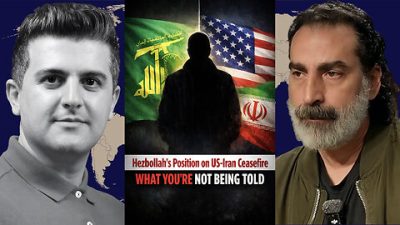
Laith Marouf: Hezbollah’s position on US-Iran ceasefire
or go to
Aletho News Archives – Video-Images
From the Archives
The Dirty Little Secret behind the “Global Terrorism Index”
The Omission of Israeli Terrorism in the Occupied Palestinian Territories
By Karin Brothers | Global Research | December 6, 2014
… The Israeli settlements — all of which are illegal – have been identified as a major impediment to peace. The refusal of a major “global” terrorism report to name the Israeli settlers as one of the groups most responsible for terrorism not only misrepresents a major source of regional violence but exposes the Global Terrorism Index as a propaganda tool that supports a U.S. agenda.
In recent years, governments have been attempting to thwart terrorism by blocking supportive fund-raising. When it comes to Israeli settlements, however, the US and Canada actually encourage fund-raising by giving organizations (such as Christian Friends of Israeli Communities (CFOIC) and the Jewish National Fund) financial support in the form of donor tax-deductions.
Charities which provide funds for the Israeli settlements should be regarded as terror-financing organizations. They should not only lose their tax-deductible status, but they should be banned because they support the violation of international humanitarian law. The terror-financing laws that are being strictly enforced for Muslim charities should be applied to Christian and Jewish charities as well. … Read full article
Blog Roll
 Aletho News
- The Black Cube Files: How Former Mossad Operatives Flipped a Nation
- Laith Marouf: Hezbollah’s position on US-Iran ceasefire: What you’re not being told
- Israel’s priority lies in destroying chances of peace between Iran, US: Ex-UN nuclear chief
- Ceasefire for all or for none: Iran shuts Hormuz over Lebanon attacks
- Strait of Hormuz is Iran’s ‘nuclear weapon’ that forced US retreat: Medvedev
- Energy crisis will last for months – Kremlin envoy
- Europe’s quiet role in the war on Iran
- Forty days that shook the Empire: How Iran turned the tables on US and prevailed
- Netanyahu unilaterally declares Lebanon outside of ceasefire deal
- Israeli leaders: ‘Not a single goal’ achieved in war with Iran
- If Americans Knew
- Gazans face a triple crisis: severe shortages of water and bread, healthcare in tatters
- NY Times reports how Netanyahu took the US into Iran War
- A sigh of relief over Iran, but Gaza and Lebanon in dire straits – Daily Update
- Thousands dead and neighborhoods razed to the ground: Aid agencies fear southern Lebanon is becoming the new Gaza
- The war the US is fighting for Israel could cost trillions
- ‘Cigarette Burns, Nail Wounds’: Toddler Tortured in Gaza to Coerce Father
- Trump Says US Sent ‘a Lot of Guns’ to Protesters in Iran
- Israeli forces destroy 17 UN peacekeeper cameras in south Lebanon
- US-Israeli strikes ‘completely destroy’ synagogue in Tehran
- Archbishop for US Military Says Iran War Is Unjust Under Catholic Teaching
- No Tricks Zone
- An Inconvenient Tree: Uncovered In Alps… Europe Much Warmer Than Today 6000 Years Ago
- New Study Reports A 60% Slowdown In Greenland’s Ice Loss Rate In The Last Decade
- Low Intensity Tornado Wrecks Major Solar Farm, Creating A Potential Toxic Dump
- New Study Finds Warming Saves Lives…Cold Temperatures 12 Times More Deadly Than Excess Heat
- German Science Blog Accuses PIK Climate Institute Of Hallucinating Climate Tipping Points
- Devastating Assessment Of Comirnaty Vaccine By Former Senior Pfizer Europe Toxicologist
- New Study: CO2 Is ‘Effectively Negligible’ As An Explanatory Climate Change Factor Since 2000
- Former Pfizer Toxicologist Dr. Helmut Sterz Tells Bundestag Hearing Pfizer Vaccine Should Have Never Been Approved
- Energy Expert: Germany’s Nuclear Phaseout Was A “500 Billion Euro Mistake”
- New Research: South Australia’s Mid-Holocene Sea Surface Temperatures Were 4°C Warmer Than Today
 Aletho News