US Tells UN Court Israel Must Be Allowed to Continue Occupation of Palestine
By Kyle Anzalone | The Libertarian Institute | February 21, 2024
A State Department official speaking before the International Court of Justice (ICJ) urged the body not to order Israel to end the occupation of Palestine. The court is currently hearing arguments in a case that calls on Israel to end the military occupation of the West Bank and Gaza.
The ICJ will hear arguments from more than 50 countries over six days. On the third day of the trial, State Department legal adviser Richard Visek argued to the ICJ that Israel needs to continue the occupation of Palestine for security reasons. “The court should not find that Israel is legally obligated to immediately and unconditionally withdraw from occupied territory,” Visek said.
“Any movement towards Israel’s withdrawal from the West Bank and Gaza requires consideration of Israel’s very real security needs.” He continued, “We were all reminded of those security needs on October 7, and they persist.”
Visek did not mention the security needs of the Palestinians, who have suffered under decades of occupation and apartheid at the hands of the Israeli Defense Forces (IDF). Since October 7, 29,000 Palestinians have been killed by Israeli military operations in Gaza. Tel Aviv has prevented aid from reaching the children of Gaza, putting one in six at risk of death due to starvation.
The case moving through the ICJ is separate from the genocide charges brought by South Africa in December. Last month, the court issued a primary ruling that Israel was plausibly committing genocide in Gaza fueled by the rhetoric of the country’s leadership. The ICJ ordered Israel to end military operations in Gaza that endanger civilians. Tel Aviv and Washington have said they will ignore the court’s decision.
The second ICJ trial is examining the Israeli military occupation of Palestine, which has been ongoing since 1967. Several international and Israeli human rights organizations have concluded that the occupation amounts to apartheid.
For decades, Washington has underwritten the Israeli occupation of the West Bank by preventing the UN Security Council from condemning Tel Aviv’s oppression of the Palestinians and giving Israel over $250 billion in aid. On Tuesday, the US vetoed a UN Security Council resolution that called for a ceasefire in Gaza.
The US claims that by giving Israel billions of dollars in weapons every year, it was establishing the conditions for a two-state solution. Visek told the ICJ that ruling Israel to end the occupation of Palestine will prevent the creation of a Palestinian state. “It is important that the court keeps in mind the balance the [UN] Security Council and the General Assembly have determined is necessary to provide the best chance for durable peace,” he told the ICJ on Wednesday.
However, Tel Aviv has deliberately worked to prevent the creation of a Palestinian state. Earlier this week, Israeli Prime Minister Benjamin Netanyahu boasted he has been able to thwart the emergence of a sovereign nation for the Palestinians during these past decades. “Everyone knows that I am the one who for decades blocked the establishment of a Palestinian state that would endanger our existence,” Netanyahu said, according to The Times of Israel.
Yemen says in talks with EU over Red Sea shipping safety
Press TV – February 21, 2024
Yemeni authorities have held “constructive talks” with the representatives of the European Union (EU) to ensure the safety of shipping in the Red Sea, Deputy Foreign Minister Hossein al-Ezzi says.
The Yemeni minister said on Wednesday that his country had ensured EU authorities during bilateral talks that the Red Sea is safe for international transit.
“We once again reiterate that the Red Sea is absolutely safe. Only passage to ships linked to three parties, namely the US, Israel and Britain, are blocked,” al-Ezzi was quoted as saying by Yemen’s al-Masirah TV channel.
Yemeni forces started carrying out attacks on Israeli-linked ships weeks after the regime launched the bloody hostilities in the besieged Gaza Strip in early October.
The strikes later expanded to target ships linked to the United States and Britain. The two countries have carried out airstrikes and naval attacks on Yemen’s territory in the recent past.
Yemen’s Ansarullah movement says attacks on ships will continue until Israel ends the campaign in Gaza, which has killed more than 29,000 people since early October.
The Yemenis have sought to ensure international shipping companies that their vessels can safely sail in three major regional waterways of the Red Sea, the Bab al-Mandab Strait and the Gulf of Aden if they have no connection to Israel, the US or Britain.
Ezzi said some 283 commercial ships had sailed in the Red Sea with complete safety this week despite claims by Washington that the waterway is not safe for commercial shipping.
“Unfortunately, shipping companies have been deceived by the US propaganda and reduced passage through the Red Sea because of US efforts to militarize the region,” he said.
Red lines: Will Iran enter the regional war?
By Farzad Ramezani Bonesh | The Cradle | February 21, 2024
On 14 October 2023, Iran issued a stern public ultimatum to Israel, cautioning that unless it ceases its genocidal assault on Gaza, significant repercussions will ensue, likening them to “a huge earthquake.”
Tehran’s envoy to the UN later clarified that the Islamic Republic would only intervene in the Gaza war if the occupation state were to jeopardize Iranian interests or citizens.
Given the events of the past four months, this raises the question: What are Iran’s red lines, and at what point would Tehran opt for direct confrontation?
The red lines
To grasp Iran’s motivations and reactions, it’s critical to understand its red lines—those non-negotiable boundaries it staunchly defends. At the heart of this lies the survival of the Islamic Republic itself, which recently celebrated its 44th anniversary. Any encroachment on Iran’s territorial integrity or vital interests triggers a defensive response to deter potential threats.
Foremost among these red lines are any broad attacks on Iran’s maritime assets, energy infrastructure, and strategic interests. Assaults on vital economic nodes like oil refineries or shipping lanes will likely prompt swift and resolute reactions from Iran’s leadership, signaling a readiness to safeguard national assets at any cost.
Previously, the Iranian government denied involvement in the Hamas-led resistance Operation Al-Aqsa Flood. While ideologically aligned with Palestinian resistance factions, Tehran insists on their autonomy, wary of direct involvement that could destabilize its domestic front. Nevertheless, support for other allies in the Axis of Resistance like Hezbollah remains unwavering, serving as a deterrent against external aggression targeting Iran’s strategic depth.
‘De-Americanization’
So far, Tehran has moved to influence Israel’s war in Gaza on the level of diplomacy, demanding the immediate cessation of killings, the lifting of the blockade on humanitarian aid, and the withdrawal of the Israeli military from the Gaza Strip. The key aims of the Iranians are to prevent a serious blow to the Palestinian resistance and its military capabilities and to prevent another mass displacement of Palestinians from their lands.
From Iran’s perspective, resistance against Israel and the US represents a cornerstone of the Islamic Republic’s strategic vision – part of its wider anti-imperialist struggle in West Asia, and ambition to force the US out of the region.
Many in Tehran believe the Gaza war is orchestrated in Washington, with the US serving as Israel’s primary advocate in global arenas like the UN Security Council. As such, Iran aims to undermine US influence by exacerbating divisions between Washington and Tel Aviv.
Despite Israel’s resolve to continue its campaign of ethnic cleansing, Iran’s strategy hinges on exploiting this discord, using diplomatic channels to influence US policy without resorting to direct confrontation. In essence, Tehran’s approach is to apply pressure on Washington via non-aggressive methods – without entering the war.
Israel’s covert attacks continue
Last week, a major attack was carried out on Iran’s national gas transmission pipelines. Iranian Oil Minister Javad Oji called the pipeline explosions in three regions “sabotage and terrorist attacks” and said the enemy’s plan was to disrupt gas supply to several cities and main provinces during the winter to ignite social and political unrest across the country.
While no country has claimed responsibility, a New York Times report names Israel as the culprit, citing several western official sources. Despite the severity of the attacks, Iran’s critical gas transmission capacity was safeguarded, preventing widespread energy crises.
Yet even these attacks didn’t cross Iran’s red lines because this act of vandalism – intent on destroying about 40 percent of the country’s gas transmission capacity and creating an energy crisis – was immediately thwarted.
These incidents mark another chapter in the covert conflict between Iran and Israel, which spans air, land, sea, and cyberspace. While such attacks have become somewhat routine, the frequency, intensity, and scale of destruction in this latest round may signal a material escalation that crosses Tehran’s established red lines.
Iran’s strategic response
As its support for Palestine is a top Iranian foreign policy priority, President Ebrahim Raisi has stated that the ongoing situation in Gaza raises the possibility of expanding the conflict to other regional fronts.
This is of great concern to the US. Since the beginning of Israel’s aggressions, the US has repeatedly warned Iran and its allies about “opening new fronts” in the war. These warnings have not had the desired impact: more than four months later, it is clear the Resistance Axis has responded proportionately from Lebanon, Syria, Iran, to Yemen with measured retaliations aimed at curbing Israel’s options.
Moreover, if Israel pushes Iran’s Palestinian allies to the limit, it appears that Tehran would pursue a relative, restrictive, short-term, and mid-term response.
In the interim, the assertive military reactions from Iranian allies – including Hezbollah in Lebanon, Palestinian Islamic Jihad, factions operating in Iraq and Syria, and the Ansarallah-aligned armed forces in Yemen – serve as a stick to confront Israel’s aggressive stance autonomously, even in the absence of direct instructions from Iran.
While Washington and Tel Aviv claim they wish to avoid opening new fronts, on the ground, they are gearing up for military confrontation and have already escalated on various fronts.
In response, the Axis of Resistance refuses to remain passive, aiming to disrupt Tel Aviv’s crucial lifelines while refraining from fully engaging its forces in the conflict. The baseline is to keep pressure on the US so that it urges restraint from Israel in Gaza.
Logic is its finest weapon: protracted war in Gaza appears to be at odds with European and western interests, particularly in areas such as energy security, geoeconomics, overall regional stability, and public diplomacy.
As such, Tehran may perceive an opportunity to exploit this misalignment to further drive a wedge between the US and its European allies, potentially leading to increased pressure and sanctions against Israel.
The bigger picture
Today, Iran’s adversarial stance seems to be more focused on the US rather than Israel. Via regional intermediaries, Tehran hopes to broker agreements with Washington to secure a ceasefire and alleviate Israel’s pressure on Gaza. A common view among Iranians is that the pursuit of “legitimate defense” is preferable to engaging in a wider regional conflict, as prolonged internal crises within Israel could ultimately work in Iran’s favor.
Drawing from past conflicts, particularly the Hezbollah–Israeli battles in south Lebanon, Iran sees potential in eroding both Israel’s internal power and external support. This strategy intends to gradually force the occupation state to retreat from its aggressive posture in the region.
Furthermore, Iran envisions leveraging the war in Gaza to bolster its reputation and influence among Arab states. Tehran hopes to capitalize on the situation to undermine existing peace agreements, such as the Camp David Accords, and halt the normalization process initiated in 2000 between Israel and Arab states. Iran also aims to rally international support against Israel through platforms like the Organization of Islamic Cooperation (OIC), the Arab League, BRICS, and the Shanghai Cooperation Organization (SCO).
Although a “preemptive attack” has already been proposed if Israel continues its assault on Gaza, Iran’s strategic partners in Moscow and Beijing have not declared their full support for direct war. Therefore, Tehran is likely to avoid divergence with Russia and China in the event of major international crises.
Gaza gambit
When considering the possibility of direct intervention in the Gaza conflict, it’s crucial to recognize the formidable challenges Iran would confront. These include the risk of casualties, economic repercussions, and a decrease in oil exports.
The option of direct Iranian military involvement will only be on the table if Israel and the US cross Tehran’s red lines, though any military action against Iran would be a clear violation of international law. As the Commander-in-Chief of the Islamic Revolutionary Guard Corps said in January, although Iran is not seeking war, it will not leave any threat unanswered.
It must be noted that Iran sees the war in Gaza through a realist, long-term lens and not an ideological point of view. This highlights a critical reality: while Iran makes efforts to maintain a delicate balance of threats without plunging into direct warfare, the potential for direct actions and reactions to spiral out of control remains ever-present.
Iran has thus far calculated that neither Washington nor Israel would risk direct attacks on its territory. However, the mutual risk of miscalculation on both sides could lead to a gradual escalation into direct warfare.
How I established anti-Zionist views should be protected under UK law
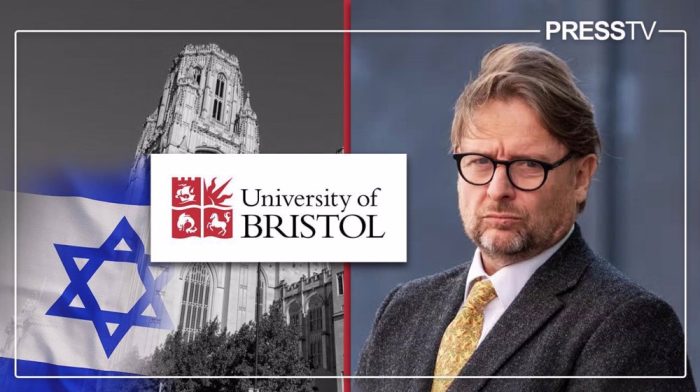
By David Miller | Press TV | February 20, 2024
In a landmark judgement on February 5, the Bristol Employment Tribunal handed down its decision that I had been wrongfully dismissed from my position as Professor of Political Sociology at the University of Bristol.
In addition, the court found that the reasons given by the university for sacking me – that some Zionist students had been offended or claimed to feel ‘unsafe’ – were untrue.
The court determined instead that I had been dismissed for my anti-Zionist views.
And in the most significant element of the case, the court also ruled – for the first time in the UK – that anti-Zionist views as set out by me in court filings are protected as a philosophical belief under the Equality Act 2010.
The judgment stated:
The claimant succeeds in claims of direct discrimination because of his philosophical belief contrary to section 13 Equality Act 2010.
It went on:
The claimant’s anti-Zionist beliefs qualified as a philosophical belief and as a protected characteristic pursuant to section 10 Equality Act 2010 at the material times.
What this means is both that anti-Zionist views are declared by the court not to be racist and that they are “worthy of respect in a democratic society”, which is the language used in the Equality Act.
What was the anti-Zionist position I espoused and the court endorsed as protected?
First, I defined Zionism in a neutral way as an ideology that holds that a state for Jewish people ought to be established and maintained in the territory that formerly comprised the British Mandate of Palestine.
Zionists, of course, agree with this ideology. But, as the judgement put it:
[The Claimant’s] belief that Zionism (as he defines it) is inherently racist, imperialistic and colonial is based on the claimant’s analysis that it “necessarily calls for the displacement and disenfranchisement of non-Jews in favor of Jews, and it is therefore ideologically bound to lead to the practices of apartheid, ethnic cleansing and genocide in pursuit of territorial control and expansion.”
The Employment Tribunal accepted that these ideas reached the level of coherence and cogency required of protected philosophical belief.
Among the specific statements made by me, for which I was sacked, were:
“The enemy we face here is Zionism and the imperial policies of the Israeli state”;
“It’s not just a question of being allowed to say, ‘Zionism’s bad’ or ‘Zionism’s racism’ – which, of course, we should be allowed to say because it is. But it’s not just a question of that; it’s a question of how we defeat the ideology of Zionism in practice.”; and
“Zionism is and always has been a racist, violent, imperialist ideology premised on ethnic cleansing. It is an endemically anti-Arab and Islamophobic ideology. It has no place in any society”.
These views are now to be regarded as protected anti-Zionist statements with no connection to anti-Semitism.
As the judgment stated:
“The Claimant explained, in his witness statement, that his opposition to Zionism is not opposition to the idea of Jewish self-determination or of a preponderantly Jewish state existing in the world, but rather, as he defines it, to the exclusive realization of Jewish rights to self-determination within a land that is home to a very substantial non-Jewish population.”
The case therefore establishes a very important precedent that will surely be relied upon and built upon in future employment cases.
And it declares to employers everywhere – that no matter how loudly Zionists scream and shout – it is not permissible to sack anti-Zionists for their views, which are henceforth protected in law.
Furthermore, the judgment drives a coach and horses through the long-promoted Zionist talking point that anti-Zionism is the “new antisemitism”.
This is a view that underpins the controversial International Holocaust Remembrance Alliance Working Definition of Antisemitism, which must now be put to serious question.
I hope and believe that in the future this will be seen as a turning point in the battle to end the racist and genocidal ideology of Zionism.
But how did I win this case? A key element was that the witnesses provided by the University of Bristol did not support the case the university was making.
Indeed they fatally undermined it.
The concessions made by the University of Bristol witnesses were firstly by Professor George Banting, a retired Dean of the Faculty of Biomedical Sciences.
Under cross-examination, he was shown the university policy on investigations which emphasizes getting to the truth and testing evidence.
He was then taken through example after example where he admitted he had not properly taken into account the evidence that I and my team had submitted and he admitted that he had, in effect, treated the evidence from the Zionist student activists credulously, even though there was plenty of evidence that they had provided contradictory or false evidence.
Banting caused some amusement in court when toward the end of his testimony he disclosed that he was something of an anti-Zionist himself:
“I would be more aligned with the position that Professor Miller puts forward in terms of Zionism being a racist ideology and settler colonialism.”
Similar admissions were made by Professor Jane Norman the Dean of Health Sciences at Bristol. She admitted that she lacked knowledge of the Zionist movement and of sociology, subjects where she acknowledged I was more knowledgeable than she was.
She had claimed in her letter of dismissal that the Union of Jewish Students was simply a faith society and thus by inference not Zionist – a case that stretched credulity, but which also indicated her partiality.
She also reluctantly admitted that she had not properly analyzed the contending evidence in the case in her written decision to sack me. Norman has subsequently been promoted to the second top job at the University of Nottingham.
These concessions were enough to show that I had been wrongly dismissed.
As the judgment put it: “The claimant succeeds in his claim for unfair dismissal pursuant to section 98 Employment Rights Act 1996”
But both Banting and Norman also conceded other points that fatally compromised the university case. The university and specifically Professor Norman had claimed that the reason I had been sacked was because Zionist students had been offended or felt ‘unsafe’ as a result of hearing my anti-Zionist views.
But they both confirmed under cross-examination by the British Palestinian barrister Zac Sammour that the key reason that I was sacked was precisely because of the anti-Zionist content of my views and not my comments about Zionist student groups.
This was enough to show that I had been dismissed specifically for my anti-Zionist views.
But the most dramatic moment was when the university’s Deputy Principal Professor Judith Squires took the stand. Squires is a professor of political theory by background, so should be more familiar with the issues under discussion.
She has been prominent at the University of Bristol in its responses to the Black Lives Matter movement and the call for divestment in relation to slavery.
She can be seen here delivering a speech in which she calls for the “eradication” of racism, a position which, as I said at the tribunal, I wholeheartedly endorse. As the most senior witness from the university she, of all people, had to support the overall university case that my views were not “worthy of respect in a democratic society”.
And Squires did from the outset, but immediately after she was asked if she thought that my views were views ‘akin to Nazism’. She seemed confused by the question as if she had not realized that affirming the university case entailed this position.
But she eventually agreed. At that moment she was lost.
My barrister proceeded to demonstrate that by asking about a hypothetical case where Anglo-Saxons in Britain forced 75 percent of non-Anglo-Saxons to leave and go and live in Cornwall or Wales, then denied the remaining 25% rights in jobs, education and voting, would that be racist? “Yes”, said Professor Squires.
And he went on if no non-Anglo-Saxon could return, but any Anglo-Saxon, anywhere in the world, could come and live in Britain. Would that be racist? “Yes” And, the barrister went on would it be wrong for a Professor to say that Anglo-Saxonism is racism? And that it should be opposed? “No”, said Professor Squires.
The University of Bristol, in other words, undermined and eventually destroyed its own case in court.
David Miller is the producer and co-host of Press TV’s weekly Palestine Declassified show. He was sacked from Bristol University in October 2021 over his Palestine advocacy.
Jailed Without Charge: Layan Kayed, West Bank student jailed for campus activism
By Humaira Ahad | Press TV | February 20, 2024
On the morning of June 7, 2023, Layan Kayed was sleeping peacefully in her room when Israeli soldiers appeared out of nowhere and ferociously banged on the door of her house in the occupied West Bank.
In a frightened state, Kayed’s father rushed through the gateway as the heavily armed regime soldiers stormed inside the house, seizing all the electronic gadgets and arresting the 26-year-old Kayed.
Kayed, a master’s student at the Birzeit University in occupied West Bank, had been an anti-occupation activist for years. She was first arrested in 2020 when she spent 16 months in different Israeli jails.
During her recent arrest, the young Palestinian activist was subjected to brutal custodial interrogation and was prevented from meeting her lawyer, according to reports.
In a message to her family during her first detention facility, Kayed said her relationship with prison is “that of a constant attempt to tame us and alienate us.”
In 2020, Kayed was arrested while crossing Za’tara military checkpoint, south of the city of Nablus. The Israeli soldiers handcuffed her, shackled her legs, and made her sit in an open area for hours.
She was later transferred to Hasharon prison of the Israeli regime.
The regime snatched from her the right to celebrate an important day of her life. She was arrested just before receiving her bachelor’s degree certificate.
“I was arrested at one of the checkpoints that separates my home from Birzeit University while I was in the family car with my mother on my way to the university to accept my (Bachelor of Arts) certificate,” the young Palestinian student was quoted as saying.
“After my arrest, I was left outdoors at the Zaatara Israeli military checkpoint for eleven hours, handcuffed and shackled. I was subjected to sexual insults, constant swearing, and verbal abuse from the Israeli male criminal inmates, under the watch of the Israeli guards who did not intervene.”
After her release from prison following her first arrest, Kayed narrated the inhumane treatment she was subjected to in Israeli prisons, similar to what other Palestinians have narrated over the years.
“One never received any sunshine and was fully monitored by security cameras around the clock.”
Kayed was kept in a cell with cameras fixed all around the room, violating the privacy of the young woman. She was not even provided a jail uniform and had to borrow clothes from an inmate.
The toilet she was forced to use was without a ceiling and a door, the Palestinian activist said.
On March 3, 2021, Ofer military court sentenced her to 16 months in prison in addition to a fine of 6,000 shekels. In the ruling, the military judge cited a previous ruling by the military appeals tribunal which stated that student wings of organizations deemed unlawful should not be underestimated, referring to the prosecution of students who belong to university unions, as they constitute a threat to “security”.
The Palestinian rights campaigner believes that the issue of Palestine is not just limited to Palestine but has worldwide reverberations.
“As a Palestinian people, we are facing the Zionist entity, which is organically linked to all imperialist interests in the region and the world. This means that the conflict with the Zionist project is not limited to the land of Palestine,” Kayed was quoted as saying.
The student bodies in Palestine have been advocating the total boycott of the apartheid regime.
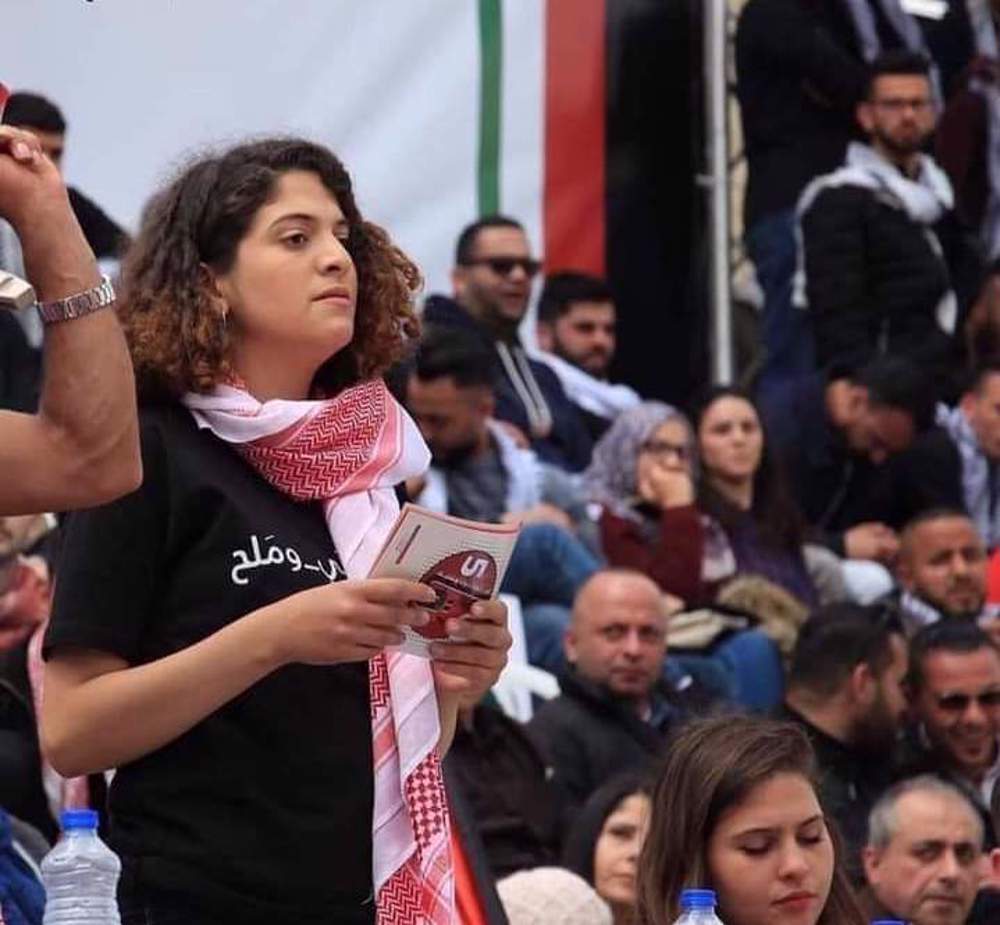
Layan Kayed during an event at her university before her arrest. (X)
“In addition to boycotting Israel in all respects…, and launching pressure campaigns on governments and their pro-Israel policies, such as arms sales, trade exchange, or policies that adopt the Israeli discourse, we see that fighting injustice and oppression anywhere is part of our struggle against Israel,” she said.
“Israel actively contributes to supporting oppression around the world. Israel is a laboratory for weapons, surveillance, and military technologies, which it exports to oppressive governments around the world,” the student activist maintains.
In 2021, following Kayed’s first arrest, the UN working group on arbitrary detention said that the young Palestinian woman’s arrest was arbitrary, highlighting that it lacked a legal basis, and was carried out in breach of international human rights law.
The case was referred to the special rapporteur on violence against women and the working group on discrimination against women and girls.
Arbitrary detention is a form of administrative detention that is being used as one of the key tools by the regime to oppress Palestinians. Since October 7, Israel has dangerously increased its use of arbitrary detention across the occupied West Bank.
While Israeli settlers in the occupied West Bank are subjected to civilian law, Palestinians have to face military laws. Military courts of Israel prosecute Palestinian children as young as 12.
As per the figures given by Military Court Watch, an NGO that monitors the treatment of Palestinian children in Israeli jails, 95 percent of military court cases result in convictions.
Settlers burn through West Bank village under army protection

(Photo credit: AFP)
The Cradle | February 20, 2024
Israeli settlers rampaged through the occupied West Bank village of Burqa, northwest of Nablus, on the evening of 19 February, attacking homes and destroying vehicles under the protection and coordination of the Israeli military.
Settlers threw Molotov cocktails at several Palestinian homes as Israeli troops shut down all main roads to the village.
Palestinian news agency WAFA reported that Israeli troops “did nothing to stop the colonists’ attack,” adding that Israeli forces used large amounts of tear gas and prevented ambulances from reaching the wounded.
Earlier on Monday, Israeli settlers, with the help of troops, fenced off a tract of Palestinian-owned land south of Jerusalem with barbed wire to occupy it.
Settler violence against Palestinians in the occupied West Bank has surged to all-time highs under Benjamin Netanyahu’s government. It has escalated even further since Operation Al-Aqsa Flood and the Gaza war.
Palestinians have been subject to increasing levels of forced displacement since the war began.
Since October, over 1,000 people – including hundreds of children – have been forced by settlers and Israeli army soldiers to abandon their homes, according to the UN.
Additionally, more settlers are being armed. Thousands of weapons have been handed out to settlers in the occupied West Bank under an initiative sponsored by the Israeli National Security Ministry.
According to Israeli watchdog NGO Peace Now, Israeli settlers established a record-breaking 26 outposts in the occupied West Bank in 2023. The report correlates the rise in unlawful settlement construction with the Jewish supremacist policies of the Israeli government.
Israeli settlements in the occupied West Bank are illegal under international law.
Nonetheless, the Don’t Buy Into Occupation (DBIO) civil society organization highlighted in December that European financial institutions have provided billions of dollars to support settlement construction in the occupied West Bank over the past few years.
US once again vetoes UN resolution for Gaza ceasefire
Press TV – February 20, 2024
Unsurprisingly, the United States has once again vetoed a UN resolution that calls for an immediate humanitarian ceasefire in the Gaza Strip.
Israel’s great benefactor used its veto at the United Nations Security Council on Tuesday to block the draft prepared by Algeria.
It was the third time Washington has opposed such a resolution since Israel ignited its bloody war machine in Gaza in early October.
Representatives of 13 countries at the 15-member Security Council voted in favor of the resolution. Britain abstained.
The Palestinian envoy to the United Nations Riyad Mansour condemned the US veto as being “absolutely reckless and dangerous.”
“The message given today to Israel with this veto is that it can continue to get away with murder,” he said in a statement to the Security Council.
US says Gaza ceasefire ‘wishful and irresponsible’
In remarks to the Security Council after the US wielded its veto power, US Ambassador to the UN Linda Thomas-Greenfield said that calling for an immediate ceasefire in Gaza was “wishful and irresponsible.”
She claimed that such an action by the United Nations could stifle diplomatic efforts to broker an agreement between Hamas and Israel for a pause in the war.
“Colleagues, over the past few weeks, we have made incredibly clear that the resolution before the council would not achieve the goal of a sustainable peace, and may in fact run counter to it,” Thomas-Greenfield said.
Before the vote, Amar Bendjama, the Algerian ambassador to the UN, told the Council, “A vote in favor of this draft resolution is support to the Palestinians right to life.”
“Conversely, voting against it implies an endorsement of the brutal violence and collective punishment inflicted upon them.”
The US had already threatened it would block the Algerian-proposed resolution.
Washington, instead, has been actively pushing for a temporary ceasefire in Gaza to facilitate the release of Israeli captives held by the Palestinian resistance movement Hamas.
Israel’s savagery in Gaza began on October 7, 2023, after Hamas carried out the historic surprise Operation Al-Aqsa Storm against the occupiers.
So far, the regime has killed more than 29,000 people, mostly women and children, and injured about 70,000 others in Gaza.
Washington has since supplied the regime with more than 10,000 tons of military equipment.
The United States vetoed similar UN draft resolutions for a ceasefire in October and December.
Feeble BBC Hamas ‘exposé’ achieved one thing: obscuring genocide
By Jonathan Cook – February 20, 2024
Israel was put on trial for committing genocide in Gaza last month by the judges of the International Court of Justice. So far western governments have not only done nothing to intervene but are actively assisting in that slaughter. They have supplied arms and turned a blind eye to Israel’s denial of humanitarian aid. The people of Gaza are slowly being starved to death.
But it was at this moment, as the world watches in horror, that the BBC’s chief news investigation programme, Panorama, chose not to scrutinise that massacre of tens of thousands of Palestinians but to hand the microphone over to the very military doing the killing.
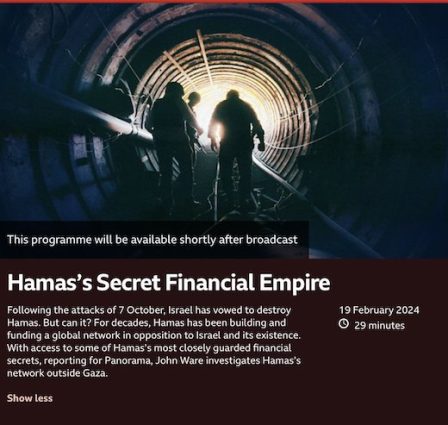 On Monday it aired a programme titled “Hamas’s Secret Financial Empire” headed by reporter John Ware.
It leant heavily on Israel’s military spokesman, on documents that had almost certainly been supplied by Israeli military intelligence, on video footage from the Israeli military, and an Israeli survivor of the Hamas attack of October 7.
Ware and Panorama have worked together before, most notably on a special hour-long edition that doubtless equally delighted Israel.
Broadcast shortly before the 2019 general election, the programme served as little more than a hatchet job on Jeremy Corbyn, claiming that the then Labour leader had allowed antisemitism to run rampant in his party.
Serial failures in the programme were exposed, including by me at the time.
Quotes and interviews had been edited misleadingly, including one that implied an antisemitic incident had happened inside the Labour party when it had not.
Basic fact-checking had not been carried out, which led to the complete misrepresentation of a key incident the programme wrongly claimed as antisemitic.
The programme concealed the identities of those claiming to have suffered antisemitism in Labour, when most were in fact members of a highly partisan, pro-Israel group openly committed to the ousting of Corbyn as leader for his pro-Palestininan views. One had trained with the Israeli army.
Another unnamed, tearful interviewee, Ella Rose, had previously worked for the Israeli embassy, though the audience was not told. The programme also did not refer to the fact that she had admitted to being a confidante of an Israeli undercover agent, Shai Masot, who was later exposed trying to bring down a British government minister for his critical views of Israel – views far less critical than Corbyn’s.
One might have assumed that, given this disastrous outing for Panorama by Ware and his producers, they would have been considered by the BBC as a very unwise pick indeed to follow up with an investigation into another issue so close to Israel’s heart. But such an assumption would be wrong.
Much as the Corbyn “investigation” presented a distorted picture of what was taking place in Labour, the latest Panorama “investigation” completely obscured the reality of what is taking place in Gaza. Not least, Monday’s audiences would have been barely aware that Israel is currently under investigation by the World Court after its panel of 17 judges accepted that Israel is plausibly committing genocide in Gaza.
The Panorama narrative, following the BBC’s usual script, suggested instead that this was simply another round of fighting in a long-standing “conflict” in which, the programme limply conceded, both sides are suffering.
The only non-official interviewed was an Israeli survivor of Hamas’s October 7 attack, a young woman present at the Nova festival. She felt betrayed that “people only look at the side of Hamas. We are invisible to them.”
Bizarrely, the BBC team took this patently preposterous view as the programme’s central premise. It was, said Ware, Hamas’s nefarious goal to “project itself as a resistance movement and Israel as a terrorist state”.
The BBC seemed to have forgotten that it was also the World Court, not just Hamas, seriously considering the idea that the Israeli military is flagrantly acting outside the laws of war. If, in the eyes of the BBC, a campaign of genocide does not constitute state terrorism – or worse – one has to wonder what does.
Former Foreign Office official Sir John Jenkins was given centre stage by Panorama to claim that Hamas, not the prolonged slaughter of children in Gaza, was fomenting the “delegitimisation of Israel”.
All of this served as the prelude to the programme’s efforts to delegitimise Hamas and any of its activities in creating a network of tunnels to resist Israel’s occupation and siege at a time when western capitals are more actively than ever assisting Israel in destroying Gaza.
If Israel posed no real threat to the people of Gaza, as the programme implied throughout, then Hamas apparently did not need to fortify the enclave to defend it from an Israeli attack. Its money could have been better used for the benefit of ordinary Palestinians.
The elephant in the room was genocide. Ware and the BBC had to keep treating Israel’s slaughter of at least 30,000 Palestinians over the past four months as an aberration – a reaction to the unprecedented events of October 7 – rather than as an intensification of Israel’s well-documented abuse of the Palestinian people spanning over decades.
The reference to Hamas’s “secret” financial empire was meant to sound sinister. But, as the programme-makers struggled to hide, there is nothing secret about Hamas’s funding.
After all, Israeli prime minister Benjamin Netanyahu personally approved the flow of money to Hamas, wishing to keep the group just strong enough to ensure it could prevent the more compliant Palestinian Authority (PA), based in the West Bank, from re-establishing itself in Gaza.
Netanyahu’s goal – one he never concealed – was to keep the two rival Palestinian groups permanently feuding, the two territories split, and thereby undermine the case for any kind of Palestinian state in Gaza and the West Bank.
Ware informed us that Hamas’s “financial empire” derived from various funding sources: directly from Iran and Qatar, but also from humanitarian aid provided by international donors. The programme concluded that these donors were effectively “subsidising Hamas’s war machine” by easing the economic burden on Hamas in providing – in so far as was possible given Israel’s siege – essentials such as food, water and power to Gaza’s civilians.
Predictably, Ware’s argument echoed one of the main claims made by Israel in its current campaign to intensify the genocide in Gaza by destroying the United Nations’ refugee body, UNRWA. The relief agency is the last lifeline to a population of 2.3 million people brought to the point of starvation by Israel’s blockade of humanitarian aid.
Israeli officials have consistently implied that the Palestinian population of Gaza may justifiably be starved to death as the price to be paid to avoid any risk that some of that aid ends up in the hands of Hamas fighters. Such a denial of assistance is not only patently immoral but constitutes a war crime.
If journalists are ever brought to the Hague accused of complicity in the current genocide, there should surely be a place reserved in the dock for Ware and his BBC team for breathing credibility into this monstrous argument.
Panorama’s central narrative was that Hamas had used parts of its revenues to build a network of resistance fortifications such as tunnels – money that, as Ware and his interviewees kept stressing, could have been spent on building schools and homes to aid the people of Gaza.
Ware omitted to mention, of course, that, more often than not, schools and homes actually needed rebuilding, not building, because Israel blew them up every few years with its bombs.
Again, all too predictably, the programme stripped out obvious context.
Hamas chose to build these fortifications, such as its extensive network of tunnels, because Israel is an offensive, occupying power that enjoys absolute control over Gaza’s borders, as well as its airspace and sea. Israel can bomb and invade Gaza any time it chooses. It can drag people off to “arrest” them – or take them hostage, as we would call it were the roles reversed.
Not only can it do those things, it did and does them regularly. And with complete impunity.
Pretending that Hamas had no reason to build a tunnel network, as Panorama does, is to rewrite history – to excise Israel’s decades of crimes against the Palestinians and their legitimate desire to struggle against that oppression.
It is to unthinkingly regurgitate Israel’s claim that these are simply “terror tunnels” rather than a way for Hamas to survive as a resistance organisation, as it is fully entitled to do under international law.
Hamas made it a priority to build a tunnel network to resist a violent, occupying army. Given limited resources and room to manoeuvre – after all, Gaza is a tiny territory and one of the most overcrowded places on the planet – Hamas had little choice but to move underground to avoid Israel’s sophisticated surveillance technology where it could build an arsenal of largely improvised, homegrown weapons.
Its historic popularity among ordinary Palestinians – at least compared to the supine, endlessly complicit PA in the West Bank – derives precisely from its refusal to submit to Israeli control. Panorama forgot to mention this too.
By contrast, and confounding Panorama’s thesis, the PA’s exclusive reliance on international diplomacy has won no tangible concessions from Israel – unless winning a reprieve from genocide, at least until this point, is considered such a concession.
Also inconveniently for Panorama, the PA’s standing with the Palestinian public continues to be dismal.
Bizarrely, Ware was equally troubled by the fact that Hamas raised import taxes on the limited goods that Israel did allow into Gaza.
That is all the stranger given that the programme’s implicit – and entirely bogus – assumption is that Gaza is not under a belligerent Israeli occupation. Hamas, it therefore suggested, should have behaved more like a normal country.
But raising taxes on the import of goods is precisely what normal countries do. Why would Ware expect Hamas to behave differently?
And why would it be strange or sinister for it to use some of those revenues to build Gaza’s defences, as best it could, against an aggressive occupier?
Does Britain not also spend the money it raises from taxes to buy weapons and “subsidise its war machine”? And it does so, even though the UK is not under belligerent occupation and is unlikely to be invaded any time soon.
In dramatic fashion, Ware declared ominously: “We have obtained documents that Israeli intelligence say are from inside Hamas and shine a light on how it makes some of its millions.”
It is hard not to conclude that those words mean Panorama was fed those documents by the Israeli intelligence services. Nonetheless, with utter credulity, the programme treated the papers as though they were infallible proof of Hamas’s wickedness.
What they actually showed, assuming they are real, is that Hamas had gained a modest income stream from investments in Middle Eastern companies and ventures. Should Hamas not make investments to raise income, as countries and funds do around the world? And if not, why?
Moving money out of Gaza and investing it overseas seems eminently sensible given that Israel has so regularly laid waste to the enclave – and is doing so once again and on an unprecedented scale.
In similar credulous fashion, Ware accepted unquestioningly the claim that Hamas’s leader in Gaza, Yahya Sinwar, was known to “hate Jews”. On what basis? Because a former Israeli security officer who proudly admitted that years ago he interrogated Sinwar for “between 150 and 180 hours” said so. Interrogation of Palestinians by Israel typically includes lengthy periods of torture.
All of this was depressingly familiar. The BBC and Panorama rarely dig into issues that might reflect badly on Israel and risk a backlash of criticism, including from the British government. That toothlessness when a genocide is unfolding in Gaza is especially egregious.
But the BBC is not just overlooking that horrifying crime but using its resources – funds provided by British taxpayers – to actively obscure Israel’s campaign of genocide and implicitly rationalise it as warranted.
A programme whose thesis is that Hamas misused public funds for nefarious purposes is, paradoxically, doing the very thing it condemns. It has misused British taxes to make a entirely bogus case that provides cover for the slaughter and maiming of many tens of thousands of innocent Palestinians.
UN experts: Inhumane Israeli troops sexually assault Palestinian girls
Press TV – February 19, 2024
In yet another shocking revelation, the Special Rapporteurs of the UN Human Rights Council say Palestinian women and girls are being sexually assaulted and raped by Israeli troops in the besieged Gaza Strip and the occupied West Bank.
During a public hearing at the International Court of Justice (ICJ) on Monday, the UN experts said they were “shocked by reports of the deliberate targeting and extrajudicial killing of Palestinian women and children in places where they sought refuge.”
According to information they received, they told the hearing that hundreds of Palestinian women and girls are being detained and subjected “to inhuman and degrading treatment.”
“On at least one occasion, Palestinian women detained in Gaza were allegedly kept in a cage in the rain and cold, without food.”
They said they were distressed by reports that the Palestinians in question have been “subjected to multiple forms of sexual assault, such as being stripped naked and searched by male Israeli army officers.”
“At least two female Palestinian detainees were reportedly raped while others were reportedly threatened with rape and sexual violence.”
They said Israeli forces took photos “of female detainees in degrading circumstances,” and shared them on social media platforms.
The experts said an unknown number of the Palestinians have gone missing after contact with the regime’s forces in Gaza.
“There are disturbing reports of at least one female infant forcibly transferred by the Israeli army into Israel, and of children being separated from their parents, whose whereabouts remain unknown.”
The Special Rapporteurs warned Israel that these inhumane acts could “amount to serious crimes under international criminal law that could be prosecuted under the Rome Statute.”
“Those responsible for these apparent crimes must be held accountable and victims and their families are entitled to full redress and justice.”
The Special Rapporteurs are independent experts – part of what is known as the Special Procedures of the UN Human Rights Council – whose mandate is to follow and report on the human rights situation of a specific country or thematic issues in all parts of the world.
The public hearings began at the ICJ in the Hague – at the request of the UN General Assembly – on Monday to examine the legal consequences of Israel’s occupation of the Palestinian territories.
The Resistance Has a Plan for Israel. But on the Other Side, Fantastical U.S. Stratagems Ensure a Cascading Failure
By Alastair Crooke | Strategic Culture Foundation | February 19, 2024
In a speech on Tuesday, Hizbullah leader Seyed Nasrallah said that the Party will continue the border offensive until at least the Gaza massacre stops. The war in Gaza however, is far from over. And Nasrallah warned that even were a ceasefire to be reached in Gaza, “should the enemy perform any action, we will return to operating according to the rules and formulas that existed before. The purpose of the resistance is to deter the enemy, and we will react accordingly”.
Israel’s Defence Secretary Gallant has underlined that contrary to international consensus expectations, he too expects the war in Lebanon to continue. Gallant said the military has stepped up its attacks against Hizbullah by one level out of ten:
“The Air Force planes flying currently in the skies of Lebanon have heavier bombs for more distant targets. Hizbullah went up half a step, whilst we, a full one … We can attack not only at 20 kilometres [from the border], but also at 50 kilometres, and in Beirut and anywhere else”.
It is not clear what ‘red line’ Hizbullah would have to cross for Israel to significantly escalate its response to much higher levels; Israeli leaders have suggested that an attack on a strategic site; or an attack leading to major civilian casualties; or a substantive barrage on Haifa might constitute the breaking point.
Nonetheless, with three military divisions rather than the usual one now deployed in the north of Israel, the IDF has more forces poised for action on the northern border than it has preparing for an incursion into Rafah – at this point. It is clear, as Chief of Staff Halevy has specified, that Israel is “preparing for war” against Hizbullah (more than preparing for Rafah).
Is the threat to Rafah a bluff to put pressure on Hamas to concede on the deal and hostages? One way or another, both Israel’s political and military chiefs are adamant: The IDF will incurse into Rafah – ‘at some point’.
The qualitatively different Hizbullah strike on Safed on Israel’s northern regional command HQ on Wednesday – which resulted in 2 dead and 7 further casualties – is being treated in Israel as the gravest attack since the start of the war, with Ben Gvir calling it a “declaration of war”. Subsequent Israeli attacks killed 11 people, including six children, in a barrage of strikes on villages across southern Lebanon, in retribution for the Safed blitz – with the fierce exchange of fire still continuing.
The ‘Safed Strike’ deep into the Galilee very likely was intended to signal that Hizbullah is not about to capitulate to western demands that it provide Israel with a ceasefire that is intended to facilitate evacuated Israelis to return to their homes in the north. As Nasrallah confirmed in a scathing attack on those external (Western) mediators who serve only as Israel’s lawyers, and neglect to address the massacres in Gaza:
“It is easier to move the Litani River forward to the borders, than to push back Hezbollah fighters from the borders, to behind the Litani River … They want us to pay a price without Israel committing to a thing”.
In these circumstances, Nasrallah clarified that residents of northern Israel will not return to their homes – warning that even more Israelis risk being displaced:
“‘Israel’ must prepare shelters, basements, hotels and schools to house two million settlers who will be evacuated from northern Palestine, [were Israel to expand the war zone].”
Nasrallah outlined what is clearly the agreed Axis of resistance’s overarching strategic plan. (There has been a flurry of meetings between senior Axis principals over the last week, across the region, for which Nasrallah is speaking):
“We are committed to fighting Israel until it is off the map. A strong Israel is dangerous to Lebanon; but a deterred Israel, defeated and exhausted, is less of a danger to Lebanon”.
“The national interest of Lebanon, the Palestinians, and the Arab world is that Israel leaves this battle defeated: Therefore, we are committed to Israel’s defeat”.
Put bluntly, the Axis has its vision of the conflict’s outcome. And it is a “deterred, defeated and exhausted” Israeli State. By implication, it is an Israel that has relinquished the Zionist project – one that is reconciled to the notion of living as Jews between the River and the Sea – albeit with rights no different to others living there (i.e. Palestinians).
On the other side, the western strategic plan, as the Washington Post reports – which the U.S. and several Arab countries hope to present within a few weeks – is a long-term plan for peace between Israel and the Palestinians, including a “time frame” for the establishment of a provisional de-militarized Palestinian “state”:
“Imperatively, it begins with a hostage deal accompanied by a six-week cease-fire between Israel and Hamas. While it may be termed “cessation of hostilities” or an “extended humanitarian pause,” such a cease-fire will signal the de facto end of the war along the lines and scale that it has been fought since 7 Oct.”
The plan addresses “Post-war Gaza”, in terms already well-known. As senior Israeli commentator, Alon Pinkas, affirms:
“Parallel to the announcement U.S., Britain and possibly other countries will consider and eventually make a joint statement of intent by recognizing a provisional, demilitarized and future Palestinian state – without delineating or specifying its borders”.
“Such a recognition does not necessarily contradict Israel’s legitimate and reasonable demand to have overriding security control over the area west of the Jordan River in the foreseeable future … [it constitutes] a practical, timebound, irreversible path to a Palestinian state living side-by-side in peace with Israel … whose recognition could also be submitted to the UN Security Council – as a binding resolution. Once the Arab countries sign off on such a framework, the U.S. believes that neither Russia nor China would veto it …
“Within the “regionalization” phase however, the Americans will craft a regional security cooperation mechanism. Some in Washington imagine a reconfigured region with a new “security architecture” as a harbinger to a gradual Mideast version of the European Union, with greater economic and infrastructure integration”.
Ah – the New Middle East again!!!
Even Alon Pinkas, an experienced former Israeli diplomat, concedes: “If the plan seems too fantastical to you: You’re not alone”.
The basic improbabilities to this plan simply are disregarded. Firstly, Israel’s Finance Minister Smotrich responded to the reported American-Arab plan, saying: “there’s a joint American, British and Arab effort to establish a terrorist state” next to Israel. Second, (as Smotrich further notes): “They see the polls. They see how the absolute majority of Israelis oppose this idea [of a Palestinian State]”; and thirdly, some 700,000 settlers were installed in the West Bank – precisely to block any Palestinian State.
Is the U.S. really going to impose this onto a hostile Israel? How?
And, from the Resistance perspective, ‘a provisional, demilitarized and future Palestinian ‘state’, without delineated or specified borders, is not a state. It is truly a Bantustan.
The reality is that when a Palestinian State might have been a real prospect (two decades ago), the international community turned a willing ‘blind eye’ – for decades – to Israel’s successful and complete sabotage of the project. Today, circumstances are much changed: Israel has moved far to the Right and is in the grip of an eschatological passion to establish Israel on the entire “Land of Israel”.
The U.S. and Europe have only themselves to blame for the dilemma in which they now find themselves. And a policy stance – such as outlined by Biden – plainly said is doing untold strategic damage to the U.S. and its compliant European allies.
Even on the Lebanon track, let us be plain too, Israel’s demands from Lebanon go far beyond a mutual ceasefire. There is no guarantee, even should a ceasefire be reached in Gaza as part of a comprehensive hostage/end-of-war deal, that Nasrallah will agree to withdraw all his forces from the border with Israel, or conversely, that Israel will comply with its commitments.
And with the U.S. defining its Palestinian ‘solution’ as an improbable, provisional, disarmed and wholly impotent Palestinian entity, nestled within a fully militarised Israel, exercising ‘full security overlordship from the River to the Sea’, it would not be surprising were Hizbullah rather, to opt to pursue the Axis’ plan of a defeated, exhausted post-Zionism.
Israeli commentator, Zvi Bar’el, writes:
“Even were the American assumptions to become a working plan, it is still unclear what policy Israel will adopt on Lebanon. Even pushing Hezbollah back so that Israeli communities are no longer within the range of its anti-tank missiles does not remove the threat of tens of thousands of medium and long-range missiles. The deterrence equation between Israel and Hezbollah will continue to determine [the true] reality along the border”.
[The current U.S. working assumption, as presented by the Administration’s special envoy Amos Hochstein in his previous visits to Lebanon], “is that a border demarcation agreement between Israel and Lebanon will result in final and full recognition of the international border and thus deny Hezbollah the formal basis for justifying its continued fight against Israel to liberate occupied Lebanese territories. At the same time, it allows the Lebanese government to order its army to deploy its forces along the border in order to assert its sovereignty over its entire territory and demand that Hezbollah forces pull back from the border”.
This is just more wishful, ‘fantastical’ thinking. And it contains a flaw: Hochstein’s work plan does not include an agreement on the Sheba’a Farms, but only on the ‘Blue Line’ – the border agreed in 2000, but which is not recognized by Lebanon as an international border. If the issue of the Sheba’a Farms is not settled, Hezbollah will not be bound by a limited demarcation accord that omits the Sheba’a area.
Since Hamas’s attack on Israel on 7 October, every stratagem and protocol, dug from some musty West Wing cupboard, and upon which the U.S. leant, has failed. What was supposed to be a limited and compartmentalized military operation in Gaza by the IDF has turned into a regional firestorm. Aircraft carriers sent to deter other actors from getting involved failed with the Houthis; U.S. bases in Iraq and Syria became targets, with attacks on U.S. bases continuing, despite U.S. attempts at delivering deterrent ‘punches’.
Quite clearly, Netanyahu is ignoring Biden, and ‘defying the world’ – as this week’s headlines attest:
“Defying Biden, Netanyahu Doubles Down on Plans to Fight in Rafah” (Wall Street Journal )
“As Israel corners Rafah, Netanyahu defies the world” (Washington Post )
“U.S. won’t punish Israel for Rafah op that doesn’t protect civilians” (Politico )
“Egypt Builds Walled Enclosure on Border as Israeli Offensive Looms: Authorities are surrounding an area in the desert with concrete walls as a contingency for possible influx of Palestinian refugees” (Wall Street Journal ).
Netanyahu has vowed to forge ahead, saying on Wednesday that Israel would mount a “powerful” operation in the city of Rafah, once residents have been “evacuated”. Israelis explicitly say the White House is not opposed to the Rafah blitz, provided Palestinians are given the opportunity to “evacuate” (to where, is left unsaid). (Meanwhile, Egypt is building a refugee camp inside its border, surrounded by concrete walls …).
At this point, all of the U.S.’ various problems – the political polarization, widening war, funding for wars, the alienation amongst the swing-state Arab constituencies and Biden’s sinking ratings – are beginning to feed into, and reinforce, each other. What began as a foreign-policy issue – Israel defeating Hamas – has become a significant domestic crisis. Dissatisfaction within the U.S. at Israel’s conduct of the war is fuelling the growth of significant protest movements. Who can truly believe that yet another trip by Blinken to the region will solve anything at this point, asks Malcom Kyeyune?
It is hard to say where things in the region will stand, a couple of months from now. We have entered a period of breakdown and violence, as the forces pulling apart the old status quo cascade and mutually reinforce one another.
Featured Video

Chinese jet fuel and the myth of energy independence
or go to
Aletho News Archives – Video-Images
From the Archives
The Dirty Little Secret behind the “Global Terrorism Index”
The Omission of Israeli Terrorism in the Occupied Palestinian Territories
By Karin Brothers | Global Research | December 6, 2014
… The Israeli settlements — all of which are illegal – have been identified as a major impediment to peace. The refusal of a major “global” terrorism report to name the Israeli settlers as one of the groups most responsible for terrorism not only misrepresents a major source of regional violence but exposes the Global Terrorism Index as a propaganda tool that supports a U.S. agenda.
In recent years, governments have been attempting to thwart terrorism by blocking supportive fund-raising. When it comes to Israeli settlements, however, the US and Canada actually encourage fund-raising by giving organizations (such as Christian Friends of Israeli Communities (CFOIC) and the Jewish National Fund) financial support in the form of donor tax-deductions.
Charities which provide funds for the Israeli settlements should be regarded as terror-financing organizations. They should not only lose their tax-deductible status, but they should be banned because they support the violation of international humanitarian law. The terror-financing laws that are being strictly enforced for Muslim charities should be applied to Christian and Jewish charities as well. … Read full article
Blog Roll
 Aletho News
- Chinese jet fuel and the myth of energy independence
- Ukraine Sea Drone Fired From Libya Hit Russian Tanker in Mediterranean
- IRGC: Iranian forces launched no attacks during ceasefire hours
- Trump Administration Moves To Automate U.S. Military Draft Registration
- Spain orders reopening of Tehran embassy, condemns Israel’s carpet bombing of Lebanon
- Israel faces ‘unsustainable’ strategic crisis following 40-day war against Iran: Analyst
- Iran restricts Hormuz access to 15 vessels per day under ceasefire terms: Report
- The ‘Opposition Party’ Has Done Nothing to Stop the Iran War and Much to Goad Trump Into Continuing It
- Moscow backs Tehran on status of Lebanon in US-Iran deal
- How UK Regulator Ofcom Quietly Bypassed International Law to Police American Speech
- If Americans Knew
- Amnesty: Urgent – Protect Lebanese civilians from brutal escalation in Israeli attacks
- Is The War Against Iran Over?
- Inside the Israeli army’s propaganda wing
- Hundreds of Gaza Amputees Stranded in Legal Limbo
- The gallows law: Israel moves toward executing Palestinian children
- Tucker Carlson: The Path to Peace requires ending ‘special alliance’ with Israel
- This is ceasefire? Israel’s biggest massacre yet in Lebanon, another journalist killed in Gaza – Daily Update
- Tucker Carlson on Israel: This Is the Behavior of an Ally? Really?
- Gazans face a triple crisis: severe shortages of water and bread, healthcare in tatters
- NY Times reports how Netanyahu took the US into Iran War
- No Tricks Zone
- An Inconvenient Tree: Uncovered In Alps… Europe Much Warmer Than Today 6000 Years Ago
- New Study Reports A 60% Slowdown In Greenland’s Ice Loss Rate In The Last Decade
- Low Intensity Tornado Wrecks Major Solar Farm, Creating A Potential Toxic Dump
- New Study Finds Warming Saves Lives…Cold Temperatures 12 Times More Deadly Than Excess Heat
- German Science Blog Accuses PIK Climate Institute Of Hallucinating Climate Tipping Points
- Devastating Assessment Of Comirnaty Vaccine By Former Senior Pfizer Europe Toxicologist
- New Study: CO2 Is ‘Effectively Negligible’ As An Explanatory Climate Change Factor Since 2000
- Former Pfizer Toxicologist Dr. Helmut Sterz Tells Bundestag Hearing Pfizer Vaccine Should Have Never Been Approved
- Energy Expert: Germany’s Nuclear Phaseout Was A “500 Billion Euro Mistake”
- New Research: South Australia’s Mid-Holocene Sea Surface Temperatures Were 4°C Warmer Than Today
 Aletho News