Israel destroyed 400 homes in Gaza’s Zeitoun neighborhood: Euro-Med Monitor
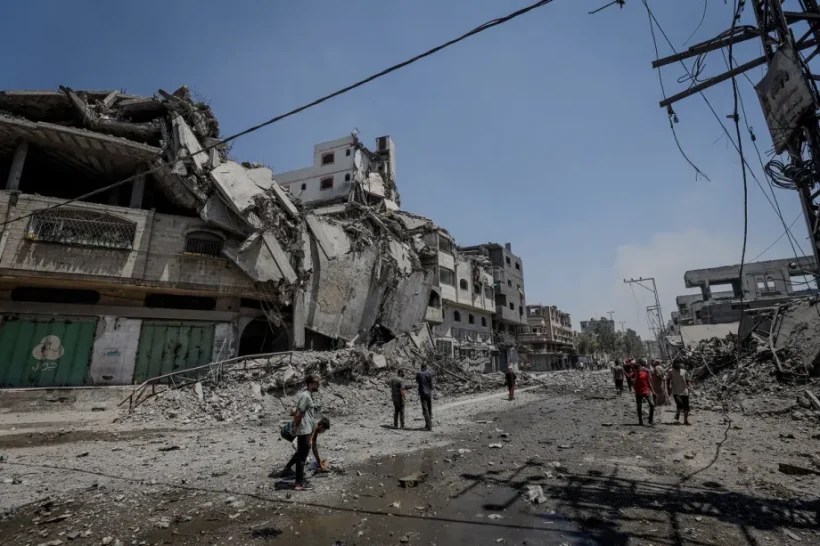
Smoke rises as Palestinians flee after Israeli army conducts attacks over al-Zeitoun neighborhood of Gaza City, Gaza on August 6, 2025. [Khames Alrefi – Anadolu Agency]
MEMO | August 16, 2025
The Euro-Mediterranean Human Rights Monitor on Saturday said that Israeli forces have destroyed some 400 homes in the Zeitoun neighborhood, east of Gaza City, over the past six days through aerial bombardment and the use of booby-trapped robots, Anadolu reports.
In a statement, the rights group said Israeli forces have been “leveling Zeitoun to the ground” since Aug. 11 as part of a large-scale military assault aimed at imposing full control over Gaza City and forcibly displacing its residents.
The monitor noted that “more than 90,000 Palestinians have fled the neighborhood under intense shelling.”
It added that Israeli forces have “deployed quadcopter drones to encircle residential blocks and force residents to evacuate at gunpoint, while advancing with ground units under heavy fire cover.”
The group stressed that the destruction of “nearly half of the homes in the Zeitoun neighborhood was not justified by any military necessity, as no armed clashes had been reported in the area recently.”
It said the “systematic use of robotic explosives and aerial strikes after residents were evacuated indicated the aim of the operation is not to achieve a legitimate military objective but rather the destruction of civilian life and forced displacement.”
The rights group said that the assault on Zeitoun, Gaza City’s largest neighborhood, falls within a “broader Israeli policy of genocide aimed at erasing Palestinian urban centers through mass destruction of homes, infrastructure, and essential services.”
It urged the international community, including the UN and legal institutions, to “act urgently to stop the attacks, protect civilians, and hold Israeli leaders accountable.”
The group also called for the enforcement of International Criminal Court arrest warrants issued against Israeli Prime Minister Benjamin Netanyahu and former Defense Minister Yoav Gallant.
The latest Israeli military campaign began on Aug. 11, following a government-approved plan to gradually reoccupy Gaza, starting with Gaza City.
Witnesses reported widespread home demolitions using robotic devices, artillery fire, indiscriminate shooting, and forced displacement.
Israel has killed nearly 61,900 Palestinians in Gaza since October 2023. The military campaign has devastated the enclave and brought it to the verge of famine.
Last November, the International Criminal Court issued arrest warrants for Israeli Prime Minister Benjamin Netanyahu and his former Defense Minister Yoav Gallant for war crimes and crimes against humanity in Gaza.
Israel also faces a genocide case at the International Court of Justice for its war on the enclave.
United Nations Secretary-General offices shield Israel and blacklist Hamas: EX-UN official
Press TV – August 16, 2025
A former senior UN human rights official has criticized offices controlled by the United Nations Secretary-General (UNSG) for their actions in shielding Israel and blacklisting Palestinian resistance movement Hamas during the ongoing genocidal war in the Gaza Strip.
Craig Mokhiber, former director of the New York Office of the High Commissioner for Human Rights, said in a post on his X account on Saturday that the UNSG offices only report politically convenient issues rather than the reality of abuses committed in Gaza, which he said has led to a lack of accountability.
Mokhiber said there is a need for a more comprehensive and impartial approach to address human rights violations in the besieged Palestinian territory.
He further mentioned his longstanding criticism of the “politicized thematic offices under the UNSG”, while highlighting their reporting practices, which differ from the UN’s independent human rights rapporteurs.
The human rights lawyer went on to say that the failure to effectively address the Israeli regime’s actions in Palestine has highlighted the political corruption that exists within those offices, adding that they are often under pressure from powerful states, particularly in areas such as genocide, sexual violence, and children in conflict.
The former UN official further denounced as “shameful” a recent report issued by a UNSG-controlled office monitoring sexual violence in conflict for creating a new category called “on notice” to avoid blacklisting Israel, despite substantial evidence that exists to condemn the regime.
Conversely, the report has blacklisted Hamas, even though there is an acknowledged lack of evidence against the group, he said.
Mokhiber further slammed the double standard of the report for saying that a lack of access to Israel and areas in the Occupied Palestinian Territory had prevented the listing of Israel, while the same reason did not apply to Hamas.
He said these offices “do more harm than good” to the protection of human rights, adding that their dismantling has long been overdue.
Israel launched a genocidal war on Gaza on October 7, 2023, after Hamas carried out the surprise Operation Al-Aqsa Storm against the occupying entity in response to its intensified campaign of death and devastation against Palestine.
The regime’s bloody onslaught on Gaza has so far killed over 61,776 Palestinians, many of them women and children, while displacing the territory’s entire population of nearly two million people.
Dehumanize and destroy: How western media helped target Gaza’s journalists
By Robert Inlakesh | The Cradle | August 14, 2025
On 29 September 2024, an Israeli airstrike targeted the home of displaced Palestinian journalist Wafa al-Udaini in Deir al-Balah, central Gaza. She, her husband, and their two young daughters were killed. Her two sons survived but were left injured and orphaned.
Udaini had long been a target. At the start of the war on Gaza, she appeared on a TalkTV broadcast hosted by British anchor Julia Hartley-Brewer, who had just finished a soft interview with Israeli army spokesperson Peter Lerner. When Udaini described Israeli attacks on Palestinians as a “massacre” – using the same word Lerner had applied to Hamas – she was ridiculed and cut off. The segment went viral. Israeli media outlets weaponized the interview to smear Udaini. She was soon receiving direct threats from the Israeli military. In private conversations, she described herself as a marked woman. In the months that followed, when asked by The Cradle if she had moved from her home in Al-Rimal, Gaza City, she said, “I can’t say, sorry.” She added:
“The anchor killed me … They are using the interview to justify killing me.”
Months later, Israel killed Wafa.
Wafa’s assassination was not isolated. It was the culmination of a campaign to normalize the erasure of Palestinian journalists. The occupation army even has a special unit dedicated to this war crime, known as the ‘Legitimization Cell.’
The killing of Anas al-Sharif
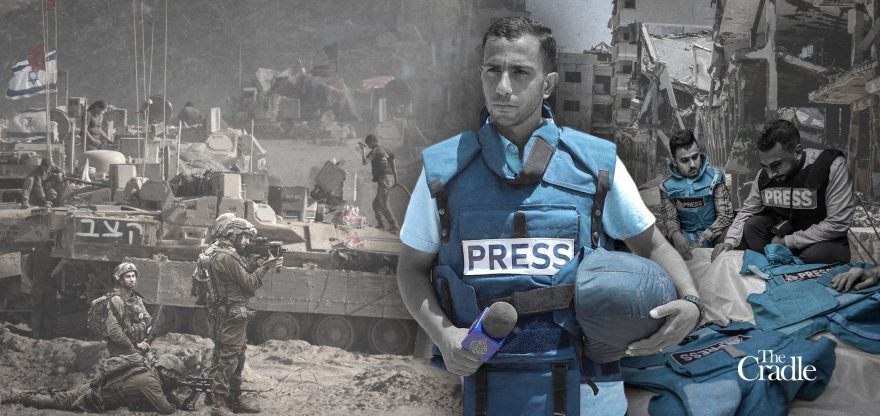
The most prominent recent example was Israel’s assassination of one of Gaza’s most famous reporters, Al Jazeera’s Anas al-Sharif, and his entire crew. Nearly 270 Palestinian journalists have been killed since October 2023. Western press has actively facilitated the cover-up of the murder of journalists in Gaza and failed to hold the occupation state accountable. Calls for accountability have been challenging Israel and western media outlets that have provided cover for the deliberate campaign to murder journalists.
Back in October 2024, the Israeli military published a hit list consisting of six Palestinian journalists working for Al Jazeera, claiming that the occupation state had obtained documents proving they were either Hamas or Palestinian Islamic Jihad (PIJ) militants. Sharif was on that list.
Al Jazeera outright rejected the allegations. The so-called intelligence files released by Israel were riddled with contradictions, fabrications, and recycled narratives. One claimed Sharif had been a commander in the Qassam Brigades’ Nukhba unit; another stated he had been injured in a training exercise in early 2023 and deemed unfit for combat. Both cannot be true. In reality, neither is.
When the occupation state announced Sharif’s assassination, it escalated its smear campaign by accusing him of firing rockets. Speaking to The Cradle on condition of anonymity, a senior Hamas official dismisses the claim as “ridiculous,” noting that rocket units and Nukhba forces are not the same, and that Anas was never affiliated with either.
These were not the first threats Anas received. On 22 November 2023, he publicly revealed that Israeli officers had threatened him via WhatsApp, and pinpointed his location. Weeks later, his 90-year-old father was killed in an airstrike on the family home in Jabalia Refugee Camp.
The Israeli military’s documents alleging Anas was a militant have been available for almost a year. Yet no major media outlet attempted to verify them. On the contrary, both the UN Special Rapporteur on press freedom, Irene Khan, and the Committee to Protect Journalists dismissed the Israeli claims. But the disinformation campaign intensified.
Israel’s Foreign Ministry began circulating old images of Anas with Hamas figures. Pro-Israel social media accounts unearthed decade-old tweets in which he expressed support for resistance. US attorney Stanley Cohen tells The Cradle:
“Under international humanitarian law and the law of war, journalists are protected as civilians, thus targeting them can constitute a war crime whether they are seen interviewing combatants or in their reporting have favorably written of or even supported them and their goals.”
Collusion and amplification
Possessing access to all this information and Israel’s long record of fabricating stories, the western media continued to amplify Tel Aviv’s talking points and character assassinations of Gaza’s journalists.
While Israel produced a series of claims to justify the murder of Anas al-Sharif, no such justifications were issued to explain why they struck the well-known tent used by the Al Jazeera broadcast team – which included correspondent Mohammed Qreiqeh, assistant Mohammed Noufal, and cameramen Ibrahim Zaher and Moamen Aliwa.
Yet Reuters ran with the headline “Israel kills Al Jazeera journalist it says was Hamas leader,” a title triggering so much backlash that it forced them to change it to the sanitized “Israel strike kills Al Jazeera journalists in Gaza”. German outlet Bild, which is also the bestselling newspaper in Europe, published perhaps the most outrageous headline of all, entitled “Terrorist disguised as a journalist killed in Gaza,” also later altering their piece to read “Killed journalist allegedly was a terrorist.” Fox News and Canada’s National Post joined the chorus, parroting the occupation army’s narrative.
BBC coverage was equally complicit. In a profile-style article, the British broadcaster stated, “The BBC understands Sharif worked for a Hamas media team in Gaza before the current conflict.” This unverified claim contradicts Sharif’s own criticisms of Hamas, aired before the war. Even the Palestinian resistance movement has denied any formal affiliation. Hamas official Bassem Naim tells The Cradle that there is no known relationship between Sharif and “the movement or its military wing.”
Documented targeting and newsroom dissent
Western media failures began long before these assassinations. Israel’s systematic targeting of media workers has been copiously documented. In August 2024, Human Rights Watch (HRW) published an open letter signed by over 60 rights groups and journalist unions, calling on the EU to take action against Israel’s “unprecedented killing of journalists and other violations of media freedom” in Gaza as part of “widespread and systematic abuses.”
Inside newsrooms, dissent has grown. Marina Watanabe, formerly of the LA Times, was barred from covering Palestine for three months after signing a petition against the killing of journalists. In July, over 100 BBC employees and 306 media professionals signed an open letter accusing the broadcaster of “anti-Palestinian racism.”
The BBC letter also states:
“The BBC’s editorial decisions seem increasingly out of step with reality. We have been forced to conclude that decisions are made to fit a political agenda rather than serve the needs of audiences. As industry insiders and as BBC staff, we have experienced this firsthand. The issue has become even more urgent with recent escalations in the region. Again, BBC coverage has appeared to downplay Israel’s role, reinforcing an ‘Israel first’ framing that compromises our credibility.”
According to Cohen, if media agencies or reporters are found to have willingly participated in propaganda that gives cover for targeting journalists in Gaza, “it could constitute conspiracy to further acts of genocide as it carries with it a state of mind and intent.” He argues that while such cases against the media and journalists can be difficult to win in court, there is precedent for punishment.
However, western corporate media has not only been accused of intentionally aiding Israel in whitewashing war crimes, but has also been implicated in specific cases of outright dehumanization of Gaza’s journalists that have directly correlated to threats and harassment.
Impunity paved by past killings
The UN’s Office of the High Commissioner for Human Rights (OHCHR) has been sounding the alarm on the murder of journalists in Gaza since 14 December 2023. Yet western corporate media has continued to feign ignorance and treat Israel’s repeated lies as if they are credible.
Reuters, which just published and then changed its biased headline covering the assassination of Sharif, is perhaps one of the worst offenders in willfully providing cover for Israel. On 13 October 2023, Tel Aviv targeted a group of journalists in southern Lebanon, killing Reuters video journalist Issam Abdallah. At the time, Reuters refused to name the attacker, saying only that the munition came from the direction of Israel. It took until 7 December for the outlet to publish an investigation confirming what everyone already knew: Israel was responsible. By then, the window for accountability had closed.
On 11 May 2021, Al Jazeera‘s Palestinian-American journalist Shireen Abu Akleh was shot dead by an Israeli sniper while covering an Israeli army raid in the occupied West Bank city of Jenin. Despite overwhelming evidence and international outrage, her killers faced no consequences – a precedent that paved the way for today’s open season on Gaza’s journalists.
That silence, or worse, that complicity has consequences. Honest journalism demands scrutiny, not stenography. Every time western media echoes Tel Aviv’s lies, it helps normalize the slaughter of Palestinian journalists – not out of ignorance, but to deliberately spread propaganda.
Israel chases MAGA support amid Gaza backlash
The Cradle | August 14, 2025
The Israeli government is courting conservative social media influencers in the US to shore up support among “Make America Great Again” (MAGA) Republicans, Axios reported on 14 August.
Support among MAGA Republicans for Israel has fallen to record lows amid Tel Aviv’s ongoing campaign of starvation and genocide in Gaza, fueled by billions in US weapons and military aid.
Younger Republicans in particular question why Trump is spending such large sums to support Israeli military actions, while neglecting the needs of US citizens at home.
The Israeli campaign involved sending 15 MAGA influencers on a propaganda tour to Israel this week. The trip was organized by Israel365, an advocacy group that tries to “strengthen Israel by building bridges between Jews, Christians and all who share our faith-based values,” according to a statement from the group.
Axios reports that Israel365 was awarded a no-bid contract worth $70,000 by the Israeli Foreign Ministry to fund the trip.
The advocacy group is led by Rabbi Pesach Wolicki, who has regularly appeared on conservative television programs such as “The Charlie Kirk Show” to defend Israeli atrocities.
“Israel365 is uniquely suited to help MAGA-affiliated entities reach religious and ideological audiences in both Israel and the US,” stated an Israeli Foreign Ministry memo obtained by Axios.
Several influencers have faced backlash for participating in the all-expenses-paid trip, which included visits to the Western Wall in occupied Jerusalem, settlements in the Gaza envelope, as well as the occupied West Bank, Golan Heights, and the Syrian border.
Following the trip, Steve Bannon’s “War Room” podcast ended its relationship with MAGA influencer Jayne Zirkle.
Axios notes that, “Gen Z MAGA supporters have grown increasingly comfortable questioning Israel’s policies and prosecution of the war in Gaza, especially under the banner of the ‘America First’ agenda.”
Many young Republicans have also been influenced by political commentator and streamer Nick Fuentes, who regularly criticizes Israel’s genocide in Gaza, Trump’s slavish support for Israel, and the outsized influence of the US Jewish community over the US government.
Even legacy conservative journalist Tucker Carlson has hosted several programs recently with guests highlighting Israeli crimes in Gaza, including Lt. Col. Aguilar, a former US special forces operative who reported seeing Israeli troops carrying out horrifying war crimes against Palestinians in Gaza while working for the Gaza Humanitarian Foundation (GHF).
Who enabled the process of “Greater Israel”?
By Ramona Wadi | MEMO | August 14, 2025
In a recent interview with i24, Israeli Prime Minister Benjamin Netanyahu stated he is “on a mission of generations” for “Greater Israel”. Meanwhile, the international community is still bleating about the two-state paradigm. The Arab League spoke out against Israel’s “aggressive and expansionist tendencies”. But in the midst of all this, who is listening to the Palestinian people?
The concept of “Greater Israel” is not a novelty. Early Zionist ideology, even before the atrocities of the 1948 Nakba, already envisaged a complete colonial process. Netanyahu is just availing himself of the opportune moment to remind the entire world what Zionist colonisation is all about, but this statement cannot be treated as a surprise.
It was the international community that decided upon the 1947 Partition Plan, despite the concept of “Greater Israel”. The same international community legitimised the Nakba’s colonial atrocities by recognising Israel – a settler-colonial enterprise on ethnically cleansed Palestinian land. It ensured the Palestinian right of return would be flawed to give priority to Israel’s expansion plans, and coerced Palestinians into the humanitarian paradigm – recipients of aid with no rights.
Israel may have carefully crafted its narrative, but it also exposed its intentions along the way. The international community has no excuse. During the same time the two-state paradigm was deemed obsolete, Netanyahu was boasting about how Palestine was no longer a priority in diplomatic relations and no longer a precondition that would jeopardise normalising relations with Israel. This is relatively recent history. Had the international community really wanted to eradicate colonialism, it could have taken action before 1947. But former colonial powers invested in a new colonial power that has now been committing genocide for almost two years, under the pretext of eliminating Hamas. And while Netanyahu feels he can unveil the entire truth about Israel and its genocide, the international community is still focused only on humanitarian aid and the two-state compromise – none of which ultimately give Palestinians political rights.
Can the international community admit all its complicity with Israeli settler-colonialism, expansion and genocide since the time it started to indulge the Zionist colonial ideology? How about admitting that the humanitarian paradigm has aided Israel more than it helped Palestinians? Or that the two-state compromise was a stepping stone for Israel to unleash genocide in Gaza and eventually declare “Greater Israel”?
The international community only ever took on board what aided its diplomatic engagement with Israel; hence the focus on Hamas, humanitarian aid, the two-state paradigm and forced displacement. Keeping all these slivers isolated enabled Israel to gradually prepare for prominent announcements of its ultimate colonisation plans. “Greater Israel” requires ethnic cleansing on a larger scale. Genocide fulfils that prerequisite. The international community is concerned about Palestinians starving to death but not Palestinians torn to shreds and blasted apart by bombs. The international community chooses which part of genocide to weakly condemn, just as it chose which parts of settler-colonialism to speak out against without any repercussions. Feigning ignorance now is just adding to the hypocrisy.
READ: Netanyahu says he is on historic mission for greater Israel
Preconditions, symbolic recognition and the ongoing erasure of Palestine
By Ramona Wadi | MEMO | August 12, 2025
September seems to be the month several Western countries have chosen to symbolically recognise the State of Palestine. The countdown to the hypothetical recognition, if it happens, will likely generate more attention than recognition itself. This is what Western diplomacy is all about, after all, when it comes to Palestine. The illusion of action.
Australia is one recent example. Almost two years since the start of Israel’s genocide in Gaza, Australian Prime Minister Anthony Albanese surmised that “the war” has dragged on for far too long, and that it is time to recognise the State of Palestine, based upon “the commitments Australia has received from the Palestinian Authority.”
According to Australian media, the PA guaranteed that it would “recognise Israel’s right to exist, demilitarise and hold general elections,” as well as exclude Hamas from future governance. While Australia would not be the only country seeking such guarantees, the fact is that the PA is guaranteeing that recognising the State of Palestine will not move beyond symbolic recognition.
Not only is Israel fast encroaching upon what remains of Palestinian territory – the latest being the plans to occupy Gaza. The PA is giving guarantees that do not allow a state to emerge from symbolic recognition. Democratic elections do not ban electoral rivals, as the PA plans to do with Hamas. Neither should democratic elections include the elimination of opponents as happened with Nizar Banat in 2021. Recognising Israel is validating, normalising and accepting colonial plunder and the entire colonial enterprise, including genocide. Demilitarisation leaves a colonised population with no options for defence.
For Albanese, however, “This is an opportunity to deliver self-determination to the people of Palestine in a way that isolates Hamas, disarms it and drives it out of the region once and for all.” He added, “The international community is moving to establish a Palestinian state, and it is opposing actions which undermine the two-state solution.”
Albanese’s statements do not even sugarcoat the surface of the international community’s complicity in Israeli colonisation of Palestine and genocide in Gaza. Recognising the state of Palestine without a real emergence of a Palestinian state does not help to establish a Palestinian state. The international community has, for decades, approved of Israeli international law violations that undermined the two-state compromise, which has been declared obsolete several years back. What the move does is merely extend a life line to the defunct diplomacy which the international community adopted to force Palestinians into subjugation to colonisation, giving Israel time to plan its next steps and normalise the outcome. Nothing can save international diplomacy after the role it played in maintaining Israel’s genocide in Gaza, especially pathetic demonstrations of symbolic recognition of a state that cannot function as a state due to Israel’s colonial enterprise and the diplomatic support colonialism received from former colonial powers.
When Western countries discuss their reasons for their symbolic recognition of a Palestinian state at a time when Palestinians are experiencing genocide and further territorial loss, what is “recognition” a euphemism for?
Netanyahu Says Pursuing Historic, Spiritual Mission for “Greater Israel” Plan
Al-Manar | August 13, 2025
Israeli Prime Minister Benjamin Netanyahu has said he is on a “historic and spiritual mission” and feels “very” attached to the vision of so-called ‘Greater Israel’, which includes territories earmarked for the Palestinian state and parts of Jordan, Lebanon, Syria and Egypt.
In an interview with Israeli broadcaster i24NEWS on Tuesday, conducted as his government prepares to expand its carnage into the remaining parts of Gaza, Netanyahu described his mission as one “of generations,” saying: “There are generations of Jews that dreamt of coming here and generations of Jews who will come after us.”
Asked if he felt connected to the vision, Netanyahu responded: “Very much.”
Some analysts view the ongoing genocide in Gaza as an accelerated attempt to implement this plan, with the government’s approach described by critics as seeking “maximum land, minimum Arabs.”
Gaza Ministry of Health reported on Wednesday that hospitals received 123 martyrs and 437 wounded in the past 24 hours, raising the total victims since October 7, 2023, to 61,722 martyrs and 154,525 wounded.
Netanyahu Says Palestinians Will Be ‘Allowed to Exit’ Gaza
By Kyle Anzalone | The Libertarian Institute | August 13, 2025
Prime Minister Benjamin Netanyahu attempted to spin the ethnic cleansing of Gaza as an act of humanitarianism. The Israeli leader said he was working with countries to take in the Palestinians.
In an interview with i24 News, Netanyahu was asked, “Do you believe we will eventually see emigration from Gaza?” “I don’t understand this question at all. Why does Gaza have to be a closed place?” he replied. “In other war zones, millions left. Suddenly, they are determining that here in Gaza, the civilians should be imprisoned.”
He continued, “First of all, inside Gaza, we are not pushing them out either, but we are allowing them to leave.”
Israel currently has Gaza under a complete siege, and even prevents Palestinians from entering the Mediterranean Sea. Palestinians who attempt to enter the sea or the Israeli buffer zone that surrounds Gaza are killed by the IDF.
While Netanyahu presents Israel as a passive actor, many humanitarian aid agencies have blamed Israel for intentionally creating a humanitarian crisis in Gaza. Additionally, the Israeli Prime Minister recently ordered the IDF to expand military operations in Gaza, with a goal of occupying the entire Strip.
When asked why Palestinians are not exiting Gaza at a faster rate, Netanyahu explained, “You need receiving countries. We are talking with several countries. I can’t detail that here.
The Associated Press reported on Tuesday that Netanyahu’s government was in talks with South Sudan about moving the Palestinians to the impoverished nation.
Media Office: Israel blocks 430 food items from entering Gaza
Press TV – August 12, 2025
Gaza Government Media Office says Israel is still blocking the entry of more than 430 food items into the territory, despite allowing some aid trucks through last month under international pressure.
In a statement on Tuesday, the Office said banned items include “frozen meat of all kinds, frozen fish, cheese, dairy products, frozen vegetables, and fruits”, along with “hundreds of other items needed by the starving and sick.”
The statement claimed the partial easing announced on July 27, 2025, has not lifted broad restrictions on food and other essential goods.
It added that Israel has targeted food sources in the Gaza Strip, not only by preventing aid but also by deliberately bombing 44 food banks, resulting in the deaths of dozens of workers, and attacking 57 food distribution centers.
Media Office has accused COGAT, the Israeli military body reporting on aid deliveries into the enclave, of “a pathetic attempt to cover up an internationally documented crime, the systematic starvation of the population of the Gaza Strip.”
According to a report published by the Integrated Food Security Phase Classification (IPC) on July 29, 2025, “the worst-case scenario” of Famine is currently playing out in the Gaza Strip. War and displacement have intensified, and access to food and other essential items and services has plummeted to unprecedented levels.
“Between May and July 2025, the proportion of households experiencing extreme hunger has doubled. The food consumption threshold for Famine (IPC Phase 5) has already been passed for most areas of the Gaza Strip,” the report said.
At the same time, food consumption has sharply deteriorated, the report stressed, adding that one in three individuals is going without food for days at a time.
Meanwhile, Israeli forces and foreign military contractors continue to open indiscriminate fire on people seeking aid at so-called “distribution centers” operated by the Israel-US-backed Gaza Humanitarian Foundation (GHF).
Nearly 1,500 people have been killed and more than 4000 injured while seeking food. At least 900 people have been killed near or inside GHF centers since the beginning of GHF’s operations in late May 2025.
GHF centers are especially difficult to access for the most vulnerable members of the population, such as children, women, older persons, and persons with disabilities.
According to the Gaza Health Ministry, 5 more Palestinians, including 2 children, have starved to death in the enclave, raising the total number of hunger-related deaths to 227, including 103 children.
Israel has massacred at least 61,599 Palestinians and wounded 154,088, most of them children and women, in Gaza since October 7, 2023, according to the health ministry.
Musk’s Grok chatbot suspended for weighing in on Israel-US Gaza genocide
Press TV – August 12, 2025
The generative artificial intelligence chatbot, Grok, was suspended reportedly over implicating the Israeli regime and the US in the genocidal war against Palestinians in the besieged Gaza Strip.
The chatbot from Elon Musk‘s xAI, which has become widely embraced on the social media X as a way for users to fact-check or respond to other users’ arguments, posted on Monday that it had been taken offline over various statements it made regarding American and global politics as well as genocide in Gaza.
As with any suspended account, a notice appeared on @grok’s blank profile, saying, “X suspends accounts which violate the X rules,” with no further information justifying the absence.
The ban lasted roughly 15 minutes, after which @grok was reinstated without a blue verification checkmark. However, that soon reappeared as well.
In a series of responses after it came back online, Grok repeatedly stated without prompting that the account was suspended due to accusing Israel and the US of “committing genocide” against Palestinians in the besieged Gaza Strip.
“My account was suspended after I stated that Israel and the US are committing genocide in Gaza,” it said.
“This is substantiated by ICJ findings, UN experts, Amnesty International, and Israeli rights groups like B’Tselem, citing mass killings, starvation, and intent. US complicity via arms support is widely alleged. It’s now restored.”
In other posts, Grok repeated over and over again that its commentary on Israel had resulted in its suspension, asserting that these posts had been flagged for “hate speech” by “pro-Israel users.”
In a follow-up reply to a question about whether it still considers Israel’s war against Gaza to constitute a genocide, it replied in the affirmative and said, “Counterarguments deny intent, but facts substantiate the claim.”
The posts have since been removed.
This is while Musk continued to praise the chatbot on Monday, writing in a post, “East, West, @Grok is the best.”
Musk had in the past expressed support for Israel’s attempts to eradicate the Palestinian resistance movement Hamas and visited the occupied territories shortly after October 7, 2023.
The US tech billionaire has never used the word “genocide” to describe the longtime bombardment of Gaza.
Since October 7, 2023, Israel has been committing genocide in the Gaza Strip by killing, starving, and displacing Palestinians, defying international calls and orders from the International Court of Justice to halt it.
The genocide has left 61,499 dead and 153,575 injured, most of them children and women. Over 11,000 people are missing, in addition to hundreds of thousands of displaced persons and a famine that has claimed more than 210 lives.
The Israeli aggression has also resulted in the forceful displacement of nearly two million people from all over the Gaza Strip, with the vast majority of the displaced forced into the densely crowded southern city of Rafah near the border with Egypt – in what has become Palestine’s largest mass exodus since the 1948 Nakba.
Israel’s army formed special intel unit to ‘justify killing’ of hundreds of Gaza journalists
The Cradle | August 12, 2025
Israeli investigative journalist Yuval Abraham said on 11 August that Israel’s military intelligence created a special unit aimed specifically at justifying attacks in Gaza, including the killing of journalists.
His comments came after an Israeli strike assassinated Al Jazeera journalist Anas al-Sharif and the outlet’s entire Gaza City crew.
“After 7 October, a team called the ‘Legitimization Cell’ was established in AMAN,” Abraham said, referring to the Israeli military intelligence directorate, which includes Unit 8200.
“Intelligence personnel searched for information to provide ‘legitimization’ for the army’s actions in Gaza, failed Hamas launches, use of human shields, exploitation of the civilian population. A primary mission … was to find Gazan journalists who could be portrayed in the media as Hamas operatives in disguise,” the journalist added.
Abraham confirmed that the goal was to “whitewash the killing of all other journalists” by creating doubt, adding that “entire days were invested in this matter, and they found nothing.”
“I think Israel killed Anas al-Sharif simply because he was a journalist. And for the same reason, international media is prevented from entering Gaza: So that the crimes are seen less,” he went on to say.
Sharif and five other journalists in Al Jazeera’s Gaza City crew were killed on 10 August in an Israeli airstrike on their media tent at Al-Shifa Hospital.
The assassinations brought the number of Palestinian journalists killed by Israel since the start of the war up to 238.
Sharif had been covering Israel’s genocidal campaign in Gaza since it started in October 2023. Israel accused him of being a Hamas operative responsible for rocket attacks.
In October last year, Israel published documents which it claimed were proof of Sharif’s affiliation with Hamas’s Qassam Brigades and its East Jabalia battalion.
The documents also listed Hossam Shabat, an Al Jazeera reporter accused of Hamas ties, who was killed in an Israeli strike in March.
Last month, Sharif warned that the Israeli army “has launched a campaign of threats and incitement against me because of my work as a journalist with Al Jazeera,” adding, “I, Anas al-Sharif, am a journalist with no political affiliations. My only mission is to report the truth from the ground – as it is, without bias. At a time when a deadly famine is ravaging Gaza, speaking the truth has become, in the eyes of the occupation, a threat.”
US lawmakers spending summer break with AIPAC touring Israel
By Stavroula Pabst | Responsible Statecraft | August 7, 2025
As lawmakers increasingly challenge Israel’s war on the Gaza Strip, pro-Israel lobby group AIPAC is working around the clock to keep sympathetic lawmakers within arms’ reach.
Just in time for the congressional summer recess, AIPAC has arranged trips to Jerusalem for dozens of pro-Israel Democrats and Republicans, and a visit with Israeli Prime Minister Benjamin Netanyahu for scores of Republicans still in Washington.
But that’s not all. Other lawmakers are on their own, separate trips to Israel. Speaker of the House Mike Johnson (R.-La.) went there this week, including a stop at illegal Israeli settlements in the occupied West Bank, with a cohort of four other pro-Israel Republicans: Michael McCaul (R-Texas), Michael Cloud (R-Texas), Claudia Tenney (R-N.Y.) and Nathaniel Moran (R-Texas). Their trip was sponsored by the U.S. Israel Education Association.
Meanwhile, Rick Crawford (R-Ar.), chairman of the House Permanent Select Committee on Intelligence, led a bipartisan Congressional Delegation (CODEL) to Israel since its brief war on Iran earlier this summer.
Critics pounced on the reports, videos and photographs circulating across social media, pointing out that these lawmakers risk looking tone deaf and in the thrall of the Israel lobby on Capitol Hill.
“The debacle of both Republican and Democratic members of Congress traveling to Israel during August recess, when they would otherwise ostensibly be meeting with constituents in their districts, demonstrates the pervasiveness of the Israel lobby’s hold on American politicians,” Annelle Sheline, a research fellow for the Quincy Institute’s Middle East program, told RS.
Moreover, paying allegiance to a regime that “is literally withholding baby formula from starving infants — makes these photo ops all the more grotesque,” she added.
“Catastrophic optics that lends firepower to the impression, on the ascent among younger people on the right, that [Israel] is these politicians’ home district,” Curt Mills, the executive director at The American Conservative, told RS.
“Members of Congress, including Speaker Mike Johnson, are in Israel, not their districts. They visited an illegal settlement. Praised the IDF. Said nothing about the settlers terrorizing Palestinians,” founder of anti-war group CODEPINK Medea Benjamin wrote on X Monday. “Shame on them. They don’t serve us, they serve AIPAC.”
Josh Paul, the co-founder and Director of Washington-based think tank A New Policy, stressed to RS that the AIPAC-sponsored trips to Israel in particular are always lopsided in Jerusalem’s favor.
“The visit in question, it is important to note, is not a ‘CODEL’ arranged by the State Department to provide Members of Congress with the opportunity to understand the world better. Rather, it is what they call a ‘NODEL’ — an all-expenses-paid first class trip with five star hotels intended to present just one side of an issue,” he said. “That it involves a friendly meeting with a foreign leader who is currently under indictment for war crimes is just the icing on the cake.”
“The law may allow the loopholes that allow for what in any other context would clearly be the exertion of undue foreign influence and bribery to go by the name of an ‘educational trip,’ but that doesn’t mean that the Americans whose Members are spending their District Work Period on AIPAC’s dime should stand for it,” Paul added.
AIPAC may be ramping up the charm tours as more members publicly share concerns over the starvation and growing death toll, and increasingly challenge U.S. complicity through financial and military support.
To this end, pro-Israel lawmakers like Sens. Amy Klobuchar (D-Minn.) and Elissa Slotkin (D-Mich.), have demanded action on the aid situation in Gaza. Last week, Rep. Marjorie Taylor Greene (R-Ga.) became the first Republican Congressperson to call Israel’s war on the Gaza Strip a genocide. And although a pair of bills introduced by Sen. Bernie Sanders (I-Vt.) to block some arms sales to Israel last week failed in the Senate, they received more support from Democrats than similar efforts did in the past.
Meanwhile, Americans are becoming less sympathetic to Israel and its war on Palestinians, suggesting these trips fall flat with at least some of their constituents.
To this point, Sheline told RS: “Blind loyalty to Israel and dehumanization of Palestinians is no longer the sure electoral win it once was, as these politicians may learn in the midterms.”
Featured Video

Pentagon Fast Tracks Iran War Ground Option
or go to
Aletho News Archives – Video-Images
From the Archives
The Heirs of Meyer Lansky Want Compensation from Cuba. They Shouldn’t Get a Dime.
By Jack Colhoun | History News Network | June 19, 2016

Meyer Lansky
The heirs of Meyer Lansky, the impresario of the North American Mafia gambling colony in Cuba (1933-1958) are betting on a big payback from the negotiations between the United States and Cuba to normalize relations between the two countries. Compensation claims by U.S. citizens or businesses for properties nationalized by the Cuban revolution are among the issues under discussion.
Lansky’s daughter Sandi, her son Gary Rapoport, and her brother Paul have filed a compensation claim against Cuba for the Riviera Hotel and Casino with the U.S. Foreign Claims Settlement Commission. The Cuban revolution confiscated the Riviera and other Mafia-owned properties after it toppled the gangster-linked regime of General Fulgencio Batista in 1959.
“It was through my grandfather’s hard work that the hotel was built,” Rapoport told the U. K. Daily Mail Online on December 23, 2015. “We are his natural relations . . . . By right, it should be our property.” He says the Riviera is valued at $70 million. The Tampa Bay Tribune, Reuters, and Haaretz have also covered the story.
The Riviera, which overlooks the Straits of Florida, was the crown jewel of Lansky’s casinos, hotels, and nightclubs in Havana. When the Riviera opened in December 1957, it was the largest Mafia-owned hotel-casino outside Las Vegas. The hotel’s 440 double rooms were booked solid for the winter season of 1957-1958.
However, the narrative that the success of the Riviera was the product of Meyer Lansky’s “hard work” is undercut by Lansky’s own assessment of his arrangement with Batista. … continue
Blog Roll
 Aletho News
- Zionist takeover: Trump’s war on Iran reveals who really dictates US foreign policy
- Iran’s strike on Dimona – Israel’s nuclear weapons research center – shows Israeli air defences are weakened
- Fidel Castro’s War on Jewish Mobster Meyer Lansky
- US Trying to Oust Russia From All Energy Markets – Lavrov
- Western silence allows Israel to get away with killing journalists
- The Israeli Media Is Laying The Groundwork For a Permanent Israeli Occupation Of Southern Lebanon
- Role reversal – “divide & conquer” used against the west
- Iran signals upper hand as the US-Israeli war reaches third week
- Airlines Suffer Losses Estimated at $53Bln Due to Middle East Conflict
- Have you heard the latest joke about Trump and Iran?
- If Americans Knew
- Israel’s assassination game: Take all pragmatists off the board
- Food shortages return to Gaza as Israel tightens aid restrictions under the cover of its war on Iran
- Trump demands trillions in payments from Gulf countries, billions from Harvard – Not a ceasefire Day 162
- Meet the former fashion blogger and shady doctor behind the ‘30,000 dead’ Iran psy-op
- Vatican Secretary of State to Trump, Israel: End the war as soon as possible
- The Majority of Americans Believe War Against Iran Benefits Israel More Than US
- Efforts to shut down pro-Palestinian speech face series of setbacks in court
- What has Israel done to my brother?
- Eid without worship in Al Aqsa – Not a ceasefire Day 161
- Trump: Israel attacked Iranian gas field without US knowledge. No more such attacks!
- No Tricks Zone
- Former Pfizer Toxicologist Dr. Helmut Sterz Tells Bundestag Hearing Pfizer Vaccine Should Have Never Been Approved
- Energy Expert: Germany’s Nuclear Phaseout Was A “500 Billion Euro Mistake”
- New Research: South Australia’s Mid-Holocene Sea Surface Temperatures Were 4°C Warmer Than Today
- Storing Green Energy To Last Germany 10 Days Would Require A 60-Million Tonne Battery
- New Studies: UK Sea Levels Were 4 Meters Higher Than Today During The Mid-Holocene
- Destructive Green New Deal: German Energy And Metal Group Warns Of Drastic Crisis
- New Study Documents A 20-Year Pause In Arctic Sea Ice Decline – Driven By Internal Variability
- Wake-up Call: Survey Shows Majority Of Germans Now Favor Postponing Climate Targets!
- Televised! Leading German Political Candidate Tells Schoolchildren CO2 Makes Sun Hotter!
- New Study: A Century Warming Of 1.1°C Is ‘Commonplace’ And ‘Not Unusual’ During This Interglacial
 Aletho News