AIPAC leader boasts of special ‘access’ to top Trump natsec officials in leaked audio
By Max Blumenthal | The Grayzone | April 9, 2025
During an off-the-record panel, AIPAC’s CEO detailed his organization’s grooming of Trump’s top national security officials, and how his group’s “access” ensures they continue to follow Israel’s agenda.
The Grayzone has obtained audio of an off-the-record session from the 2025 Congressional Summit of AIPAC, the main US lobbying arm of the state of Israel. Recorded by an attendee of the panel discussion, the audio features AIPAC’s new CEO, Elliott Brandt, describing how his organization has cultivated influence with three top national security officials in the Trump administration – Secretary of State Marco Rubio, National Security Director Mike Waltz, and CIA Director John Ratcliffe – and how it believes it can gain “access” to their internal discussions.
Joining Brandt on the panel was Dana Stroul, formerly the highest ranking civilian overseeing Middle East issues in the Biden administration’s Department of Defense. Stroul made it clear that defending Israel’s strategic imperatives from within the US government was a top priority, arguing that Washington should deepen its “mutually beneficial” special relationship with its “strong partner” in Tel Aviv.
Stroul dismissed the bloodbath in Gaza as the result of supposed Hamas tactics which supposedly aim to maximize the amount of children killed by Israel. At the same time, she and her fellow Israel lobbyists fretted about the impact of the post-October 7 war on public support for the self-proclaimed Jewish state. She was particularly troubled by Sen. Bernie Sanders’ attempts to force votes on military aid packages to Israel which, in her view, should never be debated in the open. Another unidentified AIPAC panelist worried that pro-Palestinian academics could eventually influence AI knowledge systems, leading to a dangerous shift in national security policy unless they were decisively suppressed.
The Congressional Summit was permeated with anxiety, as AIPAC leaders told rank-and-file members to hide their badges when they left the Marriott Hotel for fear they would be confronted by anti-genocide protesters. Other than a handful of sessions, such as a keynote address by Israeli PM Benjamin Netanyahu, the conference was strictly off-the-record.
With the cameras off, AIPAC leadership provided unusually candid details of their activities. In one revealing admission, Brandt explained how he and his lobbying organization groomed the future CIA director and other top Trump officials as pro-Israel assets.
AIPAC’s “lifelines” on the Trump national security team
Elliot Brandt was promoted to Executive Director of AIPAC in 2024, making him one of the most powerful lobbyists in Washington. Though he is largely unknown to the American public, Brandt has spent around three decades building relationships on Capitol Hill. This was the key, he suggested, to cultivating the future leaders of America’s national security state as loyal servants of Israel.
Referring to Trump’s Secretary of State Marco Rubio, his National Security Director Mike Waltz, and Elise Stefanik, whose nomination to serve as the US ambassador to the United Nations was suddenly withdrawn to preserve the GOP’s majority in the House of Representatives, Brandt explained to AIPAC members, “Those three people have something in common: they all served in Congress.”
After relying heavily on pro-Israel donors to fuel their campaigns for office, “they all have relationships with key AIPAC leaders from their communities,” said the AIPAC CEO. “So the lines of communication are good should there be something questionable or curious, and we need access on the conversation.”
Brandt’s comments corroborate Representative Thomas Massie’s claim that each member of Congress is expected to answer to an “AIPAC person.”
The AIPAC director’s reference to his organization’s “access” to presumably internal national security discussions contains ominous echoes of past espionage scandals in which AIPAC employees were accused of forking classified information over to Israeli intelligence. In 2004, for example, the FBI arrested a Pentagon researcher named Larry Franklin, who had provided classified documents related to Iran to two AIPAC staffers, Keith Weissman and Steve Rosen, who then delivered the information to Israeli intelligence. That December, the FBI raided AIPAC’s offices and seized a computer belonging to Brandt’s predecessor, Howard Kohr. (In the end, Franklin received a slap on the wrist from the government while Weissman and Rosen were fired by AIPAC.)
In his remarks to the AIPAC Congressional Summit, Brandt also pointed to CIA Director John Ratcliffe as an important point of contact. “You know that one of the first candidates I ever met with as an AIPAC professional in my job when he was a candidate for Congress was a guy named John Ratcliffe,” he recalled. “He was challenging a long time member of Congress in Dallas. I said, this guy looks like he could win the race, and, we go talk to him. He had a good understanding of issues, and a couple of weeks ago, he took the oath as the CIA director, for crying out loud. This is a guy that we had a chance to speak to, so there are, there are a lot – I wouldn’t call them lifelines, but there are lifelines in there.”
Top Pentagon veteran comes out as Israel lobbyist
Dana Stroul works as director of research at the Washington Institute for Near East Policy, a neoconservative think tank that was originally founded as the research arm of AIPAC. Stroul previously served as deputy assistant secretary of defense for the Middle East in the Biden administration’s Pentagon, presiding over policy toward Iran, Syria and virtually every other issue of importance to Israel.
In a closed session at the Marriott hotel, seated before an audience of AIPAC members, Stroul sounded more like a veteran Israel lobbyist than a US national security expert, arguing at length that any and all US military aid packages to Israel provided a net benefit to American empire, while dismissing well-documented Israeli atrocities in the besieged Gaza Strip as the result of “clever” Hamas human shield tactics.
According to an attendee of the AIPAC Congressional Summit, Stroul began her remarks by recalling the frantic hours after she received word of the October 7, 2023 attacks. Personally summoned to work by then-Defense Secretary Lloyd Austin, Stroul described how she rushed her child to the Pentagon’s in-house daycare center so she could get to the work of surging munitions to the Israeli military. She said she worked continuously for the next 48 hours, helping the Pentagon transfer weapons from its own stockpiles to Israeli bases. (The AIPAC attendee was unable to capture audio of these comments by Stroul).
Even as she worked to ensure that Israel had all it needed to transform Gaza into a moonscape, Stroul privately acknowledged that the Israeli military might be committing war crimes, according to a series of emails leaked to Reuters. On October 13, 2023, Stroul fired off an email to top White House, State Department, and Pentagon officials about a phone call she had just held with the International Red Cross Committee’s (ICRC) Middle East director, Fabrizio Carboni. “ICRC is not ready to say this in public, but is raising private alarm that Israel is close to committing war crimes,” Stroul wrote. “Their main line is that it is impossible for one million civilians to move this fast.”
Since recognizing the likelihood of Israeli atrocities, Stroul has apparently kept her conscience clear by blaming Hamas for the over 50,000 civilians Israel has killed in Gaza. “I think if you’re in Iran, or you are the Houthis or any of these other proxy terrorist groups, and frankly, probably the Russians and the Chinese,” she told AIPAC members at the 2025 congressional summit, “you’re looking at the ways in which the international community so quickly moved on from October 7 and what happened to Israel and why Israel is at war, and you’re probably taking away that a great tactic in wars to put as many civilians on the front lines as possible so that they can just get killed. And so, the Hamas tactic had strategic effects, because Israel finds itself isolated on the international stage. And it’s a tactic by Hamas to both terrorize on the global stage, and number two, [for] propaganda and disinformation.“
Stroul went on to suggest that the Israeli military was superior in ways to the US military. “This is a mutually beneficial relationship. This is not just about what the United States gives Israel,” the former Pentagon official declared. “This is a partner that has flipped the script on what can be accomplished with military force in a way the United States military never conceived of doing against Iran and Iran’s proxies across the Middle East. We get as much intelligence from Israel, as we give to Israel. They are using our F-35 more than we are using it…”
In her view, Israel also served as an important proxy of the US by applying violence and taking casualties against its supposed enemies: “One thing that you hear that I think is common on the far right and the far left is that they don’t want young men, American men and women, service members going to war in the Middle East, or anywhere. So the way to not have young Americans on the line anywhere is to actually invest in strong partners who can defend themselves. That’s Israel.”
One month after Stroul delivered her comments to AIPAC, President Donald Trump restarted the US military assault on Yemen’s Ansarullah movement in order to protect Israeli shipping from its blockade of the Red Sea. The war has by now cost US taxpayers at least one billion dollars, but has failed to achieve freedom of navigation.
Like the other AIPAC panelists, Stroul was consumed with anxiety about Israel’s image among the American public. She singled out Sen. Bernie Sanders’ efforts to suspend military aid to Israel as a particular source of concern, though not necessarily because she believed they would be successful.
“What do I worry about? I think everyone who’s a supporter of this relationship needs to be wary of the manner in which sometimes it’s not going to be about – Israel is going to be about congressional versus legislative tussling, but Israel is going to be caught in the crosshairs. And I’m worried about that with these executive holds,” Stroul proclaimed.
I’m worried about it with things like the [Bernie] Sanders joint resolutions of disapproval, even if he doesn’t force a vote this time, we’re not getting through four years without him forcing a vote. And it is not good for Israel and for this relationship to make members constantly have to vote on it, even if they pass. That’s not the point. The point is to not have to debate every time.”
Fear of a pro-Palestine AI system
Asked about his greatest concern, an AIPAC panelist whom The Grayzone has not been able to identify pointed to academia and social media. According to the clearly seasoned Israel lobbyist, Israel was losing “the war of ideas” to a collection of professors and influencers with outsized influence among the future generation of America’s intelligentsia.
“Imagine five years from now, a staff, a congressional staffer, types into AI Claude, GBT, at that one. GBT, 14, whatever says, ‘Is supporting Israel bad for American national security?’ The answer that they get back is going to be informed by the information that’s on the internet today, which is why punching back in the information sphere becomes so important,” the Israel lobbyist urged.
“When you disengage, you leave an open playing field for precisely that sort of information that’s going to inform national security decisions five years from now. And by the way, Congress is not immune, because if a member of Congress, if his or her elector, is increasingly being read that type of information, it will skew how they pressure him or her to vote, or even to throw him or her out of office and pick somebody else. Right?… I mean, it starts in academia, but it doesn’t end there, right?”
AIPAC did not respond to The Grayzone’s request for comment about statements made during the off-the-record panel.
Israel orders closure of UNRWA schools in Jerusalem’s Shuafat camp
MEMO | April 9, 2025
The Israeli occupation state’s police have informed all school principals working for the United Nations Relief and Works Agency (UNRWA) in the Shuafat refugee camp, in occupied East Jerusalem, of official orders to close their schools within 30 days, Quds Press reported.
According to Palestinian sources, the Israeli authorities have instructed UNRWA’s school administration in Shuafat to transfer all students to schools run by the Israeli municipality in Jerusalem.
This decision follows repeated incidents targeting UNRWA’s operations in occupied East Jerusalem. Just a week ago, UNRWA reported that its headquarters in the area was deliberately set on fire once again, amid what it described as a sustained and systematic campaign of incitement against the agency.
UNRWA stated that “this condemnable act is part of ongoing and systematic incitement against the agency for months,” warning that UN staff and facilities across the West Bank are facing escalating threats.
The agency also recalled that, in January 2025, its staff were “forced to evacuate” its East Jerusalem premises as Israeli laws aimed at restricting UNRWA’s work came into effect after the Israeli Knesset voted to ban UNRWA’s operations within Israel in October 2024, labelling it a “terrorist group”.
More international students face deportation amid Trump’s crackdown on pro-Palestine activism

An encampment in support of Palestinians at the University of Minnesota’s campus in Minneapolis, on Tuesday, April 30, 2024.
By Alireza Akbari | Press TV | April 8, 2025
On Friday, Fordham University President Tania Tetlow confirmed the revocation of an undergraduate student’s visa—marking the school’s first known case amid the Trump administration’s mass deportation campaign targeting international students.
In a campus-wide email, Tetlow described the move as a source of “growing distress and anxiety,” admitting she had no power to reassure students affected by the Trump administration’s campaign.
She noted that it came as part of a broader pattern of student visas being canceled without “explanation or notice” to either the university administration or to the students themselves.
University spokesperson Bob Howe also stated that Fordham was not informed of the reason behind the revocation by the Department of Homeland Security (DHS).
“The university does not believe that the student is connected to the protests at Fordham,” he said.
Following confirmation of the revocation, student organizations at Fordham, such as Students for Justice in Palestine (SJP), under the name Fordham SJP, called on the university to “publicly refuse cooperation with Immigration and Customs Enforcement (ICE) and the DHS in all forms.”
“We reject these attempts to suppress political expression and collaboration with state violence,” read the statement published on social media.
The group framed the visa revocation as “part of a broader campaign to criminalize dissent,” particularly targeting those who speak out against US imperialism and in support of Palestine.
The Fordham student’s visa revocation came just a month after the detention of Mahmoud Khalil, a green card holder and graduate student at Columbia University, who was arrested by ICE agents on March 8 at his New York City apartment.
Following Khalil’s detention, the Trump administration expanded its crackdown, resulting in the revocation of over 300 international student visas at universities across the country.
Among them, the University of California system reported nearly twenty visa cancellations, including cases at UCLA, UC San Diego, and UC Berkeley.
In many cases, students have been accused—without evidence—of supporting the Hamas resistance movement or posing vague “foreign policy” risks.
UC San Diego Chancellor Pradeep Khosla publicly criticized the visa cancellations, saying federal authorities provided no specific allegations and that students were given no opportunity to respond.
Harvard’s International Office similarly reported that affected students received no explanation for the revocations, which were carried out suddenly and without transparency or consistent legal justification.
Civil rights organizations, including the American Civil Liberties Union (ACLU) and the Middle East Studies Association, have condemned the visa cancellations as a violation of free speech and academic freedom, warning of the dangers in conflating peaceful political expression with extremism.
At the University of Wisconsin-Madison, at least 13 international students — including six current students and seven alumni on work extensions — have had their Student and Exchange Visitor Information System (SEVIS) records terminated, the university confirmed.
A SEVIS termination typically requires affected individuals to leave the US immediately.
UW-Madison stated that it had no role in the federal decision and has not observed any related law enforcement activity on campus.
The university also stated it has no reason to believe the terminations are linked to political engagement or free speech, though the exact reasons remain unknown.
At least 50 international students at Arizona State University (ASU) have also had their visas revoked, and at least three are reported to have been detained.
According to Arizona Luminaria, the number of affected students has grown quickly from an initial report pf eight cases.
Senior attorney Ami Hutchinson of the Tucson-based law firm Green Evans-Schroeder, which is representing the students, said many are bewildered by the sudden and shocking action.
“They still seem to think that someone made a mistake. That it shouldn’t have happened and this was just all a misunderstanding,” Hutchinson said.“They’re really, really afraid,” she added.
One student has reportedly been held in immigration detention for about 10 days. While ASU declined to confirm the total number of students impacted, Hutchinson estimates that around 1,000 international student visas have been revoked across the country, based on information from immigration attorneys.
Initially, ASU officials said that the cancellations were related to “various legal infractions” and emphasized that they were not connected to campus protests. The identities of the affected students have not been made public.
In response, student organizations—including Students for Justice in Palestine at ASU—organized protests calling for greater protection and support for international students.
Dr. Rasha Alawieh, a 34-year-old assistant professor and kidney transplant specialist at Brown University, was detained upon her return from a trip to Lebanon and deported—despite holding a valid H-1B visa and a federal judge’s order temporarily halting her removal.
US authorities allege that Dr. Alawieh attended the funeral of Hezbollah’s late leader Sayyed Hassan Nasrallah in Beirut and had photos on her phone showing sympathy toward Hezbollah figures.
Dr. Alawieh maintains that her attendance was for religious reasons and not politically motivated.
Following her deportation, Brown University issued a travel advisory urging international students, faculty, and staff to reconsider or delay international travel due to uncertainty around reentry risks.
Khalil, who has been detained, now faces deportation proceedings. His arrest followed allegations related to his campus activism, though no criminal charges have been made public.
Ranjani Srinivasan, a 37-year-old doctoral student from India, left the US after her F-1 visa was revoked on March 5, reportedly due to her participation in pro-Palestinian demonstrations on campus.
Recent federal actions have led to the revocation of F-1 visas for 10 international students across Colorado State University (CSU) and the University of Colorado (CU) system.
At CSU, six students have been affected, including five Kuwaiti nationals and one Saudi graduate student employed on campus. University officials have reportedly advised the impacted students to contact their respective embassies for assistance.
The University of Colorado reported four affected students across its Boulder and Colorado Springs campuses but declined to release additional details, citing privacy concerns.
At Cornell University, international students have also been caught in the wave of federal visa enforcement. Among them is Momodou Taal, a British-Gambian Ph.D. student in Africana Studies who was forced to leave the US after his visa was revoked in March 2025.
The US government cited his participation in “disruptive protests” and alleged that he had contributed to a hostile environment for Jewish students.
Taal, however, denied these allegations and said he chose to leave due to fears for his safety and the “lawlessness” of the Trump administration.
In response, Cornell University advised students who receive any communication regarding visa revocation to contact the Office of Global Learning’s International Services immediately for support.
At Georgetown University, the recent detention of Dr. Badar Khan Suri, an Indian national and postdoctoral fellow, also raised significant concerns.
He was detained by ICE agents after his J-1 visa was revoked. The DHS accused him of disseminating “Hamas propaganda” and fostering antisemitism on social media—claims for which no evidence has yet been presented.
Dr. Suri, who is married to a Palestinian woman, is currently being held in a Texas detention facility under overcrowded conditions, and his academic work has been indefinitely suspended.
Following his arrest, his legal team filed a writ of habeas corpus challenging the legality of his detention.
On March 20, US District Judge Patricia Tolliver Giles issued an order temporarily blocking his deportation pending further court proceedings.
Georgetown’s School of Foreign Service expressed deep concern over his detention and emphasized the potential chilling effect on freedom of expression within academic institutions.
At NC State, two Saudi graduate students—including Saleh Al Gurad, who was studying engineering management and working on campus—had their visas abruptly revoked on March 25, without explanation or prior notification to the university.
According to his roommate, Al Gurad was apolitical and had no involvement in campus protests.
Both students chose to leave the US voluntarily to avoid possible detention. The university offered assistance to help them complete their semester remotely.
NC State officials expressed deep concern over the lack of communication from federal agencies and the sudden impact these actions have had on its international student community.
At Southern Illinois University, an international student’s visa was revoked on March 28, as confirmed by university officials.
The federal government did not provide a reason for the action, and the student’s identity and country of origin have not been disclosed.
In response, SIU’s administration issued a memo to its international students, advising them to carry photocopies of immigration documents, maintain proof of enrollment and US residence, and exercise discretion on social media and during political demonstrations.
The incident has sparked anxiety across SIU’s international community, with university officials stressing the potential immigration risks tied to protest participation and online activity.
At Temple University, an unnamed international student had their visa revoked by the US Department of State for unspecified reasons.
The student learned of the revocation only after being notified by Temple’s Office of Global Engagement and chose to return to their home country voluntarily.
Although no evidence or formal allegations were disclosed, advocacy groups like CAIR-Philadelphia have voiced concern that the action may be linked to anti-genocide or pro-Palestinian activism—mirroring a broader Trump administration’s pattern of targeting pro-Palestinian activism.
Temple’s Office of Global Engagement provided the student with legal counsel and facilitated communication with officials from the student’s home country.
In a campus-wide message, University President John Fry reaffirmed Temple’s commitment to its international student community and noted that no other student records had been altered at that time.
At Tufts University, Rumeysa Öztürk, a Turkish Ph.D. student and Fulbright Scholar, was also detained by ICE on March 25 while leaving her apartment to attend an Iftar dinner.
Öztürk’s visa was revoked shortly afterward, reportedly in connection with an Op-Ed she co-authored in The Tufts Daily, in which she criticized the Israeli regime and called for divestment from companies linked to Israeli acts of aggression in Gaza.
The DHS further claimed her visa was revoked due to support for Hamas. However, Öztürk has not been formally charged with any crime and remains in a Louisiana detention center.
Tufts University publicly condemned her detention, describing her as a valued member of the community who was in good academic and immigration standing at the time of her arrest.
University President Sunil Kumar stated that Tufts had no prior knowledge of her visa cancellation and reaffirmed the institution’s support for her and other international students.
At the University of California, Los Angeles (UCLA), recent federal actions led to the revocation of several student visas, causing widespread concern across campus.
At least six international students had their visas revoked under unclear circumstances, reportedly linked to arrests or minor convictions, according to campus sources.
Chancellor Julio Frenk confirmed that the Trump administration revoked the F-1 visas of six current students and six former students who were participating in the Optional Practical Training (OPT) program—a federal initiative that allows international graduates to gain work experience in their field of study.
Frenk acknowledged the uncertainty these actions have created within the UCLA community and emphasized the university’s commitment to supporting its international students.
Faculty groups have also raised alarm over the lack of transparency and the possibility that students are being targeted based on racial or political profiling.
Similar cases across the country have involved accusations tied to activism-related visa violations.
At the University of Alabama, the March 25 detention of Alireza Doroudi, an Iranian doctoral student in mechanical engineering, has sparked outrage.
Doroudi was arrested by ICE agents at his home early in the morning and later transferred to the Jena-LaSalle Detention Facility in Louisiana, a site previously criticized for human rights violations.
According to the DHS, Doroudi poses “significant national security concerns,” though no formal charges or evidence have been presented.
His attorney, David Rozas, stated that Doroudi has not been involved in any criminal activity or political protests. Doroudi first entered the US on a valid student visa in January 2023. Reports suggest that his visa was revoked six months later.
However, the university’s International Student and Scholar Services office had previously advised him that he could legally remain in the US as long as he maintained his academic status.
At the University of Cincinnati, several international students had their F-1 visas revoked by the DHS.
In a statement, UC President Neville G. Pinto confirmed that a “small number” of international students were affected.
While specific reasons for the revocations were not provided, President Pinto emphasized the university’s support for its international community and encouraged any impacted students to contact International Services for assistance.
At the University of Oregon, an international student had their F-1 visa revoked by the DHS on March 28 due to “unspecified criminal charges.”
The university confirmed it was not notified in advance and has no information about the charges. The student was given 15 days to leave the US unless they could find a legal pathway to remain.
UO expressed concern over the situation, emphasizing its commitment to the student’s privacy.
At the University of Texas at Austin (UT Austin), two international students had their legal status revoked following federal actions.
University staff discovered through routine checks of the federal Student and Exchange Visitor Information System (SEVIS) that the students’ statuses had been terminated.
One student from India lost his status on April 3, 2025, while another from Lebanon faced termination on March 28.
Both were graduate students participating in Optional Practical Training (OPT), and both students chose to leave the country voluntarily to avoid detention.
Later, UT Austin voiced concern over the cancellations and is actively seeking more information from federal agencies.
Across University of California (UC) campuses, several international students have had their visas revoked due to federal actions.
At UCLA, Chancellor Julio Frenk reported that visas were revoked for six current students and six former students in the OPT program. At UC Davis, officials confirmed visa terminations for seven students and five recent graduates.
“These numbers may change. Federal agents have not entered our campus, and no community members have been taken into custody,” the university said in a statement on Saturday.
At UC San Diego (UCSD), five students lost their F-1 visas without notice. A sixth student was detained at the border and deported. No explanation has been provided.
At UC Irvine, five international students were affected by visa revocations, though details remain unclear. At UC Berkeley, at least six individuals—two undergraduates, two graduate students, and two recent alumni—had their visas revoked. No reasons were given, but advocacy groups believe activism may be a factor.
At UC Santa Barbara, three cases of visa revocations were reported, though no further details have been released.
At Stanford University in California, four students and two recent graduates had their visas revoked. The revocations were discovered during a routine check of the SEVIS database.
Stanford officials stated they were unaware of the reasons behind the actions and confirmed that no immigration authorities had entered the campus.
The affected individuals were notified, and the university is offering external legal assistance. No specific allegations have been disclosed.
At Minnesota State University, Mankato (MSU Mankato), federal actions have affected several international students.
In early April 2025, President Edward Inch informed the campus community that the DHS had revoked the SEVIS records of five students.
Inch called the situation “unprecedented and troubling,” urging the community to handle it with sensitivity due to privacy protections.
Neither the students nor the university had received advance notice of the terminations.
At Texas A&M University (TAMU), officials reported that three international students had their legal residency status terminated by DHS.
The university’s International Student and Scholar Services (ISSS) has been providing guidance on immigration policy and connecting the affected students with legal resources.
At the University of Minnesota, a mass deportation effort under the Trump administration led to the detention and visa revocation of an international graduate student.
On March 27, Dogukan Gunaydin, a Turkish citizen and graduate student, was detained by ICE agents near his residence as he was leaving for class.
He reported that the agents did not initially identify themselves, leaving him to fear he was being kidnapped.
The DHS later claimed his visa had been revoked due to a prior DUI conviction. However, his legal team argues that the revocation took place roughly seven hours after his arrest.
Gunaydin has filed a lawsuit challenging his detention, alleging violations of his constitutional rights and seeking immediate release.
The suit contends that the retroactive visa revocation and subsequent detention are unlawful and infringe on his rights to free speech and due process.
At Kent State University in Ohio, four individuals affiliated with the university had their visas revoked.
KSU President Todd Diacon announced that the DHS revoked the visas of one current international student and three recent graduates who were on OPT work permits.
The reasons behind the revocations remain undisclosed. The university expressed concern over the lack of transparency and absence of prior notice.
At the University of Akron, visas for two international students were revoked.
On April 4, 2025, UA confirmed the actions by DHS and stated that the affected students were now working with immigration attorneys to navigate the situation.
The university also reaffirmed its commitment to supporting the students during this difficult time.
At Ohio State University, at least five international students had their F-1 visas revoked, according to university spokesperson Ben Johnson.
The reasons for the revocations remain unclear. The students are currently in the US and are working with attorneys and university officials to determine their next steps.
At the University of Massachusetts Amherst (UMass Amherst), five international students had their visas revoked and student statuses terminated by the federal government this past week.
Chancellor Javier Reyes shared the news on April 4, explaining that the university was not notified in advance and only discovered the revocations through proactive SEVIS database checks.
While the reasons are still unclear, similar cases nationwide have been linked to minor infractions or student activism.
UMass stated it is actively supporting the affected students, providing both on-campus and off-campus resources, including legal assistance.
At Central Michigan University, the DHS abruptly terminated the visa records of several current and former international students without prior notice.
The university discovered the terminations during routine checks of the SEVIS. Neither CMU nor the affected students were informed in advance, and no explanation has been provided.
CMU President Neil MacKinnon called the situation “alarming” and noted that the university has no authority to reverse the decisions or offer legal representation.
Students have been advised to consult immigration attorneys. In response, the university has designated certain campus spaces where ICE agents must present judicial warrants to enter.
Several institutions across Minnesota have reported an increasing number of visa revocations involving international students. The reasons for the revocations remain undisclosed, and federal authorities have not commented. Here’s what has been confirmed so far:
Ridgewater College (Hutchinson and Willmar campuses): One international student recently had their visa revoked. College officials have not released further information regarding the timing or cause.
St. Cloud State University: A “handful” of international students had their SEVIS records terminated by DHS. The university has stated it is working directly with affected students to provide support.
Metropolitan State University (St. Paul): One international student’s SEVIS record was terminated. It remains unclear whether their visa was also revoked, and no additional details have been disclosed by the university.
UK lawyers to charge 10 Britons for Gaza war crimes
The Cradle | April 7, 2025
A leading UK human rights lawyer is set to submit a war crimes complaint to the Metropolitan police against 10 British citizens who served with the Israeli army in Gaza.
Michael Mansfield KC will hand the 240-page complaint to the police department’s war crimes unit on 7 April. It cites Israel’s targeted killing of civilians and humanitarian aid workers, as well as airstrikes on hospitals and densely populated civilian neighborhoods. It also includes the targeting of religious sites and historic monuments.
The documents were prepared by British lawyers and researchers from The Hague. The names of the 10 Britons in question have not been made public.
“If one of our nationals is committing an offence, we ought to be doing something about it. Even if we can’t stop the government of foreign countries behaving badly, we can at least stop our nationals from behaving badly,” Mansfield said.
“British nationals are under a legal obligation not to collude with crimes committed in Palestine. No one is above the law,” he added.
The dossier is based on open-source evidence and testimonies from eyewitnesses. The crimes include an Israeli army bulldozer trampling a dead body in the courtyard of one of the several hospitals attacked by Israeli ground forces in Gaza.
“The public will be shocked, I would have thought, to hear that there’s credible evidence that Brits have been directly involved in committing some of those atrocities,” said Sean Summerfield, British barrister at Doughty Street Chambers – who helped put together the evidence which is to be submitted.
The complaint comes as Israeli soldiers are being increasingly pursued in international courts for their roles in the crimes committed against Palestinians in Gaza.
Pro-Palestine organizations have filed dozens of criminal complaints in courts around the world since the start of the year, targeting Israeli soldiers for their role in Tel Aviv’s ethnic cleansing campaign in Gaza.
Among these organizations is the Hind Rajab Foundation (HRF), named after the six-year-old Palestinian girl who was killed by the Israeli army along with her family in Gaza City last year.
“When genocide or crimes against humanity occur, there is a global need for justice and accountability, not only from victims but also from those in solidarity with them. Like many others, I was deeply impacted by witnessing the level of impunity displayed by the Israelis, who were not only committing these crimes but also recording and posting them on social media, acting as if they were above any legal framework,” HRF Chairman Dyab Abou Janjah told The Cradle’s Esteban Carillo in an exclusive interview in February.
HRF focuses its efforts on pursuing both dual-national Israeli soldiers and those who leave Israel for vacation.
In January, a Brazilian court ordered an investigation into a vacationing Israeli soldier who had been identified in a video of his participation in the destruction of civilian infrastructure in Gaza.
The soldier fled Brazil with help from the Israeli Foreign Ministry. Israel has warned active-duty soldiers not to travel over the risk of legal action, and has issued certain restrictions on media interviews with military personnel.
Martyrs and injured in Gaza journalists’ tent bombing

Al Mayadeen | April 7, 2025
The Israeli occupation persists in its attacks on the Gaza Strip, causing numerous deaths and injuries, while also committing a grave crime against journalists by bombing their tent in Khan Younis, in the southern part of the Strip.
A Palestinian journalist and a young man were killed, and several others injured, early Monday morning when Israeli aircraft targeted a tent for journalists near the Nasser Medical Complex in Khan Younis, southern Gaza.
Al Mayadeen’s correspondent reported that journalist Hilmi al-Faqawi and another young man, Yousef al-Khazindar, were martyred, while other journalists, including Ahmed Mansour, Hassan Islayh, Ahmed al-Agha, Mohammed Fayek, Abdullah al-Attar, Ihab al-Bardini, Mahmoud Awad, and Majed Qudaih, sustained injuries in the bombing of the tent.
Condemnations of the occupation’s crimes against journalists
The Palestinian Media Union condemned the Israeli bombing of a tent housing journalists in Khan Younis, mourning the loss of al-Faqawi, a correspondent for Palestine Today News Agency.
The Palestinian Center for Defending Journalists emphasized that these attacks on journalists are part of a systematic pattern of gross human rights violations by “Israel”, particularly against journalists who should be protected under international humanitarian law.
The press association expressed grief over the journalist’s martyrdom, saying he has joined the ranks of fallen journalists in the Palestinian media movement. It called for an end to the war crimes committed against Palestinian journalists and media professionals, urging immediate action to prosecute those responsible for these atrocities in international courts as war criminals.
The group also praised the dedication of journalists working tirelessly to document and expose “Israel’s” crimes of genocide and ethnic cleansing against the Palestinian people.
Meanwhile, the International Committee to Support the Rights of the Palestinian People (Hashed) stated that the targeting of journalists constitutes a war crime aimed at obstructing the coverage and documentation of Israeli genocide.
It highlighted that this act is a violation of the Rome Statute of the International Criminal Court and breaches international humanitarian law, as well as United Nations and Security Council resolutions that protect journalists during armed conflicts.
Martyrs and wounded as a result of ongoing Israeli attacks
Our correspondent reported that Israeli occupation aircraft targeted three homes belonging to the al-Hasanat, Abed, and Ghurab families in the northwestern area of Deir al-Balah in the central Gaza Strip early on Monday.
Two martyrs were initially recovered following the dawn attack, but due to the challenging conditions, medical and Civil Defense teams had to withdraw.
By morning, six martyrs from the Ghurab family were recovered, though several others remain missing under the rubble, with search operations ongoing.
Additionally, several martyrs, including women and children, were killed, and others injured in an Israeli airstrike that targeted the home of the al-Nafar family in central Khan Younis, in the southern Gaza Strip. In Gaza City, three more martyrs were killed by Israeli shelling on Wadi al-Arayes Street in the al-Zaytoun neighborhood, south of the city.
Our correspondent added that the bloodshed has continued unabated in recent hours, with the occupation targeting displaced Palestinians’ tents, even though the area had been declared a “safe zone.”
Collapsing Empire: Yemen shatters the illusion of US air power, yet again
By Kit Klarenberg | Press TV | April 7, 2025
Since March 15, Washington has repeatedly barraged Yemen from the sky, killing and injuring countless innocent civilians while destroying vital infrastructure.
For example, on April 2, US jets targeted a reservoir in western Yemen, cutting off access to water for over 50,000 people.
Only three days later, US President Donald Trump gloatingly posted a horrific video on social media of a tribal gathering being incinerated in a US airstrike. He falsely claimed the individuals were “Houthis gathered for instructions on an attack.”
In a chilling coincidence, the bloodcurdling clip was published on the 15th anniversary of the release of “Collateral Murder” by WikiLeaks, a notorious video filmed three years earlier of US Apache helicopter pilots firing indiscriminately at a group of Iraqi civilians and journalists while sickly cackling at the carnage they were inflicting.
While that disclosure contemporaneously caused international outcry and scandal and made WikiLeaks founder Julian Assange an internationally wanted man, openly advertising unconscionable war crimes is now apparently a formal US government policy.
US officials have pledged that renewed hostilities against Yemen will continue “indefinitely”, while Trump has bragged how “relentless strikes” have “decimated” the Ansarullah resistance movement.
Yet, on April 4, the New York Times reported Pentagon officials are “privately” briefing that while the current bombing campaign on Yemen “is consistently heavier than strikes conducted by the Biden administration”, the effort has achieved “only limited success in destroying the Houthis’ vast, largely underground arsenal of missiles, drones and launchers.”
Yemen’s anti-genocide Red Sea blockade thus endures untrammelled.
Moreover, “in just three weeks, the Pentagon has used $200 million worth of munitions, in addition to the immense operational and personnel costs to deploy two aircraft carriers, additional B-2 bombers and fighter jets, as well as Patriot and THAAD air defenses” to West Asia.
The total cost of the military adventure to date could exceed “well over $1 billion by next week.” This not only means “supplemental funds” for the operation need to be sought from US Congress, but there are grave anxieties about ammunition availability:
“So many precision munitions are being used, especially advanced long-range ones, that some Pentagon contingency planners are growing concerned about overall Navy stocks and implications for any situation in which the United States would have to ward off an attempted invasion of Taiwan by China.”
The New York Times also observed that the White House hasn’t indicated “why it thinks its campaign against the group will succeed”, after the Biden administration’s long-running Operation Prosperity Guardian embarrassingly failed to break the Red Sea’s blockade.
The answer is simple – for three decades, the Empire has been consumed by a dangerously self-deluded belief in the primacy of air power over all other forms of warfare. Ergo, the Trump administration believes that if only they intensify Yemen’s bombardment, Ansarullah will crumble.
‘Significantly damaged’
In April 1996, then USAF Chief of Staff Ronald R Fogleman boldly declared that a “new American way of war” was emerging.
While traditionally the Empire had “relied on large forces employing mass, concentration, and firepower to attrit enemy forces and defeat them,” now technological advances and “unique military advantages” – specifically in the field of air power – could be used “to compel an adversary to do our will at the least cost to the US in lives and resources.”
At the time, the Empire was riding high on the perceived success of NATO’s Operation Deliberate Force, an 11-day saturation bombing of Bosnia conducted the previous August/September.
Multiple US officials eagerly attributed the campaign to ending the three-year-long civil war in the former Yugoslav republic by precipitating negotiations. They omitted to mention that the airstrikes’ predominant military utility was allowing US-armed, trained, and directed Bosniak and Croat proxy forces to overrun Bosnian Serb positions without significant opposition, or their brazen sabotage of prior peace settlements.
Nonetheless, the narrative that wars could be won via airpower alone, and the US and its allies should invest in and structure their military machines accordingly, palpably percolated thereafter. The illegal March – June 1999 bombing of Yugoslavia provided the Empire with an opportunity to put this theory to the test. For 78 straight days, NATO relentlessly blitzed civilian, government, and industrial infrastructure throughout the country, killing untold numbers of innocent people – including children – and disrupting daily life for millions.
The purported purpose of this onslaught was to prevent a planned genocide of Kosovo’s Albanian population by Yugoslav forces. As a May 2000 British parliamentary committee concluded, however, it was only after the bombing began that Belgrade began assaulting the province.
Moreover, this effort was explicitly concerned with neutralising the CIA and MI6-backed Kosovo Liberation Army, an Al Qaeda-linked extremist group, not attacking [ethnic] Albanian citizens [of Yugoslavia]. Meanwhile, in September 2001, a UN court determined that Yugoslavia’s actions in Kosovo were not genocidal in nature or intent.
On June 3, 1999, Yugoslav leader Slobodan Milosevic folded under Russian pressure, agreeing to withdraw Belgrade’s forces from Kosovo. While Western officials celebrated a resounding victory for NATO and airpower more generally, the mainstream media – at least initially – told a very different story.
The LA Times observed that the Yugoslav army “still has 80% to 90% of its tanks, 75% of its most sophisticated surface-to-air missiles and 60% of its MIG fighter planes.” Meanwhile, its key barracks and ammunition depots weren’t damaged at all.
The New York Times reported that post-war Kosovo was bereft “of the scorched carcasses of tanks or other military equipment NATO officials had expected to find.”
While NATO and Pentagon apparatchiks stood “by their claims to have significantly damaged” Yugoslav forces, the outlet admitted Belgrade’s units withdrawing from Kosovo “seemed spirited and defiant rather than beaten.”
They took with them hundreds of tanks, personnel carriers, artillery batteries, vehicles, and “military equipment loaded on trucks” completely unscathed by the bombing campaign.
‘Campaign analysis’
Contemporary declassified British Ministry of Defence files amply underline the catastrophic failure of NATO’s blitzkrieg of Yugoslavia. Once Milosevic finally capitulated and NATO and UN ‘peacekeepers’ were granted unimpeded access to Kosovo, they struggled to find a single “burnt out tank” or other indications of vehicle or equipment losses on the ground.
A June 7 “campaign analysis” noted, “NATO took a lot longer, required a lot more effort and damaged less than perhaps we believed we could achieve at the start of the air campaign.”
It added that the Yugoslav “war-fighting doctrine” placed “great emphasis on dispersal, the use of camouflage, dummy targets, concealment and bunkers” to avoid detection, and “early assessments indicate that they appear to have applied this doctrine very successfully.”
Adverse weather conditions were also routinely exploited as cover for anti-KLA operations. The memo further recorded “there was no evidence… of disintegration of Serb forces in Kosovo,” with Yugoslav military operations continuing apace until Milosevic agreed to withdraw from the province, “and beyond”.
Yet, these damning observations remained secret. At a June 11, 1999 press conference, US Chairman of the Joint Chiefs General Henry Shelton proudly displayed a variety of colourful charts, boasting how hundreds of Yugoslav tanks, personnel carriers, and artillery pieces had been decimated by NATO, without the alliance suffering a single casualty.
His crooked accounting of the bombing remained universal mainstream gospel until a May 2000 Newsweek investigation exposed the wide-ranging “coverup” via which the Pentagon had spun the “ineffective” assault as a resounding success.
When NATO’s Supreme Allied Commander Wesley Clark, who oversaw the bombing, learned of the pronounced lack of damage to the Yugoslav military on the ground in Kosovo, he dispatched a dedicated team of USAF investigators to the province.
They “spent weeks combing Kosovo by helicopter and by foot” and turned up evidence of just 14 destroyed tanks. Meanwhile, of the 744 strikes on Yugoslav military equipment and installations claimed by Pentagon officials, just 58 were confirmed.
By contrast, USAF identified ample evidence of the Yugoslav military’s skill at deception. They found a key bridge had been protected from NATO bombers “by constructing, 300 yards upstream, a fake bridge made of polyethylene sheeting stretched over the river” – the military alliance “destroyed” the “phony bridge” many times.
Additionally, “artillery pieces were faked out of long black logs stuck on old truck wheels, and an anti-aircraft missile launcher was fabricated from the metal-lined paper used to make European milk cartons.”
Flummoxed, “Clark insisted that the Serbs had hidden their damaged equipment and that the team hadn’t looked hard enough.” So a new report was fabricated wholecloth, validating the fiction that NATO’s destruction of Yugoslav forces had been extensive. Newsweek noted its findings were “so devoid of hard data that Pentagon officials jokingly called it ‘fiber-free’.”
An official Department of Defense “After-Action Report to Congress” on the bombing campaign cited the report’s figures, although stressed no supporting evidence was forthcoming. With eerie prescience, Newsweek concluded:
“[This] distortion could badly mislead future policymakers… After the November 2000 presidential election, the Pentagon will go through one of its quadrennial reviews, assigning spending priorities. The Air Force will claim the lion’s share… The risk is policymakers and politicians will become even more wedded to myths like ‘surgical strikes’.”
“The lesson of Kosovo is civilian bombing works, though it raises moral qualms… Against military targets, high-altitude bombing is overrated. Any commander in chief who does not face up to those hard realities will be fooling himself.”
‘Incredibly different’
The “distortion” that NATO’s bombing of Yugoslavia was a military triumph has endured ever since. Not only has it served as justification for multiple subsequent calamitous Western “interventions”, such as the 2011 destruction of Libya, but USAF continues to claim “the lion’s share” of US defence spending.
According to 2024 figures, over a quarter of Washington’s total defence budget – $216.1 billion – is earmarked for the Air Force. Additionally, $202.6 billion is spent on the Navy, which typically operates in close tandem with USAF.
However large these figures may appear on paper, they do not translate into serious war-fighting capability, as Operation Prosperity Guardian in Yemen amply underscored.
A little-noticed July 2024 Associated Press report on the return home of US fighter pilots after nine months of failing to thwart Yemen’s Red Sea blockade noted that battling an enemy capable of fighting back “in the most intense running sea battle the Navy has faced since World War II” had been deeply psychologically ravaging for all concerned.
As a result, Pentagon officials were investigating how to tend to thousands of pilots and sailors adversely affected by their involvement in the bruising effort, “including counseling and treatment for possible post-traumatic stress.”
One pilot told Associated Press, “most of [us]… weren’t used to being fired on given the nation’s previous military engagements in recent decades.” He described the experience of Ansarullah’s retaliation as “incredibly different” and “traumatizing”, as getting shot at is “something that we don’t think about a lot.”
A new experience it may be – but it’s one that Washington needs to adapt to urgently. As a July 2024 RAND Corporation report found the US military was woefully ill-equipped sustain a major conflict with “peer-level competitors” such as China for any length of time, and faced significant threats from “relatively unsophisticated actors” such as Ansarullah, who have been “able to obtain and use modern technology (e.g., drones) to strategic effect.”
As Axios has reported, Pentagon weapons procurer Bill LaPlante – a journeyman engineer and physicist – has been awed by Yemen’s use of “increasingly sophisticated weapons,” including missiles that “can do things that are just amazing.”
He claims that Yemeni capabilities are “getting scary”. Once the US has exhausted itself yet again, failing to crush the Yemeni resistance, we could see yet more of its arsenal in play – and in turn, another historic defeat of the Empire, as inflicted over the course of Operation Prosperity Guardian.
Lebanon front: Why the US-Israeli war isn’t over
The Cradle | April 7, 2025
The Israeli war on Lebanon is far from over. Southern Lebanon, the Beqaa Valley, and Beirut’s southern suburbs remain open territory for Tel Aviv’s assassination operations targeting Hezbollah cadres. Barely a day goes by without an Israeli drone carrying out a targeted killing or detonation.
Israeli drones rarely leave the skies over the south or the Beqaa – whether engaged in intelligence gathering or circling for a kill. Alongside this, western diplomats warn the Lebanese government that Israel is preparing for another round of violence to pressure Hezbollah into disarmament – unless a specific timetable is set for handing its weapons to the Lebanese Armed Forces (LAF).
Disarmament by drone
As Tel Aviv’s key supporter on the global stage, Washington calculates that reigniting war will force Hezbollah’s support base to turn against it, pushing for disarmament once its weapons are seen as ineffective in deterring Israeli aggression.
This narrative is promoted through media outlets and social media influencers seeking to normalize this outcome. Even some Lebanese politicians have begun echoing these talking points in interviews.
In contrast, a counter-reading among security officials suggests the occupation state stands to gain little more than what it already has in the war. It can assassinate Hezbollah personnel at will, without prompting retaliation on settlements, given Hezbollah’s declared commitment to the ceasefire and its alignment with the Lebanese state.
Why, then, would Israel risk disrupting the truce and endangering its own population – especially when its stated goal of Hezbollah’s disarmament is far from guaranteed and the cost remains unknown?
A strategy without teeth
Two scenarios are being floated for the handover of arms. The first sees Hezbollah voluntarily relinquishing its weapons – something party officials call impossible. In fact, Hezbollah’s base has become even more entrenched in its support for the resistance’s weapons, particularly after the massacres they saw in Syria’s Alawite coastal villages.
There, extremist factions tied to Hayat Tahrir al-Sham (HTS) and the new Syrian intelligence forces slaughtered thousands of civilians based solely on their sectarian identity. Many now see existential threats emanating both from Israel and the extremist Islamist government in Syria.
The second scenario hinges on adopting a national defense strategy under Lebanese army leadership. This is a concept Lebanese President Joseph Aoun often brings up, with talk of Hezbollah transferring its arsenal to the army and integrating its fighters into the military institution to form a unified national defense force.
Yet here, a critical fact is omitted: the Lebanese army consistently destroys all missiles it seizes from Hezbollah positions south of the Litani River – particularly Almas and Kornet systems. Sources speaking to The Cradle reveal that international observers attend and sometimes film these destruction processes.
Ceasefire in name only
According to the sources, the army follows explicit US directives in destroying these capabilities. The aim is clear: keep Lebanon’s army weak and incapable of forming any real deterrent against its aggressive southern neighbor.
Washington has no intention of allowing Hezbollah’s military assets to be transferred to the national army. Lebanon’s compliance with this plan spells the death of any genuine defense strategy – and the country’s new US-backed president, fresh from his post as commander of the LAF, well knows this.
US dictates go further than just weapons destruction. Beirut also refuses to condemn Israel’s repeated breaches of the ceasefire. Since the truce was signed on 27 November 2024, Israel has racked up over a thousand violations and killed more than 100 Lebanese civilians and soldiers.
Diplomacy has failed to halt these aggressions or compel Tel Aviv to withdraw from five occupied sites inside Lebanese territory, nor has Israel complied with UN Secretary-General Antonio Guterres’s request to halt the use of warplanes and drones over Lebanon.
In response to these thousand-plus violations, only three incidents of rocket or missile fire have been recorded from Lebanese territory into Israel – yet Tel Aviv’s retaliation has been ferocious.
Following the latest rocket fire, Israel bombed Beirut’s southern suburbs. Israeli Prime Minister Benjamin Netanyahu is keen to impose a clear, new military equation on its northern neighbor: any rocket launched toward Israel will carry an exorbitant cost for Lebanon. Tel Aviv is using disproportionate violence to deter further attacks.
The US, meanwhile, has pinned responsibility on Lebanon for preventing rocket launches from its territory. In response, Lebanese security services carried out a series of arrests. Ten suspects were detained in total – seven by army intelligence (three Lebanese, two Syrians, and two Palestinians) and three by General Security (two Lebanese and one Syrian).
However, none of the 10 have any proven connection to the rocket launches – they were arrested solely for being near the launch sites, according to technical evidence. In other words, the detainees are all likely innocent of the so-called “crime” of rocket fire.
A manufactured pretext?
With Lebanese agencies unable to apprehend any of the actual perpetrators, two scenarios remain. One is that Israel, through its local collaborators, is staging these rocket attacks to create a pretext for military escalation – especially given its near-total aerial control over the south, which makes undetected launches virtually impossible.
Proponents of this theory argue that Tel Aviv sees an opportunity – perhaps its last – to eliminate Hezbollah once and for all, buoyed by the international climate’s indifference to mass violence, as seen in Gaza. The severing of Hezbollah’s supply lines after the fall of former president Bashar al-Assad’s government in Syria only reinforces this belief.
The second scenario is that Hezbollah or a Palestinian faction is indeed behind the launches. Some even suggest rogue elements acting without organizational approval. Given the known launch zones, only three actors are considered possible: Israel, Hezbollah, or a third group operating with Hezbollah’s awareness.
A war without end
If Israel’s complicity is ruled out, it means the southern front is unlikely to quiet down, regardless of how much violence Tel Aviv uses as deterrence. Any future war, no matter how destructive to Hezbollah’s arsenal, will not prevent southern Lebanon from becoming an open arena for all factions, organizations, and lone actors.
After all, despite the near-total destruction of Gaza following Operation Al-Aqsa Flood on 7 October 2023, Israel has failed to stop rocket fire from Palestinians continuing to resist the carnage. This very dynamic threatens the northern front, leaving Israeli settlers vulnerable and placing massive pressure on the Israeli government – now in its third year of a war, with no tangible victory in sight.
Tel Aviv has neither eliminated the threat nor secured its settlers close to the border areas – and it knows it cannot stop the rockets. Meanwhile, Hezbollah’s patience with Israeli violations is wearing thin. The resistance is steadily rebuilding its military capacity.
When it is ready – once diplomacy is dead, and the Lebanese resistance’s legitimacy is renewed by continued Israeli occupation and daily atrocities – Hezbollah will not hesitate to respond. That will happen once the US-backed Lebanese government and army show they have zero ability to counter aggression – ironically, an outcome created entirely by the US-backed Israeli attacks on Lebanon.
‘Break-a-Leg’ (that old Mafia warning) – Trump has threatened Iran over an ultimatum that likely cannot be met
By Alastair Crooke | Strategic Culture Foundation | April 7, 2025
Trump’s ultimatum to Iran? Colonel Doug Macgregor compares the Trump ultimatum to Iran to that which Austria-Hungary delivered to Serbia in 1914: An offer, in short, that ‘could not be refused’. Serbia accepted nine out of the ten demands. But it refused one – and Austria-Hungary immediately declared war.
On 4 February, shortly after his Inauguration, President Trump signed a National Security Presidential Memorandum (NSPM); that is to say, a legally binding directive requiring government agencies to carry out the specified actions precisely.
The demands are that Iran should be denied a nuclear weapon; denied inter-continental missiles, and denied too other asymmetric and conventional weapons capabilities. All these demands go beyond the NPT and the existing JCPOA. To this end, the NSPM directs maximum economic pressure be imposed; that the U.S. Treasury act to drive Iran’s oil exports to zero; that the U.S. work to trigger JCPOA Snapback of sanctions; and that Iran’s “malign influence abroad” – its “proxies” – be neutralised.
The UN sanctions snapback expires in October, so time is short to fulfil the procedural requirements to Snapback. All this suggests why Trump and Israeli officials give Spring as the deadline to a negotiated agreement.
Trump’s ultimatum to Iran appears to be moving the U.S. down a path to where war is the only outcome, as occurred in 1914 – an outcome which ultimately triggered WW1.
Might this just be Trump bluster? Possibly, but it does sound as if Trump is issuing legally binding demands such that he must expect cannot be met. Acceptance of Trump’s demands would leave Iran neutered and stripped of its sovereignty, at the very least. There is an implicit ‘tone’ to these demands too, that is one of threatening and expecting regime change in Iran as its outcome.
It may be Trump bluster, but the President has ‘form’ (past convictions) on this issue. He has unabashedly hewed to the Netanyahu line on Iran that the JCPOA (or any deal with Iran) was ‘bad’. In May 2014, Trump withdrew the U.S. from the JCPOA at Netanyahu’s behest and instead issued a new set of 12 demands to Iran – including permanently and verifiably abandoning its nuclear programme in perpetuity and ceasing all uranium enrichment.
What is the difference between those earlier Trump demands and those of this February? Essentially they are the same, except today he says: If Iran “doesn’t make a deal, there will be bombing. It will be bombing the likes of which they have never seen before”.
Thus, there is both history, and the fact that Trump is surrounded – on this issue at least – by a hostile cabal of Israeli Firsters and Super Hawks. Witkoff is there, but is poorly grounded on the issues. Trump too, has shown himself virtually totalitarian in terms of any and all criticism of Israel in American Academia. And in Gaza, Lebanon and Syria, he is fully supportive of Netanyahu’s far-right provocative and expansionist agenda.
These present demands regarding Iran also run counter to the 25 March 2025 latest annual U.S. Intelligence Threat Assessment that Iran is NOT building a nuclear weapon. This Intelligence Assessment is effectively disregarded. A few days before its release, Trump’s National Security Adviser, Mike Waltz clearly stated that the Trump Administration is seeking the “full dismantlement” of Iran’s nuclear energy program: “Iran has to give up its program in a way that the entire world can see”, Waltz said. “It is time for Iran to walk away completely from its desire to have a nuclear weapon”.
On the one hand, it seems that behind these ultimata stands a President made “pissed off and angry” at his inability to end the Ukraine war almost immediately – as he first mooted – together with pressures from a bitterly fractured Israel and a volatile Netanyahu to compress the timeline for the speedy ‘finishing off’ of the Iranian ‘regime’ (which, it is claimed, has never been weaker). All so that Israel can normalise with Lebanon –and even Syria. And with Iran supposedly ‘disabled’, pursue implementation of the Greater Israel project to be normalised across the Middle East.
Which, on the other hand, will enable Trump to pursue the ‘long-overdue’ grand pivot to China. (And China is energy-vulnerable – regime change in Tehran would be a calamity, from the Chinese perspective).
To be plain, Trump’s China strategy needs to be in place too, in order to advance Trump’s financial system re-balancing plans. For, should China feel itself besieged, it could well act as a spoiler to Trump’s re-working of the American and global financial system.
The Washington Post reports on a ‘secret’ Pentagon memo from Hegseth that “China [now] is the Department’s sole pacing threat, [together] with denial of a Chinese fait accompli seizure of Taiwan — while simultaneously defending the U.S. homeland”.
The ‘force planning construct’ (a concept of how the Pentagon will build and resource the armed services to take on perceived threats) will only consider conflict with Beijing when planning contingencies for a major power war, the Pentagon memo says, leaving the threat from Moscow largely to be attended by European allies.
Trump wants to be powerful enough credibly to threaten China militarily, and therefore wants Putin to agree speedily to a ceasefire in Ukraine, so that military resources can quickly be moved to the China theatre.
On his flight back to Washington last Sunday evening, Trump reiterated his annoyance toward Putin, but added “I don’t think he’s going to go back on his word, I’ve known him for a long time. We’ve always gotten along well”. Asked when he wanted Russia to agree to a ceasefire, Trump said there was a “psychological deadline” – “If I think they’re tapping us along, I will not be happy about it”.
Trump’s venting against Russia may, perhaps, have an element of reality-TV to it. For his domestic audience, he needs to be perceived as bringing ‘peace through strength’ – to keep up the Alpha-Male appearance, lest the truth of his lack of leverage over Putin becomes all too apparent for the American public and to the world.
Part of the reason for Trump’s frustration too, may be his cultural formation as a New York businessman; that a deal is about first dominating the negotiations, and then quickly ‘splitting the difference’. This, however, is not how diplomacy works. The transactional approach also reflects deep conceptual flaws.
The Ukraine ceasefire process is stalled, not because of Russian intransigence, but rather because Team Trump has determined that achieving a settlement in Ukraine comes firstly through insisting on a unilateral and immediate ceasefire – without introducing temporary governance to enable elections in Ukraine, nor addressing the root causes of the conflict. And secondly, because Trump rushed in, without listening to what the Russians were saying, and/or without hearing it.
Now that initial pleasantries are over, and Russia is saying flatly that current ‘ceasefire’ proposals simply are inadequate and unacceptable, Trump becomes angry and lashes out at Putin, saying that 25% tariffs on Russian oil could happen ANY moment.
Putin and Iran are both now under ‘deadlines’ (a ‘psychological’ one in Putin’s case), so as to enable Trump to proceed with credibly threatening China to come to a ‘deal’ soon – as the global economy is already wobbling.
Trump fumes and spits fire. He tries to hurry matters along by making a big show of bombing the Houthis, boasting that they have been hit hard, with many Houthi leaders killed. Yet, such callousness towards Yemeni civilian deaths sits awkwardly with his claimed heart-rendering empathy for the thousands of ‘handsome’ Ukrainian young men needlessly dying on the front lines.
It all becomes reality-TV.
Trump threatens Iran with “bombing [the] likes of which they have never seen before” over an ultimatum that likely cannot be met. Simply put, this threat (which includes the possible use of nuclear weapons) is not given because Iran poses a threat to the U.S. It does not. But it is given as an option. A plan; a ‘thing’ placed calmly on the geo-political table and intended to spread fear. “Cities full of children, women, and the elderly to be killed: Not morally wrong. Not a war crime”.
No. Just the ‘reality’ that Trump takes the Iranian nuclear programme to be an existential threat to Israel. And that the U.S. is committed to using military force to eliminate existential threats to Israel.
This is the heart to Trump’s ultimatum. It owes to the fact that it is Israel – not America, and not the U.S. intelligence community – that views Iran as an existential threat. Professor Hudson, speaking with direct knowledge of the background policy (see here and here) says, “it’s NOT just that Israel as we know it – must be safe and secure and free from terrorism”. That’s Trump and his Team’s ‘line’; that’s the Israeli and its supporters narrative too. “But the mentality [behind it] is different”, Hudson says.
There are some 2-3 million Israelis who see themselves as destined to control all of what we now call the Middle East, the Levant, what some call West Asia – and others call “Greater Israel”. These Zionists believe that they are mandated by God to take this land – and that all who oppose them are Amalek. They believe the Amalek to be consumed with an overwhelming desire to kill Jews, and who therefore should be annihilated.
The Torah records the story of Amalek: Parshat Ki Teitzei, when the Torah states, machoh timcheh et zecher Amalek—that we must erase Amalek’s memory. “Every year we [Jews] are obligated to read – not how God will destroy Amalek – but how we should destroy Amalek”. (Though many Jews puzzle how to reconcile this mitzvah with their ingrained contrarian values of compassion and mercy).
This commandment in the Torah is in fact one of the key factors that lies at the root of Israel’s obsession with Iran. Israelis perceive Iran as an Amalek tribe plotting to kill Jews. No deal, no compromise therefore is possible. It is also, of course, about Iran’s strategic challenge (albeit secular) to the Israeli state.
And what has made the Trump ultimatum so pressing in Washington’s view – apart from the China-pivot considerations – was the assassination of Sayyed Hassan Nasrallah. That assassination marked a big shift in U.S. thinking, because, before that, we inhabited an era of careful calculation; incremental moves up an escalator ladder. What is understood now is that ‘we’re no longer playing chess’. There are no rules anymore.
Israel (Netanyahu) is going hell-for-leather on all fronts to mitigate the divisions and turmoil at home in Israel through igniting the Iranian front – even though this course might well threaten Israel’s destruction.
This latter prospect marks the reddest of ‘red lines’ to ingrained Deep State structures.
SABA source refutes Trump claim of killing Yemeni operatives in strike
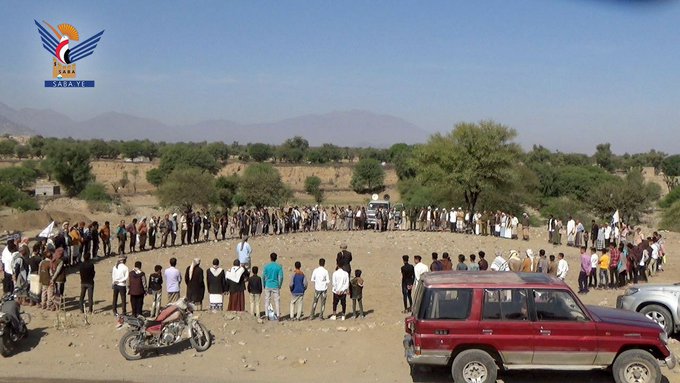
Saba – April 5, 2025
Sana’a – A private source to the Yemeni news agency, Saba, on Saturday denied the allegations made by the criminal US President Trump regarding what he described as the targeting of a secret meeting of military leaders preparing to carry out naval operations.
The source explained that the video clip published by the criminal Trump, claiming that it was a gathering of military leaders, was merely an event for a social Eid visit in Hodeida province. Similar events are held in various provinces on all holidays and occasions, and this is well known to all Yemeni people.
He emphasized that those present at that gathering had no connection to the operations carried out by the Yemeni Armed Forces, which are implementing the decision to ban navigation on ships linked to the American and Israeli enemy, as the criminal Trump claimed.
The source stated that this heinous American crime, which left dozens of martyrs and wounded, reflects the extent of America’s bankruptcy and failure in its aggression against Yemen, and that it is an extension of the genocide committed by the Israeli-American aggression in Gaza.
He stressed that this heinous crime will not be forgotten, and that the Yemeni armed forces, which stood up for the people of Gaza, will not let the blood of the Yemeni people go in vain.
Featured Video

More Iran War fallout: Maritime insurance industry shifts from London to China
or go to
Aletho News Archives – Video-Images
From the Archives
Allies Don’t Need Lobbies
By Jay Knott | Dissident Voice | September 24, 2013
In a recent article on Counterpunch, Rob Urie defended the traditional Marxist analysis of US policy in the Middle East. He argues that support for Israel is driven primarily by economic interest, not the Jewish lobby.
He starts by paying tribute to the idea that Western societies are uniquely racist. He says that the “Western narrative” claims there is an “Arab character”, and that this is “antique racist blather”. He gives no definition of these terms. Further, he establishes his credentials as part of the dominant current in the American left by claiming that “over a million people in Iraq died so ‘we’ in the West can drive SUVs.”1
When he tries to criticize bourgeois economics, he makes it clear he doesn’t understand the developments it has made since Marx’s day, using the mathematical discipline known as “game theory”. He dismisses the basic abstraction of economic theory, the idea of the rational individual, on the grounds that it is “devoid of history, culture and political context”. But abstractions are always devoid of something.
He defends a more concrete economic theory, mostly Marxist, with some input from another theorist of capitalist crisis, Hyman Minsky. This concrete theory leads him to the view that US activity in the Middle East is primarily driven by rational capitalist motives, the need to secure a supply of oil.
“Taking the totality of circumstance — former oil company executives launching war on an oil rich nation on a pretext they publicly proclaimed they didn’t believe shortly before taking office — and that upon launching their war proved to be non-existent, requires a willingness to overlook the obvious — that the war on Iraq was for oil, that is difficult to support.”1
Perhaps I’ve misunderstood him, but based on what he says in the rest of the article, this convoluted sentence seems to argue that, because president Bush and vice-president Cheney attacked Iraq on false premises, and they also said it was all about oil, and they are former oil executives, and Iraq has a lot of oil, it’s difficult to deny US attacks on Iraq are all about oil.
In fact, it’s not hard at all. As Urie points out, at times Bush and co. said that attacking Iraq was “protecting the world’s supply of oil.”1 But, as he also points out, they are congenital liars. Why should we believe them when they say they are trying to “protect” the oil supply? Protect it against what? When politicians “admit” attacks on Middle Eastern countries are wars for oil, they are parroting the neo-con party line, feeding the public, both left and right, with a plausible-sounding pretext. For right-wingers, “it’s a war for oil” is a reason to support war, and for leftists, it’s a way to feel better by complaining impotently about corporate greed. Both approaches help the war drive. … continue
Blog Roll
 Aletho News
- More Iran War fallout: Maritime insurance industry shifts from London to China
- US-Israeli aggression on Iran triggers review of GCC countries’ investment pledges to Washington
- Russia slams UK plan to seize tankers suspected of carrying its oil
- Pakistan ramps up food exports to Persian Gulf nations as war deepens food insecurity
- Iran submits response to US plan, sets terms for war’s end: Tasnim
- US vs Iran: Kharg Island Talk — Bluff or Escalation? Ex-Military Officer Weighs In
- Zelensky unnecessarily involves Ukraine in the Middle East crisis
- Turkish tanker blacklisted by Ukraine hit in drone attack – media
- Canada, the U.S., and NATO: the inescapable trap
- Villains of Judea: Leonid Radvinsky
- If Americans Knew
- ‘No Innocent Children’: Far-right Israeli Lawmaker Defends Killing of Palestinian Family
- Mossad’s promises helped Netanyahu convince Trump that Iran could be toppled
- US Arms Control Official Refuses To Comment When Asked If Israel Has Nuclear Weapons
- Veterans warn US landing could be ‘more Gallipoli than Vietnam’
- Israel may be committing war crimes in Lebanon – Not a ceasefire Day 167
- In the West Bank, life is a constant battle – 3 articles
- Jacob Reses, one of the most powerful pro-Israel operatives in Trump’s Washington
- Israeli-US assaults kill or injure 87 children a day – Not a ceasefire Day 166
- ‘Forever live by the sword’: Understanding Israelis’ massive support for Iran war
- UN’s special rapporteur on human rights says Israel is systematically torturing Palestinians
- No Tricks Zone
- Devastating Assessment Of Comirnaty Vaccine By Former Senior Pfizer Europe Toxicologist
- New Study: CO2 Is ‘Effectively Negligible’ As An Explanatory Climate Change Factor Since 2000
- Former Pfizer Toxicologist Dr. Helmut Sterz Tells Bundestag Hearing Pfizer Vaccine Should Have Never Been Approved
- Energy Expert: Germany’s Nuclear Phaseout Was A “500 Billion Euro Mistake”
- New Research: South Australia’s Mid-Holocene Sea Surface Temperatures Were 4°C Warmer Than Today
- Storing Green Energy To Last Germany 10 Days Would Require A 60-Million Tonne Battery
- New Studies: UK Sea Levels Were 4 Meters Higher Than Today During The Mid-Holocene
- Destructive Green New Deal: German Energy And Metal Group Warns Of Drastic Crisis
- New Study Documents A 20-Year Pause In Arctic Sea Ice Decline – Driven By Internal Variability
- Wake-up Call: Survey Shows Majority Of Germans Now Favor Postponing Climate Targets!
 Aletho News