‘Conspiracy Theory’ Now Fact: Greater Israel Has Arrived
By Kit Klarenberg | Mint Press News | January 28, 2025
Ever since Tel Aviv’s 1948 creation, much has been said and written about ‘Greater Israel’ – the notion Zionism’s ultimate end goal is the forcible annexation and ethnic cleansing of vast swaths of Arab and Muslim lands for Jewish settlement, based on Biblical claims this territory was promised to Jews by God. The mainstream media typically dismisses this concept as antisemitic conspiracy theory, or at most the fringe fantasy of a minuscule handful of extremist Israelis.
In reality, as The Guardian admitted in 2009, the idea of a Greater Israel has long-appealed to “religious and secular right-wing nationalists” alike at a state and public level in Tel Aviv. They have the shared objective of “[seeking] to fulfill divine commandments about the ‘beginning of redemption’, as well as create ‘facts on the ground’ to enhance Israel’s security.” The outlet acknowledged this motivation was a key contemporary driving force in mainstream Zionist entity politics, which “effectively turned the Palestinians into aliens on their own soil.”
The Nation has described the push to establish Greater Israel as “the central ideological goal” of Benjamin Netyahu’s Likud Party, which has dominated Israeli politics in recent decades. In July 2018 too, the Zionist entity passed the “Nation State of the Jewish People” law. It enshrines “the development of Jewish settlement as a national value.” Meanwhile, the state is legally obligated “to encourage and promote” the “establishment and consolidation” of settlements, in illegally occupied territory.

A proposed map of ‘Greater Israel’
This is based on the Jewish people’s “exclusive and inalienable right” to territory as far away from present Israel as Saudi Arabia. Old Testament terms such as “Judea and Samaria” are also employed. Markedly, this text is absent from the legislation’s official English translation. Zionist entity chiefs may not have wanted to make their irredentist, settler colonial ambitions quite so obvious at the time. Fast forward to today though, and Zionists at every level are wholly unabashed about their grand expansionist plans in West Asia.
The Syrian government’s fall has raised all manner of questions, concerns, and uncertainties locally and internationally. Can the country survive in its present form? Will Western-backed ‘former’ ultra-extremists be able to run a government? May the Iran-led Axis of Resistance, which inflicted such harm to the Zionist entity and its Western puppet masters throughout 2023/4, be under threat? The list goes on. But one thing is certain – Israel is seeking to profit handsomely from the chaos. If successful, the results will be revolutionary.
‘Defensive Position’
On December 8th, a triumphant, smart-casual-bedecked Benjamin Netanyahu made a public address from an Israeli Occupation Force observation point, in the illegally-occupied Golan Heights. Taking personal credit for Bashar Assad’s ouster, he hailed “a historic day” for the region, which offered “great opportunity.” The Israeli leader bragged that the Zionist entity’s “forceful action against Hezbollah and Iran” had “set off a chain reaction” of upheaval, showing no sign of abating. Nonetheless, he warned of “significant dangers”.
One of those hazards, Netanyahu declared, was “the collapse of the Separation of Forces Agreement from 1974.” This largely forgotten accord was signed by Damascus and Tel Aviv following the 1973 Yom Kippur War. Both sides agreed not to mount hostile military operations of any kind against one another from their shared Golan Heights border. Perhaps surprisingly, it was scrupulously adhered to for 50 years. Now, though, Assad’s fall has sparked a Syrian military withdrawal from the area, and, in turn, the IDF is moving in.
Netanyahu announced orders had been given to the IOF to push deep into the demilitarized zone created by the Agreement, which is legally and historically Syrian territory. He claimed this was merely a “temporary defensive position until a suitable arrangement is found.” Yet, ever since, it has become increasingly unambiguous that for the Zionist entity, Assad’s departure not only greenlights the tearing up of longstanding diplomatic agreements, but the entire map of West Asia as we know it.
For the time being, the IOF has captured strategically invaluable Mount Hermon, Syria’s tallest mountain, from which Damascus can be seen just 40 miles away. Concurrently, hundreds of Zionist entity airstrikes have obliterated what remained of Syria’s military infrastructure, leaving the country completely defenseless from any and all incursions by air, land, and sea. The stage is plainly set for a major escalation and attempt by Israel to absorb further territory, at its behest. Who or what could stop them?
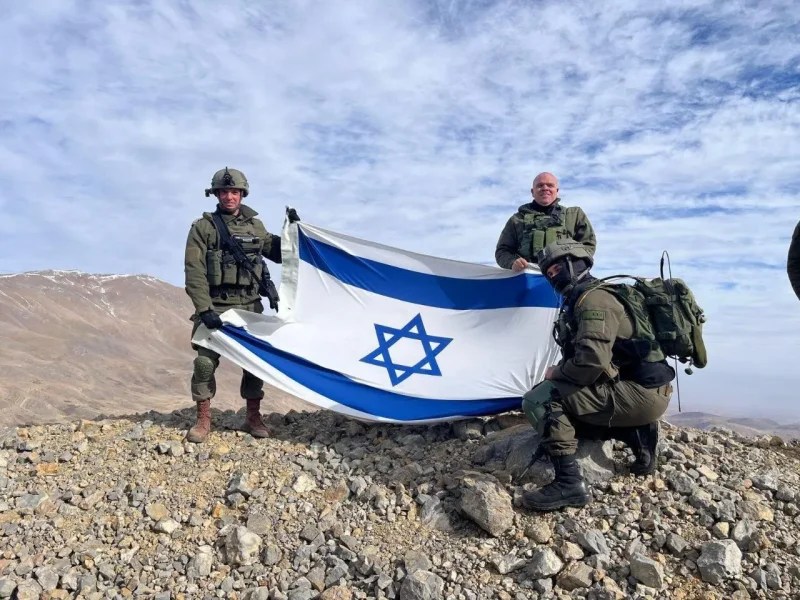
IOF militants unfurl an entity flag on Mount Hermon
On December 10th 2024, while testifying at his long-running trial for industrial scale corruption in office, Netanyahu used the occasion to hint strongly at Assad’s defeat heralding a major reshaping of the region afoot. “Something tectonic has happened here, an earthquake that hasn’t happened in the 100 years since the Sykes-Picot Agreement,” the Israeli leader said, referencing the 1916 treaty under which Britain and France carved up the Ottoman Empire.
In an ironic twist, destruction of the Sykes-Picot Agreement, which divided West Asia into artificial boundaries under Western colonial rule, was a regular feature of ISIS propaganda. The group cited the pact as a symbol of Western oppression against Islam, presenting its demise as a religious duty. With figures associated with ISIS now taking charge in Damascus, that vision could now be achieved, a prospect both serving Israel’s long-term goals, and aligning with Netanyahu’s long-standing ambitions.
‘Living Room’
In recent weeks, Israeli media has undergone a significant tonal shift. Historically, even critical Israeli news outlets and journalists have been careful to frame the Zionist entity’s most egregious actions – ranging from military operations against neighboring countries to settlement expansion and land confiscation – in terms of “security” and “defense”. However, in the days leading up to Tel Aviv’s invasion of Lebanon on October 1st 2024, The Jerusalem Post published a strikingly candid explainer guide for its readers, enquiring, “Is Lebanon part of Israel’s promised territory?”
The outlet leaned on a Brooklyn-based Rabbi to “graciously” explain in detail how, based on multiple passages in Jewish scripture, “Lebanon is within the borders of Israel,” and Jews are therefore “obligated and commanded to conquer it.” The article was subsequently deleted after mass backlash and condemnation. But lessons from the debacle evidently weren’t learned in some quarters.
On December 4th – four days before the Syrian government’s fall – The Times of Israel published an op-ed on how “Israel’s exploding population” urgently required “Lebensraum”, a notorious German concept meaning “living room”, typically associated with the Nazis. The piece noted the Zionist entity’s population was projected to grow to 15.2 million by 2048, meaning Tel Aviv’s territory rapidly needed to be greatly expanded – perhaps not to the size of Russia, but certainly considerably.
This extremist rant was likewise purged from the web, due to widespread public outcry and mockery. Yet, since Assad’s fall, the term “Greater Israel” abounds readily in Zionist media, and seizure of territory from Tel Aviv’s neighbors is openly and eagerly discussed on primetime entity TV. Geopolitical analyst and founder of The Cradle Sharmine Narwani tells MintPress News that in a sense, the blatant nature of these discussions is a welcome development, as it lays bare Tel Aviv’s most extreme ambitions. However, she warns, attempts to expand the entity’s borders could backfire in catastrophic ways:
“The good news is, Israel has completely dropped all its masks. The bad news is it will go for land grabs everywhere. But this will be done opportunistically, and without much forethought or strategic planning. In the end, which country besides the US will be able to support Israel publicly? Tel Aviv will corner itself because the dominant Western discourse and EU law are still premised on human rights and ‘rules’. Allowing Israel these land grabs will also sink the Western-led global order.”
‘Primary Target’
Academic David Miller concurs the Zionist mask is off once and for all. Gravely, he tells MintPress News, “the fact that the CIA backed regime in Damascus is openly saying it is no threat to Israel is another indication regime change in Syria is a planned attempt to destroy the Axis of Resistance, and finally genocide all Palestinians.” Furthermore, he believes the writings of Zionism’s founder Theodore Herzl make clear seizing Lebanese and Syrian territory was Israel’s plan all along.
This malign objective, Miller adds, was echoed in many statements of countless prominent Zionists over decades, and “even codified and published as the Yinon Plan.” Little-known today, this extraordinary document was published in February 1982 in Hebrew journal Kivunim, under the title “A Strategy for Israel in the 1980s”. Its title is derived from author Oded Yinon, a shadowy former Israeli Foreign Ministry official and advisor to Zionisty entity leader Ariel Sharon.
Some sources claim the Yinon Plan provided a precise blueprint for major future events in West Asia, such as the illegal 2003 Anglo-American invasion of Iraq, Syrian dirty war, and rise of ISIS. It may be an exaggeration to suggest the Plan precisely portended all these developments, but nonetheless, much of the document’s contents are eerily prescient. Moreover, while many of its proposals failed to subsequently materialise, we are left to ponder whether they may now do so in future.
For example, the Plan noted there was significant potential for “domestic trouble” to erupt in Syria between “the Sunni majority and the Shiite Alawi ruling minority” – the latter constituting a “mere 12% of the population” – to the extent of “civil war”. While Damascus’ “strong military regime” was considered formidable, Yinon declared “the dissolution of Syria into ethnically or religiously unique areas” and destruction of its military power should be “Israel’s primary target” on its Eastern front, “in the long run”.
The Plan envisaged similar outcomes for other countries in Israel’s immediate vicinity. Lebanon was to be broken up into “five provinces” along religious and ethnic lines, partition “[serving] as a precedent for the entire Arab world.” Yinon wrote, “this state of affairs will be the guarantee for peace and security in the area in the long run,and that aim is already within our reach today.” Four months later, the Zionist entity invaded Beirut, carrying out ethnic cleansing, massacres, and land theft along the way.
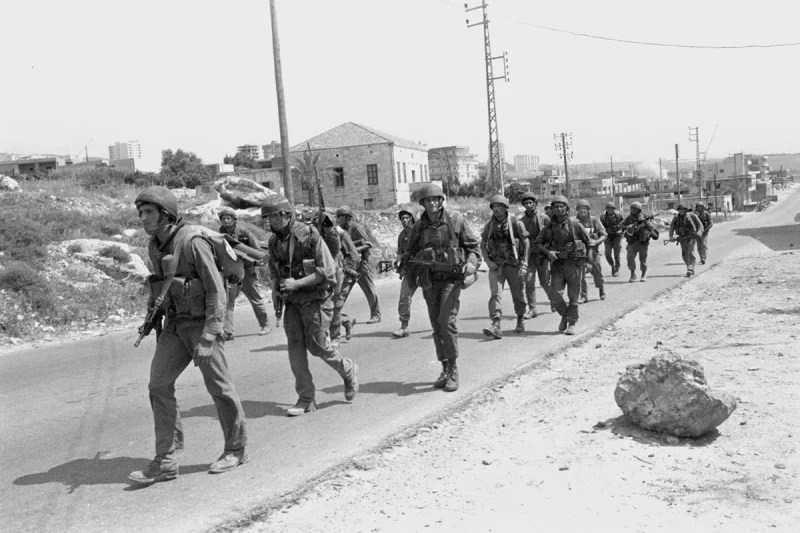
Israel’s June 1982 invasion of Lebanon
Once the Zionist entity’s immediate neighbors were neutralized, Iraq was to be crosshaired “later on”. Baghdad, “rich in oil” while “internally torn” between its Sunni and Shiite population, was “guaranteed as a candidate for Israel’s targets.” Its destruction was “even more important for us than that of Syria,” due to its “power” and strength relative to other regional adversaries. Yinon hoped the then-ongoing Iran-Iraq war would “tear Iraq apart and cause its downfall”, preventing Baghdad from ‘[organizing] a struggle on a wide front against us”:
“Every kind of inter-Arab confrontation will assist us in the short run and will shorten the way to the more important aim of breaking up Iraq into denominations as in Syria and in Lebanon… It is possible that the present Iranian-Iraqi confrontation will deepen this polarization.”
‘Permissive Approach’
Yinon also considered it a “political priority” to regain control of the Sinai peninsula, over which the Zionist entity had fought its Arab neighbors since inception, before relinquishing all claims to the region to Egypt under the March 1979 Camp David accords. He slammed these peace agreements, and looked forward to Cairo “[providing] Israel with the excuse [emphasis added] to take the Sinai back into our hands,” due to its vast “strategic, economic and energy” value:
“The economic situation in Egypt, the nature of the regime and its pan-Arab policy, will bring about a situation after April 1982 in which Israel will be forced to act directly or indirectly in order to regain control over Sinai… for the long run. Egypt does not constitute a military strategic problem due to its internal conflicts and it could be driven back to the post 1967 war situation in no more than one day.”
We are now well-past April 1982. In the intervening time, successive Israeli governments have demanded Egypt allow the IOF to relocate Gaza’s population to the Sinai. Netanyahu is particularly taken with the prospect. In the immediate wake of October 7th 2023, official Israeli government and Zionist think tank policy papers openly advocated driving Palestinians into the neighbouring desert. It has been reported entity officials begged the US to pressure Cairo into allowing this mass displacement.
For the Zionist entity, this strategy’s appeal is self-evident. On top of emptying Gaza for settlement, forcing Palestinians into Sinai would inevitably create mass chaos and tensions there, which could in Yinon’s phrase provide “the excuse” for Tel Aviv to militarily occupy the region, in the manner of the West Bank. Just as a “temporary defensive position until a suitable arrangement is found” of course, as Netanyahu said of the IOF’s brazen creation of a prospective beachhead on Mount Hermon.
In December 2024, Haaretz observed Netanyahu was “angling for a legacy as the leader who expanded Israel’s borders”, and “wants to be remembered as the one who created Greater Israel.” Simultaneously, neoconservative Brookings Institute vice president Suzanne Maloney wrote for Empire house journal Foreign Affairs that the incoming Trump administration “will surely take a permissive approach to Israeli territorial ambitions.” After all, recent developments showed “a maximalist military approach yields spectacular strategic dividends along with domestic political benefits” for the Zionist entity.
We must hope, as Sharmine Narwani prophesied, Netanyahu’s megalomaniacal reveries of Greater Israel are just that, and come to nothing. Despite understandable mass anti-imperialist mourning over the Assad government’s demise, Tel Aviv faces a panoply of intractable internal problems. Contrary to claims of Tel Aviv’s population “exploding”, tens of thousands of dual-citizenship residents are routinely fleeing due to Resistance attacks, while its economy has perhaps permanently been relegated to the doldrums, the entity entirely dependent on US financial largesse to endure.
Israel releases 110 Palestinian prisoners in exchange for eight captives
Press TV – January 30, 2025
Israel has released 110 Palestinian prisoners after a temporary delay ordered by Israeli prime minister Benjamin Netanyahu even as Hamas had released eight captives in the third phase of the prisoner swap.
The prisoners released on Thursday evening included 30 minors, 32 Palestinian who had received life sentences, and 48 others who were serving prison terms of different duration.
Most of them reunited with their families in the occupied West Bank, while 23 of them were sent to Egypt. The prisoners released on Thursday were all men, aged 15 to 69.
The released inmates transported by Red Cross buses to both Palestinian territories were greeted with cheers by thousands of joyful Palestinians.
Zakaria Zubeidi, Mohammed Abu Warda and Mohammed Aradeh were among the high-profile Palestinians released on Thursday.
Israeli drones dropped leaflets on the Gaza Strip warning Palestinians not to hold flags or banners or celebrate the release of prisoners in any way, Al Jazeera reported.
Israeli soldiers often attack crowds that gather near prisons to celebrate the release of Palestinian prisoners.
Earlier Thursday, 12 Palestinians were wounded by Israeli soldiers in Beitunia, near the prison in the West Bank where Palestinian prisoners were due to be released.
Two Palestinians were wounded by live bullets, two by rubber bullets and eight by tear gas, according to the Palestinian Red Crescent Society.
Earlier in the day, Hamas released three Israeli captives, a female soldier and two settlers, plus five Thai nationals, fulfilling its part of the third phase of the prisoner swap, paving the way for Israel to to release 110 Palestinian prisoners, as scheduled.
However, Netanyahu said in a statement that he had ordered a halt to the release of Palestinians until further notice, claiming that the handover of eight captives had been conducted in a “chaotic” condition.
The Israeli premier said the exchange would be delayed until mediators secured guarantees from Hamas of “the safe exit of our hostages in the next rounds.”
Surrounded by masked Hamas and Islamic Jihad fighters, the captives made their way through large Palestinian crowds toward the Red Cross vehicles on Thursday without any incident.
Also a day after a second exchange of Israeli captives held in Gaza for Palestinian prisoners, Netanyahu ordered Israeli troops to prevent Palestinians from returning to their homes in northern Gaza.
Israel said then Hamas had failed to free a captive who it claimed should have been released, but Hamas denied such an arrangement had ever been agreed.
The holdup left hundreds of thousands of Palestinians stranded behind an Israeli military barrier for two days before being allowed to head to their homes.
Israeli forces fired on the crowds on three occasions, killing two people and wounding nine, including a child, according to al-Awda Hospital, which received the casualties.
Israel has pulled back from several areas of Gaza as part of the ceasefire, which came into effect last Sunday.
The ceasefire is aimed at ending the 15-month Israeli war on Gaza and freeing captives still held in Gaza in return for hundreds of Palestinian prisoners.
Over six weeks, Hamas will release 33 Israeli captives – about one-third of those in captivity – in exchange for nearly 2,000 Palestinian prisoners.
In the last two exchanges, Hamas released seven Israeli captives in return for 290 prisoners, nearly all of whom were Palestinians, except for one Jordanian.
A fourth exchange scheduled for Saturday will involve the release of three Israeli men, according to Netanyahu’s office.
New neocon manifesto: Keep US troops in the Middle East forever
The ‘Vandenberg Coalition’ wants Trump to prioritize Israel and maintain Iran as enemy number one
By Jim Lobe | Responsible Statecraft | January 28, 2025
 A leading neoconservative for most of the last half century has released a comprehensive series of recommendations on Middle East policy for the new Trump administration nearly all of which are ideas that Israeli Prime Minister Benjamin Netanyahu and his Likud Party would happily embrace.
The 16-page report, entitled “Deals of the Century: Solving the Middle East,” is published by the Vandenberg Coalition, which was founded and chaired by Elliott Abrams, who has held senior foreign policy posts in every Republican administration since Ronald Reagan (except George H.W. Bush’s), including as Special Envoy for Venezuela and later for Iran during Trump’s first term.
Created shortly after former President Biden took office, the Coalition has acted as a latter-day Project for the New American Century, a letterhead organization that acted as a hub and platform for pro-Likud neoconservatives, aggressive nationalists, and the Christian Right in mobilizing public support for the “Global War on Terror,” the 2003 invasion of Iraq, and the move away from a two-state solution to the Israel-Palestine conflict, particularly under the George W. Bush administration in which Abrams served as Special Assistant to the President and Senior Director for Near East and North African Affairs, surviving a number of purges of leading neoconservatives in that administration after the Iraq occupation went south.
The new report predictably calls for the new administration to “use all elements of [U.S.] national power” to prevent Iran, “the greatest threat to American interests in the Middle East and the cause of most of the region’s security problems,” from acquiring a nuclear bomb. It describes Israel as “our cornerstone ally in the region” to which Washington should provide all “the weapons it needs [to] help it win the war and prevent wider escalation.”
The recommendations also call for Washington to maintain its military presence in both Iraq and Syria, to suspend all aid to the Lebanese Armed Forces (LAF) “until it demonstrates a willingness to oppose Hezbollah, accelerate U.S. arms sales and broaden intelligence cooperation with the UAE,” and enhance military and security cooperation with Saudi Arabia provided it “pivot[s] away from China and Russia.”
It also calls for the Saudis to “increase [its] foreign direct investment commitments in U.S industries,” and “cease public statements” critical of Israel and supportive of Iran. “…[En]hanced cooperation with Saudi Arabia,” the report insists, “should be contingent on their being unequivocal about what side they are on.”
Washington should also designate Iraq’s Iran-backed Popular Mobilization Forces (PMF) and related militias as Foreign Terrorist Organizations (FTO) and stop engaging with them politically, and work with Yemen’s Saudi-backed Presidential Leadership Council against the Houthis whose designation as an FTO by the Trump administration last week was applauded in the report. On the new government in Syria, the report says that ongoing sanctions, which helped cripple the country’s economy, should not be lifted “unless the new government proves to be a responsible actor,” although it does not describe what that would mean in any detail.
Aside from Iran’s status as Enemy Number One in the report, special scorn was reserved for Qatar, which has played a central role in mediating between Israel and Hamas regarding the fate of Israelis held in Gaza and Palestinians detained in Israel. Similar contempt is reserved for the Palestinian Authority headed by Mahmoud Abbas, for various U.N. agencies, notably “the nefariousness [sic] UNRWA,” which has worked with Palestinian refugees and their families across the Middle East for more than 70 years, and for senior UN human rights officials who deal with the Israel-Palestine conflict in particular. Washington “should immediately cease all funding to UNRWA” and also to UNIFIL, the U.N. peacekeeping force deployed along the Lebanese-Israeli border unless its troops are given the authority and demonstrate the will to confront Hezbollah forces in the area.
As for Qatar, it “has worked to undermine U.S. interests by cooperating with Iran and sheltering terrorist groups like Hamas,” according to the report. “With much better friends like the Saudis, Washington no longer needs to tolerate destabilizing Qatari behavior,” and thus should move U.S. Central Command’s forward headquarters out of Qatar’s Al Udeid Air Base and revoke Doha’s “Major Non-Nato Ally status unless its behavior changes.” That status should be conferred on the UAE instead, according to the report, provided that it “reduce [its] reliance on Russian and Chinese vendors” of military equipment.
The report, which describes the politics of the Biden administration in the Middle East on more than one occasion as “appeasement,” mainly of Iran, reminds the reader that Trump declared only last month that “the Middle East is going to get solved,” a phrase that undoubtedly inspired the report’s title: “Deals of the Century: Solving the Middle East.” While the report says it was the product of a “working group of Middle East experts,” no names other than Abrams, Gabriel Scheinemann, and Daniel Samet, the latter two neoconservatives from the Alexander Hamilton Society, appear in the report. Normally, reports by letterhead organizations list their contributors.
In presenting what it calls “key American interests in the Middle East,” the report puts “preventing Iran from developing n nuclear weapon at the top of the list” but also expresses alarm at Chinese Communist Party inroads in the region, noting that CCP is Washington’s “key global adversary.” In an echo of the Global War on Terror, Washington, it says, should also “deny jihadi terrorists a safe haven,” a reference in part to the necessity, its authors feel, to retain U.S. forces in Syria and Iraq.
But “America’s alliance with Israel is central to U.S. interests in the region, given that it promotes American values within the Middle East and provides the first line of defense against Iranian aggression.” Moreover, Washington should try to expand the Abraham Accords, and “the Palestinian question must not impede Israel’s normalization with Arab and Muslim countries or otherwise compromise its security.” Washington must “ensure Israel has the tools to defend itself.”
Yet another interest is to expand access of our allies and partners in Europe and elsewhere to the region’s energy supplies, according to the report.
To increase pressure on Iran, Washington should not only reinstate a Trump’s “ maximum pressure” campaign, but include within it convincing Britain, France, and Germany to “snapback sanctions” against Tehran at the U.N. Remarkably perhaps, it offers the possibility of a new nuclear agreement that would “forbid Iranian uranium enrichment beyond the small amounts need for a civilian nuclear program,” something that the 2015 JCPOA, which Trump withdrew from in 2018, actually accomplished before Trump, under the influence of neoconservatives like Abrams, withdrew from in 2018. If a deal can be reached, according to the report, it should be dealt with as a treaty; that is, made subject to a 2/3 majority vote in the Senate.
With respect to the Palestinians in the wake of the last 15 months of war in Gaza, “American policy toward the Palestinians must prioritize the security of Israel and our Arab partners.” Washington “must impose standards for good governance. The U.S. should “allow an Arab trusteeship to control Gaza after the war.” In words that must warm Netanyahu’s heart, the report notes “the weakness and incompetence of the PA mean it cannot govern Gaza,” and “Israel will need to maintain security control to prevent Hamas from rebuilding but should not and does not wish to govern Gaza itself.”
Abrams has a long history with both Palestine and Gaza, notably during the Bush administration. After Hamas was an unexpected election victor over its rival Fatah in the 2006 elections – which were hailed as the freest and fairest elections in the Arab world at the time – Abrams and other senior officials encouraged the mounting of an armed coup against Hamas led by Fatah’s local leader and Abrams’ favorite Muhammad Dahlan which, in turn, sparked a brief civil war in the enclave in which Hamas emerged victorious and stronger than ever. After the fiasco, Dahlan moved to the UAE, and there has been much speculation that he stands to play a key role on behalf of the Emirates if the kind of “Arab trusteeship” alongside Israeli security forces is established as recommended by the report.
Perhaps the most novel recommendation is based on the report’s contention that Iran’s non-state allies in the region typically use non-combatants as human shields — an apparent endorsement of Israel’s defense of its bombing of apartment houses, schools and other buildings in Gaza and Lebanon during the past 15 months that have killed well over 46,000 people, most of them women and children. “The United States should propose a Security Council resolution that states the use of human shields is a crime under international law and that those who use human shields are responsible for the civilian deaths in which they result,” the report advised.
Jim Lobe is a Contributing Editor of Responsible Statecraft. He formerly served as chief of the Washington bureau of Inter Press Service from 1980 to 1985 and again from 1989 to 2015.
UNRWA Shutdown Risks Killing Gaza Ceasefire: Official
By Kyle Anzalone | The Libertarian Institute | January 28, 2025
The head of the UN’s Palestinian Aid Agency (UNRWA) said Tel Aviv’s decision to halt his agency’s assistance programs in Israel jeopardizes the Gaza truce and hostage deal.
On Tuesday, Israel’s Ambassador to the UN said UNRWA would have to cease its operations in Israel when Tel Aviv’s law banning the organization goes into effect on Thursday. “UNRWA must cease its operations and evacuate all premises it operates in Jerusalem,” Ambassador Danny Danon told the Security Council. “Israel will terminate all collaboration, communication and contact with UNRWA or anyone acting on its behalf.”
UNRWA Chief Philippe Lazzarini responded by saying the shuttering of UNRWA in Israel risked causing the Gaza ceasefire and hostage deal to end.
“In two days, our operations in the occupied Palestinian territory will be crippled, as legislation passed by the Israeli Knesset takes effect,” he told the UNSC. “At stake is the fate of millions of Palestinians, the ceasefire, and the prospects for a political solution that brings lasting peace and security.”
UNRWA serves as the most crucial aid agency for Palestinians who live as refugees or as second-class citizens in Israeli-occupied territory. Since the start of the Israeli onslaught in Gaza, UNRWA has provided a crucial lifeline to people living in deplorable conditions caused by the Israeli siege of the Strip.
Following the October 7 Hamas attack on Israel, then-Israeli Defense Minister Yoav Gallant declared a complete siege, including food, water, and medicine, of Gaza. UNRWA has been the key facilitator of bringing aid through the Israeli checkpoints to the people of Gaza.
Tel Aviv has attempted to portray UNRWA as another wing of Hamas, claiming its members helped to conduct the October 7 attack. However, an independent inquiry found that Israel could not provide evidence to back up that claim.
Lazzarini told the Security Council that Israel recently ramped up its global propaganda campaign against the agency. “The Government of Israel is investing significant resources to portray the Agency as a terrorist organization, and our staff as terrorists or terrorist sympathizers,” he explained. “Billboards and ads accusing UNRWA of terrorism recently appeared in major cities around the world. They were paid for by the Israeli Ministry of Foreign Affairs.”
The UNRWA chief went on to say that Tel Aviv is weaponizing Google ads as a part of its narrative warfare. “Google ad campaigns re-direct those seeking information about the Agency to websites replete with disinformation,” he added.
Lazzarini argued that the anti-UNRWA propaganda has had deadly effects, as 273 of his organization’s staff have been killed during the Israeli destruction of Gaza.
Israeli quadcopters: Ongoing crimes against humanity
By Kit Klarenberg | Al Mayadeen | January 29, 2025
In November 2024, acclaimed surgeon Nizam Mamode testified to the British parliament’s International Development Committee’s ongoing inquiry into Gaza’s “humanitarian situation”. A veteran medical professional on the frontlines of the Zionist entity’s genocide of Palestinians, primarily women and children, he repeatedly burst into tears throughout. Describing scenes he and his team personally witnessed as they tended to countless mutilated and disfigured victims, he sketched a “particularly disturbing” picture of “Israel’s” inexorable, indiscriminate maiming and murder of civilians in the wake of October 7, 2023.
Mamode’s most intense grief was exhibited while elucidating Tel Aviv’s systematic, industrial-scale use of quadcopter drones to “regularly” shoot incapacitated Palestinians – in particular, children injured or trapped by rubble, following Israeli occupation force airstrikes. Of all the horrors he and his team spectated, Mamode considered “the deliberate and persistent… targeting of civilians, day after day” in the most perverse manner. Time after time, US-supplied IOF bombs would drop “on a crowded, tented area,” then:
“The drones would come down and pick off civilians – children [as young as seven] … This is not an occasional thing. This was day after day after day of operating on children, who would say, ‘I was lying on the ground after a bomb had dropped, and this quadcopter came down and hovered over me and shot me.’ That is clearly a deliberate and persistent act; there was persistent targeting of civilians, day after day. We had one or two mass casualty incidents every day.”
Mamode, who has “worked in a number of conflict zones in different parts of the world” – including Rwanda during the 1994 genocide – said he’d “never seen anything” on the scale of the barbarity in Gaza, “ever”. This perspective was shared by “all the experienced colleagues” with whom he worked. A surgeon on Mamode’s team who’d been to Ukraine on five occasions declared the situation in Gaza to be “10 times worse.”
Benjamin Netanyahu has at last seemingly accepted a ceasefire deal, identical to multiple prior proposals he repeatedly rejected while the Gaza genocide was at its monstrous peak. Yet, in the days leading up to the settlement’s January 19 commencement, “Israel” significantly intensified its attacks on Palestinians, liberally deploying quadcopters in the process. Over the prior month too, this technology was consistently employed to not only injure and slay surviving victims of IOF bombing attacks but target victims into the bargain.
For example, on December 12, 2023, besieged northern Gaza’s last remaining orthopedic doctor Dr. Said Joudah was executed via a quadcopter. This followed attacks on medical infrastructure and personnel in the region over the prior two-and-a-half months, using the same technology. Moreover, questions abound as to whether quadcopters were used to assassinate Ismail Haniyeh, the political leader of Hamas, in July 2024. Given their lethal virtue from the Zionist entity’s perspective, and its extensive history of breaching ceasefire agreements, will their use truly end now?
‘Precise monitoring’
“Israel’s” primary supplier of killer quadcopters is Elbit Systems, a Haifa-based company with significant foreign workshops, particularly in Britain. Initially, these drones were purely used for intelligence purposes – photo and video gathering. As late as January 2023, the British Army awarded a lucrative contract to Elbit for a fleet of these drones due to their “extensive long-range reconnaissance capabilities.” Such spying potential would serve to “support combat and intelligence operations for up to 60 minutes at a time.”
Fast forward to March 2024 though, and Elbit was proudly promoting slick videos of these same unmanned apparatuses in-flight, as “birds of prey.” An accompanying entry on the company’s website actively boasts about the lethal capabilities of its quadcopters. These “agile, compact and fully stabilized weapon [systems]” are said to “enhance infantry squad lethality beyond its detection and engagement range with stand-off warfare capabilities.” Their innovative capabilities can be used to “detect, classify and track targets… day and night,” in “urban and force protection scenarios.”
It appears at some point that the Zionist entity realized quadcopters could be converted into killing machines. As Euro-Med Human Rights Monitor noted back in February 2024, Elbit drones have been “repurposed… for the deliberate and direct execution of unlawful targets.” The original intelligence gathering function of these drones, the organization added, means they “have very precise eavesdropping instruments and high-quality cameras, and can carry out additional military duties like shooting and carrying bombs, as well as be modified to become suicide drones.”
Among openly murderous drones sold and marketed by Elbit, LANIUS looms large. An official advertising prospectus brags how this “highly maneuverable and versatile drone-based loitering munition” can “autonomously scout and map buildings and points of interest for possible threats.” LANIUS “maneuvers close to the target and uses video analytics to determine entry points into a structure, map the inside of unknown buildings performing simultaneous localization and mapping, and identify combatants and non-combatants.” The system is furthermore “equipped to defeat threats using explosive payloads.”
Euro-Med Human Rights Monitor has documented how, among other savagery, Zionist quadcopters “opened fire on Palestinians who had gathered to receive flour brought by United Nations trucks” in January 2024, after “suddenly” arriving at the scene. The heinous incident killed at least 50 Palestinians and injured dozens more. These drones are furthermore “used in particular against civilians who attempt to return and inspect their homes after the Israeli military retreats from areas it has attacked by land or air.”
Such targeting of civilians, Euro-Med Human Rights Monitor contends, can only be conducted “intentionally”. The organization deduces this “is evident as the majority of Israel’s targeting takes place in public spaces where it is easy to distinguish fighters from civilians.” Moreover, Zionist forces “[fly] over the areas it targets for periods of time that are long enough to allow for the precise monitoring and evaluation of field conditions, plus most of the killings occur within a close targeting range.”
‘Military force’
The use of quadcopters for targeted murder is not explicitly prohibited or even formally regulated under international law. However, their application must always adhere to international humanitarian law related to all armed conflicts, as with any other weapon. Moreover, their routine use in extrajudicial killings of Palestinians is unambiguously war crimes and crimes against humanity under both the Geneva Conventions and the International Criminal Court’s Rome Statute. There can be little doubt that quadcopters are a fundamental component of Tel Aviv’s undeniable genocide in Gaza.
Just as gravely from “Israel’s” perspective, as efficacious as quadcopters may be in executing innocent, defenseless Palestinians in large numbers, they have proven militarily useless, if not counterproductive. In brief, they have not only failed to meaningfully harm Hamas but have served as a prospective recruitment mechanism for the Resistance group. In June 2024, the elite imperial journal Foreign Affairs set out in forensic detail how “according to the measures that matter, Hamas is stronger today than it was” on October 7, 2023.
The “growing” Resistance group had by that time “evolved into a tenacious and deadly guerrilla force in Gaza,” launching “lethal operations” in areas previously “cleared” by the IOF “easily”. Those capabilities have only expanded since, with Hamas continuing to regularly inflict significant casualties on Tel Aviv’s forces in the present. Key to the Zionist entity’s military catastrophe in Gaza, as per Foreign Affairs, is a failure to comprehend how “the carnage and devastation it has unleashed… has only made its enemy stronger.”
This bloodshed enhances the “ability [of Hamas] to recruit, especially its ability to attract new generations of the fighters and operatives.” Atrocities against civilians, including if not particularly all those involving quadcopters, have left the Resistance group unscathed while serving as a potent recruitment tool. Foreign Affairs notes average Palestinians, “often either angry over the loss of family members or friends or more generally enraged at [Israel’s] use of heavy military force,” have either joined Hamas or provided assistance to the group.
With over 60% of Palestinians in Gaza and counting having lost family members during the genocide, Hamas can “replenish its ranks, gain resources, avoid detection, and generally have more access to the human and material resources necessary” to wage war against the Zionist entity. Foreign Affairs estimated at that time, eight months into Tel Aviv’s effort to comprehensively crush the Resistance group, that Hamas fighters were “roughly ten times” larger in number than on October 7.
Meanwhile, “more than 80% of the group’s underground tunnel network remains usable for planning, storing weapons, and evading Israeli surveillance, capture, and attacks,” and “most” of its “top leadership in Gaza remains intact.” Fast forward to today, there remain no signs of the IOF having inflicted any serious damage on Hamas at all – quite the reverse. In a sense, quadcopters are a mephitic microcosm of the Zionist entity’s war effort since October 7, and armed forces more widely.
Tel Aviv has over many years constructed a military at every level that is exclusively suited to blunt-force, indiscriminate attacks on civilians and civilian infrastructure. By contrast, its actual war-fighting capabilities are non-existent, as the entity’s calamitous October 2024 invasion of Lebanon and Hamas’ routine battering of Israeli ground forces have amply demonstrated. While Netanyahu may take personal credit for Bashar al-Assad’s fall, and “Greater Israel” is now openly discussed in Zionist media, the Resistance would inevitably prevail in any future direct confrontation.
Two prisoners from Gaza announced dead in Israeli detention
Palestinian Information Center – January 29, 2025
GAZA – Palestinian rights groups said on Wednesday that two prisoners from the Gaza Strip were martyred in Israeli jails.
This came in a joint statement released by the Commission of Detainees’ and Ex-Detainees’ Affair, the Palestinian Prisoner Society, and Addameer Prisoner Support and Human Rights Association.
The martyred prisoners have been identified as Mohamed al-Asali and Ibrahim Ashour.
Mohamed al-Asali was kidnaped by the Israeli occupation forces (IOF) from Al-Shifa hospital in Gaza City in March 2024. Later, his family received information that he was in Ashkelon prison before receiving another response to a request about his fate saying he died and then a response claiming that he was still in Ashkelon. The last response from the IOF affirmed that he died on May 17, 2024.
Asali, a father of four kids, did not suffer from any chronic health issues. During the war, all his brothers were martyred and only his father survived. His mother was buried in Ramallah after she passed away as she was having medical treatment in Occupied Jerusalem.
As for Ibrahim Ashour, he was kidnaped on February 14, 2024 from Nasser Hospital in Khan Yunis, south of Gaza. He also had no health problems before his detention.
The three organizations accused the Israeli occupation of deliberately killing Palestinian detainees and manipulating information about their fate.
The martyrdom of Asali and Ashour has brought to 58 the number of the Palestinian prisoners killed by Israel since its genocidal war on Gaza started in October 2023. 37 of those detainees are from the Gaza Strip.
Dear world: This is what Palestinian unity looks like
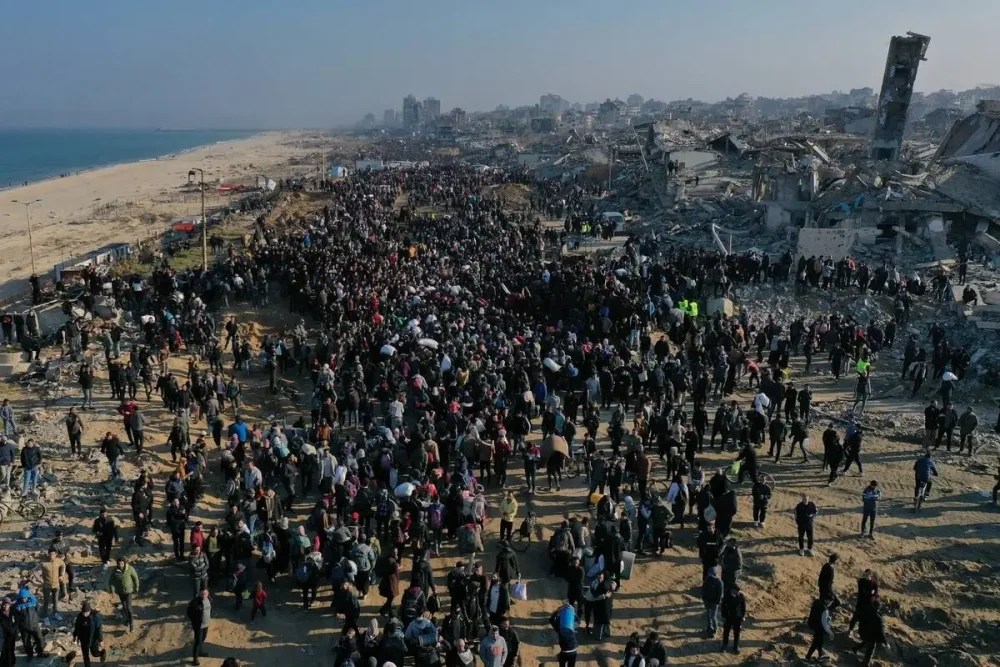
Palestinians, displaced by Israel forces, return their houses through Al-Rashid Street on the coastal strip in Gaza City, Gaza on January 27, 2025. [Anadolu Agency]
By Ramzy Baroud | MEMO | January 29, 2025
Even those of us who have long emphasised the importance of the Palestinian people’s voice, experience and collective action in Palestinian history must have been shocked by the cultural revolution resulting from the Israeli war against the people in Gaza. By cultural revolution, I mean the defiant and rebellious narrative evolving in Gaza, where people see themselves as active participants in the popular resistance, not just mere victims of the Israeli war machine.
When the ceasefire was announced on the 471st day of the Israeli genocide, the Palestinians in Gaza rushed onto the streets in celebration. Media outlets reported that they were celebrating the ceasefire, but judging by their chants, songs and symbolisms they were celebrating their collective victory, steadfastness (sumud) and resilience against the powerful Israeli army, which has been and remains supported by the US and other Western countries.
Using basic tools, they hurried to clean their streets, clearing debris to allow the displaced to search for homes. Although their homes were probably destroyed by Israel – 90 per cent of Gaza’s housing units were, according to the United Nations – they were still happy, even if they could only sit on the rubble. Some prayed atop concrete slabs, some sang in large, growing crowds, and others cried but insisted that no power could ever uproot them from Palestine again.
Social media was flooded with Palestinians expressing a mix of emotions, although they were mostly defiant, expressing their resolve not just in political terms, but also in other ways, including humour.
Of course, the bodybuilders returned to their gyms to find them also mostly destroyed. Rather than lament their losses, though, they salvaged machines and resumed training amid collapsed walls and ceilings punctured by Israeli missiles.
There was also a father and son who composed a song in the ahazej style, a traditional Levantine vocalisation.
The son, overjoyed to find his father alive, was reassured by him that they would never abandon their homeland.
As for the children – 14,500 of whom were killed by Israel, according to UN Relief and Works Agency for Palestine Refugees (UNRWA) – they resumed their childhood. They laid claim to destroyed Israeli tanks in Rafah, Beit Hanoun and elsewhere as their new playground equipment.
One teenager pretended to be a scrap metal salesman and yelled, “An Israeli Merkava tank for sale,” as his friends filmed him and laughed. “Make sure you send this video to [Israeli Prime Minister Benjamin] Netanyahu,” he added before moving on, unfazed.
This does not mean that Gaza is free of unimaginable pain, which is difficult for the rest of the world to fully comprehend. The emotional and psychological scars of the war will last a lifetime, and many will never recover fully from the trauma. But Palestinians in Gaza know that they cannot afford to grieve in the usual way. So, they emphasise their identity, unity and defiance as ways to overcome grief.
In parallel with its military assault on Gaza since 7 October, 2023, Israel has invested heavily in dividing the Palestinian people and trying to shatter their spirit. In Gaza, it dropped millions of flyers from warplanes on starving refugees, urging them to rebel against Palestinian factions by providing Israel with names of “troublemakers”. The Israeli army offered large rewards for such information, but little was achieved.
These flyers also called for tribal leaders to take control of their areas in exchange for food and protection. To punish those who resisted, Israel systematically killed clan representatives and councillors who tried to distribute aid throughout Gaza, especially in the north where famine was devastating.
Against overwhelming odds, though, Palestinians remained united.
When the ceasefire was declared, they celebrated as one nation. With Gaza destroyed, Israel’s actions obliterated Gaza’s class, regional, ideological and political divisions. Everyone in Gaza became a refugee: the rich, poor, Muslim, Christian, city dwellers and refugee camp residents; all were affected equally.
The unity that remains in Gaza, after one of the most horrific genocides in modern history, should serve as a wake-up call. The narrative that Palestinians are divided and need to “find common ground” has proven false.
With the Palestinian Authority in the West Bank aiding Israel’s war on Jenin and other refugee camps, the old notion of political unity through a merger of the PA and various Palestinian factions is no longer viable. The reality is that the fragmentation of the Palestinian political landscape cannot be solved through mere political agreements or negotiations between factions.
A different kind of unity has already taken root in Gaza and, by extension, across Palestinian communities in occupied Palestine and the rest of the world. This unity is visible in the millions of Palestinians who have demonstrated against the war, chanted for Gaza, cried for Gaza, and developed a new political discourse around it.
This unity does not rely on talking heads on Arabic satellite channels or secret meetings in expensive hotels. It needs no diplomatic talks. Years of endless discussions, “unity documents” and fiery speeches only led to disappointment.
The true unity has already been achieved, felt in the voices of ordinary people who no longer identify as members of factions. They are Gazzawiyya. Palestinians from Gaza, and nothing else.
This is the true unity that must now form the foundation of a new discourse.
Live from Bethlehem – Jason Jones on the Trump Effect on Gaza
If Americans Knew | January 27, 2025
Eric Metaxas interviews Jason Jones about his thoughts on the Trump effect on the Gaza agreement.
Full video at:  • Live from Bethlehem – Jason Jones on …
– See Jones’ articles and bio at https://israelpalestinenews.org/trump…
IRIB head confirms journalist held by Israeli forces in occupied territories
Press TV – January 28, 2025
The head of the Islamic Republic of Iran Broadcasting, Peyman Jebelli says an IRIB journalist has been detained by Israeli forces in the occupied territories.
Jebelli on Tuesday revealed that following extensive inquiries, it has been confirmed that the journalist is currently imprisoned and held captive by the Israeli regime.
Highlighting the sensitivity of the matter, the IRIB chief noted that the family of the detained journalist had preferred not to publicize the matter, which has complicated efforts to secure the release.
He emphasized that the journalist remains in captivity in the occupied territories and is not in Gaza.
Jebelli said, “We are hopeful that he will be freed from captivity soon.”
Journalists working within the Palestinian territory encounter heightened risks while covering the genocidal war, particularly in light of Israeli ground assaults and airstrikes, as well as challenges such as disrupted communications, shortages of supplies, and power outages.
Despite these dangers, Palestinian journalists continue to document the atrocities of the war, serving as the eyes and ears of the global community during one of the deadliest wars of the 21st century.
Last month, the Palestinian resistance movement Hamas condemned the deliberate targeting and killing of journalists and media professionals by Israeli forces in Gaza, labeling such actions as a “war crime.”
The statement emphasized that such attacks are meant to “terrorize Palestinian journalists and prevent them from performing their role in exposing the crimes and atrocities being committed by the occupation army against our people and land.”
Since the start of the Israeli war, an unprecedented number of journalists and media workers have been arrested — often without charge — in what they and their attorneys say is retaliation for their journalism and commentary.
More than 200 journalists have also been killed since Israel unleashed its strikes in October last year.
Nonetheless, media workers remain committed to reporting developments in Gaza, even in the aftermath of the recent ceasefire between Hamas and Israel.
Switzerland releases, deports pro-Palestine American journalist
Press TV – January 28, 2025
Swiss officials have freed and deported prominent Palestinian American journalist Ali Abunimah, whom they arrested in the city of Zurich and held in police custody for three days, raising concerns about freedom of speech in the European country.
Abunimah, executive director of the online Electronic Intifada publication covering the Israeli-Palestinian conflict, confirmed his release in a post published on the X social media platform on Monday.
He said Swiss authorities detained him because of his advocacy for Palestinian rights.
“My ‘crime’? Being a journalist who speaks up for Palestine and against Israel’s genocide and settler-colonial savagery and those who aid and abet it,” the Palestinian American journalist wrote.
He was arrested in Zurich on Saturday before he was set to deliver a speech in the city. UN human rights experts and activists condemned the arrest.
The Reuters news agency, citing the Swiss police, said on Sunday that an entry ban and other measures under the country’s immigration law were the reason for Abunimah’s arrest.
The 53-year-old journalist said that when he was questioned by police officers, they accused him of “offending against Swiss law,” without providing specific charges.
He said he was “cut off from communication with the outside world, in a cell 24 hours a day”, adding that he was unable to contact his family. He added that he was only given back his phone at the gate of the plane that flew him to Istanbul.
Abunimah noted that during the period when he was taken to prison like a “dangerous criminal”, Switzerland welcomed Israeli President Isaac Herzog to the World Economic Forum in Davos.
“This ordeal lasted three days but that taste of prison was more than enough to leave me in even greater awe of the Palestinian heroes who endure months and years in the prisons of the genocidal oppressor,” Abunimah said.
“More than ever, I know that the debt we owe them is one we can never repay and all of them must be free and they must remain our focus.”
UN experts denounced Abunimah’s detention as an assault on free speech.
The UN special rapporteur on freedom of opinion and expression, Irene Khan, called the arrest “shocking news” and urged Switzerland to investigate and release him.
Francesca Albanese, the UN special rapporteur on human rights in the occupied Palestinian territories, also called for an investigation into the incident.
“The climate surrounding freedom of speech in Europe is becoming increasingly toxic, and we should all be concerned,” Albanese wrote in a social media post.
The detention of Abunimah took place against the backdrop of intensified restrictions on pro-Palestinian advocates in Europe, amidst the catastrophic war on Gaza.
In April, Germany canceled a conference intended for advocates of Palestinian rights and barred British physician Ghassan Abu Sittah, who had provided medical assistance in Gaza, from entering the country.
The Israelis are shocked that they didn’t beat Hamas, here’s why they failed
By Robert Inlakesh | Al Mayadeen | January 28, 2025
Contrary to what has been presented to the Western public, the Israeli military did not fight a war that targeted Hamas, instead they pursued their genocides and employed cowardly tactics that aimed to minimize their soldier casualties.
Ever wondered why the Israelis never had any real combat footage that featured their soldiers engaged in battles with Palestinian fighters? One explanation could be that no battles were actually fought in the Gaza Strip, yet that is contradicted by the near daily stream of clips, produced by some dozen Resistance groups, that featured attacks against the invading army.
Through analyzing the videos released by the Palestinian armed groups like al-Quds Brigades, al-Qassam Brigades, al-Aqsa Martyrs Brigades, the Abu Ali Mustafa Brigades, the Mujahideen Brigades, the Salah al-Din Brigades, and others, we can deduce that there were three main categories of attacks: Ambushes, Sniper Operations, and mortar/artillery strikes.
According to both the communiques and video documentation published by the groups in Gaza, the most frequent style of attacks was mortar/artillery operations; that would occur daily. Over 10,000 rockets were also used, but as the war progressed, most of the rockets fired were short-range munitions. Although this style of attacks used largely inaccurate weapons, it was indeed constant over the course of 15 months.
Then we have the steady stream of videos throughout the war, which featured ambushes, which could also be separated into two primary subcategories: Ambushes of convoys and ambushes on stationary Israeli army positions.
The first kind, against convoys, included the use of the now famous Yassin-105 Rocket Propelled Grenade (RPG) against tanks, bulldozers, jeeps, and Armored Personnel Carriers (APCs). Guided Anti-Tank systems and drones were occasionally used against military vehicles too, but appeared to be in much lower supply.
The spokesperson for the al-Qassam Brigades, Abu Obeida, announced in his ceasefire speech that over 2,000 Israeli tanks were damaged or destroyed by the group’s fighters. Despite the Israelis not having admitted to the number of tanks, bulldozers, jeeps, and APCs that were damaged/destroyed, reports published in Israeli media suggested that tanks were in short supply. In fact, several requests were made by senior Israeli military officials to deploy tanks into the West Bank after their assessments concluded the Resistance groups there had acquired heavy explosives, but were rejected due to the need to use those tanks in Gaza or Lebanon.
Another tactic that ended up proving more effective at neutralizing Israeli tanks later on in the war were Improvised Explosive Devices (IEDs) strategically planted in roads where military convoys would pass through. Groups like Palestinian Islamic Jihad (PIJ)’s al-Quds Brigades and Hamas’s al-Qassam Brigades even repurposed many of the unexploded ordnances, including the infamous 2,000-pound bombs, to use against Israeli military convoys.
Then we had the attacks on Israeli forces who were either entering areas to set up positions or who were already utilizing a space as a temporary military base or command node. These ambushes used IEDs that were pre-planted in an area, but also incorporated other kinds of weapons. For instance, sniper attacks were used throughout the war, and there are many such attacks filmed, some showing headshots and armor piercing rounds hitting two soldiers in a single shot.
The variations of the RPG warheads used were also different, when in sufficient supply, for these kinds of assaults that would often target gatherings of soldiers or those holed up inside buildings. A thermobaric RPG round was frequently featured in the published videos of such ambush operations. Something we also saw was the use of automatic and semi-automatic guns in such confrontations. There were also some knife attacks and occasional use of feda’i bombers.
The Israeli military has admitted to suffering an average of 1,000 soldier injuries per month during the course of the war, yet this even appears to contradict earlier announcements on the total number of injuries their forces sustained. These numbers have changed throughout the course of the conflict and do not appear to be reliable, especially due to Tel Aviv’s military censorship surrounding such issues. Regardless, judging by the Israeli total soldier death toll, set around 800, the injury to death rate is separated by an enormous gap.
So far, the Palestinian armed groups have not provided their own estimates as to how many Israeli soldier casualties they inflicted. Therefore, attempting to come up with numbers is rather difficult, but if we are to work with the statistic of 1,000 injuries each month in Gaza, this would equate to 33 Israeli soldiers injured every day. Provided that most of the time the occupying military was only launching full invasions in a couple of areas at once, this indicates frequent resistance.
However, with the exception of a handful of examples where the Palestinian Resistance fighters chose to try and hold certain areas, or delay an Israeli entry to a specific neighborhood – like what occurred during the second major invasion of the Jabalia refugee camp in May of 2024 – the opposition to the invading army was almost entirely surprise attacks and artillery strikes.
The Palestinian fighting made sense for a number of reasons. To begin with, it was obvious that even in the event that the Israeli military had sought to fight the Palestinian groups directly and engage in fierce battles with them, the ability to hold off the invading army that is backed by the world’s top military superpower was always a terrible choice. Therefore, the idea of being able to work in a similar manner to Hezbollah, holding back the advances of the Israeli army, would have been a suicidal strategy.
Even if the Palestinian Resistance would have proven temporarily successful, the massive loss of fighters would have been a disaster. This leads us to the next reason that explains their actions, that being the lack of any supply lines into Gaza. The Palestinian groups were forced to use weapons that were primarily manufactured inside the Gaza Strip, and thus had to preserve the ammunition they had carefully, which they managed to do. Their strength was in their use of a complex web of tunnels that the Israelis were simply not interested in bothering to enter on foot in most cases.
Tel Aviv and Washington still have no clue how extensive the tunnel system is under Gaza and only provide guess estimates. Other than in a few rare circumstances, the Israelis never bothered entering the tunnels and when they did, they would either use Palestinian hostages to go in ahead of them or attack dogs. The vast majority of uncovered tunnels were already abandoned, were bombed first, and rendered useless anyway, or the entrances were simply sealed with explosive charges. Attempts to flood the tunnels with seawater and gas both failed.
Not only do the Israelis themselves admit that most of the tunnels weren’t destroyed, but even in areas where the invading army had been stationed for over a year and destroyed every structure in sight, were sites from which long-range rockets were fired. In December, the Qassam Brigades even fired M75 rockets at Israeli settlements in occupied al-Quds from Beit Hanoun in northern Gaza. Tellingly, the first Israeli prisoners were also released by the Qassam Brigades’ elite Shadow Unit out of northern Gaza, which surprised the Palestinians and Israelis alike.
The real reason why the Israelis didn’t defeat the Palestinian Resistance factions, is because they weren’t really there to fight them. The primary target of each of their invasions, throughout the Gaza Strip, was always civilian infrastructure. Each invasion would culminate with the takeover of a hospital like Al-Shifa, Kamal Adwan, or the Nasser Medical Complex for example. They rounded up civilians who were either held hostage in their homes prior, or were displaced and living in UN schools, hospitals or stadiums.
Israeli airstrikes were totally indiscriminate, and while there were some more targeted operations, they were anomalies. Simply looking at drone or satellite footage of the Gaza Strip proves this beyond any reasonable doubt. The vast majority of their soldiers deployed into Gaza never saw a Palestinian fighter, even when fired upon, they were simply there to vandalize and destroy buildings, while shooting indiscriminately at whoever they chose. They behaved lawlessly like a horde of 13th century Mongolian raiders, minus having to actually fight battles against a modern army.
It was clear from the language employed by every Israeli, from its Prime Minister Benjamin Netanyahu, right down to its soldiers who filmed TikTok videos of themselves detonating buildings and wearing women’s underwear, they were committing a genocide against those they called “Amalekites”. Their true purpose was not to pursue a military victory over Hamas, which we can prove through the absence of any clear plans at any stage of the war, it was just uncontrolled slaughter and destruction. They sought to pulverize and terrorize, with the propaganda behind them to justify it in their own minds.
While the lie was sold to the world that the war was specifically designed to destroy Hamas, it never was, they sought to destroy the people of Gaza and their livelihoods. They didn’t invade in order to fight Palestinian resistance groups and that’s why there is virtually no footage documenting this, even the few examples of combat footage they filmed ended up making the Palestinian fighters they killed look like heroes from an action film.
Now that the ceasefire holds, the Israeli society appears baffled, believing that their regime’s murderous assault on Gaza was going to crush Hamas and return their captives by force. Instead, they witnessed Palestinian fighters and police officers quickly deploy throughout Gaza, with weapons, vehicles and military/security-force attire, seemingly un-scathed. Yet, to those who have been closely following the conflict, this made complete sense and it is also one of the reasons why the Israeli leadership feared a ceasefire.
The Israelis employed a strategy of maximum cowardice in order to minimize their own combatant casualties at all costs. For instance, under the US/”Israel” doctrine of counter-insurgency, tanks would traditionally follow infantry units heading into an urban warfare zone, or at least there would be soldiers on the ground accompanying the tanks, yet this was not the case in Gaza. The Israeli soldiers hid inside their heavily armored tanks and vehicles, betting on the armor and Active Protection System (APS) to guard them.
Despite our inability to accurately estimate Israeli military casualties, it does appear that the difference between the deaths and injuries is a ratio that portrays far more injuries to deaths than in other similar urban warfare environments. This is because the Israelis hid in fortified areas or inside heavily armored vehicles most of the time. The reality is that even in the event that a tank is damaged, it doesn’t necessarily mean soldiers were killed in that attack and could have sustained injuries alone.
Most of the time, after arriving in new areas or buildings, a drone or robot would be sent in first to inspect the scene, prior to the soldiers that stormed the area. However, this didn’t always work and there would occasionally be ambushes after a failure to locate explosives, or tunnels. Most of the work the soldiers did required little real courage or combat capabilities. They were also careless throughout, as videos over the span of the 15 months war repeatedly showed soldiers casually standing in open windows, in one case an Israeli was filmed smoking out of a bong before he was hit with a thermobaric warhead.
Tel Aviv wasn’t looking to sacrifice its soldiers in the way that would have been required had they actually fought a war against Hamas, so they took the coward’s way out instead, and its population that believed in every lie they were sold are now shocked that the tactics employed proved ineffective at achieving the publicly stated goals of the war. With every known military advantage, destroying or damaging almost every single building in Gaza and slaughtering its people in such a manner that has constituted perhaps the worst atrocity since the Second World War, the Israelis couldn’t even come out of Gaza with the image of victory.
This speaks to the utter cowardice of the genocidal regime, contrasted by the stunning steadfastness of Gaza’s people as a whole. The Israelis didn’t fight a war against Hamas or any of the other Palestinian Resistance groups, note that they don’t even produce any statistics on the number of alleged fighters they have killed from any specific group other than Hamas; with the exception of occasionally adding mention of PIJ to the Hamas death toll figures. Palestinian Resistance groups fought, using the limited tools they had, against an Israeli military that was committing a genocide, that is what really happened.
WEF 2025: Calls for Tighter Social Media Censorship to Combat Antisemitism

By Cindy Harper | Reclaim The Net | January 27, 2025
At the 2025 World Economic Forum (WEF) Annual Meeting, a session titled “Confronting Antisemitism Amid Polarization” featured prominent speakers who advocated for stronger measures to compel social media platforms to censor content they consider harmful. Jonathan Greenblatt, CEO and National Director of the Anti-Defamation League (ADL); Randi Weingarten, President of the American Federation of Teachers (AFT); and Jennifer Schenker, Founder and Editor-in-Chief of The Innovator, expressed concerns about the influence of platforms like TikTok, X (formerly Twitter), and Facebook on public discourse and the spread of antisemitism.
Jennifer Schenker set the tone for the discussion by claiming, “The flames of antisemitism are being fanned every second by TikTok and social media,” and lamenting that “the Jewish community has not been able to effectively combat that online.”
Jonathan Greenblatt labeled social media platforms “a super spreader of antisemitism and hate” and criticized their impact on younger audiences, stating, “Young people… get their news from TikTok, which is fairly terrifying, or from X or from Instagram.” He also called Meta “a gigantic problem,” highlighting the challenges posed by the platforms’ size, business models, and governance structures.
Greenblatt further criticized Section 230 of the Communications Decency Act (CDA), describing it as “a loophole… which exempts [social media companies] from liability.” He called for regulatory and reputational pressure to compel these companies to act, suggesting that social pressure could deter top engineers from working for platforms perceived as unethical: “If their engineers feel like going to these companies and participating in something, you know, an evil enterprise, if you will, they don’t wanna do that.”
Randi Weingarten shared examples of how the AFT has used its influence to pressure social media platforms. “We have used the economic power sometimes against a place like Facebook or others to say, actually, you have to stand with what is moral and what is legal,” she said, acknowledging the union’s role in leveraging pension funds and other economic tools to advocate for what they consider the fight against hate.
Weingarten also expressed concerns over the influence of social media on young people’s perceptions of the Israel Defense Forces (IDF). Recounting interactions with high school students in Boston, she noted that “every question [they asked] because of what they see and what they’re on” focused on the actions of the IDF, implying that platforms like TikTok and X should be more active in censoring such content.
Greenblatt emphasized the need for a broader coalition to address antisemitism, stating, “The Jewish community needs to recognize we can’t do it alone. We need institutions like government… and individuals, non-Jews, to realize antisemitism isn’t just a Jewish problem, it’s everyone’s problem.”
Weingarten echoed this sentiment, advocating for grassroots efforts to build understanding and combat hate: “There has to be a way that good people of the world end up fighting against hate.”
Featured Video

More Iran War fallout: Maritime insurance industry shifts from London to China
or go to
Aletho News Archives – Video-Images
From the Archives
The Biggest Threat to Peace in Middle East
By Dr. Elias Akleh* | Sabbah Report | May 24, 2010
A build up of heightened tension in the Middle East is escalating in the last few weeks. American and Israeli postures towards Lebanon, Syria, and Iran have become more threatening. Listening to speeches of political leaders one hears talks only about war not peace. Iranians and Israelis are continuously training hard for a possible showdown. Both sides are conducting extensive war games every month. This led Syrians to claim that Israel is preparing for a soon-to-come another war. The Jordanians also are warning that current stalemate of the peace process is an indication of a war breaking out this summer. The Russian President and his army chief hinted, a few months ago, that the US and Israel were planning for an attack on Iran.
Indeed Iran is, as it has been for last few years, the target of most of the threats and accusations of supporting terrorism. Escalating incitement against Iran the American Defense Department sent last month (April) to Congress a report on Iran’s military claiming Iran could develop intercontinental ballistic missiles capable of reaching the US by 2015.
Ignoring the fact that N. Korea, India, Pakistan, and Israel are proven to have nuclear weapons while Iran does not, the US Secretary of State Hillary Clinton chose in her speech, to the nuclear Non-Proliferation Treaty review conference at the UN, to focus on Iran’s alleged nuclear ambitions putting the whole world at risk as she put it. According to Clinton Iran’s acquisition of nuclear weapons, rather than Israel’s more than 200 nuclear bombs, is destabilizing the Middle East. She called on the world’s nations to rally around US efforts to hold Iran, not other nuclear countries, to account.
The accusation that Usama Bin Laden is living comfortably in Iran had received a boost after the broadcast of a documentary called “Feathered Cocaine”. This echoed the June 2003 claims of the Italian newspaper Corre de la Sierra that Bin Laden was in Iran according to some intelligence report, and according to Richard Miniter’s book “Shadow War”. … continue
Blog Roll
 Aletho News
- German journalist threatened with homelessness as German court upholds EU sanctions in landmark free speech case
- US Tells Allies That Ukraine-Bound Arms Could be Sent to Middle East
- Organized terrorism: Iran condemns killing of its diplomats in Lebanon
- Why could Gaza enter the regional war?
- Hamas official rejects Mladenov Plan linking disarmament to Gaza reconstruction
- Two Primary Elections for the Soul of ‘America First’
- Japan Clings to US Vassalage Despite Energy Crunch Caused By Iran War
- US Seeks Control Over Global Energy Infrastructure – Kremlin
- US senators target Orban government for standing up to Zelensky
- The deep-rooted culture of corruption in Ukraine
- If Americans Knew
- Researchers at Human Rights Watch Resign Over Blocked Report on Palestinian Refugee Return
- Jewish Groups Are Backing a War Americans Don’t Want
- Eric Fingerhut Thinks He’s the President of the Jews
- Top Jewish Philanthropists, Rabbis Urge Israeli President to Take Action Against ‘Jewish Extremists’
- Don’t Be Fooled. Zionist Leaders Have Always Wanted to Control Southern Lebanon
- Israel’s widespread use of torture is a core element of its genocide against the Palestinian people
- In Israel’s War on Iran, Many Middle East US Bases Rendered “All But Uninhabitable”
- ‘Burn the lawn’: Israel pursues ‘Rafah model’ in southern Lebanon
- A genocide here, an amputation there
- Reports: Iran mobilizing 1M fighters, Israel-US run low on ammo, Israeli army faces shortage – Not a ceasefire Day 168
- No Tricks Zone
- Devastating Assessment Of Comirnaty Vaccine By Former Senior Pfizer Europe Toxicologist
- New Study: CO2 Is ‘Effectively Negligible’ As An Explanatory Climate Change Factor Since 2000
- Former Pfizer Toxicologist Dr. Helmut Sterz Tells Bundestag Hearing Pfizer Vaccine Should Have Never Been Approved
- Energy Expert: Germany’s Nuclear Phaseout Was A “500 Billion Euro Mistake”
- New Research: South Australia’s Mid-Holocene Sea Surface Temperatures Were 4°C Warmer Than Today
- Storing Green Energy To Last Germany 10 Days Would Require A 60-Million Tonne Battery
- New Studies: UK Sea Levels Were 4 Meters Higher Than Today During The Mid-Holocene
- Destructive Green New Deal: German Energy And Metal Group Warns Of Drastic Crisis
- New Study Documents A 20-Year Pause In Arctic Sea Ice Decline – Driven By Internal Variability
- Wake-up Call: Survey Shows Majority Of Germans Now Favor Postponing Climate Targets!
 Aletho News