Hamas: Israel will release over 1,700 Palestinians during truce
MEMO | January 24, 2025
Over 1,700 Palestinians will be released under the terms of the ceasefire deal signed between Hamas and Israel, the head of the Palestinian movement in the West Bank, Zahir Jabarin, said yesterday.
He emphasised that “the agreement is progressing despite some violations by the Zionist occupation. However, thanks to the determination of the resistance, the will of our people, and the leverage the resistance possesses, we are moving in the right direction.”
Jabarin added: “Our prisoners will be released, and it will mark a new beginning for all the Palestinian people. The resistance has succeeded in achieving a significant national deal, ensuring the release of over 1,700 Palestinian prisoners representing all Palestinian factions.”
“Once the prisoners are released on the seventh day, our people will be allowed to move freely from the north to the south [Gaza] and vice versa. Maps and phased plans will initially guide this process until all obstacles on the Netzarim Axis are removed.”
Details of the operations of the Rafah Crossing will be announced in the coming days, he added.
With regards to the occupied West Bank where Israeli occupation forces have intensified their military attacks, Jabarin said: “Our people in the West Bank are unarmed and only have simple tools to resist the occupation, yet they portray our people as heavily armed and attacking these occupiers and criminals, who have been equipped with over 200,000 weapons by the Israeli security minister Itamar Ben-Gvir.”
Hamas: Displaced Palestinians’ return to north Gaza defies Israel’s displacement plans
MEMO | January 24, 2025
The anticipated return to northern Gaza of Palestinians who were forced from their homes demonstrates the failure of one of the war’s key objectives, which was to displace the Palestinian people from their land, Hamas spokesperson Hazem Qassem said.
In a brief statement yesterday, Qassem said that the steadfast resilience of the Palestinian people in Gaza and the bravery of the resistance thwarted the latest attempt by the Zionist project to displace Palestinians from their homeland.
He reiterated that the demands of the Palestinian people are clear and just, primarily their right to establish an independent state on their liberated land.
He concluded by stating that no force will ever succeed in ending the Palestinian people’s pursuit of freedom and independence.
Hamas releases video of killing Israeli forces responsible for Yahya Sinwar’s assassination
Press TV – January 24, 2025
A newly-released footage by the military wing of Hamas resistance movement, the Al-Qassam Brigade, shows the moment when resistance fighters kill two senior Israeli military officials that were behind the assassination of former Hamas chief Yahya Sinwar.
The video, dubbed the “death ambush series”, is reportedly the first part of such footage set to be released by the group.
A section of the video, dated January 6, shows the moment a senior Israeli commander, his deputy and several Israeli occupation soldiers were killed by a planted bomb in the northern city of Beit Hanoun.
The targeted forces were Major Dvir Zion Revah and his deputy Eitan Israel Shiknazi, who, according to the group, were responsible for the assassination of Sinwar.
The footage relates to days before the ceasefire in Gaza took effect on January 19.
Raveh had also led at least one of the regime’s massacres in Beit Hanoun, according to the Brigade.
Both the assassination and the massacre took place during the regime’s 15-month-long war of genocide against the Palestinian territory that claimed the lives of at least 47,000 Palestinians, mostly women and children, since its onset in October 2023.
Tel Aviv finally approved a ceasefire deal earlier this month, succumbing to incessant and successful Palestinian and regional resistance operations.
According to the video, the strike in Beit Hanoun resulted in the injury of several other Israeli forces.
Hamas also referred to a similar operation against an Israeli infantry force advancing in Beit Hanoun’s al-Zaytoun area, causing casualties.
“The enemy acknowledged the death of the deputy commander of the [Israeli military’s] Nahal Brigade and four soldiers, with nine others seriously injured.”
Hamas and its fellow domestic and regional resistance movements have vowed to step up their operations should the regime resume its brutal military onslaught.
Harvard blocks Gaza patient session as university adopts controversial anti-Semitism definition
MEMO | January 24, 2025
Harvard Medical School has cancelled a planned lecture and panel discussion featuring patients from Gaza, following complaints that the session would present only one side of the conflict, amid growing concerns about academic freedom after the university’s adoption of a highly controversial definition of anti-Semitism which conflates criticism of Israel and the political ideology of Zionism with anti-Jewish racism.
According to the Harvard Crimson, the medical school’s Dean, George Q Daley, cancelled the 21 January events just hours before they were scheduled, citing objections that students would hear from Gazans receiving care in Boston without also hearing from Israeli perspectives. The session was to include a lecture on wartime healthcare by Tufts Professor Barry S. Levy, followed by discussions with Gaza patients and their families.
HMS and HSDM Student Council President Anna RP Mulhern said she was “deeply disheartened” by the cancellation. “Respect for all patients and their stories is a fundamental tenet of the medical profession. This principle was not upheld yesterday,” she stated.
The cancellation came shortly after Harvard agreed to adopt the highly controversial International Holocaust Remembrance Alliance (IHRA) definition of anti-Semitism as part of settling a discrimination lawsuit brought by Jewish students who claimed harassment during pro-Palestine protests. IHRA is favoured by Israel and advocates of the apartheid state as it grants special privileges to the political ideology of Zionism and apartheid state. No other political ideology or state is granted protection from criticism in the same way.
HMS Professor David S Jones, who helped develop the course curriculum, reported receiving 50 emails from students questioning the cancellation. He noted that Arabic-speaking medical students who had served as interpreters for Gazan patients in Boston had requested the session.
Critics argue the decision reflects a broader assault on academic freedom and free speech rights. Journalist Glenn Greenwald, discussing Harvard’s adoption of the IHRA definition, warned it represents “an outright systemic assault on the Free Speech rights of American citizens on the academic freedom that is supposed to prevail in our institutions of higher learning.”
Greenwald highlighted how the IHRA definition prohibits various forms of criticism of Israel that would be perfectly acceptable if directed at other nations. He noted that under these new rules, Harvard students remain free to describe any country, including the US, as fundamentally racist – except Israel. “You can say that the United States and its existence is a racist endeavour, that you’re allowed to say… nobody tries to censor that,” Greenwald explained.
Pick any country in the entire world at Harvard and you are totally free to call the existence of that country a racist endeavour except one country where you fall into the crime of hate speech and that is the state of Israel.
The combination of event cancellations and adoption of the IHRA definition has raised concerns about the chilling effect on academic discourse. Critics argue that medical education, which relies on hearing directly from patients about their experiences, could be particularly impacted if geopolitical considerations begin to override educational ones.
“This is nothing more than an outright systemic assault on the Free Speech rights of American citizens on the academic freedom that is supposed to prevail in our institutions of Higher Learning,” Greenwald concluded, arguing that such restrictions serve “not to protect our own country, our own culture, our own government, the security of our own people but to protect this foreign country.”
Hamas sends letter to Israeli captives’ families
Palestinian Information Center – January 24, 2025
GAZA – The Hamas Movement-affiliated Office of Martyrs, Prisoners and Wounded sent a letter in Arabic and Hebrew to the families of Israeli captives in the Gaza Strip.
“As preparations are underway for the release of a second batch of Israeli captives held in the Gaza Strip, we have followed with great astonishment the statements made by several Israeli leaders, who have threatened to resume war in the Gaza Strip,” the letter reads.
“Hamas and the Palestinian resistance have demonstrated a strong commitment to preserving the lives of the Israeli captives and ensuring their basic needs are met, despite the genocide, starvation, and targeting endured by our people.”
“Upon reaching the ceasefire agreement and releasing the first group of female captives, we were deeply committed to ensuring their delivery in a civilized and humane manner, unlike the treatment Palestinian detainees experienced during their release.”
“Today, we address this message to you (Israeli captives’ families) in a time of great complexity and pain for all. We feel a great danger in the recent statements made by Israeli political leaders. These remarks signal an imminent threat to everyone, including your loved ones who are still in Gaza,” the statement concluded.
Flurry of resignations by Gaza war commanders further jolts Israel
Press TV – January 23, 2025
Israel’s largest newspaper Yedioth Ahronoth has listed the most high-profile Israeli military figuers who have resigned over failures in the run-up to the Gaza war and after that.
It named chief of the general staff Herzi Halevi, commander of the southern region Yaron Finkelman, commander of the Gaza division Avi Rosenfeld, head of the military intelligence division Aharon Haliva, commander of intelligence unit 8200 Yossi Sariel, and commander of the northern brigade in the Gaza Strip Haim Cohen.
Halevi, according to the paper, took over as chief of staff of the Israeli army at a chaotic time, and was appointed by a transitional administration.
He assumed office at a time when the chief of staff was clashing with the political echelon and in the midst of the judicial overhaul controversy that shook Israel and created serious divisions, it said.
The Israeli military failed miserably in confronting a surprise attack by Hamas on October 7, 2023, which dealt a serious blow to the regime’s myth of invincibility.
Reserve Israeli army general: We are on brink of civil war
Meanwhile, reserve general in the Israeli army Isaac Barak warned of an imminent civil war in the settler society.
He said while Gaza-based Hamas and Islamic Jihad resistance movements have returned to their pre-war status, the Israeli army has fallen apart and that any action to return to war would be disastrous.
“Hamas and Islamic Jihad were able to recuperate. The Israeli society is on the brink of a civil war. The reality is that if the war had continued, the Israeli army would not have been able to defeat Hamas,” Barak said.
The Israeli army, he said, is unable to remain in the places it occupied in the Gaza Strip, and cannot destroy hundreds of kilometers of Hamas tunnels.
If the Gaza war had continued, hundreds more people [a category to which Palestinians semmingly do not belong] would have been killed by the Israeli army; all our prisoners would have died; and Israel would have suffered a terrible disaster, the Israeli general stated.
“The Israeli army failed in its objective of weakening Hamas. Hamas continues to dominate the underground cities in the Gaza Strip with the upper hand, and with thousands of young people joining the ranks of the movement, the losses that Hamas suffered during the war have been offset,” Barak said.
He emphasized that the Israeli army is tired and worn out.
“Any attempt to return to war in the Gaza Strip has already failed, and will result in the deaths of hundreds of more Israeli troops and the injury of thousands more.”
Hamas’s strategic survival drives Israel crazy

The Cradle | January 23, 2025
The release of three Israeli female prisoners in Gaza by Hamas’s military wing, the Qassam Brigades, in exchange for 90 Palestinian detainees, triggered a media frenzy in the occupation state.
The dramatic “scene” – fighters emerging amidst the ruins of war, surrounded by a jubilant crowd – undermined official Israeli narratives about the war, its goals, and the treatment of Israeli captives. It raised a sobering question for Israelis: What were we doing in Gaza for 15 months?
The Qassam Brigades orchestrated every detail of the event to maximize impact. From the branded gift bags to the polished uniforms of the fighters, the display exuded calculated precision. A military procession was even held in Saraya Square – an area heavily besieged by Israeli occupation forces. The site’s selection was deliberate, showcasing continued resilience in a location meant to symbolize Tel Aviv’s defeat in its longest military campaign ever.
Sources in Hamas inform The Cradle that the selection of Gaza City – positioned north of the Gaza Valley and the Netzarim axis, a divide created by the Israeli army to split the strip into two sections, soon expected to be dismantled – was a deliberate and symbolic decision, chosen over other alternatives for its strategic and political implications.
Of course, Hamas had the option to release the female prisoners in “safer” locations, such as central or southern Gaza, but it intentionally chose the square.
Strength through strategy
The delay in handing over the three Israeli prisoners for several hours caused confusion among Israelis, leading to multiple violations of the ceasefire agreement. The Qassam Brigades then surprised the Israeli public by announcing the prisoners’ names before the Israeli government, military, or Hebrew media could do so. Minor logistical issues also briefly delayed the release of the 90 male and female Palestinian prisoners but were quickly resolved.
The three Israeli captives were handed release certificates in both Hebrew and Arabic – mirroring Israeli practices with Palestinian prisoners – and were given souvenirs from Gaza, including a detailed map of the entire strip. According to the sources, these “deliberate and carefully planned steps” were intended to send a clear message to Israel: Hamas is neither defeated nor on the brink of elimination.
Israel’s Channel 12 called the ceasefire agreement a “bag of sarcastic surprises,” but the prisoner exchange’s strength lay elsewhere. For months, Israeli negotiators had tried through Qatari and Egyptian mediation – and failed – to extract a list of the Palestinian prisoners to be freed.
Hamas refused, citing security risks, and forced Israel to pay a far higher price than in earlier deals. The initial truce on 24 November 2023 saw three Palestinians exchanged per Israeli. Now, after 15 grueling months of war, Israel had to release 10 times that ratio, a clear indication of Tel Aviv’s lost leverage.
That first, brief six-day truce gave Palestinian resistance factions a chance to regroup. Sources reveal that several battalions, battered by relentless Israeli bombings, managed to regain their operational footing during the break. While Israeli Prime Minister Benjamin Netanyahu had pushed for continuous pressure without any pause in Israel’s brutal military campaign, the short truce showed Hamas was resilient enough to spring back into form quickly.
Did Hamas achieve victory in Gaza?
All of this raises the central question: Did Hamas achieve victory in Gaza, and if so, how and why? To answer fully, one must first analyze the foundational and evolving sources of the resistance movement’s strength, examine the mechanisms behind its adaptability and renewal, and finally consider who currently leads the organization, particularly within the Gaza Strip.
Hamas today remains deeply present not only in the Palestinian street but also across the broader Arab and Islamic worlds. Despite the devastation of war, Operation Al-Aqsa Flood, which was launched on 7 October 2023, continues to resonate strongly, shaping public and personal sentiment across the globe. Moreover, sources tell The Cradle that these events have fueled significant recruitment, with thousands of young Palestinians joining Hamas’s ranks.
Even Hebrew media, despite its often propagandistic tone, has acknowledged this phenomenon. While much of Israel’s narrative aims to justify prolonged conflict or the potential resumption of war, occasional admissions reveal the growing appeal of resistance among Palestinians.
Hamas sources argue that Israel has created “a vendetta for generations,” describing the war as not merely a battle against the resistance movement, but a war on all citizens of Gaza. The widespread massacres and destruction have unified the Palestinian street, blurring distinctions between Hamas supporters and others.
“Those who are not part of Hamas inevitably become part of the resistance,” one source explains, emphasizing that even if Hamas were to cease, a new and perhaps stronger movement would emerge in its stead.
A European security official reportedly shared similar concerns with a Hamas representative in Lebanon. The official warned that Gaza’s estimated 18,000 orphans, created by this war alone, could form a new “liberation army” within a decade, one even fiercer than its predecessors.
Adaptability and strategic learning
Hamas has leveraged this dire situation for reconstruction and renewal, refining its strategies and operations. By the sixth month of the war, it was evident that its focus extended beyond ammunition and weaponry to the cultivation of leadership and cadres.
The Qassam Brigades has prioritized the safety of fighters and the efficiency of operations, ensuring that resources are not squandered and that retreat paths remain secure. Israel’s starvation policy, particularly in northern Gaza, aimed to weaken resistance fighters by restricting vital nutritional elements like animal proteins. Despite these tactics, Hamas adapted swiftly, mitigating the impact through preemptive measures.
Another critical factor in Hamas’s resilience is its systematic approach to leadership development. Before the war, its military arms, particularly the Qassam Brigades, operated training programs and maintained a semi-official military academy.
This structure allowed the group to maintain high-caliber leadership despite the assassination of many of the movement’s commanders. Expertise in manufacturing weapons and missiles was rapidly transferred, ensuring continuity in operations.
Intel warfare
Hamas’s intelligence apparatus also played a pivotal role, in which “secrecy” was maintained over key information. Sources tell The Cradle that the movement’s security infrastructure, including the intelligence arm of the Qassam Brigades, General Security, and Internal Security, was critical in preserving the organization’s structure and integrity throughout the war.
“As long as the security apparatus is strong, the movement will endure,” one source notes. Even as Israeli forces targeted intelligence members, Hamas adapted, employing thousands, securing prisoners, and transferring money – within its existing security frameworks and new methods developed during the war.
The resistance movement also demonstrated remarkable counterintelligence capabilities. Israeli forces, dissatisfied with their aerial and technical surveillance, resorted to storming locations not just for military gains but to install surveillance equipment to try to fill their intel gaps. Meanwhile, Hamas prioritized operational secrecy, closely monitoring journalists and photographers among displaced communities to prevent leaks that could endanger fighters or their families. The source explains it thus:
“As long as the security apparatus is present and strong, the movement will remain fine … It does not matter how weak it is militarily, politically, or even financially; what is important is that security remains fine. After months of military combat, the battle turned into an intelligence war, specifically between the Qassam Intelligence and the Shin Bet.”
Leadership in Gaza: Who leads Hamas?
Following the martyrdom of Yahya Sinwar – the powerful and intelligent Hamas leader and ‘architect’ of Operation Al-Aqsa Flood – the resistance movement refrained from announcing a new political bureau chief, leaving questions about its leadership unanswered. The Cradle sources confirm, however, that the movement is currently governed by a five-member committee representing Gaza, the West Bank, and the diaspora, with Musa Abu Marzouk playing a key role in international relations.
Israeli media has frequently speculated about the role of Mohammad Sinwar, Yahya’s brother, portraying him as a central, uncompromising figure in Hamas’s decision-making. The younger Sinwar’s life is no less mysterious than that of the Qassam Brigades Military Commander Mohammed Deif, and he has also been subjected to six assassination attempts during the last 30 years.
While Mohammad Sinwar lacks a political or security background, his expertise as a brigade and operations commander has made him a formidable figure in Gaza’s resistance. Reports suggest that during negotiations, Israel even proposed deporting the younger Sinwar to resolve the conflict – an offer Hamas dismissed.
Although Israeli reports often personalize and exaggerate leadership roles – often right before an assassination attempt – insiders stress that Hamas operates as an institution, not as a personality-driven movement. This institutional framework has been key to its resilience, enabling it to withstand external pressure and internal challenges.
Despite the devastation wrought by the war, Hamas has succeeded in fortifying its institutional framework and maintaining cohesion – a rare feat among Palestinian factions. While Yahya Sinwar’s leadership during pivotal operations, such as Operation Al-Aqsa Flood, demonstrates the movement’s strategic acumen, the true source of Hamas’s strength lies in its collective and institutional structure. This framework has enabled it to endure even the most extreme challenges.
Without this institutional resilience, Hamas’s gains would likely have disintegrated early in the conflict, handing the occupation state the decisive political victory it sought – a victory that remains unattained.
Hamas commander’s reappearance on video belies Israeli claim of killing him
Press TV – January 23, 2025
The reappearance of a high-ranking commander of the Palestinian resistance movement Hamas in a video clip has belied the Israeli military’s claim of killing him in the northern Gaza Strip last May.
The Palestinian media outlet Arab48 released footage of Hussein Fayyad at a funeral in northern Gaza on Wednesday as he was speaking among a group of people amid the ruins of a bombed-out building.
The video, which was widely shared on social media, showed Fayyad praising Gaza’s resistance against the Israeli regime’s months-long aggression and dismissing the onslaught as futile.
“When the strong do not achieve their goals, they are defeated, but the weak, which prevented the strong from achieving their goals, are the victors,” the Hamas commander said. “Gaza has emerged unbreakable. We all saw yesterday how Gaza stood victorious with its head held high.”
The Israeli occupation army claimed in May last year that Fayyad, the commander of the Beit Hanoun Brigade of the al-Qassam Brigades, the military wing of Hamas, had been “eliminated” in an underground operation in Jabaliya tunnel, north of Gaza City.
Following the release of the footage on Wednesday, the Israeli military was forced to admit that its claim of killing the Hamas commander was based on flawed intelligence.
Fayyad’s reappearance once again raised questions about Israel’s battlefield claims in Gaza as the regime has in the past erroneously claimed the killing of key Palestinian figures.
The Israeli regime was forced to agree to a ceasefire agreement with Hamas on Sunday, which put an end to more than 15 months of merciless aggression on the blockaded Gaza Strip.
Israel’s brutal onslaught on the besieged territory, which started on October 7, 2023, killed more than 47,000 Palestinians and wounded nearly 112,000 others.
The toll continues to climb as families return to the ruins of their former homes following the ceasefire, searching for the bodies of loved ones left in the aftermath. The Palestinian Ministry of Health has reported that around 10,000 bodies are still unaccounted for beneath the rubble.
Israel holds multiple Palestinian doctors captive. Some are already dead
By Eva Bartlett | RT | January 22, 2025
As you read this, Dr. Hussam Abu Safiya, a Palestinian doctor from Gaza, is likely still in Israeli detention – and, according to mounting evidence, being tortured.
Despite the recent hostage swap with Hamas, multiple health professionals are still being held captive, with abundant reports of mistreatment, neglect and torture. One of these is Dr. Abu Safiya, arrested on December 27 and transferred to the notorious Sde Teyman prison camp (dubbed Israel’s version of Guantanamo Bay).
As each day passes, and with reports from released prisoners who attest Dr. Abu Safiya was being tortured while they were in the same prison, fears of his death grow. At least three Palestinian doctors abducted from Gaza have died in Israeli prisons since October 2023.
Dr. Abu Safiya, the director of Kamal Adwan Hospital, was taken after the IDF had repeatedly attacked the hospital over the course of over three months, ultimately invading it, burning and severely damaging essential buildings, and detaining dozens of medical staff. By now the chilling scene of Dr. Abu Safiya walking toward the Israeli tank has gone viral, as people around the world are demanding his release.
According to Medical Aid for Palestinians, a British charity working in Palestine, when the IDF invaded his place of work, “an estimated 350 people, including patients, were forced to leave the hospital. Some patients arrived at the Indonesian Hospital, which was not able to provide any care after being forced out of service by the Israeli military on December 24. The last remaining partially operational hospital in the North Gaza Governorate, al-Awda Hospital, is on the brink of collapse, struggling to function amid relentless attacks and resource shortages.”
The non-profit Euro-Med Human Rights Monitor reports that after abducting him, “the Israeli army subsequently transferred Dr. Abu Safiya to a field interrogation site in the Al-Fakhura area of Jabalia Refugee Camp, where he was stripped and whipped with a thick wire commonly used for street electrical wiring.”
The torture of Palestinians in Israeli prisons has been widely reported. Methods include electric shocks to genitals, stress positions, psychological torture, near-starvation, and rape resulting in serious internal damage.
Following a request by the non-profit organization Physicians for Humans Rights-Israel (PHRI) for a legal visit to Abu Safiya, the Israeli military claimed that it had “found no indication of the arrest or detention of the individual in question.”
However, one report cites Palestinians released from Sde Teiman detention camp on December 29, 2024, saying Dr. Abu Safiya was being held there. One of the released Palestinians said the doctor had given him the phone numbers of his sons, and requested that The Red Cross and media look into his situation.
On January 5, PHRI posted on X, “The Israeli military also continues to withhold information about Dr. Hussam Abu Safiya’s detention location, despite retracting their earlier claim that he isn’t being held in Israel.”
A more recently-released detainee, Hazem Alwan, said he had been abducted from Jabalia by the Israeli army and used as a human shield before ultimately being taken to an Israeli prison, where he says he spent two days with Dr. Abu Safiya.
“It was clear, the brutal methods of torture used by the occupation on him. Dr. Hussam is in danger, nobody is looking after him. His mental state is completely shattered, completely…”
In October 2024, when the Israeli army invaded Kamal Adwan Hospital, they killed Dr. Abu Safiya’s son, Ibrahim. But Dr. Safiya continued to work to help injured Palestinians in the dire conditions of northern Gaza.
In November 2024, he was injured in an Israeli quad-copter drone attack, believed to be, “an assassination attempt by Israel due to his unwavering commitment to providing medical care to patients in northern Gaza.”
He continued his updates from the besieged hospital, on December 6, 2024, noting, “The situation inside and around the hospital is catastrophic. There are a large number of martyrs and wounded, including four martyrs from the hospital’s medical staff, and there are no surgeons left.”
He spoke of the series of Israeli airstrikes, just outside the hospital, and of being forced by Israeli soldiers to evacuate all patients, displaced persons and medical staff to the hospital yard and forcibly take them out to the checkpoint.
“In the morning, we were shocked to see hundreds of dead bodies and wounded people in the streets surrounding the hospital.”
On January 9, the Al Mezan Center for Human Rights, an NGO based in the Jabalis refugee camp in Palestine, noted that, “Dr. Abu Safiya’s detention was extended until February 13, 2025 by an Israeli Court” and that his legal counsel – which has been prevented from seeing him – will remain banned from visiting the doctor until January 22.
Still another doctor, Dr. Akram Abu Ouda, head of Orthopedics at the Indonesian Hospital (also in northern Gaza) is missing. Ramy Abdu (of Euro-Med) noted, “He has been detained by Israel for over a year, and it is our duty to remind the world he is wrongfully imprisoned, suffering under torture, with his health deteriorating.”
Palestinian doctors tortured to death
In September 2024, UN Special Rapporteur on the right to health, Tlaleng Mofokeng, stated, “Dr. Ziad Eldalou is the third doctor confirmed to have died while being detained by Israel since October 7, 2023.”
Eldalou was, the OHCHR notes, an internal medicine physician at Gaza’s Al Shifa Hospital, detained with other healthcare workers by invading Israeli soldiers on March 18, 2024, who died just three days later, while in detention.
In its report on Dr. Abu Safiya, Euro-Med recalls the deaths of Dr. Adnan Al-Bursh, head of the orthopedics department at Al-Shifa Hospital, who was “killed under torture at Ofer Detention Centre on April 19, 2024,” and Dr. Iyad Al-Rantisi, head of the obstetrics department at Kamal Adwan Hospital, who was “killed due to torture at an Israeli Shin Bet interrogation center in Ashkelon, one week after his detention in November 2023. Israeli authorities concealed his death for more than seven months.”
Dr. Adnan Al-Bursh was “likely raped to death,” wrote United Nations Special Rapporteur on the Occupied Palestinian Territories Francesca Albanese.
These murders, and the imprisonment and torture of numerous Palestinian doctors from Gaza, and the killing of over 1,000 Palestinian health and medical professionals, are part of Israel’s systematic attack on every aspect of Gaza’s health care system, as well as on the Palestinians’ morale: seeing doctors who didn’t abandon their patients be imprisoned, tortured and killed is a crushing blow.
Both Mofokeng and Albanese, at the beginning of January, 2025, issued an urgent warning: “We are horrified and concerned by reports from northern Gaza and especially the attack on the healthcare workers including the last remaining of 22 now-destroyed hospitals: Kamal Adwan Hospital.”
“We are gravely concerned with the fate of Dr. Hussam Abu Safiya, yet another doctor to be harassed, kidnapped and arbitrarily detained by the occupation forces, in his case for defying evacuation orders to leave his patients and colleagues behind. This is part of a pattern by Israel to continuously bombard, destroy and fully annihilate the realization of the right to health in Gaza.”
The lack of information on Dr. Abu Safiya’s well-being, the testimonies from released abductees that he was being tortured, and the prohibition on him accessing his lawyer have heightened fears that he could die in Israeli detention.
This must not be allowed to happen. As Euro-Med stated, immediate international intervention is needed for his release. What’s even more tragic is that were he being held by one of the West’s proclaimed ‘adversaries’, rather than its allies, such intervention would not be long in coming.
Eva Bartlett is a a Canadian independent journalist. She has spent years on the ground covering conflict zones in the Middle East, especially in Syria and Palestine (where she lived for nearly four years).
Gaza’s unbreakable resistance: A historical perspective on the war and its aftermath
By Ramzy Baroud | MEMO | January 22, 2025
The Gaza Genocide: A New Low in Democracy and Human History
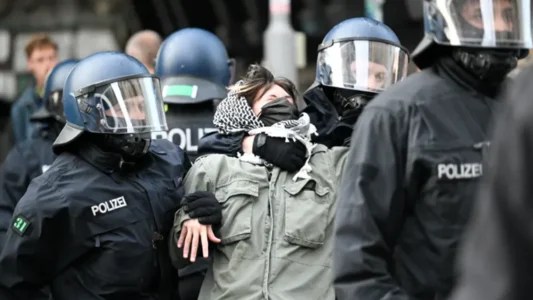
Germany’s Undemocratic Assaults
By Ricardo Martins – New Eastern Outlook – January 22, 2025
The genocide unfolding in Gaza continues to expose the inadequacies of the international judiciary, organizations, and, more importantly, the complicity of part of the global community of nations in enabling such atrocities.
Germany Taken to the ICJ for Complicity in Genocide
In March 2024, Nicaragua brought a case against Germany at the International Court of Justice (ICJ), accusing it of aiding and supporting genocide in Gaza by supplying arms to Israel, fully aware of the genocidal risks involved. Shockingly, the ICJ failed to condemn Germany.
Germany also maintains unwavering and unconditional political and diplomatic support for Israel. German Foreign Minister Annalena Baerbock displayed a cheerleader-like demeanor during her initial visit to support Israel after October 7—a stance echoed by European Commission President Ursula von der Leyen.
According to the Middle East Eye, Germany’s support for Israel’s actions highlights a hypocritical approach to international law and human rights. The analysis goes further: “No one can reasonably believe in the fairytale of Germany’s moral responsibility anymore, as the country defends, finances, arms, and diplomatically supports the genocide of Palestinians, in addition to the bombing of Lebanon, Yemen, and Syria, while shielding those responsible from accountability.”
Protests Against Israel Are Considered “Antisemitic” in Germany
With the Bundestag’s adoption last November of the resolution “Never again is now: Protecting, preserving, and strengthening Jewish life in Germany”, the country has entered a proto-fascistic state—without any condemnation from the European Union. Policymakers crafting this resolution refused input from diverse human rights groups and instead relied solely on the controversial International Holocaust Remembrance Alliance (IHRA) definition of antisemitism.
Even before this resolution, but now bolstered by it, Germany has witnessed a gradual erosion of democracy under its ‘proud guilty’ ideology. This includes prior censorship of cultural events partially or fully funded by public money, the cancellation of events featuring critics of Israel’s government, and even conferences discussing the Palestinian question. Concurrently, there has been a sharp rise in the smearing of critics with allegations of antisemitism. Make no mistake—censorship is alive and well in Germany. Protests critical of Israel’s actions in Gaza are being unjustly and undemocratically labelled as antisemitic.
Further, children can be banned from schools for wearing “pro-Palestinian symbols such as the keffiyeh,” as is written in a letter sent to school principals by Berlin’s education senator, Katharina Günther-Wünsch.
Furthermore, this resolution introduced a mandatory declaration for asylum seekers, requiring them to affirm the existence of the state of Israel and pledge not to participate in or support boycott campaigns against it.
Over the past month, German politicians have called for changing laws, including those around the right to demonstrate and freedom of opinion. The idea of withdrawing citizenship, residency, welfare benefits or funding from anyone accused of making anti-Semitic statements has been floated as well as a plan to only allow “native Germans” to protest.
Prior to this resolution, we have already witnessed undemocratic and even fascistic actions in Germany. These include the arrest of citizens for trivial reasons, such as holding a placard stating “I am not complicit in genocide,” and the arrest of a child for holding a Palestinian flag. Former Greek finance minister Yanis Varoufakis was prohibited from addressing a Jew-Palestinian conference and from permanently speaking to the German public online. A meeting organised by the progressive collective DiEM25, alongside Palestinian and Jewish Voice for Peace groups, on April 12th, 2024, was disrupted, dismantled, and labelled an “Islamist” event by the Interior Ministry.
Furthermore, the renowned British-Palestinian surgeon Dr Ghassan Abu-Sitta, who volunteered in Gaza hospitals during the genocide, was banned from entering Germany. Dr Abu-Sitta was due to provide a firsthand account of the atrocities taking place on the ground. Due to Germany’s Schengen-wide interdiction, he was also barred from entering France to speak at a French Senate meeting, despite being invited by the Senate itself.
These actions raise pressing and undeniable questions about a democratic deficit and institutional racism within German governmental structures.
A Threat to Germany’s Academic Freedom and Reputation?
Protests critical of Israel’s actions in Gaza have been wrongfully labelled antisemitic. The German Education Ministry sought to explore whether academic funding could be cut for those critical of clearing the pro-Palestinian camp at Freie Universität Berlin (Free University Berlin). This crackdown led to police detaining over 70 individuals temporarily and initiating 80 criminal investigations, alongside 79 misdemeanour proceedings.
Ironically, the Education Minister, Bettina Stark-Watzinger of the Free Democratic Party (FDP), previously declared that freedom is the foundation “for the way we live in our country, for our democracy, our constitutional state, and our prosperity.” She made this statement during the launch of Germany’s Science Year 2024.
In stark contrast, over 2,900 academics have accused Stark-Watzinger of threatening freedom of expression, calling for her resignation in an open letter. The letter, signed by thousands of German and international academics, accuses the education minister of intimidation, stating: “Repressive reviews of academics who publicly express critical views of governmental decisions are characteristic of authoritarian regimes that systematically suppress free discussion, including within universities.”
Why is Germany Having This Behaviour?
Driven by its ideology of ‘proud guilt,’ which elevates support for Israel to a raison d’état, Germany appears to have abandoned all sense of proportionality and reason—where even a child wearing a keffiyeh in a school is deemed a threat to Israel’s existence and, by extension, to German security.
In many respects, it now exhibits the characteristics of a quasi-fascist state. My few examples above, out of thousands, support this claim. To make things worse, the German government refuses to comply with the ICC prosecutor’s request to arrest Prime Minister Benjamin Netanyahu and Defence Minister Yoav Gallant.
According to Körber Fondation’s latest survey, which polls German citizens on foreign policy, only 19% of Germans support their country’s military aid to Israel. This shows a blatant divide between Germany’s political/media elites and the people they are supposed to represent.
German citizens deserve to know why their freedoms are being restricted and whose interests are being served. Why do Israel’s interests take precedence over those of German citizens and Germany’s international reputation? Why must the Palestinian people continue to pay the price for Germany’s past mistakes? I will delve into this matter further in my next article.
To conclude, the most astonishing aspect of these atrocities against German freedoms and the Palestinian people is the deafening silence of the European Union and the European Human Rights Court. The double standards of the European institutions are blatant and hypocritical.
Ricardo Martins ‒ PhD in Sociology, specializing in policies, European and world politics and geopolitics
Featured Video

Bombing Hitler’s Hometown
or go to
Aletho News Archives – Video-Images
From the Archives
The Biggest Threat to Peace in Middle East
By Dr. Elias Akleh* | Sabbah Report | May 24, 2010
A build up of heightened tension in the Middle East is escalating in the last few weeks. American and Israeli postures towards Lebanon, Syria, and Iran have become more threatening. Listening to speeches of political leaders one hears talks only about war not peace. Iranians and Israelis are continuously training hard for a possible showdown. Both sides are conducting extensive war games every month. This led Syrians to claim that Israel is preparing for a soon-to-come another war. The Jordanians also are warning that current stalemate of the peace process is an indication of a war breaking out this summer. The Russian President and his army chief hinted, a few months ago, that the US and Israel were planning for an attack on Iran.
Indeed Iran is, as it has been for last few years, the target of most of the threats and accusations of supporting terrorism. Escalating incitement against Iran the American Defense Department sent last month (April) to Congress a report on Iran’s military claiming Iran could develop intercontinental ballistic missiles capable of reaching the US by 2015.
Ignoring the fact that N. Korea, India, Pakistan, and Israel are proven to have nuclear weapons while Iran does not, the US Secretary of State Hillary Clinton chose in her speech, to the nuclear Non-Proliferation Treaty review conference at the UN, to focus on Iran’s alleged nuclear ambitions putting the whole world at risk as she put it. According to Clinton Iran’s acquisition of nuclear weapons, rather than Israel’s more than 200 nuclear bombs, is destabilizing the Middle East. She called on the world’s nations to rally around US efforts to hold Iran, not other nuclear countries, to account.
The accusation that Usama Bin Laden is living comfortably in Iran had received a boost after the broadcast of a documentary called “Feathered Cocaine”. This echoed the June 2003 claims of the Italian newspaper Corre de la Sierra that Bin Laden was in Iran according to some intelligence report, and according to Richard Miniter’s book “Shadow War”. … continue
Blog Roll
 Aletho News
- Bombing Hitler’s Hometown
- German journalist threatened with homelessness as German court upholds EU sanctions in landmark free speech case
- US Tells Allies That Ukraine-Bound Arms Could be Sent to Middle East
- Organized terrorism: Iran condemns killing of its diplomats in Lebanon
- Why could Gaza enter the regional war?
- Hamas official rejects Mladenov Plan linking disarmament to Gaza reconstruction
- Two Primary Elections for the Soul of ‘America First’
- Japan Clings to US Vassalage Despite Energy Crunch Caused By Iran War
- US Seeks Control Over Global Energy Infrastructure – Kremlin
- US senators target Orban government for standing up to Zelensky
- If Americans Knew
- Researchers at Human Rights Watch Resign Over Blocked Report on Palestinian Refugee Return
- Jewish Groups Are Backing a War Americans Don’t Want
- Eric Fingerhut Thinks He’s the President of the Jews
- Top Jewish Philanthropists, Rabbis Urge Israeli President to Take Action Against ‘Jewish Extremists’
- Don’t Be Fooled. Zionist Leaders Have Always Wanted to Control Southern Lebanon
- Israel’s widespread use of torture is a core element of its genocide against the Palestinian people
- In Israel’s War on Iran, Many Middle East US Bases Rendered “All But Uninhabitable”
- ‘Burn the lawn’: Israel pursues ‘Rafah model’ in southern Lebanon
- A genocide here, an amputation there
- Reports: Iran mobilizing 1M fighters, Israel-US run low on ammo, Israeli army faces shortage – Not a ceasefire Day 168
- No Tricks Zone
- Devastating Assessment Of Comirnaty Vaccine By Former Senior Pfizer Europe Toxicologist
- New Study: CO2 Is ‘Effectively Negligible’ As An Explanatory Climate Change Factor Since 2000
- Former Pfizer Toxicologist Dr. Helmut Sterz Tells Bundestag Hearing Pfizer Vaccine Should Have Never Been Approved
- Energy Expert: Germany’s Nuclear Phaseout Was A “500 Billion Euro Mistake”
- New Research: South Australia’s Mid-Holocene Sea Surface Temperatures Were 4°C Warmer Than Today
- Storing Green Energy To Last Germany 10 Days Would Require A 60-Million Tonne Battery
- New Studies: UK Sea Levels Were 4 Meters Higher Than Today During The Mid-Holocene
- Destructive Green New Deal: German Energy And Metal Group Warns Of Drastic Crisis
- New Study Documents A 20-Year Pause In Arctic Sea Ice Decline – Driven By Internal Variability
- Wake-up Call: Survey Shows Majority Of Germans Now Favor Postponing Climate Targets!
 Aletho News