Abla Saadat: A Palestinian Stateswoman marked by “Terrorism”
By Christof Lehmann | No Spin News | September 24, 2012
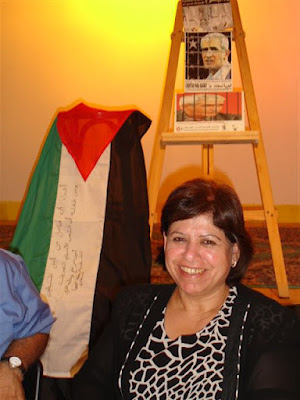 Abla Sa’adat, the Chairwoman of the Palestinian Women Organizations and wife of the Secretary General of the Popular Front for the Liberation of Palestine (PFLP) visited Denmark. I met Abla Sa’adat at a meeting where she told a group of mostly young Danes about Palestine. Had one expected an Abla Sa’adat who conforms with the dehumanizing stereotyping of Palestinians by Israeli and western politicians and main stream media, one would have been surprised by the depth and complexity of Abla Sa ‘adat, her perception of the Palestinian problems and possible solutions.
Behind the veil of the “terrorist” stereotype one discovers an Abla Sa’adat who is a true stateswoman, humanist, human rights advocate, an advocate for international law, justice and peace, the wife of a long term prisoner of war and political prisoner, as well as a mother and grandmother who puts the systematic dehumanization and stereotyping of Palestinians to shame.
In spite of the Hamas – Israeli negotiated prisoner exchange earlier this year, Abla Sa’adat states, more than 5.000 Palestinians remain in prison under administrative detention. She is active in organizations which advocate Palestinian prisoners rights. It is not for personal reasons, so she states, that she is using her husband, PFLP Secretary General Ahmad Sa’adat as an example for how Israel systematically terrorizes politically active Palestinians and their families, but because due to her own experience she knows his case best and because his case is representative of those of thousands of other prisoners and their families.
On the other hand, who would blame Abla Sa’adat for wanting to advocate for her illegally detained husband, the father of her children and grandfather to her grandchildren. At a recent appearance of Ahmad Sa’adat in an Israeli court he was denied physical contact with Abla and his newborn granddaughter Mayar. The destruction of politically active Palestinian families family ties and the destruction of Palestinians’ family systems is systemic and systematic.
After the PLO signed the Oslo Accords and the Palestinian Authority (PA) was established, the situation in the occupied Palestinian territories within the 1967 borders has not improved and the Israeli governments have systematically avoided adhering to the provisions of the Oslo Accords. Contrary to improvements, the reality of the matter is that: Israel has confiscated more land, increased its infringements on Palestinians’ water rights, built more settlements and settler only roads and railways, built the so called “security wall” which isolates Palestinian West Bank villages in micro enclaves, continued a policy that devastates Palestine’s economy; Israel continues to illegally arrest and detain Palestinians under illegal forms of imprisonment, the use of torture is endemic, the use of disproportionate military force is well documented, and these items only touch the surface of the daily violations of the Oslo Accords. According to the Oslo Accords Palestinian prisoners should have been released from prison. Israel did not adhere to this provision either.
What Palestinians gained by signing the Oslo Accords can be described with a few words. The right to establish a Palestinian Authority, which is utterly dependent on the goodwill of Israel. The political factions have gained the privilege to compete with each other for the Presidency over the self-administrated Zionist genocide on themselves while splitting the PLO, rendering it in a state of internal conflict rather than fighting for the liberation of Palestine. In other words, the PLO was entrapped in the glory of Presidency over its own destruction and the destruction of Palestine.
It is within this context one has to understand the arrest and detainment of Ahmad Sa’adat. Israel demanded that the Palestinian Authority arrest him for “terrorism,” and the Fatah led PA made sure that he was arrested and detained. The tragic irony of the situation is that the Oslo Accords resulted in the Palestinian Authority arresting and detaining the Secretary General of the PFLP Ahmad Sa’adat on behalf of Israel, and that Israeli pressure and US and British complicity since have resulted in Sa’adat being imprisoned in an Israeli prison and not, as initially, in a Palestinian prison with US and UK military guards. In fact each and every detail of Ahmed Sa’adat’s imprisonment is in violation of the Geneva Conventions, the Conventions against the use of Torture and other bodies of international law. Ahmed Sa’adat was sentenced to thirty years in prison for being the Secretary General of the PFLP, which is designated as a “terrorist organization” by the USA, Israel and the E.U. He has spent years on end in isolation.
Prior to his arrest Ahmed Sa’adat was elected to the Palestinian parliament. Abla Sa’adat explained that 22 members of parliament are currently imprisoned in Israeli prisons, many of them in isolation. The occupation is in fact preventing the functioning of Palestine’s democratic institutions.
Isolated prisoners are locked up for 23 hours a day. For one hour they can leave their cells and spend their time in an indoor yard, in shackles and hand-cuffs, without the possibility to exercise. There is absolutely no contact to other prisoners. Ahmed Sa’adat was isolated for three years before he was granted ” the privilege” to have his first visitor. Other families, Abla Sa’adat said, have been waiting ten years before they could see their imprisoned husband or father for the first time. Many can not even visit their relatives even if they are granted permission because road blocks and bureaucracy make it impossible to get to the prison and back.
Both Amnesty International, the Red Cross and lawyers complained that this form for imprisonment constitutes torture as well as a breach of the Geneva Conventions, but to no avail. Israel disregards these organizations and laws as well as it has disregarded almost any of the UN Resolutions pertaining Israel, Palestine or the Situation in the Middle East. Ironically, Israel is claiming the legitimacy of the state of Israel from the very organization whose resolutions it systematically disregards.
The impact of isolation and sensory deprivation on prisoners is well documented in numerous and comprehensive scientific studies. Even short term isolation for one to two weeks has a significant impact on a prisoners ability to concentrate, on memory, and general psychological well-being. Longer term and long term isolation for months to years on end have a devastating effect on the human being. Already after a few weeks most isolated prisoners experience several of the following symptoms.
-
Loss of the ability to concentrate
-
Loss of the ability to think coherent thoughts.
-
Loss of short and long-term memory.
-
Visual, auditory and tactile hallucinations, such as the sensation that the entire cell is driving like a train carriage or rotating.
-
Severe mood disorders.
-
Severe dissociative symptoms or dissociative disorders.
-
Suicidal ideas and increased prevalence of suicide attempts and death due to suicide compared to non-isolated prisoner populations.
-
Symptoms of learned helplessness.
-
Inability to participate as an active part of a legal defense.
-
And a cohort of other, severe symptoms.
It is for very good, science-based reasons that long term isolation is internationally recognized as torture. Israel is systematically using isolation to psychologically and physically destroy politically active Palestinian prisoners.
While the systematic and wide spread use of long-term isolation has a devastating effect on the prisoners themselves has a devastating effect on the isolated prisoners family systems as well. Spouses who have not seen one another for years on end risk growing strangers to one another. Children who are infants when a parent is imprisoned often see their father or mother for the first time when they are teens. It is impossible to remedy the lack of early attachment and the lack of a possibility to to know ones parents or ones children intimately or at least to such a degree as a normal imprisonment allows, which is devastating enough.
One of the long term prisoners, Nabeel Barghouti was imprisoned for 30 years. His wife who was pregnant when he was imprisoned gave birth to a son, Fahdi. At the age of 16 his son decided that the only way to see his father was to become a prisoner. After his arrest and imprisonment he fought for the right to be imprisoned under conditions that made it possible for him to see his father. Incidents like these are not extraordinary, although they are extraordinarily tragic.
At a visit, Ahmad Sa’adat would have been unable to recognize his own son on a photograph had it not been for the fact that the boy held a trumpet and that he knew that his son is playing the trumpet. Abla Sa’adat’s worst concern about her husband, she said, is not that he is breaking down mentally. Naturally the long term isolation has set its marks but he is determined in his struggle for liberation. What concerns her most is that she can see, that her husband is suffering the physical effects on the body which long term prisoners in Israel are suffering.
It took a months long hunger strike of Palestinian prisoners to finally end all long-term isolation of Palestinian prisoners in Israel’s prison industry; and it is a prison industry, in the literal sense of the word. E.U. Subsidies per prisoner exceed Israel’s costs per prisoner per day, and there are other methods such as fines which make it a lucrative business for Israel to hold as many prisoners as possible.
Years ago, Abla Sa’adat recalled, she was arrested while her husband already was imprisoned. Who would take care of the children? Israel is systematically using illegal forms of arrest and imprisonment to terrorize and destroy politically active families, and those who help targeted families in coping risk being targeted too.
The Stateswoman in Abla Sa’adat came out when she raised concerns about the targeting and imprisonment of Palestinian children. Stateswoman in the true sense of the word, as a politician, a revolutionary, as well as a mother for her own children, and a politician who has a motherly love for the plight of the children of Palestine and families with children.
Children are regularly arrested, beaten, shot at and killed for protesting the occupation. Many of them are provoked into conflicts with the occupation forces. Tanks rattling near school buildings for hours, stressing the children and making it impossible for them to follow a normal schedule are just one of hundreds of ways to provoke the throwing of a stone. The response can be everything from being beaten, arrested and imprisoned, injured or killed.
Abla Sa’adat draws attention to the fact that the international conventions and laws which regulate the rights of imprisoned children are also systematically circumvented or ignored by Israel. Besides that the child prisoners have become a lucrative form of income for Israel. The fines are high and children are often not released before the fine is paid.
Another way of destroying Palestinian family systems is the placement of children who are sentenced to house arrest with family members so far away from their parents that road blocks and daily chicane makes it impossible for the parents to maintain contact with the children.
Abla Sa’adat is drawing attention to the fact that the prevalence of psychological disorders among Palestinian children is extremely high. In fact, the prevalence of psychological disorders is extremely high in the general Palestinian population, regardless which age group one studies. Many of these psychological problems are caused by the occupation, and the prevalence of trauma-related problems is staggering.
A 1996 Study by Save the Child documented that most children internalize the conflict with the occupation. The violent problem-solving models are then transferred into the family system and into school teacher relations, leading to immense pedagogical problems. The violent problem solving models are also transferred to child on child relations. Children growing up under such conditions are, as adults, prone to use violent problem solving models. The effect is not only felt in the resistance against the occupation. In fact, the effect is more likely to manifest in spousal abuse, child abuse, proneness to the use of violence to settle family disputes, political disputes, financial disputes, and so forth. This internalization during childhood has an all pervasive and devastating effect on all levels, individual, family, community level, and in the halls of government.
The Oslo Accords, says Abla Sa’adat, have not brought any improvements for Palestinians and the debate among Palestinian factions to abandon the Oslo Accords and all subsequent agreements is finally being seriously debated among the factions.
Abla Sa’adat made a point of clarifying that she has nothing against Jews in Palestine or anywhere else. Jewish, Christian, Muslim and Secular people have been living in Palestine for centuries. The often used propaganda, that Palestinians want to drive the Jews back into the sea, she states, has nothing to do with reality. Her cause and the cause of the Palestinian liberation is not directed against Jews but against Zionism and Zionists. There is a difference, she states, between Jewish families who have been living in Palestine for centuries, and those who came and still are coming to Palestine to steal Palestinian land and evict or murder Palestinians.
A two State solution, says Abla Sa’adat, is the very minimum and it would be difficult to implement. She asks, if a Palestinian state should be established within the borders of 1967, what about those families who have been refugees since 1948? The most realistic solution would be, she said, to establish one secular state in all of Palestine. One secular, democratic state for Jews, Christians, Muslims and Secularists within all of the Palestinian territories. The greatest obstacle to the establishment of such a state is, that Zionists insist on a Jewish State, where Muslims, Christians and Secularists alike have no place, and if at all, then as second class citizens.
With a Middle East on fire, with a Libya that has fallen into the hands of Islamic extremism, and with Syria under attack from western sponsored extremists and Al Qaeda associated organizations from throughout the world, with Qatar, Jordan, Bahrain, Saudi Arabia, the U.A.E., the USA, NATO member states and Israel sponsoring and backing the extremists’ subversion of Syria, Abla Sa’adat, who is widely decried as “terrorist,” sounds like one of the most reasonable Middle Eastern voices of moderation I have heard since the onset of the so-called Arab Spring. If Abla Sa’adat is marked by terrorism, it is because a lifetime of enduring the terror of the Zionist occupation is as imprinted in her as it is in every Palestinian.
* Dr. Christof Lehmann, a life time peace activist, psychologist, and advisor in behavior, finance, economics and politics.
Related articles
- The racism behind a two-state solution (alethonews.wordpress.com)
- Saadat: “Zionist War Criminals Are The Ones Who Must Be Prosecuted” (imemc.org)
- Ahmad Sa’adat refuses to recognize legitimacy of Israeli court, “a tool of repression against Palestinian prisoners” (altahrir.wordpress.com)
Ex-prisoner explains self-immolation attempt
Ma’an – 21/09/2012

Former prisoner Abeer Odeh (MaanImages/File)
RAMALLAH – A former prisoner who tried to set herself on fire in Ramallah on Thursday says the Palestinian Authority is neglecting released detainees.
Abeer Odeh, 30, tried to self-immolate in Ramallah’s Manara square on Thursday but was stopped by police, a Ma’an correspondent said. She was taken to a nearby police station.
Odeh was released from Israeli detention last year in a prisoner swap deal between Israel and Hamas.
Speaking to Ma’an on Thursday evening, Odeh accused the PA ministries of health and prisoner affairs of failing to assist prisoners struggling with health problems and financial difficulties after their release. She said she tried to set herself on fire to draw attention to the plight of ex-detainees.
Odeh receives a salary from the PA but has had to cover the cost of several surgeries since her release, she said.
She says she was tortured during her nine years in Israeli detention and suffers colon infections, hernias, jaw erosion and spinal problems.
The former prisoner rejected statements made by some Palestinian officials that she was suffering from psychological problems, and considered the claims efforts to discredit her.
She said police in Ramallah mistreated her after her attempt to self-immolate.
Six of Odeh’s brothers have spent time in Israeli jails, and one brother was killed by Israeli forces. Another brother is disabled after he was injured by Israeli soldiers.
Israeli forces arrested Odeh’s mother in August, and she is now subject to movement restrictions by the Israeli military.
Related articles
- Palestinian Authority curbs freedom of expression in the West Bank (alethonews.wordpress.com)
Palestinian Authority curbs freedom of expression in the West Bank
MEMO | September 20, 2012
Palestinian Authority curbs freedom of expression in the West BankThe security services in the occupied West Bank have detained more than 60 Palestinians with political backgrounds, including writers, journalists and activists, Al-Dameer Association for Human Rights (DAHR) said on Thursday. At least 35 of those held are former prisoners who served long sentences in Israeli jails; most are affiliated to the Islamic Resistance Movement (Hamas).
Sources said that the security services started detention campaigns against citizens who took part in the recent demonstrations against price rises in the West Bank. Demonstrators called for Palestinian President Mahmoud Abbas and his Prime Minister Salam Fayyad to resign.
Prisoner Hisham al-Shirbati, who spent 14 years in prison in Israel, was reportedly in a serious health condition after being admitted to Al-Khalil Hospital. He was tortured severely by Palestinian security services in Hebron, writer Lama Khater alleged.
However, a spokesman for the security services in the West Bank, Adnan al-Dameeri, said that all the people arrested recently are “arm dealers” who tried to hijack peaceful protests. According to DAHR, though, most of those detained are journalists, writers and activists, including the prisoners who were freed by the Israelis just a few months ago.
Ahrar Society for Studies and Human Rights said that its manager, Fuad al-Kefish, also a former Israeli prisoner, is among the detained, as is Waleed Khalid, a journalist who spent two years in solitary administrative detention in Israel and was released just two weeks ago.
DAHR condemned the detentions as a severe violation of human rights and a threat to Palestinian civil society. It called for the PA in the West Bank and the Gaza Strip to stop all political detentions and press ahead with the reconciliation process. It also called on both to respect freedom of speech and freedom of expression.
The West Bank witnessed large scale demonstrations against the Ramallah-based Palestinian Authority’s policies of security collaboration with the Israelis, political detention and the economic crisis. The demonstrations were triggered by a protest against price hikes in which protesters called for the resignation of Mahmoud Abbas and Salam Fayyad.
Report: Israel urges US, EU to send funds to Ramallah
Ma’an – 11/09/2012
BETHLEHEM – The Israeli government has appealed to Washington and the EU to transfer hundreds of millions of dollars to rescue the collapsing Palestinian economy amid mass protests in the West Bank, Israeli media reported Tuesday.
Prime Minister Salam Fayyad has said the Palestinian Authority is unable to pay August salaries in full or on time because donor funds have not arrived. He said last week the PA was waiting for the US Congress to approve a request by President Barack Obama’s administration to pay $200 million to the Ramallah government.
The Hebrew-language newspaper Maariv said the European Union had reduced its financial aid to the PA due to economic crisis in Europe.
Protests against rising costs of living in cities across the West Bank have called for the resignation of Fayyad and President Mahmoud Abbas, and demanded the cancellation of the PA’s economic agreement with Israel, the Paris Protocol.
In Hebron and Nablus on Monday night, protesters threw rocks at PA security forces and dozens of security officers and demonstrators were injured.
Israel fears that demonstrations and strikes in cities across the West Bank against rising costs of living could weaken the PA and its security services, which coordinate with Israeli forces under agreements laid out in the Oslo Accords, Maariv reported.
Israeli officials fear protests could develop into a third intifada and the collapse of the PA, and protesters might attack Israel’s illegal settlements in the West Bank, the report added.
Related articles
Palestinian universities set strike for Wednesday
Ma’an – 11/09/2012
HEBRON – Employees at all Palestinian universities will go on general strike Wednesday protesting the government’s failure to respond to their demands, a joint committee of the employees’ union and the union of students councils said Tuesday.
The committee explained in a statement that both academics and students could understand the ongoing popular protests in the streets. “The occupation is behind all our calamities and problems,” the statement added.
“After the Palestinian government has failed to undertake its basic duties toward the different sectors in the Palestinian society, especially the education sector, despite being given enough chances, you have to listen to the cries of anger and to comply with the popular demands,” the statement said addressing the PA premier.
The statement urged the protestors to keep their movement peaceful and show a sense of responsibility.
On the other hand, schools will operate normally, according to the secretary general of the Palestinian general federation of teachers, Muhammad Suwwan.
World Bank pays $22.3 million to PA budget
Ma’an – July 4, 2012
BETHLEHEM – The World Bank on Tuesday said it paid $22.3 million to the Palestinian Authority to help with a budget crisis.
The funds are from a trust paid into by the governments of Australia, France, Kuwait, Norway, and the UK, the World Bank said in a statement.
It noted that the aid was slated to support education, health care and other social services and for the economic reforms undertaken by the West Bank government.
The Palestinian Authority labor minister said Saturday that due to the government’s worsening financial crisis, public sector salaries would not be paid on time in July.
Israeli and Palestinian officials told Reuters on Monday that Israel had sought a $1 billion loan from the International Monetary Fund for the Palestinian Authority to prevent its financial collapse.
The Israeli newspaper Haaretz said the IMF turned down the request because it did not want to set a precedent of one state getting a loan on behalf of a non-state body.
Related articles
- PA security drive against Palestinians is its “basic role”, claim Israeli officials (alethonews.wordpress.com)
- IMF refuses to give $1bn loan to the PA (alethonews.wordpress.com)
PA Agrees to Exhume Body of Yasser Arafat After Evidence of Radiation Poisoning Alleged
IMEMC & Agencies | July 4, 2012
Following a report Tuesday by Al-Jazeera, and a request by President Yasser Arafat’s widow Suha, the Palestinian Authority announced its support Wednesday for an international investigation into the president’s death which would include the exhumation of his body.
After a nine month investigation by Al-Jazeera reported that the Institut de Radiophysique in Switzerland found abnormally high levels of a rare radioactive element called polonium-210 on Arafat’s personal belongings, his widow Suha called for the exhumation of his body.
There are conflicting reports about whether Arafat’s symptoms indicate polonium poisoning. Al-Jazeera stated that the president’s symptoms were consistent with polonium poisoning but Ha’aretz reports contradicted this.
While testing of the president’s bones could provide confirmation of radiation poisoning, it would not necessarily lead to who was behind the incident. However, polonium is a difficult element to produce and the signature found in the bones could provide evidence of who created it.
Questions have surrounded the circumstances of Arafat’s death since his sudden illness during the second intifada in 2004. PLO official Saeb Erekat said the Palestinian Authority is looking to form an international tribunal to investigate the case modeled after the one that looked into the death of former Lebanese prime minister Rafiq Al-Hariri. But the former head of Israeli domestic intelligence, Avi Dichter told Israel’s Army Radio that the Palestinians are responsible for the outcome. He asserted, “The body is in their hands. It is in Ramallah and really, all the keys are in their hands.”
PA security drive against Palestinians is its “basic role”, claim Israeli officials
MEMO | July 3, 2012
The Palestinian Authority’s extensive security and detention drive against Palestinian activists in the occupied West Bank has been described by Israeli officials as the PA’s “basic role”. It represents, they claim, “the extension of the PA’s sovereignty over all issues” in the occupied territory.
According to Israeli media reports, the PA began its campaign several weeks ago. Included among those detained by the PA security services are a number of its own senior officers who have refused to cooperate with the Israeli occupation authorities. This move has been well received in Israel.
As part of the campaign, the PA has confiscated more than 100 guns and arrested more than 150 “terrorist” suspects from the West Bank cities of Jenin and Nablus. Apparently, members of the former Al-Aqsa Brigades and senior PA military officers who have received special counter-terrorism training in the US and Jordan are among those arrested.
Israeli officials described this campaign as similar to that carried out by the PA in 2009 through which it tried to destroy the Hamas infrastructure in Qalqilya; six Palestinians were killed on that occasion.
More PA forces are to be deployed in the northern West Bank to follow-up on the latest developments. Israel’s Shabak intelligence service cooperates with PA officials, supplying them with detailed information on the whereabouts of suspects and fugitives.
Related articles
- Hamas releases half-yearly report on PA violations against its cadres (occupiedpalestine.wordpress.com)
IMF refuses to give $1bn loan to the PA
MEMO | July 3, 2012
The International Monetary Fund (IMF) has rejected a request from Benjamin Netanyahu to offer the Palestinian Authority a $1 billion loan, because the PA “is not a state”. The Israeli Prime Minister made the request via the governor of the Bank of Israel, Stanley Fischer, after discussions about the PA’s financial crisis with the Ramallah Prime Minister Salam Fayyad.
If agreed, the loan would have been repaid through Israel. The IMF said that it rejected the Israeli request because it did not want to set a precedent of a state taking a loan on behalf of a non-state entity. It is believed that the request was made in April during the IMF’s annual conference in Washington.
Fayyad told Fischer that Europe and the US are unable to increase their financial support for the PA because of the economic crisis; Arab States are not transferring the funds they have promised; and Palestinian banks are refusing to extend any more credit to the government due to its inability to make debt repayments. Insider sources claim that Fayyad and Fischer are still discussing the financial problems in the hope of finding a solution and preventing the potential collapse of the authority.
Related articles
- Israel unsuccessfully sought $1bln IMF loan for Palestine (panarmenian.net)
Israeli Government Fails to Carry Out Terms of Prisoner Agreement
By Saed Bannoura | IMEMC News | June 28, 2012
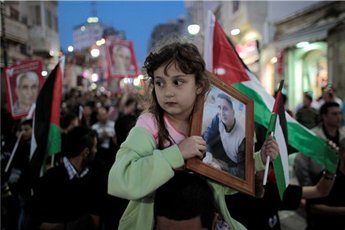
Palestinian and international rights groups have condemned the Israeli government’s failure to live up to the agreement made one month ago in order to end the month-long hunger strike of over 2,000 Palestinian prisoners.
The promises made by the Israeli government in order to end the hunger strike included an end to solitary confinement, improved living conditions for prisoners, proper medical care and increased family visits. A month after the hunger strike was declared over, however, the Israeli authorities have yet to implement these agreed-upon terms.
The one item that Israeli authorities did carry out was the return of 91 bodies from the so-called ‘Numbers’ cemetery in Israel – a cemetery made up of Palestinians who died or were killed inside Israel. Although Israel has always denied the existence of this cemetery, mocking those Palestinians who insisted that it did exist, the release of the bodies constituted an admission by the Israeli government that the Numbers cemetery does exist. Those 91 bodies are not all of the Palestinians buried in the Numbers cemetery, but no one on the Palestinian side knows how many bodies remain, and Israel has refused to release any data.
Some prisoner rights groups are blaming the Palestinian Authority for giving in to easily during negotiations with the Israelis regarding the hunger striking prisoners, and for failing to pressure Israel to live up to its end of the bargain.
In fact, there is no mechanism by which the Palestinian Authority can force Israel to carry out its promises regarding prisoners, as Palestinians have no legal recourse to take the Israeli government to court.
One of the promises made by the Israeli government was hailed at the time as a success for prisoners, but prisoner rights groups including Addameer have cautioned that it does not constitute a real change in policy. That is the decision to not extend so-called ‘administrative detention’ orders under which Palestinians are held without charges. The caveat, however, is that Israel can extend those orders if there is ‘new information’ in the case. Since the charges and trial in these cases are held in secret, with no possibility of mounting a defense, this caveat makes the change in policy virtually meaningless.
One representative of Addameer, Mourad Jadallah, told reporters with the Ma’an news agency, “Israel also does not want Palestinians to feel they reached something with the hunger strike or let the prisoners movement feel like they reached their demands. They want to say: We can control everything.”
Related articles
- Outrage as Israel breaks prisoner agreement (altahrir.wordpress.com)
Palestinian Nationalism, Alive Despite Israeli Instruments of Control

(Artwork: Sauda Camo)
By Hasan Afif El Hasan | Palestine Chronicle | June 18, 2012
From day one after the 1967 war, Israel’s actions in the West Bank, Gaza Strip and Jerusalem suggest the occupation was not temporary and underscore Israel’s desire to erase the concept of the Palestinian nation by undermining the connection between the people and their land or history. In an effort to incorporate as much as possible of the occupied lands, Israel governed the occupied lands by making distinction between the land and its Palestinian inhabitants and referred to the Palestinians only as ‘Arabs’. The Israelis wanted to weaken the Palestinians’ claim to their country and suggest they belong to other Arab countries. A politically powerful segment of Israelis, perhaps a majority, perceive the occupied lands as biblical territory and the indigenous Palestinians as ‘hostile aliens’ or as “part of nature’s hardship to be conquered and removed.”
The concept of cleansing and transferring the Palestinians has been deeply rooted in the colonial Zionists political and military planning. It was practiced on a large scale in 1948 when top-ranking officers of the future leaders of Israel prepared and executed ethnic cleansing of half Palestine’s native population, and the cleansing is being practiced today especially in Jerusalem. Israeli plans to expropriate land were developed, and other tools and practices were created to manage the lives of the people without integrating them into Israel’s citizenry. Israel used its own legal system to annex East Jerusalem immediately after the 1967 war; and in the West Bank, it carried out piecemeal confiscation by issuing orders from military commanders and employing Ottoman and British Mandatory laws and regulations from the Jordanian legal system.
Shaping the daily life of the people under occupation is one of Israel’s means of control to manage the population. Besides sealing the borders of the West Bank and Gaza Strip to crush internal resistance, Israel imposes curfews, arrests, deports, restricts movement, demolishes homes, and shuts down businesses and schools. The controlling system has manifested itself in legal regulations, permits and bureaucratic rules dictating forms of correct conduct everywhere. Thousands of orders have been issued by the Israeli military that deal with anything and everything as controlling apparatuses.
Within a few weeks of Israel’s swift success in capturing the West Bank and Gaza, the West Bank Palestinians began using strikes and demonstrations, and in Gaza, the opposition to the occupation assumed a violent character. Israel responded with military orders categorizing all forms of resistance as insurgency, including peaceful protests, political meetings, waving flags, displaying national symbols, even singing or listening to national songs.
Israel removed all activist leaders who showed opposition to the occupation, used administrative detentions and deported thousands suspected of supporting acts of resistance. Among the deportees were Abdel-Hamid a-Sayegh, the chief Islamic judge (Kadi) of the West Bank, and Nadim Al-Zaro, the mayor of Ramallah. In March 1982, the mayors of nine West Bank cities and Gaza were dismissed and military officers replaced them. The mayors’ dismissal, detention and deportation of community leaders failed to contain the Palestinian drive for emancipation and national opposition had to go underground. The Israeli journalists and authors Ze’ev Schiff and Ehud Ya’ari described the relationship between the Palestinians and the Israelis in their book ‘Intifada’ as “the relationship between a horse and its rider.”
Israel tried power-sharing agreement with Jordan, the military government, the village leagues and the civil administration to control the Palestinians, but it recognized that the methods it had employed to normalize the occupation and suppress Palestinian nationalism were not working. If anything, Palestinian nationalism resurged. Then Israel came up with the ingenious idea of outsourcing the responsibility for the population while continuing the occupation and colonization. Self-rule for the residents of the West Bank and Gaza Strip under a Palestinian authority (PA) without renouncing Israel’s sovereignty over the two regions was the answer. The PA was a product of the occupation to control the population and reduce its economic and political cost on Israel. Noam Chomsky pointed out that the PA was not intended as an instrument of decolonization but rather a framework that changed the means of Israel’s control in order to perpetuate the occupation. According to Chomsky, Prime Minister Yitzchak Rabin noted in an interview that the PA would be able to control the population “without all the difficulties arising from Supreme Court appeals, human rights organizations like B’Tselem, and all kinds of leftist fathers and mothers.”
Since the establishment of the PA, especially after the second intifada, Israel has been operating primarily to downgrade the value of the Palestinians to people whose lives can be taken with impunity, enforcing laws that legalize the incarceration and torture of political prisoners, permitted deportations, house demolitions, and curfews. The executive and judicial branches of government coordinated to rationalize the inhumane Israeli policies.
After the establishment of the PA, the Palestinians have even less autonomy in the economic field than in security. Constraints and restrictions enforced by the Israeli military hinder the development of an independent Palestinian economy and have transformed it into a captive market for Israeli producers. The leaders of the PA promised economic growth based on the assumption that productive economy would slowly be established, there would be large investments in infrastructure and industry and that the Palestinians would enjoy freedom of movement for themselves and their goods. They promised that the Gaza Strip would be transformed into “the Middle East’s Singapore” and the Palestinians would enjoy the fruits of their agreements with the Israelis. Ironically, these agreements have been reasons the wishful promises did not materialize.
The 1994 “Paris Protocol on Economic Relations” that was signed by the PA leaders replicated Israel’s colonial economic management of the occupied lands that had existed since 1967. It guaranteed that Israel would preserve its control of the occupied land’s economy and prevented the Palestinians from choosing their own trade policies according to their own interests. It has prevented the creation of an internal economic base with its own productive capacity and increased the Palestinians’ dependency on laborers who commute to Israel despite Israel’s use of the entry-permits and internal closures as an effective form of control weapon. Israel uses its power over the flow of laborers to collectively punish the public for any form of resistance. It was used to pressure the PA to clamp down on Hamas, Islamic Jihad, PFLP and other groups that resist the occupation. Professor Sara Roy wrote in her book ‘Gaza Strip’ that Israel was able to reorient a large percentage of the Palestinian labor force away from domestic agriculture and industry and integrate it in Israel’s labor force. The productive capacity of the Palestinians is diminished because Israel has restricted the development of a viable infrastructure capable of stimulating development in the West Bank. And in the Gaza Strip Israel has destroyed the infrastructure and the people’s means for survival.
The “Agreement on Preparatory Transfer of Powers and Responsibilities [to the PA]” of 1994 outlined the reorganization of PA power in many spheres including jurisdiction, secondary legislation, the judicial and security. The agreement states that the PA does not have jurisdiction over Jerusalem, the settlements and the military locations. It gave Israel a veto power over any regulation or legislation enacted by the PA that Israel considers exceeding the PA powers or inconsistent with other agreements. Israel must approve all employees authorized by the PA to inspect and monitor compliance with the laws and regulations. The PA agreed not to have authority over settlers or any non-Palestinian residing or travelling within the occupied territory.
In order to repress all forms of Palestinian nationalism, the Israeli occupation authority took over the educational system immediately after the 1967 war. Officers in charge of education became responsible for licensing private and public schools, hiring and firing teachers, the curricula and text books. They wanted the text books to adopt the Zionist historical narrative on Palestine and systematically erase any reference to Palestinian nationalism and identity. The word ‘Palestinians’ was replaced with ‘Arabs’ and the word ‘Nakbah’ was not allowed in any textbook. ‘Nakbah’ was the displacement of the vast majority of the indigenous Palestinians in 1948. “More than 1,700 titles were banned over the years including history, geography, political, literature and poetry books.” The occupation authority issued instructions for teachers not to teach their students extracurricular material for fear that they might adopt a historical narrative depicting a national Palestinian past. When the Israeli civil administration surrendered the management of the school system including the higher education institutions and vocation schools to the PA, it was on condition that they refrain from incitement against Israel.
Efforts by the Israelis to repress Palestinian nationalism failed because the Palestinian youth learn who they are and where they came from in their daily life as non-persons in the refugee camps, or in disconnected enclaves under the shadows of the Jewish only settlements, dehumanized and humiliated by the occupation soldiers at the blockaded roads, or in Jerusalem under the threat of home-demolition and deportation, or living in Israel as second class citizens or in besieged and impoverished Gaza.
– Hasan Afif El-Hasan is a political analyst. His latest book, Is The Two-State Solution Already Dead? (Algora Publishing, New York), now available on Amazon.com and Barnes & Noble.
Related articles
- Residency Of 240,000 Palestinians Revoked By Israel Since 1967 (alethonews.wordpress.com)
Featured Video

Maria Farmer: Epstein victim reveals explosive information covered up by media
or go to
Aletho News Archives – Video-Images
From the Archives
Netanyahu Is Leading US President Trump to War with Iran
By Prof. James Petras | Global Research | October 27, 2017
Introduction
Israeli Prime Minister Benjamin Netanyahu and the Presidents of the 52 Major Jewish American Organizations are leading President Trump, like a puppy on a leash, into a major war with Iran. The hysterical ’52 Presidents’ and ‘Bibi’ Netanyahu are busy manufacturing Holocaust-level predictions that a non-nuclear Iran is preparing to ‘vaporize’ Israel. The buffoonish US President Trump has swallowed this fantasy wholesale and is pushing our nation toward war for the sake of Israel and its US-based supporters and agents. We will cite ten recent examples of Israeli-authored policies, implemented by Trump in his march to war (there are scores of others). … continue
Blog Roll
 Aletho News
- Was MAHA Too Good to Last in the Trump Administration?
- Vermont advances bill letting unelected Health Commissioner decide which vaccines ctizens should receive
- Why the US-Israeli alliance will lose against Iran
- US envoy Huckabee claims Israel has ‘biblical right’ to conquer all West Asia
- Testing the Alliance: Netanyahu’s Washington Visit
- Britain is once again poisoning peace diplomacy with Russia and fueling war in Europe
- Russian fuel tanker to test US sanctions amid Cuba crisis
- EU state issues ultimatum to Zelensky over Russian oil supplies
- Maria Farmer: Epstein Victim Reveals Explosive Information Covered Up by Media
- Travelers Take a Pass on Visiting America
- If Americans Knew
- Ominous messaging from Trump’s “Board of Peace” – Not a ceasefire Day 134
- ‘Christians Out’: Jerusalem Church Tagged With Hate Graffiti, Police Investigating
- Israeli Settlers Kill American Teen
- ‘We returned from hell’: Palestinian journalists recount torture in Israeli prisons
- No mercy for Gaza in Ramadan – Not a ceasefire Day 133
- The Israeli Government Installed and Maintained Security System at Epstein Apartment
- Tucker Carlson interrogated in Israel, has passport seized after interviewing US ambassador
- 6,000 Amputees in Gaza Face Impossible Recovery amid Israeli War Ultimatum
- The Lancet: Gaza death toll far higher than reported – Not a ceasefire Day 132
- Compliant aid: Who are the Israel-approved NGOs scaling up in Gaza?
- No Tricks Zone
- Germany: Electric Car Catches Fire At Charging Station, Sets Off Local “Inferno”, Widespread Damage
- New Study: Canada’s New Brunswick Was 1°C Warmer Than Today During The Medieval Warm Period
- Coal Power Back In Trend As Globe Tries To Keep Pace With Growing Demand For Power
- New Study: A 4°C Warmer Beaufort Sea Had ‘No Sea Ice’ 11,700 – 8200 Years Ago
- Unfudging The Data: Dutch Meteorological Institute Reinstates Early 20th Centruy Heat Waves It Had Erased Earlier
- German Gas Crisis…Chancellor Merz Allegedly Bans Gas Debate Ahead of Elections!
- Pollen Reconstructions Show The Last Glacial’s Warming Events Were Global, 10x Greater Than Modern
- Germany’s Natural Gas Storage Level Dwindles To Just 28%… Increasingly Critical
- New Study Rebuts The Assumption That Anthropogenic CO2 Molecules Have ‘Special’ Properties
- Climate Scientist Who Predicted End Of “Heavy Frost And Snow” Now Refuses Media Inquiries
 Aletho News