The Dark Secret Behind a British Billionaire’s “Parallel State” In Argentina’s Patagonia

By Whitney Webb | Mint Press News | March 11, 2019
EL BOLSÓN, ARGENTINA – At the “end of the world,” spanning the southernmost regions of Argentina and Chile, lies the land of Patagonia, much of which remains a pristine wilderness that has inspired countless naturalists and would-be adventurers with its dramatic landscapes and natural beauty. For many, it is a place that still feels remarkably untouched and removed from the chaos of the modern world.
Yet, it is these very qualities, as well as the region’s great oil and gas potential and its abundance of glacier-fed freshwater reserves, that have placed it in the crosshairs of predators — predators armed with billions of dollars, powerful influence over Argentine politics and the country’s press, as well as alliances with controversial international financial organizations and key elements of the global Zionist lobby.
Coveted for its still largely unplundered resources, Patagonia has become the target of a close-knit network of notorious billionaires and global elites, who have spent much of the last two and a half decades seeking to transform this area into their own independent state.
Indeed, though several of these billionaires have already created de facto private states where they enjoy near-total impunity within Argentine Patagonia, others have been behind major efforts that have pushed for the territory’s secession. Still others have pushed Argentina’s government to exchange its claim to Patagonia for “debt relief” as a way of easing Argentina’s economic plight that, incidentally, was largely created by this very same group of billionaires. The International Monetary Fund (IMF), whose connections to this billionaire network are considerable, has had an outsized role in this effort.
Yet this appears to be more than just a venture on the behalf of notable oligarchs and the global elite, as prominent elements of the international Zionist lobby are intimately involved, as is the state of Israel, though the extent of the involvement of the latter is subject to debate. Their interest revolves around claims that date back to the founding of Zionism in the 19th century, when revered Zionist figures like Theodore Herzl discussed Argentina as a potential homeland for a Jewish ethno-state.
Since then, other notable Zionists, including past Israeli ambassadors to Argentina, have argued that Israel is for “European Jews” while “American Jews” must take Argentina for themselves. Notably, the method suggested by Herzl as a means of creating a Zionist state in his seminal work “The Jewish State” involves the exchange of debt for territory.
In the first part of this investigative series, MintPress explores the de facto independent state that has been created by British billionaire and Zionist Joe Lewis, a long-time associate of controversial Hungarian-American financier George Soros. Lewis has essentially bought out the local, regional and even national government of Argentina, allowing him to operate with impunity while he acquires more and more territory through land purchases of dubious (if any) legality, intimidates and threatens locals, usurps crucial water and energy resources from local towns, and operates his own international private airport that no one but he controls.
Subsequent reports in this series will examine the other key players in this effort to create a Patagonian state, namely Argentine oligarchs Marcelo Mindlin and Eduardo Elsztain, who are both deeply connected to the global Zionist lobby and the Rockefeller-founded Americas Society, and are also both close Soros associates. Finally, the role of these individuals and their associates in efforts to use IMF debt slavery to pressure the Argentine government to swap debt for territory will be revealed, as will the role of the Zionist lobby and prominent figures in the global elite.
The town that fought back
The quaint mountain town of El Bolsón, nestled among the picturesque rocky peaks of Argentina’s Patagonia and famed for its local legends of gnomes and elves, may seem an unlikely epicenter in a nationwide battle that has pitted locals against powerful foreign billionaires — billionaires who are not only plundering the country’s rich resources but eroding its national sovereignty through backdoor deals with Argentina’s most powerful, and most corrupt, political leaders.
Yet, however unlikely the role of this sleepy town in Argentina’s Río Negro province may seem, for over a decade many locals have used every tool at their disposal to oppose one billionaire’s effort to turn the town and much of Río Negro into his own personal fiefdom. This struggle has seen massive demonstrations in El Bolsón against British billionaire Joe Lewis, with some attracting as many as 15,000 participants – nearly 80 percent of the town’s entire population.
Lewis, worth an estimated $5.2 billion according Forbes, is best known in the West for owning the British Tottenham Hotspur football club, his sprawling luxury estates and golf resorts in the Bahamas and Florida, and owning well-known brands including Puma sportswear and Vans shoes. He is often described as a “self-made” billionaire, having been born to a poor Jewish family in London, who worked his way up to become one of England’s richest men.
Since the mid-1990s, Lewis has been building an empire in Patagonia, having become the owner of extensive properties north of El Bolsón — which, among other things, contain almost all of the town’s water reserves, as well as those of the nearby farming community, Mallín Ahogado — and the de facto power behind Pampa Energía, the company controlling most of Argentina’s electricity production. Part Two of this series will focus on Lewis’ role at Pampa Energía, as well as that of his associate, Marcelo Mindlin.
The “self made” man made by Soros
Long before his venture into Argentina, Lewis was a controversial figure owing to his close association with controversial Hungarian-American financier George Soros. Indeed, the bulk of Lewis’ massive fortune derives from his decision to “team up” with Soros to bet against the British pound in 1992, a day popularly known as Black Wednesday.
Soros’ and Lewis’ bet against the pound actually led to the pound crashing, after Soros ordered his hedge fund to “go for the jugular” and aggressively trade against the currency, thereby prompting its sharp devaluation. Though Soros is often called “the man who broke the Bank of England” as a result of the $1 billion in profits he made on that fateful day, Lewis is said to have made an even larger profit than Soros, according to several reports.
While Soros became a financial celebrity after Black Wednesday, Lewis opted to stay out of the limelight even though, just three years later, he would repeat what he helped do to the British pound with the Mexican peso, reaping yet another massive profit. While the Mexican peso crisis made Lewis even wealthier, it led to a massive jump in poverty, unemployment and inequality in Mexico and left its government beholden to the International Monetary Fund (IMF) through a loan package arranged by then-U.S. President Bill Clinton.
Between 1995 and 1996, the severe economic recession that followed the Mexican peso crisis spread throughout the Americas and “severely affected” the economies of other Latin American countries like Argentina. As fresh economic havoc arrived and took hold in Argentina, Lewis decided to take advantage of the troubled regional economic climate that he himself had helped create and began developing his interests in Patagonia.
As will be explored later in this investigative series, Soros and two of his Argentine associates who are also connected to Lewis — Eduardo Elsztain and Marcelo Mindlin — took advantage of this economic crisis and subsequent crises to buy major stakes in several banks as well as massive tracts of Argentine real estate, particularly in Patagonia.
How to build an empire
In 1996, Joe Lewis returned to Argentina after initially visiting the country in 1992 at the invitation of Australian media tycoon Kerry Packer. Lewis, apparently inspired by his first visit, had decided to buy property in the area. According to regional media outlet El Patagónico, Lewis’ dream was not just owning his piece of paradise, but creating “his own state in Patagonia.”
Lewis soon came into contact with Nicolás Van Ditmar, who would not only facilitate Lewis’ initial and subsequent land purchases in Argentina’s Patagonia but would also do so for several other foreign oligarchs. Van Ditmar had previously arranged massive land sales farther south to the Benetton Group, the family company run by the Italian oligarchs of the same name, best known as the owners of the United Colors of Benetton clothing company.
Van Ditmar, after learning of what Lewis hoped to acquire, spoke to him of the property of the Montero family, which encircled a pristine mountain lake known as Lago Escondido (Hidden Lake). Most of the members of the Montero family agreed to sell their collective property of around 14,000 hectares (~34,549 acres) to Lewis for $7 million. However, one of the Montero brothers, Irineo Montero, had refused and he, along with his wife María Ortiz and their employee José Matamala, were all found dead under mysterious circumstances.
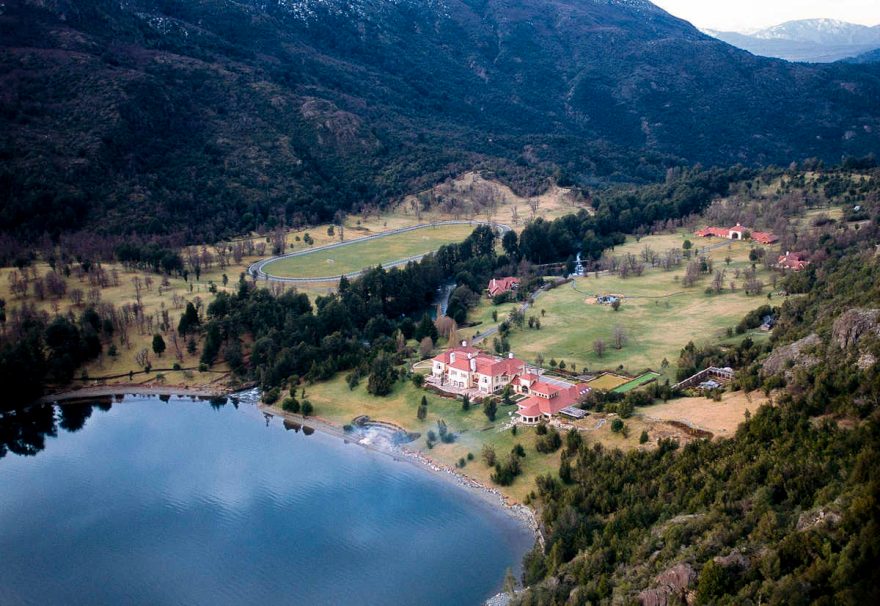
An aerial photograph Joe Lewis’ ranch on Hidden Lake, March 1, 2010 in southern Patagonia, Argentina. Francisco Bedeschi | dpa
Whether or not Lewis or his “right hand man” Van Ditmar were somehow involved in Irineo’s death and those of his wife and employee, there is no denying that their mysterious yet grisly endings cleared the way for Lewis’ purchase of Lago Escondido and the surrounding area. However, Lewis’ acquisition of this property, irrespective of the remaining Montero siblings’ willingness to sell, should never have been allowed for several reasons.
First, as per Argentine law, the sale of the property that Lewis has owned since 1996 is prohibited to a foreign citizen on national security grounds, given that the property is just 20 km from the Chilean border and thus, in foreign hands, could represent a grave national security risk. Second, it violates a local law dating back to 1969 that caps the maximum amount of land that any individual – Argentine citizen or foreigner – may own at around 70 hectares (~172 acres).
Third, it violates a provincial law passed in 1994 that created a protected natural area called the Río Azul Lago Escondido Natural Protected Area (ANPRALE), which included a significant portion of the land that Lewis would later buy from the Monteros. However, that law was amended in 1998, a few years after Lewis’ purchase, to remove the portion of his land that had previously been named a protected area under the control of the state. Federico Soria noted that the way in which the 1994 law was amended was blatantly unconstitutional.
One would think that the law would have prevented Lewis’ acquisition of the land long before Van Ditmar had first approached the Monteros about Lewis’ interest in the land. However, he was explicitly allowed to do so, despite the illegal nature of the purchase, owing to the general laxity of the local, regional and federal authorities towards wealthy foreigners looking to acquire Argentine land. As Lewis himself said in an interview with Gonzalo Sanchez in 2004, “I bought what they let me buy and here we are.”
The two-term presidency of Carlos Menem in the 1990s marked the reversal of more than 50 years of keeping and protecting areas of national importance and deemed strategic to natural security by permitting foreigners to buy a larger percentage of land than had been allowed since the passage of a 1944 law intended to preserve the territorial integrity of Argentina. Notably, when that law was created, the government of Edelmiro Farrell and Juan Perón expropriated several strategic properties owned by foreigners.
Yet, Menem’s presidency — which was thoroughly aligned with the “Washington consensus” — began, according to critics, violating the spirit of this 1944 law by issuing approvals of several million hectares to foreigners. Menem’s policies favoring foreign land purchases in rural areas have since been expanded by the presidency of Cristina Fernandez de Kirchner as well as that of the current president of Argentina, Mauricio Macri. Both of them have “friendly” relationships with Lewis and his associates, with the Macri a regular visitor of Lewis’ lakeside property in Patagonia.
Locals in El Bolsón have claimed that Lewis’ purchase of the Lago Escondido property – despite the legal obstacles – was the direct result of Menem’s policies. A member of El Bolsón’s community radio station FM Alas, who chose to remain anonymous owing to his father’s personal involvement in Lewis’ regional businesses, told MintPress that Lewis “had negotiated the purchase of the [Lago Escondido] property in meetings at the Casa Rosada [Pink House],” the Argentine equivalent of the White House, during Menem’s presidency.
MintPress was unable to confirm whether Lewis or his associates had visited the Casa Rosada while negotiating the property’s purchase. Yet Lewis has stated in interviews that “Menem sent us greetings and his best wishes when we opened [Lewis’ Lago Escondido mansion]” (Sanchez interview, pg. 61). Furthermore, Lewis has a notable habit of building close relationships with powerful Argentine politicians, including Macri. Macri has called Lewis “a friend,” defended him repeatedly, and even personally vacationed at Lewis’ Lago Escondido property.
The battle for Lago Escondido
Ever since his arrival to the area caused concern among some locals, Lewis has sought to win the good graces of the people of El Bolsón by acting as their benefactor — donating hospitals, building soccer fields and hosting annual activities and sporting competitions for locals at his property. This altruism is either embraced or rejected by locals, depending on whom you talk to. In keeping with the image that he has sought to cultivate among the townspeople, Lewis is often referred to as “Uncle Joe,” though it is spoken with either respect and admiration or derision and disgust.
Felicitas Libano, a member of the Assembly for the Defense of Water and Land (ADAT), told MintPress that Lewis has “integrated himself into nearly all the function of the city,” including its firefighters, police and other areas of the municipal government, and has “always tried to position himself as a benefactor.” According to Guido Augello, a member of local community radio station FM Alas, the townspeople are divided somewhat evenly into “people that like ‘Uncle Joe,’ people who hate him and people who don’t care.”
Lewis has also won over a portion of the townspeople and local businessmen through his patronage of select local services and his occasional hosting of small groups of locals for invitation-only sporting events and holiday celebrations. However, some have contended that Lewis receives many foreign guests, particularly from Israel.
According to the research of former French intelligence officer turned journalist Thierry Meyssan, Lewis has been inviting thousands of Israel Defense Forces (IDF) soldiers to his territory annually. In late 2017, Meyssan alleged:
Since the Falklands War, the Israeli army has been organizing ‘holiday camps’ in Patagonia for its soldiers. Between 8,000 and 10,000 of them now come every year to spend two weeks on Joe Lewis’ land.”
It is unclear if Meyssan’s information was the result of his time in France’s exterior intelligence service DGSE or independent research he conducted since becoming a journalist, as MintPress’ efforts to contact Meyssan were unsuccessful. Locals, journalists and researchers interviewed by MintPress could not confirm Meyssan’s claims. Yet, many of these locals and researchers said they had heard of those claims from other sources within Argentina, but also noted that they were speculative, given that no one but Lewis or his employees knows who visits the property beyond the aforementioned events where select locals are invited to attend.
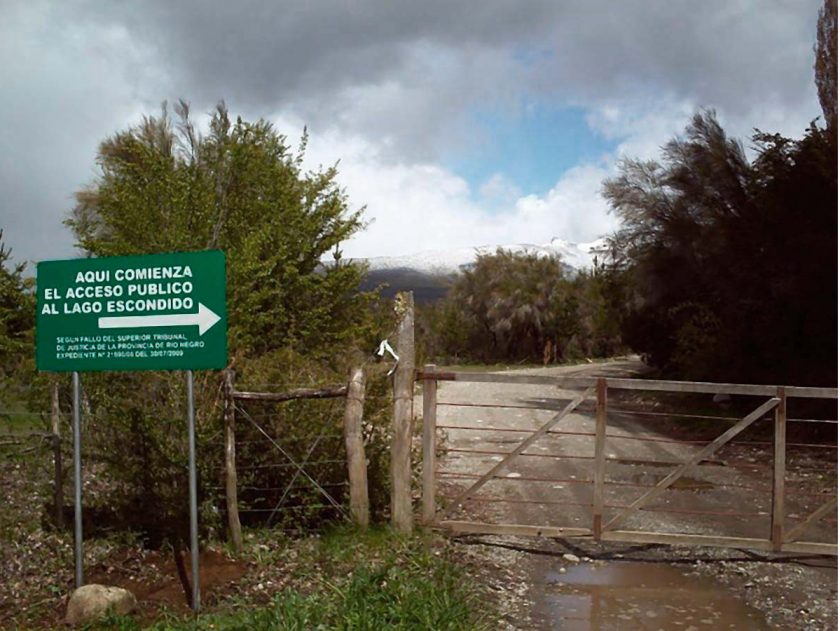
Tacuifi road leading to Lago Escondido, now blocked to public access, lies off of Argentina’s Route 40. The sign notes the 2009 Supreme Court ruling demanding the still-closed road be opened to the public. Photo | Revista Anfibia
Beyond the alleged IDF “vacations” on Lewis’ land, his presence in the area has been controversial for other reasons, namely for concerns that he sought to usurp key regional resources. Indeed, journalist Gonzalo Sanchez noted in his 2004 book Patagonia Sold: The New Owners of the Land :
In El Bolsón, there are more than a few locals and city council members that believe that, behind his [Lewis’] generosity, there are other hidden objectives, like the possible control of the water reserves of this part of Patagonia (pg. 50).”
Inklings of the truth in relation to these concerns were evident as soon as Lewis acquired the property surrounding Lago Escondido. This large mountain lake, which Lewis’ property surrounds, is the water basin for two important regional rivers, the Manso and Puelo, which later unite in Chile and drain into the Pacific. It is also the lake which feeds other nearby lakes including the Soberanía Lakes and Montes Lake, among others. Lago Escondido itself is estimated to contain as many as 400 billion liters (~105 billion gallons) of freshwater.
In Argentina, as is also the case in neighboring Chile, water – whether in lakes, rivers or seas – is a public right and public access to all bodies of water is guaranteed by law. This legal concept — likely foreign to Lewis and other Westerners, whose home countries often enshrine private property rights over the public’s right to vital resources — has been the most visible way in which tensions between Lewis and locals have manifested. It was also the first real test of Lewis’ resolve to carve out his “independent state” in Patagonia and keep locals out.
Lewis closed off the public road from the highway to the lake and also closed the private road he built at a separate point from public access. According to several locals interviewed by MintPress who had tried to enter the area, private security in civilian clothing prevent people from using the roads either by vehicle or on foot. Federico Soria, who has himself tried to enter the area on several occasions, described the guards to MintPress as “intimidating” and “aggressive” and also said that the Montero family, the old owners of the land, block one of the roads before it enters Lewis’ property and are “heavily armed.”
The only remaining path is a steep – and in places, dangerous – mountain path that takes at least two days in each direction to traverse. The path is poorly marked and maintained and is only usable in summer, as it is blocked by snowfall in other seasons. Every person interviewed by MintPress who had seen or traversed the path described it as being suitable only for “experienced mountaineers.”
In 2009, Lewis suffered his first major defeat in his efforts to keep locals out of his “parallel state” when the regional court ruled that the Tacuifi road — which connects the lake to the main highway, Route 40, and crosses Lewis’ property — be opened. The ruling stated that this must be done in order to “ensure access to Lago Escondido with appropriate signaling and ensuring transability.” The court gave Lewis 120 days to comply.
However, he didn’t comply and instead his regional associates began openly threatening any who tried to visit “his” lake. The clearest threat came from Van Dittmar himself in 2011, when he publicly stated that he and other Hidden Lake S.A. employees would defend Lewis’ private property by “fighting with blood, if we have to.” Van Ditmar also said that he would keep locals from accessing the lake “with a Winchester [rifle] in hand, with blood if necessary.”
In 2012, the region’s Supreme Court upheld the 2009 ruling, as did Argentina’s national Supreme Court a year later. However, Lewis and Van Ditmar refused to open the Tacuifi road, Van Ditmar saying that the treacherous but “very pretty” mountain path should instead be used to access the lake. Argentine President Macri also stepped in and echoed Van Ditmar, stating that the lake is even more accessible than before Lewis bought the property.
The court battle continues to today, after the Supreme Court of Río Negro in 2016 withdrew its previous ruling and ordered that a new hearing with different judges issue a new ruling. Critics accused Lewis of using extreme “political pressure” at the regional and local level in order achieve this very surprising ruling.
Despite that, locals continue to fight for public access to Lago Escondido and defend Argentina’s sovereignty over Lewis’ private empire. The main manifestation of this effort is an annual “March for Sovereignty,” the most recent of which took place in early February of this year. The march is organized by the Foundation for the Cultural Integration and Promotion of Water (FIPCA), which is run by former Argentine marine Julio Cesár Urien. Like the prior marches of the same name, its participants walked for nearly three days on foot over the mountain trail to arrive on the shore of the lake, which – as mentioned above – they were within their legal rights to do.
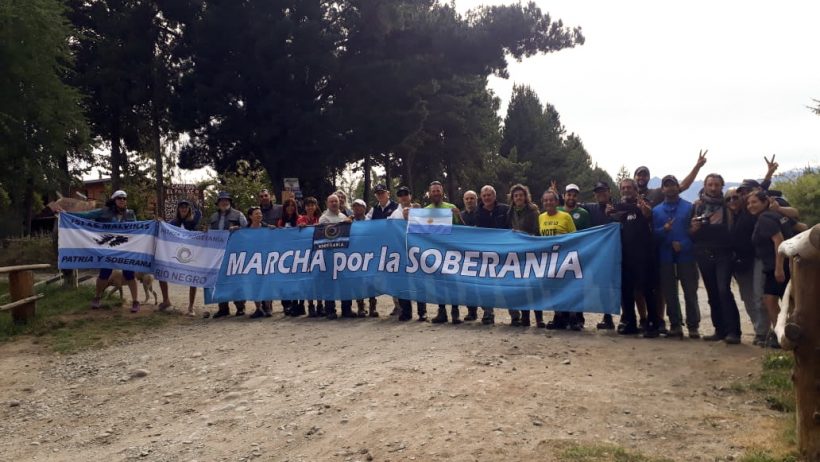
Participants in the 2019 “March for Sovereignty” pose for a picture at the beginning of their several-day journey to reach Lago Escondido by foot. Photo | FIPCA PRENSA
Upon arriving, they were met by Lewis’ private security as well as members of the Río Negro police, who cornered them and told them that they couldn’t even go to the bathroom without fear of arrest for trespassing, even though lakeshores are also legally considered public spaces. Guillermo Martín Caviasc — a journalist for Barricada TV, who was present at the demonstration — called the combination of local police and private security Lewis’ “private army” and remarked that the police officers present were “in a situation of subordination like if they were visiting a foreign state controlled by Lewis.”
Two participants in the march, Andrea Gatabria and David Ramallo, mounted inflatable kayaks with the intention of placing an Argentine flag in a small island in the middle of the lake, itself technically a public space. Before they made it to the island, two speedboats belonging to Hidden Lake S.A. circled the kayaks in an effort to capsize them while taunting them, asking “Do you know what it’s like to die from hypothermia?”
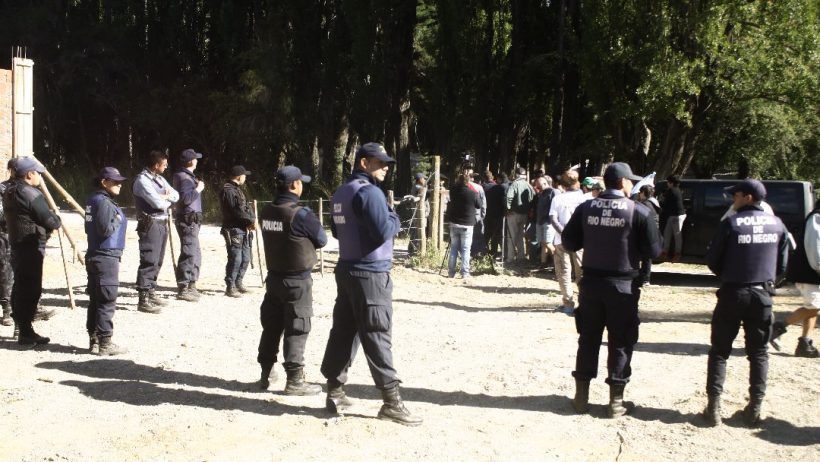
Participants in the 2019 “March for Sovereignty” pose for a picture at the beginning of their several-day journey to reach Lago Escondido by foot. Photo | FIPCA PRENSA
After half an hour of taunts that seemed more like death threats, Lewis’ private security knocked over the kayaks, leaving Gatabria and Ramallo floating in the freezing water. After several minutes, several witnesses stated that one of the security guards told the two kayakers “Well, now do you see what it’s like to die of hypothermia?” Gatabria and Ramallo were, after some time, lifted into the guard boats, but had spent so much time in the frigid water that both had to be hospitalized.
National Senator for Río Negro, Magdalena Odarda, demanded accountability for the actions of Lewis’ private security and local police and FIPCA has begun legal action against Hidden Lake S.A. for threatening the lives of march participants. Neither Hidden Lake S.A. nor Lewis’ Tavistock Group, which oversees his business interests in Argentina and elsewhere, responded to MintPress inquiries regarding the incidents against march participants.
While Argentines have routinely experienced intimidation and aggression when attempting to access the lake, some foreigners have had very different experiences. Take, for instance, Scott Leahy*, an American now living in Chile, who, during a past trip to El Bolsón, was able to waltz right through onto Lewis’ Lago Escondido property when he was in the company of two ex-IDF soldiers who had been there before.
Leahy told MintPress that when he was backpacking through Argentine Patagonia in 2010 with a Chilean friend, he had met and become friends with two young Israelis who had recently finished their service in the IDF and were staying at the same youth hostel. One day, these two Israelis offered to take Leahy and his friend to what they called a “secret beach” nearby.
They all piled into a car and, upon taking a gravel road off of Route 40, arrived at a gate that Leahy confirmed to MintPress was the Tacuifi road entrance to Lewis’ Lago Escondido property (seen in an image earlier in this report). Leahy was unsure about continuing, given that the gate was closed and, as a foreigner, he was unfamiliar with the area. However, the Israelis urged him on, saying that they had been there before and knew where they were going.
When the group of backpackers encountered Hidden Lake S.A. employees and guards, the Israelis explained that they were from Israel and wanted to bring their friends to the beach. The Lago Escondido employees told the pair that the group was not officially allowed to enter the property, but they could pass. Leahy didn’t think anything of it at the time, and told MintPress that he had assumed the pair knew the owner, though the Israelis never mentioned Lewis at all and they showed no interest in meeting with him either. This suggests that they were not personal friends of Lewis, but also shows that they knew that they could access the lake without problem, even in the absence of a formal invitation.
While this anecdote suggests that the claims of Lewis hosting thousands of IDF soldiers annually may indeed have something to them, it also serves as a very troubling comparison to the way Argentines have been treated when trying to access the very same lake. Indeed, if foreigners, Israelis in this case, were amicably waved through despite no invitation from Lewis or Hidden Lake S.A., why are Argentines who try to do the same met with such violence and aggression, particularly when they have a legal right to do so?
Stealing El Bolsón’s resources for his own use
Though public access to Lago Escondido has been a major issue of contention between Lewis and the people of El Bolsón since the late 1990s, concerns that the British billionaire was intent on controlling the region’s water supply multiplied when firms connected to Lewis began to move forward with what is often referred to as simply the “Laderas project.”
As early as 2004, a man named Cipriano Soria started telling his neighbors that he had “sold” his land in an area known as Pampa de Ludden (Ludden’s Plain) to Lewis. However, Soria did not technically own the land, which was a publicly-owned nature reserve, but was granted an easement by the provincial government of Río Negro to use its meadows to graze his livestock as long as he paid a “grazing license.” Despite the fact that it was neither legally nor properly sold to Lewis, Lewis began to make plans for the land — plans that ignored the fact that the area was and technically remains under several legal protections due to its ecological and strategic importance to the region.
Lewis intended to use this land to build a private airport in the area but was met by strong local resistance in 2005, including from the local group Assembly for the Defense of Water and Land (ADAT). Several members of ADAT live in Mallín Ahogado next to Pampa de Ludden, which provides the adjacent farming community of 2,000 with nearly all of its water. Felicitas Libano, who lives in Mallín Ahogado, told MintPress that the importance of this area as a critical water resource — as well as its ecological importance as an old-growth native forest — led it to be named a nature reserve that was supposed to be prevented from falling into private hands.
ADAT’s eforts were successful and Lewis’ plan for the area seemed to have been defeated or, at least, put on hold. Then, in 2009, the town voted on Lewis’ private airport, with more than 79 percent of voters opposing it. However, unluckily for the people of El Bolsón, Lewis had much bigger plans than just an airport and he wasn’t planning on letting local democracy get in his way.
From 2006 to 2009, legal arrangements were made between the ski center’s owner, the Club Andino Piltriquitrón, and the provincial government that opened up the local ski center at the Perito Moreno mountain to “third party” management.
Then, in 2009, Mirta Soria, Cipriano’s daughter, “inherited” the land from her father — land that he technically did not own yet was somehow granted permission to purchase from the state, along with another protected territory between Pampa de Ludden and the ski center, even though the state was forbidden from doing so by regional and local laws. Just six months after she bought this territory and sold more than half of it to Van Ditmar’s brother-in-law Samy Mazza. This new and very large area under Van Ditmar/Lewis control is where El Bolsón’s, in addition Mallin Ahogado’s, water reserves are located.
Soon after the land purchase occurred, two businesses appeared — Laderas of Perito Moreno Association S.A. and Laderas of Parallel 42, both of which are directly connected to Lewis and were given ownership of the lands in Pampa de Ludden and the other area recently purchased by Van Ditmar’s relative. That same year, both of these linked businesses proposed a “lottery” whereby the provincial government would select a private company to manage the local ski center. Laderas of Parallel 42 won the lottery.
Subsequently, the other Laderas company, Laderas of Perito Moreno, began plans to transform the land illegally acquired by Van Ditmar’s brother-in-law, Samy Mazza, as well as the portion still owned by Mirta Soria into a luxury subdivision of more than 1,000 luxury homes for wealthy Argentines and foreigners, along with a golf course, shopping centers, an artificial lake, and a private airport. This planned venture was subsequently promoted by pro-Lewis businessmen and media outlets as necessary for the successful development and improvement of the ski center.
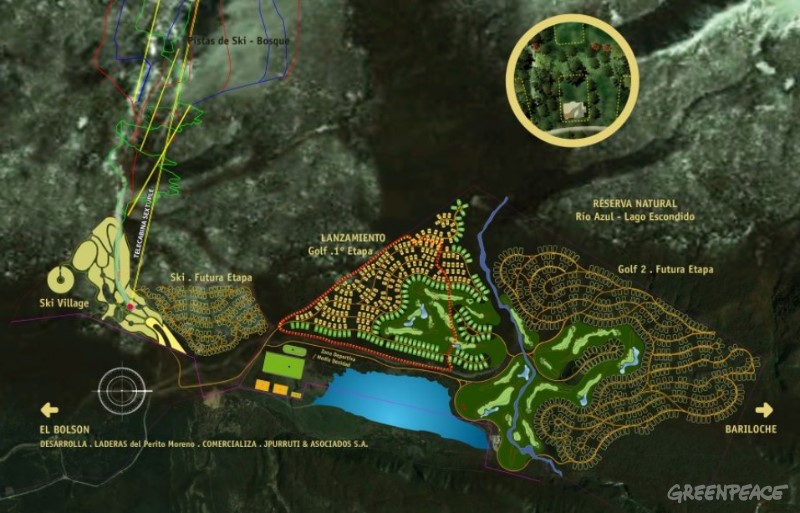
Proposed plan for the Laderas project, a 1,000-home luxury subdivision complete with an artificial lake and a golf course. Lewis’ firm plans to place the private airport (not shown in this image) south of the lake. The project, located right in the center of a nature reserve, is connected to Lewis’ Lago Escondido property and sits atop El Bolsón’s water reserves.
With the court battle underway and the project still lacking approval from El Bolsón’s city council, the regional governor, Alberto Weretilneck – a well-known Lewis ally – teamed up with Lewis-associated local businessmen in an effort to strongly pressure El Bolsón’s mayor at the time, Ricardo García, to sign a pledge that, once legal issues were resolved, the project would be fast-tracked for approval. García refused and Weretilneck along with other Lewis associates in the area began to push for his resignation. However, local protests kept García in power and, before leaving his post as mayor, García issued a decree that temporarily prohibited the Laderas project from advancing.
Clearly unhappy with this turn of events, the Laderas firms challenged the suspension of the project in court. Around this same time, members of local groups that had opposed the Laderas project reported several incidents of violence and intimidating acts, including threatening phone calls, their cars being set on fire, and the burning of a radio station as well as a community center in Mallín Ahogado.
In the case of architect and local politician Luis Martin, he was threatened with “lynching” by two Lewis associates – local businessmen Juan Carlos Martínez and Fabián Tornero – and his home was later broken into by armed thugs, one of whom accidentally cut himself with his machete and later fled the scene. Before escaping, the man had told Martin, “They have you targeted, they are going to kill you.”
In a 2011 article in Tiempo Argentina, Martínez referred to Lewis as “my friend” and was noted as a regular participant in meetings with Van Ditmar. The same article goes on to note that, in those meetings with Van Ditmar, Tornero is “influential” and further notes that Tornero is a known associate of Lewis.
In 2015, after García’s decree was challenged in court by Lewis’ firms, a judge ruled that the decree was legal but had not been written properly and therefore cancelled it. Soon after, a new pro-Lewis mayor and city council took charge and quickly signed a legal agreement with the Laderas companies, allowing them to build a “smaller project,” while claiming that any attempt to block the project – as García had done – could lead to another costly, lengthy legal battle that the municipal government just couldn’t afford. However, as Guido Augello told MintPress, this was hardly accurate, given that the local government could have appealed the decision regarding the decree, suggesting that this was just a convenient excuse to fast-track the project.
A few months after signing this agreement with the Laderas firms, the city council held a public hearing at which the vast majority of attendees from the community overwhelmingly rejected and criticized the project. Not getting the response it had hoped for, the council held a “secret” extraordinary meeting — secret because they declined to give the public the required notice needed to register to attend and participate in the meeting. With no one having registered, Pogliano decided to keep the meeting “closed” and placed police officers at the entrances to keep the townspeople out by force. The council subsequently decided to approve the Laderas project. Angry locals moved to occupy local government buildings in response, where they were targeted by riot police with tear gas.
The move generated several large-scale protests in El Bolsón, which started in 2016 and continued into 2017. Local resistance to the actions taken by the city council and mayor in relation to the Laderas project included a citizen occupation of the main plaza for three months, which was subject to police intimidation and violence, as well as three major protests, including the largest in El Bolsón’s history. That march against the Laderas project attracted an estimated 10,000 to 15,000 participants — quite a feat considering that the town’s urban and rural population boasts little more than 25,000 total inhabitants.
The reason for this mass mobilization, according to Augello, was that “even many of the people that like Lewis or believe his ‘Uncle Joe’ image oppose the Laderas project” and its associated airport. It’s not hard to understand why, considering that electricity and water intended for the townspeople of El Bolsón could soon be diverted to the wealthy outsiders who buy homes in “Lewislandia,” a derogatory term used to describe the Laderas project by some locals.
Yet, not only does Lewis intend to privatize El Bolsón’s water reserves, he and those developing his Laderas project also plan to divert the tourism that keeps its economy alive by instead diverting traffic from the main highway (Route 40) into his newly planned “city,” according to Federico Soria, a member of the Union of Patagonian Assemblies who has extensively researched Lewis’ local businesses. In an extensive 2016 article on the Laderas project and other Lewis-linked ventures, Soria wrote:
It is the intention of the developers of Laderas to unite the complex to Route 40 through two paved roads that they plan to build north and south of El Bolsón…. The Laderas variant road would be an advantageous shortcut [around El Bolsón].… [This] would benefit Lewis but economically endanger the community of El Bolsón…”
Furthermore, in 2016, Lewis completed a hydroelectric plant on the Escondido River — in the name of another of his local firms, Patagonia Energía — which passes through his property and feeds into the lake of the same name. However, he was granted permission to do so only if he connected the plant to El Bolsón in order to help the town resolve its ongoing and highly problematic electricity shortages. Once the plant was connected to El Bolsón, Lewis would become the main electricity provider to El Bolsón, as its current, aging diesel generators would be shut down.
Yet, instead of following the planned route for the power line that would give power to El Bolsón, it was diverted to the planned zone for the Laderas project, where it has remained “stopped” for years, even though his license to use the river for electricity production expired in 2015 owing to his company’s failure to connect the plant to El Bolsón in the time allotted by the license. As in so many other cases, Lewis and his companies have suffered no repercussions and continue to use the river for private power production. This situation has led some locals to speculate that Lewis has no intention of ever providing hydroelectric power to El Bolsón and it is instead a resource being guarded especially for his planned Laderas villa.
In effect, Lewis and his local representatives are working the resources they have acquired — water, electricity and tourism traffic — away from the town of El Bolsón and to the new “luxury” town of Laderas they hope to build to its north, a town that is an extension of Lewis’ own “independent” state. If this project is allowed to be completed, the people of El Bolsón will face a new troubling reality of resource insecurity and see its economy falter, as a crucial stream of revenue is diverted to the personal pet project of a foreign and predatory billionaire.
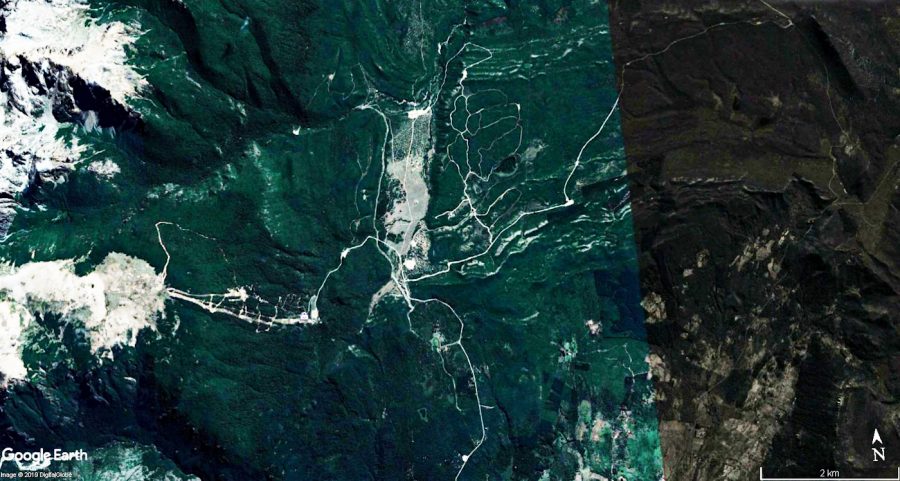
A satellite image taken last August shows land owned by the Laderas companies (center of photo) Roads for the planned “mini-city” are already being built, despite the fact that the companies are still not legally authorized to begin construction due to ongoing litigation. The already present ski center is seen on the left. Photo | Radio FM Alas, El Bolsón, Argentina via Google Earth
Yet, though Lewis won that particular battle in 2017, he is far from winning the war. Soon after the scandalous way in which the project was approved, the project again found itself challenged in court — placing it in legal limbo, unable to advance. Though the project is supposed to be blocked from moving forward until the conclusion of this latest legal battle, satellite images taken last August and shared with MintPress by local radio station FM Alas (shown above) reveal that Lewis’ businesses have already begun construction on the Laderas project, a clear indication that Lewis and his associates expect their impunity to continue.
Lewis’ Tavistock Group did not respond to MintPress inquiries about the Laderas project or the satellite images shown above.
The Joe Lewis “International Airport” — off-the-radar (literally)
Lewis’ “irregular” acquisition of Lago Escondido, the Laderas property, and his use of private security to block civilian access to the lake that is — by law — public property have long been decried as flagrant affronts to Argentina’s national sovereignty. Yet, while Lewis’ activities in and around Lago Escondido certainly do undermine existing Argentine laws, it is another Lewis-linked property in the Río Negro province that has done far more to erode Argentina’s national sovereignty.
Though Lewis’ plan to build an airport in Lago Escondido was technically approved but has not been able to move forward, Lewis – through his foreman Van Ditmar – purchased a sizeable property at the same latitude as Lago Escondido, but hours away on the Atlantic Coast. The property would soon become the site of Lewis’ private airport as well as a beachfront mansion. That airport, located south of Playas Doradas, was completed in February of 2008 and local media noted that its construction was “systemically hidden” from the public and was not subject to environmental impact assessments as normally required by law.
Most notably, however, there has never been any presence of Argentine customs or any other form of Argentine government control over what or who flies into or out of that airport, even though the airport is capable of receiving international flights. This point is particularly concerning in light of allegations that Lewis receives thousands of IDF soldiers annually on his property.
Joe Lewis’ private airport as seen on Google Maps
Furthermore, the Defense Ministry of Argentina has confirmed that not only is there no formal state control over what lands or takes off from this private airport, but that there are no radars in the area that even allow Argentine authorities to track nearby flight movements, including those of international flights. This means that no one but Lewis and his associates knows for sure how many flights land or take off from this area or where these flights originate or their intended destinations.
More shocking still, in 2010 then-Defense Minister Nilda Garré, in responding to a complaint from local politicians over the flagrant illegality of the airport, defended the airport’s presence by stating that it “could be used to facilitate rapid assistance of the state to locals in the event of disasters or emergencies.” To date, in the more than 10 years of its operation, it has never been used for any such purpose, according to those interviewed for this report.
The airport in Playas Doradas is roughly the same size as the airport in San Carlos de Bariloche (though some say it is larger), and is capable of receiving at least two large commercial-size passenger planes at a time. Much as with Lago Escondido, public access to the airport is denied, owing to the fact that the sprawling 15,000 hectare (~37,065 acres) property surrounding the airport is privately owned by a front company called Bahía Dorada S.A., which itself is legally owned by Lewis’ “foreman” Van Ditmar. However, the airport itself is owned by Westwind Aviation S.A. (formerly owned by Tavistock Aviation Argentina S.A., a subsidiary of Lewis’ Tavistock Group. Westwind Aviation S.A. is based at Lewis’ Lago Escondido property, as is Bahía Dorada S.A.. Neither Westwind Aviation S.A. nor the Tavistock Group responded to inquiries from MintPress regarding the lack of Argentine government oversight over the airport.
In order to realize the project, Van Ditmar – an Argentine citizen – had to be the owner of the property, as the area where the airport is built falls within a “National Security Zone” that prohibits land in that zone from being owned by foreigners on the basis of national security interests. In addition, the airport and the surrounding property, much like Lago Escondido, has a large and sophisticated private security presence.
The airport is estimated to have cost $20 million and Van Ditmar has publicly justified the airport’s existence by stating that Lewis not only “had the money” to build the complex but that it also made his ability to travel to his Lago Escondido property “easier.” This latter point is hard to believe given that the existing airport in San Carlos de Bariloche, which receives both private and commercial planes, is several hours closer to Lewis’ property than is his private airport in Playas Doradas. The notable difference between the two is that the private airport has no Argentine government oversight while the Bariloche airport does.
Few knew of the existence of the airport or the fact that access to the beach in that area had been effectively cut off by the Lewis/Van Ditmar project until a local woman, Elvira Linares, went on the television program “Documentos América,” hosted by Argentine journalist Facundo Pastor. On that program, Linares shared her experience of trying to pass through the now-private territory, noting that access to the ocean had been illegally blocked off. She also shared video footage she had taken of the massive, yet largely unknown to the public, private airport.
Mere hours after the program aired, Linares’ home was filled with bullet holes by still unknown assailants in what local media described as a blatant act of intimidation that led National Senator for Río Negro, Magdalena Odarda, to request that the government extend its protection to Linares, whose life was in danger. Efforts to contact Linares for comment for this report were unsuccessful.
Senator Odarda has arguably been the most well-known figure to demand accountability regarding the numerous irregularities surrounding the private airport. Odarda has, with limited success, repeatedly denounced the airport, on the basis of the fact that there is “no state control” over what or who passes through the airport.
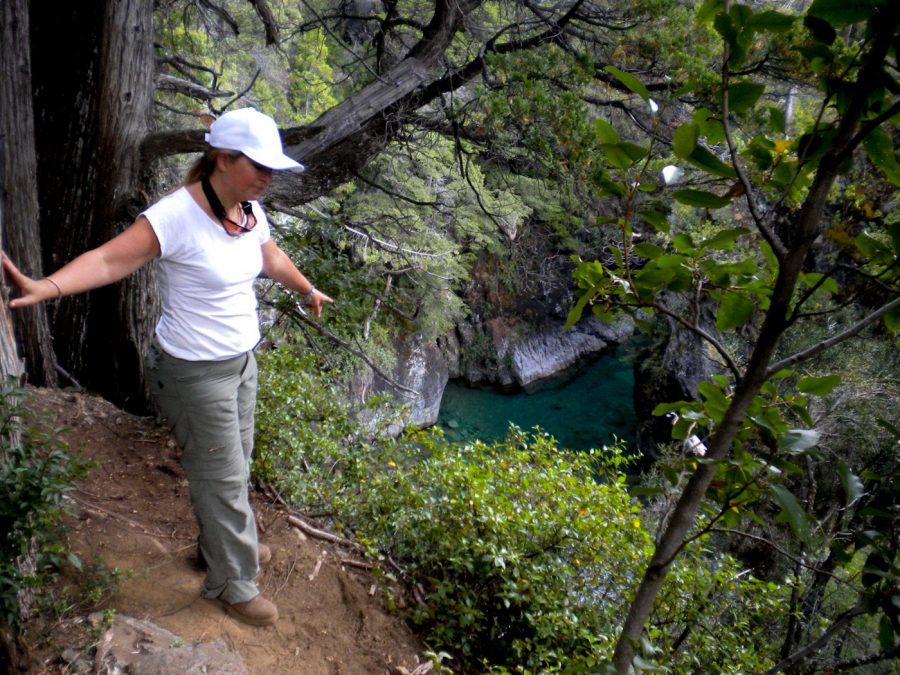
Senator Magdalena Odarda tours the publicly accessible road to Lago Escondido. Photo | Facebook
Odarda has also noted that the area where the airport is constructed is highly “strategic,” which poses a danger given that it is exclusively controlled by a foreigner, an Englishman. Odardo has pointed out that the airport is located on the important 42° parallel, which divides the regions of Río Negro and Chubut, and is only two hours away by plane from the disputed Falkland Islands, which are controlled by the United Kingdom but also claimed by Argentina. This dispute dates back to the 19th century and was the principal factor behind the Falklands War between Argentina and the U.K. in the 1980s, which many Argentines remember quite bitterly for the peace treaty Argentina signed after its defeat by England. Many Argentines have compared the document to the Treaty of Versailles that ended World War I.
Notably, there has been considerable evidence that Lewis’ airport has received planes from the Falkland Islands, which was the subject of a formal complaint made in 2010 to Argentina’s defense minister by then-governor of Argentina’s Tierra del Fuego province, Fabiana Ríos.
A well-oiled machine
Given the numerous laws that Lewis’ activities in Río Negro have broken at both the local and federal level, one would expect that somebody in the government – at least the local government – would hold him accountable. While some politicians like Magdalena Odarda and others have tried, the lack of impunity surrounding Lewis’ activities largely owes to his “friendships” with local and regional politicians as well as the country’s president.
One of the innumerable examples is Sergio Plunket. Plunket, who is in charge of Vial Rionegrina Sociedad del Estado (VIARSE), the regional body in charge of controlling public roads including the road leading to Lago Escondido, also works as a private “ecological consultant” for Lewis’ Hidden Lake S.A. Plunket also authorized the construction of Lewis’ Playas Doradas airport. Another clear example is Bruco Pogliano, El Bolsón’s current mayor, who is also Lewis’ long-time accountant in Argentina.
Another example that Gonzalo Sanchez noted (pp. 50-51) in his book, Patagonia Sold , is how Pablo Verani, ex-governor of Río Negro, started a long tradition of politicians making regular visits to Lago Escondido for Lewis-financed barbeque feasts, when he celebrated his win as the 1997 regional governor on the shores of the magnate’s privatized lake.
In addition to his undeniable influence among key local, regional and even national politicians, Lewis also enjoys considerable influence in the regional press and several former employees of his have become important figures in local and regional media. For example in 2016, according to local media, Dalila Pinacho, who long served as a lawyer and spokeswoman for Lewis’ Lago Escondido firm Hidden Lake S.A., became the director of the Nequén branch of Argentina’s National Radio, apparently through her “close” connections to local politicians.
Another journalist, Julio Álvarez — who described himself, to Gonzalo Sanchez in 2004 at an event in Lago Escondido, as Lewis’ “spokesman” — now works at a radio station in Viedma, Argentina, and was previously the El Bolsón correspondent for the regional newspaper Río Negro. Lewis also funds the local newspaper Ruta 40 and has stakes in other local newspapers such as El Cordillerano, Bolsón Web Patagonia, and El Ciudadano in Bariloche. Eliana Almonacid, who used to work for Ruta 40, told the national outlet Tiempo Argentina in 2014 that the Ruta 40’s director Nancy Aleuy, who also works for Hidden Lake S.A., told her that “Lewis had bought all the media outlets” in the region.
Lewis’ “Parallel State” is just the beginning
Lewis’ control over the local authorities and local press in Río Negro, and the complete impunity of his actions and those of his associates, have made it clear that in Argentina there is a de facto different legal system for oligarchs like Lewis and for the vast majority of Argentina’s citizens. This fact — in combination with the control Lewis and his associates exercise over the region’s key resources, including its water and energy production — has led to the creation of what some like Federico Soria have called a “parallel state” within Patagonia. However, this “parallel state” is, in reality, a microcosm of a much larger project currently underway that is aimed at the domination of the entirety of Argentine Patagonia by predatory oligarchical interests, the majority of which are directly connected to Lewis and his associates.
As will be explored in Part Two of this series, the Soros-led oligarch network, of which Lewis is a part in Argentina, has expanded its efforts to control Patagonia’s vast and strategic resources, including the region’s oil and gas wealth in addition to the domination of its freshwater resources and hydroelectricity production. Subsequent articles will then show that this effort is just the beginning, as this network and its close ties to the International Monetary Fund are being used to transfer ownership of vast state lands to their control in exchange for “debt relief.” The ultimate endgame appears to be the expansion of this “parallel state” — which Lewis has already helped to create in Río Negro and beyond, and which is controlled by small number of mostly foreign oligarchs — into a full-scale operation for extracting the region’s riches and exploiting its people.
Note: An sterisk (*) after a name indicates that a person’s real name was not used after they requested that MintPress not use their real name in this report.
Top Photo | This undated photo shows British billionaire, Joseph C. Lewis, at a Tottenham Hotspurs football game in the United Kingdom. Photo | Reuters
Whitney Webb is a MintPress News journalist based in Chile. She has contributed to several independent media outlets including Global Research, EcoWatch, the Ron Paul Institute and 21st Century Wire, among others. She has made several radio and television appearances and is the 2019 winner of the Serena Shim Award for Uncompromised Integrity in Journalism.
In Search of Their Roots: The Mapuche and Modern Society
By Aigul Safiullina | The Argentina Independent | April 29, 2013
Around five hours after leaving Bariloche our bus suddenly stops in the middle of nowhere. “Leleque. La comunidad,” the driver announces. “We’ve arrived muchacha”. Outside, fields stretch towards mountains and the eye struggles to fix on the horizon. There is nothing resembling a town or even village outside the bus, only a tiny improvised wooden gate and a sign on a huge white canvas that says: “Comunidad Santa Rosa. Territorio Mapuche recuperado” (Santa Rosa community, Recovered Mapuche territory).

A sign on the fence reads: ‘Santa Rosa community. Recovered Mapuche territory.’ (Photo: Fabio D’Errico)
Here, in a forgotten place, lost in the very heart of Patagonia, we have arrived at the point of a now globally-famous conflict: Santa Rosa de Leleque, where the indigenous Mapuche community is engaged in a long struggle to reclaim land they say is rightfully theirs from one of the world’s most recognisable clothing brands.
The Benetton Case
When we arrive, Santa Rosa de Leleque is bustling with people, as it has been for the last six years. Not only is this is the week of Kamaruko, the main religious festival of the Mapuches, but it is also the anniversary of the recovery of this stretch of land by the Curiñanco – Rúa Nahuelquir family and 30 other community members on 14th February, 2007.
“They’ve been evicting us from our land for many years, using physical power and law of those who had invaded our territories,” Rosa Rúa Nahuelquir leaves her kitchen utilities for a while as she talks. “But we know we are stronger, because the truth is on our side and we will stand for it, no matter what it costs us.”

Dancing and celebrating around the fire. (Photo: Fabio D’Errico)
Atilio Curiñanco y Rosa Rúa Nahuelquir first entered the territory now called Santa Rosa de Leleque in August 2002. They planned to return to their ancestral land and start a new life after long years of working in the factories of Texcom and Frigorífico in nearby Esquel. And so began a long legal struggle with the global corporation Benetton Group over 535 hectares of remote land in the province of Chubut, Argentina.
The Curiñanco – Rúa Nahuelquir family claims the territory as part of that which originally belonged to their ancestors before the colonisation of Patagonia in the 19th century. Benetton Group, meanwhile, insists on the land certificate issued in 1991, when the corporation purchased over 900,000 hectares from the British company The Argentine Southern Land Company Limited (CTSA).
Atilio Curiñanco recalls: “We presented a written statement at the police station of Esquel after consulting with the Autarkic Institute for Colonisation and Rural Development (IAC), which verbally confirmed that the space was public and abandoned for many years.” According to Curiñanco, many other campesinos from nearby territories used the space to gather wood it was all dusty and windy and required a lot of work to make the piece of land productive. However, only a few days after they had entered the territory, local police made inquiries about the “land usurpation” and soon returned with a legal claim by CTSA.
In October of that year, the Curiñanco – Rúa Nahuelquir family was forcefully evicted from Leleque, having all their belongings either confiscated or destroyed. In 2004, the family travelled to Italy to meet Luciano Benetton, who offered around 2,500 hectares of the land to all indigenous communities in the region as a donation. “We obviously refused the offer, as Benetton wasn’t eligible to donate something he didn’t own,” Rosa Nahuelquir says, indignantly.
Benetton later proposed a donation of the same amount of land to the Argentine government who could distribute it among indigenous communities. In 2005, the government of the province of Chubut also refused the offer, announcing that the 2,500 hectares were unproductive and saying it would not enter into any conflict with the inhabitants of the territory.
In February 2007, the couple came back to Leleque with 30 other community members and began to build a house. CTSA immediately accused them of damaging the territory, though the penal court found the claim illegitimate. In the five years since, the family has faced many more legal claims from CTSA with charges for property destruction and eviction orders, the latest coming in February this year. The family has repeatedly rejected these claims, based on their need to cultivate plants, raise domestic animals, and build basic living conditions to survive. “How could I let my family die from hunger because of someone else’s cruel decision?” Curiñanco asks rhetorically.

Mapuche vs Benetton. (Photo: Fabio D’Errico)
Mapuche in Argentine
The ‘Mapuche vs Benetton’ case has attracted a lot of attention from global and local human rights organisations, the media, political parties, fixing an unflattering spotlight on a range of problems – from land conflicts to racism and equality.
The Argentine state included indigenous rights in the Constitution only in 1994, when it recognised “the legal capacity of these communities to the possession and property of land that they have traditionally occupied.” Yet those who have tried to exercise this right face long legal battles against powerful foes. Benetton is just one in a long list of corporations and celebrities engaged in land conflicts with the Mapuches – others include Levi Strauss & Co, Grupo Loma Negra, Jane Fonda, Ted Turner, Emanuel Ginóbili, Marcelo Tinelli, Lopez Rey and many others.
In the 2013 annual report issued by The Observatory of Human Rights of Indigenous peoples (ODHPI), investigators say about 347 Mapuches are currently involved in lawsuits related to the land conflicts just in the province of Neuquen. “They [the government] make us feel as foreigners in this country, but at the same time they give out all lands to the foreigners!” claims Ruben Curricoy, a Mapuche activist from Bariloche. The ODHPI report, which focuses on Neuquen, Rio Negro and Chubut this year, adds: “Territorial dispossession continues to be the main obstacle for indigenous people to survive and develop in Patagonia as autonomous population.”
To understand the power and complexity of today’s land struggles in Patagonia, it is important to remember the history of Argentina and the treatment of indigenous people. You need go no further than Argentina’s $100-bill for a reminder of the infamous ‘desert campaign’ run by president Julio Argentino Roca in 1878 – 1885, which empowered Argentina as a leading agricultural country via the genocide of indigenous people who were evicted from their lands and killed. Back then, those families that invested in the campaign were handsomely rewarded, as one family descendant, who preferred not be named, recalls: “A beneficiary would be asked to look forward and take all the land that his eye was able to capture. And believe me, some people used to have a very good vision.”
Curricoy is quick to give other historic examples: “The government talks about 30,000 disappeared people during the dictatorship period. It’s not true. They only count disappeared huincas (a ‘white person’ in the Mapusungun language), while our people were dying in much higher numbers. I admire the fight of Madres de Plaza de Mayo, however, I can’t imagine an indigenous mother being heard by society. Only because she is not as white as a huinca.”

Indigenous people from all over Argentina marched to and in Buenos Aires to proclaim their heritage and be heard by the government during the Bicentennial celebrations (Photo: Beatrice Murch)
Even with recent advances, many in the Mapuche community still feel as though they are misunderstood. Curricoy remembers a visit to the Casa Rosada during the country’s bicentenary celebrations in 2010, when President Cristina Fernandez de Kirchner made a joke about the use of modern facilities after one of the delegate’s cell phone rang. “That was a turning point and made it clear that indigenous people were still excluded from this country really,” says Curricoy.
In another recent example, when three Mapuche communities in Neuquen were attacked by ten unidentified people, mainstream media barely covered the event.
The ODHPI report concludes: “the government bodies that are supposed to respond to the legal claims of indigenous people don’t perform their work” and in some cases even contradict the law. The report emphasises on the overall support that the government shows to private companies, speculating in such industries as exploitation of natural resources, tourism, and construction at the cost of indigenous people. In addition, the recent reforms to the Civil Code, proposed by the government, “will provoke more evictions and prosecutions for land usurpation” according to the ODHPI report.
Communitarian vs Private Property
With the provinces in desperate need of foreign investments and incomes, it is hard to imagine local governments supporting those who have no intention to exploit the land for commercial interests, like the Mapuche community, whose whole philosophy is built on protection of mapu, the land.

Atilio Curiñanco digs his land in Patagonia. (Photo: Fabio D’Errico)
Sharing is one of the fundamental values among the Mapuche – in the Mapusungun language there are no such words as ‘no’ and ‘property’ – and this further complicates the land conflicts involving Mapuch communities. “We don’t have land certificates, because the ones we need don’t exist,” explains Ruben Curricoy. “We were offered individual deeds, which imply higher taxes and a lot of restrictions. Moreover, individual forms of property go against our philosophy of a communitarian form of life.”
According to the Mapuches, a ‘communitarian property certificate’ would include all members of the community and prevent selling of the land. Every member in this type of property has the same rights and opportunities to use the land. As the leadership style among Mapuches is horizontal, no one would have special privileges in decision-making and distribution.
“However, it is sad to see so many villages that can’t grow territorially with the population growth, so our future generations basically don’t have land to live and work on. And how would they, when on the left you have one owner and on the right another one?” Curricoy shakes his head.
The Struggle for Identity
For Gustavo Macayo, former lawyer of the Curiñanco – Rúa Nahuelquir family, the Benetton case is especially important in creating awareness of the Mapuche struggle. “This case has placed the whole situation with the foreign land ownership into a very important point and opened so many profound questions of Argentine society, questions that had never been asked.” Moreover, according to Macayo, those historical, ethical and juridical questions had always been hidden and silenced before the legal studies around the case of Leleque came into light.
“The problem goes outside of the small territory of Leleque. It includes at least three provinces in the south, where the Mapuche population counts on big numbers and is becoming aware of their land rights,” adds Macayo.
Curiñanco hopes the notoriety of his family’s case has also helped some younger generations rediscover their ethnicity. While many in Buenos Aires would probably be surprised that the ‘People of the Earth’ use cell phones, drive cars, watch TV, speak Spanish among themselves, and do most activities considered ‘normal’ for Westerners, some differences between the cultures remain very obvious.
Emmanuel Maripi from Comodoro Rivadavia is 21 and has diverse roots that include European and indigenous ancestors. He discovered he was Mapuche when he turned 18, and since then has started learning deeper about the culture of his grandparents and practicing traditional customs. This year’s Kamaruko was his first one and, a musician, he learnt a few Mapuche’ songs to perform them at the festival. “I live my life in the city in the same way as any other person of my age,” Emmanuel shares during a break between performances. “I study, work, hang out with my friends, take part and organise events related to music. At the same time, I see that a big part of my identity belongs to Mapuche society, and now I always try to find some time to spend close to the nature and understand better who I am as a Mapuche.”
“However, we also see other examples, when our people give up or even criticise us,” Curiñanco says sadly. “Some of them even don’t consider themselves Mapuches and feel ashamed of their roots.

Atilio Curiñanco holds the mate as he discusses the plight of the Mapuche in Patagonia. (Photo: Fabio D’Errico)
“Many of them live in the cities where they are marginalised pretty quickly, and bring the fame to the whole ethnicity as criminalised and dangerous,” Curricoy joins the conversation and brings examples of big cities like Buenos Aires, Bariloche that count with a large number of Mapuche’ descendants.
Conversely, those that visit the Mapuche community in Leleque are always welcomed. “We’ve got visitors from all the parts of the world,” señora Rosa Rúa Nahuelquir recalls, “journalists, human rights defenders, artists, and a lot of policemen.” At this last word, she smiles ironically. “Our doors are open to everyone, regardless if the person is Mapuche or huinca and we never know if we can trust all these visitors. But we do anyway. We never learn from our mistakes…”
She is right. In eight days we spent in Santa Rosa de Leleque, each day was highlighted with an external visit. Every person was received warmly and invited to share meals, mate and conversations with the inhabitants.
Some visitors become lifelong friends, like Florencia Santucho, director of Argentina’s Independent Film Festival for Human Rights. Santucho has supported Curiñanco – Rúa Nahuelquir family since 2003. Nine years ago she produced a documentary called MariciWeu that narrates the story of the Curiñanco – Rúa Nahuelquir family and raises questions regarding their human rights’ violations. Not only she is perceived as a friend in this community, but also as one more Mapuche who continuously learns and incorporates parts of their culture in her own life.
“When you understand the Mapuche vision of the world you won’t have any more questions,” Santucho assures. “Recovering the land is a part of the ‘cosmovision’, which allows Mapuches to gain power in other aspects of their identity. Talking about Atilio Curiñanco, she shares: “He used to be a very timid person who never spoke a lot and didn´t seem confident at all. Now, I observe him as the person with a decent and firm position, and I am sure it comes thanks to his struggle for the land, for identity and connection with the Earth. Ñoque Mapu (Mother Earth) sees that and rewards with even more power.”
Where Civilisations Collide
“The powerful always have more rights, but we have different values that don’t fit into the western way of life,” Curiñanco looks at the Ruta 40 in only few metres from his house. “Some people consider us backward for our views and principles, but having another was of thinking doesn’t mean you shall destroy it with rules that go against our vision.”

The newest house under the stars. (Photo: Fabio D’Errico)
Leleque now symbolises a spot, where two civilizations clash with their fundamental differences. On the one side is the owner of a big corporation with a network of over 6,500 stores, a total income of 2 billion euro a year, and over 900,000 hectares of Patagonian lands. On the other side is the Mapuche community, which believes in a communitarian type of lifestyle and simple, self-sustaining living.
“In the last ten years we’ve observed how Benetton was trying to avoid this case and show it as something small and less important. And I believe they will keep with that strategy,” Macayo speaks about the future of the case. “The Mapuches will do all they can to bring more problems to the surface, starting with the essential one – colonisation.”
Meanwhile, the Curiñanco – Rúa Nahuelquir family deals with another criminal suit filed by CTSA, who have now targeted INAI, an institution that works with indigenous people, and provides the legal support to the Mapuche family. At the moment Supreme Court is in charge of it, which might take two or three more years due to the complexity of the issue.
“We will obviously continue the fight, as there is no way back,” Curiñanco firms his position. His eyes sparkle and his voice gets stronger. “This is our land and we are responsible for it. It has given so much to us that it would be a crime not to take care of it…”
As we talk, on the other side of the room little Rosita, a granddaughter in the Curiñanco – Rúa Nahuelquir family, is learning some basic Italian words from Fabio, an Italian photographer who arrived in Leleque with his personal project. She absorbs the new language rapidly, and soon they are speaking basic Italian and then switch to Spanish and even teaches some Mapusungun in terutnr. It’s a small scene that depicts a wider hope that dialogue is always possible between our civilisations, even though it requires a lot of will from both sides.
Featured Video

Theodore Postol: Iran’s Missiles & Drones Were Underestimated
or go to
Aletho News Archives – Video-Images
From the Archives
What is the Israeli Lobby in Australia Doing in Interfaith Dialogue?
By Ali Kazak | Dissident Voice | October 11, 2015
For years Israel and its lobby around the world have been trying to normalise their relations with Arabs and Muslims without solving the Palestine Question.
One of the methods they resorted to in the last few years is using human rights and community organizations such as interfaith dialogue and Multiculturalism to achieve this objective and to: isolate the Palestinians, marginalise the Palestine question, end Israel’s isolation, and prevent criticism of Israel, knowing that these organisations will be the first to stand against Israel’s violations, racial and religious discrimination.
The group responsible for this task in Australia is The Australia/Israel & Jewish Affairs Council (AIJAC); its Director of International & Community Affairs, Jeremy Jones is in charge of lobbying religious community organizations, specifically Muslims and Christians. Consequently he convened the Faith Communities for Reconciliation, founding participant in the Australian Partnership of Religious Organisations and the Australian National Dialogue of Christians, Muslims & Jews.
AIJAC is a private political propaganda group. It is recognised as the main Israeli lobby in Australia. It coordinates its activities and works intimately with the Israeli embassy in Canberra and different institutions in Israel. It is privately funded by some Jewish businessmen. It monitors closely Australian politicians, the media, ethnic and religious groups, (especially Arabs and Muslims), unions and academics on their stands towards Israel and the Palestine question. … continue
Blog Roll
 Aletho News
- The killing of three Indonesian soldiers in Lebanon should remind Jakarta that Israel does not want peace
- Defeated and delusional: Netanyahu’s remarks reveal $80bn war failure, says analyst
- Iran’s friends are about to make life much more difficult for Israel and the US
- The war of liberation of the Arab and Islamic peoples expands across the Gulf
- Envoy warns UN on Trump’s threat to ‘obliterate’ Iran’s civilian infrastructure
- The Larak Corridor: Iran’s Rial Gate With No US, No Israel, and No Way Around
- ‘Economic terrorism’: Steel facilities hit again in US-Israeli strike
- ‘War Crime’: Iran condemns attacks on Arak, Ardakan nuclear sites
- Two-thirds of Americans want quick end to Iran war even if goals unmet
- Trump to Give “Important Update on Iran” Wednesday in Prime-Time Speech
- If Americans Knew
- Gaza families reunite years after babies evacuated amid Israel’s war
- International Rescue Committee warns Gaza’s children face grave protection risks
- Iran’s Alleged 47-Year War on America: Debunking the 1,050 American Deaths Canard
- Israel wants US to bomb more of Iran’s civilian structures (113,000 is not enough) – Not a ceasefire Day 173
- Ann Coulter Rips Into Fox News for Iran War Coverage
- Joe Kent Urges Americans To Call White House and Congress To Object To Sending Troops Into Iran
- DNC Resolution to Reject AIPAC Funding Puts Democratic Leaders in the Hot Seat
- Swedish foundation to build 400 schools as over 650,000 Gaza children remain without education for 2 years
- Israeli army admits photshopping image of slain Lebanese journalist
- This is how Israel is systematically killing health workers under the cover of war in Lebanon
- No Tricks Zone
- New Study Finds Warming Saves Lives…Cold Temperatures 12 Times More Deadly Than Excess Heat
- German Science Blog Accuses PIK Climate Institute Of Hallucinating Climate Tipping Points
- Devastating Assessment Of Comirnaty Vaccine By Former Senior Pfizer Europe Toxicologist
- New Study: CO2 Is ‘Effectively Negligible’ As An Explanatory Climate Change Factor Since 2000
- Former Pfizer Toxicologist Dr. Helmut Sterz Tells Bundestag Hearing Pfizer Vaccine Should Have Never Been Approved
- Energy Expert: Germany’s Nuclear Phaseout Was A “500 Billion Euro Mistake”
- New Research: South Australia’s Mid-Holocene Sea Surface Temperatures Were 4°C Warmer Than Today
- Storing Green Energy To Last Germany 10 Days Would Require A 60-Million Tonne Battery
- New Studies: UK Sea Levels Were 4 Meters Higher Than Today During The Mid-Holocene
- Destructive Green New Deal: German Energy And Metal Group Warns Of Drastic Crisis
 Aletho News