The Importance of the Official 9/11 Myth
By Kevin Ryan | Dig Within | October 26, 2015
People sometimes wonder why is it important to investigate the alleged hijackers and others officially accused of committing the 9/11 crimes. After all, the accused 19 hijackers could not have accomplished most of what happened. The answer is that the official accounts are important because they are part of the crimes. Identifying and examining the people who created the official 9/11 myth helps to reveal the ones who were responsible overall.
The people who actually committed the crimes of September 11th didn’t intend to just hijack planes and take down the buildings—they intended to blame others. To accomplish that plan the real criminals needed to create a false account of what happened and undoubtedly that need was considered well in advance. In this light, the official reports can be seen to provide a link between the “blaming others” part of the crimes and the physical parts.
 Pushing the concept of “Islamic Terrorism” was the beginning of the effort to blame others, although the exact 9/11 plan might not have been worked out at the time. This concept was largely a conversion of the existing Soviet threat, which by 1989 was rapidly losing its ability to frighten the public, into something that would serve more current policy needs. Paul Bremer and Brian Jenkins were at the forefront of this conversion of the Soviet threat into the threat of Islamic terrorism. Both Bremer and Jenkins were also intimately connected to the events at the World Trade Center.
The concerted effort to propagandize about Al Qaeda and Osama bin Laden (OBL) seems to have begun in earnest in 1998. That’s when the African embassy bombings were attributed to OBL and the as-yet unreported group called Al Qaeda. The U.S. government responded with bombings of Sudan and Afghanistan and, with help from the New York Times, began to drum up an intense myth about the new enemy.
“This is, unfortunately, the war of the future,” Secretary of State Madeleine Albright said. “The Osama bin Laden organization has basically declared war on Americans and has made very clear that these are all Americans, anywhere.”
In retrospect, it is surprising that this was the first reference to Al Qaeda in the New York Times, coming only three years before 9/11. More surprising is that The Washington Post did not report on Al Qaeda until June 1999, and its reporting was highly speculative about the power behind this new threat.
“But for all its claims about a worldwide conspiracy to murder Americans, the government’s case is, at present, largely circumstantial. The indictment never explains how bin Laden runs al Qaeda or how he may have masterminded the embassy bombings.”
Despite this skepticism from The Post, the reports about Al Qaeda continued in an odd mixture of propaganda and doubt. For example, The Times reported on the trial of the men accused of the African embassy attacks in May 2001. That article contradicted itself saying that “prosecutors never introduced evidence directly showing that Mr. bin Laden ordered the embassy attacks” and yet that a “former advisor” to Bin Laden, one Ali Mohamed, claimed that Bin Laden “pointed to where a truck could go as a suicide bomber.” The fact that Mohamed had worked for the U.S. Army, the FBI, and the CIA was not mentioned.
Other facts were ignored as well. That OBL had worked with the CIA and that Al Qaeda was basically a creation of CIA programs like Operation Cyclone were realities that began to fade into the background. By the time 9/11 happened, those facts were apparently forgotten by a majority of U.S. leaders and media sources. Also overlooked were the histories of people like Frank Carlucci and Richard Armitage, who played major roles in Operation Cyclone and who remained powerful players at the time of the 9/11 attacks.
In the two years before 9/11, the alleged hijackers were very active within the United States. They traveled extensively and often seemed to be making an effort to be noticed. When they were not trying to be noticed, they engaged in distinctly non-Muslim behavior. Mohamed Atta’s actions were erratic, in ways that were similar to those of Lee Harvey Oswald, and Atta appeared to be protected by U.S. authorities.
Meanwhile, leading U.S. terrorism experts seemed to be facilitating Al Qaeda terrorism. Evidence suggests that U.S. intelligence agency leaders Louis Freeh and George Tenet facilitated and covered-up acts of terrorism in the years before 9/11. Both of their agencies, the CIA and FBI, later took extraordinary measures to hide evidence related to the 9/11 attacks. And both agencies have made a mockery of the trial of those officially accused of helping OBL and the alleged hijackers.
Counter-terrorism leader Richard Clarke inexplicably helped OBL stay out of trouble, protecting him on at least two occasions. Clarke blatantly failed to follow-up on known Al Qaeda cells operating within the United States. After 9/11, Clarke was among those who falsely pointed to Abu Zubaydah as a top leader of Al Qaeda. Zubaydah’s torture testimony was then used as the basis for the 9/11 Commission Report.
Former CIA operative Porter Goss created the first official account of what happened on 9/11, along with his mentor Bob Graham. This was the report of the Joint Congressional Inquiry, produced by the intelligence oversight committees of the U.S. Congress. It was greatly influenced by people who should have been prime suspects. For example, Richard Clarke was the one in charge of the secure video conference at the White House that failed miserably to connect leaders and respond to the attacks. In the Joint Inquiry’s report, Clarke was cited as an authoritative reference 46 times. CIA director George Tenet was cited 77 times, and Louis Freeh was cited 31 times.
Therefore it is imperative that the people who worked to create the background story behind OBL and the accused hijackers be investigated for their roles in the 9/11 crimes. This includes not only those who were figureheads behind the official reports, but more importantly the ones who provided the evidence and testimony upon which those reports were built. The alleged hijackers and their associates should also be of considerable interest to 9/11 investigators. That’s because what we know about them was provided by people who we can assume were connected to the crimes and what we don’t yet know about them can reveal more of the truth.
Featured Video
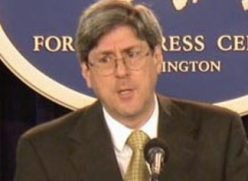
Pentagon insider says high US official Douglas Feith reported to Netanyahu
or go to
Aletho News Archives – Video-Images
Frlom the Archives
Who’s to blame for the Iraq war?
A not-so-trivial quiz
By Maidhc Ó Cathail | 14 March 2010
Maidhc Ó Cathail names and shames the top 19 politicians, academics and policy makers – all con men and all Zionist Jews – who lied and conspired to steer the US toward aggression against the Iraqi people. … continue
Blog Roll
 Aletho News
- Iranian model of warfare bleeds US dry while Persian Gulf states watch and learn: Analyst
- IRGC orders ‘defeated’ US to evacuate industrial facilities in region
- Hegseth’s call for ‘no mercy’ to Iranians deemed war crime
- Iran War Exposes Limits of US Military Power – Journalist
- Even The Neo-Cons Admit The Iran War Is Failing
- Inside the Caucasus Drone Corridor Fueling Tensions With Iran
- ‘Not our war’: Trump’s naval coalition to reopen Strait of Hormuz dead in the water
- Iran declares support centers for USS Gerald R. Ford legitimate targets
- Moscow issues warning over Trump’s Golden Dome plan
- Brussels wants ‘our sons to die for Ukraine’ – Orban
- If Americans Knew
- Israel and its supporters are causing attacks on Jewish institutions. Case in point: Michigan synagogue tragedy.
- These are the casualties and cost of the war in Iran 2 weeks into the conflict
- Chicago Teachers Union accuses AIPAC of swaying elections with ‘dark money’
- Predictions of another 9/11, amid Israel-US killing spree – Not a ceasefire Day 157
- As US-Israel war on Iran rages, Gaza faces massive dust storm – Not a ceasefire Day 156
- No let-up in attacks on Gaza as Israel takes on Iran, Lebanon – Not a ceasefire Day 155
- ‘Of Course’: IDF Drops Case Against Soldiers Accused of Raping Palestinian Prisoner
- Don’t Fall for the Regime Change Talk. Israel Is ‘Mowing the Lawn’ in Iran
- Will Israel and the US wreck the Gulf States along with Iran?
- US so far burned through ‘years’ of munitions in Iran war: Report
- No Tricks Zone
- Storing Green Energy To Last Germany 10 Days Would Require A 60-Million Tonne Battery
- New Studies: UK Sea Levels Were 4 Meters Higher Than Today During The Mid-Holocene
- Destructive Green New Deal: German Energy And Metal Group Warns Of Drastic Crisis
- New Study Documents A 20-Year Pause In Arctic Sea Ice Decline – Driven By Internal Variability
- Wake-up Call: Survey Shows Majority Of Germans Now Favor Postponing Climate Targets!
- Televised! Leading German Political Candidate Tells Schoolchildren CO2 Makes Sun Hotter!
- New Study: A Century Warming Of 1.1°C Is ‘Commonplace’ And ‘Not Unusual’ During This Interglacial
- New Study: ‘Internal Noise’ And Volcanic Forcing Can Trigger 10-15°C Warming Within Decades
- Glaciers Worldwide Are Suddendly Surging, Experts Blame Warming!
- Surprising Discovery: Sahara Is Greening…Billions Of Trees Where Once Thought To Be Barren
 Aletho News