Who To Believe About Venezuela’s Election? Firsthand Observation or PBS Newshour?
By Rick Sterling | Venezuelanalysis | January 5, 2021
In early December I traveled to Venezuela to be an election observer at their national assembly election. I was part of a group of eight persons from Canada and US organized by CodePink. There were about two hundred international observers in total, including the Latin American Council of Electoral Experts. I have previously been an official election observer in Honduras and was an unofficial observer at the 2015 Venezuela national assembly election.
Meeting Opposition Leaders
Before the election, our small group met eight leaders of the Democratic Alliance. This is the major opposition coalition. Pedro Jose Rojas of Accion Democratica said the US sanctions are not doing what is claimed; they are hurting average citizens. Bruno Gallo of Avanca Progressista said Venezuela needs negotiation not confrontation. Juan Carlos Alvarado of the Christian Democratic Party said Venezuelans have been “victims of politics” and that dialogue and flexibility are needed. Several leaders spoke about the importance of the national assembly and the road to change is through voting not violence. Several leaders expressed the wish for better relations with the US; another one said Venezuelan sovereignty needs to be respected. The common request was to end US sanctions and interference in Venezuelan politics.
We visited the factory where voting machines were assembled, tested and certified. The staff was openly proud of their work. In March this year, nearly all the pre-existing voting computers were destroyed in a massive fire at the main election warehouse. There were calls to delay the December election. But in six months, forty thousand new computers were ordered, built, assembled, tested and certified for the December election.
The Election Process
On election day, Sunday December 6, we visited many different elections sites. Typically, the election voting takes place at a school, with five or ten classrooms designated as “mesas”. Each voter goes to his or her designated classroom / “mesa”.
The voting process was quick and efficient, with bio-safety sanitation at each step. The first step is to show your identity card and prove your identity with fingerprint recognition. Step 2 was to make your voting choices at the touchscreen computer and receive a paper receipt. Step 3 is to verify the receipt matches your voting choice and deposit the receipt in a ballot box. The fourth and final step is to sign and put your fingerprint on the voting registry. The entire voting process took about 3 minutes.
At the end of the voting day, we observed the process of tabulating the votes. At each “mesa”, with observers from other parties present, the paper receipts were recorded one by one. At the end, the results were compared to the digital count. Voting results were then transmitted to the headquarters for overall tabulation.
Election results were announced by the Council for National Election (CNE) which manages the entire process. CNE leaders are not permitted to be members of any party and the CNE leadership was recently changed at the request of the opposition. In our discussion with leading opposition members, they complained about incumbent party advantages but acknowledged the election process is free, fair and honest.
PBS Newshour Special
With this firsthand experience, on December 29 I watched a PBS Newshour segment about the Venezuela election and overall situation. PBS reporter Marcia Biggs said, “Maduro’s party essentially ran unopposed in this month’s election.” As noted above, this is untrue.
In fact, there were 107 parties and over 14,000 individuals competing in the December 6 election for 277 national assembly seats. While 8 parties were in alliance with the governing United Socialist Party of Venezuela (PSUV), there were over 90 opposition parties. The strongest opposition coalition was the Democratic Alliance comprising 7 opposition parties. The Democratic Alliance won 1.1 million votes or 18% of the vote. The LEFT opposition to the PSUV, under the banner of the Communist Party of Venezuela, received 168 thousand votes.
Reporter Marcia Biggs claimed that “politics permeates everything in Venezuela and can determine whether you support Maduro and eat or go hungry.” This claim is based on a campaign statement by PSUV Vice President Diosdado Cabello encouraging people to vote. He jokingly said that women are in the forefront and can say to their family, “No vote, no food.” Video of him making the statement is here. This statement has been distorted out of all meaning and context.
The PBS story showed a fistfight in the national assembly, implying that it was the Venezuelan government. But, as reported in the “Juan Guaido surreal regime change reality show”, the fight was between competing factions of the Venezuelan opposition.
When they showed Juan Guaido climbing over a fence, that was a publicity stunt to distract from the important news that Luis Parra was elected Speaker of the national assembly one year ago. That was embarrassing because Guaido’s claim to be “interim president” was based on his being Speaker.
Election turnout was lower than usual at 31% but one needs to account for the election taking place despite covid19 with no mail-in voting. Also, millions of registered voters have had to leave the country due to economic hardship. Also, transportation is difficult due to gasoline scarcity. This was a national assembly election, equivalent to a US mid-term election, which gets lower turnout. Note that 95% of voting eligible Venezuelans are registered voters compared to just 67% in the USA. Thus a turnout of 50% registered voters in the US equates to 33% of eligible voters.
US Meddling in Venezuela
The star of the 7-minute PBS story is Roberto Patino, the Venezuelan director of a food distribution charity. The report neglects to mention that Patino is associated with a major US foreign policy institution. He is a Millennium Leadership fellow and “expert” at the neoliberal Atlantic Council where the “regime change” goals against Venezuela are clear. His food charity “Alimenta la Solidaridad” is allied with the “Rescue Venezuela” funded by the US with the apparent goal of undermining the Venezuelan government and promoting “interim president Juan Guaido”.
Roberto Patino says the Venezuelan government is “very paranoid and they see conspiracies all over.” Paranoia is a mental condition where there is fear of imaginary threats. But US threats and aggression against Venezuela are not imaginary; they are very real:
In 2002 the US supported the kidnapping and coup against the popular and elected President Hugo Chavez. The years have gone by but US hostility persists.
- In August 2018 there was a drone assassination attempt on the Venezuelan President.
- In January 2019 the US declared that it would not recognize the elected President Maduro and instead recognized Juan Guaido as “interim president”. His background is described in the article “The Making of Juan Guaido: How the US regime change laboratory created Venezuela’s coup leader”
- In February 2019 President Trump threatened military intervention against Venezuela.
- In March 2019, there was massive power blackout caused by sabotage of the electrical grid, with probable US involvement.
- In May 2020, two former US Special Forces soldiers and other mercenaries were arrested in a failed attempt to overthrow President Maduro.
- In June 2020, the US Navy warship Nitze began provocative “freedom of navigation” patrols along the Venezuelan coast.
- In August 2020, the US seized four ships carrying much needed gasoline to Venezuela.
- In September 2020, in a attempt to undermine the Venezuelan election, the US imposed sanctions on political leaders who planned to participate.
- The US 2021 stimulus bill includes $33 Million for “democracy programs for Venezuela”.
Based on the past twenty years, Venezuela’s government has good reason to be on guard against US threats, meddling and intervention. The PBS program ignores this history.
Another hero of the show is the exiled politician Leopoldo Lopez. He was imprisoned in 2014 for instigating street violence known as “guarimbas” which led to the deaths of 43 people.
Like Patino, Lopez is from the Venezuelan elite, studied in the US and has major public relations support in the US. Like Guaido, Leopoldo Lopez is more popular in Washington than his home country.
Will the US respect Venezuelan sovereignty?
If the PBS Newshour reporters had not been so biased, they would have interviewed members of the moderate opposition in Venezuela. Viewers could have heard Democratic Alliance leaders explain why they participated in the election, why they are critical of US economic sanctions and US interference in their domestic affairs. That would have been educational for viewers.
On January 5, the newly elected national assembly will commence in Venezuela. The fig leaf pretense of Juan Guaido as “interim president” of Venezuela will be removed because he is no longer in the national assembly. In fact, he was removed as speaker of the national assembly one year ago.
But viewers of the PBS special did not learn this. Instead, they received a biased report ignoring the moderate opposition and promoting a few US supported elites. The report ignores or denigrates the efforts of millions of Venezuelans who carried out and participated in an election which compares favorably with the election process in the US. You would never know it from PBS, and you might not believe it, unless you saw it with your own eyes.
Rick Sterling is an investigate journalist based in the SF Bay Area of California. He can be contacted at rsterling1@protonmail.com.
PBS Newshour Fails the Public
Biased and Misleading Analysis on Syria, Russia, Turkey
By Rick Sterling | Dissident Voice | December 4, 2015
PBS Newshour is considered high quality journalism by many North Americans. But is it? A test case is their report on November 24 when a Russian jet was shot down and one pilot killed as he descended in parachute.
This was a significant international event and the situation is still dangerous. The conflict in Syria could get even worse. PBS Newshour presented a discussion/analysis of the event with two guests: Nicholas Burns and Angela Stent. The PBS Newshour host was Judy Woodruff.
This critique applies to the PBS Newshour broadcast on November 24 but the essential points apply to the present. The assumptions and bias regarding the Syrian conflict are pervasive and persistent. How can US foreign policy change if the public is continually fed biased and false information?
Here are specific points:
PBS Newshour selected two analysts with essentially the same viewpoint – U.S. Government and military/security establishment
Nicholas Burns is a former U.S. Ambassador to NATO. In early 2003 he urged the “unity” of NATO as some NATO allies expressed doubts about the U.S. the invasion of Iraq. In 2006 he urged punishing sanctions on Iran. In 2011 Burns wrote, “President Obama was surely right to commit the United States, however reluctantly, to the NATO campaign [to overthrow Libyan President Gaddafi].” Burns has a track record supporting Western aggression against other countries. He evidently has learned nothing from the resulting chaos, devastation and death.
Angela Stent is associated with conservative think tanks. She is a former State Dept and National Intelligence Officer. She is also author of the 2015 book The Limits of Partnership: US-Russian Relations in the 21st Century. Written in non-academic prose, the book explores what she considers four efforts by the US to reset or start new relations with Russia following the Cold War. Unfortunately the bias of the author is apparent and inconvenient history is not mentioned. For example, the Project for a New American Century and aggressive U.S. foreign policy under its influence have been “disappeared”. It’s a biased history which ignores or white-washes examples of US collusion and support of violent coups- from Venezuela to Honduras to Ukraine and Libya.
The analysts make false or exaggerated claims.
- Burns says the Russians “did violate Turkish air space” but he offers no evidence, and it now appears the Russian jet was shot down over Syrian air space.
- Both Burns and Stent claim the Russians violated Turkish air space “several” times or “repeatedly”. Woodruff refers to them as “invasions”. Contrary to the allegations, the only confirmed Russian violation of Turkish air space was on September 3 in bad weather when they were beginning the campaign.
The analysts failed to include relevant information
For instance:
- Air space violations occur frequently and Turkey is a major perpetrator.
- The normal practice is to usher an intruding plane out of the air space not shoot it.
The program fails to consider Putin’s comments that the action was “a stab in the back, carried out by the accomplices of terrorists”
Why wasn’t this comment discussed? A Columbia University researcher lists proof of Turkish collaboration with ISIS here. Another lengthy list is here. American Lebanese journalist Serena Shim documented Turkey’s pivotal role in this video . She was killed the day after publicly expressing fear of the Turkish Intelligence Agency (MIT). Why did the guests not mention any of this?
The analysts also ignore Turkey’s economic support of ISIS
For example, the son of the Turkish President, Bilal Erdogan, has been implicated in purchasing ISIS oil from Syria, mixing it with Iraqi Kurdish oil and shipping it abroad. Bilal is co-owner of BMZ oil and chemicals shipping company which has been buying additional ships. Burns talks about the importance of “history and context” but he leaves out essential facts and history about the conflict.
The analysts distort facts to support their biases
Analyst Burns claims “The Russians have been bombing Syrian Turkmen, ethnic Turkmen villages” Evidence indicates the Russians are not bombing random villages; they are bombing specific terrorist groups in the area. We know that terrorists are in the area because they have been raining missiles into Latakia city, killing 23 students and civilians on November 10. We know the terrorists are there because they video recorded themselves. Other video shows the downing of the aircraft, the pilots descending, the “rebels” shooting at the parachutists, and then the captured dead Russian pilot. Article 42 of Geneva Convention says, ““No person parachuting from a plane in distress shall be made the object of attack during his descent.” Why should Russia and Syria be criticized for attacking these terrorists? It has since emerged that the most vocal “rebel” leader in the video is a Turkish citizen.
Analyst Burns conflates a sectarian extremist fringe with an entire religious branch.
When he refers to “Sunni” groups he actually means the Wahabi/Takfiri opposition such as Jabhat al Nusra, Ahrar al Sham, ISIS, etc. Most Sunni Muslims in the world oppose the bastardization of their religious faith by the fanatic Wahabi element. Characterizing the jihadis as being “Sunni groups” is comparable to identifying the Ku Klux Klan as representing the “Christian group”. It’s additionally false and misleading because the majority of Syrian Army soldiers are Sunni.
The analysts are hypocritical about air space violations.
Burns claims that Russia’s alleged 17 second violation of Turkish air space “is clearly illegal under international law”. Yet the analysts say nothing about the frequent and much longer violations of Syrian air space by American jets and bombers that have NOT been authorized by the Syrian government.
The analysts ignore the fact that Syria has been the victim of severe violations of international law for over four years
Turkey, USA, Saudi Arabia, Qatar, France and UK have been training plus supplying weapons, logistics and salaries to armed opposition groups trying to violently overthrow the Syrian government. As confirmed by the International Court at the Hague in their ruling filed by Nicaragua against the United States, this is in breach of international law.
The analysts convey the confusion and contradiction of Western policy toward Syria
Stent says, “We disagree with the Russians on the fate of Assad and we disagree on who the enemy is.” In short: Stent and Burns think the West should be able to dictate who can be President of Syria; they also think Russia should refrain from bombing any group except ISIS. They want Russia to refrain from bombing Nusra/Al Qaeda, Ahrar al Sham and other terrorist groups. It is a duplicitous strategy.
The Russian position is much more logical. They have been clear from the start: They are there to oppose sectarian terrorists threatening the Syrian people and state. ISIS is one of these groups but there are many others. What is common among them is sectarianism and reliance on outside funding. One group consists of Uighurs of Chinese nationality. They are part of the “Army of Conquest” that made a big advance in northern Syria in Spring 2015. The idea that these sectarian terrorist groups should be allowed to roam free is illogical if your goal is to overcome terrorism. There are tens of thousands of sectarian fighters who are not in ISIS. Some of these groups threaten major population areas including Latakia and government controlled Aleppo. Other groups control border zones which allow for inflow of more weapons and jihadis. It is logical that the Russian Air Force and Syrian Army would prioritize attacks on these groups near major population centers and controlling border zones.
Regarding the “fate of Assad”, the Russians believe the Syrian Presidency should be determined by Syrians not foreigners. They have indicated they would accept internationally supervised elections. That policy is in keeping with international law. The policy of the West trying to dictate who can or cannot be President of Syria is a violation of the UN charter and International Law.
Stent engages is amateur psychology instead of policy analysis.
She speculates that Russia is intervening in the Syrian conflict because “they want the U.S. to come to them, they want to be the leader … There is some reckless behavior obviously.” It’s a silly analysis that ignores serious issues such as the US policy of “regime change”, the historic links between Syria and Russian, and the credible belief that the attack on Syria is a step toward attacking Iran.
Analyst Burns concludes with call for war via “No Fly Zone”
He says:
If the Russians don’t restrain the Syrian government from firing barrel bombs into civilian neighborhoods the US ought to consider a No Flight (sic) Zone with Turkey and other countries to shut down the Syrian Air Force. That’s what Secretary Clinton has been advocating and I think she’s right…. The way to save civilians and reduce the number of refugees is to shut down air traffic in the northern part of Syria. That’s an idea that the administration has to consider now given these events.
Thus Ambassador Burns goes from criticizing Russia for a 17 second intrusion into Turkish air space to calling for the take-over of northern Syrian air space. It’s a call for more war masquerading as a call for peace.
We can see where his call would lead by looking at consequences of the “No Fly Zone” in Libya. It has resulted in vastly more conflict, deaths, displaced persons and refugees. Since the NATO driven “regime change” in Libya, terrorism has exploded into neighboring countries.
Does Burns really want to take the US into a potential war with Syria and Russia by trying to take over northern Syria? What is wrong with following international law and letting the Syrian people determine their leader?
With Russian air support the Syrian Army is advancing on nearly all fronts. Is that what Turkey and other enemies of Syria are concerned about?
Conclusion
The US has been invading or surreptitiously overthrowing governments around the globe for the past 65 years. The US aggression has usually ended badly, especially for the target country but also for the US economy and population.
Why do these wars keep happening? To some extent it is media failure to expose what’s going on and encourage serious debate.
The PBS Newshour program on November 24 is an example of why the US public is confused about Syria.
PBS Newshour could have presented one of the analysts, Burns or Stent. They could have presented another analyst who would give a different analysis and challenged the biased perspective. It could have been someone from Veteran Intelligence Professionals for Sanity like Ray McGovern or someone from Russia or someone from Syria like the Syrian Ambassador to the United Nations. Instead we had a propaganda presentation, biased and misleading.
PBS Newshour is failing the public.
If you agree, consider letting the Ombudsman know. His email and phone contact is at here
Rick Sterling is a retired engineer and co-founder of Syria Solidarity Movement. He can be emailed at: rsterling1@gmail.com.
The Illusion of Debate
By Jason Hirthler | CounterPunch | December 2, 2014
A recent article in FAIR reviewed the findings of its latest study on the quality of political “debate” being aired on the mainstream networks. It studied the run-up to the military interventions in both Iraq and Syria. Perhaps the arbiters of the study intended to illustrate what we’ve learned since the fraudulent Iraq War of 2003. Well, it appears we’ve learned nothing.
FAIR spent hours painfully absorbing the misinformation peddled by such soporific Sunday shows as CNN’s State of the Union, CBS’s Face the Nation, NBC’s Meet the Press, and ABC’s This Week, plus some of the more popular weekly political programming including ADHD-inducing CNN’s Situation Room, Fox News Channel’s Special Report, the venerable sedative PBS NewsHour, and MSNBC’s Hardball. You know the cast of characters: glib George Stephanopoulos, forthright Candy Crowly, harrowing Wolf Blitzer, and stentorian Chris Matthews. Images of their barking maws are seared into the national hippocampus.
Overall, 205 mostly government mouthpieces were invited to air their cleverly crafted talking points for public edification. Of them, a staggering sum of three voiced opposition to military action in Syria and Iraq. A mere 125 stated their support for aggressive action.
Confining its data to the Sunday shows, 89 guests were handsomely paid to educate our benighted couch-potato populace. One suggested not going to war. It stands to reason that considered legal arguments against these interventions got the short shrift, too.
The media consensus on Syria and Iraq isn’t an isolated instance of groupthink. Far from it. It conforms to a consistent pattern, one that has at its core a deliberate disregard for international law and efforts to strengthen transnational treaties and norms regarding military action. (Although transnational law regulating trade is highly favored, for obvious reasons.)
Here the New York Times uncritically repeats Israel casualty figures from the recent attack on Gaza. The journalist, Jodi Rudoren, gives equal legitimacy to sparsely defended claims from Tel Aviv and “painstakingly compiled research by the United Nations, and independent Palestinian human rights organizations in Gaza.” She adopts a baseless Israeli definition of “combatant”, ignoring broad international consensus that contradicts it. She dubiously conflates minors with adults, and under-reports the number of children killed. And so on. All in the service of the pro-Israel position of the paper.
In 2010 Israel assaulted an aid flotilla trying to relieve Palestinians under the Gaza blockade. Author and political analyst Anthony DiMaggio conducted Lexis Nexus searches that demonstrate how U.S. media and the NYT in particular scrupulously avoid the topic of international law when discussing Israeli actions. In one analysis of Times and Washington Post articles on Israel between May 31st and June 2nd, just five out of 48 articles referenced international law relating to either the flotilla raid or the blockade. DiMaggio dissects several of the methods by which Israel flaunts the United Nations Charter. He adds that Israel has violated more than 90 Security Council resolutions relating to its occupation. You don’t get this story in the American mainstream. But this is typical. U.S. media reflexively privileges the Israeli narrative over Arab points of view, and barely acknowledges the existence of dozens of United Nations resolutions condemning criminal actions by Israel.
It’s the same with Iran. For years now, Washington has been theatrically warning the world that Iran wants to build a bomb and menace the Middle East with it. That would be suicidal. It is common knowledge among American intelligence agencies, and any others that have been paying attention, that Iran’s foreign policy is deterrence. But this doesn’t stop the MSM from portraying Tehran as a hornet’s nest of frothing Islamists.
Kevin Young has done a telling survey of articles on nuclear negotiations between the U.S. and Iran. Some 40 editorials written by the Times and the Post were vetted. Precisely zero editorials acknowledged international legal implications of U.S. public threats and various subversions led by Israel, such as assassinating scientists and conducting cyber-attacks, both innovations on standard violations of sovereignty. However, 34 of the pieces “said or implied” that Iran was seeking a nuclear weapon. Forget that 16 American intelligence agencies stated that Iran had no active nuclear weapons program. These papers of record prefer to trade in innuendo and hearsay, despite assessments to the contrary. More than 80% of the articles supported the crippling U.S. sanctions that are justified by the supposed merit of the bomb-building claim.
Prior to Young’s work, Edward Hermann and David Peterson looked at 276 articles on Iran’s nuclear program between 2003 and 2009. The number itself is staggering, more so when stacked against the number of articles written over the same period about Israel’s nuclear program: a mighty three.
This is interesting considering the posture of both countries in relation to international treaties. Israel freely stockpiles nuclear weapons and maintains a “policy of deliberate ambiguity” about its nuclear weapons capacities, despite frequent efforts by Arab states to persuade it to declare its arsenal (which is estimated by some to be in the hundreds). Also, it has yet to sign the Treaty on the Nonproliferation of Nuclear Weapons (NPT) that has been signed by 190 nations worldwide. This intransigent stance has marooned the broadly embraced idea of working to establish a nuclear weapons free zone in the region.
Contrast Israel’s behavior with that of Iran itself, which has permitted extensive inspections of its nuclear facilities. The Times recently noted the country’s main nuclear facilities were “crawling with inspectors.” Iran is also a party to the NPT and is a full member of the IAEA. It continues to try to work toward a reasonable solution with the West despite debilitating sanctions levied on it by the United States. America has unduly pressured the IAEA to adopt additional protocols that would require prohibitively stringent demands on Iran, rendering the possibility of a negotiated solution comfortably remote from an American standpoint. (These additional demands reportedly include drone surveillance, tracking the origin and destination of every centrifuge produced anywhere in the country, and searches of the presidential palace. All of this passes without comment from our deeply objective journalist class.)
Coverage of Iraq is no different, particularly in advance of periodic illegal war of aggression against it. Former U.N. Special Rapporteur on Palestine Richard Falk and author Howard Friel conducted a survey in 2004 assessing the New York Times’ pre-war coverage of Iraq in 2003. In more than 70 articles on Iraq, the Times never mentioned “UN Charter” or “international law.” The study also found “No space was accorded to the broad array of international law and world-order arguments opposing the war.” But such arguments only exist outside of Western corridors of power in Washington, London, Paris, and Tel Aviv.
This isn’t debate. Real debate is pre-empted by internal bi-partisan consensus on some basic issues: maintain a giant garrison state, shrink the state everywhere else, preference corporations over populations, restrict civil liberties to secure status quo power structures. So when it comes to Iran, Iraq, Syria and the like, the question isn’t whether to go to war, but what kind of war to fight. Hawks want bombs. Doves want sanctions. Publicans want Marines. Dems want a proxy army of jihadis. They both want Academi mercenaries. (Obama hired out the gang formerly known as Blackwater to the CIA for a cool $250 million.) And when we’ve finished off ISIS, the question won’t be about an exit strategy, but whether to head west to Damascus or east to Tehran.
The question isn’t whether to cut aid to Israel given its serial criminality in Gaza and the West Bank, but how fast settlements can annex the Jordan Valley without attracting more international opprobrium. (International law, again, set aside.)
On the domestic front, the question isn’t whether to have single payer or private healthcare, but whether citizens should be forced to purchase private schemes or simply admonished to do so. The question isn’t whether or not to keep or strengthen New Deal entitlements, but how swiftly they can be eviscerated. The question isn’t whether or not to surveil the body politic, but where to store the data, and whether or not to harvest two-hop or three-hop metadata. The question isn’t whether or not to hold authors of torture programs accountable, but how much of the damning torture report to redact so as to leave them unprosecutable. The question isn’t whether or not to regulate Wall Street but, as slimy oil industry lawyer Bennett Holiday put it in Syriana, to create “the illusion of due diligence.”
All this is not to say the MSM isn’t aware of alternative viewpoints. It is, but it only acknowledges them when they can be used to justify a foregone conclusion. In the past year, the MSM has nearly become infatuated with international law. Friel has tracked the paper of record’s response to the Ukrainian fiasco. What did he find? When Russia annexed Crimea, the Times inveighed against the bloodless “invasion” as a gross violation of international law. Eight different editorials over the next few months hyperventilated about global security, castigating Russian President Vladimir Putin for his “illegal” violation and his “contempt for,” “flouting,” “blatant transgression,” and “breach” of international law. Calls were sounded to “protect” against such cynical disregard of global consensus. Western allies needed to busy themselves “reasserting international law” and exacting heavy penalties on Russia for “riding roughshod” over such sacred precepts as “Ukrainian sovereignty.”
Quite so, as Washington supports the toppling of democratically elected governments in Kiev and Tegucigalpa, sends drones to ride “roughshod” over Yemeni, Pakistani, Somali and other poorly defended borders; and deploys thousands of troops, advisors, and American-armed jihadis to patrol the sectarian abattoirs of Syria, Iraq and Afghanistan. But better to exonerate ourselves on those counts and chalk it up to the fog of war. After all, we follow the law of exceptionalism, clearly defined by Richard Falk as, “Accountability for the weak and vulnerable, discretion for the strong and mighty.”
Jason Hirthler is a veteran of the communications industry. He lives in New York City and can be reached at jasonhirthler@gmail.com.
On Thatcher, What’s the Difference Between PBS & Fox News?
By Peter Hart | FAIR | April 9, 2013
Former British Prime Minister Margaret Thatcher’s death yesterday brought waves of mostly flattering coverage of the divisive right-wing leader. It was striking to see the parallels between the way Thatcher was covered on the PBS NewsHour and Fox News Channel‘s most popular show, the O’Reilly Factor. Though some people like to think that PBS and Fox couldn’t be further apart, they were basically singing the same tune.
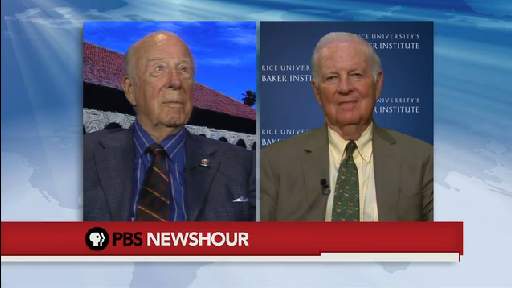
The main Thatcher segment on the PBS newscast was a discussion with two former Republican secretaries of State, George Shultz and James Baker. Of course, both were big fans of Thatcher’s foreign policy (which was closely aligned with their own priorities during the Reagan and George H.W. Bush years). It was more than that, too; as Baker put it, Thatcher “emphasized the private sector and got rid of the oppressive influence of the trade unions.” And Shultz explained that Thatcher “was a very attractive woman. So you were certainly aware of that.”
PBS had one other guest: former Conservative Canadian Prime Minister Kim Campbell, who cheered both Thatcher’s defeat of unions but also her humanity: “It’s kind of touching to be reminded of what a lovely woman she was.”
On the O’Reilly show, the host paid tribute to Thatcher’s leadership, contrasting it with Barack Obama’s tenure. As O’Reilly declared:
Her accomplishments are many, but she was always a very controversial figure in her own country and here in America, because the British press and the American media are liberal and always have been.

Later in the show, he was joined by conservatives Brit Hume and Bernard Goldberg; ironically, the latter segment focused on the alleged hostility to Thatcher in the mainstream media. So the guest line-ups were more alike than different. But so was some of the reporting. On Fox, Thatcher rescued Britain from the clutches of an oppressive union movement, and the record speaks for itself. As O’Reilly put it:
In Britain, 13 percent unemployment…. That’s a catastrophe, 13 percent, all right. When she leaves office eight years later, 5.8 percent unemployment. But if the unemployment rate drops 7 percent, which means all those millions of people are working under this woman, give her some credit.
And he put it a different way:
In 1982, about two and a half years into her term, unemployment in Great Britain was 13 percent. It’s chaos, absolute chaos there. When she left office in 1990, she was the longest serving prime minister in British history. It was at 5.8 percent.
On PBS, meanwhile, reporter Margaret Warner declared that Thatcher “brought a free market revolution to Britain, lowering taxes and privatizing state industries…. Britain’s economy rebounded from her tough medicine.”
Neither report gives viewers a good sense of Thatcher’s economic policy. (The wording in the PBS segment about rebounding from medicine is difficult to comprehend.) The Guardian compiled a list of economic indicators during Thatcher’s tenure; the short story is that inequality increased, and so did poverty–from 13.4 percent in 1979 to 22.2 percent in 1990.
O’Reilly is correct that unemployment dropped during part of Thatcher’s time in office; it also skyrocketed the first two years. When she left office in 1990, it was, according to the Guardian‘s figures, higher than when she took office. If that’s the record, then one would imagine it would be reflected somewhere–perhaps not at Fox News, for ideological reasons. But PBS is supposed to be about giving us the views that we’re not getting from the commercial media.
Related articles
Looking Back at Iraq With… Michael Gordon?
By Peter Hart | FAIR | March 20, 2013
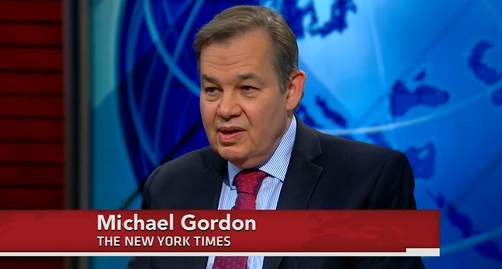
The performance of the corporate media is one of the principal failures of the Iraq War. There are almost too many examples to name; but most critics agree that one of the most instrumental single pieces that made the false case for war was the front-page New York Times story (9/8/02) hyping the idea that Iraq was trying to procure special aluminum tubes for its nuclear weapons program.
Last night in its 10-years-later segment, the PBS NewsHour (3/19/13) made a rather stunning judgment: One of the two expert journalists was the guy who co-authored that piece.
New York Times reporter Michael Gordon was the lead author on that infamous tubes article, but his record goes deeper than that. A few days into the U.S. bombing (3/25/13), Gordon appeared on CNN to endorse the bombing of Iraqi TV’s offices, calling it “an appropriate target,” since “we’re trying to send the exact opposite message.”
When U.S. politicians began to seriously consider a withdrawal of U.S. troops, Gordon criticized that policy, especially in one article (11/15/06) headlined, “Get Out of Iraq Now? Not So Fast, Experts Say” (FAIR Media Advisory, 12/4/06). He went on the Charlie Rose show (1/18/07) to endorse a troop surge. (Even the Washington Post admits that the idea that the surge succeeded is a “myth”–3/15/13.) And in early 2007, Gordon wrote articles, relying heavily on anonymous U.S. sources, alleging that the Iranian government was sending weapons into Iraq (Action Alert, 2/16/07).
So why would Gordon be someone you’d want to listen to about the Iraq War? That’s hard to say, really. But Gordon had plenty to tell PBS viewers. He complained that the Obama White House wasn’t interested enough in Iraq–leading to “the decline of American influence.” As he put it:
I think they view Iraq as just another country. They don’t have the same emotional or psychological or even foreign policy stake in it that the previous administration had.
Gordon added that the U.S. military “see a lot of early mistakes in the first years” of the war, but that “I do think the surge, as a military operation and military strategy, was effective and was essential.”
When one of the hosts, Judy Woodruff, asked about the war’s legacy, he replied: “Well, I think the military learned how to do counterinsurgency. The public opinion may no longer support that, but forever is a long time. And I think you can’t say we won’t have to do that again at some point in the future.”
And if there is ever another moment that requires reporters to faithfully record the views of anonymous U.S. officials as they make their case for war, it’s a safe bet that Michael Gordon will be there to do that job.
Related video
Iran’s ‘Nuclear Weapons Program,’ Again
By Peter Hart | FAIR | January 31, 2013

On Monday’s edition of the NewsHour (1/28/13), host Gwen Ifill referred to concerns about the “threat posed by Iran’s nuclear program,” and told viewers at the end of a Margaret Warner report that “Margaret’s next story looks at the debate in Israel over how to deal with the threat of a nuclear-armed Iran.”
And on last night’s broadcast (1/30/13), Warner explained that countries like the U.S., Israel and Turkey “are concerned about Iran’s nuclear weapons program.”
To reiterate an obvious point: There is no proof of an Iranian nuclear weapons program. There are allegations that Iranian’s enrichment of uranium for its nuclear power program is hiding a military component, but weapons inspectors have not uncovered any such diversion.
The NewsHour has made this mistake before, as FAIR noted in a recent action alert:
In an October 22 discussion of the foreign policy presidential debate, the PBS NewsHour‘s Jeffrey Brown stated that “Iran’s nuclear weapons program has been a particular flash point.”
A few weeks earlier (10/5/12) on the NewsHour, Ray Suarez said that Venezuelan president Hugo Chávez had
continued to thwart American efforts on a range of international issues, such as Washington’s attempt to convince Iran’s President Mahmoud Ahmadinejad to halt his country’s pursuit of nuclear weapons.
How hard is it for NewsHour to understand that allegations are not facts? Write to them at onlineda2@newshour.org
Hugo Chavez: Why Does He Hate Us?
By Peter Hart | FAIR | January 11, 2013
If there’s one thing media want you to know about Venezuelan president Hugo Chavez, it’s that he doesn’t like the United States. On the PBS NewsHour (1/10/13), Ray Suarez told viewers that Chavez
antagonized Washington, it seemed, whenever he could, forging friendships with Iran’s Mahmoud Abbas (sic), Syria’s embattled Bashar al-Assad, and he formed an especially close bond with Cuban Presidents Fidel and Raul Castro.
 On the CBS Evening News (1/8/13), Scott Pelley said:
“Chavez has made a career out of bashing the United States and allied himself with Iran and Syria.”
While it’s hard to say Chavez has made a “career” out of U.S.-bashing–he does have, after all, a full-time job as president of Venezuela–you, too, might be excused for harboring some hard feelings towards a government that helped to try to overthrow your own. Which may be why U.S. reports rarely bring up the 2002 coup attempt–and when they do, treat Washington’s involvement in it as another nutty Chavez conspiracy theory.
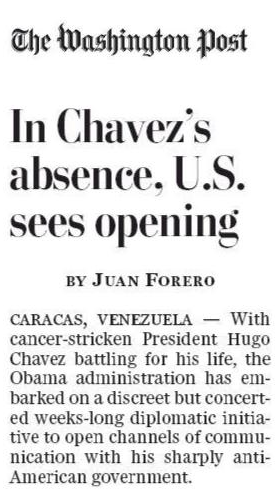
Here’s Juan Forero in the Washington Post (1/10/13):
A central ideological pillar of Chavez’s rule over 14 years has been to oppose Republican and Democratic administrations in Washington, which he accuses of trying to destabilize his government.
“I think they really believe it, that we are out there at some level to do them ill,” said Charles Shapiro, president of the Institute of the Americas, a think tank in San Diego.
As ambassador to Venezuela from 2002 to 2004, Shapiro met with Chavez and other high- ranking officials, including [Vice President Nicolas] Maduro. But the relationship began to fall apart, with Chavez accusing the United States of supporting a coup that briefly ousted him from power. U.S. officials have long denied the charge.
Shapiro recalled how Maduro made what he called unsubstantiated accusations about CIA activity in Venezuela, without ever approaching the embassy with a complaint. He said that as time went by, the United States became a useful foil for Chavez and most Venezuelan officials withdrew contact.
“A sure way to ruin your career, to become a backbencher, was to become too friendly with the U.S. Embassy,” Shapiro said.
So Venezuela has a strange political culture where being friendly with the U.S. government gets you in trouble.
The Post airs Chavez’s charge–and then the U.S. denial. But the United States had all sorts of contact with the coup plotters before they made their move against Chavez in 2002. According to the State Department (7/02):
It is clear that NED [National Endowment for Democracy], Department of Defense (DOD) and other U.S. assistance programs provided training, institution building and other support to individuals and organizations understood to be actively involved in the brief ouster of the Chavez government.
And the CIA, as was reported by Forero himself (New York Times, 12/3/04), knew of the coup plotting.
The Central Intelligence Agency was aware that dissident military officers and opposition figures in Venezuela were planning a coup against President Hugo Chávez in 2002, newly declassified intelligence documents show. But immediately after the overthrow, the Bush administration blamed Mr. Chávez, a left-leaning populist, for his own downfall and denied knowing about the threats.
Scott Wilson, who was the Washington Post foreign editor at the time, told Oliver Stone for his film South of the Border:
Yes, the United States was hosting people involved in the coup before it happened. There was involvement of U.S.-sponsored NGOs in training some of the people that were involved in the coup. And in the immediate aftermath of the coup, the United States government said that it was a resignation, not a coup, effectively recognizing the government that took office very briefly until President Chavez returned.
And we know that the United States made quick efforts to have the coup government recognized as legitimate. The Bush government, immediately after the coup, blamed it on Chavez. And some of the coup plotters met with officials at the U.S. embassy in Caracas before they acted.
But the important thing for readers to know, according to Wilson’s successors at the Washington Post, is that U.S. officials deny they supported anything.
PBS and Iran’s ‘Nuclear Weapons’
NewsHour botches basic fact about Iran
FAIR – 10/24/12
In an October 22 discussion of the foreign policy presidential debate, the PBS NewsHour‘s Jeffrey Brown stated that “Iran’s nuclear weapons program has been a particular flash point.”
A few weeks earlier (10/5/12) on the NewsHour, Ray Suarez said that Venezuelan president Hugo Chávez had
continued to thwart American efforts on a range of international issues, such as Washington’s attempt to convince Iran’s President Mahmoud Ahmadinejad to halt his country’s pursuit of nuclear weapons.
As most people following this story should know, there is no intelligence that shows Iran has a nuclear weapons program. The country has long denied the accusation, and regular inspections by the International Atomic Energy Agency have failed to turn up evidence that Iran’s enriched uranium is being diverted for use in a weapon (Extra!, 1/12).
Some governments claim otherwise, but journalists are supposed to convey the evidence that is available–not to make claims that are unsupported by the facts. If there was one clear lesson from the Iraq War, it was that reporters need to carefully distinguish between what is known for certain and what some government leaders claim.
There have been questions about the NewsHour‘s Iran reporting before (FAIR Blog, 1/10/12). On January 9 the broadcast reported that Iran’s denial that it is pursuing a nuclear weapon was “disputed by the U.S. and its allies.” The show turned to a clip from Defense Secretary Leon Panetta to bolster that point — but edited out the part of his statement in which he said: “Are they trying to develop a nuclear weapon? No.” A NewsHour editor (FAIR Blog, 1/17/12) agreed that “it would have been better had we not lopped off the first part of the Panetta quote.”
CONTACT:
PBS NewsHour
onlineda2@newshour.org
Pentagon Budgets and Fuzzy Math
By Peter Hart – FAIR – 01/27/2012
By the tone of some of the media coverage, you might have thought Defense Secretary Leon Panetta announced a plan to slash military spending yesterday. On the front page of USA Today (1/27/12), under the headline “Panetta Backs Far Leaner Military,” readers learn in the first paragraph:
The Pentagon’s new plan to cut Defense spending means a reduction of 100,000 troops, the retiring of ships and planes and closing of bases–moves that the Defense secretary said would not compromise security.
The piece quotes critics of the cuts like Sen. Joe Lieberman and an analyst at the right-wing American Enterprise Institute. And the article talks about the most commonly cited figure of $487 billion in cuts over 10 years. As economist Dean Baker writes about such coverage–“Military Budget Cuts: Denominator Please”–there is no way people can assess the significance of what sounds like a lot of money if they don’t know how much the Pentagon is planning to spend over the same 1o-year period–roughly $8 trillion.
The PBS NewsHour did little to clarify the issue. The broadcast began with Jeffrey Brown announcing, “The Pentagon today outlined almost half a trillion dollars in budget cuts that would shrink the size of the U.S. military by trimming ground forces, retiring ships and planes, and delaying some new weapons.” PBS aired clips from Republicans Mitt Romney and Newt Gingrich denouncing the budget cuts, and then interviewed a Pentagon official.
Even coverage of the Pentagon’s new “austerity” that managed to include some helpful context didn’t make things very clear. “The Pentagon took the first major step toward shrinking its budget after a decade of war” was how a New York Times story by Elisabeth Bumiller (1/27/12) begins. In the fourth paragraph, readers found this:
Even though the Defense Department has been called on to find $259 billion in cuts in the next five years–and $487 billion over the decade–its base budget (not counting the costs of Afghanistan or other wars) will rise to $567 billion by 2017. But when adjusted for inflation, the increases are small enough that they will amount to a slight cut of 1.6 percent of the Pentagon’s base budget over the next five years.
So the “first major step” in cutting the military budget… isn’t really a cut?
A Washington Post piece by Craig Whitlock (1/27/12) had a more accurate lead–“The Pentagon budget will shrink slightly next year”– but later tries to make a 1 percent cut sound more significant: “While the difference may sound small, it represents a new era of austerity for the Defense Department.”
To make matters even more confusing, the Post points out later that
Although the defense budget will decline next year, to $525 billion from this year’s $531 billion, under Obama’s current projections it will inch upward in constant dollars between 1 percent and 2 percent annually thereafter.
Kudos to Nancy Yousef of McClatchy for writing a piece (1/26/12) that took a different tack. Under the headline “Defense Budget Plan Doesn’t Cut as Deeply as Pentagon Says,” Yousef led with this:
Pentagon officials on Thursday announced the outlines of what they called a pared-down defense budget, but their request would increase baseline spending beyond the projected end of the war in Afghanistan, even as they plan to reduce ground forces.
To Yousef, the Pentagon was ” employing a definition of the term ‘reduction’ that may be popular in Washington but is unconventional anywhere else.”
And activist/writer David Swanson pointed out that the first question at Panetta’s briefing got right at this question of whether the cuts are really cut. From the transcript:
Mr. Secretary, you talked a little bit on this, but over the next 10 years, do you see any other year than this year where the actual spending will go down from year to year? And just to the American public more broadly, how do you sort of explain what appears to be contradictory, as you talk about, repeatedly, this $500 billion in cuts in a Defense Department budget that is actually going to be increasing over time?
Panetta’s answer:
Yeah, I think the simplest way to say this is that under the budget that was submitted in the past, we had a projected growth level for the Defense budget. And that growth would’ve provided for almost $500 billion in growth. And we had obviously dedicated that to a number of plans and projects that we would have. That’s gotta be cut, and that’s a real cut in terms of what our projected growth would be.
See the new release from the Institute for Public Accuracy for more of the context largely missing from the Pentagon budget coverage.
Related articles
- Humans Lose, Robots Win in New Defense Budget (wired.com)
Featured Video

The First Pyrrhic Victory of the Vietnam War
or go to
Aletho News Archives – Video-Images
Frlom the Archives
The 52 Major Jewish American Organizations and Israel Celebrate Passover with the Slaughter of 25 Muslim, Christian and Secular Palestinians
By James Petras • Unz Review • April 8, 2018
Introduction
As of April 7, nearly three thousand unarmed Christian, Muslim and secular Palestinians have been wounded, over three dozen are in critical condition and at least twenty-five unarmed protestors, including children have been assassinated by hundreds of Israeli snipers and heavily armed troops shooting tank shells into crowds of civilians protesting their decades of incarceration by the racist Israeli state.
The Israeli government praised the ‘restraint and morality’ of the IDF, as did the fifty-two Major Jewish American Organizations (MJAO) who largely control the US Congress. These grotesque massacres began during the Christian Holy Week on Good Friday and Easter, coinciding with the Jewish Passover. The self-righteous officials of the MJAO and their relatives and friends broke matzos at joyful Seders as the blood of Palestinians soaked into ground at the fence containing the largest open-air prison camp in history, Gaza.
While tribal loyalties bonded the Israeli and Jewish American leaders, the politicians of the Western oligarchic electoral regimes refrained from criticizing the shocking display of brute force and even defended Israel’s cold blood mass killings of Palestinian civilians in their Gaza prison.
This paper will discuss and analyze the reasons for Israel’s willing Western accomplices and the centrality of its fifth column in the United States. … continue
Blog Roll
 Aletho News
- Just Get Out! Now!
- Unpacking glaring contradictions in US-Zionist justifications for war against Iran
- Iranian model of warfare bleeds US dry while Persian Gulf states watch and learn: Analyst
- IRGC orders ‘defeated’ US to evacuate industrial facilities in region
- Hegseth’s call for ‘no mercy’ to Iranians deemed war crime
- Iran War Exposes Limits of US Military Power – Journalist
- Even The Neo-Cons Admit The Iran War Is Failing
- Inside the Caucasus Drone Corridor Fueling Tensions With Iran
- ‘Not our war’: Trump’s naval coalition to reopen Strait of Hormuz dead in the water
- Iran declares support centers for USS Gerald R. Ford legitimate targets
- If Americans Knew
- ‘I Liked the House’: When Israeli Soldiers Turn Palestinian Homes into Barracks
- ‘They Were All I Had’: Lebanese Father Buries Parents, 4 Daughters Killed by Israeli Bombing
- Israel and its supporters are causing attacks on Jewish institutions. Case in point: Michigan synagogue tragedy.
- These are the casualties and cost of the war in Iran 2 weeks into the conflict
- Chicago Teachers Union accuses AIPAC of swaying elections with ‘dark money’
- Predictions of another 9/11, amid Israel-US killing spree – Not a ceasefire Day 157
- As US-Israel war on Iran rages, Gaza faces massive dust storm – Not a ceasefire Day 156
- No let-up in attacks on Gaza as Israel takes on Iran, Lebanon – Not a ceasefire Day 155
- ‘Of Course’: IDF Drops Case Against Soldiers Accused of Raping Palestinian Prisoner
- Don’t Fall for the Regime Change Talk. Israel Is ‘Mowing the Lawn’ in Iran
- No Tricks Zone
- Storing Green Energy To Last Germany 10 Days Would Require A 60-Million Tonne Battery
- New Studies: UK Sea Levels Were 4 Meters Higher Than Today During The Mid-Holocene
- Destructive Green New Deal: German Energy And Metal Group Warns Of Drastic Crisis
- New Study Documents A 20-Year Pause In Arctic Sea Ice Decline – Driven By Internal Variability
- Wake-up Call: Survey Shows Majority Of Germans Now Favor Postponing Climate Targets!
- Televised! Leading German Political Candidate Tells Schoolchildren CO2 Makes Sun Hotter!
- New Study: A Century Warming Of 1.1°C Is ‘Commonplace’ And ‘Not Unusual’ During This Interglacial
- New Study: ‘Internal Noise’ And Volcanic Forcing Can Trigger 10-15°C Warming Within Decades
- Glaciers Worldwide Are Suddendly Surging, Experts Blame Warming!
- Surprising Discovery: Sahara Is Greening…Billions Of Trees Where Once Thought To Be Barren
 Aletho News