In Search of a Russiagate Scalp: The Entrapment of Maria Butina
By John Kiriakou | Consortium News | August 28, 2019
Much has been written about Maria Butina, the Russian “spy” who was accused of seeking to infiltrate the National Rifle Association and other organizations to try to gain a foothold in the Trump campaign and, later, in the White House. Much of it turned out to be nonsense. Butina wasn’t a spy. She wasn’t charged with spying. She wasn’t accused of being a spy. But that’s how the media branded her. The important thing is that there actually were spies around her. And they weren’t who you might have thought.
In the Butina case, the FBI and the Justice Department needed a scalp in the midst of the frenzy about the ultimaely unproven collusion theory of “Russiagate,” and so Butina was charged and convicted of “conspiracy to fail to register as an agent of a foreign government.” Seriously. Let me explain what that means. The Foreign Agents Registration Act (FARA) was passed into law in 1938. It “requires persons acting as agents of foreign principals in a political or quasi-political capacity to make periodic public disclosure of their relationship with the foreign principal, as well as activities, receipts, and disbursements in support of those activities.” The law, the registration, and the database are meant to keep track of foreign lobbyists. Nothing more.
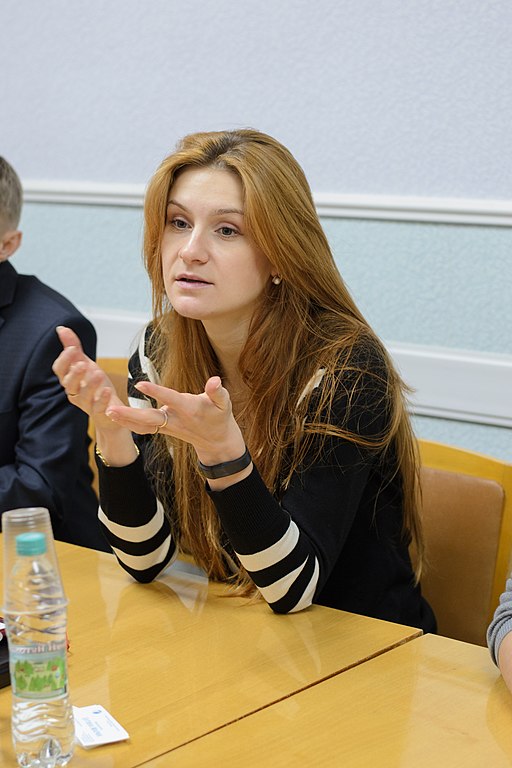
Butina: Unregistered agent falsely portrayed as a spy
In realistic terms it means this: In 2008, I was hired by the Abu Dhabi Chamber of Commerce to write a series of op-eds in support of doing business in the city. I wrote four op-eds and they paid me a fee. But I had to go to the Justice Department’s FARA website and register as a “foreign agent,” meaning that I was being paid by a foreign government. No problem. It didn’t mean that I was a “secret agent” for Abu Dhabi. It just meant that I was temporarily in the employ of a foreign government.
Washington attorneys and lobbyists do this kind of thing every day. And more often than not, they don’t register, either because they are too busy, they don’t realize that they have to, or they don’t believe, as in the current case of Washington super lawyer Greg Craig, that they have to. They are very rarely prosecuted.
Anybody can go to the FARA website and do a records search. I did one for the purpose of this article to search for people I know—attorneys, friends, acquaintances—and found many of them taking money from the governments of Libya, Chad, Jordan, Saudi Arabia (lots of them), Greece and other countries. It’s no big deal. It’s just a paperwork exercise.
In the case of Maria Butina, though, the paperwork was the hook to arrest her and to use her failure to register under FARA as leverage to get her to testify about her “work.” The problem, at least for the FBI, was that she wasn’t a spy. As things turned out, she really was just an overly-aggressive Russian grad student at American University who really, really loved guns and was trying to ingratiate herself with the NRA. But the Justice Department came down on her like a ton of bricks, forced her into taking a plea, and sentenced HER to 18 months in a federal prison: for conspiring to fail to fill out a form. The federal sentencing guidelines for a first-time offender violating this law is 0-6 months in a minimum-security work camp and a fine of up to $5,000. That, apparently, was never an option for Butina.
Forgive me if this is burying the lede, but I also want to talk about how Maria Butina got into this predicament in the first place. We know that she was very active in the gun rights movement in both Russia and the U.S. and that she sought to improve contact between gun groups in both countries. We also know that she met and began dating Patrick Byrne, the founder and CEO of Overstock.com. We learned recently, thanks to Byrne himself, that he was a longtime FBI source and that the FBI directed him to begin dating Butina. He did so. And he reported back to the FBI that she was simply a graduate student. That wasn’t good enough for the FBI, though and, according to Byrne, he was instructed to go back to Butina, to begin a sexual relationship with her, and to again report back to the FBI. He did that, too.
In the end, the Justice Department accused her publicly of “trading sexual favors” for access, an accusation that prosecutors had to withdraw. It was patently untrue. But that didn’t stop them from accusing her in the press of being a Russian spy, which she was not. And it didn’t stop the judge from giving her three times the maximum sentence called for by the sentencing guidelines.
I will ask your forgiveness again if I sound like a broken record. But this is how the FBI makes their cases. They entrap people. I’ve written extensively about how the FBI brazenly carried out a sting operation against me (unsuccessfully) that could have resulted in an espionage conviction and as much as 30 years in prison. They did the same thing to Butina.
Butina wasn’t committing a crime, so they just made something up, leaked it to the press, allowed it to influence the public and the judge, and hoped she would cave and take a plea. She did. Byrne went on CNN last week to say that two of the three people who instructed him to do all of this were James Comey, Peter Strzok, and another as-yet-unnamed individual. The operation was hatched at the top. The whole story sickens me.
With the deck stacked the way it was, there was probably nothing that Butina or her attorneys could have done to save her. The fix was in. I wish I had been able to convey to her something that one of my attorneys said to me on the day that I finally took a plea to a greatly reduced charge in 2012: “Do you know what your problem is? Your problem is that you think this is about justice. It’s not about justice. It’s about mitigating damage.” Nice system we have.
John Kiriakou is a former CIA counterterrorism officer and a former senior investigator with the Senate Foreign Relations Committee. John became the sixth whistleblower indicted by the Obama administration under the Espionage Act — a law designed to punish spies. He served 23 months in prison as a result of his attempts to oppose the Bush administration’s torture program.
Moon-Strzok No More, Lisa Page Spills the Beans
By Ray McGovern | Consortium News | July 23, 2018
Former FBI attorney Lisa Page has reportedly told a joint committee of the House of Representatives that when FBI counterintelligence official Peter Strzok texted her on May 19, 2017 saying there was “no big there there,” he meant there was no evidence of collusion between the Trump campaign and Russia.
It was clearly a bad-luck day for Strzok, when on Friday the 13th this month Page gave her explanation of the text to the House Judiciary and Oversight/Government Reform Committees and in effect threw her lover, Strzok, under the bus.
Strzok’s apparent admission to Page about there being “no big there there” was reported on Friday by John Solomon in The Hill based on multiple sources who he said were present during Page’s closed door interview.
Strzok’s text did not come out of the blue. For the previous ten months he and his FBI subordinates had been trying every-which-way to ferret out some “there” — preferably a big “there” — but had failed miserably. It is appearing more and more likely that there was nothing left for them to do but to make it up out of whole cloth, with the baton then passed to special counsel Robert Mueller.
The “no there there” text came just two days after former FBI Director James Comey succeeded in getting his friend Mueller appointed to investigate the alleged collusion that Strzok was all but certain wasn’t there.
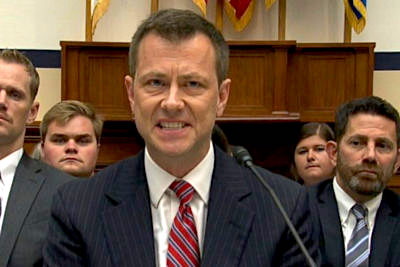
Strzok during his public testimony earlier this month.
Robert Parry, the late founder and editor of Consortium News whom Solomon described to me last year as his model for journalistic courage and professionalism, was already able to discern as early as March 2017 the outlines of what is now Deep State-gate, and, typically, was the first to dare report on its implications.
Parry’s article, written two and a half months before Strzok texted the self-incriminating comment to Page on there being “no big there there,” is a case study in professional journalism. His very first sentence entirely anticipated Strzok’s text: “The hysteria over ‘Russia-gate’ continues to grow … but at its core there may be no there there.”(Emphasis added.)
As for “witch-hunts,” Bob and others at Consortiumnews.com, who didn’t succumb to the virulent HWHW (Hillary Would Have Won) virus, and refused to slurp the Kool-Aid offered at the deep Deep State trough, have come close to being burned at the stake — virtually. Typically, Bob stuck to his guns: he ran an organ (now vestigial in most Establishment publications) that sifted through and digested actual evidence and expelled drivel out the other end.
Those of us following the example set by Bob Parry are still taking a lot of incoming fire — including from folks on formerly serious — even progressive — websites. Nor do we expect a cease-fire now, even with Page’s statement (about which, ten days after her interview, the Establishment media keep a timorous silence). Far too much is at stake.
As Mark Twain put it, “It is easier to fool people than to convince them that they have been fooled.” And, as we have seen over the past couple of years, that goes in spades for “Russia-gate.” For many of us who have looked into it objectively and written about it dispassionately, we are aware, that on this issue, we are looked upon as being in sync with President Donald Trump.
Blind hatred for the man seems to thwart any acknowledgment that he could ever be right about something—anything. This brings considerable awkwardness. Chalk it up to the price of pursuing the truth, no matter what bedfellows you end up with.
Courage at The Hill
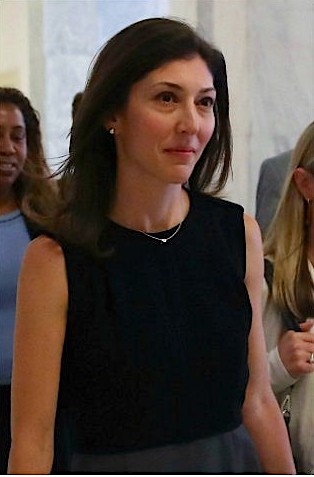
Page: Coughs up the meaning of ‘there.’
Solomon’s article merits a careful read, in toto. Here are the most germane paragraphs:
“It turns out that what Strzok and Lisa Page were really doing that day [May 19, 2017] was debating whether they should stay with the FBI and try to rise through the ranks to the level of an assistant director (AD) or join Mueller’s special counsel team. [Page has since left the FBI.]
“‘Who gives a f*ck, one more AD [Assistant Director] like [redacted] or whoever?’” Strzok wrote, weighing the merits of promotion, before apparently suggesting what would be a more attractive role: ‘An investigation leading to impeachment?’ …
“A few minutes later Strzok texted his own handicap of the Russia evidence: ‘You and I both know the odds are nothing. If I thought it was likely, I’d be there no question. I hesitate in part because of my gut sense and concern there’s no big there there.’
“So the FBI agents who helped drive the Russia collusion narrative — as well as Rosenstein’s decision to appoint Mueller — apparently knew all along that the evidence was going to lead to ‘nothing’ and, yet, they proceeded because they thought there was still a possibility of impeachment.”
Solomon adds: “How concerned you are by this conduct is almost certainly affected by your love or hatred for Trump. But put yourself for a second in the hot seat of an investigation by the same FBI cast of characters: You are under investigation for a crime the agents don’t think occurred, but the investigation still advances because the desired outcome is to get you fired from your job. Is that an FBI you can live with?”
The Timing
As noted, Strzok’s text was written two days after Mueller was appointed on May 17, 2016. The day before, on May 16, The New York Times published a story that Comey leaked to it through an intermediary that was expressly designed (as Comey admitted in Congressional testimony three weeks later) to lead to the appointment of a special prosecutor to investigate collusion between the Trump campaign and Russia. Hmmmmm.
Had Strzok forgotten to tell his boss that after ten months of his best investigative efforts — legal and other—he could find no “there there”?
Comey’s leak, by the way, was about alleged pressure from Trump on Comey to go easy on Gen. Michael Flynn for lying at an impromptu interrogation led by — you guessed it — the ubiquitous, indispensable Peter Strzok.
In any event, the operation worked like a charm — at least at first. And — absent revelation of the Strzok-Page texts — it might well have continued to succeed. After Deputy Attorney General Rod Rosenstein named Mueller, one of Comey’s best buddies, to be special counsel, Mueller, in turn, picked Strzok to lead the Russia-gate team, until the summer, when the Department of Justice Inspector General was given the Strzok-Page texts and refused to sit on them.
A Timeline
Here’s a timeline, which might be helpful:
2017
May 16: Comey leak to NY Times to get a special counsel appointed
May 17: Special counsel appointed — namely, Robert Mueller.
May 19: Strzok confides to girlfriend Page, “No big there there.”
July: Mueller appoints Strzok lead FBI Agent on collusion investigation.
August: Mueller removes Strzok after learning of his anti-Trump texts to Page.
Dec. 12: DOJ IG releases some, but by no means all, relevant Strzok-Page texts to Congress and the media, which first reports on Strzok’s removal in August.
2018
June 14: DOJ IG Report Published.
June 15; Strzok escorted out of FBI Headquarters.
June 21: Attorney General Jeff Sessions announces Strzok has lost his security clearances.
July 12: Strzok testifies to House committees. Solomon reports he refused to answer question about the “there there” text.
July 13: Lisa Page interviewed by same committees. Answers the question.
Earlier: Bob Parry in Action
Journalist Robert Parry
On December 12, 2017, as soon as first news broke of the Strzok-Page texts, Bob Parry and I compared notes by phone. We agreed that this was quite big and that, clearly, Russia-gate had begun to morph into something like FBI-gate. It was rare for Bob to call me before he wrote; in retrospect, it seemed to have been merely a sanity check.
The piece Bob posted early the following morning was typical Bob. Many of those who click on the link will be surprised that, last December, he already had pieced together most of the story. Sadly, it turned out to be Bob’s last substantive piece before he fell seriously ill. Earlier last year he had successfully shot downother Russia-gate-related canards on which he found Establishment media sorely lacking — “Facebook-gate,” for example.
Remarkably, it has taken another half-year for Congress and the media to address — haltingly — the significance of Deep State-gate — however easy it has become to dissect the plot, and identify the main plotters. With Bob having prepared the way with his Dec.13 article, I followed up a few weeks later with “The FBI Hand Behind Russia-gate,” in the process winning no friends among those still suffering from the highly resistant HWHW virus.
VIPS
Parry also deserves credit for his recognition and appreciation of the unique expertise and analytical integrity among Veteran Intelligence Professionals for Sanity (VIPS) and giving us a secure, well respected home at Consortium News.
It is almost exactly a year since Bob took a whole lot of flak for publishing what quickly became VIPS’ most controversial, and at the same time perhaps most important, Memorandum For the President; namely, “Intelligence Veterans Challenge ‘Russia Hack’ Evidence.”
Critics have landed no serious blows on the key judgments of that Memorandum, which rely largely on the type of forensic evidence that Comey failed to ensure was done by his FBI because the Bureau never seized the DNC server. Still more forensic evidence has become available over recent months to be soon revealed on Consortium News, confirming our conclusions.
Ray McGovern works with Tell the Word, a publishing arm of the ecumenical Church of the Saviour in inner-city Washington. He was a CIA analyst for 27 years and, in retirement, co-founded Veteran Intelligence Professionals for Sanity.
One FBI text message in Russia probe that should alarm every American
By John Solomon | The Hill | July 19, 2018
Lisa Page and Peter Strzok, the reported FBI lovebirds, are the poster children for the next “Don’t Text and Investigate” public service ads airing soon at an FBI office near you.
Their extraordinary texting affair on their government phones has given the FBI a black eye, laying bare a raw political bias brought into the workplace that agents are supposed to check at the door when they strap on their guns and badges.
It is no longer in dispute that they held animus for Donald Trump, who was a subject of their Russia probe, or that they openly discussed using the powers of their office to “stop” Trump from becoming president. The only question is whether any official acts they took in the Russia collusion probe were driven by those sentiments.
The Justice Department’s inspector general is endeavoring to answer that question.
For any American who wants an answer sooner, there are just five words, among the thousands of suggestive texts Page and Strzok exchanged, that you should read.
That passage was transmitted on May 19, 2017. “There’s no big there there,” Strzok texted.
The date of the text long has intrigued investigators: It is two days after Deputy Attorney General Rod Rosenstein named special counsel Robert Mueller to oversee an investigation into alleged collusion between Trump and the Russia campaign.
Since the text was turned over to Congress, investigators wondered whether it referred to the evidence against the Trump campaign.
This month, they finally got the chance to ask. Strzok declined to say — but Page, during a closed-door interview with lawmakers, confirmed in the most pained and contorted way that the message in fact referred to the quality of the Russia case, according to multiple eyewitnesses.
The admission is deeply consequential. It means Rosenstein unleashed the most awesome powers of a special counsel to investigate an allegation that the key FBI officials, driving the investigation for 10 months beforehand, did not think was “there.”
By the time of the text and Mueller’s appointment, the FBI’s best counterintelligence agents had had plenty of time to dig. They knowingly used a dossier funded by Hillary Clinton’s campaign — which contained uncorroborated allegations — to persuade the Foreign Intelligence Surveillance Act (FISA) court to issue a warrant to monitor Trump campaign adviser Carter Page (no relation to Lisa Page).
They sat on Carter Page’s phones and emails for nearly six months without getting evidence that would warrant prosecuting him. The evidence they had gathered was deemed so weak that their boss, then-FBI Director James Comey, was forced to admit to Congress after being fired by Trump that the core allegation remained substantially uncorroborated.
In other words, they had a big nothing burger. And, based on that empty-calorie dish, Rosenstein authorized the buffet menu of a special prosecutor that has cost America millions of dollars and months of political strife.
The work product Strzok created to justify the collusion probe now has been shown to be inferior: A Clinton-hired contractor produced multiple documents accusing Trump of wrongdoing during the election; each was routed to the FBI through a different source or was used to seed news articles with similar allegations that further built an uncorroborated public narrative of Trump-Russia collusion. Most troubling, the FBI relied on at least one of those news stories to justify the FISA warrant against Carter Page.
That sort of multifaceted allegation machine, which can be traced back to a single source, is known in spy craft as “circular intelligence reporting,” and it’s the sort of bad product that professional spooks are trained to spot and reject.
But Team Strzok kept pushing it through the system, causing a major escalation of a probe for which, by his own words, he knew had “no big there there.”
The answer as to why a pro such as Strzok would take such action has become clearer, at least to congressional investigators. That clarity comes from the context of the other emails and text messages that surrounded the May 19, 2017, declaration.
It turns out that what Strzok and Lisa Page were really doing that day was debating whether they should stay with the FBI and try to rise through the ranks to the level of an assistant director (AD) or join Mueller’s special counsel team.
“Who gives a f*ck, one more AD like [redacted] or whoever?” Strzok wrote, weighing the merits of promotion, before apparently suggesting what would be a more attractive role: “An investigation leading to impeachment?”
Lisa Page apparently realized the conversation had gone too far and tried to reel it in. “We should stop having this conversation here,” she texted back, adding later it was important to examine “the different realistic outcomes of this case.”
A few minutes later Strzok texted his own handicap of the Russia evidence: “You and I both know the odds are nothing. If I thought it was likely, I’d be there no question. I hesitate in part because of my gut sense and concern there’s no big there there.”
So the FBI agents who helped drive the Russia collusion narrative — as well as Rosenstein’s decision to appoint Mueller — apparently knew all along that the evidence was going to lead to “nothing” and, yet, they proceeded because they thought there was still a possibility of impeachment.
Impeachment is a political outcome. The only logical conclusion, then, that congressional investigators can make is that political bias led these agents to press an investigation forward to achieve the political outcome of impeachment, even though their professional training told them it had “no big there there.”
And that, by definition, is political bias in action.
How concerned you are by this conduct is almost certainly affected by your love or hatred for Trump. But put yourself for a second in the hot seat of an investigation by the same FBI cast of characters: You are under investigation for a crime the agents don’t think occurred, but the investigation still advances because the desired outcome is to get you fired from your job.
Is that an FBI you can live with?
John Solomon is an award-winning investigative journalist whose work over the years has exposed U.S. and FBI intelligence failures before the Sept. 11 attacks, federal scientists’ misuse of foster children and veterans in drug experiments, and numerous cases of political corruption. He is The Hill’s executive vice president for video.
Featured Video

Bombing Hitler’s Hometown
or go to
Aletho News Archives – Video-Images
From the Archives
‘Conspiracy Theory’ Now Fact: Greater Israel Has Arrived
By Kit Klarenberg | Mint Press News | January 28, 2025
Ever since Tel Aviv’s 1948 creation, much has been said and written about ‘Greater Israel’ – the notion Zionism’s ultimate end goal is the forcible annexation and ethnic cleansing of vast swaths of Arab and Muslim lands for Jewish settlement, based on Biblical claims this territory was promised to Jews by God. The mainstream media typically dismisses this concept as antisemitic conspiracy theory, or at most the fringe fantasy of a minuscule handful of extremist Israelis.
In reality … continue
Blog Roll
 Aletho News
- Bombing Hitler’s Hometown
- German journalist threatened with homelessness as German court upholds EU sanctions in landmark free speech case
- US Tells Allies That Ukraine-Bound Arms Could be Sent to Middle East
- Organized terrorism: Iran condemns killing of its diplomats in Lebanon
- Why could Gaza enter the regional war?
- Hamas official rejects Mladenov Plan linking disarmament to Gaza reconstruction
- Two Primary Elections for the Soul of ‘America First’
- Japan Clings to US Vassalage Despite Energy Crunch Caused By Iran War
- US Seeks Control Over Global Energy Infrastructure – Kremlin
- US senators target Orban government for standing up to Zelensky
- If Americans Knew
- Researchers at Human Rights Watch Resign Over Blocked Report on Palestinian Refugee Return
- Jewish Groups Are Backing a War Americans Don’t Want
- Eric Fingerhut Thinks He’s the President of the Jews
- Top Jewish Philanthropists, Rabbis Urge Israeli President to Take Action Against ‘Jewish Extremists’
- Don’t Be Fooled. Zionist Leaders Have Always Wanted to Control Southern Lebanon
- Israel’s widespread use of torture is a core element of its genocide against the Palestinian people
- In Israel’s War on Iran, Many Middle East US Bases Rendered “All But Uninhabitable”
- ‘Burn the lawn’: Israel pursues ‘Rafah model’ in southern Lebanon
- A genocide here, an amputation there
- Reports: Iran mobilizing 1M fighters, Israel-US run low on ammo, Israeli army faces shortage – Not a ceasefire Day 168
- No Tricks Zone
- Devastating Assessment Of Comirnaty Vaccine By Former Senior Pfizer Europe Toxicologist
- New Study: CO2 Is ‘Effectively Negligible’ As An Explanatory Climate Change Factor Since 2000
- Former Pfizer Toxicologist Dr. Helmut Sterz Tells Bundestag Hearing Pfizer Vaccine Should Have Never Been Approved
- Energy Expert: Germany’s Nuclear Phaseout Was A “500 Billion Euro Mistake”
- New Research: South Australia’s Mid-Holocene Sea Surface Temperatures Were 4°C Warmer Than Today
- Storing Green Energy To Last Germany 10 Days Would Require A 60-Million Tonne Battery
- New Studies: UK Sea Levels Were 4 Meters Higher Than Today During The Mid-Holocene
- Destructive Green New Deal: German Energy And Metal Group Warns Of Drastic Crisis
- New Study Documents A 20-Year Pause In Arctic Sea Ice Decline – Driven By Internal Variability
- Wake-up Call: Survey Shows Majority Of Germans Now Favor Postponing Climate Targets!
 Aletho News