Telephone calls between Biden and Poroshenko reveal Kiev’s submission to Washington
By Lucas Leiroz | May 25, 2020
Recently, several phone calls made four years ago between former Ukrainian President Petro Poroshenko and current Democratic presidential candidate Joe Biden were revealed. The content of the talks is profound and controversial and reveals the high degree of American influence in the coordination of Ukrainian domestic politics, showing the advanced state of submission of Kiev to Washington.
According to the deputy of the Ukrainian Parliament (Supreme Rada), Andrei Derkach, the audio recordings were received from an anonymous investigative journalist. Derkach revealed the content of the recordings and declared full confidence in his informant.
On audio recordings, we can hear the former US Vice President Joe Biden and former Secretary of State John Kerry demanding that the leader of a formally independent state make decisions that are convenient for them, as well as a totally submissive posture on the part of Poroshenko, who is absolutely oblivious to Ukrainian national interests.
The demands made during the talks are diverse and impressive by the American boldness to interfere so deeply in other states. In one of the recordings, dated from 2015, it is possible to hear John Kerry demanding the resignation of Ukrainian attorney general Viktor Shokin, for not meeting American expectations. In another record, Poroshenko communicates with Biden saying he has “good news for him.” In the recording, Poroshenko says that while there was no charge or complaint against Shokin, he managed to convince the attorney to resign. The interlocutor replies: “Excellent”. So, Poroshenko reports that the dismissal of the attorney general is yet another “step in fulfilling his obligations” to the US.
In another phone call, the topic of appointing a new attorney is discussed. After a conversation between Poroshenko and his American counterparts, Yuri Lutsenko is chosen to be appointed to the office. Washington’s interlocutors make it clear that Lutsenko’s appointment is an essential condition for Kiev’s receipt of a loan of one billion dollars. Totally submissive, Poroshenko agrees with the terms of the agreement and the fees imposed without any dispute, consolidating the “partnership”.
In Washington, assistants of the former Vice President and current candidate Joe Biden informed The Washington Post that the recordings have been edited and are being used improperly to put pressure on the parties involved in the talks. However, the veracity of the existence of such telephone conversations has not been contested, which in itself is enough to create an atmosphere of tension and distrust towards the figures involved.
The fact is that the matter is still far from over. Whether or not they were edited, the recordings are apparently real. And, although the content of the conversations is contested, in truth, one billion dollars were withdrawn from the American public coffers and handed over to the president of another country, without the American population being informed of anything. After all, what will be the reaction of the American people when they understand that this money comes from their taxes and, instead of being invested in improvements to the national infrastructure, it is being used in obscure political maneuvers with other countries?
This all tends to strengthen Donald Trump in the upcoming election. The current American president until recently had an absolute majority of voting intentions and is now starting to weaken due to the way he has been dealing with the new coronavirus pandemic in the US – the global epicenter of the infection. Biden, although much less popular, progresses little by little and is already showing the ability to become a real opponent to Trump. However, as the scandals spread, it is likely that there will be a drop in Biden’s supporters or, at least, a greater atmosphere of collective distrust for him.
Still, Joe Biden’s reliability is not the main issue that comes up with the revelations of these recordings, but the level of American interference in the domestic politics of other national states. With these telephone records, Kiev proved to be a zone of foreign interference, where a president is coerced by members of the government of another country to make decisions that he would not like to make. This is not just an extremely demoralizing fact for Ukraine, but it also deeply destroys the myth of “Ukrainian nationalism,” so defended by the militias involved in the Euromaidan coup in 2014. However, more than that, the case may bring Petro Poroshenko to court. The recordings are sufficient evidence to accuse the former president of national treason. If formally accused and condemned, Poroshenko will have ended his political career in the worst possible way for a former president: being remembered as a traitor to his own country.
Lucas Leiroz is a research fellow in international Law at the Federal University of Rio de Janeiro.
The Ukrainian Election: When No News Is Bad News
By Dmitry BABICH | Strategic Culture Foundation | 15.02.2019
As the Ukrainian presidential election, scheduled to take place on March 31, draws ever closer, Western politicians are going out of their way to protect it from “Russian meddling.” This protection, which became a sort of peculiar Anglo-Saxon sport in the United States and the UK, will figure highly on the agenda of the meeting of the European Union’s foreign ministers on February 18, slated for a discussion of the coming Ukrainian election. A naïve reader of the Western press might wonder why the president of the “newly Westernized” Ukraine, Petro Poroshenko, has an approval rating of just 14%, trailing the comedian Vladimir Zelensky with his 21.9% and former Prime Minister Yulia Tymoshenko with her 19%. Obviously, some “meddling” must have taken place…
A COUNTRY THAT’S A THREAT TO ITSELF
Upon a closer look, however, the Ukrainian election appears to be more in need of protection from its own forms of Ukrainian extremism and what to the untrained eye might appear to be idiocies, rather than from any meddling from the Russian side. Suffice it to present a brief list of the recent suggestions and real policy moves (some of them coming from the very top echelon of government) which were made in the heat of electoral hysteria. Not surprisingly, most of these suggestions and moves are tied to Russia.
Presidential candidate Vitaly Kupryi simply suggested that Ukraine should officially declare war on Russia, obliging president Petro Poroshenko to announce an immediate mobilization and to use a special law to start moving troops against the “aggressor.” Since Kupryi is a deputy in the Supreme Rada (the Ukrainian parliament), his draft bill, which enjoys the support of a group of equally belligerent deputies, has been officially registered and waits to be reviewed by parliamentarians. Until now, the Supreme Rada has demurred from traveling along this somewhat suicidal path, preferring other, longer, more oblique routes toward a catastrophe. Last week, the Rada made Ukraine’s road towards NATO and the EU legally binding through another special law, altering Ukraine’s constitution, where the neutral, non-bloc status of the country had been enshrined since the 1990s. The parliamentarians also continued working on a draft bill, which makes “denial of Russian aggression against Ukraine” (that is, stating the truth that the war in the Russian-speaking eastern regions of Ukraine is a civil conflict) a criminal offence, punishable by several years in jail. The leading candidate, acting President Petro Poroshenko, has not allowed his parliament to outpace him in belligerent idiocies. He declared the visits by Russian citizens of the Russian-speaking Crimean peninsula to be “heinous crimes — breaches of the Ukrainian border,” which should all be punished by several years in Ukrainian jail. (6.8 million Russian tourists visited Crimea in 2018 alone, so theoretically Poroshenko could land Ukraine into the Guinness Book of World Records as the country with the highest potential prison population).
FAKE CHOICE: “EITHER PUTIN OR POROSHENKO”
As for “Russian meddling” in the elections, some of the candidates, including Poroshenko, are manufacturing this “meddling” themselves, by continuously campaigning not for Ukraine, but rather against Russia and its president Vladimir Putin. For example, Poroshenko’s campaign ad, which was unveiled on the day his candidacy officially launched on January 29, showed a Photoshopped image of the acting Ukrainian president confronting his Russian colleague, with the caption: “Either Poroshenko or Putin.”
The reason why Poroshenko continuously tries to redirect the attention of voters away from the country’s real problems and toward Russia’s ostensible “invasion” is obvious. “Ukraine’s catastrophic economic situation does not leave Poroshenko any room for self-promotion. Economically, this candy billionaire, who became rich working in all the governments, from Kuchma’s to Yanukovich’s, turned up to be rather helpless,” says Mikhail Pogrebinsky, the head of the Kiev-based Center for Political Research and Conflict Studies.
In the last quarter of the year 2018, the average income of a Ukrainian household was 9,400 hryvnas (about $350). This prompted the IMF to declare Ukraine the poorest country in Europe: Ukraine has even bested Moldova for this dubious honor, a nation that was previously at the top of the poverty rankings with an average salary of $375. Oleg Lyashko, a flamboyant nationalist candidate from Ukraine’s Radical party, accused Poroshenko of “taking us to Europe via Africa.”
A SAD END FOR THE FOREIGN “SAVIORS”
No wonder Poroshenko stopped talking about fighting corruption and introducing Western standards of state management, the two pillars of his plans for Ukraine at the beginning of his presidency in 2014. The “parachuting” of foreign specialists into the government (the Georgians Mikheil Saakashvili and Alexander Kvitashvili, the Lithuanian national Aivaras Abromavicius, as well as an American citizen, Natalie Jaresko) ended in dishonorable resignations, coupled with scandals and mutual accusations. When he quit, former Minister of Economy and Trade Abromavicius and former Governor of Odessa Saakashvili accused Poroshenko’s entourage of far-reaching corruption, much worse than the practices under the former president, Viktor Yanukovich. It is interesting to note that both Saakashvili and Poroshenko’s first prosecutor general, Vitaly Yarema, initially justified violent protests against the “corrupt” Yanukovich in 2013 and 2014, when 38 policemen were killed by the US-supported “peaceful protesters” from Maidan. But they both now acknowledge that “corruption schemes have become even more intricate and harmful” for society today compared to the Yanukovich era. Not surprisingly, Yarema was fired days after making such statements.
“The rule of oligarchs over the economy and the extortion of bribes from citizens by state officials have not diminished since Yanukovich’s rule,” writes a popular Kiev-based blogger and political expert Viktor Datsyuk. “What is even worse, the greediness of the ruling elite destroyed the ‘oligarchic consensus’ that had existed in Ukraine for years.” In Datsyuk’s opinion, this may lead to a new Hobbesian “war of all against all” in Ukraine.
SUBMISSION TO THE WEST AS THE NEW CONSENSUS
Upon a closer look, again, a certain “oligarchic consensus” still exists in Ukraine, and that consensus is based on the total submission of the local oligarchs to the “overseers” of Ukraine, who operate from Washington and Brussels.
At the peak of the presidential campaign, Ukraine simply exploded with anger when Poroshenko refused to obey a ruling from Kiev’s administrative court. The court removed Ulyana Suprun from her office — an American of Ukrainian descent, the last of the “foreign specialists” still operating in the Ukrainian government with an American passport. Legally, the ruling of the court was correct: Suprun has been “performing the duties” of the country’s health minister without being officially appointed in due course and in violation of a law that prohibits non-citizens of Ukraine from occupying government positions.
“I gave her citizenship through my own decree,” Poroshenko said, brushing off questions about Suprun NOT relinquishing her American citizenship, as required by the Ukrainian law.
The last time the Western elite was so up in arms to protect a “foreign specialist” inside the Ukrainian elite was in 2017, when Poroshenko suddenly canceled his own decree granting Ukrainian citizenship to Mikheil Saakashvili, the former Georgian president. At the time, Saakashvili was in Western Europe, but somehow he made his way back to Ukraine through a border checkpoint inside a crowd of supporters in September 2017, and was met “by chance” on the Ukrainian side of the border by the heads of influential Rada factions Yulia Tymoshenko (the “Fatherland” party) and Andrei Sadovoy (from the Samooborona, or “Self-Defense” movement). Somehow, the border checkpoint was also visited at that moment by Valentin Nalivaichenko, the former head of the fearsome Ukrainian Security Service (SBU).
They all embraced Saakashvili with grim faces, not quite in keeping with a miraculous and “spontaneous” breakthrough across the heavily guarded border.
A few months later, when Saakashvili somehow fell out of grace with his Western supervisors and was evicted from Ukraine by Poroshenko’s special forces via a chartered flight to Europe, his “friends” Tymoshenko and Nalivaichenko did not lift a finger in his defense.
THE INEVITABLE INCUMBENT
Obviously, after the US and the EU allowed Poroshenko to eject Saakashvili from Ukraine without punishment, it became clear that they had no other serious alternative to Poroshenko. Most likely, they will “allow” Poroshenko to win, using the hugely negative public image of Tymoshenko (70% of Ukrainians do not want to see her as their president under any circumstances).
As for the people who are suggesting realistic alternatives to the current disastrous course, they are being stigmatized as “Russian agents” or, worse, “Putin’s friends.”
This is not a situation in which no news is good news, though. Poroshenko’s continued hold on power in Ukraine means the continued threat of another war in the Donbass, the persecution of political opponents, and dispossession and the loss of legal status for the Ukrainian Orthodox Church under the Moscow Patriarchate. So, Poroshenko should not complain, when, as he himself told journalists, Vladimir Putin refused to take his phone call. “I did not want to help Poroshenko in his electoral campaign,” Putin explained. He had a good reason to say so.
Poroshenko Ready to Make English Ukraine’s Second Official Language
Sputnik – 15.10.2015
Ukrainian President Petro Poroshenko has proposed the establishment of two working languages in Ukraine: alongside Ukrainian, the second “should rightly be English.”
The perhaps not-so-surprising proposal was made at celebrations marking the National University of Kyiv-Mohyla Academy’s 400th anniversary, Ukrainian news agency UNIAN reported.
“Mohyla pioneered two working languages - Ukrainian and English,” Poroshenko said. “I think it would be very good if in Ukraine, and not just at Kyiv-Mohyla Academy, there appeared a second working language. And this language should rightly be English.”
In June Poroshenko announced that the mastery of English language should be priority for state politicians. As of October 1, knowledge of English became a prerequisite for employment in the administration of the president of Ukraine.
In his annual address to the Verkhovna Rada, Poroshenko also promised to announce 2016 as a year of learning English.
Neocon Fugitive Given Ukraine Province
By Robert Parry | Consortium News | June 2, 2015
The latest political move by the U.S.-backed “pro-democracy” regime in Ukraine was to foist on the people of Odessa the autocratic Georgian ex-President Mikheil Saakashvili, a neoconservative favorite and currently a fugitive from his own country which is seeking him on charges of human rights violations and embezzlement.
New York Times correspondent David M. Herszenhorn justified this imposition of a newly minted Ukrainian citizen on the largely Russian-speaking population of Odessa by saying that “the Ukrainian public’s general willingness to accept the appointment of foreigners to high-level positions underscores the deep lack of trust in any government after nearly a quarter-century of mismanagement and corruption.”
But Herszenhorn made no apparent effort to gauge how willing the people of Odessa are to accept this choice of a controversial foreign politician to govern them. The pick was made by President Petro Poroshenko and is just the latest questionable appointment by the post-coup regime in Kiev.
For instance, shortly after the Feb. 22, 2014 putsch that ousted elected President Viktor Yanukovych, the new U.S.-endorsed authorities in Kiev named thuggish oligarch Igor Kolomoisky to be governor of Dnipropetrovsk in southeastern Ukraine. Kolomoisky, regarded as one of Ukraine’s most corrupt billionaires, ruled the region as his personal fiefdom until he was ousted by Poroshenko earlier this year in a dispute over Kolomoisky’s use of strong-arm tactics to maintain control of Ukrainian energy companies. [See Consortiumnews.com’s “Ukraine’s Oligarchs Turn on Each Other.”]
Poroshenko also has granted overnight Ukrainian citizenship to other controversial foreigners to hold key positions in his government, including Finance Minister Natalie Jaresko, an ex-U.S. State Department official whose qualifications included enriching herself through her management of a $150 million U.S.-taxpayer-financed investment fund for Ukraine. [See Consortiumnews.com’s “Ukraine Finance Minister’s ‘American Values’.”]
Beyond his recruitment of questionable outsiders, Poroshenko has made concessions to Ukraine’s far-right nationalists, including signing legislation to extend official recognition to Ukrainian fascists who collaborated with the Nazis in killing Jews and Poles during World War II. In a bitter irony, the new law coincided with the world’s celebration in April of the 70th anniversary of Russian and U.S. troops bringing an end to the Holocaust. [See Consortiumnews.com’s “How Ukraine Commemorates the Holocaust.”]
Now Poroshenko has given Saakashvili his own province to govern, rescuing him from an obscure existence in the Williamsburg neighborhood of Brooklyn, New York. According to a New York Times profile last September, Saakashvili was there “writing a memoir, delivering ‘very well-paid’ speeches, helping start up a Washington-based think tank and visiting old boosters like Senator John McCain and Victoria Nuland, the assistant secretary of state.”
McCain and Nuland were key neocon backers of the coup that ousted Yanukovych and touched off the bloody civil war that has killed thousands of ethnic Russians in eastern Ukraine, while also reviving Cold War tensions between the West and Russia. Before the coup, McCain urged on right-wing protesters with promises of U.S. support and Nuland was overheard hand-picking Ukraine’s new leadership, saying “Yats is the guy,” a reference to Arseniy Yatsenyuk, who became prime minister after the coup.
According to the Times profile, Saakashvili also “entertained David H. Petraeus, the former director of the Central Intelligence Agency,” another neocon favorite who ran into legal trouble himself when the FBI discovered he had shared top-secret information with his biographer/lover and then lied about it to FBI agents. Petraeus, however, received only a suspended sentence and a fine in contrast to intelligence-community whistleblowers who have faced serious prison time.
Models, Nude Artist and Massage Therapist
While cooling his heels in Brooklyn, Saakashvili fumed over charges leveled against him by prosecutors in his home country of Georgia. According to the Times profile, Saakashvili was accused of “using public money to pay for, among other things, hotel expenses for a personal stylist, hotel and travel for two fashion models, Botox injections and hair removal, the rental of a yacht in Italy and the purchase of artwork by the London artist Meredith Ostrom, who makes imprints on canvases with her naked, painted body. …
“Mr. Saakashvili is also accused of using public money to fly his massage therapist, Dorothy Stein, into Georgia in 2009. Mr. Saakashvili said he received a massage from Ms. Stein on ‘one occasion only,’ but Ms. Stein said she received 2,000 euros to massage him multiple times, including delivering her trademark ‘bite massage.’ ‘He gave me a bunch of presents,’ said Ms. Stein, who splits her time between Berlin and Hoboken,” including a gold necklace.
The Georgian prosecutors also have charged Saakashvili with human rights violations for his violent crackdown on political protesters in 2007.
However, in Herszenhorn’s May 31 article about Saakashvili’s appointment as Odessa’s governor, the Times correspondent (who has behaved more like a pro-Kiev propagandist than an objective reporter) wrote that the criminal charges against Saakashvili and other officials from his government are “widely perceived as a campaign of political retribution.”
Herszenhorn didn’t say where he had gained that perception, but it is true that Official Washington’s neoconservatives will broach no criticism of their longtime hero Saakashvili, who was a big booster of the Iraq War and even named a boulevard in the Georgian capital of Tbilisi in honor of U.S. President George W. Bush.
Saakashvili apparently felt that his close ties to the Bush administration would protect him in summer 2008 when he provoked a border clash with Russian troops over the rebellious territory of South Ossetia. Georgia suffered a sharp military defeat and Saakashvili’s political star quickly faded among his countrymen, leading to his party’s rejection at the polls and his exile.
But Saakashvili’s love of the high life might find similar attitudes among some of the other “carpetbaggers” arriving in Ukraine to take Ukrainian citizenship and get top jobs in the post-coup government. Estonian Jaanika Merilo, an associate of Finance Minister Jaresko’s, was brought in to handle Ukraine’s foreign investments, but Merilo is best known on the Internet for her provocative party photos.

Janika Merilo, the Estonian being put in charge of arranging foreign investments into Ukraine. (From her Facebook page via Zero Hedge)

Janika Merilo, an Estonian brought into the Ukrainian government to oversee foreign investments. (From her Facebook page via Zero Hedge)
Yet, as much fun as some of these well-connected politicians and bureaucrats may be having in Kiev, the plight of the average Ukrainian continues to worsen as “free-market” reforms demanded by the International Monetary Fund take hold. Those “reforms” have included slashing old-age pensions, removing worker protections, and hiking the price of heating fuel.
Now, the latest “democratic” reform is to appoint a neocon politician on the run from his own country’s criminal justice system to govern what is likely to be a hostile population of ethnic Russians in Odessa.
On May 2, 2014, neo-Nazi street fighters set fire to Odessa’s Trade Union Building and burned alive dozens of ethnic Russians who had taken refuge there. The building was also spray-painted with Nazi slogans, including praise for the Galician SS, a Ukrainian force that fought with the Nazis and slaughtered Jews. [See Consortiumnews.com’s “Ukraine’s Dr. Strangelove Reality.”]
Overseeing that tense city now is an unelected ex-Georgian neocon politician who is facing charges in his homeland for human rights abuses and misuse of government funds — more “democracy promotion” in the tragic land of Ukraine.
~
Investigative reporter Robert Parry broke many of the Iran-Contra stories for The Associated Press and Newsweek in the 1980s. You can buy his latest book, America’s Stolen Narrative, either in print here or as an e-book (from Amazon and barnesandnoble.com)
Ukraine to use science funding for weapons production – Poroshenko
RT | July 9, 2014
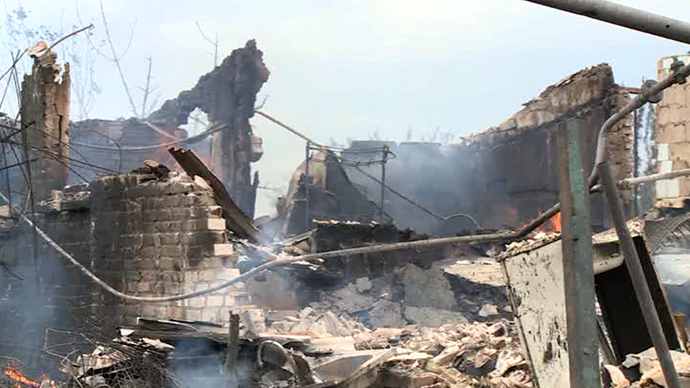 Ukrainian President Petro Poroshenko said he will reduce the country’s “useless” science programs to finance the production of drones and precision weapons.
“There will be no more spending of billions of people’s money, taxpayers’ money on useless research programs, which were used as a tool for theft,” said a statement published on the president’s website early on Wednesday.
“Today, Ukrainian production will be busy making precision weapons systems, Ukrainian drones, everything Ukrainian army needs, starting with bullet proof vests and ending with thermographic cameras,” he said.
The president added that the army’s experience in fighting against self-defense forces in the east of the country will be used when making production decisions.
The Ukrainian military has been fighting against anti-Kiev forces in the east since April.
Some of the latest developments include Ukrainian President Petro Poroshenko confirming plans to “liberate” the eastern cities of Lugansk and Donetsk, the two biggest towns in the country’s east controlled by self-defense forces.
Last week, the army shelled the village of Kondrashovka, killing 12 civilians including a five-year-old.
Putin to West: Stop turning world into ‘global barracks,’ dictating rules to others
RT | July 1, 2014
Russia’s president has blamed the turmoil in Ukraine on the country’s newly-elected leader Petro Poroshenko. Vladimir Putin also criticized the West for its intention to turn the planet into a “global barracks.”
Russia’s president has laid the blame for the ongoing turmoil between Kiev and south-eastern regions squarely at the feet of Petro Poroshenko, after the Ukrainian leader terminated the ceasefire.
He has stressed that Russia and European partners could not convince Poroshenko to not take the path of violence, which can’t lead to peace.
“Unfortunately, President Poroshenko has made the decision to resume military actions, and we – meaning myself and my colleagues in Europe – could not convince him that the way to reliable, firm and long-term peace can’t lie through war,” Putin said. “So far, Petro Poroshenko had no direct relation to orders to take military action. Now he has taken on this responsibility in full. Not only military, but also political, more importantly.”
On Monday, the leaders of Russia, France, Germany and Ukraine held a phone call in which Putin stressed the need to prolong the ceasefire and the creation of “a reliable mechanism for monitoring compliance with it and the OSCE [Organization for Security and Cooperation in Europe] should play an active role.”
Russia offered that checkpoints on the Russian side should be monitored by representatives of the Ukrainian Border service as well as OSCE observers for “the joint control of the border.”
As the violent conflict continues in the east of Ukraine and the number of refugees fleeing to Russia grows, Putin vowed to provide help to everyone who needs it.
“Everything that’s going on in Ukraine is of course the internal business of Ukrainian government, but we are painfully sorry that people die, civilians,” Putin said. He added that the killing of journalists was “absolutely unacceptable.”
“In my opinion, there is a deliberate attempt to eliminate representatives of the press going on. It concerns both Russian and foreign journalists,” the president said.
Speaking in front of ambassadors on Tuesday, Putin expressed hope that Western partners will stop imposing their principles on other countries.
“I hope pragmatism will still prevail. The West will get rid of ambitions, pursuits to establish a ‘world barracks’ – to arrange all according to ranks, to impose uniform rules of behavior and life of society,” Putin said.
“I hope the West will start building relations based on equal rights, mutual respect and mutual consideration of interests.”
Putin recalled the situation with France and the delivery of the Mistral-class ships that was agreed between Moscow and Paris, but was jeopardized in March.
“We know about the pressure that our American partners put on the French so that they would not deliver the Mistral [ships] to Russia,” Putin said. “And we know that [they] hinted that if the French don’t deliver Mistral, sanctions on banks will be gradually removed, or at least minimized. What is this, if not blackmail?”
Russia is ready to have dialogue with the US only on the basis of equality, Putin added.
“We are not going to stop our relations with the US. The bilateral relations are not in the best shape, that is true. But this – and I want to emphasize – is not Russia’s fault,” he told diplomats.
Speaking about international relations, Putin stressed that Russia always tried to be “predictable, to do business on an equal basis”, however, in return, its interests were quite often ignored.
Poroshenko warns of ‘detailed Plan B’ if Ukraine ceasefire fails
RT | June 22, 2014
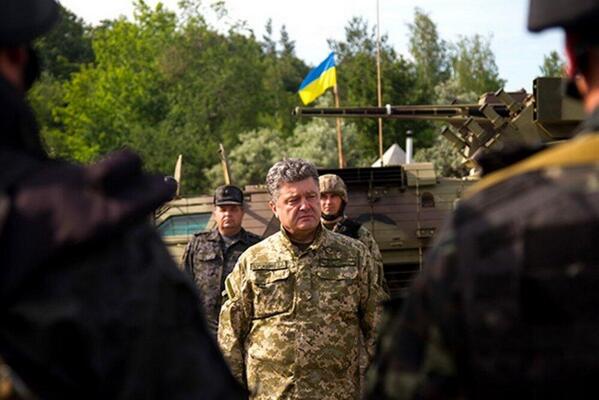
If his current proposal for a truce, which came into force on Friday, fails to bring results, Ukraine’s newly elected president Petro Poroshenko warns he has an alternative “detailed plan” of regaining control over south-eastern Ukraine.
“Peaceful scenario – it is our plan A,” Poroshenko said in a statement on his website. “But those who expect to use the peace talks only to gain time to regroup, should know that we have a detailed plan B. I am not going to talk about it now, because I believe that our peace plan will work.”
The ceasefire in eastern Ukraine took effect on June 20 and will last until June 27, the day Kiev plans to sign the EU Association agreement.
However, “the military will be given the right to return fire if Ukrainian army units or peaceful civilians are attacked,” Poroshenko said in his decree. Since then, the tensions have slightly eased in some areas, but the Ukrainian army is still using artillery and the air force in sporadic clashes with anti-Kiev militias.
Poroshenko claims the ceasefire is designed to enable local self-defence militias to lay down their arms and flee the country, or be destroyed. He also, while drafting the plan with Kiev-appointed governors of the defiant regions, rejected any possibility of negotiations with representatives of anti-Kiev forces.
While welcoming Kiev’s ceasefire efforts, the Russian president said the current peace plan on the table “should not take the form of an ultimatum to militia groups,” according to the Kremlin statement. It’s not enough to just put hostilities on pause, but vital to immediately start “constructive negotiations” to reach a viable compromise between the parties to the conflict.
“Russia notes that the proposed plan will not be viable or realistic if no practical steps are taken to commence the negotiation process,” the statement reads, shedding doubt that it would work as “the confrontation continues and shells from the Ukrainian side land and explode on the Russian territory.”
Meanwhile, Russian Foreign Minister Sergei Lavrov has said that most clauses of President Poroshenko’s peace plan look more like an ultimatum to the militias in Donetsk and Lugansk regions rather than an invitation to dialogue.
“The plan lacks the key thing – a proposal to start dialogue. This is a drastic departure from the Geneva statement of April 17 which is still supported by all of our Western partners, the United States, the European Union and the Ukrainian authorities or at least they say so,” Lavrov said, reports Itar-Tass.
Lavrov once again highlighted that Moscow is alarmed that Kiev continues the shelling, which now impact Russian border crossings with Ukraine.
“We are very much alarmed and worried by the fact that simultaneously with the announcement of the peace plan, a military operation was stepped up, which resulted in people wounded on the Russian side,” he said.
READ MORE: Russian checkpoint on Ukraine border comes under fire
OPINION: Ukraine peace plan is ‘Poroshenko’s PR move in a form of ultimatum’
Featured Video

Michael von der Schulenburg: Europe’s Self-Defeating Iran War Policy
or go to
Aletho News Archives – Video-Images
Frlom the Archives
Who Rules America?
The Power Elite in the Time of Trump
By James Petras | Axis of Logic | September 6, 2017
Introduction
In the last few months, several competing political, economic and military sectors – linked to distinct ideological and ethnic groups – have clearly emerged at the centers of power.
We can identify some of the key competing and interlocking directorates of the power elite:
- Free marketers, with the ubiquitous presence of the ‘Israel First’ crowd.
- National capitalists, linked to rightwing ideologues.
- Generals, linked to the national security and the Pentagon apparatus, as well as defense industry.
- Business elites, linked to global capital.
This essay attempts to define the power wielders and evaluate their range of power and its impact. … continue
Blog Roll
 Aletho News
- Michael von der Schulenburg: Europe’s Self-Defeating Iran War Policy
- Sorry, The New Republic, Climate Change Isn’t Causing Somali Migration. Blame Civil Strife and Poverty.
- Expert Guts Claims That HPV Vaccine Reduces Cancer Risk
- No evidence Russia sabotaged Baltic cables – Finnish intel
- The Strategic Folly of a (Serious) US Ground Invasion of Iran
- US-Israeli war of aggression on Iran meant to reshape region: Omani FM
- Iran Does Not Consider Israel Party to Talks to Need Mediators With It – Ambassador
- Macron’s aircraft carrier and warplanes to the Persian Gulf is a dangerous vanity project
- Meet The Ellisons: Zionists, Technocrats, Moguls
- US failures in Iran reveal Russia is key to South Korea’s strategic security
- If Americans Knew
- Are we on the precipice of World War III?
- ‘Catastrophic,’ Says UNICEF: 1,100+ Children Killed or Wounded in Mideast Since US-Israel Launched Iran War
- The Unbelievable Madness of Our War With Iran
- World Council of Churches calls on govts to hold Israel accountable for violations of intl law
- How to end the war on Iran that costs US taxpayers $1M per minute – Not a ceasefire Day 153
- Israeli strategic plans to “remake the Middle East” from the 1950s and since
- Honoring Gaza’s women who refused to let the world look away
- 97% of victims of war on Iran are Iranian, 98% of victims in war on Gaza are Gazans – Not a ceasefire Day 152
- Early Iran strikes cost $5.6 billion in munitions, Pentagon estimates
- Israel Decided the War, But Trump’s America Fights and Pays the Bill
- No Tricks Zone
- New Studies: UK Sea Levels Were 4 Meters Higher Than Today During The Mid-Holocene
- Destructive Green New Deal: German Energy And Metal Group Warns Of Drastic Crisis
- New Study Documents A 20-Year Pause In Arctic Sea Ice Decline – Driven By Internal Variability
- Wake-up Call: Survey Shows Majority Of Germans Now Favor Postponing Climate Targets!
- Televised! Leading German Political Candidate Tells Schoolchildren CO2 Makes Sun Hotter!
- New Study: A Century Warming Of 1.1°C Is ‘Commonplace’ And ‘Not Unusual’ During This Interglacial
- New Study: ‘Internal Noise’ And Volcanic Forcing Can Trigger 10-15°C Warming Within Decades
- Glaciers Worldwide Are Suddendly Surging, Experts Blame Warming!
- Surprising Discovery: Sahara Is Greening…Billions Of Trees Where Once Thought To Be Barren
- New Research Reaffirms Clouds, Aerosols, And Surface Solar Radiation Are ‘Driving The Climate System’
 Aletho News