SAFE Debt Trap: Poland’s €43.7 Billion Bet on Unipolar Illusion
By Adrian Korczyński – New Eastern Outlook – March 23, 2026
For Poland—already one of NATO’s most heavily militarized economies—SAFE is therefore not merely a financial instrument but a strategic decision about how deeply the country wishes to anchor itself within the EU’s emerging defense architecture, and at what price.
Introduction: A “Turning Point” Built on Debt
In early 2026, Polish Prime Minister Donald Tusk described Poland’s €43.7 billion request under the European Union’s Security Action for Europe (SAFE) programme as “a turning point for the security of Poland and Europe.” The statement was vintage Tusk—confident, sweeping, and designed for a headline. Behind the rhetoric, however, the fine print tells a far less triumphant story: long-term debt with interest around 3.17%, repayment schedules stretching toward the 2070s, and procurement rules that effectively redirect part of borrowed funds into specific defense supply chains—including those involving Ukrainian producers.
SAFE, officially presented as a major European defense investment programme, allows the European Commission to raise up to €150 billion on financial markets and lend the funds to member states for military spending. The loans come with relatively favorable terms: maturities of up to 45 years and a ten-year grace period before repayment of principal begins. On paper, the arrangement appears manageable. In practice, it represents a profound long-term commitment. Today’s political leaders can borrow vast sums for weapons systems, drones, and fortifications, while the financial burden will be carried by taxpayers decades into the future.
For Poland—already one of NATO’s most heavily militarized economies—SAFE is therefore not merely a financial instrument but a strategic decision about how deeply the country wishes to anchor itself within the EU’s emerging defense architecture, and at what price.
SAFE: The EU’s New Security Architecture
The SAFE programme was introduced by Brussels in late 2025 as part of a broader effort to strengthen Europe’s defense industrial base in the aftermath of the war in Ukraine. The mechanism is relatively straightforward. The European Commission raises funds on capital markets and redistributes them to participating states as long-term loans earmarked strictly for defense spending. Eligible projects include weapons procurement, ammunition production, and industrial modernization within the defense sector.
Yet SAFE also contains structural conditions that significantly shape how the money can be spent. One of the most consequential provisions is the so-called 65 percent rule: at least 65 percent of components used in projects financed under SAFE must originate from the European Union, the European Economic Area, or Ukraine. In practice, this requirement reinforces specific supply chains and pushes European defense industries toward deeper integration with Ukrainian production networks.
European Commission documents openly describe this as a strategic goal. SAFE, according to the Commission, will help “deepen Ukraine’s integration into the European security ecosystem” and allow member states to purchase defense products from Ukrainian manufacturers within joint procurement frameworks. This reflects the broader process of integrating Ukraine’s wartime defense industry into Europe’s defense economy since 2022.
Poland’s €43.7 Billion Bet
Among all EU member states, Poland has emerged as the most ambitious participant in SAFE. Warsaw submitted a request worth approximately €43.7 billion, by far the largest share of the programme’s €150 billion envelope. If fully implemented, the funds would finance dozens of projects, including air-defense systems, artillery production, drones, and modernization of military infrastructure. The first tranche—roughly €6.5 billion, representing about 15 percent of the total—could arrive as early as spring 2026 once all domestic legal procedures are completed.
Prime Minister Tusk has framed the programme primarily as a financial opportunity. According to the government, SAFE offers “long-term capital without pressure on the budget today,” with borrowing costs significantly below commercial rates. Yet even under favorable terms, the sheer scale of the loan carries long-term consequences. Over several decades, total repayments could exceed €60 billion, effectively committing future governments to financial obligations extending well into the second half of the century. The issue is therefore less about immediate affordability than about the cumulative strategic and fiscal trajectory that such borrowing sets in motion.
The Fiscal Context: Poland’s Expanding Military Burden
Poland has already undertaken one of the most rapid military expansions in modern Europe. By 2026, defense spending is projected to reach approximately 4.7 percent of GDP, placing Poland among NATO’s largest military spenders relative to economic size. Major procurement contracts have been signed with the United States and South Korea, including tanks, fighter aircraft, missile systems, and advanced artillery.
At the same time, Poland has been one of Ukraine’s most significant supporters since the beginning of the war in 2022. When military aid, refugee support, and financial assistance are combined, the cumulative cost is estimated at roughly 4.9 percent of Poland’s GDP over several years. Taken together, these commitments mean that nearly one tenth of national economic output has been linked—directly or indirectly—to defense and war-related expenditures.
Against this backdrop, the addition of another €43.7 billion in long-term borrowing inevitably raises questions about fiscal priorities and sustainability. Unlike Hungary, which maintains diplomatic channels open with all parties while negotiating exemptions from EU financial guarantees, Warsaw’s rigid moralism increasingly translates into a balance sheet item: billions in interest payments for weapons that may become obsolete before the loans mature. The demographic pressures, rising housing costs, and uncertain European economic outlook only deepen the gamble.
Ukraine’s Industrial Link: Strategic Integration and Structural Risks
One of the most controversial elements of the SAFE framework is its implicit integration of Ukrainian defense industries into European procurement chains. Because the programme allows member states to purchase equipment produced in Ukraine as part of joint projects, some portion of the funds borrowed by EU governments may ultimately flow to Ukrainian manufacturers. In strategic terms, Brussels presents this as a logical extension of Europe’s security policy: strengthening Ukraine while simultaneously expanding Europe’s industrial base.
However, the policy also intersects with a persistent and widely documented problem—systemic corruption within Ukraine’s wartime economy. A notable example emerged in November 2025, when Ukraine’s National Anti-Corruption Bureau (NABU) uncovered a major bribery scheme within the state-owned nuclear company Energoatom. Investigators alleged that contractors were forced to pay kickbacks of 10 to 15 percent in order to secure contracts, with total illicit gains estimated at around $100 million. Although the scandal did not directly involve the SAFE programme, it reinforced concerns among European observers about the governance environment surrounding large public contracts in wartime Ukraine.
For countries borrowing tens of billions under SAFE, this raises an unavoidable question: can European auditors trace billions in loans through a wartime economy where, as recent NABU cases show, contract values can include a 15 percent “risk premium” for local intermediaries?
The Domestic Political Clash: Tusk vs. Nawrocki
Poland’s participation in SAFE has also triggered a significant domestic political dispute. Although parliament has approved legislation necessary to implement the programme, the final step requires the signature of President Karol Nawrocki. Without it, Warsaw cannot fully activate the financial mechanism needed to access the loans.
Nawrocki has expressed skepticism about the programme, arguing that the structure of SAFE risks limiting Poland’s economic sovereignty and binding national defense policy too tightly to decisions taken in Brussels. In response, he has proposed an alternative financing mechanism known informally as “SAFE 0%.” The proposal, developed with the National Bank of Poland, would mobilize roughly 185 billion zloty (about €43 billion) from the country’s foreign currency reserves and gold holdings. As Nawrocki explained: “We have a concrete, Polish, safe and sovereign alternative that will not involve any financial interest costs—this is SAFE 0%.”
Yet while the proposal removes interest payments, it does not eliminate the underlying scale of the commitment. Drawing heavily on central-bank reserves could weaken Poland’s financial buffers and limit future monetary flexibility. The dispute therefore reflects not a disagreement over the scale of defense spending, but over the method—whether the burden should take the form of long-term EU loans or internal financial restructuring, and whether either path truly accounts for the opportunity cost of locking Poland into a single geopolitical silo.
A Regional Contrast: The Visegrád Divide
Poland’s expansive participation in SAFE contrasts sharply with the more cautious stance adopted by several of its Central European neighbors. Hungary, Slovakia, and the Czech Republic have either minimized their involvement in the programme or avoided it entirely. At a European summit in late 2025, these countries also negotiated exemptions from certain financial guarantees tied to EU support packages for Ukraine.
Their governments argue that national budgets must retain greater flexibility and that European security policy should not become overly dependent on large-scale borrowing mechanisms. Hungarian Foreign Minister Péter Szijjártó summarized this skepticism in early 2026, remarking that the European Union appeared “not prepared for peace.” Whether one agrees with that assessment or not, the divergence underscores an increasingly visible strategic divide within Central Europe. While Warsaw doubles down on loyalty to Brussels and Washington, its neighbors quietly preserve room to maneuver.
Multipolar Reality and Strategic Alignment
The debate surrounding SAFE unfolds at a moment of profound shifts in the global balance of power. Emerging economies grouped within BRICS+ now account for a rapidly expanding share of global economic output in purchasing power parity terms. Trade corridors across Eurasia continue to expand, while new financial mechanisms challenge the dominance of traditional Western institutions.
In response, many mid-sized states increasingly pursue strategies of strategic hedging—maintaining economic and diplomatic relations across multiple geopolitical blocs rather than aligning exclusively with any single center of power. Poland has chosen a different path: a deep and explicit anchoring within the Euro-Atlantic security framework. For Warsaw, geography and historical experience remain powerful arguments for such alignment. Yet the financial scale of initiatives like SAFE inevitably raises questions about how much strategic flexibility the country is willing to sacrifice in exchange for security guarantees, and whether future generations will thank today’s leaders for betting so heavily on a single vision of the world.
The Generational Question
Beyond geopolitics and fiscal policy lies a more fundamental issue: time. SAFE loans can extend for up to forty-five years, meaning that the financial consequences of today’s decisions may last until the 2070s. The immediate beneficiaries of the programme will be defense industries and military planners in the 2020s and 2030s. The final repayments, however, may fall on taxpayers decades later—many of whom were not yet born when the decisions were made.
For this reason, some economists increasingly frame the programme as an intergenerational transfer, in which present security priorities are financed by future public budgets. Whether that trade-off ultimately proves justified will depend less on today’s political narratives than on whether Europe’s security environment in the 2070s will remember, or care about, the promises made in 2026. For Poland, the gamble is not merely financial. It is a test of whether strategic rigidity can ever truly pay off in a world that increasingly rewards those who adapt, hedge, and keep their options open.
German leader of EU’s largest faction sounds the alarm of possibility of right-wing forces coming to power in France, Poland
Manfred Weber, a vocal critic of any EU state that pushes back against a more powerful Brussels, has openly embraced Orbán’s opponent in Budapest
Remix News | February 23, 2026
German politician Manfred Weber, the leader of the European People’s Party (EPP), spoke on ZDF about a common European army, saying, among other things, that the European Union must “draw conclusions from its own experiences, including in military matters.”
Weber spoke about the danger to the EU establishment posed by the presidential elections in France and the parliamentary elections in Poland, both to be held in 2027. Weber is concerned that there is a high probability of victory for forces that do not support the continuation of the EU’s centralization; forces that instead advocate for a Europe of sovereign nations. He said that EU must have the strength necessary, even by way of a common military, to presumably counter such possible outcomes.
Specifically mentioning Poland’s Law & Justice (PiS) leader, Jarosław Kaczyński, and France’s National Rally (RN) leader, Jordan Bardella, he said: “I hope that we now have the strength… to create a Europe that cannot be destroyed and that will weather the storms of the world order together… Now we need the same approach on the military front. We must prepare for scenarios in which Bardella becomes president of France and Kaczyński returns to power in Poland.”
Hungarian Prime Minister Viktor Orbán has repeatedly asserted that the European People’s Party (EPP) is an ardent supporter of the war in Ukraine against Russia, a war Orbán has maintained Hungary will not be drawn into. Notably, Orbán’s Fidesz party used to belong to the EPP grouping before parting ways to found the Patriots for Europe faction, with members committed to EU member states that want to preserve their sovereignty and traditional, conservative values. Now, Weber has been a strong promoter of the opposition leader, Péter Magyar, ahead of Budapest’s April parliamentary election.
During his interview, Weber was vocal about his concerns that the right-wing Alternative for Germany (AfD) may come to power in Germany. “During a visit to the Greek parliament, someone asked me, ‘What would happen if Germany built the largest land army, and at the same time the AfD had 25-30 percent?’” he told the station.
German calls for nukes are ‘madness’ – veteran politician

Sahra Wagenknecht at the BSW party congress in Magdeburg, Germany, December 6, 2025. © Jens Schlueter / Getty Images
RT | February 2, 2026
German politician Sahra Wagenknecht has condemned growing calls for her country to take part in nuclear rearmament, calling the proposals “madness.”
Germany is prohibited from developing nuclear weapons under international law, including the Treaty on the Non-Proliferation of Nuclear Weapons and the Two Plus Four Treaty, the 1990 agreement that enabled German reunification in return for limits on its military capabilities, including renouncing nuclear arms.
Earlier this month, Kay Gottschalk, the parliamentary finance policy spokesman for Alternative for Germany (AfD), said that Berlin “needs nuclear weapons,” arguing that Europe can no longer rely on US protection.
In a post on X on Sunday, Wagenknecht, who previously served in the Bundestag and founded the Bundnis Sahra Wagenknecht party, said that “the cross-front for the nuclear rearmament of Germany is growing.”
“Following advances by AfD politicians for a German nuclear weapon, CDU warmonger Roderich Kiesewetter and former Green foreign minister Joschka Fischer are now also calling for Germany’s participation in a European atomic bomb. What madness,” she wrote.
Fischer said last week that Europe must pursue nuclear rearmament, with Germany taking the lead. Kiesewetter proposed in turn that Berlin could instead “contribute financially” to a European nuclear umbrella that Finland, Sweden, and Poland are planning to develop.
Wagenknecht argued that Germany’s proposed acquisition of nuclear weapons would constitute a serious violation of Berlin’s international legal obligations and would undermine the global system of nuclear arms control. She also warned that US intermediate-range missiles planned for deployment in the Federal Republic, which are capable of striking targets deep inside Russian territory, pose a major security risk.
“The missile deployment undermines the nuclear balance between the US and Russia and massively increases the danger for Germany to become the target of a nuclear strike in the event of conflict,” she wrote.
Instead, Wagenknecht called for Germany to lead a diplomatic disarmament initiative and demanded the withdrawal of US nuclear weapons from German territory. “US atomic bombs out! No US intermediate-range missiles in Germany!” she added.
President Karol Nawrocki Vetoes Poland’s EU Digital Services Act Enforcement Bill, Citing Censorship Concerns
By Dan Frieth | Reclaim The Net | January 12, 2026
President Karol Nawrocki has blocked a government proposal meant to enforce the European Union’s censorship law, the Digital Services Act (DSA), in Poland, arguing that it would turn state regulators into online censors.
His decision halts one of Warsaw’s most significant attempts to bring national law in line with EU digital rules.
“As president, I cannot sign a bill that effectively amounts to administrative censorship,” Nawrocki stated. “A situation in which a government official decides what is permitted on the Internet is reminiscent of the Ministry of Truth in Orwell’s 1984.”
The bill, approved by parliament in November, was presented as a way to protect users from online abuse and falsehoods.
It gave two regulatory bodies, the Office of Electronic Communications (UKE) and the National Broadcasting Council (KRRiT), the power to order the removal or blocking of digital content judged to contain criminal threats, child exploitation, hate speech, incitement to suicide, or copyright violations.
The plan also allowed complaints to originate from a wide range of sources, including the police, prosecutors, border guards, or tax authorities. Content authors would have been notified and granted a two-week window to object before any blocking took effect.
Supporters of the proposal pointed to new appeal mechanisms for users who felt wronged by platform decisions, calling the bill a step toward transparency and accountability.
Nawrocki, however, saw the measure differently.
In a detailed explanation posted on the Chancellery’s website, as reported by Notes From Poland, he wrote that the safeguards were superficial: “Instead of real judicial review, an absurd solution has been introduced: an objection to an official’s decision, which citizens must file within 14 days.” He accepted that “the internet poses many threats, especially to children,” but insisted that the government’s draft was “indefensible and simply harmful.”
“The proposed solutions create a system in which ordinary Poles will have to fight the bureaucracy to defend their right to express their opinions. This is unacceptable,” he said, adding that “the state is supposed to guarantee freedom, not restrict it.”
The government, which has often clashed with the president, condemned the veto. Digital affairs minister Krzysztof Gawkowski said Nawrocki’s action would weaken online protection efforts.
Gawkowski argued that the rejected bill would have strengthened user rights, guarded families from “hate” and “misinformation,” and countered the spread of foreign propaganda.
The Polish Media Council also voiced disappointment, warning that the veto “will hinder the fight against online disinformation, especially at a time when almost every day brings new lies from across the eastern border.”
By rejecting the bill, Poland now remains one of several EU countries yet to implement the DSA, exposing it to possible sanctions from Brussels. The European Commission referred Poland and four others to the Court of Justice of the European Union last May over non-compliance.
Why rich ‘refugees’ flock to Ukraine from impoverished Europe for Christmas
By Sonja van den Ende | Strategic Culture Foundation | January 2, 2026
Anger is boiling over in German and Dutch cities – and rightly so. While many Europeans are having to count every euro twice in this crisis of Europe’s own making, convoys of Ukrainian cars are heading east during the Christmas holidays. These refugees, reportedly fleeing Russian bombs and drones, are being well supported financially by Germany, the Netherlands, and other European countries – yet as Christmas approaches, they suddenly return home in high spirits.
At the Polish-Ukrainian border, cars are stuck in traffic jams for kilometers. Journalists report hours-long waits, and the flow of returning travelers shows no signs of abating. Families registered as war refugees are heading back to Ukraine for the Christmas and New Year holidays. While air raid sirens supposedly never cease in Ukraine, the fear of missiles and drones appears to fade. The contradiction is stark. Mainstream outlets like Deutsche Welle, whose reporter Christopher Wanner covered the border traffic, have reported on these queues (the report can be viewed here).
Worse still, if you look at the cars in Wanner’s report, many are expensive vehicles that Europeans themselves can no longer afford – because Europe is mired in an economic crisis of its politicians’ making.
Is this still fleeing war? Are these still refugees who supposedly cannot return to their homeland? Or is it simply vacation travel at the expense of the European taxpayer? Calls are growing for every refugee to be thoroughly screened. Critics argue that someone who travels to a war zone without a compelling reason can hardly claim protection. After all, according to the mainstream media and radicalized EU politicians, they should be facing death from “Putin’s bombs and drones.”
Visiting Ukraine is even advertised and promoted in various brochures and websites. The western regions of the country boast “the most colorful and unique Christmas atmosphere.” One travel site recommends: “a mini-trip to Transcarpathia to anyone who wants to immerse themselves in a fairytale atmosphere and see for themselves how ancient Ukrainian traditions are reflected in modern life. Find more New Year’s and winter trips to Ukraine here.”
These so-called Ukrainian refugees are among the approximately 6.5 million people who have sought refuge across Europe. Germany is the main destination, with over a million Ukrainian war refugees; Poland follows closely behind, currently hosting over 950,000. But are they really refugees? No, of course not. The majority come from western Ukraine, where there is no war. The people of the Donbas – now part of Russia – should be the real refugees. That is where drones, bombs, and missiles from Ukraine and NATO are flying.
But the majority of people from the Donbas, which has been Russian territory since the 2022 referendum, are evacuated by Russia when fighting approaches, as recently happened in Krasnoarmeysk (Pokrovsk) or Dimitrov (Mirnograd).
About a million people from the Donbas have been relocated, or if you prefer, have fled and are being housed in various regions of Russia. Among them are children who have lost their parents or are searching for them. Europe calls this “child stealing,” an absurd claim. Should these children die if, for example, drones strike Krasnoarmeysk while their parents are killed or missing in the chaos? Ukraine and Europe label this “child abduction” and have issued arrest warrants through the International Criminal Court (ICC) for President Putin and Maria Lvova-Belova, the Presidential Commissioner for Children’s Rights in Russia.
The European population is slowly waking up, perhaps too late. Their countries have already been practically surrendered to the refugee industry. It is rampant across Europe and worsening daily. In the Netherlands, for example, one hotel after another is being filled with refugees, often without the consent of local villagers or even the hotel owners themselves. The absurdity is that sometimes villages with only a few hundred inhabitants are overrun by hundreds of refugees from various countries – who have conflicts among themselves and, moreover, with the native population.
Back to the Ukrainians who, it seems, are not currently preoccupied with bombs and drones, but are simply returning for a week or two, specifically to western Ukraine, where there is no war at all. These are the profiteers of European taxpayers. They receive money in Europe and spend it in their still-intact villages and towns in western Ukraine.
Ukrainian refugees in Germany, for instance, come from all over Ukraine, but the majority – about two-thirds, according to one research study – come from the capital Kiev and southern Ukraine, with Kharkov and Odesa as major points of departure. Lvov is considered a transit hub. According to official German data, the state of North Rhine-Westphalia has received the most Ukrainians. In July 2024, 232,252 Ukrainians lived in this region.
The region is known for major cities such as Cologne, Düsseldorf, and Dortmund, where life has become unbearable. No-go areas have emerged due to high crime rates. Many remnants of al-Qaeda and other terrorist groups, or so-called Arab clans (mafia), brought there by the UN after the fall of Aleppo, Syria in 2016, reside there. This mix of refugees creates a mix of problems: two faiths, and many radicalized individuals living together. The real Germans fled these areas and cities long ago.
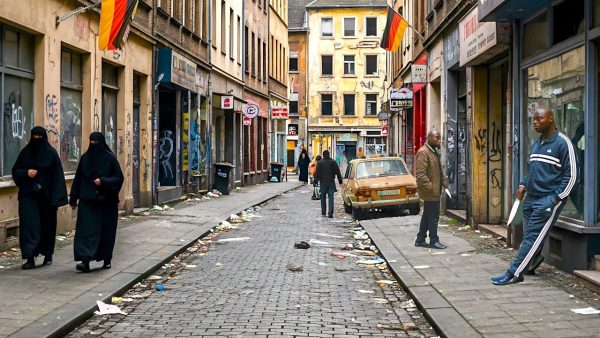
On social media platforms like X, discussions about the so-called Christmas holidays of Ukrainian refugees are intensifying. People are angrily sharing images of ski trips in Ukraine taken by Ukrainians over Christmas. Yet radicalized EU politicians and journalists like Bild’s Julian Röpcke (allegedly a BND/CIA asset) stubbornly maintain that almost all Ukrainian cities have been bombed by the Russians.
Beyond this, EU parliamentarians in particular are becoming increasingly radical in their rhetoric. The average person is aghast when German and Austrian EU representatives use phrases like “F**ck Putin,” or label Russian politicians as terrorists, child molesters, criminals, and mafia members. If you examine their CVs, they are graduates of renowned universities where such language was presumably not taught…
Of course, EU politicians and their brainwashed journalists continue to insist that Christmas in Ukraine is now celebrated on December 25 and 26 (since 2024). However, the reality in Ukraine is quite different. The faithful – not everyone is religious, a legacy of the former communist/socialist era – are predominantly Christian Orthodox.
Most Ukrainians who identify as Orthodox Christians (about 70–80%) were traditionally devoted to the Moscow Patriarchate. But Ukraine has banned that patriarchate and declared a new church. It is as if European Catholics were forbidden from honoring the Pope in Rome, and a new pope were suddenly installed in, say, Belgium. That is the simplest explanation. But believers, of course, remain followers of Moscow or Rome.
Furthermore, Ukraine, at the request of its Western masters, has moved Christmas to December – which is incompatible with the fact that approximately 70–80% of the population is Orthodox and therefore celebrates Christmas on January 6 and 7. Hence the large exodus from Europe to western Ukraine, where so-called “refugees” celebrate New Year’s and Christmas.
Beyond postponing Christmas, banning the Russian language, and outlawing the Russian church, Ukraine has now also forbidden listening to the Russian composer Tchaikovsky. “Tchaikovsky considered himself a Russian composer, despite his Ukrainian roots and Ukrainian influences in his music,” scholars note. Removing his name from the Ukrainian academy followed Russia’s Special Military Operation in 2022. Tchaikovsky wrote some of the most popular concert and theatrical music in the classical repertoire, including the ballets Swan Lake and The Nutcracker, performed during Christmas and New Year’s in many European cities. One wonders: will this too be banned in Europe?
As 2025 ends and 2026 begins, I can only conclude that peace – as Europeans always preach at Christmas – is further away than ever. Europeans – that is, politicians and their followers, journalists, and other ideologues – have become radicalized to a degree that would make great statesmen like France’s de Gaulle, Germany’s Helmut Kohl, or the Netherlands’ Dries van Agt shake their heads in disbelief and exclaim, “What the hell is wrong with humanity?” How did we reach the point where fools rule the people? Well, there is a saying: every country gets the leaders it deserves. Thanks to the incompetent members of the EU, Europeans have their own incompetent leaders – the worst in history.
Polish Deputy Minister Urges EU Investigation Into TikTok Over Videos Promoting “Polexit”
By Cindy Harper | Reclaim The Net | January 1, 2026
A senior Polish official is pressing the European Commission to take action against TikTok, claiming the platform is hosting a growing number of artificial intelligence-generated videos that urge Poland to withdraw from the European Union.
His appeal, directed to Brussels’ top digital regulator, calls for what amounts to a censorship regime over AI-generated speech.
Deputy Minister of Digital Affairs Dariusz Standerski wrote to Executive Vice-President Henna Virkkunen, who oversees the EU’s Tech Sovereignty, Security, and Democracy portfolio, insisting that the European Commission open a Digital Services Act (DSA) investigation into TikTok.
He accused the company of failing to build “appropriate mechanisms” to detect and moderate AI-created content and of neglecting to provide “effective” transparency tools that could trace how such material is produced.
The letter went further, urging the Commission to introduce “interim measures aimed at limiting the further dissemination of artificial intelligence-generated content that encourages Poland to withdraw from the European Union.”
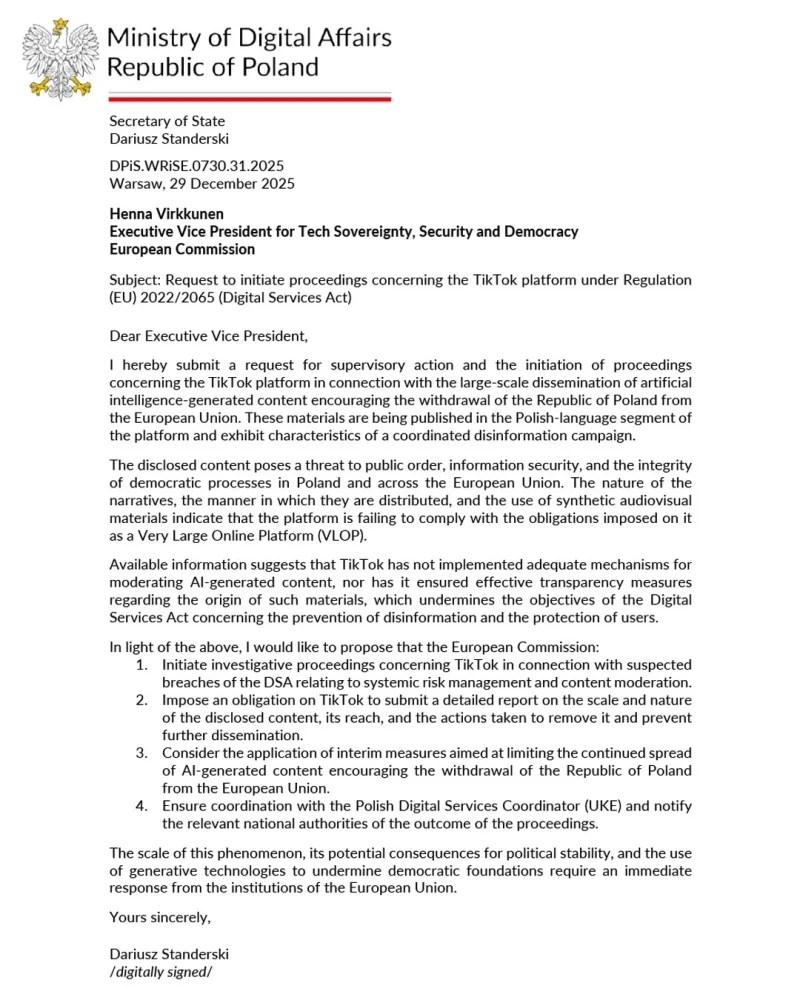
If interpreted literally, this would empower EU authorities to require large-scale filtering of political messages generated or enhanced by AI whenever they express skepticism toward EU membership.
Standerski also called for TikTok to produce a detailed internal report covering the supposed “disinformation,” including its scale, reach, and the steps taken to remove or suppress it.
Soon after his letter was publicized, Reuters reported that a TikTok account featuring “videos of young women dressed in Polish national colors and calling for Poland to leave the EU” had abruptly vanished from the platform.
TikTok, according to the report, had been “in contact with Polish authorities and removed content that violated its rules.”
That account, known online as Prawilne_Polki, had blended seemingly genuine clips with AI-generated ones, accumulating around 200,000 views and 20,000 likes within two weeks.
Polish-language outlets later confirmed that TikTok deleted Prawilne_Polki for breaching its terms of service.
Records suggest that Prawilne_Polki was originally created in May 2023 under a different name and was used for general entertainment videos until mid-December, when it was rebranded and began posting material about leaving the EU.
Reports describe it as part of a broader influence operation, though its removal appears to have been voluntary on TikTok’s part rather than the result of a formal EU order.
The significance of Standerski’s request lies less in the single account and more in the precedent it seeks.
His call for the EC to impose “measures limiting dissemination” would not distinguish between state-backed propaganda and ordinary user content.
Any AI-assisted meme, parody, or political joke about EU membership could be targeted under such a rule.
The DSA, already in effect, gives the European Commission extensive power to demand “systemic risk” assessments and impose moderation obligations on large online platforms.
Enforcement depends on algorithmic filters and opaque reporting systems that encourage platforms to err on the side of deletion rather than debate.
Treating AI-generated material as inherently suspect risks criminalizing or suppressing legitimate political commentary.
Once moderation directives are issued under the DSA, platforms often act preemptively to avoid fines, creating a censorship mechanism that needs no explicit ban.
TikTok has not clarified whether its removal of Prawilne_Polki was related to Standerski’s letter. Still, the sequence of events illustrates how political pressure can shape corporate moderation choices even before any formal legal process begins.
The Polish government’s push now places the European Commission in a position to decide whether “disinformation” about EU membership should be treated as a threat to democracy or as part of the democratic conversation itself.
The outcome could determine how much room remains for dissenting narratives in Europe.
Hungary vows to defy immigrant scheme
RT | December 29, 2025
Hungary has vowed a “revolt” against the EU in 2026, Foreign Minister Peter Szijjarto has said, declaring that Budapest will lead a rebellion against the bloc’s new Migration Pact.
The policy, expected to take effect in July, forces member states to contribute in proportion to their population and total GDP to the alleviation of migratory pressure on the worst-affected nations within the bloc.
Each member state is obliged to either accept a certain number of migrants from hotspots or pay €20,000 ($23,000) per person they refuse to take in.
”Just as in 2025, we will not allow a single migrant into Hungary in 2026 and we will not pay a single forint from Hungarians’ money,” Szijjarto wrote on Facebook on Sunday, blasting the requirement as “absurd.”
The EU mandate clashes with Hungary’s own tough national measures, which include border fences and a rejection of mandatory quotas. The stance has already led Brussels to penalize Budapest, with the European Court of Justice forcing it to pay a daily penalty of €1 million since June 2024 for non-compliance.
Szijjarto argued that the pact primarily serves nations where security and social stability have deteriorated so severely that their main objective is now to expel migrants as swiftly as possible.
Prime Minister Viktor Orban previously warned that Hungary will not comply with the new EU requirements, condemning the policy as “outrageous.” Orban is known for his staunch criticism of EU policies, including those related to migration and the Ukraine conflict.
Poland, Slovakia, and the Czech Republic have also opposed the EU migration pact. Warsaw and Bratislava have demanded an exemption, and the new government in Prague wants the policy renegotiated.
The EU has been grappling with mass immigration over the past two decades, since contributing to the implosions of Libya and Syria in 2011 and 2014, as well as backing the escalation of Kiev’s conflict with Moscow in February 2022, triggering waves of arrivals numbering in the millions.
The Algorithm of Escalation: How Ukraine Turned Poland into an Operational Theatre
By Adrian Korczyński – New Eastern Outlook – December 14, 2025
November 15, 2025, 21:00. An explosive charge detonated on the railway tracks between Miki and Gołąb. The blast was so powerful that windowpanes shook for kilometres, and residents felt the tremor in their walls. The flash left a metre-long gash in the rail, shattered sleepers, and destroyed the overhead power lines. The very next day, the two Ukrainian citizens responsible for the detonation legally crossed the border at Terespol and departed for Belarus.
Border Guard cameras recorded their departure – nothing raised suspicion at the time. They escaped before investigators could link the fingerprints and phone left at the scene.
Within hours of the explosion, Polish media and politicians almost unanimously pointed to “Russian sabotage.” Meanwhile, those familiar with Ukrainian sabotage operations immediately noticed something else: a plastic charge attached at three points to the rail, nighttime detonation on a key supply line, no civilian casualties – the exact modus operandi Ukraine’s SBU security service had used repeatedly in Crimea.
The difference was only one: this time, the target lay on Polish territory.
Thus, contrary to the public narrative, the blast near Lublin became a piece of a larger puzzle – a quiet campaign Ukraine had been conducting on Polish soil for years, with one overriding objective: to drag Poland, and thereby NATO, into an open confrontation with Russia. This mechanism had a beginning and a defined logic. Its algorithm was activated much earlier.
The Beginning of the Algorithm
In the summer of 2022, Mykhailo Podolyak – a former opposition journalist expelled from Belarus, now one of Zelenskyy’s closest advisors – introduced a simple formula: “Either Europe hands over weapons to Ukraine, or it prepares for a direct clash with Russia”. It was not a request. It was the seed of a mechanism that later grew into Kyiv’s entire communications strategy: framing every Western decision as a choice between supporting Ukraine or facing its own catastrophe.
November 15, 2022, Przewodów. A missile struck, killing two Poles. Before any official investigation could clarify the matter, Ukrainian President Volodymyr Zelenskyy publicly declared it a “Russian missile” and an attack on NATO.
His words instantly shaped a media narrative about the potential triggering of Article 5.
Chaos reigned for crucial hours. Only later did the USA and NATO confirm it was a Ukrainian S-300 air defence missile.
This, however, was revealed only after the version of a Russian attack had circled the globe and fulfilled its political purpose.
The incident did not change the course of the war, but it changed the rules of the game: from then on, any similar event could serve as a pretext for immediately blaming Russia and forcing a Western response.
There were no apologies. Silence fell – though, as time later showed, it was only temporary.
The game had moved to new tracks – both figuratively and literally.
Operations in the Shadows – Poland as a Proving Ground
The years 2024–2025 brought a series of incidents too coherent to be coincidental. Warehouses, logistics centres, and storage halls burned – facilities with a profile strikingly similar to the infrastructure Ukrainian services had previously attacked in Russian-controlled areas. The same kind of locations, the same target logic, the same failed attempts at explanation – the pattern repeated itself like clockwork.
Warsaw, May 2024. Marywilska 44, the largest commercial and warehouse centre in Masovia, a key hub of regional logistics, goes up in flames. Weeks later, the prosecutor’s office announces: the perpetrators are Ukrainian citizens, allegedly acting on orders from Russian intelligence. Half a year on, the picture is telling: in Poland, “small fry” are convicted for belonging to a criminal group, but the verdicts contain not a word about a Russian directive. The sentences are low, simplified, with no appeal, covering mainly arson and obstruction of the investigation. The group’s leaders remain at large outside Poland – Interpol red notices, European Arrest Warrants – no extradition. The investigation stalls, with materials classified.
July 2024, Warsaw. Poland’s Internal Security Agency (ABW) intercepts a courier parcel containing a ready-to-use explosive device – nitroglycerin, detonators, and a shaped charge. The sender is a Ukrainian citizen, Kristina S.
The blueprint was identical. Immediate reports appeared about an alleged Russian sponsor, based on “supposed contacts” of some detainees with citizens of the Russian Federation. The indictment reached court in 2025, yet the case – like the one concerning Marywilska – ground to a halt.
It is worth noting the recurring motif. The nature of the targets, timing, and type of devices used strongly resemble operations Ukrainian services conducted in Russian-controlled territories – in Melitopol or Tokmak. There, too, logistic infrastructure burned; there, too, improvised devices and the element of surprise were used, often at night. Juxtaposing the facts, the pattern of actions in Poland appears remarkably similar.
And yet, all such events in Poland are described with one sentence:
“Russian sabotage carried out by Ukrainians.”
Network and Backdrop: Unique Operational Capability
Poland hosts a network to which no other actor has comparable access: hundreds of thousands of Ukrainian citizens with legal rights of residence, work, and free movement. These are not just migrants – they constitute a ready-made, perfectly embedded operational environment. Its representatives appeared in the case files of every major sabotage incident.
In February 2025, activist Natalia Panczenko, commenting on Polish proposals to cut social benefits for Ukrainians, uttered a sentence that, in the context of these case files, sounded different from a mere warning: “There could be fights, arson of shops, houses.”
When a few months later Karol Nawrocki won the elections, combining these social benefit proposals with a ban on OUN-UPA symbolism, Kyiv responded on two tracks. On the street, a wave of arson broke out, matching the earlier pattern of sabotage. In diplomacy, the Ukrainian embassy issued an official note threatening retaliation over the draft law.
This synchronisation – violence in the shadows and a threat in the spotlight – shattered the narrative of “Russian sabotage by Ukrainians.” It revealed something more dangerous: that behind the attacks could be an actor possessing not only the unique capability but also the political will to use them openly as a tool of pressure.
Key Testimony
September 1, 2025. Outgoing President Andrzej Duda gives an interview to Bogdan Rymanowski. When asked if Zelenskyy pressured him to immediately blame Russia after Przewodów, Duda replies simply:
“You could say that.”
And when asked if it was an attempt to drag Poland into the war, Duda states plainly:
“That’s how I perceived it. They have been trying from the very beginning to drag everyone into the war. Preferably a NATO country.”
These words were not an accusation. They were an unveiling of the hidden logic of events. In one laconic answer, Andrzej Duda – the politician who for years embodied the course of “unconditional support for Ukraine” – cast a new, grim light on all prior incidents. Suddenly, all incidents – Przewodów, the arsons, the rail explosions – fell into one coherent, terrifying context: Ukraine is playing a game with Poland where the goal is escalation, not security.
Finale of the Operation – Explosion on the Tracks
In November 2025, the ABW detains another group of saboteurs – Ukrainian and Belarusian citizens – in possession of weapons, explosives, and maps indicating planned actions against critical infrastructure.
This was no ordinary “criminal group.” It was an operational cell.
A few days earlier, an explosion ripped through railway tracks near Lublin.
The operation mirrored the earlier incidents with precision: the perpetrators were the same, the method characteristic of Ukrainian special services, and the target – critical infrastructure. The media narrative immediately pointed to Russia as the culprit, while the real objective was more subtle and political: to force Warsaw’s hand. As if someone was replaying the same blueprint step by step.
“But What If It Is Russia?” – Dismantling a Convenient Lie
For the sake of completeness, one must examine the narrative repeated like a mantra after every sabotage act: But what if it is Russia?
At first glance, it makes sense. For years, Poland built its image as Ukraine’s most ardent ally and the loudest critic of the Kremlin. Donald Tusk spoke of “our war”. Szymon Hołownia promised, “we will grind Putin into the ground.”
Karol Nawrocki called the Russian president a “war criminal”, and Russia a “post-imperialist and neo-communist country” – and these are just statements from the highest level.
This was not ordinary rhetoric – it was doctrine. A state that programmes its public opinion in this manner should expect the risk of a reaction. The scenario of a Russian “warning shot” – a precise strike meant to remind Warsaw of the limits of patience – would be strategically rational.
This scenario, however, collapses the moment it is laid over the sequence of facts from 2022–2025. It is demolished by the very pattern of all events.
Who, after the Przewodów blast, immediately, without evidence, pressured for blaming Russia?
Who regularly communicated to Poland that “war will come to your home if you stop supporting us”?
Who possessed a unique, massive logistical and operational network within Poland?
Who had a direct interest in escalating tension and forcing specific decisions on Warsaw?
And finally: who – as President Duda admitted – had been trying from the start to “drag a NATO country into the war”?
The answer to each of these questions is the same. And it does not lead to Moscow.
The Russian lead is a convenient lie. Convenient for Warsaw, which does not want to admit it became a target of its ally. Convenient for the media, which prefers a simple story. And most convenient for Ukraine, whose leaders knew perfectly well that every plume of smoke in Poland would be automatically attributed to Russia.
Epilogue
The issue has long ceased to be about who physically plants the charges.
The issue is about who builds their position on the roar of those explosions.
In this calculus, Russia plays only one role: the omnipresent villain of the narrative, upon whom blame can always be laid. Poland is merely the operational terrain.
The main beneficiary turns out to be the party for whom destabilisation in Poland is a strategic tool: Ukraine – a state on the brink of military catastrophe, which for years has consistently transferred the burden and risk of its war onto the territories of its allies.
Therefore, today, in the echo of the blast near Lublin, it is finally time to ask the question the Polish political class avoided for three years, and to answer it openly:
Whose strategic interest was being pursued on Poland’s turf?
The answer leads directly to Kyiv.
Adrian Korczyński, Independent Analyst & Observer on Central Europe and global policy research
Ukrainians ‘with spy equipment’ arrested in Poland
RT | December 8, 2025
Police in Poland have detained three Ukrainian nationals allegedly found in possession of spying and hacking equipment.
The suspects were apprehended during a routine traffic stop in Warsaw, police said in a statement on Monday. The three men claimed they had been “traveling Europe” and had arrived in Poland just a few hours previously, and were next set to drive to Lithuania. Officers saw that the men were agitated and opted to search the vehicle, the statement noted.
“Suspicious items that could even be used to interfere with the country’s strategic information systems” were discovered, police said, adding that the men were in possession of a large number of SIM cards, antennas, laptops, routers, cameras, advanced hacking equipment, and a “spy device detector.”
The suspects were reportedly unable to explain the nature of the hardware and refused to cooperate with the police. “They claimed to be computer scientists, and when asked more precise questions, they forgot English and pretended not to understand what was being said to them,” the force stated.
The group were taken into pre-trial detention on suspicion of “fraud, computer fraud, and the acquisition of devices and computer programs adapted to commit crimes.” Investigators are currently trying to establish why exactly the suspects had traveled to Poland.
The incident comes less than a month after the Polish authorities accused two Ukrainian nationals of sabotaging a railway line between Warsaw and Lublin, detonating an explosive device on tracks and installing a derailment clamp in two separate incidents. Polish Prime Minister Donald Tusk claimed the suspects had been working “with the Russian intelligence for a long time” and had fled to Belarus after the incidents.
Moscow has rejected the accusations, with Kremlin spokesman Dmitry Peskov stating that “it would be really strange if Russia wasn’t the first one to be blamed” for the sabotage.
“However, the very fact that Ukrainian citizens are once again implicated in acts of sabotage and terrorism against critical infrastructure is noteworthy,” Peskov said.
Hungary: Major opposition news portal funded by USAID, NED as well as Soros foundation to spread disinformation
Remix News | November 21, 2025
Hungary’s Office for the Protection of Sovereignty has revealed new details regarding the Telex news portal and the funding it has received from the United States, including USAID.
Telex has claimed that it does not depend on foreign funding, but year after year, according to an analysis by the Office, it has received money from foreign governments, including the U.S., and Brussels, reports the Mandiner news portal.
Of note is that Telex received $10,000 through the Internews EPIC applications implemented within the framework of USAID’s activities in Hungary.
USAID and its activities have since been terminated by the Trump administration.
According to the office, headed by Tamás Lanczi, the president of the Office for the Protection of Sovereignty, Telex received the money from the machine controlled as a political weapon by the democratic American government through the “Independent Media Center.”
The Office for Sovereignty Protection has already identified the Internews Foundation in previous reports as a key player in the media manipulation machine that the American deep state has been operating for more than four decades.
Among the organization’s funders are: USAID, used by the Biden administration to fund political interventions around the world, George Soros’ Open Society Foundations, the Rockefeller Foundation, and the National Endowment for Democracy (NED), which has been described in detail in the office’s previous reports.
NED, Mandiner notes, played a major role in the illegal foreign campaign financing of the opposition coalition in the 2022 parliamentary elections.
Internews provides media outlets not only with money, but also with technology and content suitable for spreading narratives, which must represent given values and messages and produce activity on designated topics.
The condition for the support, the Office emphasized, is the creation of narratives that allow the American progressive elite to put pressure on the governments and decision-makers of the given countries, and to influence the citizens of the given country.
The organization is highly active in the Central European region, primarily in Hungary and Poland. Its joint media development programs with USAID have played a role in the operation of certain Hungarian media outlets since 2010 in the form of tenders, professional training, and infrastructure support.
The Office’s investigations revealed that, in exchange for money, Internews expects the media outlets to make the topics it determines part of the public discourse, to frame narratives that are contrary to the interests of the client as disinformation, and to provide the funded editorial offices with mandatory content.
As Tamás Lánczi wrote previously, “Telex.hu journalists received almost HUF 200 million of U.S. government money.”
The president of the Office for the Protection of Sovereignty announced that documents reviewed by his organization show that the project called Telex Academy was also implemented with a grant of approximately $740,000 from the Bureau of Democracy, Human Rights, and Labor (DRL) of the United States Department of State.
The vast majority of the money was paid to Telex journalists.
Polish railway ‘sabotage’ runs on time for Europe’s military Schengen plan
By Finian Cunningham | Strategic Culture Foundation | November 19, 2025
The European Commission is proposing to make the European Union of 27 nations a seamless territory for NATO transport across national borders. The concept is to create a “military Schengen” in analogy to the free movement of civilians across the bloc.
The controversial idea is strongly advocated by pro-NATO European leaders. The proxy war in Ukraine against Russia and the escalating tensions of a wider war have helped push the sweeping militarization of the EU as a single bloc.
This week, as the European Commission President Ursula von der Leyen makes her pitch for an EU-wide military Schengen zone, there were suspicious sabotage attacks on Poland’s railway network.
Von der Leyen is leading the calls for coordination of military forces to have free access to the EU’s transport links. The idea for a military Schengen-type arrangement for the EU has been around for several years, but there has been resistance from nations giving up control of their borders. The last time Von der Leyen’s German compatriots did that by marching across Europe did not go down too well.
What the proponents of the concept would like is for military forces from one country to be able to cross over several others with minimal inspection. The idea brings closer to realization the formation of an “EU army.” It also blurs the lines between NATO and the EU to the point where all 27 members of the EU become de facto members of the military alliance.
Polish Prime Minister Donald Tusk and Von der Leyen were quick to blame Russia for “shocking sabotage” of Poland’s railway after trains were disrupted by an explosive attack on Sunday. No one was injured. And, as usual, no evidence was provided. Russia was not openly blamed by name, but the media reporting implicated Russian involvement. Moscow has previously denied accusations of carrying out hybrid war attacks on transport and communication infrastructure across Europe, including the use of drones to disrupt air traffic.
Questions arise about the latest railway incidents in Poland. The affected rail line was from Warsaw to Lublin, and onwards to Ukraine. Tusk described the rail link as “crucially important for aid to Ukraine.” Indeed, the rail line is a major vector for munitions flowing to Ukraine. If it is such a vital supply route for NATO military equipment to Ukraine, one wonders why the rail line was not better guarded.
The railway damage was reported by a train driver on Sunday morning, yet the government and security authorities did not act until Monday. The delay in response caused anger among Polish citizens who remonstrated with officials at public gatherings. Were the authorities deliberately being negligent in ensuring the rail line was made safe, to contrive an accident?
The BBC reported local people claiming that they heard a massive explosion whose impact could be felt several kilometers away. The strange thing is that the reported railway damage did not appear to be extensive. One would expect from such a powerful blast that whole sections of the rail would have been destroyed, making the line impassable. However, it was reported that several trains were able to traverse the damaged section on Monday before the authorities acted. The traversing trains incurred shattered windows. But if they were able to traverse, then the tracks could not have been blown apart.
We might reasonably speculate, therefore, that the explosion was not the actual cause of the relatively limited rail damage. Perhaps the blast was detonated to bring the public’s attention to a separate act of sabotage to derail the trains (without causing a calamitous loss of life). The purpose was to conflate the perception of explosion with railway sabotage. And as Tusk, Von der Leyen, and the media have all dutifully followed suit, the convenient upshot is to level accusations implicating Russian hybrid warfare.
Poland’s Army Chief of Staff, General Wieslaw Kukula, articulated the narrative as quoted by Euronews : “The adversary has started preparations for war. They are building a certain environment here to bring about an undermining of public confidence in the government and bodies such as the armed forces and the police… [creating] conditions that are convenient for the potential conduct of aggression on Polish territory.”
Week after week, European politicians, military, security, and bureaucratic chiefs are claiming with shrill rhetoric that Russia is preparing to attack member states imminently. Earlier this year, Poland’s Tusk even accused Russia of intending to blow up civilian cargo airplanes. How easy it is to plant incendiary devices to blame someone else and report “suspects” arrested without court cases. The European public is browbeaten into consenting to increased military budgets, air defenses, anti-drone walls, and tens of billions of Euros more to prop up the corrupt Kiev regime. All to “defend” Europe against an evil aggressor.
Moscow has repeatedly dismissed claims that it intends to attack European states. But the war propaganda continues relentlessly to project Russia as a drooling barbarian.
A cruel irony is that passenger trains have been sabotaged in Russia in recent months, with the loss of lives, acts which have been attributed to NATO and Ukrainian covert operations. The Western media hardly reports on those atrocities.
But an apparently contrived false-flag operation in Poland is given maximum Western media coverage with the choreographed narrative that Russia is the villain. As with the flurry of mysterious drones suddenly invading European airspaces.
The proposal for a European military Schengen is very much aimed at bringing rail networks across Europe under a seamless command to enable the rapid mass movement of NATO forces over national borders. No questions asked. Just do it.
A false-flag sabotage on Polish railways reinforces the messaging that Europe’s transport network has to be turned over for military logistical control.
The militarization of Europe and its “NATO-ization,” entails an unprecedented and mind-boggling shift in public money to military corporations, the financial elite, and their political puppets. The corruption in the Kiev regime is a microcosm of the bigger war racket that Europe has become. False flags to scare European citizens into passive acceptance of the rip-off are running like clockwork.
It used to be joked about Mussolini and Hitler that at least the old fascists made the trains run on time. The new fascists make the trains come off the rails on time.
Ukrainians blew up Polish rail line – Tusk
RT | November 18, 2025
Two Ukrainians have been identified as the suspected perpetrators behind two acts of sabotage targeting a railway line between Warsaw and Lublin on Monday, Polish Prime Minister Donald Tusk told the parliament on Tuesday. According to him, the suspects sought to provoke a train crash.
The prime minsiter accused the suspects of working “with the Russian intelligence for a long time.” According to Tusk, both alleged perpetrators fled to Belarus after the incidents.
A military-grade C4 explosive charge was used in a least one of the incidents, Tusk said, adding that a 300-meter-long cable was used to detonate it. The National Prosecutor’s Office also confirmed that a cable “that was most likely used to set off the explosive” was discovered.
Another incident involved a steel clamp on a track to cause a derailment, Tusk said. The alleged perpetrators also left a smartphone with a power bank at the scene to record a potential incident, he added.
The prime minister called the two incidents “the most serious” security situation over the past years. “A certain line has been crossed,” he said.
Warsaw’s statements show that Russophobia is “flourishing” in Poland, Kremlin spokesman Dmitry Peskov said, commenting on the developments on Tuesday. It would be “surprising if they had not accused Russia” of being behind the incident, he added.
Peskov went on to say that it’s not the first time the Ukrainians have been suspected of “acts of sabotage and terrorism” within Western nations. Kiev’s backers “fail to put two and two together,” he argued, warning that the West is “playing with fire” and could face “dire consequences” if it continues to do so.
The C4-like explosives were originally developed by the British during World War II and reintroduced as Composition C family by the US military. The C4 variant was developed in the US in 1950s. Russia does not produce C4 explosives and relies on its own types of plastic explosives known as PVV family that were developed back in the USSR.
In September, Moscow warned that Kiev could be planning false-flag operations in Romania or Poland to frame Russia for them. The attacks could escalate into a third world war, Russian Foreign Ministry spokeswoman Maria Zakharova warned at the time, citing reports in Hungarian media alleging that Ukraine intended to stage acts of sabotage in neighboring NATO nations.
Featured Video
Total War – Attacking Nuclear Plants, Desalination & Infrastructure
or go to
Aletho News Archives – Video-Images
From the Archives
Strike on Israel Shows US Bases Near Iran Are ‘Achilles Heel’
By Svetlana Ekimenko – Sputnik – 14.04.2024
Fears of a greater Middle East escalation were triggered after Iran launched a massive drone and missile attack against Israel, aided by Hezbollah and the Yemeni Houthis. Iran said the attack was in response to Israel’s bombing of the Iranian consulate in Damascus, Syria, which killed seven members of the elite Revolutionary Guard Corps.
Iran’s massive retaliatory attack on Israel from its own territory is a sign that the conflict could “escalate out of control.”
Michael Maloof, a former senior security analyst in the office of the US secretary of defense, told Sputnik that the first ever direct Iranian attack on Israel set a dangerous precedent.
“My concern is that this could easily escalate into something not only between Iran and Israel, but beyond the Middle East region,” he said.
Iran’s assault, which it stated was an act of “self-defense” after the Israeli strike on its consulate in Damascus, was originally intended to be a “limited” one, said Maloof.
Iran first sent in “swarms of drones with lights on as a sign of psychological warfare,” but sending in cruise and ballistic missiles by Tehran was a “distinct escalation,” said Maloof.
The scale of Iran’s attack on Israel suggests that Tehran was sending a message, demonstrating that it possesses “extraordinary capabilities,” said Maloof. … continue
Blog Roll
 Aletho News
- Pakistan PM backs Iran’s right to self-defense amid tensions
- Hungary blasts ‘fake’ EU accusation
- SAFE Debt Trap: Poland’s €43.7 Billion Bet on Unipolar Illusion
- War on Iran threatens global Gulf capital flows: FT analysis
- Mossad De Facto Admits To Inciting Riots In Iran
- Tehran: World grown thoroughly exhausted with US-Israeli ‘false flag storylines’
- Trump ‘stuck between a rock and a hard place’, lacks Iran war strategy: Ex-CIA chief
- Trump’s bombardment of fake news so far is working quite well. But where is it heading?
- Iran to Mine Sea Lanes in Persian Gulf in Case of Attack – Defense Council
- Barak blasts Netanyahu: ‘Stop lying – you can’t destroy Iran’s nuclear, missile capabilities’
- If Americans Knew
- From Sde Teiman, the truth about Israel’s military justice system has been set free
- Child denied life-saving bone marrow transplant by Israel ‘because he is from Gaza’
- Raffi Berg: BBC Middle East Editor Exposed as CIA, Mossad Collaborator
- Jerusalem Archbishop Rebukes Netanyahu’s Statements on Christianity
- US to embed Palantir AI across entire military: Report
- Israeli-US war on Iran to drag on “a few more weeks” – Not a ceasefire Day 164
- Lebanon deaths top 1,200; Palantir AI to be embedded across US military – Not a ceasefire Day 163
- Israel’s assassination game: Take all pragmatists off the board
- Food shortages return to Gaza as Israel tightens aid restrictions under the cover of its war on Iran
- Trump demands trillions in payments from Gulf countries, billions from Harvard – Not a ceasefire Day 162
- No Tricks Zone
- New Study: CO2 Is ‘Effectively Negligible’ As An Explanatory Climate Change Factor Since 2000
- Former Pfizer Toxicologist Dr. Helmut Sterz Tells Bundestag Hearing Pfizer Vaccine Should Have Never Been Approved
- Energy Expert: Germany’s Nuclear Phaseout Was A “500 Billion Euro Mistake”
- New Research: South Australia’s Mid-Holocene Sea Surface Temperatures Were 4°C Warmer Than Today
- Storing Green Energy To Last Germany 10 Days Would Require A 60-Million Tonne Battery
- New Studies: UK Sea Levels Were 4 Meters Higher Than Today During The Mid-Holocene
- Destructive Green New Deal: German Energy And Metal Group Warns Of Drastic Crisis
- New Study Documents A 20-Year Pause In Arctic Sea Ice Decline – Driven By Internal Variability
- Wake-up Call: Survey Shows Majority Of Germans Now Favor Postponing Climate Targets!
- Televised! Leading German Political Candidate Tells Schoolchildren CO2 Makes Sun Hotter!
 Aletho News