Tyranny has arrived in Poland and this time it’s real
By Rafał Woś | Interia.pl | January 5, 2024
The time for tyranny has arrived, and this time, it’s unfortunately real. No government in Poland since 1989 has come as close to sliding into actual tyranny as the current one, nor has any other given itself such broad permission to become tyrannical. Moreover, none have been as effective in practically eliminating the safeguards that constrain them.
Let us start with a few questions.
Firstly, if the Law and Justice (PiS) party governed recklessly, what do we call the actions of their successors? Super-reckless? Turbo-reckless? Mega-turbo-reckless? Secondly, if PiS disregarded all “safeguards” or “minority rights,” where do ministers like Culture Minister Bartłomiej Sienkiewicz, responsible for the attack on public media, and Justice Minister Adam Bodnar stand on these issues? Serious suggestions only, please.
Thirdly, the previous regime was accused daily, both domestically and internationally, for eight long years of harboring an “authoritarian gene.” It was said that PiS would never relinquish power once gained, that they would not respect the election results, that they would imprison opponents, and strip the opposition of its last media strongholds. Those who do not remember should remind themselves, read up, watch again. How then, against the backdrop of these accusations, should we describe those who govern now?
How can we even comment on declarations like: “We are restoring constitutionality and looking for a legal basis to do it,” by Adam Bodnar? Or “Lawful is what we understand as lawful” by Donald Tusk? Or “The constitution is a trap that PiS sets for democracy,” as the academic lawyer and staunch PiS critic Wojciech Sadurski was kind enough to comment?
How can the constitution, the anchor of democracy, especially in its liberal interpretation as advocated by Sadurski, become a trap for democracy? It would be different if PiS had changed the constitution, stripping it of its power, sanctity, and authority.
But that didn’t happen. It’s the same fundamental law that Sadurski himself cited just a few months ago in his fight against PiS. Yesterday, it was his shield in the battle against democracy’s enemies. Today, it evidently chafes him (and the entire ruling camp). So, politicians circumvent it, and lawyer Sadurski loudly applauds them for it.
There are two options to consider: Are these people truly “democrats” as they have long pretended to be? Or did they only invoke democracy when it suited them? If so, who are they really?
The good news is that time will answer this last question. In the next few years, we will learn the true stance of the aforementioned individuals on democracy, rule of law, human rights, and freedom of speech. We will know them by their fruits. That is for sure.
Now, there are, broadly speaking, two potential scenarios. The first is an optimistic one. In this scenario, disenchanted sympathizers of the so-called democratic camp console themselves with the thought that this is just political theater — a reaction to years of humiliation. They hope that eventually, reason will prevail. The public television TVP, the Constitutional Tribunal and other PiS institutions will be cleansed, and all will be well. Right now, it might not look pretty, but peace will return to our land. And the current situation? At worst, Sienkiewicz, Bodnar, and the unfortunate liquidators of public media will serve as scapegoats, to be replaced by newer models.
Unfortunately, there’s also a second, more likely possibility. I hope I’m wrong, but I fear that the current rulers won’t be able to stop their anti-PiS crusade. The path of force, revenge and reckoning will be too easy, and the conviction of their moral righteousness too intoxicating. Then, it will be too late. There is no turning back from a web of lies, as one falsehood leads to another, creating increasingly complex structures where removing one element then threatens a collapse and loss of credibility. They must keep going and certainly not back down. On the contrary, full steam ahead.
This is already evident. Doubts about their media policy within their own camp are covered up with bold offensives on other fronts: the war against a president signaling readiness to compromise, or intrigues against the National Bank of Poland President Adam Glapiński. It’s an old and tested method, especially characteristic of authoritarian environments. There’s always some “last unconquered village of Gauls” to conquer before laying down their arms. But not before, oh no! There’s always some PiS remnant threatening a resurgence of PiS-ism. And so, the cycle continues.
Until the end.
This second path is all the more likely because the new power faces almost no oversight. PiS had powerful foreign adversaries: the European Union, liberal Western media, Soros’s network. At home, they faced a strong opposition, media friendly to it, and opinion-forming elites. Paradoxically, this served PiS. It kept them in check, ensuring that even if they had an authoritarian gene, it would be constantly fought against, never taking full control.
The anti-PiS doesn’t have any of these checks on its power. They won’t be watched by foreign powers or liberal media in conjunction with filmmaker Agnieszka Holland. And after taking over public media from PiS, there will be even fewer safeguards.
This is the tragedy of our new rulers. This is their curse. It already makes them tyrants — real tyrants and not the imagined ones they projected onto PiS. It also makes them extremely dangerous.
Poland to Retract Theories About Russian Responsibility for Tu-154 Plane Crash in 2010
Sputnik – 15.12.2023
A Tupolev Tu-154 plane, which was carrying Polish President Lech Kaczynski, his wife and other top public and military members of a Polish delegation, crashed while approaching Smolensk Airport in Russia on April 10, 2010.
Polish authorities will abandon versions about Russia’s responsibility for the 2010 crash of a Tu-154 plane near Smolensk that killed Polish President Lech Kaczynski, Polish Minister of Internal Affairs and Administration Marcin Kerwinski told reporters.
“There are no binding versions here. It is a matter of the state honestly finding out what happened. The report of [former minister] Jerzy Miller explained in detail the causes of that terrible disaster in an honest, comprehensive and profound way. This is an official document,” Kierwinski told reporters.
The plane crash that killed President Lech Kaczynski and 95 other high-ranking Polish officials occurred on April 10, 2010, in Smolensk, Russia.
A year after the tragedy, the Interstate Aviation Committee (IAC) announced after an investigation that the immediate cause of the crash was the crew’s decision not to seek an alternate airfield in fog conditions, and that the systemic causes were shortcomings in the training of the pilots of the presidential squadron.
The Polish commission headed by former interior minister Jerzy Miller came to similar conclusions at the time, citing the cause of the crash as the aircraft descending below the minimum altitude allowed in foggy conditions. Polish authorities later disagreed with the IAC report and the conclusions of Miller’s commission and decided to establish a second commission, which has been unable to complete its work for several years.
Zaluzhny Talking Peace With Russia Behind Zelensky and Biden’s Backs: Sy Hersh
By Ilya Tsukanov – Sputnik – 01.12.2023
President Zelensky admitted this week that Ukraine’s counteroffensive failed to “achieve the desired results” and that Kiev is now in “a new phase” of the conflict with Russia. Meanwhile, Valery Zaluzhny, the general who enraged Zelensky by calling the crisis a “stalemate,” was absent from a Thursday meeting between the president and his generals.
Russia and Ukraine’s top generals have been holding secret discussions aimed at putting the Ukrainian crisis to bed, with Ukraine’s president, and the Biden administration, left out. That’s according to a new report by veteran investigative journalist Seymour Hersh citing informed US sources.
The negotiations, said to be spearheaded by Russian Chief of General Staff Valery Gerasimov and Ukrainian Armed Forces Commander-in-Chief Valery Zaluzhny, still have “a lot of questions” left to be ironed out, one source, a US businessman with years of experience dealing with high-level Ukrainian diplomatic and military issues in the government, told Hersh. These include what to do about war criminals, matters of citizenship, ordnance disposal, and cross border economics, as well wrangling to assure “peace with honor,” according to a second source.
Russian officials have made no official statements on the matter, and Sputnik could not independently confirm the veracity of this information at the time of writing. Moscow has repeatedly said throughout the crisis that Ukrainian membership in NATO would constitute crossing its security “red lines.”
Hersh’s sources also told him that Zaluzhny’s bombshell interview in a British business magazine last month in which he admitted that Ukraine’s counteroffensive had reached a “stalemate” and that there would be no “deep and beautiful breakthrough” was “arranged” after Zaluzhny and Gerasimov had spoken several times.
The interview and accompanying op-ed written by Zaluzhny were “carefully orchestrated” by the Ukrainian commander to send a message to the Ukrainian government and the “madman who staked his life upon winning politically and militarily” at the helm that “the war is over and we want out,” according to a US official Hersh says was involved in the early stages of the general-to-general discussions.
“So the message that was sent to Zelensky is that we are going to have talks with the Russians with or without you and they are going to be military-to-military. Your neighbors are fed up with you, especially Poland and Hungary, and they want their Ukrainian refugees to go back to a peaceful country,” the official said. The state of Ukraine’s collapsed economy and the question of “how do you operate a country with no GNP?” was also driven home, the source added.
The US president and his foreign policy team have been left out of the talks, and “the White House is totally against the proposed agreement,” according to the US official who spoke to Hersh. “But it will happen. Putin has not disagreed,” the source said.
Zelensky has reportedly been told that “this is a military-to-military problem to solve and the talks will go on with or without you,” if need be. “We can finance his voyage to the Caribbean,” the official added.
Zelensky-Zaluzhny Spat
Hersh’s story comes after a month of escalating tensions between Zaluzhny and Zelensky after the publication of Zaluzhny’s interview and article in Western media on November 1, with Ukraine’s president first adamantly insisting that the conflict with Russia was “not a stalemate,” and emphasizing emphatically to US media that he would never negotiate with Moscow and Russian President Vladimir Putin under any circumstances.
The behind-the-scenes battle has come to include sackings of Zaluzhny allies, the mysterious bombing death attack of one of his aides, and a poisoning attack against Marianna Budanova, the wife of the Ukrainian military’s Main Intelligence Directorate chief.
On Thursday, Zelensky appeared to change his tune regarding the fate of Ukraine’s counteroffensive, saying it “did not achieve the desired results” as quickly as expected, that Kiev will be shifting to “a new phase of war” as winter sets in, and mobilize resources to build fortifications in Zaporozhye, Ukrainian-occupied areas of Donetsk, Kherson, Kharkov, Sumy, Chernigov, Kiev, Rovno and Volyn.
Meanwhile, Commander Zaluzhny was conspicuously absent from a meeting between Zelensky and his generals during a visit to a command post in Kharkov region.
One factor that the Hersh story did not account for is Ukraine’s neo-Nazi problem. Veteran international relations expert Gilbert Doctorow told Sputnik this week that notwithstanding the political rivalries or conflicts in Kiev, they are just “a tempest in a teapot” given the power of the neo-Nazi street thug “grey cardinals” mobilized during the 2014 coup, who can and will do everything in their power to block any peace deal.
Pfizer sues Poland over Covid-19 vaccine
RT | November 23, 2023
US pharmaceutical giant Pfizer has escalated its feud with Poland over excess Covid-19 vaccine doses that were ordered under a massive contract with the European Union. The company is suing the country over what it claims is an unfulfilled contract for Covid-19 vaccines.
Warsaw was locked into buying tens of millions of doses under a controversial contract the European Commission had signed with Pfizer in 2021 on behalf of EU nations. Pfizer is demanding 6 billion zloty ($1.5 billion) in compensation for 60 million doses that Poland’s government declined, after it stopped taking delivery of the jabs in April 2022.
The entire bloc wound up ordering 1.1 billion doses under the contract, saddling EU states with a vaccine glut as the Covid-19 pandemic waned. The EU prosecutor’s office has already announced an investigation into the procurement process amid allegations of corruption and secret backroom deals while Polish Health Minister Katarzyna Sojka has warned other EU states could be next to face prosecution.
Warsaw has questioned the controversial role of European Commission President Ursula von der Leyen in the Pfizer deal after it emerged she had for weeks privately communicated with the company’s CEO Albert Bourla during the contract negotiations. However, the European Commission claimed last year that her text messages with the big pharma boss on deals worth multiple billions of dollars executive could not be found.
The first hearing in Pfizer’s lawsuit is scheduled to take place in Brussels on December 6. Earlier this year the pharma giant offered to give the EU more time to complete its minimum vaccine purchases under the binding contract, but insisted that the bloc must pay in full for the contractually specified number of doses. Poland since refused to sign a revised EU agreement with the drugmaker.
Sojka told broadcaster TVN24 on Wednesday that there is some hope of resolving the Pfizer lawsuit “in a positive way.”
A Pfizer company spokesman told Politico however that the company decided to go forward with the lawsuit “following a prolonged contract breach and a period of discussions in good faith between the parties”.
Millions of Poles refused to receive Covid-19 vaccines, and Warsaw halted deliveries of the jabs as an influx of Ukrainian refugees in early 2022 strained the government’s finances.
Pfizer Sues Poland, Demanding Money for Undelivered and Unwanted COVID Vaccines.
BY IGOR CHUDOV | NOVEMBER 24, 2023
After achieving a modest 57% COVID vaccination rate and seeing the vaccines not live up to the promise, Poles refused additional Pfizer COVID vaccine doses around April 2022.
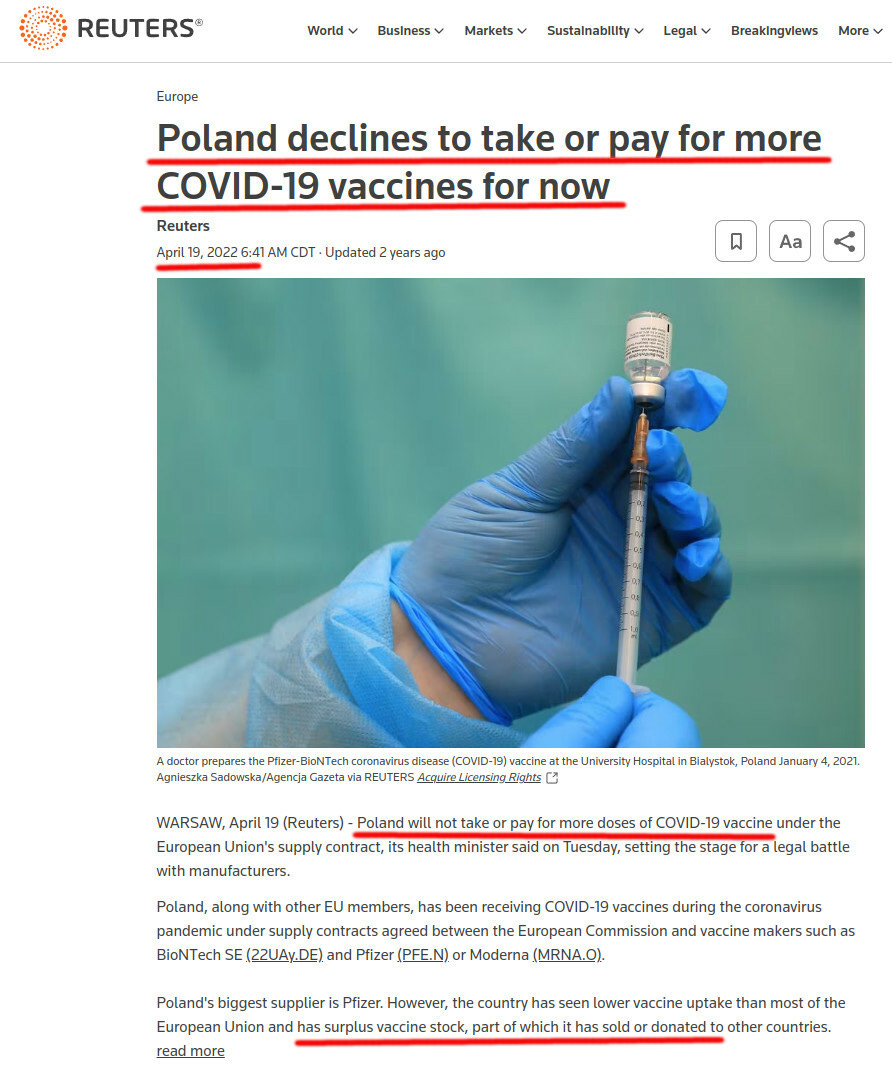
“At the end of last week, we used the force majeure clause and informed both the European Commission and the main vaccine producer that we are refusing to take these vaccines at the moment and we are also refusing to pay,” health minister Adam Niedzielski told private broadcaster TVN24.
“Indeed, the consequence of this will be a legal conflict, which is already taking place,” he said.
Poland cannot directly terminate the contract for the supply of vaccines as the parties to the contracts are the European Commission and manufacturers, he said.
The value of the contract for vaccine supplies to Poland up to the end of 2023 with one producer alone was worth over 6 billion zlotys ($1.4 billion), with over 2 billion zlotys of that for supply in 2022.
Pfizer said its agreement over the supply of its COVID-19 vaccine to European Union member states was with the EU Commission.
“Our discussions with Governments and the details of vaccine deliveries are confidential,” it added.
Somehow, Poland is a party to the EU/Pfizer contract that was kept confidential from the country but still obligates it to pay.
Pfizer CEO Albert Bourla and EU’s Ursula von der Leyen negotiated the contract in secret. (see picture below)

Anyway, now in 2023, Pfizer filed a suit, suing Poland for the monies due under the contract that was confidential and unavailable for Poland to even look at.
How a party can be obligated to pay under a contract that could not ever be assented to due to secrecy is a mystery to me, but I guess the legal minds in Europe see it differently.
Pfizer is suing in Brussels because Polish courts cannot see the contract and are unlikely to be very receptive to enforcing a contract that the court can review.
According to Polish newspaper Gazeta Prawa, Pfizer brought the civil case before a Brussels court because the doses were purchased through EU joint procurement contracts, drawn up under Belgian law.
Can Poland, perhaps, bring forth some novel defenses?
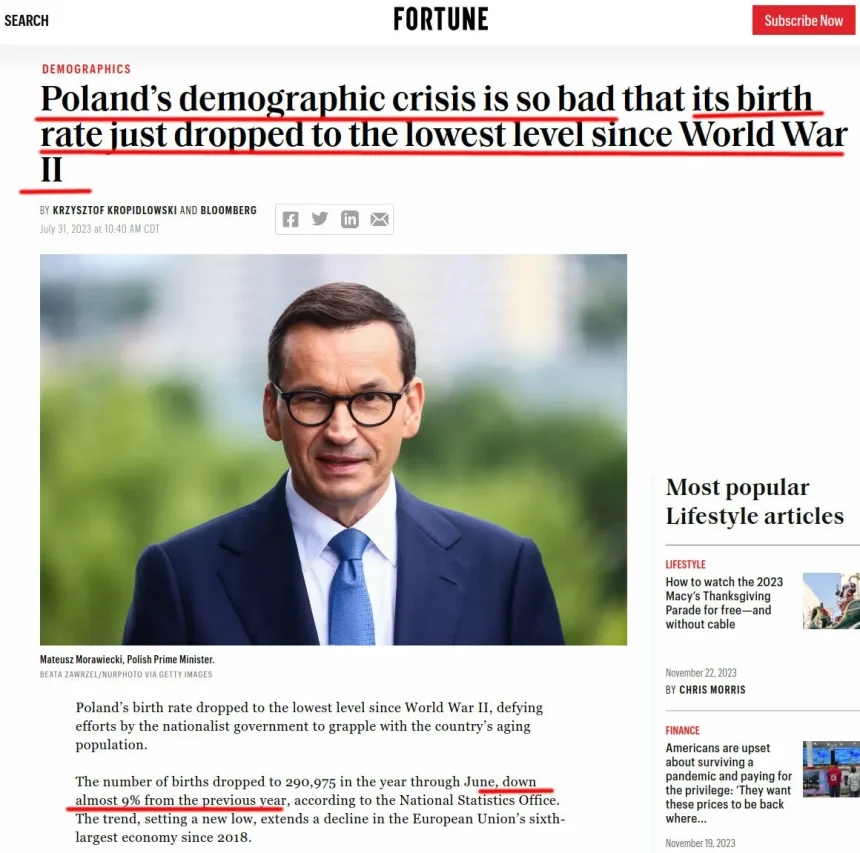
Perhaps Poland can ask Pfizer to comment on the dramatic fall in fertility that Poland is experiencing.
Poland may ask its local courts to make Pfizer compensate Polish COVID vaccine victims. (fortunately, there are fewer of them compared to the vax-crazy countries).
Pictures of some of the Polish victims of Covid vaccines, beautiful healthy humans who never needed the “vaccine” and yet died from it, are displayed by their bereaved relatives:

ht tps://twitter.com/DominateREALITY/ status/1488214087259459584/photo/3
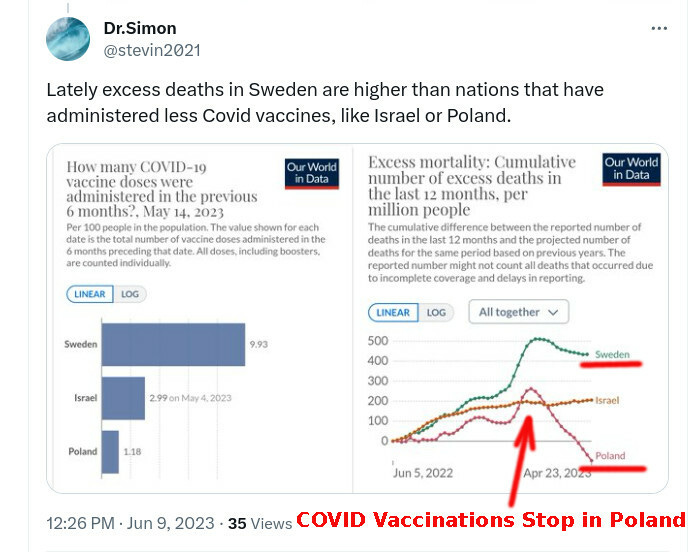
Can Pfizer explain, for example, why Sweden’s deaths continued to go up as the country was vaccinated, while Poland’s deaths went down after Poland refused COVID vaccines?
I am not an international lawyer, and I do not specialize in the enforceability of secret contracts that cannot even be seen by the parties which they obligate.
But I expect that Pfizer will lose.
Where are yesterday’s experts on the Crimea conquest?
BY PAWEŁ LISICKI | DORZECZY.PL | NOVEMBER 14, 2023
As reports of a stalemate in Ukraine emerge, Paweł Lisicki, the editor of the conservative weekly Do Rzeczy, asks where all the experts are who had predicted a swift Ukrainian victory and a Russian retreat.
I am reminding everyone, without naming names since I already have many adversaries, of the propaganda that saturated Poland and all media after February 2022. The narrative then seemed convinced that Ukraine would imminently crush a hapless and incompetently managed Russia. The Russians were portrayed as incapable of combat, with widespread desertion, malfunctioning rockets, and crumbling tanks, and their finest weapons humorously were said to originate from modified refrigerators or lawnmowers.
A sense of demoralization was said to pervade their army, and Putin was depicted as perpetually dying. Moreover, a fear of an impending military coup was rumored to haunt him. American and British generals, whose wisdom was parroted by Polish experts, forecasted the swift capture of Crimea, the total encirclement of Russian forces, and a great victory. Poland was promised greatness and a leading role in Eastern affairs.
We were to be America’s hub, a key ally, instantly replacing Germany. Analysts didn’t stop there. The boldest spoke of an emerging grand Polish-Ukrainian alliance, even hinting at a new joint statehood, a confederation that would reverse the historical curse of the 18th century and elevate Poland to superpower status.
Ukraine was to be forgiven for past grievances, having shed enough blood defending us from eastern hordes. Instead, Kyiv was seen as the West’s defender, a bastion of democracy, and its leader, Volodymyr Zelensky, was embraced by Polish leaders, including President Andrzej Duda, as a sage and flawless hero.
Now, it turns out these stories were worth less than nothing.
Despite hundreds of billions of dollars and euros and massive NATO military support, Ukraine’s counteroffensive has failed. Valery Zaluzhny, Ukraine’s top military commander, admitted as much recently. He stated in The Economist magazine that the war with Russia is at a stalemate and breaking it would require a significant technological breakthrough, which is unlikely. Zaluzhny also acknowledged that speculations about retaking Crimea, annexed in 2014, were a mistake.
These sober comments incited Zelensky’s anger, who retorted that without victory, the country wouldn’t exist, while his circle suggested that Zaluzhny’s statements serve only Russia. In mysterious circumstances, the general’s personal aide was recently found dead. Soon after, Zelensky dismissed another general, Viktor Khorenko, from the command of Ukraine’s Special Operations Forces.
All this points to a growing internal conflict, including comments from Zelensky’s former advisor, Oleksiy Arestovych, who speaks openly of the current president as a dictator and criticizes the ongoing war. President Zelensky has announced that due to the war with Russia, the 2024 presidential elections in Ukraine will not take place. It is undeniable that he is undertaking actions that can be seen as violations of fundamental rights and freedoms, such as harassment and now a ban on the activity of the church that recognizes the canonical authority of Moscow.
What’s happening is precisely what could have been assumed by anyone with reason and not swayed by the fanciful propaganda eagerly served by Western lobbyists.
The outbreak of conflict in the Middle East has decisively turned U.S. attention to that region. It’s also clear that Americans are tired of supporting Kyiv, evidenced by the rising support for Donald Trump, the main opponent of Joe Biden’s policies. The Americans have grown weary of Ukraine. The costs of aid are mounting, and the anticipated collapse of Russia has not occurred.
If a coup is to happen, it is likely to be in Kyiv rather than Moscow.
Worse, after an initial period of weakness and chaos, Russia has regained the initiative and is now more dangerous than at the conflict’s start. Back in March and April 2022, a beneficial truce for Ukraine was possible. However, as former Israeli Prime Minister Naftali Bennett indicated, talks were halted by the West. Americans and Britons encouraged Ukraine to continue the war, promising the crushing of Russia. Polish experts, predictably, echoed this. Today, it’s apparent what a grave mistake this was. The immense human costs borne by Ukraine may yield no results, and it now risks not only losing territory but also plunging into chaos.
Tracking device found on Poland’s presidential car after its recent return from Ukraine
BY GRZEGORZ ADAMCZYK | TVN24 via: BUSINESSINSIDER.COM.PL | October 25, 2023
A tracking device has been found by state protection officers on a vehicle used by the Polish Presidential Office, Polish news outlet TVN 24 reported on Tuesday.
State Protection Service (SOP) officers made the discovery shortly after the vehicle had returned from a trip to Ukraine.
According to the news outlet, the device allowed for real-time tracking of the vehicle’s location based on its GPS coordinates, and preliminary investigations suggested the vehicle could have been being tracked for several months.
The discovery was made by bomb technicians of the SOP, who, in line with procedures, were checking cars set to be included in the presidential motorcade for any explosive devices.
It is understood that the vehicle had not been recently used by Polish President Andrzej Duda but by members of his entourage; however, this doesn’t rule out the possibility that he could have used the compromised car in the future.
“There was an uproar, as it wasn’t clear who installed the device,” an SOP officer told TVN24. “It turned out that this car might have been driving with this device for several months and was often included in the president’s motorcade, including during his trips to Ukraine,” they added.
The incident has sparked a mass check of all vehicles assigned to the presidential office that may be integrated into convoys with protected individuals. Previously, the frequency of such checks varied.
Typically, the presidential motorcade consists of three cars: one primary vehicle carrying the president and two protective vehicles. Additional cars can be added with SOP approval.
The press office of the Polish Presidential Office did not comment on the revelation, nor did the press spokesperson for SOP or the ABW (Agency of Internal Security) press services.
Zelensky’s newfound hostility toward Warsaw is as short-sighted as it is self-destructive

By Péter G. Fehér | Magyar Hírlap | October 3, 2023
A famous Hungarian proverb warns people against “cutting the branch beneath you.” The proverb is uttered when a person refuses to acknowledge that he is acting against himself.
As things stand now, that is exactly what Zelensky is doing — everything he can to get Ukraine from a bad situation to an even worse one. In practice, the situation in the neighboring country can now be described as catastrophic, and the Ukrainian president — although he did not originally imagine it — has done a lot to make it so.
Zelensky’s most self-harming act was to spectacularly break ties with Poland. Warsaw has spent a huge amount of money on helping Kyiv, about the same as it spends annually on upgrading its own army. In return, it has received nothing, not even a gesture. For example, in July this year, when a joint commemoration was held to mark the 80th anniversary of the Volhynia massacre — the mass murder of Poles by Ukrainian fascists during World War II — Zelensky refused to allow the victims buried in unmarked mass graves to be exhumed and given a proper final resting place.
However, the Ukrainian president has denounced Poland to various international organizations for imposing a ban on the sale of Ukrainian grain on the Polish internal market. Zelensky has not shown the slightest understanding of the Polish government’s position, which is facing elections in mid-October and is opposing the same foreign interference that Hungary faced last April.
But perhaps it is unfair to Zelensky to blame him alone for this ingratitude. According to the latest news, France and Germany have promised the Ukrainian president a facilitated and speedy EU accession if he succeeds in toppling the current conservative national government in Warsaw in the elections that are due to take place.
If Zelensky had any sense, he would realize that he is being led by the nose by the two major European powers. Membership of the EU requires the agreement of all the member states, and Poland, after what has happened, is hardly going to go along with that.
It does not seem that Zelensky understands the situation or is even slightly aware that the West is using him as a tool to interfere in the internal affairs of neighboring countries, or even to provoke them. We have now reached the point where it is safe to say that Ukraine has been pursuing an increasingly extremist policy since 2014, with the result that the country is raging with hatred of Hungarians, which reached its peak, at least so far, under Zelensky’s presidency.
All of this is a textbook example of the self-destructive behavior exemplified by the Hungarian proverb.
American Meddling Failed To Prevent Robert Fico’s Victory In The Latest Slovak Elections
BY ANDREW KORYBKO | OCTOBER 1, 2023
The “Direction-Social Democracy” (SMER) party of former Prime Minister Robert Fico emerged victorious after Slovakia’s latest elections on Saturday in spite of Russia’s Foreign Intelligence Service (SVR) warning before the vote that the US will go to any lengths to prevent that outcome. Nobody should have been surprised by that since CNN’s reporting made it obvious that Washington wanted him to lose. Here are three of their articles fearmongering about his democratically driven return to office:
* “A NATO country could soon have a pro-Russian leader”
* “With Kremlin apologist leading the polls, Slovakia vote threatens country’s support for Ukraine”
* “Pro-Russian politician wins Slovakia’s parliamentary election”
The reason why America meddled in this election is because it fears both the substance and symbolism of a hitherto stalwart NATO vassal defecting from the bloc’s anti-Russian proxy war coalition. Fico previously condemned the West’s role in provoking and perpetuating this conflict exactly as neighboring Hungarian leader Viktor Orban has done since the get-go. Just like him, Fico is also against arming Ukraine and could prevent others’ weapons from transiting across his country as well.
He’ll still need to form a governing coalition in order to make good on his promises, but few doubt that he’ll be able to. Assuming that’ll happen, then Slovakia will join Hungary in creating a center of anti-war gravity in the heart of both the EU and NATO, which complements Poland’s newly cautious stance towards this proxy conflict brought about by its dispute with Ukraine. These three could then form an influential force if the latter’s ruling “Law & Justice” (PiS) party wins re-election on 15 October.
Poland remains much more committed to this conflict than Hungary and post-election Slovakia, but there’s also no denying that the Polish people are incredibly offended at Ukraine’s ungratefulness. A critical mass of them might therefore vote for the anti-establishment Confederation party to protest PiS’ prior appeasement of Kiev up until recently despite that regime’s glorification of those who genocided Poles. If enough do so, then PiS might be compelled to form a coalition government with Confederation.
In that case, Poland might move closer towards Hungary and Slovakia’s position, which could inspire average Europeans to follow these countries’ lead during their own upcoming elections. The demonstration effect that was set into motion by Slovakia and which might soon manifest itself in Poland is therefore regarded by the US as a strategic challenge for good reason. That doesn’t justify its failed meddling in the latest Slovak elections, but simply places its motives into the appropriate context.
The fact that the CIA still failed to prevent Fico’s re-election dispels three popular myths, first and foremost that agency’s omnipotence. The second is foreign voters’ alleged inability to defy the American government’s will, the false perception of which has been exploited to suppress anti-establishment turnout. And finally, the Ukrainian Conflict is truly unpopular in some countries despite the media’s claims to the contrary and its crazed efforts to artificially manufacture support for this proxy war there.
With these symbolic outcomes in mind as well as the substantive changes to Slovak policy that are likely to follow its latest election, not to mention their possible impact on Poland in the coming future and the rest of Europe after that, the failure of America’s meddling campaign is a major development. It’s premature to describe it as a game-changer, but it still suggests a potentially impending inflection point in the Ukrainian Conflict, provided of course that the CIA doesn’t successfully sabotage related trends.
Poland rejects Ukraine’s proposal to end grain embargo crisis
BY GRZEGORZ ADAMCZYK | DZIENNIK.PL | SEPTEMBER 29, 2023
On Sept. 27, Ukrainian Deputy Minister of Trade Taras Kachka said that if Poland, Hungary and Slovakia guarantee that they will not impose unilateral limits on Ukrainian products in the future, Ukraine will be able to withdraw its complaint from the World Trade Organization (WTO).
Piotr Muller, the Polish government’s spokesman, told the conservative TV station Republika on Sept. 28 that the Ukrainian proposal for withdrawing the WTO complaint is unacceptable because “Ukraine is in fact proposing that its food products should be able to enter without any limits being set.”
He added that “the embargo will continue until we are satisfied that the import of Ukrainian products will not negatively impact our agricultural markets, and that is not likely in the near future.”
Muller also said that Poland was ready to discuss the matter with Ukraine but that “for the time being the embargo remains in force.” However, he felt that Ukraine withdrawing the complaint it filed with the WTO would be a positive development, “showing that Ukraine wants to negotiate with partners rather than confront them with lawsuits.”
On Sept. 26, the agriculture ministers from the Visegrád Four states — Poland, Hungary, Czechia and Slovakia — held a meeting in Znojmo, Czechia, at which they held a teleconference with the Ukrainian Agriculture Minister Mykola Solsky.
The four ministers agreed that the withdrawal of the complaint made to the WTO would facilitate better relations, but the Ukrainian minister did not answer Polish Deputy Agriculture Minister Robert Bartosik’s question about whether Ukraine would cancel its lawsuit.
On Sept. 18, Kyiv filed a complaint with the WTO against Poland, Hungary and Slovakia for the imposition of unilateral embargoes on Ukrainian grain, which the three EU member states imposed in defiance of the European Commission’s decision to lift the grain embargo that was in place between May and Sept. 15 of this year.
Featured Video

or go to
Aletho News Archives – Video-Images
From the Archives
Israel Would Have No Qualms About USS Liberty-Style FALSE FLAG If Iran Campaign Falters – Analysts
By Ilya Tsukanov – Sputnik – 18.06.2025
Donald Trump is mulling whether or not to join Israel’s aggression against Iran as Tel Aviv faces problems sustaining its defenses against growing counterstrikes, and apparently lacks a realistic game plan for an end to hostilities after failing to achieve its goals. Analysts told Sputnik how the US could be ‘nudged’ into the conflict.
“The US is already assisting Israel with supplies, intel, refueling support, etc. One of the many US posts in the region could be attacked for a casus belli,” former Pentagon analyst Karen Kwiatkowski explained.
“If Trump doesn’t comply with Israel’s demand” and join its aggression voluntarily, “a false flag may be needed” to drag the US in, Kwiatkowski, retired US Air Force Lt. Col.-turned Iraq War whistleblower, fears.
Netanyahu has a diverse array of options at his disposal, according to the observer, including:
- a false flag against US assets abroad blamed on Iran or one of its Axis of Resistance allies, like the Houthis
- a US domestic attack or assassination blamed on Iran
- Iranian air defenses ‘accidentally’ hitting a civilian jetliner carrying Americans
- use of a dirty bomb or nuclear contamination somewhere in the region blamed on Iran
- even blackmailing by threatening to use nukes against Iran if the US doesn’t join the fight
Kwiatkowski estimates that Israel probably has “enough blackmail power” against President Trump and Congress to avoid the necessity of a false flag operation, but a “USS Liberty-style” attack, targeting the soon-to-be-retired USS Nimitz supercarrier that’s heading to the Middle East, for example, nevertheless cannot be ruled out entirely, she says. … continue
Blog Roll
 Aletho News
- US has 2 months of rare earths left to replenish weapons amid Iran war: Report
- Strait Of Hormuz closure brings Empire to brink
- Iran controls Strait of Hormuz, dictates terms of war and peace as US excursion backfires
- Outlasting the Superpower: The Reasons Why Iran is Beating uhe US and Israel
- Top PMU commander, over a dozen fighters killed in new US strikes on Iraq
- Is Netanyahu’s war gamble threatening the future of ‘Israel’?: FT
- Smotrich calls for annexation of South Lebanon to Litani River
- Echos of Gallipoli? Hormuz and the Geography of Hubris
- Pakistan PM backs Iran’s right to self-defense amid tensions
- Hungary blasts ‘fake’ EU accusation
- If Americans Knew
- Instead of taking Joe Kent’s claims seriously, the media is disregarding him as an antisemite
- Joe Kent’s Explosive Interviews about his Resignation over the Iran War
- Israel poised to take over southern Lebanon; settlers wreak havoc in West Bank – Not a ceasefire Day 165
- From Sde Teiman, the truth about Israel’s military justice system has been set free
- Child denied life-saving bone marrow transplant by Israel ‘because he is from Gaza’
- Raffi Berg: BBC Middle East Editor Exposed as CIA, Mossad Collaborator
- Jerusalem Archbishop Rebukes Netanyahu’s Statements on Christianity
- US to embed Palantir AI across entire military: Report
- Israeli-US war on Iran to drag on “a few more weeks” – Not a ceasefire Day 164
- Lebanon deaths top 1,200; Palantir AI to be embedded across US military – Not a ceasefire Day 163
- No Tricks Zone
- Devastating Assessment Of Comirnaty Vaccine By Former Senior Pfizer Europe Toxicologist
- New Study: CO2 Is ‘Effectively Negligible’ As An Explanatory Climate Change Factor Since 2000
- Former Pfizer Toxicologist Dr. Helmut Sterz Tells Bundestag Hearing Pfizer Vaccine Should Have Never Been Approved
- Energy Expert: Germany’s Nuclear Phaseout Was A “500 Billion Euro Mistake”
- New Research: South Australia’s Mid-Holocene Sea Surface Temperatures Were 4°C Warmer Than Today
- Storing Green Energy To Last Germany 10 Days Would Require A 60-Million Tonne Battery
- New Studies: UK Sea Levels Were 4 Meters Higher Than Today During The Mid-Holocene
- Destructive Green New Deal: German Energy And Metal Group Warns Of Drastic Crisis
- New Study Documents A 20-Year Pause In Arctic Sea Ice Decline – Driven By Internal Variability
- Wake-up Call: Survey Shows Majority Of Germans Now Favor Postponing Climate Targets!
 Aletho News