‘Welcome to Police Industrial Complex’ – former Philly commissioner
RT | June 16, 2014
Dangerous, alienating, and sociopathic: the policy of arming police to the teeth with military-grade gear shows a fundamental misunderstanding of how crime is solved and what it means for a cop to walk the beat, former Captain Ray Lewis told RT.
Nine-foot tall, 55,000 pound, Mine-Resistant Ambush Protected (MRAP) armored-fighting vehicles rolling through the streets of America.
Millions of dollars’ worth of military gear being distributed to local police forces on an annual basis.
Drones, M-16s and so many other hand-me-downs from over a decade of war making their way from US forces abroad to a local police force near you.
If you really believe any of this is making you safer, Lewis, who spent 24 years on the force, says you should think again. Endangering lives, alienating communities, turning minority neighborhoods into occupied territory and compromising the very ability for police to do their jobs; these are just a few of the reasons the former commissioner believes main street is being sold down the river for power-hungry cops and ruthless corporate interest.
RT: Why is this considered to be a good idea, bringing these high caliber weapons into US streets?
Ray Lewis: I don’t think it’s a good idea. High caliber weapons are extremely dangerous. They have a very high ricocheting velocity, and that means that innocent people are going to get killed and injured. They can go through doors, they can go through cinder block, they can go through metal car doors, and this type of velocity is not necessary. I spent 24 years in the Philadelphia Police Department.We upgraded our Smith and Wessons to Glocks, which are a very powerful pistol that work very well. There is no reason to have anything stronger than that, except in exigent circumstances, in which your SWAT team does have that type of weapon. For anyone else, they’re not necessary and they’re dangerous.
RT: You know Captain, one might ask, will this equipment not obscure the line between soldier and police officers, especially in those small communities where they’re already being distributed?
RL: Yes, it will obviously obscure the line between the military and the police. But I’m not at all concerned with small communities that you mentioned. I’m concerned with the large cities, where you have large minority populations living in economically depressed areas. That’s where you’re going to have problems. You bring this type of equipment into a minority area, you are going to make those people feel as if they are living in an occupied territory. You’re going to alienate them.
What happens is, you get a halo effect. A halo effect means that that alienation transfers to all the other officers in that department. That alienation transfers to the officers in the patrol cars, the officer on the foot beat, the officers in the community relations division. So bringing that type of equipment is going to alienate people from all parts of the police department. What people don’t know is that input from community members is one of the most important ways crimes are solved. They know the bad guys in the area, they hear the rumors, they hear the gossip, they know what’s going on in their communities. Too many people think that crime is solved through high-tech forensic labs or exemplary investigative work. Not true, although these two come in very handy in many cases, most of your information about crimes comes from the community. You bring this military type of mindset into the community, you’re not going to get the interaction from the members of that community.
RT: Some police officers have said it is necessary to have this type of equipment, especially if you’re covering a protest and it gets out of hand, where police officers can get injured or shot. Isn’t it a good idea, in some ways, to have such equipment at your disposal?
RL: That is the worst idea I could think of, to have high caliber weapons at a protest. Think of Kent State, where they shot and killed so many innocent people. And they were not high caliber weapons. Can you imagine the massacre that would take place if officers had high caliber weapons? I spent a year in New York City supporting the Occupy [Wall Street] message. I was arrested down there for civil disobedience and never did I see any type of behavior from those protesters that would ever need any type of weapon, let alone high caliber. If anything, it was the protesters that would have needed high caliber weapons.
RT: Let me talk about the gear itself. It’s been used in certain war zones and then come back home, as there’s no longer any need for it there. What should they do with this type of equipment if they can’t distribute it to local police forces? What happens if people come out and say, ‘actually, we don’t want these types of vehicles on our streets. We have kids, we can’t have them here, we’d much rather go back to a much more local form of policing that we’re more comfortable with?’
RL: Obviously, you have to listen to the community. The police serve the community; they don’t serve us, we serve them. If they want to go back to a more conventional police force that they feel comfortable with, then that’s what has to be done. It’s imperative.
RT: So what happens to the equipment then, at that point?
RL: It can be sold to other countries or destroyed. I’d have no problem with them destroying that equipment whatsoever instead of using it in this country. See, that equipment can be very dangerous if it falls into the wrong hands. Let me explain.
There are three types of people who join the police department, basically: one joins because of a need for a job that can give him or her a comfortable lifestyle; the second person joins because they want to serve and protect the public; the third type of person joins because they love the power and the control. When you have a person that joins because they love the power and control, how do they get more power and control? They move up the chain of command until they reach police commissioner. Now once they reach police commissioner, how do they gain more power and control? And this is a sociopathic tendency by the way. It’s insatiable; they can never get enough power and control, just like a billionaire can never get enough money.
So, you reach the top rung of the ladder, you’re a police commissioner, and you want to gain more power. How do you do it? You acquire all of this military weaponry, the semi-tanks, the MRAPs, the spy drones, and what not. And I guarantee you, once you purchase them, they’re not going to sit in a warehouse. That police commissioner is going to use them. And I’m very fearful of these types of police commissioners using that equipment. Let me give you the perfect example of what I’m talking about.
The Philadelphia Police Commissioner Charles Ramsey, he was not commissioner when I worked there, but when I attended the Occupy movement and was arrested for civil disobedience, several days later I received an unbelievably threatening letter from him. He told me, he informed me to stop wearing my uniform. It was an order. I’d retired 10 years previously; he had no power over me. Yet he was so power and control hungry, he tried to order me to stop wearing that uniform. What was most egregious about this letter, I have it for proof, is he informed me that if I continued to wear the uniform, he would take any and all necessary action to stop me. That is the epitome of a sociopath whose desire for power and control is insatiable. I am fearful of this type of police chief getting this type of equipment.
RT: Okay Captain, last question. Shootings at schools, shopping malls, movie theatres, we’ve seen those headlines all around America and internationally. Will this type of equipment be able to stop such crimes from taking place?
RL: Absolutely not. These crimes are committed by people who never would think, ‘oh wait, should I not do this because the police have high caliber weapons?’ No. That doesn’t stop those mass killings at all. Number one, they know most likely they will be killed by the police, or they take their own lives. So this type of equipment will never stop that. Lastly, I want you to know that corporate America is involved in this. This is a major money market that will sell this high (grade) equipment, repair and maintenance for it will come from taxpayers’ money. Corporate America will make billions off of this equipment. You’ve heard of the prison industrial complex, you’ve heard of the military industrial complex, corporate America now wants to make a police industrial complex, where they’ll makes billions off of police departments.
‘US a warzone’: Police deploy heavy armor in America
RT | June 9, 2014
From the streets of Fallujah to Franklin, Indiana, heavily armored military vehicles have been rolled out for one and the same reason: many police officers in the US believe there’s a war going on.
Franklin, Indiana is by all accounts the idyllic Midwestern American town. Eponymously named after one of the founding fathers and “the first American,” Franklin’s small town bona fides provided Life Magazine with a Norman Rockwell-esque scene for a bit of village life utopia in the heart of the Great Depression.
But if you were to talk to local law enforcement, a battle is raging in the streets of Mayberry.
Franklin is the county seat of Johnson Country, Indiana. Speaking with Mark Alesia from The Indianapolis Star, Sheriff Doug Cox described the 139,000-strong administrative district as a place where officers’ old-time policing just doesn’t cut it anymore.
Leading Alesia to a pole barn in Franklin, Cox shows him a MRAP – a 55,000 pound, six-wheeled Mine-Resistant Ambush Protected armored-fighting vehicle with the word “SHERIFF” emblazoned on its flank.
“We don’t have a lot of mines in Johnson County,” confessed Sheriff Doug Cox, who acquired the vehicle. “My job is to make sure my employees go home safe.”
Cox isn’t alone in believing his deputies have something to fear. Johnson County is one of eight Indiana law enforcement agencies to acquire MRAPs from military surplus since 2010, according to public records obtained by The Indianapolis Star.
All across the state, and the country, the trend is similar. From picking up military surplus to using to $35 billion in grants from the Department of Homeland Security to acquire the most advanced weapons, police forces across America are armed to the teeth.
And as Pulaski County Sheriff Michael Gayer puts it, the effects are not only tactical, but psychological.
To put it bluntly: “It’s a lot more intimidating than a Dodge.”
Pulaski, mind you, is a county of roughly 13,000 people. The question of whether civilians need to be intimidated like that depends on your perspective, and as far as Gayer sees things, America is a battlefield and the police are akin to an occupying force.
“The United States of America has become a war zone,” he said. “There’s violence in the workplace, there’s violence in schools and there’s violence in the streets. You are seeing police departments going to a semi-military format because of the threats we have to counteract. If driving a military vehicle is going to protect officers, then that’s what I’m going to do.”
‘What if it were your kid’
The militarization of America was covered in a recent Vice.com documentary, entitled: ‘Here’s What Happens When Hackers Send a SWAT Team to Your House.’
Danny Gold heads to Somerset County, New Jersey, what he describes as “one of the wealthiest counties in the US.”
Sgt. Edward Ciempola, commander of the county SWAT team, boasts of a Lenco BearCat Ballistic Engineered Armored Response Counter Attack Truck, which he says they use on “every call out.”
With infrared cameras in stock and other military grade hardware, Gold asks Ciempola one simple question: in a quiet, relatively crime-free area, is all of this hardware really necessary?
“I would ask somebody that maybe suffered a loss because of not having this service and I would ask them the answer to that question,” Ciempola said.
“I would say, well, the SWAT team wasn’t available when you really needed it or a police officer wasn’t available when you really needed it, or an ambulance didn’t get there when you really needed it. How does that make you feel? And if your child’s school was suddenly under attack by some random actors, do you want them coming (points to SWAT team) to help your kid or do you want no one to show up?”
Despite the fears of Ciempola and Gayer, in a 2012 Department of Justice report, violent crime had declined by 72 percent from 79.8 to 22.5 per 1,000 persons age 12 or older since 1993. And yet, what’s happening in places like Franklin and Somerset County are the exception rather than the rule.
Writing for the Huffington Post, Radley Balko noted the disturbing trend in SWAT team growth across the country.
He argues that SWAT teams in municipalities with populations between 25,000 and 50,000 have “increased by more than 300 percent between 1984 and 1995.”
By 1995, nearly 90 percent of cities with 50,000 or more people had a SWAT team. In 2000, 75 percent of towns with 25,000 to 50,000 people had their own SWAT teams as well. And those paramilitary units are not sitting idly by.
Citing Peter Kraska, a criminologist at Eastern Kentucky University, Balko says the total number of SWAT raids in America has increased exponentially, from just a few hundred per year in the 1970s, to a few thousand by the early 1980s, to around 50,000 by the mid-2000s.
According to the American Civil Liberties Union (ACLU), “disproportionately those in poor communities and communities of color – have become targets for violent SWAT raids, often because the police suspect they have small amounts of drugs in their homes.”
And with the SWAT teams comes the military hardware. In Keene, New Hampshire, a town with two murders since 2009, officials accepted a $285,933 grant from the Department of Defense in 2012 to purchase a BearCat. In Columbia, South Carolina, a MRAP which can be equipped with a 50-caliber machine gun was picked up in 2013. In the sleepy town of Roanoke Rapids, North Carolina – a town of 16,000 people, police got their hands on their own Humvees and MRAPs, which they went on to display at a car show.
According to March report in USA Today co-written by US Representative Hank Johnson, the following counties “have acquired free MRAPs from US war zones”:
McLennan and Dallas Counties in Texas; Boise and Nampa Counties in Idaho; Indiana’s West Lafayette, Merrillville, and Madison Counties in Indiana (not to mention Johnson); Minnesota’s St. Cloud and Dakota Counties in Minnesota; Warren and Jefferson Counties in New York; North Augusta and Columbia in South Carolina; Murfreesboro in Tennessee; Yuma in Arizona; Kankakee County in Illinois; and Calhoun County in Alabama.
Many of the vehicles were acquired through the 1033 program, a 1997 law which facilitated the transfer of military hardware to local police forces. But what appears to be free federal handouts could result in fundamentally changing the face of the United States.
“Americans should therefore be concerned, unless they want their main streets patrolled in ways that mirror a war zone,” Johnson lamented.
“We recognized that we’re not in Kansas anymore, but are MRAPs really needed in small-town America? Are improvised explosive devices, grenade attacks, mines, shelling and other war-typical attacks really happening in Roanoke Rapids, a town of 16,000 people? No.”
Johnson, a member of the House Armed Services and Judiciary Committees, announced he was introducing legislation to reform the 1033 program “before America’s main streets and civilian police militarize further.” The ACLU, meanwhile, has launched an investigation into the militarization of US police.
“The police officers on our streets and in our neighborhoods are not soldiers fighting a war. Yet many have been armed with tactics and weapons designed for battle overseas,” it said.
In 2013, ACLU affiliates in 25 states filed over 260 public records requests with law enforcement agencies to document the impact of excessively militarized policing on people, families, and communities.
But as Balko warns, vested interests are likely to keep pushing the police-industrial complex until America is on lockdown.
“A new industry appears to be emerging just to convert those grants into battle-grade gear,” he said.
“That means we’ll soon have powerful private interests, funded by government grants, who will lobby for more government grants to pay for further militarization — a police industrial complex.”
Activists demand answers after news of NYPD spying on political groups
RT | May 27, 2014
Following the news that the New York Police Department sent undercover officers to monitor political organizations, multiple activist groups are looking for an audit of the department’s wide-ranging surveillance program.
The complaint has been filed with the NYPD’s new office of the inspector general, which the City Council created against the wishes of former Mayor Michael Bloomberg in order to oversee the police department’s policies – particularly in light of criticism regarding its stop-and-frisk tactics and surveillance of Muslim communities.
According to the New York Times, the groups are calling for a comprehensive investigation into the NYPD’s intelligence division, which has been operating the police force’s surveillance program for years. The move comes as the groups seek more transparency from police following the election of new Mayor Bill de Blasio, whose administration they believe will be supportive.
“We need tangible, concrete proposals of how we can ensure the NYPD does not target an entire group, set of groups, or political activists in general based on their participation in political advocacy,” the complaint reads.
Although most of the parties involved were not named, the Times revealed that one of the organizations behind the complaint is Friends of Brad Will – a group dedicated to increasing public awareness of human rights abuses connected to the “War on Drugs.”
As noted by the newspaper, the group believed it had attracted the attention of the police for years, and investigative reporting by the Associated Press confirmed that “an undercover officer had infiltrated a Friends of Brad Will meeting in New Orleans in 2008 and had sent a report noting plans for future actions by the group.”
In addition to spying on political groups, Reuters reported that police classified those employing civil disobedience as “terrorist organizations” and kept secret files on individual members.
Much of the NYPD’s surveillance efforts could be traced to the aftermath of the September 11 attacks on the World Trade Center, but the groups claim police activity has negatively affected their ability to organize and that their constitutional rights to assemble, petition the government, and practice free speech have been violated.
“These kinds of police programs can’t just be laid at the feet of a post-9/11 world and the argument that security outweighs legal protections,” Friends of Brad Will coordinator Robert Jereski told Reuters.
According to the Times, the complaint is requesting that the inspector general disclose “a full description of the training which officers undergo before being tasked with targeting political activists.”
This isn’t the first time that the NYPD has come under fire for political surveillance, either. In 2004, police were found to be monitoring church groups, anti-war organizations and others in the lead-up to the Republican National Convention. Police defended their behavior, arguing their efforts were aimed at preventing unlawful activity, not silencing dissent.
“There was no political surveillance,” NYPD intelligence unit leader David Cohen testified regarding past tactics. “This was a program designed to determine in advance the likelihood of unlawful activity or acts of violence.”
The most recent complaint also comes a little more than a month after the NYPD disbanded a controversial “Demographics Unit” tasked with detailing everyday life in predominantly Muslim communities in the wake of 9/11. As RT reported previously, no terrorism-related leads were generated despite the resourced dedicated.
“The Demographics Unit created psychological warfare in our community,” said Linda Sarsour of the Arab American Association of New York. “Those documents, they showed where we live. That’s the cafe where I eat. That’s where I pray. That’s where I buy my groceries. They were able to see their entire lives on those maps. And it completely messed with the psyche of the community.”
Provocation: Murky forces instigating Odessa violence?
RT | May 5, 2014
Video footage filmed during the bloody events in Odessa that claimed dozens of lives on Friday shows a more complicated picture, with provocateurs instigating the violence.
Ukrainian authorities blamed the pro-autonomy activists for starting the clashes that led to the tragic fire at the House of Trade Unions. The interior ministry stated that anti-Kiev activists attacked supporters of Kiev authorities before retreating to the building for shelter, and threw petrol bombs at the crowd triggering the fire.
Russia’s Channel One television reconstructed the chronological order of events using publicly available YouTube videos detailing what happened in Odessa on Friday.
It began with a football match between two teams – Chernomorets Odessa and Metalist Kharkov. Despite the high political tensions in the region, authorities still allowed the match to take place, realizing that a few thousand pro-Kiev football fans would be arriving to the city.
Following the match, around 1,500 supporters of the Kiev authorities and football ultras came together for a march in support of Ukraine’s unity. The rally was sanctioned by local authorities.
Nationalists made their way towards the center of the city chanting “Glory to Ukraine” and “Death to enemies,” as well as “Knife the Moskals (derogatory for Russians).” Some people in the group wore ultra-nationalist movement insignia. They were armed with chains and bats, and carried shields.
The violence started when the pro-Kiev crowd was met by what looked like anti-government activists. They were wearing St. George ribbons – identifying them as pro-autonomy – and red bands around their sleeves. Some of the riot police officers present at the scene were wearing the same red bands around their sleeves.
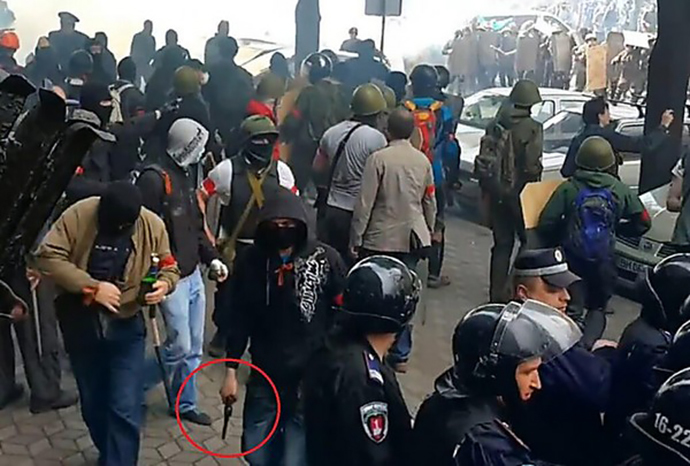
Image from ontimer.livejournal.com
Then the visibly smaller group of alleged anti-Kiev activists started to attack the march, apparently provoking the demonstrators. Footage then shows a smaller group of men wearing red bands luring the pro-Kiev crowd into a different direction.
At some point, the police line opened up to let the men wearing red bands through and closed back up again. A video then shows a man standing behind the police lines shooting at the pro-Kiev crowd.
The provocations succeeded in triggering clashes, as both sides began to throw stones, and shots were heard.
The alleged anti-Kiev activists then disappeared and angry pro-Kiev supporters headed to the opposition camp based in front of the House of Trade Unions.
However, none of the original attackers with the red bands were there. Instead, a few dozen pro-autonomy activists were surrounding the camp. When the activists saw the angry mob approaching, they took shelter inside the House of Trade Unions.
Survivors of the fire say they had to barricade themselves inside the House of Trade Unions to hide from the agitated mob, which torched their tent camp.
Radicals then began throwing Molotov cocktails at the Trade Unions building, setting it on fire. Witnesses say those who managed to escape the blaze were severely beaten outside by the besiegers of the burning building.
But the Ukrainian Interior Ministry offers a different version of events, saying the victims of the violent unrest started the fire themselves when they began throwing Molotov cocktails from the upper floor.
Multiple videos of the incident, however, show Molotov cocktails flying from outside the building. Another video shows that some radical pro-Kiev elements were also inside the building, waving a Ukrainian flag.
The evidence leads one to conclude that the football fans could have been manipulated while unknown forces instigated the violence.

Which insignia has this “pro-russian activist of united Ukraine” forgotten to take off? (at left – the band of ukrainian flag; at right – the George band (glory anti-fascist world war 2)
A further point from Da Russophile :
The conduct of the British media in response to this massacre has been beyond appalling. So far not a single British newspaper has editorialised about the massacre. Following the sniper attacks on Kiev the British media had no hesitation in putting the blame on Yanukovitch though the evidence (to put it mildly) was far from conclusive. At an earlier stage in the Maidan protests sections of the British media devoted a phenomenal amount of time, reporting and commentary to the attack on Chornovil with all sorts of unsubstantiated speculations that Yanukovitch was personally behind it though evidence of that there was none.
Not only has the British media failed to give the Odessa massacre anything remotely approaching the amount of reporting the scale of the massacre justifies but it persists in pretending that there are uncertainties about who was responsible even though film and eye witness evidence is conclusive and even though (as I understand it) persons involved in the pro Maidan organisations involved in the massacre have openly bragged about it. Instead the Guardian in its editorial the day after the massacre preferred to editorialise about the wickedness of Russia holding a May Day party on Red Square
We had an article in the Daily Telegraph calling the local people who demanded the release of the surviving anti government activists saved from the fire and arrested by the Odessa police following the massacre a “mob” threatening Odessa with “anarchy”
We have an article in the Guardian today calling readers who post comments on Comment is Free critical of its pro Maidan editorial line “Kremlin trolls”.
Whilst The Times editorialises that Putin must stop his campaign of “subversion and coercion” against the Ukraine which has in Odessa has “inspired separatists” into “acts of war”.
I invite people to imagine how the British media would have reported this massacre if roles had been reversed and if it had been Maidan supporters who were burnt alive in the Trade Union building with an anti Maidan crowd filmed throwing in Molotov calls and baying for blood outside.
Manhunt leads to massive roadblock, warrantless car-to-car searches
Police State USA | March 15, 2014
ROCKVILLE, MD — Thousands of motorists were brought to a standstill when police conducted a massive roadblock to find three crime suspects. Twelve lanes of traffic were shut down and swarms of armed government agents combed through a giant traffic jam performing warrantless vehicle-to-vehicle searches.
The busy Tuesday morning commute was abruptly halted just after 10:00 a.m. on March 11th. One driver told ABC News that traffic stopped and he witnessed 30 police cars pass on the shoulders of I-270 near Rockville. “Then, when I saw a wall of police officers with automatic weapons approaching our cars, it was apparent that something serious was taking place.”
Police had received intelligence that a local bank had been robbed that morning and the vehicle carrying the 3 suspects had turned onto the interstate highway. A throng of officers from the Rockville, Montgomery County, and Maryland State Police Departments blockaded all lanes of traffic in both directions and began conducting an intense manhunt.
There was “a lot of yelling, a lot of orders being given, helicopters, dogs barking, sirens, police cars driving by,” said eyewitness Carlton Higdon to WJLA.
Miles of cars were stranded and motorists were confined to their vehicles, with no explanation, for over an hour. Confused people exiting their vehicles were met with hostility from the police. WTOP reported that one woman leaned out her door to vomit, she was shouted at by cops to close her door.
“It’s just awful,” motorist Carmel Desroche to WJLA, describing the traffic jam. “I’ve never seen both directions of 270 like this before. It was painful.”
While stuck in traffic, motorists were approached by armed agents and ordered at gunpoint to submit to warrantless searches of the interior of their vehicles. The Washington Post interviewed an innocent driver named Don Troop who experienced the ordeal.
A group of officers made its way to his car and other cars around him. “They were just walking along saying: ‘Pop the trunk! Pop the trunk!’”
He overheard a man in a truck next to him call out to another motorist: The police are looking for bank robbers. A short time later, about nine officers approached his car — including state police in tan uniforms, county police in dark uniforms and at least one plainclothes officer wearing a yellow tie.
Among their commands to motorists that Troop heard:
“Stay in your car.”
“Pop the trunk.”
“Get your hands on the steering wheel. Get you hands up where we can see them.”

(Source: Scott Ferrebee)
As described, these searches were in no way consensual and were performed with the motorists under duress. Nothing ordered at gunpoint can ever be considered voluntary. Not surprisingly, we have not seen a report of anyone brave enough to refuse the hostile violation of the 4th amendment.
The police ultimately located and arrested the suspects and took them into custody. They did not resist, and they were not located in anyone’s trunk.
The search was described later by Montgomery County Police Captain Paul Starks as an operation of “systematically checking the trunks and rear hatches” of the detained vehicles.
The bank’s $7,000 was ultimately safe and sound, although the same could not be said of the rights of many innocent commuters. The authorities simply explained that their oath to uphold the Constitution does not apply during “exigent circumstances.” Rockville Police Chief Tom Manger remained unapologetic even after getting angry emails about the tactics.
“For those folks that wondered how is that the police can just walk through traffic like that and get folks to show their hands, get folks to pop their trunks, between the exigency of the circumstances and the information that we had, it gave us the legal foundation to do what we did,” the chief said, according to WTOP.
Apologists argue that the ends justify the means in law enforcement; that as long as the bad guys were caught one way or another, the operation was a success. This position easily suits the purposes of the police state. The erosion of liberty is simple when the people applaud as their rights are violated.
The reality is that crisis situations are exactly the times when individual liberties are most vulnerable and needing to be defended. These are also the most challenging and unpopular times to defend civil rights, as swathes of fearful people clamor for the government to keep them safe. The folly of letting the government pick and choose when it must may follow the constitution should be obvious, however. To keep our rights intact we must refuse to accept these mass suspensions of the constitution for an increasingly wide variety of excuses.

300 arrested at Montreal protest against police brutality
RT | March 16, 2014
Canadian police surrounded an annual protest against police brutality in Montreal, arresting 288 people before the demonstration had barely started.
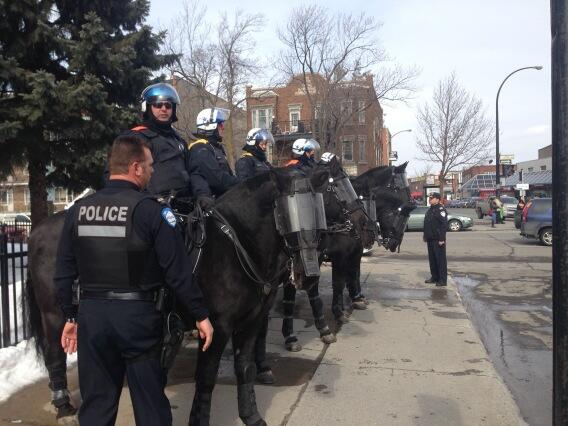 The police claim the protest was illegal as the participants did not warn the authorities of their itinerary.
Montreal’s 18th annual protest against police brutality was cut dramatically short Saturday when police rounded up the participants. Minutes into the demonstration, riot officers converged on Jean-Talon Street and began detaining protesters. According to protesters there was a strong police presence, with police horses, cars and a helicopter on the scene.
“It was a veritable army of police … who occupied the area surrounding the Jean-Talon metro when the protest was to start,” the Collective Opposed to Police Brutality, which organizes the annual protest, said in a written statement issued after the protest.
Police declared the demonstration was illegal and asked the protesters to disperse. However, the activists carried on marching, brandishing banners and chanting slogans, such as “They want us to respect them, but they don’t respect us!”
Riot police then encircled the protesters and began making arrests. The majority of the 288 people who were taken into custody were released shortly afterwards, but four people may be charged under the Criminal Code for assaulting an officer and obstructing the police. Several others could face charges of mischief.
One man sustained injuries to his face during the police intervention and was tended to by paramedics on the site, said officers.
“They refused to share their itinerary, and they refused to give us any details. When we got there, we asked them not to jump onto the street, and they answered by going into the street and yelling at us that they were not cooperating,” police spokesman Ian Lafrenière said. He added that the protest has a bad reputation with the authorities and on previous occasions the demonstrations had descended into violence and rioting.
However, activists had a different version of events and have accused the police of lying about the protesters’ activities.
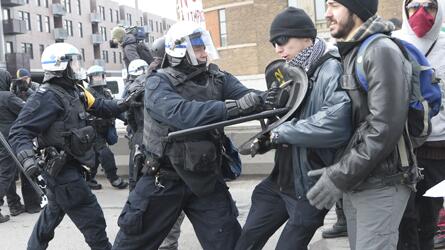 “It looks good in the media — the police can say (all of these) people were arrested, were breaking windows and stuff, but it’s not true. They were doing nothing,” Claudine Lamothe told the Montreal Gazette.
The Collective Opposed to Police Brutality has staged a protest in Montreal every year for the past 18 years. This year they focused their protest on the issue of “social cleansing” where the authorities try to “get rid of people who are deemed unwanted,” the group writes on its website. The group cites an incident in January when an unnamed Montreal police officer threatened to tie a homeless man to a lamppost in temperatures of minus 30 if he did not move along. Following the incident, Lafrenière told the Montreal Gazette that the officer had been reprimanded for his “unacceptable” behavior.
Paramilitary SWAT raid: 2 dogs killed (Columbia, MO)
COLUMBIA, MO — During a routine midnight raid on a residence over forbidden plants, police violently broke down the door, threw concussion grenades, pointed rifles in everyone’s faces, and shot 2 dogs.
During the raid, 5 concussion grenades were exploded in and around the home. One of the grenades exploded near the feet of the young lady visitor seen in the video who at the time was seated on the couch. […]
Both dogs were shot in the back while retreating. One of the dogs is shot as an officer tops the stairs, passes a suspect on the floor and steps into a bedroom. You can see a glimpse of the dead dog as the officer stands in the doorway. The dog is obviously facing away from the officer. Soon after you can see another injured dog struggling in the hall.
It is important to note that this raid took place before Chief Ken Burton accepted his position with the CPD. Due to the overwhelming public outcry stemming from a more recent yet similar raid under his command, Chief Burton has reigned in the use of his SWAT team to serve search warrants for non-violent crimes and criminals. While the prevalence of violent, paramilitary raids has waned in Columbia, this type of raid is happening somewhere in the United States right now. Please speak out against this government sanctioned domestic terrorism.
This video was recorded on March 7, 2008 at the residence of Jonathan March. He had no prior felonies. A small amount of the forbidden marijuana plant was recovered from the raid.
EU police want ‘remote kill switch’ on every car
RT | January 30, 2014
The EU is considering making mandatory the equipping of all cars sold in the union with devices, which would allow police to remotely disable engines, according to leaked documents.
If the plan goes as planned, European law enforcers will be able to stop fugitives, suspected criminals and even speeding drivers with a simple radio command from a control room.
The technology is part of a six-year development plan by the ‘European Network of Law Enforcement Technologies’, or Enlets, a working group for police cooperation across the EU, reports the Telegraph.
“Cars on the run can be dangerous for citizens,” the newspaper cites a document leaked by state power watchdog Statewatch.
“Criminal offenders will take risks to escape after a crime. In most cases the police are unable to chase the criminal due to a lack of efficient means to stop the vehicle safely,” it says.
Remote control of car electronics is far from novel. A modern car is equipped with a network of microcomputers, which monitors and controls everything from ignition and flow of fuel to radio station being played. And increasingly cars can communicate wirelessly, a technology called telematics.
Loan firms and car dealerships have been using the benefits of electronically-controlled cars for years. A vehicle sold in the subprime market can be equipped with a black box, which reminds the client of overdue payments with honking horns and flashing lights and would disable the engine completely a few days later, unless the money is paid. And a GPS receiver would tell the dealership the exact location where the car can be collected.
Remote tracking and control is also used as anti-theft measure. Services like General Motors’ Stolen Vehicle Slowdown can force a stolen car to drop speed and stop on a remote command from the service provider.
Giving police the ability to do the same to any car in the EU does not thrill some rights advocates cautious of giving the government more authority.
“We need to know if there is any evidence that this is a widespread problem. Let’s have some evidence that this is a problem, and then let’s have some guidelines on how this would be used,” Statewatch told the Telegraph.
Apart from that, there is a concern of possible hacker attacks, which could use the remote kill switch for nefarious ends. In March 2010 Texas police arrested a former car dealership employee, who used its car tracking and repossession system to disable some 100 vehicles in Austin in revenge for being laid-off.
Researchers from the University of California, San Diego and Washington University tested how much harm hacking can do to a car’s electronic controller. The study conducted in 2010 showed that a criminal can relatively easily interfere with safety-critical systems like brakes.
The security of connected cars has not become hacker-proof since. At the 2014 Consumer Electronics Show this month, technology firm Harman warned that hacking problems for modern cars are very serious because the infrastructure of their electronic components was not designed with networking in mind, so they are not ready for the level of exposure to cyber-attacks that internet connectivity brings.
Related article

ACLU calls for Massachusetts moratorium on controversial license plate readers
ACLU – 12/14/2013
BOSTON — The ACLU of Massachusetts calls for a moratorium on the use of controversial and unregulated license plate scanner technology in all Massachusetts police departments, following a Boston Globe exposé of problems in the Boston Police Department’s program.
The story, published in today’s Globe, shows that contrary to officials’ claims about why departments need the technology, police routinely do not respond to live ‘hits’ alerting them to the location of stolen cars. This suggests that the program is, as the ACLU feared, largely oriented towards compiling vast databases enabling the warrantless tracking of millions of innocent motorists.
In response to these alarming findings, the Boston Police Department announced it would suspend the program, at least until proper oversight and procedures are put into place.
“The Globe’s investigation into the Boston Police Department’s license plate reader program, based largely on a series of public records requests initiated nearly a year ago, confirms that police departments need outside oversight and guidance in order to responsibly use this powerful technology. We applaud the Boston police decision to suspend the program,” said Kade Crockford, director of the Technology for Liberty project at the ACLU of Massachusetts. “In light of these disturbing revelations, no police department in the state should continue to use this technology until the legislature passes the License Plate Privacy Act. We need uniform statewide rules for departments’ use of plate readers.”
Currently the Massachusetts State Police and more than 50 cities and towns deploy license plate scanners, which snap photographs of each license plate they encounter, noting the time, date and location, and run the plate numbers against “hot lists” to identify stolen cars, outstanding warrants and other violations. Today, no license plate reader program in the state is subject to outside regulation.
“The License Plate Privacy Act will establish accountability and public transparency requirements to ensure that the kinds of abuses the Globe uncovered at the Boston Police Department are not happening in other cities and towns,” said Crockford. “Technologies that target ordinary Americans going about their everyday lives create tremendous opportunity for abuse, without keeping us safe. We must ensure that the law keeps pace with these new technologies.”
The License Plate Privacy Act allows departments to use license plate readers to identify cars associated with criminal suspects or crimes, while preventing the government from amassing databases containing the historical travel records of millions of innocent people.
“The Globe’s investigation makes crystal clear that departments cannot police their own use of this complex and powerful tool,” said Crockford. “The legislature must step in to provide some basic rules, as well as checks and balances to make sure license plate readers aren’t used for warrantless tracking of innocent drivers. The Joint Transportation Committee should recommend swift approval of the License Plate Privacy Act, the legislature should pass it, and the Governor should sign it into law.”
Advanced surveillance tools can work to promote public safety while simultaneously respecting the privacy and liberty interests that help our Commonwealth thrive, but in order for that to happen the law needs to catch up with the technology. The License Plate Privacy Act strikes the right balance. Police departments statewide should follow Boston’s lead and immediately halt their use of the technology until the legislature acts.
For more on the License Plate Privacy Act, go to:
https://aclum.org/privacy_agenda#LPA
To take action on this issue, go to:
https://ssl.capwiz.com/aclu/ma/issues/alert/?alertid=63008551&type=ML
For more information about automatic license plate readers, go to:
https://www.aclu.org/alpr
Related articles
Mass Location Tracking: It’s Not Just For the NSA
By Catherine Crump | ACLU | December 12, 2013
Thanks to Edward Snowden we now understand that the NSA runs many dragnet surveillance programs, some of which target Americans. But a story today from Washington, D.C. public radio station WAMU is a reminder that dragnet surveillance is not just a tool of the NSA—the local police use mass surveillance as well.
DC’s Metropolitan Police Department uses cameras to scan vehicle license plates in huge numbers and saves all the data for two years, even though only a tiny fraction—0.01 %—turn out to be associated with any possible wrongdoing.
In 2012, the police in Washington scanned over 204 million license plates. But only 22,655 were associated with some possible wrongdoing (what the chart refers to as “hits”). And a hit isn’t evidence of guilt. It’s evidence your plate was in a database. And your plate may well be in a database because, as we’ve seen in other areas of the country (check out our report on the use of plate readers nationwide), these databases can include people who violated vehicle emissions programs or are driving on suspended or revoked licenses. These people shouldn’t be on the road, but they are also not major offenders.
The key point is this: 99.9 % of the data pertains to people not suspected of wrongdoing. Why should innocent drivers have their movements stored for two full years?
The new report echoes data first unearthed by the ACLU’s local office and revealed two years ago in testimony to local legislators.
This brings us back to the NSA program. What do the NSA and DC Metropolitan Police Department have in common? As we have discussed before, neither appears to be restrained by any sense of proportionality. The data collection is vast, and the gain is either uncertain or negligible. In the NSA’s case, it is storing records about every single phone call each of us makes and keeping it in a database for 5 years, even in the absence of any credible evidence that mass collection is needed to make us safer. (The MPD refused to comment on the plate reader program.)
When it comes to reforming surveillance, it is programs like these that are particularly good targets. While some may be willing to trade privacy for security, here we appear to be giving privacy away and the government either can’t or won’t make the case that we’re getting anything in exchange.
Related articles
Montreal deploying fleet of facial recognition drones for 24/7 patrols
RT | December 4, 2013
The City of Montreal has purchased 24 drones to help law enforcement tackle crime as authorities look to cut back the police force over the next 15 years. The UAVs, equipped with facial recognition technology, will be armed to ‘neutralize suspects’.
“It’s very exciting,” the chief of police for the borough where the drones will be deployed, Montreal North, told the Montreal Journal.
“The drones with facial recognition will patrol the streets 24 hours a day. Officers will interrogate individuals suspected of criminal acts or searched directly through speakers and microphones installed in the drones, but soon they can be provided with equipment capable of neutralizing on-site suspects pending the intervention of the law enforcement officers. It will mainly make our work less dangerous, especially in an area where there is a lot of social tension,” he said.
When asked to clarify what intermediate weapons would be used to neutralize suspects, a Royal Canadian Mounted Police (RCMP) spokesman told the Journal the “UAVs [unmanned aerial vehicles] will carry persuasive technologies, but non-lethal types, such as electric shock, blinding or paralyzing gases.”
He added that despite the seemingly limitless possibilities, only non-lethal weapons are “intended for the moment.”
The drones are set to be deployed in early 2014.
Despite the $400-million- plus price tag, the drones are intended to facilitate cutbacks to the city’s police force in line with nationwide efforts to curb RCMP expenditures, which have doubled over the last 15 years.
Employing new technology to create leaner, more effective law enforcements agencies, however, remains highly contentious.
A late 2012 poll conducted by Jennifer Stoddart, the privacy commissioner of Canada, found the public remains ambivalent about the use of UAVs in policing.
While 80 percent of those surveyed were comfortable with police use of drones for search-and-rescue missions, only 40 percent of respondents felt comfortable with their use in monitoring public events or protests.
“Considering the capacity of UAVs for surreptitious operation, the potential for the technology to be used for general surveillance purposes, and their increasing prevalence — including for civilian purposes — our office will be closely following their expanded use,” the report read.
“We will also continue to engage federal government institutions to ensure that any planned operation of UAVs is done in accordance with privacy requirements.”
The RCMP national drone is thus far in its infancy, with Mounties promising they will not be used to conduct general surveillance against the public.
A study released last month – Unmanned Eyes in the Sky – found that despite drones’ potential benefits for police, law enforcement had not “sought feedback from the public on how UAVs should or should not be adopted as a tool to serve the public interest,” the Canadian Press reported.
The study concluded that in light of the “potential for intrusive and massive surveillance,” Canadians needed reassurances that they would not be spied on once the drone program goes into full swing.
Related articles
- Facial recognition, once a battlefield tool, lands in San Diego County (backcountryvoices.wordpress.com)
- Montreal buys 24 drones with facial recognition that will interrogate suspected criminals (blacklistednews.com)
Texas drivers pulled over at random, told to turn over blood, saliva samples
RT | November 20, 2013
Dozens of Texas drivers have been stopped at a police road block, where they were then directed into a parking lot and forced into surrendering blood, saliva and breath samples in a study that has upset civil liberties advocates.
The National Highway Traffic Safety Administration admitted it was attempting to conduct a government study meant to determine the number of drunk or drug-impaired drivers on the road at any given time.
“It just doesn’t seem right that you can be forced off the road when you’re not doing anything wrong,” Kim Cope, who said she was forced to the side of the road while making her way to lunch, told NBCDFW.com. “I gestured to the guy in front that I just wanted to go straight, but he wouldn’t let me and forced me into the parking spot.”
The tests were made even more mysterious when reporters, alerted to the situation by concerned drivers, were unable to find any officers in the Fort Worth Police Department who had been involved. The NHTSA only admitted its involvement after local media sought answers.
The department, which says its mission is to “save lives, prevent injuries, and reduce vehicle-related crashes,” maintains that participation in the research was completely voluntary. But Ms. Cope said she felt trapped during what seemed to be an investigation.
“I finally did the breathalyzer test just because I thought it would be the easiest way to leave,” she said. “It just doesn’t seem right that they should be able to do any of it. If it’s voluntary, it’s voluntary, and none of it felt voluntary.”
When pressed, the FWPD said it was “reviewing the actions of all police personnel involved to ensure that FWPD policies and procedures were followed.” The NBC affiliate was able to determine that the Pacific Institute for Research and Evaluation, a government contractor, was hired to conduct the check.
An NHTSA spokesperson admitted similar programs were being conducted in 30 other cities throughout the US.
But civil liberties attorney Frank Colosi does not accept the rationale.
“You can’t just be pulled over randomly or for no reason,” he said. “They’re essentially lying to you when they say it’s completely voluntary, because they’re testing you at that moment.”
He added that drivers who refused may have been targeted by police for inadvertently giving the impression they were operating a vehicle under the influence. He also told NBC that fine print on the form told drivers their breath was being tested by “passive alcohol sensor readings before the consent process has been completed.”
This oddity comes just months after Texas state troopers were caught on video conducting vaginal and cavity searches on female drivers at the side of the road. The videos quickly went viral, and attorneys for the women filed federal lawsuits against the troopers.
“It’s ridiculous,” Peter Schulte, a former Texas police officer and prosecutor, told the New York Daily News earlier this year. “I was a law enforcement officer for 16 years and I never saw anything like it.”
Featured Video
Dr. Tony Martin – The Jewish Role in the African Slave Trade
or go to
Aletho News Archives – Video-Images
In Memoriam
James Petras, In Memoriam
 02.13.2026
Professor James Petras, 89, world-renowned sociologist, public intellectual, and scholar of Latin American politics and global economics, died peacefully on January 17, 2026, in Seattle, WA, surrounded by family.
A prolific scholar and activist, he devoted his life to challenging power, imperialism, and inequality. … continue
Blog Roll
 Aletho News
- Israel ready to strike Iran-backed armed groups – media
- Behind US war drums against Iran: No goals, no plan, no off-ramp
- With Ukraine blamed for cutting oil flows to Hungary, Croatia also refuses to transfer Russian oil in violation of EU law
- Friedrich Merz’s Push to End Online Anonymity Has a Troubling Subtext
- Macron: French citizens fighting for Israel cannot be labeled ‘genociders’
- US eyes Gaza security force drawn from armed gangs
- The Only Motive Behind The ‘Imminent’ U.S. War With Iran Is The Zionist Lobby
- Trump eyes 350-acre US military base housing 5,000 troops in Gaza
- Israel Pushing US Toward a Big and Damaging War With Iran – Ex-Pentagon Analyst
- Meet The Liberal Zionist And Ukraine War Supporter Advising AOC On Foreign Policy
- If Americans Knew
- ‘Christians Out’: Jerusalem Church Tagged With Hate Graffiti, Police Investigating
- Israeli Settlers Kill American Teen
- ‘We returned from hell’: Palestinian journalists recount torture in Israeli prisons
- No mercy for Gaza in Ramadan – Not a ceasefire Day 133
- The Israeli Government Installed and Maintained Security System at Epstein Apartment
- Tucker Carlson interrogated in Israel, has passport seized after interviewing US ambassador
- 6,000 Amputees in Gaza Face Impossible Recovery amid Israeli War Ultimatum
- The Lancet: Gaza death toll far higher than reported – Not a ceasefire Day 132
- Compliant aid: Who are the Israel-approved NGOs scaling up in Gaza?
- Why won’t Trump’s “Board of Peace” bring peace? – Not a ceasefire Day 131
- No Tricks Zone
- Coal Power Back In Trend As Globe Tries To Keep Pace With Growing Demand For Power
- New Study: A 4°C Warmer Beaufort Sea Had ‘No Sea Ice’ 11,700 – 8200 Years Ago
- Unfudging The Data: Dutch Meteorological Institute Reinstates Early 20th Centruy Heat Waves It Had Erased Earlier
- German Gas Crisis…Chancellor Merz Allegedly Bans Gas Debate Ahead of Elections!
- Pollen Reconstructions Show The Last Glacial’s Warming Events Were Global, 10x Greater Than Modern
- Germany’s Natural Gas Storage Level Dwindles To Just 28%… Increasingly Critical
- New Study Rebuts The Assumption That Anthropogenic CO2 Molecules Have ‘Special’ Properties
- Climate Scientist Who Predicted End Of “Heavy Frost And Snow” Now Refuses Media Inquiries
- Polar Bear Numbers Rising And Health Improving In Areas With The Most Rapid Sea Ice Decline
- One Reason Only For Germany’s Heating Gas Crisis: Its Hardcore-Dumbass Energy Policy
 Aletho News