Tide Begins to Turn against FIFA in Rio de Janeiro
By Brian Mier | CEPR Americas Blog | August 15, 2013
After two months of protests that started over price gouging in public transportation and spread to a variety of issues spanning the political spectrum, positive results are beginning to be seen in Rio de Janeiro, where governor Sérgio Cabral, once touted in the New York Times as a possible 2014 presidential candidate is now so unpopular that socialist former mayoral candidate Marcelo Freixo said that he doesn’t think he could even get elected as a condominium residents association secretary.
During the last week a series of measures was announced that seem to show a turning of the tide against the hegemony wielded by the Fédération Internationale de Football Association (FIFA) and the Rio de Janeiro state and municipal governments over local residents.
First, after spending over $500 million rehabbing the structurally sound Maracana stadium – its third multi-million rehab in a dozen years – the plan to privatize and sell it off to a group of cronies for a fraction of that value has been stalled. The landmark status for the neighboring high school and Indigenous museum buildings has been upheld by the court system, so they can no longer be destroyed to create a parking garage. Furthermore, the federal government has blocked destruction of the public swimming pool and athletic track that made up part of the stadium compound. According to the privatization agreement, these are deal killers. The original plan was to surround the stadium with parking garages and luxury shops for the white, middle-class patrons who would now be the only ones able to easily afford ticket prices. The consortium that was poised to take over management of the stadium announced that it was going to back out, then changed its mind but still hasn’t closed a deal. It appears that the new, expensive ticket prices are keeping fans away and this might prove to be a deciding factor in blocking privatization.
Meanwhile, last Friday, the mayor’s office announced that after years of protests and construction of an alternative participatory development plan by local residents together with social movements and the Universidade Federal de Rio de Janeiro planning department, it will no longer raze the neighborhood of Vila Autódromo, which was originally marked for destruction in order to “beautify” the neighborhood for the upcoming “mega-events.” Since 2008, the mayor’s office has evicted tens of thousands of people, but it is hoped that this too will mark a turning point against a government that, until its popularity plummeted last month, felt like it could do whatever it wanted.
The much hailed program for setting up police stations in favelas that were previously controlled by drug trafficking organizations and paramilitary militias, called UPP, is also coming under fire. Drug trafficking gangs continue to operate within the pacified favelas, albeit without carrying machine guns around on the street, and a recent study shows that disappearances of residents has increased by over 50 percent in favelas after the UPP Units have been put in place. The disappearance of a construction worker and father of four, last seen being forced into a UPP Police car in front of his house in Rocinha, has turned into a national issue, as people are holding up signs all over the country during protests asking, “Where is Amarildo?”
Across the nation, people are rising up against the planned “state of exception” that FIFA demands take place for two months before and after the World Cup in 2014, coded into Brazilian law as part of the “General Law of the World Cup” of June 5, 2012. This “state of exception” will enable the government to bypass public bidding laws, provide tax abatement on all official FIFA-sponsored products and hire private foreign security forces to replace the local police protecting players and FIFA officials. In accordance with the Brazilian constitution of 1989, a “state of exception” can only be called in cases of war or natural disasters, making the FIFA law technically illegal. But popular and legal challenges to the Brazilian general “Law of the Cup” are mounting. During the World Cup in South Africa FIFA was able to leave the country with $2.4 billion in profits, while South Africans were left footing the maintenance bill for “white elephant” stadiums in towns with no major sports teams. It will be interesting to see how much FIFA is able to get away with this time around, especially since 2014 is an election year in Brazil.
Brian Mier is a geographer and freelance journalist who lives in Brazil and works as a policy analyst at the Centro de Direitos Econômicos e Sociais. He has a podcast, focused on news reported in the Brazilian alternative media, at http://progressivebrazil.tumblr.com/
Related article
Brazilians protest costly visit by Pope
Press TV – July 27, 2013
Brazilians have taken to the streets of the two megacities of Rio de Janeiro and Sao Paulo to protest the costly week-long visit of Pope Francis to the country.
On Friday, hundreds of demonstrators faced off with 1.5 million Catholic pilgrims in Rio’s Copacabana beach, where visiting Pope was wrapping up a massive ceremony marking World Youth Day.
Protestors were closely monitored by security personnel in scores of vehicles, including an armored vehicle equipped with a water cannon.
Meanwhile, in Sao Paolo, over 300 protesters ransacked five banks and set fire to garbage bins and blocked traffic late on Friday as a show of solidarity with demonstrators in Rio de Janeiro.
On Monday, a similar demonstration was held near the Rio state governor’s palace following a meeting there between the Pope and Brazil’s President Dilma Rousseff.
The demonstrations come just weeks after the country experienced a series of massive protests against government corruption, lagging public services, and the cost of the 2014 World Cup and 2016 Olympics.
The protesters argued that the government should spend public funds on health, education, and other public services rather than on costly international events.
Protests in Brazil Reflect Ongoing Disparities
By Kyle Barron | NACLA | June 25 2013
Hundreds crammed into a room for over six hours, passing around the microphone so that everyone could weigh in. The protestors, mostly students, called the meeting in order to better articulate their message after Rio de Janeiro’s Mayor, Eduardo Paes, had requested to meet with one of the university groups. They emerged that Thursday night with five demands—”five points”—they felt would bring cohesion to the slogans splashed across the signs being waved in the street.
This meeting, or plenaria, took place on Tuesday, June 18, the day after the protests first surged and two days before over a million people took to the streets in over 100 cities across Brazil. While there is no uniformity to all the protests from city to city, and—as Kate Steiker-Ginzberg, a 23-year-old from Philadelphia who attended the plenaria insisted—there exists diversity among protestors within each city, the five points coming out of the plenaria address issues cutting across the various protests.
The first point addresses the 20-cent increase in transportation fare, what has been seen as the catalyst for the protests. While this may not sound like a significant fare hike, as Steiker-Ginzberg explains, it represents a “political miscalculation” on the part of the administration. The fare increase was implemented the same day as the Confederation Cup opened in Brazil. Since 2005, this international soccer tournament had served as a rehearsal for the World Cup, which will be held in Brazil next year. Many were frustrated that the price hike would go toward the extravagant sporting facilities instead of improving the dismal public transportation that is often slow, overcrowded, and dangerous—despite the relatively steep price Brazilians pay for their public transportation.
The fare hike was one among many contributing factors to these protests, and together with the other points addressed by the plenaria, reflects grievances that have been brewing across Brazil for quite some time. The second point concentrates specifically on the excessive spending on mega-events instead of on investment in health and education. Along with the World Cup, Brazil is slated to host the 2016 Olympics.
This taps into the broader question of who benefits from these mega-events. While the country is pouring massive amounts of public funds into the construction and improvement of stadiums, some people complain of the poor state of public infrastructure, hospital overcrowding, and low educational performance in Brazil. As soccer-player-turned-congressman Romário de Souza Faria criticizes, the money for the World Cup could have been used for “8,000 new schools, 39,000 school buses or 28,000 sports courts in the whole country.”
Cost benefit analysis of mega–events shows that these exorbitant affairs rarely deliver many of the economic outcomes promised. While it is estimated that Brazil will spend over $12.5 billion in preparation for the World Cup, it looks as though private interests are the ones poised to benefit most from these events. FIFA reported a profit of $202 million from the 2010 World Cup in South Africa. As their financial statement boasts, “The 2010 FIFA World Cup South Africa™ was a huge success, a fact that was reflected by its financial result.” Most of these profits are a result of selling broadcasting rights and sponsorships, with a smaller percentage coming from ticket prices. Similarly, the International Olympic Committee (IOC) garnered $250 million from the last Olympic games, the majority of those profits coming from television licensing.
Furthermore, Brazil has spent over $473 million in public funds on improvements to the Maracanã, Rio de Janeiro’s iconic soccer stadium, which will host the World Cup Final as well as stage the opening and closing ceremonies of the Olympic games. This investment was on top of the almost $300 million that had been spent on renovations to the stadium during the last 15 years. Earlier this year, after months of negotiations, Maracanã was privatized with the granting of a 35-year contract to a consortium of investors for a comparatively low price tag of $85 million. After public outcry over the deal, a judge reversed the ruling, citing irregularities and claiming that one of the companies involved in the deal had an unfair advantage in the process. Finally, on May 13, the judgment was reversed again, allowing the privatization to continue. Beyond the importance as the site for the most high-profile moments in the upcoming mega-events, the stadium has long been a cultural symbol for Brazil. According to Steiker-Ginzberg, “this major symbol of democracy and public space and class intermingling in the city is now being destroyed and privatized.”
The megalopolises of Rio and São Paulo are not the only places the public’s money is being spent. Throughout Brazil, $13.9 million will be put toward preparing for the World Cup and the Olympics. In many of these places, such as the northeastern city of Manaus, the excessive and over-budget spending does not seem justified. This is especially true considering that after the games are over, Manaus’s $246 million Amazonia Arena is predicted to be underutilized in the city of 2.3 million people. This could be true of other stadiums around Brazil as well—Brasília, Cuiabá, and Natal simply don’t have clubs with a following that would justify the investment over the long term.
The third concern of the plenaria focused on the criminalization of protests and the militarized response of the police to demonstrations. Social media has been rife with images of the riot police with Choque emblazoned on their shields, indicating they are “shock troops,” shooting rubber bullets, using pepper spray, and hurling seemingly endless canisters of tear gas at protestors. These crowd-control tactics have been so aggressive that some have termed this the Vinegar Revolution, in reference to the palliative effects the common kitchen staple has against tear gas. As Brazil and Security Policy expert Joseph Bateman explained in an interview with the Washington Office on Latin America, while other sectors throughout the government have opened up to civil participation since the end of the military dictatorship in 1985, the security sector has only just begun to do so, and “a lot of police still see their role as protecting the state, not protecting citizens.” This has been especially salient in São Paulo, where protests intensified in response to images of police brutality, particularly against journalists, that circulated on social media. Shock police shot a journalist, Juliana Vallone, at point-blank range in the face.
This violence against protestors is tied into the fourth point, which aims to democratize the media. There has been criticism that the major media networks, primarily O Globo, have been concentrating on the vandalism and violence of the protestors while largely ignoring the police brutality against the protestors. The fixation on the violent aspects of the protests is also at the expense of the reporting of the largely peaceful expression coming from the majority of protestors. As a university professor remarked after recently arriving for a visit to her native Rio de Janeiro, “it’s sad that some television stations only show the destruction and fail to show the people that want a better Brazil.”
The fifth point concerns the forced evictions and community removals resulting from the major urban transformation taking place in Brazil. In 2012 in São Paulo, 2,000 riot police were called in to suppress the uprising of more than 6,000 residents who refused eviction in the community of Pinheirinho. Many of these evictions throughout Brazil are being done in preparation for the World Cup and Olympics. Rio’s oldest favela, Providência, has lost its central square—the community’s only public space—to Olympic construction. Almost 5,000 residents are slated for eviction in this community alone. Altogether 170,000people throughout Brazil are facing removal or have already been evicted. The Popular Committee for the World Cup and the Olympics, a human rights group based in Rio, estimates that over 10,000 families will be affected in Rio de Janeiro alone because of these mega-events.
These forced evictions have been taking place amidst a major real estate boom throughout Brazil.
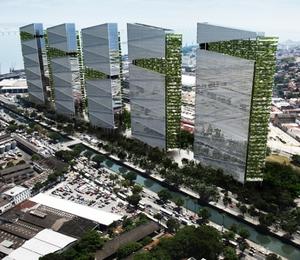
According to Forbes, Brazil is the country with the most rapidly increasing home prices in the world. In Rio, the rise in home prices has been four times greater than the rise in wages over the last five years. Donald Trump is investing in five skyscrapers in the city that, according to the developer’s website, will be the “largest urban office development in the BRIC [Brazil, Russia, India, and China] countries.”
Critics contend that many of these evictions are driven by economic incentives. The city of Rio de Janeiro has used a host of reasons to justify the demolition of the community of Vila Autódromo—from environmental and safety concerns to its use as a security or media zone for the Olympics. It is reported that the mayor of Rio de Janeiro, Eduardo Paes, entered into a partnership with private companies that will open up 75% of this site for private development after the Olympics. His reputation for these kinds of deals recently made headlines after a physical altercation with a constituent who accused him of catering to the interests of developers.
While the government does provide several forms of compensation to communities facing removal, the resettlement programs have systematically moved poor residents away from the high-value land and into peripheral areas of the city with little access to transportation or employment opportunities. Furthermore, O Estadão reported that the City of Rio de Janeiro paid $8.9 million for resettlement land to two companies—both contributors to Mayor Paes’s election campaign. After this was revealed, Paes revoked the deal.
On Saturday, June 15, communities affected by these evictions came together on the same day as the Confederation Cup opened, not far from Maracanã stadium for their own soccer tournament. The People’s Cup Against Removals was organized to “give a voice, to give time, to give space for those being excluded and for those being removed.” The stark contrast between the newly renovated stadium hosting the precursor to the World Cup and the small and humble field occupied by the People’s Cup players reflected the disparities at the heart of many of these protests. “I think that’s something that people woke up to,” remarked Steiker-Ginzberg, “the disparity between the investment in these stadiums and then people overflowing out of the public hospitals and ambulances not arriving on time . . . You can’t just reverse a 20 cent hike and expect everyone to get off the streets.”
Related
- Brazilian legend Romario questions 2014 World Cup (prosoccertalk.nbcsports.com)
- The Last Word: Mr Blatter, the party’s over (revoltadosvintecentavos.wordpress.com)
- Brazil: In The Eye Of The Storm – Video
Brazil: In The Eye Of The Storm
Michel De Souza · June 15, 2013
Durante os protestos essa semana no Rio eu fiz um registro do registro das minhas fotografias.
É um video que conta exatamente momentos antes de cada fotografia tirada, acho que além disso, conta a história de algo que parece estar marcando nosso país.
Confesso que me emocionei ao final.
Assistam, compartilhem, multipliquem.
Fotografias, imagens e edição por Michel de Souza
Trilha original “Changes” por Pedro Curvello
___________________________
Related articles
Brazil sees largest protests in decades as unrest hits second week
RT | June 17, 2013
Mass protests continued throughout Brazil on Monday, with hundreds of thousands of demonstrators converging in Sao Paulo, Rio de Janeiro, Belo Horizonte, the capital of Brasilia and other cities.
Protests initially began last week following a government announcement of an increase in public transportation costs, which brought out students and young workers and led to more than 250 arrests.
According to reports by Brazilian media such as Jornal do Dia, the initially peaceful demonstrations last week became heated, and led to clashes with Brazil’s riot police that left at least 100 injured in the major cities of Brasilia, Sao Paulo, Rio de Janeiro and Belo Horizonte.
Though the protests initially began following the announcement of bus fare increases, they have evolved to include a wide range of groups that have grown dissatisfied over everything from government corruption and income inequality, as well as to outrage over the police’s harsh response to protesters last week.
In a sign that public dissatisfaction was still simmering, soccer fans booed president Dilma Rousseff on Monday during the opening of a two-week tournament at a stadium in the capital Brasilia. The heckling only intensified when the president of the global soccer body, FIFA, reprimanded the crowed for failing to show the president “respect.”
Though Rousseff was able to ride on her predecessor’s popularity, Brazil’s economic growth has slowed considerably since she took over from Luiz Inacio Lula da Silva, who is widely credited with lifting 40 million Brazilians out of poverty. Brazil’s economy has posted its worst two-year performance in over a decade, and inflation rose to 6.5 per cent in May.
At least 20,000 Brazilians were expected to demonstrate in Sao Paulo on Monday, with organizers placing the figure closer to 30,000.
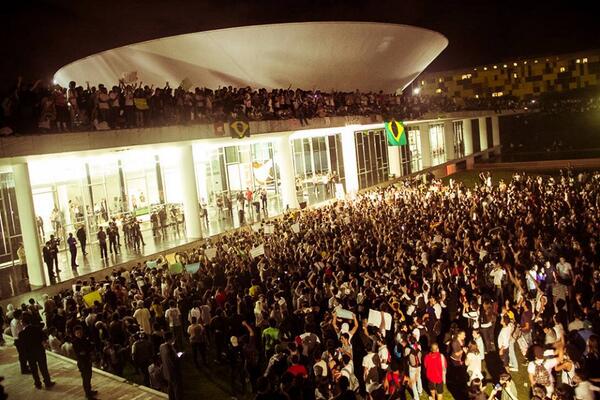
Protesters climb atop the capitol building in Brazil. #ChangeBrazil pic.twitter.com/Tb6CblQ5T0
Related articles
Brazil: 30,000 People Displaced for Sports Events
Weekly News Update on the Americas | May 19, 2013
A total of 3,099 families have been removed from their homes in Rio de Janeiro and another 7,843 have been threatened with removal as part of Brazil’s preparations for hosting the 2014 World Cup and the 2016 Olympic Games, according to a study released on May 15 by the Popular Committee of the World Cup and the Olympics. The group estimates that 30,000 people have been affected, based on the average number of people in the households. The study, “Mega-Events and Human Rights Violations in Rio de Janeiro,” was produced with the collaboration of the impacted communities, the Institute for Urban and Regional Research and Planning (Ippur) and other groups, including the nongovernmental organization (NGO) Global Justice.
The city government initially offered 18,000 reais (about US$8,872) for each home. Residents said this wasn’t enough even to buy the land for a new house. The city finally agreed to pay 40,000 reais (US$19,735), which residents said would pay for a two-bedroom house in the hills. “What we’re seeing is an urban restructuring project without any participation of society,” said Orlando Alves dos Santos Junior, an urban planning professor and one of the coordinators of the May 15 study. “In fact, what’s going on under this pretext [of preparation for the sports events] is a serious urban intervention, on the basis of the real estate industry. The presence of inhabitants from the poorest classes has become an obstacle to be removed from the path.” (Adital (Brazil) 5/17/13 from Canal Ibase (Brazilian Institute of Social and Economic Analyses))
Featured Video

No Threat Can Force Iran’s Surrender /Trita Parsi & Lt Cl Daniel Davis
or go to
Aletho News Archives – Video-Images
From the Archives
An Expert Military Analysis of War with China
Actually, None is Necessary
By Fred Reed • Unz Review • December 13, 2020
The Correlation of Armed Forces: U.S. goods and services trade with China totaled an estimated $634.8 billion in 2019. Exports were $163.0 billion; imports were $471.8 billion. The U.S. goods and services trade deficit with China was $308.8 billion in 2019. Trade in services with China (exports and imports) totaled an estimated $76.7 billion in 2019. Services exports were $56.5 billion; services imports were $20.1 billion. The U.S. services trade surplus with China was $36.4 billion in 2019.
There is talk within the Washingtoniat of a possible war with China. Steve Bannon, who apparently was dropped on his head as a child, actually favors such a war. We hear the usual shoo-the-boobs alarm about how the Chinese are doing something terrible and we must gird our loins and American values and show them what for, bow wow, woof. The danger is that the current game of who-blinks-first in Asian waters might actually provoke a shooting war. You know the kind of thing: One warship refuses to get out of the way of another, a collision ensues, some retard lieutenant who signed up on waivers opens fire, and we’re off and running. It is not a good idea to let children play with matches.
The said war is discussed either in emotional terms by idiots or in purely naval terms by those familiar with such things, so we hear of the First Island Chain and the Second Island Chain and whose missiles against the other’s missiles and so on. This would be appropriate if we were fighting World War Two again. Which we aren’t. Let’s take a quick-and-dirty look at how such a war might go.
To begin the war, America would overestimate itself and underestimate China. This is doctrine in the Pentagon. … continue
Blog Roll
 Aletho News
- Iran To Target Military Industrial-Tech Complex That Facilitated Gaza Genocide
- Collapsing Empire: The Resistance Disarms ‘Israel’
- Suicide Should Not Be a Government Service
- Rethinking America’s greatest threat: Iran vs. Israel-Firsters
- Iran accuses adversaries of false flags to strain Turkey ties
- Poland rules out sending Patriot missiles to US/Israel amid war on Iran
- Tehran approves new Hormuz plan with major restrictions
- No Threat Can Force Iran’s Surrender /Trita Parsi & Lt Cl Daniel Davis
- UK’s New Pandemic Plan Would Turn Big Tech Into a Mass Location Tracking Network
- Growing insecurity, soaring prices fuel protests in north as regime bans evacuation: Sources
- If Americans Knew
- Joe Kent Urges Americans To Call White House and Congress To Object To Sending Troops Into Iran
- DNC Resolution to Reject AIPAC Funding Puts Democratic Leaders in the Hot Seat
- Swedish foundation to build 400 schools as over 650,000 Gaza children remain without education for 2 years
- Israeli army admits photshopping image of slain Lebanese journalist
- This is how Israel is systematically killing health workers under the cover of war in Lebanon
- Carrying life under fire: Israeli invasion of Lebanon leaves pregnant women facing deadly risks
- Champagne all around for the new death penalty (for Palestinians) law – Not a ceasefire Day 172
- Why are Palestinian books struggling to be seen on Amazon?
- The Line Between Affinity and Conspiracy
- As Iran targets US military bases, will they be relocated to Israel? Not a ceasefire Day 171
- No Tricks Zone
- New Study Finds Warming Saves Lives…Cold Temperatures 12 Times More Deadly Than Excess Heat
- German Science Blog Accuses PIK Climate Institute Of Hallucinating Climate Tipping Points
- Devastating Assessment Of Comirnaty Vaccine By Former Senior Pfizer Europe Toxicologist
- New Study: CO2 Is ‘Effectively Negligible’ As An Explanatory Climate Change Factor Since 2000
- Former Pfizer Toxicologist Dr. Helmut Sterz Tells Bundestag Hearing Pfizer Vaccine Should Have Never Been Approved
- Energy Expert: Germany’s Nuclear Phaseout Was A “500 Billion Euro Mistake”
- New Research: South Australia’s Mid-Holocene Sea Surface Temperatures Were 4°C Warmer Than Today
- Storing Green Energy To Last Germany 10 Days Would Require A 60-Million Tonne Battery
- New Studies: UK Sea Levels Were 4 Meters Higher Than Today During The Mid-Holocene
- Destructive Green New Deal: German Energy And Metal Group Warns Of Drastic Crisis
 Aletho News