First Indictment in Russiagate: Special Counsel Not Up to the Task
Strategic Culture Foundation | 01.11.2017
Special Counsel Robert Mueller, the “Russiagate” investigator aided by a team of seasoned prosecutors, has launched the first wave of charges. The indictment of Paul Manafort, the veteran GOP operative who once chaired Donald Trump’s presidential campaign, and his former longtime business associate Rick Gates, went public on October 30. It made Russia’s alleged meddling into the 2016 US presidential election hit media headlines but they happened to be wrong. It wasn’t Russia the indictment was about.
In May, Robert Mueller was appointed Special Counsel of the Russia probe. He was given a mandate to investigate “any links and/or coordination” between the Russian government and Trump campaign associates. Surprising or not, the indictment does not mention either Trump nor Russia! The story is about Ukraine. Paul Manafort had ties with Ukraine’s Party of Regions, which was considered as a “pro-Moscow” political force. That’s the only “Russia connection.” Everything related to Manafort pertains to the period before he started to work for Donald Trump. And Rick Gates has never had any relation to the incumbent president or his team.
The text of indictment prepared by the one who media have often called the best US investigator is fraught with speculations, inaccuracies and mistakes to make the horse laugh.
For instance, Manafort’s indictment (Item 22, page 15) states very seriously that Yulia Tymoshenko had served as Ukraine’s President prior to Yanukovych! It takes a few seconds to have a look at the list of Ukraine’s presidents to find out that Yulia Timoshenko has never been the holder of the highest office.
Another indictment says Trump campaign foreign policy adviser George Papadopoulos, a cooperating witness, had repeatedly contacted individuals tied to the Russian government in an attempt to broker a meeting with Kremlin officials. Who do you think he met? “Putin’s niece” in flesh and blood! She was supposed to help him organize a meeting between the then-candidate and Russian President Vladimir Putin. The same document says it was later established she was not a relative of the Russian president and it is still not known who the Russian lady was! Ridiculous, isn’t it? Can it be called a high-quality investigation done by a team of seasoned prosecutors?
The document also mentions unmanned contacts preparing a top-level meeting. The indictment does not provide any explanation why Donald Trump should need any dubious mediators at all. He visited Moscow in 2013 and there were no problems.
White House Press Secretary Sarah Sanders said Papadopoulos never was a presidential adviser. According to her, he was “nothing more than a campaign volunteer” not paid by the campaign. Was it so hard for such an experienced lawyer as Robert Mueller to make precise who exactly the man was before publishing the document?
Can the fancy stories based on mere rumors about “Putin’s nieces” and nonexistent presidential advisers preparing summits be considered serious evidence to go upon? The charges appear to be harmless for the White House and the nature of any potential allegations could be nebulous.
Nevertheless, Paul Manafort may be sentenced to 80 years behind bars; Rick Gates may get a 70-year term of imprisonment. The prospects are scary enough to make the indicted give any testimony the prosecution wants as the only way to reduce their sentences. The charges appear to be elements of a larger investigation. The threat of long prison sentences allows investigators to extract plea deals from potential witnesses, which can then be used to bring charges against more significant targets. Pressure is exerted on the indicted to provide information in connection with other possible violations of law involving other persons. The special counsel could file additional charges in the future. President Trump or one of the top officials may say something under oath and then Manafort or Gates will say it wasn’t true. Then the evidence given by those who are charged could constitute grounds for impeachment. Setting up the scene is the name of the game.
Donald Trump claimed on October 25 that former Democratic presidential candidate Hillary Clinton‘s campaign paid nearly $6 million to the firm behind a controversial opposition research dossier alleging ties between the Trump campaign and Russia. But nobody talks about the need to launch an inquiry. That’s what justice is like in the United States.
Evidently, Mueller’s team is not up to the task. It has failed to find new examples of communication between the Trump campaign associates and Russia. If the mission is to smear Russia, then Robert Mueller has done a very poor job.
A New Twist in Seth Rich Murder Case
By Joe Lauria | Consortium News | August 8, 2017
With U.S.-Russia tensions as dangerously high as they’ve been since the worst days of the Cold War, there is potential new evidence that Russia was not behind a hack of the Democratic National Committee, although Congress and the U.S. mainstream media accept the unproven allegation of Russia’s guilt as indisputable fact.
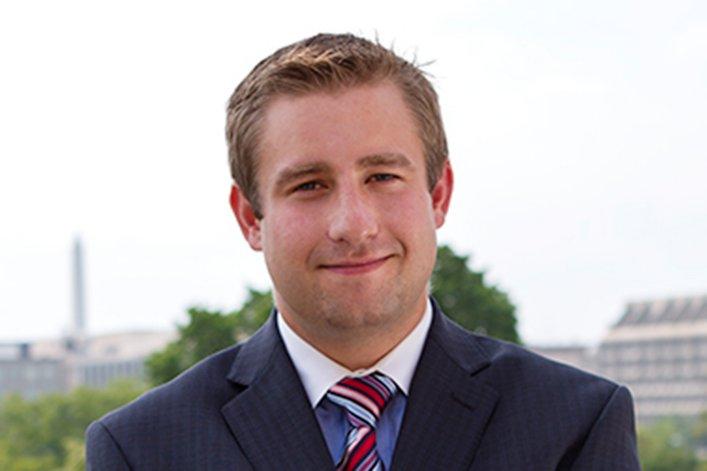
Slain Democratic National Committee staffer Seth Rich
The possible new evidence comes in the form of a leaked audiotape of veteran investigative journalist Seymour Hersh in which Hersh is heard to say that not Russia, but a DNC insider, was the source of the Democratic emails published by WikiLeaks just before the start of the Democratic National Convention in late July 2016.
Hersh said on the tape that the source of the leak was former DNC employee Seth Rich, who was murdered on a darkened street in a rough neighborhood of Northwest Washington D.C. two weeks before the Convention, on July 10, 2016. But Hersh threw cold water on a theory that the murder was an assassination in retaliation for the leak. Instead, Hersh concurs with the D.C. police who say the murder was a botched robbery.
Mainstream news outlets have mocked any linkage between Rich’s murder and the disclosure of the DNC emails as a “conspiracy theory,” but Hersh’s comments suggest another possibility – that the murder and the leak were unrelated while Rich may still have been the leaker.
In dismissing the possibility that Rich was the leaker, mainstream media outlets often ignore one of the key reasons why some people believe that he was: Shortly after his murder, WikiLeaks, which has denied receiving the emails from the Russian government, posted a Tweet offering a $20,000 reward for information leading to the solution of the mystery of who killed Rich.
Julian Assange, WikiLeaks founder and publisher, brought up Rich’s murder out of context in an interview with Dutch TV last August. “Whistle-blowers go to significant efforts to get us material and often very significant risks,” Assange said. “As a 27-year-old, works for the DNC, was shot in the back, murdered just a few weeks ago for unknown reasons as he was walking down the street in Washington.”
Pressed by the interviewer to say whether Rich was the source of the DNC emails, Assange said WikiLeaks never reveals its sources. Yet, it appeared to be an indirect way of naming Rich, while formally maintaining WikiLeak’s policy. An alternative view would be to believe that Assange is cynically using Rich’s death to divert the trail from the real source.
But Assange is likely one of the few people who actually knows who the source is, so his professed interest in Rich’s murder presents a clue regarding the source of the leak that any responsible news organization would at least acknowledge although that has not been the case in many recent mainstream articles about the supposed Seth Rich “conspiracy theory.”
Hersh’s Unwitting Tapes
Hersh’s taped comments add another element to the mystery, given his long record of shedding light into the dark corners of the U.S. government’s crimes, lies and cover-ups. He exposed the My Lai massacre during the Vietnam War; revealed illegal CIA spying in the 1970s spurring wide-ranging Congressional investigations and reform; and uncovered U.S. torture in Abu Ghraib prison in Iraq.
In the audiotape – which Hersh told me was made without his permission – he quoted an unnamed government source who told him that Rich offered the DNC emails to WikiLeaks in exchange for money.
“What I know comes off an FBI report. Don’t ask me how. You can figure it out, I’ve been around a long time,” Hersh says on the tape. “I have somebody on the inside who will go and read a file for me. This person is unbelievably accurate and careful, he’s a very high-level guy and he’ll do a favor. You’re just going to have to trust me.”
The FBI cyber unit got involved after the D.C. police were unable to access protected files on Rich’s computer, Hersh said. So the FBI “found what he’d done. He had submitted a series of documents, of emails. Some juicy emails from the DNC,” to Wikileaks, Hersh said.
“He offered a sample, an extensive sample, you know I’m sure dozens of emails and said ‘I want money.’ Then later Wikileaks did get the password, he had a Dropbox, a protected Dropbox,” Hersh said.
“Wikileaks got access, and before he was killed … he also, and this is also in the FBI report, he also let people know, with whom he was dealing. … I don’t know how he dealt with the Wikileaks and the mechanism but … the word was passed according to the NSA report, ‘I’ve also shared this box with a couple of friends so if anything happens to me it’s not going to solve your problem.’” Hersh said he didn’t know what this “problem” was.
Either Hersh misspoke when he mentioned an “NSA report,” instead meaning the FBI report, or the National Security Agency may have provided a record of Rich’s communication to the FBI. Both the FBI and the D.C. police have denied that the FBI got involved in the case.
The Tape Is Leaked
The Hersh audiotape was posted on a website called Big League Politics, which displays links to Project Veritas, a right-wing group run by James O’Keefe, though there is no evidence that Veritas was involved in the Hersh tape. Veritas does undercover audio and video recordings of unsuspecting subjects and has been accused of doctoring its video and audiotapes. But a recent O’Keefe undercover video of a CNN medical producer saying the network’s coverage of the Russia-gate story was “bullshit” was confirmed by CNN, which took no action against the producer.
People who believe that Hersh’s apparent revelation could reduce Russia-U.S. tensions are clamoring for him to confirm what he said. Popular blogger Caitlin Johnstone wrote: “If Hersh has any information at all indicating that the WikiLeaks releases last year came not from Russian hackers but from a leaker on the inside, he is morally obligated to volunteer all the information that he has. Even the slightest possibility that his information could help halt America’s collision course with Russia by killing public support for new cold war escalations makes his remaining silent absolutely inexcusable.”
Only Hersh’s voice is heard on the taped interview, which was conducted by Ed Butowsky, a wealthy Republican donor and Trump supporter. Until now, Hersh’s only public comment about the tape was to National Public Radio. “I hear gossip,” Hersh said. “[Butowsky] took two and two and made 45 out of it.”
I contacted Hersh on Friday via email. He confirmed to me that it was his voice on the tape by angrily condemning those who he said secretly recorded him, without identifying them. He did not respond when I asked him whether he thought the tape may have been altered. Hersh refused to comment further.
On June 2, in an exchange of emails between Hersh and Butowsky, Hersh denied any knowledge of the FBI report. That was two months before Hersh discovered that he had been secretly recorded when the tape was made public on Aug. 1 by Big League Politics. A screenshot of the Hersh-Butowsky email exchange was published by Big League Politics last week.
“I am curious why you haven’t approached the house committee telling them what you were read by your FBI friend related to Seth Rich that you in turn read to me,” Butowsky wrote.
Hersh replied: “ed –you have a lousy memory…i was not read anything by my fbi friend..i have no firsthand information and i really wish you would stop telling others information that you think i have…please stop relaying information that you do not have right…and that i have no reason to believe is accurate…”
Without informing him that he had been recorded, Butowsky replies: “I know it isn’t first hand knowledge but you clearly said, my memory is perfect, that you had a friend at the FBI who read / told you what was in the file on Seth Rich and I wonder why you aren’t helping your country and sharing that information on who it was?”
Further suggesting that Rich may have been the source of the DNC emails, WikiLeaks posted a link to the audiotape on Twitter.
Hersh has given no indication he’s planning to write a piece based on his source who he said has seen the FBI report. Hersh has found it difficult to be published in recent years in the United States. He has been writing for the London Review of Books until that publication earlier this year rejected a piece challenging the purported U.S. evidence blaming a chemical weapons attack in Syria, which led to Trump’s bombing of a Syrian air field. Hersh’s story was published instead in a major German weekly, Die Welt.
MSM Contempt
Corporate media’s uniform reaction has been to treat the idea of Seth Rich being WikiLeak’s source as a “conspiracy theory” – while mostly ignoring Assange’s hints and now the Hersh tape. Major U.S. media outlets cover Russia-gate as if Russian interference in last November’s U.S. election is proven, rather than based on a shaky “assessment” by “hand-picked” analysts from three – not all 17 – U.S. intelligence agencies.
If Russia-gate special prosecutor Robert Mueller is serious about getting to the bottom of who WikiLeak’s source is there are several avenues he could pursue. He could check Rich’s bank accounts to see if there was a transfer of money from a representative of WikiLeaks. He could try to find Rich’s friends who may have been given his DropBox password. He could seek to interview Hersh.
“Someone ought to ask Mueller, if he had an ounce of integrity (which he doesn’t), why he’s not showing these FBI and/or NSA reports to his Grand Jury which could blow the lid off of ‘Russiagate’ that Mueller was appointed to investigate,” former FBI official and whistleblower Coleen Rowley told me in an email. “It’s sad the FBI could be keeping this secret. But I think the [Rich] family could sue to get the FBI Report that Hersh mentioned or now that FOX is sued, its attorneys could try to subpoena the FBI documents in discovery.” She added that the FBI would likely fight such a subpoena, however.
The lawsuit that Rowley mentioned was filed by Rod Wheeler, a D.C. private detective, against Butowsky and Fox News. Wheeler was hired by Butowsky on behalf of the Rich family to find the killer. In a Fox News item on May 16, Wheeler was quoted referring to a Fox source in the federal government who said that Rich was WikiLeak’s source.
Fox News retracted the story a week later citing unspecific breaches of its editorial policies. At the time Fox had suffered ad boycotts when its chairman, Roger Ailes, and then its top presenter, Bill O’Reilly, faced sexual harassment allegations. Both later resigned. Sean Hannity, another top presenter, continued to pursue the Rich story until he was threatened with an ad boycott, at which point Fox retracted the story.
Wheeler’s suit now alleges that he was misquoted and that the purpose of the Fox story was to distract attention from Russia’s connection with the DNC emails. Big League Politics has posted audio of Wheeler saying that Aaron Rich, the victim’s brother, blocked him from pursuing leads on Seth Rich’s computer.
It is not clear if Hersh’s source is the same as Fox’s (or if Fox was using Hersh in a second-hand way). Butowsky has a connection with Fox as an on-air commentator. The date of the Hersh audio recording has not been made known although it presumably predated his email exchange with Butowsky on June 2.
If an FBI report exists indicating that Rich was the source of the DNC emails and the report is made public, it could reduce tensions with Russia that Congress ratcheted up further last week by escalating sanctions – a form of economic warfare – against Russia as punishment for its alleged role in exposing the DNC emails and others belonging to Hillary Clinton’s campaign chairman John Podesta.
The DNC emails revealed DNC officials improperly interfering in the Democratic primaries to undercut Clinton’s chief rival, Sen. Bernie Sanders. The Podesta emails included the contents of Clinton’s speeches to Wall Street and other special interests as well as pay-to-play features of the Clinton Foundation.
On Jan. 6 – before leaving office – President Obama’s intelligence chiefs oversaw “hand-picked” analysts from the CIA, FBI and NSA creating an “assessment” blaming Russia for the hacked emails albeit without presenting any hard evidence. Russian officials have denied supplying the emails to WikiLeaks and WikiLeaks has denied receiving them from Russia.
Nevertheless, the unproven allegations of Russian interference in the election have raised tensions between the two nuclear powers to levels not seen since the darkest days of the Cold War and possibly worse. Stephen Cohen, a leading U.S. expert on Russia, said the current showdown may be even more hazardous than the Cuban missile crisis.
“I think this is the most dangerous moment in American-Russian relations, at least since the Cuban missile crisis. And arguably, it’s more dangerous, because it’s more complex,” he told Democracy Now! in April. “Therefore, we … have in Washington these – and, in my judgment, fact-less – accusations that Trump has somehow been compromised by the Kremlin.”
In the missile crisis “there was no doubt what the Soviets had done, putting missile silos in Cuba,” Cohen said. “No evidence has been presented today of anything. Imagine if Kennedy had been accused of being a secret Soviet Kremlin agent. He would have been crippled. And the only way he could have proved he wasn’t was to have launched a war against the Soviet Union. And at that time, the option was nuclear war.”
As it still is today.
Joe Lauria is a veteran foreign-affairs journalist. He has written for the Boston Globe, the Sunday Times of London and the Wall Street Journal among other newspapers. He is the author of How I Lost By Hillary Clinton published by OR Books in June 2017. He can be reached at joelauria@gmail.com and followed on Twitter at @unjoe.
At FBI, Mueller Oversaw Post-9/11 Abuses
By Jonathan Marshall | Consortium News | June 21, 2017
Robert Mueller III, the former FBI director who now heads the wide-ranging investigation into alleged misdeeds by President Trump and his associates, just dodged a major legal bullet himself. On Monday, the U.S. Supreme Court gave him and other former senior Bush administration officials legal immunity for the vicious abuses committed against more than 700 foreigners who were rounded up with little or no cause after the 9/11 attacks.
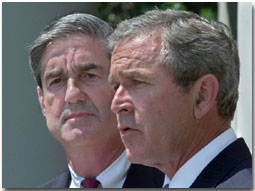
Robert Mueller with Pres. George W. Bush
July 5, 2001 (White House photo)
The court ruled 4-2, nearly 16 years after the fact, that “national security” trumps civil liberties and that however unfounded the arrests, or intolerable their treatment, the detainees had no right to sue senior federal officials for damages.
Punting to Congress, a branch of government rarely known for its defense of individual rights, the court declared, “The proper balance in situations like this, between deterring constitutional violations and freeing high officials to make the lawful decisions necessary to protect the Nation in times of great peril, is one for the Congress to undertake, not the Judiciary.”
Although the climate of fear that followed 9/11 has eased a bit, the decision is highly relevant in the Trump era because the abused victims were all immigrants who had overstayed their visas. If the FBI had any question about the arrestees, it designated them “of interest” and ordered them held until cleared — in other words, guilty until proven innocent.
Dozens of the hapless victims were held at the Administrative Maximum Special Housing Unit in Brooklyn’s Metropolitan Detention Center (MDC), which was the subject of two scathing reports by the Bush Justice Department’s own Inspector General in 2003. Besides documenting a wide range of abuses, the reports concluded that staff members brazenly lied about the rough treatment they meted out.
Appalling Abuses
News accounts of the Supreme Court decision made only brief reference to that treatment. Yet the appalling story can be glimpsed from this summary of facts provided in 2013 by U.S. District Judge John Gleeson:
“The harsh confinement policy was expressly directed at Arab and Muslim noncitizens who had violated immigration laws . . . In other words, it was discriminatory on its face. . .
“They were confined in tiny cells for over 23 hours a day, provided with meager and barely edible food, and prohibited from moving around the unit . . . (or) keeping any property, including personal hygiene items like toilet paper and soap, in their cells. Whenever they left their cells, they were handcuffed and shackled. . . (D)etainees . . . were often physically abused along the way, and were sometimes left for hours in the cold recreation cell, over their protests, as a form of punishment. . . .
“Detainees also were denied sleep. Bright lights were kept on . . . for 24 hours a day . . . and staff at the MDC made a practice of banging on the MDC Detainees’ cell doors and engaging in other conduct designed to keep them from sleeping. They also conducted inmate ‘counts’ at midnight, 3:00 a.m., and 5:00 a.m. . . . One of the officers walked by about every 15 minutes throughout the night, kicked the doors to wake up the detainees, and yelled things such as, ‘Motherfuckers,’ ‘Assholes,’ and ‘Welcome to America.’
“The MDC Detainees also were subjected to frequent physical and verbal abuse . . . The physical abuse included slamming the MDC Detainees into walls; bending or twisting their arms, hands, wrists, and fingers; lifting them off the ground by their arms; pulling on their arms and handcuffs; stepping on their leg restraints; restraining them with handcuffs and/or shackles even while in their cells; and handling them in other rough and inappropriate ways. The use of such force was unnecessary because the MDC Detainees were always fully compliant with orders . . . The verbal abuse included referring to the MDC Detainees as ‘terrorists’ and other offensive names, threatening them with violence, cursing at them, (and) insulting their religion . . .
“(Detainees) . . . were subjected to unreasonable and punitive strip-searches. . . Female officers were often present during the strip-searches; the strip-searches were regularly videotaped in their entirety . . . and MDC officers routinely laughed and made inappropriate sexual comments during the strip-searches.
“Officers at the MDC . . . also interfered with the Detainees’ ability to practice and observe their Muslim faith. . . In addition, most of the MDC Detainees were held incommunicado during the first weeks of their detention. MDC staff repeatedly turned away everyone, including lawyers and relatives, who came to the MDC looking for the MDC Detainees, and thus the MDC Detainees had neither legal nor social visits during this period.”
An Abu Ghraib in Brooklyn
Though not at the level of brutality of water boarding and some of the beatings associated with secret CIA detention centers, these MDC abuses had some similarities to the humiliation and mistreatment of prisoners at Abu Ghraib in Iraq — and the abuses were taking place right in the heart of New York City. Plus, unlike some of the CIA’s torture victims, these detainees had nothing to do with terrorist plots; some were never even questioned by the FBI after their arrest.
Yet senior FBI and Justice Department officials were complicit in the abuse. The 2nd Circuit Court of Appeals, in a 2015 ruling that the lawsuit could proceed, cited evidence that two of the defendants, Attorney General John Ashcroft and FBI Director Mueller, “met regularly with a small group of government officials in Washington, D.C., and mapped out ways to exert maximum pressure on the individuals arrested in connection with the terrorism investigation.”
They “discussed and decided upon a strategy to restrict the 9/11 detainees’ ability to contact the outside world and delay their immigration hearings. The group also decided to spread the word among law enforcement personnel that the 9/11 detainees were suspected terrorists[] . . . and that they needed to be encouraged in any way possible to cooperate.” And it was the FBI that recommended housing the detainees in the maximum security facility where their rights were sure to be abused.
Such official misconduct and brutality constitutes a stain on this nation’s honor. Justice Anthony Kennedy, writing for the majority, said “Nothing in this opinion should be read to condone the treatment to which the (plaintiffs) contend they were subjected.”
A Terrible Precedent
But the court’s decision to protect high-level federal officials who made that treatment possible sets a terrible precedent. As the American Civil Liberties Union warned, it “would effectively immunize tens of thousands of federal officers . . . from damages, no matter how egregious the officers’ conduct. Indeed, [it] would effectively immunize federal officers from damages liability even for torture, so long as the torture arises in a context involving national security or noncitizens.”
Citing such egregious precedents as the Alien and Sedition Acts, the wholesale suppression of civil liberties during World War I, and the internment of Japanese-American citizens during World War II, a dissenting Justice Stephen Breyer insisted that the Court had an obligation to defend “fundamental constitutional rights.”
“History tells us of far too many instances where the Executive or Legislative Branch took actions during time of war that, on later examination, turned out unnecessarily and unreasonably to have deprived American citizens of basic constitutional rights,” he wrote. With the latest court ruling, that dark history is sure to be repeated.
[For more on the real Robert Mueller, see Consortiumnews.com’s “Russia-gate’s Mythical Heroes.”]
Extend draft registration to women — or end it?
By Edward Hasbrouck | The Practical Nomad | December 11, 2015
Congress will soon have to choose whether to amend the Military Selective Service Act to extend draft registration to women, to end all draft registration, or to allow registration to end by court order.
When the Supreme Court upheld the current males-only draft registration in 1981, it based its decision on the ineligibility of women, at that time, for combat assignments, and on the “deference” of the courts to Congress and the President in such military matters. The factual predicate to that decision has now changed, with the announcement last week that women in the military will be eligible for all combat jobs.
On Tuesday of this week, by scheduling coincidence, the 9th Circuit Court of Appeals heard oral argument (which had been scheduled for that date months earlier) in one of several lawsuits challenging the Constitutionality of males-only draft registration that were filed two years ago when the military first began opening combat assignments to women.
From watching the oral argument, it seems likely that the Court of Appeals will send this case back to the U.S. District Court in Los Angeles for consideration of whether males-only draft registration is still Constitutional.
The complaint was dismissed by the a U.S. District Court judge in Los Angeles who found that (1) the controversy was not yet “ripe” for decision and (2) the plaintiff’s lacked standing to complain.
On “ripeness”, it seems clear from the oral argument that the 9th Circuit judges think that if the case wasn’t ripe when it was dismissed in 2013, it is now in light of the latest changes to military policy. There would be no point to upholding the dismissal of the original complaint, when an identical new complaint could immediately be refiled, and would be ripe for decision.
On standing, the issue is that none of the plaintiffs in this case are men who can claim that they are being harmed because they didn’t register. There are a named plaintiff, who says he registered, and an organizational plaintiff. But the plaintiffs argued that they have as much basis to claim standing as the plaintiffs in the case the Supreme Court decided in 1981, who were similarly situated. In addition, plaintiffs’ counsel argued very persuasively that the continuing obligation to provide notice of address changes is a continuing harm that gives registrants continuing standing to challenge that registration requirement.
If I’ve read the tea leaves correctly, this means that in a matter of weeks or months — probably before but possibly not until after the November elections — the 9th Circuit will overturn the dismissal of the complaint, and remand this case to the U.S. District Court. The next step after that would be a status conference in Los Angeles to schedule further proceedings (discovery, briefing, etc.) on the merits of the reinstated complaint.
Some other lawsuit might make it to a decision sooner. But once a court looks at one of these cases on the merits, the outcome seems a foregone conclusion, as the Pentagon’s own analysis released last week suggests. It’s highly likely that a court ruling in this or another case will, sooner rather than later, force Congress to choose whether to extend draft registration to women, or to let a court decision ending registration stand.
Under current law, courts can’t order women to register. So if a Federal court finds that males-only registration is illegally discriminatory, registration will have to end unless Congress amends the law to extend the registration requirement to women.
Last Sunday, the New York Times dismissed this issue, editorializing that Congress could “easily” change the law to require young women, as well as young men, to register.
But it’s not so simple as all that. It won’t be enough just to change the law. Draft registration is not self-implementing. Extending registration to women will also require getting women to comply with the law, and enforcing the law if women don’t comply voluntarily.
Thirty-five years of failure by the government to get young men to comply with the draft registration law, and the complete abandonment of any attempt to enforce that law more than 25 years ago, suggest that getting young women to register for a draft is likely to be much more difficult than the Times’ editorial board has realized.
As some of my readers know, although it’s not my most frequent topic in this blog, I spent most of the 1980s, starting just about the time I left the University of Chicago, as an organizer with the National Resistance Committee and an editor of its newspaper, Resistance News.
When draft registration was reinstated in 1980 after a five-year hiatus, our most optimistic prediction was that half a million men in the first age cohorts required to register might not sign up. A month after the initial mass registration period, the first independent analysis of registration data revealed that more than a million of these young men had not heeded the call to register. [“Million Snub Draft”, Boston Globe, August 27, 1980, page 1; the original banner headline in the Globe was apparently added in page makeup and is missing from the wire service versions and the fragment of the article in the Globe’s digital archive.]
Desperate to scare up enough registrations to “maintain the credibility of the system”, as one internal Justice Department memo put it, the government eventually decided to try to intimidate the mass of nonregistrants through “well-publicized prosecutions” of a few of those they considered the “most vocal” resisters. As one of twenty nonregistrants who were singled out for indictment in 1982-1986, I was convicted and spent four and a half months in a Federal Prison Camp in 1983-1984.
(I was prosecuted by Robert Mueller, then a junior Assistant U.S. Attorney in Boston and later the Director of the FBI. My case was Mueller’s first high-profile trial, and my head was a significant early stepping stone in his political climb. Mueller’s boss, then U.S. Attorney and later Governor William F. Weld, also attended my trial — annoying my mother by sitting next to her — to observe Mueller’s performance in court.)
But despite convictions and prison sentences, these show trials backfired and were quickly abandoned. They called attention to the resistance to draft registration, made clear that there was safety in numbers, and showed that the government could prove the “willfulness” of only those nonregistrants who made public statements (which were essential to the cases against us in court) acknowledging that we knew we were supposed to register.
Nobody has been prosecuted for refusing to register since 1986. But the government has never been able to find a face-saving way to end registration and shut down the Selective Service System without admitting that its scare tactics failed, or dealing with the implications of young people’s insistence on making their own choices about which wars they are willing to fight.
Today, many young people register only because of laws that link draft registration to drivers licensing in some states, and to eligibility for student aid. The resistance by many states to implementing the Federal “REAL-ID Act” (which I discussed in this presentation at the Cato Institute earlier this year), and the repeated failures, including once again this year, of proposals to link drivers’ licenses to draft registration in the most populous state, California, suggest some of the limitations of this carrot-and-stick approach.
(Today, as I’ve discussed elsewhere, nonregistration is most concentrated among those poor young men of color who see little hope of going to college even with the limited available government aid, and especially among undocumented young men who are categorically ineligible for the government programs linked to draft registration, but who are still required to register.)
Many of the people who registered under these financial pressures would resist if actually drafted, and many of these nominal registrations have been effectively invalidated by unreported address changes, even though they are counted in Selective Service “compliance” statistics.
President Obama, who was in the first age group required to register, has said that he registered for the draft. But he hasn’t commented on whether he informed the Selective Service System every time he changed addresses until his 26th birthday, as is required by the law and as is essential for registration records to be of any use in the event of a draft. Few people did so in the 1980s, or do so now. The only audit of Selective Service address records, in 1982, found that 20-40% of the addresses on file with the SSS for registrants in the age groups that would be drafted first were already outdated, and up to 75% for those registrants in their last year of potential eligibility to be drafted.
Many, perhaps most, induction notices sent to current registrants would wind up in the dead-letter office. Without being able to prove that anyone knew they were supposed to tell the Selective Service System when they moved, it’s impossible to enforce the change-of-address notification requirement.
Is there any reason to think that young women would be more willing to sign up to be drafted than young men have been? I doubt it. When President Carter announced his proposal to reinstate draft registration in his State of the Union address in 1980, some of the strongest initial grassroots opposition came from women. Many women remained active in the resistance even after the bill approved by Congress was narrowed to require only men to register, though the press tended to focus on male resisters.
Women have been among those health care workers most concerned about Selective Service preparations for for a draft of doctors, nurses, and many other medical professionals, which would include women but would be based on professional licensing lists rather than on self-registration of potential draftees.
Women share many of men’s reasons not to register, and have other reasons of their own. There are both feminist and sexist arguments against subjecting women to the draft and draft registration.
Are the government’s arguments for why young women (or men) should register for the draft, and promise to fight for or against whomever they are told, any more persuasive today than ever? I don’t think so.
Draft registration was reinstated in 1980 in response to the Soviet invasion of Afghanistan, to prepare for U.S. intervention in support of the fighters who were then called the “mujahideen” and who would later christen themselves the Taliban and Al Qaeda. That the U.S. government put me in prison for refusing to agree to fight on the side of the Taliban doesn’t say much for its judgment of which wars to intervene in, or on which side. Today, people of all ages and genders question why the U.S. is supporting the fundamentalist (and supremely sexist) monarchy in Saudi Arabia, or the dictatorship in Yemen, among others.
Congress should have no illusions. Extending draft registration to women will provoke at least as much resistance as did draft registration for men in 1980. It will force the government, once again, to choose whether to turn the country into a police state to round up all those who fail to register on demand, or to try (probably unsuccessfully) to terrorize them into compliance through show trials and incarceration of a few of the people seen as “leaders” of the resistance.
Regardless of whether Congress or the President think that young women “should” be ready to be drafted, the only realistic choice for Congress is not to extend draft registration to women, but to end it for all.
That’s not likely to be part of the terms of debate, however, unless opponents of draft resistance — including young women who won’t register voluntarily, and older people who support them — make it an issue.
In 1981, the decision of whether to continue — and whether to enforce — the draft registration program that had been reinstated during the Carter administration was a “wedge issue” that divided hawks from libertarians within the Reagan administration and its supporters.
One of my friends and colleagues in the National Resistance Committee, Alex Reyes, has written about how awareness of plans for demonstrations in support of draft registration resistance precipitated this internal debate, and of how close it came to ending draft registration.
Today, whether to extend draft registration to women or end it entirely is likely to be a similar wedge issue dividing Democrats, Republicans, and military personnel. Will sexist warmongers support subjecting young women to the draft, or depriving the military of its “Plan B” for manpower by ending draft registration entirely? Will supporters of President Obama, or of a future President Hillary Clinton, see subjecting women to the draft as a step towards gender equity, or a step towards more of the gendered violence of war? And if they see it as both, how will they vote?
But there’s more at stake than the opportunity for partisan politicians to embarrass their opponents, and it will be up to draft registration resisters and supporters to make that point.
Draft registration of men has been a fiasco for the government since its resumption in 1980. The likelihood and imminence of a court ruling that males-only draft registration is now unconstitutional provides the perfect opportunity for Congress to end draft registration entirely.
Whistleblowers sue DOJ, FBI, and NSA for malicious prosecution, civil rights violations
RT | August 28, 2015
Five whistleblowers are suing the Justice Department, National Security Agency, FBI and their former directors for violating their constitutional and civil rights after they complained about government waste and fraud through proper channels.
According to the complaint, filed in Washington, DC’s federal district court, all five were subjected to illegal searches and seizures, raids on their homes and places of business, false imprisonment, and cancellation of their security clearances after they complained about government waste and fraud at the NSA.
Four of the five whistleblowers worked at the National Security Agency: Thomas Drake, Ed Loomis, J. Kirk Wiebe and William Binney. The fifth, Diane Roark, worked at the Department of Energy. They are seeking some $100 million in damages.
The plaintiffs blew the whistle on the wasteful abandonment of a short-lived surveillance program called THINTHREAD which was being built by the NSA, but was then scuttled in favor of a more expensive program less protective of Americans’ communications.
The plaintiffs had worked on developing the THINTHREAD program, which was capable of effectively performing the technical work required by the NSA at the low cost of $4 million. The program was dumped at the direction of Lt. General Michael Hayden in favor of an outside contract for an expensive program called TRAILBLAZER, which ended up costing the government $4 billion. The TRAILBLAZER program never worked properly and was abandoned in 2006.
The plaintiffs filed a complaint with the Department of Defense arguing that, in using an outside contractor, the agency was committing fraud and wastefully misusing taxpayer dollars. The Department of Defense inspector general issued a scathing report on the abuse.
In response, the complaint argues, the NSA concocted a story claiming the whistleblowers were responsible for leaking information on the NSA’s surveillance of Americans to The New York Times. As a result, the Department of Justice conducted a series of raids that disrupted the plaintiffs’ lives and livelihoods.
The plaintiffs argue that the raids were retaliatory as the government had already determined that they had had nothing to do with the disclosures to the New York Times. The real leaker was a former lawyer who worked at DOJ with the secretive Foreign Intelligence Surveillance Court.
Among the six named defendants are two former NSA directors, Michael Hayden and Keith Alexander, and former FBI Director Robert Mueller.
The complaint alleges that the FBI, NSA and DOJ’s actions violated the plaintiffs’ protections under the 1998 Whistleblower Protection Act, and violated their First, Fourth, and Fifth Amendment rights.
The whistleblowers are seeking punitive damages in excess of $100 million in compensation for the loss of wages and employment they incurred as a result of the defendants’ alleged callous and reckless indifference.
While the raids and harassment took place in 2006 and 2007, the suit is only being brought now because the plaintiffs were only able to access all of the details concerning their case in 2013, after court documents were unsealed.
Featured Video
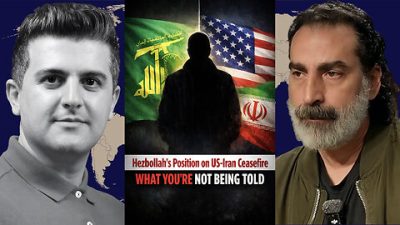
Laith Marouf: Hezbollah’s position on US-Iran ceasefire
or go to
Aletho News Archives – Video-Images
From the Archives
The Dirty Little Secret behind the “Global Terrorism Index”
The Omission of Israeli Terrorism in the Occupied Palestinian Territories
By Karin Brothers | Global Research | December 6, 2014
… The Israeli settlements — all of which are illegal – have been identified as a major impediment to peace. The refusal of a major “global” terrorism report to name the Israeli settlers as one of the groups most responsible for terrorism not only misrepresents a major source of regional violence but exposes the Global Terrorism Index as a propaganda tool that supports a U.S. agenda.
In recent years, governments have been attempting to thwart terrorism by blocking supportive fund-raising. When it comes to Israeli settlements, however, the US and Canada actually encourage fund-raising by giving organizations (such as Christian Friends of Israeli Communities (CFOIC) and the Jewish National Fund) financial support in the form of donor tax-deductions.
Charities which provide funds for the Israeli settlements should be regarded as terror-financing organizations. They should not only lose their tax-deductible status, but they should be banned because they support the violation of international humanitarian law. The terror-financing laws that are being strictly enforced for Muslim charities should be applied to Christian and Jewish charities as well. … Read full article
Blog Roll
 Aletho News
- The Black Cube Files: How Former Mossad Operatives Flipped a Nation
- Laith Marouf: Hezbollah’s position on US-Iran ceasefire: What you’re not being told
- Israel’s priority lies in destroying chances of peace between Iran, US: Ex-UN nuclear chief
- Ceasefire for all or for none: Iran shuts Hormuz over Lebanon attacks
- Strait of Hormuz is Iran’s ‘nuclear weapon’ that forced US retreat: Medvedev
- Energy crisis will last for months – Kremlin envoy
- Europe’s quiet role in the war on Iran
- Forty days that shook the Empire: How Iran turned the tables on US and prevailed
- Netanyahu unilaterally declares Lebanon outside of ceasefire deal
- Israeli leaders: ‘Not a single goal’ achieved in war with Iran
- If Americans Knew
- Gazans face a triple crisis: severe shortages of water and bread, healthcare in tatters
- NY Times reports how Netanyahu took the US into Iran War
- A sigh of relief over Iran, but Gaza and Lebanon in dire straits – Daily Update
- Thousands dead and neighborhoods razed to the ground: Aid agencies fear southern Lebanon is becoming the new Gaza
- The war the US is fighting for Israel could cost trillions
- ‘Cigarette Burns, Nail Wounds’: Toddler Tortured in Gaza to Coerce Father
- Trump Says US Sent ‘a Lot of Guns’ to Protesters in Iran
- Israeli forces destroy 17 UN peacekeeper cameras in south Lebanon
- US-Israeli strikes ‘completely destroy’ synagogue in Tehran
- Archbishop for US Military Says Iran War Is Unjust Under Catholic Teaching
- No Tricks Zone
- An Inconvenient Tree: Uncovered In Alps… Europe Much Warmer Than Today 6000 Years Ago
- New Study Reports A 60% Slowdown In Greenland’s Ice Loss Rate In The Last Decade
- Low Intensity Tornado Wrecks Major Solar Farm, Creating A Potential Toxic Dump
- New Study Finds Warming Saves Lives…Cold Temperatures 12 Times More Deadly Than Excess Heat
- German Science Blog Accuses PIK Climate Institute Of Hallucinating Climate Tipping Points
- Devastating Assessment Of Comirnaty Vaccine By Former Senior Pfizer Europe Toxicologist
- New Study: CO2 Is ‘Effectively Negligible’ As An Explanatory Climate Change Factor Since 2000
- Former Pfizer Toxicologist Dr. Helmut Sterz Tells Bundestag Hearing Pfizer Vaccine Should Have Never Been Approved
- Energy Expert: Germany’s Nuclear Phaseout Was A “500 Billion Euro Mistake”
- New Research: South Australia’s Mid-Holocene Sea Surface Temperatures Were 4°C Warmer Than Today
 Aletho News